BLACK MASS

By Marc S. Sanders

Black Mass tells the story of an FBI agent, and his two childhood friends who are brothers.  One brother is Billy Bulger, a Massachusetts state senator.  The other is notorious Boston gangster James “Whitey” Bulger.  The script has a lot of elements to make for a great crime drama, but I wonder what Johnny Depp is doing here made up to perform like a crazed ghoul.

The FBI agent is John Connolly (Joel Edgerton) who turns to Whitey (Depp), a fearful leader of the Irish mob in South Boston during the nineteen seventies through eighties to work as an informant, providing intel on the competing Italian Mafia.  It’s no secret about Whitey Bulger’s dealings or what territory he covers.  Agent Connolly does his best to protect his friend, so long as he collects pertinent information that leads to arrests.  However, what’s the limit to Bulger’s activities, and how does this reflect on a public figure like Whitey’s politician brother, Billy (Benedict Cumberbatch)?

Much of Black Mass reenacts recorded testimonies after everything has shaken out.  Guys who survived Whitey’s violent crew (Jesse Plemmons, Rory Cochrane) offer information on the gangster’s activities and what he compelled his captains to carry out.  Mixed in with these voiceovers are how Connolly responds to the progress of his operations.  Time and again, his superiors (first played by Kevin Bacon and later by Corey Stoll) question Connolly about how beneficial Bulger can be if the crook always has his finger on the trigger, killing those that might rat him out.  Black Mass is told from an assortment of different perspectives and sometimes that muddies the water.

The most interesting storyline is how Connolly uses and protects his criminal friend, while also stepping away from getting blood on his hands.  Joel Edgerton gives the best performance of the film as an FBI guy who turns a blind eye to Whitey’s crimes. Connolly thinks he can continue his own corruption while Whitey cooperates and leads him to big, heroic indictments of the Italian mob.  As long as the arrangement upholds, the corrupt agent will always have an answer for his actions and stay ahead of the ethical lines he knows he’s crossing.  More importantly, even if his wife protests, Connolly is getting prestigious promotions and collecting substantial paychecks for his progress.  Scott Cooper directs Edgerton with conflicts of overwhelming complications.

One problem is that Whitey Bulger is a loose cannon who is never intimidated, not even by the Feds, especially not by his childhood friend.  His brother Billy looks away to maintain a clean political image.  Therefore, it is quite easy for Whitey to gun down a rat associate in broad daylight in the middle of a wide-open parking lot, shotgun and all.  The killer doesn’t even need to run away from the scene of the crime.  This is Whitey Bulger.

Johnny Depp is great in the role, but does his portrayal belong in this film?  Depp’s career is widely celebrated for the quirky, makeup clad parts he plays such as Jack Sparrow and Edward Scissorhands.  Even Ed Wood is delightfully weird.  In Black Mass, the actor dons steel grey eye contacts, white slicked back hair making him appear almost bald, and skeletal teeth beneath a near albino complexion.  He looks like Skeletor without the hood.  Throw in a brooding, deep Bostonian accent and you have the ghoul I referred to earlier.  Is this Whitey Bulger?  Online photos of the real guy do not seem consistent with the film’s appearance.  Depp’s delivery of dialogue and even his wicked Freddy Krueger laugh seem too far beyond the realm of this crime drama.  The actor is working on another plane than everyone else in the cast who wear hairpieces, three-piece cotton suits and cheesy off-the-rack polyesters and denims to populate this time period from forty years ago. 

A scene showing Bulger dining on steaks with Connolly and his FBI partner (David Harbor) was famously used in preview showings ahead of the film’s release.  Take this scene out of context like the trailer did and Depp looks scary good as he terrifies Harbor for doing something as simple as revealing a long-time secret family recipe.  Afterwards, Whitey goes upstairs to harass Connolly’s wife (Julianne Nicholson) at the bedroom door.  The dinner scene sold me on getting a ticket for the movie as soon as it was released.  However, put it back into the framework of the script and I feel like Black Mass is diverting itself from a complex crime drama to a vampire in a Member’s Only jacket.  As good as Depp is with his makeup and his vocal inflections and pace, it just doesn’t seem to belong in this particular film.  Marlon Brando as Don Corleone with the shoe polish in the hair and the cotton in the mouth? That works.  Johnny Depp as Count Dracula in Sergio Valente skinny jeans is not as effective.

Because the script changes hands from one perspective to another and then another, I found the reenactments of Connolly and Bulger’s reign of crimes to be a little inconsistent.  I found much potential for Benedict Cumberbatch’s purpose as Whitey’s brother, but there is too much diverted away from that character because the picture is trafficked with what everyone else is doing and seeing on top of giving Johnny Depp a lot of scenery to chew.

Black Mass pursued the potential for a very interesting gangster picture like Goodfellas or Donnie Brasco, but it wants to capitalize too much on the latest Johnny Depp routine.  I think James “Whitey” Bulger is an interesting twentieth century bad guy with a violently daring and checkered background.  He had associates within his family and gang to color in a movie that’ll grab you.  The tainted lawmen who were involved are also intriguing.  Scott Cooper and the screenwriters knew this, but often they opt to go in different directions.  

Now that a loose interpretation of Bulger has been played by Jack Nicholson in Martin Scorsese’s Oscar winning The Departed and again here, it’s time to tell the cold-blooded killer’s story once more.  Just go simpler without all the clownish theatrics.

AVENGERS: INFINITY WAR

By Marc S. Sanders

Avengers: Infinity War is a really FAT movie. Like ORCA FAT (thank you Keyser Soze), because it is chock full of so much to see. If this equated to gorging on junk food, after two hours and forty minutes, I would have a diabetic cardiac arrest immediately following the credits. Is this a film that is worth that handicap, however? You bet it is.

There is an ensemble of top Hollywood talent portraying a huge cast of characters, once again, and thus another installment has surfaced in the franchise that allows them to have various moments to shine. Producer Kevin Feige with all of Disney’s support, has mastered the formula to ensemble casting and production, as good as when George Clooney and company performed under Steven Soderbergh’s direction in the Ocean’s 11 remake. Thousands of special effects shots do not overpower the stage presence of the actors. The Marvel movies succeed because a story is always written first. Then witty dialogue comes thereafter, and then valid, convincing shock value. The special effects are the final ingredient. This is what the Transformers franchise and (yes, I’ll even own up to it) the Star Wars prequel trilogy (about ¾ of it) failed to achieve. This successful formula gives merit to the (at the time) biggest opening weekend ever, worldwide, and Avengers: Infinity War deserves the accolades.

How good is it? Well, reflecting back to May 1980, when sitting in a crowded theatre watching the ending to The Empire Strikes Back, by comparison I think audiences have finally been served up a cliffhanger (10 years in the making) that is just as effective. How is this all going to wrap up from here? How is this all going to be resolved? Reader, I don’t know if the next chapter will be satisfying. I don’t know if we will feel cheated like Annie Wilkes from Stephen King’s Misery. Presently, however, I’m turning an ending like this over in my mind; the same way I did with my pals in 1980 debating the survival ratio of Han Solo and if Darth Vader has told the truth, and if that was Vader’s brain or head that I saw, and who is this “another” that Yoda referred to….and that, my friends, is what makes a spectacular film. I don’t care if it gets watered down in the hype and McDonald’s promotions and toys. If you can mull over a movie long after it has ended, for days, even months and years, then a film like The Empire Strikes Back and Avengers: Infinity War has more than served its purpose.

Josh Brolin provides a villain with a justification to his madness. He’s not just twirling his mustache to be mischievous and sinister. He has a destiny to fulfill, and his portrayal of the mad titan Thanos does not compromise. This is a beast of a purple villain with size 52 boots and gold-plated armor with a chin that looks like it was clawed by Wolverine. Thanos cries, actually cries, while committing his crimes. He’s not just cackling. He flat out says that he executes his actions all so that he can relax and retire. Isn’t that what we are all trying to do, anyway? Nothing wrong with that. Guy sounds like a CEO to a large corporation. Maybe Thanos is updated to resemble an Elon Musk. 

All of the other actors from main staple Robert Downey Jr to Chris Pratt to Chadwick Boseman to Zoe Saldana and Chris Hemsworth, and so on, remain consistent to what we’ve seen of various prior installments. Their gimmicks continue to avoid becoming stale. Audience applause is cued by their appearances. These are well loved characters.

As an avid comic book reader of the silver age (1980s), Avengers: Infinity War presents itself as of one those annual limited series runs that were special because they were MAIN EVENTS!!!! My favorite back then was Marvel’s Secret Wars. Typically, a comic book from the 1980s would average about 18-22 pages with advertisements sprinkled in. Nearly every scene in this film equates to one issue of a limited run of a main event. That is a why a fat movie like this succeeds. The cast of characters are separated in various story lines. The scenes are given their time to flesh out and develop to move the subplots and overall story along. Each scene is like reading a new 18 page issue comic book. If I’m watching a comic book film, by golly, I want to see how a comic book is brought to life in a cinematic medium. Marvel’s films succeed greatly over DC’s films (produced by Warner Bros) because they rely on the source material. They know they got the goods. Cast it right, adapt it properly and go with that. If it ain’t broke, don’t fix it. A wealth of material (nearly 70 years) and Marvel/Disney uses it all. (How does DC/Warner Bros miss the mark so often?)

Of all of the Avengers films, Infinity War is definitely the best one. Ironically, I wasn’t expecting it to be. I was waiting for this stuff to get old and tiring. It just hasn’t faltered yet. It hasn’t gotten lazy yet. It all seems so fresh still. It’s a fantastic cinematic accomplishment. Sure, its main story is a guy chasing down six different colorful MacGuffins. So what! It’s simple. It allows the characters to stand out from there. An organized plotline like this doesn’t take much effort or time to explain its purpose. It states its conflict early on, and then the show stopping moments present themselves. One after the other after the other until a monster of an ending that is so jaw dropping, head shaking, thrilling and gasping, satisfyingly arrives. 

More importantly, the MacGuffin search drives the motivations and fleshes out the film’s main character, Thanos. This Marvel installment belongs to Josh Brolin as Thanos. Everyone else serves as his antagonists. What matters is that the bad guy wins this time, just like demonstrating that an Empire will strike back. Ironic that Spider-Man makes a humorous correlation to that celebrated franchise from almost forty years ago.

Avengers: Infinity War ended up in my top 10 list of 2018, and still holds as the best film in the Marvel Cinematic Universe.

AUGUST: OSAGE COUNTY

By Marc S. Sanders

Once the dead are buried, the secrets come out.  Some mourn the loss.  Others mourn the reality of what existed.  Tracy Letts’ Pulitzer Prize winning play August: Osage County was adapted into a very well-cast film in 2013.  Letts’ screenplay is just as biting as his original source. Perhaps that is because of the performances of not just Meryl Streep and Julia Roberts, but also the entire collection of actors.

Dysfunctional is not a strong enough word for the Weston family of the sleepy, lifeless area of Osage County, Oklahoma.  The patriarch, Beverly (Sam Shepard) hires Johnna (Misty Upham) a Native American housekeeper/helper, for his pill popping, cigarette smoking wife Violet (Streep) who is also stricken with cancer of the mouth.  Shortly after, Beverly disappears.  The family comes home to the dusty shelves of books and old black and white family photographs and learns that Beverly has committed suicide.  The opportunities flood in for Violet (or Vi) to unleash every ugly, harsh truth that her three daughters Barbara, Ivy and Karen (Roberts, Julianne Nicholson and Juliette Lewis) have encountered along with their partners.  There’s also Vi’s sister Fannie Mae (Margo Martindale), her husband Charlie (Chris Cooper) and their son Little Charlie (Benedict Cumberbatch) to revisit the revelations of the Weston family.  Barbara’s estranged husband Bill (Ewan MacGregor) and her daughter Jean (Abigail Breslin) have their own drama to contend with as well.

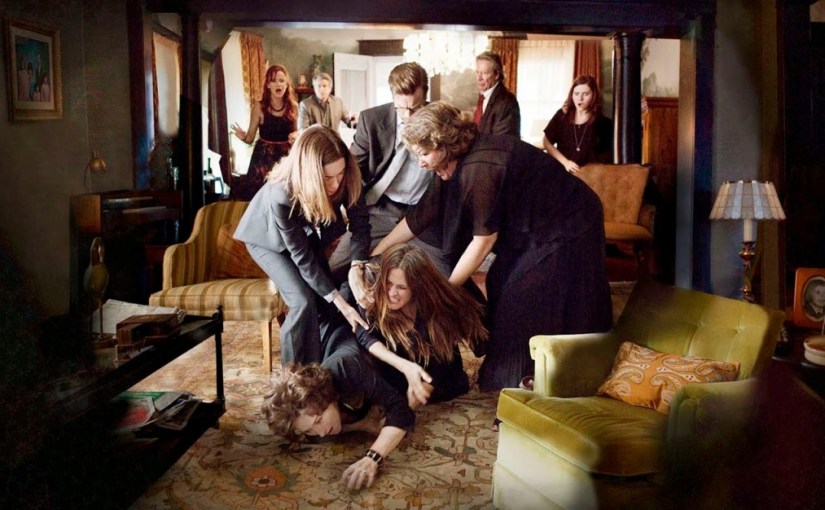
It’s best not to spoil too much of what is revealed in the movie directed by John Wells.  The centerpiece of the picture is the afternoon family meal following the funeral service.  This must be one of the most intense and captivating dinner scenes caught on film in recent years.  Wells positions his cameras perfectly, so you know where every family member is seated at the table and the trading of barbs that go back and forth between the different combinations of arguments.  I would say the scene lasts at least twenty minutes and Wells manages to seat the viewer next to or right in front of every person at the table.  At one end of the table is Charlie.  Chris Cooper is a reluctant fill in to the void left by Beverly, the original patriarch.  The instigator is Vi. Meryl Streep is placed at the other head of the table where her drug addled eye contact can be had with anyone seated in her presence.  I’d love to have seen Meryl Streep while shooting this scene because even when the camera is not on her for a close up, I can still see that she is there in the dining room.  I’d argue she never turned off this persona during the making of this film. 

The most agonizing relationship is clearly between Vi and oldest daughter Barbara.  The first pairing on screen for Meryl Streep and Julia Roberts.  Why didn’t it happen sooner?  Moreover, why hasn’t it happened again since this film?  Perhaps because it is rare to find material of this dramatic weight to justify what can come from these two incredible actors.

The dinner scene is left discomforting to say the least, but the timing and delivery of Tracy Letts’ dialogue is functioning with high energy.  At age fourteen, Jean is the youngest member at the table, and she is questioned as to why she doesn’t eat meat.  According to her, you are consuming an “animal’s fear.”  The Westons are only adoring when they are cruel to one another.  One of the rare times that the rest of the family will unite with the antagonizing Vi is when they can mock and chortle at young Jean’s philosophy for “claiming” to be vegan, which is also undone by her parents when they reveal what she eats back home in Colorado. 

A hip middle aged Florida man named Steve (Dermot Mulroney) in a Ferrari has accompanied Karen to Osage.  Karen is the flighty one with her head in the clouds.  Steve has been married three times and takes a liking to teenage Jean’s curiosity to try pot.  Vi expresses disdain for the jerk with another welcome facial expression from Streep, but Tracy Letts does not have his character lash out or protest Karen’s choice to marry the guy.  For Violet Weston, it is better that Karen does marry this letch.  It gives Vi more purpose to criticize and belabor upon one more poor decision made by another daughter.  Violet thrives on bellowing out the shortcomings of her children, her dead poet/author husband, her sister, and anyone else within her presence.  It’s how she lives and overcomes her cancer while an unkempt wig conceals her chemo remaining grey hairs.

On the side, a relationship is brewing between first cousins Little Charlie and Vi’s middle daughter Ivy.  They know it’s wrong, but they can’t help hiding their affections much longer.  Cumberbatch goes against type here as a nervous, insecure young man who has not matured from his boyhood nature.  Julianne Nicholson appears to be the most held together of the three daughters as she has never ventured out of Osage while living with her parents.  She is now ready to give up that lifestyle, and she’s leaving it in Barbara’s lap to figure what’s to come of Vi. 

Barbara is the most unhinged.  She is married to sweet natured but boring Bill and it’s likely that the past demons she clung to from her upbringing left Osage with her when she relocated to Colorado with her husband and daughter.  Bill might be having a tryst with one of his college students but is he the worst one in the marriage?  Barbara Weston might be Julia Roberts’ best role since her early career film introduction in Steel Magnolias and her Oscar winning turn in Erin Brockovich.  In films like these, Julia Roberts doesn’t look like the starlet she once was in the 1990s.  In August: Osage County she has downed her appearance with no makeup, unwashed hair, and wrinkled clothes while carrying an emotionally exhausted physique.  However, she’s perfect to play the eldest daughter who somehow must be the one responsible for picking up the shattered pieces of dishware that hit the floor on numerous occasions and fractured connections left behind in the family dynamic.  This is a commanding performance by Julia Roberts; one that needs to be seen.  Incidentally, she never does clean up the broken plates.  I only assume it would be her who must do so.  However, the quiet Johnna is around somewhere. She will make everything disappear.

Memorably, a physical altercation ends the dinner.  The day passes into the next mid afternoon and more secrets are uncovered.  Some are quite horrifying, considering the circumstances that some members of the family have themselves in.  Just when you think that this script is ending with a debate of which daughter will look after mother now that daddy is gone, there’s more troubling truth to grapple with as well.

August: Osage County is a movie hinged on the acting chops of its cast with a smart, unforgiving script for the damaged characters depicted.  It falls in the same category as David Mamet’s Glengarry Glen Ross or Sam Shepard’s True West.  We may be witnessing the abnormalities and sins of these people, but it would be more unusual had these folks possessed genuine happiness and solid affection for one another.  The quietly muted Native American Johnna enters the household of people who replaced her own people, who occupied this land long before the early generations of Westons ever arrived.  It’s telling that Tracy Letts demonstrates the original occupants still survive in peace while the ones that took over can’t find a way to live happily among themselves.  Watch the film or see the play.  Then come back and tell me if the white folks of the Weston family truly belong in the once occupied Native American Osage County, Oklahoma.

THOR: RAGNORöK

By Marc S. Sanders

Thor’s third adventure in the Marvel Cinematic Universe, subtitled Ragnarök, is altogether fun, silly and primarily very campy. Sure, Cate Blanchett looks wickedly theatric as Thor’s evil older sibling Hera, but even she is not taking any of this too seriously.

There’s not much to evaluate within this film. Chris Hemsworth and Tom Hiddleston return as brothers at odds, Thor & Loki, and get sidetracked on a gladiator battle planet where they encounter a lighter, more tender and funnier Hulk care of Mark Ruffalo. The camp also comes to the forefront by way of Jeff Goldblum as the Gamemaster, a role obviously engineered to cater to his dialect idiosyncrasies.

The film is lots of neon colors of CGI and set piece junk helmed by director Taika Waititi. I commend Marvel Studios for recruiting these (at the time) unheard of directors with insightful visions. While most every Marvel film to date has its own unique appearance, Thor: Ragnarök is a balance of the prior Thor films, banking on the humorous success of the Guardians Of The Galaxy films.

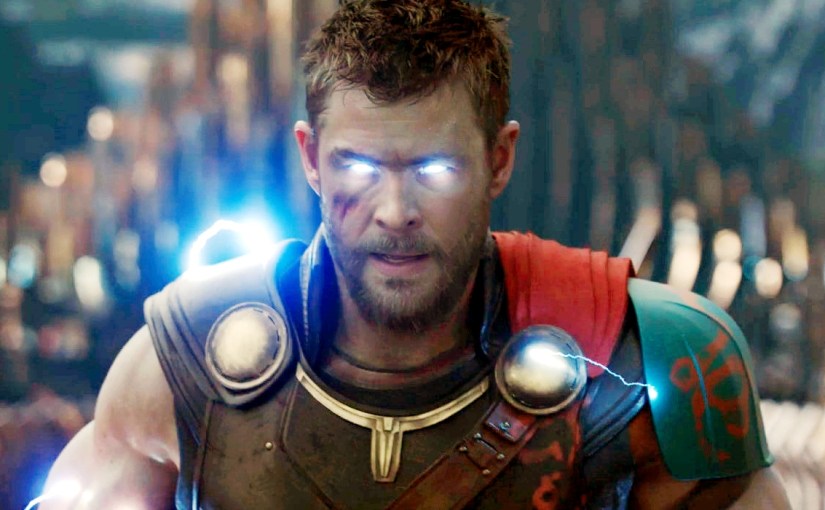
The gem this film offers is combining Led Zeppelin’s “Immigrant Song” with a fierce lightening powered one eyed Thor to fend off a few baddies. Compliments also to a bad ass, and sometimes drunk, Tessa Thompson as the Asgardian known as Valkyrie.

A favorite moment is an encounter with Benedict Cumberbatch as Dr. Strange. Good editing and direction offer an inspired Three Stooges routine where Thor is unexpectedly thrust about down a staircase or through a room. Plays like a great cartoon short.

Ragnarök has some shocking moments in its ending, but the weight of drama or story is none too burdensome.

It’s nothing special of a film, but it is amusing and gleeful, especially when Thor is forced to a chair while Willy Wonka’s “Pure Imagination” plays like annoying elevator music. That is sure to make the God Of Thunder irritable, and we the audience only gain from it.

Thor: Ragnarök is really a fun family movie of adventure, good character design and laughs.

DOCTOR STRANGE

By Marc S. Sanders

The first MCU movie that makes the biggest departure from any of the other installments in the franchise.

Doctor Strange operates on a level beyond punchy powers as Avengers director Joss Whedon noted. The film explores a very far, very fictional belief in the mystical arts and magic. So much so that sometimes characters like The Ancient One and Mordo speak in an English that is so foreign and so confusing. Still, I’m not complaining.

I enjoyed this film immensely. Benedict Cumberbatch is so right in the role of Stephen Strange. His character’s arrogance is not over the top, but necessary and evident. I really liked his transition from expert surgeon to a permanently damaged physical person and then onto The Sorcerer Supreme complete with the Cloak of Levitation, a better and more deserving way to describe it than just another cape.

The morphing of city landscapes and neighborhoods into arced and flipped and reverse mazes are really fun and change shape with crisp sound editing and music.

Good supporting work is also on display from Rachel McAdams, Chiwetel Ejiofor and especially Tilda Swinton. My one wish is that the villain played by the very capable Mads Mikkellsen was fleshed out more. He’s an actor who can handle heavy roles. Regretfully, I don’t think the script gives him enough to do here.

This Marvel chapter stands on its own with little reliance on the other films. However, the green infinity stone at play here is easier to understand now that I’ve seen Avengers: Infinity War. I’m talking about The Time Stone, of course!

Doctor Strange is a solid film; one that I would love to watch again a year from now and likely feel just as entertained.

NOTE: stay away from the 3D Blu Ray discs. Watch it in 2D. Having seen the 3D in theatres the first time, I clearly remember not enjoying the film very much. It was blurry and dark. At times the picture didn’t look crisp. The 3D effort was a nuisance and a terrible distraction. Less is more. Stick with 2D.

FOUR LIONS (2010, Great Britain)

by Miguel E. Rodriguez

Director: Christopher Morris
Cast: Riz Ahmed, Arsher Ali, Nigel Lindsay, Kayvan Novak, and a very special guest star
My Rating: 9/10
Rotten Tomatometer: 83% Certified Fresh

PLOT: A small group of incompetent British terrorists set out to train for and commit an act of terror.


The world of cinema has a long history of taking subjects traditionally considered taboo and turning them into comedy.  German concentration camps?  Life Is Beautiful mines it for comedy.  P.O.W. camps?  Ever hear of Hogan’s Heroes?  What about Hitler himself?  The Great Dictator and Look Who’s Back lampoon him perfectly.  Race relations?  Look no further than Blazing Saddles.  In recent years, even 9/11 has become a kind of punchline for jokes, with varying degrees of success.  As with all comedy, context is king.

Such is the case with Four Lions, a British film from director Christopher Morris.  In it, the subject and especially the philosophy of suicide bombers are, forgive the pun, exploded with equal doses of logic and ruthless humor.

Omar (Riz Ahmed) is a member of a “cell” of extremists who imagine themselves to be part of a glorious Jihad against Western civilization, but who, as Omar himself puts it, can’t even “stir their tea without smashing a window.”  In the opening scene, Waj (Kayvan Novak) is trying to make one of those videos claiming responsibility for a terrorist act, but the cameraman points out that the gun he’s holding is too small.  It’s actually a replica of an AK-47, but it’s about half scale.  Waj solves the problem by first saying he has big hands, then by simply moving closer to the camera.  Can’t argue with that logic.

Their leader, Barry (Nigel Lindsay), is a Caucasian man who has converted to Islam and become a true believer – “radicalized”, I think is the word.  (Director Christopher Morris says he’s based on a man who was once a member of a far-right, fascist party in the UK; in an attempt to “out-knowledge” the Asian youths he regularly assaulted, this man studied the Qur’an in depth…and as a result “accidentally” converted himself and became a Muslim.  Talk about truth being stranger than fiction.)  Barry is no prize either.  He knows all the proper buzzwords and catchphrases, but he is convinced the best way to defeat government surveillance when walking outside is to constantly shake your head back and forth.  So your face will come out blurry.  Once again, unassailable logic at work.

The fourth member is Faisal (Adeel Akhtar), who buys up large quantities of bleach and liquid peroxide for bomb-making, but to do so he had to make several trips to the same store.  To make sure no one at the shop suspected, he used different voices every trip, including a woman’s voice.  Barry objects: “You’ve got a beard!”  Faisal explains he covered his beard with his hands when he used the woman’s voice.

“So why has she got her hands on her face, Faisal!?”
“…cos she’s got a beard.”

Again…impeccable logic leading to ridiculous actions.  The movie is chock full of these kinds of perfectly logical reasons for doing absurd things.  A movie with only two dimensions would simply use that same lens, point it towards the actions of suicide bombers, and congratulate itself on its cleverness.  But Four Lions, hilarious though it is, goes another level deeper.

Omar has a wife and young son.  They are both totally on board with Omar’s plans for becoming a suicide bomber.  All three are convinced that his act of martyrdom will ensure his place in Paradise where he will eventually be reunited with his family.  When Omar discusses his plans with his wife, Sofia, she is calm, cool, and collected, as if they were discussing when and where to buy their next house.  When Omar tells his son a bedtime story, he makes changes to the story of The Lion King, so it more closely reflects his own beliefs, and the son smiles and eats it up.  Chilling.

But then Omar’s brother, Ahmed, pays a visit.  Ahmed is what I would call an “orthodox” Muslim, wearing the robes and head coverings and the longer beard.  By contrast, Omar is dressed in far more “Western” gear and trainers.  Ahmed has gotten wind of Omar’s plan and wants to try to talk him out of it because the Qur’an teaches non-violence…but his orthodox beliefs also state he can’t be in the same room as Omar’s wife.  Omar makes a point that, according to Ahmed’s beliefs, there are “60,000 opinions saying we can’t fight back!  We must measure our beard with a ruler and lock our wives in a cupboard!”

What you’ve got here is a key lesson in great comedy.  Be funny, but have a point.  What is the point here?  In my opinion, the point of this scene is to single out the vast contradictions possible in any kind of religion where extremists have staked out territory on the fringes.  A man believes in non-violence but can’t be in the same room as a woman.  Another man believes in martyrdom but has water gun fights with his son and wife.  They’re both right and they’re both wrong.  We tend to see one viewpoint as being hand in hand with the other by default, but Four Lions makes the case that great variety is possible.  A man in a robe and a long beard is not automatically a terrorist.  A man with a loving wife and family is not always the “good guy.”  Nothing is black and white.

But I don’t want to make the movie seem like it’s some kind of grand polemic on religious intolerance.  It has its serious moments, yes, but damn, is it funny.  I’m trying hard to think of another movie where a bunch of terrorists wind up running in a fictional “fun-run” marathon dressed as a ninja turtle, a cowboy riding an ostrich, an upside-down clown, and an orange bear.  (Actually, I’m not quite sure that’s a bear…that would be a question for the police.)  Or where one terrorist’s master plan involves strapping a bomb to a crow.  Or where a short discussion is held to determine exactly which parts of a car are Jewish.  As they say in the clickbait ads, the answer to that question may SURPRISE you!

(Also, if you’re a fan of Star Wars, I apologize in advance for any trauma you may experience…you’ll see what I mean.)

Admittedly, the subject matter of this comedy may turn off some viewers.  That is their right.  But if you’re an admirer of sharp-edged comedy that takes no prisoners and follows its own logic to its inexorable conclusions, Four Lions is gold.

THE POWER OF THE DOG

By Marc S. Sanders

Don’t blame Jane Campion.  Blame me. 

The ending to The Power Of The Dog feels ambiguous, but writer and director Campion invites you to think and ponder.  It also helps that I have a good friend who shed some light on how the film actually wrapped up.  I’m grateful because I appreciated the picture even more.  Ironically, my friend didn’t care for the movie.

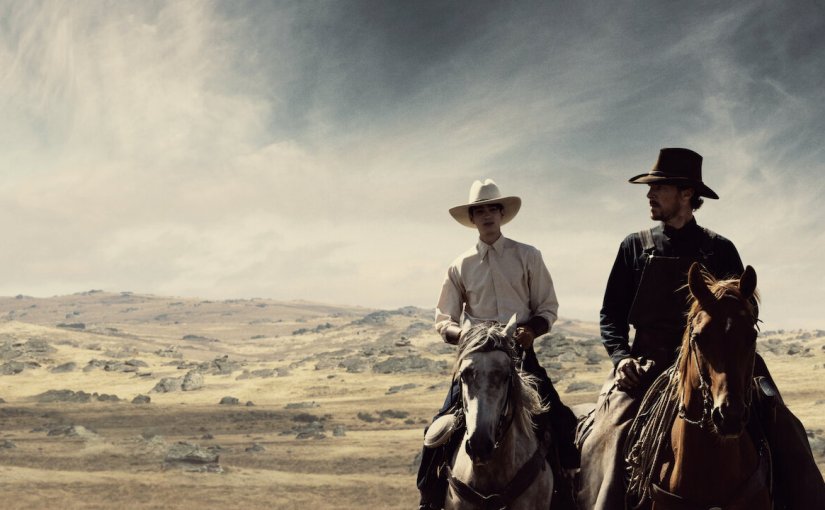
Technically, Jane Campion directs an absolutely breathtaking film with majestic cinematography and art design of open Montana fields taking place in 1926.  Tech work can only take me so far though, and I appreciated the four different perspectives of the headlining cast that includes Benedict Cumberbatch, Jesse Plemons, Kirsten Dunst and Kodi Smit-McPhee. 

Cumberbatch is Phil, a cowboy relic of the Old West.  He’s an expert horseman donned with spurs on his boots, and leather padding on the jeans along with the worn in staple cowboy hat.  He also has a fearful and intimidating temper.  Maybe that’s because his era is soon to be passed by and he’s not designed or updated for anything else.  Plemons is George. Phil’s subdued, business wise brother who knows his way around their Montana ranch, and more importantly knows how to build connections that’ll provide fiscal and political support, while he drives his Ford buggy to get from one place to the next.  Dunst is Rose, the artist of appetizing delicacies and designs who marries George.  She manages the kitchen of her restaurant and can play piano; not exceptionally well but her love for the instrument is what matters.  Her son is Peter, played by Smit-McPhee, a lanky and weak, yet book smart, young adult with his focus on the science of medicine.  He aspires to be surgeon.  So, as the 20th century is now over a quarter complete, these four individuals represent what once was, what is now, what is trending and what will become.

Campion sprinkles her film in more atmosphere than telling dialogue.  The gist of the story is how Phil’s tormenting presence scares both Rose and Peter.  A hair-raising scene occurs midway while Rose attempts to play a song on the piano, only to be drowned out by Phil’s cruel banjo interpretation from the top of the staircase.  Cumberbatch is really scary here as the bear teasing the cub to poke him.  Rose tries again and again to play only to be further interrupted by Phil.  A banjo is an instrument of a bygone era, the Old West.   The piano is the more sophisticated and elegant device to use now within the decorated designs of a reading room.

The future is also upon the characters.  Young Peter purchases a pair of sneakers to wear; not exactly the most appropriate for a horse ranch, nor are his suppressed homosexual yearnings.  Still, the future carries forth as he studies the latest in medicine and surgical practices, whether it is through dissection of a rabbit or studying the most up to date medical journals.

George is the symbol of transition.  He was raised like his brother Phil to be a rancher, but he knows that time has passed.  Currency, technology and longevity are necessary and it is not wise to remain stagnant in a time gone by.  It’s practical to develop connections with the Governor of the state, to drive himself and Rose in a car as opposed to by horseback.  To carry on the family name, it is also prudent he marries and builds a new generation.

I appreciated the subtle visuals and behaviors that Campion weaves into her adaptation from the novel by Thomas Savage.  Over the course of two hours, I was always learning something new, whether it be about the characters or the period setting.  Most telling is the fact that the past can not live in an updated future such as Phil with his suprising and deeply inhibited attraction to Peter.  As well, the future is not going to adjust well to the past like when Peter is trying to learn horse and ranch handling from a teasingly cruel Phil while wearing a ridiculous cowboy hat, white sneakers, and factory tailored jeans.  Furthermore, even if you’re only a frequent movie watcher, you likely are aware that Westerns would pit cowboys against Indians.  Rose demonstrates with her talents for craft how Native Americans are appreciated in this still young new century.  Phil and his ranchers would never imagine such relations to ever exist.

Our history is not comfortable with our eventual future, and our future can not fathom how we ever lived within our past.

Because these two worlds can never mesh in accordance with each other, a loss will have to be committed.  In another storyteller’s hands, The Power Of The Dog, might have resulted in a gun shot, or a stabbing or an illness to eliminate what cannot survive.  As well, long speeches of dialogue would spell out what must cease to continue and what must continue to flourish and go on.  With Campion’s lens, and with Savage’s work, it works atmospherically, however.  The environment of the Montana landscape along with life on a transitioning horse and cattle ranch serve the conflicting time passages and the characters who are relegated to a past, or a present, or a future. 

Don’t watch The Power Of The Dog with expectations of simplicity or quotable dialogue.  I value Campion’s approach to not spoon feed me.  Rather, take in the visuals of the four main characters’ behaviors.  Allow yourself to become more observant of the nature of how things end up.  Powerfully speaking, Jane Campion shows that some people will work well together, while others will crave to blend effectively, and sadly some can never live within another environment or time period, much less someone else’s.

The Power Of The Dog offers a thought-provoking message of loss and reflection while gazing into what’s just beyond.  It’s a very well-made film.

1917 (2019)

by Miguel E. Rodriguez

Director: Sam Mendes
Cast: Dean-Charles Chapman, George MacKay, Colin Firth, Mark Strong, Benedict Cumberbatch
My Rating: 10/10
Rotten Tomatometer: 89% Certified Fresh

PLOT: Two British soldiers during the First World War are given an impossible mission: deliver a message deep into enemy territory that will stop 1,600 men, including one of the two soldiers’ brothers, from walking straight into a deadly trap.


Bear with me for a second…I promise I’ll actually get to the movie in a second.

I’m not a professional movie critic.  I write reviews simply because it amuses me to do so, and because one of my friends made it possible for him and I to post our reviews in an online forum.  For about two months, though, I haven’t written a single review.  I pondered this with Marc a little while ago, and the only reason I could come up with was that I didn’t feel INSPIRED to write something.

Not that I haven’t seen good movies in those two months. Waves, Uncut Gems, Star Wars: The Rise of Skywalker, Jumanji: The Next Level, Frozen 2, Little Women, Bombshell, maybe one or two others – they were all good, even great.  (In the case of Uncut Gems and Waves, I’d even call them “must-see” events.)  But I never felt compelled to run home and put pen to paper, or fingers to keyboard.  I simply felt that I had nothing to contribute where those movies were concerned.

Well, tonight I saw 1917, and now I have to say, this is a different case altogether.

For anyone who’s not quite aware of why this movie is so special, aside from it just being really good, 1917 was hyped as being told in one single shot with a camera that follows two soldiers through battlefields and countrysides as they attempt to deliver an important message to a distant company of English soldiers.  No cuts to different angles, no cuts at all, in fact.  (Actually, there IS a single cut, but more on that later.)

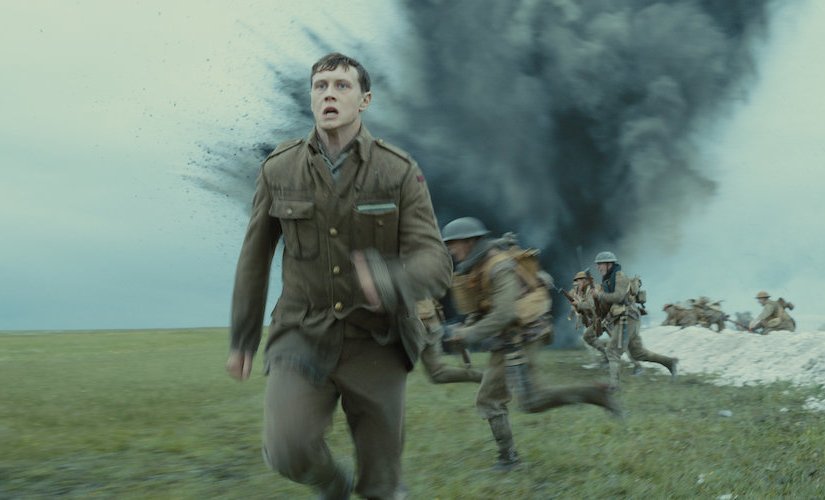
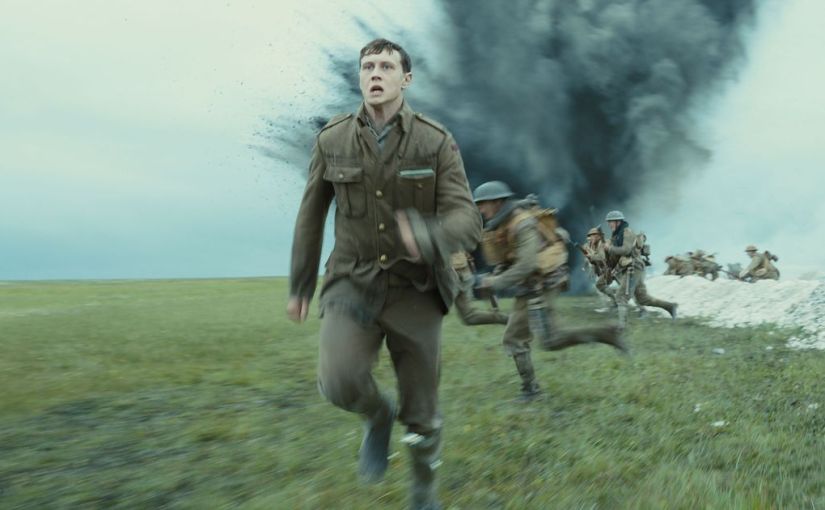
While I originally felt it was a bit of a stunt to get it noticed at Oscar time (remember Birdman [2014]?), after seeing the movie it was abundantly clear that this was no mere trick to dazzle an audience with.  This specific story is particularly suited to this specific method of filming.  It forces the audience to empathize with these two soldiers immediately, and only them.  I was reminded for some reason of Saving Private Ryan, and a line spoken by Tom Sizemore: “This time the mission is a man.”  Well, this time, the men are the mission, and the mission is paramount.  The single-take strategy has the uncanny ability to put us in the shoes of these soldiers more so than many other war films.  You feel like you’re right there in the mud with the empty artillery shells and the corpses and the rats.

And that’s the supreme achievement of the movie: its ability to put us there and KEEP us there for two hours without ever calling attention to the fact that, “Hey, we haven’t cut yet and it’s been over a half hour!”  A lot of that has to do with camera placement and movement and, of course, the actors’ ability to keep us engaged.

But one thing that I kept noticing throughout the movie was the small details.  I’m not going to remember them all, but they included:

  • At one point, the British soldiers walk through an abandoned German bunker.  In a throwaway detail, the name “KLARA” is seen scrawled on one of the walls.  The camera doesn’t focus on it, but it just passes by.
  • We encounter a group of British soldiers, and of them is a Sikh.  The other soldiers are doing bad impressions of their superior officers, but the Indian’s impression is clearly better than the other Englishmen, with proper diction, upper-class accent, everything.
  • In the British trenches, various sections have unique names.  The one I remember most clearly is “Paradise Alley.”
  • As they walk, one of our two heroes notices cherry trees, and he quickly rattles off several different varieties of cherries.  He knows them because his family has an orchard back home.
  • An intense scene where someone has to literally wade through dozens of corpses.
  • In one remarkable scene, the movie pauses to listen to a song. Fighting is imminent, death may arrive at any moment, but for a brief moment, everything stops. It’s a brilliant moment…almost holy.

Little things like that.  The reason I bring them up is because some of them seemed unnecessary to the story, but they colored the story so that it felt more real than most.  And the closing credits reveal that this movie is based on stories told to director Sam Mendes by his grandfather, who served in World War One.  So many, if not all, of those little details were probably one hundred percent REAL details, the kind of details that could only be remembered by someone who was there.

Another reason the movie is so suspenseful is because we’ve become subtly programmed to believe that, in a war movie, the ending can’t be too Hollywood; otherwise, it’s not real enough.  The soldiers must deliver a message.  Will they even survive long enough to deliver the message?  Assuming they do, will the officers receiving the message even follow the order?  A civilian appears at one point…will they live?  They engage in combat…who will live and who will die?  I was on edge the whole movie because I never really felt “safe”, which was EXACTLY the kind of feeling you want when you’re watching a war movie.  In my opinion.

Now, about that whole single-shot thing.  There actually IS one cut, a SINGLE cut, during the whole movie.  You’ll know it when it happens.  But when you’ve seen as many movies as I have, you’ll also notice “invisible wipes”, where the camera passes by something in the foreground – a pillar, or a rock, or a tree – that comes in between the camera and the person/object being filmed.  Using clever editing and lighting, you can cut two shots together using that pillar/rock/tree as the splicing point.  And there is a LOT of that going on in this movie.

I’m not taking anything away from the achievement of the film, it’s spectacular.  It’s just something I noticed that I could not UN-notice for the duration of the film.  A minor quibble, nothing more.

1917 is definitely a top contender for Best Picture of 2019.  I have only seen a handful of World War I movies, but this is certainly one of the very best.  I’d rank it up there with Kubrick’s Paths of Glory any day.

1917

By Marc S. Sanders

Sam Mendes’ World War I drama 1917 is a cinematic achievement in film artistry. Watching the picture, which I highly recommend in a Dolby theatre, is exhilarating, leaving me to ponder how this type of filmmaking was ever accomplished.

Mendes, along with legendary cinematographer Roger Deakins (Blade Runner) primarily shot the film in one long-real time-take with no breakaway until about two thirds of the film is complete. Then, it resumes into another long take for its final act.

We accompany two British soldiers assigned to trek across the front line into enemy territory and warn a unit of 1600 fellow soldiers that a planned attack has been set up as an ambush against them by the German army.

Mendes is also credited as screenwriter with Krysty Wilson-Cairns and the story and characterizations remain pretty basic. Almost too basic, actually. Because the film is shot in close to real time, 1917 doesn’t allow for much complexity or dimension beyond the now of the mission at hand, and that’s where it suffers slightly. There are moments where we are just walking the countryside and are expected to look at the splendor of war torn Europe. We wind a corner and suddenly we are entering a bunker where a rat hanging from a ceiling enters the frame. We climb a ladder out of a trench, and we immediately come face to face with the aftermath of a violent battle that leaves behind torn up bodies and piles of shell casings.

The achievement with camera work is impossible not to admire and become in awe of it. Eventually, however the novelty wears a little thin. There’s little emotional connection to the two soldiers played by Dean Charles Chapman and George Mackay. Brief appearances by Benedict Cumberbatch, Colin Firth and Mark Strong are fleeting for but a second.

I was highly impressed with 1917, but I was never moved by the film, even when an emotional confrontation comes up near the end. I never got to know these characters beyond the urgent sojourn they take. So much of the conversations didn’t matter much to me.

Again, this is a master class in filmmaking. Mendes will likely win a directing Oscar because I am dumbfounded with his accomplishment. His steady camera could not have been mounted on a ground track against the rough terrain. So how did he do it?

Oscar recognition must also go to Mendes’ team of 6 art directors. The battlefields are strewn about with corpses, barb wire, deep trenches, underground bunkers, dirt, mud, dust, blood, and so on. War is hell is what we’ve all heard. 1917 brings that mantra to life in sickening, shuddering detail.

I recommend the film while it remains in theaters, but I won’t say it is the best picture of the year because for each great feat of technical work, there’s a lack in the emotional punch that other war films have provided.