WEAPONS

By Marc S. Sanders

The longevity of horror movies and the insatiable appetite that audiences hunger for hinges on curiosity.  Horror is other worldly or beyond commonplace.  It’s unrealized. Stories likely begin with the concept of a particularly unique, unheard of scenario.  

For example, one night in a small suburban neighborhood, what could explain why an entire classroom of elementary school students, taught by Ms. Gandy, leave their homes at exactly 2:17 in the morning, vanish into the darkness and never return? Could Ms. Gandy be behind this mystery?  Also, why is Alex the only student in the class to show up for school the next day?

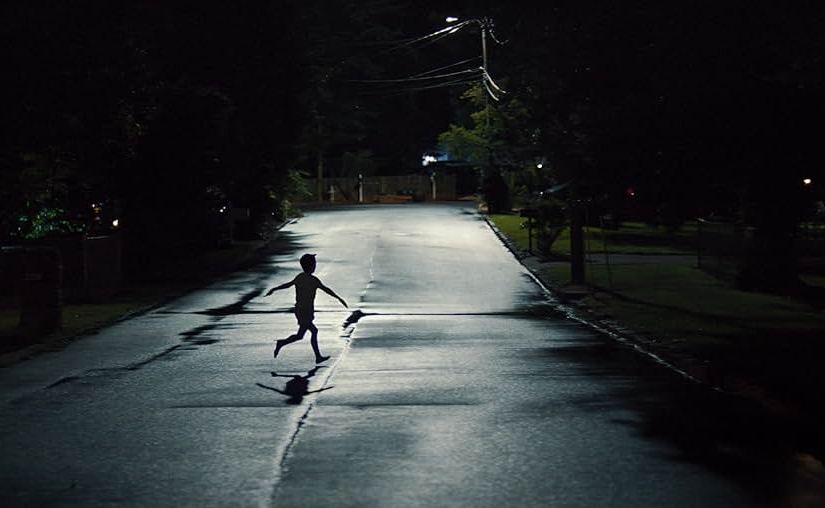
Reader, the trailer for Weapons had me hooked.  The imagery showing the silhouettes of innocent children running into the darkness with their arms outstretched was eye opening.  A young girl narrates the brief camp fire ghost story in the preview. It also opens the film with additional details.  This set up seems odd and different.  Doesn’t sound like another vampire or zombie flick to me.  This was going to be something else.  Frankly, ahead of the release of Zach Cregger’s film, I could not stop thinking about it.  I needed to know the reason behind this phenomenon.  

Yet, anticipation and finally scratching that itch turned out to be disappointing.  

Cregger’s movie answers almost all the questions it offers even if some elements are not wholly consistent as the story unravels.  The only salvation to watching Weapons is not knowing why any of this happened, in particular with the squirrelly young teacher, Ms. Gandy (Julia Garner, whose career continues to impress) at the center of it all.  

Like most second rate horror films though, there are teases of drawn out scenes as you anticipate the next jump scare.  Loud knocking on a front door to motivate the protagonist to go “Helloooooo!!!! Anyone there?,” and then to open the door to an empty street is just as annoying. Especially, if nothing is ever explained of that sequence. Was this wedged into the final cut for another hair raising experience? The best horror has an explanation for EVERYTHING you see. However, I was waiting for a cat or a bird to jump into frame. It’s been done!

There are also the nightmare sequences.  Once again, I have been banged over the head with “It’s just a dream!”  This is such a desperate, last resort trope to stretch out a running time or make up for lost road in storytelling.  Can movies just stop with the “only a dream” sequence please?  Freddy Krueger is the only one who can legitimately lay claim to this tired idea.

While I may not care for the explanations of Cregger’s phenomena, at least I can compliment his skills as a filmmaker during the expository portion of his picture.  The writer/director provides an abundance of tracking shots through the hallways of the school, down neighborhood streets, in Ms. Gandy’s house, and even within the small confines of a liquor store.  

Much of his material is positioned behind his characters and he tracks where they are walking while being limited on showing their facial expressions.  Recently, I watched Alfred Hitchcock’s Notorious and the film initially only shows the back of Cary Grant’s head.  It works as a mysterious character device.  For the first twenty minutes of Weapons, we are primarily only seeing the back of Julia Garner’s head.  I was invested in this movie wondering what is it about this loner teacher who is being admonished as a witch within the community.  This movie is starting out with a modern day Salem. Ms. Gandy is weird and I desperately want to look her in the eye, but Cregger’s direction won’t let me.  So, I can’t get a grasp of this odd individual.  Well played.

The outline of Weapons works like Doug Lyman’s Go or a Quentin Tarantino film.  Cregger said he got inspiration from Paul Thomas Anderson’s Magnolia.  The movie is divided into different perspectives of a collection of characters.  You see the teacher’s experience first, and then respectively of another student’s father (Josh Brolin), a cop (Alden Ehrenreich), a homeless meth addict, and the school principal (Benedict Wong).  Their stories eventually cross paths while more and more clues and answers gradually deliver.

What is surprising are the humorous beats that come out of some of the frightening moments of the picture.  The bonkers ending feels like a salute to a memorable scene from Ferris Bueller’s Day Off.  What comedy derives from the dark elements though felt unwelcome to me.  For a horror picture with fascinating potential, the threats and whatever suspense that was to be expected suddenly feels watered down.  Now, Weapons feels like an uninspired episode of Tales From The Crypt or an exhausting and unnecessary two hour installment of Stranger Things.  This movie had its brains working overtime when it began and then lost its intelligence along the way.

Two characters in the script are given too much unwanted and uninteresting attention here.  When the film arrives at their perspectives, the picture meanderingly drags along offering little of anything substantial.  It felt like I walked into a different movie, far away from the spooky stuff that was eerily described in the beginning of the film.  More material could have been devoted to others in the town with a bigger and more personal stake in the central plot.  There are too many diversions of little significance.  Seventeen children disappeared and yet we only get to know one father and brush by another mom and dad. No one else is feeling the agony of this incident?

There are pertinent clues of simple logic that are overtly ignored as well so that the story can just simply move along.  Specific objects in Ms. Gandy’s classroom suddenly disappear and no one seems to question their absence while this case is being investigated.  Because it’s too apparent, you can’t help but dwell on this inconsistency.  If you’ve participated in an Escape Room, this bit of information will tediously occupy your mindset.  

Weapons has a marvelous idea, but it circumvents common elements of all horror movies too.  There’s a spooky house, nightmares, a haggardly weird old lady, knocks on the doors and lots of darkness too.  I don’t mind any of this.  What gnawed at me though was the simplicity of the answers to the riddles, and the enormous waste of veering off into several characters who bear little importance.

Someone should take this idea of children running away into the night and do it all over again.  I just love the idea. Other screenwriters would have written Zach Cregger’s story and then ripped the pages off their legal pad and tossed the crumpled balls of paper over the shoulder to start again. Cregger seems to have just settled on his first draft.

Weapons feels like a movie where the audience gets to experience a wrenching case of writer’s block, and nothing could be more frustrating.
OPPENHEIMER

By Marc S. Sanders

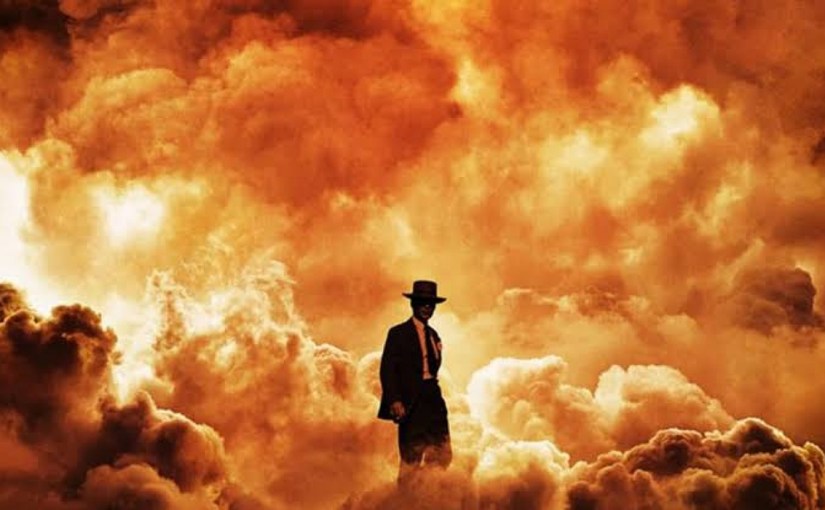
Christopher Nolan is one of the modern-day directors that you can rely on for brainy science fiction whether they are in embedded in dream subconsciousness, intergalactic space travel, transcendences of time, or even putting a fresh polish on a favorite superhero.  With Oppenheimer, he triumphs with exploring the actual prophets of science in the twentieth century, particularly its title character J Robert Oppenheimer, the brilliant physicist played convincingly well by Cillian Murphy.  Nolan doesn’t just stop at the assembly and discovery of science though.  He uncovers the consequences of Oppenheimer’s innovation and genius insight.  Dr. Oppenheimer might have been the man who knew too much and arguably that cost him quite a bit, personally.  Additionally, the so-called lab rat of his atomic bomb, namely the planet Earth, suffered the expense of a, at the time, troubling present day, and a still ongoing future. 

This movie seems to start right in the middle of its story and as a viewer you need to claw your way through the dense foliage to find its beginnings and what comes afterwards.  The first two scenes of the movie are titled “Fission” and “Fusion.”  There are no time periods specified by a font caption, however.  The differences in various points in history are distinguished by where J Robert Oppenheimer is located during select points in his life.  For seconds at a time, the film will change its photography from vibrant color to black and white, for example.  The characters will either look more aged with grey hair and some wrinkles or during more youthful time in their lives.  At one point Oppenheimer is being recruited by Lewis Strauss (Robert Downey, Jr) to head the department of a new kind of weapon development.  Work the science to make a difference.  There’s another time period where he’s being interrogated in a small room by a governmental suit and tie committee.  Oppenheimer is also in his classroom or debating and working with colleagues.  Another story observes his progress with building the atomic bomb among a collection of other engineers and scientists in a desert town, Los Alamos, specifically built at his own request, under the order of the nothing but militant Colonel Leslie Groves (Matt Damon), to conduct his work and research while hiding in plain sight. 

The film also covers Oppenheimer’s association with possible suspects of the Communist Party during the stressful pre-cold war era of McCarthyism.  Questions arise if his reliable brother Frank (Dylan Arnold) is a communist or even his mistress (Florence Pugh).  Does that in turn make Oppenheimer a communist as well?  If that is the case is J Robert Oppenheimer, the man tasked with ultimately ending World War II in favor of the Allies, sharing secrets with Russia and/or the Communist Party?

Nolan’s film gets easier to watch as it moves along, but you must get used to his pattern of filmmaking.  If you have never seen a Christopher Nolan film, I do not recommend you start with Oppenheimer.  His work is recognized for fast paced edits of different time periods and conversations.  There is much information to decipher. As well, there’s a very large collection of welcome characters to sort through, who worked with or against Oppenheimer.  Having only seen it once, I was captivated with the picture, but I know that I need to see it again.  The quick edits, working beautifully against the soundtrack orchestrations of Ludwig Göransson (nominate him for an Oscar, please), happen a mile a minute.  I appreciated this method because it enhanced the urgency of Dr. Oppenheimer in the eyes of the world, first as the savior of the united Allies against the last remaining superpower of the Axis countries, Japan. Then later focus is on whether it is in the United States’ best interests for the regarded physicist to have security access to the country’s most secret weapons and technological progress in a post war age.

People have been cajoling about how they know the ending to Oppenheimer.  They drop the bomb, of course!  (Twice actually.)  However, they do not know the entire story adaptation that Christopher Nolan as director and screenwriter presents. 

Cillian Murphy is perfectly cast. Give him an Oscar nomination.  He serves the confident, assured scientific leader who becomes envious of competing powers who achieve the impossible, like splitting the atom, while also admiring peers and mentors like Niels Bohr and Albert Einstein (Kenneth Branagh, Tom Conti).  All these men are interested only in what can be accomplished.  The superpowers that fight in war, though, are interested in how these accomplishments of modern science can be used to their advantage at a cost of collateral damage.  It is these conflicts of interests that Nolan admirably demonstrates over the course of the film. 

A telling scene for me, that I won’t forget, is when Robert Oppenheimer meets Harry Truman (Gary Oldman, doing an unforgettable cameo).  As the physicist exits the Oval Office, having shared his concerns and scruples with the Commander in Chief, Nolan includes a throwaway line delivered by the President, that I won’t soon forget.  It will not be spoiled, here.  Yet, the dialogue speaks volumes of what the United States held important regarding the servants who did the country’s bidding.  The scene closes like a stab in the heart, and suddenly science is no longer just facts within our planet.  Science is now questioned on whether it should ever be acted upon. Those questions certainly have remained as long as I’ve been alive to read about our never-ending world climate.  These inquiries will be here for many generations after I’m gone as well; that is if men and women’s recklessness with science doesn’t destroy the Earth before then.  At one point, Oppenheimer shares a small fraction of possibility for the end of the world when they activate and test their first atomic bomb. Matt Damon’s Colonel Groves’ asks for a reiteration of that observation.  Is this finding worth even the smallest, most minute risk?

Emily Blunt portrays Kitty Oppenheimer.  She’s marvelous as a lonely alcoholic wife to Robert, and a mother minding a home built in the desert while her husband serves an important purpose.  I didn’t take to her presence in the film until her grand moment arrives during an interrogation scene.  As the character gives her testimony regarding Oppenheimer’s communist ties, Blunt locks herself in for a wealth of awards in late 2023/early 2024.  Once you’ve watched the movie, you’ll likely know which scene I’m referring to and you can bet it’ll be that sample clip shown on all the awards programs.  This might not be Blunt’s best role, because it is rather limited within crux of the film, but I’d argue it is her greatest scene on film that I can remember.

Oppenheimer is a three-hour film, and it demands its running time.  There are so many angles to the man that few really know about.  Many know it was he who instrumentally built the atomic bomb that to date has only been used twice within a period of four days.  Thankfully never since.  Nolan emphasizes how unaware we are of how carefree the doctor’s government supervisors performed with the weapon he agreed to build.  Don’t just drop the bomb once.  Send a message to Japan by dropping it twice so they know to no longer engage in this ongoing war.  Choose the area where an army/government official didn’t honeymoon though.  It’s too beautiful a region.  Tens of thousands of men, women and child civilians perished immediately following the strikes.  Many others died weeks later following exposure to the nuclear effects that followed.  All issued as a horrifying cost to end a war that was already being won now that Hitler was dead.

Mechanically, Christopher Nolan does not disappoint either.  I watched Oppenheimer in a Dolby theater and I highly recommend it over a traditional one.  However, beware of the sound.  It is a LOUD!!!!!  Your seat will rattle early in the film when Cillian Murphy is shown in close up imagining the collision of atoms, protons, and neutrons.  How a star naturally dies in space runs through Oppenheimer’s consciousness as well, and then we see how a black hole forms.  Nolan offers a Cliff’s Notes edit of science doing its job.  Murphy performs so well when he’s not speaking and cut against the quick edits of Nolan’s visual and sound effects of science at play.  It shows how an educated scientist thinks beyond what is documented on a chalkboard or in a textbook.  J Robert Oppenheimer used to teach about the building blocks and natural destruction that occurs within the universe.  Regrettably, what he learned about natural function soon becomes manufactured capability when the professor accepts the task of building scientific destruction with his bare hands. Man stole fire from the Gods.

Oppenheimer is so dense in the scope of science and the scientist behind it.  That’s a huge compliment.  It’s an engaging film with much to tell, and a lot more to think about afterwards.  It accomplishes what the best movies do.  It leaves you thinking long after the film has ended.  More importantly, it’ll leave you frightened for the future based on the behavior of this planet’s past. 

Oppenheimer is one of the best films of the year.

HAIL, CAESAR! (2016)

by Miguel E. Rodriguez

DIRECTORS: Ethan Coen & Joel Coen
CAST: Josh Brolin, George Clooney, Alden Ehrenreich, Ralph Fiennes, Scarlett Johansson, Tilda Swinton, Channing Tatum
MY RATING: 7/10
ROTTEN TOMATOMETER: 86% Certified Fresh

PLOT: A movie studio “fixer” in 1950s Hollywood faces his biggest challenge yet when the star of the studio’s most prestigious film in production is kidnapped by a shadowy organization calling itself, “The Future.”


The word “idiosyncratic” feels like it was invented for the Coen Brothers…or maybe vice versa.  Their 2016 film Hail, Caesar! is yet another case in point.  Packed with the kind of early Hollywood detail we wouldn’t see again until 2022’s Babylon, this film is a love letter to the 1950s studio system that produced such classics as All About Eve, Stalag 17, The Bridge on the River Kwai, and Ben-Hur.  However, the comic story surrounding this love letter is a bit rambling and disjointed.  About halfway through, I found myself wondering if maybe the movie wouldn’t have been better if the filmmakers had just ditched the comedy and made a straight-up drama.  But then we got to the climax, and I realized, no, comedy is better for serving up the kind of silliness we get at the end.  It’s no Raising Arizona, but it’ll serve.

In classic film noir fashion, a narrator (Michael Gambon) informs us that Eddie Mannix (Josh Brolin) is head of production at the fictional Capitol Pictures, which is in the middle of shooting its most ambitious picture ever, an epic Biblical tale called Hail, Caesar!  (Think Ben-Hur with a lower budget and an outright plagiarized screenplay.)  However, their leading man, the improbably handsome and incredibly dumb Baird Whitlock (George Clooney), abruptly goes missing when he is kidnapped by a couple of lurking extras.  Mannix must deal with finding Whitlock while also figuring out what to do about:

  1. DeeAnna Moran’s (Scarlett Johansson) unexpected pregnancy.
  2. Hobie Doyle’s (Alden Ehrenreich) inability to deliver lines without a cowboy accent, which infuriates his director, Laurence Laurentz (Ralph Fiennes).
  3. Two persistent gossip columnists (both played by Tilda Swinton) who are running stories on Whitlock’s disappearance and/or salacious rumors about Whitlock’s past.
  4. A lucrative job offer from Lockheed.
  5. His promise to his wife (Allison Pill in a tiny role) to quit smoking.

Whew!  And I haven’t even mentioned the singer/dancer Burt Gurney (Channing Tatum) or the mysterious group of academics who have apparently kidnapped Whitlock, a group calling itself, “The Future.”  …spooky…

As in many other of the Coen Brothers’ films – not ALL of them, but many of them – the story itself is not really the point.  It just serves as an excuse for Ethan and Joel to present the viewer with scene after scene demonstrating their immense affection for a bygone era of filmmaking.  When Scarlett Johansson’s character, DeeAnna, is introduced, for example, we don’t just get a line or two about what she does (she’s an aquatic star modeled after Esther Williams).  We’re treated to an elaborately choreographed scene with dozens of bathing beauties, ScarJo diving from a great height wearing a mermaid tail, and a mechanical whale complete with a spouting blowhole.

At one point, Mannix visits the chief film editor for the studio, C.C. Calhoun (Frances McDormand), to see how Mr. Laurentz’s film is shaping up.  This scene in particular is lovingly presented, as we get a quick-cut sequence of Calhoun unspooling the film in the dim editing room, re-threading it, punching a button, flipping a switch, click-clack, click-clack, and Mannix watches the opening sequence of “Merrily We Dance” on the tiny Moviola as the projector whirs in the background.  I would bet real money that Martin Scorsese really, REALLY loved this scene.  (Plus there’s a nice little comic button at the end of the scene that is an excellent demonstration of Edna Mode’s immortal dictum in The Incredibles: “No capes!”)

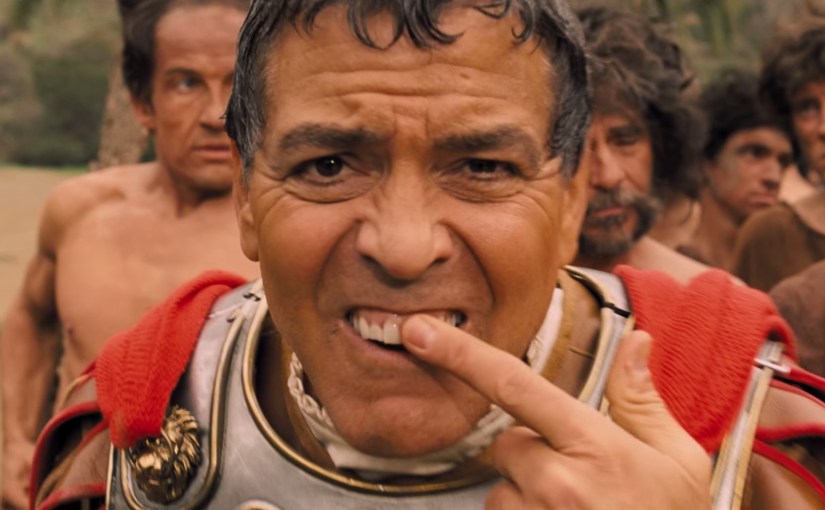
The whole movie is like that.  It’s one of the most nostalgic homages to old Hollywood that I’ve ever seen.  But the movie can’t seem to make up its mind about what it’s about.  George Clooney puts on a clinic of how to play dumb as the clueless Baird Whitlock.  (In fact, this movie serves as the conclusion to the unofficial “Idiots” cycle of films from the Coen Brothers films, which also includes O Brother, Where Art Thou?, Intolerable Cruelty, and Burn After Reading, all of which star Clooney in a lead role…playing an idiot.)  Alden Ehrenreich is pretty convincing as a young star with a pretty boy face and limited acting ability, which I’m sure is far from the truth, but he pulls it off.  His scene where he tries to wrap his Texas accent around the simple line, “Would that it were so simple”, with his director patiently trying to coach him, is hilarious on its own.  But it runs on a little too long, as does the aforementioned scene in the editing room.  The subplot with the gossip columnists feels tacked on, almost as of the Coens were trying to pad the running time.  There’s a magnificently choreographed scene where we watch Channing Tatum’s character do some tap dancing dressed as a sailor for another movie being filmed, but even THAT runs a little too long.

Ultimately, Hail, Caesar! feels more like an intellectual exercise instead of an emotional one.  I hate to keep bringing this movie up by comparison, but Babylon, for example, managed to capture a nostalgia for Old Hollywood AND kept me emotionally involved for its entirety.  There was an energy that kept things moving.  Hail, Caesar! lacks that energy, but I can’t quite bring myself to call it a “bad” movie because I connected with its affection for the monolithic, flawed system that managed to create so many diamonds amid SO many lumps of coal.  (Just like today!)

SOLO: A STAR WARS STORY

By Marc S. Sanders

To those who naysayed this standalone installment in the galaxy far, far away, all I say is you are trying too hard to be pleased.  Shut up and have some fun, will ya?

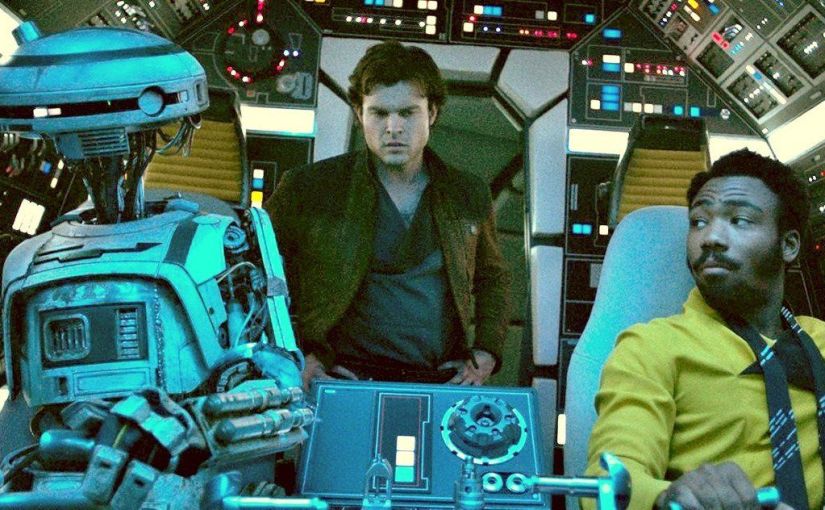
Solo: A Star Wars Story presents a film that stands on its own, relying on mysterious legendary side stories only talked briefly about for the last fortysomething years like the Kessel Run, Sabaac card games, dice and the origin of how Chewbacca met everyone’s favorite space smuggler, Han Solo, plus the Millennium Falcon and the scoundrel Lando Calrissian.  

My brother and even a few friends of mine (Joe Pauly) grew up loving John Wayne’s films. No one else epitomized a Hollywood western better than The Duke.  He was their childhood hero.  For me, it is the generation after that which introduced the space cowboy Han Solo played by Harrison Ford.  He is not anywhere near a multi-dimensional character; pretty one note if you ask me (which ironically is opposite of what I demand in any kind of storytelling these days).  

Captain Solo was the guy who would make it up as he goes; never planning ahead or considering others beyond his trusted furry partner and his beloved spaceship.  He’d poorly talk his way out of trapped situations and when that didn’t work, he was a fast draw with his blaster.  

The screenwriters for Solo, legendary Lawrence Kasdan with his son Jonathan, were all aware of Han’s placement in this space opera, while constructing this film.  Only this time they intended on showing how that devil may care came about. It reminded me of a similar approach writer Paul Haggis took with the reinvention of James Bond in Casino Royale.    A lone hero trusts very little beyond his own arrogance and self-assurance.  The Kasdsans used that technique as the spine for this story and it works.

Director Ron Howard is the right guy to fill in following a notorious director incident beforehand.  Howard keeps the film moving fast with casualties you might not expect to perish, revealing masks (an under looked theme of the original films), traitors, fast ships, fast cars, and their pursuits and chases.  A favorite scene, saluting the Western, is a thrilling train robbery across a snowy mountain that seamlessly changes its angle and vector at times.  It’s as awesome a scene as it promised in the trailers.  

Howard is best at keeping the film grounded in actors rather than tired CGI cartoons.  He definitely makes Han, Lando and the rest look convincing trying to steer a ship or carry a blaster and play cards.

The cast is great.  Alden Ehrenreich is fine in the role; young, cocky, brash, handsome.  I wasn’t looking for him to do a Harrison Ford impersonation.  That would only look like a 12:45 am Saturday Night Live skit. The guy had to do his own thing, not someone else’s much like the Batman and Bond films have done before.  Donald Glover is perfect as Lando, even adopting Billy Dee Williams own way of pronunciation (“Han” vs Ha-an”).  Still, he makes the part his own.  He’s fun to watch.  Beyond some mild makeup scarring, Paul Bettany makes for a really uncomfortable crime lord, like a suave Miami Vice drug kingpin, and Woody Harrelson is just right in the inspirational pirate role; gruff and tough and educating.  Emilia Clarke is finally directed properly in a film.  (I still haven’t forgotten her awful Terminator: Genisys Sarah Conner portrayal.). She is dangerously sexy, but smarmy and cocky like Carrie Fisher was.  She’s a great femme fatale of the 1940s beautifully incorporated into some very thick sci fi.  

This was such a fun time at the movies.  Go ahead.  Accuse me of my bias, but as well shouldn’t I be expected to be a tough demanding critic of all new Star Wars material?  I’d probably be wanting it to match the magic of the original trilogy.  Well no.  I don’t want it that way.  I want new and fresh ideas, while still recognizing George Lucas’ used universe settings.  Disney and Lucasfilm continue to move along, stretching their imagination in monies well spent while also following the rules of smart aleck characters, film western motifs, Eastern cultures and death-defying cliffhangers.  Had the Star Wars franchise remained with Fox, audiences would not be getting the treats we’ve been blessed with for these last 10 years.

Solo really only has two minor misfires.  The droid L3, Lando’s Co-pilot, does not live up to Anthony Daniels nor Alan Tudyk and their high brow robot attitudes.  Why? Because it’s hard to understand what L3 is truly saying.  The lines are garbled at times; drowned out by the robot dialect I guess, and maybe also by a mostly origninal score.

As well, there is one ending moment that’s eye opening, but puzzling with little demand for it.  It was one surprise that did not seem to be well thought out and considering this is a stand alone film, it left me unsure of what Lucasfilm hoped to gain from it.  The moment was too distracting for me.  Yet it’s in there and it’s not the worst offense.  Just very very unnecessary and perplexing.

Solo: A Star Wars Story is none other than great fun with something to think about.   I was laughing out loud.  The audience we were with was clapping and cheering.  That’s why Star Wars films continue to thrive.  Their audiences get caught up in the ride, especially when the films are relatable while not taking themselves too seriously.