INSOMNIA

By Marc S. Sanders

Insomnia is an unusual kind of crazed killer pursuit because the hero is initially implied to be compromised, and before the first act of the picture ends, we see that he truly is not as noble as he is described.  This Christopher Nolan film, one of the few that neither he nor his brother Jonathan wrote, is headlined by three Oscar winners and they beautifully absorb this insightful script from writer Hillary Seitz.

Al Pacino is a celebrated Los Angeles Detective named Will Dormer.  When we see him arriving aboard a propeller plane into the foggy town of Night Mute, Alaska with his partner Hap Eckart (Martin Donovan), he looks weary and worn out.  Greeted with warm welcomes by a fan of his is Ellie Burr (Hilary Swank) and his old friend Chief Nyback (Paul Dooley).  Will has been special requested to investigate the murder of a young girl found in a trash heap, strangled to death.  Happenings like this do not occur often in Night Mute.  So, it is best to use the assistance of an expert.

Right away, Will is ready to get to work by visiting the girl’s boyfriend at school.  What he doesn’t realize is that it is ten o’clock at night. At this time of year, a midnight sun lasts twenty-four hours over this little getaway.  After he’s had a chance to investigate the victim’s body and go over the autopsy notes, the discovery of her bookbag leads to the prime suspect, mystery writer Walter Finch (Robin Williams).  A raid on his home near the beach is initiated and it does not go as planned.  Will screws up while chasing down the guy who gets away. 

While it seems that with some cover up, Will can keep his terrible error in judgment to himself, Walter knows everything. Now, with taunting phone calls in the middle of broad sunlit evenings, Will’s insomnia is becoming a hinderance as he tries to do his job while suppressing his own personal guilt and egregious acts.

The duality of Pacino versus Williams is reminiscent of Eastwood against Malkovich in In The Line Of Fire.  It works very well especially because of the departure that Robin Williams takes from his usual fare.  Ironically, he portrayed another creepy guy in the year of this release with a movie called One Hour Photo.  Williams is just a different kind of cut from Al Pacino and that’s why their conflict works well.  Pacino’s gruff tone, which is all too familiar within the second half of his career, has a roughness against the smooth and calm demeanor that Robin Williams relies on with his dialogue.  Walter Finch appears relaxed, rested and neat.  Will Dormer is wrinkled, tired, and lonely with guilt.  This killer has an inescapable edge over the cop, and thus Insomnia stands apart from the other fare of its time from the likes of Fincher, Demme or the Scott brothers’ respective films.

Christopher Nolan captures a creepy and uncomfortable setting for an environment bright with daylight amid a corner of the world that still embraces the nature of Earth.  He is thorough explorer with his go-to director of photography, Wally Pfister.  Clouds and the blurs of fogs keep moments unclear.  The sun blaring through windows is disorienting.  You can also feel the chill of Alaska, even if you are like me and have never visited the state. 

Though the film was primarily shot in Canada, there are amazing bluish/white overhead shots of snow-capped mountains and expansive rocky lakes surrounded by green woods.  A foot chase midway through the picture uses this unusual environment as Dormer chases after Finch across an expanse of floating logs that trap him underwater.  As Pacino desperately looks for an opening to the surface, Nolan really makes you feel like you are drowning amid this unexpected trap.  (Try to watch Insomnia on with at least a 5.0 surround sound.)

Hilary Swank’s role appears like a forgettable partner early on, but her significance opens up later in the story as more is revealed.  I look at her character of Ellie and it occurs to me that a theme of mentorship builds the backdrop of Insomnia.  Ellie has studied Will’s most famous cases and he’s much like a celebrity in her presence.  Finch is a well-known author that built a connection with the murder victim who avidly read his novels.  This film is a good reference to the adage that perhaps it is best to never meet your heroes.

I was very surprised by the directions that Insomnia takes, and quite early on.  There are unexpected moments that occur very quickly after the exposition is covered.  Nolan’s film is not a carbon copy of the tough cop working to nab the intelligent killer that’s on the loose.  Bodies do not just turn up before the final showdown, and the office Captain does not unleash on the detective threatening to pull him from this case.  What you observe in Insomnia is not what you have seen a thousand times before. 

Will Dormer is in an unsolvable conundrum of doing the right thing, but can he afford to surrender to his own misgivings after a decorated thirty-year career?  I could not predict how he would get himself out of this situation where Walter Finch, his antagonist, has got the clear advantage. 

Insomnia is a well thought out script superbly brought to vision by Christopher Nolan.  A thinker’s thriller.

NOTE: It’s a nice touch to call Pacino’s character “Dormer” which in French and Latin means “to sleep.”
SCARFACE (1983)

By Marc S. Sanders

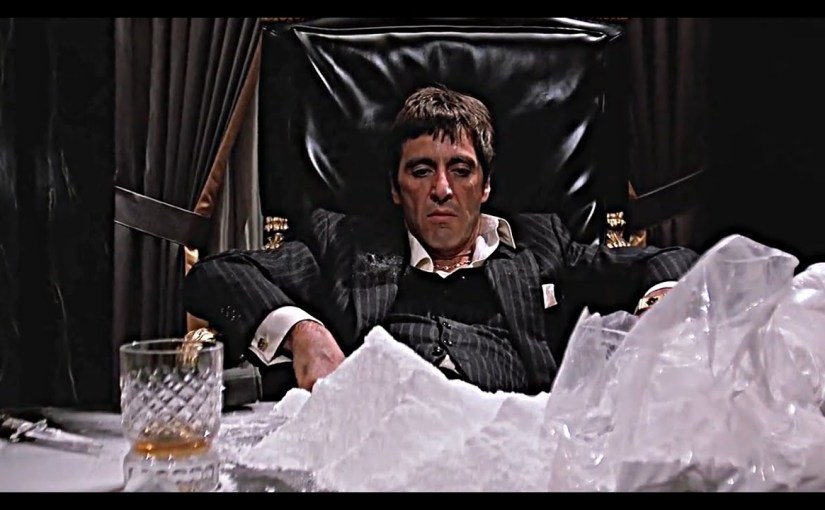
On Thanksgiving Day when we glutton ourselves with an abundance of food, it seemed highly appropriate to watch one of the most self-indulgent pieces ever put on film.  Brian DePalma’s Scarface with a script written by Oliver Stone and featuring Al Pacino.  This is a movie that brags about its boastfulness.  I mean look at everything that is mashed into this thing.  Blood, bullets, lots of cocaine and too much Al Pacino.

Pacino is Cuban refugee Tony Montana.  He is one of a handful of small time criminals who is shipped over to the United States when Castro wanted less people to oversee.  Refugee camps are fenced up under the highways of Southern Florida where no law is enforced among the tented populations.

Soon after Tony arrives he’s hot on the scene of pushing the newest underground product through Miami – cocaine.  With his buddy Manny (Steven Bauer) the two men get in good graces with a well dressed sleaze named Omar (F Murray Abraham), who is second in command to an established drug kingpin named Frank (Robert Loggia).  For Tony and Manny it’ll only be a matter of time before they take over as the numbers one and two bad guys.  That’ll include Tony marrying Frank’s blond trophy girlfriend Elvira (Michelle Pfeiffer in her breakout role) and winning a trusting partnership with a South American drug czar named Alejandro (Paul Shenar).  If you ever expect to get killed, you don’t want to be by the orders of Alejandro.  A helicopter serves much more of a purpose once it takes flight.

Scarface is a step-by-step movie or a climb up a three-hour ladder and then a gradual drop down off a balcony into a bloody fountain below.  There’s no depth and it works like a shopping list that you check off as it moves along. Props and houses and suits and jewelry and cars and cocaine and cash have more significance than what anyone has to say. Other than Tony, none of the people in this film matter. What Tony acquires and what he says about himself is all that is important.

This is a big ass movie with bloody graphics and killings, mountains of drugs and money, a lot of fucks, a gaudy estate home, a way over the top Al Pacino and lots and lots and lots of bullets and guns to go with them.  The film only settles for one chainsaw killing, though.  At the time, I recall that scene was up for big debate on the film’s MPAA rating.  Brian DePalma wanted to up the ante on brutality to grab moviegoers’ attention.  The scene remains quite stomach churning.

DePalma’s best work is at the beginning of the Scarface.  Following the establishing real life footage of the Cuban refugees arriving by boats in search of an American dream, Tony is taken into custody and questioned by a batch of immigration agents.  DePalma only keeps one steady camera focused on a very tan Pacino with a faint signature scar on his left cheek, sitting in the middle of the room and putting on a Cuban accent that only he could uniquely own.  Pacino’s concentration in this moment is admirable as he responds to questions from all different directions.  It’s all done in one take with the director’s camera circling around Pacino.  After this introduction is over, the tone of the movie changes for the next two hours and ten minutes into a gritty interpretation of Lifestyles Of The Rich And Famous.

Oliver Stone’s dialogue with Brian DePalma’s set ups don’t require much of the other actors.  It’s like everything caters to an always inebriated, hyperactive Al Pacino doing his Tony Montana with the gold chains and wide collared shirts over the linen suits.  He’s a motor mouth of endless f-bombs, with a slinky Michelle Pfeiffer in a blond bob-cut, dressed glittery evening gowns, at his side.  She has nothing of significance to say.  This is all you learn about Elvira; what you see of her materialism and all the coke she snorts.  She never smiles or exudes any connection to the Pacino character.  It’s all eye candy.  In fact, there’s never a clear answer of what becomes of this character.  That’s a problem because the movie is so much about Tony Montana, nothing else matters.

Other characters not given enough attention are Tony’s sister Gina (Mary Elizabeth Mastrantonio) and their mother (Miriam Colon).  Momma despises Tony for the criminal thug he is while Gina becomes enamored with the wealth and drug night life.  Unfortunately, Momma only has one meaty scene and Gina’s purpose to the script is to lend reason for another character’s eventual demise.  Both of these actresses are very good with what little they have.  Yet so much is devoted to Tony’s indulgence and the mania that Pacino brings that they are sidelined as well.

Brian DePalma seems to be more proud with how excessive he can make this guy than actually turning him into a guy.  Wait until you see the mansion that Tony gets. His office alone is of black, gaudy exuberance. His master bedroom contains a small swimming pool size tub right in the middle of the carpeted floor.  That setting occupies a fifteen-minute-long scene of Tony in a bubble bath, watching his five TV screens while not talking about anything meaningful except himself as he chastises Manny.  Elvira is only there to uphold her dread for her husband as she snorts coke off of her vanity.  When they both leave, an Oliver Stone monologue ends with a now recognizable sound byte of “Well say ‘allo to da bad guy!” Ah! Big deal! Tony never seemed so bad ass as he does feel obnoxious.

Again, Scarface is about not much else except the conceit of sleazy criminal.

When someone has to die it becomes a long drawn-out process as Tony, aka Pacino, puts on a performance or delivers a sermon.  Tony will meet with kingpins from Columbia along with other South Americans and dirty government officials.  There will be 5-7 guys in the room but for the most part it is only Tony talking.

“Say ‘allo to my little fren!” is one of the most memorable lines to come out of the 1980s decade of excess and it arrives during the ongoing and endless bloody shootout that closes the film.  There’s buckets of blood and truckloads of ammunition fired off.  These machine guns seem designed to kill things twice the size of elephants.  Little Al Pacino, with a ginormous cannon gripped in one hand, gets hit in all places and extremities except the head so that he can keep ranting – I mean this guy never shuts up – and going as he fends off the armies of goons coming at him from all directions.  Truly, it’s laughable and nowhere is it ever absorbing.  It’s like I’m watching someone else play a first-person shooter video game during a sleepover.  My friend is entertained while I’m just watching him be entertained.

Scarface comes to an abrupt halt when the final shootout stops.  There’s no footnote to ponder or real news story to follow up on.  The credits roll and the orchestral strings of the soundtrack cut in. You get the idea that DePalma, Stone, and Pacino became exhausted over this monster of a movie and simply declared “Okay! That’s enough!”

Considering the later insightful pieces that Oliver Stone delivered like Platoon and JFK, I wish he explored more of the politics and Cuban dealings affecting the United States.  As this film arrived in 1983, soon after there would be more of an intellectual standpoint to make us aware of a very real drug epidemic in this country.  It may appear to be sending some kind of message, but Scarface doesn’t challenge the brains that flourished this contraband industry.  Forty five minute episodes of Miami Vice tell more than this three-hour opus.

Plenty of gangster films like Chinatown, The Godfather, and Goodfellas offer up the greed and ego of the criminal mind, but the men of those pictures are never as self-indulgent or off putting as Tony Montana.

Besides, what does it say about a movie called Scarface when no one calls the main guy Scarface, and you hardly ever see the scar graced across his profile?  The real Scarface, Al Capone, would be very disappointed in Al Pacino.

SEA OF LOVE

By Marc S. Sanders

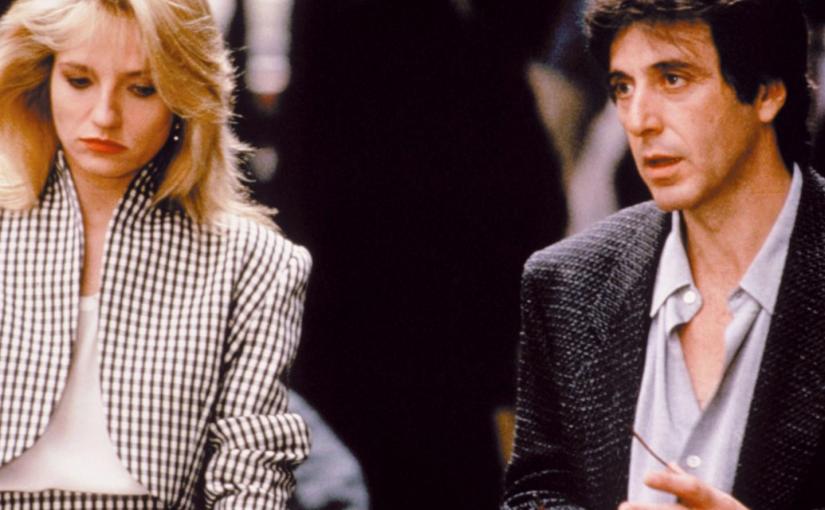
Al Pacino is a twenty-year veteran New York City cop, working out of Manhattan, on the trail of a serial killer in Sea Of Love.  The profession is nothing new to Pacino’s repertoire of roles, but the portrayal is unique thanks to a smart and suspenseful script from Richard Price and intense directing from Harold Becker.

The killer leaves a calling card.  A 45 LP record of Phil Phillips ’50s classic crooner, “Sea Of Love,” spinning on the turntable.  The victims are naked men lying face down in bed with a bullet to the head.  Turns out that a cop from another precinct played by John Goodman has uncovered a similar crime scene in Queens.  So, the two team up.  They believe the murderer is a woman.

All the victims have posted a Lonely-Hearts Club blurb in a magazine. The invitation for a date stands out because the text rhymes.  The detectives decide to post their own ad in the same kind of format, meet the women who respond and hope to nab the killer.  It gets complicated when Pacino encounters a breathtaking and sultry woman played by Ellen Barkin. 

Pacino’s cop is a smart guy.  He’s got instincts.  Yet, perhaps due to his constant drinking, insomnia, and the bitterness he carries now that his partner (Richard Jenkins) has hooked up with his ex-wife, he’s also quite vulnerable.

The mystery is strong, and the tension builds as Sea Of Love moves on.  Barkin has Pacino and the audience convinced that she’s the prime suspect.  Still, he lets his defenses down because he’s easily getting seduced by her advances.

Whether you’re watching Al Pacino share scenes with John Goodman or Ellen Barkin, the execution is fantastic.  Great performances from the three.  Pacino and Goodman have a natural exchange with one another. Often humorous, but the guys always talk like cops.  When Pacino admits to tossing away a fingerprinted glass from Barkin, Goodman suggests lifting the prints from something- ahem – more personal of his.  A cute wink and nod exchange.

More important to the film is the erotic chemistry between Barkin and Pacino.  Harold Becker uses a late-night supermarket visit in the vegetable aisle to evoke the risky and irresistible nature the two characters develop for one another.  Other scenes build well on the relationship between these two lonely strangers who’ve only recently met. 

Moments of isolation and drunken stupors also work towards fleshing out Pacino’s burned out cop.  He’s got a schleppy posture to him and an exhausted expression with his sullen eyes and shaggy black hair.  At the same time, his character’s twenty years of experience seem to uphold his alertness.  This cop knows he’s letting his guard down. Without any dialogue, you see the internal struggle Pacino has with what should be done against what he is deliberately neglecting.

This film was Ellen Barkin’s breakthrough role.  She received rave reviews as someone who takes care to uphold a New York City trendy appearance by day as a shoe salesperson in contrast to a woman looking for some carefree lust in the evening.  For Pacino, Sea Of Love reinvigorated a career slump following a series of poorly reviewed films.  Together, they make for a sexy yet untrusting pair.

Circumventing this relationship is the mystery.  Is Barkin the culprit? She seems to have a dark way about her that may not surprise you.  Price, Barkin and Becker designed the character quite well for her to at least have the potential to be a killer of men.  Is she setting Pacino up to be the next victim?

New York City from the late 1980s looks great, even though interiors were shot in Toronto.  Trevor Jones offers a nail-biting soundtrack to keep the suspense heightened at just the right beats of the picture with Becker’s camera pointing down dark hallways or when new clues are discovered.

I’ve seen Sea Of Love a few times and even with knowing the surprise ending, the film still holds up thanks to the performances from its three stars, along with its taut editing, well-paced writing, and smart direction. 

This is a good erotic murder mystery.

GLENGARRY GLEN ROSS

By Marc S. Sanders

The characters in David Mamet’s Glengarry Glen Ross are under terrible pressure.  They are salesmen who are consistently chasing insurmountable sales goals in real estate properties.  One of them has an ill daughter in the hospital.  Another has a temptation to rob his office as a means of earning some fast cash.  Another is in despair of his self-worth.  To be a salesman, of any kind of commodity, is a tough life to lead.  The payoffs can be enormous when a sale is successful.  However, once a transaction is complete, the response is often “what have you done for me lately?”  These guys are never happy.  However, they are also some of the cruelest, most insensitive, and thoughtless people you will ever meet.  They have no other choice but to behave that way.  It’s the nature of the business.

The film adaptation of Mamet’s Pulitzer Prize winning play contains a collection of outstanding actors doing some of their best work.  They embrace the brutal dialogue the screenplay hands over to them with relentless cursing and flaring tempers.  Glengarry Glen Ross has you believe that you run your sales career on your own with little help or encouragement from the people you slave for. 

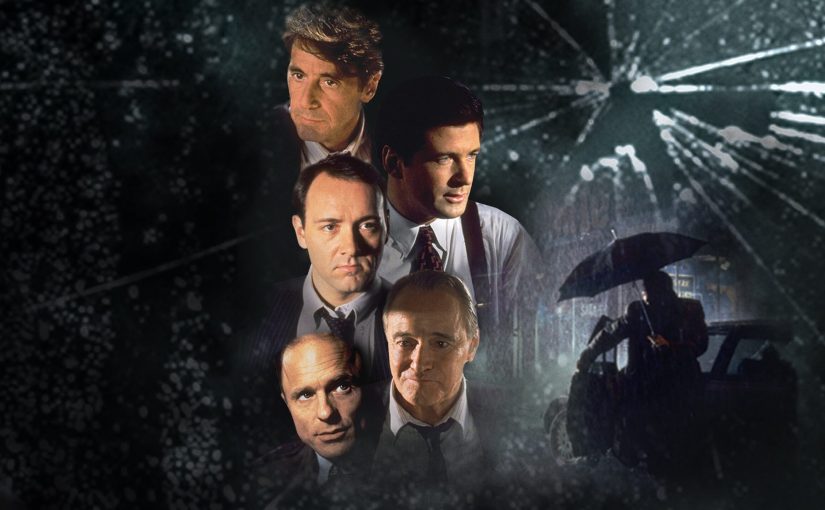
Early in the film, Alec Baldwin, known only as a man named Blake (based on the end credits) visits the office where these salesmen are based out of.  He delivers an unforgiving and harsh reality of what these men must do.  They either get their sales numbers high on the board, where they can win a new Cadillac, or they settle for a set of steak knives for second place.  After that, they are fired.  Regardless of where they currently stand though, they should not even be pouring themselves a cup of coffee.  Coffee is only for closers.  The office manager, known as Williamson (Kevin Spacey), only provides the men with sales leads that have already been exhausted with rejection and hang ups. 

Director James Foley does a wise technique with color.  The first half of the film appears in drabs of greens and greys amid an evening of torrential rain downpour.  Before Blake finishes his threatening presentation, he dangles new leads, the “Glengarry Leads,” in front of the men saying these are not for them, because they are only for closers.  The old leads that Williamson hands out are on green index cards, nothing flashy.  Blake’s leads are bright pink with a gold ribbon tied around them.  Foley makes sure that even a prop tells a story.

The salesman that gets the most attention is perhaps Shelley “The Machine” Levene played by Jack Lemmon.  He’s elderly and past his prime with no numbers currently on the sales board.  Frequently, he is making calls to the hospital for an update on his daughter who is due for surgery, but if he can’t make a payment, then the procedure is likely not to happen.  Lemmon is fascinating in maybe the best performance of his career.  Many of his scenes are toe to toe with Spacey as he shifts from pleading to demanding to disingenuously threatening and ultimately bribing Williamson for the new leads. Levene is so out of touch now that he can’t even sell Williamson on helping him out.  Spacey as Williamson is terrific in his defiance to not lend any sort of aid to Shelley.

David Mamet added additional material to the script, not found in the stage play.  The Blake character is new to the film, for example, and I think it is a better, more fleshed out story because of it.  As well, Foley is able to go outside of the reserved settings of the bar and office, as he follows Levene making a knock-on-the-door sales call in the middle of the rainy night to a family man.  This may be Lemmon’s best scene of the film as he weasels his way into the home to quickly get his raincoat and hat off and get a seat on the sofa as he begins his “once in a lifetime” opportunity that the potential customer may miss out on.  It’s a sales pitch, despite Lemmon’s charm, and the patron can see right through Levene’s performance.  As the door closes on Shelley, you’re terribly sad for his desperation and failure.

On the other end of the spectrum is the current, most successful salesman named Richard Roma.  He’s played by a showy looking Al Pacino who initially doesn’t perform in the broad strokes he’s become recognized for as an actor.  Pacino does a quiet, delicate approach to his character’s sales presentation as he shares a table with a sap (Jonathan Pryce) who is weeping into his liquor glass.  Roma stretches the rainy evening out in the bar with this guy, talking about vague anythings, until he can subtly pounce on him with a brochure that’ll get his signature on a contract. 

Two other salesmen, Moss and Aaronow (Ed Harris, Alan Arkin) vent their frustrations elsewhere in the bar as they eventually segue into an idea of burglarizing the office for those tempting new leads.  However, are they working together as a team on this idea, or is one working something over on the other?  Mamet’s dialogue is chopped up perfectly with utterances and interruptions, that before a character reveals his intentions, you are left flabbergasted.  What is demonstrated here is that a skillful salesman is also an efficacious manipulator.

The second half of the film is set on the following morning where the sunlight has come through.  New revelations following the stormy night from before will present themselves as the men gradually arrive at the office to find it actually has been robbed.  The obvious of circumstances are there.  However, Mamet sets up an ending that’ll leave you breathless.  It did for me the first time I watched the film.  Just when you think you are watching a protagonist throughout the film, something else entirely comes up.

Glengarry Glen Ross has been regarded as a modern-day Death Of A Salesman.  Maybe it is.  I’ve worked in this kind of field before. There were months where I was good at it, and like everyone else, I would brag about my success with recaptured anecdotes and celebratory curse words flying out of my mouth.  There were also months where I would gripe about how uncompromising this life is. When I didn’t want to do sales any longer, I spent twelve years as an assistant to sales representatives.  They are not your friend.  They are only focused on the next contract to be signed and booked before month end, and they will ask anything of you with a seething f-word attached to their request.    Are we so terrible if we can not make an unreachable goal with tools that offer no help and supervisors that lend no encouragement or forgiveness?  To be a salesman means that any of your past accomplishments or education do not define you.  You are only identified as the one who must acquire the next thing, and then the next thing after that.  It will change your attitude about yourself and how you treat others.  It’ll alter your dialogue which is so vitally apparent in Mamet’s story.  It will even influence you to take measures you never thought you’d be capable of.

James Foley enhanced an already electrifying script from David Mamet.  He knew that if he was going to show how hard and challenging it is to be a salesman of boring, uninteresting, and practically intangible parcels of land, then he was going to have to be relentless in the art direction and settings contained in the film.  The first half of the film never, ever lets up with the rain storm going on outside in the city street.  The evening is as black as can be, and yet Williamson casually will ask Levene if he is going out tonight. Who in the dead of night in the rain is going to want to talk to a droning salesman about anything?  Yet, that’s what is expected of this life.  The office setting is unfriendly, decorated with ideals that hang from the walls with phrases like “A man must embrace further than what he can reach.”  Little touches like this only add to the uncaring and selfish nature the men really have for one another. 

Glengarry Glen Ross depicts a hard life for the man in a suit.  You may dress like what is expected of a professional, but you are also always scraping the bottom of another bottom.  The cliché that money can’t buy happiness is personified in a film like this.  You may get to the top and score a nice commission, but it’ll soon be forgotten and nothing you’ve done before will lend to your current state.  Next month, someone else will be standing where you are standing.  Worse, you may never be standing on top again, and then what will you do?

Sadly, I believe that Glengarry Glen Ross reflects what many people experience at least at one point in their lives.  We are all salespeople to a degree whether we are doing a job interview or even trying to impress the parents of someone we are dating.  It doesn’t always work out.  The question is where do any of us go from that point.

SERPICO

By Marc S. Sanders

In the 1970’s Al Pacino had a slew of Oscar nominated roles.  One of those revered performances was as Frank Serpico, the righteous cop working with a corrupt New York City police department, in Sidney Lumet’s gritty Serpico.  The wardrobes and appearances of New York and its five boroughs seem unfamiliar nearly 50 years later, but the film can still maintain interest for a viewer because it’s astonishing how valid and true all the facts remain.  Cops were happily taking handouts, while the politicians and commissioners took no issue with looking the other way.  Whether it was disregarding a deli owner’s double-parking offenses for a free sandwich, or skimming some payouts from drug and prostitution rings, Serpico’s morals were always facing an insurmountable conflict.

Lumet’s film starts off with an interesting observation.  Word gets out that Frank has been shot and is being rushed in an ambulance, and one police officer asks the other, if a cop did it (not who did it).  If you never knew anything about this guy’s life or what he experienced, you know in just a small economy of words that Frank Serpico has become everyone’s enemy; not just to the hoods, pimps and drug pushers, but to those who are supposed to be his allies and support.

Long before Al Pacino inherited his gruff smoker’s voice that bellows like an angry lion with too much phlegm, he had the ear piercing outbursts with the same intensity to frighten his co-stars.  His character is seemingly the one true blue cop in the entire squad who doesn’t befriend the local hoods.  Serpico never accepts a bribe or hides a report.  It’s a frustrating ordeal and Pacino goes to the limits with big outbursts while pacing back and forth and showing terrible fear and panic in his eyes.  Lumet’s camera is quick enough to capture every tick that Pacino exudes.  It’s not Al Pacino performing within the frame of the camera.  It’s actually Sidney Lumet’s lens adjusting to how wild Pacino goes physically with his volume and body language.  

Frank Serpico was a lone wolf.  As the story progresses, the other cops find it hard to believe that he will not accept being part of the gang that is on the take. They grow concerned.  Can they trust Frank to keep his mouth shut and let things be?  No, they can’t count on Frank to toss a blind eye.  He is persistent on getting this story out to the proper authorities.  Naturally, it’s hard for these corrupt individuals to share a locker room or ride in the same car with him as a passenger.  Frank’s limit though is that he is reluctant to testify.  Get the investigation going and have the authorities uncover it for themselves, and then do something about it.  That’s all.  If he testifies, then his life is truly in danger as this all becomes official in a court of law.

Serpico is a good film because of Pacino and because of the concept of the story.  It’s more compelling because arguably in the United States’ most well-known city, corruption actually abounds.  Dirty cops in New York City?  Why, that’s unheard of! It was sadly all true and justice was not being executed fairly.  

However, Serpico is not Lumet’s best film, nor Pacino’s.  Often it meanders.  There’s not a lot of action.  There’s quite a number of scenes where Pacino’s screaming paranoia takes over.  It grows tired, honestly.  Moreover, it gets repetitive.  Many of Pacino’s outbursts feel like I just saw a scene like that, five minutes earlier.  

What keeps me going through the film is the fact that one authority after another refuses to take this problem head on.  The captains, the commissioner, the prosecutors and even the mayor of New York City never allow any chance of pursuing the wrongdoing that’s occurring.  After all, if you prosecute everyone involved, who is going to be left and how would that make an elected official look in the eyes of his constituents?

There are subplots focusing on the relationship between Frank and a couple of his girlfriends played by Barbara Eda-Young and Cornelia Sharpe.  I found these connections to exist as additional outlets for Pacino’s outbursts.  I didn’t terribly mind this material.  The acting is fine, but what did I gain from moments?  I read that the actual Frank Serpico had four relationships during his time as a New York City cop.  From a story perspective however, condensed into a film, I didn’t gain any new insight.

Serpico is worth watching.  I just wouldn’t put this on the top of my Lumet or Pacino priorities for must see viewing.  Still, it’s a true story that I’m satisfied was told.  In 1974, Hollywood was taking risks to show the ugly side behind a uniform or face of nobility.  This is where I consider film medium to be a necessary conduit of information and awareness for us.  On that level, Serpico serves as an important treatment.

THE DEVIL’S ADVOCATE

By Marc S. Sanders

The Devil’s Advocate does not get the accolades it truly deserves, and I’ve never understood why. It is more than just a supernatural thriller or a legal drama. It’s both actually, and most films cannot lay that claim.

Director Taylor Hackford has assembled a brilliant cast that boasts a debut from Charlize Theron in the incredibly complex role of Marienne, wife to Keanu Reeves’ hot shot southern drawled, Gainesville attorney. Theron hits every pulse perfectly beginning with loose, beautiful and cocky to insecure, haunted and victimized. When I first saw the film in theatres, I left believing she’ll get an Oscar nomination. Alas, the powers that be never gave her consideration and they were wrong. Beyond a relishing Al Pacino as the lord’s most infamous fallen angel, Theron’s performance sends the script home into absolute believability. The power of Satan is executed on Marienne, and the visual and audible evidence lies in Theron’s delirious performance. She’s astonishing.

Next up, Reeves is entitled to lots of credit. The role of Kevin Lomax is his best role (Ahem…Sorry, Neo. Sorry John Wick. Sorry Johnny Utah.). He carries a disillusioned swagger that he is as good as his record of trial wins implies. Yet, is he as good as the best of the best New York City attorneys? When you are the son of Satan, maybe so. What works best though are the ongoing tests of will for Reeves’ character. His inescapable hillbilly dialect blends perfectly with a script that questions temptation against instinct, against opting for what is right. At the time of release, Keanu Reeves might have been perceived as his surfer dude Bill & Ted character not be taken seriously enough here. I never let that be an interference for me, however. Reeves doesn’t compromise and he avoids the wholesome, God-fearing kid that Kevin Lomax is meant to be. Instead, his Christian teachings seem like a nuisance for him; an obstacle to a more satisfying life regardless of sin. Reeves balances the dimensions beautifully.

Then there’s the machine behind all this. Al Pacino is John Milton, hardly disguising his true identity. He’s too proud of who he is to do that. Sure Pacino is chewing the scenery. Yet, shouldn’t he? This is Mephistopheles he’s playing here; an entity ready to undo the will of the Lord. He carries no honor for God. However, he maintains a rule book and before he accepts a disciple, he’ll make certain that it is by the follower’s choice alone. He administers the test, but he doesn’t take it. Pacino gets the best lines and the best monologues. He’s treated with an opportunity to two step along to Frank Sinatra. He’s given free reign to operate based on his legendary career. He’s my favorite devil of any and all films.

Taylor Hackford is meticulous in his direction. There’s a great moment near the beginning where Kevin is saying goodbye to his God loving and very Christian mother. He goes to her church. This is the first of many smart choices for Hackford. He does not allow Kevin to step inside the church. Rather, he paces just outside the door. Kevin does not have a relationship with God, thus opening an opportunity for Satan. Other moments are there too, such as Milton always insisting on traveling by subway…underground. Heck, there’s even a moment where a man with a box that says “Halo Industry” walks by Kevin and John; nice subtle nod. New York City is treated like a character boasting its numerous, sky-high cathedrals and angelic artwork. Pacino is the ultimate NYC resident; a creature of the concrete jungle. Hackford also recruits the notorious to boost the lair surrounding Reeves and Theron with appearances from the likes of Don King and Alphonse D’Amato. (Satan’s disciples, perhaps?)

This is one of my favorite films. It carries not one single flaw. It is richly assembled in dialogue, story, cast, set design and direction.

The Devil’s Advocate is one of those films that you want to watch over and over and delight in Pacino’s thought provoking one liners, debate with your conscience vs Satan’s own argument (he makes some good points here) and question the power of free will. It’s a fun, thinking picture.

DOG DAY AFTERNOON

By Marc S. Sanders

Sidney Lumet uses his best strengths in this ridiculous Brooklyn bank robbery that is actually based on fact.

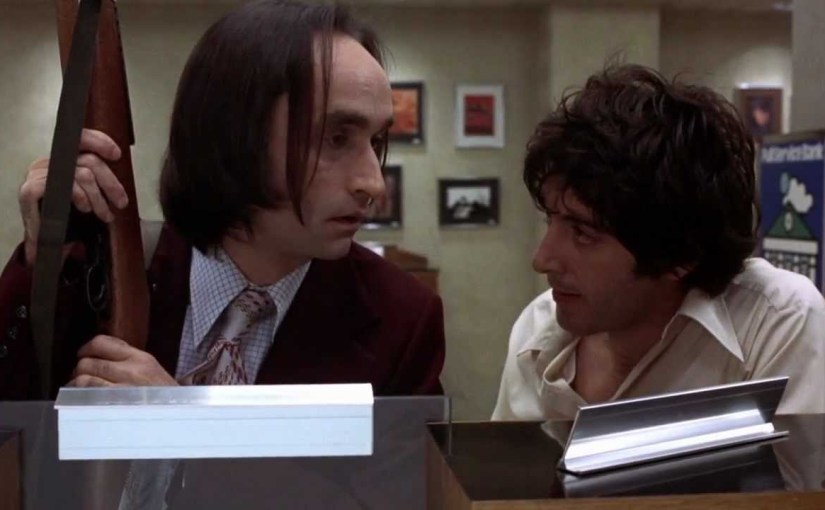
Here, Al Pacino and his cohort, John Cazale, play inadvertent stupidity without compromise. If two of the three stooges went on to do drama, this would be the material they’d use.

A simple bank robbery with little to no planning spirals out of control and into sheer pandemonium. Nothing goes right even when Pacino’s dimwit character, Sonny, is deluded enough to believe all is going in his favor. He immediately earns the support of the encroaching Brooklyn community only to lose them when he shows his true homosexual nature. Then he’s blindsided as to what happened. Layered in drenching sweat, Lumet wisely takes advantage of Pacino’s best up close facial expressions. Utter delirium!!!!!

Once again, Lumet’s camera moves while his best actors remain naturally in place. Al Pacino does his thing and trusts his director will find his shots. As the cop initially in charge, Charles Durning does as well. Pacino and Durning especially have great scenes together in the middle of a heavily populated New York Street as the robber shines off the cop, and the cop does his best to obtain some measure of control. It’s a scream fest for the ages. “Attica! Attica!” Pacino and Durning’s best career performances were always the ones where it looked like neither of them were ever acting. Dog Day Afternoon is one those better examples.

Frank Pierson’s jagged script of wild turns makes every person whose an extra like the pizza delivery man, for instance, caught up in the hysteria. The pizza kid shouts out to the crowd “I’m a star!!!” It’s great reason to applaud Sidney Lumet’s control over a crew and the entire company of extras he’s employed. This film is a rare example where all of the extras (seemingly the entire Brooklyn population) are as integral as the leads. The setting is the main antagonist from the media all the way to the observers who can’t look away and can only cheer, yet mock as well. Brooklyn, New York is a great character here.

Most fascinating about Dog Day Afternoon is that it is all based on fact from the media circus to dumb bank robbers with a need to steal in order to fund a lover’s sex change operation. It’s ridiculous. It’s funny. It’s frighteningly stressful and it’s all true.

This was released following the first two Godfather films and confirms the enormous range Al Pacino possesses with his performance talents. Hyperactive and dumb here as gay bank robber, Sonny; quietly contained, evil as Michael Corleone. His range was through the roof in the 70s before absorbing his loud, crackling, smokers voice. It was when the script outshined Pacino and before the current age of writing being catered to its bankable star.

Lumet also allows great moments for the hostages who become undone to the point of regretfully using foul language, to actually befriending their captors. He’s a director who efficiently leaves no stone untouched.

Chris Sarandon as Leon, Sonny’s male gay spouse is great here too. He’s full of melodrama, panic, worry, and a New York maternal despair. Another great scene is a phone exchange between Pacino and Sarandon. It might appear funny at first, especially in the 70s when homosexuality was lampooned often with the other F-word, but anyone who appreciates the filmmaking of Lumet will quickly contain their snickering when they realize a gay man is equal flesh, bone and feelings like anyone else.

Dog Day Afternoon is very telling of an out of the closet social media future. The story will always get grabbed regardless of danger or sensitivity. People will get swept up in the hoopla (a teller hostage quickly boasts her brief fame on television “Girls, I was on TV!”), police will overextend their privilege, helicopters will swarm, the criminals will demand their moment in the spotlight, and the public will serve as jury per the majority.

It’s a vicious cycle but considering it is a 1975 masterpiece, it’s all disturbingly valid and sensationally true.

THE INSIDER

By Marc S. Sanders

When I think of Michael Mann’s The Insider from 1999, I cannot get over how deep it is with its storytelling. Inspired by true events and based upon a Vanity Fair article, I consider the adjective “deep” because it’s really a one-story trajectory, but it covers so many different facets; so many different industries and how they operate and sometimes overlap with one another. The tobacco industry, journalism in both television and print, state law and even the deterioration of an American household. Michael Mann shows how one simple action can balloon into something bigger affecting others all at once. You gotta get through one thing before you swim deeper into the bottomless pool of policy, contracts, ethics and threats.

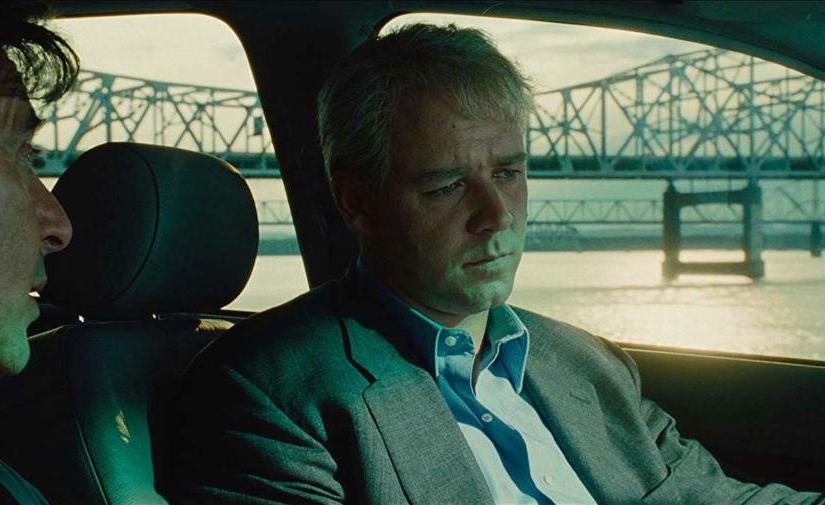
Russell Crowe portrays Jeffrey Wigand, a top leading chemist with the Brown & Williamson Tobacco Company. Upon realizing that he has detrimental information should it go public, the company fires him and compels him to sign a confidentiality agreement not to reveal any of his research or activities while in service to them. That won’t suffice for the incredibly powerful tobacco company though, as Dr. Wigand receives threats that include disturbing emails, possible prowlers and a bullet that mysteriously turns up in his mail box.

Wigand crosses paths with Lowell Bergman (Al Pacino), a producer with 60 Minutes at CBS Television. Bergman works often with famed interviewer Mike Wallace (Christopher Plummer, who should have been nominated, much less won an Oscar). Wigand gets more and more motivated to go on Bergman’s show and tell everything about how the tobacco industry manipulates cigarette manufacturing to make it all the more addicting.

Bergman wants the story but he wants to play it carefully. Toeing the the line of maintaining Wigand’s confidentiality agreement might require a deposition by the scientist in a state courtroom so that his testimony will be public record. In other words, get a state to subpoena him and then the interview can happen because what Wigand says in an interview is already public record.

It’s complicated. Not so much for the viewer though. It’s complicated for Jeffrey Wigand. Russell Crowe emotes his rock and hard place situation with terrible anguish and a short temper. Michael Mann gets great closeups that capture the stress like deep wrinkles and dark circles under the eyes along with pale white skin, a big gut, wrinkled dress shirts, and rough shaves. The stress also carries over to his southern gentile wife (Diane Venora in an entirely different role from Mann’s Heat) and his two girls. They are collateral damage here. Wigand could also lose medical coverage on top of his salary and the threats of civil liability. Jeffrey Wigand is an ant under the very large heel of Big Tobacco.

Lowell Bergman also has obstacles from within his own camp. Journalistic integrity is tested with Wigand’s interview. It’d almost be better if Wigand was lying. That way Big Tobacco could not sue CBS for breach of a confidentiality contract. The more truth he tells, the greater the liability. Considering that CBS Corporate is in the middle of a buyout that could be very profitable for a select few, CBS is disregarding Bergman’s reputation for bringing in experts and informants that have made 60 Minutes the most watched news program on television.

These are the dilemmas that comprise Mann’s near three-hour film. What’s as interesting is the in between material. With Mann sometimes shooting with a documentary like approach, we catch glimpses of how a journalist will pass a colleague in a rotating lobby door and they’ll make arrangements to exchange one story in a time slot for another. These are mere seconds, but it paints a colorful setting that the news never sleeps. We see how Big Tobacco (represented by a slimy Michael Gambon) can subtly intimidate one man in a corporate office. We see a trio of lawyers take a phone call from a private jet they are piloting to consider Wigand as a material witness. We see how one of those lawyers (Bruce McGill) will handle an objection during his questioning of a witness (an unforgettable scene). We see how Wigand must adjust with his family to downgrade to a smaller home with old dusty kitchen cabinets and how it all gradually weighs down his marriage. We see how Bergman has to be covert with meeting Wigand in a hotel lobby. We also see how Big Tobacco can issue a smear campaign and how Bergman has to go across the street to a newspaper colleague to first ask for a deadline of print to be pushed back, and later how he grants a story to the paper to reveal shady dealings and how to refute what’s already been falsely claimed. There’s even a deal that indirectly involves the infamous Unabomber. It’s these little details that keep the film’s pulse alive.

Even before all of this begins, Mann demonstrates the lengths Bergman and Wallace will go to for 60 Minutes. They go deep into the Middle East to get an exclusive interview with the Head Sheik for the Hezbollah terrorist group. Christopher Plummer as Mike Wallace is marvelous here as he stands up against an irate bodyguard strapped with a machine gun to argue about how close he will sit next to the Sheik. If you want the story, the true story, you have to be genuine and be fearless with risk.

I can’t say enough good things about The Insider. It’s truly an education to watch the film with blazing cinematography in blues and grey hues from Dante Spinotti. Mann is always known for his coolness with film, dating all the way back to the MTV vibe of Miami Vice to Thief with James Caan, and his LA crime drama Heat. The tradition carries on here.

As well, the dialogue is so crisp from a script by Mann and Eric Roth. Pacino is memorably given an opportunity to sum up the machinations of CBS corporate in the third act of the film. The Mike Wallace character is not written as a television personality with a cue card. He’s got real, good, seasoned intelligence in his words. Plummer just enhances the script.

The Insider ranks at the top of the list of films focused on journalism next to features like Sidney Lumet’s Network, Tom McCarthy’s Spotlight and Alan J Pakula’s All The President’s Men. It explores the danger that can come from truths that need to be told which others never want disclosed. It covers the methods by which parties are recruited to help get the truth and the lengths operatives will go to, to squash a story.

The Insider is a gripping, magnificent film.

HEAT (1995)

By Marc S. Sanders

My all time favorite crime drama, as well another one of my most favorite films, is Michael Mann’s Heat which is widely recognized for the much-anticipated moment where Al Pacino and Robert DeNiro finally share the screen together for the first time. The Godfather Part II never counted as their characters performed in different time periods. Still, Heat has so much more going for it, beyond just its headliners.

Michael Mann wrote the screenplay he directed. It deeply involves both the thief, Neil McCauly (DeNiro), and the homicide detective who pursues him, Vincent Hanna (Pacino), with inspiration from two real life characters. Therefore, this film drives with more authenticity than a standard Lethal Weapon picture. Much more is at stake than a standard kill shot, arrest or the score to take down. The women and children and partners these guys become associated with carry a weight and sense of value. Even the hoods who betray them hold significance. How they matter and are part of the story is just as pertinent.

The story focuses on DeNiro, with Val Kilmer and Tom Sizemore taking down high stakes scores, not petty liquor store hold ups. An early armored truck hold up goes well until a new partner executes the three security guards in broad daylight on the street, at point blank range. Pacino takes the case along with his brilliant squad of detectives that includes great supporting performances from Mykelti Williamson, Ted Levine and Wes Studi. Then it becomes a cat and mouse tale where two equals match one another in wits, skill, and experience. To believe the equal match up though required casting Pacino and DeNiro. The film would not work with any other pair. Through their respective careers, their various performances came off different than one another. Yet, it has been often easy to imagine either one of them playing their classic roles instead. I could envision DeNiro as Michael Corleone or Serpico. I can also envision Pacino as Rupert Pupkin or Travis Bickle. The range of these actors is unlimited.

Diane Venora and Ashley Judd are two actresses not used enough in films. As the wife to Pacino’s round the clock detective, Mann provides time for Venora to show the pain of a woman in love with a man who can hardly ever be home because he’s always on the prowl of DeNiro’s professional thief and his crew. Venora is a likable woman in the role, only the circumstances of her marriage and the difficulties of dealing with a troubled pre teen (a fantastic Natalie Portman who will break your heart with just three scenes) are gradually making her cold. She has a great monologue midway through the film that is terribly dark, as she surmises Pacino’s cunning detective.

Ashley Judd is a different kind of cold as the wife of Val Kilmer’s gambling addicted sharpshooter. She’s a beautiful housewife and mother to a toddler that is trying to maintain a happy home. However, the balance of living with a career criminal is near impossible to maintain.

Michael Mann put so much thought into characters like this. Other directors and writers would keep the story on the streets and in the hideouts and city precincts. Mann goes not just for the low level criminal hoods who provide information in a night club at 2 AM. Mann allows his crime drama to spill over into the home.

He even allows a side story to occur with an ex con (Dennis Haysbert) out on parole trying to get his life back in order. What does this guy with his loving girlfriend have to do with anything else? Eventually, the bridge is connected, and it comes down to an emotional and heartbreaking conclusion.

Heat deliberately takes its time to flesh out a lot of great characters. The large cast are all given moments to stand apart from the rest. It is primarily a quiet, talking picture of careful planning and investigation. However, when the legwork is complete, Mann arrives at two scenes right in the middle of the film. The first is the now famous coffee shop sit down confrontation between Neil and Vincent. Mann did a masterful job of capturing the two actors doing some of their finest work with nothing tangible to aid them; no props or grand music or effects. Just a table in the middle of a crowded coffee shop. The professionals allow their history to show only so much but the cop and thief know this is not going to be easy from here on out. Mann did numerous takes, but with at least two cameras showing at each go round. So, if Pacino is talking, we see DeNiro’s facial reactions and vice versa. Pacino’s take #11 is also DeNiro’s take #11. It is one of the all-time great scenes in film history. Beautifully written. Beautifully constructed. Beautifully performed.

The next centerpiece is the bank robbery that occurs at midday in downtown Los Angeles. Neil and crew are almost scott free when Vincent and squad intercept them in the middle of the street. What sets this massive shootout (based on a real incident) above all others is that I actually get choked up and emotional over the moment. Characters that I have become acquainted with for the last 90 minutes are swept up in huge risks and danger of massive gunfire and ambushes. I even become terrified for the extras that Mann includes in this scene. I’ve watched this scene a hundred times and I can’t help but actually get tearful over it. Mann has the power to make me have an affection for these characters. As well, how will the spouses, who become aware of this matter, be going forward? That accounts for much of the latter half of the film.

Neil holds true to a philosophy he learned while doing time. If you spot the heat around the corner, allow nothing to interfere that you cannot walk away from immediately to avoid getting apprehended. He is put to the test of that motto when he falls in love with an introverted graphic designer played with quiet reserve by Amy Brenneman. This storyline will sum up the ending. Again, Mann shows the characters on the outside of these guys with their guns, working in an underworld environment. How do the risks of these guys play out on others?

Technically, Heat succeeds as well with brilliant blues, blacks and whites in cinematography. Major accolades for Dante Spinotti. Everything from the well-lit coffee shop to Neil’s unfurnished, ocean view apartment and even a blue Camaro that Neil drives away in through an underground tunnel are brilliant. Spinotti paid careful attention to the evolution of the characters. As Neil drives into that tunnel, the car turns white hot. He is on his way to escape with an unsure Brenneman by his side. Often in moments like this, the film tells more than any piece of dialogue could ever sum up.

Heat is a must watch film for genuine portraits of characters few of us will ever cross paths with. We should understand, though, they have more than just a drive to steal or to get an arrest. These guys exist for more than just the score. Few crime dramas ever approach that angle, and that is why Heat is such a special film.

THE GODFATHER PART III

By Marc S. Sanders

Francis Ford Coppola and Mario Puzo finished out their Corleone trilogy in 1990 with The Godfather Part III. Not so much a sequel, this third film feels more like an epilogue jumping towards Michael Corleone’s (Al Pacino) elder years as the Don of the most powerful Mafia family in the late 70s/early 80s.

Michael seems exhausted with his rule as he suffers from diabetes as well as remorse for his past sins; especially feeling the guilt of ordering the execution of his brother Fredo.

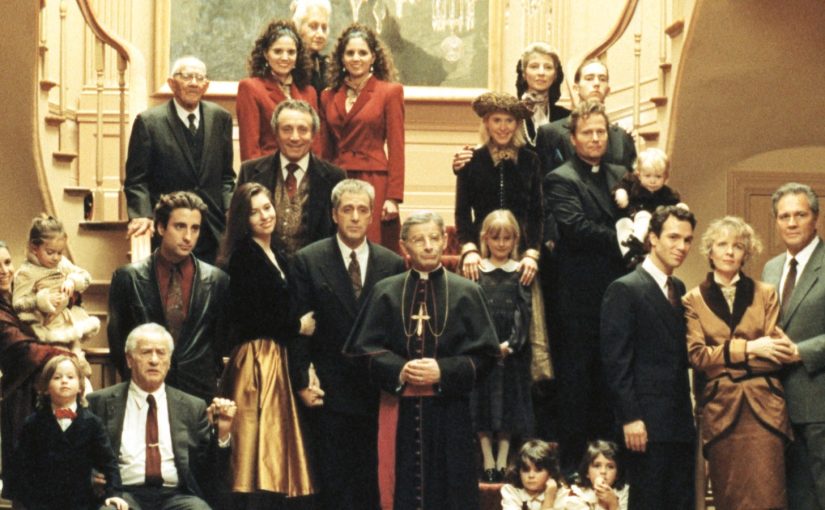
Still, he is drawn to crime, but on a more sophisticated and righteous nature by taking advantage of the Roman Catholic Church. Michael intends to purchase the powerful bank associated with the church but that’ll have to fall in line with the Pontiff’s agreement. It doesn’t help that the Pope is in failing health. The setup of all this lends to another grand opening where Michael earns a prestigious award from the church in the same tradition of an austere celebration of many guests that lend to character set ups for the film. A Godfather movie is not a Godfather movie without a grand reception to open the film.

The most interesting character is Michael’s nephew, Vincent (Andy Garcia), a fierce hot head like his father Sonny. He wants to work for Michael desperately while fending off a street hood boss (Joe Mantegna). An older don also comes into play by the great character actor, Eli Wallach. Diane Keaton as ex-wife Kay is also here but more or less to quietly bicker with Michael. Sister Connie is here, too, with Talia Shire. The Connie character always changes from each movie. Here she’s a deadly black widow. There’s also Michael’s daughter Mary (Sofia Coppola, contrary to popular opinion, I insist she’s very good in the role). Is Mary a legitimate cover for the family as the spokesperson for a fundraising effort? Is the possibility of Vincent and Mary (as cousins) getting intimate a terrible risk?

I like this film and hold it in high regard. Namely because Coppola and Puzo took an approach straight out of the news when there was an embezzlement scheme occurring within the Vatican bank. The problem for many I believe was that the plot of this grand scheme was not flashy or bloody enough, even if a participant is revealed to be hanging from a London bridge with fraudulent receipts falling out of his pockets…which actually happened in real life.

The film allows many opportunities for Michael to allow his anguish in guilt to flow. Fans grew used to a fierce Michael Corleone from the first two films. The elder Michael here would rather not get involved. Hence the introduction of Garcia’s character. He’s very good in the role. Yet there’s not much dimension to Vincent. He’s a scary violent guy, and a contradiction to what Michael seeks. Yet, thats about all there is. I would have wanted more dimension to this role; the guy destined to carry on the reign.

Sofia Coppola is fine in her part and undeserving of the lashing she received upon the film’s release. She’s Michael’s young daughter; a young adult dangerously close to the fray. The one innocent constant within the family. For me, I found a dramatic stake in her character.

The ending is very powerful. Slowly methodical as the family assembles in Sicily to see Michael’s son’s stage opera debut. There are elements that are consistent with the other films’ endings, but this violent conclusion comes with quite a shocking result. I was really moved by it.

Coppola didn’t measure up to the first two films with this effort. I agree with that. Still, The Godfather Part III is worthy of holding its place in the saga. It carries the traditions of the prior films in set up and music and operatic narrative. Be patient with its slow pace because I think the ending will grab you.