BELFAST

By Marc S. Sanders

Within the first three minutes of Kenneth Branagh’s Belfast, there is impactful transition that goes reverse in time.  Van Morrison supplies the music to the film and it opens in bright color capturing glimpses of the thriving city.  There are well paved highways with ongoing traffic.  Fresh painted construction cranes stand in front of a blue sky with a warm sun.  Buildings have beautiful architecture.  There are pieces of eye-popping art within the city.  It looks like the most gorgeous vacation destination.  Even the opening credits are stenciled in nice gold font.  Then Branagh’s camera lifts up over a wall and the screen reverses back in time to August, 1969 where it’s depicted in black and white.  A sweet blond-haired boy named Buddy (Jude Hill) is holding a stick and a trash can lid as he slays an imaginary dragon, but then reality dawns upon him and violent riots erupt on the street he lives on. Cars are set on fire, windows are smashed, bricks are thrown, and Molotov cocktails burst into flames.  What we see as prosperity now, had a history at one time, and history is not always something to embrace.  Belfast reminds us that it was ugly before it got better.

Belfast, Ireland in the late 60s/early 70s is shown through the eyes of Buddy.  Branagh never has Buddy be forced to grow up so fast, despite the inflamed conflicts between Protestants and Catholics living in Ireland.  He plays in the park.  He watches Star Trek on TV.  He does his math homework with his Pop (Ciaran Hinds). He’s a little bit of a troublemaker as he pockets chocolate from the local candy store.  He also escorts his grandmother (Judi Dench) to the movies and live theater.  He’s a happy little kid, but he’s also wise to the new world thrust upon his doorstep.  It’s hard not to see the make shift barrier walls of junk at the end of the block and the sometimes-questioning policemen.

His Pa (Jamie Dornan) leaves for two-week trips for work, but when he’s home, Buddy eyes upon his Pa’s childhood friend intimidating him to join the cause to rid the area of Catholicism.  His Pa is put into an “either you’re for us or you’re against us” dilemma.  Pa does not sway so easily. 

His Ma (Catriona Balfe) tries to keep things as normal as possible.  A surprising moment occurs when Buddy gets swept up in looting a grocery store with the rioters.  He runs home with a box of laundry detergent.  Ma will not stand for that and escorts him back to the store to return the item.  Ma gets a full account at this moment of what’s become of their hometown when all she wants to do is properly discipline and raise her child.

As tensions rise over the coming months, Ma debates with Pa about whether to leave Belfast for a new life in the United Kingdom.  I think this becomes more traumatic for Buddy than the random violence he periodically witnesses.  He’d have to leave his grandparents and his school and his friends.  As well, he’s been working so hard to keep his grades up so that he can sit at the front of class, next to the young girl he pines for.  They are working on a science project that recounts the historic first trip to the moon.

Belfast is a rather short film, but Branagh’s script offers much.  It focuses on a piece of mid-twentieth century European history that I was never familiar with.  The film gives you the minimum details through conversations and sound bites from news broadcasts.  That’s fine, but my attention span was waning at times.  It’s not fair for me to criticize the picture this way.  I just couldn’t relate to the culture of the community, and so I just was not engaged on this one and only viewing.

It’s clearly well-made, and Branagh presents a convincing depiction primarily of this one residential block that this family lives on.  While Buddy’s exploits are endearing and there are especially good performances all around, the riot violence is scary with harsh sound editing of screams and shattering window panes.  The cinematography is strong, especially when it contrasts with color.  The choice is made to depict a live performance of A Christmas Carol in color while the seated audience with Buddy and his grandmother stays in black and white.  Branagh does a cool effect by having bright orange stage lights reflect in Dench’s eye glasses which remain in monochrome.  When the family goes to see Chitty Chitty Bang Bang, the movie screen is in color like the film they are watching.  The characters of Belfast remain in black and white, though.  This family and others like them, remember these tumultuous times in a dull, gray perspective.  It was a non-celebratory and often harsh way to live.  The escapism they partake will always be preserved in promising and welcome colors, however.  This is a fantastic storytelling device.

As Kenneth Branagh wrote and directed the piece, it’s clear that he strove for his exact vision and he has a personal achievement he should be proud of.  There doesn’t appear to be any compromise to his picture.  It’s very well directed with its cast performances, the town extras and the technical choices made.  Yet, the film never grabbed me emotionally.  Belfast exists to simply to show how this family survived day to day with turmoil surrounding them.  If anything, at least I learned something new within the confines of Ireland from fifty years ago.

CODA

By Marc S. Sanders

CODA is a film directed by Sian Heder that focuses on a New England fisherman family known as the Rossis.  There is Frank, the dad, Jacki, the mom, Leo, the son, and then there is Ruby, the daughter.  Frank, Jacki and Leo are deaf. Ruby is not.  Ruby is the family interpreter by default.  She’s content with holding the title, but as she is close to finishing high school, it’s seeming less and less fair.  That’s the conflict at play with CODA.  At times, it’ll make you laugh hysterically and it’ll also make you cry for multiple reasons.  You’ll cry as Ruby breaks free from her reserved lifestyle and shyness, and you’ll also cry because Ruby seems likely to miss out on a lifetime of opportunity with her god given talent of singing.

Ruby is portrayed by Emilia Jones.  Watch out for this actor.  She will be the next big sensation.  It amazes me that she was not nominated for an Academy Award.  Jones operates on so many levels in this film.  She learned fluent sign language for the role, in addition to singing gorgeous harmonies, and operating a fishing boat.  Oh yeah.  She has to act the role too, and Ruby Rossi has got to be one of the best protagonists of the last 10 years in film.  She’s an absolute hero. 

Ruby follows a rigid routine of waking up at 3:00am every day.  She goes out on the boat with Frank and Leo to bring in fish to sell on the dock later in the day.  It’s practically necessary to have her there as the one hearing person out in the open sea.  From there, she races her bike over to school.  She’s only adding to her plate when she opts to join the school choir to be close to a school crush named Miles (Ferdia Walsh-Peelo).  

The problem is that Ruby is incredibly shy.  So, when the music teacher known as Mr. V (a brilliantly energetic Lonnie Farmer) requests she sing solo following a long line up of students ahead of her, she retreats in fear.  Mr. V knows there’s something there though, and he gradually uncovers the singing voice Ruby never realized she had.  Suddenly, he’s proposing the idea of preparing an audition where she could attend the Berklee College of Music.  Ruby is reluctant at first, but Mr. V instills confidence in her talents.  However, he doesn’t stand for her tardiness at private rehearsals either.  He demands she takes this seriously, even if she has to tend to her family.  He’ll also make her tough, not willing to let her surrender to those that tease and bully her at school.  I swear that Lonnie Farmer must be a music teacher on the side. What an inspiring individual he portrays.  He’s hilariously intimidating in his classroom, but loved by his students in this film.  He should have gotten an Oscar nomination as well, and he ranks up there with other celebrated teacher characters in film history.  Completely unforgettable.

The Rossis are in the middle of a crisis.  The dock where they keep their boat and sell their fish supply is charging outrageous fees to all of the fisherman.  What makes it harder for this family though is the communication barriers they encounter.  Frank (Troy Kotsur) relies on Ruby to speak on his behalf, even cursing them out when necessary.  In response to the challenge, Jacki (Marlee Matlin) starts to sell their fish privately to circumvent around the overbearing-imposed taxes.  Yet, she also depends on Ruby to speak on her behalf during a news interview or with customers.  On the other hand, Leo (Daniel Durant) insists that Ruby should follow her own path.  Leo reminds everyone that just because he’s deaf doesn’t mean he’s dumb and he can handle the business.

CODA is a coming-of-age picture.  While the title may stand for “child of deaf adults,” Heder’s film focuses further away from deafness being an obstacle as the film moves along.  It lends more attention to Ruby’s dilemma of not being able to be in three places at once.  She’s only living a different life than that of her family, and that’s a problem I’d argue happens for most of us.  Eventually, we all have to leave our nests   

It becomes problematic when she has to deal with doctor visits on behalf of her parents where she embarrassingly has to explain to them the doctor says not have sex in order to heal their jock itch.  Frank and Jacki have sex in the house, completely unaware of how loud they are while Miles is over to practice singing.  Frank loves to play gangster rap at a high volume to feel the beat of the bass.  Imagine how that looks for Ruby when he’s picking her up at school.  These issues are as inconvenient as any family makes someone feel.  Frank, Jacki, Leo and Ruby enjoy their lives.  It’s just hard at times to enjoy their lives together.  Isn’t that the case for any of us?

CODA is so aware of its subjects on singing, deafness, sign language, family, fishing and first love.  Ruby has a multitude of relationships that are explored.  She has to deal with her affections towards Miles.  She has her mentor, Mr. V, to answer to.  Ruby has to understand that Leo can depend on himself, and she has to balance what is best for her while questioning how much she can give of herself to her mom and dad.  What wonderful storytelling conflicts there are to explore here!  Sian Heder’s Oscar nominated script allows enough time in just under two hours to meet the demands of each angle presented. 

I’m always pointing out how much I love random singing or dancing that appears in non-musical films.  CODA is another perfect example.  Ironically, I just read that the film is actually going to be adapted into a stage musical.  It has to happen.  It’ll break through so many glass ceilings on the limitations people have presumed comes with deafness.  Deafness is never a limitation. In the film, however, each time Ruby sings either solo or as a duet with Miles, your pulse will race.  Emilia Jones has vocals that lift your spirits and make you appreciate the gift of actually being able to listen and hear.  So many of us take that for granted.  Sian Heder’s film will remind you not to.  Just watching Frank place his palms on his daughter’s throat while she sings to him, reminds you that the gift of sound, whether you hear it or not, is a beautiful thing.  Frank doesn’t hear the song.  Rather, he feels the vibration of song.

CODA is one of the best pictures of 2021.  When you watch CODA, it’s simply easy to just embrace CODA.

BEN-HUR (1959)

by Miguel E. Rodriguez

Director: William Wyler
Cast: Charlton Heston, Jack Hawkins, Haya Harareet, Stephen Boyd, Hugh Griffith
My Rating: 9/10
Rotten Tomatometer: 86% Certified Fresh

PLOT: After a Jewish prince is betrayed and sent into slavery by a Roman friend in 1st-century Jerusalem, he regains his freedom and returns for revenge.


For my money, 1959’s record-setting production of Ben-Hur would be a better pick for an annual Easter flick over C.B. de Mille’s overblown The Ten Commandments.  Certainly, Commandments shows the actual story of Passover and might lay claim to more special effects sequences, but Ben-Hur feels grander AND more intimate at the same time.  Plus it actually shows Christ and the crucifixion at the end, and what better symbols could you ask for in an Easter film?

Then, of course, there’s that chariot race.  Game, set, and match.

Ben-Hur was created in an era when Hollywood was watching its profits dwindle because of the advent of television, which was keeping more and more people glued to their sets at home instead of paying for a ticket at the box office.  One way to get people back into theaters was to take the “bigger-is-better” approach: do things that were impossible on a TV budget.

Consider these statistics: Three hundred separate sets were built for Ben-Hur.  The chariot race alone required 15,000 extras on 18 acres of backlot at Cinecitta Studios in Rome and took 10 weeks to shoot.  Over a million props were needed, and it took two years to amass them all before shooting.  Approximately 1.25 million feet of expensive 65mm film was exposed and developed at a cost of roughly a dollar per foot.  The budget for the film ballooned to nearly $15 million, equivalent to over $146 million in today’s dollars, an unthinkable amount in the late 1950s.

But when it was released, Ben-Hur made history by being the first film to win eleven Academy Awards, including Best Picture, Best Director, Best Actor, and Best Supporting Actor.  It remains the only film to date to win Best Picture and Best Visual Effects.  At the box office, it raked in $75 million ($731 million when adjusted for inflation), making it one of the most profitable films in Hollywood history at the time.  It remains popular today, ranked in the IMDb’s top 250 most popular movies and listed as the #2 epic film of all time by the American Film Institute.  (#1 is Lawrence of Arabia, naturally.)

How does a 63-year-old film, with a running time of 3 hours and 42 minutes, with a blatantly religious plotline culminating in the crucifixion of Christ and a shamelessly manipulative miracle, and featuring some of the hammiest acting this side of Bollywood, remain as popular as it is?  Because despite its shortcomings, it does what every film should do, long or short, sacred or secular: it tells a rollicking good story, and it does it extremely well.

After a solemn prologue depicting the first Nativity, we jump forward 26 years and meet Judah Ben-Hur (Charlton Heston), a wealthy Judean prince who enjoys a reunion with his old friend, Messala (Stephen Boyd).  They grew up together but went their separate ways, and now Messala is a Roman tribune assigned to keep the peace in Judea.  Poor Judah realizes just how far they’ve grown apart when an accident leads Messala to arrest Judah and his mother and sister, to demonstrate his power and loyalty to Rome.  Judah vows vengeance and is sentenced to die as a galley slave.  But fate intervenes in the form of Quintus Arrius (Jack Hawkins), a Roman general whose life Judah saves in battle.  Arrius befriends Judah and officially adopts him as his own son, giving Judah the means to return to his homeland, wreak his vengeance upon Messala, and rescue his mother and sister from prison.

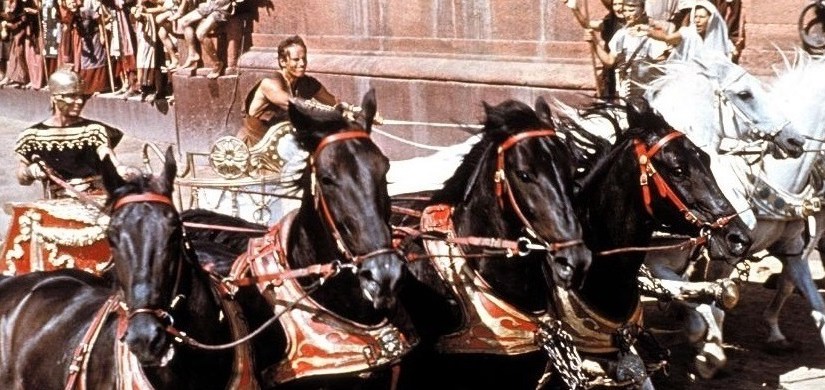
…and that’s just Act One.  Act Two focuses heavily on Judah’s revenge in the form of one of the greatest set pieces in Hollywood history: the chariot race.  Or, more properly, The Chariot Race.  If you’ve never seen it, Google/YouTube it.  Even viewed as a stand-alone scene, it is as breathtaking and thrilling as any car chase ever filmed.  It’s so good that George Lucas cribbed many of its beats for the pod-race sequence in Star Wars: Episode I – The Phantom Menace.  The crashes you see during the race were planned, but they were performed with real stuntmen in real danger.  Note especially one sensational stunt where a 2-wheeled chariot drawn by four horses, at full gallop, approach a crashed chariot in their path.  The horses leap the chariot, then the chariot dangerously rolls over the crash itself, hurling the stuntman so high into the air he nearly topples head over heels over the front of his own chariot.  I am at a loss to imagine how they could possibly accomplish this same scene today without the use of visual effects.

Peppered throughout the story are brief scenes featuring Jesus of Nazareth, although we never hear Him speak, and we never see His face.  In Act One, He offers water to Judah as he is being marched to the galleys, a compassionate act that will resonate through the years.  Later He is glimpsed from a distance delivering the Sermon on the Mount.  And later still, we see His trial, His journey to Golgotha, and His crucifixion.  Everyone involved in those scenes show the appropriate and expected levels of awe and sadness, while the score plays a mournful dirge.  It’s a little ham-handed by today’s standards, especially when compared to modern films like The Passion of the Christ, but it is still effective.

The movie’s highest level of filmmaking, apart from The Chariot Race, is on its best display in the first half of the movie.  Nearly two-and-a-half hours fly by, thanks to superb editing.  It’s never boring or soapy.  (Well…ALMOST never soapy.  The requisite love scenes between Judah and the slave girl Esther, played by the lovely Haya Harareet, are not as easy to watch as the rest of the film, but thankfully there aren’t that many of them.)  Every event and every scene feels crucial to the story.  There’s never a moment that drags.  Like the best epic films, watching Ben-Hur makes me feel like I’m reading a richly detailed novel.

If the film has a major downfall, it’s the story that follows The Chariot Race.  The movie doesn’t exactly grind to a halt, but it doesn’t offer the viewer any kind of climactic punches that can match the visceral effect of Judah’s capture, escape, and victory in the race.  (Sorry if I spoiled that for you, but if you seriously thought he lost that race, seek help.)  Sure, there’s the capture and crucifixion of Jesus and the miraculous aftermath, but while that satisfies the true arc of the story, I still, to this day, feel like the film deflates a little at the end.  There’s simply nothing it can offer that could possibly follow up that damn Chariot Race.  The race is the payoff.  Everything that follows feels anti-climactic.

That quibble aside, Ben-Hur is still as captivating as it ever was, with “old” Hollywood’s full power brought to bear to bring audiences a cinematic experience unlike any other at that time.  No matter where you might stand when it comes to its religious overtones, you can’t deny that the movie is exactly as respectful as it needs to be for this story.  And ultimately, the message of the film isn’t “An eye for an eye.”  It’s “Love thy enemy as thyself.”  It takes Judah Ben-Hur a little while to get there.  But he gets there.

THE DARJEELING LIMITED (2007)

by Miguel E. Rodriguez

Director: Wes Anderson
Cast: Owen Wilson, Adrien Brody, Jason Schwartzman, Amara Karan
My Rating: 8/10
Rotten Tomatometer: 69%

PLOT: A year after their father’s funeral, three brothers travel across India by train in an attempt to bond with each other.


In one of the bonus features on the Criterion Blu-ray for Wes Anderson’s charming The Darjeeling Limited, film critic Matt Zoller Seitz compares it to Stanley Kubrick’s 2001: A Space Odyssey because (I’m paraphrasing here) it is the perfect distillation of the director’s method, mood, and style.  I would reserve that distinction for either The Royal Tenenbaums or The Grand Budapest Hotel, myself, but The Darjeeling Limited certainly does capture everything that is typical of a Wes Anderson film: charm, whimsy, troubled souls, a quest of some kind, attention-grabbing camera moves, frequent slo-mo (but not too much), cameos, light and dark material jockeying for position, and a denouement that may signal the end of the film but certainly not the final arc of the main characters.

Meet the Whitman brothers: Francis (Owen Wilson), Peter (Adrien Brody), and Jack (Jason Schwartzman).  A year ago, their father died, and for the first time since that day, they’re about to meet each other and speak to other on board The Darjeeling Limited, a train that will take them across India on a spiritual journey.  Francis, the eldest, is the eager organizer of this little pilgrimage, providing everyone with laminated daily itineraries that are produced by Brendan, his personal assistant who is also travelling in a separate train car.  Francis will spend much of the film wearing bandages on his head and face that make him look as if he lost a fight with a honey badger.  What caused these injuries is not for me to say.

The ostensible reason for this journey is spiritual awakening and reconnecting with each other.  “I want us to become brothers again like we used to be and for us to find ourselves and bond with each other,” says Francis.  Peter and Jack are skeptical and not exactly psyched for this little trip, each for their own reasons.  Peter has a wife back home, 7-and-a-half months pregnant, who has no idea he’s in India.  Jack, a writer, has broken up with his girlfriend, but he obsessively checks her voicemails remotely because he still has the code to her answering machine.  (Hey, this was made in 2007 when you could still do that.)  He has his own return ticket in case he wants to leave the trip early.  Of course, he’ll find that difficult without his passport, which Francis has confiscated.  “For safety,” he argues.  Yeah, right.

There is an ulterior motive for the trip, having to do with who did and didn’t attend their father’s funeral, but ultimately the ins and outs of the characters, while engaging, kind of take a back seat to the trademark Wes Anderson visual style.  This is not a bad thing.  I am not a fan of Anderson’s first film, Bottle Rocket, because I felt it was all posturing with no meat to the story.  However, with each successive film of his, I become more and more endeared and captivated with his trademarks, especially when he uses it to tell stories that I would never have thought would “mesh” with his style.

For example, near the halfway point of the film, an extremely unexpected crisis occurs.  Because the movie has been happy and bouncy and witty up to now, it comes completely out of left field.  But remarkably, in the middle of this action, Anderson’s camera remains as “Anderson-esque” as ever, still performing quick pans and push-ins and keeping me involved in the story.  This crisis might have felt contrived in another film, a plot device to inject some needed drama into the story.  Not here.  Anderson’s storytelling methods made the event feel as random as anything life might throw at us on any given day: the death of a parent, the birth of a child, a snake getting loose in your train compartment, etcetera.

With one or two obvious exceptions (I think), the entire film was shot in India.  The trusty IMDb trivia page informs me the train scenes themselves were filmed inside a moving train travelling from Jodhpur to Jaisalmer.  The beautiful Indian locations are a major feature of the film.  They visit temples, marketplaces, a monastery, and hilltops overlooking vast Indian vistas.

And all the while, Francis, Jack, and Peter struggle to come to grips with their differences and their brotherhood.  “I wonder if the three of us would’ve been friends in real life,” Jack asks at one point.  Great question.  Given what we see in the film, it’s sometimes hard to believe they ever loved each other.  At one point, Francis and Peter get into a wrestling match and Jack has to step in: “I love you, but I’m gonna mace you in the face!”  That’s real love right there.  Right?  I guess…

I’ve heard that if you’re ever not sure what a book or a movie is about, just look at how a character has changed at the end of the story as opposed to what they were like at the beginning.  In The Darjeeling Limited, that’s not so easy to pin down.  I can see that Francis has grown a bit (he eventually relinquishes his brothers’ passports).  But when it comes to Jack and Peter…I’m not sure much has changed with them at all.  Does that make this Francis’s movie through and through?

I’m not sure it matters.  I mean, yes, the story is fun to watch, and I wanted to see where this journey would lead each one of the three brothers.  But for me, the element, or factor, or whatever, that makes The Darjeeling Limited so fun to watch is the directorial style of Wes Anderson.  In this film, as in so many of his films, it’s not about the destination.  It’s about the journey.

[Trivia note: the Criterion Blu-ray also contains a short film called Hotel Chevalier which is intended as a kind of prologue to The Darjeeling Limited.  Don’t make the mistake I did…if you get the Blu-ray, be sure to watch the movie with the prologue.  Don’t wait until after watching the main feature.]

[Super-nerdy trivia note: every musical cue in the film was cribbed from the early films of James Ivory and Satyajit Ray; Wes Anderson wanted to pay tribute to the filmmakers who influenced so much of his style.]

BOOGIE NIGHTS

By Marc S. Sanders

Boogie Nights was director Paul Thomas Anderson’s second feature following a very different and very quiet film debut with the gambling addiction piece Hard Eight.

Heck, it’s fair to say all of Paul’s films are very different; here is the seediness of porn while later in his career he will focus on the ruthlessness of a wealthy and angry oil man and then an obsessed dressmaker devoid of care for the models who parade his accomplishments. (See There Will Be Blood and Phantom Thread.). Paul was definitely striving for recognition with his familial depiction of life in the California pornographic film industry.

What I’ve always liked about Boogie Nights was Anderson’s intent to show the naive innocence of this large cast of characters. Filming blatantly oblivious awful porn scenarios can still be regarded as very proud efforts by its talent.

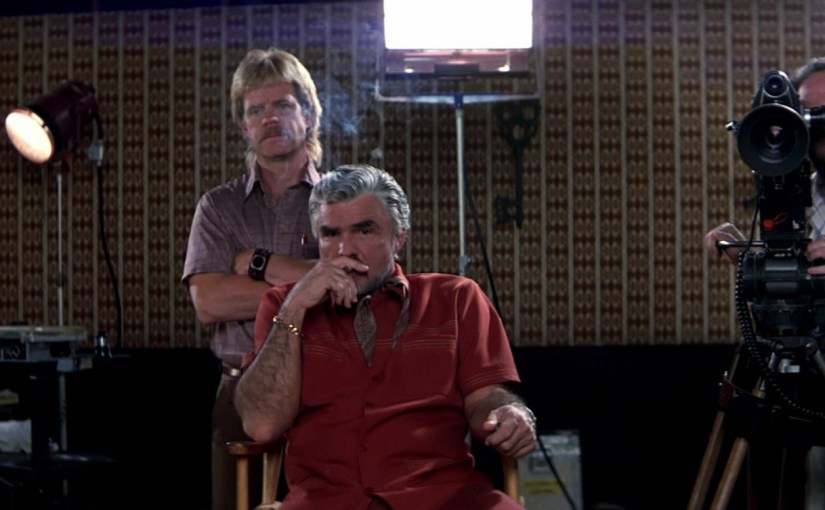
The main character is Eddie Adams (aka the amazing Dirk Diggler) played with macho pathos by Mark Wahlberg. It’ll likely be the best role of Wahlberg’s entire career. Dirk is proud of his natural talent in front of the camera. He’s even more proud of what God has gifted him. Don Cheadle is another porn star named Buck. He’s also proud of his accomplishments and simply a kind fellow looking to make country cowboy a trendy look for a black man while selling the “Hi-est Fidelity” in stereo equipment on the side. Julianne Moore is Amber Waves, the maternal porn mom of the bunch; very affectionate, very comforting and very reassuring when Dirk shoots his first porn scene. The one individual who really holds all of these misfits together is Burt Reynolds as Jack Horner, the porn film director. He’s the paternal one who believes in his artistic merits of shooting porn but with a story, and only with the integrity of film, and never the cheapness of videotape. So, Jack is like any artist who insists on a certain type of canvas. It might be smut, but he has principles, and he has pride.

Anderson is wise in how he divides up the developments. The film begins in the late 1970s during evening night life and decadence and everything seems fine and innocent and right despite the endless debauchery of reckless sex and drug use on a Disco backdrop. Wahlberg’s character is welcomed lovingly into this world, and nothing appears wrong. It all seems to stay that way for Dirk until New Year’s Eve, 1979. The 80s begin with a gunshot and then Anderson’s cast must pay for the revelry of their sins. A great moment presented on this night is where Amber Waves introduces Dirk to cocaine. Dirk has been thriving, making money, developing a following and now it is jeopardized in one moment thanks to his naivety. Julianne Moore is superb in this particular scene against Wahlberg. She’s the mentor with the peer pressure to pass on her high and keep it running.

Drug addiction, violence, sexual abuse and even changes in pop culture lead to hard times for these likable people.

It’s a hard life. It’s a complicated life. Yet it’s not all necessarily illegal. Morally, it might appear wrong, but it’s a life nonetheless.

Anderson was wise to use (at the time, relatively new) filming techniques of Martin Scorsese with rocking period music and fast edits along with savored moments of great steady cam work. One long cut especially works when the film first begins on the streets of Reseda and on into a crowded night club. This industry doesn’t sleep. So, neither will the camera that follows it. The music must also be celebrated. I do not listen to Night Ranger’s Sister Christian without thinking of firecrackers and a dangerously drug addled Alfred Molina playing Russian roulette. Though I know which came first, I also wonder if Three Dog Night’s Momma Told Me Not To Come and Spill The Wine by Eric Burton & War was written to enhance the celebratory introduction for Dirk when he attends his first party at Jack’s house. It’s another great steady cam moment from a driveway, followed by steps in and out of Jack’s house to simply a bikinied girl’s dive in the swimming pool. As a viewer I was absorbed in the California haze. Superior camera work here.

The cast of unknowns at the time were a blessing to this film. Anderson writes each person with care and attention and dimension. They have lives outside of this world like Amber’s child that we never get to meet, thanks in part to her lifestyle. She might be maternal but that doesn’t make her a good mother. Julianne Moore should have won the Oscar she was nominated for. Burt Reynolds’ own legacy seems to carry his role. His distinguished silver hair and well trimmed beard earn him the respect of every cast member and he performs with a quiet grace of knowledge, and insight, even if he will inevitably be wrong with how things turn out. Phillip Seymour Hoffman plays the dumb kid Scotty insecure and unsure of his homosexual attraction to Dirk. It’s not easy to play a dumb character when you are not doing it for laughs. Hoffman makes a huge impact with little dialogue but Anderson is wise enough to capitalize on him.

Boogie Nights offers one of the best cast of characters and assembled talents in any film ever made. An individual movie could be made about each of these people, and it’d be interesting and entertaining.

Try to avoid a blush and mock at the industry depicted because then you’ll see how another walk of life truly lives day to day. It might be porn. It might be smut. Yet, it’s still a thriving industry.

THE AMERICAN

By Marc S. Sanders

Director Anton Corbijn must have been terribly bored directing George Clooney in The American. All that his top billed star does is brood. He broods a lot, and sips coffee, reads a paper, drives his car, and constructs an assassin’s rifle for a beautiful woman.

Corbjin’s film opens with Clooney playing a man named Jack (no last name offered) who’s an assassin and about to be a target of Swedish men who share the same interest. It’s a good quiet start for a film, with an eye opening surprise to close it out before advancing the story.

Jack is instructed by his confidant to hide out in a small Italian town where a local priest encourages him to admit his sins. It’s not so easy, however, when Jack is busy bedding a local prostitute and building a dangerous weapon for pay.

I saw the ending coming. Yet, it’s a good ending. Getting there is the challenge. I think this was Clooney’s attempt to echo Matt Damon’s Jason Bourne. Brood, hardly speak, look at unusual people and cars in the vicinity, hide in plain sight without altering your appearance, sip coffee, drive a car, and brood some more. Brooding, however, begets boredom…at least for me it does.

The American drags itself slowly through an hour and forty-five minutes of countless close ups served up by Corbjin. There are so many close ups of Clooney that he obviously needed something to do besides appearing stoic all the time. So, he shifts his chin and bottom jawbone back and forth. I wanted to know if Clooney was chewing gum. That’s about all the film offers me to ponder at times. Is George Clooney chewing gum, or is he chewing his cud? Gotta go with the latter because I didn’t see a pack of gum anywhere within this town.

Yeah! That’s about all there is to say about The American. Corbjin gets some breathtaking shots of the Italian countryside, but I didn’t care about that. All I wanted to know was if George Clooney is a gum chewing assassin, or just an assassin, and because there will likely never be a sequel, I’ll never find out.

Darn!!!!

SNOWPIERCER

By Marc S. Sanders

Korean director Bong Joon-ho’s sci fi thriller Snowpiercer is a locomotive fast paced adaptation, that oddly enough is reminiscent of The Wizard Of Oz. There’s no yellow brick road however. Here, the on foot journey occurs on a massively long on going train that contains the last survivors of a frozen apocalyptic Earth.

Each car of the train separates the demographic classes of this populace. The one percenters live it up closer to the front of the train. The steerage and lower class are resorted towards the back, forced to live in filth and nourish themselves on protein bars made of vermin and waste. Chris Evans is the hero who leads the pack from the back to the front. They’ve had enough and they will not be restrained any longer. However, who and what resides up there? Let the journey into the unknown begin.

I liked Snowpiercer a lot, and mainly because the surprise of what was next kept me alert. An especially fun moment occurs when the gang comes along the car where elementary school is in session.

Characters are met along the way, including a warped performance from Tilda Swinton. She’s dressed in uniform regalia that David Bowie or Elton John might have worn to mock totalitarians. Her performance matches her wardrobe. She definitely makes her antagonist role her own with her pale complexion, short stark red buzz cut, weird dialect and large false teeth.

John Hurt is also a welcome surprise as the old wise one that is needed for these roles. He’s doing his basic John Hurt but that’s all we need.

Rounding out the cast is Octavia Spencer. She’s good too with lots of energy. A great pair up also comes from Song Kang-ho and Ko Asung as techies who can assist the band with opening doors from one car to another; allies that are encountered along the journey to see the wizard or the one in the engine car. I won’t dare spoil that surprise. The cameo was welcome in my eyes.

The journey is great.

The final moments of the film are a little short sighted though. It’s a great action set up but when everything settles down, not much is offered for a final statement on the grand outcome. I wanted more from that.

This is, however, worth checking out. Snowpiercer might consist of a ridiculous concept with all life residing on a never stopping train, but the set pieces are great fun, as are the characters.

GUARDIANS OF THE GALAXY

By Marc S. Sanders

Forgive me! I’m going into the woods or, rather, outer space a little on this review.

Director James Gunn brings new perspective to Marvel Studios’ Guardians Of The Galaxy, by recognizing the one instinct that every person possesses but is not acted upon often enough…the instinct to dance.

I love to watch characters (not part of a standard song and dance musical) break out into dance. It comes out of nowhere while it humanizes the person. I write my own plays that way, and I award my characters the opportunity to dance as well. I love it when I see it because it’s always a surprise and always welcomed with a smile. Think of that great moment in John Hughes The Breakfast Club, when the five kids let it all out after they’ve let it all out among themselves in confidence. Look at Eddie Murphy boogie in a night club in 48 hrs and Beverly Hills Cop, and look past the crappy script of Footloose for one of the silliest and most fun dance soundtracks to bop your head to. That last bit offered some inspiration for James Gunn especially. Dancing is needed in life. Dancing brings a surge of security as we shed our inhibitions for a fleeting moment. James Gunn reminds his audience of that. If you can’t smile and tap your toe to at least one fresh minute of GOTG then I worry for your soul.

Try not to smile when you first see lead hero Peter Quill aka Star Lord shake, slide and lip sync out by himself on a marooned, wasted planet to the melody of Come And Get Your Love by Redbone. Yes. Don’t deny it! Your head was shifting and your foot was shaking when you first saw this moment.

Gunn hit on all the right notes with a film that could have torpedoed straight to B class junk in another director/writer’s hands.

GOTG focuses more on the humor than any of the zippy outer space special effects. Everyone is having a good time, even the bad guys.

The story more or less focuses on the pursuit and take away/get back of a MacGuffin. Because that’s so simple, Gunn doesn’t have to concern his script with logic and over plotting. Instead, he can offer time for great naive one liners from brutish Dave Bautista as lovable Drax The Destroyer (do I really need to explain this character? ) and Rocket Raccoon (do I really need to explain this character as well?). There’s a giant tree named Groot who will happily tell you “I am Groot” in case that wasn’t clear to you, and a tough as nails, green skinned Gamora played by Zoe Saldana. She, along with Chris Pratt as Quill, have great chemistry together as they develop a caring friendship amid their competitiveness and wacky action. A pause in the play to allow a sway and flow dance for Saldana and Pratt to Elvin Bishop’s Fooled Around And Fell In Love is hypnotic as Gunn stages it against a gorgeous purple galaxy sky with random yellow sparkles raining down. I could stay in that scene forever.

Main focus goes to Quill who pirates the galaxy while not knowing much about his father and keeps the memory of his Earth mother alive with her “Awesome Mix Tape Vol 1.” He’s a lone pirate with no allegiance, and happily scavenges items for pay from the highest bidder. Pratt has fun with his breakout cinematic role. He laughs, he teases and yup, he dances.

On a first viewing, GOTG can leave you a little bewildered as you try to comprehend what weird name belongs with what weird character and what is everyone talking about. Your next viewing will feel like an invitation to a night club because you’ll realize whatever exposition Gunn’s script offers is really not significant.

James Gunn offers a pleasure piece of sights and musical sounds. One motif I like about his fictional galaxy is that no two characters look the same. It reminded me of George Lucas’ first Star Wars film. The famous cantina scene never shows two of the same species of alien. That’s all that’s needed to imply the vastness of the population. Unlike the Aquaman, James Gunn doesn’t feel the need to show you every inch of this universe to prove just how big it all is. He adopts the means of many extras all with their unique look.

The villain is Lee Pace, a guy who’d make a great Bond villain actually. He’s hidden behind a lot of costume and makeup as Ronan, and maybe he could’ve been given more to do. There’s not much one on team time between him and the Guardians.

Other fun moments abound though, including a ridiculous daylight chase through a busy planetary downtown, and a ridiculous prison break led by Rocket and Groot that reminded me of a lot of the Zucker brothers humor from their Airplane! and Naked Gun films.

James Gunn manages the biggest and bravest departure from the Marvel Cinematic Universe and it’s oh so right and necessary to keep the franchise alive and fresh.

Guardians Of The Galaxy is Marvel Studios’ answer to Looney Tunes and The Muppets. The great Mel Blanc and Jim Henson would have applauded a ridiculous film like this for years on end.

IN THE HEAT OF THE NIGHT

By Marc S. Sanders

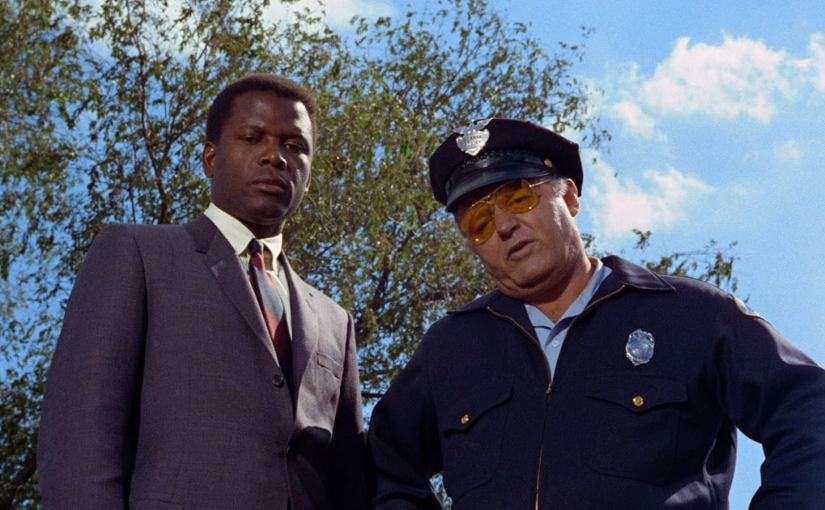
In 1967, just before the assassination of Dr. Martin Luther King Jr, Norman Jewison’s film In The Heat Of The Night won five Academy Awards including Best Picture, Best Actor for Rod Steiger and Best Adapted Screenplay by Sterling Silliphant.  While it is easy to classify the movie as a crime drama/murder mystery/detective story, the setting and themes of racial prejudice overshadow who the killer is or the motive.  As the film progressed, I grew less curious of who bludgeoned white businessman Philip Colbert to death and why.  It was much more important to understand exactly why Steiger’s Mississippi Police Chief Gillespie is so quick to believe that a well dressed and cooperative black man who was simply apprehended for waiting at a train station would be the culprit.  The black man is Virgil Tibbs (Sidney Poitier), a Philadelphia police detective.

After Tibbs has an opportunity to identify himself, Gillespie shamelessly requests his services in solving the crime.  Murder doesn’t happen often in Sparta, Mississippi.  Tibbs’ supervisor speaks highly of his officer’s capabilities.  Tibbs knows how to look for signs of rigor mortis on the deceased.  He knows how to identify that the killer was right-handed and he knows that when another suspect is quickly brought in, that he can’t be the killer either.  Still, many of the heated conversations between Gillespie and Tibbs are the same.  Their back and forths even become redundant at times.  Gillespie, nor the deputies and other residents of Sparta, are apt to listen to a “colored” person.  At one point, Tibbs is put in a cell for not agreeing with Gillespie’s conclusions.  He’s also ordered on two or three occasions to get out of town.  Tibbs is not so willing to surrender though, even if he’s regarded with racial disdain.  The impression is that this murder will not be so challenging for Tibbs to solve, if only he had a little more time and cooperation.  So, the riddle of the crime is not the overall conflict of In The Heat Of The Night.  More so, it is the racial hatred that a deep south Mississippi town has for an educated and skillful black man from up north.  

I read that the film was shot primarily in Sparta, Illinois.  Poitier made that request for his own safety while a tense period within America was occurring against the backdrop of the civil rights movement.  Jewison’s film is quite brave.  In the face of racial divide within the United States, this film still got made.  Yet, it had to be produced with an abundance of caution. 

A telling scene happens in the middle of the picture.  Tibbs requests Gillespie escort him to a wealthy cotton plantation owner’s home.  As they drive up to the home, they pass by the black cotton pickers collecting the crops under the hot sun.  They meet in the estate green house with a Mr. Endicott, who comes off very cordial to Tibbs at first.  However, when a slight accusatory question comes from Tibbs, Endicott slaps him across the face.  Tibbs responds with a slap right back at him.  In Mississippi, a black man better know his place, even if the prime suspect of a murder is a wealthy white man, or more simply just white.  It’s a classic moment in film history.  However, it remains an important scene and maybe its significance should be all the more heightened in modern day 2022 with the Black Lives Matter mentality at the forefront; where police/African American race relations are being tested. 

Three white men were recently sentenced to life in prison without parole for the hate crime killing of a black jogger named Ahmaud Marquez Arbery in the state of Georgia.  All that Mr. Arbery was doing was jogging through a neighborhood.  He didn’t have a weapon.  He hadn’t come in contact with anyone to even slightly suspect a threat.  He was noticed by these three criminals, and because he didn’t belong in that area, he was brutally murdered for the color of his skin.  Evidence would reveal where these men stood with regards to black people as a history of various texts that were clearly racial in nature were later uncovered.  If it wasn’t going to be Mr. Arbery who was murdered, it was eventually going to be another black person who would fall victim to these men. 

Though Dr. King was murdered shortly after the release of In The Heat Of The Night, I’m cautiously optimistic that racial hatred has lessened and the generations that followed learned from the misgivings of their ancestors.  Still, the term “hate crime” is often used in news reports today.  The debate of the Confederate flag and its argument for keeping it flying still has to be pondered.  Fifty years later, I cannot understand why, though. 

I will never forget a vacation I took with my family to Stone Mountain in Georgia back in 2005.  It was fourth of July and we were picnicking on the lawn next to a couple of teenagers while waiting for the fireworks.  I struck up a conversation with a local teenage girl and the flag and the confederacy along with the carving of Confederate leaders (Stonewall Jackson, Robert E. Lee and Jefferson Davis) on the rock sight were brought up.  Her defense of these topics was “It’s history.  Not hate.”  I became much wiser in that moment.  I was just a naïve Jewish guy who was raised in New Jersey.  I was not aware enough.  Much still hadn’t been learned and a whole lot needed to be unlearned.  History is not a reason to celebrate.  History is not meant to honored.  History is meant to be remembered for our rights, and especially our wrongs.  Much of history should not be repeated, and yet that’s what happens all too often.

In The Heat Of The Night is another example of the power of films.  So much is debated about what is taught in our schools.  A proposal of law for “Don’t Say Gay” is likely to be passed in Florida where it’s deemed impermissible to discuss homosexuality in elementary schools.  Books are continuing to be restricted from availability in libraries.  So, if our institutions of learning are being censored, then we have to rely on other mediums.  Movies like Schindler’s List or In The Heat Of The Night or Do The Right Thing offer those opportunities.  Films open a window to view love and hate as well as tolerance and prejudice.  We can never afford to look at our world with rose colored glasses.

ELEVATOR TO THE GALLOWS (1958, France)

by Miguel E. Rodriguez

Director: Louis Malle
Cast: Jeanne Moreau, Maurice Ronet, Georges Poujouly
My Rating: 10/10
Rotten Tomatometer: 93% Certified Fresh

PLOT: A married woman and her lover hatch an apparently foolproof plan to kill her husband (his boss), but a split-second decision at a crucial moment sends everything into a tailspin.


We plan, God laughs. – old Yiddish proverb

Let me get this out of the way right at the top: Elevator to the Gallows is one of the best crime drama/thrillers I’ve ever seen.  It holds its own against anything by Hitchcock or Clouzot.  With admirable focus and restraint, first-time director Louis Malle (My Dinner with Andre, Vanya on 42nd Street) crafts a gripping illustration of how the best laid plans can fall apart because of one minor miscue.

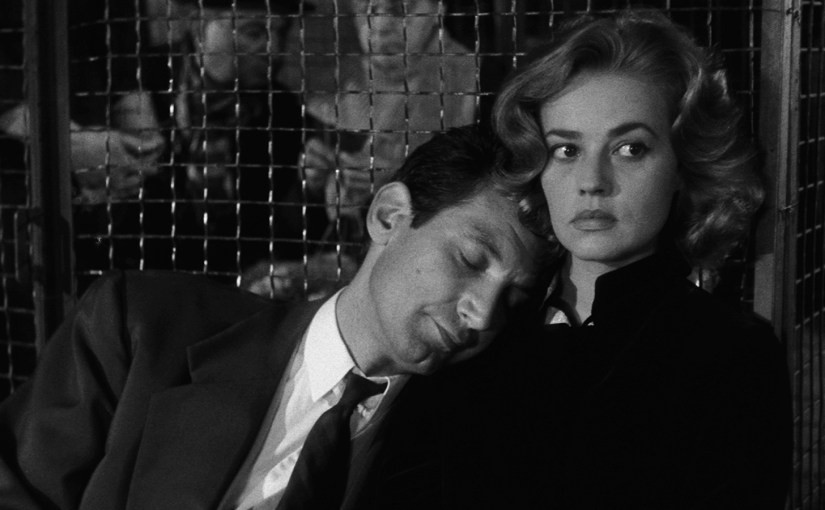
The film cuts right to the chase at the opening scene, showing a phone conversation between Florence Carala (Jeanne Moreau) and her lover, Julien Tavernier.  They discuss their plans for Julien to kill her husband in his office on a Saturday evening, after which he’ll pick her up at a café where she’ll be waiting, and that will be that.  Everyone will assume her husband is in Geneva on business, and no one will discover the murder, which Julien will arrange to look like a suicide, until Monday morning, giving Florence and Julien plenty of time to make their escape.

(I liked how we never got any flashbacks of the relationship between Florence and Julien.  All we need to know is, they’re lovers, they’re desperate enough to commit murder, and that’s it.  Very concise.  I love it.)

Julien’s plan involves using a grappling hook to avoid using the office elevator to get to his boss’s office one floor above his.  He proceeds with the plan, nearly getting caught in the process, but he’s able to commit the crime and leave the building with several witnesses as an alibi, witnesses who will say they never saw him enter his boss’s office before he left.  So far so good.

Julien gets to the street, takes the top down from his convertible, takes one last look back at the building…and realizes he left a vital clue in full view of any pedestrian or street cop.  Leaving his car running, he decides to run back into the office building and retrieve the evidence before the night guard shuts off the power for the night.

Unnoticed by Julien, a florist and her bad-boy boyfriend have been having an argument at the shop next to his car.  The boyfriend sees this rich man leave his convertible on the street…with the engine running…

Thus begins a Hitchcockian odyssey that leaves Julien stranded in an elevator, his car and his identity stolen, and his mistress stranded on the streets wondering where the hell her lover is.  At one point, Florence sees Julien’s car drive by the café where she’s waiting…she can’t quite make out the driver, but who is that girl in the car with him?!  Has she been betrayed at the last minute?

The film follows the younger couple, Louis and Véronique, as they tool around in Julien’s car, eventually winding up at a roadside motel, and unwittingly making friends with two German tourists.  They even share drinks with the Germans and take some candid photos using a little spy camera in Julien’s raincoat.  (We learn that Julien was in the Foreign Legion and was well-trained as a soldier – maybe even in spycraft.)  I found myself wondering why we were wasting time with this larcenous couple…until they decide to check into the motel as Mr. and Mrs. Tavernier to cover their own tracks.

The screenplay ingeniously heaps one hasty decision on top of another so that, just when it seems Julien might be in the clear, something else happens that makes it seem impossible he won’t be discovered or at the very least blamed for something he didn’t do.  Meanwhile, Julien is desperately trying to escape the elevator, using a penknife as a screwdriver, getting excruciatingly close to tripping a vital switch that’s just out of his reach.  He eventually tries to get out using the old climbing-the-cable trick…which is of course exactly when a night watchman is making his rounds.

This story is so good, I can’t believe there hasn’t been an American remake.  And it’s not like there aren’t other great films out there that cut right to the chase and never look back for flashbacks or additional material.  I’m not sure what makes Elevator to the Gallows so good, to be honest.  Maybe I was rooting for Florence and Julien when they are clearly not the good guys.  Maybe it’s the economy of the storytelling, or the screw-turning twists that lead the police to believe Julien has committed more than one murder.  At one point, Louis and Véronique make a startling decision that had me yelling at the screen.

Words fail me on this one.  I can’t describe it any better than by saying this is one of the best films I’ve ever seen, certainly one of the best film-noirs I’ve ever seen, and a movie that I’ll bet Hitchcock watched while thinking to himself, “Damnation…I wish I’d thought of that.”