UNSTOPPABLE (2010)

By Marc S. Sanders

An adventure of the unexpected needs to start with urgency. 

“Let’s say there’s a runaway train that’s barreling through the state of Pennsylvania and no one is on board to stop it.”

“Not bad.  What else you got?”

“This train is a half mile long. So, it’s a roller coaster of a beast.”

“Go on.”

“How about there’s another train on the same track and the two are going to collide with each other?”

“It’s got potential.  Anything else?”

“Oh yeah.  The train is carrying toxic chemicals that could cause mass destruction and casualties of epic proportions throughout the rural area.”

“Okay.  Now we’re talking.  Any guns?  Can we find a way to get machine guns into the mix?” 

“Yes!  I got it.  How about if the people try to derail it and the only way to make that happen is the cops shoot at this tiny button on the bottom of the engine, and this button is located between the gas tanks?  So it’s gotta be a direct hit while the train is in motion.”

“Okay.  Okay.  That’s genius.  Let’s green light it.”

Now this might have been how Unstoppable, director Tony Scott’s final film, got put into commission, but what is especially fascinating is that this is based on a true story. An out-of-control locomotive actually went off with no one on board to control it.  It happened within the state of Ohio about fifteen years prior to the release of this film.  Only it was not as dramatic or suspenseful as Tony Scott and his crew assembled their movie.  Unstoppable is a pumped-up, steroid enhanced reenactment of the actual story.

The director recruited his most common go to lead, Denzel Washington, for the role of Frank Barnes.  He’s an engineer with over thirty years’ experience who is wiser than the big wig suits on the top floor.  He can bring this potential disaster to a halt before it happens.  Frank is also a mentor to the fresh, young conductor, Will Colson (Chris Pine). 

Will is cranky because his wife is upholding a restraining order against him and the two are at a standstill of hashing their problems out over the phone.  Frank is in a bad mood because the young guys like Will are being brought in to replace the grizzled fellows who are being pushed out.  Frank is also a widower with two estranged daughters. Though, he gets a kick out of telling Will the girls are paying their way through college by working at Hooters.

Denzel Washington and Chris Pine make a good pair.  Buddies who antagonize each other at first, they later share what’s eating at them personally and professionally. Then they work well together to resolve the crisis at hand.  Their characters are not very dimensional, nor should they be.  After all, it’s all about the train.  Yet, I believed them as train engineers/conductors.  Either of these guys could be operating a merry go round and I’ll believe they know some serious shit about how the carousel operates and moves in a circular motion.  My point is these actors really work at it to appear like guys who are well trained within the freight train industry, and I buy all of it.

In the control center, staring at large monitors with high tech maps is Connie (Rosario Dawson).  She’s communicating on the CB with Frank and Will and giving them updates on the status of when their engine will be within hookup range with the one speeding out of control.  She’s also the figurehead with the smart mouth, needed to stand up to her bubbleheaded corporate boss (Kevin Dunn) who threatens to fire all of them.  In other movies, this guy would be the angry police captain in a cop movie.  He’d be the government official who believes he can protect the President while Kevin Costner or Clint Eastwood knows that’s not how it works.  This is a slot role.  Use the same dialogue for a guy like this no matter what the picture is about because it’s all standard stuff. 

On paper, Unstoppable sounds ridiculous and quite ordinary for an adventure.  A runaway train.  Isn’t there anything else?  Yet, Tony Scott applies his quick edits and aggressive zoom in and zoom out shots to the movie’s breakneck progression.  He’s also got those curved Steadicam movements within Connie’s control center accompanied with glowing bright lights of greens, reds and blues. 

News reporters’ updates, along with footage from helicopters, are spliced in between the scenes that Washington and Pine share together in the cab of their train engine.  The glue holds up well.  There’s time allowed for Frank’s girls to cheer daddy on while at Hooters. Will’s wife played by Jessy Schram holds their young son while nervously fidgeting and tearing up watching the news.  I don’t think she has any dialogue beyond the line “C’mon Will!” Soon, she’s live on the scene staring straight ahead for the final act of the film.  That’s a problem.   I’m questioning why she’s looking in the same spot straight ahead if this train barrels on and on.  It’s certainly not in a stationary position.  She’s not watching a baseball game.  No bother.  It’s not fun to question a picture like this with such semantics. 

The exhilaration comes in how Tony Scott sets up his action pieces with daring leaps on and off the train and running sprints on top of and in between the cars.  Guys hang from helicopters with attempts to board the train.  Cop cars turn their sirens on and speed parallel to the locomotive, and yes, as in any Tony Scott film, a handful of cop cars bang themselves up real good in some gritty pile ups. A gorgeous red pickup truck works its way into the story too.

Screeching sound effects are also necessary.  They were nominated for an Oscar. 

Perhaps my one complaint that’s hard to accept is that in some shots, the train, which is supposedly going at over 70 mph, doesn’t look like its going fast enough.  Urgency is important in a film like this and when I get the impression the train is not traveling at a high enough speed, well then the threat doesn’t feel so threatening.  It’s when there are shots underneath from an on the track perspective that you really get an idea of the exhilaration.  In a movie like Speed, the bus always looked like it was accelerating and never slowing down.  Here, the train seems to move slow enough at times that anyone could have just leaped on board, but as Miguel always says, “Then there would be no movie.”

Don’t go into Unstoppable with your Neil deGrasse Tyson laws of physics.  Don’t get hung up on the wife who can see everything that’s happening by staring straight ahead when this speeding train is racing past her from right to left.  Don’t worry. Move on.  It may not look like it, but this train is going faster than it appears. 

Just enjoy the ride, and relish in what set Tony Scott aside as a well-equipped and capable action director.  Sadly, he left this world too soon.  There were more fun action movies to be made by him.  Unstoppable at least reminds you why he is still so sadly missed.

WALL·E

By Marc S. Sanders

There are some movies that seem to accurately predict what we can expect of our planet’s future.  Paddy Chayefsky was one such prophet with his script for Network and the rampant consumption of television influence and addiction.  Author Phillip K Dick might have also been a Nostrodomus of sorts when his writings were adapted into such films as Total Recall, Minority Report and Blade Runner which offered convincing convenience to lifestyles and evolved productivity.  Perhaps the imagineers behind PIXAR are also on to something because their adorable, futuristic WALL·E does not seem so farfetched.  

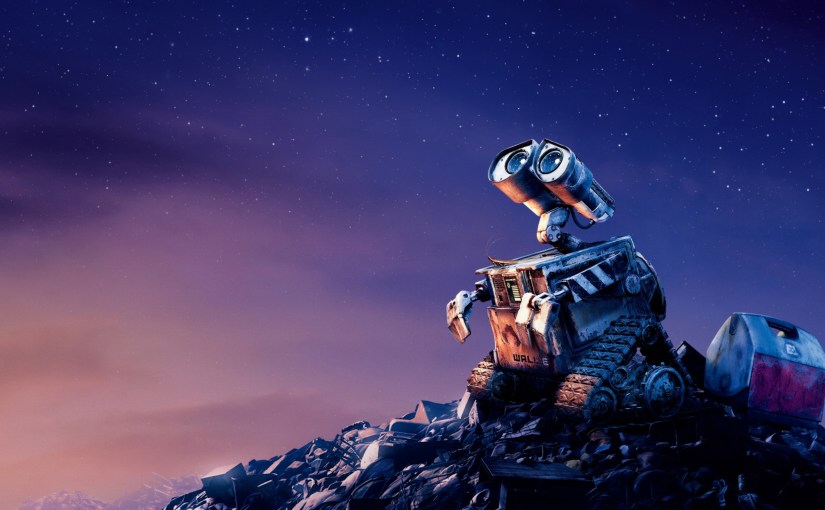
The robot title character is a trash collector on an abandoned planet Earth seven hundred years into the future.  A Wal-Mart/Sam’s Club amalgamation known as the fictional Buy N Large appeared to have become the main resource for any immediate need of the human population that once existed; what the coming of Amazon is turning into. This monopolized interpretation of absolute capitalism was run by a CEO and maybe Commander In Chief of the free world, played by Fred Willard, the one major flesh and blood actor to appear in this picture. 

WALL·E, along with a faithful cockroach, roams the wastelands.  The puppy dog, bug eyed robot wheels around on his tractor legs collecting the endless amounts of leftover trash and compacting it into neat, stackable boxes.  Piled on top of each other, these boxes get as high as skyscrapers.  These are the remnants from what Buy N Large left for the planet.

One day a rocket ship arrives and drops off a highly sophisticated and glossy white droid that we come to know as EVE.  For WALL·E, it’s almost love at first sight even though EVE has a treacherous laser cannon for an arm and intimidating blue cyborg eyes.

Eventually, the two bots hitch a ride into space when the rocket returns to pick up EVE.  They arrive on a galaxy cruise liner that’s floating through the solar system.  While the two get into a bunch of Looney Tunes shenanigans running through the corridors and piping of the ship, the audience bears witness to what exactly happened to planet Earth, and who has survived to carry on.  At this point a prophecy seems to be declared by writers Andrew Stanton, Pete Docter and Jim Reardon (all PIXAR regulars at the time).

Humans aboard this liner have become oversized, lazy blobs with no neck, fat arms, fingers and legs, and reclined to permanent seats while robotics cater to their hungers and comforts.  These people are cheerful but happily lazy and unproductive.  Remember when your mother would tell you to clean your room?  Well, the wasteland universe of WALL·E bears justification for mom’s aggravation and constant pestering.

The computerized animation of this PIXAR romantic adventure is dazzling in details and character expression.  There’s an unattractive sand like and earth tone mood to anyplace we explore on Earth.  Yet, the industrial sheen of the cruise liner appears to have all the comforts imaginable.  You can practically taste the colors and feel the balmy air conditioning within this ginormous vehicular city in space. Yet, the telling story of WALL·E has no problem convincing me that this is not right.  This is not a future I’d want to be a part of.

Disney and PIXAR follow that mentality of ensuring a soul of emotion drives their characters of fantasy and it’s easy to fall in love with the clunky lead robot.  You want WALL·E to be safe from sandstorms, while also keeping his only friend, the cockroach, by his side for companionship in an entirely lonely world.  His only other source of cheerfulness comes from watching the musical Hello, Dolly! on an old TV. Even playing ATARI’s Pong is not stimulating enough for this little guy.

Sound Effects Wizard Ben Burtt, who pioneered staple sci fi elements with the Star Wars films, performs the vocal expressions of chirps and beeps for WALL·E’s innocence.  There’s a language to the little fella and it’ll leave a lump in your throat when he calls for EVE.  Elissa Knight brings a more experienced, technologically up to date personality to EVE.  We worry when an organized entity like EVE robotically screams for WALL·E when she thinks he’s in danger.  She’s only supposed to follow a program, but the manufactured mind lends to a side effect of genuine emotion.  As the two get acquainted with each other, there’s a touching chemistry to them both.  A floating dance through space is as much silly as it is adorably romantic.  You cannot help but smile because by this point you are invested in this relationship as much you’d buy Rick and Ilsa’s affections towards one another, or Harry and Sally’s.

I really embrace the childlike love story connecting these two non-living beings.  Set against what appears like an apocalyptic wasteland, there are layered dynamics to this animated film, one of PIXAR’s best.  

I have to also salute the film’s nods to classic science fiction that also offer not so unrealistic possibilities.  An antagonist comes in the form of a robot similar in appearance to HAL-9000 from Kubrick’s 2001: A Space Odyssey.  He’s a nasty bugger with an all too familiar blood-red eye. It’s also a delight to recognize Sigourney Weaver’s voice as the cruise liner’s computer, a sort of slap in the face to monochromatic computers that would countdown a certain doom for the actress’s most famous role of Ellen Ripley in the Alien films.  PIXAR has always been brilliant with their wink and nod delights.

The film was released in 2008, a near generation ago maybe, when iPhones and Androids were not even as entirely sophisticated as today.  Yet PIXAR could telegraph what was to come.  The environments on Earth and on the cruiser tell us just how overly reliable we’ve become on technological conveniences for socializing or even one stop shopping.  

We are getting to a point where we might not even procreate with one another.  It’s a sad irony that it will take two self-thinking, yet designed for programing, robotic appliances to remind us how valuable the human touch is and what a purpose to life really serves ourselves and those we have to interactively live with.  

You might be embracing that cell phone tight in the palm of your hand, but will that device ever hold your hand in return?

HERETIC

By Marc S. Sanders

Heretic operates like you’re playing Dungeons & Dragons but adapted into an Escape Room experience.  The stakes at play are bigger than just your life.  You have no choice but to truly test your faith.  Can you adhere to the religious beliefs you always vowed to uphold when a lunatic is holding you captive?

Sister Barnes and Sister Paxton (Sophie Thatcher, Chloe East) are two impressionable young ladies who are proud to spread the gospel of The Church of Jesus Christ of Latter Day Saints from door to door.  With bicycles and pamphlets in hand, proudly wearing their name tags, they visit the homes of those who have recently expressed interest in the church.

As a dark and stormy night approaches, they knock on the door of an eerie house that belongs to the charming Mr. Reed (Hugh Grant in an utterly surprising role).  Once the ladies are assured that the gentleman’s wife is at home, ready to offer some blueberry pie, they happily enter and are quickly engaged in an unsettling test that will carry on through the evening.

I went into Heretic not knowing a single thing about the film and that made my encounter with the piece that much more interesting.  It’s a disturbing thriller that always kept me curious.  Mr. Reed seems to go on tangents that eventually get to a point where the Sisters are confused, but eventually coherent of the strange man’s demonstrations.  The film is not shy about challenging practically every religious denomination known to man from Christianity to Judaism to Islam and Mormonism.  According to Mr. Reed the ten thousand other doctrines spread across the planet need also be questioned.

Higher powers and miracles – do they really exist?

There’s no doubt that Heretic is a suspenseful thriller teetering on horror but unlike most effective efforts in this genre I was never uneasy with the picture.  It doesn’t rely on jump scares and only gore introduces itself when it must serve the storytelling.  However, it’s an intelligent character study where the heroines are challenged over and over again while remaining in captivity.  So, I was always enthralled with how Sister Barnes and Sister Paxton will entertain their destiny from one step to another.  Stay for pie or don’t.  Lie or tell the truth.  Choose the purple door or the green door.  Belief or Disbelief.

As someone who is primarily educated in Judaism only, it was still not hard to follow the wordy, rambling dissertations of Mr. Reed.  He easily compares his own take on religion to the different interpretations found in music from bands like The Hollies and Radiohead, as well as the various editions of the board game Monopoly which suddenly take on new meanings.  He even brings up Jar Jar Binks to deliver a point.  It’s odd.

Hugh Grant is an unlikely selection for a role like the charming, yet sinister Mr. Reed.  As weird as he is in this darkened house with endless hallways, I wanted to trust him through most of the first half of the picture.  I didn’t care if there was a haunting corridor or staircase to walk down.  This is Hugh Grant of Notting Hill fame.  Grant’s resume of roles lends to the surprising effectiveness of his part here.  He’s always been that adoring charmer on screen.  Ian McKellan or Anthony Hopkins?  I’d never trust them.  Hugh Grant?  Well, why wouldn’t I?

I was hoping-praying actually-that Heretic would not dissolve into a sick rape and slasher movie typical of when young girls are welcomed into a creepy, inescapable house.  That’s cheap, exploitative thrills.  Fortunately, this movie never goes that route.  

The roles of the two Sisters are brilliantly written.  To open the piece, before you know anything about Sister Barnes and Sister Paxton the two women are sitting on a park bench that bears a seedy condom advertisement while staring into a heavenly Utah sky. The topic of their conversation is of a pornographic nature.  Sinful and mischievous, despite the value they hold in their religion and the proud purpose they serve with the church.  These are complex characters that are compelled by their antagonist to make some fair hypotheses about if they genuinely embrace what they claim to value and share with a community.

Heretic is most definitely a psychological thriller with some grotesque imagery.  It gets its audience caught in a trapped claustrophobia thanks to a lot of spooky atmospheric labyrinths.  Furthermore, its strengths lie in the writing, directing and most importantly three of the best performances to come out this year from Hugh Grant, Sophie Thatcher and Chloe East.  

This is a thinking thriller for anyone who has ever uttered a single prayer at least once in their lifetime.  If that’s you, then Mr. Reed may have some questions for you.  Get out of the rain and step inside.  

TRAP

By Marc S. Sanders

The devil is in the details and when you are watching an M Night Shyamalan film it’s transparent enough to know the writer/ director has a penchant for disregard.  He’ll put the two by fours together but he doesn’t hammer the nails into place treating his structure with less sturdiness than a house of cards.

His latest thriller Trap gains from a respectable, though nothing great, performance by Josh Hartnett as a psychotic serial killer named Cooper, also known as The Butcher.  However, Shyamalan takes away the actor’s credibility by allowing his portrayal to make unbelievable escapes while also being granted an ability to eavesdrop on people while attending a loud pop/rock concert with his pre-teen daughter, Riley (Ariel Donoghue). 

Cooper and Riley have a great father/daughter relationship.  She’s beyond thrilled to see her favorite singer, Lady Raven (Saleyka Shyamalan, the director’s real-life daughter), live on stage.  He’s thrilled to accompany her while munching on stadium snacks and granting the dutiful empathy she needs from middle school drama. Cooper only gets alarmed though when he sees an overwhelming amount of police officers and FBI agents roaming all over the stadium.  He asks some questions and learns that this event is being used as a means to capture the infamous killer on the loose known as The Butcher.  Now Cooper must play a game of cat and mouse by evading the authorities while not alarming Riley.

Once again, Shyamalan has an enticing set up, but then he doesn’t deliver.  First it’s hard to swallow Hartnett’s character listening in on conversations happening yards away down hallowed hallways, or even backstage where Lady Raven’s voice is blaring through stadium speakers while she’s dancing and singing in front of thirty thousand fan girls.   Reader, I saw Sting in concert performing one of the quietest songs imaginable, “Fields Of Gold,” and I still could not hear my wife ask me to get her a Coke when she was standing right next to me.

Midway through the film it only gets more ridiculous and even corny as Lady Raven ends up at the family home where Cooper’s wife (Alison Pill) and children become enamored with the celebrity playing piano in their living room.  Then there is an overly long scene meant to offer terrifying suspense when a character locks herself in the bathroom.  Then it’s back to Raven’s limo and then onto a new house and then back to the first house.

The structure of Shyamalan’s script seems to always paint itself into a corner.  So what does the writer do? If he’s trapped with no idea, well he just deepens the corner further and further.  He defies his blueprint, and pushes those two by fours further and further out.  

All of it is hard to digest.  Cooper needs to escape a limousine surrounded by swarms of both fans and police officers. Cut to the next shot and Josh Hartnett’s character is walking away from the commotion unbeknownst to everyone else who stayed glued to the doors and windows of the limo.  Excuse me but none of the car doors ever opened.  I didn’t even see the sunroof open.  Yet, the film insists the guy escaped from the vehicle.  So just go with it.  OKAY??? 

The irony of a film called Trap is that the filmmakers could not even figure out the traps they devised.  Therefore, they’ll just disregard offering up the sleight of hand and move along.

No good magician insists his audience trust him when he says that his assistant who stepped in the box has disappeared.  A good magician, or even a bad magician, is at least smart enough to know that we need to see it for ourselves.  

AIRPORT

By Marc S. Sanders

Burt Lancaster described his participation in what would become the first of a batch of 1970s all-star disaster epics as the worst picture he’s ever done.  He declared it “the worst piece of junk ever made.”  Perhaps because of this assessment we were eventually blessed with the Airplane! spoofs a decade later.  

Airport is a sudsy soap opera drama from novelist Arthur Hailey.  It’s an indiscreet invitation to make fun of it, but I doubt it was meant to be regarded that way in 1970.  Then, Airport was likely celebrated as that new kind of picture like The Godfather, Jaws and Star Wars would pioneer in their own rights.   

The film was a box office smash for Universal Pictures, garnering an acting Oscar for kindly old Helen Hayes along with nominations for Best Picture, Cinematography and Screenplay.  It spawned three more films following its success.  Yet, it’s terribly cornball, drowning in floods of cheese, and coated in the thickest of sap.  You better swallow that Maalox now.  This airport is all backed up!

Lincoln International Airport is getting blanketed in one of the treacherous, most blinding snowstorms imaginable.  So naturally it’s the right time to launch passenger airlines into the night sky while also welcoming jets to land.  Were harsh weather conditions not so alarming fifty years ago for air travel?

Well, this blizzard is going to be the first of several problems starting with a plane stuck in the snow right in the middle of the airport’s major runway.  Burt Lancaster is Mel Bakersfield, Lincoln’s Controller, who once again puts aside his family and his troubled marriage to oversee the matter.  He recruits the grizzled, cigar chomping Joe Petroni (George Kennedy) to clear that runway.  Mel firmly believes Joe is the only man who knows what the hell to do.  (Best I could tell is that Joe picks up a shovel like everyone else.) Mel’s other issue is that his pesky wife is disrupting his happy affair with Tanya Livingston (Jean Seberg), the no nonsense, yet perky appearing, blond airline executive with the mini uniform dress hemline.

Further upholding the proud chauvinism of this picture is everyone’s favorite lounge singing lizard Dean Martin as Vern Demerest.  These names!!!! If this movie wasn’t taking place at an airport, I’d swear it was a news station.  Vern also has an inconvenient marriage now that he’s learned his cutie stewardess Gwen Meighen (Jacqueline Bisset) is pregnant.  Cue the squeaky violin music as Vern offers to cover the abortion.  Shocking!!!! Gwen might want to have the child, but she’s gracious enough not to make it an obligation for Vern.  She’s gonna let her dreamboat wonder of a man be, so he remains a doting husband on the side.

So we got melodrama for the airport staff, the pilot, the stewardess… Hmmm…Oh yeah!  The passengers!!!!

A mentally ill, down on his luck man (Van Heflin) spends six dollars cash on a life insurance plan for his wife Inez (Maureen Stapleton) before boarding Vern & Gwen’s plane with a dynamite bomb in his briefcase.  Can Inez warn Mel, Tonya and everyone in time before the plane takes off?

Of course, this kind of stressful tension requires some adoring comic relief, and Helen Hayes as kindly old Mrs. Ada Quonsett delivers an Oscar winning performance.  She takes pleasure in being a habitual stowaway on one flight after another.  Gosh darn it if Tonya is going to make sure to put a stop to this lady’s shenanigans.  

The Cinemaniacs (Miguel, Thomas, Anthony and I) watched this together and Mig pointed out the cinematography first.  It’s dull like straight out of a Sunday night TV movie.  Thomas reminded us that this was in the same vein as most of Arthur Hailey’s material, like Hotel – the book that became a movie that became a TV series.  The soap opera occupies the first two thirds of the picture.  Then a potential threat of disaster occurs, and you work to guess who lives and who dies.  

Directors George Seaton (also screenwriter) and Henry Hathaway work to get the audience invested in these people first while trying to educate us on the most up to date operations in a fully functioning airport.  If George Kennedy’s character is not shoveling snow on a runway and giving it all he’s got in the stuck plane’s cockpit, he’s telling the others what to expect from a potential bomb explosion aboard a jet.  And Look!!! There’s telephones in Mel and Vern’s cars.  Push button ones too.  All over the airport are red phones next to white phones.  There’s luggage.  There’s blankets and pillows for everyone on board the plane. There are also unsuspecting women wearing minks and smuggling jewelry into the country, but the seasoned custom security guard has got a good eye. He can see everything, except for the guy with the bomb. And there’s snow.  Lots and lots of snow but the cabs make it to the airport in the nick of time.  There’s also a message about the need for updating construction on our country’s airports with the most sophisticated traffic controls and operations imaginable.  Should the money be spent?  On top of all this, how are Mel and Vern’s wives and families holding up?

Maybe it’s unfair.  It’s hard to embrace Airport when I have already grown up watching the ZAZ team brilliantly spoof the picture with the Airplane! films.  Yet, I’m confident that had I seen Airport upon its initial release, I likely would not hail the romances of Lancaster, Seberg, Martin and Bisset as the next iterations of Rick and Ilsa.  The dialogue and scenarios are eye rolling at best.  The chemistry sputters as soon as we see the characters for the first time.  The men are twenty five years older than the women, but the love is supposedly passionate?

The extras who are granted snippets of dialogue look like they are reading cue cards and the major players truly look bored.  Watch the cast when the bomb goes off on the plane (like you didn’t think it wouldn’t happen).  There’s no adrenaline from Dean Martin.  He looks lost without his signature scotch and cigarette. The passenger extras never got the memo that they are supposed to be on board a plane with a gaping hole in the rear lavatory.  The priest on board slaps the guy next to him, but I need more convincing of the panic that is supposed to persist.

Fifty years later, the legacy of Airport hinges on only one purpose and that is to give it the ol’ Mystery Science Theater 3000 treatment.  More importantly, once you finish watching it, about all you want to do next is watch Airplane! 

“The cockpit!  What is it?”

“It’s the little room at the front of the plane where the pilots sit, but that’s not important right now.”

ZURAWSKI V TEXAS

By Marc S. Sanders

The topic of the harrowing documentary Zurawski V Texas is abortion.  However, the debate is a different angle than I believe either side of the ongoing argument is accustomed to. 

Filmmakers Maisie Crowe and Abbey Perrault provide extensive up to date coverage on attorney Molly Duane who represents a growing contingent of women who suffered complications during their pregnancies.  The diagnoses might have varied but the commonality was that in most cases these circumstances became life threatening to the point where medical professionals deemed the best resolution was to follow through with an abortion so that an unhealthy child is not delivered and forced to suffer a brief life in agony.  At least just as pertinent is to preserve the health and often save the lives of the mothers.

Amanda Zurawski from Austin, Texas is the first mother to make a claim. Thereafter, a parade of other women sought out her attorney, Molly Duane, to testify of their experiences and plead with the Texas courts to make exceptions to the state’s altogether blanket outlaw of abortions performed within the state.  As soon as the prologue begins, we see Amanda testifying of her suffering at a congressional hearing.  Close ups jump to the expressions of the government officials who appear intent on listening to Amanda’s plight where she describes having gone into septic shock with her life in serious jeopardy.  It’s a very sad story, but Amanda demonstrates that she’s a stronger warrior than these men that she is facing.  They can do nothing but sit there speechless.  Who knows if they are even listening to the woman on the stand.

Later, as Amanda and Molly take their case to another court, the want to be mother describes how one of her fallopian tubes had to be closed up and her uterus needed to be reconstructed.  Because she was not permitted needed abortion, she is unable to try again with another pregnancy. 

Two other women are also focused on in the documentary. 

Samantha Casiano is forced to carry to term, and then at the end of nine months, deliver an anencephalic baby with no chance of living.  The experience comes at a cost of Samantha’s mental health and her marriage when her husband becomes withdrawn.  Following this incident, Samantha follows through with a tubal ligation to avoid the risk of going through this ordeal again.

Another plaintiff is Austin Dennard, an OB-GYN doctor, who as a patient left the state of Texas to terminate her pregnancy following a risk-laden diagnosis.  She eventually becomes a mother, but now she is a doctor not permitted to aid her patients with their ordeals. 

A struggling roadblock continuously reiterated in Zurawski V Texas is the threat that any medical professional faces should they perform or assist in an abortion, regardless of the reasoning behind it.  Molly Duane and her clients are arguing that if there any exceptions to Texas’ unreasonably strict laws that forbid abortions, it is unclear.  The ladies are petitioning for a clarified explanation which never comes.  Can’t they just get a straight answer on why exceptions for continued health care can not be executed?

I watched this documentary after I have already done my early voting ahead of the 2024 election.  Amendment 4 is on the state of Florida ballot and it’s a clear Yes or No vote of whether abortions should be made legal.  Zurawski V Texas goes beyond the typical Pro Life vs Pro Choice debate that will never satisfy this entire country.  This age old argument is split down the middle, and now politicians and lawmakers seem to weaponize the topic to earn constituents’ favors and votes.  In fact, it is the only reason I can figure for why Ken Paxton, the State of Texas Attorney General is always on the trail of each Molly’s wins within the Texas courthouses. 

Molly will win her arguments while standing in front of one judge after another, but then the uncompromising Paxton will overrule the judgment literally within hours afterwards.  Just as you are about to clap for her success, “Five hours later” appears on the screen.

The documentary covers the ladies’ families and friends who ask how can someone be Pro Life, while outlawing a medical procedure to save a life.  Ken Paxton is the villain of this frightening story because any shred of reasoning from him is never provided while he exercises his stubborn authority.  It’s monumentally unfair.

In the film, when Molly Duane takes the case to the Texas Supreme Court, it is astounding to see members of the court question why Molly and her clients are not going after the doctors who are denying the care that is needed.  It’s a direct insult to the intelligence of these women who are suffering physically, mentally, professionally and even domestically.  There are plenty of health care providers on the side of committing abortions to save the lives of the mothers and avoid any further suffering of embryos and newborns that cannot survive.  However, how can doctors be expected to perform when the state threatens them with criminal charges, license suspensions, fines and incarcerations? 

These professionals have earned the training to save lives.  Yet a governing body is not allowing them to make fundamental, ethical and appropriate decisions for best interests of their patients. 

Most documentaries will at least tell you in a byline that the producers reached out for comment from the other side, and usually that contingent declines to speak on the subject.  I cannot assume that the filmmakers reached out to the opposition of this topic.  People like Ken Paxton or even Governor Gregg Abbott and Senator Ted Cruz of Texas.  The film makes no claim to that idea.  So, I wish there was an attempt to get an answer from the opposing parties.  Still, we get footage of the naivety with governing figures asking questions that lack merit or substance, and worse, we get Paxton’s closeminded and unexplained reasoning for his overturning on cases legally ruled in favor of Molly Duane’s clients. 

Maisie Crowe and Abbey Perrault have assembled an informative film that hopefully will influence votes and ongoing petitions for this important argument.  The day after I post this article is Election Day, November 5, 2024.  Abortions do not just fall exclusively into the category of reproductive rights and the right for women to decide what they want and do not want to do with their bodies.  There’s even more at stake than that.

Zurawski V Texas presents a health crisis that never, ever should be a predicament.  Our doctors have the knowledge and experience to do what is necessary to save the lives of mothers who carry with no fault or mistake or lack of sound judgment.  They are women who chose or planned to become pregnant.  Sadly, complications interfered like it can in any kind of health situation.  Complications can occur during an appendectomy.  Are doctors supposed to stop what they’re doing and check to be sure they won’t go to prison before they proceed any further?  The same could be said with heart surgery or brain surgery.  There are resolutions for these patients to escape terrible, life threatening risks.  Yet, the weaponizing of a political argument for campaign wins stands in firmly in their way and disregards the simplicities of what can save human lives.

Last week, I declared one of the film’s at the 2024 AFI Film Fest was the best I’d seen this year, so far.  That was Clint Eastwood’s Juror #2.  Days later however, Zurawski V Texas stands at the top of the list.

This documentary might focus solely on the state of Texas, but the scenarios warn of a nationwide epidemic if the stringent rulings of our governing bodies continue to neglect basic health while the figures of authority work to prolong their political careers, at the cost of their constituent’s lives. 

Zurawski V Texas is without a doubt the most important film made this year. 

UNSTOPPABLE (2024)

By Marc S. Sanders

The Oscar winning film editor of Argo, William Goldenberg, finally directs his first film and it’s a winner.  The true story of Anthony Robles, the one-legged NCAA world champion wrestler is brought to the screen in Unstoppable.  While the story is paint by numbers for a typical sports movie, because it is adapted from his real-life experiences during his time at Arizona State University, it cannot help but be embraced.  The cast is sensational as well, with not one weak link.

Anthony Robles (Jharrel Jerome, the Emmy winner of the HBO miniseries When They See Us) is a good kid.  Anthony is loved by his brothers and sisters, and his mother.  They cheer him on to persist and win.  He’s a hero to his younger siblings.  Anthony also gets much encouragement from his high school wrestling coach, Michael Peña, and his co-worker that he cleans airplanes with, played by Mykelti Williamson.  Still, he has a troubled domestic life.  His stepfather is an intimidating tyrant.  Bobby Cannavale plays one of the harshest villains in recent memory.  A towering monster with a voice that’ll make you wince.  He’s verbally abusive and eventually we learn physically as well to Anthony’s mother Judy (Jennifer Lopez). 

As the film begins, following a winning match, Anthony receives an all expenses paid ride to a Pennsylvania college.  However, that school does not contend in the NCAA and despite everyone telling him to take the free ride, he has his eyes set on Arizona State.  Even ASU’s Coach Shawn Charles (Don Cheadle, and dang is he ever good) is not confident in Anthony making the final cut for the team.  Yet, Anthony defies what everyone else thinks and scrounges up the monies with his family’s support to attend the local university.  Now the challenge is to make the team against all odds with his crutches to support him through rocky terrain hikes and laps around the track while carrying heavy weights.  How does a man with one leg stand upright and manage to climb mountainous terrains in the desert heat while staying in pace with the rest of the candidates?  How does he even hold a thirty-pound weight while running the track on crutches?  Anthony Robles will show you.

Unstoppable does not offer anything new or inventive.  Anthony even reflects on the fictional character Rocky Balboa a few times.  There are challenges to overcome, not just for Anthony, but for Judy as well.  The bank wants to foreclose on their home and her husband is monster of a jerk.  Plus, there’s Anthony’s handicap which can never serve as an excuse for falling behind with the rest of his squad. 

Some matches are lost.  There are scary episodes at home.  There’s the imposing undefeated champion that Anthony will eventually have to face.  There are the loving moments between mother and son.  It’s all textbook, and the ending is predicted as soon as the film begins.  Still, had I known Anthony Robles personally while growing up, I’d be saying this story is prime for a movie or a book and that is what became of it. 

At the 2024 AFI Film Festival, there was a Q&A following the film’s presentation.  Jennifer Lopez, Jharell Jerome, William Goldenberg, and Judy and Anthony Robles were in attendance.  To watch the film and then hear of these people’s real-life experiences afterwards is astonishing.  Both mother and son came from rock bottom scenarios mired in debt and abuse.  Now, long after Anthony has finished his career as a champion wrestler, we see that the two continue their crusades.  I won’t spoil what they went on to next.  The film provides a footnote ahead of the end credits, but it is nothing short of inspiring.  The Robles demonstrate that anything is possible and nothing works as an excuse.

Jennifer Lopez and Jharrel Jerome share a lot of beautiful scenes together.  Lopez might be easy fodder for gossip columns, but she is truly a wonderful actress.  Jerome reminds me of when I first saw Cuba Gooding Jr in Boyz In The Hood, which was an astonishing debut of a promising career.  This guy needs to be cast in a lot of beefy roles going forward.  He’s a sensation. 

William Goldenberg has made an under the radar film, but it has box office success written all over it like The Karate Kid or Rocky.  His vast experience in editing allows for a well-paced two hours so that even if you know what is coming next, you remain enthralled and wanting to cheer on the protagonists. 

The film will be streaming on Amazon Prime soon, and that is perhaps it’s only disappointment.  Again, as I have written in other recent columns, a movie like Unstoppable belongs in the theatres first and seen with well attended audiences who will clap and cheer at both Judy and Anthony’s triumphs.  Some of my fondest memories are watching the heroes I grew up with played by Ralph Macchio and Sylvester Stallone finally achieving that hard-to-reach gold crown, and suddenly there’s an overwhelming cheer from the audience within the darkness of the theatre.  Remember when Rocky sprinted up the 72 steps of the Philadelphia Museum Of Art?  A cued response almost seems edited into the context of the film.  That kind of experience is absent from the private confines of a living room.

Unstoppable has joined the lexicon of amazing sports stories.  You can’t help but cry while you are cheering.

TWO PEOPLE EXCHANGING SALIVA (FRANCE)

By Marc S. Sanders

For a short film with a running time of only thirty-five minutes, Two People Exchanging Saliva (aka DEUX PERSONNES ÉCHANGEANT DE LA SALIVE) offers a lot to tell within its absurdist universe thanks to writers/directors Natalie Musteata and Alexandre Singh.  Reflecting on the film, which I saw during the After Dark collection of shorts at the 2024 AFI Film Festival, my list of imagery grows longer and longer and I am grateful for it.  There’s much to remember, even nearly a full week after seeing the film.

Shot within a department store located off the Champs-Élysées within the heart of Paris, the film is a gorgeous black and white presentation with striking lighting to illuminate a wide collection of settings.  Shoe racks never looked so ethereal.  A staircase leading upward feels very curious.  Piles of cardboard boxes feels terrifying before I even know what they are to personify.  Yet, the oddities that Musteata and Singh introduce are what tempts you to learn more about the rules they have set up for this fictional cosmos.

Malaise (Luàna Bajrami) is a salesperson at this store and like the rest of the staff, she must exhale her breath directly into the nose of a security guard before starting her shift.  She is suppressed by a domineering supervisor, Pétulante (Aurélie Boquien).  It cannot be more apparent that Pétulante feels threatened by her best customer’s favorability for Malaise.  That customer is Angine (Zar Amir Ebrahimi).  Among these three ladies, this comes off like a common soap opera love triangle that has been seen many times before.  Yet, the writers/directors throw some spice at this centerpiece.

Within this world, kissing is outlawed, punishable by death.  Hence the necessary requirement for a breath smell.  Ingest some garlic or other reprehensible aromatic food to divert any temptation from breaking the law.  Furthermore, products are sold at a cost of slaps to the face.  Several players exhibit the scabs and bruises, as well as nosebleeds, that evidence their purchases.  Looking at Angine it’s easy to see she is certainly a high-priced shopper.

With these set ups in place, the story can take off and rely on bold imagery.  We witness Malaise’s fear of what can happen if she commits to her attraction for Angine when the apparent crime of kissing occurs within the store.  We fear that Pétulante will pounce on prohibitive kissing in order to win her prized client back while getting her underling, Malaise, permanently out of the picture.  We see the great lengths of tormented slapping Angine endures in order to have another shopping experience with the innocent Malaise. 

The film serves reminders of the nature of punishment if a kiss is committed between two people.  The criminals are literally boxed up and disposed in a junk heap of other boxes that encase people just like them.  Musteata and Singh’s most powerful shots are of this pile of boxes dumped into a landfill toppling one over the other.  It’s like something from George A Romero film, like Night Of The Living Dead.  No big effects here.  Nothing that looks like a large expense beyond collecting a enormous supply of cardboard boxes.  Yet, when piled together in an outdoor area under the shine of their black and white cinematography from Alexandra de Saint Blanquat, it’s terribly haunting.

My wife and I got to speak with Natalie Musteata and Alexandre Singh on a few occasions during the 2024 AFI Film Festival.  They explained how the idea of this dystopian universe came to them while quarantining in their New York home during Covid.  They went through the steps of obtaining financial backing and they discovered that it would be more cost effective to shoot the picture in France than in the United States.  As well, they had access to a department store in Paris after it had closed for the night.  They went through the process of setting their scenes, rehearsing their actors, coordinating lighting and camera positioning within the few hours available to them before sunrise when the store would reopen.  Listening to them, I could envision the tight scheduling pressures they must have experienced in making this film.

I also find it interesting that they assembled this film during Covid. Simply shaking hands with others was highly discouraged to avoid a spread of disease. Highly charged debates on reproductive rights are so prominent right now too.  In Two People Exchanging Saliva, it’s not hand shaking that is impermissible, it’s something much worse, but also more intimate – kissing.  As well, in order to live off of materialism, one must fall victim to an abuse of their bodies, and they have the marks to show for it just beneath their eyes and across their profiles.  In this world, people are limited and exposed to the will of a domineering enforcement.  I salute the allegories found in the short film.  It may sound silly on the surface.  Natalie and Alex even laughed while explaining the plot of their film before we had a chance to see it.  Still, it is not altogether farfetched.  When can we live truly independently without a threat of punishment, when all we want is a will to live and love with one another?

Two People Exchanging Saliva was the winner of the Grand Jury Prize at the 2024 AFI Film Festival, and I could not be happier for the filmmakers’ accolades.  It’s worthy of its merits.  If you can find this outstanding short film I highly encourage you to take a little over a half hour out of your day to experience something entirely unique, while beautifully presented. 

Seek out your local art houses for a film short festival coming soon.  Two People Exchanging Saliva should be included in any collection that’s being offered.  Now I’m hoping an Oscar nomination is on the horizon for Natalie and Alex.  Bon Chance!!!!

JUROR #2

By Marc S. Sanders

Since Unforgiven, director Clint Eastwood has sought out projects that have an intrinsic message or a question of morality.  That film seemed to channel the second half of his career that has spanned over a half a century.  Before, many of his films sensationalized the quiet killer or the silent tough guy with the six shooter gunplay and cracking fists. After the movie won Best Picture in 1992, movies like A Perfect World, Letters From Iwo Jima and Mystic River were not developed for simply the sake of escapist entertainment.  There was something to ponder after the stories wrapped up. 

Eastwood’s latest film, and supposedly his last, is Juror #2 and to the best of my recollection, I believe it is the first time the actor/director brings his experience to a courtroom.  Some of his more recent efforts have been questionable and not up to his best standards (Cry Macho), but Juror #2 is one of the best films he’s directed, and perhaps the best picture I’ve seen this year so far. 

Nicholas Hoult plays Justin Kemp, an expectant father with his wife Allison (Zoey Deutch).  He has just been selected for jury duty in a Savannah, Georgia courthouse.  Justin is Juror #2.  The case centers on trying a man for the murder of his girlfriend who was found bloodied and bruised in a rocky, wooded canal beneath a bridge.  Earlier that night, the couple were witnessed at a local watering hole having a drunken argument.  She walked off in the dead of night in the pouring rain.  The man was seen going after her.

Coincidentally, Justin was at this same bar.  He drove off in his car around the same time, but he accidentally hit what he thought was a deer.  The incident was hardly considered again until the opening statements were heard in court a year later.  Suddenly, the young man is putting two and two together and questioning if in fact he hit a deer.  Now Juror #2 embarks on a test of morality while sometimes adopting a Twelve Angry Men narrative.  Justin might appear as noble as Henry Fonda, but is he the culpable one?

Juror #2 assembles a good cast of characters.  Toni Collette is the prosecuting attorney, Faith Killebrew, who is also campaigning for an important election.  Collette has that deep southern twang, but the earth tone suits she wears along with her firm body language exude a tough exterior.  You believe Collete’s character is compartmentalizing this trial away from her chances of election.  The opposing attorney, Eric Resnick (Chris Messina, who I’d like to see in more films), is apt to imply the true motive behind Faith’s pursuit of trying his client.  Is it for personal gain, because Eric truly believes his client is innocent.  The evidence and facts add up to reasonable doubt.

Eastwood, with a script by Jonathan A Abrams, places his film in a variety of on set locations around Savannah.  Personally, it was fun recognizing certain areas following a recent weekend getaway my wife and I took to the storied town.  There are flashback pieces to the night in question at the bar and the crime scene.  Beautiful locales within the historic squares of Savannah are also covered in addition to the river boats near the docks.  Much of the picture occurs in the jury room where the group of twelve deliberate.  Leslie Bibb is charming as the Jury Foreperson.  However, Justin tries to find ways to allow his peers to consider other possibilities.  The only one on his side is a well-cast J.K. Simmons.  Simmons has the deep crackling voice that absorbs you into what he’s believes versus everyone else in the room.  Against him are jurors played by Cedric Yarbough and Chikako Fukuyama, also well cast.  What seems like an easy wrap up case of declaring a guilty verdict turns into a dead heat of 10 to 2, and eventually even Faith the prosecutor is personally questioning what occurred.

Juror #2 is very well cast film.  None of the actors are stand out marquee names, which works as an advantage.  They all appear common.  They don’t look like movie stars and thus it is easier to buy them in their roles.  After seeing the film at the 2024 AFI Film Festival, the gentleman sitting next to me had to surrender to a friendly debate we had.  He tried to point out plot holes in the film but I had an answer for each element he questioned.  Juror #2 is solid in its storytelling.  The motives that characters like Justin and Faith and even the respective jurors stand by all have a validity to their lines of thinking.  Therefore, Abrams’ script works well at arguing two sides of the same coin and the picture concludes with an opportunity to think about it long after it’s over.  Hanging threads to solid conundrums are a favorite factor of mine.

A story currently circulating in the trade papers is that Juror #2 is only being released in fifty theatres nationwide.  This is Warner Brothers’ decision and it’s a terrible shame.  When the debate of streaming versus exclusive theatrical releases is continuously being put into question, this is a sure sign of movie theatres eventually becoming obsolete. What a pleasure it was to watch Clint Eastwood’s film among crowd at the famed Grauman’s Chinese Theater (aka TCL Theatre) in Hollywood, California.  The audience was completely engaged, applauding as names appeared in the credits and laughing at the intended cues provided by the director and screenwriter.  To see a film, any film in a theatre, is a unique experience when it can be embraced among a crowd of movie lovers. 

If Robert Zemeckis’ Here can be released nationwide in thousands of venues, there is no reason why a well-made Clint Eastwood picture can not have the same treatment.  Movie houses were never designed to offer only the latest Marvel or Transformers film.

My hope is that the ongoing, widespread positive reception that Eastwood’s final film is receiving is noticed thereby building some traction for Warner Brothers to consider going wider with exposure.  At the very least, the famed studio owes it to arguably its most prized filmmaker and actor.  Time after time, the WB logo appears just ahead of Eastwood’s own Malpaso studio credit.  There is no Warner Brothers without Clint Eastwood and to close out his legendary career commands a bigger recognition. 

At the very least, Warner Brothers needs to recollect what occurred with a film like The Shawshank Redemption.  No one saw it in theatres and it had a terrible initial box office.  Some argue it was the title that turned people off.  Maybe.  Yet, think about the admiration that movie continues to garner thirty years later.  Warner Brothers needs to pay more attention to the quality they possess in their library.

At any rate, my hat off to Mr. Clint Eastwood – a pioneer filmmaker and one of the last survivors of a filmmaking yesteryear.  He began directing in 1971 with the thriller Play Misty For Me, and at age 94, he has only enhanced his meticulous dedication to drawing a crowd in while directing sensational casts.  Along with Harrison Ford and Steven Spielberg, I have followed Clint Eastwood’s career all my life.  Beginning with seeing Dirty Harry at age 8, I grew up on his imposing stature and his reliance on silent performances.  The first R rated film I saw in theatres was Sudden Impact.  Beyond being a Producer, Director and Actor, he is also a film composer.  Clint Eastwood is one of the few multi-talented people within the history of Hollywood, but no one compares to him.  You’re likely never to hear someone say that guy reminds me of Clint Eastwood, because there is only one Clint Eastwood. 

I am only blessed because I still have yet to see every one of his films.  If Juror #2 is his last effort, it’s a noble and solid ending to his run.  Yet, I’m glad I know I still have more to uncover in Clint Eastwood’s celebrated career.

NOTE: The murder victim is portrayed by Francesca Eastwood, Clint’s daughter.  As well, look for a blink and miss it moment where the director makes his way down a staircase while JK Simmons and Toni Collette share a scene together.  Eastwood is full bearded but there is no doubt that’s the guy.

PERSONAL NOTE: On the closing night of the 2024 AFI Film Festival, I had the pleasure to meet actors Cedric Yarbaugh, Amy Aquino and Zele Avradopoulos following the film and it was such a treat to hear how much they appreciated Mr. Eastwood as a director. All three were consistent in their admiration for the filmmaker describing him as patient, quiet, and a master of his craft who continuously worked with the same crew on one film after another. It was a real treat to chat with them. I also saw Nicholas Hoult walk by me three times and because I simply didn’t recognize him, I regret not asking him for a quick chat and photo as well. Yet, he and Toni Collette introduced the film which included a quick impersonation of Clint on the phone offering the role to him. Everyone was positively charming. This was such a memorable moviegoing experience. I’ll treasure the memory always.

HERE

By Marc S. Sanders

I get a thrill out of being in a location occupied by someone from the past.  Last week, I toured Paramount Studios and sat on the bench that Tom Hanks did when he shot Forrest Gump.  There’s something exciting about it.  Time capsules or a recovery of an ancient burial are fascinating to me.  Just once I’d love to hold in my possession Action Comics #1, Superman’s very first appearance.  Often, items like this are preserved behind glass in museums to witness and study.

Robert Zemekis is a “What if?” director.  What if a man was marooned on a deserted island or what if you could communicate with extra-terrestrials from another galaxy?  What if live humans could interact with cartoon characters? He reunites with Hanks as well as Robin Wright for his newest film called Here.  The picture attempts to answer what precisely happened in one specific, exact location since the dawn of Earth.  

The film opens with the violent creation of the planet, complete with molten rock and falling meteors stirring about, along with an ice age, and a prehistoric period.  Then it is on to further points in history that the script from Eric Roth will occasionally return to, such as the plight of a Native American tribe and then later close to a post-Revolutionary War era where a house with a large bay window in the living room is erected and a famed historical figurehead is referred to.  We witness the activities on both sides of this living room’s bay window, and what was there before it.

There are brief views of folks living in the early twentieth century when new technology like airplanes are fresh, and eventually a Lazy Boy becomes essential to any home.  

Primarily though, there are three generations of a twentieth century family lineage that starts with Paul Bettany as a PTSD alcoholic World War II veteran, and his housewife Rose (Kelly Reilly).  Tom Hanks portrays Richard, their eldest child who aspires to become a career painter before his plans are interrupted by marrying his pregnant girlfriend, Margaret (Robin Wright).  Life, however, gets in the way of his dreams.

Finally, we are brought to a more current point with an African American family living through challenging times of police brutality and Covid.

Over the course of the whole movie, Zemeckis has you believe that his camera never moves once from this specific place.  He narrates the activities that occur in this broad scope of time with pictures within pictures.  Rectangles or squares will appear to show what happened later in life or back in the past on this specific spot and then transition the scene to that new period episode he wants us to witness.  Where the fireplace is located, a squirrel climbed the bark of a tree that was once there.  Where the sofa is now, there worked a slave laborer from the 1700s, or its where a Native American smoked a pipe before then.

If Here was any longer the novelty might have worn off.  Fortunately, the characters with the most interesting storylines are given to Bettany, Reilly, Hanks and Wright.  The challenges of living long lives raising children, dealing with job security, health, love, loss and stress are carried by them.  We grow accustomed to how the family lineage evolves, particularly with Thanksgiving dinners, Christmas photos, marriage, graduations, and children growing up.  

It helps that the latest trend of visual effects, de-aging and aging the players, works convincingly in this picture.  I attended a live conversation at the 2024 AFI Film Festival between Tom Hanks and Robert Zemeckis, and the actor revealed that to get himself back to the age of seventeen and then a thirtysomething all the way to a man in his eighties required Zemeckis’ team to collect thousands of images and footage from the actors’ extensive careers.  Everything was then seamlessly assembled for effective performances.  I think the trickery works.  If it didn’t, then it’s likely Here would not succeed.

My one issue with the film is the glaring omission of substantial storytelling for the African American family compared to the amount of time devoted to the family who lived in this home before them.  The African American characters do not appear fleshed out enough.  They only serve to remind us of current, complicated times that we recently endured or are still living through.  Roth and Zemeckis did not go deep enough with this group, only to bookend it with an unimpactful death.

Here works like a warm blanket to snuggle up with.  I believe it is worth a second and maybe a third watch in order to catch all the little changes in details that vary as time travels through this piece of land that eventually became a living room.  The TVs and what’s on changes from the Beatles first appearance on The Ed Sullivan Show to The Three Stooges to CHiPs (neat wink and nod moment here; tell me if you know what I am thinking of) and Katie Couric and so on.  The furniture gets updated.  So do the phones. What occurs across the street in front of the two-story colonial house changes.  Though we are only seeing one room during the entire running time, it’s near impossible to pinpoint what was there before from left to right and top to bottom. What’s there now and what will be there later is part of embracing the experience of Here.  However, what kept my attention is how Eric Roth and Robert Zemeckis invent ways to keep different time periods connected.  It’s relative to how Zemeckis did numerous minute and detailed face lifts to Hill Valley in his Back To The Future trilogy.

By the end of Here, there’s opportunities to relate to how many of these people end up with their long lives.  They experience all the ingredients of life through love, frustration, happiness, illness, loss, anger, sadness and eventually death.

Here is a deliberate experimental film, and for most of the picture, its attempts at modifying the stage of performance truly work.  Where it falls short is not allowing equal attention to all of the stories that enter this locale.  Then again, if the movie were to go any longer, time might have come to a mundane standstill.  It’s simply a blessing that I had just enough time being Here.