FLOW (Latvia, 2024)

by Miguel E. Rodriguez

DIRECTOR: Gints Zilbalodis
MY RATING: 10/10
ROTTEN TOMATOMETER: 97% Certified Fresh

PLOT: Somewhere deep in a forest wilderness, a solitary Cat barely survives a cataclysmic flood by clambering into a boat with an assortment of other animals; their survival will depend on their ability to help each other.


Nearly twenty-five years ago, Disney released an animated film called Dinosaur [2000] that was touted as being an industry game-changer.  The premise was revealed in a stunning, epic-length teaser trailer that fired my imagination.  Some of you may remember it.  Using state-of-the-art CG animation, and with no spoken dialogue, we watched as a dinosaur egg on prehistoric Earth was flipped out of its nest, carried away by scavengers, dropped into a river, swallowed and regurgitated by a fish, then plucked out of the water by a pterodactyl that soared over magnificent real-world vistas and plains before being dropped accidentally into a jungle canopy where the egg was discovered by a family of, I think, prehistoric lemurs.  A reminder: all with no spoken dialogue.

I remember thinking, wow, Disney is going to attempt the impossible: create a feature-length animated movie with no spoken words.  I was stoked.  What an experiment!  Hasn’t been done since Fantasia [1940]! And if anyone can pull it off, it’ll be Disney, right?  Imagine my disappointment when I went to see the movie, the opening scene plays out exactly as shown in the teaser, the lemurs peek through the foliage at the fallen egg, and one of the lemurs opens its mouth…and talks.  Not just human speech, but with a New York-Brooklyn-esque accent that almost sounded like Bugs Bunny.  Dreams shattered.

I mention that story because Flow, the recent winner of the Golden Globe for Best Animated Motion Picture, promised the same thing in its trailer: an animated film without words, starring only animals on a perilous journey.  I was skeptical.

Until I watched the movie today.  Not only does it deliver on its promise (making Dinosaur look shallow and childish by comparison), it sets some kind of crazy bar for mystical, awe-inspiring visuals that I would put on the same level as Avatar [2009] or Dune [2021].  Yes.  They’re that good.  And, according to IMDb, it was all created using only Blender, a free, open-source animation software tool.  Flow is a remarkable accomplishment.

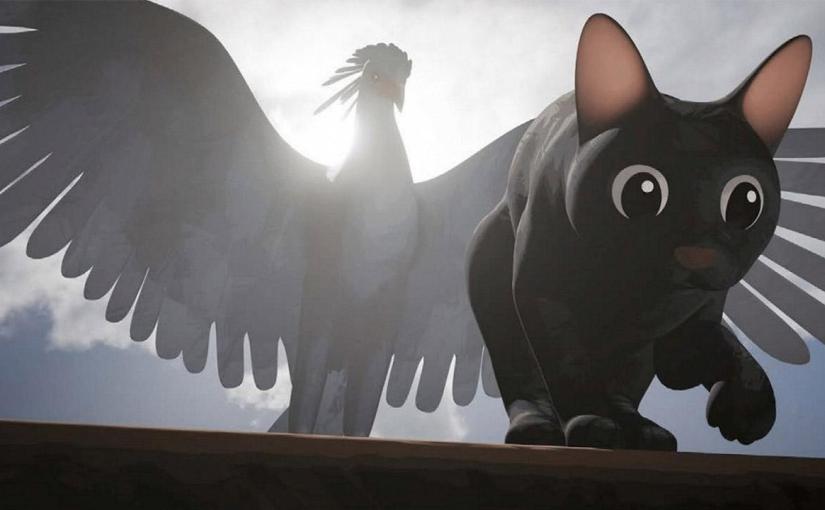
The story opens with Cat wandering a forest.  None of the animals are named, of course, nor were they named by the animators.  They were all referred to simply by their species or breed: Cat, Whale, Bird, etc.  After being chased by some dogs, including a friendly Retriever, Cat curls up in the top floor of an abandoned, expensive-looking forest cabin with nary a human in sight.  Where are all the people?  No answer is given.

With ominous abruptness, a cataclysmic flood sweeps through the forest, leaving Cat and Retriever stranded at the cabin as the waters steadily rise.  Retriever hops into a passing rowboat occupied by the other dogs from an earlier scene, but Cat understandably passes on this opportunity and eventually finds itself sharing a second boat occupied by a grunting, monosyllabic Capybara.

…but this simple plot summary doesn’t begin to do justice to the experience of simply watching this film.  I am super glad I saw it on the big screen first, 3rd row back, so the screen filled my field of view.  The whole movie reminded me of the best oceanic scenes in Finding Nemo [2003], crammed with detail, lavishly rendered, so that you sort of fall into the world.  There are hints to indicate that the forest and the lands beyond, now flooded, were once populated by humans, but they have all disappeared.  Statues of animals.  Top floors of houses still untouched by water, but not for long.  And, on a distant hilltop, a massive statue of a cat, on which Cat must find refuge at one point.

The look of the film is something I’m not going to be able to describe very well.  Partnered with the smooth CG animation itself, the main animal characters nevertheless have a hand-painted quality to their coats and fur.  The virtual camera moves as if being held by a real cameraman, reminiscent of the best scenes in the first Avatar.  There is a magical, spiritual sequence towards the end of the film (you’ll know the one I mean) that took my breath away and rivals anything from Pixar or Studio Ghibli.  I may not know precisely what it means, but to be honest, I didn’t care then, and I don’t care now.  I just know that it is a spectacular scene.  There are subtle hints that this world may not even be Earth as we know it, or when we know it.  Mystery abounds!  I love it.

I must give special mention to the animation of the lead character.  Cat has moments of cat behavior so specific and real that, even if you’re not a cat person or watched umpteen cat videos on YouTube, you will recognize it as being 100% authentic.  For that matter, the same could be said of all the animals in the film.  I must be honest and report that there are times when, viewed through a lens of “is-this-realistic”, the animals behave in a way that does not compute with reality.  I highly doubt a capybara would be able to figure out how to work the rudder of a sailboat…and yet, in this movie, it does, and it’s fine.

Which brings me to the one problem I can imagine some folks might have with the film: the ending.  I can’t tell if the right descriptor is “elliptical” or “open-ended” or “inconclusive.”  Perhaps it’s a plea from the filmmakers for cooperation and teamwork in an age where uncontrollable outside forces are doing their best to prevent it; like these animals, we’re all in the same boat.  Or maybe that’s not the message.  The beauty of Flow is that the ending is subject to interpretation, thanks to the lack of dialogue simply telling us what it means.

Frankly, I’m not too fussed about extracting the message from Flow.  I am too grateful that a film like this even exists to lose sleep over its Deeper Meaning.  It is a film constructed out of wondrous sights that harken back to the days of Pinocchio and Fantasia [both 1940], when animators and filmmakers gave equal weight to story and visuals, and it’s one of the best animated films I’ve ever seen.

MAXXXINE (2024)

by Miguel E. Rodriguez

DIRECTOR: Ti West
CAST: Mia Goth, Elizabeth Debicki, Michelle Monaghan, Bobby Cannavale, Giancarlo Esposito, Kevin Bacon
MY RATING: 8/10
ROTTEN TOMATOMETER: 72% Certified Fresh

PLOT: In 1985 Hollywood, adult film star and aspiring actress Maxine Minx finally gets her big break. But as a mysterious killer stalks the starlets of Hollywood, a trail of blood threatens to reveal her sinister past.


When I started posting my blissful reviews of X and Pearl [both 2022], I got one response more than any other: “Wait till you get to MaXXXine; it’s the weakest of the trilogy.”  Having just watched it, I would say that calling MaXXXine the weakest film in this trilogy is like calling Return of the Jedi [1983] the weakest film in the original Star Wars trilogy.  You may be technically correct, but it’s still a great ride and a better film than many others in this genre.

Six years after the bloody events of X, we pick up the story of Maxine Minx (Mia Goth) as she auditions for a film role in Los Angeles.  She’s been signed by a devoted but semi-skeevy agent, Teddy (Giancarlo Esposito in a fabulously bad hairpiece), and she has experienced modest success as a porn star.  But she longs to spread her wings in “legitimate” films, because as we all remember, Maxine craves fame more than anything in the world.  As she never tires of repeating: “I will not accept a life I do not deserve.”

Just as things start looking up for Maxine’s career, a package is left on her doorstep…a VHS tape labeled ominously, “For Maxine.”  When she pops it into her VCR, she’s treated to a shot from her filmed but unfinished porn movie from six years ago…evidence which would link her to those horrific murders and endanger her newfound success.  Meanwhile, the infamous real-life serial killer Richard Ramirez, aka “The Night Stalker”, terrorizes Los Angeles at night, not to mention a copycat killer who is branding his victims with pentagrams.  How these murders are linked to Maxine, and when and where John Labat (Kevin Bacon) comes into play, is not for me to divulge.  And one by one, Maxine’s friends and co-workers are turning up dead…

The plot of MaXXXine is nothing new, let’s face it.  What makes it sparkle is the wit and TLC provided by director Ti West and his collaborators.  For anyone who was alive in 1985, this film is like a stroll down memory lane.  I found myself thinking about Quentin Tarantino’s Once Upon a Time…in Hollywood [2019], with its loving recreation of late-1960s Los Angeles and serial-killer-related plotline.  That’s not to say MaXXXine is ripping off Q.T.’s film, not at all.  Both films have an immense affection for their respective timeframes and have gone to great lengths to immerse us in that culture.

Another filmmaker that came to mind during MaXXXine was Jordan Peele, director of his own trio of horror neo-classics: Get Out [2017], Us [2019], and Nope [2022].  Ti West’s films share a lot of characteristics with Peele’s films.  The Maxine trilogy looks like a million bucks on screen, despite what must have been very limited budgets.  The plots and screenplays are airtight with one or two minor exceptions.  (Peele’s plots are more Twilight Zone than reality, so they get a bit of a pass on plausibility.)  And the characters are intelligent, sharply drawn, and rarely fall into cliched behavior.

If MaXXXine is not quite as terrifying as its predecessors, I’m prepared to forgive it.  Whatever it lacks, it makes up for in its besottedness with Hollywood.  There is a scene where one character chases another through a Universal backlot (oddly deserted, but whatever); they run through various movie sets, including the town square featured in Gremlins [1984] and Back to the Future [1985], winding up at – and I almost could not believe this – the Bates Motel and even inside the Bates house behind it.  Only a director/screenwriter deeply in love with the movies, and horror films specifically, would dare to write a scene like that into their script, and I loved it.  (Trivia note: they had to get permission from the Hitchcock estate first…awesome.)

I haven’t even mentioned the movie’s subtext.  The movie Maxine has gotten a part for is being directed by a woman, Elizabeth Bender (the pleasingly towering Elizabeth Debicki), who believes The Puritan II is her chance to prove that her voice is worth listening to in an industry dominated by male voices, especially in 1985.  If the only way to get people to listen is to make a B-list horror movie with A-list concepts/ideas, so be it.  Two of the best horror movies I’ve seen in recent years were directed by women: The Babadook [2014] and Saint Maud [2019].  And yet, out of over 1,850 movies in my personal collection, only 70 were directed by women.  I guess things haven’t changed that much in the movie industry in forty years.  Discuss.

MaXXXine begins with a quote from Bette Davis.  I won’t recite the quote here, but it implies that an actor isn’t a star until they’re considered a monster.  I hope that’s not true.  But for Maxine Minx…if that’s what it takes, well, then…that’s what it takes.

NIGHTBITCH (2024)

by Miguel E. Rodriguez

DIRECTOR: Marielle Heller
CAST: Amy Adams, Scoot McNairy, Jessica Harper
MY RATING: 7/10
ROTTEN TOMATOMETER: 59%

PLOT: A woman pauses her career as an artist to be a stay-at-home mom, but her domesticity takes a surreal turn.


[SPOILER ALERT…if you plan on seeing Nightbitch, avoid this review.  This movie, like most movies, works best on the viewer if they have no idea what’s happening or what’s about to happen.  Consider yourself Spoiler-warned.]

Nightbitch shoots out of the starting gate like a thoroughbred – or a greyhound, if you will – but about halfway through, it runs out of narrative steam.  I felt like a gambler watching a horse race, watching my horse lead the pack around the first turn, already spending the winnings in my head, and then my horse fades a bit, then a bit more, and by the time we get to the finish line, I’m tearing up my ticket in frustration.  I needed a WIN, not a PLACE.  There goes my trifecta.

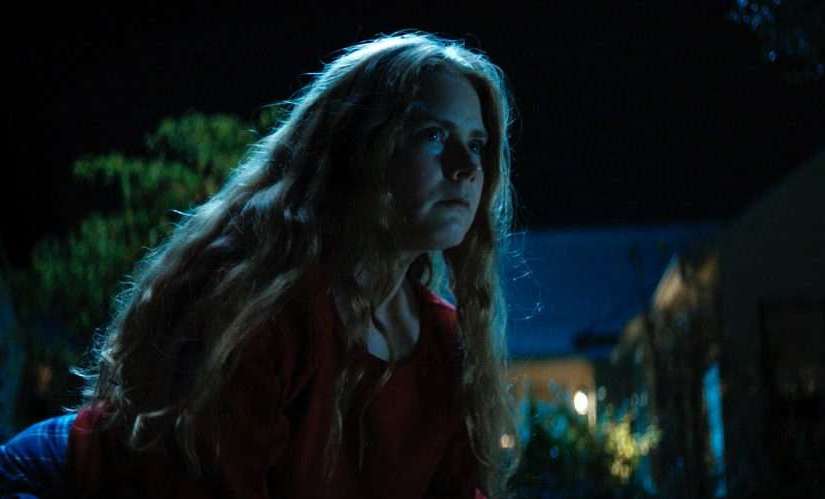
Amy Adams plays an unnamed Mother who has put her promising career as an artist on pause to be a stay-at-home mom while her also-unnamed Husband (Scoot McNairy) pursues his career as a…um…well, whatever it is, he has to travel a lot, leaving Mother at home with, you guessed it, Son (played by adorable twins Arleigh and Emmett Snowden).  Referred to throughout the movie as “my guy” and “sport” and “little buddy,” Son is a typical toddler in the throes of the terrible twos: cute for long stretches, maddeningly frustrating for longer stretches.  [Ed. Note: the author is not a father, has no plans on becoming a father, and will never possess the immense dedication it takes to rear a child, so don’t expect him to embrace the chaos of toddler-hood because it ain’t gonna happen.]

Mother is going through an identity crisis, set up in a brilliant opening scene where Sally, the woman who assumed Mother’s job at an art gallery, asks her, “Do you just love getting to be home with him [Son] all the time?”  Mother answers the question with a little more honesty than Sally or anyone had a right to expect, including this tidbit: “I am deeply afraid that I am never going to be smart, or happy, or thin ever again.”  I am a straight Hispanic cisgender male, so I’m here to tell you, I will never understand that mindset, but I am reasonably certain there are untold millions of moms out there who, if they listened to Mother’s opening statement, would say, “AMEN, sister.”

A little later, Mother delivers an internal monologue where she reflects that, as a mother, you can squeeze someone into the world “who will one day pee in your face without blinking.”  Again, I’m not a parent, but I know that’s truth in cinema right there.

After a few more establishing scenes of Mother interacting with Son, who absolutely REFUSES to go to sleep at night or eat anything for breakfast except, apparently, hash brown patties fried in butter, some odd things start to happen.  At the playground, some stray (?) dogs approach her as if she’s their best friend.  Mother notices her sense of smell has become much more acute.  Son helpfully points out that her back is hairy.  And, in a creepy Cronenberg-y moment, she notices a lump growing at the base of her spine just above her rump.  Curiosity gets the best of her.  She heats a needle, lances the lump, and…well, if you remember the title of the film, you have an idea of what pops out of that lump.

This was all wonderfully thrilling stuff as a movie lover.  I’m thinking, “My god, this is a Spike Jonze movie told from a woman’s perspective!  I’ve never seen anything like this!  This is gonna be GREAT!”  Mother starts to enjoy eating a lot of meat.  She starts to play “doggie” with Son, growling and barking at each other like two puppies.  The two of them eat their lunch at a deli with no silverware…or hands, to the consternation of other diners.  Son doesn’t sleep at night, so Mother, in a genius parenting move, buys a dog bed and gets Son to play “doggie” and sleep in the dog bed at night.  Presto, problem solved!

And more and more dogs start showing up at her door, at night, sometimes bringing gifts: small dead animals.  One night she walks outside, starts digging around, and an astonishing transformation takes place…

I know, I know, SPOILERS, I get it.  But it’s important to get across just how brilliantly original the first act of the film is, because the second act is, alas, all downhill.  I am not saying that the film’s message is unimportant, not at all.  I admire the film because of its message, and because it was being delivered in such an original way.  But then we get into conflict with Husband, who is desperately trying to understand why their 2-year-old is now sleeping in a dog bed on the floor, or why their cat suddenly turned up dead on the front porch, or why his wife suddenly wants a separation.  It must be said, Nightbitch is remarkably even-handed with the Husband’s dialogue.  He is not reduced to a 2-dimensional sitcom husband.  When she lays into him for not supporting her career, he fires back with a well-reasoned argument.  Their dialogue could be turned into a first-rate play.

But instead of exploring the surreal nature of Mother’s new condition, the movie settles into soap-opera territory, with only the occasional nod to the mystical incidents in the first act.  I distinctly remember, in the middle of the second act, feeling as if a balloon had deflated in the plot.  I imagine defenders of the film might say, “Well, the second act is where the weird stuff has to take a back seat to deal with the real issues at hand.”  Okay, maybe that’s true from a real-world perspective, but to me, it felt as if the filmmakers were on the verge of showing us something mindboggling, then backed away from the precipice at the last minute.

Does that make me guilty of critiquing a movie for what I wanted as opposed to what I got?  I guess it does, as much as I dislike that tendency in myself.  I feel there are so many different ways the movie could have gone in act two, could have leapt gleefully over the edge of convention and truly broken the mold with this movie.  When it became clear what they were doing instead, my elation evaporated.

I give Nightbitch a generally favorable score, though, based on the mad inventiveness of the first act and the plot in broad strokes, and also on the incredibly brave performance from Amy Adams, who maybe has two scenes in the entire film where she seems to be wearing any makeup.  She also appears to have to put on some weight for the role, which is not something I can ever recall seeing a female actor do.  Male actors have turned that kind of thing into a cottage industry, but when was the last time you saw a woman do it?  That took guts.  Watch Nightbitch for Amy Adams’ performance and for the story, even if the movie doesn’t follow its own plot to a satisfying conclusion.

THE SUBSTANCE

By Marc S. Sanders

It’s no surprise that a science fiction gore fest would make its way on the silver screen intent on enhancing our lives as we grow out of adult youth.  Plastic surgery and bust enhancements, unwanted hair removal, butt lifts and Botox are common vernacular discussed in magazine articles, infomercials and talk shows.  Well known actors rely on beauty preservations and enhancements to uphold their careers or give themselves a needed boost to stay relevant.  I mean come on, Tom Cruise wouldn’t naturally look like that.  Still?  Let’s get real.

What I admire about Coralie Fargeat’s The Substance is how she applies her updated Frankenstein experiments within the boundaries of Hollywood glitz and glamour.  Her film starts out ironic, then reflective and concludes on B level satire.  Wasn’t this how The Toxic Avenger came to be?

Fortunately, the brains of the writer/director overcome the beauty that’s attempted.

Elisabeth Sparkle (Demi Moore) is an obvious nod to Oscar winner Jane Fonda.  She is unbelievably gorgeous and physically fit, especially for a fifty-year-old award-winning starlet. (Incidentally, Demi Moore is over age 60.) She has found a second career success as a daily TV workout video hostess. Yet, she senses that her expiration of youth is quickly approaching.  It could not be more apparent from what her sleazy producer Harvey shares with her.  This jerk has no filter and tells it like it is. Audiences want younger and curvier, and Elisabeth ain’t it.  Harvey is played by Dennis Quaid and Farageat is not shy about presenting this guy with every priority of superficiality.

Elisabeth gets axed from her show.  Fortunately, she comes upon a possible remedy for her aging dilemma known as The Substance.  After some toiling about, Elisabeth agrees to try this clandestine idea out promising a better, more improved version of herself.  

The kit to make this all happens is delivered.  First is a needle injection and further instructions mandate without compromise that every seven days Elisabeth must return from the alter ego that spawns from her.  Except this is not so much an alter ego as it is alter body.  Literally from behind Elisabeth’s back enters Sue (Margaret Qualley).  Both Elisabeth and Sue are reminded by the mysterious voice on the phone that they are “one,” and they must use the contents of their kits to nourish one another’s bodies daily plus, and without fail, surrender to a seven-day hibernation while the other roams the earth.  Every seven days they must alternate.

Sue, with Elisabeth’s psyche, gets the job as the replacement hostess and Harvey goes nuts for her as the ratings and her popularity soars.  The Substance is serving its purpose.  

Yet, what happens when the two egos do not cooperate with the program’s mandates?  Well, you find out with an assortment of grotesque and ugly side effects that develop both mentally, and especially physically.  The Substance tackles some extraordinary consequences ranging from multiple personality disorders that joust with one another, and insecurities that even beauty enhancements could never resolve.

Amid all of the ugly gore of blood and fluids and stitching and rotted, infected skins is a jaw dropping performance from Demi Moore.  The Substance is deliberately not big on dialogue as it depends more on perception and facial response.  The best example is when Moore as Elisabeth prepares herself for a date and builds up an unnerving frustration as her character focuses on her reflection in the mirror.  I read that Demi Moore slapped and rubbed the skin of her face raw while shooting this scene in take after take.  Her commitment to the scene could not be more evident.  A later scene with her adorned in offensively aged makeup is at least as aggressive for the actress.  A food binge goes maniacal, and Demi Moore is sensationally focused on its messiness and engorgement.

The Substance is very smart from beginning to end.  Yet, the conclusion is outright ridiculous, and Coralie Fargeat clearly wants it that way.  It’s not only that Elisabeth and Sue suffer at the punishments of their own hubris, but Harvey and those that put appearances over any kind of, well, substance must succumb to their own superficial priorities.  Fargeat takes what could have been a comparable messy Three Stooges pie in the face route where everyone’s dignity has to be shed.  The blinders of beauty get washed away in an overwhelming deluge.

The Substance is elevated to an absurd narrative as quick as it begins.  No one is glamorized even if this is Hollywood.  We get close ups of Harvey gorging himself on sloppy, saucy cocktail shrimp while Elisabeth watches in disgust.  Later, the physical side effects go by way of famous makeup artist’s Rob Bottin’s work on films like John Carpenter’s The Thing.  The director tosses obvious nods to Stanley Kubrick’s The Shining with a ghastly orange hallway and reminiscent geometrically zig zag carpeting.  Even a men’s room designed in cherry blood red harkens back to that film.  Food is repulsive in this film that focuses on body image.  Colors of all kinds are loud, garish, and bright.  The director doesn’t want you to wince at only the very graphic details of Elisabeth and Sue’s ongoing transformations.  If these characters are going to feel or behave ugly, then the world they live will feel at least as repulsive.

A friend of mine who takes to curious kinds of horror and fright fests was eager to see The Substance.  She watched the night before I did and was angered by the ending that she found ridiculously over the top.  Definitely no argument there.  Yet, because this is satire offering a reflection of truth, as gross as the film is and as absurd as the ending gets, it logically adds up.  

We can try all we want to hold on to our youth and outer appearances.  However, either we must learn to become satisfied with the limitations that science can offer or we will pay penalties for defying what is instructed of ourselves.  The Substance is beyond any sense of science.  This film tosses hints at the viewer that Elisabeth, and later Sue, should think twice about what they choose next.  Then again, whoever thinks twice in one these B movie schlock fests, anyway?  

I even think this film goes a step further.  In cancer patients, chemotherapy remains the leading remedy for treatment of the illness.  We turn to its resolve despite the sickening side effects that stem from its program.  We want to live and we will compromise our ways to go on living.  Elisabeth Sparkle needs to remember though that she does not suffer from cancer.  She’s an insecure woman who isn’t ready to face change.  I’m not minimizing how the character feels.  I can relate.  She is facing a hard, agonizing truth from her perspective. I took steps in my lifetime to enhance my appearance and mentally and physically it was not the best option for me.  

It’s fortunate that Demi Moore allows me to relate to what’s traumatizing her.  Margaret Qualley does well holding up the other half of the picture as her side of this one personality gets drunk off the attention and perfection she’s entered into this new world.  

Commonly speaking, I also thought of the Queen from Snow White And The Seven Dwarfs.  An elegant woman so insecure with her beauty against that of a young girl and she sees no other way to come out on top than to change into an ugly, old hag.  Like Elisabeth in The Substance, the Queen in Snow White will accept a notion of looking worse before it gets better.  Since this film is satire, don’t we all go through experiences like this at one time or another?

Some of us learn.  Some of us persist and persist though.

NOSFERATU (2024)

by Miguel E. Rodriguez

DIRECTOR: Robert Eggers
CAST: Lily-Rose Depp, Nicholas Hoult, Bill Skarsgård, Aaron Taylor-Johnson, Willem Dafoe
MY RATING: 8/10
ROTTEN TOMATOMETER: 85% Certified Fresh

PLOT: The true OG vampire movie gets a fresh coat of paint in this gothic tale of obsession between a haunted young woman and the terrifying vampire infatuated with her.


Allow me to begin, as so many great films do, with a couple of flashbacks.

2018: The indie band Weezer records and releases their polarizing cover of Toto’s stone-cold classic “Africa.”  While recorded and produced with all the modern techniques at their disposal, fans of both bands say, correctly, that this new version is virtually identical to the original…so what was the point?  Couldn’t they have put some kind of new spin on it, like (for better or worse) UB40 and their cover of “Can’t Help Falling in Love”?  Why bother?

1991: Orion Pictures releases The Silence of the Lambs, an adaptation of Thomas Harris’s terrifying psychological thriller.  It goes on to win the coveted “Big Five” at the Oscars: Best Picture, Director, Actor, Actress, and Screenplay (Adapted).  Having devoured the book during one summer vacation, I go to a screening expecting to be wowed.  But…because the filmmakers stuck SO closely to the book (with some minor exceptions), there is little to no suspense for me.  While I am genuinely floored by how well-made and well-acted the film is, I do not experience any of the thrills and chills felt by those viewers who had NOT read the book.  I knew ahead of time what they would find in the corpse’s throat in the funeral parlor, how Lecter would escape from the courthouse, and how Starling would stumble upon Buffalo Bill’s house.  Don’t get me wrong, it’s a stellar movie.  But it was never truly scary for me.

Which brings me to Robert Eggers’s long-gestating remake of THE original vampire movie, Nosferatu.  Based on the immortal silent classic of the same name from 1922, directed by F.W. Murnau, the story will be familiar to any serious film/horror buffs, especially since Murnau “borrowed” liberally from Bram Stoker’s novel, Dracula, without first obtaining legal permission from Stoker’s estate.  How liberally?  Here’s a quote from IMDb: “All known prints and negatives were destroyed under the terms of settlement of a lawsuit by Bram Stoker’s widow.”  The only way the film survived was via 2nd-generation copies from other countries around the world.  Plagiarism?  Or homage?  I would normally say here, “You be the judge,” but the courts seem to have answered that question pretty definitively.

I mention this because every version of the Dracula mythology, starting with Nosferatu all the way through the semi-campy Hammer films to Coppola’s famous “low-tech” version and beyond – all of them tell the same story with only minor changes.  Consequently, the thing I look for in those films is not WHAT they’re telling me, but HOW they’re telling it.  Any student of pop culture knows Bruce Wayne’s origin story, so Batman Begins [2005] holds no surprises there, but the story is told extremely well, and so you roll with it, you know what I mean?

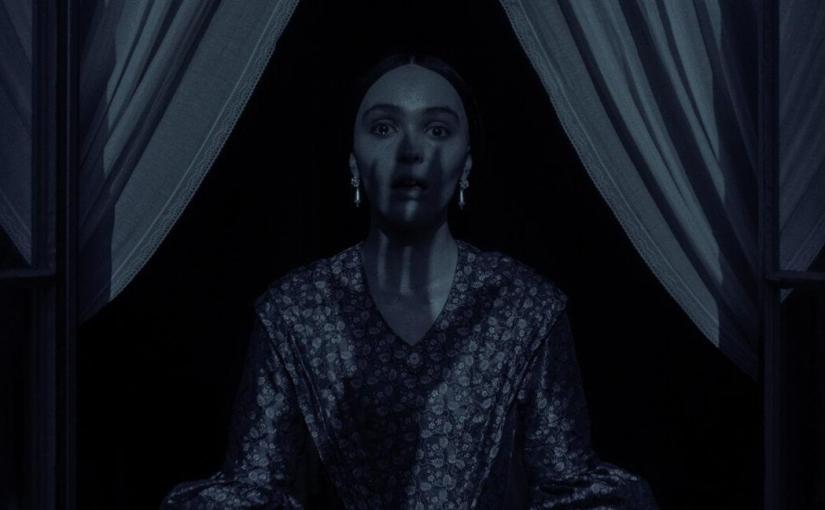
With Eggers’s Nosferatu, the production values on display are magnificent.  Eggers gets the mood and tone of a genuinely gothic horror story exactly right, as I knew he would, based on his previous films, especially The VVitch [2015].  The colors are muted to recreate the vibe of a black-and-white film, which paradoxically makes some of the scarier scenes even scarier.  The performances all around are top notch.  Poor Nicholas Hoult is saddled with the thankless Thomas Hutter role, stuck in straight-man mode the entire film; but Lily-Rose Depp had me thunderstruck with her performance as Ellen, Thomas’s wife, and the dependable Bill Skarsgård delivers the goods as Count Orlok, with a proper Transylvanian moustache (right out of the history books, haters) and an accent thick enough to tar ten miles of a country road with.

But let’s think about this for a second.  Those of you unfamiliar with the story of Nosferatu might be thinking to yourselves, “Who’s Thomas Hutter?  Who’s Ellen?  Don’t you mean Jonathan Harker and Mina?”  Well, naturally, those are the names the vast majority of filmgoers are going to be familiar with, not Thomas and Ellen and Count Orlok (which for my money is a much creepier name than “Dracula,” but I digress).

And therein lies part of the problem with this film.  I was so thoroughly familiar with the Dracula story that, even though this new film is a wonder to behold, it held very little suspense for me, since I knew exactly what was going to happen next, beat for beat.  There are, of course, cosmetic differences here and there: Thomas’s visit to a Romani village before he arrives at Orlok’s castle…Orlok’s straight-up possessions of Ellen…the highly effective jump-scares with the dogs here and there.  But I’ve seen it all before, MANY times.

(By contrast, I just recently watched one of the greatest slasher movies I’ve ever seen, X [2022], and it has virtually every slasher-movie-trope imaginable, and yet it somehow managed to transcend its own genre and become some kind of crazy masterpiece.)

In fact, in a very unexpected twist, there actually were two genuinely scary/creepy moments for me, and neither of them featured Count Orlok himself, at least not in the flesh.  They both involved Ellen, Thomas’s new wife, who becomes literally possessed by Orlok’s influence in scenes that legitimately give The Exorcist [1973] a run for its money.  Ellen thrashes about, rolls her eyes into the back of her head, speaks in an unnaturally guttural croak, bends backwards impossibly far – is Lily-Rose Depp a contortionist on the side? – and generally scares the bejeezus out of her husband and the audience.  On the strength of these two scenes alone, in addition to the general excellence of filmmaking craft on display, I would have no hesitation in recommending Nosferatu to moviegoers.

So, yes, despite my disappointments at the story level, given there were virtually no surprises plot-wise, I still give the movie a favorable rating just because it’s so well made.  If it had been created in a vacuum, if there had never been a vampire movie before this one, I believe I would have been creeped out to a much greater degree than I was, and this would have been hailed as an instant masterpiece.  But it is darkly beautiful to look at and wonderfully moody; there are many shots that are very nearly duplicates of shots from the original, which I enjoyed on a film-geek level.  I look forward to Robert Eggers tackling purely original material again.  He knows what he’s doing.

RED ONE

By Marc S. Sanders

Santa Claus has been kidnapped.  It’s up to Dwayne Johnson and Chris Evans to rescue him before Lucy Liu has to explain to all the Presidents and Prime Ministers across the world that there might not be a Christmas.  It’s one thing to read this as pertinent information.  It’s another to say it out loud with a straight face.  I’m now convinced that Lucy Liu is the most amazing actress of all time.  Not a curve, not a wrinkle, not a twitch in her stoic expression. Still, I believe Christmas is going to happen.

Yes, ol’ St. Nick (J.K. Simmons) has been captured.  His bodyguard is Cal (Dwayne Johnson), also head of security at the North Pole.  He is determined to get the bearded man in red back before Christmas Eve, and he partners up with a petty computer hacker mastermind, lacking any Christmas spirit, named Jack (Chris Evans).  The guys will argue with each other before they connect as buddies. You know how this works.  They’ll follow the leads to find out who and why “Red One” was taken. 

Red One works as a fun action picture with pretty cool and imaginative visuals like I’d count on from director/writer Jake Kasdan, son of Lawrence.  As a Christmas movie though? It needs a lot more tinsel.  

J.K. Simmons is not a conventional fat man Santa with a jolly “Ho Ho Ho.”  This dude is a weightlifter and, well, he talks like the guy from Whiplash and those Spider-Man movies.  Pair him up with the bruising Dwayne Johnson and this Santa is the morose police captain who would sit behind a desk, handing out the next Lethal Weapon assignment.  

The director of security is played by Lucy Liu, dressed in a black starched pantsuit, stressing the urgency of the problem.  Like the rest of the cast, save Evans, she takes Christmas way serious and that’s where the problem lies with Red One.  It’s not gleeful or celebratory of the holiday.  When she warns us that Christmas may not come, how am I supposed to respond to such a dire consequence?  Should I be scared? Am I supposed to laugh or cry?  When Doc Brown told Marty McFly he may be erased from existence, well you know that was pretty heavy (and not as trivial as something wrong with the gravitational pull of the earth).  When Lucy Liu and The Rock talk about NO CHRISTMAS of all things, I gotta wonder if I’ll get my annual Chinese dinner with my Jewish family.  Red One feels like a cliffhanger episode of NCIS.  Even Die Hard was more in line with the Christmas spirit than this flick.  John McClane declared his “Ho Ho Ho!” when he got a machine gun.  No one in this movie seems to have a sense of humor.  Chris Evans cracks some one-liners as if he’s shying away from the hokey script that everyone else embraces like a Tom Clancy novel.  

What works in Red One is the visual imagery of a wicked Christmas witch and assorted trolls and monster mayhem, particularly from Krampus (Santa’s gholish beast of a brother played by Kristofer Hivju) who gives a hilarious beatdown on The Rock.  There’s also a cute way to disarm some beastly polar bears who can encase our heroes in ice. The designs of the North Pole look cool as an industrial military base specializing in toy manufacturing.  However, we could have seen some cool gadgetry with this factory.  Instead, there’s a lot of underground mazes to circumvent that we barely get a look at amid the fast pace of the action scenes.

Cal is gifted with a power wristlet that packs a punch, shrinks him down for fighting advantages and has the ability to turn Hot Wheels cars into life size Chevrolet products for quick travel.  Naturally, Cal also knows that storage closets found in any toy store will transport you to another part of the world.  Nifty!  Not holiday spirited though.

The chases and fights work.  Johnson and Evans make for an okay buddy cop kind of pair.  The designs of the movie hold.  Yet, what’s missing is a spirit of Christmas magic.  Again, the holiday of Santa with his magical reindeer and cookies and stockings all feel hollow here.  Something is definitely missing because it’s hard for me to pinpoint who this film is catered for.  Families?  Red One comes off too nihilistic for that crowd ready to enjoy everyone’s comfort during winter break.  It’s too hokey just for the adults or the action movie lover.  A threat of Santa Claus missing with Christmas at risk also seems too overwhelming for the under 8 crowd.  

I got a kick at everything I saw on screen but there’s no one to connect with or empathize, and even for this Jewish guy, there’s an absence of Christmas tidings to behold from music to decor to the common recognizable tropes. Even when Santa poses as a shopping mall iteration, Simmons’ tough guy exterior doesn’t lend to any sort of joy or whimsy that comes with the holiday.

The sad irony is that Cal wants to retire because he sees more pessimism and materialistic selfishness in the adults these days.  Santa tries to convince Cal to reconsider as the spirit of the holiday will return.  If that’s true, then St Nick with a J. Jonah Jameson disposition does not offer much promise.  

These guys are rescuing Santa Claus like they are rescuing the President Of The United States, and frankly who the hell has liked any of the Presidents Of The United States of late?

GONE WITH THE WIND

By Marc S. Sanders

Gone With The Wind is probably the first of the sweeping epic.  It spans a transitional period in history from the American Civil War and through the aftermath known as Reconstruction.  Contained within these historical contexts are the prominent Georgian Southern Plantation residents. They court and romance one another ahead of the war. They celebrate with welcome glee, ready to fend off the horrible Yankees of the North who desire to put an end to black slavery.  Nearly ninety years later Victor Fleming’s film, based on Margaret Mitchell’s bestseller, is an impressive piece of movie making with set designs and shots that remain superior to many modern films of today. 

At the top of the character pyramid is young Scarlett O’Hara (Vivien Leigh), the spoiled Southern Belle of a wealthy Irish plantation owner.  Her spoiled livelihood pines only for the noble and dashing Ashley Wilkes (Leslie Howard).  Yet, he has committed himself to his cousin and Scarlett’s best friend Melanie (Olivia de Havilland).  Enter Rhett Bulter (Clark Gable), a self-made wealthy prospector who is taken with Scarlett. She gives him the coldest of shoulders as she waits for Ashley to leave Melanie and have him all to herself. 

Before the soap operas of radio and television arrived, there was Rhett and Scarlett in a competition of romantic swordplay. As you watch Gone With The Wind, you see how the relationships change with marriages and children, along with death as a cost of war.  If it wasn’t for how well this collection of actors perform, all of this storytelling would feel quite hammy by today’s expectations.  Yet, Clark Gable is undeniably handsome and confident as Rhett.  His stature is so impressively consistent with that pencil thin perfect mustache to enhance his proud grin.  He doesn’t wear the costumes of 1860 regality.  The costumes wear Clark Gable.  If the film were ever to be remade, no one could match what Gable delivered.  Vivien Leigh is also unforgettable.  Scarlett is hard to like, though amusing in how she holds to her convictions of rejecting Rhett’s advances while still obsessing over Ashley.  Sometimes you want to shake this spoiled brat down to reality.  Yet, as the film demonstrates, reality shellshocks the young lady as the war overcomes and she must learn to fend for herself and those closest to her.  Viviene Leigh is radiant, and she epitomizes this character amid the vibrant colors of her dresswear and her piercing eyes that focus on what is important to her.  Whether it is schoolgirl flirtations or determined survival, Viviene Leigh is always focused on Scarlett’s stubborn strengths, which at times are also her weaknesses.

The construction of Gone With The Wind is what stays with me most.  Knowing what we know of our country’s bloody history, it’s surprising to see how excited the men of the South are to enlist in the Confederate Army, defending their ways of Southern gentility and slave ownership.  Yet, even for a film, Victor Fleming does not shy away from the atrocities of war.  Before Oliver Stone demonstrated the false heroism that a man like Ron Kovic expected to find in Vietnam (Born On The Fourth Of July) or even what could be found in the first acts of All Quiet On The Western Front, Gone With The Wind was there to flip the coin first.  The same men who bucked their horses and fired their pistols in celebration of going off to fight either never returned or they came back to a thinly spread, elderly doctor ready to sever their limbs. 

The most unforgettable shot of this film occurs when naïve Scarlett traipses across a long block of wounded men to find the doctor and insist he tend to Melanie who is about to deliver a child.  The number of extras and the amount of detail and design in this one scene is astounding.  It’s truly a walk back in time and it never glamourizes an unforgiving history.  You cannot help but be marveled at this wide shot; one of the best I’ve ever encountered.

Following this moment, Scarlett is forced to grow up as Sherman’s forces advance through Atlanta and Savannah burning everything in sight, including what’s most precious, her plantation home known as Tara.  The art design of Tara should be studied in film school.  Victor Fleming’s crew show a beautiful expanse of land and prominence to open the film, just ahead of the Civil War, then it is followed by a pillaged and burn stained remnant of invasion that could not be fended away.  Fleming also captures stunning silhouettes of Scarlett and others with the foreground bathed in a burnt orange sunset or a grey and gloomy sky.  An unleafed oak tree is off to the side lending to the foreground and implying a current barrenness of what was once a luxurious South.  Just ahead of the film’s intermission, Victor Fleming completes his canvas on film showing a defiant Scarlett with a raised fist delivering her self-sworn testimony to reviving Tara for a new day.  It’s just another unforgettable moment in all of film history.

The length of Gone With The Wind feels overwhelming clocking in at just under four hours.  Still, the picture moves and progresses through historical landscapes and the developments of young Scarlett as she moves from her unquestioned reliance from Mammy, her house servant (Hattie McDaniel, the first African American to win an Oscar) and on to her courtships and marriages.  During her transitions, she must contend with lack of food, money and resources for herself and the slaves she’s grown up with at Tara, as well as the other plantation widows and wives.  Scarlett also must grow up quickly to find ways to fend off tax demands of Union Carpetbaggers.  All of these character developments hold my interest much more than the battle of the sexes engaged between her and Rhett.  These characters are wonderful.  Pure cuts of cinema grandeur.  However, I was caught up more in their recoveries following an undeniable defeat at the hands of war and what little was left behind.

When the film returns to the soap opera chapters, it is not so much that I am admiring Vivien Leigh, Clark Gable, Olivia de Havilland or Leslie Howard.  I am much more engaged in the backgrounds they occupy.  The rubble of carnage followed by the grand reconstructions that remedied their new situations.  Rhett and Scarlett fight for common ground in their eventual marriage, have a child and then emotionally toy with one another.  It’s nothing boring.  However, it is a lot of same old, same old and Margaret Mitchell’s sweeping epic finds sad resolutions to their dilemma of uncommon grounds with each other.  Arguably, these resolves in the storylines are a little too convenient as the story works to draw your tears while keeping you engaged in the drama.  Gone With The Wind is so legendary though, and still one of the biggest revenue earning films of all time. It is likely had I seen this film at the end of the 1930s when technicolor films were rare treats, that anything put on the screen would take me away in the splendor and heartache.  I reflect on the film after watching it for a second time and I still do not like Scarlett.  However, I admire what she endures and how she persists.

In 1939, Victor Fleming directed both The Wizard Of Oz and Gone With The Wind, two films with only the commonality of technicolor achievements.  They remain two of the greatest cinematic triumphs of all time and will always carry that honor.  I’d argue that Fleming was a Francis Ford Coppola, or a James Cameron or George Lucas of his time.  A pioneering and aggressive filmmaker looking to invent a new way to absorb moving images on a screen, accompanied by grand instrumental soundtracks and actors who complimented zoom ins and outs with his camera.  Victor Fleming is a director who truly remains unmatched.  When you watch these two films, you are carried off into unfamiliar times and places. You are forced to observe beyond what appears closest to you.  The immediate stories do not stop with Dorothy or Scarlett.  Look at Munchkinland or war-torn Savannah as far as your eye can take it. Fleming has something all the way back there, that far out, for you to see and collect in your consciousness.

Today, Gone With The Wind is accepted as a piece with an asterisk next to its title.  The treatment of African Americans in the film along with their dialects and appearances is held into question.  Should these people be depicted in this manner?  Ahead of the film, streaming on MAX currently, there is a warning label of what some may consider inappropriate content even though the film remains preserved in its original final edits.  It should be.  How blacks were cast in films and how blacks were treated in history can not be changed and if we are to improve on our future of filmmaking and the histories that have yet to come, then the worst thing we could ever do is disregard the errors of our ways and whitewash over how any people were regarded and what our perspectives looked like.  Hattie McDaniel’s character may be the most beloved and memorable character in Gone With The Wind.  She’s a scene stealer whenever Gable or Leigh share a moment with her.  It speaks volumes that she could win the Oscar during a time when overt prejudice was never subtle. She was not even permitted in the theatre to accept her trophy. Clark Gable almost didn’t attend the ceremony in protest of her restriction.  McDaniel held that he go in honor of the film.  Still, Ms. McDaniel insisted that she’d rather play a maid on screen a hundred times over than live the life of a real maid fulfilling the servitude of someone else’s demands. 

Ahead of the challenging progress that came over twenty years later with the civil rights movement, McDaniel demonstrated a need for people of color to connect and relate to any kind of movie watcher.  Gone With The Wind would not have the reputation it has always held without Hattie McDaniel or Butterfly McQueen (as Prissy, another house servant).  To wit, these actors upheld what was being fought for within the Civil War and how those of the deep south lived and treated one another.  While we should be sensitive to how blacks were treated at this time, I am also grateful for their contributions into a historical depiction of a violent and unfair period.

Gone With The Wind takes commitment to watch.  Yet, it is such an important masterpiece in filmmaking.  It carries an immense significance that I believe it is one of a select number of films that must be watched in everyone’s lifetime.  I expect to still be breathing when the film reaches its one hundredth anniversary, and while some critics and skeptics poke at its shortcoming in sensitivity, I also hope that those who wish not to censor or erase an often-cruel history will give the picture its ongoing salutes and applause.  I’ll be at that Fathom event in the movie theater for that one hundredth anniversary.  This film was made to last a full century after its debut and then to last another hundred years thereafter.

It’s a masterful, epic and unforgettable piece of movie making.

PEARL (2022)

by Miguel E. Rodriguez

DIRECTOR: Ti West
CAST: Mia Goth, David Corenswet, Tandi Wright, Emma Jenkins-Purro
MY RATING: 10/10
ROTTEN TOMATOMETER: 93% Certified Fresh

PLOT: In 1918, a young Texas woman on the brink of madness pursues stardom in a desperate attempt to escape the drudgery, isolation, and lovelessness of life on her parents’ farm.


I originally gave Pearl a rating of 9 out of 10 because it was not quite as terrifying as its predecessor, X [2022], but I have decided to amend that to a 10 out of 10 based solely on the performance by Mia Goth in the title role.  If her performance had appeared in anything other than an indie horror film, I firmly believe she would have been nominated for an Oscar, or at least a Golden Globe.  But I’ll get to that in a second.

Pearl is a prequel to the acclaimed horror flick X, in which most of a porno film crew is stalked and murdered by an insane old woman, Pearl, and her equally insane old husband, Howard, in Texas in 1979.  It starred Mia Goth as Maxine, a stripper who was convinced she was meant for bigger and better things.  This time, in the prequel, Goth plays Pearl as a young woman growing up in Texas, but this time it’s 1918.  World War I is on the verge of ending, but the Spanish Flu pandemic is in full swing; folks in town don’t go anywhere or do anything in town without wearing a cloth mask over their nose and mouth.  (Sound familiar?)

Pearl’s home life is not quite functional.  In her first scene, over a lush score that sounds as if it were imported from the 1940s, Pearl dances in the barn and talks to a cow and a goat and a horse, like Snow White, about how she’s going to become famous and leave town, and everyone will know her name.  Then a goose waddles in from outside and interrupts her conversation; Pearl gets an odd look in her eye, grabs a pitchfork, sidles up to the goose, aaaand you can probably guess the rest.  (The gator from X makes a nice cameo shortly thereafter.)  Meanwhile, that ‘40s musical score punctuates the action like a Disney movie.  The effect is profoundly odd, but compelling.

We learn more about Pearl’s home life with her invalid father and domineering mother, Ruth (Tandi Wright).  She married young, but her husband, Howard, was called off to war in Europe, leaving her alone with her less-than-ideal parents.  She dreams of fame, but Ruth, with her strong German accent, sternly reminds Pearl of her responsibilities to her father and the farm.  One day, Pearl rides her bicycle to town to buy medicine for her father (sounds like the beginning of a fairy tale) and decides to go to the movies, which were very different in 1918.  She meets the strikingly handsome projectionist (David Corenswet, aka the new Superman) who encourages her to take the time to live her own life before it’s too late.  On her way home, Pearl stops in a cornfield, finds a scarecrow, and engages in a charming little song and dance with him…until her mind plays tricks on her and the encounter turns into something altogether different.

The whole movie is like that.  Shot in vivid colors and featuring an evocative soundtrack, it alternates between The Wizard of Oz and Joker.  (In fact, IMDb trivia notes that female fans of this movie call it “the female Joker.”)  It keeps you off balance in all the best ways, threatening to fly apart, but Ti West’s direction and Mia Goth’s performance manage to hold everything together in a satisfying, but disturbing, whole.  As with X, I can acknowledge the achievement, but I’m damned if I can explain how it was done.

There are many highlights in Pearl: her audition for a traveling dance show.  Pearl wheeling her father to the edge of the lakeside dock.  The scarecrow.  The tipping point between Pearl and her mother.  The pig on the porch.  (Gross.)  The look on her father’s face when Pearl dresses him up for a gentleman caller.  But the pièce de résistance of the entire film is, without question, Pearl’s monologue.

In a movie in which Mia Goth teeters on overkill in several scenes, the screenplay (co-written by Goth and Ti West) provides Pearl with a heart-rending soliloquy that should be more famous than it is.  Pearl’s sister-in-law, Mitsi (Emma Jenkins-Purro), sensing that Pearl is troubled, encourages her to indulge in a little play-acting: “Pretend I’m Howard.  What do you want to say to me?”  What follows is a 7-minute speech, most of it captured in an unbroken 5-minute take that must be seen to be believed.  In it, Goth expresses virtually every emotion imaginable as she unburdens herself, purges herself of all her repressed rage at her husband for leaving her alone, at her mother for holding her back from her dreams, at her father for having the temerity to fall ill and causing her to remain home for his sake.

Does this speech excuse her violent behavior?  Not at all.  But it explains it as well as any other serial killer movie I’ve ever seen.  I was reminded a little bit of Charlize Theron in Monster [2003], who also played a woman who committed terrible crimes, yes, but who was pushed into making those choices by her family and a society who little noticed or cared about her situation.  That’s how stirring Goth’s performance is, that I would compare it to one of the greatest performances ever captured on film.  In a movie that flirts with parody a couple of times, this last speech grounds it and the main character firmly in the real world.  It’s truly astonishing.

I’m almost sorry I saw Pearl AFTER watching X.  Almost.  It kind of makes me want to go back and watch X again, armed with all this new information on Pearl’s backstory.  It also solidifies the psychic connection between Pearl and Maxine, which was touched on several times in X, and which I imagine will be revisited in some way in Maxxxine [2024]…but I’m just speculating.  Pearl is good enough to stand with any of the best serial-killer-origin stories ever made.

(P.S.  As with X, you’ll want to make sure you watch the credits, except this time you want to stay with it until the last image fades to black…you’ll know what I mean.  IMDb informs me this crazy, creepy moment happened because after the last line, director Ti West refused to yell “Cut” and just let the camera run, and the actor in question, being a professional, simply stayed in character.  It’s remarkably unsettling.)