VERTIGO

By Marc S. Sanders

Never would I think Alfred Hitchcock would enter the world of the supernatural.  At least of all that I’ve read about him and the films I’ve seen to date, I do not recall tales of ghosts and ghouls from the master of suspense.  Yet, as I’m watching his classic, psychological film, Vertigo, I’m questioning the territory that Hitch has entered.

James Stewart returned to work with Hitchcock in 1958.  He plays Police Detective John “Scotty” Ferguson who opts to retire following a frightening encounter involving a foot chase over the rooftops of San Francisco.  When he succumbs to his debilitating fear of heights, a police man loses his life in the process.  Scotty just can’t go on.

He is recruited by his wealthy industrialist friend Gavin Elster (Tom Helmore) to shadow his wife, Madeleine (Kim Novack).  Gavin is concerned that Madeleine may be suicidal, because it is becoming not too unreasonable to consider that perhaps a woman from the past has taken possession of her.  Scotty is reluctant of course, and it all sounds like a bunch of nonsense.  Yet, he accepts the assignment.

Vertigo may be a classic film, known by millions worldwide, but I won’t dare utter any hint of what’s to come.  Scotty’s pursuit of Madeleine continues to spiral into new inventive twists like Alfred Hitchcock always took advantage of.  The film could have ended on several different notes, and its running time could have been shorter.  However, Hitch lay insistent on peeling back more of the onion.

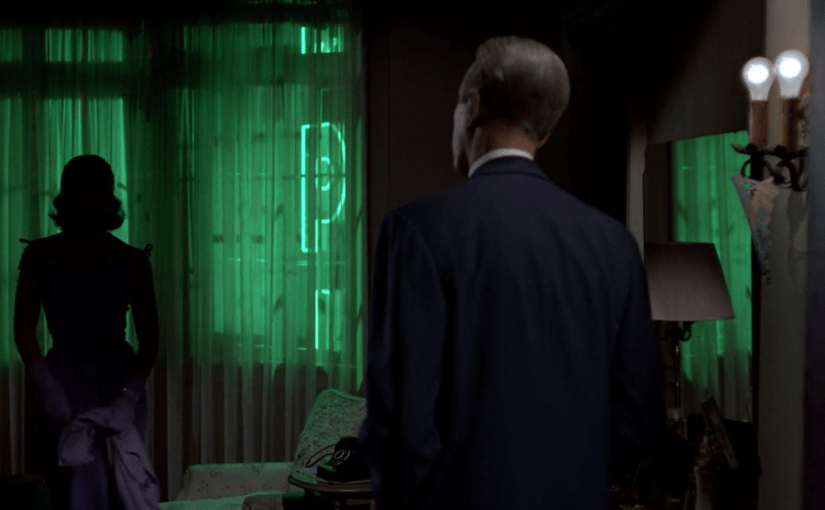
I was fortunate to see the movie following a painstaking restoration after the film was uncovered to be in terrible shape.  Now, it is preserved on 4K disc, and Vertigo is tantamount to the necessity of 4K.  Firstly, as Scotty continues to oversee where Madeline goes and what she does, Hitchcock keeps much of her activity bathed in a rich emerald green.  Green almost works like breadcrumbs for Scotty.  She drives a green car.  Many of her elegant dresses have green in them.  Hitchcock lights many of her scenes in green.  Oddly enough though, while green is so apparent from Scotty’s perspective, Madeleine’s overall purpose and intent is such an enigma.  So, film historians proudly recall how the most popular outfit for the bleach blond Novack to wear in the film is a plain, simple grey suit which tells us nothing.  Grey is melancholy, seeming to express no kind of emotion.  Not fear, or anger or love, or happiness or sadness.  The suit even becomes a significant plot point later in the picture.  The woman is there plain as day, at times shining in the emerald car, or beneath a green light, but why is she there? 

As well, Scotty’s continued pursuit and eventual love affair with Madeleine overcomes him and he spirals into a madness highlighted in reds and blues and oranges with spiral lines turning into bottomless pits.  Hitchcock even imposes haunting animation to show how Scotty’s mind is splintering and falling away from any depth of reality.

I have seen clips of the original film and the colors are so faded out.  It takes you out of the picture.  The color is so pertinent to the narrative of Vertigo that there was no question.  The movie had to be restored.  Watch this movie on 4K.  You won’t regret it.

Have you looked at the well-known marquee poster for Vertigo lately?  It is definitely one that’s consistent to dizzying turns and descents to overtake the movie.

Furthermore, the opening credits of the film zoom into the pupil of a woman’s eye and then spiral sketches start to turn and spin.  It’s easy to connect this to the side effects of Scotty’s acrophobia.  He gets dizzy.  His visual perspective draws him out of measured reality.  As the film progresses, though, it goes further than that.  Hitchcock turns Scotty into a man crippled with obsession. 

I heard my Cinephile colleagues discuss this film recently, implying that Vertigo is not their favorite.  They didn’t like James Stewart’s character.  For one thing he falls in love with Madeleine, his friend’s wife. The Cad!!!  Later, he invokes unequivocal dominance over a new woman he meets in the second half of the picture.  (I won’t say much more, here.)  He insists the woman dress like Madeleine and do her hair and makeup like Madeleine.  She also needs to walk like her too.  Stewart and Hitchcock really put this protagonist through the ringer.  He’s first crippled with a fear of heights.  However, dominant obsession interferes with him as well.  Is it the acrophobia that is so debilitating, or is it a sick obsession that comes into play?

San Francisco is an ironic setting for a film where the main character has a fear of heights.  It’s made up of steep hills that descend from high tops, or ascend into the sky.  Try climbing the staircases that stand upon these hills and now you are even closer to the heavens and further away from the ground.  How could a guy like Scotty Ferguson live in such a city?  Yet, here it is.  Maybe it was a sick, subtle joke of Hitchcock.  I think it’s a nice touch to amplify the suspense.

James Stewart is just as good here as he was in Rear Window.  The likable fellow who serves as a sponge to what’s laid out before him.  If he absorbs too much though it could defeat him altogether.  Much of the suspense Hitchcock is known for, stems from this thread line.  Stewart’s Hitchcockian characters get drunk on needing to know more, and delve even further.  The audience can’t help but get intoxicated with him.

Kim Novack is radiant.  She gives an especially incredible acting performance.  Through the first half of the picture, she’s quiet and reserved laying credence to what Gavin suggests to Scotty.  Is she being possessed by a young woman with odd resemblances too her, who killed herself back in the 1800s?  Is it something else?  Her turn in the second half of the picture leaves you questioning if you are even watching the Kim Novack.  An amazing double performance from her that lends to one of the twists that Vertigo offers.

Pictures like Vertigo and Rear Window are so important for people to see.  These films laid the groundwork for much of the horror, macabre and disturbingly mysterious stories shown today.  They are pioneering films that only invent what needs to be shown.  In other words, they don’t get diverted in overcompensating with action and gore.  Many films that derived from Vertigo desperately turn to blood and over the top stunts and visual effects.  Alfred Hitchcock thought about how the actors, the settings and wardrobe, along with his cameras, would capture the terror and embrace the unknown.  Filmmakers need to continue learning from a craftsman like him.

AT CLOSE RANGE

By Marc S. Sanders

Sean Penn has been a gifted actor from the very beginning of his career.  Whoever thought the kid who played surfer dude Jeff Spicoli in Fast Times At Ridgemont High would go on to evoke such intensity in future roles afterwards?  Other actors who did that kind of sophomoric material went on to be in Police Academy movies.  Penn would never shake that surfer image, but he would at least equally receive accolades for his dramatic turns. In James Foley’s At Close Range the high stakes drama could not be more apparent. 

Penn portrays Brad Whitefore, Jr. in this film based on a true story taking place in a small, rural Pennsylvania town in 1978.  Brad Jr.  is going nowhere and that’s fine with him.  He’d rather be an intimidating, fearless kid who will defy his step father so he and his brother (Chris Penn, Sean’s real-life sibling) can get drunk and high.  When Brad opts to go live at his father’s, Brad Sr., house, he hopes that he will learn the ropes of becoming a career criminal like his dad.  Brad Sr. (Christopher Walken) specializes in ripping off tractors, farm equipment, cars, wealthy property owners, and safes carrying large amounts of cash.  He happily welcomes his son into his home with his misfit gang and his new young wife.  Dad will also express love to his son by giving him a car and support, while also welcoming in Jr’s new girlfriend Terry (Mary Stuart Masterson). 

There is a code among these criminals however, and it stretches to flesh and blood as well.  No one is to talk about what they do or how they do it.  Shortly after dad allows his son join in on a job, Brad Jr. learns of the consequences if anyone talks about their handiwork, especially if you are seen chatting with local law enforcement.

At Close Range came out in 1986.  Even by then, I don’t think it would be challenging to forecast where the story is heading.  What’s most interesting about the film are the cast performances from Penn, Walken, and Masterson.  James Foley sets up good scenes where loving trust works at one point, but when that is shattered, what is the detritus left over afterwards?  Christopher Walken plays a guy with no limits to upholding his code, and as I reflect on that motivation, I can’t help but think how relevant Madonna’s eerie ballad Live To Tell (from her True Blue album) is so very important to the picture.  The song should have received an Oscar nomination based on its significance alone.  I’ve only now just seen the movie for the first time.  Yet, I’ve been familiar with the song for nearly forty years.  It carries much more meaning now.

James Foley’s film could’ve been better, however.  The first hour is incredibly slow moving and doesn’t seem to offer much direction or exposition for what the film is truly going to be about.  At some points it is a boy meets girl storyline with Penn and Masterson.  They have good scenes together, but were they all necessary?  Couldn’t some of this material ended up on the cutting room floor?  Then in other areas it is a father/son coming of age piece where pals from both of their respective backgrounds get drunk together on any given night.  Brad Sr. is emulated for his leadership, the gun he carries, the money he flashes and the high-end muscle cars he steals, even gifting one to his son.  Brad Jr. is looked upon as the cool rebel (maybe a more aggressive modern James Dean) for not surrendering to intimidation from anybody. 

The movie also ends kind of abruptly.  It’s clearly understood what’s going to come of the father and son’s relationship.  Sean Penn and Christopher Walken stage a nail biting, very intense showdown in the kitchen.  However, what happens to them individually?  The final scene actually ends right in the middle of what could have been some good dramatic work, but it all goes to black.  Had I been in a movie theatre, I might have thought the projector broke down.  Business must have interfered behind the scenes.  A producer must have stepped in and pulled the plug.  It’s the best excuse I can think of, because the end credits intruded way too soon.  If the film was being edited for length, then there was much material to chop out of the first hour.  The filmmakers basically cut off the wrong leg.

At Close Range is not a steady trajectory of a movie.  It moves in too many sideways directions to stay focused on what it wants to be considered.  Is it a more genuine Rebel Without A Cause?  Is it a rural, backwoods interpretation with inspiration from Mean Streets?  Thankfully, what saved me from turning it off or falling asleep are the assembled cast performances.  At the very least, it got me interested to read up on the real story the film is based on.

THOR: LOVE AND THUNDER

By Marc S. Sanders

Taika Waititi’s Thor: Love And Thunder doesn’t just operate as a standard Marvel Super Hero movie.  I think it encapsulates what moviegoers treasure when watching a film, and that consists of a gamut of emotions with the opportunity to absorb the best in sight and sound.  Even if we are watching a guy fly through the skies with a cape that’ll be marketed into a million toys and t-shirts, sight and sound are nothing without brains behind a script.  It’s fortunate that a director like Waititi always works with that in mind.  Marvel overseer Kevin Feige knows how to recruit talent behind the camera and you just can’t go wrong with the architect of a spoof on the surface, yet an all too horrifyingly real film underneath, like the widely acclaimed Jo Jo Rabbit.

I’ve always laid claim to the fact that movies largely recognized as “tear jerkers” like Steel Magnolias and Terms Of Endearment are actually comedies first, and then dramatic sob stories second.  I’m serious about that observation.  Why?  Because if a film is going to go to great lengths to risk the outcome of one of its main characters, then it must get its audience to embrace and deeply love that person first.  The best avenue to that approach is to outrageously laugh and cheer that character on ahead of what’s to come.  Taika Waititi’s second film to center on the God of Thunder does just that.  The best reward I got from Thor: Love And Thunder is that I laughed quite often (as the trailers imply), but I also teetered on tears as well.  Good fantasy storytelling will incorporate an all too real conflict with its protagonists and then introduce the strange and unusual as an escape.  The best example may be The Wizard Of Oz, and the simple set up of Dorothy and the risk of her perishing with her dog Toto in a threating tornado.  More recently, I also think about Guillermo Del Toro’s Pan’s Labyrinth centering on a young girl in early twentieth century war torn Europe.  Again, Waititi’s coming of age during Nazi occupation opus, Jo Jo Rabbit, follows this formula as well.  Without spoiling too much from Thor’s latest adventure, Waititi presents an all too real and unforgiving circumstance for one of the film’s characters and then segues into his delightfully and never too weird assortment of settings and characters.

It’d be easy to think that by what may be the sixth or seventh time we’ve seen Chris Hemsworth in the garb of this character that anything inventive would have been exhausted by now.  Not so.  A new dimension in storytelling arrives midway through the film that presents a different crisis for the proud God.  Hemsworth really approaches it beautifully.  It was reminiscent of Christopher Reeve in the original Superman, actually.

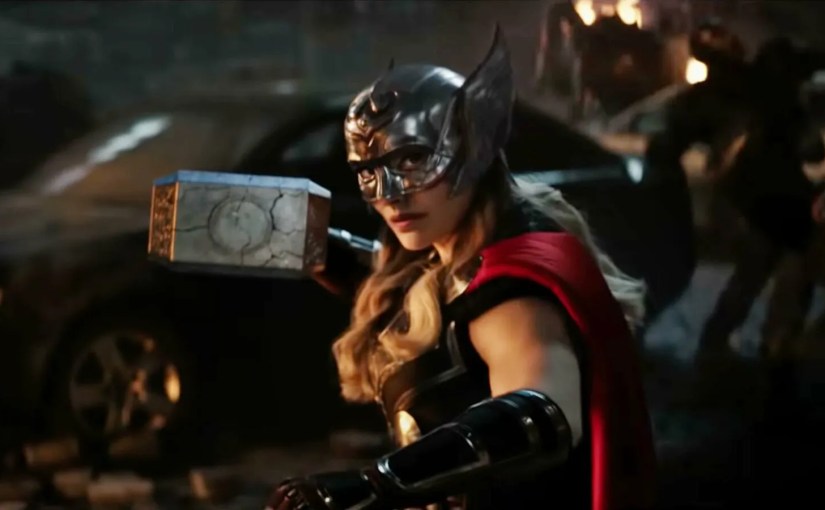
A supporting cast of return players work well together, particularly Natalie Portman, who is given a much more fleshed out and well considered character arc than her two previous Thor films. (Early on, Marvel Studios was notorious for not writing good female characters in any of their pictures.  They were just presented as glamorous damsels in distress. Thankfully, that’s well behind them by now.)  Portman returns as the on again/off again love interest, Dr. Jane Foster, for Thor.  Even better though, Jane actually becomes Thor!!!!! (No spoiler there.  Just look at the trailer or marketing poster.)  There’s great on-screen interaction with Portman and Hemsworth, even when it’s a montage of past dating episodes like in ridiculous Halloween costumes or having a domestic squabble as any typical married couple might have.  Hollywood should reunite these two for a romantic comedy in the vein of Rob Reiner/Nora Ephron material.  Chris Hemsworth is a much better partner than Ashton Kutcher ever was in a past Natalie Portman film.  Put Chris Hemsworth together with Natalie Portman again and they could become as adoring as Tom Hanks and Meg Ryan did.

By the time the fourth movie comes, does it really matter who the villain is played by?  Well, when you are writing a smart script amid ridiculous visuals like Taika Waititi is known for, the answer is yes.  This film surprisingly opens on a downer prologue that necessitates good dramatic acting amid silly CGI and garishly loud costumes.  It’s fortunate that Christian Bale, who regularly performs on a method level comparable to Daniel Day Lewis, was available to portray the scrawny, pale and scarred Gorr The God Butcher.  Bale puts all his talents into what could’ve been a throwaway role like, say a Ghostbusters bad guy.  (Can anyone tell me who actually played Gozar in the 1984 film????)  This is another notch in Bale’s repertoire of outstanding credits that should not be overlooked.  You can sympathize with Gorr, as well as be frightened of him.  There’s much range in this character on the same level as the Thanos villain from earlier Marvel films.

Russell Crowe has a fun appearance as the God known as Zeus.  He looks over the top ridiculous and he works in antics that seem like they came out of episodes of Who’s Line Is It Anyway?  Put it this way, I haven’t forgotten how Crowe walks down a staircase yet.  If Russell Crowe is anything of an educated performance artist, then when he was getting sized up in wardrobe, I’m sure the wheels were turning and he was considering what tics could work for that of a God drowning proudly in his own vanity.

Tessa Thompson and Taika Waititi are thankfully back, respectively as Valkyrie, King of the fishing/tourist destination New Asgard, and the simply innocent rock guy buddy, Korg.  The Guardians Of The Galaxy are here too.  It’s a fun bit of material they have to play with.

In another director/screenwriter’s hands, any Thor film would likely get boring with its standard formal Shakespearean like vocabulary and artificial CGI.  Isn’t that an ongoing problem with CGI anyway?  So often it looks to fake.  Because Taika Waititi opts for bright colors and odd shapes and sizes of setting and background characters, nothing could look artificial, because the fantasy is always acknowledged as over the top by the very characters occupying the space.  A glass castle of pinks and purples that resembles gigantic glass Mary Jane bongs or science lab beakers is accepted in a Thor film, just as much as munchkin size, owl like creatures with small beaks are a terrorizing army in flying jet skis with mounted laser guns.  Mix in a blaring rock soundtrack and Waititi hits the notes where it’s okay to laugh at the silliness of it all. In other moments, he’ll invite his audience back in from recess to take in what’s hard and difficult to live with and endure.  Again, Waititi pleasantly surprised me with the balancing act of outrageous comedy against crushing drama when he made Jo Jo Rabbit.  The blend works so well here in not so typical Marvel fashion.

Thor: Love And Thunder left me thinking that it is the best of the superhero’s four films.  It’s measure of laughs and choked up drama kept engaged and I appreciated the experience.  Remember, I recalled Steel Magnolias and Terms Of Endearment in this write up.  If you don’t take that comparison lightly, then hopefully you’ll have the same experience I did with this installment of the Marvel franchise.

PS: Hats off to the trailers for not incorporating everything the film has to offer.  Within the first fifteen minutes of the movie, I was actually taken aback by an element I never considered or expected.  It only enhanced my perspective of the film.

PSS: Anyone that knows me, knows that I love Guns N Roses.  Consider me a born-again fan.  Particularly Sweet Child O’ Mine will always be one of my most favorite songs.  This film reminded me that it was the first song my daughter heard the day after she was born, when I sang it to her in the hospital room. 

STRIPES

By Marc S. Sanders

A trifecta of talent was widely received when Bill Murray, Harold Ramis and Ivan Reitman came on the Hollywood scene. With films like Meatballs and Animal House, they were toeing the line of B movie T&A material. Audiences, however, responded to the wisdom in the comedic potential of disregarding the authoritative party. That is especially true in their R rated army romp from 1981, Stripes.

Stripes is arguably not their most memorable film of any of their careers, but for me it is probably my favorite; more than Caddyshack or Ghostbusters. The comedy was spot on, and the timing was perfect. When John Winger and Russell Zisky (Murray & Ramis) decide to enlist in the army on a spur of the moment, their basic training experience is actually believable. It could happen. I could relate. If I was as big a guy as John Candy, playing the lovable “Ox,” and I was running the obstacle course, yeah…I might run off course uncontrollably into the outer woods. All these guys are completely out of shape. There’s no way we were ever gonna see Rambo here.

Bill Murray might be the leader of this rag tag gang of miscreants, but his own material is just very, very funny. Few comedies have such a hilarious opening scene as he does while he escorts a snobby woman to the airport in his cab. He has enough of her, and so everything is put out on the table. The Three Stooges would have smacked a pie in this woman’s face. John Winger decides to terrify her with some action photos while he drives. To date, no one has ever come close to duplicating this scene.

Winger continues with his rebellion against his Drill Sargent played by Warren Oates who is terrific in his own right. Oates convincingly comes off as straight army material amid all of these nitwits. He can give a facial expression that says a thousand words.

John Candy is a huge highlight in perhaps his breakthrough cinematic performance. Ramis and Reitman wrote a great character in Ox. I think it’s hilarious that a fat guy thinks the most ideal way to lose weight is to join the army because it’s free with a six to eight week work program. We all love to see that it eventually occurs to Ox that basic training in the Army is not exactly a weight watchers program. A major highlight is when Winger rushes Ox into a mud wrestling ring at an adult club. Pure slapstick fun. You can’t help but laugh.

I’m surprised to see that many took issue with the film’s second half. I loved it as the platoon has to pursue Winger and Ziskey who have a special puke green colored RV that the army has engineered with more weaponry than a James Bond car. Eventually, this leads to a ridiculous rescue within a Russian occupied Czechoslovakian outpost. It’s a great blend of action and comedy that holds up nearly 40 years later. What’s not to like?

I’ll be honest. I saw Stripes when I was 10 or 11, and it actually gave me an education on the current life of what it’s like to be in the Army. Having never enlisted, I’m nevertheless convinced that Warren Oates was an accurate interpretation of what a hard driven Drill Sargeant was like. Because it seemed so genuine. It seemed only fitting that a great comedy could be drawn from resisting that kind of authority. The material in Stripes didn’t come off silly or Looney Tunes like. It all seemed natural. The jokes just came alive amid the challenges of entering the Army life.

Stripes remains a favorite comedy of mine.

SCANNERS

By Marc S. Sanders

David Cronenberg’s Scanners, from 1981, is part of the Criterion DVD collection. So is Michael Bay’s Armageddon from 1998. Why? Beats the hell outta me, but what does that truly say about Criterion?

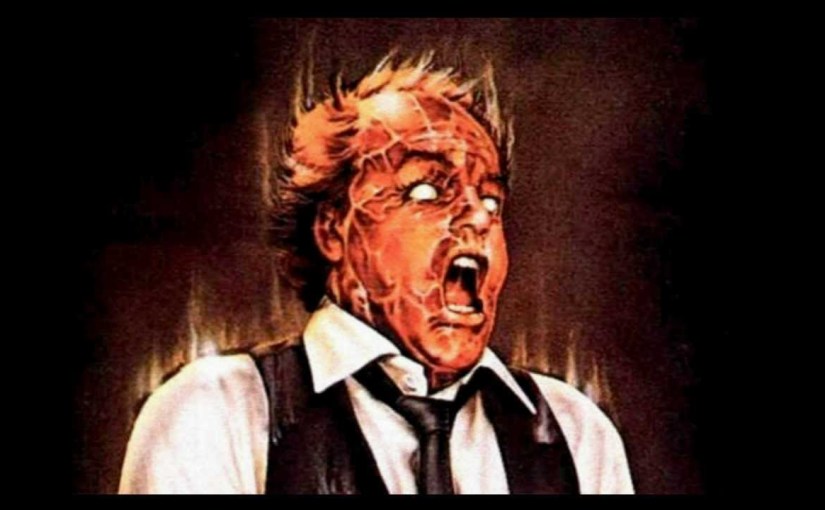
Scanners tells the story of people who are capable of mind controlling others. Some use this ability so powerfully that they can actually make a person’s head explode into what looks like what can happen when you leave a hot dog in the microwave too long. It’s likely how they achieved this visual effect, actually.

Well known cinematic henchman (with the cool voice) Michael Ironside plays a nasty scanner named Revok. In 1981, the best and most cheap way to display “scanning” was for Ironside to distort his face, roll his tongue back as well as his eyes and shake like he’s having a seizure or contending with intolerable constipation. Maybe in 1981, this would amaze and terrify me. In 2020, I wanna say “Michael, knock it off. Pick your toys up off the floor, and brush your teeth.”

There’s also Cameron Vale (Stephen Lack), a good guy scanner. He does the same kind of weird contortions though not as spastic as Revok. He’s been hired by some soft spoken scientist, Dr. Paul Ruth (Patrick McGoohan) – no, not THAT Dr. Ruth – to stop Revok from, I think, taking over the world. McGoohan, plays the role of mentor like he’s failing miserably at his audition for Obi Wan Kenobi.

A scan causes faces to convulse and squirt out blood that looks like Kool Aid. Maybe even your hands would catch fire. That’s about all Cronenberg offers here. Just a lot of schlocky, hamburger meat gore centered around Vale catching up to Revok. Eventually, we learn how a scanner became a scanner. It’s not very eye opening. The final frame does offer a twist but the credits roll too quickly thereafter to really relish that moment.

I can only envision that Scanners was one of those cheapie, mindless, B movie horror flicks on USA Up All Night with Rhonda Shear, during the late ‘80s & ‘90s.

Certainly mindless at least, and that’s the irony. A film about performing mind control and yet it doesn’t have a brain cell in its mix.

THE RIVER WILD

By Marc S. Sanders

Meryl Streep can do anything. Comedy, drama, accents, age defiance, make unbearable choices, even play opposite Roseanne; anything! She can even go white water rafting. She’s a real life James Bond.

In The River Wild, Streep takes a while to outsmart bad guys Kevin Bacon and John C Reilly, but she always maintains the raft through dangerous rapids while protecting her husband and son (David Strathairn and Joseph Mazzello).

See, according to Curtis Hanson’s adventure film, the best way to outrun the law following committing a robbery is to go white water rafting, even if you have no experience with the sport. That becomes a downer for Meryl Streep’s family getaway where tensions are high in her marriage to her workaholic husband. Fortunately, this setback might get them on the right track and Strathairn will find an appreciation for the dog that has come along. Reader, I won’t give it away but like I said, Meryl Streep can do anything. So, the odds on the family pet making it out of this alive are pretty favorable. Too bad Mazzello and the dog won’t listen to dad when it’s necessary.

The plot of The River Wild is very simplistic. Hanson quickly gets to the river following some exposition of familial discourse at home. However, just because he gets to the river so soon, doesn’t mean that the thrills begin right away. There’s a lot of beautiful nature footage here and everyone is happily getting along. Bacon connects with Mazzello much to Strathairn’s chagrin, and he flirts charmingly with Streep. Then lo and behold, oh my stars, Kevin Bacon is a bad guy??? What? The Footloose guy?????? Why he’s six degrees of any one of us!!!!!

Hanson gets some good action moments on the rapids. There close up shots against the rocks, and right into the water and down the impossible falls. The suspense is lacking though. Strathairn makes an escape in the woods. He’s got a good head start, and the best option he can come up is to climb a steep rock wall in plain sight with no coverage whatsoever. Kevin Bacon, what are you doing? Shoot the guy!!!! Mr. Hanson, you just brought your stride to a screeching halt.

That’s the problem with The River Wild. There’s a lack of thrill to it all. This is not a film brave enough to really endanger the dog, nor the kid, nor Streep. The worst that’s really done is a couple of punches to Strathairn and a cut above his eye.

Mazzello made it as the screamer kid star in his adolescent years in film (see Jurassic Park). Bacon seems like he wanted to get a little crazier in the villain role, but he held back. I wanted him to cross the line a little more, a lot more actually. He wasn’t dangerous enough for me. Reilly was just a bumbling, worried accomplice in tow.

Hanson has done way better than this with his supreme effort like L.A. Confidential and even Eminem’s 8 Mile. Thank goodness I can still respect the man’s career beyond this doused misfire.

BLACK PANTHER

By Marc S. Sanders

Ryan Coogler’s Black Panther is a stand out film among what has become an overpopulated Marvel Cinematic Universe.

It is a super hero film for sure, complete with the standard gadgets, super strength and abilities, action and over the top science fiction. Yet, this film did not have to be a superhero narrative to drive home the message of its story. This could have been an Oliver Stone film rooted in political quagmire. It could have been a John Hughes teen rip off film that takes place in a typical Wasp suburban school.

A question embraces this film. Simply, when is it appropriate to share?

Chadwick Boseman plays the title character also known as T’Challa, and following the recent death of his father he becomes the next king of the fictional African based country of Wakanda, a location hidden from the rest of the world so that no one else can take advantage of its most precious resource, Vibranium, which has allowed for the most sophisticated technology, weaponry and even medical advancements ever known. How it’s all lumped together, who knows? Pick up a Marvel Comics Encyclopedia for that answer. T’Challa is tasked with whether it is a moral obligation to share the resource with the rest of the world. However, if it is provided, will the Vibranium be taken advantage of for nefarious purposes?

(SIDE NOTE: Reviewing all of these Marvel films is getting to be trying, as I feel resorted to using the same terminology some times; words and phrases like “hero,” “villain,” “nefarious purposes” and “also known as.”)

His nemesis is Eric Killmonger played by Michael B. Jordan; this guy is going to get an Oscar one day. Killmonger is an educated, skilled soldier and cousin to T’Challa who was abandoned by Wakanda following his own father’s betrayal of the country. He grew up in the projects of Oakland, California. Killmonger returns to Wakanda with the purpose of becoming king and allowing the tech and resources Wakanda possesses to be used by the outside world, particularly by populations of African descent and people of color who have endured a history of suffering. Once again, Marvel Studios scores with a villain you want to root for and endorse. Just like Jeff Bridges’ Obidiah Stane in the first Iron Man film, you have to recognize the stance that Killmonger holds on his side of argument. That’s great writing. It’s not so much that Killmonger is a slaughterer. He really isn’t at all. Once he overthrows the hero, the mission is only just beginning as he wishes to right the wrongs of Wakanda for never providing in the first place. It’s ironic really. This guy sides on the fact that he doesn’t want a wall, while the protagonist is doing all he can to maintain a divider to the outside world. In 2018, was there another film that really reflected the sign of the times so succinctly?

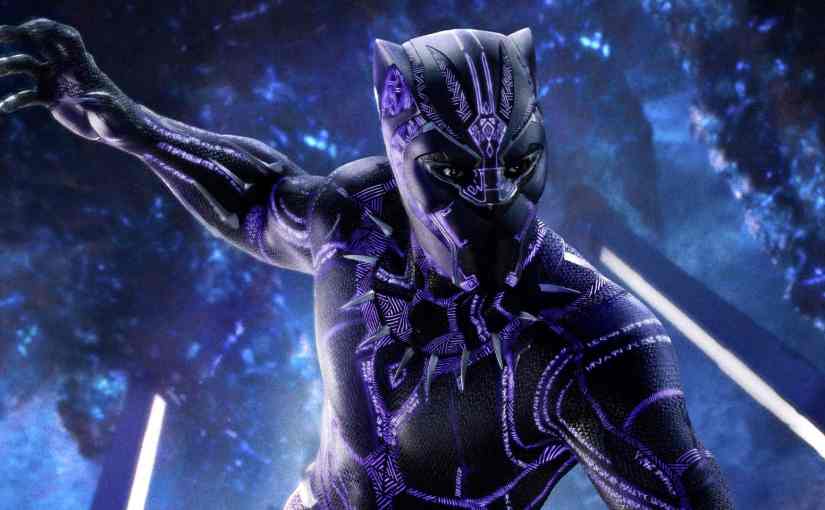
Coogler makes a beautiful sweeping film of country and special effects. The Wakandan ships are very cool. Overhead shots of Africa and the camp bases of various tribes are astonishing. One particular tribe resides on a winter like mountainside and the leaders room is spectaculary decorated in horizontal lumber hangings. T’Challa’s staff of mostly female combat warriors and scientists led by Lupita Nyong’o are really exciting. At times the film takes inspiration from some of the best standards of the James Bond films, as his sister introduces her latest inventions for the Black Panther suit. Naturally, the Black Panther costumes are stand outs in the film, black with glowing power enhancements of purples and yellows.

Is Black Panther worthy of a Best Picture nomination and an abundance of awards attention? I’m still not sure. It’s a very strong piece that is light years ahead of any DC Universe film, but it has great characters and messages like most of the Marvel films and even some of the more recent Bond films featuring Daniel Craig. Maybe it is one of the best films of they year, and maybe it should be a Best Picture nominee, but perhaps only because 2018 did not offer a wealth of extraordinary film achievements to begin with. I found merits in all of the 8 Best Picture nominees in this particular year, but I also found problems with many of them too (don’t get me started on A Star Is Born); shortcomings that in another year with better films would keep many of these nominees from ever being considered for the grand prize.

Yet, as I document these thoughts, I think about Black Panther again. Truly, it does not have anything negative in its feature. Ryan Coogler directed and wrote a very focused and thought provoking film. Yup! It was truly one of the year’s best films.

MALIFICENT

By Marc S. Sanders

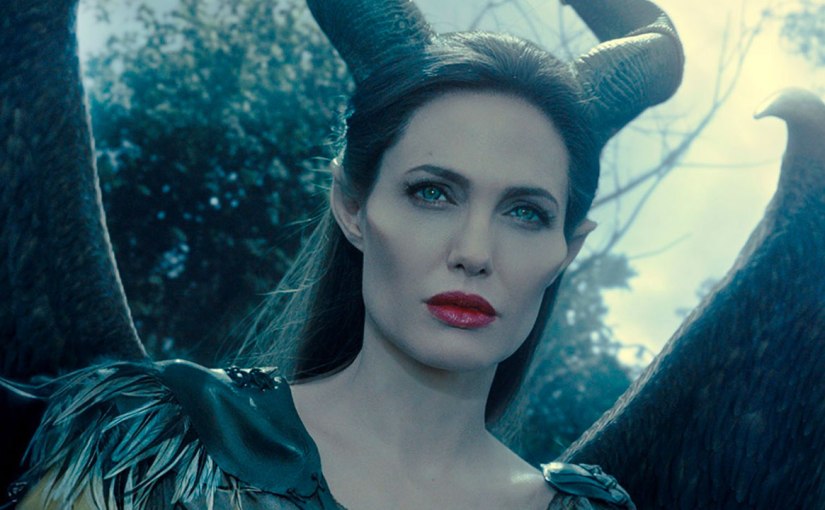
The wagon train of live action adaptations of Disney animated classics reached its pinnacle with 2014’s Maleficent. Much credit going towards Angelina Jolie’s portrayal of the title character. However, the visuals cannot be dismissed either. It’s a gorgeous film directed by Robert Stromberg.

Stromberg brings his wealth of experience in visual effects (Avatar and Master And Commander: The Far Side Of The World) to his directorial debut. The fantasy world of Maleficent’s forest, as well as the looming castle on its outskirts are dressed in gorgeous colors and vast dimension of pathways and caverns. The magical spells wafting in greens, golds, blues and reds, wielded by the characters, including the three protective fairies (led by a strong Imelda Staunton) is hypnotic and blends beautifully with the live actors’ performances. It’s as bold in the visual department as anything cropped up by Peter Jackson or James Cameron.

What makes this brisk 90 minute film special is a different point of view from the classic film Sleeping Beauty. Is there justification to a villain’s actions? Stromberg and Jolie certainly make a case for it. It’s a reminder that there are two sides to every story. Anyone ever consider that maybe Maleficent might have been betrayed at one point? I’ll be damned. At least that’s what I thought, after watching this film.

No one in life is born evil. I like to think people are made evil or perceived as evil. This film is a great example of that, much like the musical Wicked or the recent hit film Joker.

Jolie offers up the frightening aspects of the fairy dressed in black that we’ve been familiar with all these years. However, she’s fortunate that the capable script from Linda Woolverton offers up opportune moments to consider her soft, sensitive side. There are moments of no dialogue as Maleficent observes Princess Aurora (Sleeping Beauty) grow, and she develops a reluctant (it’s hard to resist calling her “Beasty”) affection for the child. Maleficent will even participate in a playful mud fight. There are more than just evil machinations going on here.

Unlike the other Disney live action iterations, Maleficent shows something new and unexpected. It harbors my appreciation for the film whereas Beauty And The Beast or Aladdin did not because they just churned out the same old thing.

If Stromberg’s film suffers from one weakness I’d say it could have used a stronger performance from Sharlto Copley (The A Team film adaptation) as the antagonist, Aurora’s father and Maleficent’s first love; the eventual king. There was not much threat from this guy. He was no match in character much less performance against Jolie.

Still, Maleficent is a great character film with lots of fun, whimsical visuals to explore.