SPEED

By Marc S. Sanders

Jan de Bont’s Speed is one of the best action thrillers ever made. It moves at a breakneck pace with huge suspense, big laughs and never-ending excitement. It’s also really smart with its crazy storyline.

A mad bomber (Dennis Hopper) manages to terrorize the city of Los Angeles by rigging a high-rise elevator with a bomb. Thirteen hostages need to be rescued and for an opening scene of a movie it does not get better than this. The heights and cramped space of the elevator and shaft are tightly claustrophobic, leaving you biting your nails. Small explosions come unexpectedly. This is what Hitchcock is always talking about. Putting a bomb under a table is suspense. The moment you detonate the bomb, the fear is over. De Bont blows up some bombs, but he leaves you hanging for when he’s going to set off the biggest bomb of all – the one that’ll put a hole in the world.

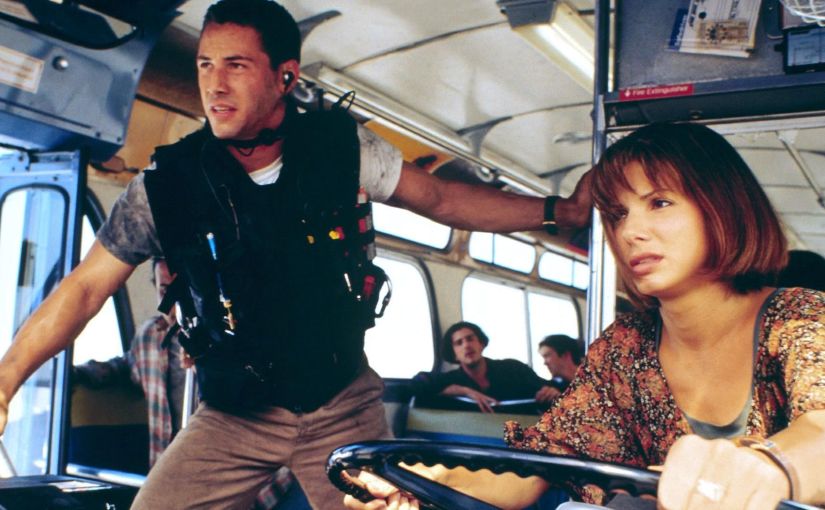
Later, the bomber does the same to a city wide transit bus traveling the freeway routes of rush hour traffic in the city. If the bus’ speed drops below 50 MPH, it’ll explode. Imagine pulling two tricks of Hitchcock all in one film. Imagine trying to never slow down a bus. This bad guy is destroying the city without even setting the big bomb off yet. This is great writing from Graham Yost. The whole scenario is tension at a maximum level.

The cop trying to stop the bomber is Jack Traven (at the time of release, an unlikely Keanu Reeves). Reeves is a perfect hero in this film. He allows the film to stand apart from being just another Die Hard rip-off by avoiding the Bruce Willis smart aleck stance. He’s a smart guy who keeps focus on just the situation at hand. He’ll get the bad guy later.

Sandra Bullock plays an adorable character named Annie who consequently has to drive the bus. This was Bullock’s breakthrough performance and I truly think it still holds as one her best. She’s funny, but she has some good dramatic moments as the tensions build up where Hopper’s crazed bomber makes things more difficult for Jack and the passengers. Bullock is good at crying on film, but she also knows how to deliver a line too.

De Bont does a great job at poking fun at the mundane trappings of traffic and intercity daily activity. As the bus careens through the city, pedestrian crossings are at risk, tow truck cars are problematic, cop cars are bashed up, and Annie is mindful enough to turn her blinker on as she careens around the corners. That last gag kills me every time. De Bont does what I always insist works in most films. He makes the setting of his film the character as well. This bomb rigged bus is stressing out the city of Los Angeles, for sure.

Seeing Speed holds a special memory for me. I saw it on its opening Friday night with some college buddies. Two days later, I insisted on taking dad to see it. Dad could not stop laughing through the absurdity of it all as street signs crash down, cars get totaled, and the fast editing blended with Annie’s laughable panic. Most especially, he loved a hapless driver (a scene stealing cameo from Glenn Plummer) in his gorgeous Jaguar convertible known as “Tuneman” by his license plate. Jack desperately hijacks his car as a means to catch up to the bus. As Tuneman’s car gets more and more wrecked, Dad could not get over it. He was in stitches. This is why movies can be so vital in our lives. I’ll never forget Dad’s nonstop laughing. I carry it with me forever, and I heard it again last night as I caught up with Speed. He’s gone now, but these are the moments I miss most about Dad.

A third act of the film is just as thrilling. Let’s see. We’ve done an elevator and a bus. How about a subway train? It’s a briefer sequence for the climax of the film, but it keeps the thrills ongoing.

Speed works on so many levels with a brilliant cast of B actors (at the time of 1994) that also include Joe Morton, Alan Ruck and a great Jeff Daniels as Jack’s partner with bomb experience. The action sequences cannot be complimented enough, and the Oscar nominated editing from John Wright with De Bont’s direction pair perfectly in timing.

Speed is an absolute thrill ride and a rocking great time at the movies.
THE LORD OF THE RINGS: THE RETURN OF THE KING

By Marc S. Sanders

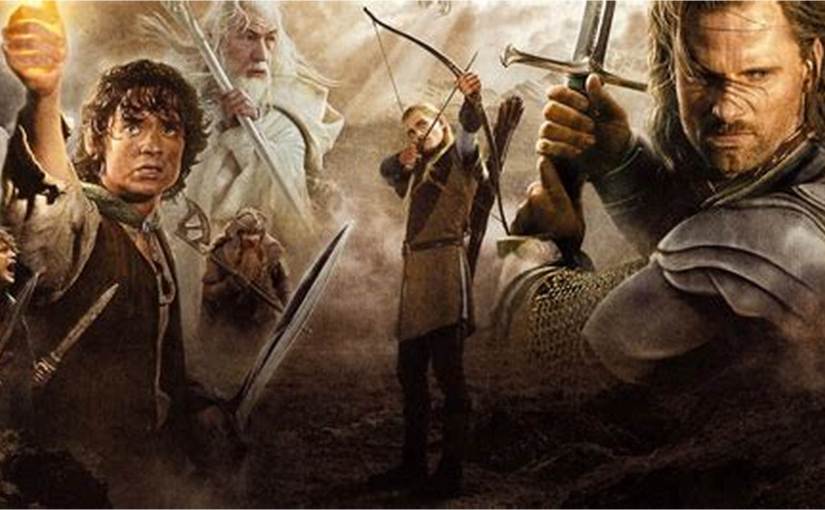
I remember film critic Gene Siskel once said that to take issue with the length of a film is not entirely fair. After all, you are getting more movie for your buck. Would Siskel have felt that way about The Lord Of The Rings: The Return Of The King? Peter Jackson closes out the film adaptation of JRR Tolkien’s sweeping fantasy with an epic that allows you to marvel at everything you see, but does that mean we want to feel as overly exhausted as its main protagonist, Frodo Baggins, feels? Trust me. Poor Frodo looks wiped.

More battles are enacted in the third film. Jackson just changes the dynamics up a little bit. Now armies don elephants with a number of enormous, curved tusks. Another army has a different looking giant troll. Haven’t seen elephants before. Haven’t seen that kind of troll yet either. As well, there is another King who is apprehensive to cooperate in the fight against Sauran and his Orc minions. There’s also a green glowing ghost army. Meanwhile, Frodo and Sam (Elijah Wood and Sean Astin) continue their journey to Mount Doom where the almighty Ring must be destroyed. Gollum (Andy Serkis) remains as their untrustworthy guide.

Jackson seemingly covers every page written by Tolkien. I’m talking about depicting every dream each character has or line they utter or slow motion expression they offer, or walk that they take. Peter Jackson is a completist.

The Return Of The King won Best Picture along with a bevy of other Oscars. Seemingly it should have won anyway. The first two films were recognized with Best Picture nominations as well. For the third film to win was to honor the entire trilogy and its achievements in filmmaking. The Lord Of The Rings trilogy reinvented movie making as a whole. The bar was set so much higher following its release and huge reception of these films.

That being said, it takes endurance to stay with the picture. Most especially with The Return Of The King as the film has multiple endings. Just when you think it’s over, it’s not, and it’s tedious and a little frustrating. Jackson seemed to have too hard a time saying farewell to his digital Middle Earth with its endearing characters.

The length is a problem I have with the film, but none of it seems wasteful either. Every caption and scene carry an importance to it. At least that’s how Jackson wants you to feel. The question is, if a number of momentary scenes had not been woven into the final edit, would I miss it, and my answer would be likely not.

MOONSTRUCK

By Marc S. Sanders

Moonstruck has to be one of the most delightful romantic comedies of all time thanks to an outstanding cast, an intuitive director (Norman Jewison) and a script full of brilliant dialogue and set ups from John Patrick Shanley.

Loretta Castorini (Cher in her Oscar winning role) is a 37 year old widow. Her husband of two years got hit by a bus. So, naturally when her father, Cosmo (the hilarious Vincent Gardenia), hears the news that Loretta got engaged to the boring schlub Johnny Cammareri (Danny Aiello), he knows this is a bad omen and she should not get married again. Sure, her husband got hit by a bus, but that can only mean that marriage is no good for Loretta. When they wake up Rose (Olympia Dukakis in her well-deserved Oscar winning role), Loretta’s mother, to share the news, she just opens her eyes and asks, “Who died?” This is an adorable Italian family living in Brooklyn and somehow an Irishman wrote the script which was then directed by a Jewish mensch, and everyone is working on all Italian cylinders.

Two minutes into the film and I’m laughing. I’m laughing at Johnny’s wimpy proposal in the local Italian restaurant. I’m laughing at Rose and Cosmo who’ve seen enough of life to know that you don’t get married for love anymore. Rose is for Loretta getting married though. Cosmo doesn’t wanna spend the money.

Just after Johnny proposes, he flies off to Sicily to be by his dying mother’s bedside. He requests that Loretta invite his brother Ronny (Nicholas Cage), who he hasn’t spoken to in five years, to the wedding. Ronny is upset with Johnny. Ronny got his hand chopped off in the bread slicer at his bakery when Johnny was talking with him and Ronny looked the other way.

When Loretta approaches Ronny, before you know it, they are sleeping with each other. Ronny then invites Loretta to see La Boheme at the Met that night. Loretta knows it’s wrong and can’t keep this up. It’s a sin. She goes to confession, but then she also goes to buy a new dress and dye the greys out of her hair.

As well, Cosmo is stepping outside of his marriage, only Rose is not so stupid. She knows what’s going on. When Rose is dining alone, a college professor who strikes out with one attractive student after another joins her table. Rose isn’t gonna do anything. Instead, she asks the question on everyone’s mind “Why do men chase women?” Then she answers it. “Because if they don’t, they think they’ll die.” But they’re gonna die anyway. Right?

It sure looks like my column is just summarizing the film but my breakdown of Moonstruck simply celebrates all that’s good about it. Here’s a film that doesn’t stereotype a New York Italian family. Instead, it shows how they regard one another as well as the people within the neighborhood from the eager to please waiter in the restaurant to the mortician that Loretta works for. The mortician spills butter on his tie. Loretta takes the tie off of him and says she’ll get it cleaned.

Life in the home of Castorini family is shown beautifully with natural humor to display its atmosphere. Cosmo’s quiet elderly father with five yappy dogs on leashes is only a part of every passing day. Like I’ve made claim on other films, the best movies offer smart characters. Everyone has a way of carrying themselves in Moonstruck, and they’re not dumb. They might be cheap like Cosmo or wimpy like Johnny or a little dim like Ronny, not dumb, but they’re all wise to how they handle themselves.

This might seem like a relatively easy, untechnical little New York comedy. Norman Jewison, however, uses a great approach that makes each setting feel like you’re watching the most alive stage play you’ve ever encountered. I’m actually surprised this film has yet to be adapted for the stage. Maybe, just maybe, Moonstruck hasn’t made it to live theatre yet because it’d be damned near impossible to recapture the harmony of this magical cast.

I love Moonstruck.

A QUIET PLACE

By Marc S. Sanders

M Night Shamylan is kicking himself right now for not thinking of this story.  All it took for director/co-writer John Krasinski was very, very minimal dialogue, some well skilled young actors and his brilliantly, talented wife Emily Blunt to pull off one of the best pictures of 2018.

Another desolate, post-apocalyptic future has occurred and thankfully this story does not feature tired zombies or vampires.  Krasinski uses old fashioned techniques to hide or mistakenly reveal his characters to the boogie men with no other agenda except to shut out all of the noise. A silo, a basement, a waterfall, fire, a nail, a hearing-impaired character, bare feet, a toy space shuttle, sand, lights and fireworks. I accepted every plot device used in the film, and each element is a miniature story in and of itself.  As well, when there are moments that allow the four main characters to actually talk, there stands to be good reason for it and I bought all of it.

Emily Blunt is an incredible actress full of hard concentration and Krasinski does not let up on long running close ups to heighten her tension of isolation surrounded by the most terrifying threats, all while enduring a physical emergency.  She stares without a blink.  She effortlessly shakes with paranoia, and she evokes pain of the worst kind; all without uttering a sound or saying a word.  This is the same actress who played a snobby diva in The Devil Wears Prada, and later went on to portray the most popular nanny of all time, Mary Poppins.  This performance should not be overlooked.  It’s incredible.  You don’t need monsters in your face to be afraid.  All you need is Emily Blunt to carry you along.  

Krasinski springboards his terror off the best horror films from Jaws to The Shining to Alien to The Blair Witch Project and the original Paranormal Activity.  Yet, he does manage to pioneer his craft with A Quiet Place.  This is not something you have seen before. Hiding in silent fear has been done to death.  The girl always hides in the closet from the killer.  Here, you can hide, but staying out of sight won’t necessarily save you or do you any favors.  These creatures just might be prepared for that.  So, now you have something new to wrestle with.  Can you keep quiet?  This script does not make that easy. If ever a movie was to justify the need for Oscar categories like Sound and Sound Effects Editing, then this is the film to turn to.  These tools give reason for the storyline more overtly than any other that I can imagine.  You do not take the sound for granted, and you do not take the lack of sound for granted either.

Miguel Rodriguez and I originally saw this picture in a Dolby theatre.  It’s a telling film that gives reason for a Dolby theatre in the first place.  A film like this is worthy of the upgraded ticket price. (By the way, Mig, you still owe me $11.00.)

Put John Krasinski up as a top-notch director.  I believe this film was granted a very small budget, but like the best directors to come before him, he has managed to put up big screams and the best in dramatic storytelling with little expense. He even manages to tug at your heartstrings if you allow it. The ending was a huge pay off for me personally.  John Krasinski gives you a horror film, but he’ll make sure you have something to think about while you’re watching it, and long after you have left the theatre.

THE ENFORCER

By Marc S. Sanders

It’s no surprise that Harry Callahan is a chavaunistic son of a bitch. He has never been one to be shy about his prejudices, after all. In 1976, viewers found it endearing in an ironic way. Today, the character would never be produced into a studio film.

The third entry in the popular Dirty Harry series called The Enforcer is good but does not hold up as well as I remember. By the end, Harry must upgrade from blowing the bad guy away with a bazooka. He can no longer settle for his trusty .44 Magnum. It makes sense. Make everything your protagonist normally does do the same thing he’s always done, only make it bigger, and more actiony!!!! Not much interest in the on-screen chemistry that Clint Eastwood will have with said bazooka though.

Fortunately, there’s a better angle here and that is through actor Tyne Daly, as Harry’s new partner. Daly is terrific as one of San Francisco’s first female Police Inspectors who has to live up to the muster of a violent city as she accompanies a violent cop. It’s a great character that draws out feelings in Harry. She gives him pause to care and think beyond himself. Eastwood and Daly are where the chemistry is really at.

Everything else is kind of a waste really. Callahan never goes toe to toe with the main bad guy, a leader of a militant group terrorizing the city. This villain is nothing great or exciting.

Still, beyond Daly there are some great action scenes such deescalating a liquor store hold up by plowing a squad car through its front door. Makes sense, right?

IRON MAN 3

By Marc S. Sanders

The third chapter of the armored superhero, Iron Man, is an improvement on the second installment. Still, that’s not much of a compliment.

Action director Shane Black takes the reins from Jon Faverau, and gives himself a writing credit as well. I’ve always liked Shane Black’s writing style. Like this film, a lot of his works take place during Christmas. Lethal Weapon is a well-balanced picture that over thirty years later shows a nice offering of character background and action. When the action occurs, you are already invested in the characters. So, suspense is capable of holding some weight to an action movie. I only wish I saw some more of that here with Iron Man 3. Oh well!

First, let’s get the most obvious problem out of the way. Once again, Gwyneth Paltrow is there to wear sharp looking ladies suits, carry a brief in her hand and yell “TONY” a lot. You could make up a drinking game around that bit. Just when the Marvel films got it right with Hayley Atwell as Agent Peggy Carter in Captain America: The First Avenger, they revert back to their old ways yet again. If you are going to have female characters in your films, give them something weighty to work with that is evenly matched with the guys.

Robert Downey Jr is another problem, I’m afraid. He is so cherished in the role of Tony Stark by now. The first Iron Man really offers a great performance by him with a good arc. The prior film in the MCU, The Avengers gives him some great play with the other titanic superheroes. However, the writing is not thoughtful in Iron Man 2 or Iron Man 3. The first installment left you feeling that Tony was open to accepting care and tenderness from other people. His cockiness became subdued following a traumatic capture and escape.

Then the cocky monster within seemed to resurface in #2 and #3. Did Downey (who improvises a lot of his material) and the writers forget where they left off? Black literally has Tony Stark give away his address on live television to the bad guys, headed by a mysterious terrorist known as The Mandarin (Ben Kingsley). How stupid is this? Batman doesn’t give away where his Bat Cave is. Why would Iron Man do that?

From that point, we are treated to an attack on Tony’s ocean view, cliff side home from helicopters. Reader, Shane Black wrote a sequence like this twice before, in Lethal Weapon and Lethal Weapon 2. It’s been done before. The filming appears clunky in this centerpiece scene with camera shakes and uneven sound editing and lots of ceiling and wall dust. It’s a little hard to follow.

I’ll give credit to Black for throwing in a twist that comes out of nowhere. To my knowledge, this moment has left viewers very divisive. For me, I admire the effort but the development comes off wimpy. It involves Ben Kingsley as The Mandarin who promises to be a real threat to the film. Yet, the character’s motive turns out to be something else entirely. It’s odd, but it kept me engaged during the film. When the film ended, I was left wishing it was something else altogether. For the first two thirds of the film, Kingsley is very good with a hard, edged, roughly intimidating voice as he shares disturbing newscasts of threats to the President and the world. He was a different kind of villain that we hadn’t seen before, much like Heath Ledger’s Joker. Then the rug is pulled out on that attraction.

One really bright spot comes from Ty Simkins, as a kid named Harley that winds up assisting Tony when everything is against him. He is a fun, spunky kid who has some good exchanges with Downey’s well recognized, zippy delivery. He’s more fun to watch than Gwenyth Paltrow. That’s for sure.

Guy Pearce is another adversary who leads a team of baddies. Their bodies heat up to extremely hot and orange looking temperatures. (Forgive my poor English! That’s what comes to mind. Oh well!) Amazingly enough, their clothes don’t burn off while they easily can singe any Iron Man suit they come in contact with. Should I be focusing on that inconsistency? That’s one main problem with the film. It’s too apparent. I know this is all sci fi, but don’t make the fiction of the fiction so obvious, please. Pearce is fine in the role but he’s overshadowed by what his super villain powers are capable of. So, basically cast iron metal burns, but clothing fabrics do not. Got it! Check!

I’m not sure if Iron Man 3 is really worth a watch. Probably not, actually. Maybe so, if you want to marathon through all the Marvel films like I do. Yet, it really offers nothing significant to the films yet to come and shows nothing new to carry forward from the prior films. Much like Iron Man 2, it’s a pretty meaningless.

THE LORD OF THE RINGS: THE TWO TOWERS

By Marc S. Sanders

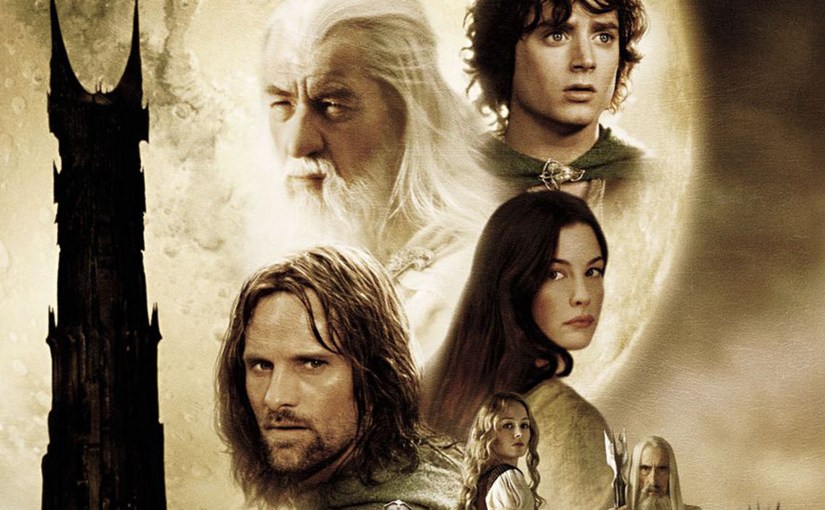
Peter Jackson’s second installment film adaptation of JRR Tolkien’s The Lord Of The Rings trilogy is The Two Towers. The captivating fantasy themes that audiences discovered in the first film continues.

Battle scenes with Orc armies are well edited and staged perfectly in digital settings. The film’s ending with a long, drawn-out battle located at the stone castle Helms Deep is stunning, full of heroic actions executed by favorite characters like Legolas the Elf (Orlando Bloom), Gimli the Dwarf (John Rhys-Davis) and especially Aragorn, destined to be King (Viggo Mortensen).

The Two Towers is almost marvelous with the exception of an overstayed welcome of the Ents – life size talking trees. Treebeard is the main Ent character, where the Hobbits Merry and Pippin take shelter by sitting on his branches. The effects of the Ents work. When the film returns to this storyline however, the narrative drags and the audience suffers. Treebeard converses in his own speak with the other Ents, the Hobbits ask “well?” and it’s supposed to be amusing that all they said was good morning. It’s not amusing. It’s boring.

The big centerpiece of the film belongs to Andy Serkis doing his full body animated effect to bring the untrustworthy, dual personality Gollum/Sméagol to life. Serkis should have received an Oscar nomination as he piggy backs on the continuous journey that Samwise Gamgee (Sean Astin) takes with the ring bearer Frodo (Elijah Wood). Gollum can’t resist what he once owned for himself-the “precious” Ring. Frodo’s good instincts insist upon not harming Gollum or Sméagol while Sam has strong reservations.

Jackson’s second film offers up a heightened urgency on all fronts. He’s good at showing the weight of the ring upon the psyche of Frodo and Gollum and he leaves time for other stories where Saruman’s (Christopher Lee) army conquers more lands-allegorical to the period of time when Tolkien wrote his novels following Nazi occupation within Europe.

Jackson is a completist and no stone is left unturned. A large portion of the film is appreciated even when you consider that you can take a bathroom break anytime Treebeard shows up.

FATAL ATTRACTION

By Marc S. Sanders

When Adrian Lyne’s Oscar nominated film hit theatres in 1987, apparently men thought twice about having an extra marital affair. It wasn’t enough that a man could violate the marital bond of commitment. No. Now he could get his loving wife and child killed.

Fatal Attraction works as a great psychological study for its first three quarters of film. Then it slogs its way into a slasher/horror fest of burned bunnies and gutting kitchen knife hysteria. The ending was an insult to the intelligence of everything we had seen before.

An unstable woman who knows she’s destroying a man’s happy home life is doing even worse by destroying herself. Mentally she cannot control what she commits and what she obsesses over. She is ill. This unstable woman is played by Glenn Close, and it is evident that she has done her research in psychopaths. Close is great at simply changing the inflection in her voice. In the beginning of the film, she has a relaxed whisper about herself as she exudes seductiveness.

Later, her tone is sharp, accusatory, patronizing, and intimidating. By the end, a new whisper of a psychotic personality threatens. The role is played by Close as if she is changing from one number to the next on a musical instrument.

The man in this scenario is worse. He gets his rocks off and tries to move on unaware of the collateral damage he leaves the woman with, and beyond presumption of how his break in trust will wreak havoc on his loving wife and young child. His moral crimes are nowhere near as apparent as the obsessed woman’s. At least she has evidence of a psychological symptom. He’s just an ignorant jerk when it comes down to it. Michael Douglas was just right for this role of a very successful lawyer with good looks and brash silliness with his friends and wife, while also being an attentive father. Yet, he’s also good at letting his guard down, foolishly assuming he can put it back up again once his weekend fling is over.

The film really is a duel in the aftermath of adultery. Disturbing phone calls, the demand for contact to stop, the nagging need for ongoing affection. It’s all orchestrated very well. Then, comes the crazy person who boils a bunny to generate a frightful scream from its audience followed by knives and blood and the last minute (SPOILER ALERT) “she’s not really dead” shocker. The delicate nature of a common and sensitive scenario is exploited for sudden jumps and terror.

James Dearden’s screenplay is so well thought out until it is executed desperately for box office returns in its last five minutes. Granted, Dearden had a different ending in mind, more appropriate to earlier references to Madame Butterfly. Hollywood decided to nix that plan and go with a more satisfying comeuppance for the villain, or rather one of the villains. What a shame.

Personal note: I’d seen Fatal Attraction before, but this is the first time I’m watching it in well over 11 years. I could never get myself to watch a late scene in the film where Close’s character takes Douglas’ daughter for a day of fun on a roller coaster. It was too real. Too disturbing. It was too easily done, and as a father it was too nightmarish for me.

THE IRON GIANT

By Marc S. Sanders

Before he became known as a Mission: Impossible director or the guy who brought The Incredibles to the screen for Disney/Pixar, Brad Bird made the animated film The Iron Giant for Warner Bros. Animation. It’s absolutely brilliant in its visual drawings, storytelling, characterizations and period setting awareness.

The film takes place in a small town off the coast of Maine in the year 1957. The race for space has declared a winner as the Russians’ satellite, Sputnik, is the first to orbit the planet. The threat of the Cold War is no longer a secret. It’s out in the open as classrooms are exposed to danger drill warning films where children must hide under their desks in the event that a nuclear holocaust occurs. The film they watch is an absolutely hilarious sequence about what was a pretty serious subject matter at the time.

One student gleefully takes in the residual flying saucer flicks on TV, that spawned from this quagmire of paranoia occupying America at the time. His name is Hogarth Hughes, voiced by Eli Marienthal. When his TV antenna turns up missing one night, Hogarth goes off into the woods where he discovers a giant robot munching on the metal of a nearby power plant and in danger of electrocution when he gets tangled in the wires. The robot (Vin Diesel) is unfamiliar with earth and recognizably innocent, but quickly trusts Hogarth as a friend.

Young Hogarth is thrilled upon his discovery but knows his mom (Jennifer Aniston) would never approve of him keeping the robot, much less even a small pet. A government bureaucrat named Kent Manley (Christopher McDonald), complete with the fedora hat and trench coat, becomes suspicious of Hogarth. Kent’s Cold War guard drives him to uncover this 50-foot-tall robot with his own eyes. Find the threat and eliminate it at all costs. When he eventually gathers the evidence, he calls in the military to wage war right in the heart of the small Maine town.

There is much humor in The Iron Giant which truly stems from the intelligence gifted to all of the characters. Hogarth, as a kid, is first a teacher as the robot learns to pronounce basic vocabulary. The Iron Giant who has the capability to shape shift his body into a blaster kind of weapon, is not aware at first of the destruction he can leave behind until Hogarth makes him understand. Early on, Hogarth learns that the giant feeds on metal, but he must show his friend the best way to satisfy his hunger. It’s not with railroad tracks, that’s for sure.

Hogarth also matches wits with Kent. A great scene has the G-man and the kid defying each other to stay awake, rather than go off into the night in search of the giant. The clock just ticks away. Their eyes get more and more droopy. The laughs come from the animated characterizations and editing.

Hogarth’s mother, Annie, is never regarded as naive even if she’s unaware of her son’s new secret friend. A great scene has Hogarth doing his best to hide the giant’s metal hand in his bathroom. Hogarth has to do some quick but believable thinking to cover up what’s crawling around the house. Annie is a mom concerned her son might be violently ill, but trusts him when he insists he’s alright. I like that. Mom regards son as an equal. She respects his privacy but regrets it when she steps out of bounds to peek in on him in the bathroom. It’s sweet and smart, but funny too.

The Cold War is likely not a familiar subject matter for most kids, and yet there’s something to learn here. Russia and America were on the dawn of new technology. The nuclear age was upon us. The question was will they or won’t they act upon that technology. As well, will the two countries act in response to simply the threat of having such power at their fingertips? That’s what The Iron Giant of the film represents. When the giant, metal eating man is uncovered what response will it generate?

As the film progresses, kids can see why a resort to violence is truly not the answer. For how we appear might not offer an explanation on the surface. We need to familiarize ourselves with one another before truly declaring an enemy in our midst. So many movies only exist because one character just won’t speak up. Brad Bird’s film, adapted from Ted Hughes’ book The Iron Man, goes against that convention. A beatnik character by the name of Dean (Harry Connick Jr) who helps Hogarth and his new friend actually explains how the robot is not a dangerous figure who wants to destroy our planet. It then becomes a means of debate for the purposes of violence between the Army General (John Mahoney) and Kent Mansley, the government official. Do they believe the giant won’t become destructive?

I like to think a moment like this offers a subtle suggestion for the people in positions of power that are in charge to justify whether to go to war or not. It might be simplistic animation and the suspense is heightened by the time the film reaches this moment, but it’s another opportunity for viewers, especially kid viewers, to decide for themselves of what is right and wrong. Is defense or engaging in offense a more appropriate action?

Too often in family films, the kids are geniuses, maybe a little too smart or inventive, and the adults and parents are nitwits as a means for slapstick gags. Not the case here. Every character has an intelligent perspective. That’s what sets The Iron Giant ahead of other subpar family films.

Credit also has to go to the animation. There’s depth to everything seen from the main street of the town to the ocean side harbor to the woods where the giant hides. The sketches are so well defined, you want to look in the windows or sneak around the next tree. This is masterful direction. While an animated film is never shot in an actual location, Brad Bird makes sure you’ll see every corner of the New England locales that are conceived for his film.

Everything about The Iron Giant is a crowning achievement in animation. One of the best of its medium for sure.

PRETTY IN PINK

By Marc S. Sanders

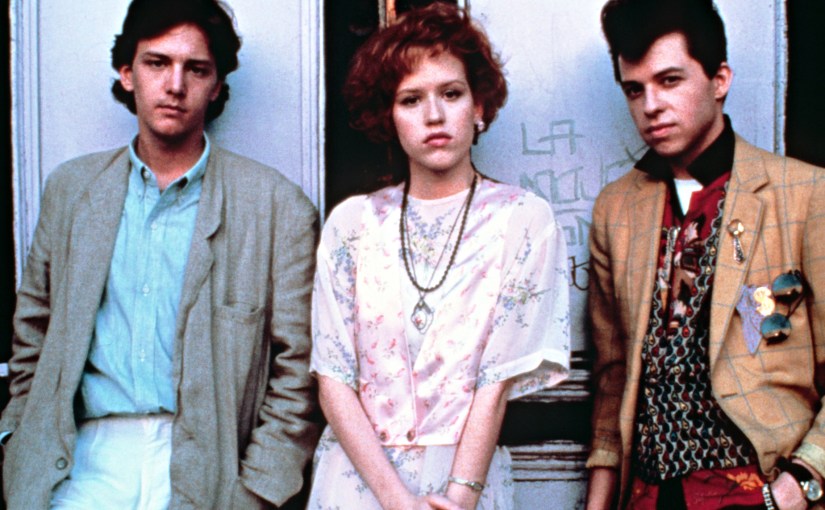
Director Howard Deutch directs John Hughes script, Pretty In Pink, by adhering to the familiar themes quickly recognized as Hughes’ signature touch from prior films. Deutch and Hughes maintain a vibe of alternative rock music amid a Chicago public high school community that could never be possible. Did I have this much independence in high school like Molly Ringwald as Andie, her adoring rich boy crush Blaine (Andrew McCarthy), or weirdly annoying (and lovable at the same time) Duckie played by Jon Cryer? And, oh yeah, a high school senior asshole named Steph played by asshole character perfectionist James Spader with his long cigarettes, Italian suits and barely buttoned shirts would never exist in an institution of education. So, there’s that too.

The kids at this school are divided among two different sides of a track-poor (Andie & Duckie) and rich (Blaine & Steph). Never meant to socialize or get along, the conflict of the film occurs when Andie and Blaine fall for one another.

This is Molly Ringwald’s 3rd Hughes film and looking back maybe it was a mistake for her career as she was outgrowing the roles she was getting pigeonholed for. Still, who else could you envision in the role of the aspiring dress designer who is responsible for her schlub of a father she lives with (Harry Dean Stanton), and friends with a weirdly eccentric, 80s punk/alt dressed co-worker played by Annie Potts?

Hughes’ is quite serious here, though the setup is not acceptably realistic, even back in 1986. These characters are competitive with one another for status in a high school setting. What other environment could the outline for Pretty In Pink take place in, though? Prom is on the minds of these “adults.”

Pretty In Pink was never a perfect movie. It has a perfect soundtrack, and I like the cast a lot as well as Hughes’ characterizations. Its glaring imperfection, however, is that these characters fit like a circle in the square setting of high school. The elements clash big time.

Still, I’ve always had an unusual affection for the film. I guess it is because I look past its inaccuracies and accept a playing field and the positions that Hughes and Deutch defiantly assign to the four characters. How does the intrusion of background and status overcome an affection between two people, and can this ever be happily resolved?

The ending was supposed to be different, very different. Yes. I should agree with the original conclusion because the math of the story adds up to that point. However, Reader…I am as defiant a viewer as Hughes and Deutch were as filmmakers. It’s wrong!!!! Nevertheless, I loved the ending that was eventually tacked on. So don’t judge me.