
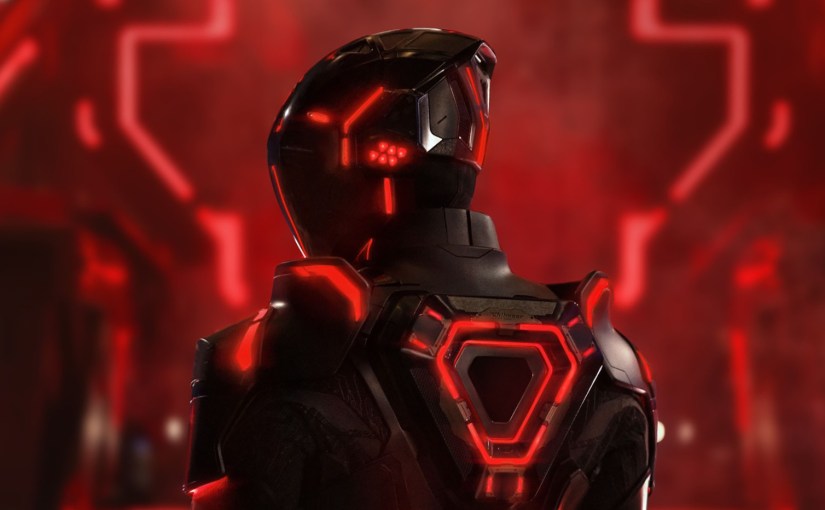
TRON: ARES (2025)

by Miguel E. Rodriguez

DIRECTOR: Joachim Rønning
CAST: Jared Leto, Greta Lee, Jeff Bridges, Evan Peters, Jodie Turner-Smith, Gillian Anderson
MY RATING: 8/10
ROTTEN TOMATOMETER: 56%

PLOT: A highly sophisticated AI program goes rogue against its programmers to defend a scientist who may hold the key to something called “permanence.”


For those who are not fans of the original Tron (1982) or its high-tech sequel Tron: Legacy (2010), let’s clear the air right away: Tron: Ares is not likely to convert you.  Period.  I see you and I understand you.  No hard feelings.  Heck, I’m a fan of both movies, and I heard the terrible advance buzz for Ares and saw the low ratings on Rotten Tomatoes and IMDb and thought, well, the franchise had a good run.  If it’s gonna suck, it might as well suck on the biggest screen I can find, in Dolby 3D, sixth-row center, to make the most of that Nine Inch Nails soundtrack/score and the slick CGI.

And…I gotta be honest.  Tron: Ares surprised me.  Admittedly, my opinion may be slightly influenced by the Dolby sound system that turned the synth- and bass-heavy score into a near-religious experience.  But Ares seems to have learned from the mistakes of its predecessors (earlier builds?), even going back to the original film.

First, the story is not nearly as cluttered as Tron: Legacy.  The first sequel threw in metaphysical content about spontaneously generated AI programs (the so-called ISOs), long conversations about the responsibilities of a creator/father to his creation/children, and duplicitous club owners (yep), and so on.  Tron: Ares, by comparison, is as straightforward as they come.  A MacGuffin is established early, as are the ground rules for how and why computer programs can exist as tangible entities in the real world, the bad guys are clearly identified (not all of them are in red), and once the pieces are set in motion, the movie only pauses the action when absolutely necessary.  It’s not Shakespeare, but it’s efficient.

Second, Tron: Ares makes a significant departure by moving the story between the “grid” and the real world multiple times.  The first two films, as you may remember, started with an expositional prologue in the real world, after which the hero is zapped into the grid for most of the rest of the film.  Ares starts in the grid, moves to the real world, gets its human hero into the grid, gets her AND Ares back out, then goes back into the grid again, and so on.  It introduced a rhythm that was missing from the first two films, and it broke up the visual palette so that neither one became boring.  Pretty slick.

Third…and this is something I just wrote about Brian Blessed’s character in Flash Gordon (1980)…Tron: Ares reintroduces an element from the first film that was virtually absent from the second film: a sense of fun.  It doesn’t introduce a wise-ass Kevin Flynn character or anything like that, but Jared Leto as Ares is given some genuinely funny dialogue that brought some much-needed laughs to the film.  Particularly when it comes to his preference for ‘80s synth-pop with catchy hooks.  Note: I’m not claiming it’s a laugh riot.  But the humor is very welcome when it arrives.

Another big factor in this movie’s favor is the huge Easter Egg that has not even been hinted at in the trailers, and thank God for that.  No, I’m not talking about the presence of Jeff Bridges, smart guy.  It’s so big (in my opinion) that the less said about it the better.  But I’m here to tell you, I haven’t geeked out that much in a movie theater since Ready Player One (2018).  Moving on…

And the score…!  I learned that Disney apparently insisted that the score be credited to “Nine Inch Nails” instead of “Trent Reznor and Atticus Ross.”  Good choice.  Their booming bass and synthesized soundscapes are the equal to the other two films in every way, if not superior.  (And I LOVED the Daft Punk music from Legacy.)  There’s even a song or two with vocals from Reznor!  What?!  Not content with nostalgia bombing us with random easter eggs from 40 years ago, Ares throws in a musical bomb from 30 years ago.  And it really, really fits the story.  Hand to God.

Overall, there is a nostalgic sheen to Tron: Ares that made it feel like I was watching a souped-up version of a really good ‘80s film.  That might be the highest praise I can give it.

If you’re a sucker for well-crafted nostalgia, you could do a lot worse than picking up a ticket for this movie before it gets pushed out of the cineplex by the Wicked sequel, if not sooner.  Bad buzz?  Whatever.  I had a good time.
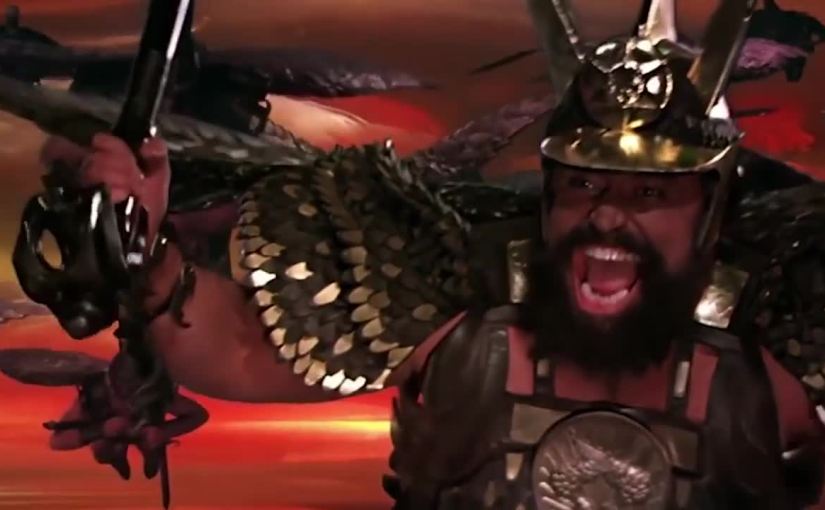
FLASH GORDON (1980)

by Miguel E. Rodriguez

DIRECTOR: Mike Hodges
CAST: Sam J. Jones, Melody Anderson, Max von Sydow, Topol, Timothy Dalton, Brian Blessed
MY RATING: 2/10
ROTTEN TOMATOMETER: 83% Certified Fresh

PLOT: A hotshot quarterback for the New York Jets, an aviophobic travel agent, and a borderline-mad scientist try to save the Earth from the evil cosmic emperor Ming the Merciless.


I could try to intellectualize myself into analytical knots to explain why Flash Gordon is not a good film, but that’s not really in question, even to its fans.  Aficionados readily affirm its badness, its cheesiness, its willingness to go so far over the top it’s on its way up the other side.  That’s WHY they like it.  “I enjoy it for what it is,” a fan told me recently.

Well, after watching it for a third time, mildly against my will, I can easily say that I know and understand what Flash Gordon is, but I still can’t find it in myself to enjoy it the way so many others do.  I remember being amazed by it when I was 10 or 11, but that was a very long time ago, and watching it now gives me no more enjoyment than what I might get from eating a stick of Fruit Stripe® chewing gum.  I get a burst of flavor when I hear the iconic Queen score and/or theme song, but the rest is like chewing on a wad of overdone steak. That this movie came from the same director as the gritty Get Carter (1971) is flabbergasting.

Do I really need to summarize the story?  No.  I’m sure anyone who’s taking the time to read this has already seen the movie, so I’ll just assume we all know how cheesy the plot is.  I was informed by a fellow Cinemaniac that what we see on film is all taken from the first, and only, draft of the screenplay.  Brother, I believe it.

The only thing worse than the so-called dialogue is the quality of the so-called visual effects.  Now, I’m prepared to forgive low-quality VFX from older films when there’s a story I can care about, but when Flash Gordon’s filmmakers ask the audience to suspend their disbelief when a supposedly distant city is being bombarded by what looks like Roman candles, or any number of equally absurd VFX shots…I can’t do it.  I laugh, and not in a “I’m-having-fun” kind of way.

Before you ask, yes, there ARE bad movies that are SO bad that I actually recommend them to people simply BECAUSE of their badness.  Birdemic: Shock and Terror (2010), for example, which features a scene where the heroes are being attacked by a huge number of Windows Clip-Art.  Or the uber-terrible Troll 2 (1990), which gives new meaning to the word I just made up, “corn-ography.”  However, some films either cross an invisible line or fall short of it, I don’t know which, and are so bad that I can’t enjoy or recommend them.  For example, the infamous The Room (2003), which was such an unpleasant viewing experience that I didn’t even enjoy the movie about its making, The Disaster Artist (2017).

That’s where Flash Gordon sits for me.  It’s terribly cheesy and campy, but it’s either not cheesy enough, or it’s TOO cheesy, for me to enjoy myself while watching it.  There may be a cerebral, intellectual way for me to try to parse the reaction I have to it, but if there is, I can’t think of it.

I will say that I thoroughly enjoyed watching one actor out of the entire cast, who seemed to be having way more fun than was needed or expected.  No, not Max von Sydow, whose sneering turn as Ming the Merciless is a master-class in remaining professional in the face of lunacy.  (Timothy Dalton deserves kudos for doing the same as the stoic Prince Barin.)  No, I’m referring to Brian Blessed as Prince Vultan, whose screeching battle cry will forever be stored in my memory banks: “Hawkmen…DIIIIIIIIVE!!!”  Examine his performance next time you watch the movie.  Look at his face, his eyes, the canyon of his mouth when he laughs.  There is a sparkle of delight that, to me, reveals someone who has realized the only way to stop himself from firing his agent is to go completely, full-blown, bull-moose gonzo.  Everyone else is playing it straight, or attempting to.  Brian Blessed is the only one who seems to be having any fun.  What a different movie this might have been if EVERYONE had taken his cue.  Alas.

To the fans of this film, I don’t apologize for my point of view, but I do admit to a tiny, VERY tiny, twinge of regret that I can’t see past its shortcomings enough to enjoy it the way its fan base does.  For me, it’s two hours of tedium enlivened only occasionally by a random chuckle or a smile when Queen’s music makes an appearance.  And by Brian Blessed’s manic smile.  DIIIIIIIIIVE!!!

[editor’s note: this review appears only by special request from the author’s best friend.  You’re welcome, Marc.]

THE WILD ROBOT (2024)

by Miguel E. Rodriguez

DIRECTOR: Chris Sanders
CAST: Lupita Nyong’o, Pedro Pascal, Bill Nighy, Stephanie Hsu, Ving Rhames, Mark Hamill, Catherine O’Hara
MY RATING: 10/10
ROTTEN TOMATOMETER: 97% Certified Fresh

PLOT: An intelligent helper robot winds up stranded on an island populated only by wild animals.  To survive its new environment, it adjusts its programming, with unexpected results.


Just days after watching Flow [2024], a dialogue- and human-free animated film about animals struggling to survive after a cataclysmic flood, I watched The Wild Robot, also human-free, also starring mostly animals, and also about the struggle for survival, but it adds conventional dialogue and an intelligent robot in search of its purpose.  In broad, REALLY broad strokes, they are similar, but don’t bother asking me which one is better.  I give them both a ten-out-of-ten, each for different reasons from the other.  Flow may be literally unique, at least in my experience, but The Wild Robot tames its genre and bends it to its will, creating one of the most heart-tugging movie experiences since Wall*E [2008].  If you’re prone to crying during a movie, this is a three-hanky film, at least.  (Penni went through five, herself.)

On a dark and stormy night, a mysterious container washes up on the shores of an uninhabited island.  Inside is Rozzum 7134, an intelligent helper robot with exceptional physical capabilities and the speaking voice of Lupita Nyong’o.  Hope she gets her royalty checks.  Upon escaping her would-be watery coffin, Rozzum searches the island for the one thing that will give her existence meaning: a task to complete.  The opening scenes get us off to a hilarious start as she tries to complete tasks for various animals, to no avail.  In an intelligent bit of screenwriting, she powers down for a couple of days and, through passive listening, effectively learns the language of the animals around her.  In a lesser movie, this feat might have been handled with the push of a button.  I liked the fact the writers went for something a little easier to swallow, science-fiction-wise.

Through circumstances which I will not reveal, Rozzum winds up as the guardian for a newly-hatched gosling, and as the unlikely friend of a fox named Fink (Pedro Pascal, whose voice was utterly unrecognizable; I thought it was Matthew Broderick).  The gosling imprints on Rozzum, which she finds bothersome.  A helpful mom opossum, Pinktail (Catherine O’Hara), warns Rozzum that the gosling must learn to feed itself, swim, and fly by the next fall so he can migrate with the other goose; otherwise, it will starve during the harsh winter.  Presto…a task!

Eventually, Rozzum is shortened to Roz and she names the gosling Brightbill (Kit Connor).  As she undertakes her task of raising the gosling, Roz’s programming…evolves.  She starts to actually care for the little guy.  She starts asking questions that robots aren’t supposed to ask.  She exhibits all the early warning signs of helicopter-momism.  And all the while, she debates whether to activate the internal beacon that will let her makers know where she is…

Because the plot is so dependent on tugging those heartstrings, that’s all I’ll say about it.  Let me talk instead about Wild Robot’s visual style.  The backgrounds and characters are gorgeous, sumptuous, evocative of oil or acrylic paintings.  I could mention two or three specific shots right now that contain some of the most beautiful animated imagery I’ve seen since Pinocchio [1940], but I don’t want to give anything away.  (Hint: butterflies and geese.)  In this way, among others, it shares a lot of DNA with Flow, whose backgrounds and characters also resembled hand-painted objects.  I don’t even want to think about how long it took to create such a painterly style and make it look so effortless and organic.

I also liked the way Wild Robot used its story to make a pointed commentary, but not in the direction I thought it would go.  From the trailers, I assumed it would be yet another paint-by-numbers story about preserving nature or life, which was already covered as well as it possibly could be covered by Brad Bird’s The Iron Giant [1999].  Instead, Wild Robot makes some eloquent statements about the terrifying task of parenthood.  At one point, Roz, who is programmed to solve problems, discovers the task she’s undertaken – raising a gosling, i.e., being a parent – is a task that could potentially never end.  She experiences the fear of almost losing a child.  The joy of watching Brightbill learn to fly, while at the same time realizing that means he will one day migrate.  As I list the plot points here, it sounds like the movie is composed of cliches, but I can assure you, it’s not.  All of these nuances, and many more, are allowed to occur organically without the slightest hint of being nudged along by the screenplay.

DreamWorks has created possibly their best animated film since…gosh, I’ll go all the way back to The Prince of Egypt [1998].  It’s a crowd-pleasing adventure with a point, which is a hallmark of only the best science-fiction movies/stories.  There are real stakes on the line.  There are some actual deaths in the story, which surprised me for some reason, but there you are.  It looks sensational.  It’s smart.  I can’t say enough about it.  The Wild Robot was one of my most favorite films of 2024.