NIGHTBITCH (2024)

by Miguel E. Rodriguez

DIRECTOR: Marielle Heller
CAST: Amy Adams, Scoot McNairy, Jessica Harper
MY RATING: 7/10
ROTTEN TOMATOMETER: 59%

PLOT: A woman pauses her career as an artist to be a stay-at-home mom, but her domesticity takes a surreal turn.


[SPOILER ALERT…if you plan on seeing Nightbitch, avoid this review.  This movie, like most movies, works best on the viewer if they have no idea what’s happening or what’s about to happen.  Consider yourself Spoiler-warned.]

Nightbitch shoots out of the starting gate like a thoroughbred – or a greyhound, if you will – but about halfway through, it runs out of narrative steam.  I felt like a gambler watching a horse race, watching my horse lead the pack around the first turn, already spending the winnings in my head, and then my horse fades a bit, then a bit more, and by the time we get to the finish line, I’m tearing up my ticket in frustration.  I needed a WIN, not a PLACE.  There goes my trifecta.

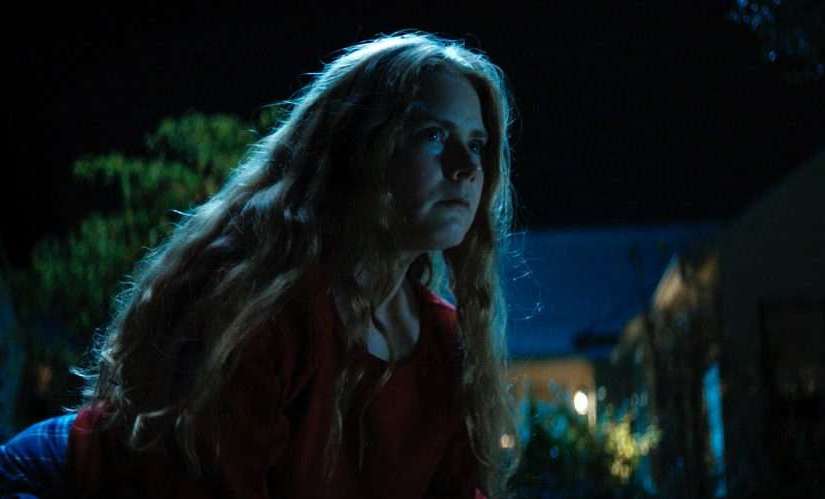
Amy Adams plays an unnamed Mother who has put her promising career as an artist on pause to be a stay-at-home mom while her also-unnamed Husband (Scoot McNairy) pursues his career as a…um…well, whatever it is, he has to travel a lot, leaving Mother at home with, you guessed it, Son (played by adorable twins Arleigh and Emmett Snowden).  Referred to throughout the movie as “my guy” and “sport” and “little buddy,” Son is a typical toddler in the throes of the terrible twos: cute for long stretches, maddeningly frustrating for longer stretches.  [Ed. Note: the author is not a father, has no plans on becoming a father, and will never possess the immense dedication it takes to rear a child, so don’t expect him to embrace the chaos of toddler-hood because it ain’t gonna happen.]

Mother is going through an identity crisis, set up in a brilliant opening scene where Sally, the woman who assumed Mother’s job at an art gallery, asks her, “Do you just love getting to be home with him [Son] all the time?”  Mother answers the question with a little more honesty than Sally or anyone had a right to expect, including this tidbit: “I am deeply afraid that I am never going to be smart, or happy, or thin ever again.”  I am a straight Hispanic cisgender male, so I’m here to tell you, I will never understand that mindset, but I am reasonably certain there are untold millions of moms out there who, if they listened to Mother’s opening statement, would say, “AMEN, sister.”

A little later, Mother delivers an internal monologue where she reflects that, as a mother, you can squeeze someone into the world “who will one day pee in your face without blinking.”  Again, I’m not a parent, but I know that’s truth in cinema right there.

After a few more establishing scenes of Mother interacting with Son, who absolutely REFUSES to go to sleep at night or eat anything for breakfast except, apparently, hash brown patties fried in butter, some odd things start to happen.  At the playground, some stray (?) dogs approach her as if she’s their best friend.  Mother notices her sense of smell has become much more acute.  Son helpfully points out that her back is hairy.  And, in a creepy Cronenberg-y moment, she notices a lump growing at the base of her spine just above her rump.  Curiosity gets the best of her.  She heats a needle, lances the lump, and…well, if you remember the title of the film, you have an idea of what pops out of that lump.

This was all wonderfully thrilling stuff as a movie lover.  I’m thinking, “My god, this is a Spike Jonze movie told from a woman’s perspective!  I’ve never seen anything like this!  This is gonna be GREAT!”  Mother starts to enjoy eating a lot of meat.  She starts to play “doggie” with Son, growling and barking at each other like two puppies.  The two of them eat their lunch at a deli with no silverware…or hands, to the consternation of other diners.  Son doesn’t sleep at night, so Mother, in a genius parenting move, buys a dog bed and gets Son to play “doggie” and sleep in the dog bed at night.  Presto, problem solved!

And more and more dogs start showing up at her door, at night, sometimes bringing gifts: small dead animals.  One night she walks outside, starts digging around, and an astonishing transformation takes place…

I know, I know, SPOILERS, I get it.  But it’s important to get across just how brilliantly original the first act of the film is, because the second act is, alas, all downhill.  I am not saying that the film’s message is unimportant, not at all.  I admire the film because of its message, and because it was being delivered in such an original way.  But then we get into conflict with Husband, who is desperately trying to understand why their 2-year-old is now sleeping in a dog bed on the floor, or why their cat suddenly turned up dead on the front porch, or why his wife suddenly wants a separation.  It must be said, Nightbitch is remarkably even-handed with the Husband’s dialogue.  He is not reduced to a 2-dimensional sitcom husband.  When she lays into him for not supporting her career, he fires back with a well-reasoned argument.  Their dialogue could be turned into a first-rate play.

But instead of exploring the surreal nature of Mother’s new condition, the movie settles into soap-opera territory, with only the occasional nod to the mystical incidents in the first act.  I distinctly remember, in the middle of the second act, feeling as if a balloon had deflated in the plot.  I imagine defenders of the film might say, “Well, the second act is where the weird stuff has to take a back seat to deal with the real issues at hand.”  Okay, maybe that’s true from a real-world perspective, but to me, it felt as if the filmmakers were on the verge of showing us something mindboggling, then backed away from the precipice at the last minute.

Does that make me guilty of critiquing a movie for what I wanted as opposed to what I got?  I guess it does, as much as I dislike that tendency in myself.  I feel there are so many different ways the movie could have gone in act two, could have leapt gleefully over the edge of convention and truly broken the mold with this movie.  When it became clear what they were doing instead, my elation evaporated.

I give Nightbitch a generally favorable score, though, based on the mad inventiveness of the first act and the plot in broad strokes, and also on the incredibly brave performance from Amy Adams, who maybe has two scenes in the entire film where she seems to be wearing any makeup.  She also appears to have to put on some weight for the role, which is not something I can ever recall seeing a female actor do.  Male actors have turned that kind of thing into a cottage industry, but when was the last time you saw a woman do it?  That took guts.  Watch Nightbitch for Amy Adams’ performance and for the story, even if the movie doesn’t follow its own plot to a satisfying conclusion.

FORCE OF EVIL (1948)

by Miguel E. Rodriguez

DIRECTOR: Abraham Polonsky
CAST: John Garfield, Beatrice Pearson, Thomas Gomez, Marie Windsor
MY RATING: 8/10
ROTTEN TOMATOMETER: 100% Fresh

PLOT: A crooked lawyer working for a numbers-running “combine” nevertheless tries to get his older brother to quit the racket himself when an even bigger combine tries to move in.


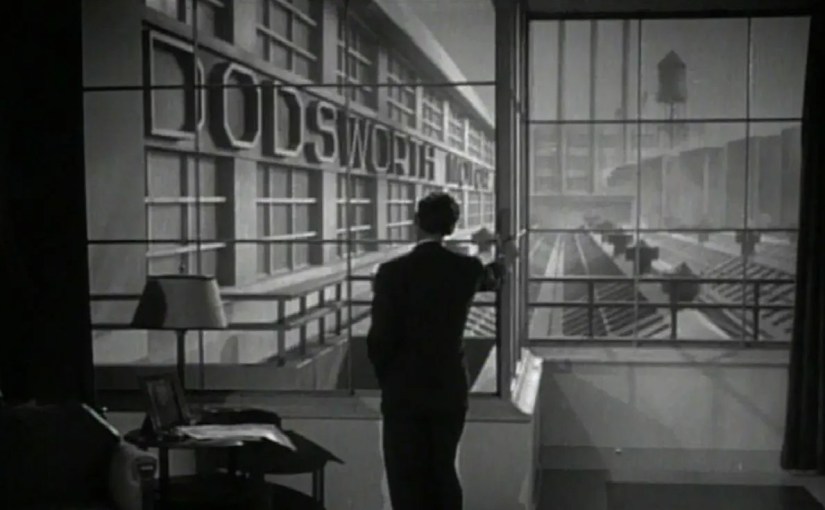
On the surface, Force of Evil looks and feels like a B-movie: low production values, populated by talented bit players elevated into larger roles [John Garfield being the exception, naturally], and looking like it was shot on the fly by a television crew.  Of course, reading that sentence back to myself, I realize I could also be describing Hitchcock’s Psycho [1960], but Force of Evil feels even more low rent than that.  There are shadows present in brightly lit rooms that could only be caused by stage lights behind the camera.  Oddly timed edits draw attention to themselves and threaten to take the viewer out of the movie.  The female roles are literal representations of the so-called “Madonna-Whore” complex, limited to expressions of fluttering tension or full-on seduction.  The dialogue, at least near the beginning, is filled with legal and financial jargon that had me rewinding a couple of scenes to try to digest what the characters were saying.

And yet, Force of Evil exudes a strange power through its unique use of language and the borderline-Shakespearean nature of its tragic story, involving a crooked lawyer (John Garfield) who works for a numbers racket, but nevertheless tries to convince his older brother to quit the business when a larger “combine” threatens to take over.

John Garfield, God love him, was no Brando or Bogart, but in this movie, the screenplay provides him and everyone else with dialogue that feels lifted out of a stage play that was translated into English from some foreign language.  Here’s a line from Leo Morse (Thomas Gomez) to his younger brother, Joe (Garfield):

“Do you know what that is, Joe?  Blackmail!  That’s what it is!  Blackmail!  You’re crazy!  You’re absolutely crazy mad!”

Another example:

“All right.  I am sensible.  I am calm.  I’ll give you my answer calmly and sensibly.  My final answer.  My final answer is finally NO.  The answer is no – absolutely and finally no, finally and positively no!  No, no, no!  N – O!”

To call that kind of language “stylized” is an understatement.  The repetitive words, the broken-up clauses…tilt your head and it could almost read as poetry.  In fact, in Martin Scorsese’s introduction on the Force of Evil Blu-ray, he relates a story where a critic watching a screening of the film exclaimed, “My god, it’s written in free verse!”

While I acknowledge the screenplay’s poetic form, I found an even more contemporary comparison: David Mamet.  I semi-recently watched his film Homicide [1991] and wrote in my review that “…Mamet’s signature word choices…suggest an almost Shakespearean construction, as if the words are being shoehorned into a buried structure or pattern that operates subconsciously…trying to create a mood reminiscent of Greek tragedy…”  Those words apply equally well to Force of Evil’s screenplay by director Abraham Polonsky and Ira Wolfert.  I got a distinctly Mamet-esque vibe from the dialogue in this 1948 film, with just a dash of Aaron Sorkin, perhaps.

(Ebert once said that Pulp Fiction [1994] is a movie that he could watch with the picture turned off, just so he could listen to the crackling dialogue.  Force of Evil could just as well fit that mold, in my opinion.)

There’s even a Mamet vibe to Garfield’s acting style, as he rarely cracks a smile or any other expression for the entire film; we only sense changes in tone by the volume of his voice, not by the expression on his face…much like the lead actors in Mamet’s House of Games [1987].  That stylization sets Force of Evil apart from many of its film-noir counterparts.  To be sure, other noirs have their share of stylized dialogue and characters, but this movie sets some kind of stylization bar that must be heard to be believed.

The story can be summarized easily (see the top of this review), but it is powerful in its simplicity, at least when it comes to the interplay between Joe and his older brother.  As for the female characters, they are sadly stuck in placeholder roles that are there either as eye candy (Marie Windsor, a film-noir regular in her first major role) or as the young woman, Doris (Beatrice Pearson), helpless before the wiles of a wicked smooth-talking man like Joe Morse.  No Ida Lupones or Barbara Stanwycks or Lauren Bacalls here.  However, there is an interesting conversation between Joe and Doris that gives us an interesting insight into Joe’s character, as well as hiding a discussion of moral relativism in plain sight.

Joe is doing the ‘40s film equivalent of “putting the moves” on Doris, telling her baldly that she WANTS him to be wicked to her, “because you’re wicked, really wicked…you’re squirming for me to do something wicked to you – make a pass for you, bowl you over, sweep you up, take the childishness out of you, and give you money and sin.  That’s real wickedness.”  In so many words, he’s telling her that she’s ASKING for it.  This is not a nice man.  He goes further.  He tells her:

“If I put my hand in my pocket and gave you a ruby, a million-dollar ruby for nothing, because you’re beautiful and a child with advantages and because I wanted to give it to you without taking anything for myself – would that be wicked?”

In Joe’s mind, charity isn’t just for suckers, it’s downright evil.  Doris mounts a good defense, telling Joe how she hasn’t been fooled by magicians or smooth-talking men since she was a little girl.  Joe keeps following his path of logic, but an interesting thing happens.  He incriminates himself, and at the end of the scene he seems to realize it:

“To go to great expense for something you want, that’s natural.  To reach out to take it, that’s human, that’s natural.  But to get your pleasure from not taking, from cheating yourself deliberately like my brother did today, from not getting, from not taking…don’t you see what a black thing that is for a man to do?  How it is to hate yourself and your brother, make him feel that he’s guilty, that…that I’m guilty?”

There’s that free verse in action again, with those repetitive phrases.  His own amoral code trips him up, and the camera lingers on Joe’s haunted face for a moment before we fade into the next scene.  I mention this exchange because it’s so atypical of even some of the greatest noirs, which are usually full of hard-boiled dialogue about heaters and button men and glamorous dames.  In Force of Evil, we’re invited to turn inwards with our anti-hero and compare our definition of evil with his, as Doris does later in the film.

The film ends with several scenes of shocking violence, including a murder that looks inspired by Battleship Potemkin [1925] and a three-way shootout in a darkened office.  There is a remarkably evocative shot as Joe hurries down a staircase, and it appears as if he is making his own descent into hell.  Force of Evil has recently been critically re-evaluated; after years of being dismissed as nothing more than an assembly-line noir thriller, it was recently restored by UCLA and the Film Foundation and was also selected to the National Film Registry.  It’s not the greatest film noir I’ve ever seen, but if you’re a fan of the genre, you owe it to yourself to hunt down a copy and give it a look…or more appropriately, a listen.

A GHOST STORY (2017)

By Miguel E. Rodriguez

Director: David Lowery
Cast: Casey Affleck, Rooney Mara, Will Oldham
My Rating: 9/10
PLOT: A white-sheeted ghost…on second thought, I’d better not say.

———————————————————————————————————————————-

SPOILER ALERT…

There is no way to discuss or review this movie without giving away certain key plot points that are more effective when you don’t know they’re coming, so please, if you have any intentions of seeking this movie out, ignore this or ANY other review until after you’ve seen the movie.

All good?  Okay, let’s begin.

A Ghost Story is more like a meditation on its subject than any movie I’ve seen since 2001: A Space Odyssey.  Like Kubrick’s sci-fi epic, A Ghost Story contains long, VERY long stretches of film that involve little or no dialogue.  Sometimes there are stationary shots that simply sit and regard a scene and just…wait for something to happen.  One shot especially struck me, where a character just sits on the kitchen floor and eats some pie.  No dialogue, just eating.  For four minutes.  That’s a LOT of screen time for a film that clocks in at 92 minutes, WITH credits.

So what’s going on here?  On the surface, I’ve just described the most boring film ever made.  But in this case, director David Lowery’s method of storytelling is vital to what the movie’s really about.

[Here’s where the spoilers really start, last chance to bail.]

Rooney Mara and Casey Affleck play a young couple who live in a small house in what appears to be Texas or some other Midwestern state.  Tragedy strikes early on when Casey Affleck’s character (listed in the credits only as “C”) is killed in a car crash.  After Rooney Mara’s character (“M”) identifies his body at the morgue, we’re treated to the first of several long takes as the camera watches her leave but stays with C’s body covered in white cloth.  The seconds tick…tick…tick by, and by this time we’re wondering why we’re still here.  Rather than boring me, this had the effect of moving me to the edge of my seat.  I was pretty sure I knew what was about to happen, but as more and more time elapsed, my certainty ebbed away and I became galvanized.  What IS going to happen?

Well, whatever it is happens, and C is now a ghost covered in a white sheet with two eye holes, looking for all the world like someone wearing a Charlie Brown Halloween costume.  (“I got a rock.”)  After apparently declining the opportunity to “move on”, he returns to his house, and here’s where the movie got to me.  C’s ghost is now a mute witness to his wife’s grieving.  We’re not quite sure what his purpose is, at least not right away.  There’s no mystery to solve, no unfinished business to deal with.  He just watches her.  (She obviously can’t see him.)

During this segment of the movie, I was mesmerized.  It’s hard for me to describe or even understand what gripped me so much in scenes where very little is happening.  I found myself empathizing, not with the wife, but with the ghost.  It’s one of those “what-if” questions that you pose to your friends.  If you COULD come back, would you?  “C” made his decision, and here he is, but his presence is bittersweet.  He can see her, but she can’t see him.  I felt the longing that is only apparent onscreen.  Maybe this part of the movie is a Rorschach test.  We see what we want to see, which makes us feel what we expect to feel.  I don’t know.  But I can’t deny the effect these scenes had on me personally.

As the movie progresses, we are also treated to sudden jumps forward in time.  Rather than the usual fades or segues, months or years suddenly go by in a single hard cut.  Time behaves differently for the ghost.  He’s got nothing BUT time.  Like many literary and movie ghosts, he’s rooted to one physical location, unable to leave, while the living get on with living, year after year, decade after decade.  This made me empathize with him even more.  How sad it must be for a spirit to bear witness to decades, even centuries passing by him, with no way to interact with the living.  Oh sure, he can make light bulbs flicker and he’ll have the occasional tantrum with broken plates and floating cups.  But nobody can talk to him.

Well, that’s not quite true.  He has one companion.  One day, through the window, he spots another ghost in the house next door.  This ghost is also covered in a bedsheet with holes cut out for the eyes.  They seem to communicate by, I guess, telepathy, because we don’t hear their voices, but subtitles tell us they are indeed having a conversation.  In one of the saddest moments of the film, the other ghost tells C that he or she is waiting for someone…but he/she can no longer remember who it is.

If there was ever a case to be made for someone to “head toward the light” rather than remaining on Earth, that’s it.  Far better, in my opinion, to complete the journey to “the other side”, whatever it may be, rather than endure an eternity of waiting for…what?

Look at me.  Philosophy.  That’s the effect this movie had on me.  It got me to really THINKING about the kinds of topics that I normally avoid thinking about.  The inevitability of death.  The efforts we make to keep our memories alive after we’ve gone.  Remembering those who are no longer with us.  Heavy, man.

After some time, “C” eventually does find a reason to stay, beyond attachment to his wife.  I won’t reveal what it is, but it’s organic, and it’s something I would certainly be invested in if I were in the ghost’s place.  His attempts to fulfill his goal are poignant, and constantly being frustrated.

The final reel is where the movie may potentially lose a lot of viewers.  It even lost me a little bit while I was watching it, but upon reflection, I can see where it’s going.  After all, any movie made about the afterlife is pure speculation anyway, so who am I to say their concept makes no sense?  There is a certain sad logic to it, after all.

There’s that word again, “sad.”  This is definitely not a popcorn movie, that’s for sure.  This is a thought-provoking film designed to inspire introspection and reflection.  AND it’s entertaining, make no mistake.  But, yes, sadness is a big part of the film.  I didn’t tear up or anything, but it is filled with overwhelming heartbreak.

And yet, with that final shot, there’s a kind of triumph to the whole thing.  Not the kind of triumph like at the end of Rocky or your average Spielberg movie, but a sense of completion, of sudden realization.  It won’t please everyone, but it works.

A Ghost Story will mean many things to many different people.  If there’s a better definition of effective “art”, I don’t know what it is.