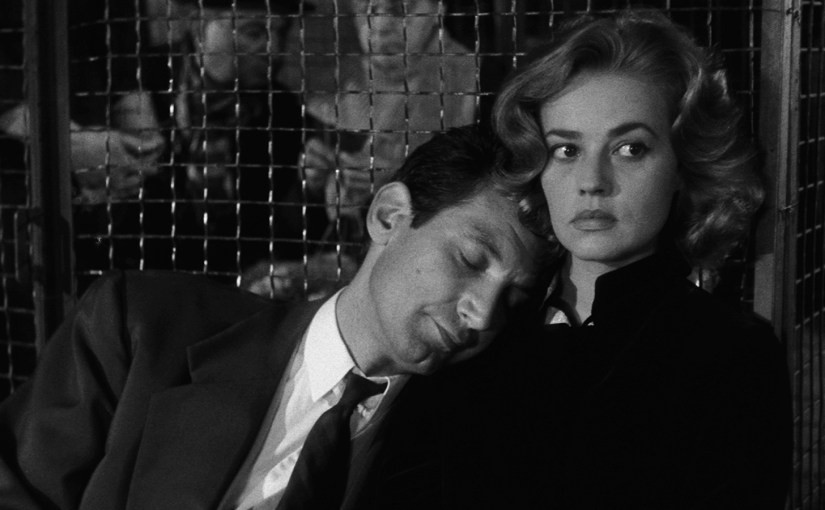
ELEVATOR TO THE GALLOWS (1958, France)

by Miguel E. Rodriguez

Director: Louis Malle
Cast: Jeanne Moreau, Maurice Ronet, Georges Poujouly
My Rating: 10/10
Rotten Tomatometer: 93% Certified Fresh

PLOT: A married woman and her lover hatch an apparently foolproof plan to kill her husband (his boss), but a split-second decision at a crucial moment sends everything into a tailspin.


We plan, God laughs. – old Yiddish proverb

Let me get this out of the way right at the top: Elevator to the Gallows is one of the best crime drama/thrillers I’ve ever seen.  It holds its own against anything by Hitchcock or Clouzot.  With admirable focus and restraint, first-time director Louis Malle (My Dinner with Andre, Vanya on 42nd Street) crafts a gripping illustration of how the best laid plans can fall apart because of one minor miscue.

The film cuts right to the chase at the opening scene, showing a phone conversation between Florence Carala (Jeanne Moreau) and her lover, Julien Tavernier.  They discuss their plans for Julien to kill her husband in his office on a Saturday evening, after which he’ll pick her up at a café where she’ll be waiting, and that will be that.  Everyone will assume her husband is in Geneva on business, and no one will discover the murder, which Julien will arrange to look like a suicide, until Monday morning, giving Florence and Julien plenty of time to make their escape.

(I liked how we never got any flashbacks of the relationship between Florence and Julien.  All we need to know is, they’re lovers, they’re desperate enough to commit murder, and that’s it.  Very concise.  I love it.)

Julien’s plan involves using a grappling hook to avoid using the office elevator to get to his boss’s office one floor above his.  He proceeds with the plan, nearly getting caught in the process, but he’s able to commit the crime and leave the building with several witnesses as an alibi, witnesses who will say they never saw him enter his boss’s office before he left.  So far so good.

Julien gets to the street, takes the top down from his convertible, takes one last look back at the building…and realizes he left a vital clue in full view of any pedestrian or street cop.  Leaving his car running, he decides to run back into the office building and retrieve the evidence before the night guard shuts off the power for the night.

Unnoticed by Julien, a florist and her bad-boy boyfriend have been having an argument at the shop next to his car.  The boyfriend sees this rich man leave his convertible on the street…with the engine running…

Thus begins a Hitchcockian odyssey that leaves Julien stranded in an elevator, his car and his identity stolen, and his mistress stranded on the streets wondering where the hell her lover is.  At one point, Florence sees Julien’s car drive by the café where she’s waiting…she can’t quite make out the driver, but who is that girl in the car with him?!  Has she been betrayed at the last minute?

The film follows the younger couple, Louis and Véronique, as they tool around in Julien’s car, eventually winding up at a roadside motel, and unwittingly making friends with two German tourists.  They even share drinks with the Germans and take some candid photos using a little spy camera in Julien’s raincoat.  (We learn that Julien was in the Foreign Legion and was well-trained as a soldier – maybe even in spycraft.)  I found myself wondering why we were wasting time with this larcenous couple…until they decide to check into the motel as Mr. and Mrs. Tavernier to cover their own tracks.

The screenplay ingeniously heaps one hasty decision on top of another so that, just when it seems Julien might be in the clear, something else happens that makes it seem impossible he won’t be discovered or at the very least blamed for something he didn’t do.  Meanwhile, Julien is desperately trying to escape the elevator, using a penknife as a screwdriver, getting excruciatingly close to tripping a vital switch that’s just out of his reach.  He eventually tries to get out using the old climbing-the-cable trick…which is of course exactly when a night watchman is making his rounds.

This story is so good, I can’t believe there hasn’t been an American remake.  And it’s not like there aren’t other great films out there that cut right to the chase and never look back for flashbacks or additional material.  I’m not sure what makes Elevator to the Gallows so good, to be honest.  Maybe I was rooting for Florence and Julien when they are clearly not the good guys.  Maybe it’s the economy of the storytelling, or the screw-turning twists that lead the police to believe Julien has committed more than one murder.  At one point, Louis and Véronique make a startling decision that had me yelling at the screen.

Words fail me on this one.  I can’t describe it any better than by saying this is one of the best films I’ve ever seen, certainly one of the best film-noirs I’ve ever seen, and a movie that I’ll bet Hitchcock watched while thinking to himself, “Damnation…I wish I’d thought of that.”
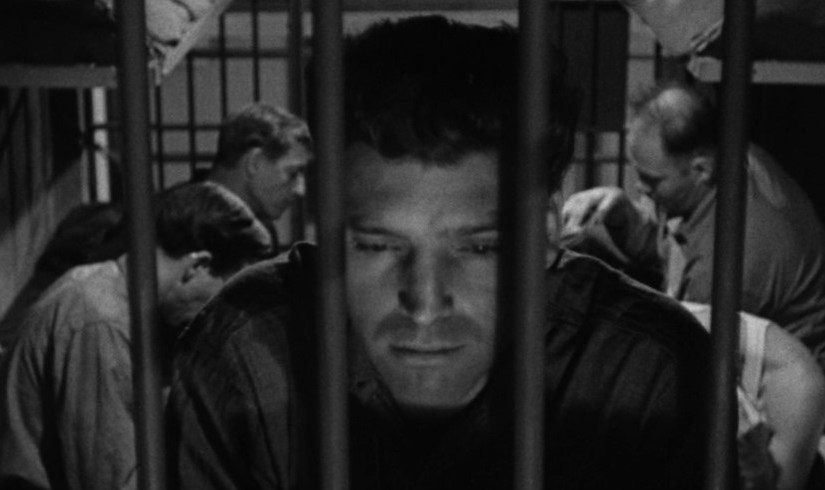
BRUTE FORCE (1947)

by Miguel E. Rodriguez

Director: Jules Dassin
Cast: Burt Lancaster, Hume Cronyn, Charles Bickford, Ann Blyth
My Rating: 9/10
Rotten Tomatometer: 94%

PLOT: A convicted felon tries to organize a prison break under the nose of a sadistic chief guard who is on the verge of becoming the new warden.


In Brute Force, released seventy-five years ago, we are witness to: a man getting crushed by a metal press, a suicide, a brutal interrogation with the help of a length of metal pipe, a prisoner machine-gunning dead cops out of sheer frustration (okay, you got me, that part is off camera), and the kind of nihilistic ending that you typically only see in old French films.  Wages of Fear, for example.  I mean, this movie is violent by TODAY’S standards, let alone just a couple of years after World War II ended.

Joe Collins (Burt Lancaster in only his second film) is just getting out of solitary confinement at Westgate Penitentiary when he sees one of his cellmates being driven out of prison…in a hearse.  This only solidifies his resolve to escape with the help of his remaining cellmates.  Meanwhile, we get glimpses of life elsewhere in the prison.  The current warden is a trembling coward who addresses the prisoners only through a P.A. system in his office.  The prison physician, Dr. Walters, sees injustice and top-down barbarism on a daily basis and has his own method of escape: whiskey.  Inmate informants and stool pigeons are dealt with promptly and carefully.

Looming above everyone, despite his relatively small stature, is Captain Munsey (Hume Cronyn).  He has the real power at Westgate.  He rarely raises his voice and even stops his lieutenant from beating a prisoner unnecessarily.  But he unflinchingly doles out punishments and even strong-arms other convicts into ratting out their buddies.  Of course, the stoolies are usually found out and wind up dead.  Shame about that.

The crux of the story is the escape plan, an ambitious endeavor involving capturing the yard tower which controls the gate and lowers the drawbridge – an actual drawbridge! – to the mainland.  Between making these plans and various other intrigues involving the warden and an imperious visiting government official, we are also treated to flashbacks showing how some of Joe’s cellmates wound up in prison to begin with.  Here the film gets a little overly melodramatic, a typical trait of many dramas of the ‘40s, but director Jules Dassin wisely doesn’t dwell on them for too long.  The scenes do just enough to create more audience empathy for these “bad men” without bathing in soap.

I put “bad men” in quotes because these guys are, in fact, criminals, but they’re also our protagonists.  When it comes to Joe himself, it seems clear by his demeanor and his flashback that he wasn’t just a criminal, he was a leader of criminals, head of his own little gang.  This is not a very nice man.  The only convict sharing a cell with Joe who might conceivably be considered a “good guy” is Tom, a man who embezzled money from the company he worked for to buy his frustrated wife a fur coat.  Everyone else looks capable of perpetrating real violence.

Why do we root for these men?  Partly because it’s in our nature to support anyone who is out to give authority figures the finger.  From Cool Hand Luke all the way to Hannibal Lecter and beyond, we are instinctively drawn to men and women who are bucking the system.  But it’s especially prominent in this movie where we see these men at the mercy of a broken system that eventually revokes all their privileges, even visiting hours, in the name of restoring discipline.  Armed guards watch the prisoners everywhere, even in the chapel.  There is no longer any attempt at actual rehabilitation.  In the prison’s auto garage, a prisoner is asked what he’s learned while working there.  His answer: “I’ve learned that, when I get out, I don’t wanna be a mechanic.”  He hasn’t learned anything.  He’s just learned that it’s better to not get caught.  For this we pay our taxes?

So, yes, there is a strong message in Brute Force.  It’s not especially subtle, especially during the liberal Dr. Walters’ various monologues about the corrupting nature of power and the futility of expecting lasting behavioral changes through punitive measures.

But what stood out to me was the unexpected level of violence in the story.  Sure, some of it is discreetly left off screen, but what is left to the imagination can be infinitely worse than what the screen shows us.  Case in point: Se7en, where we are always shown murder scenes, never the murders themselves.  Or the infamous ear scene in Reservoir Dogs, where we never actually see the deed being done, yet it’s remembered as one of the most violent scenes in film history.

In Brute Force, during an interrogation, we see Captain Munsey winding up to deliver several blows with a lead pipe to the head of a handcuffed prisoner.  We push past the prisoner, so we only see Munsey, and down comes the first blow.  We hear the impact, then cut to just outside Munsey’s office where other officers are killing time playing cards or writing reports.  And through the doorway we hear more impacts, one after the other after the other.  Some officers look uncomfortably toward the office but make no move to stop what’s happening in there.  One officer is so disturbed he throws down his cards and stalks away.  Right away, we’re thinking, jeez, if HE’S that upset, something terrible is going on in that office.

This is not the kind of “realness” I was expecting from a 1947 film.  And it doesn’t end there.  There are other little vignettes of violence during the climactic escape attempt that made me gasp, including a hand-to-hand fight where one guy appears to be getting hit in the head and neck with a belt of machine gun bullets…for real.  At least twice.  Looked convincing to me, anyway.

Jules Dassin (1911-2008) is known for directing some of the best loved film noirs of all time, including The Naked City [1948], Night and the City [1950], and Rififi [1955], which won him the Best Director award at Cannes that year.  His best films are steeped in atmosphere and a fatalistic sense of…well, fate, an idea that no matter how hard we kick and scream at the walls of our existence, any attempts to escape will be met with massive resistance and will most likely end in failure, or at best only a partial victory.  Not a particularly uplifting outlook, but who says all movies must have a happy ending?  Sometimes you get the bear, sometimes the bear gets you.  By the end of Brute Force, Dassin ingeniously combines those two outcomes.  Tricky.

TURNING RED (2022)

by Miguel E. Rodriguez

Director: Domee Shi
Cast: Rosalie Chiang, Sandra Oh, Wai Ching Ho, James Hong
My Rating: 10/10
Rotten Tomatometer: 95% Certified Fresh

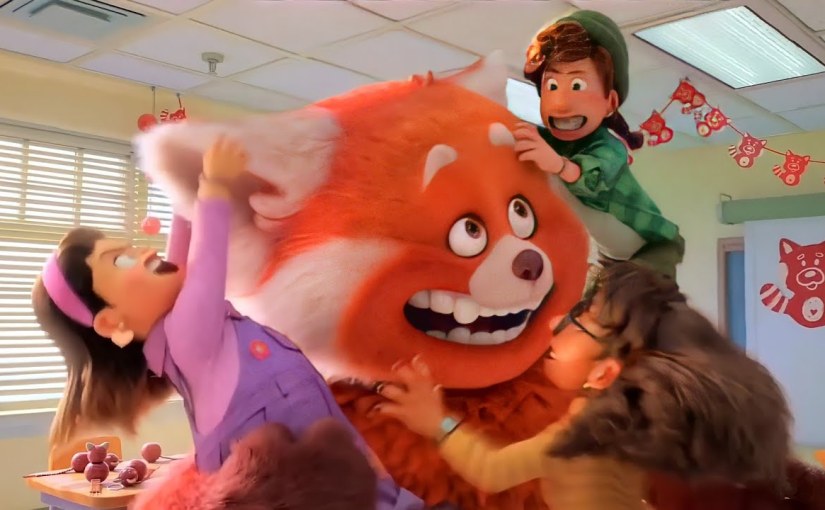
PLOT: A 13-year-old girl named Meilin wakes up one morning with the rather inconvenient power to turn into a giant red panda whenever she gets too excited.


Disney/Pixar’s Turning Red is one of the best, funniest animated movies I’ve seen since Inside Out.  Or The Lego Movie.  Take your pick.

If you’ve seen the trailer, you know the plot.  A 13-year-old Chinese-Canadian girl named Meilin [may-LINN] discovers one day she has the (inconvenient) ability to turn into a giant red panda.

Details: Meilin’s relationship with her mom, Ming (Sandra Oh), is complicated enough without this new tangle.  Ming encourages Meilin to excel at everything and has enlisted her help with running and maintaining a small Chinese temple devoted to an ancient ancestor of theirs who supposedly channeled the power of the red panda to defend her children thousands of years ago.

When Meilin learns to control her newfound power to a certain degree, she decides to use it, not to fight crime, but to earn some money to buy a ticket to see this awesome boy band, called 4Town (even though they have five members), with her three besties.  Like, Oh.  Em.  GEE!

Complications ensue, Meilin tells a crucial, heartbreaking lie at one point, and previously unsuspected powers are unleashed.  That’s all you’re getting out of me, story-wise.

While the story was great, and worthy to stand with Pixar’s finest films, what made Turning Red stand out for me was the humor.  It is just plain laugh-out-loud funny.  I was laughing through almost the entire movie.

Through a completely believable misunderstanding, Meilin’s mom, Ming, thinks she knows what’s behind Meilin’s strange new behavior and asks her, ever so delicately, “Did the scarlet peony bloom?”  There’s a brilliant moment when Ming chases Meilin to school and, in front of an entire classroom, holds up an item she forgot to pack in her bag: a box of pads.  That’s right out of a John Hughes movie, man!  I laughed like a maniac.

Meilin’s three friends are a treat, especially the little spitfire named Abby, whose face seems to be permanently stretched into a fierce scowl.  There’s a moment when she catches one of those red playground balls with her teeth.  Maybe SHE’S the monster.

As with all the best Pixar films, though, the humor, as effective as it is, is just window-dressing for the real thrust of the story.  The exploration of the mother-daughter relationship hasn’t been done this well since Brave.  And I’ve gotta say, it was refreshing to see how real the character of Meilin was.  Because she’s rooted in the real world (of 2002 Toronto), her attitude felt more authentic somehow.  Sure, in Brave, Merida had the same rebelliousness and determination to forge her own path despite an imposing mother figure.  But with Turning Red, everything was more grounded.

There’s a moment when Meilin has turned into a panda and is running down a city street trying to hide.  She passes a convenience store where a cute guy works the counter.  She is desperate to get out of sight…but she stops just long enough to glance through the window at the cute guy, stomp her foot like Thumper, and yell, “Ah-OOO-gah, ah-OOO-gah!”  Another big laugh.  And I thought to myself, “See, that’s normally what you would see GUYS do in a movie.  Who makes a Disney film about a girl obsessed with boys?  What a treat!”  (I know, I know, the early Disney princesses weren’t exactly models of modern feminism, I’m talking about more recent films, stay with me here…)

Naturally, there’s a lot of symbolism with Meilin being thirteen, coming of age, and suddenly going through all sorts of changes.  What’s great about the storytelling is that the symbology is secondary, at least initially.  There’s the usual very well-executed denouement where all the emotional threads come together.  But before we get there, it’s just a story about a young girl with a weird problem.  And I have to say again, it is doggone FUNNY.

I took a glance at the “rotten” reviews at rottentomatoes.com, and I kept seeing one repeated phrase among several of them: the lead character was “irritating.”  I am at a loss to explain this point of view.  Meilin is a 13-year-old girl.  Of COURSE, she’s irritating.  AND obnoxious.  What were you expecting?  Meilin is endearing precisely because she’s portrayed as someone who isn’t perfect, even though she’s trying hard to be.  She lies to her parents.  When she has to think of something to calm herself down, she doesn’t think of her mom…she thinks of her best friends.  She feels bad about it, but what are you gonna do, she’s thirteen.

Further pontificating from me seems pointless.  Take it from a lifelong Pixar fan.  Turning Red is one of their finest moments.  It’ll make you laugh, and if you’re not careful it’ll make you cry.  It might make you remember what it was like to scream like crazy at a rock concert.  It’ll make you remember your first real best friends.  And it’ll make you wonder why more people don’t make movies like this.  Because they should.

KATE & LEOPOLD

By Marc S. Sanders

Fish out of water stories will always be told. Kate & Leopold directed by James Mangold reminded me of the New York City based romantic comedy Big, which was a better variation on that formula.

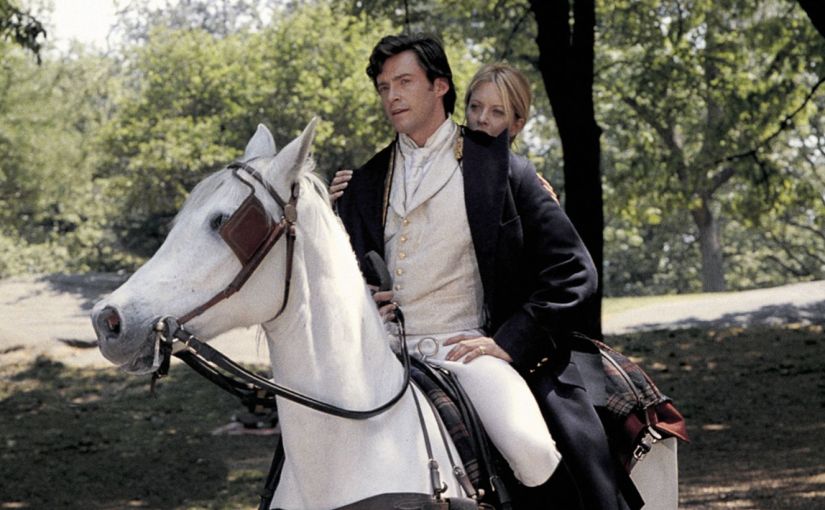
In Kate & Leopold, Hugh Jackman portrays the second title character also known as the Duke of Albany in the year 1876, and apparently the eventual inventor of the elevator. One night, he pursues a curious fellow who is attending an evening ball designed to find a bride for Leopold. The man runs and Leopold gives chase into the rain where they find themselves hanging from scaffolding of what will become the Brooklyn Bridge, designed by-you guessed it-Leopold. The moment of suspense ends with Leopold accompanying the fellow named Stuart (a very miscast Liev Schrieber) into present day New York; a New York unfamiliar to Leopold where manners of grace and elegance have gone out the window and you’re expected to pick up your dog’s poop following a walk.

Let’s get this out of the way, quick. Stuart has uncovered time travel. How does it work? Who cares? Move along.

Stuart’s ex-girlfriend and downstairs neighbor is played by the late 20th century staple resident of the Big Apple movies, Meg Ryan. She’s the Kate of the film’s title. Just like other romantic comedies of this nature, Kate is tense and stressed and trying to land a big account where she’s looking for the right spokesperson for a new butter spread commercial. You think Leopold, in his signature 19th century outfit, may fit the bill? I’m thinking you guessed correctly.

What else do you think happens? Yeah. You’re right. Kate and Leopold start to fall in love.

I grew tired of Kate & Leopold for a few reasons. There’s a side story meant for some slapstick kind of humor where Stuart, who is the “Doc Brown” of this picture, falls down an elevator shaft only to be relegated to a mental ward where he struggles to get in touch with the leads to explain what must be done from here. C’mon!!! A patient in a hospital should be able to make a lousy phone call.

Two, as Leopold romances Kate as well as coaches her brother (Breckin Meyer) in the ways of romance, how does he manage to find the financial resources for a violinist or the decor he uses to uphold his manners of refine? Reader, if I’m occupying myself with these trivial questions, then what do you think might be wrong here?

Chemistry!

Most importantly, the chemistry between Ryan and Jackman seems way off. I didn’t believe for a second these two were falling in love with one another. They speak two different variations of English and while Leopold is a man of great chivalry, I never found a moment in the film where he would be captivated by the modern-day Kate. What did Kate do anywhere in this picture that swept him off his feet? For Kate, when did she fall in love with Leopold? She’s hardly giving him the time of day and he’s really only a convenient opportunity to rescue her big account, but that’s not love for me. That’s not romance. That’s, at best, discovery. Like finding the next big talent or gimmick. If this is what love is, then who fell in love with Mr. Clean and how many years is the Jolly Green Giant married now? Did the Kool-Aid Man find his betrothed when he smashed through her kitchen wall?

In Big, director Penny Marshall found opportunities for the Elizabeth Perkins character to stop and look at the 12-year-old character version of Tom Hanks. Because she stopped and looked, she then still felt comfortable in her own skin. Hanks’ kid like character develops a first crush. A first crush may not be love, but to a 12-year-old, nothing is more confusing or self-occupying.

In Mangold’s film which he co-wrote with Steve Rogers, Leopold admits early on that he’s never been in love. Where’s the weight of his emotions here? I never uncovered those moments between the characters of Kate & Leopold, while a film like Big devoted a wealth of attention to it.

As well, like I said earlier, I could not take my mind off figuring out how Leopold is paying for this elegant rooftop dinner. Where did he get the money, in New York City, to pay for all this?

Know what Tom Hanks did in Big? He got a job!

THE LAST CASTLE

By Marc S. Sanders

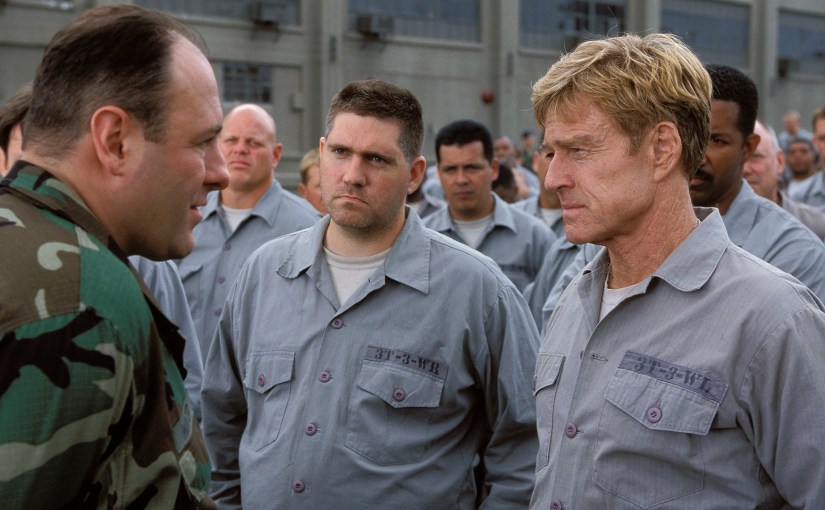
Robert Redford, James Gandolfini and Mark Ruffalo go to sleep in The Last Castle, a prison movie of no consequence directed by Rob Lurie.

They go to sleep. So naturally, I go to sleep.

Redford plays Three Star General Eugene Irwin (a real tough guy name!) sentenced to a military prison. It’s where we have to accept that Gandolfini as a “ruthless” Colonel Winter controls his inmates with an iron fist. (Iron? Aluminum Reynolds Wrap is more like it.). That’s what the Netflix or TV guide description might tell you.

Watch the film however, and you’ll nary see anything terribly harsh from Gandolfini, much less will you see anything triumphant from a run of the mill Redford. Exactly what is the problem these two guys have that motivate the General into a forever-to-get-there uprising against the prison? These guys never appear to be enduring much of a harsh reality.

Amid the concrete walls, basketball is played with glee, rocks are carried to and fro and bets for cigarette winnings are proffered. I don’t get it. What’s wrong with this, and why is Gandolfini regarded as such a dick about it? This Colonel Winter is no Tony Soprano. That’s for sure.

I think it’s in Redford’s contract that dirt must never grace his boyhood good looks and his neat blond hair style remain preserved even when he’s running through 7 foot flames to rescue Ruffalo from a downed helicopter. (Psst, that’s the most exciting—that’s the only exciting—part of the film.)

The Last Castle is not a good movie.

As the allegorical chess play between the opposing leaders carries forth, much flexibility is offered to both sides to plan accordingly for the final battle. This is too neat and too pretty for a prison mutiny uprising. It’s real convenient that there are only rubber bullets in the guards’ rifles. That way it’s safe for everyone to play in the sandbox a little longer past curfew.

Don’t believe me about all this? Then answer me this question:

Where in the hell did Redford’s band of prisoners find the time, resources and covert opportunity to construct a building tall SLING SHOT STRAIGHT OUTTA BRAVEHEART OR LORD OF THE RINGS to chuck boulders with? I mean how the hell would you even hide such a thing when you are locked in a prison? It ain’t under the mattress. That’s for sure.

THE BABADOOK

By Marc S. Sanders

The Australian psychological horror film, The Babadook is a very unsettling piece, and I hate my colleague, Miguel E Rodriguez for subjecting me to a viewing. It’s so unnerving simply because it is so good.

Jennifer Kent writes and directs an eerie film about a troubled mother and her young son (Essie Davis, Noah Wiseman) named Amelia and Samuel Vanek. Samuel’s father passed away in an accident while taking Amelia to the hospital when she was in labor. Seven years later, Amelia endures much sorrow and loneliness while Samuel has social issues in school and resorts to crafting barbaric weapons out of wood. I just played with action figures. This kid puts sharp knives on a sling. Other mothers and children keep their distance from them. Samuel’s school is concerned of his presence with other first graders, and Amelia opts to not even celebrate the boy’s birthday on the actual day, also known as her husband’s date of death.

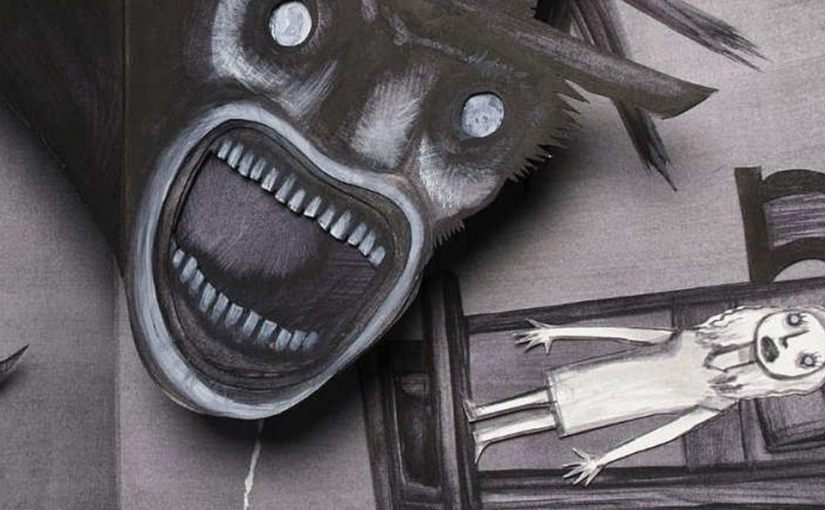
One evening, Samuel pulls a book known as “Mister Babadook” off the shelf for bedtime reading. Opening the book is their first and most regrettable mistake. Haunting images of a dark shadow are shown in “pop up book” form with promises of death and so on in a cute, yet sinister, Dr. Seuss like rhyme. This is the evil “Cat In The Hat.”

Like most creepy horror films, there’s pounding on doors and floors, open doorways to find nothing there, disturbing phone calls, shadows, surprising sound editing and so on. That’s nothing new. What makes Kent’s debut film so special though are the performances from Davis and Wiseman.

As I watched the film with Miguel, I told him after about a third of the way through that I hate that annoying little kid. I think that’s the point though. Noah Wiseman plays his part with great hyperactivity who can never be satisfied or calmed with any variation of attention. Essie Davis plays Amelia as strung out and exhausted. You can’t help but feel for her inescapable circumstance of being trapped in a home with no other family and no friends who seem willing to help, much less tolerate her crazed son.

Later, long after the disturbing children’s book is read, Jennifer Kent’s script turns on a different perspective. It’s not so much that the character’s have changed. More so, the aftermath of reading “Mister Babadook” has altered the mother and son’s behaviors. What caught me by surprise was that my own perspective gradually changed on the two players.

You will need to watch the film to truly uncover the mystery of the book’s power. However, it’s a very frightening exploration. Kent is very good with the sensory overload; which really is a necessary tool in horror, particularly in what you hear and what you see. Kent mixes up what sense is alarmed first though, with each passing sequence. It makes it hard to relax as a viewer, while it’s also hard for the mother and son to sleep at night. That’s what keeps the hairs on your body standing up and believe me, mine were standing at full attention.

Kent covers much psychologically. Insomnia, depression, aggression, night terrors and trauma are all given attention as they manifest into this disturbing unrecognizable character know as The Babadook.

I also observed an interesting aspect in use of color. Namely that Amelia is dressed primarily in faded pink and yellow while Samuel is adorned in dark grey or charcoal like the two story home they live in. The contrast in colors left me guessing who was the real source of fright in this film because at times the contrast seems to flip. I risk sounding vague here, but I’d prefer not to spoil what’s presented.

Again, The Babadook left me feeling shaken like the best of Stephen King’s adapted films including Stanley Kubrick’s The Shining and especially the latter half of Brian DePalma’s Carrie. I’ll even go on record and say this film is better or more effective than those two films. It’s sharper and more mysterious.

I’m not sure I was entertained with The Babadook because I was always feeling disturbed and unsettled. Good horror films do that to me. Forgive me. I can’t help that.

On the other hand, Miguel was quite entertained at me cursing him out and loudly expressing my seething hatred towards him as I watched. What can I say? Mig had it coming for introducing me to The Babadook.

CAPTAIN AMERICA: THE WINTER SOLDIER

By Marc S. Sanders

Anthony and Joe Russo direct one of the best action pictures of the last 20 years as they pit the heroic patriot against weaponized SHIELD planes, trap him in an elevator with 15 strong arm men to take on singlehandedly, and most especially the dude dressed like the American flag goes up against a mysterious figure that possesses a highly weaponized steel arm. Best yet, none of these sequences pertain to the story so much as they frame it.

Chris Evans returns as Steve Rogers aka the first title character, and he’s even better this time around. Captain America: The Winter Soldier hearkens back to the thematic 1970s conspiracy theory features like The Parallax View with Warren Beatty and Three Days Of The Condor with Robert Redford as Cap first finds himself on one side of an important debate for our modern times. When is too much warfare enough? How far must we go to serve as a means of protection? Evans appears as if he’s researched the strong position held by his character, and he’s believable in his mindset. Is the motive out of fear, or power, or could it actually just all be for protection? He’s convincing in his character’s argument. Naturally, if he can’t agree with the powers that be, he’ll find himself on the run with allies like Scarlett Johansson as Black Widow and Anthony Mackie as the supercool Falcon.

Johansson is given much more to work with as she trades “Buddy Cop Movie” wits with Evans as well as helping him with his dating scene. She also offers up some sharp intelligence to a promising complex former KGB/spy. It’s about time she get her own film in the series. She’s overdue. (Well…now we all know how that turned out.)

It’s especially appropriate that Redford himself is recruited as Secretary Alexander Pierce. Redford plays puppet master for a film that offers the biggest altering twists the MCU has offered up to this point. To handle the role requires an actor with a history to his career and since Redford has dabbled in films of this nature, he fits right in. He must have been especially pleased to accept this role recognizing the layered angles to a script provided by Christopher Markus & Stephen McFeeley.

Sebastian Stan returns with an astonishing turn as his character Bucky. When all the surprises are revealed by him, your pulse will likely not have come down following a thrilling highway shootout.

Lastly, credit must be given to Samuel L Jackson. This film offers the most for his Nick Fury character to play with. Fury finds himself on the wrong end of an argument that leads to a shocking betrayal and sabotage. Jackson’s roles often fall into the same routine of timing and delivery, screaming “mother effing” frustrations. It’s often lovingly joked about but it gets tiring too. Here however, he’s given a chance to be the victim of a brutal attack and deal with an aftermath. It’s the best material written so far for the Nick Fury character.

The Russo brothers, not normally known for big budget extravaganzas, surprised audiences with a well-executed film that offers suspense, extensively choreographed action sequences and great characterizations all around. They have identified Captain America as the soldier of morals, but moreover they recognize where he stems from. The Brothers certainly haven’t forgotten that he’s really a 95-year-old man at the time of this story. That sets up some good laughs. The adventure of the picture is top notch and thankfully it primarily all takes place in daylight where nothing is strategically hidden and appearing as shortsighted work in dark photography. The Russos know how to pinpoint exactly where Cap needs to throw his shield, what it should bounce off of, and how the hero should get it back. Everything here is top notch.

Captain America: The Winter Soldier only gets better with repeat viewings, and you really don’t even need the other MCU films to follow its trajectory. It’s worth watching at any given moment.

THOR: THE DARK WORLD

By Marc S. Sanders

Like Louis Letterier’s The Incredible Hulk, director Alan Taylor’s Thor: The Dark World is a very underrated installment in the Marvel Cinematic Universe. It focuses on a lot of humor with well edited action and moments that allow all the major players to offer up good material.

First Chris Hemsworth as Thor. Yeah, he’s doing the same thing and that’s fine. If it ain’t broke, don’t fix it. Moving on… This is an important chapter in the MCU, as it introduces the second of the legendary Infinity Stones, the red Aether, which consumes Thor’s love interest from Earth, Jane Foster, played by Natalie Portman. Fortunately, it provides better writing for Portman to play with. She really is the MacGuffin of the film, and she works as a story device to explore more of Asgaard, one of the best set pieces in all of the Marvel films. Jane uncovers the mysterious stone, or rather liquid, that has been hidden away for centuries; this is all Lord Of The Rings stuff. Once she finds the stone and is consumed with it, then the film segues into its originality.

Apparently, it’s not good if the Aether is used for destruction while the Nine Realms are in Convergence, which we are told happens every 5,000 years. What is Convergence? Well, that’s where it’s fun to watch Thor: The Dark World. The Nine Realms line up, literally like a rainbow of circles stacking on top of one another. It’s really cool to look at. What’s more fun is how Jane and her crew drop random objects into an open space within a deserted London warehouse and then it disappears, and then drops back down to them from above their heads. Sometimes, they drop something, only the objects don’t return at all. I like all of this stuff, because it’s all visual and ultimately that is what movies are about. Showing us something. Asgaard, The Convergence, Thor’s swing of his hammer, the Aethar, it’s all fun to see. I’ll credit Alan Taylor’s direction for a lot of this. He’s shown great achievements in Game Of Thrones. He carries his visions over to Thor’s universe.

Next is the villain is Malekeith, the head of the Dark Elves, with some really wicked looking makeup, and it only gets more wicked as he progressively gets more powerful. He wants to get the Aether and bring the Nine Realms into Darkness. Christopher Eccleston (best known for G.I. Joe; that should tell you something) takes on this role which is nothing special. I don’t care so much about the villain in this film as I do about the conflict of the story. The conflict is the real treat. Eccleston is nothing special. He’s not bad. He’s not good. He’s just nothing special. Moving on…

Tom Hiddleston is back as the trickster Loki, one of the best written characters in all of the Marvel Cinematic Universe. The script gives him a lot to play with and opportunities to irritate and antagonize Thor who reluctantly recruits his assistance. “Well done. You just decapitated your grandfather.” See the movie (again?) and you’ll love the timing of this line. Hiddleston has fun with the levity of Loki but there is a sad central story to the adopted son of Odin. During his first appearance in the film, following his incision of the New York alien invasion from The Avengers, Loki is arrested in chains to stand before his father, and Hiddleston clicks his heels together at attention, giving a serious grimace before declaring “I really don’t see what all the fuss is about.” Hiddleston continues to work and develop at this favorite character who remains tricky and unpredictable. I love it.

Anthony Hopkins is back as Odin, Thor’s father. Yeah, he’s doing the same thing and that’s fine. Again, if it ain’t broke, don’t fix it. Moving on…

There’s a lot of fantastic sci fi and fantasy sequences to this film and from a CGI perspective, it’s artistically beautiful. It’s just a fun ride of exploration. Thor was never a favorite comic book character of mine growing up. The MCU opened my eyes to something special in his adventures and those that surround him. It’s even great when Thor jumps on the tube to return to a battle in Greenwich Village. I’m expecting some energetic debate on my feelings towards this film. Bring it on and I’ll match you. As Thor might say after his hammer turns a giant rock monster to rubble, “Anyone else?”

Reader, if I can quote this film three times in a review that should tell you how much I love Thor: The Dark World.

INTERNAL AFFAIRS

By Marc S. Sanders

Internal Affairs has a promising start as we see Richard Gere as decorated officer Dennis Peck compromise a police shooting in favor of his fellow officer (Michael Beach) who has just shot a fleeing unarmed suspect in the back. Right away it’s apparent that Gere is the bad guy here and soon we will see how Andy Garcia as new Los Angeles Internal Affairs officer Raymond Avila will investigate Peck for his violations. Unfortunately, the movie from director Mike Figgis reduces itself to simply having the male characters of the film, including William Baldwin as another dirty, drug addicted cop, physically abusing the female characters around.

This film from 1990 shows its age for sure with frizzy hair sprayed dos and large lapel jackets and skinny ties, but that was not my main issue. It would not be until 2006 in the Martin Scorsese film The Departed that we would see what I was hoping for with Internal Affairs; how a dirty cop works, and how the righteous cop gives pursuit. If only Figgis’ film was smart enough to focus on the method behind Dennis’ actions of crime and police superiority. Instead, we get a Richard Gere who actually shows he can play an effective bad guy, psychologically messing with Andy Garcia’s character by giving him the illusion that he’s having an affair with his wife. What’s Garcia’s response to this? He slaps his wife, played by Nancy Travis, in the middle of a crowded restaurant. When the two clear the air about what’s going on, they slap each other again before making up.

Gere also slaps and physically threatens his own wife played by Annabella Sciorra to drive the point home that she better not talk to the Internal Affairs department. As well, Gere also slaps around his mistress, a wife of one of his criminal associates. William Baldwin’s character slaps around his wife too. You seeing a pattern here?

It’s one thing to depict domestic abuse in film. There’s room for that. Because it sadly happens all too often, it’s appreciated if it’s handled with sensitivity. Here though, the abuse against women is used as a punchline to a scene, one after the other, and the overall theme of the picture is not supposed to be domestic violence. It bothers me that Mike Figgis tosses this kind of material around like effective drama, seemingly trying to make it look sexy to smack a good looking woman around by a good looking man. About the only woman in the cast not to get abused is Laurie Metcalf as Garcia’s lesbian mentor and partner. She gets referred to as a “dyke,” by both the villain and the hero of the film. This is just a very cold, thoughtless picture that runs short on imagination.

How does Garcia get the idea to investigate Gere’s character? He just has a sneaky feeling about the guy. That’s all that’s necessary to move things along here. In a better police film like The French Connection, the cops were displayed with step-by-step surveillance tactics that first put them on to a low rent street hood that ultimately leads to something bigger. We saw a method to their instincts that led to something tangible and proof worthy. I wish Mike Figgis, with a screenplay by Henry Bean, delved more deeply into what made the Dennis and Raymond characters so good at what they do. Films like Heat and Dirty Harry explore those backgrounds. Internal Affairs just takes the cheap shots of beating and dominating the women in these characters’ lives, while never showing the drive for what they do. Ultimately, the film comes up short sighted, and especially very, very insensitive. This is just an abusive film.

THE TOWERING INFERNO

By Marc S. Sanders

The kid who played Bobby Brady of TV’s The Brady Bunch and Gregory Sierra (Julio from Sanford and Son) star alongside OJ Simpson and an Oscar nominated performance from Fred Astaire in The Towering Inferno. This is one of the best films to be churned out of the Irwin Allen disaster machine of 1970s movie making.

William Holden is the proud builder of a beautiful new skyscraper in the heart of San Francisco. Paul Newman is the sensible architect who manages to acknowledge what’s wrong the construction of the building. Namely, a jerky Richard Chamberlain, as the building’s electrician, opted for faulty, less expensive wiring that conveniently overheats on the eve of the building’s grand celebration that includes a Senator (Robert Vaughn) and the Mayor with his wife in a loud, baggy Pepto Bismol colored dress. Seriously, it’s never hard to make this woman out among a sea of formally dressed extras who are celebrating on the grand opening located on the building’s promenade floor. Floor number 135 to be more precise. Because it’s so high up, we are treated to a scenic, outside elevator that’ll eventually not make it to the ground allowing a couple of screaming extras to be held in treacherous suspense. Good stuff here, for sure.

Steve McQueen’s coolness eventually arrives as the main fire chief leading the high rise charge against the blazes. His Thomas Crown Affair co-star, Faye Dunaway, is here to cue the romantic rhythms of John Williams’ score, and to hop into bed with Newman for some afternoon delight.

The story is that Newman and McQueen were at odds for who was getting top billing. Watch the very beginning of the film for the inventive compromise for the name placement in the credits.

The real stars of this who’s who cast are the special effects. Now I truly mean this. Nearly fifty years later, and the visual effects of the massive fires, explosions, helicopter sequences, and enormous heights still hold up. There’s lots of good footage that burns up, crushes, floods and drops a handful of extras for a fast paced three-hour epic disaster flick.

Astaire might have been the sole acting nominee but I just can’t get over how the debonair, prime for a Love Boat appearance with no hair out of place Robert Wagner didn’t get any recognition. This man puts just a damp washcloth on his head, promises his half naked sweetie that he’ll “be back with the whole fire department,” and sprints straight into the flames for the grandest death scene in film history. It’s a glorious scene for sure when Wagner buys it. I cheer every time I see it. The dude just face plants into the flames. Doesn’t even bend down or kneel to pray. This guy just topples over like a Jenga tower, with the washcloth remaining on his head.

The Towering Inferno amazingly did not beat out The Godfather Part II for Best Picture. I know. I’m stunned as well, reader. Uh huh! Nevertheless, it’s still worth a watch all these years later. If anything, you get to see some pretty eye-popping visual effects and action scenes directed personally by Irwin Allen. You also get to familiarize yourself with the best talent in Hollywood that was working at the time. There are also lots of great moments amid the soapy cheesiness of the script.

Most of all, and this is where I finally get sincere, it’s a film that does not make light of our country’s firefighters who continue to risk their lives everyday so that any one of us can survive. Not enough films embrace the proud men and women who stand between us and danger. The Towering Inferno salutes that immeasurable bravery.