HOTEL TERMINUS: THE LIFE AND TIMES OF KLAUS BARBIE (1988)

by Miguel E. Rodriguez

DIRECTOR: Marcel Ophüls
MY RATING: 9/10
ROTTEN TOMATOMETER: 100% Fresh

PLOT: A documentary about Klaus Barbie, the Gestapo chief in Lyon, France, and his life after the war.


There is so much to unpack in Hotel Terminus, Marcel Ophüls’ epic documentary, that I am hesitant to even try to write about it.  In terms of the craft of filmmaking, there is nothing to critique aside from the skillful editing, which surprisingly makes its 4.5-hour running time fly by.  In terms of content…I mean, where could I even begin?  Here’s a summary I found online: “Marcel Ophüls’ riveting film details the heinous legacy of the Gestapo head dubbed ‘The Butcher of Lyon.’ Responsible for over 4,000 deaths in occupied France during World War II, Barbie would escape – with U.S. help – to South America in 1951, where he lived until a global manhunt led to his 1983 arrest and subsequent trial.”

Wait, what?  The United States intelligence apparatus smuggled a brutal Nazi officer out of Europe?  Six years after the Nuremberg trials?  Yes.  Ophüls interviews various players from US Army Counterintelligence – known as the “CIC” in the 1940s – who state flatly on camera that Barbie had connections and information regarding Russian communists, so it was in America’s best interests to keep Barbie alive and out of prison and get him to South America.

So, at the very least, today I learned something.

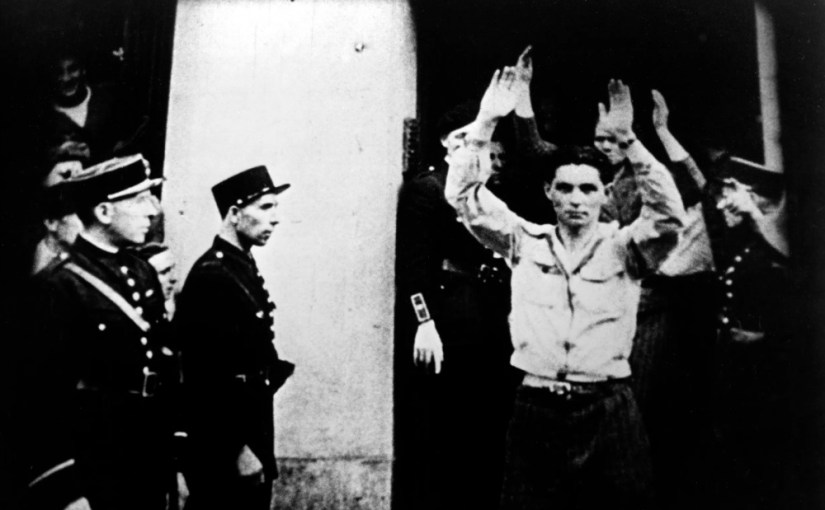
This sprawling documentary also features eyewitnesses to Barbie’s atrocities in Lyon, France, where he was stationed.  I don’t want to recite a laundry list of these terrible acts, but the film does key on two specific events during his tenure: the arrest and execution of Jean Moulin, a French Resistance leader, and the deportation to Auschwitz of 44 Jewish children from an orphanage in a town called Izieu.  Ophüls interviews scores of people who were in the room when Barbie arrested Moulin.  Many of them disagree who was to blame – a rat or someone with loose lips – but they all remember who made the arrest.  The stories from witnesses to the deportation of the children are beyond belief.

What is the point of a documentary like this?  Why should it be important for a filmgoer, or just an average Joe, to block out nearly five hours to watch a series of talking heads tell story after shocking story about the inhuman tactics of a monster?  Well, for one thing, that’s not the whole story.  Hotel Terminus actually has an arc, because Barbie was discovered living in Bolivia in 1972.  In 1983, he was extradited to France where he was convicted on numerous crimes against humanity and sentenced to life in prison, where he died in 1991.  The filmmakers didn’t know that in 1988, of course, but it felt good to throw that factoid in there.  Another interesting factoid: America apologized to France in 1983 for helping him escape to Bolivia in the first place.  Better late than never, I guess?

So, it’s good to know while watching that the man in question will eventually get his just desserts.  But there are times when it almost feels like the “A-story” of Barbie’s eventual arrest gets overwhelmed by the “B-story,” which is the paradoxical attitudes of many of the people interviewed.  One man wonders, what’s the point of it all?  Barbie committed his crimes forty years earlier, and France has a statute of limitations of twenty years, so just let the man grow old and die in obscurity.  Another theorizes that stirring up old memories of the war when many would rather move on actually created more civil unrest in France and Germany.  Barbie’s defense attorney at his war crimes trial (a Eurasian Frenchman) wonders why Barbie is being tried for crimes against humanity while France’s own acts of torture and horrific imprisonment during the Battle of Algiers are discreetly ignored.

And always Ophüls has rejoinders for each of these statements with stories of families separated, men and women tortured, family members whisked away and never seen again.  One woman recalls being tortured as a girl by Barbie, while her mother was told, “This is YOUR fault; if you would just talk, we would stop.”  And so on, ad infinitum.  But I am compelled to point out again how compelling this was.  These and so many other stories like them did not depress me or lower my spirits.  Instead, I was riveted.  I can’t explain why.  For myself, I felt like this was something I needed to hear, and other people needed to hear.  Here was a record of something that really happened, to real people in a real place in a time that was not so long ago, in the grand scheme of things.

There was also a section that really made me take notice.  Many, MANY people said on camera that, in his old age, Barbie was “a good man.”  He was friendly to his neighbors – even some Jews! – and a loving father.  His daughter-in-law is interviewed, and she states that he always had a kind word for her and always tried to include her in his family circle, even after her husband (Barbie’s son) died.  It made me think about the driving force behind last year’s brilliant Zone of Interest: the banality of evil.  Perhaps among many others, Barbie was living proof that evil will not always wear a black hat and have glowing red eyes.  Evil is just as capable of engaging you in friendly conversation as the next man.  (I was also reminded of a line from David Fincher’s Se7en: “If we catch John Doe and he turns out to be the devil, I mean if he’s Satan himself, that MIGHT live up to our expectations.  But he’s not the devil.  He’s just a man.”)  Is that one of the lessons of this film?  That evil is not supernatural or some kind of horrific aberration, but just a small person with delusions of grandeur?  Discuss.

There are echoes of Schindler’s List in the details of these stories, but Ophüls notably never uses any archival footage of concentration camps or of the Holocaust itself.  He apparently felt that audiences had, regrettably, become accustomed to the gruesome imagery of those events.  Instead, he relies on the viewer’s imagination to provide all the necessary details.

He also, tellingly, never provides answers to the stickiest questions that surrounded Barbie’s trial, especially the one about France being willing to charge him with crimes against humanity while ignoring their own history in Algeria.  I thought about that one a lot in relation to America.  Our country is great for a whole host of reasons, but it’s not perfect.  We rise up in vocal disapproval when a foreign country commits genocide, or when a country’s citizenry is threatened by totalitarianism…while ignoring (for the most part) the fact that our country exists because of genocidal practices against indigenous Americans.  Am I suggesting that perhaps Ophüls is wrong to focus on Barbie and not France’s history?  Absolutely not.  Barbie was a monster and got what he deserved, belatedly or not.  But I am suggesting that the film raises questions that deserve further discussion.

Ultimately, I’m glad I saw Hotel Terminus, and I would unhesitatingly recommend it to anyone who asks.  The visceral nature of the stories told by some of the subjects is enough to make it compelling, even without the overarching structure of following Barbie to his downfall.  It’s a challenging watch, to be sure, but I promise you’ll never be bored.  Trust me.

MAGNUM FORCE

By Marc S. Sanders

If you don’t know by now, I’m a huge admirer of Clint Eastwood’s work. His talents broach so many facets.  He acts.  He produces. He’s likely even better when he’s in the director’s chair.  He actually sings and he has even orchestrated his own music for some of his films.  Ever since I was first introduced to him at a young age when he played Dirty Harry Callahan and Fido Beddo, partnered with Clyde the orangutan, I was fascinated by his coolness and confidence in his stature on screen.  Whether he’s raising a fist, donning a scowl, giving a smirk or a squint of his narrow eyes or using his most famous prop, a .44 Magnum handgun, as an extension of his right arm, I’ve always been magnetically drawn to what he does on screen.

Online, a common question is asked: What is your favorite Clint Eastwood movie?  If I have to choose one, I guess it would have to be Magnum Force, the follow up to Dirty Harry.  Yet, I always believed Magnum Force could not operate without hitching on to the impact and message from Dirty Harry.  I can’t just like The Godfather Part II without liking the first film.  I can’t just love The Empire Strikes Back without liking its box office predecessor.  Same goes for The Lord Of The Rings pictures.

Magnum Force works so well because it questions what celebrated the Harry Callahan character that Eastwood portrayed two years prior.  This is a San Fransisco cop who defies authority when he knows that a danger must be suppressed without the inconvenience of bureaucratic red tape and police procedurals that ultimately will work in the criminals’ favor if not taken care of immediately.  As the first film demonstrated, it is easy for us to side with Harry’s desperation because we know the crazed killer is on the loose and he is only going to kill again and again while never surrendering or negotiating.  This second follow up film (in a series of five) tests the ideology of Eastwood’s character. 

A series of grisly murders are occurring within the city and it appears that a traffic cop is committing the acts.  The victims are the worst mobsters and pimps within San Fransisco who time and again have been overlooked for their crimes and/or have been released from trial or prisons based on technicalities.  A handful of characters within Magnum Force remind us that someone is saving the taxpayers a lot of money each time the body count increases. 

There’s a slight mystery to this film.  Harry encounters four rookie cops (David Soul, Robert Urich, Kip Niven and Tim Matheson) who seem very likable.  They are admirable of Harry’s reputation.  Harry is impressed by their shooting skills in particular.  Another traffic cop is an old friend of Harry’s, a guy named Charlie McCoy (Mitchell Ryan) who is on the edge and might pose a threat if he continues working the streets.  Any of these men could be suspects to these vigilante murders as it is soon realized that the scene of some of these crimes are similar. Often, cars are pulled over for traffic violations.  As well, ballistics indicate that the weapons of choice are normally a .357 Magnum, the standard issued firearm for a police officer.

The debate with Harry’s philosophy, firmly established in the prior film, is staged against that of his superior, Lt. Briggs.  He’s played by Hal Holbrook who is one of the best antagonists in all of Eastwood’s films.  They play so well against one another.  Early on, Briggs declares he’s never once had to pull his gun out of his holster.  Callahan sarcastically salutes the lieutenant by reminding him that men have got to know their limitations and that’s where the measure of asking what is ultimately necessary in fighting crime.  Where does it begin and when does it end?

Harry Callahan is that unusual cop who is frowned upon for the actions he takes in his own hands.  Other cops in movies played by Stallone or Gibson go to extreme measures simply for the cinematic action of it all.  Callahan is never thanked or given any serious commendations for what he executes with his .44 Magnum, a weapon that is as outside the lines as Harry himself. 

The difference between Harry and whoever this vigilante is must be deciphered and much of Magnum Force’s grey area is all that is seen.  Eventually, the black vs white clarity reveals itself and a telling lesson presents itself between what Harry Callahan stands for and what guise a vigilante operates under.  At the risk of revealing too much, the best scene of the picture occurs between Holbrook and Eastwood’s characters as they sum up the entirety of the film before the climax.  This film is over fifty years old and still the assortment of mindsets found within Magnum Force are worth pondering. Callahan is put to the test one time before in a haunting parking garage.

Beyond what’s worth considering among these many dangerous philosophies, this is a solid action picture with thrilling and well edited shoot outs among the cops and robbers.  A hilarious plane hijacking is derailed by Harry when he poses as a pilot.  Later there’s a store robbery that is undone and then there is a warehouse port exchange of gunfire that puts Harry and his partner in unexpected danger. 

There is an interesting target competition between the cops that implies what Harry suspects.  I like this scene in particular because it gives an inside look into how police officers interact and admire one another when not on the streets.  Yet, when one particular cop cannot get a thought out of his mind, it carries over into the action of the moment.  At the combat range, Harry fires his gun at one particular target that may cause you to sit up in your chair a little.  Often, Eastwood performs with little to no dialogue in his films and this is one very informative moment.

As much as I’m a big fan of Magnum Force, the penultimate scene always sticks in my craw a little.  Callahan is pursued on foot within the bulk of a freighter.  There is very little light provided in this sequence as Harry moves down one corridor or around a corner elsewhere.  It’s hard to see what is happening and who is where or who I am looking at.  For such a thrilling movie, this is a bit of a letdown as overall much of the action of this movie is driven by the plot.  Nothing feels random in Magnum Force.  Everything moves towards more story development or realizations.  Yet, I have to be somewhat forgiving only because this darkened scene occurs after all of the cards are put on the table and all the hero has to do is survive.

Just before the foot chase, there is a thrilling car chase with Eastwood actually doing the driving that takes us through the well-known twists of Lombard Street.  Director Ted Post wisely covers this from an overhead shot.   The car careens up and down the steep slopes of San Fransisco’s avenues and there are plenty of intense close ups of Eastwood behind the wheel accompanied by the screeching tires, bullets bouncing off the windshield and motors humming.  I have declared it before, the best place to have a car chase is in San Fransisco.  Surprisingly, this pursuit hardly ever gets categorized with the great ones like Bullitt, The French Connection, Ronin or The Seven Ups.

If you have never seen Magnum Force, check it out.  It is off color at times, but the exploits of Harry Callahan and the scum he’s forced to associate with were never about political correctness.  Still, there is much to debate, argue, and lend some serious thought to, especially in a newly unsteady climate of police acceptance and procedure.  My one recommendation though is to watch it as a double feature with the original Dirty Harry to truly see the two sides of Harry Callahan’s coin. 

NOTE: An interesting fact I just realized at the end of Dirty Harry, the cop shoots the bad guy with his right hand.  Later, he tosses his badge, but with his left hand.  Especially with Magnum Force as a follow up film, I see the internal struggle of Harry Callahan pitting his gun up against the mindsets that come with his badge.

THE SCORE

By Marc S. Sanders

Nothing like a good heist thriller.  Am I right? 

It is hard to believe that Marlon Brando’s final performance was with Robert DeNiro and yet the two were never part of the same cast before.  Finally, though, the Oscar winning actors, who were both recognized for portraying Vito Corleone, teamed up for a little film that contained some daring thrills while also welcoming some crackling good acting scenes together.  Edward Norton joined them, and it worked sensationally.  The Score, directed by Frank Oz, is a forgotten gem, or in this case as priceless as the gold and jeweled scepter the three set their sights upon stealing.

Filmed on location in Montreal, DeNiro portrays Nick, a professional thief who is very disciplined in his work and would never dare commit a heist in his own town where he publicly operates as a jazz nightclub owner.  As the opening scene suggests, he only practices outside of his city and usually outside of Canada.  Yet, a brash cocky kid named Jack (Norton) enters his private life with a proposition too good to pass up.  DeNiro’s handler/investor, Max (Brando), urges Nick to overcome his reluctance and team up with Jack for one last score that’ll rake in thirty million dollars. Once the job is done, six million is earmarked for Nick.  Finally, Nick can get out of this business and move on with his nightclub mortgage paid off.  He can also get more serious with his stewardess girlfriend Diane (Angela Bassett). 

The MacGuffin?  A scepter from the 1600s that was crafted for French royalty.  It is currently locked in a state of the art safe located within the basement of the Montreal Customs Building.  This fortress is equipped with cameras, security guards, sensors, you name it.  Jack is working on the inside, posing as a mentally challenged maintenance man.  He supplies all the intel to Nick with ways to get inside showing him who is doing what, where and how.  Nick then prepares the strategy around what information is collected.

The shakedown of The Score is nothing unfamiliar.  The enjoyment comes from the acting scenes between the actors, especially when it is DeNiro and Brando.  It is as thankful to see these two legends perform on screen as it was to see DeNiro team up with Al Pacino in Michael Mann’s Heat.  This older interpretation of Brando is so entertaining.  He has a lot of fun with Max’ sarcasm and when he curses it just comes so naturally.  Just a huge departure from what the actor did in classics like Streetcar and On The Waterfront.  DeNiro is great at chastising Brando’s character with the risks he’s taking at getting them in trouble.  Their dialogue works beautifully with their performances.

Same goes for DeNiro and Norton.  It’s not so much a mentor/student relationship.  Right from the start, there is friction. Nick is overly cautious while Jack is anything but.  Yet, the film primarily focuses on the thieves’ preparation for the big job and the characters speak as if there is a trust or honor among them, but the skepticism remains.  Often Jack is defiant of Nick’s specific instructions.  Norton is great going at odds with DeNiro.

Once the wheels are set in motion, the pattern of the script is to introduce one unexpected obstacle after another.  At one point the men realize they need a particular access code.  So, an exchange in a public park has to take place. Against Nick’s wishes, Jack plays a potentially dangerous game.  Later, it is learned that the scepter might be moving on from Montreal.  So, the job has to be completed much sooner than planned.  Max seems to be hiding some details as well that leave Nick uneasy.  By the time all these bridges are crossed you have a solid foundation for the first two acts of the film before the heist gets going.  It’s all good stuff.  The epilogue to the picture is very satisfying as well with a couple of unexpected twists thrown in.  When a bag gets unzipped, you’ll likely be nodding your head and applauding.

Edward Norton is a fantastic character actor (when he’s not being a straight lead in other films).  Just like in films such as The Incredible Hulk, Fight Club and especially his debut Oscar nominated performance, Primal Fear, he dons a dual personality for this role.  Norton easily contorts his physicality to portray “Brian” the guy who’s working on the inside of the Customs Building.  When the persona is shed though, Jack is a guy that most need to be careful to trust or go up against.  Edward Norton demonstrates such ease with the transitions from one personality to the other. 

Angela Bassett is terrific actor, but her character belongs in another movie.  The one shortcoming is that Bassett feels more like a prop for DeNiro’s motivation rather than a fully-fledged love interest.  Out of context, the scenes they share are really impressive, but within the framework of the picture, Bassett comes off as an inconvenient detour.  It’s not her fault.  The relationship between Nick and Diane just does not seem to belong here.  I never had any urge for their happily ever after wrap up.  I was only concerned with Nick, Jack and Max pulling off the score.

Another minor shortcoming is Howard Shore’s soundtrack for the film.  It plays with loud horns that scream official action.  Yet, when the scenes are absent of music or only accompanied by soft jazz performances from Mose Allison and Cassandra Wilson does The Score feel like it is in its quiet mood comfort zone.  Howard Shore’s louder pitch just feels a little too intrusive here because these guys operate in whispers and clandestine actions.  I especially get a kick out of how Nick and Jack use their special tools that quietly click and turn and thump with no other sound in the area.  Their hardware work like musical instruments. 

Overall, this is a delicious, sophisticated thriller with an outstanding cast and Frank Oz’ direction thankfully does not get too inventive because he knows he’s assembled an A plus collection of actors.  Oz also has the art design and scenic details within Montreal working to his advantage. The locales are peppered in with a welcome French culture along the cobblestone streets.  DeNiro and Brando seem very comfortable and absorbed in this city that’s rarely used as a backdrop in film. Lastly, the procedure of the actual theft at play is a lot of fun to watch as it all seems plausible but still impressively crafty.

It’s worth your risk to check out The Score on a Friday or Saturday night when you need to get away from the chaos of everyday life.  It’s a quiet, relaxed suspense yarn that’s so very pleasing.

NOTE: If you have not seen the film yet, I encourage you to stay away from the trailer which can be found online.  I believe too many of the twists and surprises contained within the movie are revealed simply to bait an audience.  The less you know about what happens, the more satisfying the picture is.

FURIOSA: A MAD MAX SAGA

By Marc S. Sanders

George Miller has never gone deep with his Mad Max movies.  The director treasures the inventions of his auto chases and the tricked out diesel junk contraptions that participate in high speed pursuits through his apocalyptic desert wasteland.  The more outrageous the vehicles and the crazier the stunts are, the more fulfilled Miller appears to be with his filmmaking.  However, the fifth film within this gonzo world of barbaric S & M dressed drivers invites us to explore the past of a surprisingly treasured character,  introduced in the prior film.  Her name is Furiosa and this time we see what she experienced as a young child (Alyla Browne), followed by what she learns as a young adult (Anya Taylor- Joy).  This fifth film in the franchise serves as a prequel to the last film, Mad Max: Fury Road.

As a pre-teen, Furiosa is abducted by the bandits who serve under the pompous and proud Dr. Dementis (Chris Hemsworth, playing his Thor role as if the Marvel character was a celebratory villain). A thrilling prologue covers this sequence of events with rescue efforts from the would-be heroine’s mother to save Furiosa and bring her back to their secret home of green vegetation located beyond the desert plains.  There are heart stopping motorcycle chases with the warrior mother bearing a sniper rifle and fighting with her last breath through the whole sequence.  Charlee Fraser portrays the title character’s mother. Thanks to her performance, she had me convinced me that the rescue will deem successful, accompanied by Miller’s reliable direction.  An absolutely thrilling opening.

Dementis rides his esteemed tri-motorcycle chariot steed, inspired by the sword and sandal adventures of Ben Hur and Gladiator.  A hilarious over the top vehicle to see Chris Hemsworth piloting.  His biker gang is in tow along with young Furiosa as they journey to the Citadel, first seen in Fury Road.  Dementis puts his conceit against that of Immortan Joe (Lachy Hume) the skeleton masked ruler of The Citadel for a chance at…what else?  Conquest and power.

Furiosa grows up a few years and gets mentored by a trucker named Praetorian Jack (Tom Burke).  I still love these character names by the way.  The truck chase is the highlight of the picture, with paragliding motorcycle riders swooping in like large attack birds trying to sabotage the weaponized rig full of delightful surprises that’ll make you shout “OH!!!” in the middle of the theater.  It is sequences like this that audiences adore in the Mad Max pictures. 

Unlike the other films though, Furiosa gets a little lethargic during the story set ups which are angles that never anchored the other better installments, The Road Warrior and Fury Road.  Reintroducing the Immortan Joe character is not as interesting this time and this desert picture gets a little too waterlogged when he enters the story.  He just doesn’t feel very necessary.  The two younger Furiosas and the self absorbed Dementis are plenty with just enough story opportunities to make a solid movie.  Retreading on other characters slow this fifth installment down a bit.

The whole cast looks great.  Anya Taylor-Joy is the best bad ass version of a younger Charlize Theron, who originated the role.  She hardly has any lines but her expressions on camera beneath the war paint, grease, dirt and long hair extensions look awesome.  Though the lead actress is hilariously dwarfed by Hemsworth’s Dementis, they make for a great dichotomy of hero vs villain.  She’s the quiet reserved David.  He’s the proud Goliath.  This is a dream casting pair.

Practical stunts are done once again and George Miller does impressive work with his camera.  His tactics for filming action scenes demonstrate why a Michael Bay normally fails.  Nothing is a quick take edit.  You watch these motorcycle riders and Furiosa hold onto to the bottom of the speeding truck and Miller will circle the camera, with no cuts in the take, so we see what is happening next to both sides of her profile.  The camera will then swoop up to see who’s running and holding on to the top of rig or who is parasailing from a great height while tethered to some kind of buggy vehicle below.  Amazing work.

However, seeing Furiosa on a large Dolby screen, it’s not hard to see a computer enhanced finish applied to the photography.  It’s very glossy and nowhere is it grainy like the very early Mad Max films from over forty years ago.  Yet, as dirty as these vehicles and characters are, the cleanliness of the cinematography sometimes does not clash well with what’s on the screen.  It’s a little distracting honestly and that was a surprise to me considering how perfect Fury Road looks on my 65-inch flat screen at home.  This one looks a little too perfect.  This might be that film where less may have been more.  

The background story work on Furiosa is not a terrible grievance.  The final print of the picture is acceptable.  All of it is definitely worth watching and I hope box office picks up following a sluggish opening weekend because I encourage anyone to see Furiosa: A Mad Max Saga on a big screen first.  I just think George Miller and company may have leaped much further than necessary this time around.

MAD MAX: FURY ROAD

By Marc S. Sanders

After watching Mad Max: Fury Road, you will feel like you need a shower.  Strike that, you will need a shower in aloe first, then a traditional shower and then a weeklong bath in aloe.  It’s a baked in environment that gives you the feel of grainy sands and burning sunbeams.

George Miller’s return to the gonzo, apocalyptic diesel future franchise is exciting from the moment the Warner Bros logo appears with the vroom vroom blaring through your sound system’s speakers.  Miller hardly surrenders the breakneck speed of his two-hour picture to let an audience catch a breath, and because the director is so unforgiving it makes this a tour de force of action entertainment that other adventure films can only strive to at least match.  Still, the movie has next to no story, and that’s fine.

Up until this 2015 reinvention, Mel Gibson was the Aussie Road Warrior donned in leather fighting to survive against lawless bandits coming from any direction in the sand swept plains of an earth afterlife.  Now Tom Hardy takes over the role.  Frankly, it could have been anyone who got recast in the part.  Hardy has few lines and for half the film his face is caged in a grotesque, steel bar mask while he is strapped to the front of a hot rod, gear grinding, amalgamation of a vehicle, simply to be a kind of three-dimensional hood ornament.  This Max is suffering through high-speed chases with his head trapped in animalistic headgear and his arms and legs bound behind his back while he’s tethered to this four-wheeler.  It’s brutal and we can feel how tortuous it is for Hardy’s character.  Yet, we love it!!!!  Keep it going, George!

The real star of Fury Road is Charlize Theron as a one arm rebel caked in black grease with a shaven head.  Her name? Imperatour Furiosa.  What a name!!!!!  Furiosa attaches a steering wheel to the driving hilt of an 18 – no 20, maybe 24-wheeler (it could even be 36) big rig with a big ball of fuel hitched to the back. She detours away from a band of outlaw drivers ruled over by Immortan Joe (Hugh Keays-Burn).  Yes!  His name is Immortan Joe. 

In tow with Furiosa are Joe’s pregnant concubines whose fetuses are declared his property.  These lovely lasses dressed only in bed sheets have names like Capable, Cheedo The Fragile, The Dag, Toast The Knowing and The Splendid Angharad (Riley Keogh, Courtney Eaton, Abby Lee, Zoë Kravitz and Rosie Huntington-Whitley).  What is the point of listing off these ladies’ identities? Well, the script for the film doesn’t do so. Yet, the end credits do in a heavy metal kind of font, and it is clear that George Miller is proud of every name, every piece of junk that flies through the air in one crash and bash after another, and every flame that exhausts out of a pipe or even a death metal rock guitar orchestrated by a guy simply known as The Doof Warrior (played by a musician named Iota).  Incidentally, The Doof Warrior is garbed in red long johns and tethered by chains to a big rig with the biggest, blastiest speakers known to man.  The Doof Warrior serves no purpose except to scratch on the guitar while flames shoot out of the stem.  I’m laughing as I type this all out.  This whole display is thankfully ridiculous while all of these figures have the most outlandish and greatest names of all time!!!!

When Furiosa diverts away in the mighty big rig with the pregnant women, Joe follows suit with his endless band of albino crazies in one tricked out vehicle after another.  One car has the chassis of a Mercedes wedged on to the fattest wheels ever conceived.  Another is a Chrysler (I think) resting atop a pair armored tank tracks.  Joe’s automobile looks like it got disqualified from a monster truck rally because it was caught taking diesel steroids. 

Anyway, Mad Max eventually catches up with Furiosa and the ladies.  His last name is not something simple like Jones, Smith, Sanders or Rodriguez.  It’s ROCKATANSKY!!!!!  BOOM! That is awesome!!! A one-time underling of Joe’s, named Nux (Nicholas Hoult), eventually sways over to the heroes’ side as well, and the pursuit carries on.  Furiosa’s destination is a location of green, beyond the desert wasteland.

It’s a wonder that Mad Max: Fury Road was applauded so much in 2015.  However, take a moment to consider the construction of this two-hour operatic noise fest and you cannot help but salute all the merits that went into the final product.  First the nominated visual effects are primarily practical with little to no CGI.  If George Miller is going to make another Mad Max film, he’s going all the way.  The cinematography is gorgeous in a tan, orange, and yellow sun burning desert, while the night scenes are unhidden due to a pure, bright blue.  The interior of the truck seems cramped and uncomfortable, and yet Miller leaves enough room for the viewer to sit inside and uncover every hidden firearm plus get up close with the driver and the lady passengers.  There’s even a cool weapon found in the stick shift.  Wait until you see that!  The editing is relentless with perfectly captured close ups of so many character drivers and passengers all in a matter of seconds.  Plus, wide overhead shots and extended ground captions make it easy to understand just how many vehicles are included in this endless demolition derby.  I’m talking hundreds of monster machines ready for weaponized destructions. The choreographed action scenes of gun shots firing and vehicular collisions is like a ballet of a perfect derby show.  Monster razor blades are given their due, along with an assortment flame throwers. Also, kamikaze suicidal albinos are ready to act like destructive grenades.  Not one scene or shot in a Transformers CGI picture of metal vomit comes close to a millisecond of George Miller’s craft.

No other film could be as deserving of Academy Awards for sound, cinematography and editing as well as nominations for Best Picture and Best Director.  Even the warped-out S&M costume designs and make up are eye popping; merits that also earned Oscars.  You might have a fondness for art house cinema like Fellini or perhaps a Daniel Day-Lewis piece that invests in the method of caliber acting performances, but you cannot deny the artistic efforts vested by George Miller, his editor wife Margaret Sixel, and the rest of the crew. Mad Max: Fury Road was placed on so many top ten lists in the year 2015, and its because the film succeeds in the best of technical achievements. 

George Miller operates like that nasty kid named Sid from the Toy Story pictures.  He assembles his set pieces in the most tricked out, ugly and grotesque combinations of auto body parts, gives them engines that breathe fire and roar like vicious beasts that smell like diesel and then collides them altogether in a wide open plain.  Try to imagine Miller as a young child with his Matchbox cars on his bedroom floor.  His parents might have had some concern while observing his play activity.  What’s appreciated though is that this director never settled for simple with his Mad Max films and he never repeated what he’s already demonstrated.  No car crash looks the same.  No single shot is  repetitive.  This is how a director of any film genre should operate.  When they take attentive care to every frame they capture with their camera, then they get a Mad Max: Fury Road

One of the best films of the twenty-first century!

NOTE: I originally saw this film in 3-D in the theaters.  Wanna know my sentiments towards 3-D? Well, I hated this film after I saw it.  I gave up five minutes into the piece because the 3-D was unforgiving in distraction and dark beyond comprehension and measure.  Watching Mad Max: Fury Road again, a number of years later in a standard 4K on my 65-inch flat screen, you can likely tell by my write up that my sentiments have drastically changed for the picture.  It’s also telling to note that the new prequel film Furiosa is not being presented in 3-D.  Unless it is a James Cameron film or a special exception like Ridley Scott’s Prometheus, modern 3-D is as big a failure as the new formula Coke was back in the 1980s. 

KINGDOM OF THE PLANET OF THE APES

By Marc S. Sanders

The revival of the Planet Of The Apes films within the last decade and a half remain impressive.  Moreover, the first film, Rise Of The Planet Of The Apes, led to a global epidemic that wiped out most of humanity, well before we ever heard the term COVID, or used the word pandemic in our everyday vernacular.  That first film was guided by James Franco with fast food science summarization, but it was a thrilling film in context of storytelling and most especially in the visual effects delivered by WETA (who worked on Peter Jackson’s Tolkien films) convincing audiences that apes inherited a superior intelligence to overthrow the dominant human species.  A chimp character named Caesar led the rebellion and he was masterfully played by Andy Serkis.  Caesar did for the retelling of Planet Of The Apes what Wolverine did for X-Men.

In this 2024 fourth installment titled Kingdom Of The Planet Of The Apes, Caesar has now passed away and this universe jumps many generations into the future.  The new ape hero is Noa played by Tampa native Owen Teague.  The mannerisms of Noa are just as convincing as what we saw in Caesar, even if the character is not written with as much nuance or magnetic care that we found in Serkis’ performance over the prior three films.

In this film, practically all of humanity is wiped out.  This ape population, Earth location unknown, has formed a bond with the bird community and Noa and friends find adventure while retrieving eggs from high birds’ nests to be used for a symbolic ceremony within their village.  

However, just as real-life human history teaches us, other ape factions adopt man’s nature to control and conquer.  Noa finds himself on a horseback sojourn to rescue his village members who were harshly taken from camp.  Along the way he meets wizened orangutan Raka (Peter Macon) who apprises Noa of the legend of Caesar.  Curiously, a mute teen girl (Freya Allen) is found as well.  They engage in a united trek that will test them as encounters with danger present themselves.  In particular, they come upon the sadistic tribe overruled by the mighty gorilla Proximus Caesar (Kevin Durand).

All of these ape portrayals are marvelous to observe.  The expressions and change in facial features plus the flex of limbs and torsos with involuntary motion are unbelievable to see as the characters deliver their dialogue and converse or debate with one another.  The hand-to-hand combat interactions are perfectly enacted. You remain impressed through the course of the entire film, even if the picture is unnecessarily longer than it needs to be.

Kingdom moves episodically through Noa’s eyes.  The movie begins with one story.  Then as additional characters are introduced it moves on to something else until it gets to a mildly sinister (PG fare, really) telling of Proximus forcing his chimp followers to heed his command by opening a large steel vault door of a beached ocean cruiser from the long-lost days of human occupation.  What’s in the vault?  Well, I was never expecting much, but Proximus believes the contents to be revolutionary. By commanding under a misleading guise of what the original Caesar stood for, he’s a vicious figurehead to the apes he holds hostage.

The interesting aspect to Kingdom is by this fourth film we know who the real Caesar was.  Though, Noa was never educated on the messianic purpose of that leader.  So, we find Proximus to be a deceitful evangelist to his underlings. While it’s not a major requirement to know what occurred in the prior films, it helps to know what Caesar stood for versus how he is regarded in this further future.  Ministers deceive biblical teachings and the figures within the holy text to capture their congregations’ impressions.  Proximus functions in a similar way.

The prior films kept a divide between the apes and the few human survivors as a means to set up conflicts.  With Kingdom, we witness beyond what Caesar oversaw generations later, and how divisions within the ape species serve only to live quietly or govern with a domineering crown and the symbol of a legend to deliver an updated mantra.

Socially speaking, like the best Ape films and going back to the French novel adaptation from Pierre Boule (known for also writing The Bridge On The River Kwai), these stories work when they explore new aspects of intelligent developments within the ape communities.  Some function with selfishness and a need for power.  Others lean towards love, friendship and a moral compass.  Blend these ideals together and in turn comes conflict – the nucleus of effective storytelling.

Kingdom Of The Planet Of The Apes is perhaps the weakest of the four most recent films.  The film is too long with unnecessary exposition.  Noa is not the hero that Caesar was. Though some turn up, humans are primarily absent from the whole film, and they are still the best opponents against the ape communities.  

The cliffhanging ending keeps me excited for more subsequent tales because I’ve not grown tired of this franchise yet.  These films are more dazzling than James Cameron’s two Avatar films combined.  

I must confess I was hoping this movie would address some hanging threads that stem all the way back to Rise Of The Planet Of The Apes.  Still those topics have regrettably not been addressed and I hope those moments were not just some random wink ‘n nod.  Specifically, I’m referring to the rocket that astronauts launched in the direction of Mars just before the virus spread across the planet and Caesar’s band took over Earth.

There’s a good story in Kingdom Of The Planet Of The Apes.  I was just hoping for a few other angles than some of what were offered up this time around.

HOMICIDE (1991)

by Miguel E. Rodriguez

DIRECTOR: David Mamet
CAST: Joe Mantegna, William H. Macy, Ving Rhames, Rebecca Pidgeon
MY RATING: 8/10
ROTTEN TOMATOMETER: 88% Fresh

PLOT: A Jewish homicide detective investigates a seemingly minor murder and falls in with a Zionist group as a result.


Homicide is one of those movies where the lead character experiences just one damn thing after another until he winds up in a situation that is not even barely hinted at in the film’s first half hour.  If I didn’t think it was being a little pretentious – and maybe if I understood the term just a little more – I’d call it Kafkaesque.  It reminds me a bit of Martin Scorsese’s After Hours, where that lead character is drawn unwittingly into the unexplored jungles of New York City at night.  Likewise, Detective Bobby Gold (Joe Mantegna) starts the film on a manhunt, searching for a wanted killer, and thirty-six hours later winds up begging Zionist activists to let him be involved in blowing up a storefront suspected of printing Nazi pamphlets.

In other hands, the events of the film leading up to Gold’s digression into racial/social activism could come off as comic.  First, he’s put on the manhunt case, searching for a man named Randolph.  Then a weirdo booked for killing his family wigs out at the station and attacks Gold, ripping the strap off his holster, and giving him a bump on the head that’s visible for the rest of the movie.  (I was unavoidably reminded of Jake Gittes’s nose in Chinatown.  Both wounds serve as constant reminders of either the odds the characters face or of the unpredictability of the world they inhabit.)  On their way to interrogate Randolph’s mother for his whereabouts, Gold and his partner, Sullivan (William H. Macy), randomly run into what looks like a hostage situation which turns out to be a cop cornered by a vicious dog in a candy store.  In the store is a dead woman.  The commanding sergeant arrives at the scene and gives Gold the dead woman case.  Turns out the dead woman is Jewish.  Her family shows up at the scene, learns Gold is Jewish, and insist he be their personal liaison for the case.  Meanwhile, Sullivan has to carry on with the Randolph case on his own.  A recurring theme will be how Gold keeps missing out on important events with the Randolph case while babysitting the family of the dead woman, a case he considers unimportant.

What happens next unfolds so naturally and surprisingly that I will not spoil it for you.  What I will say is that Mamet turns a standard police procedural into a searing character study of a man who has never really considered who he is in terms of his heritage.  At one point, he speaks with a Jewish scholar who shows him a page of Hebrew text.  Gold says, “I can’t read it.”  The scholar tells him, “You say you’re a Jew and you can’t read Hebrew.  What are you then?”  This is a question that Gold will try to answer for the rest of the film.

On a personal note, that bit of dialogue resonated quite a bit with me.  I’m full-blooded Puerto Rican on both sides of my family.  Yet my knowledge of Spanish is barely passable.  When faced with reading Spanish text, I can sound out the words, but my comprehension level is probably only 60 to 70%.  My conversation with fluent Spanish speakers is halting, at best.  I just never took the time to learn it as thoroughly as my parents or my sister did.  Does that make me any less Puerto Rican?  I don’t think so, and I might feel resentment towards a stranger telling me that I’m not Puerto Rican just because I don’t speak Spanish.  I know who and what I am, and my identity is not tied to what language I speak.

But things are different for Detective Gold.  Earlier in the film, he talks to his partner, Sullivan, on the phone and talks about how the Jewish family he’s now working for, or with, are high-strung, crying wolf (they claim someone is shooting at them from the building next door, but there are no bullet holes to prove it), how they saved ten bucks a week by letting the old lady work at the store herself, how they’re “not MY people, baby.”  Only after he realizes he’s been overheard does he feel immense guilt and obligation to help the family.  Not to just solve the case, but to “find the killer.”  So, he’s experiencing all sorts of new emotions that may or may not be interfering with his ability to do his job impassively.

The people in Homicide sound as if they are speaking in subtext only, using Mamet’s unique writing style to bypass what we think of as “normal” speech and deliver lines that are almost poetic, even when laced with racial epithets and curse words.  This makes the overall tone of any Mamet-scripted film seem hyper-stylized, as if the characters are one level removed from reality, but not in a bad way.  It elevates the film somehow.  I’m at a loss to describe it more accurately.

One bit of dialogue exemplifies what I’m talking about.  Gold is being thrown out of a building.  The gentleman at the door tells him, “Don’t bother to return.  The next time you come, there’ll be nobody here.”  Don’t bother to return?  That’s unnecessarily decorous.  “Normal” conversation would be something like, “Don’t bother coming back.  If you do, we won’t be here.”  However, Mamet’s signature word choices here suggest an almost Shakesperean construction, as if the words are being shoehorned into a buried structure or pattern that operates subconsciously.  Based on what happens with Gold throughout the film, I could theorize that Mamet is trying to create a mood reminiscent of Greek tragedy, and the actors are reciting dialogue that has been translated from Greek or some other language.

But that’s just me.

The experience of watching Homicide will never be quite as exciting or kinetic as other superlative crime dramas like, say, Heat or The Departed, movies that also examine their characters in detail, sending them on similar journeys of self-discovery.  Those other movies are defined as much by their action as by their intelligence.  In Homicide, any “standard” action scenes are purely incidental, or sometimes accidental, intended not to thrill but to move the plot forward with a minimum of fuss.

In any event, the action is not the linchpin of this film.  We watch Homicide, not to see who Gold kills or who tries to kill Gold, but to see if he is capable of resurrecting the person within himself that he thought he had killed long ago, a sacrifice he made on the altar of being a good cop.  He has a painful conversation where he realizes that everything he’s done to suppress his own self has been, “Not for me.  All for someone else.”  He must decide whether to act in service of his conscience or his sworn duty as a cop.  The choices he makes have consequences he never anticipated, as with all good tragedies.  Homicide reminds us of that inescapable fact, not with a bang or a whimper, but with the calm, flat gaze of an impassive Greek god who lets us draw our own conclusions.

THE PROFESSIONAL (Léon)

By Marc S. Sanders

The cult following that has come with Luc Besson’s first American made film seems unwarranted to me.  It’s currently listed as number 40 on IMDB’s top 250. I have no idea why. I recognize the artistic style of the picture, but what is here to relish beyond an enlightening introductory performance from would be Oscar winner Natalie Portman?

To watch Besson’s use of the camera makes me feel like a viewer from the director’s native France.  The setting is Little Italy, New York and it has a feel to it like Besson just stepped off the plane and decided to hone his lens on a condensed city section, but lacking an education of its culture or history.  The Professional certainly doesn’t look or feel like Dog Day Afternoon, When Harry Met Sally…, or Die Hard With A Vengeance.  (Perhaps the music from Éric Serra altered my mood.)  I never took issue with this aspect of the movie. It is unfortunate however that Besson’s film comes off too perverse in its storytelling, especially with its character blend.

Portman is Mathilda, a spunky kid who survives the murder of her family when a corrupt, drug dealing DEA agent named Stansfield (a way over the top Gary Oldman) carries out the slaughter after her father fails to pay a debt.  Fortunately, as Mathilda is returning home and coming upon the bloody aftermath, Stansfield and his crony of killers opt not to take her out too as they believe she belongs with the occupant of her neighboring apartment.  Léon lives there and happens to be a skillful hitman and weapons expert who pulls Mathilda inside to safety.  He’s played by Jean Reno.  These killers who massacre by day have no care to eliminate the other tenants living on the same floor, including a little old lady.  Why?  I don’t know.  Maybe they called in sick on the day assassination school covered “Chapter 6: Leave No Witnesses.”

Besson does not apply much brainpower to the script he wrote and directed.  Oldman’s characterization could not be more obvious with how unhinged he behaves.  His department colleagues who take less than a minute and a half to question him don’t even raise an eyebrow.  While the storyline can be dismissed as a pulpy kind of graphic novel come to life, isn’t it lucky that if your family is going to get shot up, you have a professional hitman living right next door? I mean c’mon.  This is only the set-up of the picture, within the first ten minutes, and my suspension of disbelief never arrived.  

The most egregious lack of consideration falls within the relationship between Reno and Portman’s characters though.  She’s twelve.  He’s in his late thirties or early forties, but his silence implies it is time for assisted living.  When they are not relocating from apartment to apartment, trying to stay out of sight of Oldman’s gang, they are valuing the life of Léon’s beloved plant, drinking milk and demonstrating the fine art of sniper operations.  That’s fine – it’s the stuff of Tarantino fare.  

However, when the pair decide to entertain each other with Portman doing routines of Madonna and Chaplin for play fun, there’s a cringey temperature to the picture.  Besson was seeking out a relationship between a random man and child without any element of sexual proclivities involved and yet, it’s there.  In another writer/director’s hands, there would have been a stronger attempt to develop a paternal relationship between the two characters.  Yet, Natalie Portman doing a childlike song and dance performance of “Like A Virgin,” with Jean Reno’s Léon acting unaware seems artificial and perversely moving in the wrong direction.  When danger crosses their path later and they both say “I love you” to one another, I can’t help but question how this bond might have turned out if they were never forced to separate and save themselves from the bad guys while continuing to live a quiet life with a house plant and gallons of milk.

The final third of The Professional has the inevitable shootout and explosions.  Out of context, it looks good but again this is New York.  So, when Stansfield brings in the firepower of the entire city police to force Léon and Mathilda out of the tenement building, shouldn’t someone be questioning someone?  Anyone? It’s ridiculous.  None of the neighbors run for cover or are given warnings to divert away as a small rocket launcher is propped up for blasting the front door open, along with anyone inside.  

The Professional contains a boring, inappropriate middle section accompanied with a ridiculous opening and ending.  Therefore, I have trouble locating the merits for this piece.  I can recognize the potential of Natalie Portman in her performance.  Yet, if this were the first film I ever saw Gary Oldman in, I might not be so prone to watching anything by this best of the best character actors.  “EVERYONE!!!!” he screams, shouts, screeches, and bellows all at the same time.  Whether you’ve seen the film or not, most cinephiles relish in that sound byte from him on social media. I’d argue it’s in no way a salute to the actor.  Frankly, it’s indicative of the material when a guy as accomplished as Gary Oldman cannot uncover enough of a quirk in a bad guy from a very unimaginative script.  It’s not your fault Gary, so much as it is Mr. Besson’s.

Jean Reno has a cool looking, silent poise to Léon, the professional hitman, but there’s nothing lent to him to work with except a pair of opaque, circular sunglasses, milk, a plant and at least as many guns and ammo as found in The Matrix.  Reno functions on little dialogue and no background save for a few scenes he shares with Danny Aiello as the mob boss who frequently hires him for jobs.  Reno’s scenes with Natalie Portman only demonstrate how inappropriate their connection as actors in a scene are, as well as how their characters are supposed to serve each other. 

The faults of The Professional ultimately lie with its puppet master, Luc Besson.

THE MAN IN THE MOON (1991)

by Miguel E. Rodriguez

DIRECTOR: Robert Mulligan
CAST: Sam Waterston, Tess Harper, Reese Witherspoon, Jason London, Emily Warfield
MY RATING: 10/10
ROTTEN TOMATOMETER: 91% Fresh

PLOT: A 14-year-old girl in 1957 comes of age when she develops a crush on a handsome neighbor…who only has eyes for her older sister.


The Man in the Moon has a plot that sounds like a high-concept pitch somewhere between an ABC After-School Special and a third-tier soap opera.  But somehow, magically, it transcends the trappings of soap opera and veers towards the truly operatic, touching on grand emotions while keeping itself grounded in reality.  I watched the movie in awe, wondering how something so sappy was holding my interest the whole way through.  Afterwards, I came up with two overarching reasons: the spectacular debut performance of a 14-year-old Reese Witherspoon, and the sure-footed direction from one of Hollywood’s old masters, Robert Mulligan, who cut his teeth on stage plays for television in the 1950s before directing his masterpiece in 1962, To Kill a Mockingbird.

Like Mockingbird, The Man in the Moon takes place in the deep South.  The time is 1957, when Elvis was king and children were still encouraged to say “Yes, ma’am” and “No, sir” to their parents.  Dani Trant (Witherspoon) is still young and tomboyish enough to escape her Sunday chores by dashing off to the local swimming hole after church.  Her older sister, Maureen (Emily Warfield), is set to start college at Duke in a few months.  Their close relationship is established in a sweet opening scene where they sit in their outdoor, screened-in bedroom, doing each other’s hair and talking about life and Maureen’s doubts and how Dani envies Maureen, and so on.  Like in real life, the conversation touches on deep topics, but never really resolves anything.  It just feels good to talk, to know the other person is really listening.  This scene is mirrored in the movie’s final scene in a fantastic bit of screenwriting where the conversation is very different, but the emotions being discussed are more or less the same.

One day, Dani goes skinny dipping in the watering hole and finds an unexpected visitor: Cort Foster (Jason London), 17, whose mother and younger brothers have just moved back to their old farm next door.  Turns out Cort’s mother, Marie, is an old friend of Dani’s mom, Abigail.  This is the kind of stuff soap operas thrive on, but even at that point, even though I was aware of the contrivances of the story, I never felt overly manipulated.  It all just felt very…real.  Once again, it’s a testament to the director’s skill in making sure nothing gets punched up unless there’s a reason for it.  It’s never bland, don’t get me wrong.  But it never feels fake.  I don’t like the word “organic” in connection with acting or directing, but that feels like the right word to use here.

Things move swiftly.  Dani and Cort become quick friends, but when things get a little too flirtatious at the swimming hole, Cort backs away and admonishes Dani.  “You almost got more than kissed, little girl.”  Dani asks Maureen for tips on kissing boys.  It looks as if Cort is always on the verge of making a bad decision, but he has the good sense to put on the brakes.  The film is making you think the movie is going to be about one thing, but then there’s a family crisis, and in the hubbub, Cort meets Maureen, there’s an instant attraction, Dani feels left out…

But that’s enough summarizing.  Based on what I’ve written, you may already think you know the arc of the film, but I can assure you, you’re wrong.

Let’s talk instead about Reese Witherspoon’s performance.  It must be seen to be believed.  It belongs in the pantheon of the greatest debut performances of all time.  She is as self-assured and confident and natural as she was in her Oscar-winning performance in Walk the Line.  It’s almost like watching some of the early films of Marilyn Monroe; the screen just seems a little brighter when she’s present.  Watch her facial expressions when Cort realizes who she is after their first encounter at the swimming hole.  Watch her smile after her first kiss.  Look at her self-control when she tells her father she understands why he had to take the strap to her (that’s a long story that I won’t spoil).  For the most part, I just watched her performance in awe, but once or twice I turned on my analytical mode and tried to see if I could “catch” her acting.  Couldn’t do it.  The fact she wasn’t at least nominated for an Oscar for this movie is a complete freaking mystery to me.

For that matter, the whole movie is a mystery to me.  Before watching it, I had only heard about it from a rave review by Roger Ebert.  I couldn’t find it streaming anywhere so I had to pay a relatively pretty penny to get it on Blu ray, sight unseen.  (Spoiler alert: it was worth it.)  Yet here is a brilliant gem of a film that tells a simple story of love and sadness and doubt and everything in between.  There are some plot surprises – I won’t say twists, exactly, it’s not a Shyamalan movie – that I absolutely did not see coming.  In retrospect, maybe I should have, but the storytelling kept me engrossed in the moment.  It kept me focused on the here and now, so I never felt the need to try and guess what was around the corner.  I hesitate to use this word, too, but it was mesmerizing.  To tell a story this cornball (on the surface!) and keep it fresh and alive is some kind of miracle.

It’s been said that no good movie is too long.  The Man in the Moon clocks in at just under 100 minutes with credits, but I was prepared to stick with it for at least another half hour, just to see what these characters would do and say, and how they would deal with the next challenges life throws at them.  When the movie ends, it doesn’t feel like an ending.  It has the good sense not to make things too final, as if the solutions to all the issues in the film could be wrapped up in a bow.  All that remains is the bond between two sisters, and if they have that, that’s all that matters.

THE FALL GUY

By Marc S. Sanders

Indulge me please while I spout off a number of movie titles. 

I am big fan of Emily Blunt.  She justifiably earned her first Oscar nomination for Oppenheimer.  She was Mary Poppins – a damn good one.  She’s good in her husband John Krasinski’s A Quiet Place monster movies.  Have you seen Sicario? The first one?  You should!  As well, there’s the role that put her on the map with The Devil Wears Prada.  Just a great actress with a huge repertoire of sensational performances under her belt.

I am also a big admirer of Ryan Gosling.  Magnificent in the long-awaited Blade Runner sequel.  He’s a dancing wunderkind and musical genius as well with films like La La Land.  You ever seen The Nice Guys where he partnered with Russell Crowe?  Another one you should see.  Also find him in The Ides Of March, directed by George Clooney.  He got his umpteenth nomination for Barbie recently, but let’s face it, after that Oscar show performance for Best Song the man only overshadowed what he blew our eyes out with, and now I believe they should bow to his dancing feet for hosting duties.  Plus, the guy is now the pinnacle live action Beavis to go with Mikey Day’s Butthead.  Is there nothing this guy can’t do?

I think back to all of these sensational cinematic achievements, and I am dumbfounded that when this pair finally, at long last, team up it is for wasteful bash up/smash up junk like a television adaptation of the Lee Majors’ ABC action series The Fall Guy.  It’s been a long time since I was so bored watching a stunt filled two-hour flick with zero spice or flavor.  There are fire balls aplomb in this movie and I don’t think Gosling ever feels the burn.

I’ve seen the Die Hards and the Lethal Weapons with the fight scenes and car chases and bombastic explosions. Amid all nine of those pictures (well maybe not the last Die Hard movie) the action usually drove at least some semblance of story, suspense and amazement.

The Fall Guy, directed by former stuntman David Leitch, proudly declares itself a stunt movie because the hero, Colt Seavers (Gosling) is a stunt man for action movies.  However, the audience is shortchanged on…well…the stunts.  I remember Miguel and I watching The Fast And The Furious for the first time.  We both agreed the movie failed because it did not provide what it was selling, namely car chases and car stunts.  At least not enough of them.  Instead, we got Paul Walker and Vin Diesel getting all Terms Of Endearment like and we asked ourselves, when are they going to get in a car and drive.

Consider the opening sequence of The Fall Guy.  First I’m dazzled by a well-done Steadicam shot the runs at least four minutes as it follows Colt talking on his cell phone as he struts from his movie set trailer then on into the lobby of a sky rise building, through a crowd of movie extras, crew and cameras, up an elevator and then over to a platform ledge where a harness is strapped to his uniform and he is suspended high above the ground below, while facing up.  A fall is gonna happen, right? And it does, but then we do not see the finish of the fall.  This one shot walk for Gosling cuts the legs out from under us. Just as the fall is about to finish, it cuts to the guy in a stretcher being wheeled into an ambulance. 

Now you can insist to me that is the start of the story.  Colt breaks his back in a stunt fall gone wrong and thus he’s now retired and surely 18 months later, he will be called back to do his best bidding and set the wheels in motion for the rest of the movie.  Okay.  Fine.  I’m with you.  The hero comes out of retirement for one last job. Yet, THE RYAN GOSLING just did the actual fall and we couldn’t see THE RYAN GOSLING finish the fall.  This wasn’t a stunt double as far as I could tell.  I’ve used this analogy before, but this is like Moe throwing the cream pie at Curly, only you don’t get to see the pie make impact with Curly’s face.  I feel cheated, and I felt cheated during most of The Fall Guy.

This approach is done often during Leitch’s film.  He’ll put Colt into a stunt sequence but then cut away to something else.  Later in the movie, Colt gets into a fist fight with some bad dudes while trying to hang on to a runaway truck and trailer careening through the streets of Sydney, Australia.  Colt throws punches.  He gets punched.  He falls.  He hangs on.  He gets up again.  Wash, dry, repeat.  The problem is that Leitch opts to cut away after each punch or fall to Emily Blunt doing a rendition of “Against All Odds” in a karaoke bar.  This whole action scene is chopped up for no purpose that keeps me in the film.  It’s like when I would have to ask my kid to stop interrupting while the grown ups are still talking.  I love watching Emily Blunt sing.  I love watching Ryan Gosling do his version of what a kamikaze Mel Gibson used to do in his younger years.  Can we just have one thing at a time though?  This kind of juxtaposition is not intriguing or beguiling or whatever the filmmaker wants it to be, and it does no favors for either lead.

The story is pretty simple and pedestrian. Nor does it follow the theme of the TV show that everyone has forgotten or that this generation has ever heard of.  Blunt plays Jody Moreno, a maybe former flame/middle school crush of Colt’s.  Unbeknownst to her, the producer (Hannah Waddingham) of the science fiction film Jody is directing has reached out to Colt a year and a half after his broken back accident to come to Australia and not only work on the set but also track down the star (Aaron Taylor-Johnson) of the picture who has disappeared without a trace.  Colt is not very bright and he’s especially not a detective of any sort. 

Once this is all set up, The Fall Guy flip flops from the search, over to Colt getting set on fire repeatedly on the set, and then back to the search, followed by the inevitable twist, which is in no way a twist because the surprise seems known as soon as movie begins. 

I was not expecting utter brilliance here, but I was hoping for substance.  Gosling and Blunt are two of the biggest stars out there right now and can have their pick of the litter in what they do next.  It only makes sense that these two should pair up for a movie, but this is what they choose?  The script has less wit or intelligence than a coloring book that has yet to be scribbled in by a four-year-old.  I remember the hype around a picture called The Mexican with Julia Roberts and Brad Pitt, the biggest stars of the time finally teaming up, and just like it is with The Fall Guy, they had zero chemistry, and they barely shared any scenes together.  When they did, they hardly acknowledged each other.  Filmmakers cannot just stop working when they get the marquee names to sign a contract for the film.  They gotta work to live up to the hype that comes with these capably appealing actors.

In his pursuit, Colt gets drugged and then we see a unicorn standing next to him for a long sequence.  The audience sees the unicorn, but Colt hardly acknowledges it.  I don’t get where the ha ha ha is supposed to come from this bit.  I think the writers were maybe going for an Airplane!/Naked Gun gag.  Colt gets thrown through glass walls.  He tells us he was part of the Miami Vice stunt show at Universal Studios by simply wearing a jacket that says it, but so what?  There’s no dimension to any of this. (I did appreciate hearing the theme song during a very brief nighttime boat chase.)

Aaron Taylor-Johnson (Avengers: Age Of Ultron, Kick Ass, and one time James Bond candidate) is another fine actor, not doing his best work.  He’s a jerk here with bleach blond locks and nothing to do.  He’s just unlikable and unfunny.  Hannah Waddingham?  Never heard of her, but I can only imagine she’s got something better lined than this obnoxious movie producer role with an annoying over the top Australian accent.  If she’s really Australian, then I’ll have to surrender to the fact that I just don’t know the down under dialect.  Frankly, she’s just terrible. 

Never thought I’d say this but Gosling and Blunt had a thousand times more chemistry when they did that presentation at the 2024 Oscars jabbing at the Barbenheimer trend and shamelessly promoting the upcoming release of this film.  In this movie, they look like they are not making eye contact with one another or listening to what the other actor is saying. I don’t blame them, though.  I call foul on David Leitch for lousy directing.

The most interesting thing about the film adaptation of The Fall Guy are post credit behind the scenes footage where I got to see all of these stunts in their uninterrupted entirety, but without the glossy cinematography finish.  However, an Easter egg scene shows up with THE LEE MAJORS and the other blond Heather from the 1980s, THE HEATHER THOMAS.  She is given blond wig and probably an unseen muzzle because she has no dialogue to say except stand there in a cop’s uniform with her butt and boobs sticking out.  Majors is left to be dull, like he probably was in the final season of the show when it was jumping the shark.  If the writers of this movie just used a tenth of their imagination, they could have kept Lee Majors as the original Colt Seaver who mentors Gosling into being THE FALL GUY of today.  Why couldn’t Lee Majors have a substantial role in this picture?  It would have worked.  However, that is not likely because there’s barely a plot, character, or even stunt scene that implies the makers of this movie have that kind of capable imagination. 

Find another movie for Emily Blunt and Ryan Gosling. STAT! They are so much more worthy then the building they jumped off of only to land in this fire ball blasted junk resting below.