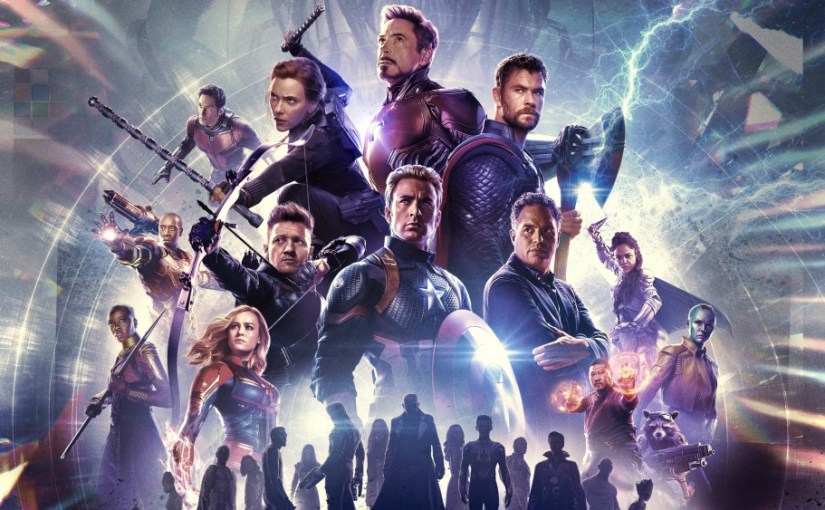
AVENGERS: ENDGAME (2019)

By Miguel E. Rodriguez

Directors: Anthony Russo & Joe Russo
Cast: Robert Downey Jr., Chris Evans, Mark Ruffalo, Chris Hemsworth, Scarlett Johansson, Jeremy Renner, Don Cheadle, etcetera, etcetera…
My Rating: 10/10
Rotten Tomatometer: 96% Certified Fresh

PLOT: After the devastating events of Avengers: Infinity War, the universe is in ruins. With help from some of their remaining allies, the Avengers assemble once more to try to undo Thanos’ actions.


I have tried several different drafts of this review, and I simply am unable to write a decent review without necessarily revealing spoilers.

So…

DO NOT READ ANY FURTHER IF YOU HAVE ANY INTENTION OF SEEING AVENGERS: ENDGAME IN THE FUTURE.  SPOILER ALERT!!!

SPOILER ALERT!!!

SPOILER ALERT!!!

You have been warned.

For starters, Avengers: Endgame is not my favorite movie in the MCU.  (That title still goes to the incredibly complex, endlessly debatable Captain America: Winter Soldier, the superhero movie for people who hate superhero movies.)  BUT…Endgame contains my single favorite moment in the entire franchise.  It occurs during the climactic battle, and it involves…hardware.  YOU know what I’m talking about.

That aside, while Endgame is a more-than-worthy sendoff for the 11-year-long story arc, and is Hollywood spectacle at its best, I gotta be honest and say that the 3-hour running time was starting to get to me around about the 2-hour mark.  Yes, the plot threads all had to be woven together to bring everything to a head for the ultimate showdown, and I wouldn’t dream of eliminating anything that I saw, but it just was feeling a little slow.

Other than that…it gets all A’s across the board.

  • ACTION – I haven’t seen CGI action on this scale since the Battle of the Pelennor Fields in The Lord of the Rings: The Return of the King.  Or Avengers: Infinity War, take your pick.  I can only imagine the headaches and nervous breakdowns experienced by the hordes of CGI artists who painstakingly created the outstanding battle scenes.  They were incredibly dense, but I was never unable to see any of the key moments involving key characters.  Nothing was too dark or murky.  It was an event.
  • HUMOR – In spite of the heaviness of the proceedings, the filmmakers never lost sight of their origins: COMIC books.  From the first appearance of Thor in residence at New Asgard, to Stark’s never-ending supply of dry one-liners, to Hulk’s selfie in the diner, the audience is always kept from falling into major depression, even after some really, REALLY dark moments in the story.
  • CLOSURE – The film ends the way it does because it HAD to.  Some of the original actors are just getting too old to do it anymore, folks, that’s just the way it is.  Hugh Jackman hung up his claws on Wolverine because he was getting too old to get into that kind of shape anymore.  And some other actors are just ready to move on.  It’s time.  Regardless, though, the way that certain characters were granted their own particular curtain call…it was IMMENSELY satisfying, not a bit gratuitous, and even noble for everyone involved.  I wasn’t moved to tears myself, but there were audible sniffles in the movie theater.

(I did also REALLY like the abandoned New York cityscapes after we jump ahead in the timeline a little bit.  I’ve always LOVED the concepts of modern edifices and cities left to ruin after abandonment.  That’s one of the reasons I really love I Am Legend.  BUT I DIGRESS.)

So, yes, it’s worth the hype.  They got it right.  It is a fitting final chapter to one of the most amazing cinematic achievements in history.  It IS a little long, but I can get over that.

And I am stoked to see what comes next.
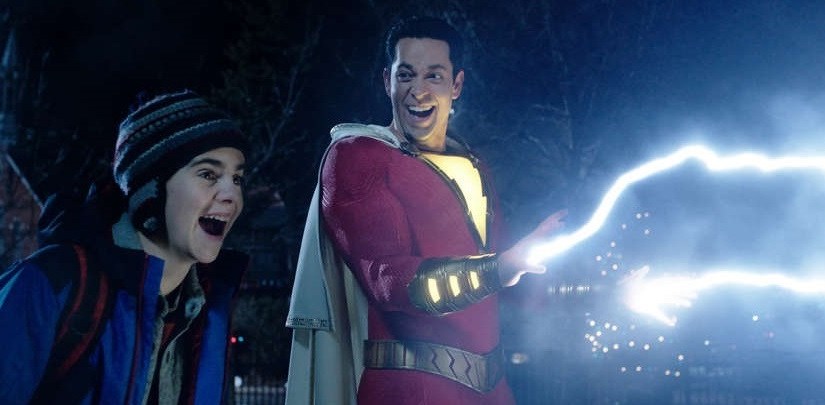
SHAZAM! (2019)

By Miguel E. Rodriguez

Director: David F. Sandberg
Cast: Zachary Levi, Mark Strong, Asher Angel, Adam Brody, Djimon Hounsou
My Rating: 9/10
Rotten Tomatometer: 91% Certified Fresh

PLOT: Fourteen-year-old Billy Batson’s life is changed forever when he is tapped to be the recipient of all the powers of a god by an aging wizard.


What’s that, you say?  The trailers for Shazam! look like something that should have gone straight to video?  Looks kinda stupid?  Like something along the lines of 2011’s abysmal Green Lantern crossed with Sky High?

Well, you’re not wrong in terms of the trailer.  However, like all the best trailers, it only shows you what it WANTS to show you, and keeps the best stuff hidden until you pay your admission fee.  And what the trailers DON’T show you is the heart, appeal, and just plain fun of Shazam!  It’s the DC Extended Universe’s answer to Guardians of the Galaxy.

Plug the director’s name, David F. Sandberg, into IMDb, and you discover that his biggest credits to date are the Lights Out movie (a one-trick horror pony) and Annabelle: Creation, unseen by me, but which intuition tells me was not exactly a superhero movie.  So he would not seem to be the ideal candidate to helm a movie that tries to bring some constantly-requested fun into DC’s dark universe of films.  But whatever Sandberg learned on those other movies was worth learning, because he has created a comic-book movie that’s just about as much fun as Spider-Man: Into the Spider-Verse.  Like someone remade Big where the little kid turns into Superman instead of Tom Hanks.

The beginning of the film is pretty standard comic-book stuff.  The origins of a key character, background on young Billy Batson (played by Asher Angel, a young actor who is the spitting image of Arya Stark on Game of Thrones, has anyone seen the two of them in the same room together, just saying), and his introduction into a foster home unique in the world of comic-book films, at least to my knowledge.  Billy’s new foster home is a melting pot of cultures, from Asian to (I think) Samoan, with siblings ranging in age from about 9 to 18.  There was something kinda cool about it, but not distracting.  Just…unique.

When Billy miraculously gains his powers (in a scene that is distinctly Potter-esque, what with wizards, lightning bolts, and orphans), one of his foster siblings, Freddy, becomes his manager, owing to the fact that he’s an expert on superheroes, particularly Superman and Batman, although he can also be seen wearing a t-shirt with the Atlantean logo on it…nice touch.   The scenes where Freddy and Billy attempt to determine the extent of Billy’s new powers are worth the price of admission.  And they have a certain logic.  If a bullet shot from a gun bounces off your brand-new super-suit, AND your body has completely transformed, how do you know if your HEAD is bulletproof or not?  Speaking for myself, I’d just use my super-speed and get out of the way, but that’s not really definitive enough for our heroes.

Anyway.  The movie uses a lot of comedy and just enough super-villainy to get us through the story without bogging us down in the deep dark psyche of the villain.  And it builds to one of the most inspired climaxes I’ve seen in a comic book movie in a really long time.  I don’t want to give too much away, but I will say this: just remember that throne room.

Don’t let the kitschy nature of the trailers scare you away.  This is a great, FUN movie.

US (2019)

By Miguel E. Rodriguez

Director: Jordan Peele
Cast: Lupita Nyong’o, Winston Duke, Elizabeth Moss
My Rating: 9/10
Rotten Tomatometer: 94% Certified Fresh

PLOT: A family’s beach vacation turns sinister when a group of doppelgängers begins to terrorize them.


[SPOILER, SPOILER, MOST CERTAIN SPOILERS TO FOLLOW]

It’s abundantly clear after two films (with hopefully many more to come) that Jordan Peele was and is an enormous fan of The Twilight Zone, that legendary TV show that presented tales of strange and the weird situations that very often turned into legitimate horror stories.  For me, that’s what Us is: a feature-length episode of The Twilight Zone, with everything amped up to 11, including the ambitious nature of the ending which, I think, bit off a little more than it could chew.

However, the ending is not what makes this film special, it’s how we get there.  And the events leading up to the end of the film make for one of the most unsettling movie experiences I’ve ever had.

I cannot stress the creepy nature of this story enough.  A family’s beach vacation is interrupted when intruders invade their home, and the intruders turn out to be…their doubles.  Doppelgängers.  Virtually identical except for disturbing aspects, like an additional scar or a perpetual smile or a cloth mask.  When these “others” faced their victims inside the house, I was indescribably terrified.  I found myself asking, what would I do in this situation?  If I found myself sitting across from an exact duplicate of me, a duplicate who never spoke but just stared and smiled and made weird clicking noises instead of talking?

I’d s**t myself, that’s what I’d do.

The story takes some interesting twists and turns, and it doesn’t follow traditional genre convention when it comes to who lives and who dies.  Whenever I expected one thing to happen, the movie neatly sidestepped my expectations ingeniously.

There’s also unexpected comedy, especially when someone tries to use their automated personal assistant at a crucial moment.  Think of all the times Siri has misinterpreted your questions.  Yeah.  It’s one of THOSE moments.

The movie is an amalgam of the best moments of Rod Serling, M. Night Shyamalan, Alfred Hitchcock, John Carpenter, and even a little Spielberg here and there with the comedy moments.  It’s clear that director Jordan Peele has digested the best films from these directors and crafted his own take on the horror/suspense genre, using those masters as a guide.  (I’m referring to Shyamalan’s EARLIER films when I call him a master, because they WERE masterful…not his later stuff, which is…not great.)

I, for one, found myself sucked into the story, hook, line, and sinker.  It did become clear, however, that the underlying reason for the existence of these doppelgängers was, inevitably, going to be a LITTLE disappointing.  Science experiment gone awry?  Space aliens?  Results of a newly-emerging virus?  As the movie entered its final stages and the meaning behind the doubles’ existence was revealed, I did find myself a little disappointed.  Like when someone shows you how a stunning magic trick was accomplished with a simple fake thumb.

Would it have been more interesting to leave the existence of these doubles unexplained?  To make it a TRUE Twilight Zone episode and leave the audience with a mystery instead of a true resolution?  I think it would have been more interesting that way, so instead of shaking my head at the almost banal nature of the doppelgängers, I would have left intrigued.  After all, John Carpenter never explained how Michael Meyers vanished after being shot several times at point blank range.  But it was CREEPY, brother.

So, there you go.  I loved it, the ending was a little disappointing, but not disappointing enough to kill the movie for me.  The journey was more important than the final destination, in my book.

LUCE

By Marc S. Sanders

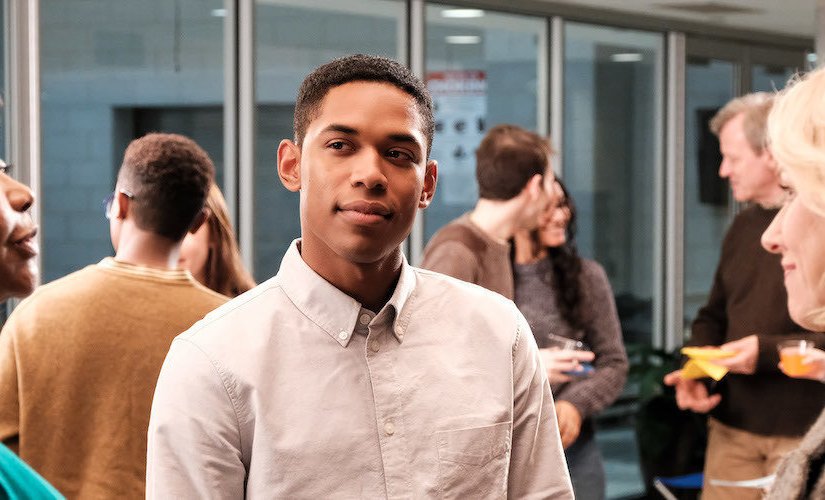
In early 2022, the local theatre that I volunteer at, Carrollwood Players in Tampa, Florida, will be presenting Luce by playwright Julius Onah.  I’d never heard of this dramatic play before, and I learned that Onah wrote a screenplay adaptation with J.C. Lee.  Onah directed the film. 

Watching the film ahead of seeing the stage production left me quite surprised.  It was not what I expected.  Luce is a story that begins as what I anticipated would be an examination of social or racial injustice and evolves into a suspenseful thriller that questions those arguments.  There are four main characters to ponder what they stand for.  Luce (Kelvin Harrison Jr) is an adopted black boy from a war-torn country and now the star athlete and likely valedictorian of his high school.  Amy and Peter (Naomi Watts and Tim Roth) are his white well to do parents, and Mrs. Harriett Wilson (Octavia Spencer) is Luce’s African American history and government teacher with a fifteen-year tenure at the prestigious high school.  Over the course of the film, each character will be fleshed out with background and dimension.  Each character may also change his or her position on the main conflicts at hand, and each one of them will exercise an action of misgiving or betrayal.  So, in what seems like a perfect world of brilliant academics and success, who can we trust?

Harriet is introduced as “stern” and later confirmed by Luce and Peter as a “bitch,” but spoken humorously within the private confines of their car ride home from an evening speech event that Luce conducted at school.  Amy shames them for the characterization.  The men in her family are wrong to describe a hard-working woman in such a way, even if it is a little sarcasm among just themselves.  A day or so later, and Amy meets with Harriet because she’s disturbed by an essay that Luce wrote glorifying the philosophy of Frantz Fanon, who believed that elimination by violence is a sound societal solution to his country’s problems.  The assignment was to select a historical figure and write the paper from that figure’s perspective.  Following her review of the essay which left her uneasy, Harriet takes it upon herself to search Luce’s locker where she uncovers a bag of illegal fireworks.  Amy is shocked by Harriet’s actions and at first can not fathom Luce as a boy who would ever have a violent nature or want to cause harm.  Debates in the kitchen occur when she gives the run down to Peter.  Questioning confrontations with Luce and his parents occur as well.  It just doesn’t make sense.  Luce is such a model student.  He’s also a brilliant debater, and that makes it hard to get to the truth.  Is there any truth to get to at all however? Is there any justification to question him when no crime or damage has occurred and by all accounts, Luce did in fact meet the standards of the assignment?  Luce asks a good question as well. As a student, were his civil rights violated by Harriet when she took it upon herself to search his locker, under no one’s authority or approval?

All of these questions are presented early on in the film.  Afterwards, developing twists take place and the story adopts a thriller mentality to it.  Luce seems so kind and enviable.  Kelvin Harrison Jr. presents the character with a beautiful smile, who is well versed, polite and presentable.  Luce even steps in to calm down a fight among his peers.  He delivers gracious speeches.  He’s a brilliant model of the debate club and he’s a star on the track team.  He takes it upon himself to approach Harriet with a mea culpa to whatever misunderstanding may have occurred, but there’s also a disturbing subtext.  He volunteers to her that his favorite holiday is Independence Day because he appreciates its meaning when he considers the violent country he was rescued from…along with the celebratory fireworks that traditionally accompany the day.  Wilson never asked for this information, and yet Luce is telling her anyway.  Is he being sincere, or is he using this as a means to torment Harriet?

Amy becomes torn by these events.  Does she really know her son, that she eventually nurtured out of the fear of his original environment?  Does it make sense for Amy to hide the paper and fireworks that Harriet gave to her with trust that she’ll address these allegations with her son and husband?  Did Peter really want to adopt this boy, when he and his wife could have easily had a child on their own, thereby avoiding the challenges of raising a child of a different race, from a war-torn country?

As a white, middle class, Jewish American male, I don’t think I’m any wiser on the plights that people of other races have endured following my experience with Onah’s film and screenplay. I thought I might have been early on in the film, but then the film seems to divert to the wise mechanics of how any one of us can be sinister, either for our own satisfaction or to prove a point, or to protect a loved one, or to mask our own foolish blindness.  Onah deliberately leaves threads of his story ambiguous, and I appreciate that.  I always like to think and ponder a film or a play or book, with its characters, long after it’s over and Luce is a perfect opportunity. 

There are surprising moments in Luce.  Just when you think you have one of these four characters figured out, something happens that forces you to take two steps back and start over.  I’ll credit Onah’s story for that, but also the impeccable casting here.  Octavia Spencer is such a great actor.  She’s awarded a character here with much background that is challenging and lends to why the other players in the story have a right to question her actions.  Watts is given more material to play with than Roth.  Typically, I’d argue that mothers bear the weight of affection towards a child more than a father and so more opportunities present themselves here for Watts to turn Amy into an unsure, but loving mother. It’s ironic, but as I watching this film, I couldn’t help but parallel some of the themes with the play/film Doubt by John Patrick Shanley, which also ends with much uncertainty.  Amy certainly becomes more of a character plagued with internal doubt as the story progresses here.  Tim Roth is maybe given the least amount of dimension here, but he embodies the wishy-washy nature of not really knowing what’s true and what isn’t.  Roth portrays the guy like he doesn’t know whose side he’s on anymore, and he just wants to cut through the bullshit.  Harrison needs to become a more established actor in today’s mediums of streaming and cinema.  He’s brilliant at playing one face while keeping me guessing whether he’s playing another face as well.  By far, this was the most important role to cast in this film, and the production got the right guy for the part.  Side note: after watching the film it was interesting to see what his character’s name could potentially stand for.  Don’t read anything ahead of the film.  Check out the trivia notes on IMDb afterwards. 

You may expect to have a discussion on what Luce was trying to say.  I don’t think it bears overthinking from a societal perspective, really.  If Julius Onah were to hear me say this, or read this publication, he might be disappointed to know that.  Rather, I think it’s better to piece together how all of the surprises came to be.  Regardless, Luce is terrific dramatic entertainment with superb and nuanced performances, and heightened suspense from its toe the line direction and the entire cast.

JUST MERCY

By Marc S. Sanders

I’ve learned so much from movies. I really have, and I’m continuing to learn. An important lesson that I absorbed from Destin Daniel Cretton’s film Just Mercy is that we have a long way to go in this country. A racial divide is sadly still in existence. As I watched this film while the nationwide protest response to the killing of George Floyd is still prominent, it’s glaringly obvious that this story, taking place from 1987 to 1993, has likely only made a tiny dent in the reach for equal and fair justice between black and white Americans.

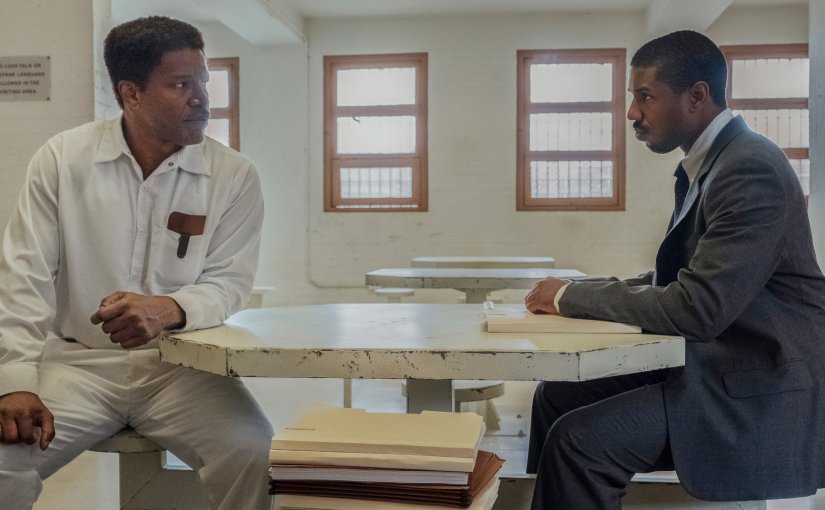
Just Mercy follows newly appointed Alabama civil rights attorney Bryan Stephenson’s (Michael B Jordan, who I still insist will win an Oscar one day) pursuit to overturn a murder conviction for Walter “Johnny D” McMillan (another magnificent performance from Jamie Foxx). Johnny D was easily ruled to have murdered an eighteen year old white woman. The trial hinged on the testimony of another convict (Tim Blake Nelson) pressured into making up an outrageous story that put Johnny D at the scene of a crime he had nothing to do with. All that mattered was that the all white jury believed this ridiculous testimony.

Bryan is newly graduated from Harvard University with nothing but righteousness and the intent of making a difference in this world. Against his family’s urging for fear of his life, he deliberately moves to Alabama with Federal Grant money to start the Equal Justice Initiative (EJI) with Eva Ansley (Brie Larson), a passionate white southern mother who is prepared to face the danger of a prejudiced community that’s hypocritically proud to boast that it is the hometown of writer Harper Lee (To Kill A Mockingbird). Bryan is informed that he can actually visit the Mockingbird museum and see where Atticus Finch actually stood. I question if the majority of Monroe, Alabama have even read Lee’s book.

Bryan’s intent is to research and represent those prisoners that likely never received a fair trial. One man is a Vietnam veteran who did in fact kill a woman with a home made bomb. Sadly though, his PTSD likely motivated this regrettable action. This man is more mentally ill than guilty and his country could care less.

Most of the film’s focus goes to the egregious acts that convicted Johnny D. While it’s plain to see how innocent he is, Bryan is faced with bigoted pushback from the local police force as well as the District Attorney (a very good and effective Rafe Spall). Bryan obtains a material witness but then that is compromised. Now he must rely on if the convict who originally testified against Johnny D will come clean with telling the truth.

There’s a lot you can become more aware of while watching Just Mercy. First, our legal system can be very tainted with extreme prejudice. Second, slavery may have been long abolished by the end of the twentieth century, but it’s racial underpinnings and need to dominate a black community still appears justified in many southern eyes. There’s a sad food chain that exists in the state of Alabama. It therefore becomes an impossible obstacle for Bryan and Johnny D when they take their case to the state Supreme Court. This doesn’t take a law degree to recognize such an apparent wrong. Yet, that means nothing if the judicial system won’t even read a simple and otherwise obvious explanation.

A third aspect that Just Mercy presents is police brutality against black men. It exists. A black man, such as a hard working tree cutter like Johnny D or a Harvard graduate in a suit, can get pulled over. The man can cooperate completely with hands shown and calm politeness when faced with an authority. Yet, with next to no action that black man will suddenly have a gun drawn on him and get slammed against a truck and put in handcuffs.

Moments like this continue to occur simply because of the color of their skin. It matters not where they were going or where they were coming from. If they just look guilty, then they must be guilty.

Just Mercy is a demonstration of a large menu of wrongs being committed against black America. Cretton’s script with Andrew Lanham, is a well edited and focused film that doesn’t drift into any side stories. Bryan Stephenson seemingly takes in a lot of cases all at once but for a two hour and twenty minute film, only so much can be presented.

Yes, Johnny D’s case is most prominent but time is also devoted to what could be his overall fate, a trip to the electric chair. Bryan Stephenson sees this first hand with another case. It is often a wrong and terrible outcome but it at least amplifies his motivation to represent these wrongly convicted men.

Bryan Stephenson is a tremendous hero portrayed by a humble yet passionate performance from Michael B Jordan. How many Harvard graduates would truly take their expensive Ivy League degree and put their lives on the line in an unwelcome community with no pay to save the lives of convicts who no one else has ever regarded?

Most especially during the current climate of our country, Just Mercy is an absolute must see film.

GOOD BOYS

By Marc S. Sanders

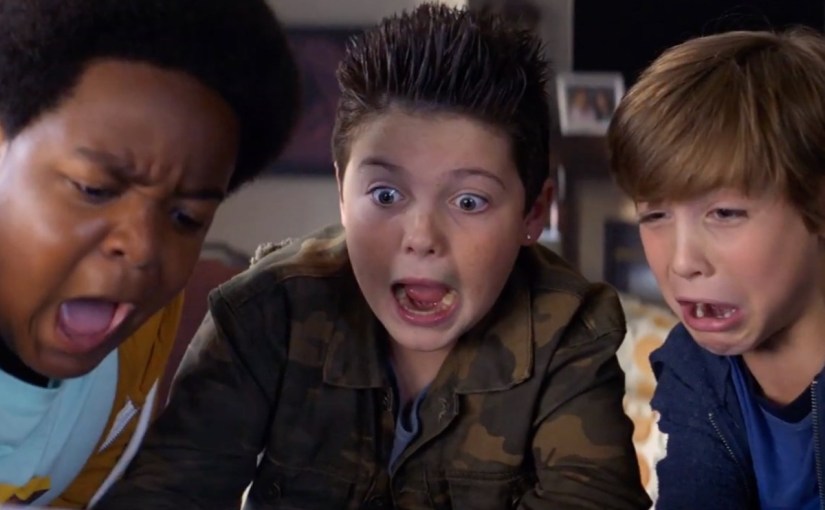
Jacob Tremblay, Keith L Williams and Brady Noon are the sixth grade Good Boys, a film directed and co-written by Gene Stupnitsky and produced by Seth Rogen and Evan Goldberg. This is a hard (very hard) R rated kids comedy adventure. Call it a prequel to Superbad.

Before sixth graders become aware of beer pong parties, the most important thing on their mind is perhaps a kissing party. At least it’s most important to Max (Tremblay). For Lucas (Williams, the MVP of the three kids) he’s broken up to learn his parents are getting a divorce. Thor (Noon, who needs a few more acting lessons) is feeling insecure on a scale of social popularity when all he really wants is to audition for the spring musical.

After Max loses his dad’s valuable drone while the boys are spying on some high school girls in a backyard, they end up stealing their girls’ “mollie” in an effort of blackmail to get the drone back. There’s the spine of the story.

My colleague Miguel E Rodriguez reviewed this film last year. He praised the picture for not making the gags the point of the film. However, I can’t agree with that observation. The thin plot of Good Boys serves as opportunity for one gross out or ridiculous gag after another. Okay. So the boys are unfamiliar with sex toys, particularly “a-nahl beads” or they mistake dad’s sex doll for a “CPR” doll. So when Max practices kissing on the doll, he’s confused as to why the lips feel so sticky.See, I found the main story to be getting the drone back before Max’ dad discovers it’s missing. So then why must I be subjected to imagining how much the beads smell like shit? Why must I see the kids try to cross a busy highway to get to the mall? These are detours, away from the plot. Yeah, they’re funny, but as funny as they are, they push me away from the ends that will justify their means.

An epilogue features one of the kids faking a snort of cocaine. Why? Miguel: these are set up gags. These are exactly the opposite of how you describe their ultimate purposes. None these jokes serve the plot. When I watch “The Goonies,” I get kids who pursue a chance at obtaining a treasure. The mission gets held up by booby traps. Those traps serve as obstacles to the mission at play. Anal beads and a sex doll are not obstacles. They are diversions.

If you want gags to come genuinely from the story then don’t make the mollie or the drone the MacGuffin. Make the sex toys the MacGuffin. These are no more than funny gags. Ultimately, they’re Saturday Night Live skits forced into a film. I laughed yes, but I also grew tired of these bits, that occurred every three to four minutes. What about the drone???? What about the mollie???? I dunno. Maybe with a better trio of boys, I’d be more invested in the film.

Tremblay is the most well known actor (from Room with Brie Larson). Brady Noon is supposed to be the wanna be rebel (he gets an earring), but the sensitive guy on the inside. Williams is the kid who still adheres to good behavior and is not so ready to move on from sleepovers with “Magic The Gathering” card games. Keith L Williams is the best performer of the three in fact. Great physical comedy and timing, as well as some authentic anguish. When the other two boys cry, it’s terribly, TERRIBLY, fake. The problem is the chemistry of three boys is lacking.

Stupnitsky’s coverage of scenes look like rehearsals before the real cameras started rolling. At times, it feels as if the boys, particularly Noon and Tremblay, are trying to think of their next line. When they can’t get the line right, I sense a fast thinking improv that includes shouting the F word. That’s not very funny for very long.

Foul mouthed pre teens are nothing new. Seen it before in The Bad News Bears and once again I say The Goonies. I’m not going to salute Good Boys because these three kids are given carte blanch to utter the F word on an endless cycle. That gets old. Boys uncover sex toys and handle them and naturally act perplexed by what they’ve found; okay, but is there anything more to that?

By no means is Good Boys acceptable for kids to watch. On the other hand, those that can watch a hard R rated flick like this might get a little tired of its material. I know I did. So then who is this film really aimed for? Best guess I could come up with would be a guy I know named Miguel E Rodriguez.

LATE NIGHT

By Marc S. Sanders

Mindy Kaling is a terrific writer. I first discovered her on The Office, where she scripted many of the best episodes as well as performed in front of the camera. She’s hilarious. She wrote and produced the film Late Night from 2019, and while I think it’s incredibly smart with ideas on prominent female identities and the status quo of race and gender within a fictional late night television industry, it does not forgive itself for wrapping up its ending in a pretty, pink bow.

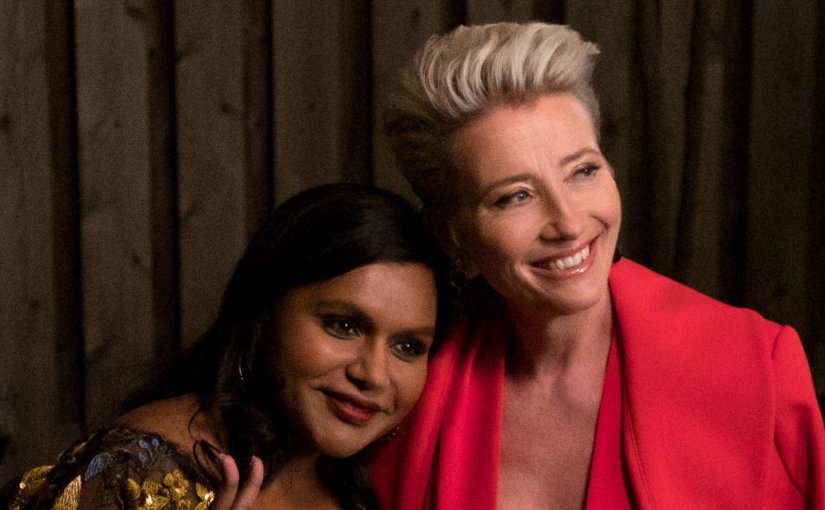
Emma Thompson is fierce as Katherine Newberry, a late night network tv host approaching 30 years in the business. She’s become a staple for the 11:30 slot, even if she hasn’t kept up with the times of Twitter and You Tube. The network is ready to cut ties with her as she has become too outdated with her material, the guests she has on, and whatever semblance of a routine she’s awarded from her team of writers, that are all white males that might not have outgrown their fraternity years but only now complain about their miserable married or single lives. It’s brought to Katherine’s attention that she doesn’t like women. To mix it up, she demands her office manager hire a woman, any woman, immediately.

Enter Mindy Kaling, as Molly Patel, with zero experience in writing or television who leaves her job at a chemical plant. Like all office films that always seem to take place in New York, the new person does not get on great with the boss, endures some humiliation, cries, but then gets a brave epiphany that catches the boss’ attention out of nowhere. Molly writes a funny pro choice/anti Republican joke for Katherine’s monologue. It eventually goes over swimmingly.

A well acted side story occurs when we get to see some pains that Katherine has while living with her loving husband, Walter, played by John Lithgow, who has Parkinson’s disease. They have some outstanding scenes together. So while the Katherine Newberry with the tough exterior works her writing team to the bone to save her reputation and show, she is also dealing with a terribly sad domestic life. Unfortunately, a one time affair that she had with a writer unnecessarily creeps its way into the film. When it becomes material for public tabloid, her show is all but dead. Now by and large, Late Night is a comedy, so how do you think this film will end? Happily of course.

I don’t take issue with a happy ending. I love them, and it’s often why I go to the movies to escape. However, this is the cutthroat business of television. Shows get cancelled frequently. Kaling’s script even demonstrates that with the network president. As well, Katherine’s demeanor demonstrates this when she fires a writer simply for asking for a raise and to spend more time with his kid. Throw in a couple of lines, however, give a monologue from the heart for your audience and suddenly the show is saved! I wish it would work this way but I doubt it really does.

Another angle the film explores is Molly as an Indian American woman intruding upon a white male dominated occupation. The story had me convinced that she overcomes these demographic obstacles. I bought it. What was hard to accept was the “one year later” epilogue where the show’s staff is made up of every variation of gender and race demographic imaginable with Thompson’s character doing a quick walk through the office to the studio. Every desk is occupied by a different looking person. How touching…and unconvincing. Again, I wish it was that easy to flip a perspective on an office staff, in just one year. Yet I don’t think it’s all that simple. This is where Kaling’s script is pandering way too much.

The performances are excellent. Kaling and Thompson have great scenes together. Lithgow with Thompson as well. Following the reveal of the affair, there’s a magnificent scene between them where they come to a resolve. Only, I think this moment belongs in another film. The affair storyline is not correlated enough to the rest of the picture. I would have abandoned it altogether and simply focus on Katherine, Molly and Walter’s struggles; surviving the business, entering the business and living with illness. The affair intrudes on the last act of the film and as soon as it bleeds, Kaling’s script patches it up too neatly. Thus, we get a happy ending that just doesn’t feel very authentic.

Mindy Kaling needs to work even further. I think she’s one of the brightest writers I know of today. She writes what she knows; about working in television and being an Indian American woman thereby bringing those facts about her background as new strengths for storylines. She only now has to be careful about not patching up the conflicts she masterfully creates with simply a cherry on top. She might turn the APPLAUSE sign on for her audiences, but that is not necessarily going to get the crowd on their feet and clapping.

CAPTAIN MARVEL

By Marc S. Sanders

Anna Boden & Ryan Fleck directed the Captain Marvel installment of the Marvel Cinematic Universe. The film has some successes, but some failures as well. Fortunately, where it lacks happens early on and then the film continues to get better.

Boden & Fleck must have directed a film that was never released because this Captain Marvel begins in the middle of a story with exposition that’s terribly hard to follow. I’ve seen it three times now, and it’s still hard to piece the first 40 minutes together. The title character is known as “Vers” (pronounced “veers”) played by Brie Larson. She dons a green uniform space suit and is part of a civilization called Kree. Her mentor is Yon-Rogg played by Jude Law. They head a team on a mission to rescue a spy of their own held captive by the shape shifting Skrulls. The mission goes awry and Vers is captured. Small snippets of a life lived on Earth flash in her subconsciousness as the Skrulls study her mind. When Vers manages to escape, she ends up on Earth in 1995. Gradually, with the assistance of a young Nick Fury (Samuel L Jackson with hair, a clean CGI complexion and no eye patch), Vers learns of her true history that she seems to have forgotten. Reader, I just summed up the first third of this film better than the movie ever did.

Boden & Fleck have some nice touches to this film but only in the second and third acts. Captain Marvel salutes the grunge music of the 90s while also taking inspired narratives from films like The Terminator. There’s some nice twists in the film too.

However, the whole first act should be thrown away and redone. It’s terribly confusing with dark cinematography on what is to be an alien planet at night and a dimly lit unfamiliar space ship. Hardly any characters are fleshed out yet but they talk in conversations that lose me. The Skrulls are shape shifters that can adapt the image of another person or creature but because it’s all so dark, it’s difficult to decipher who is who. Not much payoff comes when you are finally able to piece some material from this whole sequence later on, based on what Vers uncovers about herself, the Kree and the Skrulls.

Brie Larson is fine in the role while primarily playing it straight. Nothing special, but nothing terrible either.

Samuel L Jackson plays this Nick Fury with more naivety than seen before. He’s a younger version of himself after all. So that’s somewhat humorous, especially his chemistry with an odd cat called Goose.

Ben Mendelsohn continues to break into these mainstream film franchises as an antagonist of some sort but sadly no one remembers him, I would think. He needs to be regarded in the same league with guys like Gary Oldman and Christopher Walken. What’s next for him? How about a James Bond villain?

Annette Bening is a welcome presence as the “supreme intelligence” for Vers. Accompany her sashaying to Nirvana’s “Come As You Are,” and I’m entertained.

There was a better film here. Due to a weak beginning, I can only mildly recommend Captain Marvel. Pop culture references and a redeeming two thirds of the film rescue it from utter confusion. Still, if I have to pause the film on occasion to explain to my wife and daughter what is going on, I think that is more an issue with the film than with the viewer.

PARASITE

By Marc S. Sanders

I first discovered director Bong Joon-Ho when I watched his futuristic sci fi adventure Snowpiercer. I loved that film despite how absurd the set up was. Absurdity, though, is a credit to his craft. That’s why his latest film Parasite is a hugely successful interpretation of class warfare within South Korea. It might all appear drastically unlikely. Yet, it’s all absolutely possible when you reflect on the film after you’ve seen it.

Parasite begins almost like a farce and ends in deep, realistic horror that you’d never expect, even after you surpass the films midway surprise.

It’s best I leave much of the film’s details out. The less you know the better. I knew nothing at all about the film beyond the numerous accolades it has received. I was better off for it.

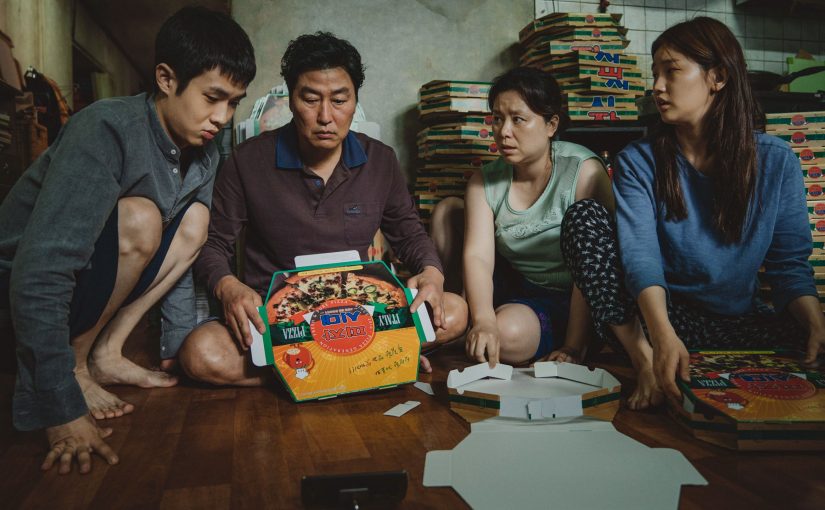
Joon-Ho’s film makes its point quickly that there is always someone better off than us and always someone worse off. (This was a theme carried over from Snowpiercer.). A poor family living off scrap money for folding pizza boxes while living in a cramped, bug ridden basement is still better off than the drunk who pisses on the street, outside their window. Just as an upper class family with all the best things in life are better off than them.

It’s only when this poor family find opportunity to dupe their way into this wealthy home through jobs they are hired for that we eventually see how lighthearted material, compliments of Joon-Ho and his writing collaborator, Jin Wan Han, can convincingly escalate into class warfare politics that even their characters ever hardly acknowledge, or are aware of. Is the wealthy matriarch really aware where her family chauffeur stems from or where he lives? The off putting scent of someone’s presence can quickly turn a tide or an impression.

I might sound vague, but I have no choice. It would be a betrayal to the imagination of the best film of 2019 if I spelled the film out for you.

Simply know that I truly appreciate the symbolic research Parasite presents as it makes note of a Korean child’s fascination with Native Americans, and how their plight parallels the story. Even that drunk taking a piss on someone else’s territory. Even the gift of a stone sculpture told me how one can be crushed or weighted down by his own country.

Parasite begins as one movie and ends as maybe five other different movies. It’s a farce. It’s wry and conveniently ironic; maybe silly at one point. It’s suspenseful and surprising. It’s also shockingly horrific.

I recently declared Clint Eastwood’s film Richard Jewell the best film of year. I stand corrected.

Parasite is the best film of the year.

THE BEST LAID PLANS

By Marc S. Sanders

Michael LiCastri writes and directs The Best Laid Plans, a film shot on location in Tampa, Florida and available on Amazon Prime – https://smile.amazon.com/Best-Laid-Plans-Linnea-Quigley/dp/B07P83YB6K/ref=sr_1_1?keywords=the+best+laid+plans&qid=1580527934&rnid=2941120011&s=instant-video&sr=1-1

LiCastri also headlines the cast as Kevin. When Kevin’s parents are threatened to be evicted following losing their jobs, he recruits Allen and John (David Plowden, Keith Surplus) to carry out ridiculous schemes to get the money he needs fast. Naturally, the first thing to come to mind is to become a pimp.

A winning sequence has the boys do a little research to play their new roles. A trip to Ybor City has them observe a toughie pushing around one of his girls (Yvelisse Cedrez in a ditzy scene stealing role). The moment discourages them from following through with the plan.

Next up, how about kidnapping Tommy (Brian Ballance) a former friend who has won the lottery. Ballance plays the role smart with biting sarcasm and wit that becomes a challenge for the trio.

Bridging this comedy together is a lot of small talk inside dialogue like references to Buffy, and Dancing With The Stars, and an analogous reference to Jessica Alba and what she could do if she gets caught. As well, I think this is the first time I’ve ever seen a dick shaped bruise on a character’s thigh. Watch the film to understand why it’s featured. The efforts in making the film is reminiscent of Kevin Smith’s early films like Clerks and Mallrats.

The schemes of our three main heroes are absurd and it lends to the comedy. The dialogue doesn’t necessarily flow naturally though. It’s a little too stilted to appreciate. The delivery needs work.

Objections aside, LiCastri and his crew must not stop with their filmmaking efforts. The script for The Best Laid Plans has the seeds of something fun, but LiCastri’s script comes off like a first draft. It needs a second set of eyes to make it grittier or maybe sillier. Something to make it more outrageous in one direction or another.

It’s a good, short film, even if there’s a better interpretation waiting to present itself.