LEVIATHAN (2014, Russia)

by Miguel E. Rodriguez

Director: Andrey Zvyagintsev
Cast: Aleksey Serebryakov, Elena Lyadova, Vladimir Vdovichenkov
My Rating: 8/10
Rotten Tomatometer: 97% Certified Fresh

PLOT: In a rugged coastal town in northern Russia, Kolya fights against a corrupt mayor to keep his house from being demolished.


The coastal town in Leviathan might be considered beautiful in some other film.  The crashing waves on its rocky shores are reminiscent of Norway or Iceland.  But in this movie, behind every exterior shot of a stupendous mountainside is a sense of dread or gloom.  No doubt there are people in this town who celebrate things like birthdays or holidays or weddings.  Not in this movie.  In Leviathan, the atmosphere seems to prohibit any kind of celebration that isn’t preceded by consuming large quantities of vodka.

Kolya is a husband and father who lives in a house he built (he says) with his own two hands, along with his wife, Lilya, and son, Romka.  He’s currently locked in a legal battle with the corrupt mayor, Vadim, who wants to bulldoze Kolya’s house to make way for what Kolya assumes will be yet another mayoral mansion.  Like all the men in his circle, Kolya drinks a little too much vodka at times and is a bit of a hothead, which is a strike against him whenever he tries to reason with the authorities about his problems.

Kolya calls an old lawyer friend, Dmitriy, in Moscow for help.  Dmitriy does some digging and shows up at Kolya’s house with a folder full of damaging information against the mayor.  We get a good sense of how the mayor operates in a scene where he shows up drunk at Kolya’s house and demands that Kolya learn his place in the grand scheme of things.  He has power and he knows it, but in this scene, and in others where he flexes his power, he’s never far away from a bodyguard or a henchman or three.  He’s a mean little man.

Not that Kolya is a saint himself, either.  He doesn’t shy away from giving his son a sharp smack on the back of the head for sassing Lilya.  When he drinks, he’s more given to insults than jovialness.  But he really does seem to love his wife, and we feel for him when we see his efforts to get the mayor off his back through legal means, when what he’d REALLY like to do is just shoot him and be done with it.

The movie establishes this basic plot relatively slowly.  It’s a great example of a slow burn.  The first few scenes seem unconnected as we see Kolya and Lilya interact with Romka, and Kolya picks up Dmitriy from the train station, and they have a meal, and so on.  It isn’t until we reach a scene in a courtroom where the whole plot is spelled out for us in an astonishing rapid-fire speech from a judge who reads out what sounds like twenty pages of legal findings in about three minutes.  It was almost like listening to a Russian version of a Micro-Machines commercial.

As the story moves on, that sense of dread escalates.  It’s that kind of feeling you read about in books where a storm is approaching.  There’s no rain, but the air is a little sharper, the wind just a tad heavier.  The whole first half of the movie is like that.  Small things happen here and there that point subtly towards impending disaster.  In one shot, Kolya cradles a shotgun in his lap.  In another, we discover that Dmitriy and Kolya’s wife are a little more than just friends.  Kolya is detained by the police for making a scene in a police station.  We see his capability for violence even though it is never truly demonstrated.  That simmering anger underneath everything he says makes any conversation with Kolya a little edgy.

At one point, the corrupt mayor comes down on his cronies, telling them to do their jobs and get Kolya and his lawyer friend off his back.  After that, in a remarkably tense scene, Kolya, Lilya, Dmitriy, and some other friends go out shooting by a small lake and waterfall.  It’s all friendly enough, with a little portable grill and the wives making kebabs and the vodka flowing freely.  But as they set up the targets (empty bottles on a log), and each of the men take their turns with their rifles, I was inexplicably on edge.  I felt, I knew that something was going to happen, I just didn’t know what.  Their children run off to play by the water…is one of them going to drown?  One of the shooters has brought, not a rifle or a shotgun, but a freaking AK-47.  (He makes short work of the target bottles.)  Was this guy going to turn the gun on Kolya?  It’s a masterful bit of suspense that culminates in a completely unexpected direction.

There are other twists and turns in the story that I won’t reveal here, but what is this movie really about?  It’s about nothing more or less than how some men seem to be born to suffer.  Kolya is one of these men.  He has a teenage son who tolerates him, but can’t stand his wife, who is actually the boy’s stepmother.  A powerful man will stop at nothing to seize his house and land, and there doesn’t seem to be anything he can do about it.  The circumstances of how and when he discovers Lilya’s infidelity are traumatic, to say the least.  And for almost two-and-a-half hours, Kolya suffers the trials of Job.  Lilya gets her fair share of grief, too.

And yet, somehow, it was still an entertaining watch.  What separates this film from another movie about human suffering (say, The Death of Mr. Lazarescu) is HOW this movie was made.  Rather than presenting the story in a documentary fashion, Leviathan looks and feels like it was shot 100% by a Hollywood crew with Hollywood production values.  It rather looks and feels like a high-end Coen brothers movie.  The story is about suffering, true, but the movie itself is slick and well-constructed.

I liked how the corrupt mayor, Vadim, visits his local Orthodox priest with his woes, and the priest, who seems to be more than a little involved in Vadim’s business dealings, advises him, “All power is from God.  As long as it suits Him, fear not.”  Basically, he’s telling Vadim to use his power to do what’s necessary, and because God is also powerful, He will be on Vadim’s side.  A rather self-serving interpretation of the power of God, but there you have it.  And then, later in the film during a sermon to his congregation, he does a complete about-face, talking about how God sees everything, but he is not honored by a show of force.  Here’s a man who tailors God’s will as it suits him.  If the mayor is a mean little man, this priest is an enabler.  I’m not sure who I disliked more.

(For the record, Leviathan has one of the most interesting and surprising “payoff” scenes I’ve ever seen in a film.  When I saw it, my jaw dropped a little…it almost redefines the movie like a Shyamalan-esque twist.  Almost.  Not quite.  But it’s interesting in that kind of way.)

Earlier, I Googled “famous Russian movie comedies” and found a page that listed ten “essential” Soviet comedies.  None were made before 1984.  I tried again and found a list of fifteen great modern Russian comedies stretching from 1995 to 2018.  I have never heard of a single one of these movies and have no idea how I would go about finding a copy were I so inclined to actually watch one of them.

I mention this because, after watching Leviathan, I needed convincing that Russian directors could direct anything other than deep dramas about the human experience in one way or the other.  Of the six Russian films I’ve seen, three are Soviet era (Come and See [1985], Mirror [1975], Stalker [1979]), and two of those are by the same director, Andrei Tarkovsky.  The others are this film and two silent classics, Battleship Potemkin and Man with a Movie Camera, which doesn’t qualify as a deep drama, I guess, but I include it for the sake of thoroughness.  The best Russian films are well made, to be sure, but light-hearted they are not.  I’m not a film scholar, but I would guess it has to do with the inherent toughness that comes with growing up Russian.  Those crazy winters, the bloody history of the place, the financial hardships, etc.  It would be interesting to see a Russian comedy, if for nothing else just to see what might make a Russian laugh.

(P.S. The IMDb trivia page reveals that, for many of the drinking scenes, the actors chose to drink real vodka. As a result, many of the takes of those scenes in the film are the 8th or 9th take, where the actors are genuinely drunk. Maybe THAT’S what makes a Russian laugh…?)
CITIZENFOUR (2014)

by Miguel E. Rodriguez

Director: Laura Poitras
My Rating: 9/10
Rotten Tomatometer: 96% Certified Fresh

PLOT: Documentarian Laura Poitras captures the first week or so of Edward Snowden’s leaks to the press and the ensuing aftermath.


Over the last month or two, I have watched two stirring documentaries (Cave of Forgotten Dreams and Nostalgia for the Light) that redefined my idea of what a “good” documentary should be.  Instead of being passive observers, those filmmakers documented what they saw and then commented on it with definite viewpoints and biases.  Narration was used heavily.  That’s not normally my favorite kind of documentary, but they were clear exceptions to my rule.

Tonight, I finished watching Citizenfour, a documentary about the first week or so of the Edward Snowden whistleblowing controversy.  In direct opposition to the other documentaries I’ve seen recently, this film steadfastly avoids narration and simply presents the facts as they happen.  As I was watching, I was simply absorbed in the storytelling, and after it was over, it occurred to me that this documentary captured something incredibly rare: the first few days of a national scandal, behind the scenes with the actual person blowing the whistle, BEFORE the story breaks.  It was captivating.

But that sense of being a fly on the wall is nothing compared to the revelations Snowden made.  If you’re politically-minded, Citizenfour is not just revelatory; it’s chilling.  If one-tenth of what he discusses just in this film is true, the ramifications are vast.  I don’t want to sound like a conspiracy theorist, but the secret surveillance programs Snowden describes are exactly the kind of tools needed to create a dictatorship.  When a government is using a program/algorithm/whatever that can follow your movements via phone calls, emails, e-payments, cell phones, laptops, etcetera…that’s a police state, empirically.

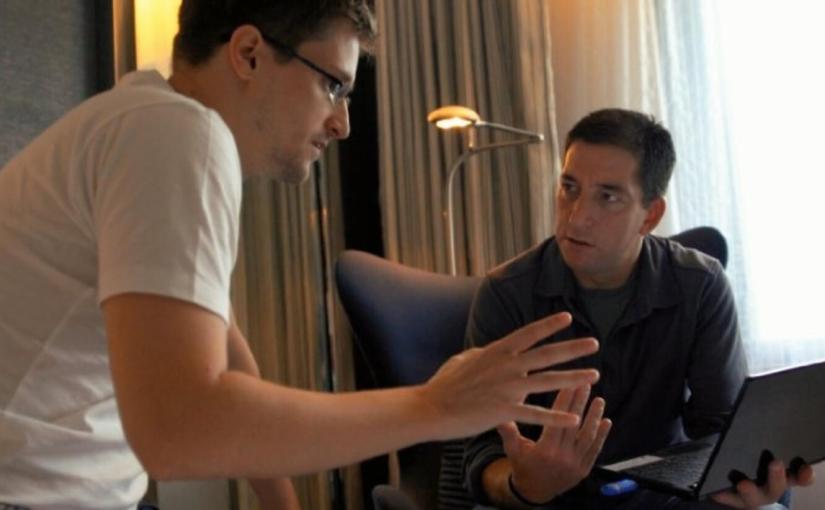
Snowden’s revelations are so mindblowing and voluminous that paranoia is the rule of the day.  He contacted Poitras and a reporter from The Guardian, Glenn Greenwald, via encrypted emails and air-gapped laptops and arranges to meet them in a Hong Kong hotel.  He makes a quick call to room service, then disconnects the phone.  Why?  Because, according to Snowden, the NSA has technology to listen in on conversations via a telephone handset, even when it’s hung up.  Later, the hotel’s fire alarm starts going off sporadically.  Snowden reconnects the phone and asks the front desk what’s going on, and he’s told it’s a scheduled test.  “Nice of them to let us know,” Snowden says.  Random event?  Who knows?  It’s a mark of how well the movie is constructed that seemingly innocuous events are transformed into, “They’re listening…”

The film follows the story, including the publication of the reports that eventually resulted in Snowden being forced to live in Russia for the better part of a year after his passport was revoked.  We meet Julian Assange as he organizes Snowden’s legal strategy along with a squad of ACLU attorneys, all working pro bono.

The genius of the film is how it simply presents the facts and allows the viewer to draw their own conclusions.  Is Snowden an attention-seeking charlatan?  Or was the US government actively spying – spying – on American citizens without their knowledge?  After a while, without really trying to, the movie takes on the air of one of those classic paranoid thrillers from the 1970s like The Parallax View and Three Days of the Condor.  At one point, Snowden logs into a laptop while covering his upper body with a blanket like a tent, presumably to make sure no one would be able to tell where he was by using the camera on his laptop.  Or something.

(Admittedly, we only hear snippets of opposing viewpoints, one from then-President Obama where he agrees that Snowden created a much-needed discussion but declines to call him a patriot because of his methods.)

But surely some of this stuff is a little too sensational, right?  The cynic in me wants to believe that’s the case.  But consider: The material in Citizenfour was so sensitive at the time that the director, Laura Poitras, had to move to Berlin because she kept getting detained by border authorities when trying to re-enter the US.  All the film footage was kept on encrypted drives to prevent access from…whomever.  In fact, she edited the movie completely in Berlin so the FBI couldn’t serve a search warrant for the drives.  Just in case.

At one point, Snowden and reporter Greenbaum carry on a conversation about another whistleblower, apparently inspired by Snowden, who seems about to release information about drone strikes and watch lists under Obama.  They are careful to censor themselves by not saying certain words and phrases out loud.  Instead, they write key phrases on pieces of paper and hand them back and forth.  And then the paper is torn to pieces.  Normally, this kind of thing would reek of paranoia, but considering what has come before, it seems perfectly reasonable, in light of what they’re discussing.

I gotta say…in all honesty, I may not be the best person to review this movie.  I think it’s well-made and eye-opening and informative, but is it going to make me change my online or cell phone habits?  Probably not.  I’m in my 50s, and I enjoy the convenience of Amazon Prime and paying my bills online and using my phone to pay for things when shopping.  Am I worried I’m being spied upon?  I suppose I should be.  But I’m not.  I guess I’m willfully ignoring facts, at least the ones based on this documentary.  I’m not saying I like it.  I’m definitely against it.  But is it enough to make me change my behavior?  If I’m being honest, no.  (And if I can’t be honest in an online review, where CAN I be honest?)  But, bottom line, Citizenfour is one of the finest documentaries I’ve seen in recent years. If you’re running short of things to be outraged about, look no further.

GUARDIANS OF THE GALAXY

By Marc S. Sanders

Forgive me! I’m going into the woods or, rather, outer space a little on this review.

Director James Gunn brings new perspective to Marvel Studios’ Guardians Of The Galaxy, by recognizing the one instinct that every person possesses but is not acted upon often enough…the instinct to dance.

I love to watch characters (not part of a standard song and dance musical) break out into dance. It comes out of nowhere while it humanizes the person. I write my own plays that way, and I award my characters the opportunity to dance as well. I love it when I see it because it’s always a surprise and always welcomed with a smile. Think of that great moment in John Hughes The Breakfast Club, when the five kids let it all out after they’ve let it all out among themselves in confidence. Look at Eddie Murphy boogie in a night club in 48 hrs and Beverly Hills Cop, and look past the crappy script of Footloose for one of the silliest and most fun dance soundtracks to bop your head to. That last bit offered some inspiration for James Gunn especially. Dancing is needed in life. Dancing brings a surge of security as we shed our inhibitions for a fleeting moment. James Gunn reminds his audience of that. If you can’t smile and tap your toe to at least one fresh minute of GOTG then I worry for your soul.

Try not to smile when you first see lead hero Peter Quill aka Star Lord shake, slide and lip sync out by himself on a marooned, wasted planet to the melody of Come And Get Your Love by Redbone. Yes. Don’t deny it! Your head was shifting and your foot was shaking when you first saw this moment.

Gunn hit on all the right notes with a film that could have torpedoed straight to B class junk in another director/writer’s hands.

GOTG focuses more on the humor than any of the zippy outer space special effects. Everyone is having a good time, even the bad guys.

The story more or less focuses on the pursuit and take away/get back of a MacGuffin. Because that’s so simple, Gunn doesn’t have to concern his script with logic and over plotting. Instead, he can offer time for great naive one liners from brutish Dave Bautista as lovable Drax The Destroyer (do I really need to explain this character? ) and Rocket Raccoon (do I really need to explain this character as well?). There’s a giant tree named Groot who will happily tell you “I am Groot” in case that wasn’t clear to you, and a tough as nails, green skinned Gamora played by Zoe Saldana. She, along with Chris Pratt as Quill, have great chemistry together as they develop a caring friendship amid their competitiveness and wacky action. A pause in the play to allow a sway and flow dance for Saldana and Pratt to Elvin Bishop’s Fooled Around And Fell In Love is hypnotic as Gunn stages it against a gorgeous purple galaxy sky with random yellow sparkles raining down. I could stay in that scene forever.

Main focus goes to Quill who pirates the galaxy while not knowing much about his father and keeps the memory of his Earth mother alive with her “Awesome Mix Tape Vol 1.” He’s a lone pirate with no allegiance, and happily scavenges items for pay from the highest bidder. Pratt has fun with his breakout cinematic role. He laughs, he teases and yup, he dances.

On a first viewing, GOTG can leave you a little bewildered as you try to comprehend what weird name belongs with what weird character and what is everyone talking about. Your next viewing will feel like an invitation to a night club because you’ll realize whatever exposition Gunn’s script offers is really not significant.

James Gunn offers a pleasure piece of sights and musical sounds. One motif I like about his fictional galaxy is that no two characters look the same. It reminded me of George Lucas’ first Star Wars film. The famous cantina scene never shows two of the same species of alien. That’s all that’s needed to imply the vastness of the population. Unlike the Aquaman, James Gunn doesn’t feel the need to show you every inch of this universe to prove just how big it all is. He adopts the means of many extras all with their unique look.

The villain is Lee Pace, a guy who’d make a great Bond villain actually. He’s hidden behind a lot of costume and makeup as Ronan, and maybe he could’ve been given more to do. There’s not much one on team time between him and the Guardians.

Other fun moments abound though, including a ridiculous daylight chase through a busy planetary downtown, and a ridiculous prison break led by Rocket and Groot that reminded me of a lot of the Zucker brothers humor from their Airplane! and Naked Gun films.

James Gunn manages the biggest and bravest departure from the Marvel Cinematic Universe and it’s oh so right and necessary to keep the franchise alive and fresh.

Guardians Of The Galaxy is Marvel Studios’ answer to Looney Tunes and The Muppets. The great Mel Blanc and Jim Henson would have applauded a ridiculous film like this for years on end.

THE BABADOOK

By Marc S. Sanders

The Australian psychological horror film, The Babadook is a very unsettling piece, and I hate my colleague, Miguel E Rodriguez for subjecting me to a viewing. It’s so unnerving simply because it is so good.

Jennifer Kent writes and directs an eerie film about a troubled mother and her young son (Essie Davis, Noah Wiseman) named Amelia and Samuel Vanek. Samuel’s father passed away in an accident while taking Amelia to the hospital when she was in labor. Seven years later, Amelia endures much sorrow and loneliness while Samuel has social issues in school and resorts to crafting barbaric weapons out of wood. I just played with action figures. This kid puts sharp knives on a sling. Other mothers and children keep their distance from them. Samuel’s school is concerned of his presence with other first graders, and Amelia opts to not even celebrate the boy’s birthday on the actual day, also known as her husband’s date of death.

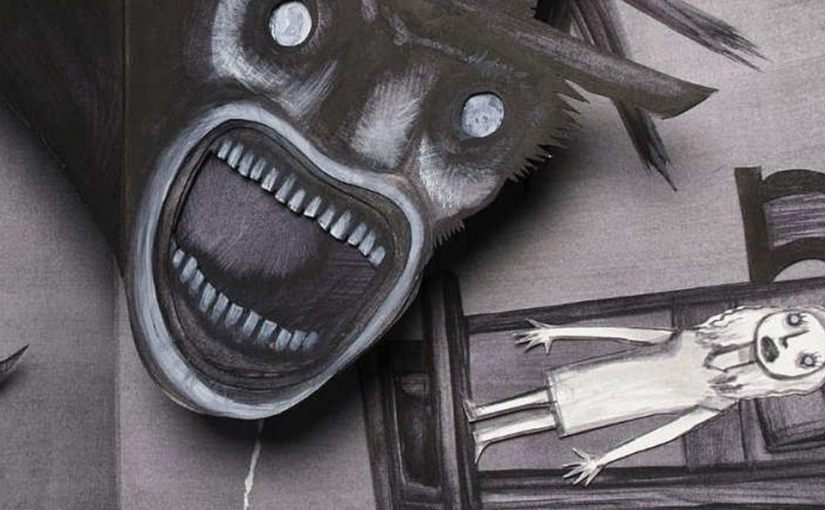
One evening, Samuel pulls a book known as “Mister Babadook” off the shelf for bedtime reading. Opening the book is their first and most regrettable mistake. Haunting images of a dark shadow are shown in “pop up book” form with promises of death and so on in a cute, yet sinister, Dr. Seuss like rhyme. This is the evil “Cat In The Hat.”

Like most creepy horror films, there’s pounding on doors and floors, open doorways to find nothing there, disturbing phone calls, shadows, surprising sound editing and so on. That’s nothing new. What makes Kent’s debut film so special though are the performances from Davis and Wiseman.

As I watched the film with Miguel, I told him after about a third of the way through that I hate that annoying little kid. I think that’s the point though. Noah Wiseman plays his part with great hyperactivity who can never be satisfied or calmed with any variation of attention. Essie Davis plays Amelia as strung out and exhausted. You can’t help but feel for her inescapable circumstance of being trapped in a home with no other family and no friends who seem willing to help, much less tolerate her crazed son.

Later, long after the disturbing children’s book is read, Jennifer Kent’s script turns on a different perspective. It’s not so much that the character’s have changed. More so, the aftermath of reading “Mister Babadook” has altered the mother and son’s behaviors. What caught me by surprise was that my own perspective gradually changed on the two players.

You will need to watch the film to truly uncover the mystery of the book’s power. However, it’s a very frightening exploration. Kent is very good with the sensory overload; which really is a necessary tool in horror, particularly in what you hear and what you see. Kent mixes up what sense is alarmed first though, with each passing sequence. It makes it hard to relax as a viewer, while it’s also hard for the mother and son to sleep at night. That’s what keeps the hairs on your body standing up and believe me, mine were standing at full attention.

Kent covers much psychologically. Insomnia, depression, aggression, night terrors and trauma are all given attention as they manifest into this disturbing unrecognizable character know as The Babadook.

I also observed an interesting aspect in use of color. Namely that Amelia is dressed primarily in faded pink and yellow while Samuel is adorned in dark grey or charcoal like the two story home they live in. The contrast in colors left me guessing who was the real source of fright in this film because at times the contrast seems to flip. I risk sounding vague here, but I’d prefer not to spoil what’s presented.

Again, The Babadook left me feeling shaken like the best of Stephen King’s adapted films including Stanley Kubrick’s The Shining and especially the latter half of Brian DePalma’s Carrie. I’ll even go on record and say this film is better or more effective than those two films. It’s sharper and more mysterious.

I’m not sure I was entertained with The Babadook because I was always feeling disturbed and unsettled. Good horror films do that to me. Forgive me. I can’t help that.

On the other hand, Miguel was quite entertained at me cursing him out and loudly expressing my seething hatred towards him as I watched. What can I say? Mig had it coming for introducing me to The Babadook.

CAPTAIN AMERICA: THE WINTER SOLDIER

By Marc S. Sanders

Anthony and Joe Russo direct one of the best action pictures of the last 20 years as they pit the heroic patriot against weaponized SHIELD planes, trap him in an elevator with 15 strong arm men to take on singlehandedly, and most especially the dude dressed like the American flag goes up against a mysterious figure that possesses a highly weaponized steel arm. Best yet, none of these sequences pertain to the story so much as they frame it.

Chris Evans returns as Steve Rogers aka the first title character, and he’s even better this time around. Captain America: The Winter Soldier hearkens back to the thematic 1970s conspiracy theory features like The Parallax View with Warren Beatty and Three Days Of The Condor with Robert Redford as Cap first finds himself on one side of an important debate for our modern times. When is too much warfare enough? How far must we go to serve as a means of protection? Evans appears as if he’s researched the strong position held by his character, and he’s believable in his mindset. Is the motive out of fear, or power, or could it actually just all be for protection? He’s convincing in his character’s argument. Naturally, if he can’t agree with the powers that be, he’ll find himself on the run with allies like Scarlett Johansson as Black Widow and Anthony Mackie as the supercool Falcon.

Johansson is given much more to work with as she trades “Buddy Cop Movie” wits with Evans as well as helping him with his dating scene. She also offers up some sharp intelligence to a promising complex former KGB/spy. It’s about time she get her own film in the series. She’s overdue. (Well…now we all know how that turned out.)

It’s especially appropriate that Redford himself is recruited as Secretary Alexander Pierce. Redford plays puppet master for a film that offers the biggest altering twists the MCU has offered up to this point. To handle the role requires an actor with a history to his career and since Redford has dabbled in films of this nature, he fits right in. He must have been especially pleased to accept this role recognizing the layered angles to a script provided by Christopher Markus & Stephen McFeeley.

Sebastian Stan returns with an astonishing turn as his character Bucky. When all the surprises are revealed by him, your pulse will likely not have come down following a thrilling highway shootout.

Lastly, credit must be given to Samuel L Jackson. This film offers the most for his Nick Fury character to play with. Fury finds himself on the wrong end of an argument that leads to a shocking betrayal and sabotage. Jackson’s roles often fall into the same routine of timing and delivery, screaming “mother effing” frustrations. It’s often lovingly joked about but it gets tiring too. Here however, he’s given a chance to be the victim of a brutal attack and deal with an aftermath. It’s the best material written so far for the Nick Fury character.

The Russo brothers, not normally known for big budget extravaganzas, surprised audiences with a well-executed film that offers suspense, extensively choreographed action sequences and great characterizations all around. They have identified Captain America as the soldier of morals, but moreover they recognize where he stems from. The Brothers certainly haven’t forgotten that he’s really a 95-year-old man at the time of this story. That sets up some good laughs. The adventure of the picture is top notch and thankfully it primarily all takes place in daylight where nothing is strategically hidden and appearing as shortsighted work in dark photography. The Russos know how to pinpoint exactly where Cap needs to throw his shield, what it should bounce off of, and how the hero should get it back. Everything here is top notch.

Captain America: The Winter Soldier only gets better with repeat viewings, and you really don’t even need the other MCU films to follow its trajectory. It’s worth watching at any given moment.

LIFE ITSELF

By Marc S. Sanders

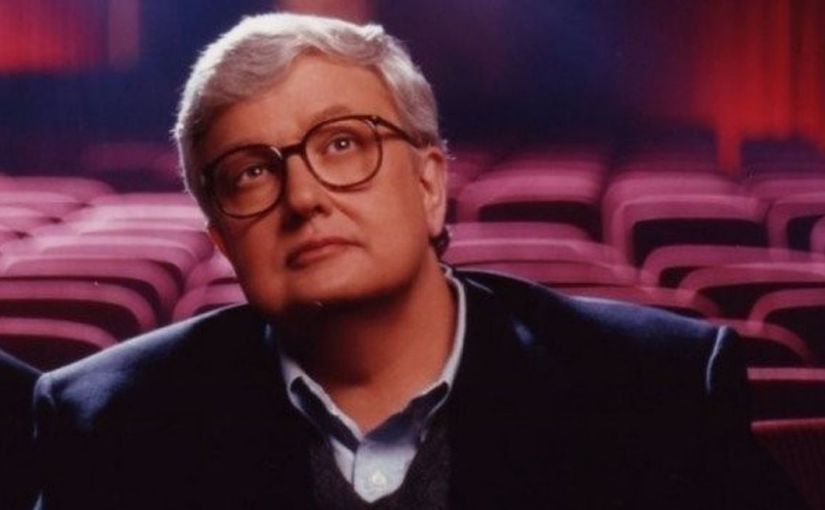
Gene Siskel and Roger Ebert’s television program was a show that I religiously watched growing up. They both taught me how to argue, how to agree, how to observe and how to appreciate; most especially when it came to the subject of movies which I continue to have an incredible passion for.

To watch Steve James’ documentary Life itself, which focuses on Ebert’s colorful and pioneering life, as the most popular film critic in the world, is a mind-blowing experience. James along with commentators such as Chaz Ebert (Roger’s wife), Martin Scorsese, Werner Herzog and A.O. Scott (film critic for the New York Times), paint a picture of what drove this man to continue his greatness all the way down to his last breath.

James alternates between the moments of struggle for Roger and Chaz during his final six months of life and his past which celebrated his annual visits to the Cannes Film Festival, his sparring matches with Siskel, his friendships, his moments of joy with Chaz and her family and his master talents of words on the page, and on the television screen.

As director of this incredible documentary, Steve James holds no filter in any of the material he shows. Roger is described as arrogant and competitive at times, sometimes acting like a bratty child. He is shown in his deformed state without a bottom jaw, and as a recovering alcoholic. He is also presented as a most valued opinion, a dear friend, a loving husband, a brave, young newspaper editor, a sensational film critic, and a man with exceptional resilience to the cruelty of thyroid cancer, deformity, and deterioration.

There was an incredible dynamic to Siskel and Ebert’s relationship where the surface would reveal animosity, but James’ documentary uncovered true loving brotherhood.

I continue to read Roger’s columns as a ritual following a viewing of a movie. His reviews are a conversation to me. They are personal to me. Roger always personally speaks to me. I’ve never felt as much a connection to any other writer. I continue to seek out clips of Siskel and Ebert’s programs on You Tube, to laugh, reflect, relate and uncover different points of view.

There will never be another Gene Siskel. There most especially will never be another Roger Ebert. I recall reflecting on his legacy during a trip to Chicago. I walked in front of the Chicago Sun Times and Roger seemed to say hello to me. I even met a local film critic there who knew Roger, attended his funeral, and somehow, I felt that I finally met Roger himself after so many years.

I especially recall missing him as the latest Transformers installment was released during that time. He savagely hated the prior two films in the franchise I think even more than me, and for that he wrote two of his best reviews. I only wished he was still alive so that I could return to that kind of review one more time for this picture as well. I didn’t see the movie, but I know he would have hated it and I would have loved the article all the same.

Roger is one of the most influential people I have encountered and Life itself was one of the best movies from 2014.

Catch this movie on demand if you can. You won’t regret it.

Thumbs up for me!

THE BABADOOK (2014)

by Miguel E. Rodriguez

Director: Jennifer Kent
Cast: Essie Davis, Noah Wiseman
My Rating: 10/10
Rotten Tomatometer: 98% Certified Fresh

PLOT: A widowed mother and her precocious but troubled young son experience some strange goings-on at home after reading a disturbing pop-up book about a malevolent spirit called The Babadook.


All due respect to the classics of the ‘70s and ‘80s, but some of the greatest and scariest horror movies have been released in the 21st century.  Paranormal Activity, The Descent, Hereditary, A Quiet Place, The Cell, It, and many, many others, including, of course, The Babadook.

However, The Babadook stands out because, not only does it achieve its scares with an ingenious less-is-more approach, but it’s actually about something.  Only the best horror films can say that.  And it’s not about some corny love-conquers-all theme.  It’s very specifically about people who have experienced a great personal loss, what that loss does to those people, and how a healing process can hopefully begin.

Amelia (Essie Davis) is a struggling single mother who was widowed on the day her son, Samuel (Noah Wiseman), was born.  Samuel is now six.  He loves his mother, but he does a lot of acting out…the kind of acting out that earns judgmental stares from other parents.  He builds crude but working weapons, including a catapult he can wear on his back.  (Assuming he lives to see college, this kid’s going to be an engineer.)

Amelia appears to be hovering on the edge of a breakdown.  She loves Samuel, but she’s painfully aware that his behavior, and her inability to control it, is causing problems at school and with other family and friends.

One night, he chooses a book to read as a bedtime story.  Amelia doesn’t recognize the book – where did it come from?  It’s a pop-up book about a nightmarish creature called The Babadook.  (For the record, the last syllable of “babadook” rhymes with “book.”)  In the annals of film history, few books are creepier and more disturbing than this freaking book.  I want one.

After reading the book, the mother starts hearing noises in the house.  Sam believes The Babadook is real.  He has nightmares.  Amelia tears the book to pieces and throws it in the garbage outside.  The next morning, there’s a knock at the door…and the book is sitting on her doorstep.  The pages have been re-assembled and pasted together…except now there are new passages at the end that include some troubling visuals of her, her son, and their dog.

Even without the subtext I mentioned earlier, this is some seriously scary s**t.  If the movie had been stripped of all its intelligence and insight, this would still be a horror classic.

The performance by Essie Davis as Amelia is as horrifying and memorable as Jack Nicholson’s in The Shining.  She’s that good.  She convincingly portrays a woman slowly descending into madness, faced with making impossible decisions while trying to shut away the crippling grief she still feels over the death of her husband.  In her mind, the best way to move on with her life is to pack all of her husband’s belongings, pictures, and clothes into the basement and keep it all locked up.  One interesting clue to her true mindset is that Samuel is not allowed to celebrate his birthday on his actual birthday, since his father died that same day.

Things get worse.  Amelia finds shards of glass in her porridge.  She discovers a hole behind her fridge with…things coming out of it.  Samuel becomes so terrified that he has a fit.  Amelia starts to see quick glimpses of what may or may not be the Babadook itself.  After one particularly horrific encounter, Samuel becomes afraid of his mother.  She seems to be changing…

It all comes together in a final sequence that includes some of the most terrifying scenes I’ve seen since The Exorcist.  (Fair warning: it’s not graphic, but some violence is perpetrated on a four-legged animal.)

What elevates The Babadook is the aforementioned underlying message of the story.  It provides a glimmer of hope for anyone who has suffered the kind of loss Amelia has suffered.  It reminded me of a famous poem by Stephen Crane, “In the Desert.”

          In the desert
I saw a creature, naked, bestial,
Who, squatting upon the ground,
Held his heart in his hands,
And ate of it.
I said, “Is it good, friend?”
“It is bitter—bitter,” he answered;
“But I like it
“Because it is bitter,
“And because it is my heart.”

At this point, everything else I want to say about The Babadook would involve giving too much away about the climax.  I am just amazed at how well this movie combines genuinely frightening material with an insightful look into correcting destructive human behavior, and not just in some general way, but very, very specifically.  It’s a modern masterpiece.