HOOSIERS

By Marc S. Sanders

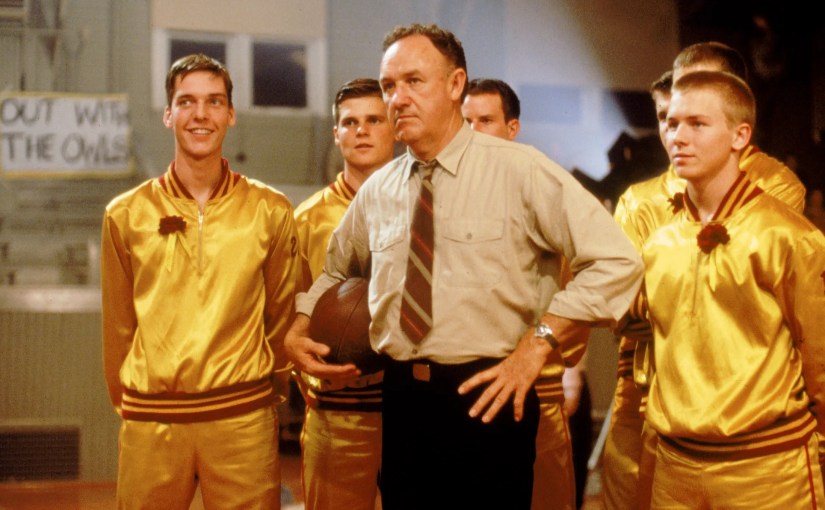
Hoosiers is a sports film offering nothing truly new or inventive.  What sets it apart though is that this high school basketball picture has Gene Hackman as the coach, Norman Dale.

Like so many films, this one occupies its opening credits with the cross country drive of the outsider arriving in small town USA with Jerry Goldsmith’s orchestral horns conducting the journey.  Welcome to the sweeping farmlands of Hickory, Indiana, 1951.  

Coach Dale has been hired by the local high school to lead the team of seven boys for the upcoming season.  Everything typical happens from there.  The potential love interest gives the guy the cold shoulder.  The town, who take such pride in the boys basketball team, find the coach unfit and work the first half of the story trying to vote him out. There’s the one kid who makes every shot and is stand offish, but just won’t play.    There’s a player who has strife with his father, the town drunk called Shooter (Dennis Hopper).  Coach gets kicked out of the games too.  Even Hackman’s recognizable short fits are here to stir it up with the referees.

Yet, is this team gonna get in shape and take it all the way to the championship?  I’ll let you decide if that’s rhetorical question.  

I dunno.  Maybe it’s because I’ve never been wild about basketball that Hoosiers just didn’t do much for me.  A film like Hoop Dreams or even the actor/players shown here impress me with their abilities to make one jump shot after another, while their capabilities to dribble appear like artistic forms of dancing.  The game however has never done much for me.  A team scores and then they go to other side the court where the other team scores.  For me, only the last few seconds of a basketball game seem important.  Otherwise, it’s a back-and-forth scrimmage to me.  Hoop Dreams lends more of a story within its tragic documentary footage than Hoosiers provides.

When I observe the team making plays on the court, there’s not much to open my eyes wider.  David Anspaugh was a new director when this movie was released. Much of the cuts within his footage are the players jumping and passing and Hackman’s sideline expressions where he slaps his play sheet before another cut to the cheering or booing crowd.  This is nothing but action takes. Where are the shortcomings and triumphs that come with cinematic athleticism?

Even the final game does not work like a story.  It’s all just a collection of basketball players making shots.  It never worked for me because I hardly know any of the kids.  The star player, Jimmy, literally has three lines in the film.  I could never pick out which young man was Hopper’s son because most of the team members are given such little attention.  It’s only when a scene or two finally presents itself for the father and son that I connect the dots, but that’s resigned for a quick last act.  The one I could always pick out was the short guy who is not very good and mostly sits on the bench.  The kid who prays too long?  Good gag, but when he’s not on one knee I don’t recall who he is among the crowd.  The players are not given distinct personalities. They are scarcely shown in close up and so I don’t know one from the other.  

Watch Teen Wolf with Michael J Fox.  Beyond the lead who is a werewolf, there are two or three others on the team that triumph, as well as faithful members of the school student body. Thus, that movie ending game becomes something entirely special and touching.

Gene Hackman is always an attraction even if some of the traits he lends to his characters are the same.  I love his grin and his quiet, sometimes sarcastic, cackle. When he throws a temper it’s not one that can be duplicated.  I’ve never seen someone who can do an exact impersonation of Gene Hackman.  He’s simply one of a kind. He’ll always be favorite actor of mine, no matter the material.

Dennis Hopper is very good as well.  He’s not just a drunk, but Shooter is a likable guy who looks worthy of a second chance.  Hopper’s body language defines all of that.  It’s not just the booze or the drying out moments that lend to the performance.  The celebrated actor is given scenes where the character is lost and helpless while trying to contribute moments of value to the basketball team.  Even the unpressed, oversized suit and greasy combover he wears tell a story.

Barbara Hershey seems underutilized.  For most of the film she proceeds with a scowl on her face, and I was never certain of her disdain for the Coach or the school where she teaches.  I could never confound exactly what her problem was anyway. At best, she’s here for an eventual on-screen kiss with the lead, but then the relationship doesn’t progress.  I read that much material went on the cutting room floor, and I can’t deny there’s an absence to her storyline.

Hoosiers is serviceable, but nothing it offers moved me and grabbed my attention.  This is a step by step sports film with every standard cliche included.  I didn’t stand up and cheer when that final shot swished through the basket in slow motion because I did that at the end of Rocky and The Karate Kid, and Teen Wolf too.  When The Bad News Bears ended I did a hard clap because those tykes had balls.  At the close of Slapshot, I couldn’t contain my laughter.  I couldn’t stop thinking about Hoop Dreams for good, long week. Other pictures focusing on athletics always possessed a way of making their stories special.  Hoosiers looks like it stole its play by play from those wunderkinds. 

TRIVIA: Look for Sheb Wooley, who portrays Hackman’s first assistant coach. He is the origin of the famous Wilhelm Scream uttered by Indiana Jones, several Stormtroopers and during the demise of various superhero villains.

THE COLOR OF MONEY

By Marc S. Sanders

The Color Of Money is the first and only time that director Martin Scorsese tackled a sequel of sorts.  Paul Newman returned to the screen as Fast Eddie Felson, the hustling pool shark from thirty years prior in The Hustler.  That movie established his career on a bigger scale going forward.

Fast Eddie is older now, and wiser.  He’s much more humbled as a bar owner with a conservative amount of cash on the table to stake younger pool players for small time wagers.  A young John Turturro is who he relies on and quickly loses faith in when a brash, cocky kid named Vincent Lauria (a perfectly cast Tom Cruise) easily undoes his opponent. 

Eddie sees the talent in the kid.  He’s got a helluva break and clears a game of nine ball with as much speed as he has conceit.  What he lacks for in brains and instinct is made up in Vincent’s cool and mature girlfriend Carmen (Mary Elizabeth Mastrantonio in an Oscar nominated role).  It does not take long for Eddie to coach her into realizing that together they can make a lot of money off of what Vincent can do in pool halls across the country.  If only he’d listen to them and do what they tell him to do. Vincent can’t comprehend how sometimes you win a whole lot more, when you lose first.

Scorsese works his camera like a swinging Steadicam.  When he gets close ups of this trio of actors, it’s never just a close up.  He’ll position his lens in a northward direction and then swing around east.  Newman, Cruise and Mastrantonio trust the eye of the camera to follow their performances.  There’s an energy to this kind of shooting.  It makes for a great style.  Scorsese was doing this novel kind of filmmaking, going all the way back to 1971 with Alice Doesn’t Live Here Anymore.  The director is so favored because as typical as a script might seem by its title or its prose, he’s going to find an exhilaration to its narrative.

Along with the director’s resident editor Thelma Schoonmaker, there’s a crackle and quickness to the many variations of pool play – much more playing than I believe was featured in The Hustler.  Schoonmaker makes sure to cut in the cracks of the pool balls as they collide with one another.  The blue cue chalk snows off the tip of the cue sticks.  Reflections of the players appear in the shine of the balls.  Close up profiles of Cruise and Newman lower down into frame just before they take their shots.  Before the kinetic energy found in later films like Goodfellas and The Departed, Scorsese and Schoonmaker were already putting their tag team best at play in The Color Of Money.

Yet, all of this is style with not so much substance.  What kind of story does this next installment in the legacy of Fast Eddie Felson have to say?  Not much really.  While the three actors are doing top notch work, the conversations run very repetitive and do not build toward higher stakes or developments.  Time and again they argue over Vincent’s refusal or naivety to understand the hustling strategies that Eddie has in mind.  Carmen gets it but she goes her own way more often than cooperating with Eddie.  Simply, this is a story of the protégé not grasping what the mentor is trying to teach, and it never evolves from that problem.  It gets stagnant.

What changes within the second half of the film is the introduction of a championship pool tournament in Atlantic City.  Therefore, it’s easy to expect a showdown between Vincent and Eddie.  It happens and there is a twist of a dagger included, but then when the real competition is about to begin, Scorsese concludes his film.  Does it matter who is the better player?  I don’t know, but as the film is wrapping itself up, one character gets short changed.  When that’s discovered, the film opts to also shortchange the audience.  I didn’t think that was very fair.

I think about the notorious ending to the HBO series The Sopranos.  Sure, it’s an ending no one will ever forget but for all the wrong reasons, and I defiantly believe it is because the storyteller ran out of imagination or lost his confidence in upholding an ending that he really wanted.  I feel the same way with The Color Of Money.  The film establishes the skills, intelligence and capabilities of these characters.  Yet, when you take the tool kits away from them, the building never gets completed; only left abandoned.

I’m drawn to watch The Color Of Money.  Michael Ballhaus’ photography is smokey and colorful. I can’t get enough of Paul Newman’s gravelly vocal inflections or even how he unfolds hundred dollar bills from the roll in his pocket.  Tom Cruise humbles himself to look like an idiotic jerk and it works well against the maturity of his scene partners.  Mary Elizabeth Mastrantonio oozes sexual appeal with a lot of brains to uphold the cons.  She has sensational scenes with Paul Newman.  There’s a coolness to the picture because of the cast, the settings, the sounds, the visuals, the editing and the direction. 

This film arrived in 1986 with rock music from the likes of Eric Clapton and Phil Collins.  Beyond Miami Vice and an assortment of John Hughes teen flicks, these artists were making for effective needle drops of atmosphere in films from the 1980s.  Scorsese’s use of the camera keeps me engaged, but when I look at what the characters are anchored to only do, and never rise above, the film does not hold the weight of other character studies that several of Newman’s and Scorsese’s pictures were so astute at achieving.

One scene transcends the arc of Newman’s character and it works beautifully within or out of the context of the picture.  A relatively unknown Forest Whittaker portrays an unlikely kid who goes up against Fast Eddie. As the long scene evolves over their pool competition, the writing hearkens back to the weaknesses and torment that defined Eddie Felson’s character in The Hustler.  If you watch the first film and then jump over to this scene, you recognize a connection for the protagonist of both pictures.  Beyond that The Hustler and The Color Of Money stand a long distance apart from each other.  This scene though is always a favorite of mine for the eventual Oscar winner, Forest Whittaker.  Watch how Whitaker holds his cue stick when he exits the scene.  Think about how he picks the cash up from the table after Newman drops it.  Consider, what his character Amos really means when he asks Eddie: “Do you think I need to lose some weight?”

Had The Color Of Money used more of Whitaker’s character in the film along with the other three, there might have been something more solid to say and introduce within the world of pool hustling with a 1980s barroom vibe.  Same could be said if John Turturro’s character was utilized more.

Paul Newman received the Oscar for this picture.  The actor was nominated seven times before, having never won and the irony is by the time this nomination arrived, Newman opted not to attend the ceremony.  Roles in films like The Verdict (for which he should have won the award) and Cool Hand Luke were much more memorable and fleshed out.  I’d argue Newman likely knew this was not his best performance because it was not the best written of his long-established career, and so he genuinely did not expect to win.  Because he won, it became a celebration of his legendary status as an actor who should have been taken much more seriously, much sooner.   (Two more nominations would follow in Newman’s career.)

DOWN BY LAW (1986)

by Miguel E. Rodriguez

DIRECTOR: Jim Jarmusch
CAST: Tom Waits, John Lurie, Roberto Benigni, Nicoletta Braschi, Ellen Barkin
MY RATING: 8/10
ROTTEN TOMATOMETER: 88% Fresh

PLOT: A disc jockey, a pimp, and an Italian tourist escape from jail in New Orleans.


The bare-bones plot description above sounds to me like a challenge from some bizarre reality show for screenwriters.  “Here’s your plot, aaaaand GO!”  The opening sequences of Jim Jarmusch’s Down by Law look and feel like an ambitious student film, down to its use of music and the black-and-white cinematography and the artsy montage of Bourbon Street and Orleans Parish, where the film takes place.  Having never seen a Jarmusch film before, as I watched these scenes, I was prepared to sit through a dense character study in which nothing much happens but a lot of talking is involved.  In a weird way, I found myself thinking of Clerks, but I despaired that Down by Law would come anywhere near Smith’s film in terms of getting me engaged in the story.

And then…a funny thing happened…

The film introduces us to two characters.  The first one we meet in great detail is Zack (Tom Waits), a gravelly-voiced former deejay living in near squalor with his girlfriend, Laurette, played by Ellen Barkin on the cusp of major stardom.  Their one scene together reveals the strategy for the rest of the film.  As I suspected, not much happens aside from a lot of talking or, in the case of this first scene, a lot of yelling, but there is a vibe or a sensation or something to the dialogue and the crisp black-and-white images that made their scene more immediate.  I am at a loss to explain exactly what it was.  I got the sense that I wasn’t watching two actors playing a scene.  I felt as if I was looking through a crack in the back wall at two real people having a real conversation.

The next character we meet, Jack (John Lurie), is not as savory as Zack.  Jack is a pimp whom we get to know during a conversation with one of his girls, Bobbie (Billie Neal).  Jack is a small-timer who dreams of hitting it big, but we know, as Bobbie does, that Jack’s big talk will never amount to much.  Jack walks and talks like he’s the man, addressing other hookers and pimps by name, and maybe he even sounds a little dangerous.  But his eagerness to expand his operation leads to some questionable decision-making that lands him in jail, to the great surprise of no one.

I just have to mention again the peculiar power of the direction and the dialogue.  The characters sometimes tend to ramble, but there’s never a second that feels superfluous.  There’s a scene where Zack, the deejay, is approached by an old acquaintance who offers him $1,000 just to drive a car from point A to point B.  The little verbal ballet between the two men, performed in mostly one shot as I recall, could have gone wrong any number of ways, as Zack demurs and his friend persists and round and round they go.  Perhaps because the dialogue is a little circular, it feels more natural than the kind of “punchy” dialogue you might get in a film noir.  The style, the camera placement, the acting, everything just sort of comes together and turns potentially boring dialogue into small windows into Zack’s psyche, and everyone else’s, for that matter.  (I think my online colleague, Marc, would enjoy this film very much, because it uses everyday language to illuminate precisely observed and defined characters.)

Zack winds up sharing Jack’s cell in jail for reasons I won’t get into.  It’s here that the story takes a unique turn.  I’ve read Down by Law described elsewhere as dreamlike or even like a fairy tale.  If so, Roberto Benigni is a benign Rumpelstiltskin.  Benigni plays Roberto (of course), an Italian tourist who has landed in jail for…well, let’s just say his offense is a little more severe than what Zack and Jack are in for, which is funny because Roberto speaks mostly broken English and walks and talks like an Italian Charlie Chaplin.  He doesn’t look like he would hurt a fly, much less commit the crime he supposedly committed.

Benigni’s presence in the film brings a lightness to the movie’s center section as the three men stew in their jail cell for weeks and months.  Zack and Jack are world-weary, anxious to tough out their time with minimal connection to each other, much less to Roberto, who is about as different from Zack and Jack as it’s possible to be without being an actual Muppet.  Is there some kind of deeper commentary being made here about how important it is to just connect with each other to make our lives easier to cope with?  How we would all be better off if we were more like Roberto, who delights in the phrase, “I scream, you scream, we all scream for ICE cream” so much that he almost starts a prison riot with it?  I don’t know.  Maybe.  I just know I felt a warm little glow watching Benigni’s performance, and how well he contrasted with Zack and Jack.

Eventually, the three men escape from prison; Jarmusch makes a bold move by never revealing exactly how they escape, because the how isn’t as important as the fact that they escape, period.  Here is where the movie really evokes fairy tales as the three men trudge through the Louisiana swamps, slowly starving, wary of alligators, working together but getting on each other’s nerves.  Even Roberto’s bubbly personality takes a brief hiatus when his comrades appear to desert him…twice.

I would rather not synopsize the plot any further.  The movie isn’t concerned with a Hollywood-style plot as it is with showing the interplay of these three very specific characters under extraordinary circumstances.  When it’s done as well as this, it’s a pleasure to experience a film that seems completely free from cliches and predictability.  As I said, I’ve never seen a Jarmusch film, but even without knowing much about his filmography, I’m glad I started with this one.  When the closing credits rolled, it strangely didn’t feel like the movie was over.  Instead, it felt as if everything I just saw was the prologue for the rest of their lives.  I envisioned a future where each character is sitting in a bar or on a park bench and spinning a yarn to whomever will listen.  “Hey, I ever tell you about the time I escaped from a New Orleans prison with two other guys?”  Maybe that’s not quite realistic, but when you’re dealing with a seriocomic neo-noir fairy tale, anything’s possible.

[Note: there is a late sequence featuring an Italian actress named Nicoletta Braschi.  Roberto falls in love with her, and she with him, and says they will spend the rest of their lives together.  In real life, Braschi and Benigni were married five years after the film was released, and they are still married today.  Fairy tale, indeed…]

PLATOON

By Marc S. Sanders

Oliver Stone’s Oscar winning Platoon takes place in the late 1960s, somewhere on the Cambodian border during the Vietnam War.  Many of the chaotic happenings the film presents are based on Stone’s own experiences after he voluntarily enlisted to fight.  However, while there is an unwinnable war occurring for the American troops, there is just as horrifying a battle going on within the ranks of the platoon the film focuses on.

Charlie Sheen echoes a lot of his father’s, Martin Sheen, voiceover narration, and performance in Francis Ford Coppola’s Apocalypse Now.  He portrays Chris Taylor, a college dropout who voluntarily enlisted for a one-year tour of duty to serve.  After only one week within the harsh, humid, and wet jungles, he’s writing his grandmother a letter asking what the hell was he thinking.  Chris is quite virginal to the harshness of war and that won’t work to his advantage when needing mentoring and support from his fellow soldiers.  The newest enlistees are the ones at the front point.  They haven’t devoted enough time to sit in the back and because of their lack of experience with war, they are not as valuable for the ongoing campaign in battle.  Platoon is not the heroics depicted in John Wayne movies.  This was one reason that Oliver Stone wanted to make this picture.  Platoon is a bitter retort to Wayne’s celebrated movie, The Green Berets.

There is an angel and devil flanking Chris in the form of Elias (Willem Dafoe) and Barnes (Tom Berenger).  Berenger is the cruel side of the conflict with his battle-scarred face.  He gives his underlings the impression that because he’s seen so much fighting and endured being shot seven times, that he must be invincible.  Elias is a fighting soldier, but he adheres to the rules of war and when it is time for rest, he joins his fellow troops in a unified vigil of drug-induced relaxation.  Chris warms up to Elias easily despite his initial fears of being a soldier with no experience or knowledge of how to survive, much less fight alongside his fellow men.

What drives the conflict between Barnes and Elias occurs following the first act of the movie.  The infantrymen come upon a Vietnamese village.  Some men, including Chris, get wildly abusive with the unarmed people, burning and pillaging their huts.  Only after Chris gets control of himself does he realize the wrongs he’s capable of by serving in this war.  He prevents a group of men from gang raping a child.  Furthermore, he witnesses Barnes commit the illegal murder of a defenseless village woman, shot at point blank range.  Elias has his bearings though and will file the proper reports when the opportunity permits.  Nothing in Platoon is easy though.  This war rages on and the possibility of an investigation and court martial is held off while the fighting continues. 

An interesting take on Oliver Stone’s direction is that he never really shows any close ups or lends any dialogue to the Viet Cong.  I believe Stone is confident that people know who our battalions were supposed to engage with.  However, as another favorite picture of mine stated (Crimson Tide), the true enemy of war is war itself.  The enemies of Elias, Chris, and Barnes as well as the rest of the platoon permeate within and among themselves and it lends to the chaos of the brutal combat scenes depicted in the film. Stone doesn’t offer much opportunity to see who any of the soldiers are shooting at or who is shooting at them.   There is much screaming and hollering but who are any of the characters shouting at and can they even be heard or understand what is being said amid the gunfire?  Platoon demonstrates that a Vietnam war picture is not one of heroics with grandstanding trumpets and a towering John Wayne who takes a hill.  War is disorganized, messy, and terribly bloody. 

This may be Charlie Sheen’s best film of his career.  As he represents the fictional account of Oliver Stone’s personal experiences, we see the trajectory of his change.  He is supposed to be there for 365 days, and he, along with his buddies, count down to when their tour will be complete.  However, this one short year will be the longest he ever encounters, and it will change him permanently, assuming he survives.  Chris is always tested of his tolerance.  He’s always subject to respond to how Barnes commands or how Elias mentors and leads. 

Oliver Stone is so convincing in his often-documentary approach to Platoon that it is at least understandable to see how the men in this picture behave and carry themselves.  Why do they refer to the Vietnamese as “gooks.”  Why do they bully with intent to commit rape.  Why do they quickly pounce to kill when for even a moment there is no threat.  Moreover, why they are willing to turn on each other.

They were never the decision makers for this conflict.  These soldiers are depleted of sleep and rest.  They are the pawns of a higher power, and they have been left to their own devices in a dense environment infested with bugs, snakes, unbearable humidity, and bodies that infest the waters and land while armed men appear out of nowhere ready to ambush.  Some ensnarements might occur within their own regimen.  None of these men are justified in their actions.  Yet, it is not hard to understand where their motivations stem from.  They are not programmed for heroics.  Keith David portrays a likable soldier who tells Chris that his mission is just to survive until he’s summoned home.  Survive among those you march and sleep with.  Outlast this hellish environment and overcome those that are trying to mow you down in machine gun fire.  Everything else around here is “just gravy.”  When you are an infantryman, you are not making a statement any longer.  You are not fighting for a cause anymore.  You are only trying to stay alive.

Platoon is such a shocking film of unconventional madness and turmoil.  Oliver Stone is relentless in the set ups he stages.  This picture came out in 1986, long before the strategic methods of the modern “shaky camera” approach.  It’s beneficial to watch the film as Stone must be positioning his camera on a track as the platoon hikes through the forest, parallel to his moving lens.  We are walking alongside them.   Early morning overhead shots depict the carnage of battles that occurred in the dark of night. Flares and sparks come from nowhere.  I think you could watch this movie ten times and still not know when to expect gunfire to intersect with the story or when the bombs to go off.  It’s hectic hysteria like I can only imagine these young men experienced before they spilled their blood on the battleground and either died right there or returned home physically and mentally crippled for life.

Platoon is one of the best and most frightening war pictures ever made.

LEGAL EAGLES

By Marc S. Sanders

In Legal Eagles, Robert Redford plays a promising district attorney named Tom Logan, who becomes ensnared by Debra Winger, playing a private defense lawyer named Laura Kelly.  Laura is representing Chelsea Deardon (Daryl Hannah), a mysterious, but alluring twenty-something accused of stealing a priceless piece of art.  Murder eventually comes into play.  Romance does as well.  Unfortunately, none of it works in what should have been a charming comedy from director Ivan Reitman (Ghostbusters, Stripes, Meatballs).  The casting is solid.  The script is not.

When this film was released in 1986, Robert Redford looked like the best option for the standard romantic comedy, to lead the fraternity of male actors eventually to come by way of Billy Crystal and Tom Hanks.  Debra Winger was well known with a collection of Oscar nominations for more serious subject matter.  However, she has always possessed that smart yuppie look; aggressive, professional, and ready for love.  Redford and Winger make a perfect pair.  The flirtations between the actors’ characters in Legal Eagles work quite successfully.  The regret is that a flat, boring mystery for them to tackle is always getting in the way. 

During Chelsea’s eighth birthday she is presented with a painting by her renowned artist father at a lavish party.  Later that night, a fire ravishes through their apartment.  Her father perishes in the flames and the painting along with other priceless pieces of art were thought to go up in flames.  Jump eighteen years to present day 1986, and Chelsea insists to both Laura and Tom that some of those paintings, including her father’s gift to her were stolen before the fire occurred.  Suspects are interviewed.  Danger gets in the way and so on.

The problem with this initial set up is that this conundrum is pretty stale.  It doesn’t offer enough to keep me interested.  What do I care about a stolen painting?  Moreover, I could care less about the fate of Daryl Hannah’s character.  She’s designed to be the standard Olan Mills Photography glamour model of the 1980s, and she is most certainly beautiful, but she is written with as much dimension of what a thumb tack does when you push it into a wall.  She just sticks there. 

There are some usual suspects for the lawyers to pursue like Terence Stamp, an interesting character actor by reputation.  Regrettably, his art dealer portrayal is not written with much logic.  The two lawyers follow him to a warehouse and find themselves in danger when Stamp traps them inside with a ticking time bomb that will not only kill them but destroy his immense collection of assets and records.  Why go through all this trouble?  You’ve got some of the most valuable, sought after pieces of art tucked away in here. 

Brian Dennehy is a cop who welcomes himself into the story and the “intuitive lawyers” happily accept his trust when he offers his file on the fire investigation from eighteen years prior.  He just turns up at random, odd moments.  Do Tom and Laura even think to wonder why this guy is so interested in assisting them all of the sudden?

What really sends Legal Eagles off the rails though is a step away from the narrative so that Robert Redford and Daryl Hannah can be caught in bed together.  This serves no purpose.  It’s a scene that screams of a producer demanding this happen to sell movie tickets and it betrays the intelligence any of us would expect of a sharp-witted New York City District Attorney.  Even more absurd is when Redford and Hannah are awakened the next morning, she is arrested for murder.  So the lawyer sleeps with the client, but no concern regarding ethics is ever questioned.  As well, Winger’s character just delivers an eyeroll response to Redford’s error in judgment, but the two continue to work in flirtatious harmony.  That doesn’t offer much respect for the aptitude of Winger’s character.  She should be repulsed by this transgression.

Legal Eagles contains more charming and mature humor than Ivan Reitman was recognized for by this point in his career.  It’s a yuppie ‘80s film.  I only wished for a more insightful pursuit and storyline for Redford and Winger to be focused on while they fall for one another amid the scenic backdrop of a bustling New York City. 

Daryl Hannah looks like she’s in another movie altogether.  Yes, she sleeps with Redford’s character, but I don’t think Hannah has more than five lines of dialogue exchanged with either Winger or Redford.  She’s expendable here.  You practically forget that she’s the accused client the lawyers are working to exonerate.

The value of the missing painting is hardly stressed upon.  The motive for murder really isn’t either.  There are not one or two fires in the film, but rather THREE!!!! Did the craft of invention just stop after page one of the screenplay? 

From a marketing standpoint, based on casting alone, this film had such potential.  The movie features some of the best working talent going for it.  Sadly, it gave all the players nothing to do, and what little was done lacked any kind of foresight or wit.

On the subject of Legal Eagles, my motion stands.  This movie is inadmissible in court!

ALIENS: THE DIRECTOR’S CUT

By Marc S. Sanders

James Cameron’s Aliens is deliberately morose in its storytelling and cinematic look.  It’s ugly and nightmarish.  It’s nerve-wracking at times.  It’s dark and somber too.  It’s also one of the best action films ever made.  For me, this is Cameron’s best film and it’s not only because I’m a sci-fi blockbuster nerd of sorts. 

Serving as a sequel to Ridley Scott’s monster movie, Alien from 1979, Aliens works on its own independence while still adhering to the storyline qualities of the original.  Sigourney Weaver returns as Ripley.  The story begins 57 years later where Ripley’s lifeboat ship from the end of the first film is found in deep space.  She reports back to the conglomerate company of the terrifying happenings she experienced with her crew mates who didn’t survive when an unrecognizable creature terrorized them aboard their vessel.  The company is less than apt to believe her account though. 

One of the company men, Burke (Paul Reiser), requests that Ripley accompany him and a squad of tough Marines on a mission to the planet, LV-426, where her crew discovered an immense crop of eggs and took back an alien aboard their ship.  In Ripley’s absence, a colony of over a hundred families was set up on the planet to establish habitable real estate.  However, the colony has lost contact, and the company is sending in the military to assess the situation to see what’s going on. Ripley is supposed to only serve as an advisor.

James Cameron’s script and direction takes its time to build up suspense and explore what’s unknown to these soldiers.  Upon arrival on the planet, much of what they find is left in wreckage and no one is to be found anywhere.  At best, Ripley can only see what was likely the remains of alien attacks with acid burns within the steel structures.  Yet to Ripley and viewers familiar with the first film, it is still a mystery as to what truly occurred.  Naturally, more will eventually be uncovered and then this arriving crew will have their hands full.

James Cameron has an imagination that bursts with colorful and amazing ideas.  The Terminator films were astonishing in its own apocalyptic future that haunts a present time period.  Titanic was a film mired in much expense and technical setbacks. Though, no one ever expected just how accomplished the award-winning blockbuster turned out to be.  Avatar is wonderous on a planetary level.  However, James Cameron is not necessarily a celebrated script writer.  Often his dialogue is very cheesy and unnatural.  Aliens is the exception though.

The script acknowledges that these gung-ho marines are “grunts.”  Thankfully, they talk like grunts.  I know that many fans adore Bill Paxton as the cut-up member of the troupe known as Hudson, who has brilliant one liners.  It’s actually a well fleshed out character.  Before Hudson knows what he’s up against, this new mission is just a lame “bug hunt” and he happily screams out as their spacecraft makes the quick drop into the planet’s atmosphere.  When he eventually comes to face to face with the monsters, terrifying, cry baby like fear overtakes him.  He’s giving his one liners like “Game over, Man,” and “We’re  fucked!”  Yet, the dread and anxiety are completely relatable.  There’s something out there waiting to tear me apart and eat me, and there’s hardly anyone left to help and rescue me.  I’m in the middle of nowhere.  Cameron wrote a good under the radar kind of character, and we feel for this guy’s dilemma as if it’s our own.  Paxton’s performance made it better and awarded it with adrenalized highs…and these aliens, with teeth and tails and acid for blood, are most definitely scary as hell.

I no longer watch the original theatrical cut of Aliens.  I turn to the Director’s Cut that Cameron always envisioned.  Particularly, it triumphs because the Ripley character is much more fleshed out with necessary dimension for the film.  Early on, a cut scene, now restored, tells us that Ripley’s daughter died from cancer while she was lost in deep space.  The daughter lived to the age of 66, even though Ripley didn’t age a bit.  Awakening from her cryo sleep, only introduces heartache for Ripley.  What I like about this information is that it serves a relationship later found in Aliens.  A little girl named Newt (Carrie Henn) is found by the marines and appears to be the sole survivor of the alien attacks.  Ripley steps in as a surrogate mother towards Newt as all of the characters work tirelessly to survive and somehow get off the planet.  The Director’s Cut gives some value to Ripley and purpose beyond just violently slaughtering aliens as a means of revenge or fulfillment.  It allows Aliens to work on an effective emotional level and Sigourney Weaver earned her Oscar nomination because of it.

Cameron introduces traitors as well into the story, which are likely not so surprising but make the film all the more challenging for the heroes of the picture.  Michael Biehn is the sex symbol, a cool and quiet tough guy.  Jenette Goldstein is a Hispanic marine who gives off good imagery as one of the few female squad members who enters the areas first with the largest gun in the troupe.  Lance Henrikson is memorable as an android that Ripley is apprehensive to trust – perhaps he’s the “Mr. Spock” of this sci-fi entry.

Technically speaking, Aliens is so unbelievably atmospheric in its bleak, futuristic setting.  Barring a few moments where the spaceships clearly look like miniatures, the interiors look organically formed.  I can’t compliment the set pieces enough in that respect.  When the Marines enter a large cavern, it is enormously shell like that it looks like an animal’s nest.  Cameron hides his various monsters perfectly.  So that when they slowly unravel their tales and skeletal forms, it looks as if the darkness within the frames begin to move.  The stillness of what surrounds our main characters awaken with life that maybe we don’t want to see. 

Aliens works independent of Ridley Scott’s prior picture because it’s a war movie; one that is set on an outer space planet.  We witness how the surviving squad troops strategize with what little they have left.  Thereafter, we see how they face enemies who may have the upper hand in battles to come.  I love how Cameron builds suspense with a sensor device the troops use.  It begins to ring as a life form closes in on their proximity.  The monitor fills with glowing blurs as more life forms nearby build up.  A nervous and great moment occurs when they can not understand how the aliens could be so close and yet none of them can see what is so nearby.  The surprise is unexpected and worthy of a scream. 

Cameron’s script doesn’t give his heroes a break.  Aliens thrives on the characters simply playing keep away, while one member of the party is working against what little they have left.  I like that.  While Aliens may be intentionally dreary the fact that there’s no easy out for these folks is what keeps the pulse of the film racing with nonstop suspense and action.

Aliens is an absolutely solid picture promising a future for this franchise. Sadly, it really never excelled above what was accomplished in these first two films from Ridley Scott, and now James Cameron.  Years later, Scott returned to the franchise with some interesting prequel films that colored in some of the elements that were only talked about before, like the company that puts all these people within the peril of the aliens.  Yet to date, that all still remains unfinished.  James Cameron just set the bar so high with his movie that the few that followed never amounted to what he created.

You may not feel all warm and fuzzy after watching Aliens, but at least you’ll feel incredibly excited with its construction from a director in the early years of his profession.  James Cameron brought about a solid script and unbelievable effects that say so much on a visual level.  If Aliens makes you nervous, fearful and especially terrified, then James Cameron has done his job.

AT CLOSE RANGE

By Marc S. Sanders

Sean Penn has been a gifted actor from the very beginning of his career.  Whoever thought the kid who played surfer dude Jeff Spicoli in Fast Times At Ridgemont High would go on to evoke such intensity in future roles afterwards?  Other actors who did that kind of sophomoric material went on to be in Police Academy movies.  Penn would never shake that surfer image, but he would at least equally receive accolades for his dramatic turns. In James Foley’s At Close Range the high stakes drama could not be more apparent. 

Penn portrays Brad Whitefore, Jr. in this film based on a true story taking place in a small, rural Pennsylvania town in 1978.  Brad Jr.  is going nowhere and that’s fine with him.  He’d rather be an intimidating, fearless kid who will defy his step father so he and his brother (Chris Penn, Sean’s real-life sibling) can get drunk and high.  When Brad opts to go live at his father’s, Brad Sr., house, he hopes that he will learn the ropes of becoming a career criminal like his dad.  Brad Sr. (Christopher Walken) specializes in ripping off tractors, farm equipment, cars, wealthy property owners, and safes carrying large amounts of cash.  He happily welcomes his son into his home with his misfit gang and his new young wife.  Dad will also express love to his son by giving him a car and support, while also welcoming in Jr’s new girlfriend Terry (Mary Stuart Masterson). 

There is a code among these criminals however, and it stretches to flesh and blood as well.  No one is to talk about what they do or how they do it.  Shortly after dad allows his son join in on a job, Brad Jr. learns of the consequences if anyone talks about their handiwork, especially if you are seen chatting with local law enforcement.

At Close Range came out in 1986.  Even by then, I don’t think it would be challenging to forecast where the story is heading.  What’s most interesting about the film are the cast performances from Penn, Walken, and Masterson.  James Foley sets up good scenes where loving trust works at one point, but when that is shattered, what is the detritus left over afterwards?  Christopher Walken plays a guy with no limits to upholding his code, and as I reflect on that motivation, I can’t help but think how relevant Madonna’s eerie ballad Live To Tell (from her True Blue album) is so very important to the picture.  The song should have received an Oscar nomination based on its significance alone.  I’ve only now just seen the movie for the first time.  Yet, I’ve been familiar with the song for nearly forty years.  It carries much more meaning now.

James Foley’s film could’ve been better, however.  The first hour is incredibly slow moving and doesn’t seem to offer much direction or exposition for what the film is truly going to be about.  At some points it is a boy meets girl storyline with Penn and Masterson.  They have good scenes together, but were they all necessary?  Couldn’t some of this material ended up on the cutting room floor?  Then in other areas it is a father/son coming of age piece where pals from both of their respective backgrounds get drunk together on any given night.  Brad Sr. is emulated for his leadership, the gun he carries, the money he flashes and the high-end muscle cars he steals, even gifting one to his son.  Brad Jr. is looked upon as the cool rebel (maybe a more aggressive modern James Dean) for not surrendering to intimidation from anybody. 

The movie also ends kind of abruptly.  It’s clearly understood what’s going to come of the father and son’s relationship.  Sean Penn and Christopher Walken stage a nail biting, very intense showdown in the kitchen.  However, what happens to them individually?  The final scene actually ends right in the middle of what could have been some good dramatic work, but it all goes to black.  Had I been in a movie theatre, I might have thought the projector broke down.  Business must have interfered behind the scenes.  A producer must have stepped in and pulled the plug.  It’s the best excuse I can think of, because the end credits intruded way too soon.  If the film was being edited for length, then there was much material to chop out of the first hour.  The filmmakers basically cut off the wrong leg.

At Close Range is not a steady trajectory of a movie.  It moves in too many sideways directions to stay focused on what it wants to be considered.  Is it a more genuine Rebel Without A Cause?  Is it a rural, backwoods interpretation with inspiration from Mean Streets?  Thankfully, what saved me from turning it off or falling asleep are the assembled cast performances.  At the very least, it got me interested to read up on the real story the film is based on.

TOP GUN

By Marc S. Sanders

For a movie that focuses a lot on showers, men’s locker rooms and bare chested sweaty and chiseled volleyball players, it’s a wonder that it is called Top Gun.  Maybe the title has another indirect meaning to it, other than a moniker for a Navy fighter pilot school of the elite.  Maybe these guys are elite for a different reason.

The Tony Scott film that is supposedly about the top one percent, the best of the best, American fighter pilots in the Navy is arguably the most important film in Tom Cruise’s career.  It launched the actor into a superstar sensation that has hardly faltered since the movie’s release all the way back in 1986.  But is it a good movie?  Well, yes and no.

I’ve always loved Tony Scott’s filmmaking technique.  Sure, his sun-soaked film shots are constantly repeated.  He always relishes in enhancing the beaded glow of sweat drenching his actor’s faces, arms and chests.  It’s seen in nearly every moment of Top Gun, as well as other celebrated pictures like Crimson Tide, Beverly Hills Cop II and True Romance.  Orange sunlight blankets palm trees and beach lined streets.  Bar saloons and military headquarters are lit in sexy blues and greens.  It may lack originality after seeing a few of his films, but it just makes the movie all the more sexy. 

Tony Scott is also a well-versed director in action sequences.  He’ll get your pulse racing and Top Gun is the best example.  The fighter jet sequences in this film are masterful in editing, sound and speed.  It’s fantastic to see how the planes will twirl around and then shoot themselves straight up into a vertical trajectory in the sky and finally cut in on actors Tom Cruise, Anthony Edwards and Val Kilmer for a “WOO!” moment in the cockpit.  This stuff still holds up.

Yet, unlike other modern-day films that focus on cadets or students in our armed forces, Top Gun doesn’t concern itself with the discipline of what it takes to serve in the Navy.  This is the informal, class clown version of An Officer And A Gentleman.  You only need look as far as Tom Cruise’s character’s pilot call name, Maverick.  The name itself is a one-word thematic description of what you are watching.  So, the kid who learned to say “what the fuck” in Risky Business, went on to do daredevil flybys while disobeying orders.

Maverick’s real name is Pete Mitchell.  He has no family except that of his co-pilot, Goose (Anthony Edwards).  The disappearance of his Navy pilot father remains a mystery…because it is sexy and cool to have a mystery for your handsome hero in a film like this.  Call it DRAMATIC HEFT!!!! 

When Maverick and Goose get the opportunity to attend “Top Gun” – a fighter school specializing in training the best pilots in the world in aerial dog fighting – they are intent on getting their names on the plaque for the best of the best of THE BEST.  Competition comes in the other prettiest of the pretty boys with Iceman (Val Kilmer).  These are all great likable characters.  Yet, even when I saw this film at sleepaway camp at age 13, I couldn’t help but notice how distracted it gets with the abundance of erotic machoism on display here.  What would serve as dramatic dialogue in another film is presented in a steam room area allowing opportunity to see the male cast wrapped in towels around their waists with wet spiky blond and black hair.  It truly doesn’t matter what they are talking about in this scene.  When you are watching it, all that you are hearing is the sound of Charlie Brown’s unseen and indecipherable school teacher.  “Waa waa.  Waa waa waa waa!”

That’s not enough though.  The infamous volleyball scene keeps you awake.  I don’t care if you are hetero or homo or bi or pan or plus, the beach volleyball scene keeps you alert as one of Kenny Loggins’ many movie songs plays in accordance.  Tony Scott doesn’t just go for tossing the ball around.  Slow mo captions are offered of each guy just posing with their chiseled arms and chests.  You may not take your eyes off of it, but oh my…what does this have to do with the discipline of attending Navy fighter pilot school training?????

The romance is second to none.  Truly!  These days, people talk about Jack and Rose in Titanic or Ross and Rachel on Friends.  For me, it’s Maverick and Charlie (Kelly McGillis).  Cruise and McGillis really light up their scenes together.  It’s an absolute perfect pairing of sex appeal and it is really when Top Gun performs at its smartest level.  The dialogue is strongest during their scenes.  The romance isn’t rushed but nicely flirted with, and when tragedy strikes within the thin storyline of the overall film, the relationship goes in another supportive and appreciated direction.  When I was a kid, with hormones being discovered for the first time, my buddies and I would elbow each other during the midnight blue sex scene between McGillis and Cruise with the Oscar winning song “Take My Breath Away” from Berlin playing.  I look at this scene now and it is modern romance at a beautiful best.  A fantastic scene from Tony Scott. 

Charlie is the unexpected, well-versed contractor for the Navy giving counsel to the pilot students on how best to operate the jets.  In the 1980s, action blockbusters normally held the women as the barely dressed damsels to be rescued, and nothing more.  The female characters didn’t have brains and the only brawn to go around was saved for Princess Leia or Marion Ravenwood (Raiders).  Charlie is an exception though.  McGillis plays the character as someone who is aware that these testosterone-filled guys will regard her as a piece of meat, until they realize otherwise.  The irony of Top Gun is that the nearly all male cast, Cruise included, are the pieces of meat.  The one main female role is actually the brains of the whole operation.  McGillis was a marvelous actress back in the day.  Go look at Witness and The Accused to see what I mean.  With her help, Cruise elevates above the hokey dialogue of the Top Gun script. Kelly McGillis really could act well in almost anything.  I wish her career went further, honestly. 

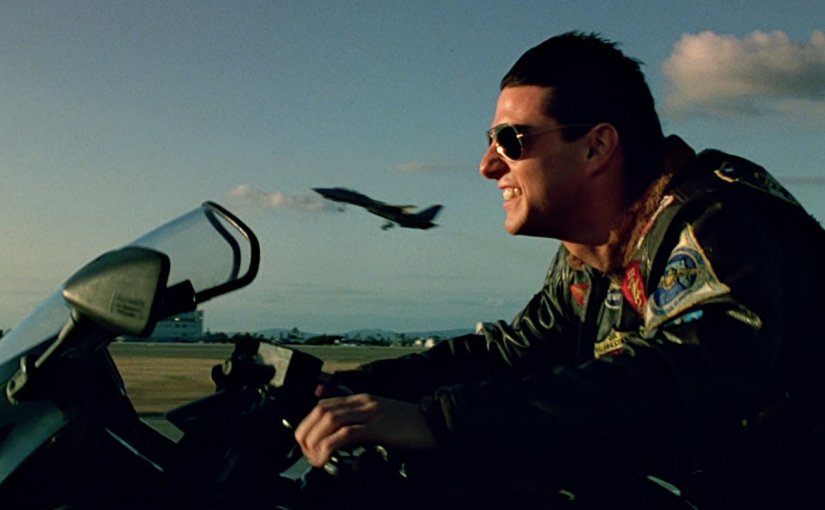
Top Gun remains a mainstay in 1980s pop culture.  If the VH1 channel is doing a documentary on the decade of Madonna, Michael Jackson, parachute pants and neon pastels, Top Gun is also brought up in the mix with a close up of Tom Cruise’s toothy grin and his aviator sunglasses.  We were never watching Oscar winning material here, but somehow the film that introduced all of us to Tom Cruise still feels like a day at the beach with the twenty something boy toy in his tight jeans and leather bomber jacket riding his Kawasaki Ninja motorcycle at top speed or breaking the sound barrier in his fighter jet with his shiny navy-blue helmet on his head.  Top Gun and Tom Cruise demonstrated that it’s a party to serve in the Navy.  Why not?  Vietnam was behind us and the decade was not embroiled in war.  Join the Navy!!!!  It’s fun and you get to shower with the best-looking guys in the world.  You’ll even get to play volleyball with them and date your sexy flight instructor.

A lot of the dialogue and the storyline may sound like an adult, military interpretation of Saved By The Bell, but you can’t break away from the sexy allure of what Tony Scott with Cruise, Kilmer, McGillis and Edwards put on the screen.  It’s always been there and somehow a sequel was never made. 

Wait a second!  WHAT??????

STAR TREK IV: THE VOYAGE HOME

By Marc S. Sanders

We owe a lot to H.G. Wells, author of The Time Machine.  Without Wells, Marty McFly would not become familiarized with a souped-up DeLorean, and Earth as we know it would be decimated by the year 2286 because a probe, in the shape of a Ring Ding pastry, from the far reaches of space could not find its humpback whale friends to say hello to.  If Star Trek IV: The Voyage Home is not the best of the film series, it is certainly the most fun and delightful.  (For the record, my personal favorite is Star Trek II: The Wrath Of Khan but sometimes I switch to Star Trek VI: The Undiscovered Country.)

Kirk, McCoy (William Shatner, DeForest Kelley) and company have managed to resurrect their comrade Spock (Leonard Nimoy, also returning to the directing chair). Now, they are enroute from the planet Vulcan to Earth awaiting trial for the crimes and violations they committed in the prior film.  However, they must follow a detour back in time to the year 1986 and pick up a pair of humpback whales.  The sea mammals are the only creatures that can speak with an alien probe and salvage the Earth from becoming destroyed.  The probe isn’t an enemy.  Its arrival is simply unsettling the planet’s oceans and core because it can’t communicate with whale life, that is now extinct by the time 2286 has arrived.

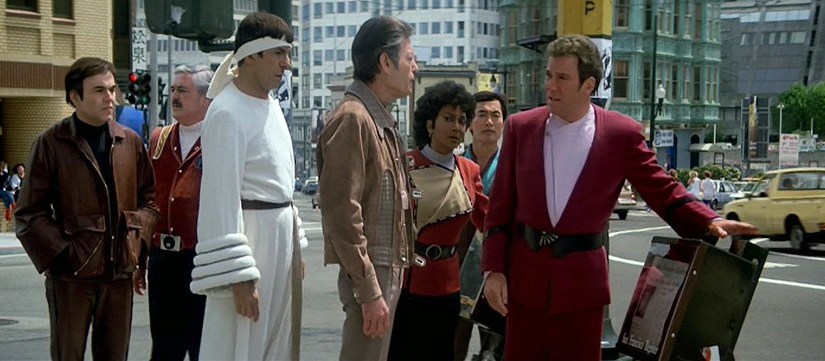
So, in a Klingon Bird of Prey that they took command of and dubbed the HMS Bounty, our favorite Federation crew, arrive in late 20th century San Francisco.  Problems lay ahead though.  Their dilithium crystals (fuel) are depleted, they are unfamiliar with the daily activities of life during this period, and just how are they to find a pair of mammoth whales by walking around the city?  As well, Spock is not exactly himself since his rebirth.  His knowledge is there, but his common sense that stems from his human half is lacking.  This leads to some funny engagements with the city folk as he develops a habit for some colorful language not commonly used in the 23rd century.  A scene on a city bus with a punk rocker is a terrific highlight. 

Well, within the film’s two-hour time frame a pair of whales is located at The Cetacean Institute and they are overseen by a spunky and emotionally caring guide named Gillian portrayed by Catherine Hicks.  Now the gang has just gotta get home to their time before it’s too late.

The script for The Voyage Home is really quite brilliant and such a pleasant surprise.  All of the characters have their own moments for humor to occur.  The best being that Chekhov and Uhura (Walter Koenig, Nichelle Nichols) have to find a nuclear power source to make up for the lack of dilithium crystals.  Imagine, during the time of Reagan/Gorbachev Cold War politics, a man with a heavy Russian accent politely asking a motorcycle cop where he may find the “nuclear wessels…NUCLEAR… WESSELS.” It’s also inspiring to place a cynically cranky Dr. McCoy in a city hospital only to question how medical practices were ever tolerated at this time. “Is this the dark ages?”

William Shatner and Leonard Nimoy make such a sincere pair of friends as Kirk and Spock.  Shatner is especially good in the Star Trek films because he performs with a way of sarcasm and whimsy.  He works like Errol Flynn, unreserved while he swings into the danger.  Yet, he’s also so sincere.  There’s a flirtatiousness to him that’s impossible not to like.  He’s just so personable.  You also feel for his Kirk when he wishes his old friend, Spock, would just return to the way he once was and simply address him as “Jim,” not Admiral.  I couldn’t help but relate to it as someone who may wish that with a relative suffering from dementia.  The loved one is still there, and yet he/she is not there.  That’s how Shatner touchingly approaches this relationship.  The chemistry between Shatner and Nimoy is unparallel.  The recasting of the roles in later years has not matched up.  The original actors just read each other’s timing perfectly like Laurel & Hardy or Felix & Oscar.  There’s Newman & Redford.  There’s Lemmon & Mathau.  There’s Shatner & Nimoy.

I always had my facts mixed up.  I was always under the impression that this film was nominated for a Best Screenplay Oscar.  It in fact wasn’t.  Yet, it really should have been.   The Voyage Home has a message on the importance of preservation of life and an urge to hold on to the integrity of our environment.  Thankfully, it’s not preachy.  There’s a combination of science fiction, adventure and humor at play here that I don’t think has ever worked better in what I’ve seen of the Star Trek universe of films and TV series. This is just a very, very smart film with good, insightful direction from Leonard Nimoy. 

Nearly forty years later and this picture still holds up.  So many of our planet’s species remain endangered.  Many are suspected to be extinct by the hands of man.  The Voyage Home touches upon these facts.  It still feels so up to date that you even get a lump in your throat at the top of the film when a dedication is made to the memory of the Space Shuttle Challenger crew.  The makers of this Star Trek installment really presented a timeless film with the help of time travel, and you don’t have to be a Trek fan to appreciate its merits.

PRETTY IN PINK

By Marc S. Sanders

Director Howard Deutch directs John Hughes script, Pretty In Pink, by adhering to the familiar themes quickly recognized as Hughes’ signature touch from prior films. Deutch and Hughes maintain a vibe of alternative rock music amid a Chicago public high school community that could never be possible. Did I have this much independence in high school like Molly Ringwald as Andie, her adoring rich boy crush Blaine (Andrew McCarthy), or weirdly annoying (and lovable at the same time) Duckie played by Jon Cryer? And, oh yeah, a high school senior asshole named Steph played by asshole character perfectionist James Spader with his long cigarettes, Italian suits and barely buttoned shirts would never exist in an institution of education. So, there’s that too.

The kids at this school are divided among two different sides of a track-poor (Andie & Duckie) and rich (Blaine & Steph). Never meant to socialize or get along, the conflict of the film occurs when Andie and Blaine fall for one another.

This is Molly Ringwald’s 3rd Hughes film and looking back maybe it was a mistake for her career as she was outgrowing the roles she was getting pigeonholed for. Still, who else could you envision in the role of the aspiring dress designer who is responsible for her schlub of a father she lives with (Harry Dean Stanton), and friends with a weirdly eccentric, 80s punk/alt dressed co-worker played by Annie Potts?

Hughes’ is quite serious here, though the setup is not acceptably realistic, even back in 1986. These characters are competitive with one another for status in a high school setting. What other environment could the outline for Pretty In Pink take place in, though? Prom is on the minds of these “adults.”

Pretty In Pink was never a perfect movie. It has a perfect soundtrack, and I like the cast a lot as well as Hughes’ characterizations. Its glaring imperfection, however, is that these characters fit like a circle in the square setting of high school. The elements clash big time.

Still, I’ve always had an unusual affection for the film. I guess it is because I look past its inaccuracies and accept a playing field and the positions that Hughes and Deutch defiantly assign to the four characters. How does the intrusion of background and status overcome an affection between two people, and can this ever be happily resolved?

The ending was supposed to be different, very different. Yes. I should agree with the original conclusion because the math of the story adds up to that point. However, Reader…I am as defiant a viewer as Hughes and Deutch were as filmmakers. It’s wrong!!!! Nevertheless, I loved the ending that was eventually tacked on. So don’t judge me.