SPECIAL GUEST REVIEW: THE ROCKY HORROR PICTURE SHOW (1975)

by Ronnie Clements with Screen Gems

Screen Gems reflects on The Rocky Horror Picture Show (1975)… Review by Ronnie (Dorian) Clements on his FB page Screen Gems http://www.facebook.com/screengemsbyronnie


On 14 August, 1975 (50 years ago), The Rocky Horror Picture Show opened at the Rialto Theatre in London. Rocky is still the longest running movie in theatrical history and the biggest cult movie of all time! I doubt if any other film will ever “usurp” it. 

[And whatever you do, forget the 2016 made-for-TV remake. It’s a pale imitation, woefully flat and best left in the vault or preferably down the pooper!]

Screen Gems 70’s Flashback …

The Rocky Horror Picture Show (1975).

A Look Back at the OG (totally re-written for the masterpiece’s 50th anniversary) …

Two of the most unforgettable Saturday afternoons of my life were spent watching live matinee performances of The Rocky Horror Show; years apart, yet equally electric. While the film adaptation, The Rocky Horror Picture Show, has rightly earned its cult status, nothing compares to the raw energy of the stage. Still, the movie captures the essence and outrageous brilliance of the original, preserving it for eternity.

As a screen adaptation of musical theatre, Rocky stands alone. There’s truly nothing else like it. The score is wildly eclectic, veering from tender ballads to glam rock anthems, and yet not a single dud among them. It’s a sonic rollercoaster that defies genre and expectation.

The plot? A delicious mash-up of horror and sci-fi tropes, with a heavy nod to Frankenstein. But what emerges is something wholly original: a campy, chaotic celebration of identity, desire and rebellion.

Written by Richard O’Brien, The Rocky Horror Show premiered at London’s Royal Court Theatre Upstairs on June 19, 1973. The original cast: Tim Curry (Frank-N-Furter), Richard O’Brien (Riff Raff), Patricia Quinn (Magenta), and Nell Campbell (Columbia), all reprise their roles in the film, bringing their eccentric brilliance to the screen.

The stage show holds the record as the longest-running theatrical production in history and it’s still performed around the world. The film, after flopping on its initial release, found new life through midnight screenings in the mid-70s. Word of mouth turned it into a phenomenon. 

Since 1975, it’s been shown continuously in cinemas — the longest theatrical run ever. Every Friday or Saturday night, somewhere in the world, fans gather in costume, props in hand, ready to shout, sing and surrender to the madness. I’ve never attended a midnight screening myself, but I’m told it’s a surreal, unforgettable experience.

The Story …

Brad (Barry Bostwick) and Janet (Susan Sarandon), two squeaky-clean newlyweds, find themselves stranded on a stormy night. Seeking help, they stumble into the gothic lair of Dr. Frank-N-Furter, a self-proclaimed “sweet transvestite from Transsexual, Transylvania”, and his bizarre entourage. What follows is a wild descent into seduction, science and spectacle as Frank unveils his latest creation: the perfect man, built for pleasure.

Does the plot make sense? Not really. But that’s beside the point. It’s pure fantasy, a glitter-drenched fever-dream, powered by a magnificent score and unapologetic theatricality.

Tim Curry was born to play Frank-N-Furter. His performance is iconic, seductive, menacing and utterly magnetic. The rest of the cast delivers with equal flair. The film’s comic book aesthetic (garish lighting, bold colors, exaggerated performances) only heightens its surreal charm.

Themes Beneath the Fishnets …

At its heart, Rocky Horror is a battle between conservatism and counterculture. And, as in life, the establishment unfortunately wins! Frank-N-Furter and Rocky are killed … but … Brad and Janet return to their “normal”, mundane lives. However, the film leaves us questioning what “normal” really means and whether conformity is truly a happy ending! 
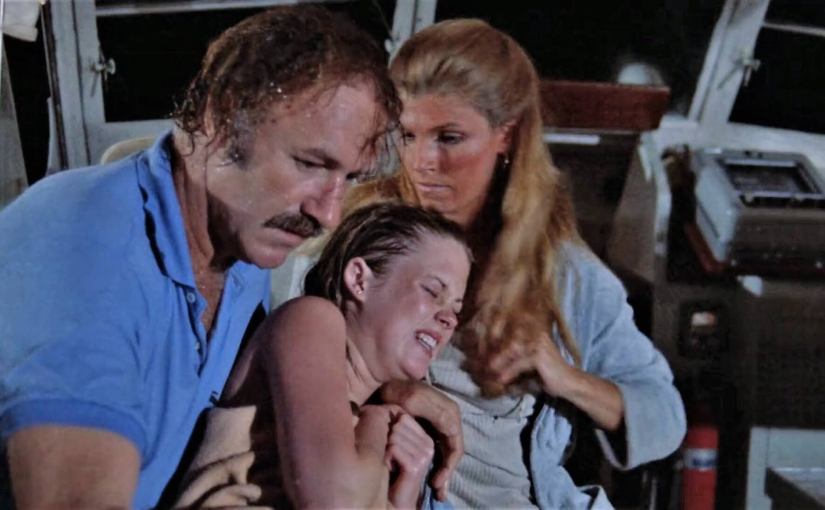
NIGHT MOVES

By Marc S. Sanders

As soon as composer Michael Small’s easy listening disco themes kick in and you see Gene Hackman make a u-turn in his green Ford Mustang convertible, I had vibes that Night Moves was going to operate like an episode of The Rockford Files.  I was alert and energized.  I liked where this was going.  A new, undiscovered gritty 70s movie to sink my teeth in.

Gene Hackman is Harry Moseby, a perfect name for a private detective.  Arthur Penn is the director in his second of three collaborations with the actor.  The film starts off well for Harry.  He’s giddily promiscuous and happily married to Ellen (Susan Clark), and he’s ready to take on a new case. 

A Hollywood has been actress needs Harry to find and bring back her sixteen year old, runaway daughter named Delly (Melanie Griffith, in her debut role).  Through a lead in the form of a young, punk kid (James Woods, in an early role), Harry flies out to the Florida Keys where Delly might have taken up with her step father.  

Seems easy enough, but before he departs Harry does some personal investigating on the side and discovers that Ellen is having an affair with a guy named Marty (Harris Yulin).  Harry’s carefree exterior is shattered.  Quickly, he becomes bitter towards all he cared about, from his wife and his profession which serves a purpose of lifting the veil on sins and secrets.  

Night Moves performs with unpredictable directions and tempos.  When Harry finds Delly with her step father Tom (John Crawford) and his younger girlfriend Paula (Jennifer Warren), the rundown boat dock where they reside seems relaxing and tranquil.  Paula tends to a dolphin pen.  There’s a plane that Tom uses for shipment trips.  Drugs?  Harry is not all that concerned.  He’s only here to pick up Delly.  A boat is there for fishing and swimming off of too.  Delly feels welcome and independent here.  Though as a teen she’s resistant to Harry’s obligation to return her to her mother in Los Angeles.  

It’s only after he wraps up the case that unexpected twists occur and now he’s got to backtrack to find out what is really going among the ranks of these folks.  In parallel succession, Harry and Ellen have to wade through their own sordid conflicts.  

Watching the Criterion issue of Night Moves was really interesting.  After seeing the film, I watched two different interviews with director Arthur Penn.  There are lots of discoveries to find in the film all the way down the very last frame of the picture.  However, the revelations of the mysteries are not told but rather shown.  Dialogue hardly spells out this story.  It’s what Arthur Penn allows you to see.  He described it as explaining through a lens or view from a window, for example.  As Penn speaks, Criterion edits in quick moments where mirrors and windows that were woven into the final cut of the film provide new information and answers.  It’s a very clever strategy.

The sinister happenings of Night Moves are undetectable until Harry gets wise.  It made me think of what Jake Gittes experiences in Chinatown.  The new assignment seems so easy.  An open and shut case until the complexities surface from under water or even high above.  

What separates Night Moves from the Mickey Spillane gumshoe stories or Chinatown and The Maltese Falcon for example, is that Harry Moseby’s personal hell interferes with an occupation where he’s meant to serve from outside of all of the sordidness.  Harry won’t slack on his case, but he still has to grapple with a sudden broken marriage that he is so capable of uncovering from his wife and her bumbling lover.  He’s not a loner like Sam Spade, Jake Gittes or Mike Hammer.  He’s opted to open his own private practice and dig into others personal conflicts and misgivings.  On the side, he wants a happy home life.  Problem is he is just too damn good at what he does.  So, he’ll get hurt.  It’s the cost of his talents.

This is a great performance from Gene Hackman.  He seems like a put together Jim Rockford in the form of James Garner.  Yet, when the film steers into the tsunami of its conflicts, this character splinters apart.  Hackman has always been good at evoking strength and confidence in the romances and adventures his characters get into as well as with their various occupations.  He’s also a dynamo at showing how his characters crack and become undone (Crimson Tide, The Conversation, The French Connection).  

The supporting cast of lesser known but familiar character actors are collectively stellar as well.  Sharing scenes with Hackman only makes them look more engaging and natural in either their privileged Hollywood, California habitats or the earthy locales of Florida islands.  Arthur Penn assembles this whole cast in great footage and sequences.

Whether it’s a trip to Florida or back to California, a late night personal stake out and break-in at an ocean beach house, a visit to a film set, or a moonlit boating venture in the Keys, Alan Sharp’s script never foreshadows what’s too come.  Thus, Night Moves offers a verity of the sinister and complex.  Just when you think you don’t need to carry much thought with the picture, it suddenly begins to challenge you.

Night Moves will have you believe it gets its title from how Harry plays the strategies of two celebrated chess champions against one another.  He explains to Paula, that while it may seem that the players are three moves ahead of each other, they’re really not.  Instead, there’s play going on beyond a standard trap of check or checkmate.  When everything is laid out to the very last second, it all makes sense even if Harry never had the instinct to think of any likely scenario before.  

Was I a little vague with you just now?  

Good.  

That’s how Night Moves serves its audience best. A stunning, unpredictable thriller.

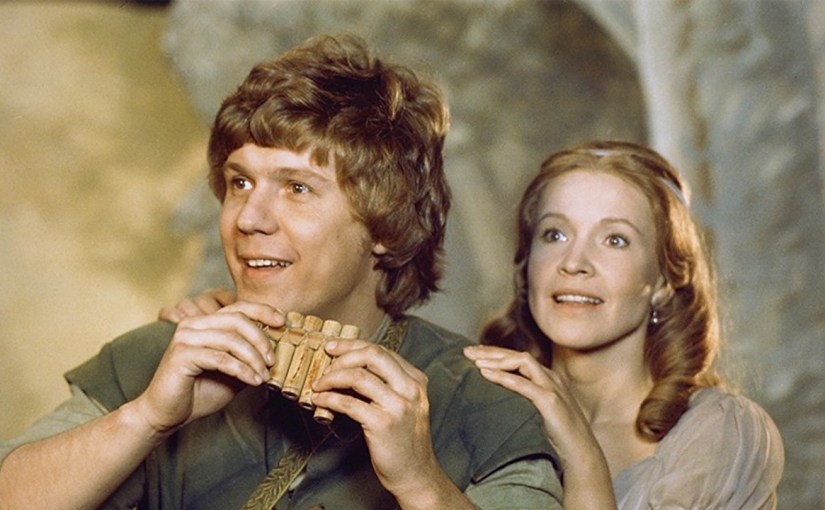
THE MAGIC FLUTE (Sweden, 1975)

by Miguel E. Rodriguez

DIRECTOR: Ingmar Bergman
CAST: Josef Köstlinger, Irma Urrila, Håkan Hagegård, Birgit Nordin
MY RATING: 8/10
ROTTEN TOMATOMETER: 91% Fresh

PLOT: Valiant prince Tamino and his zestful sidekick Papageno are recruited by the Queen of the Night to save her daughter from the clutches of evil.


Here lies the noble, magical illusion of the theater.  Nothing is; everything represents. – Ingmar Bergman

Ingmar Bergman’s whimsical staging of Mozart’s opera The Magic Flute is a movie made by a theater fan, for theater fans…and to a certain degree, it’s about theater fans.  I use the word “staging” instead of “film of” because, throughout the movie, Bergman never once lets us forget that we’re watching a staged production.  The opera’s overture plays over shots of the audience members, and at intermission we watch actors passing the time by playing chess or smoking where they shouldn’t be.  Once or twice, we see the hands of the stage crew as they move from one “cue card” to the next.  Fishing wire is clearly visible when objects “float.”  But the very artificiality of the production is what makes it so charming.  It celebrates artifice and scorns reality.  It wouldn’t surprise me if this were one of the favorite films of Tim Burton or Terry Gilliam.

Since my only previous knowledge of the story of The Magic Flute comes from a precious few scenes in the film Amadeus (1984), here’s a brief summary for anyone else who knows as much about opera as I do.  The brave, handsome prince Tamino and his enthusiastic sidekick Papageno are recruited by the Queen of the Night to rescue her beautiful daughter, Pamina, from the clutches of the evil Sarastro.  Before the opera is over, there will be revelations, separations, reunions, laughter, tears, semi-divine intervention, and even an operatic strip-tease.  There are monsters, woodland creatures, villains, three angelic young boys in a hot air balloon, and, of course, a magic flute.  And it’s all portrayed as it might be seen if we were watching it on a real stage in a real theater, with some obvious cinematic licenses taken with time and space.

I’m gonna be brutally honest: having never seen an opera, I had moderate-to-low expectations of how much I would enjoy it, even if the music is by my second-favorite classical composer of all time.  (Beethoven is the king, and that is that.)  But Bergman’s film sidestepped my expectations by not trying to present anything in a realistic way, or by simply staging a live production and just filming it from multiple cameras.  By keeping everything clearly artificial, clearly staged, and occasionally using clever movie tricks, The Magic Flute held my attention, making me curious about what other tricks Bergman might have up his sleeve.

For example, he’ll start a scene with a wide shot, showing the entire stage with the flats and fake backdrops, then cut to a medium shot, making us think we’re in the space we just were, then panning over to reveal a completely separate set that was invisible before.  But because it’s been established that we’re in the realm of theater, this kind of spatial paradox isn’t jarring, it’s almost expected.  You can get away with certain things in theater, especially opera, especially in a fantasy, that would never fly in a regular movie.  In The Magic Flute, a person’s face can be completely made over with a simple edit.  A picture in a locket can come to life.  A journey through a fantastic hellscape can be suggested by clever editing and careful camera placement.

But what if you simply don’t like opera?  Is The Magic Flute enough to convert you?  I mean…maybe?  If you’re a fan of the films of Terry Gilliam, particularly Brazil (1985) and The Adventures of Baron Munchausen (1988), then this movie is going to be right up your alley.  They share the same visual strategies and production design sensibilities.  Even if you believe you don’t like opera, The Magic Flute could still win you over for at least this one movie, simply because it’s such fun to look at.

Looking back over what I’ve written so far, I don’t believe I’ve accurately conveyed how the deliberate “fakeness” of the film enhances its effectiveness.  Live theater has the ability to get audiences to suspend their disbelief in a way that film cannot always achieve.  I’ve seen community theater productions where, for example, the walls of a café are supposed to “fly” off the stage revealing a night sky, and the effect was accomplished by simple lighting tricks.  A clubhouse foyer can be magically transformed into a golf course with a green carpet and some more selective lighting.  In live theater, the audience is constantly aware that it’s fake, but when they’re in the grip of a good story, their mind fills in the blanks.  That’s the effect Bergman is going for in The Magic Flute, and it works.

So, in the end, what you have here is a love letter to the stage, to opera, to Mozart, to fantasy.  Throughout the film, Bergman will cut to the face of young girl, an audience member, who watches with rapt attention and an almost Mona Lisa-esque smile.  Not only is he reminding us, the viewer, that this is a staged production, but maybe he’s also sending a reminder to filmmakers to never forget that, for a movie or play or opera to work, you have to remember who you’re making it for: the paying audience.  Speaking as an occasional audience member myself, I know that, when I buy a ticket, I want to be taken out of myself.  I want to believe that a man can fly, or that a wooden puppet can come to life, or that a valiant prince can overcome three tasks to win the heart of his beloved.  The Magic Flute is a tribute to the magic-makers and the storytellers, to the genius of Mozart, and to the people out there in the dark who make it all possible.

GREY GARDENS (1975)

DIRECTORS: Ellen Hovde, Albert Maysles, David Maysles, Muffie Meyer
MY RATING: 6/10
ROTTEN TOMATOMETER: 94% Fresh

PLOT: The celebrated Maysles brothers spearhead this cult classic documentary about Big and Little Edie Beale, reclusive and eccentric cousins of Jackie Onassis who occupy a crumbling mansion in East Hampton, New York.


I have seen and loved many documentaries in my life, from the sublime (Baraka, 1992) to the absurd (The Aristocrats, 2005), from the terrifying (Gimme Shelter, 1970) to the edifying (Dark Days, 2000).  But after watching the cult classic Maysles brothers documentary Grey Gardens, I am sitting in front of my computer terminal and I am at a loss of what to say about it, beyond a summary of its contents.

As the film opens, Big Edie Beale, who celebrates her 79th birthday during the film, and her daughter, Little Edie Beale, 52, reside in a sprawling mansion nicknamed Grey Gardens in a high-end East Hampton neighborhood.  Their biggest claim to fame before this film is that they are cousins to Jackie Onassis.  To say their house is a mess is an insult to both the words “house” and “mess.”  It’s a dump, although we are shown newspaper articles that seem to indicate the house was in even worse condition before the Maysles started filming.  The state health department threatened eviction unless the mansion was cleaned up; there’s even a photograph of Jackie O pitching in with the cleanup.  Through the course of the film, the Maysles and their film crew will capture what some have described as “an impossibly intimate portrait” of a relationship between two people whose minds have retreated to a point where they scarcely notice their surroundings as they repeatedly hash out old arguments from years past.

Any fan of film has at least heard the name Grey Gardens or the names of the Beales at some point in their life.  I’m told it’s featured prominently in at least one episode of the television show Gilmore Girls.  The Criterion Blu-ray contains two interviews from noteworthy fashion designers who have both designed clothing lines directly inspired by Little Edie’s clothing in the film.  There are even pictures of a European photo shoot that replicates scenes from the movie.  This is arguably one of the most famous documentaries of all time.

So, I hit play on my Blu-ray player and started watching.  The cameras do indeed capture intimate moments between mother and daughter.  Little Edie’s fashion sense involves never being seen without something covering her head, whether it’s a turban, a sweater, or a dishtowel.  Big Edie spends – based on what I saw – most of her days in bed, leaving only to take in the sun on her porch or to use the restroom.  Sometimes she leaves the bed to eat a meal, but Little Edie usually brings the food to her mother.  In one sequence, Big Edie cooks corn on the cob on a hot plate while sitting in bed.  She shares her bed with one or more of their many cats, as well as various boxes, books, binders, and photographs.  The mattress is dotted with water stains and what appears to be rust.

But wait, there’s more.  There is a hole in the top corner of a wall in one of the hallways.  This is where a raccoon lives.  At one point, Little Edie leads the camera crew to the attic to perform her version of pest “control.”  She empties a loaf of Wonder Bread onto the attic floor.  Then, as an added treat, she empties an entire box of dry cat food on top of the bread.

Now, why am I mentioning the state of their surroundings instead of recounting the delightful (I guess) eccentricities these two women proclaim at each other night and day?  Because I could not take my eyes off the backdrop of the house itself, which is as much a character in the film as the Overlook Hotel is in The Shining.  There is a room that Little Edie is in the process of decorating, but it looks as if her design process is stuck at a fourth-grade level.  The grounds of the mansion appear to be in utter disarray, overgrown and wild, with unchecked vines and bushes threatening to swallow the house itself.  Every corner of Big Edie’s bedroom is laden with stacks of boxes containing old photo albums and vinyl records, many of which feature Big Edie herself.  (She was a recording star back in the day, apparently; she doesn’t sound half bad.)

We are treated to many scenes featuring Little Edie talking to us about her past, how her mother curtailed her ambitions to be a model in Europe in order to come back home and take care of her.  How her mother sent away one of her suitors because she, Big Edie, didn’t want another cook in her kitchen.  We hear from Big Edie talking about how wild Little Edie was, how she was so hard to handle, so she had to treat her sternly.  There’s a scene where Little Edie sings and sings, and it’s clear she is not as gifted as her mother was, but do you think that’s going to stop her?  No, ma’am, not even when Big Edie begs for a radio so she can listen to something else, ANYTHING else.

I’m watching all of this play out, as the directors capture remarkable footage and whispered conversations.  It is undeniably bizarre, yes, and some of it is mildly entertaining.  (Little Edie’s dancing scenes are worth the price of admission.)  But I could not stop asking myself this question while I was watching: “Why?”  Why is this movie necessary for me to watch?  What do I gain by becoming a fly on the wall and being privy to conversations between two people who would be better off if they lived in separate houses?  In separate states?  What am I missing?  I would imagine I could find all those answers in various other online reviews or movie blogs, but if those answers didn’t occur to me while watching the film, who should I blame?  My own preferences, or the film itself?  Yet another answer I don’t have.

I’d like to think my cinematic taste is relatively evolved, although I was a bit of a late bloomer.  I didn’t see the gangster masterpiece The Public Enemy (1931) until recently, and I have yet to see more than one film by Abbas Kiarostami.  But I love a great documentary, and this has a reputation for being one of the genre’s best.  So, why did I not respond to it as enthusiastically as so many other people have?  What am I missing?  How is this entertaining?  This might hit more poignantly with mothers and daughters, but I’m just speculating.

I have no answers.  I can only promise that, at some point, I will watch this movie again because I do think it deserves another chance.  I don’t know when that will be, but when I do, I’ll try to ignore the house and focus more on the characters.  I’ll keep you posted.

FAREWELL, MY LOVELY (1975)

DIRECTOR: Dick Richards
CAST: Robert Mitchum, Charlotte Rampling, John Ireland, Sylvia Miles, Anthony Zerbe, Harry Dean Stanton, Jack O’Halloran, Joe Spinell, Sylvester Stallone
MY RATING: 9/10
ROTTEN TOMATOMETER: 71% Fresh

PLOT: When a giant ex-con fresh from prison asks Philip Marlowe to find his missing sweetheart, Marlowe winds up entangled in multiple murders, prostitutes, and a sultry trophy wife.


Because it was released only a year after Chinatown (1974), it is tempting to compare Farewell, My Lovely to that landmark film noir, but although they are in the same genre, the two films are apples and oranges…or at least apples and pears.  Both feature hard-nosed private eyes accepting cases that turn out to be more complicated and far-reaching than they appear, both feature multiple unexpected deaths, and both feature curvy, smoky-eyed dames with dangerous secrets and aging husbands.  All true to the genre.  But Chinatown breaks (successfully) with film noir in several key areas, while Farewell, My Lovely achieves its lofty heights while still remaining faithful to the bedrock tropes of vintage film noir, right down to the tired voice-over narration from the hero.  I have no idea how faithful it is to the Raymond Chandler novel by the same name, but if the book is half as entertaining as the movie, I may have to track it down and give it a read.

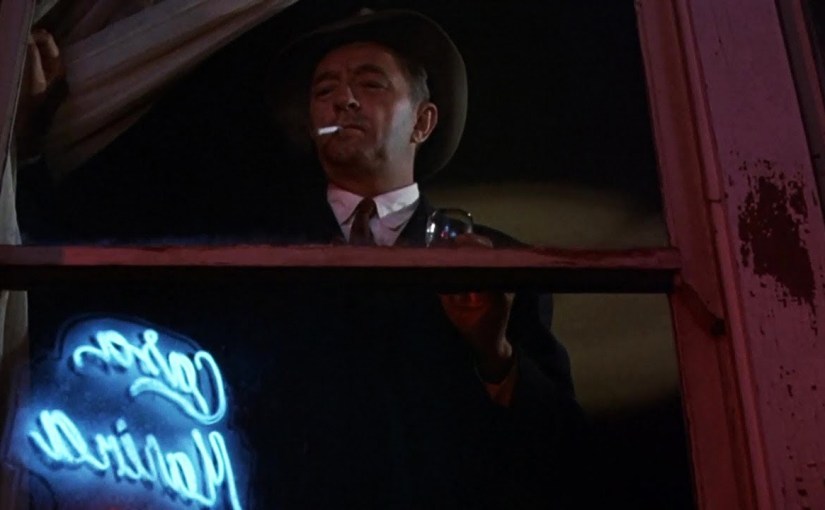
Robert Mitchum plays legendary gumshoe Philip Marlowe, the third version of the character I’ve ever seen after Humphrey Bogart (The Big Sleep, 1946) and Elliott Gould (The Long Goodbye, 1973).  Compared to the other two, Mitchum is by far the most shambling version, but I mean that in a good way.  We first see him staring out of a rundown hotel room in downtown Los Angeles, some time in 1941.  We know the timeframe because of a calendar here and there, and because Marlowe is obsessively following Joe DiMaggio’s progress, as he is on the verge of breaking the record for hits in consecutive games.  That’s a nice touch.  Marlowe’s world-weary narration plays over Mitchum’s sagging face and drooping cigarette, and the spell is complete: we are in the hands of one of the great genre pictures, from a story by one of the greatest mystery writers of his generation.

Marlowe’s story starts as a flashback, a story he’s relating to similarly-weary Lieutenant Nulty (John Ireland).  See, it all began when Marlowe was tracking down a rich family’s runaway daughter.  Soon thereafter, “this guy the size of the Statue of Liberty walks up to me.”  This is Moose Malloy, an ex-con fresh out of the slammer after serving seven years for armed robbery and making off with $80,000, which was never recovered.  Moose is played by Jack O’Halloran, whom cinephiles will recognize immediately as the overly large/tall man who played Non, the mute superpowered henchman in 1980’s Superman II.  To see this man actually string words together into sentences was a strange experience, but I eventually got used to it.

Moose wants Marlowe to find his sweetheart, Velma, who hasn’t written to him the last six years of his stretch.  Next thing you know, someone takes a potshot at Moose on the street, Moose winds up killing a guy in a bar, and Marlowe follows Velma’s trail to an insane asylum, and that’s still just the tip of the damn iceberg, because now there’s this guy who wants Marlowe to help deliver $15,000 in ransom to some other guys who stole a jade necklace…and we STILL haven’t seen the rich trophy wife yet.

And round and round it goes.  I have seen other films that attempted to combine this many plot threads and they wound up a jumbled mess.  Not this movie.  Farewell, My Lovely skillfully walked that tightrope and held my interest all the way through.  I was never lost, never confused…except for a couple of places where the soundtrack obscured a word or two, but I don’t know if that’s the soundtrack’s fault or the actors for mumbling too much.  Plus, this movie contains one of the single greatest interrogation sequences I’ve ever seen, starring Marlowe, two thugs, and the madame of a whorehouse.  It starts semi-normal, escalates with a shocker, then tops the first shocker with something I didn’t think even a hardcase like Philip Marlowe would do.  But the more I watched this movie, the more I got the sense (whether it’s true or not, I don’t know) that this Mitchum version of Marlowe is truer to the literary Marlowe than we ever got previously, in terms of Marlowe’s principles.

I should also mention the dialogue, which contains some of the best one-liners and comebacks I’ve ever had the pleasure of listening to.  For example:

  • Marlowe describing a large house he’s driving up to: “The house wasn’t much.  It was smaller than Buckingham Palace and probably had fewer windows than the Chrysler Building.”
  • Marlowe on his billing practices: “I don’t accept tips for finding kids.  Pets, yes…five dollars for dogs, ten dollars for elephants.”
  • Marlowe describing the obligatory femme fatale (Charlotte Rampling): “She had a full set of curves which nobody had been able to improve on.  She was giving me the kinda look I could feel in my hip pocket.”
  • Marlowe when the femme fatale asks him to sit next to her: “I’ve been thinking about that for some time.  Ever since you first crossed your legs, to be exact.”

Dialogue and lines like this are dangerous because they have been the targets of so many parodies for so long that modern audiences may have forgotten how to take them at face value.  But in Farewell, My Lovely, it comes off perfectly as a tribute to the classic noirs of the 1940s and ‘50s, a tip of the hat to the giants of the past.

Conversely, this movie also reminded me of many of the best eighties thrillers I remember watching, which is ironic considering it was released in 1975.  Movies like Body Heat and Jagged Edge and Silverado, whose purpose for existing seemed to be just to tell a freaking awesome story, unburdened with subtextual layering but laden with style and wit and intelligence, paying homage to their cinematic ancestors by emulating them without plagiarizing them.  There are no doubt film historians who could analyze this film scene by scene and explain exactly what the filmmakers were really trying to tell us underneath the ingenious dialogue and intricate plotting.  But even if I knew or understood all of that, I maintain the best reason for seeking out and watching Farewell, My Lovely will always because it’s just a damn good movie.

(…if for no other reason because of that interrogation scene…I had to rewind it a couple of times just to get my shocked laughter out of my system…)

JEANNE DIELMAN, 23, quai du commerce, 1080 BRUXELLES

By Marc S. Sanders

You ever see a movie that feels like utter torture while watching it, and then when you have time to reflect on it later, you at least appreciate the message it delivered?  I guess this can apply to my experience with Sight & Sound’s recent selection of Jeanne Dielman, 23, quai du commerce, 1080 Bruxelles as the greatest film of all time; number one on their list of the best 100 films of all time.  This picture usurped other achievements like Citizen Kane (number one for close to five decades) and Vertigo (which held the top spot since 2012).

Chantal Ackerman directed this feminist film in 1975, produced in Belgium, about a widow named Jeanne Dielman (Delphine Seyrig) who lives a very mundane life.  The running time of 3 hours and 21 minutes positions a still camera depicting her everyday activity over three ordinary days.  We see Jeanne boil potatoes, prepare soup, and escort gentlemen callers behind her closed bedroom door.  One man per afternoon.  In the evening, her non talkative adult son Sylvain (Jan Decorte) arrives home and she serves him soup and dinner.  The viewer watches them eat their whole meal with Jeanne barely able to hold conversation with her son who remains mostly unresponsive.  After dinner, the sofa in the living room is unfolded into a cot for Sylvain to prepare for bed.  The following morning, Jeanne takes time to fold her son’s pajamas and shine his shoes.  Jeanne will then run errands like seeking out a particular color of yarn for sowing, or a button to replace on her coat.  She also waits for a colleague (maybe another woman in her line of work) to drop off her baby to be watched for a short period of time, before Jeanne’s next afternoon appointment with another gentleman.  After the appointment, she will fold up the little towel in the center of the bed for where her customer positioned himself.

This is a very tedious film to watch with little dialogue that is delivered in French with subtitles.  There is insight to be gained however, and as I reflect on the film, it mostly comes through in the deliberately long running time.  I believe Ackerman was attempting to make a viewer’s experience with the piece feel as lonely and mundane as the main character.  There are very few cuts in the film.  Often, for long periods of times, maybe as long as four or five minutes, we are watching Jeanne sit in a chair staring into space.  We will watch her walk down her hallway or across the street to the post office.  We will watch her button every button on her coat or house robe.  We observe her take a routine bath.  We see her peel potatoes.  We watch her enter the kitchen to find a utensil and then leave while turning off the light.  She’ll then return to the kitchen for something and turn the light back on.  Near the end of the film, she receives a package and has trouble with a knot while undoing it.  After nearly three hours of this routine kind of activity, I knew she would leave the room, walk down the hall, enter the kitchen, pull open a drawer and look for a pair of scissors. There is nothing special in any of this, but it remains in the final print to be witnessed.  Nothing you see in this film is enhanced with stimulating devices like dialogue, music cues, lighting effects, close ups or strategic editing.  Even the title of the film, Jeanne Dielman, 23, quai du commerce, 1080 Bruxelles, is very, very boring and ordinary.  We are simply watching how a lonely widow lives from day one to day two and on to day three.

I am one of four members of a movie watching group of friends who get together (hopefully once a month, if our schedules allow it) to watch three movies on a Saturday or Sunday.  One member selected this film out of curiosity with Sight & Sound’s notable recognition of late.  (We also watched Shane Black’s Kiss, Kiss, Bang Bang and Doug Liman’s Go.)  While we are watching these selected movies, we respond like any audience member should to a film.  We’ll laugh or scream.  We’ll comment in moments that seem appropriate and keep the mood lively.  Much commentary was tossed around among the four of us while watching Jeanne Dielman, 23, quai du commerce, 1080 Bruxelles.  At times we sounded like locker room boys.  On multiple occasions I told my good friend Anthony how much I hate him for selecting this slog of a picture to watch.  We even started to look for symbolism or inconsistencies in the film.  On several occasions, we see Jeanne enter the kitchen and there is only one chair positioned at the table.  She walks out of the room and when she returns there will be two chairs, only we never saw her or Sylvain bring in a second chair.  What could that mean?  Is this film suddenly going to reveal itself with a supernatural characteristic?  Could there be someone else in the house?  Will Sylvain and Jeanne have dinner at the kitchen table tonight, instead of in the dining room.  Is there something symbolic about this disappearing and reappearing kitchen chair?  I’ll save you the trouble, Reader.  It means nothing.  I could only draw that it is an error in editing or continuity.  Yet, that is where our minds would go to, as we absorbed these long moments of ordinary life.  Blame us for yearning for the quick fix that most movies offer.  We are simply weak, very weak, men.

Bear with me as I tell you that to watch Jeanne Dielman, 23, quai du commerce, 1080 Bruxelles is sheer torture.  To listen to a faucet drip into an empty tin pan or watch a strand of grass grow in real time is at least as entertaining.  Movies serve to make us laugh or cry or scream in fear and heighten our suspense.  Movies serve messages that we choose to agree or disagree with.  Movies teach us about a kind of person or industry we may never come across and movies allow us into the mind of an artist’s own imagination.  Movies can disgust us.  Movies can anger us, and movies are also there to frustrate us, like Jeanne Dielman, 23, quai du commerce, 1080 Bruxelles.

To think back on this film, I’m taken with Jeanne, the character, and what she ultimately does before the film concludes.  I’d never spoil the movie’s ending.  However, it stands as the most memorable moment in the picture.  It’s a scene I won’t forget and it certainly is the most eye opening.  Most importantly, it’s understandable having lived as a witness to Jeanne’s seemingly worthless and boring lifestyle. We’ve all endured boredom.  I’d argue at times we’ve all felt a lack of worth to ourselves and those around us.  I certainly have questioned my value on this earth more times than once.  Therefore, to really feel how hollow Jeanne is with whom she caters to each day, like an unresponsive son or gentlemen callers that lack loving affection while they pay for a quick tryst, a viewer must endure the long running time of the film.  It’s the most assured way to embrace the authenticity of Jeanne’s empty livelihood.  The most important element to Chantal Ackerman’s film is likely the running time.  How else to truly understand how mundane a lonely widow is than to live through a near full three days with her?  Therefore, Ackerman is successful in getting across what she wanted to with her film.

Credit should be recognized for the actress Delphine Seyrig.  To simply sit in a chair staring into space with a camera (likely positioned on a tripod) at the other end of the room and not break character for long periods of time requires extreme concentration and endurance.  To share a scene with another actor that does not respond to anything you are doing, is equally challenging.  Seyrig is a professional actress, whose career I’m not familiar with.  She has likely portrayed more stimulating characters with more hyperactivity in other pieces of work.  To bring a performance down to a level of this most extreme kind of monotony is certainly dexterous while requiring complete focus. 

I’ll likely never watch Jeanne Dielman, 23, quai du commerce, 1080 Bruxelles ever again.  I don’t need to.  I won’t gain anything new on a second or third viewing.  I won’t ever forget the film, however.  It stands apart from most other films I have watched because the construction of the piece is intentionally unexciting and the performances are deliberately ho hum.  There are people who live completely uninteresting lives, and it is certainly sad to acknowledge that.  Movies will tell me that a deranged man will kill people.  They will also tell me that heroes go searching for treasure or that employees have a desire to exact revenge on their boss.  Movies will demonstrate how families will love each other or how two people fall in or out of love.  Movies will also explain how sorrowful it is for a person to experience loss.  Movies will also tell me that people live within a mind that offers no self-worth while their heart beats and beats from one mundane and ordinary day to another.  The best example of that is Chantal Ackerman’s Jeanne Dielman, 23, quai du commerce, 1080 Bruxelles.  An admirable accomplishment for a film dependent on the study of a woman’s sheer emptiness. 

THREE DAYS OF THE CONDOR

By Marc S. Sanders

Sydney Pollack is such a hero of Hollywood filmmaking. He was a terrific actor and a better director. As Three Days Of The Condor opens I got completely engrossed in its simple, yet frightening set up.

Joseph Turner (Robert Redford) arrives at his office where he works day to day as a “book reader.” He chats a little with his colleagues, jots a few notes down, and steps out the back door to pick up lunch for everyone. When he returns, he finds the entire office staff has been shot to death. This seems like a common day in the life of an Everyman, until it’s not. Alfred Hitchcock capitalized on this motif over and over again.

Turner makes a phone call and is asked for his code name, but before he reveals he’s known as “Condor,” he asks a very good question to the man on the other end of the line. Why is it so important that Turner reveals his code name, but the man he called doesn’t feel the need to share his own?

Having recently watched the film adaptation of The Firm with Tom Cruise, made almost twenty years after this film, I can see that Sydney Pollack knows how to not only build suspense very, very quickly but also how to maintain it too. Still, in both films the complications of the why and how become overbearing. With Three Days Of The Condor, it’s best to just watch the tight editing and well drawn characterizations all the way from Max Von Sydow as a disciplined assassin to John Houseman as the elder authority who relaxes himself with his tweed suit and bow tie behind a large table as the problems unfold. Cliff Robertson is Higgins, the contact for Turner. He’s serviceable in the part.

The entire first hour of the film is perfection; taut and gripping as we uncover what purpose Turner as a book reader serves, and for whom. The second hour found me feeling less engaged, regrettably. To aid himself, Turner kidnaps a woman shopping in a sporting goods store. Faye Dunaway plays Kathy Hale. He forces Kathy to take him back to her apartment where he hides out. Never would it occur to me that these two characters over the course of a day and a half would fall for one another and make passionate love. This is not that kind of movie, and yet there it is. Some producer must have said “Fellas, we’ve got Dunaway and Redford on screen. This is a no brainer.” Faye Dunaway is fine in the part. I bought that out of desperation Redford would hold her at gun point and force her to help. But, c’mon! Really? They gotta bang each other too????

As for the plot behind killing people, the film doesn’t work its way into car and foot chases. It relies on its wording. The problem for me is that Turner works it all out himself. There’s little reference back to earlier moments for an audience to connect the dots along with the hero. So when Turner realizes one of the motivations is in regards to oil trading, I was trying to figure when anyone said anything about oil to begin with. Revelations just seem to be pulled out of a rabbit’s hat at times. They could have said people had to be murdered because the price of milk went up by fifty cents, and that would’ve held about just the same amount of weight as oil. What ABOUT oil????? Nothing ever needed to be so explicitly discussed here.

Part of the fun sometimes in Hitchcock films, for example, is simply seeing the man unexpectedly on the run and then watching how he outwits his adversaries. Harrison Ford does that in The Fugitive. Tom Cruise did it in The Firm. Cary Grant did it plenty of times with Hitchcock. In this film, however, I never felt there was any need to explain. Once it tried to grow a brain, I thought sometimes less is more, because now I’m stuck feeling frustratingly confused amid a lot of convoluted mumbo jumbo, on top of an out of left field, unsubstantiated love sequence.

Three Days Of The Condor was one of the best, edge of your seat suspense stories I’d seen…until it wasn’t.

DOG DAY AFTERNOON

By Marc S. Sanders

Sidney Lumet uses his best strengths in this ridiculous Brooklyn bank robbery that is actually based on fact.

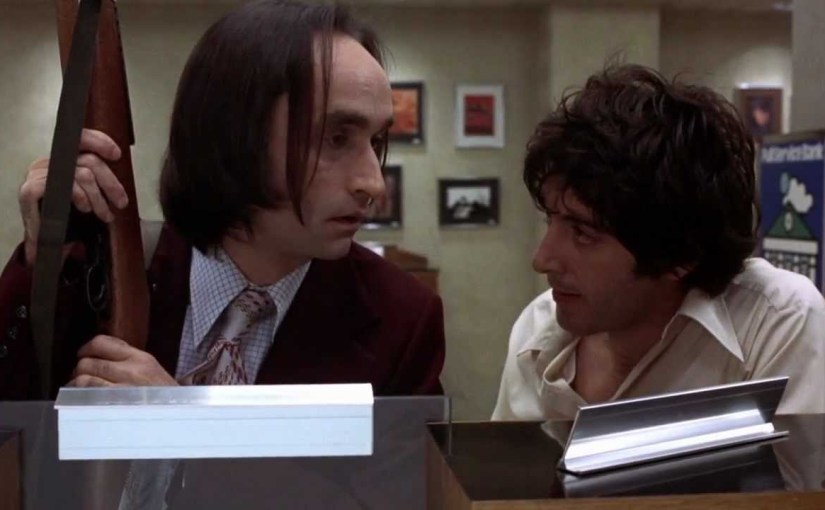
Here, Al Pacino and his cohort, John Cazale, play inadvertent stupidity without compromise. If two of the three stooges went on to do drama, this would be the material they’d use.

A simple bank robbery with little to no planning spirals out of control and into sheer pandemonium. Nothing goes right even when Pacino’s dimwit character, Sonny, is deluded enough to believe all is going in his favor. He immediately earns the support of the encroaching Brooklyn community only to lose them when he shows his true homosexual nature. Then he’s blindsided as to what happened. Layered in drenching sweat, Lumet wisely takes advantage of Pacino’s best up close facial expressions. Utter delirium!!!!!

Once again, Lumet’s camera moves while his best actors remain naturally in place. Al Pacino does his thing and trusts his director will find his shots. As the cop initially in charge, Charles Durning does as well. Pacino and Durning especially have great scenes together in the middle of a heavily populated New York Street as the robber shines off the cop, and the cop does his best to obtain some measure of control. It’s a scream fest for the ages. “Attica! Attica!” Pacino and Durning’s best career performances were always the ones where it looked like neither of them were ever acting. Dog Day Afternoon is one those better examples.

Frank Pierson’s jagged script of wild turns makes every person whose an extra like the pizza delivery man, for instance, caught up in the hysteria. The pizza kid shouts out to the crowd “I’m a star!!!” It’s great reason to applaud Sidney Lumet’s control over a crew and the entire company of extras he’s employed. This film is a rare example where all of the extras (seemingly the entire Brooklyn population) are as integral as the leads. The setting is the main antagonist from the media all the way to the observers who can’t look away and can only cheer, yet mock as well. Brooklyn, New York is a great character here.

Most fascinating about Dog Day Afternoon is that it is all based on fact from the media circus to dumb bank robbers with a need to steal in order to fund a lover’s sex change operation. It’s ridiculous. It’s funny. It’s frighteningly stressful and it’s all true.

This was released following the first two Godfather films and confirms the enormous range Al Pacino possesses with his performance talents. Hyperactive and dumb here as gay bank robber, Sonny; quietly contained, evil as Michael Corleone. His range was through the roof in the 70s before absorbing his loud, crackling, smokers voice. It was when the script outshined Pacino and before the current age of writing being catered to its bankable star.

Lumet also allows great moments for the hostages who become undone to the point of regretfully using foul language, to actually befriending their captors. He’s a director who efficiently leaves no stone untouched.

Chris Sarandon as Leon, Sonny’s male gay spouse is great here too. He’s full of melodrama, panic, worry, and a New York maternal despair. Another great scene is a phone exchange between Pacino and Sarandon. It might appear funny at first, especially in the 70s when homosexuality was lampooned often with the other F-word, but anyone who appreciates the filmmaking of Lumet will quickly contain their snickering when they realize a gay man is equal flesh, bone and feelings like anyone else.

Dog Day Afternoon is very telling of an out of the closet social media future. The story will always get grabbed regardless of danger or sensitivity. People will get swept up in the hoopla (a teller hostage quickly boasts her brief fame on television “Girls, I was on TV!”), police will overextend their privilege, helicopters will swarm, the criminals will demand their moment in the spotlight, and the public will serve as jury per the majority.

It’s a vicious cycle but considering it is a 1975 masterpiece, it’s all disturbingly valid and sensationally true.

JAWS

By Marc S. Sanders

Steven Spielberg’s third film, Jaws, is more than just an adventure or thriller piece of filmmaking. I believe it explores the dichotomy of motivations by man versus the intrinsic behavior of nature. In other words, in the peak season of summertime a great white man-eating shark will never care about how important it is for a small harbor town to sell the necessary amount of ice cream cones or hotel bookings to make an annual profit. You wanna swim with nature, then die by nature.

The New England coastal town of Amity Island has a new Police Chief named Martin Brody (Roy Scheider). When he comes upon what’s left of a girl’s mutilated corpse on the beach, he takes it extremely seriously when he learns the cause of death was a shark attack. The Mayor (Murray Hamilton) cannot afford to be mired with the inconvenience of a large fish just before the always profitable 4th of July weekend. So, the beaches must continue to stay open.

When the town gets a bloody public viewing of the problem at hand, a young, wealthy, educated oceanographer named Matt Hooper (a perfectly cast sarcastic and smart Richard Dreyfuss) is recruited. His knowledge with the science of shark behavior is not very welcome to anyone but Brody.

One dynamic of Hooper is his reliability of technology. Will any of his expensive tools be enough to rid the town of this shark?

As well, will a bounty hunt worth $3,000 satisfy? Any Joe Blow fisherman will take a crack at it. Spielberg’s film explores Hooper’s intellect of sea life, against the buffoonery that follows from others both near and far. Why not randomly toss some sticks of dynamite in the water or bait the animal with a pot roast while you’re at it? Maybe that’ll work. It’s money and technology in the face of one of nature’s most dangerous creations.

Will a sea faring Ahab like fisherman named Quint (Robert Shaw playing one of the greatest characters ever on screen) do the trick? His philosophy stems from his experience with the might of sharks in general. An illustrious monologue from Shaw describing Quint’s harrowing experience aboard the USS Indianapolis confidently tells us he’s seen what sharks can do. He’s floated in the blood red waters that sharks leave behind. Therefore, Quint has devoted his life to hunting one shark after another, boiling their large jaws of teeth for trophy hangings. He’ll win battle after battle, but never will he win the war with the nature of the ocean water.

Brody might be the only sensible guy, though. He fears the water and won’t go near it. He’s over with danger, leaving the cop’s life behind in the city for what he expected of the tranquility of ocean front real estate.

A mounting pressure always exists in Jaws. The townsfolk are hard pressed resistant to allow their businesses to avoid prosperity because of something as silly as a shark that isn’t even known to swim in these waters normally. Money is what matters. Money is what’s needed to live. During the age of quarantining with the spread of Coronavirus, Jaws is a fair allegory for the argument of staying at home or going back to work. You could die, but it’s still expensive to live.

The other argument lies in what’s more appropriate for this problem. Hooper’s technology or Quint’s hunter instinct. A metal “anti shark cage” with a spear of poison vs tying barrels to the predator and drowning him out in the shallows.

Spielberg with a script by Carl Gottlieb adapted from Peter Benchley’s best selling novel proposes no easy answer to ridding an ocean area of a man eating, uncompromising animal. That’s the thrill that keeps Jaws alive for over 45 years. Sharks will never change. Man might, but nature’s creatures will consistently emote the exact same patterns of behavior.

Unlike the fantasies of Jurassic Park or a Friday The 13th picture, a beast born of nature with enormous strength will always be unpredictable performing on God’s purpose. It will never be negotiable. If you’re a raggy fisherman like Quint, your old, leaky boat might keep you afloat for so long, but a shark will also not feel intimidated, no matter how many others of its kind this hunter might have conquered before.

Experience, technology or disregard for the elements of nature will not always win. Something unconquerable will come along.

To maintain the strength of the film’s monstrous antagonist is to watch the movie with your own most frightening, worst case scenario in mind. Hence, Spielberg gratefully never shows the great white until long after half the film is over. Masterful shots occur where his cameras seem positioned just at the surface of the water. When swimmers make desperate runs for the shore, away from danger, it feels as if the viewer is frozen in fear and getting trampled on by the panicked extras cast in the picture. What could be so terrible that these people are swimming and running away from? When Spielberg finally shows the gigantic shark emerge from the water, Scheider’s shock with his suggestion of needing a bigger boat assure you that, yes, this problem is actually this insurmountable.

Additionally, Spielberg uses props to keep the mystery of his beast alive. When the shark pulls a dock off its moorings with his bait, we know the fish is turning around to pursue its next victim as the wreckage now floats in the direction of a man’s panicky, desperate swim.

Most effectively beyond Steven Spielberg’s camerawork, has got to be the pulse pounding and blood curdling soundtrack from John Williams. (Cliche descriptions they may be, but I’d argue Williams’ score created the terms, nonetheless.). Without his music, the narration of the story would be a little lost, I’m sure. John Williams’ repetitive string notes that build, feel like the dialogue of the underwater monster. His music goes beyond the short rhythm everyone is familiar with. Looking at the opening scene with Susan Backline portraying the moonlight skinny dipper in the opening scene of the film, Williams brings in a variety of different sounding instruments that leave an impression of her body being torn apart by something she’s truly not aware of. Splashing, screams, body thrusting and harsh chords of long strings with percussion the emote panic and anarchy make for one of the most memorable opening scenes of any film. Spielberg with a collaboration of cinematography from Bill Butler and Williams orchestration make for an arguably unforgettable and frightening scene on the same level of the shower scene in Psycho.

Jaws transcends generation after generation. Everyone eventually has some kind of familiarity with the film, even if they’ve never seen it. People have seen the poster, heard the music or truly refused to step in the water off a coastline out of fear for what can’t be seen. Few films ever leave a subconscious effect on a viewer or a general public, but Jaws is most definitely one of those exceptions.

ONE FLEW OVER THE CUCKOO’S NEST

By Marc S. Sanders

After watching One Flew Over The Cuckoo’s Nest for the first time in many years, I recognized a political dual taking place on the battleground of an insane asylum. Director Milos Foreman sets the stage for one patient to win over the community from the Head Nurse in charge.

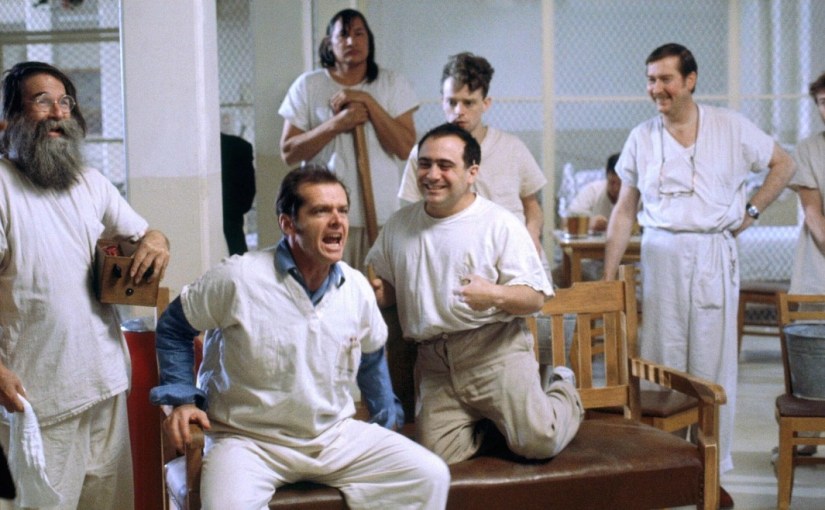
Jack Nicholson is Randall P McMurphy, a criminal who is transferred to the asylum for examination even though there are likely suspicions he’s faking his current condition as a means to escape prison life work detail. Louise Fletcher is his opponent as Nurse Ratched who has maintained an organized control over the floor of 19 men with an assortment of mentally unwell behavior.

McMurphy is a cut up as soon as he joins the gang. At first he appears observant during Ratched’s daily sessions where she asks the men to contribute to the discussion but at the same time she couldn’t be less encouraging. She’s happy to welcome ideas with open arms but don’t disrupt the process. There will also be “Medication Times” and there will be samples of classical and childlike music to subdue the patients as well. McMurphy may request the volume be lowered, but that’s not a simple request that Nurse Ratched will honor.

McMurphy’s experience outside the realm of insanity works as a wake up call for some of the men which consist of introductory performances from great character actors like Christopher Lloyd, Danny DeVito and Vincent Schiavelli. The stand out is Brad Dourif as Billy Bibbit, the stuttering suicidal young man with the baby face who fears his mother’s judgment as Nurse Ratched methodically continues to imply.

McMurphy wins over the crowd eventually. A fascinating scene is when Ratched challenges McMurphy to obtain enough votes among the men in order to watch the World Series. The count of raised hands appears to tie, but then Ratched reminds him that he needs one more vote to win. Before he can get to that point, the session is ended by Ratched. The call for election is lost due to a technicality by the governing control. An election won’t silence the voice of the people as McMurphy quickly encourages the masses to watch a blank television screen imagining his own interpretation of the game. Ratched can only domineer to a certain degree. Here’s the flaw in the Ratched character. At last a breakthrough among these ill men is established as they’ve learned to vote for themselves. They want to watch a baseball game. Ratched won’t stand for progress though.

Questions arise in One Flew Over The Cuckoo’s Nest. Is McMurphy truly faking his mental condition? Is Ratched so drunk on control to disregard doctors’ opinions for his release and keep him institutionalized? If he’s not insane, then why would she want him there? Is it all about Ratched’s obsession with winning?

Ken Kesey wrote the original novel the film is based on. He hated Foreman’s approach particularly with disregarding telling his story from the perspective of the deaf/mute six foot five Native American that McMurphy regards as “Chief” (Will Sampson). Chief seems to be the quiet one who does not take sides until McMurphy demonstrates the ease of obtaining freedom such as when the Chief helps him escape over a barb wire fence and then takes the men on a boating joy ride. I can’t side with Kesey’s insistence that the film be done from the perspective of the silent, yet memorable Chief. Film is a different medium than what’s read on a page. You can’t watch people’s thoughts. What I do find interesting is that Kesey opted for a Native American as McMurphy’s best sidekick. This is a man whose ancestors historically lost their land. McMurphy attempts to rob the rule of the asylum from Nurse Ratched. The political undertones just seem so apparent. The government control, however, is hard pressed to surrender even after McMurphy arranges for his own party of celebration complete with booze and alcohol. Ultimately, and sadly, the fate of McMurphy shows that he eventually becomes a product of his own environment. The Chief however, acknowledges his independence though.

One Flew Over The Cuckoo’s Nest is the second of three films to win the five main Academy Awards (Best Picture, Director, Actor, Actress, and Screenplay). It deserved it, and because of the film’s unsettling and messy nature it’s almost surprising that it was so well received. It’s not a glamorous film. It can show the ugliness of men drowning in their own consciousness.

At the same time, the film shows the subtle yet brutal control of those living fulfilling lives at the expense of the constituents they oversee. Sure, let’s have an open minded community of provoking thoughts, but only if it’s confined to the restrictions that remain in place. Step outside those lines and a more permanent technique will be applied so you adapt to what’s mandated…unless you can bodily lift a concrete water fountain and smash it through a cage bar enclosed window to freedom.