ASHES AND DIAMONDS (Poland, 1958)

by Miguel E. Rodriguez

DIRECTOR: Andrzej Wajda
CAST: Zbigniew Cybulski, Ewa Krzyzewska, Waclaw Zastrzezynski
MY RATING: 7/10
ROTTEN TOMATOMETER: 96% Fresh

PLOT: Against a backdrop of internal political turmoil at the end of World War II, a Polish resistance fighter faces a crisis of conscience when ordered to assassinate a Soviet official.


The Polish film Ashes and Diamonds is reportedly Francis Ford Coppola’s favorite movie, and Martin Scorsese has stated in interviews that he used it as an answer for one of his finals at film school.  From a technical standpoint, I can see why.  Echoes of this film (and perhaps others from director Andrzej Wajda’s filmography) are overwhelmingly evident in the bodies of work of both directors, from the mobile camera to the shocking moments of violence to the psychological makeup of the characters themselves.  As an emotional experience, I confess I didn’t get “worked up” over it, but it was interesting to see where two of the greatest American film directors got a healthy dose of inspiration.

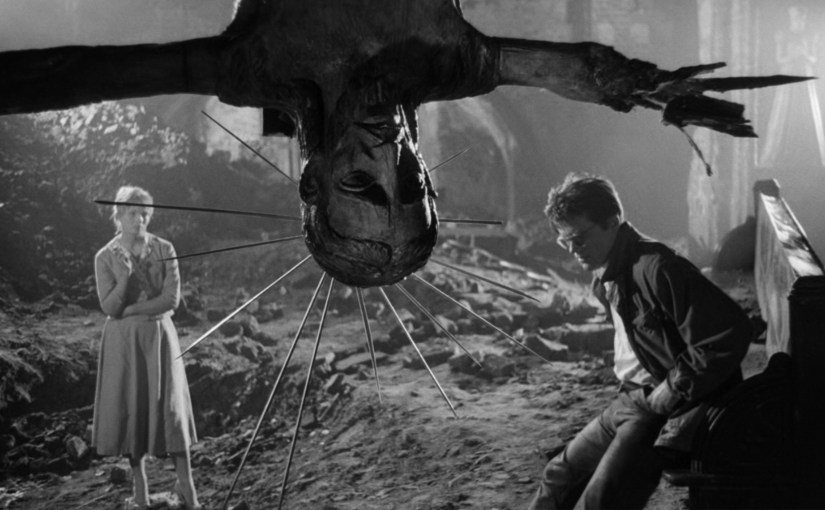
Ashes and Diamonds opens on May 8, 1945, with an idyllic scene outside a country church that quickly degenerates into a brutal double murder.  The killers are the calm, detached Andrzej and the flighty, charismatic Maciek, who spends most of the movie behind dark sunglasses.  We quickly learn their victims are not who they thought they would be.  Instead of killing two Soviet/Communist officials, they have killed two innocent factory workers.  War is hell.

Later, through circumstances that feel very Hitchcockian, Andrzej and Maciek hole up in a hotel bar, only to discover that one of their real targets, Szczuka, has booked a room in the very same hotel.  Maciek books a room directly below Szczuka’s, and the rest of the film plays out with that element of suspense hanging in the background, leaving us to wonder when and how Maciek will complete his assignment.

Complications arise when Maciek becomes infatuated with the hotel bartender, Krystyna, a blond beauty who rebuffs Maciek’s advances at first.  Later, they connect, but she doesn’t want to get involved with someone when it will eventually have to end: “I don’t want bad memories when memories are all I have left.”  Maciek falls for her so hard that he starts to doubt his resolve to kill his target.  “Will he or won’t he?” becomes the movie’s prime conflict.

Where to begin with the comparisons to Coppola and Scorsese?  The most obvious one is the unblinking attitude towards violence.  The two killings at the beginning of the film are done with very few cutaways as we see the multiple bullet hits on each victim, with one of them getting hit in the eye and another shot in the back at point blank range with such force his shirt catches fire.  (Malfunctioning squib?  Possibly, but it’s still effective.)  It’s interesting that this movie predates Bonnie and Clyde (1967) by almost a decade, but its depiction of onscreen violence feels very modern, even by today’s standards.

Then you’ve got the moral struggle of the main character, a man of action capable of casual murder who is suddenly given a reason to make something different with his life.  This reminded me of Scorsese’s The Departed (2006), with DiCaprio’s character undergoing the same internal conflict.  Maciek has multiple opportunities to kill Szczuka throughout the film, but something always pulls him back from the brink.  His partner, Andrzej, becomes impatient and reminds him what happens when soldiers let personal feelings interfere with their duties.  I had a vivid flashback of Michael Corleone’s credo: “It’s not personal, Sonny.  It’s just business.”

(I also felt that the dynamic between Maciek and his more level-headed partner Andrzej were evoked in Scorsese’s Mean Streets [1973], with De Niro’s Johnny Boy and his more level-headed partner Charlie, played by Harvey Keitel.)

But, cinematic comparisons aside, I didn’t find Ashes and Diamonds to be as gripping as other war or crime dramas of that era, such as Elevator to the Gallows, Touch of Evil (both 1958), or Rififi (1955), to name a few.  It’s a little weird to me, because all the pieces are there for a first-rate thriller.  I’m not asking that every drama pack the exact same kind of emotional gut punch every single time because I know that’s unrealistic.  But the fact remains: Ashes and Diamonds, while clearly very influential on future filmmakers, did not get me as involved as I would like to have been.  I was never bored, but neither was I over the moon.  It was…average.  Perhaps one day I’ll watch it again with a fresh eye to maybe see what I missed the first time around.

VERTIGO

By Marc S. Sanders

Never would I think Alfred Hitchcock would enter the world of the supernatural.  At least of all that I’ve read about him and the films I’ve seen to date, I do not recall tales of ghosts and ghouls from the master of suspense.  Yet, as I’m watching his classic, psychological film, Vertigo, I’m questioning the territory that Hitch has entered.

James Stewart returned to work with Hitchcock in 1958.  He plays Police Detective John “Scotty” Ferguson who opts to retire following a frightening encounter involving a foot chase over the rooftops of San Francisco.  When he succumbs to his debilitating fear of heights, a police man loses his life in the process.  Scotty just can’t go on.

He is recruited by his wealthy industrialist friend Gavin Elster (Tom Helmore) to shadow his wife, Madeleine (Kim Novack).  Gavin is concerned that Madeleine may be suicidal, because it is becoming not too unreasonable to consider that perhaps a woman from the past has taken possession of her.  Scotty is reluctant of course, and it all sounds like a bunch of nonsense.  Yet, he accepts the assignment.

Vertigo may be a classic film, known by millions worldwide, but I won’t dare utter any hint of what’s to come.  Scotty’s pursuit of Madeleine continues to spiral into new inventive twists like Alfred Hitchcock always took advantage of.  The film could have ended on several different notes, and its running time could have been shorter.  However, Hitch lay insistent on peeling back more of the onion.

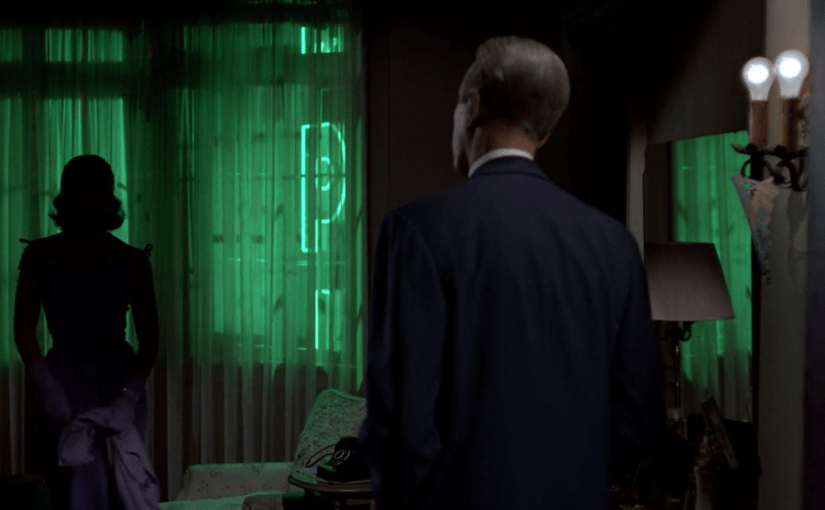
I was fortunate to see the movie following a painstaking restoration after the film was uncovered to be in terrible shape.  Now, it is preserved on 4K disc, and Vertigo is tantamount to the necessity of 4K.  Firstly, as Scotty continues to oversee where Madeline goes and what she does, Hitchcock keeps much of her activity bathed in a rich emerald green.  Green almost works like breadcrumbs for Scotty.  She drives a green car.  Many of her elegant dresses have green in them.  Hitchcock lights many of her scenes in green.  Oddly enough though, while green is so apparent from Scotty’s perspective, Madeleine’s overall purpose and intent is such an enigma.  So, film historians proudly recall how the most popular outfit for the bleach blond Novack to wear in the film is a plain, simple grey suit which tells us nothing.  Grey is melancholy, seeming to express no kind of emotion.  Not fear, or anger or love, or happiness or sadness.  The suit even becomes a significant plot point later in the picture.  The woman is there plain as day, at times shining in the emerald car, or beneath a green light, but why is she there? 

As well, Scotty’s continued pursuit and eventual love affair with Madeleine overcomes him and he spirals into a madness highlighted in reds and blues and oranges with spiral lines turning into bottomless pits.  Hitchcock even imposes haunting animation to show how Scotty’s mind is splintering and falling away from any depth of reality.

I have seen clips of the original film and the colors are so faded out.  It takes you out of the picture.  The color is so pertinent to the narrative of Vertigo that there was no question.  The movie had to be restored.  Watch this movie on 4K.  You won’t regret it.

Have you looked at the well-known marquee poster for Vertigo lately?  It is definitely one that’s consistent to dizzying turns and descents to overtake the movie.

Furthermore, the opening credits of the film zoom into the pupil of a woman’s eye and then spiral sketches start to turn and spin.  It’s easy to connect this to the side effects of Scotty’s acrophobia.  He gets dizzy.  His visual perspective draws him out of measured reality.  As the film progresses, though, it goes further than that.  Hitchcock turns Scotty into a man crippled with obsession. 

I heard my Cinephile colleagues discuss this film recently, implying that Vertigo is not their favorite.  They didn’t like James Stewart’s character.  For one thing he falls in love with Madeleine, his friend’s wife. The Cad!!!  Later, he invokes unequivocal dominance over a new woman he meets in the second half of the picture.  (I won’t say much more, here.)  He insists the woman dress like Madeleine and do her hair and makeup like Madeleine.  She also needs to walk like her too.  Stewart and Hitchcock really put this protagonist through the ringer.  He’s first crippled with a fear of heights.  However, dominant obsession interferes with him as well.  Is it the acrophobia that is so debilitating, or is it a sick obsession that comes into play?

San Francisco is an ironic setting for a film where the main character has a fear of heights.  It’s made up of steep hills that descend from high tops, or ascend into the sky.  Try climbing the staircases that stand upon these hills and now you are even closer to the heavens and further away from the ground.  How could a guy like Scotty Ferguson live in such a city?  Yet, here it is.  Maybe it was a sick, subtle joke of Hitchcock.  I think it’s a nice touch to amplify the suspense.

James Stewart is just as good here as he was in Rear Window.  The likable fellow who serves as a sponge to what’s laid out before him.  If he absorbs too much though it could defeat him altogether.  Much of the suspense Hitchcock is known for, stems from this thread line.  Stewart’s Hitchcockian characters get drunk on needing to know more, and delve even further.  The audience can’t help but get intoxicated with him.

Kim Novack is radiant.  She gives an especially incredible acting performance.  Through the first half of the picture, she’s quiet and reserved laying credence to what Gavin suggests to Scotty.  Is she being possessed by a young woman with odd resemblances too her, who killed herself back in the 1800s?  Is it something else?  Her turn in the second half of the picture leaves you questioning if you are even watching the Kim Novack.  An amazing double performance from her that lends to one of the twists that Vertigo offers.

Pictures like Vertigo and Rear Window are so important for people to see.  These films laid the groundwork for much of the horror, macabre and disturbingly mysterious stories shown today.  They are pioneering films that only invent what needs to be shown.  In other words, they don’t get diverted in overcompensating with action and gore.  Many films that derived from Vertigo desperately turn to blood and over the top stunts and visual effects.  Alfred Hitchcock thought about how the actors, the settings and wardrobe, along with his cameras, would capture the terror and embrace the unknown.  Filmmakers need to continue learning from a craftsman like him.

ELEVATOR TO THE GALLOWS (1958, France)

by Miguel E. Rodriguez

Director: Louis Malle
Cast: Jeanne Moreau, Maurice Ronet, Georges Poujouly
My Rating: 10/10
Rotten Tomatometer: 93% Certified Fresh

PLOT: A married woman and her lover hatch an apparently foolproof plan to kill her husband (his boss), but a split-second decision at a crucial moment sends everything into a tailspin.


We plan, God laughs. – old Yiddish proverb

Let me get this out of the way right at the top: Elevator to the Gallows is one of the best crime drama/thrillers I’ve ever seen.  It holds its own against anything by Hitchcock or Clouzot.  With admirable focus and restraint, first-time director Louis Malle (My Dinner with Andre, Vanya on 42nd Street) crafts a gripping illustration of how the best laid plans can fall apart because of one minor miscue.

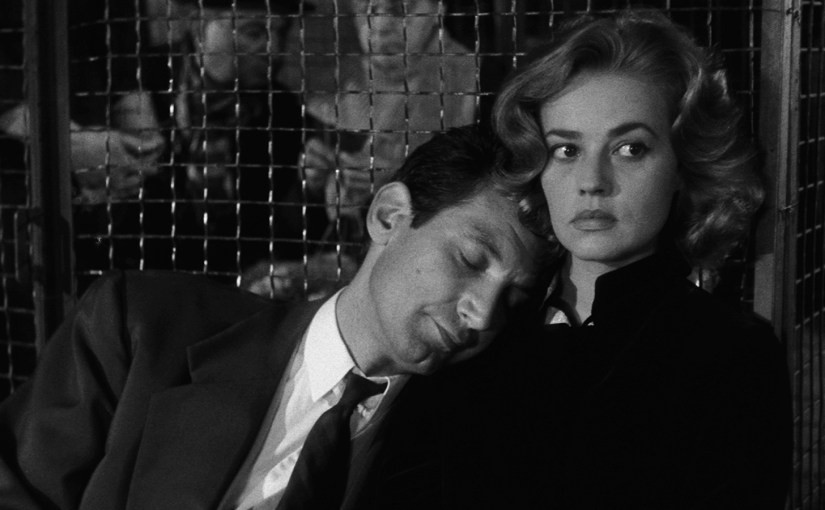
The film cuts right to the chase at the opening scene, showing a phone conversation between Florence Carala (Jeanne Moreau) and her lover, Julien Tavernier.  They discuss their plans for Julien to kill her husband in his office on a Saturday evening, after which he’ll pick her up at a café where she’ll be waiting, and that will be that.  Everyone will assume her husband is in Geneva on business, and no one will discover the murder, which Julien will arrange to look like a suicide, until Monday morning, giving Florence and Julien plenty of time to make their escape.

(I liked how we never got any flashbacks of the relationship between Florence and Julien.  All we need to know is, they’re lovers, they’re desperate enough to commit murder, and that’s it.  Very concise.  I love it.)

Julien’s plan involves using a grappling hook to avoid using the office elevator to get to his boss’s office one floor above his.  He proceeds with the plan, nearly getting caught in the process, but he’s able to commit the crime and leave the building with several witnesses as an alibi, witnesses who will say they never saw him enter his boss’s office before he left.  So far so good.

Julien gets to the street, takes the top down from his convertible, takes one last look back at the building…and realizes he left a vital clue in full view of any pedestrian or street cop.  Leaving his car running, he decides to run back into the office building and retrieve the evidence before the night guard shuts off the power for the night.

Unnoticed by Julien, a florist and her bad-boy boyfriend have been having an argument at the shop next to his car.  The boyfriend sees this rich man leave his convertible on the street…with the engine running…

Thus begins a Hitchcockian odyssey that leaves Julien stranded in an elevator, his car and his identity stolen, and his mistress stranded on the streets wondering where the hell her lover is.  At one point, Florence sees Julien’s car drive by the café where she’s waiting…she can’t quite make out the driver, but who is that girl in the car with him?!  Has she been betrayed at the last minute?

The film follows the younger couple, Louis and Véronique, as they tool around in Julien’s car, eventually winding up at a roadside motel, and unwittingly making friends with two German tourists.  They even share drinks with the Germans and take some candid photos using a little spy camera in Julien’s raincoat.  (We learn that Julien was in the Foreign Legion and was well-trained as a soldier – maybe even in spycraft.)  I found myself wondering why we were wasting time with this larcenous couple…until they decide to check into the motel as Mr. and Mrs. Tavernier to cover their own tracks.

The screenplay ingeniously heaps one hasty decision on top of another so that, just when it seems Julien might be in the clear, something else happens that makes it seem impossible he won’t be discovered or at the very least blamed for something he didn’t do.  Meanwhile, Julien is desperately trying to escape the elevator, using a penknife as a screwdriver, getting excruciatingly close to tripping a vital switch that’s just out of his reach.  He eventually tries to get out using the old climbing-the-cable trick…which is of course exactly when a night watchman is making his rounds.

This story is so good, I can’t believe there hasn’t been an American remake.  And it’s not like there aren’t other great films out there that cut right to the chase and never look back for flashbacks or additional material.  I’m not sure what makes Elevator to the Gallows so good, to be honest.  Maybe I was rooting for Florence and Julien when they are clearly not the good guys.  Maybe it’s the economy of the storytelling, or the screw-turning twists that lead the police to believe Julien has committed more than one murder.  At one point, Louis and Véronique make a startling decision that had me yelling at the screen.

Words fail me on this one.  I can’t describe it any better than by saying this is one of the best films I’ve ever seen, certainly one of the best film-noirs I’ve ever seen, and a movie that I’ll bet Hitchcock watched while thinking to himself, “Damnation…I wish I’d thought of that.”