REBEL WITHOUT A CAUSE (1955)

by Miguel E. Rodriguez

DIRECTOR: Nicholas Ray
CAST: James Dean, Natalie Wood, Sal Mineo, Jim Backus
MY RATING: 7/10
ROTTEN TOMATOMETER: 91% Certified Fresh

PLOT: After moving to a new town, a troublemaking teen forms a bond with a troubled classmate and falls for a local girl who is the girlfriend of a neighborhood tough. When the new kid is challenged to a dangerous game of “chicken,” his real troubles begin.


To begin with, yes, Rebel Without a Cause is dated.  It is lurid, obvious, and heavy-handed, leaving very little to the audience’s imagination when it comes to the film’s message.  On the other hand, there are some not-so-subtle references to even deeper issues at play that make this dated, hammy film still relevant today.  I had always thought Rebel was simply about a troubled teenager pleading for compassion from an uncaring society.  Who knew it also dealt with a forbidden homosexual attraction and implied incest?  For a movie made when the Production Code was still being enforced, that is a LOT of subtext to unpack.

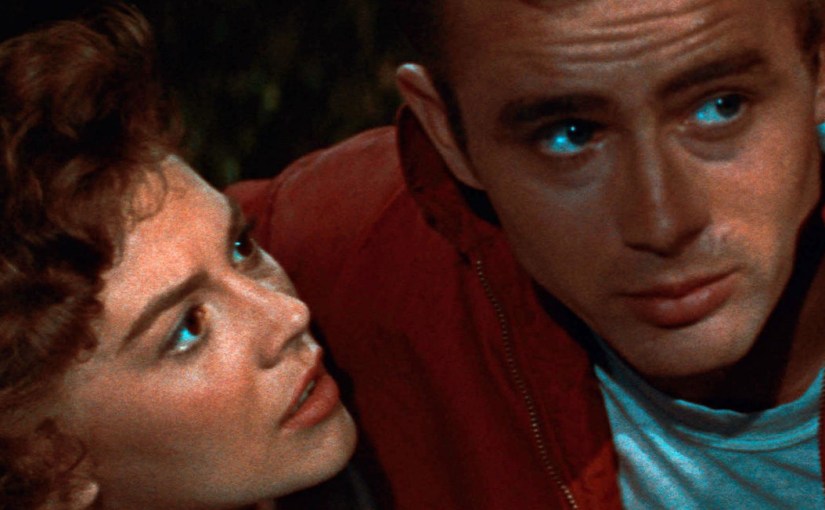
Jim Stark (James Dean) opens the film being hustled into a police station for public drunkenness in the wee hours of the morning.  Here, he will cross paths with two other teenagers: Judy (Natalie Wood) and Plato (Sal Mineo).  Over the next 24 hours, Jim will change their lives irrevocably just by trying to stay out of trouble, which has no problem finding him.

It’s here, when Jim’s parents arrive to bail him out, that Dean delivers his immortal line, “You’re tearing me APAAART!!!”  I’m kinda glad we got that out of the way so early so I didn’t have to anticipate it for the rest of the movie.  We also get the first of the film’s heavy-handedness, as Jim converses with a sympathetic cop, Ray (Edward Platt), who asks him the kinds of probing questions that only a psychiatrist would ask.  They become unlikely friends as they bond over the foolishness of Jim’s parents, who are so clearly out of touch with his inner turmoil.

During a field trip to the Griffith Observatory (the movie takes place in Los Angeles), Jim winds up in a knife fight with a local tough guy, Buzz, whom he eventually overpowers.  (The reason: Buzz called him “chicken,” just like Marty McFly…just throwing that in there.)  Buzz wants another chance, so he challenges Jim to a “chickie-run.”  That night, the two of them will drive a couple of stolen cars at high speed towards a high cliff drop; first one to bail out of their car is a chicken.

Before that can happen, we get the first of two surprising plot devices.  Jim runs into Plato at school, and it becomes instantly clear that Plato is attracted to him.  I promise I’m not reading too much into it.  The fact this wasn’t toned down even more in a movie from the mid-‘50s is a little shocking to me.  Plato looks at and hangs around Jim the way a girl with a crush latches on to the object of her desire.  Plato even has a fan-photo of Alan Ladd in Shane hanging in his locker.  It’s so obvious that I found myself wondering whether the movie would go so far as to let Plato try to kiss Jim.  Later, the screenplay makes it clear that Plato was just looking for a father figure, but dude.

Later that night, after the fateful “chickie-run”, Jim tries to explain to his parents what happened, but they’re unable to respond with anything but disbelief, and his mother even threaten to move again.  It’s abundantly clear that Jim’s parents are out of touch, a point that his hammered home again and again.  This approach at first seems overpowering, but director Nicholas Ray apparently was trying to lend the film an emotional, operatic sensibility to give the lead characters more of a mythic stature.

This is also conveyed through the film’s use of color Cinemascope, creating a frame that is just begging to be seen on the big screen where the colors and figures wouldn’t just pop, they’d EXPLODE.  If this was not a popular drive-in movie, it should have been.  That might actually be the best way to watch this movie, if at all possible.

There’s also a curious scene involving Judy’s home life that implies something unsavory is going on.  Judy approaches her father at the dinner table and tries to give him a kiss hello, but he rebuffs her: “Aren’t you getting a little old for that kind of thing?”  She feels hurt and tries again and gets a slap on the face for her trouble.  She runs out of the house and the father says something like, “She used to be so nice, now she’s nothing but trouble!”  A father who can’t accept an innocent kiss from his daughter has more going on underneath than the daughter, I can tell you that.  It’s an eyebrow-raising moment that does more to shed light on Judy’s behavior than anything else in the film.

The message of the film is simple, and it’s directed squarely at the parents: listen to your kids.  The parents in this movie do nothing but express sadness and dismay at their kids’ behavior, and never once do we see any real compassion, except when Jim’s dad (wearing his wife’s apron – more subtle coding?) tries to comfort him before the “chickie-run.”  But his words are hollow and meaningless, because he doesn’t take the time to ask the real questions that need to be asked.  Rebel Without a Cause was released at a time when popular opinion said that juvenile delinquency was largely a product of kids raised in slums or ghettos.  Rebel demonstrated that it didn’t matter where the kids were raised, it’s HOW they were raised that caused their problems.

I give the movie a 7 out of 10 because, while I acknowledge its place in film history, especially with regard to its star, I do feel the dated qualities hard.  But I give it props for delivering an important message, in a film that was powerful enough to lead some communities to ban screenings at local theaters for fear it would give the youth community bad ideas.  Talk about not seeing the forest for the trees…

EAST OF EDEN (1955)

by special guest Ronnie Clements

“A special, re-written review of my favourite Jimmy film, to mark the 70th anniversary of his death on September 30, 1955. Forget Rebel, this is James Dean’s defining performance!”


East of Eden is unmistakably a product of 1950’s cinema, steeped in the era’s stylistic restraint and tonal sincerity. But that’s not a flaw, it’s a virtue. The film unfolds with a deliberate pace, anchored by a thoughtful script, evocative cinematography and deeply felt performances. There are no dazzling effects or adrenaline-fueled sequences here. Instead, the piece leans into emotional truth.

Despite its vintage aesthetic, complete with a sweeping overture and classic framing, the themes of East of Eden remain timeless. Set in 1917, it explores the fractures of a family in turmoil and a young man’s aching search for identity, love and belonging. These struggles resonate just as powerfully today.

Adapted from John Steinbeck’s novel and directed by Elia Kazan, the story takes place in Monterey, California. At its heart is Cal Trask (James Dean), a brooding, impulsive and emotionally raw young man, desperate for the approval of his stern father, Adam (Raymond Massey). His brother Aron (Richard Davalos) and Aron’s girlfriend Abra (Julie Harris) form the emotional triangle that complicates Cal’s journey. As buried truths surface, the drama deepens with quiet intensity.

Kazan’s direction is masterful. His use of framing and camera angles, especially in intimate scenes, reveals a deep understanding of character psychology. You feel the tension, the longing, the isolation … all through the lens.

This film holds a special place in cinematic history as Dean’s first major role, preceding Rebel Without a Cause and Giant. Tragically, he wouldn’t live to see either of those released. But here, in East of Eden, he is alive and electric. Every gesture, every glance, every awkward pause speaks volumes. This isn’t just a performance, it’s a revelation. Forget Rebel. Forget Giant. East of Eden is Dean at his most vulnerable, most human, most unforgettable!

Raymond Massey delivers a chilling portrayal of the emotionally distant father. The real-life tension between Massey and Dean (Massey’s rigid traditionalism clashing with Dean’s improvisational method acting) only enriches their on-screen dynamic. Kazan, ever the tactician, allowed that friction to simmer, knowing it would serve the story.

The supporting cast is equally compelling. Richard Davalos brings quiet strength to Aron. Jo Van Fleet is haunting as Cal’s estranged mother. And Julie Harris, caught between three emotionally volatile men, brings grace and complexity to Abra.

Revisiting East of Eden is always a bitter-sweet experience for me. Dean’s tragic death in a car accident not long afterwards casts a long shadow. Watching him as Cal Trask, so alive, so raw, makes you ache for the roles he never got to play. But through this film Jimmy becomes immortal!

Cal Trask lives!

TO CATCH A THIEF (1955)

by Miguel E. Rodriguez

DIRECTOR: Alfred Hitchcock
CAST: Cary Grant, Grace Kelly, Jessie Royce Landis, John Williams [no, not THAT John Williams]
MY RATING: 7/10
ROTTEN TOMATOMETER: 93% Certified Fresh

PLOT: A retired jewel thief in the French Riviera sets out to prove his innocence after being suspected of returning to his former occupation.


Alfred Hitchcock’s To Catch a Thief is somewhat of a paradox.  It contains all the hallmarks of the master’s touch during what was arguably his most fruitful decade of work: exotic location shoots, a breathless romance, sly comedy, daring innuendo, and, of course, a vivacious blonde.  But there is little to no suspense.  There’s an intriguing mystery that admittedly left me guessing until almost the very end, but I never felt invested in the hero’s predicament.  I cared way more about L.B. Jefferies [Rear Window] or Roger O. Thornhill [North by Northwest] or even “Scottie” Ferguson [Vertigo] than I did for John Robie.

The story opens right away with a typical Hitchcock wink-and-nod.  The camera pushes in to an inviting travel brochure for the south of France, then there’s an immediate smash cut to a woman screaming.  Is she being murdered?!  This is a Hitchcock movie, after all!  No, she’s distraught because someone has stolen her precious jewelry.  There has been a rash of burglaries, in fact, perpetrated by a shadowy, unseen figure whom French authorities believe is none other than the infamous John Robie (Cary Grant), aka “The Cat.”  But Robie has retired comfortably to a stunning villa and claims he’s innocent of this new string of daring crimes.  To clear his name, he must do what the police can’t: identify and capture the burglar himself.

There’s a subplot about how Robie was involved in the French Resistance during the war, but his former comrades, who now all work at the same restaurant (!), are distrustful of him.  I was never quite clear on why.  Something about how the law could catch up to them if Robie was ever arrested?  But if they were Resistance, why would they be considered criminals?  Did they help him with his previous string of burglaries?  The screenplay is not 100% clear on this, unless my attention wandered at some point.

Anyway, in the course of Robie’s investigation, he meets (by chance?) the stunning Frances Stevens, played by the inimitable Grace Kelly in one of her three films for Hitchcock.  At first, she is aloof towards Robie, but when he escorts her to her hotel room after rebuffing him all night, she boldly plants a firm kiss on his lips before closing the door on him.  Not only that, she reveals the next day she knows exactly who Robie is and practically dares him to steal the fabulous diamond necklace she’s wearing.

While Frances is certainly no shrinking violet, her attitude and character felt…forced.  The screenplay explains (in a roundabout way) that she is a bit of a thrill-seeker, so she’s getting her kicks by tweaking a known criminal.  Okay, fair enough, I guess, but later in the film, she abruptly declares she’s in love with Robie, almost out of the blue.  This and other incidents, too numerous to mention, had me thinking that the new burglar was actually…Frances herself?  Watch the movie and tell me I’m wrong for thinking that way.  She throws herself at him in a male-fantasy kind of way because, duh, it’s a Hitchcock movie, but this aspect kept me locked in to my theory of her as the burglar, because what other motive could she possibly have?

Without giving TOO much away, let it be said that the mystery of the new burglar’s identity is cleverly hidden until the final scenes which demonstrate Roger Ebert’s Law of Economy of Characters.  This law posits that a character introduced with no clear role will turn out to be important to the plot.  In hindsight, it’s an obvious choice, but I must admit, it did keep me guessing.

But, again, while there was mystery, there was no genuine suspense.  The whole film is so light-hearted and airy that to introduce real danger might have ruined the atmosphere.  It’s not just comic, it’s downright slapstick, exemplified in a scene where Robie runs from the police only to fall into a bunch of flowers at a market and the elderly flower-seller starts beating him with a bunch of lilies.  In an earlier scene set in a hotel casino, Robie drops a 10,000-franc chip down the cleavage of a female guest as part of a ruse.  These and other instances almost make me want to classify this film as a romantic comedy rather than a suspense thriller.

Which brings up another point.  To Catch a Thief might be the most unwittingly prophetic film in Hitchcock’s filmography.  Consider:

  1. There is an early scene when Robie gets on a bus and sits next to a woman who is holding small birdcage.  Shades of The Birds, released eight years after To Catch a Thief.
  2. One scene features Robie in a motorboat, running from the police who are chasing him in…an airplane.  Four years later, Cary Grant would be running from another airplane in North by Northwest.
  3. A late scene features a key character dangling from a rooftop, which immediately reminded me of Vertigo, released five years later.
  4. The scene at the flower market takes place at an outdoor market that looks uncannily like the same one Cary Grant visits while looking for some rare stamps in Stanley Donen’s Charade, released TEN years later.  (Not a Hitchcock movie, but one featuring a very similar romantic relationship, this time with Audrey Hepburn.)

Having said all of that, I still must confess that this movie did not exactly stir up my emotions the way many other Hitchcock films do, even after repeated viewings.  To Catch a Thief is beautiful to look at, not least because of its sensational location photography and, of course, Grace Kelly.  The mystery at the center of the plot is sound, and I appreciate Hitchcock’s sense of humor, which occupies front and center as opposed to his other films where it lurks at the edges of the danger.  But I was never on the edge of my seat.  I know, I know, this isn’t Psycho or The Birds, but…there you have it.