ON THE WATERFRONT

By Marc S. Sanders

Terry Malloy innocently calls up to his friend Joe’s window and tells him to go to the roof of his apartment building to check on the pigeons.  Only what happens to Joe when he gets there is not what Terry expected setting off a complex dilemma of morality and preservation of life.

In one of Marlon Brando’s most famous roles, Terry Malloy is an ex-prize fighter who now carries out menial tasks for the New Jersey mob bosses that have a foothold over the longshoremen and their union contracts.  Terry listens to what his mobster brother Charley (Rod Steiger) tells him to do.  As long as he keeps his mouth shut, he’ll be selected each day on the dock for work and he’ll never have to lift a finger.  Just let things be and keep quiet.

Charley’s boss is Johnny Friendly (Lee J Cobb), who is ruthless with his control over the area. The guys have to surrender to the demands of Johnny and his toughies because it is no secret what really happened to Joe and who was responsible.  The cops can investigate and ask questions, but they’ll get nowhere.  It’s up to Father Barry (Karl Malden) to talk some sense into the fellas, and considering Terry was one of the last guys to see Joe alive, he’s the best option to overthrow Johnny’s reign.  If Terry shows up for a subpoena, it could put Johnny and his goons out of business.

Another conflict of interest for Terry is that he has taken to Joe’s sister Edie (Eva Marie Saint) who also knows of Johnny’s corruption.  She just has not realized that Terry might have been indirectly responsible.

Marlon Brando looks everything like a movie star should.  His slicked back hair and dark eyes shadowed by his thin eyebrows and the way he carries himself in a plaid winter coat is held in a permanent memory just as James Dean and later pop culture figures like Fonzie, or Tom Cruise and Brad Pitt evolved.  It sounds silly but there’s a reason Madonna lends recognition to the classic actor in her club song Vogue, and this is one of many films in his early career to reference for the honor. 

Eva Marie Saint is wonderful as the young woman in pain and confusion following the death of her brother.  Edie is as least as conflicted as Terry due to her immediate attraction to the tough guy’s charms while still bent on discovering who had her kind brother killed and why.  Brando and Saint have a magnificent scene together when the truth comes out and Leonard Bernstein’s music comes to a halt of silence.

On The Waterfront has an irony of life imitating art.  Mind you, I’m not here to provide a history lesson and wallow in political divisions.  I find it interesting that Terry Malloy’s dilemma is whistle blowing the corruption that occurs, while also being intimidated to keep quiet.  Patterned similarly is what director Elia Kazan infamously became known for when he testified during the Joseph McCarthy hearings against people in Hollywood suspected of having communist ties.  A Union community is designed to protect its members, but sometimes the dynamics lead to just one who is singled out to expose what is not cooperating legally and accordingly.  (Some of the actors were against working on this film because of what Kazan committed but they were bound by studio contracts.)

I am aware of how much On The Waterfront is hailed as a perennial classic.  The cast is an outstanding collection of actors beginning of course with Brando, Malden, Steiger and Cobb.  Following television appearances, this was Eva Marie Saint’s first film, and there are other uncredited actors who had not made their mark yet including Martin Balsam, Michael V Gazzo, and Fred Gwynne.  The film boasts Oscar nominations for five actors (two wins, for Brando and Saint respectively) as well as wins for Best Picture, Director and Screenplay.  All that being said and yet I cannot say I felt invested in the film. 

The characters’ plights and pains simply did not connect with me.  Actually, while I believe I’m expected to yearn for Terry Malloy’s pain and regret where he declares he “…coulda been a contender…,” I felt sorrier for his brother Charley. 

In that well-known scene between the two brothers in the back of the cab, it is Charley who is really torn.  Charley is tied to his mob boss, Johnny Friendly, but he has to convince his brother to do what is best to protect the mob he’s committed to, or it could get both of them killed.  That famous scene is owned more by Steiger than Brando.  An interesting fact is that Rod Steiger had to perform most of that scene without Marlon Brando there.  The lead actor would leave the set at 4pm sharp each day, leaving Steiger to do his half of the scene with a stand in reading Brando’s lines.  It caused a bitter rift between the two actors.  Yet, the next time you catch the film, have a look at who is really doing the heavy lifting.

I might have gotten trapped trying to understand the way the union operates and how the mob manipulates everything to their advantage.  I’m lost in some of the early dialogue and how people go about doing what they do.  Maybe what I should have done is relax my train of thought and take in how the protagonist is pulled in many different ways, none of which seem like a winning solution. 

Out of context there is a selection of great scenes on display.  Karl Malden is magnificent when he urges the longshoremen to stand up to the brutality and intimidation they are under.  His concentration is amazing as he is pelted with trash while holding his composure.  This scene won him his Oscar nomination.

Lee J Cobb is a memorable antagonist. The concluding scene between his Johnny Friendly and Terry stands as a final battle between hero and villain and the residual effects of what was shot of that bout have been honorably repeated in many films thereafter. 

There’s an obvious influence that stemmed from On The Waterfront.  Clearly, much of the material had an enormous influence on future filmmakers like Lumet, Scorsese and Coppola.  Perhaps that’s the reason it did not grab me.  Those future directors turned the motifs that Kazan provided into flashier segments of color and trick camera work.  Even the inclusion of harsh language in those grittier, later films left me with a more convincing authenticity.  Then again, I was shocked to see Terry Malloy tell Father Barry to go to hell.  Pretty bold for 1954, and still somewhat shocking within the context of the piece.

On The Waterfront is actually based on fact from happenings at the docks off of Hoboken, NJ where most of the film was shot.  To watch it today is to look back at what high stakes dramatization and dilemmas of ethics surrounded by death and crime must have looked like.  It does feel outdated to me, showing a period that is long past, but it paints its truth very, very well. 

CARMEN JONES (1954)

by Miguel E. Rodriguez

DIRECTOR: Otto Preminger
CAST: Harry Belafonte, Dorothy Dandridge, Pearl Bailey, Brock Peters, Diahann Carroll
MY RATING: 8/10
ROTTEN TOMATOMETER: 75% Fresh

PLOT: The Bizet opera Carmen is translated into a modern-day story (with an all-black cast) of a sultry parachute factory worker and a GI who is about to go to flying school during World War II.


Otto Preminger’s Carmen Jones will be (or OUGHT to be) remembered for many things, but the thing I will remember it for the most is the dynamic presence of the sexy, sultry Dorothy Dandridge in the titular role.  She may not have done her own singing – nearly all the major characters’ singing voices were dubbed by opera singers – but, by God, she knew how to own a role.  In the first five minutes, she steals the movie lock, stock, and barrel when she performs that first aria in the mess hall.  It’s like watching a Marilyn Monroe film: everything around her pales in comparison to her sheer magnetism, although with Dandridge (at least with the character of Carmen), you can see an intelligence behind the sexiness.  Dandridge thoroughly deserved her Oscar nomination.  A quick Google check shows she had some stiff competition that year: Grace Kelly, Judy Garland, Audrey Hepburn, and Jane Wyman…although how Kelly pulled out a win over Dandridge AND Garland will forever remain a mystery to me.

ANYWAY.

In this modern retelling, Carmen Jones is a factory worker during World War II, making parachutes for the war effort.  During the opening aria, she sets her sights on Joe (Harry Belafonte), a naïve GI in love with a country girl, Cindy Lou, from his hometown.  If I’m being completely honest, nothing in the film matches the simmering sexual energy of this opening number.  Carmen slinks from table to table in the mess hall, modestly dressed, but with complete knowledge of exactly how to work with what’s available.  She flirts shamelessly with Joe, right in front of Cindy Lou.

Later, Carmen gets in a knock-down, drag-out catfight with Frankie (Pearl Bailey, the only principal actor whose singing voice WASN’T overdubbed) and is arrested by the MPs.  Joe, who was just about to elope with Cindy Lou, is ordered to drive Carmen to a town some 50 miles away, since the Army can’t put civilians in jail.  This sets up another opportunity for Carmen to flirt with Joe, as she does everything but unbutton his pants during their drive.  The more he resists, the more she wants him.

…but I don’t want to simply summarize the plot, which was a mystery to me since I have never seen a production of Carmen.  (The ending is mildly pre-ordained, because, hello, it’s an opera.)  I want to express my admiration of this film, particularly for its ambition.  I’m no film scholar, but I’m prepared to bet that in 1954, there weren’t an awful lot of big studio films being directed by A-list directors featuring an all-black cast.  The fact this film exists at all is, I think, a minor miracle.  I won’t attempt to put words in the mouth of anyone in the black community, but at that time in cinematic and American history, I have to believe this was seen as a giant leap forward, AND a giant risk.  (There is probably MUCH more to this story, but I do not want to turn this article into a research paper.)

Otto Preminger’s directing style in Carmen Jones also deserves recognition.  A factoid on IMDb trivia states: “This film contains just 169 shots in 103 minutes of action. This equates to an average shot length of about 36 seconds, which is very high, given the 8-10 seconds standard of most Hollywood films made during the 1950s.”  This is important because those longer shots create, in many places, an illusion of watching a stage performance.  For instance, if I remember correctly, that opening aria that I keep going on about – Dandridge is SMOKING – runs for about 4-5 minutes and has only three total shots.  Towards the middle of the film, there’s an astonishingly long take that travels from a bar across the room to a table, following a group of five people, all singing simultaneously at multiple points.  The shot lasts just under five minutes, but it feels much longer.  It’s a brilliant piece of work.

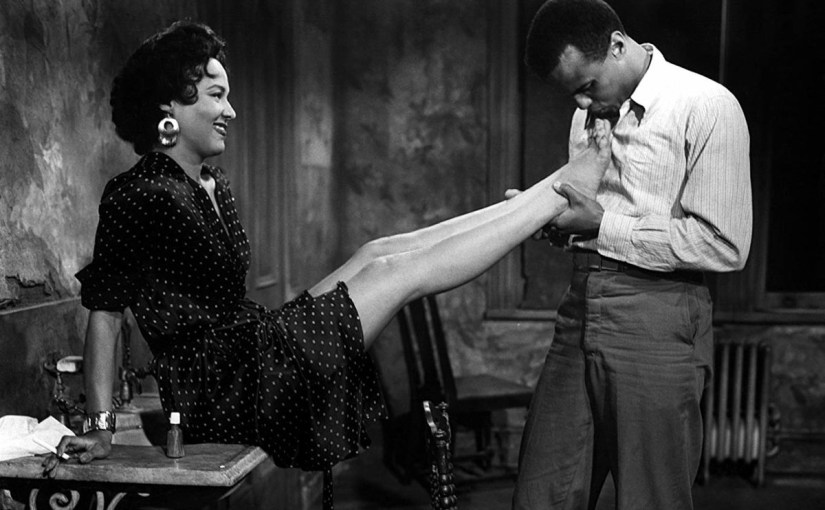
The tragic arc of Carmen Jones may seem inevitable, as I said before, but it remains an entertaining watch.  You can see the dominos falling, and you bemoan the choices Joe makes as he falls under Carmen’s spell, but I mean, LOOK at her.  There’s a scene that I’m sure would bear the Tarantino stamp of approval as Carmen paints her toenails and coyly asks Joe to blow on them for her so they can dry faster.  Dayum.  Show me a straight man who wouldn’t fall for that kind of treatment from a woman who looks like Dorothy Dandridge and I’ll show you a dead man.

If I wanted, I could get nitpicky about Carmen Jones.  Has it aged well?  Not exactly.  Does it feature great acting aside from Dandridge?  Not exactly.  Does it look natural to hear an operatic tenor burst forth from Harry Belafonte’s mouth?  Not exactly.  But Carmen Jones is a landmark of black cinema in an era when schools and government buildings still had segregated water fountains and restrooms.  Based on that fact alone, I consider Carmen Jones to be a vital step in Hollywood’s painfully slow racial evolution. (It is also a painful reminder of a career that might have been; Dandridge died 11 years later at only 42.)

HOBSON’S CHOICE (Great Britain, 1954)

by Miguel E. Rodriguez

Director: David Lean
Cast: Charles Laughton, John Mills, Brenda de Banzie
My Rating: 7/10
Rotten Tomatometer: 92% Fresh

PLOT: A widowed bootmaker in 1880s England with three unmarried daughters is thrown when his eldest daughter announces her intentions to marry his best cobbler and start her own business.


From Wikipedia: “A Hobson’s choice is a free choice in which only one thing is actually offered. … The most well-known Hobson’s choice is ‘I’ll give you a choice: take it or leave it’, wherein ‘leaving it’ is strongly undesirable.”

Ask ten cinephiles about their favorite David Lean films, and I’ll bet dollars to doughnuts not more than two of them will even know Hobson’s Choice exists.  It’s one of only two comedies Lean ever directed (the other being Blithe Spirit in 1945), and it’s one of the last smaller-scale movies he would direct before 1957’s The Bridge on the River Kwai made his name synonymous with big-budget cinematic spectacles.  Hobson’s Choice oozes charm from every frame, has many well-earned laughs, and features a brilliant performance from the great Charles Laughton.  I just wish it had a better ending.  I’ll try not to spoil it for you, but…dang.

Henry Hobson (Laughton) is a widowed bootmaker in late 19th-century England with three unmarried daughters.  The eldest daughter, Maggie (Brenda de Banzie), keeps house, manages the books, and essentially runs the business, leaving Henry free to drink himself silly at the local pub every night and come home drunk as a skunk.  Being of an undesirable age – 30 years old – Maggie is also considered unmarriable.  But she’s no dummy.  See, one of Henry’s employees is a cobbler named William (John Mills, a legendary, prolific British actor), and Maggie notices when a rich patron praises William’s boots as the best she’s ever owned.  So, Maggie hatches a plan that will accomplish three things: get herself married, steal her father’s prize employee, and start her own business with the best bootmaker in town.  Hobson, of course, will have none of it, for various reasons…one of which is that, as the father, he is expected to pay a handsome dowry to the bridegroom, and he’ll be damned if he’ll give hundreds of pounds to a lowly cobbler, nor will he allow his “uppity” daughter to get the best of him.  Comedy ensues.

There is a lot to like in Hobson’s Choice.  First, there is the clever skewering of the class system, both socio-economically and along gender lines.  Hobson is reluctant to pay anything to William other than his barely-livable wages.  When circumstances force him to treat William as if he were a member of the same middle class as he, Hobson, is, he becomes enraged because…he simply has no choice.  The idea of all men being created equal is alien to him.  This same principle applies to his treatment and perception of his daughters.  He may genuinely love them in his heart of hearts, but all we ever hear from Hobson is how bothersome and loud and “uppish” they are.  To him, their sole purpose is to keep things neat and tidy and have dinner ready when he demands it.  It never once occurs to him that Maggie, the eldest, would be capable of putting her plan together, let alone actually pulling it off.

I also enjoyed how a good chunk of the story parallels Shaw’s Pygmalion, at least in broad strokes.  Will, Hobson’s prize cobbler, is as low-class as you can get, and has been treated as such his entire life.  Part of Maggie’s plan is to get Will to behave and dress more genteelly, and her method is nothing short of brilliant.  Rather than follow Henry Higgins’s approach – bullying with a heavy hand – Maggie very gently points Will in the right direction, stepping in with a firm hand only when necessary, as when it becomes necessary to deal with Will’s landlady, one of the funniest bits in the movie.  At first, Will is taken aback by Maggie’s directness, but it’s fun watching how gradually he gets turned around.  He may not be the spitting image of a member of the royal family after all is said and done, but his transformation is unmistakable.

Another great factor is the blustery performance by Charles Laughton in a role that, in my opinion, deserves more attention from film fans.  He’s most commonly associated with Quasimodo or Captain Bligh or the barrister in Billy Wilder’s Witness for the Prosecution (1957), but in Hobson’s Choice, he convincingly plays a man who is painfully aware he’s being driven towards a specific decision he does not want to make.  He’s been lord of the “manor” his entire life, and the idea that he might be forced to bow to his daughter’s whims is unbearable.  He is the most fun person to watch in the film…although John Mills is a close second.  I love his borderline incomprehension as Maggie patiently explains her plans and orders him about.

As I said, there is a lot to like in Hobson’s Choice.  But, man, did that ending let me down.  I was reminded oddly of David Cronenberg’s most recent film, Crimes of the Future (2022), which rolls the closing credits at the EXACT moment it becomes the most interesting.  I have no theatrical knowledge of the play on which Hobson’s Choice is based (other than the fact it ran for over 130 performances), but if the play ends the way the movie does, and I had been a member of the audience at a performance of that play, I would have rolled up my program and chucked it at the curtain.  I don’t want to give too much away, but its abruptness is breathtaking.  In my mind, it leaves far too much unresolved, unless there’s something I missed in that final scene/conversation.  I kept waiting for Hobson to make his eponymous choice, and for a second it LOOKED like he did, but it also looked like he had a devious plan of his own, and then…credits.

Oh, well, no matter.  There is more charm in a single frame of Hobson’s Choice than there is in any two Will Ferrell rom-coms.  I found it thoroughly enjoyable, even if it did let me down at the end.  Since Lean directed my favorite movie of all time, I’m inclined to forgive it.  I’ve seen most of Lean’s other films, and none of them committed this same blunder, so…c’est la vieHobson’s Choice is still worth seeking out.

LA STRADA (1954, Italy)

by Miguel E. Rodriguez

Director: Federico Fellini
Cast: Anthony Quinn, Giulietta Masina, Richard Basehart
My Rating: 8/10
Rotten Tomatometer: 98% Certified Fresh

PLOT: A child-like woman is sold to a traveling entertainer, consequently enduring physical and emotional pain along the way.


Fellini’s La strada, the very first film to win the Academy Award for Best Foreign Film, is widely considered to be one of the greatest movies of all time, a touchstone of the Italian neo-realist movement that grew out of Bicycle Thieves (1948) and Umberto D. (1952).  Ask anyone who knows me, and they’ll tell you that, while I appreciate these kinds of films, they are not exactly my bread and butter.  There are some Italian movies that I will probably never watch, and I am quite sure I won’t miss them.  However, I am happy I finally sat and watched La strada.

But why?  La strada is not a happy movie by any stretch of the imagination.  It tells the story of a vaudevillian strongman, Zampanò (Anthony Quinn), who entertains street crowds by stretching a chain across his chest muscles until it breaks.  When the movie opens, he is paying the mother of a large family 10,000 lire for Gelsomina (Giulietta Masina), a child-like woman with a hugely expressive face.  For that princely sum, she will leave her family forever and learn a trade as Zampanò’s assistant.

They hit the road.  Zampanò is not a very nice man.  He teaches Gelsomina the basics but refuses to let her learn any more than is necessary.  When they eat dinner at a restaurant, he picks up a local floozy and ditches Gelsomina for the night.  When she tries to run away, he runs after her and beats her.  When they take up with a traveling circus, he refuses to let her perform with anyone else but him.  Gelsomina despairs of her existence, but she has convinced herself she can’t leave because she can’t think of anywhere else to go.

In a traveling circus, Gelsomina meets a carefree acrobat/clown known only as The Fool (Richard Basehart).  The Fool lives up to his name: performing dangerous high-wire acts and recklessly teasing Zampanò for no apparent reason, even heckling Zampanò during his act.  This is not a smart man, but he manages to steal a quiet moment with Gelsomina where, in his own way, he tries to let her know that her life has a purpose because EVERYTHING has a purpose, even a pebble he picks up off the ground.  “I don’t know what this pebble’s purpose is, but it must have one, because if this pebble has no purpose, then everything is pointless.  Even the stars!”

Examine that statement closely enough and it’s not quite as life-affirming as it seems, but it lights a spark in Gelsomina’s otherwise bleak existence.  From then on, she holds fast to that conversation, referring back to it when new hardships or doubts arise.  Meanwhile, Zampanò remains as cold and ruthless as ever, even trying to steal from a convent.

And then something unexpected happens that seems as if it will finally break Zampanò’s hold on Gelsomina, but no.  Gelsomina clings to the belief that her purpose is to be with Zampanò, no matter what happens or how miserable she might become.

…so, yeah, this isn’t exactly a happy film.  This is not the kind of movie I would normally seek out.  But in its bleakness, it achieves a kind of aching beauty, like Atonement (2007) or The Remains of the Day (1993).

A lot of that beauty is achieved through the must-see performance by Giulietta Masina as Gelsomina.  It’s clear that Gelsomina is stuck in a woman’s body but with the emotional maturity of a child.  Is she developmentally disabled?  The movie never makes it clear.  Perhaps she simply chose to retain her innocence while the rest of the world moved on around her.  In that way, she becomes almost like a character in a fairy tale.  I found myself wondering if the movie would have played the same had Gelsomina been a child rather than a grown woman.  It might have played a lot like the sequence in Pinocchio (1940) when he is captured by Stromboli and forced to perform for street crowds.

Masina’s performance as Gelsomina would be the single best reason I can think of to recommend this movie to anyone who might not otherwise watch it.  Her face and eyes light up like candles on a birthday cake when she smiles.  When she frowns, she puts clown makeup to shame.  And when she dons clown makeup herself and dances and plays the trombone, you can’t help but grin a little.  When she weeps because she can’t see The Fool anymore, she sounds like a little girl who’s lost a pet.  It’s one of the greatest performances I’ve ever seen.

That performance is key to the movie.  Zampanò’s cruelty and dismissive nature masks his own fear of Gelsomina’s innocence.  He keeps her down because he doesn’t dare allow himself to believe he might be in the wrong.  Watching the movie, we allow ourselves to hope that perhaps Zampanò will reach a turning point where he throws himself at Gelsomina’s feet, begging forgiveness for his terrible behavior and past misdeeds.  But will it happen in time to make a difference?

On the Criterion Blu-ray of La strada, director Martin Scorsese states in an interview that, if you’ve never seen a Fellini film in your life, you could watch La strada and 8 ½ (1963) and you’d know all there is to know about Fellini and his films.  I’m certainly no Fellini expert, but that sounds accurate to me.  La strada contains all the seeds – the score, the performances, the circus theme – that come to fruition in 8 ½.  But La strada is the more accessible of those two films, in my opinion.  If you’re going to start somewhere, start here.

REAR WINDOW

By Marc S. Sanders

Alfred Hitchcock’s beloved classic Rear Window remains absolutely relatable today.  Before the age of the internet and reality TV, people already had a voyeuristic instinct about them.  Heck, movies are voyeuristic!  The audience watches the behaviors and actions of people on a large screen.  Snooping into the activities within your neighbor’s private apartments is not much different.  Though likely less ethical.

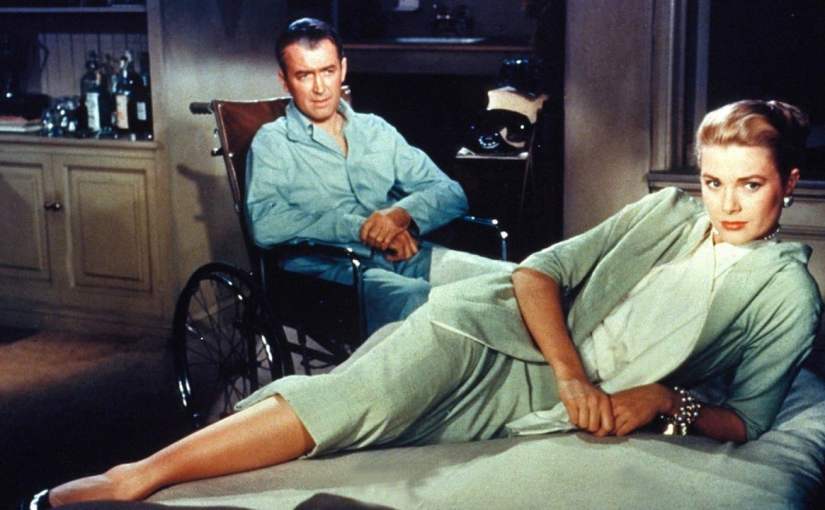
When photographer L.B. Jeffries, aka “Jeff,” (James Stewart, in one of his most famous roles) is bound up in a wheelchair with his broken leg wrapped in a waist high cast, there’s not much adventure like his traveling career demands.  So, he gets caught up in looking at the goings on of his Greenwich Village apartment neighbors like a beautiful hourglass figure dancer he dubs “Miss Torso,” or the newlywed couple and their never-ending sexual escapades.  There’s also an elderly couple who find comfort in sleeping at night on their outdoor balcony next to one another.  He can also take pleasure in a struggling musician trying to write his next piano tune while also entertaining a collection black tie guests.  Another woman he dubs “Miss Lonely Hearts,” for her desperate attempts at entertaining herself with imaginary escorts she’s “invited” for dinner, also leaves him curious to keep up with.

The most inquisitive occupants in this building are a husband (Raymond Burr) and his seemingly ill and often irritating and nagging wife.  Over one rainy night, Jeff takes notice of the husband leaving his apartment with a suitcase at three different times and the wife is nowhere in sight ever again thereafter.  Later glimpses of the husband handling a carving knife, a saw and some rope tied around a storage trunk are also eye opening.  Jeff recounts this sequence of events to his desperate love interest, Lisa (Grace Kelly, with a gorgeous on-screen entrance in one of costumer Edith Head’s legendary dresses) and his nurse caretaker Stella (a smart allecky and perfectly cast Thelma Ritter).  When the likelihood of murder has probably occurred, Jeff also lets his detective friend Tom Doyle in on what’s seen.  All seem skeptical at first. 

Now the action of murder is never seen by Jeff, nor by the audience, mind you.  For the most part, Hitchcock limits the viewer only to what Jeff sees with his own eyes or with the help of his binoculars and his long lens camera.  Midway through the film, the director allows Jeff to doze and gives us a glimpse of something the husband does.  Now, we the audience, have a slight edge of knowledge that our hero doesn’t.  This plays with Hitchcock’s approach to suspense.  We know there’s a “bomb” under the table.  The people sitting there don’t however.  It pains us to wonder if our protagonists will discover the bomb before it goes off.

I’m a big fan of Alfred Hitchcock movies because they never get too complex.  The stories he chose to direct normally place an everyman in a scenario he/she never expected to find themselves in, much less be invited to.  With a screenplay from John Michael Hayes, Hitchcock puts out only a few pieces of a puzzle.  Then, it’s up to his handicapped hero and the audience to solve it.

The voyeurism for Jeff seems like a harmless vice while his time at home slowly passes painstakingly by.  Hitchcock and Stewart do very well in assembling this film.  A close up of Stewart will have him turn his eyes to his right and then we will see what the newlywed couple are doing.  Then we will cut back to Stewart and see his reaction with a smirk.  A look down will cut to the dog, curiously digging away in a flower bed.  Then once again back to Stewart for a close up that maybe has him wondering if the dog is getting at something pertaining to this husband and his now missing wife.  The smirk leaves Stewart’s face.  Now, it’s an expression of puzzlement.

I noted earlier that Rear Window can easily be related to what drives people’s obsessions today.  We are people driven by internet surfing and television streaming and social media.  The known statistic that half of marriages end in divorce is still prominent.  (Maybe that percentage is even higher by now.) Stewart’s character of Jeff becomes so obsessed with keeping up with these people’s stories, that he hardly finds time or enthusiasm to accept the romantic gestures of Lisa.  It’d be fair to argue that technological devices of today serve as an equal distraction in relationships.

Grace Kelly is well cast here.  Arguably one of the most beautiful women to ever appear on screen, dressed in some of the most artistic and fascinating costumes provided by Edith Head, and even she can not divert Stewart’s attention away from the activities of others that Jeff doesn’t even have an intimate knowledge of.  Kelly begins her performance in the film with an approaching close up followed by a sensual kiss upon a sleeping Jeff.  She arranges a catered dinner, delivered by the renowned New York restaurant, Twenty-One.  It just doesn’t completely sway Jeff away from what he becomes obsessed with.  Much like people are with social media, Jeff has been addicted to his vice.  When Lisa tries to implore with Jeff to take their relationship further, James Stewart raises his voice to tell her to shut up and insists that her beautiful hairstyles, wardrobes and high heel shoes could never keep up with him on his travels to far off deserts, jungles and war-torn areas that he photographs.  Yes, Jimmy Stewart tells Grace Kelly to shut up.  It’s shocking.  However, maybe the film will eventually demonstrate that Jeff really doesn’t know anything about Lisa.  The everyman of cinema at that time has been corrupted by what he’s focused on, and in an Alfred Hitchcock film, it is bound to get him into more trouble than he ever expected.  More importantly, the one who cares for him may open his eyes to what he really can’t see as this mystery proceeds.  Broken leg or not, Jeff has never truly seen the real Lisa.

I recall visiting Universal Studios in Orlando, Florida when there was an Alfred Hitchcock attraction there.  I miss it.  It was taken over by a Shrek ride and soon it will be another Minions adventure.  Before ever having seen Rear Window, the attraction featured a look at the Greenwich Village courtyard setting of the film.  It was fascinating.  It was four floors of apartments directly across a courtyard that had a flower bed, folding chairs and the like.  There was also an alley that presumably led to a bustling New York City street.  Naturally, you couldn’t see much of the street.  Just a sliver.  Hitchcock arranged with Paramount Pictures to build the set this way.  Audiences would have wide open views of activities within the window frames of these apartments, the hallways beyond the front door of each dwelling and that one slim alleyway.  The viewer is as limited in what can be seen as Jeff.  This mysterious husband may be going somewhere at odd hours of the night, but once he passes that alleyway, there’s no way of knowing where he went.  Today, we might call something like this one of those “Escape Rooms.”  Solve the mystery, but only with what you can see and only from your one stationary position.  If something takes an unexpected direction, you could find yourself in danger without any means of escape.  That’s how Hitchcock sets up the limitations for Jeff.

As the film progresses, Lisa proves that she can be adventurous like Jeff claims that she isn’t.  In her beautiful gown, heeled shoes and coifed hairdo, she climbs into the apartment of the likely murder suspect looking for clues.  Jeff, however, can’t do anything but watch.  There’s not much he can do either even when the suspect returns while Lisa is still there.  He’s helpless to help her or even himself.  This assembly of direction again falls in line with the “bomb under the table” idea.  It’s one of many devices Hitchcock uses to keep Rear Window as suspensefully entertaining as it was for audiences in the 1950s.

Few directors still can’t keep audiences on the edge of their seat like Alfred Hitchcock.  He had such an intuition for knowing what would keep viewers engaged and wanting to know more.  Unlike other films from him, there’s not much of a twist to Rear Window.  The resolution falls in lifting the veils.  Jeff must reveal himself to this mysterious husband.  (When they come face to face finally, Hitch is smart to position Jeff as a silhouette in darkness.)  Lisa must show Jeff a side to her that he refuses to acknowledge in order to save their relationship. Most importantly, a mystery has to be confirmed.  You find yourself more and more breathless as the film moves on, and then more facts are revealed implying that Jeff is truly on to something.  When the picture finally ends, if you got caught in Hitchcock’s web of suspense, you’ll likely let out a satisfying sigh of relief.