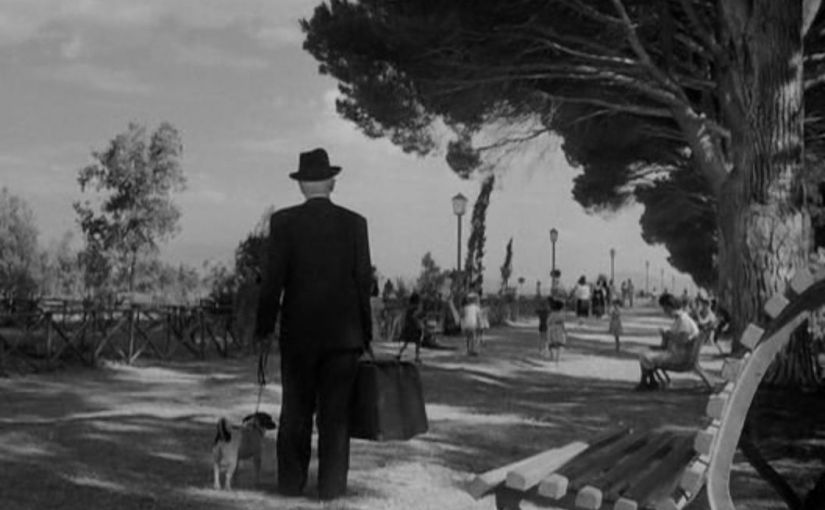
UMBERTO D. (Italy, 1952)

by Miguel E. Rodriguez

DIRECTOR: Vittorio De Sica
CAST: Carlo Battisti, Maria Pia Casilio, Lina Gennari
MY RATING: 8/10
ROTTEN TOMATOMETER: 98% Certified Fresh

PLOT: An elderly man and his beloved pet dog struggle to survive on his government pension in Rome.


The greatness of Vittorio De Sica’s Umberto D. is something I was only able to appreciate after it was over.  As the film plays out, I was waiting for something more to happen, something to add to the paper-thin plot of an elderly man struggling to make ends meet in a city whose government has forsaken him and thousands or millions like him.  When the screen faded to black at the end, my first thought was, “That’s it???  Well, what happens next?”  The fact that the film prompted me, not only to ask the question, but to attempt to come up with an answer, is probably one of the reasons why this film is widely regarded as a classic.  Not many films can claim to keep the story running forward in your head after it’s over.

Umberto Domenico Ferrari is an elderly man living in post-war Rome.  The film opens with him joining a crowd protesting the city government’s policy of cutting their pensions.  Umberto is in dire straits.  He’s behind on his rent, low on cash, his landlady threatens eviction, and he must somehow still feed his beloved dog, Flike (rhymes with “like”).  The film will follow Umberto’s tribulations over the course of several days as he berates his landlady, tries to get some cash by selling some of his books and other possessions, dines at a soup kitchen while furtively feeding scraps to Flike, and befriends the young maid in his building who has problems of her own.

Umberto D. is as good an example as any, and better than most, of Italian post-war neo-realism, a cinematic movement in which Italian film directors aimed to paint the silver screen with portraits of everyday life in their country, which was wracked with poverty and unemployment at the time.  Rather than provide an escape from such hardships, these directors felt it was their civic duty to bring the everyman (or everywoman) into the spotlight, to remind the audience that movies could be more than escapist entertainment.  They felt obliged to say, “There are more stories of despair and hardship ten feet out your front door than can be imagined by any Hollywood screenwriter.”

There are pros and cons to this approach, at least in my opinion.  On one hand, the neo-realist movement created such immortal classics as La strada [1954], Bicycle Thieves [1948, also directed by De Sica], and a little later, Rocco and His Brothers [1960]; these are films that have stood the test of time and will continue to do so for decades to come.

On the other hand, a quote from Roger Ebert comes to mind: “A man goes to the movies; the critic must admit that he is this man.”  In other words, learn to say exactly what you think about a film as opposed to what you think you should think.  And when it comes to Italian neo-realism, I’ll say this: give me a choice between a De Sica retrospective and a Christopher Nolan marathon, and it’s the Nolan marathon seven days a week and twice on Sunday.  Yes, I am aware of the place that neo-realism films have in cinematic history, and I can appreciate their greatness on a cerebral level.  However, on a gut level, I can usually only watch them once or twice, with very few exceptions.  La strada, for example, is heart-wrenching, but in such a way that I want to revisit it just to relive those emotional gut-punches at the end.

Umberto D. didn’t quite deliver those gut-punches, at least not during its running time.  …okay, there IS a moment when Flike runs away, and the possibility arises that he may or may not have been put down by the local pound.  There is a cringe-inducing scene when we watch hardened men roll a cage full of stray dogs into a large box where the dogs will be gassed; we are spared the sight of the actual procedure, but we see enough of it to get the picture.  Umberto watches the box with fear in his eyes.  Another man wants to retrieve his captured pet, but he falters when he lacks the money to pay for his return.  The look on his face as he repeatedly asks, “So, if I don’t take him, you’ll kill him?”  THAT is a scene where my emotional juices where stirred up.

(Okay, there is ONE other scene that got me a little riled up emotionally, but it happens near the film’s climax, so I can’t describe it without spoiling something.)

Aside from those very rare moments of heightened emotion, the film is mostly pedestrian, giving us more details of Umberto’s daily life as he tries and tries to find a way to get enough cash to pay his rent.  In one pathetic scene, he debates whether he should resort to panhandling like so many other men he sees on the streets.  At first, he tries it himself, practicing holding out his hand on a street corner, but when someone actually turns to give him some money, Umberto pretends he was just stretching – he just can’t bring himself to accept handouts from a stranger.  He tries to enlist Flike instead, getting him to hold his hat while sitting on his hind legs, but that doesn’t work out either.  He reaches out to former friends, to no avail.

As I’ve said before, DURING the film, these scenes, and others like them, didn’t stir me up the way I felt the director was shooting for.  It was only afterwards that I found myself pondering those scenes and Umberto’s actions.  I used to own a dog, a very long time ago.  If my dog were my only remaining connection, with no family or friends to reach out to in times of need, how would I feel if I learned he might have been captured and put down?  If I suddenly had no means of income, no way to pay the rent/mortgage/whatever, and nowhere to go if I got kicked out of my apartment/house/whatever, how would I manage?  Would I manage?  Late in the film, Umberto makes a couple of hard choices.  Would I make the same choices in his position?

As FINE appears on the screen, Umberto D. invites us to wonder about Umberto’s fate.  The last scene is, on the surface, a happy one, but somber music plays over it, and the scene does not address or solve Umberto’s situation.  This is in the neo-realist tradition.  If De Sica were asked, “But what happened to him at the end?”, I can imagine him saying, “The same thing that happens to all such men.”  If he was told, “But I don’t know what happens to such men,” De Sica might say, “Well, now you have something to think about.”  Q.E.D.

[Trivia: The lead actor, Carlo Battisti, was not a professional actor, but a professor of linguistics. Umberto D. would be his only film, and not many people can claim that kind of legacy with just one film.]

SINGIN’ IN THE RAIN

By Marc S. Sanders

Reader, I’ve been having a hard week.  My beloved puppy dog, Falcon, has not been feeling well and my family and I are so worried for him.  It’s just been a long week having to deal with reality.  Nevertheless, when I watch a classic musical like Singin’ In The Rain, it’s impossible not to smile and catch on to the energy that drives the film from the talents of Gene Kelly, Debbie Reynolds and Donald O’Connor.  This trio are not just sensational dancers and singers.  They’re adoring comedians that set a standard for facial expressions and endless entertainment variety. 

A simple, but informative story sets the spine of the picture.  Talking films like Al Jolson’s The Jazz Singer are catching on in Hollywood movie houses and the silent pictures are quickly becoming archaic.  Established talents like Don Lockwood (Kelly) and Lina Lamont (a scene stealing Jean Hagen) are being threatened with becoming extinct unless they can adapt to the use of their voices in the romantic cinematic roles they are known for.  Don will adjust.  Lina is another story.  Her alluring blond bombshell looks are recognized everywhere.  However, none of that will line up with her natural, squeaky, ear piercing vocals.  She’s a hopeless case for the best vocal coaches that money can buy.  Don and Lina are star attractions with contracts to guarantee them work, but Lina’s voice could put the movie studio out of business. 

Fortunately, Don just happens to land smack dab into the passenger seat of Kathy Selden’s (Reynolds) car.  Kathy has the voice, and soon Don and his trusty songwriting companion and pal, Cosmo Brown (O’Connor), will realize the acting talent to boot.  In the meantime, though, Kathy’s voice will dub in for Lina’s on screen.  There are great gags at Lina’s expense as she tries to work with a microphone for the first time.  This is Lucille Ball material of the finest, comedic polish.

In between all these story developments reside some of the greatest musical song and dance numbers to ever grace a screen.  Few, if any, films have matched the rubber faced hyperactive quick steps of Donald O’Connor during his rendition of “Make ‘em Laugh!” What he does with this cutaway scene looks like a superpower of marvelous agility.  Jim Carrey could never stand next to Donald O’Connor.

Gene Kelly’s accompaniment with O’Connor and their silly, tongue twisting “Moses Supposes” is magnificent to watch.  You could be on your death bed, looking at this scene, and I truly believe you’ll think nothing is so bad in life while you watch this moment.  The pair are masters with their physicality of jumping on and off desks and chairs, while they toss around a stuffy, glass eyed linguist caught in the middle of their shenanigans.  Every prop and set piece are given functionality, be it a lamp shade, office supplies or stacks of paper.  Then there are the lyrics.  How do you so fluently utter words like “Moses” and “supposes” and every other imaginable piece of vocabulary that phonetically sound like them to seem like it is as natural as saying grace? And they do it all while bouncing all over the place with two stepping in perfect sync.  It’s like nothing I’ve ever seen before.  These guys are functioning on one motor.

To add further compliment, I must emphasize that the camera pointed at these magnificent players hardly ever cuts away.  There are long sequences where the guys are literally walking up walls and back flipping over.  It’s all done in one shot.  There’s only frequent edits away for a close up or another angle.  Otherwise, Gene Kelly and Donald O’Connor are defying the impossible to show breathless choreography.  They seem to defy physics, and the props they use cooperate with every step, leap, run or jump taken.

The same goes for when Debbie Reynolds makes it a trio during another unforgettable number called “Good Morning.”  The furniture pieces are choregraphed to work with the three dancers.  All three race towards a sofa, step on to the seat cushions in unison and then walk onto the back of the sofa, allowing it to flawlessly tip over so they can continue their stride.  Just writing about this, I think about how amazing and wondrous this scene is.  Lightning in a bottle!

All of the material contained within Singin’ In The Rain is incredibly cheerful, full of color and humor and tremendously likable characters.  Yet, it does not ever teeter on being hokey or cheesy.  The musical doesn’t feel dated.  This film transcends generations like The Wizard Of Oz or Star Wars.  No matter the age, anyone should be able to like this movie. 

I love the irony of the number “Singin’ In The Rain” that lends to the title of the picture.  Just think about the word “rain.”  Often it is associated with gloominess and sorrow and mood.  However, the tempo of Singin’ In The Rain as a full length film invites happiness and glee no matter the situation.  Gene Kelly’s clownish activity with an umbrella, a large smile and a rain soaked street corner becomes one of the most delightful moments ever to grace a screen. He stomps, skips and splashes in the large puddles while taking a leap on to a streetlamp just to express all of Don Lockwood’s glorious bliss and adoration for his new love Kathy Selden.  A hat becomes its own character as gushing rain drains out of a storm pipe soaking Don’s head.  The brim of the hat seems to develop its own form of jubilation.

I’ve read that Gene Kelly was a viciously strict co-director (with Stanley Donen) and choreographer on this film.  Debbie Reynolds has testified to long sessions of endless starts and stops.  It was tortuous at times.  If just a toe or a hand was out of place in any of the choreography, Kelly would not stand for it.  It had to be perfect.  I can’t imagine Kelly in a demanding or authoritative capacity.  He is just so cheerful and lovable on screen and so is the entire company of performers.  I guess the contrast with his character lends to how impressed I am with the final product.  However, to make a picture like Singin’ In The Rain this exact and eye popping requires astute examination.  The assembled rhythm of the three dancers and the chorus behind them at least matches some of the most refined military assembly marches I’ve ever seen. 

Watch Singin’ In The Rain for a glimpse into the evolution of Hollywood and cinema.  Watch it for a simple, yet funny story.  Watch it for the characters and set pieces.  Most of all, watch Singin’ In The Rain to discover how grand and wonderful life can be.  It’s likely that none of my readers can do what Kelly, Reynolds or O’Connor accomplish in this film, but I can guarantee that you’ll feel just as joyous as they do while they are putting the show on for you.

Singin’ In The Rain is why movies are so important for our emotional lexicon of escapism.  It lends to good health to watch Singin’ In The Rain.  It’s a film we all need.

Singin’ In The Rain is a reason to live.

THE QUIET MAN (1952)

by Miguel E. Rodriguez

Director: John Ford
Cast: John Wayne, Maureen O’Hara, Ward Bond, Victor McLaglen
My Rating: 6/10
Rotten Tomatometer: 91% Certified Fresh

PLOT: A retired American with a secret in his past returns to the village of his birth in 1920s Ireland, where he falls for a spirited redhead, whose brother is contemptuous of their union.


John Ford’s The Quiet Man won two Academy Awards, one of them for Ford himself as Best Director, his fourth Oscar in that category, a feat which has yet to be equaled by any other director since.  It is on the National Film Registry, on the AFI’s list of “100 Years, 100 Passions”, and is included in the invaluable annually updated book of 1001 Movies You Must See Before You Die.  It currently carries a 91% Certified Fresh rating on the Rotten Tomatoes website and is JUST outside of the IMDb’s top 250 most highly rated films.

(And, as movie nuts will be happy to tell you, this is also the film E.T. is watching on TV when he’s drunk at home and Elliot is at school with the frogs…)

I mention all of this because I want to stress the amazing “pedigree” of The Quiet Man, a film which many have called John Wayne’s finest, one in which the familiar Wayne swagger is on display, but without the kind of Western bravado that was so integral to his success in the movies.  Yet, despite this rather impressive list of accomplishments, The Quiet Man is not quite as timeless as I hoped it would be.  It’s a relic of romantic attitudes that went out of style with the sexual revolution, the Me-Too movement, and – I’ll just say it – common sense.  It has its moments, of course, but aside from one genuine laugh-out-loud moment and a fistfight for the ages, it’s a bit of a chore.

John Wayne plays Sean Thornton, a man looking to escape his past by reconnecting with Ireland, the land of his birth, some time in the 1920s.  In the process, he falls madly in love with Mary Kate Danaher, a fiery-headed and fierce-tempered lass played by Maureen O’Hara.  Such is the chemistry between these two lovebirds that when they first lay eyes on each other, the normally stoic Mary Kate can barely walk ten feet before turning back to stare at Sean’s goofy grin…once, then twice, then THREE times.  Sean asks an old friend, “Hey, is that real?  She couldn’t be…!”  Yeah.  They talk like that all through the picture.

Anyway, one thing leads to another, and they start courting.  But Mary Kate’s elder brother, Will (played by Victor McLaglen with a face that looks like it was put together by a committee of blind men), is against their union because Sean plans to buy a parcel of land he’s been angling to get for himself.  And because this is the ‘20s, the elder brother’s word is law, so no romance for Sean and Mary Kate.  Until, that is, the townsfolk intercede on behalf of the lovebirds.  Small village, you know…the kind where everybody’s private business is an open secret.

The rest of the story is fairly predictable.  Marriage, Will still objects, a new home, the bride’s determination not to consummate the marriage until she gets her dowry, the false crisis, the big fight between Sean and Will at the climax, and so on.  The movie rises and falls on the chemistry between Sean and Mary Kate and the obstacles to their happiness.  Some formulas are old because they still work, and it is competently exploited in The Quiet Man.

For me, though, I must be honest and say that I was never quite engrossed in the story and atmosphere as I would have hoped.  For one thing, John Ford shot much of the film on location in Ireland, an extravagance not commonly indulged in during the 1950s.  However, there are insert shots here and there that were obviously staged and filmed on a studio set.  They are so obvious they became a distraction, something that has never really bothered me in other films of that era.

For another, the attitudes between men and women in The Quiet Man are hopelessly dated, so much so that I’m surprised this film still enjoys such a high rating on IMDb.  For example, there’s a famous scene where Sean intercepts Mary Kate as she’s about to leave on a train because Sean won’t ask her brother for her dowry.  Sean pulls her from the train and drags her home.  Literally drags her.  As they cross a green field, Mary Kate loses her balance and falls, but Sean barely breaks stride, and she is pulled along the grass like so much flour in a sack.  [The making-of documentary on the blu ray reveals the field was littered with sheep droppings which were not removed at Ford’s insistence.  Ah, showbiz.]  One of the female townsfolk witnesses the scene and yells to Sean: “Sir!  Sir! …here’s a good stick, to beat the lovely lady!”  Say what???

Now look: I’m not advocating for “cancellation” of The Quiet Man.  I’m just saying that you should be warned.  It’s a product of its time as much as Gone with the Wind or Some Like It Hot, full of attitudes and jokes that could never be filmed today except as parody or satire.  I get that, intellectually.  For the sake of this story (there’s a lot I’m leaving out), this scene was a necessary beat so Mary Kate could be finally convinced of Sean’s love and determination, equal to hers in every way.  But scenes like that are so glaring that they took me out of the story, and eventually all I saw was this bully who was pulling this poor woman across poop-littered grass.  What can I say.

Now.  Having said all that…I must admit there is one scene that had me laughing out loud at its daring.  It’s so forthright and downright bawdy, I’m frankly amazed it was allowed to make it into the film at all.  I was about to write a full description below with SPOILER ALERT at the beginning, but I won’t.  It involves a misunderstanding between the local matchmaker and broken furniture.  You’ll know it when you see it.  It was such a risqué joke that theaters in Boston edited it out of their film reels when it was released.  I laughed out loud pretty dang hard.

That brilliant joke aside, The Quiet Man is a serviceable film, showcasing two stars, Wayne and O’Hara, at or near the height of their powers, but who are at the mercy of a melodramatic script that is nearly a parody of itself.  I’m not sorry I watched it, you understand.  It’s a piece of Americana as ingrained in cinema history as Singin’ in the Rain.  But on the whole…I would rather watch Singin’ in the Rain for the fiftieth time than watch The Quiet Man again.  At least, not so soon.  Maybe in a few years.