ONCE UPON A TIME…IN HOLLYWOOD (2019)

by Miguel E. Rodriguez

Director: Quentin Tarantino
Cast: Leonardo DiCaprio, Brad Pitt, Margot Robbie, Timothy Olyphant, Dakota Fanning, Bruce Dern, Luke Perry, Al Pacino, Kurt Russell
My Rating: 10/10
Rotten Tomatometer: 84% Certified Fresh

PLOT: A fading television actor and his stunt double strive to achieve fame and success in the film industry during the final years of Hollywood’s first Golden Age in 1969 Los Angeles.


Quentin Tarantino’s ninth film is a little bit like Beethoven’s Ninth Symphony.  It’s big, bombastic, and goes the long way around the barn to get to the finale, but in the end it all makes sense and is a transcendent experience.

Let’s see, where do I start?

First of all, the film’s evocation of 1969 Los Angeles is like Mary Poppins: practically perfect in every way.  I’m no fashion scholar or visual historian, but every exterior shot of the city was pretty convincing to my layman’s eyes.  The movie theatres, the movie posters, the restaurants (anyone else remember “Der Weinerschnitzel”?), the cars, those HUGE sedans sharing the road with VW Bugs and M/G’s…it’s clear they did their homework.

There’s the performances by the two leads.  Tarantino once said he considered himself the luckiest director in modern history because he was able to get DiCaprio and Pitt to work on the same film.  Can’t argue with him on that score.  They carry the film in a way that few other tandems could have.  (Newman and Redford come to mind.) Mind you, DiCaprio and Putt don’t look much like each other, considering one has to be the other’s stuntman, but you get the idea.

Above all, there’s the story.  DiCaprio plays Rick Dalton, a former leading man from ‘50s TV westerns who is now playing colorful bad guys in ‘60s TV westerns.  Brad Pitt plays Cliff Booth, the stuntman who’s been taking the dangerous falls for Dalton for years.  Dalton happens to live next door to Roman Polanski and Sharon Tate on Cielo Drive in the Hollywood Hills.

All the trailers, and all the industry buzz, reveal that the Manson family and Sharon Tate play a part in the film.  That’s no spoiler.  Given what we know about those events, the movie plays like Gimme Shelter, the landmark documentary about the ill-fated concert at Altamont that was actually due to take place a few months after the events of this film.  It’s all very suspenseful, in the sense that we know what’s coming, but we’re just not sure how the movie is going to approach it.  So every scene with poor Sharon Tate in it is overshadowed by the fact that we know her ultimate fate in history.

It’s like the famous Hitchcock analogy of suspense.  Two people are eating at a restaurant when a bomb suddenly goes off under their table…that’s surprise.  Put those same two people at the restaurant, where the audience knows there’s a bomb under the table, but it doesn’t go off right away as the two people eat and converse and have dessert, and we’re wondering will they leave BEFORE the bomb goes off or not…?  That’s suspense.

And that’s the genius of this movie, with Tarantino’s sprawling, winding screenplay.  We get to know Rick Dalton and Cliff Booth intimately, we get the rhythms of their relationship, of Dalton’s mood on set, of Booth’s quiet acceptance of his role as Dalton’s sole support system.  We are treated to lengthy scenes showing Dalton at work on the set of a TV western, so we can appreciate the vast differences between an actor and their characters.  There’s a brilliant backstage scene between Dalton and a child actor who is impossibly, hilariously advanced for her age, and who winds up giving Dalton some goodhearted advice.

And interspersed through it all is Sharon Tate.  Sharon Tate bopping to music at home.  Sharon Tate picking up a female hitchhiker on her way into town.  Sharon Tate almost passing, then backing up to admire with youthful excitement, her name on the marquee of a movie theatre, right next to (gasp) Dean Martin’s name!  Sharon Tate dancing, walking, smiling, drinking…living.  She’s the diner at the restaurant, and the Manson family is the bomb we know will eventually go off.  It casts a pall over the proceedings, but not in a bad way.  It’s an interesting way to bring the reality of the situation into focus from time to time.

And now I have to end this review before I inadvertently give away certain, ah, plot elements that elevate Tarantino’s film from a mere character study or period piece into the heady heights of cinematic transcendence.  I have not myself read any reviews of the film, so I can only guess that whatever negative reviews are out there probably center on the film’s finale, or perhaps on its meandering script.  All I can say, or will say, is that I am firmly on Tarantino’s side on this one.  The way the conclusion was written and filmed is the kind of thing that people will still be talking about years from now.

So just take it from me.  If you’re a movie fan, and ESPECIALLY if you’re a Tarantino fan, this is right up your alley.  It’s easily his most slowly paced movie since Jackie Brown, but that just gives you time to e-e-e-ease into the characters, like putting on a tailored suit piece by piece.  This film, like Beethoven’s Ninth, is a masterpiece.

BROKEBACK MOUNTAIN (2005)

By Miguel E. Rodriguez

Director: Ang Lee
Cast: Heath Ledger, Jake Gyllenhaal, Randy Quaid, Michelle Williams, Anne Hathaway
My Rating: 10/10
Rotten Tomatometer: 87% Certified Fresh

PLOT: The story of a taboo romantic relationship between two cowboys, and their lives over the years.


Brokeback Mountain is the kind of movie that makes me wish I was a better communicator, like Lost in Translation.  I know I love these movies, I know WHY I love these movies, but it’s difficult for me to put into words.

Brokeback is, of course, the movie that will forever be known among the snark peddlers as “that gay cowboy movie,” which is insultingly reductive.  That’s like referring to Star Wars as “that space movie.”  To reduce the movie to those terms is to totally ignore the boundless riches to be had by watching it, I mean really watching it.

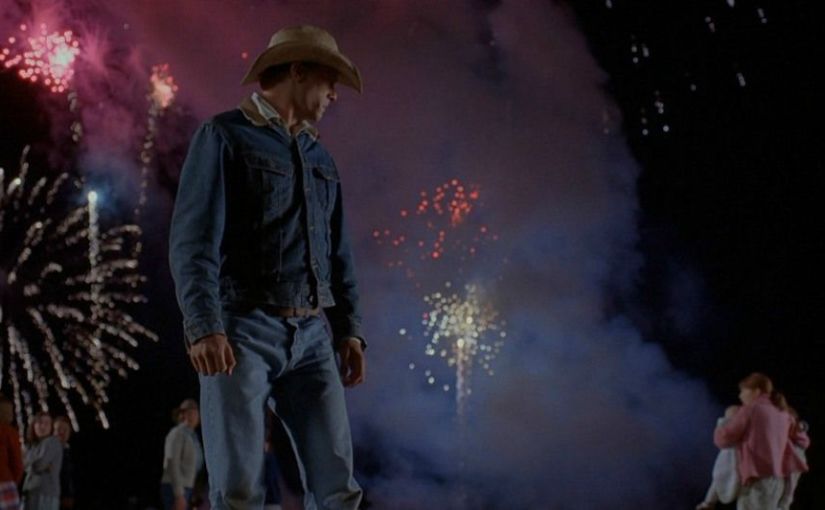
For one thing, damn, just LOOK at it.  Look at the way the skies fill the frame, with clouds hanging heavily over the mountains and the dusty streets and the trailer parks.  Director Ang Lee makes the sky into a tangible character all its own, much like Kubrick did with the Overlook Hotel.  It infuses every outdoor scene with a sense of the largeness of the world around us.  It’s a fitting backdrop for the intimate story presented to us.  In fact, those huge scenic backdrops are kind of a throwback to the ‘70s, to the films of Cimino and Arthur Penn and Bertolucci, when painting a picture with the camera was two-thirds of the story.  Virtually every outdoor scene in Brokeback Mountain is worthy of framing in an art gallery.  Stupendous.

The movie turns on the story of two men who unexpectedly and passionately fall in love in 1963, a time when gay love was still taboo, at least in polite society, and especially in any given cowboy community.  But as the story winds its way through almost twenty years in the lives of these men, it becomes less about the FACT of their affair, and more about the enormous sense of yearning and loss that comes from desperately wanting something that you can’t have.  Who among us has never felt that kind of insane desire?  Not necessarily for a person, even, but for anything at all?  A crippled man who longs to walk, or a blind man who yearns to see.  A dream job.  A dream vacation.  That’s what this movie is about.

Heath Ledger delivers the performance that really put him on the map.  His portrayal of Ennis Del Mar is incredibly subtle, although his Western accent flirts with impenetrability at times.  I love the way he shambles and mumbles through his role, virtually the entire movie, which pays off in that fantastic scene by the lake (“I wish I knew how to quit you!”) when this hulk of a man is torn down by his own unspoken passion.

Again…I’m not a poet, so this really doesn’t quite get at the mood generated by the movie.  It’s no feel-good film, that’s for sure, but it’s worth seeing by anyone who loves world-class storytelling.  Don’t let anyone, or your own preset notions, steer you different.

ROMA (2018)

By Miguel E. Rodriguez

Director: Alfonso Cuarón
Cast: Yalitizia Aparicio, Marina de Tavira, Diego Cortina Autrey
My Rating: 10/10
Rotten Tomatometer: 96% Certified Fresh

PLOT: A year in the life of a middle-class family and their maid in Mexico City in the early 1970s.


The closing credits of Alfonso Cuarón’s intensely personal, emotionally powerful Roma state unequivocally (in Spanish) that the entire movie was shot on 65mm film.  This is an important choice with a movie that communicates its emotional beats with strong, crisp visuals that don’t feel like a traditional movie.  To me, Roma feels like looking through an old, well-preserved photo album of a family I don’t know.  But the closer I look at the pictures, the more I can intuit how their lives are no less important or vital than my own.

More than most films, Roma exemplifies one of Roger Ebert’s core beliefs about film.  He said that movies “are like a machine that generates empathy. It lets you understand a little bit more about different hopes, aspirations, dreams and fears. It helps us to identify with the people who are sharing this journey with us.”

That’s how I felt watching Roma.  I never really felt like I was watching a film.  Director Cuarón (who served as his own cinematographer) uses his camera and shrewd editing to create the idea that I was looking at a fondly remembered memory instead of a traditional, plot-furthering movie sequence.  I didn’t grow up in Mexico or have a maid, but within just a few seconds of the opening scene – hell, during the opening CREDITS – I was sucked into the world of the film.

Another important element of this movie’s success is the exquisite sound design.  Over the opening credits, we see nothing except a close-up of some sort of tiled surface.  Soapy water spills over it a couple of times. We hear a mixture of street sounds, but not a busy street.  At one point a jet airliner flies far overhead, visible in the sky as reflected in a puddle of water. We can hear birds, and people talking and shouting in the distance, and a street vendor, and the occasional dog barking, and…it succeeds in placing you firmly in the world of the movie. It all feels completely organic, not engineered.

I’ve just realized I haven’t said a word about the plot.  The story, in itself, is nothing extraordinary.  We follow several months in the lives of a middle-class family in Mexico from 1970 to 1971.  They have a maid, Cleo, who discharges her duties with efficiency, who is beloved by the family children, who has a life of her own outside of her employer’s household.  Through various personal upheavals, both in her own life and the life of the family she works for, they all grow incredibly close.  …and I can almost hear your eyes glazing over as you read those words.

But, as is the case with every other film, what’s important is not WHAT this movie’s about, it’s about HOW it tells the story.  And Roma, if nothing else, solidifies Alfonso Cuarón’s standing as one of the great modern masters of cinematic storytelling.  In his hands, this humdrum story of middle-class life becomes a hymn to nostalgia. There’s a brief scene of everyone gathered around a television set, watching a variety show.  The sight of their smiling faces, illuminated by the screen, triggered a memory of my own family sitting around the TV back in ancient history, before VCRs and even cellphones(!), and watching the ABC Movie of the Week, like The Towering Inferno or Grey Lady Down.  It’s rare for a film to affect me like that.

I have to tread carefully here, because I want to mention a key event that occurs in the latter half of the film.  It’s immensely harrowing, all shot in one take (indeed, IMDb tells me it was shot only ONCE and not repeated).  In any other movie, I would say that it’s the kind of thing a screenwriter would throw in as a shamelessly manipulative plot twist, designed solely to elicit unearned emotions from the audience.  In Roma, however, the movie has so thoroughly worked its magic that the event, when it happens, is not shameless, but shocking and heartbreaking.  I was not watching an actor or actress.  I reacted as if I was watching a home movie of a real person going through a traumatic event, and it was devastating.  THAT’S the kind of rare cinematic event that I live for.

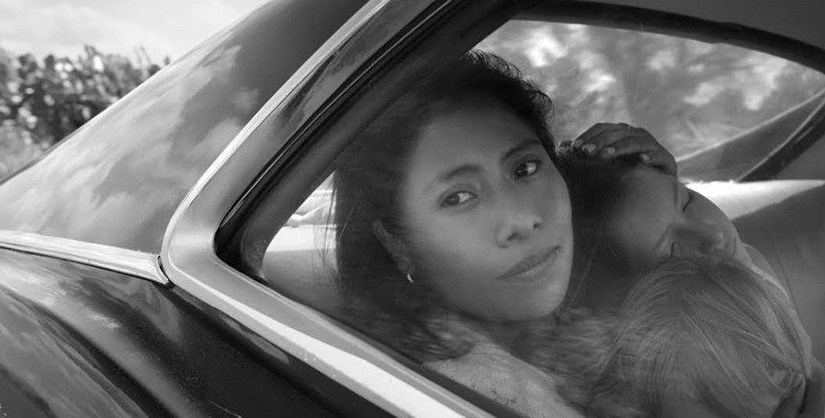
Roma is a black-and-white film shot in Spanish, with English subtitles, and which leans heavily on visual storytelling.  This may not be your cup of tea.  But if you like film at all, if you like the kind of movie where you can drink in the visuals like you were at a museum where the pictures breathed and lived and loved, then you owe it to yourself to see Roma as soon as possible.

THE FAVOURITE (2018)

By Miguel E. Rodriguez

Director: Yorgos Lanthimos
Cast: Olivia Colman, Rachel Weisz, Emma Stone, Nicholas Hoult
My Rating: 10/10
Rotten Tomatometer: 94% Certified Fresh

PLOT: In early 18th century England, a frail Queen Anne (Colman) enjoys the attentions of her close friend, Lady Sarah (Weisz), but when Sarah’s cousin (Stone) arrives at court, a subtle power struggle ensues.


This movie is a TRIP.  Imagine that someone crossed the sex-driven antics in Dangerous Liaisons with the cat-fighting in All About Eve, directed by someone who idolizes Stanley Kubrick and David Fincher.  It’s that good.

Where to begin?

I loved the story.  It’s a basic power struggle/love triangle, but told with immense wit and originality.  Queen Anne indulges in sexual dalliances with her closest confidante, Lady Sarah.  Then Abigail appears, a distant cousin to Lady Sarah; she’s hired as a scullery maid and slowly works her way into Lady Sarah’s confidence as her handmaiden.  When the Queen starts to show a preference for Abigail over Lady Sarah, oh, the fur doth fly.

Rarely has it been so much fun to see such bad people behaving so badly.  At first, I was rooting for Abigail, who is only doing what seems necessary to survive, but then it becomes obvious that there ARE no good guys in this movie.  Abigail proves herself just as capable of social atrocities as Lady Sarah or Queen Anne herself.  Normally, I HATE movies with no clear heroes, but the screenplay and camerawork kept me constantly engaged and entertained.  I think I had a smile on my face continuously after the 30-minute mark.

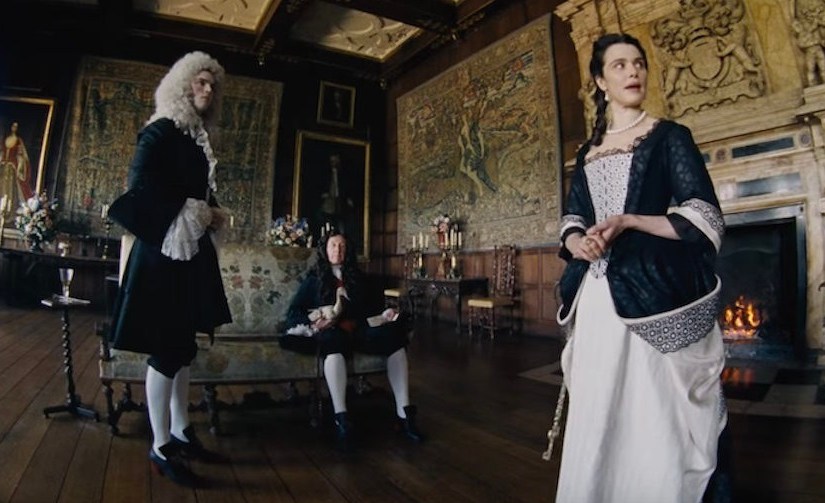
And let’s talk about that camerawork.  I’ve never seen one of this director Yorgos Lanthimos’s films before, but if they share the same visual inventiveness as THIS movie, I am going to seek them out.  The list of directors working today with visual styles unique to them is relatively short, so to find this fresh take on moving pictures was a delightful surprise.  There are a couple of places where extremely-wide-angle “fish-eye” lenses are used, distorting the picture on the edges so it looks like you’re looking at the scene through the bottom of a Coke bottle.  I found that particular device odd, calling attention to itself, but it worked.  It sort of created this idea that we’re looking at a staged performance rather than attempting to mimic or capture strict reality, which makes some of the behavior of the main characters more palatable than they might be in another film.

There are one or two moments that are so over the top, they might have derailed another film.  At one point, two characters dance during a formal party, as the Queen looks on.  It starts out daintily enough, like you’ve seen in countless other 18th-century films, the mincing steps back and forth, a little bow here, a curtsy there.  Then, as the music continues…something happens.  The man lifts the woman and swings her around on his hips like a swing dance.  They start to move their hands like in the “Vogue” video.  At one point, I’d swear the man started a rudimentary breakdancing move.  What’s going on here?  Why is this jarringly anachronistic dance intruding on the proceedings?

My first reaction while watching the movie was to just laugh in disbelief, while asking, “What IS this?”  Looking back on it now, I’d guess the purpose was to put ourselves into the mind of the Queen, whose perception of the dance starts to degrade the angrier she gets.  Regardless of its true purpose, it’s thoroughly weird but hilarious.

(Also, the screenplay contains some of the greatest zingers I’ve heard in a very long time, although I doubt some of them are historically accurate.  Not that I’m a historian, of course, but I remain unconvinced that British royals in the 1700s ever used the term “vajoojoo.”)

I’ll be honest, I was not previously aware of the actress Olivia Colman, who portrays the fragile, temperamental Queen Anne, before this movie, but I’ll be looking out for her from now on.  She more than holds her own with two Oscar winners (Emma Stone and Rachel Weisz).  Colman’s Queen Anne is a spoiled brat whose petulance is tolerated because, you know, she’s the Queen.  I loved a moment when she walks past an unsuspecting footman and yells at him, “Look at me!  Look at me!!!”  He turns and looks, and she immediately yells: “HOW DARE YOU LOOK AT ME!!!”  Right there, early on, her character is indelibly defined.

The depths to which all three women sink to exact their own particular brands of revenge upon each other will astonish you.  While the ending is not the one I quite hoped for, it’s extremely satisfying in a “be careful what you wish for” kind of way.  This movie was a delicious romp, and is definitely worth your time.

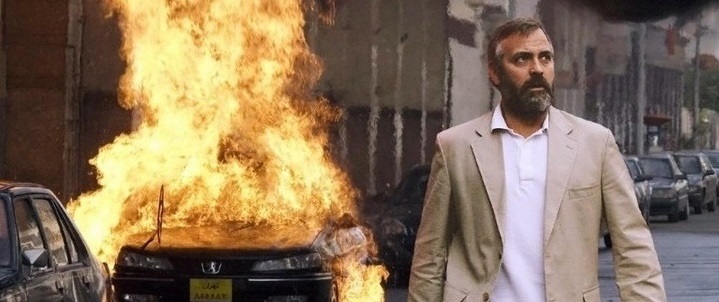
QUICK TAKE: Syriana (2005)

By Miguel E. Rodriguez

Director: Stephen Gaghan
Cast: George Clooney, Matt Damon, Jeffrey Wright, Christopher Plummer, Chris Cooper, Amanda Peet
My Rating: 8/10
Rotten Tomatometer: 72%

PLOT: A politically charged epic about the state of the oil industry in the hands of those personally involved and affected by it.


Syriana reminds me of one of those puzzles made out of twisted nails, where the challenge is to untangle them, even though it appears to be impossible.  The difference is, with Syriana, I don’t get tired of trying.  At least, not yet.

The movie is a pleasure to watch, but hard to explain.  It’s a convoluted tale that starts with an impending merger between two oil companies, detours into political and legal intrigue, and sprinkles in some religious fanaticism by the time we get to the end.  I’ve watched it five times, and I still have questions about the plot.  I JUST watched it, and I’m still not entirely sure who Christopher Plummer’s character is and why he matters at all to the story.

Normally, a movie this confusing would turn me off.  (Examples: Full Frontal [2002], The Fountain [2006], The Counselor [2013])  But when I watch Syriana, I get the sense that, underneath the twisty plot and maddeningly oblique dialogue, there lurks a great truth.  Maybe the plot is confusing because, really, the situation it’s describing is so confusing in real life.  Maybe any attempt to parse the complexities of U.S. relations with oil-producing countries is a fool’s gambit to begin with.  So the movie just jumps in with both feet and separates the watchers from the listeners.  You’ve really got to ACTIVELY listen for two hours to make ANY sense of the movie.

Maybe that’s not your thing.  Fair enough.  This is the kind of movie that I can’t defend on objective grounds.  You’re either gonna like it or not.  For myself, I get sucked into it every time I watch, even if I don’t understand it all 100%.  So.  There you go.

THE FRENCH CONNECTION

By Marc S. Sanders

Popeye’s in town.

“You been picking yer feet in Poughkeepsie?”

One of the first gritty crime dramas.

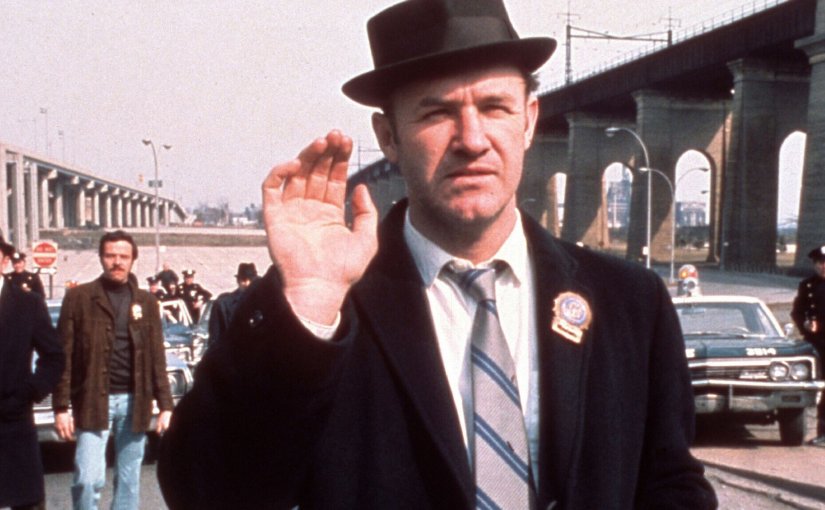
With modern cinema offering huge bravura performances a la Daniel Day Lewis or Christoph Waltz these days, it’s any wonder that today’s generation of movie goers would be puzzled that Gene Hackman won the Best Actor Oscar for this film, The French Connection, which also happened to win Best Picture. His character has no big monologues, no huge crying scenes. In fact for most of the film, he’s slamming guys up against a wall or following them up and down the dirty Brooklyn streets. Yet, his accolades were nothing short of deserved.

Watch as Hackman’s Popeye Doyle gradually exhausts himself in pursuit of “Frog 1.” His character starts out as a thrill seeking detective only to find his limits pushed against a better cat and mouse player. Dialogue isn’t sophisticated here to show his state of mind, but rather his expressions offer everything. Simply look at his close up following the extensive car search (an incredibly satisfying scene for me as a viewer).

If that’s not enough, the car/foot chase through Brooklyn is one that still has not been matched. See how it was done before CGI.

A simple drug deal is plotted perfectly from Marseille to New York, and best of all, it is all true (well mostly).

What’s most curious is the film provides one of the oddest and most unforgiving endings in a film ever. Perhaps you’ll agree (????). But, remember…THAT IS HOW IT HAPPENED!!!!

This was a film from 1971 that was raw in its language, gritty in its setting, spiteful and unafraid of the image it would leave, and that is why it won Best Picture, Best Director and Best Actor.

Bottom line, it would never have been made today. Never!

(Word of advice, ignore the sequel. A prime example of Hollywood shamelessly cashing in.)

THE LAST PICTURE SHOW

By Marc S. Sanders

Peter Bogdonovich’s classic adaptation of Larry McMurtry’s The Last Picture Show is a display of the ends of things that perhaps at one time had life.

The film opens on the main street of the fictional town of Anarene, Texas in November 1951, just as the Korean War was occurring.

A strong gust of wind blows while a mute, mentally handicapped boy fruitlessly sweeps a dusty street, and a junky pick up truck careens down carrying Duane Jackson (Jeff Bridges) and Sonny Crawford (Timothy Bottoms); both on the brink of adulthood with no future in sight. Anarene is a town that has a past and only a few remnants of a present represented by a pool hall, a diner and movie house. All three are owned by Sam “The Lion” (Ben Johnson in an Oscar winning performance). Sam is old and wise. The town speaks through Sam, who is well aware nothing of promise is offered here anymore. So it’s no surprise that all the remaining townsfolk can occupy themselves with are their televisions and sexual conquests.

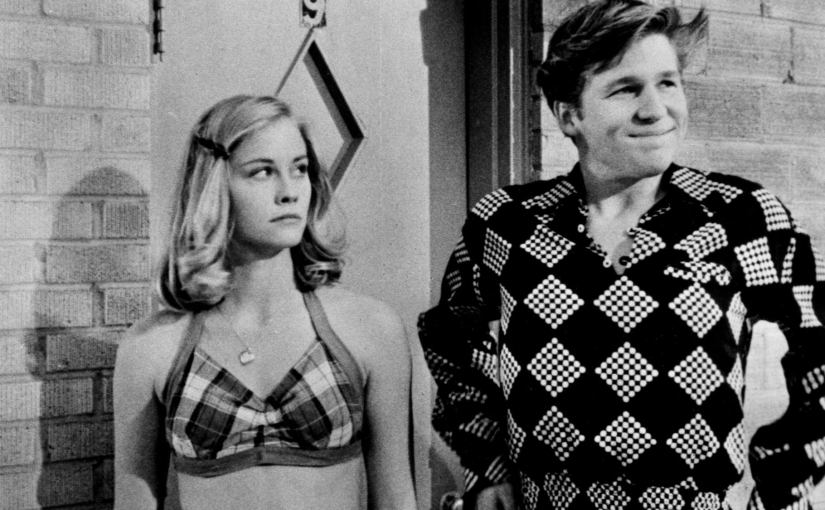
Variations of perspectives that are sexual in nature continue to symbolize what is dying in Anarene. Cybill Shepherd in her very first role portrays Jacy, the pretty girl. Her innocence will be lost as soon as she gives away her virginity. It matters little to her how that happens. Bogdanovich offers a great scene where Jacy attends a swimming pool skinny dip party. Jacy is pressured into standing on a diving board to undress in front of the revelers. I looked at this moment as a teetering balancing act. Jacy is bordering saying goodbye to her youth forever. She does undress all the way only to almost trip off the board. For the moment, Bogdonovich saves the character’s present state as she narrowly avoids falling in the water.

Later, on a whim during New Year’s Eve, Sonny and Jackson go off to Mexico with little money in their pockets and no plan in mind. When they return, an unexpected turn of events has occurred. The fate of this town is withering away with the breeze that’s always intruding. The mute boy will occasionally sweep the street again but accomplish nothing from it.

The films in the movie house represent those that were once celebrated but are now almost never noticed as these families are becoming more glued to the next common household appliance, the television with variety hour shows.

The music never changes or grows up. Hank Williams Sr, occupies the minds of folk who maintained this town at one time and are slowly dying off. The next generation does not have much appreciation for it.

I could go on. Every scene in The Last Picture Show brings about another example of an ending. Bogdonovich was meticulous in his symbolic method of McMurty’s story.

I love that the film, released originally in 1971, was shot in black & white because it shows the story in a historical context; this is what’s left of what once was. The sexual situations don’t hold back in nudity. It’s wise as I thought the nudity clashed with the black & white; it was almost intrusive. The nudity is overcoming the home life heartland that small towns like Anarene used to be remembered for. Sadly, the characters have a hard time accepting this fate.

Cloris Leachman portrays Ruth Popper, the wife of the high school coach who she suspects of being gay. She engages in an affair with young Sonny and her big moment comes when she frustratingly throws a coffee pot at the wall in a rage. She’s terrified that Sonny could never retreat to her pace of life. He’s apt to move on from her. She’ll be stuck with a closeted gay husband in an unstimulating environment. Time has become stagnant for Ruth within the confines of a lifeless marriage and a dead town.

A new way of life awaits. Destiny for Jacy, Sonny and Duane do not include Anarene in their plans.

Eventually Sonny and Duane attend a showing of John Ford’s “Red River” featuring John Wayne. The next morning, after the movie house has closed forever (no one buys tickets anymore), a new fate awaits, maybe even death. Worse yet, maybe for one of them, there is no fate. Maybe, for one of them all that’s offered is an absence of life while residing in Anarene, Texas.

I didn’t realize how much material I absorbed until after The Last Picture Show was over. Peter Bogdonovich provided more for me to think about then I was aware of. The initial slow pace of the film seems mundane at first until you understand that people like Ruth and Sam have memories they experienced but will never carry forward. It’s sad. Their history had meaning at one time. The legacy of their past, however, has no future.

The Last Picture Show is on AFI’s 100 best movies from 2007. It deserves to be as Bogdonovich deftly shows how a past withers away from a nowhere future. His set pieces and direction of characters show the suffering they endure with an unsure end they can not escape.

I haven’t stopped thinking about The Last Picture Show since it ended.

WEST SIDE STORY (1961)

By Marc S. Sanders

The musical answer to Romeo & Juliet will always remain as one of my favorites.

West Side Story crackles with energy as soon as the 6 minute overture begins and segues into overhead shots of New York City accompanied by its frequent whistle calls. Then it zooms in for something new, fresh, and eye popping; precise choreography from Jerome Robbins to represent street fighting by means of heart racing ballet. You simply can’t take your eyes off the screen.

Young love and pride carry Robbins’ film with partnered direction from Robert Wise. It’s sadly amazing that the prejudices that shape the story are arguably more evident and profound nearly 60 years later. Tony & Maria must never be together. Change the names today, and the logic behind the societal law will often mirror the reasoning found in the film.

Am I focusing too much on that message though? There’s so much to cherish in West Side Story. A film that boasts numbers like “America,” “I Feel Pretty,” “Tonight,” “Stay Cool Boy,” “When You’re A Jet,” “Maria,” and my favorite “Officer Krupke.” It does not get much better than this.

The dancing lunges at the camera. The dialogue may be dated, yeah, but the cast is so genuine to the setting (even if Natalie Wood is lip syncing her songs).

Steven Spielberg has remade the film, to be released in December, 2021. I’ll go see it, sure. Yet I don’t believe it’ll compare to the original 1961 winner for Best Picture as well as the other 9 Oscars it was recognized for.

Go back and catch up with West Side Story. It should be seen by anyone who ever wanted to watch a great film.

SUNSET BLVD

By Marc S. Sanders

One of Billy Wilder’s most famous films is Sunset Blvd. A film that’s always escaped me despite seeing two productions of the stage musical, most recently on Broadway with Glenn Close as Norma Desmond. No matter how it is interpreted, it is a haunting story narrated from the grave of young screenwriter, Joe Gillis. In the 1950 film, Joe is played by William Holden. Norma is played by Gloria Swanson, with Erich von Stroheim as her butler Max.

Joe is a down on his luck screenwriter trying to avoid his car being repossessed. Events lead him toward hiding the car in the garage of a mysterious mansion belonging to one time silent film star, Norma Desmond, now obsolete during the age of talkies. She was big at one time. Though Norma insists she is big. “…it’s the pictures that got small.”

Joe is caught in Norma’s web, feeling obligated to write her story while she provides him with all the money and clothes that she can, to keep him close with no opportunity to escape. Even a sneak away to a New Years Eve party leaves Joe feeling compelled to return to Norma where Max has set up living quarters for him.

Holden’s voiceover narration is wry and descriptive like a novelist’s words being emoted vocally. Feelings are shared allegorically. It lightens the mood of Wilder’s film which is a quite dark and strangely sad depiction of a one time film star who has aged amid her isolation and is all but forgotten among the Hollywood elite. Even Cecil B DeMille (playing himself) doesn’t carry much interest in Norma anymore. It’s especially quite telling later in the film when she unexpectedly shows up on the Paramount lot. She had been called upon, but not necessarily for a new role, rather something else entirely.

Swanson is unforgettable as Norma; one of the greatest and most memorable film characters to ever grace the screen and the part is drawn out so well within the Oscar winning script from Wilder and his long time collaborator Charles Brackett. Swanson gives honesty to Norma’s madness; look at the famous final stair descending scene. It doesn’t get much better or more impactful than that. Don’t believe me? Go watch Carol Burnett spoof that moment. It’s one of the greatest cinematic moments ever placed on celluloid.

I digress.

Yet, I get Norma’s refusal to accept the changes to Hollywood films. She tells the modern screenwriter, Joe, that back then they had FACES, not dialogue. I get it Norma. I truly get it.

Joe is challenged to maintain his own present state of mind. He’s a writer with ideas like a baseball picture. Only he needs a producer to invest. Sure the money comes to him easy from Norma but it’s conditioned under her rules and unwavering possessiveness. It’s a shame when Joe only gets an opportunity at something following meeting Betty Schaefer (Nancy Olson), a pretty, up and coming writer herself, and engaged to his best friend. Joe is stuck. He has to be covert in sneaking away to write with Betty unbeknownst to Norma. Worse, he has to resist the urge to get intimate with Betty as well. Joe has multiple problems to contend with here all stemming from being stuck in someone else’s past that offers no stimulation sexually or creatively. Wilder and Brackett pen a perfect character conundrum. Joe has no escape.

It may sound silly but I couldn’t help but think of Paris Hilton while watching Sunset Blvd. I’ve never followed the heiress’ comings and goings. However, I recall a time in the early 2000s when Hilton would be all over reality TV. She was in every magazine and on every gossip headline. Not anymore. Reality TV, like network TV, is losing its flame quickly to the newest medium of streaming services. Hilton is now 15 years older. (Desmond is only 50 in the film, when she’s all but washed up.) Could Paris be wondering what’s become of her starlight? Is Paris waiting for the “Joe” who she’ll insist on being her boy toy? My mind actually drifted towards this subject!!!!

If anything, it tells me that Sunset Blvd still holds relevance. Mediums change and those that were once prominent sadly become obsolete. Either we change with the times, or we opt to be abandoned by an ever developing future.

Sunset Blvd should be seen simply as a reminder that our history never stays stagnant. However, a danger lies in refusing to move on or in Norma’s case losing the opportunities to move on. We might all be ready for our close up Mr. DeMille, but doesn’t that mean someone needs to be holding the camera?

PULP FICTION

By Marc S. Sanders

No one can deny that Quentin Tarantino’s classic film, 1994’s Pulp Fiction is one of the greatest screen accomplishments of the latter half of the 20th century. It’s strange, lurid, scary, unforgivingly funny and altogether different from practically anything that came before it. How did the Weinstein brothers with Miramax films prophesize the energy it would surge in mainstream audiences?

When I first saw the film I was apprehensively going with two college friends who insisted I see what they experienced from a prior viewing. Suddenly, I realized that alternate surf 70s rock, black suits, and a kinetic visit to the restaurant known as Jack Rabbit Slims could entertain and make me look further than just a facial close up.

Tarantino entertains the lens of his camera by making his audience the camera. A drug dealer scrambles to find a medical book to awaken a boss’ wife who is dying from a potent heroin overdose, and the camera stands in place only frantically swinging left and right. The camera doesn’t move while everyone in the scene remains in a panic, frightened of administering an adrenaline shot. The camera stands still to allow the audience to stand in the room as well. It’s very unusually funny, but unnerving and suddenly we are amid the clutter of crime and drugs frightened of a terrible fate.

Another scene follows two gangsters down the hall as they debate whether a foot massage equates to fellatio on a woman. They look serious as they earlier regretted bringing shotguns to their destination but here they are having a debate likely reserved for men’s locker room talk. Is a foot massage really worthy of dropping a guy out of a four story window into a glass enclosed garden below? I mean, apparently the poor guy developed a speech impediment.

Tarantino used Pulp Fiction as an excuse to show how criminals inadvertently lead their lives to the unexpected, beyond a cliché cop bust. Two guys might be settling a personal vendetta, but somehow get interrupted by a redneck gang rapist and his chained up “gimp.” Two other guys might be trying to deliver a briefcase and yet somebody’s brains splatter all over the inside of a car. Another guy might have left behind a family heirloom gold watch as he and his girlfriend run for their lives, or they might suddenly acknowledge a moment of clarity when death seemingly walks out of a bathroom door.

Some might not agree but I always consider Tarantino’s colorful film characters to be rather two dimensional. What you see is all you see. There are no hints at an underlying motivation or a background to anyone you meet in Pulp Fiction, or any of his other films. Normally, that’s a negative in my book but with Quentin Tarantino it is what’s expected. He’s a masterful script writer of the situation. A well known fan of kung fu and lurid crime movies of the B variety, gangsters like Vincent Vega, Jules Whitfield, Marsellius Wallace, Butch Coolidge and Winston Wolf (even the names are entertaining) get caught up in just a random moment in time. Beyond the incident nothing else matters, and just to make it fun Tarantino uses his favorite editor, Sally Menke, to scramble everything out of order. I like to think the script was assembled this way to demonstrate that what happens in one instance doesn’t reflect what happens in another. Every brief moment is bookended. Again, two dimensional characters who don’t reach an intended karma. It doesn’t matter what’s been done before or what will be done next. It only matters in the moment.

The cast is great. Likely, you know who all the players are by now. The best compliment is that they obviously listened closely to the director’s vision. They spoke his language which had yet to be very mainstream before this film’s release. They are a pioneering cast of great talent and many owe quite a bit to Tarantino for jump starting and reviving their careers.

Pulp Fiction is a rousing expedition in sin and surf music symphony with endless quotable and un-PC dialogue that revolutionized filmmaking and brought about risk taking movie makers. It’s just exciting and fun and wild and it especially became a favorite upon seeing one of my favorite kinds of scenes-a dance sequence. If you incorporate dancing into a non musical film, you’ll likely win me over.

Spoiler alert: Vincent & Mia win the dance contest, and right they should. Chuck Berry’s “You Never Can Tell” became that other popular film song once Pulp Fiction hit the scene.

Thank you Quentin Tarantino.