GREEN BOOK

By Marc S. Sanders

The biggest surprise of Green Book is who its director is, the unlikely Peter Farrelly of The Farrelly Brothers, directors of Dumb & Dumber and There’s Something About Mary. Yet, when I reflect on the film it should not be a surprise. The Farrellys are known for raunchy humor, but often it stems from an honest source. When Viggo Mortensen’s character Tony folds an entire pizza pie in half and then scarfs it down whole, that’s a Farrelly touch but likely also what an Italian club bouncer raised in the Bronx would do without any consideration. He’d also win out in hot dog eating contest. Mortensen’s character is a far cry from his Russian Heyman in Eastern Promises or Stryder in The Lord Of the Rings. The pizza and hot dog scenes are great moments in a film weighted down by the Uncle Tom mentality of Deep South USA in 1962. Peter Farrelly needed to direct this film, and it just might be the best picture of the year.

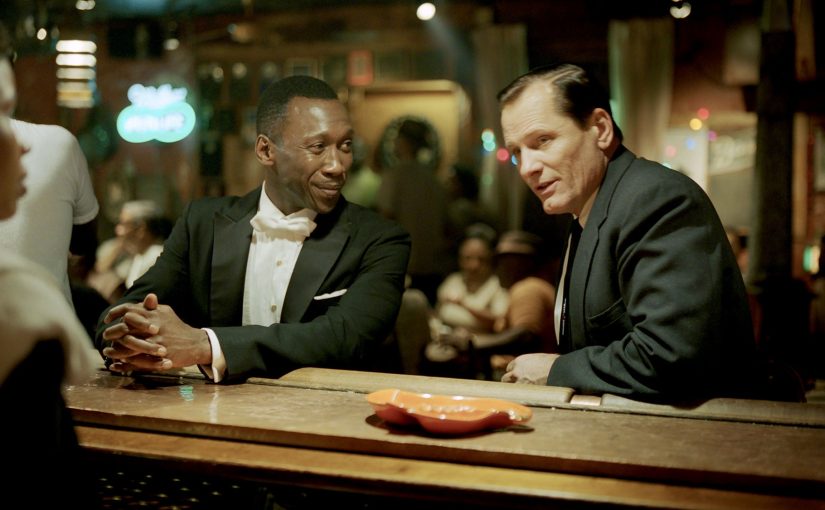
Tony (or “Tony Lip” as he’s known among his peers) is hired by Dr. Don Shirley played with such eloquence by Mahershala Ali. Dr. Shirley is an African American pianist, arguably the best in the world and ready to embark on a tour of the Midwest to Southeast of the country. It’s not that simple however as Dr. Shirley is all too aware of the racial prejudice that will befall him. Tony is hired to be Dr. Shirley’s driver as he has the toughness to look out for Shirley in the event that it is necessary. Sadly, the film shows that Tony is more than necessary.

There’s much comedy here between Ali, playing the well spoken “Felix” role, against Mortensen in the “Oscar” part. Tony and Don are worlds apart having virtually no understanding how the other half lives or what they are forced to compromise with on a daily basis. The hardships that Green Book offers focus more on Dr. Shirley as he is forced into humiliating circumstances where he is offered only an outhouse to use or denial of entry into a dining room. He could be wearing the sharpest of tuxedos, while Tony is a self aware “goombah” slob with no civility and Dr. Shirley remains the one to be overlooked. His value to Deep South America is to play his Steinway piano like meager jester.

There’s much to learn about our country’s mid 20th century history in Green Book. It’s a film I encourage families with pre-teen children to see. Not only will they learn of disillusioned hatred and treatment of black minority, but they will be entertained as well. References to Robert and John Kennedy are presented as well Aretha Franklin, and a Boston Celtics player (Name I cant recall).

The comedy that Farrelly brings keeps the audience engaged. The best dramas possess great comedy like Steel Magnolias, Terms Of Endearment, The Help, and even Kramer vs Kramer. If we can laugh along with our characters, then we will appreciate them that much more when harm and pain strikes. We want to ease their pain and be angry for them when those moments arrive. Their comedy of natural behaviors breeds affection for them. When they are compromised, we cry for them. Farrelly executes this format perfectly.

Mahershala Ali is a stand out here. He is snobbish at times towards the unmannered Tony but he is never deserving of his dismissiveness. He is a victim of the “colored mentality.” If not for the color of his skin, Dr. Shirley would have been regarded by all as a man of integrity; a hero to the American people. Sadly in 1962, many could not see past skin color. Thankfully, a great moment towards the end reminded me that it was in fact many…but not all. Watch the movie, and then tell me if you know what I’m referring to.

Remember, this is probably the best picture of 2018. Bring your children to see Green Book. Keep your children aware.

PARASITE

By Marc S. Sanders

I first discovered director Bong Joon-Ho when I watched his futuristic sci fi adventure Snowpiercer. I loved that film despite how absurd the set up was. Absurdity, though, is a credit to his craft. That’s why his latest film Parasite is a hugely successful interpretation of class warfare within South Korea. It might all appear drastically unlikely. Yet, it’s all absolutely possible when you reflect on the film after you’ve seen it.

Parasite begins almost like a farce and ends in deep, realistic horror that you’d never expect, even after you surpass the films midway surprise.

It’s best I leave much of the film’s details out. The less you know the better. I knew nothing at all about the film beyond the numerous accolades it has received. I was better off for it.

Joon-Ho’s film makes its point quickly that there is always someone better off than us and always someone worse off. (This was a theme carried over from Snowpiercer.). A poor family living off scrap money for folding pizza boxes while living in a cramped, bug ridden basement is still better off than the drunk who pisses on the street, outside their window. Just as an upper class family with all the best things in life are better off than them.

It’s only when this poor family find opportunity to dupe their way into this wealthy home through jobs they are hired for that we eventually see how lighthearted material, compliments of Joon-Ho and his writing collaborator, Jin Wan Han, can convincingly escalate into class warfare politics that even their characters ever hardly acknowledge, or are aware of. Is the wealthy matriarch really aware where her family chauffeur stems from or where he lives? The off putting scent of someone’s presence can quickly turn a tide or an impression.

I might sound vague, but I have no choice. It would be a betrayal to the imagination of the best film of 2019 if I spelled the film out for you.

Simply know that I truly appreciate the symbolic research Parasite presents as it makes note of a Korean child’s fascination with Native Americans, and how their plight parallels the story. Even that drunk taking a piss on someone else’s territory. Even the gift of a stone sculpture told me how one can be crushed or weighted down by his own country.

Parasite begins as one movie and ends as maybe five other different movies. It’s a farce. It’s wry and conveniently ironic; maybe silly at one point. It’s suspenseful and surprising. It’s also shockingly horrific.

I recently declared Clint Eastwood’s film Richard Jewell the best film of year. I stand corrected.

Parasite is the best film of the year.

DRIVING MISS DAISY

By Marc S. Sanders

Mainstream films released by big studios suffer from a major problem these days.  Too often, they don’t allow their characters to breathe.  Films today rush to the climax or the action or the cliffhanger that’ll whet our appetites for a sequel or a crossover or a toy product.  Bruce Beresford’s Driving Miss Daisy escaped all of those conventions.  In fact, I’d argue that Beresford made a buddy picture with his Best Picture Winner based upon Alfred Uhry’s well received play.

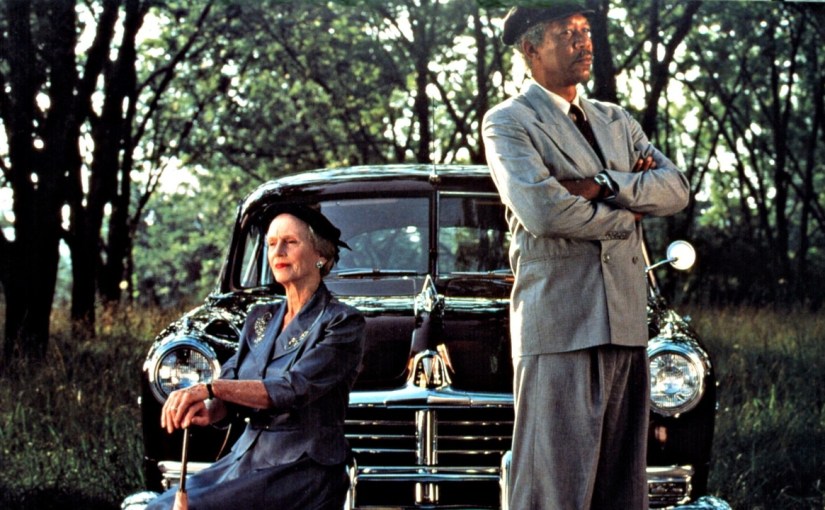
Daisy Werthan (Jessica Tandy, who won the Oscar, and held the record for oldest recipient) is an insistently independent old southern Jewish woman living in Georgia.  She drives her car where she wants to and whenever she wants to go somewhere.  However, following an accident in her driveway, her son Boolie (Dan Aykroyd in a very surprisingly good performance) breaks the hard truth to Daisy that her driving days are over since it’s likely no insurance company will ever affordably cover her.  Boolie recruits Hoke Colburn (Morgan Freeman in one of the most gentle and delicate performances of his amazing career) to chauffer the proud woman around her Georgia neighborhood.  Naturally, Daisy does not take well to Hoke at first.

The film begins in the 1950’s and then spans roughly 20 years from that point.  I love how Beresford presents the passage of time.  The cars that Hoke carries Daisy in change as the years go by.  As a new car is shown parked in Daisy’s garage, the relationship and eventual friendship of Hoke and Daisy become stronger and, on some occasions, franker and more honest.  With Hans Zimmer’s energetic score that seems to accelerate the speed of the automobiles Hoke drives, Driving Miss Daisy feels like a very sweet and tender film.  It is.  Moreover, it’s an alive picture.  However, the film does not ignore the prejudiced mentality that’s embedded within the south.  A telling moment occurs when Hoke is driving Daisy to a family gathering in Alabama.  Why would an elderly black man with an elderly Jewish woman sitting in the back seat be met with such disdain by policemen who question their presence while eating lunch on the side of the rode?  I won’t repeat the officer’s comment here, but it is ugly and a sad reflection of how things were.  Are things still that way?

Uhry’s script adaptation from his play does not stop there though.  He questions Daisy’s own stance.  She takes no issue with black people catering to her and her home on regular basis, and she becomes enamored with Martin Luther King’s inspiring wisdom.  So, when she is given the opportunity to see Dr. King speak in person, it only makes sense that Hoke will question why he was invited last minute to join her.  After so many years of servitude, why did Daisy wait until Hoke literally drove up to the location of the speech to invite him in?  I’d argue that it never occurred to Daisy, and I think Alfred Uhry believed that is part of the problem.

Both Daisy and Hoke experience anti-Semitism and racism in the mid twentieth century south.  Ironically, the film demonstrates that common victimization is one reason why they need one another.  I’m thankful that Beresford does not show a burning synagogue for dramatic effect.  Instead, he relies on Uhry’s dialogue as Hoke breaks the news to Daisy when they are on their way for morning Shabbat services.  How does Daisy feel in this circumstance?  The synagogue can be rebuilt.  The horror of knowing this kind of hate exists will never be erased.  That’s the terrible shock.  As well to empathize, Hoke describes how as a child he saw his uncle get lynched and hung from a tree.  Daisy and Hoke unite in the hate that surrounds them.

The performances of Freeman, Tandy and Aykroyd are exquisite.  Their dialect for each of their respective characters rings so true of the Georgian southern regions they stem from.  Freeman has an enunciation that rings of a black man who never learned to read.  He even develops a laugh that seamlessly works into his dialogue and reaction to Daisy’s stubbornness.  His posture is marvelous as an elderly gentleman who will walk slowly while hunched over.  It just looks so natural. Aykroyd is in no way doing one of his comedy characters.  He carries the gut of a well-fed southern man who’s become successful with his family business while not taking every fit that his mother has so seriously.  If any of us have had to tend to an elderly relative, then we can certainly relate to Boolie’s position.  Tandy is wonderful at method acting; it should be studied in performance art classes.  She was an elderly woman already when cast in the role.  Yet, as the years carry on through the story, she changes her gait to how this woman’s bones might become more brittle, or how she might speak slower or smile or frown or chew her food.  She has such a fire in every one of her scenes.  A heartbreaking scene where she appears to be having a frantic form of dementia is very eye opening as she paces her historic two-story home looking for papers she graded years earlier as a teacher.  The younger Freeman (playing a far older man) has to keep up with Tandy in this moment; even Beresford’s steady cam has to move quickly to keep focus.

Recently, I had reviewed Terms Of Endearment, and I alluded to the fact that not enough films about middle age people are focused upon, or at least given the commercial attention that they should be given.  Why is that?  So many middle age and elderly characters are so interesting.  I said it before.  Look at The Golden Girls sitcom.  After all, characters with more years behind them have had more moments to live and breathe. Actually, they have a longer history with more nuances and meaningful events they have already encountered, as opposed to twenty somethings with hot cars, pecs and guns.  Film studios are missing out on a wealth of great storytelling. 

Driving Miss Daisy is well paced story of friendship and fear, and often natural comedic material within its three lead roles.  It’s never boring.  It’s only more and more interesting as the years of the story pass by.  It’s simply an endearing buddy picture of the finest quality. 

CRASH (2005)

By Marc S. Sanders

Paul Haggis’ vignette themed script for Crash should not have won Best Screenplay. The film he directed should not have won Best Picture. Could it be that because this picture is masked as that special movie with that especially poignant message that it got the recognition I don’t think it ever deserved? I can appreciate the attempt at bringing hot button social issues like racism and injustice to light, but it does not need to be as immaturely contrived as this picture.

Crash occurs over two days within the city of modern day Los Angeles. A select group of characters of different social classes and ethnicities are covered, and the film circumvents back and forth among their perspectives. For the most part, all of these people have major social hang-ups with people outside their race. The first example shows us that if a white woman who is simply cold on a winter night hugs her husband tightly for some warmth, apparently a couple of black men will automatically believe this woman is fearful of their approach.

Especially today, I know that prejudice exists, but to this extreme and this contrived…I’m not sure. I guess I’m not sure because I have not experienced it enough to be convinced yet. When I read a friend’s testimony of falling victim to racial prejudice I lean towards believing everything they tell me. I guess it’s this movie, Crash, that left me feeling dubious and maybe that’s because the circumstances seem way too forced.

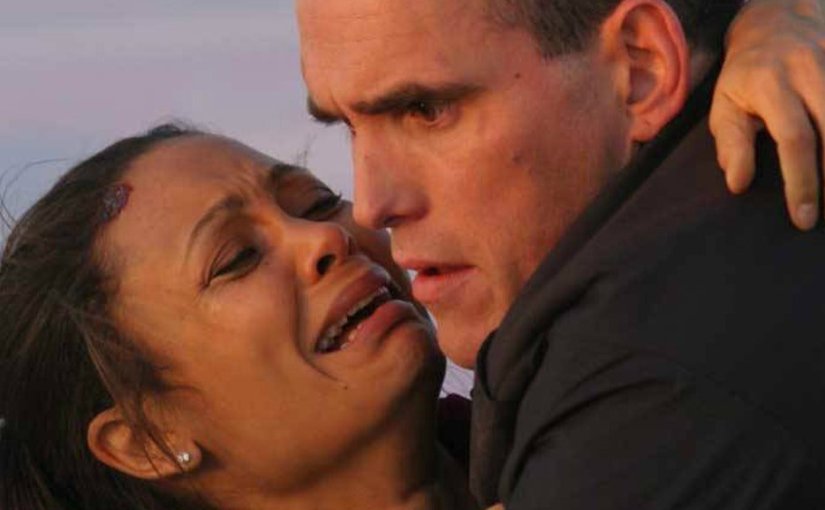
A racist cop (Matt Dillon) will pull over a well to do Muslim man (Terrence Howard) driving a high priced SUV and perform a sobriety test for no reason. Then the cop will deliberately frisk the man’s wife (Thandie Newton) with digital penetration. The next day, it’ll just happen to be that this woman will have no choice but to be rescued from a burning car by this same racist cop. Now I’m supposed to believe that the racist cop is not so bad, and the woman learns to become more tolerant. Well gee, thank heavens for coincidences!

The Muslim man (a television show director) gets car jacked the following day, and in a tense pull over moment he’s mistaken as the criminal. Fortunately, the partner of the racist cop (Ryan Phillipe) is there to subdue the situation. I’m sorry, but life doesn’t work out to be this tidy. Call me cynical, but more often than not we are not given a second chance at first impressions.

One of the real car jackers (Chris “Ludacris” Bridges) gets a moment of clarity and suddenly he’s generously giving out his last forty dollars to a group of Asian people being held in a van for human trafficking. Forgive me. If I want to begin respecting this car jacker who has held multiple people at gun point and even runs over a man, only to toss him out on the drive up to the Emergency Room, I’ll be more apt to do so if the criminal turns himself in.

I dunno. Maybe I’ve got a personal issue with Crash. It could not be more apparently preachy in how it patronizes me to simply understand the seething hate and criminal violations of its characters. I’m supposed to empathize with the racist cop because his ill father can’t get the health care he’s entitled to? I’m supposed to understand the prejudicial anger that the WASP wife (Sandra Bullock) of a District Attorney (Brendan Frasier) expresses because she no longer trusts her dedicated Hispanic housekeeper or the locksmith (Michael Pena) changing the locks on their house following a car jacking?

No. Paul Haggis didn’t earn that response from me in almost all of the short story scenarios his film offers. Maybe it’s because I tend to compartmentalize my episodes. I like to think that I don’t allow one experience with one kind of person cloud my judgement on the next person I encounter. A waiter can totally screw up my order and can even mouth off to me in a heated moment. Yet, I’ll return to the restaurant on another occasion because it’s likely I’ll run into a different waiter.

Haggis depicts people who appear to have a blanket opinion of other people with different backgrounds. These are all extremely prejudiced people with next to no understanding of where each of them stem from. An angry Persian man (Shaun Toub) puts blame on the locksmith after his convenience store is ransacked. The locksmith was only trying to explain that the back door needed to be replaced. The Persian refused to listen because his English is limited. So he just gets angry and curses the locksmith out. Haggis opts to insert a language barrier between the two men to serve up an eventual tense and dramatic moment in a neighborhood driveway with a loaded gun and a little girl. A loaded gun and a little girl! Yup, I think they teach these are the true ingredients for effective drama on the first day of screenwriting class. Again, it all comes about a little too forced.

The conveniences and ironies that bubble up at times are surprising. “Oh that guy is that guy’s brother! I see.” Things like that. However, I don’t think that is necessarily the strength of the picture.

In a film like Magnolia, we are treated to the vignettes of a handful of people too. However, not every single one of those people are sketched by means of their prejudiced natures. They are drawn by a variety of different elements whether it be a traumatic past or an inclination to do good. Then it’s kind of fun to uncover how each player is connected to one another.

In Crash, the players are only connected by the hate they carry within themselves, and Paul Haggis forces a redemption upon most of them with small gestures or a line of dialogue or the purity of a welcome snowfall to close out the film. Sorry, life is lot more messy and complicated than that. I guess I’m saying I may have learned a lot more about human nature from a downpour of frogs than a downpour of snow.

THELMA & LOUISE

By Marc S. Sanders

The strength of a good solid picture often depends on a strong cast from the top billing, above the title actors, to the bit supporting players who only have a few minutes of screen time.  Thelma & Louise, directed by Ridley Scott, is that film.  The opening credits of the movie come up in black and white over an out west landscape with an endless dirt road in the center of the screen.  Hans Zimmer’s harmonica and banjo, country sounds build on Scott’s camera work here.  The names of each actor are brought up: Susan Sarandon, Geena Davis, Harvey Keitel, Christopher MacDonald, Michael Madsen, Stephen Tobolowsky, and someone named Brad Pitt. The scene goes to color and then it blacks out and comes up on Louise’s (Sarandon) crowded diner where she waitresses.  Nothing is unfamiliar here.  Yet, it seems a little haunting in a way.  We are about to uncover a history to some common folk who live on the southern bend of America, and we will start in the state of Arkansas.

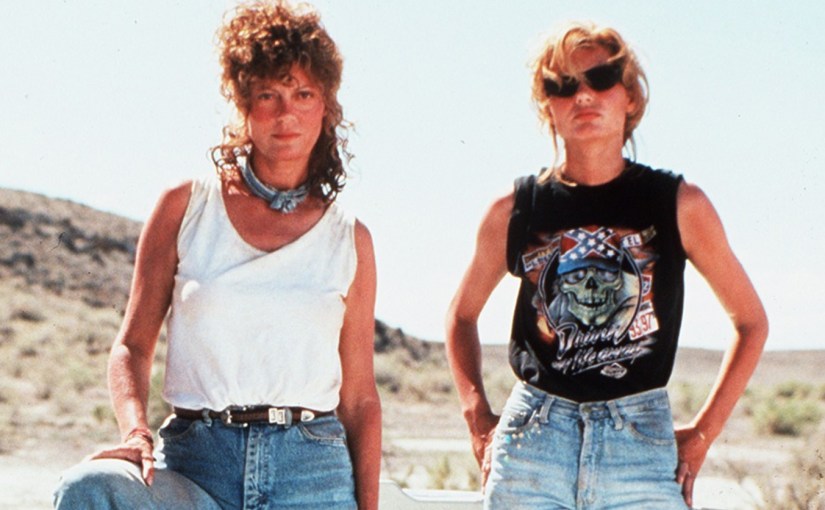
Louise has made arrangements with her best friend Thelma (Davis) to do a weekend cross country road trip to a cabin in the woods.  This is the southern odd couple.  Louise is always put together, clean and organized.  She’ll check herself in the mirror.  In a crowded ladies room, she’ll check her makeup and tidy her hair while intoxicated patrons are pushing around behind her.  Thelma is scatterbrained.  She’ll bite off a piece of a candy bar, put it back in the freezer and make three more stops back at the freezer for a couple of more bites.  She also will dump a dresser drawer of clothes into a suitcase, taking no time to sort through what she’s packing.

Both women have been treated unfairly by the men in their lives.  Thelma’s husband, Daryl (MacDonald) is a proud white trash carpet sales manager who treats his wife with absolute control, complete disregard and thoughtless disdain.  Louise just can’t even get a hold of her boyfriend Jimmy (Madsen), a musician who can’t commit to anything.  On the first night of their trip, the two ladies hit the road in an iconic 1966 green Ford Thunderbird convertible (one of the greatest, most memorable vehicles in film screen history), they’ll realize there may be worse men than the ones they’ve encountered.  Following an attempted rape, a shooting occurs and the ladies are hitting the road, hoping to make it to Mexico.

Thelma & Louise is at least Ridley Scott’s most sensitive film.  It was not the first or last time he used women as leads in his pictures.  Yet, the film moves symbolically along the stretches of highway and dirt roads as a means to reveal the strength and confidence a woman can have when she escapes the controlling shadow of a man.  At least that’s what I think.  The beginning of Scott’s film, with an Academy Award winning script from Callie Khouri, displays the title characters as weighed down by their past and current lives.  It is only when the two break free (with little options following an unforeseen dilemma) they understand they can be stronger than any man who’s ever dominated them before.  As the road trip moves on, they will encounter more hang ups and they will make mistakes, but by the time the third act comes along Thelma and Louise will sever any restraints that have held them back before.  It is such a gratifying story.

My father encouraged me to go see this movie with him.  It was 1991.  I was graduating high school.  I’d seen trailers for this picture and it was loaded with high energy country music.  I don’t like country music, typically.  In fact, I only can like country music when it is incorporated into a film.  Thelma & Louise is the best example of that feeling.  I hated the title.  Still kind of do.  It doesn’t have the ring of say Starskey & Hutch or Batman & Robin.  However, those are guy pairings.  Thelma & Louise are about two women, and I was never going to forget that.  Once I saw the film, I could not stop thinking about it.  I grew so accustomed to Ridley Scott’s direction and use of cinematography with Adrian Biddle.  The sun on the screen felt hot.  The dirt on the character’s faces and the Thurderbird felt gritty.  The sunburns on Sarandon and Davis felt sore and dry.  The glow of the car’s dashboard light felt bright in my vision. The settings spoke to me.  There’s a great moment where Louise seems to shed her feminine and dainty skin so to speak.  She hands over her jewelry to an old timer sitting on the side of road at an abandoned truck stop.  No words are shared between them.  This guy was born on this spot.  He’s never moved from this spot and Louise will leave her history behind with him.  Later, as the stakes grow, with the FBI and law enforcement closing in on the fugitives, there’s a moment where Thelma tells Louise, that she feels awake; like really awake and alert.  I knew what she was talking about.  I’ve already been on this hike for two hours with these characters, along with the crimes and entanglements they’ve gotten into and the movie has my full attention.  All these years later with repeated viewings, and I still feel that way.  I feel absolutely awake the moment the movie begins.

Khouri supplies her script with a variety of men.  Some are sensitive like the detective played by Keitel who knows that a murder didn’t just happen maliciously.  There’s more to the circumstances at play, and he’s hoping for the best for the ladies.  Some are just procedural like Tobolosky, who doesn’t recognize them as women, only as fugitives. Some are enlightening, yet deceptive like Brad Pitt’s hitch hiking handsome and charming loner that the ladies pick up, and some are simply cruel and vicious, like the rapist or Thelma’s husband, Daryl (MacDonald).  Maybe a trucker along the way is like that as well.  How will Thelma and Louise respond to each of these guys?  As the story contains a gamut of what all these men are, I never regard the picture as a middle finger protest to the male population.  Not at all.  There are men who will give women a chance and will treat them with respect and at least equality, within their surroundings.  Khouri’s script allows time for that.  Sadly though, thirty years later there are still men who will treat women like punching bags with no value and esteem.  It’s wrong.  It’s why the “Me Too” movement had to eventually come into play, long after the release of this picture. 

At the risk of sounding political with potential for debate and preach, watching Thelma & Louise last week, I could not help but think of recent current events that have occurred in mid year 2021.  Bill Cosby was set free from his prison sentence following a technicality that justified his release, but never exonerated him of his crimes of rape.  A former kid actor named Drake Bell was sentenced to three years’ probation for sending sexually explicit materials and texts to an underage girl.  More physical details have been implied on that relationship but Bell was never charged with anything on that topic.  Hence, no jail time.  A Disney channel actor has a warrant out for his arrest following missing a court date with similar charges as Bell.  Following the early rape scene in this film, the attacker is shot and killed in a parking lot.  The ladies consider going to the police and explaining what exactly happened, but they choose to run.  Why?  Because, they know that the police would never believe them.  They were witnessed minutes earlier drinking and partying with this guy in a bar.  Why would anyone believe he would try to rape one of them?  Reader, I know what they mean.  I understand.  Each time I watch the movie, I truly understand.  I know what Thelma and Louise are talking about.  It’s sad.  It’s wrong.  It infuriates me because it’s so unfair.

Callie Khouri and Ridley Scott created an outstanding adventure picture with suspense, and lots of natural humor by means of the outlaw way like Butch Cassidy & The Sundance Kid.  A surprising robbery midway through the picture is hilarious and serves as a legit character change for Thelma.  Davis is great here.  She has scenes of drama and fear throughout the movie, but she also has time for laugh out loud moments.  Alternatively, the Louise character that Sarandon portrays seems to hinge on the dramatic element.  I love a hanging thread that Khouri weaves into the script of an unknown traumatic occurrence that happened in Louise’s past.  I am certain that Sarandon knows what it is even if the audience doesn’t entirely know.  Later in the film, the humor that Louise encounters comes through as Thelma transitions over to a new kind of personality.  These women don’t change individually.  They change together.  It’s a great couple dynamic for sure.

The film is sexy and at times sweet as well.  Yet, it’s also very terrifying, with very real drama.  Thelma & Louise is an important picture to see.  I plan to show it to my teenage daughter when she is a little older.  The rape scene holds me back right now as I find it hard to watch and requires a mature eye.  Nonetheless, I want her to be aware of what is out there.  I want her to know how people, men in particular, respond and treat women.   I want her to be alert and strong when faced with any kind of adversity, deserved or not; justified or not.  I find that some movies offer the best lessons of life about the cruelty and kindness of the world.  Most especially when they are filmed with sensitivity and authenticity, like Schindler’s List or The Shawshank Redemption.  Countless viewings later with thirty years behind it, and I still learn from Thelma & Louise.  It’s another one of my favorite movies.

CHARIOTS OF FIRE

By Marc S. Sanders

The 1981 Academy Award Best Picture winner was Chariots Of Fire directed by Hugh Hudson. However, because of that honor I’m not going to pretend that this was a marvelous film viewing experience. This may be one of a select few movies where the soundtrack is far superior to the film itself. That memorable score that gets your pulse racing belongs to Vangelis, and if the soundtrack to Raiders Of The Lost Ark from John Williams should lose the Oscar, it’s not a surprise if it was to the soundtrack from Chariots Of Fire. For me, the two compared against one another though? Well, we might have an argument there, my dear reader.

The film centers particularly on two outstanding runners, maybe the fastest in the world, who compete in the 1924 Olympics for Great Britain. One runner is Harold Abrahams (Ben Cross), a Jewish Cambridge student who is frowned upon for his religion while he is well aware that his heritage is not valued for anything amongst the Christian Anglo Saxon community. It’s all the more challenging when he agrees to private coaching from Sam Mussabini (Ian Holm in an Oscar nominated performance) of Italian and Arab descent.

The other runner is Eric Liddle (Ian Charleson) who loves the exhilaration of running, though his sister prefers he devote his time to the church. He is devout in his Christian beliefs, nonetheless, and he is tested when he learns that one of his competitions is scheduled on a Sunday, the day he observes Sabbath. Despite the Olympic team’s firm position that he compete, Eric’s stance is not to participate in the race.

I don’t want to say that I was bored with Chariots Of Fire, and yet I was bored. The effort to stay with the picture informs me of the value a film can have with marquee names in its cast. As the screenplay moves from one character’s storyline to the next, it was hard to gather where things had left off. Other runners are covered as well though just not as in depth. Most of this cast, I must admit I’m not so familiar with. Sometimes they all seemed to be cut from similar molds in costume, hair color and the like. With known names in a cast, it’s much more easy to put a face with a name and follow along. Here, it was challenging to stay focused with each character. They didn’t seem distinguishable enough for me.

I know! This is not a fair argument. However, this turned out to be my experience with the film.

The technical production of Chariots Of Fire is outstanding, though. Everything from the cobblestone streets of Cambridge to the Olympic stadium in France and the hilltops of Scotland are spectacular to look at. Absolutely immersive.

I did take issue with the film’s beginning. The first ten minutes opens with Abrahams’ funeral in London, 1978, then jumps to 1924 as a student writes in his journal recalling the team’s experience and so then the narrative moves back to 1919, only to wrap up with the funeral again before the closing credits. Why so much work with these albeit brief time jumps? They carried no impact. Why not simply begin in 1919 and move forward through time?

Chariots Of Fire has always been on my bucket list to catch. It’s a necessary film to see for devoted film buffs due to its accomplishments in technicality and score plus art direction. As well, it is an educational experience in British history, despite the liberties the film takes.

I recommend the picture, but I also forewarn to have patience and strict attention to its narrative. There’s a lot of dialogue and information contained within, Hudson is passionate with slow edits of running scenes and hurdle jumps, for his method of dramatic impact and excitement. All I suggest is to be prepared to sit for what will feel like a good long while. Try to avoid any interruptions (turn your phone off). You’ll need to pay attention where the film carries you from one scene and storyline to the next.

ONE FLEW OVER THE CUCKOO’S NEST

By Marc S. Sanders

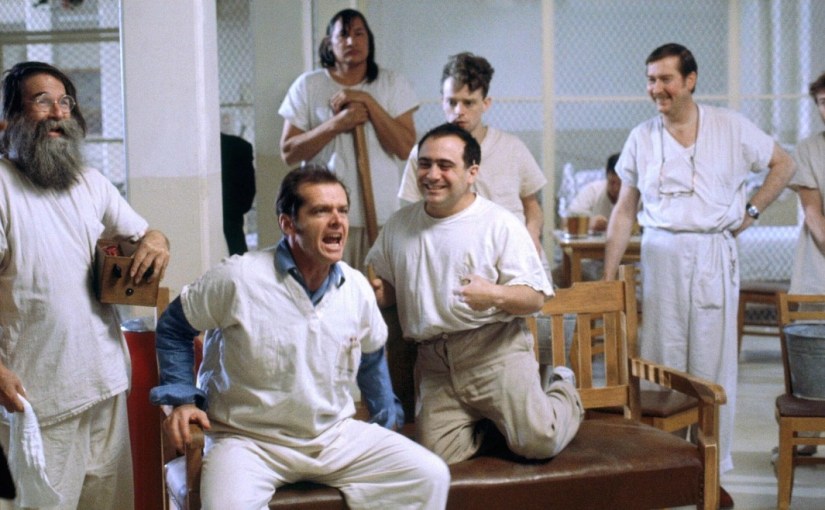
After watching One Flew Over The Cuckoo’s Nest for the first time in many years, I recognized a political dual taking place on the battleground of an insane asylum. Director Milos Foreman sets the stage for one patient to win over the community from the Head Nurse in charge.

Jack Nicholson is Randall P McMurphy, a criminal who is transferred to the asylum for examination even though there are likely suspicions he’s faking his current condition as a means to escape prison life work detail. Louise Fletcher is his opponent as Nurse Ratched who has maintained an organized control over the floor of 19 men with an assortment of mentally unwell behavior.

McMurphy is a cut up as soon as he joins the gang. At first he appears observant during Ratched’s daily sessions where she asks the men to contribute to the discussion but at the same time she couldn’t be less encouraging. She’s happy to welcome ideas with open arms but don’t disrupt the process. There will also be “Medication Times” and there will be samples of classical and childlike music to subdue the patients as well. McMurphy may request the volume be lowered, but that’s not a simple request that Nurse Ratched will honor.

McMurphy’s experience outside the realm of insanity works as a wake up call for some of the men which consist of introductory performances from great character actors like Christopher Lloyd, Danny DeVito and Vincent Schiavelli. The stand out is Brad Dourif as Billy Bibbit, the stuttering suicidal young man with the baby face who fears his mother’s judgment as Nurse Ratched methodically continues to imply.

McMurphy wins over the crowd eventually. A fascinating scene is when Ratched challenges McMurphy to obtain enough votes among the men in order to watch the World Series. The count of raised hands appears to tie, but then Ratched reminds him that he needs one more vote to win. Before he can get to that point, the session is ended by Ratched. The call for election is lost due to a technicality by the governing control. An election won’t silence the voice of the people as McMurphy quickly encourages the masses to watch a blank television screen imagining his own interpretation of the game. Ratched can only domineer to a certain degree. Here’s the flaw in the Ratched character. At last a breakthrough among these ill men is established as they’ve learned to vote for themselves. They want to watch a baseball game. Ratched won’t stand for progress though.

Questions arise in One Flew Over The Cuckoo’s Nest. Is McMurphy truly faking his mental condition? Is Ratched so drunk on control to disregard doctors’ opinions for his release and keep him institutionalized? If he’s not insane, then why would she want him there? Is it all about Ratched’s obsession with winning?

Ken Kesey wrote the original novel the film is based on. He hated Foreman’s approach particularly with disregarding telling his story from the perspective of the deaf/mute six foot five Native American that McMurphy regards as “Chief” (Will Sampson). Chief seems to be the quiet one who does not take sides until McMurphy demonstrates the ease of obtaining freedom such as when the Chief helps him escape over a barb wire fence and then takes the men on a boating joy ride. I can’t side with Kesey’s insistence that the film be done from the perspective of the silent, yet memorable Chief. Film is a different medium than what’s read on a page. You can’t watch people’s thoughts. What I do find interesting is that Kesey opted for a Native American as McMurphy’s best sidekick. This is a man whose ancestors historically lost their land. McMurphy attempts to rob the rule of the asylum from Nurse Ratched. The political undertones just seem so apparent. The government control, however, is hard pressed to surrender even after McMurphy arranges for his own party of celebration complete with booze and alcohol. Ultimately, and sadly, the fate of McMurphy shows that he eventually becomes a product of his own environment. The Chief however, acknowledges his independence though.

One Flew Over The Cuckoo’s Nest is the second of three films to win the five main Academy Awards (Best Picture, Director, Actor, Actress, and Screenplay). It deserved it, and because of the film’s unsettling and messy nature it’s almost surprising that it was so well received. It’s not a glamorous film. It can show the ugliness of men drowning in their own consciousness.

At the same time, the film shows the subtle yet brutal control of those living fulfilling lives at the expense of the constituents they oversee. Sure, let’s have an open minded community of provoking thoughts, but only if it’s confined to the restrictions that remain in place. Step outside those lines and a more permanent technique will be applied so you adapt to what’s mandated…unless you can bodily lift a concrete water fountain and smash it through a cage bar enclosed window to freedom.

SPOTLIGHT

By Marc S. Sanders

It’s tough to be a fair journalist when a higher power carries great influence over the what and how of honest reporting. In Tom McCarthy’s Best Picture Oscar winner, Spotlight, it’s not so much the crimes of child molestation by the hands of priests from the Boston Archdiocese that are so important. Rather, it is how the facts are suppressed and the pressure to contain the truth are so apparent. Maybe it finally took the will of a new editor, a Jewish editor from New York, named Marty Baron (Liev Schrieber), at the esteemed Boston Globe newspaper to get the special section crew known as Spotlight to work on how case after case of reported child molestation incidents were allowed to occur for decades under the eye of the highest powers in the church.

First, it’s important to note how easy it is for a priest to seduce a young boy. He welcomes the boy for special duties within the church. Then the priest and child may share a dirty joke together. Just their little secret. After that, touching occurs which leads to unimaginable and irreversible damage. Yet, the grown man once considered that special attention he received as a direct link to God himself. McCarthy deliberately repeats that viewpoint from more than one victim in the film; it was as if God had selected them for special attention and God was especially speaking to them. None of this could be more patterned.

Marty Baron counts on his team to not only collect the mounting number of cases. He tells them to uncover an even worse truth and that is the systemic response the church upheld where when a new case comes to light, a deal is worked with a pawn for an attorney to give settlement hush money while the priest in question will take sick leave or simply be reassigned to another church location free to do God’s will while also committing his own willing nature.

The Spotlight team consists of Mark Ruffalo and Rachel McAdams as well as Michael Keaton. All of their true to life characters were born and raised in Boston. Some under Catholic influence. So the conflict for them to do their jobs ethically and morally is challenging when faced with literally going up against the one institution that seems to own the city of Boston without it showing on paper necessarily. It also means coming to disheartening terms with their own upbringing.

To convincingly depict the grasp the church has on the politicians and newspapers in the area, McCarthy shoots a lot of his talking scenes outdoors on public benches and sidewalks. Therefore, you get an almost claustrophobic shadow of how close the Catholic Church is to the city’s residents. If a scene is at a dinner party or cocktail hour, a man of the cloth is nearby. A sidewalk stroll between a victim and a reporter seems to tread carefully. You never know if that cathedral on the corner is listening. Spotlight is primarily a journalism film of the highest standard. The pursuit for the truth is ripe with the obstacles of slamming doors when trying to get a statement or dealing with the unfair reveal of no records that legally are meant to be public. There’s a race to get the whole truth before a competing media outlet grabs it and misconstrues it. As well, what happens when a bigger story suddenly takes precedence and this story must be put on hold. I mean how do you not drop everything to report on 9/11?

Spotlight is another important film as it does not compromise in its true to life storytelling. It’s unfathomable to believe that men of God could use their positions to take advantage of the innocence of children and then refuse to accept responsibility for it. Even worse is the egregious actions taken to modify the authority of local law enforcement and judicial objectivity that should be there to protect the rights of these victims.

Tom McCarthy’s piece is excellent with a cast in top form. It would have to be as the screenplay is peppered with conversation after conversation. This is a newspaper film. So therefore it’s a talky piece. You get passionate monologues from Ruffalo who does not hold back his anger and disgust at what he uncovers with an acerbic but crusading attorney played beautifully by Stanley Tucci. This attorney has lost every battle he’s had with the church but he does not give up on his client victims either. He’s their only protector in an arena of powerful criminals who hide behind scripture.

You also have a real go-getter reporter in Rachel McAdams. McCarthy repeatedly shoots her from behind walking the streets of Boston with a pad and pen as she meets a victim or simply knocks on neighboring doors for some facts. Her challenge is seeking the truth while her grandmother holds an undying faith in religion of Catholicism by visiting the church at least three times a week. A crushing, albeit brief, scene occurs near the end of the film when the reporter’s grandmother reads her final story in the Spotlight section.

Michael Keaton is the Irish Bostonian rooted in tradition. He knows all the important people in the city. He knows Cardinal Law who runs the church and he holds on to his journalistic code of fact collecting for as long as he can muster.

The truth and web of lies and deceit could never really shock me in Spotlight. I’ve heard it all before. Instead, it’s the knowing acts of concealing horrifying sin. Ironically, those actions are committed by those that listen to the confessions of its sinful disciples. As I’m of an age where I question the validity and need for religion in our upbringing, I can’t help but wonder how these victims would have turned out had religion never became a factor in their lives. These children, now men, went on to commit suicide, become chemical dependent, and occasionally became child molesters themselves. It’s easy to argue that these conditions were never part of their chemical make up. It’s also easy to argue that the Catholic Church carelessly determined the destinies of these men without any regard for being accountable of the damaging results. Spotlight confidentially reaffirms both of these arguments.

KRAMER VS KRAMER

By Marc S. Sanders

Probably the most personal film for me, the one that I watched for the first time with adult eyes even though I was only age 8 or 9 at the time, was writer/director Robert Benton’s 1979 Best Picture winner Kramer vs Kramer.

Though my parents never divorced, somehow I recognized the character of Ted Kramer, an extremely busy New York City advertising executive who could be having a great day while staying flirtatious but then also having an outburst of frustration when things are not going his way. My father was a busy man and a hard worker. He was a man who was always very proud of his work. He loved his work so much that he wasn’t as present in my life during my adolescent years. My mother on the other hand was my best friend who could make me laugh and demonstrated unconditional and very natural love for me. I learned about humor and love from my mother during those early years. I learned about responsibility from my father and some of his own humor later on. So, as I reflect on this film I imagine what life could have been for me had my mother walked out with no notice, leaving my father to tend to my needs while having to suddenly make sacrifices with his work.

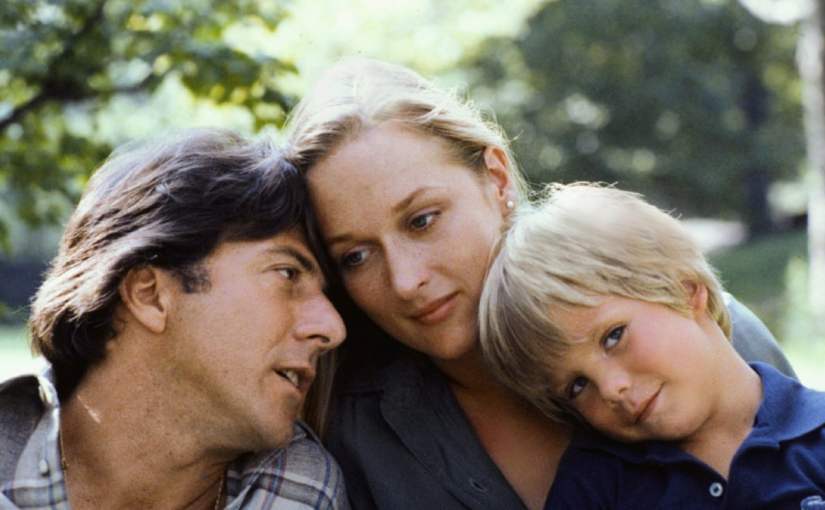
On countless occasions, I’ve written about the importance of a character arc where a protagonist will start out one way and completely change through the middle and end of the film. In Kramer Vs Kramer, the arc is not focused on a character but rather a relationship between father and son. When Billy (Justin Henry in an Oscar nominated performance) at age 6 wakes up to discover mommy is not there, he sees how lost daddy is with waking up and trying to make coffee much less crack an egg properly for french toast. Ted and Billy have been blindsided and without any warning they need to adjust to one another very quickly.

Later, Benton does an insightful tracking shot of their apartment as they wake and we see they’ve grown accustomed to a routine together of getting each other up, setting the table and reading their newspaper and comic books side by side while never uttering a word. Benton realized that the comfort of living with each other does not have to be evoked with dialogue. This routine is offered one last time at the end when an inevitable and unwanted conclusion has befallen Ted and Billy. Again, no dialogue because now as a viewer I’ve become comfortable with this special relationship. Truly, I envisioned my father and I in these three moments.

Meryl Streep is the other Kramer, Joanna. She won the Best Supporting Actress Oscar and its well earned. Benton opens the film on her sad expression in a quiet darkness. When Ted finally comes home with good news from work, Streep is really good at holding her firm stance at leaving the household permanently. It doesn’t matter that Ted has gossip to share of a co-worker’s suicide or that he got a huge promotion. She just up and hurries for the elevator despite Ted’s resistance in allowing her to leave.

Benton follows afterwards with a good long portion of the film to display the struggles that Ted and Billy need to overcome, and in a second act finally has Joanna return stating her desire for Billy to live with her. Ted will not allow that to happen. For a real actor’s showcase, it’s important to watch the scene when they meet for the first time in 18 months. The conversation is cordial and they appear pleased to catch up with one another. Seconds later, the opposite sides on what’s best for themselves, and more importantly Billy, surface and the back and forth is so perfectly timed. Streep and Hoffman have those stutters and talking over one another that seem so natural. The scene ends with a broken glass that was not rehearsed and fortunately Streep’s shocked expression remains before the scene is cut.

Hoffman is extremely good in his role. He runs a gamut of emotions to bring humor, sadness, anger, warmth and love to this part. Another powerful scene is when he desperately must find a new job within three days before Christmas. Benton makes sure that Ted appears completely strong in a disarming situation when he squeezes in a four o’clock Friday afternoon interview during a raucous office Christmas party. I love how Benton focuses a still camera on Ted sitting quietly in a lobby chair amid partiers while waiting to hear if he gets a job offer. This is determination of a very full degree. Nothing will allow Ted to lose his little boy during this custody hearing.

Kramer vs Kramer is a simple and brisk film. It moves with a fast pace, and I believe the reason for that is it takes place in a home with a father, a child and a mother. So, I like to think it was very open to relating to viewers of all ages including my preteen self. There are many different and recognizable facets to Kramer vs Kramer. Billy compares Ted’s rules to what “all the other mothers” do. There’s the school play. Ted running late for work and picking up Billy from a birthday party complete with a goody bag. Of course, there’s also the heightened drama of the courtroom custody hearing. It’s like watching stage work monologues from Streep and Hoffman. It’s brilliant.

I especially took a scene very personally where Billy falls off the monkey bars, and Ted rushing through the streets of New York to get him to the emergency room for stitches. I had a door slammed in my face once that required stitches in my bottom lip. Just like in the film there was blood all over my clothes and there was a terrible fear for this 8-year-old kid who now still feels a bump in that area. Billy’s anguish and Ted’s terrible fear and guilt seem so genuine.

I find it interesting that this film won Best Picture in 1979. A year prior it was The Deer Hunter and Patton was a few years before that. In 1980, Robert Redford’s Ordinary People won the award and in 1983 it was Terms Of Endearment. Hollywood didn’t forget the impacts of hellish war and combat films. However, with the 1980 Reagan years of much decadence and pop culture positivity, a middle-class domestic life was becoming more honest and apparent. These films were not just Father Knows Best. Films like Kramer Vs Kramer were ready to show the hard parts of living a yuppie life. Things seem so normal on the outside when really there’s a struggle to love and live on the inside.

Cinderella like films showed my eight year old eyes that if a prince and princess finally meet and dance together all will be well in the kingdom. However, Kramer Vs Kramer told me that marriage and family life do not equate to happily ever after. Don’t mistake me. I’m not being pessimistic here. What I learned at that young age is that the story really only just begins after the prince and princess fall in love with one another. Thereafter, the conflicts settle in and the happy ending arrives only when the characters adjust to the evolution of their futures together, or if necessary, without one another.

ANNIE HALL

By Marc S. Sanders

Some of the best comedy comes from watching the suffering of others. One of the best examples of this is Woody Allen’s Best Picture winner Annie Hall. Allen directs and stars in the film, and the suffering his character Alvy Singer endures is by his own mindset. Alvy could never be happy unless he is finding another opportunity to be unhappy. At one point he marries a terrific girl played by Carol Kane. Yet that doesn’t work out. As a child, he finds an allegorical reason to live his life as he does by riding the bumper cars where his father works on Coney Island. Alvy just sees life as one crash after another.

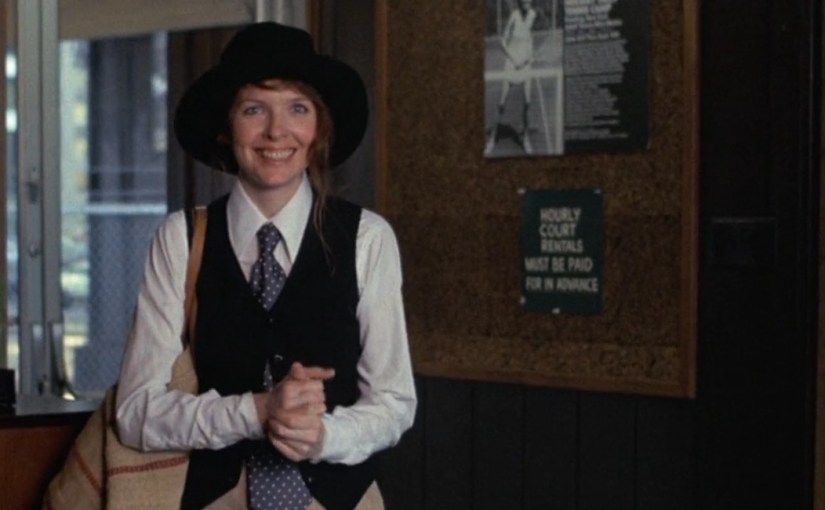
Neurotic doesn’t even begin to describe what Alvy puts himself through. Most especially he becomes insecure with himself as he dates Annie Hall (Diane Keaton, who won her Best Actress Oscar for arguably her best career role). Annie is fun loving and a little flighty. Still, there’s nothing not to love about Annie. She wants to be a singer and Alvy showers her performance with compliments despite a very rough bar crowd. However, when Annie gets reassurance of her talent from others, Alvy is not so encouraging to advance a promising future for Annie.

We see a handful of women that Alvy dates, but most of the ninety minute film focuses on Alvy’s relationship with Annie. Woody Allen penned the script with Marshall Brickman as a loose interpretation of the real life relationship he had with Diane Keaton.

Alvy is a mess. As a child he frustrated his mother with the idea of world ending events yet to come, and thus not much reason to apply himself for a fulfilling life. As an adult, he can’t even wait patiently in a line for a movie because the gentleman standing behind him is aggravatingly wrong on his viewpoint of the films of Marshall McLuhan. The best response to a hilarious scene like this is realized by actually welcoming the real life McLuhan into the frame of the picture to tell off the snobbish jerk standing behind Alvy. I must admit I never heard of Marshall McLuhan myself. Still it’s the idea of running through with a depicted scene like this that’s so dang hilarious. Wouldn’t it be so satisfying to any of us to just have our heroes interrupt a conversation to shamelessly put down our enemies?

That’s what makes Annie Hall a much more special romantic comedy than anything before or thereafter really. Woody Allen breaks the fourth wall at times. He welcomes his adult self into his childhood classroom to debate with his elementary school teachers. Later, he tries to provide a source to his neuroses by bringing both Annie and his best friend Rob (Tony Roberts) into his home to see the relatives Alvy grew up with. These intrusions into scenes of Alvy’s childhood are daringly funny and like nothing I’ve ever seen.

Alvy’s neuroses are so intense that he’ll randomly stop people in the middle of New York to inquire about their sexual experiences. He even unloads his endless dialogue of some of the greatest wit on a horse being ridden by a police officer.

Keaton is perfect for Allen to play against. There’s the hilarious moment of the two of them trying to boil live lobsters. Just between the two of them they are going to be cooking SIX LOBSTERS. Why six? Who cares? The point is to demonstrate a hilariously loving memory at being surrounded by creatures they are both terrified to handle. One lobster even crawls behind the refrigerator and that’s an amusing problem. Annie takes advantage of getting action photos of Alvy with the lobsters. Later in the film, we see that Annie has displayed a collage of this moment on her wall.

Alvy and Annie know they don’t belong together. Yet, it’s hard for them to live without one another too. Annie feels no choice but to call Alvy over at three in the morning to get rid of a spider in her apartment. Alvy obliges without hesitation to leave the bed he’s sharing with his current girlfriend to rush right over to Annie’s aid.

The trying misery they have within themselves is what keeps Annie Hall alive. Interestingly enough is that Allen and Brickman write in a conclusion for the relationship between Alvy and Annie, and show their respective aftermaths. Alvy is a professional stand up comic. Annie dreams of being a singer. What comes of their destinies is refreshing.

I don’t think I could be a close friend to Alvy or Annie. I’d get tired of their ongoing kvetching. That certainly doesn’t mean I don’t like them. I love them actually, and I want them to be happy. Maybe Annie ends up being happy following the events of Annie Hall. For Alvy, I know for sure he’ll be happy so long as he continues to be miserable, and that’s completely fine with me, and I’m certain that’s completely fine with Alvy too.