BEN-HUR (1959)

by Miguel E. Rodriguez

Director: William Wyler
Cast: Charlton Heston, Jack Hawkins, Haya Harareet, Stephen Boyd, Hugh Griffith
My Rating: 9/10
Rotten Tomatometer: 86% Certified Fresh

PLOT: After a Jewish prince is betrayed and sent into slavery by a Roman friend in 1st-century Jerusalem, he regains his freedom and returns for revenge.


For my money, 1959’s record-setting production of Ben-Hur would be a better pick for an annual Easter flick over C.B. de Mille’s overblown The Ten Commandments.  Certainly, Commandments shows the actual story of Passover and might lay claim to more special effects sequences, but Ben-Hur feels grander AND more intimate at the same time.  Plus it actually shows Christ and the crucifixion at the end, and what better symbols could you ask for in an Easter film?

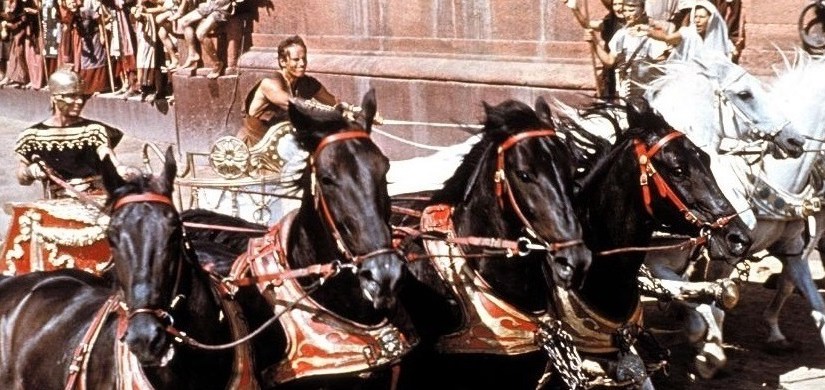
Then, of course, there’s that chariot race.  Game, set, and match.

Ben-Hur was created in an era when Hollywood was watching its profits dwindle because of the advent of television, which was keeping more and more people glued to their sets at home instead of paying for a ticket at the box office.  One way to get people back into theaters was to take the “bigger-is-better” approach: do things that were impossible on a TV budget.

Consider these statistics: Three hundred separate sets were built for Ben-Hur.  The chariot race alone required 15,000 extras on 18 acres of backlot at Cinecitta Studios in Rome and took 10 weeks to shoot.  Over a million props were needed, and it took two years to amass them all before shooting.  Approximately 1.25 million feet of expensive 65mm film was exposed and developed at a cost of roughly a dollar per foot.  The budget for the film ballooned to nearly $15 million, equivalent to over $146 million in today’s dollars, an unthinkable amount in the late 1950s.

But when it was released, Ben-Hur made history by being the first film to win eleven Academy Awards, including Best Picture, Best Director, Best Actor, and Best Supporting Actor.  It remains the only film to date to win Best Picture and Best Visual Effects.  At the box office, it raked in $75 million ($731 million when adjusted for inflation), making it one of the most profitable films in Hollywood history at the time.  It remains popular today, ranked in the IMDb’s top 250 most popular movies and listed as the #2 epic film of all time by the American Film Institute.  (#1 is Lawrence of Arabia, naturally.)

How does a 63-year-old film, with a running time of 3 hours and 42 minutes, with a blatantly religious plotline culminating in the crucifixion of Christ and a shamelessly manipulative miracle, and featuring some of the hammiest acting this side of Bollywood, remain as popular as it is?  Because despite its shortcomings, it does what every film should do, long or short, sacred or secular: it tells a rollicking good story, and it does it extremely well.

After a solemn prologue depicting the first Nativity, we jump forward 26 years and meet Judah Ben-Hur (Charlton Heston), a wealthy Judean prince who enjoys a reunion with his old friend, Messala (Stephen Boyd).  They grew up together but went their separate ways, and now Messala is a Roman tribune assigned to keep the peace in Judea.  Poor Judah realizes just how far they’ve grown apart when an accident leads Messala to arrest Judah and his mother and sister, to demonstrate his power and loyalty to Rome.  Judah vows vengeance and is sentenced to die as a galley slave.  But fate intervenes in the form of Quintus Arrius (Jack Hawkins), a Roman general whose life Judah saves in battle.  Arrius befriends Judah and officially adopts him as his own son, giving Judah the means to return to his homeland, wreak his vengeance upon Messala, and rescue his mother and sister from prison.

…and that’s just Act One.  Act Two focuses heavily on Judah’s revenge in the form of one of the greatest set pieces in Hollywood history: the chariot race.  Or, more properly, The Chariot Race.  If you’ve never seen it, Google/YouTube it.  Even viewed as a stand-alone scene, it is as breathtaking and thrilling as any car chase ever filmed.  It’s so good that George Lucas cribbed many of its beats for the pod-race sequence in Star Wars: Episode I – The Phantom Menace.  The crashes you see during the race were planned, but they were performed with real stuntmen in real danger.  Note especially one sensational stunt where a 2-wheeled chariot drawn by four horses, at full gallop, approach a crashed chariot in their path.  The horses leap the chariot, then the chariot dangerously rolls over the crash itself, hurling the stuntman so high into the air he nearly topples head over heels over the front of his own chariot.  I am at a loss to imagine how they could possibly accomplish this same scene today without the use of visual effects.

Peppered throughout the story are brief scenes featuring Jesus of Nazareth, although we never hear Him speak, and we never see His face.  In Act One, He offers water to Judah as he is being marched to the galleys, a compassionate act that will resonate through the years.  Later He is glimpsed from a distance delivering the Sermon on the Mount.  And later still, we see His trial, His journey to Golgotha, and His crucifixion.  Everyone involved in those scenes show the appropriate and expected levels of awe and sadness, while the score plays a mournful dirge.  It’s a little ham-handed by today’s standards, especially when compared to modern films like The Passion of the Christ, but it is still effective.

The movie’s highest level of filmmaking, apart from The Chariot Race, is on its best display in the first half of the movie.  Nearly two-and-a-half hours fly by, thanks to superb editing.  It’s never boring or soapy.  (Well…ALMOST never soapy.  The requisite love scenes between Judah and the slave girl Esther, played by the lovely Haya Harareet, are not as easy to watch as the rest of the film, but thankfully there aren’t that many of them.)  Every event and every scene feels crucial to the story.  There’s never a moment that drags.  Like the best epic films, watching Ben-Hur makes me feel like I’m reading a richly detailed novel.

If the film has a major downfall, it’s the story that follows The Chariot Race.  The movie doesn’t exactly grind to a halt, but it doesn’t offer the viewer any kind of climactic punches that can match the visceral effect of Judah’s capture, escape, and victory in the race.  (Sorry if I spoiled that for you, but if you seriously thought he lost that race, seek help.)  Sure, there’s the capture and crucifixion of Jesus and the miraculous aftermath, but while that satisfies the true arc of the story, I still, to this day, feel like the film deflates a little at the end.  There’s simply nothing it can offer that could possibly follow up that damn Chariot Race.  The race is the payoff.  Everything that follows feels anti-climactic.

That quibble aside, Ben-Hur is still as captivating as it ever was, with “old” Hollywood’s full power brought to bear to bring audiences a cinematic experience unlike any other at that time.  No matter where you might stand when it comes to its religious overtones, you can’t deny that the movie is exactly as respectful as it needs to be for this story.  And ultimately, the message of the film isn’t “An eye for an eye.”  It’s “Love thy enemy as thyself.”  It takes Judah Ben-Hur a little while to get there.  But he gets there.

IN THE HEAT OF THE NIGHT

By Marc S. Sanders

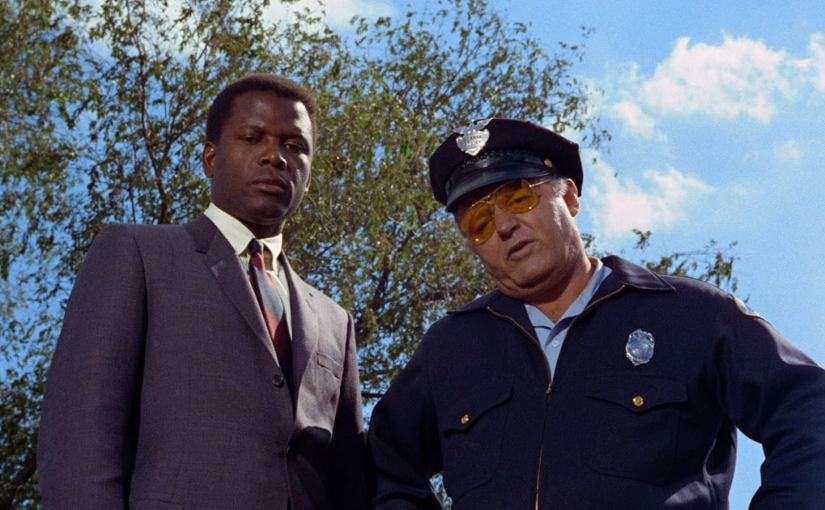
In 1967, just before the assassination of Dr. Martin Luther King Jr, Norman Jewison’s film In The Heat Of The Night won five Academy Awards including Best Picture, Best Actor for Rod Steiger and Best Adapted Screenplay by Sterling Silliphant.  While it is easy to classify the movie as a crime drama/murder mystery/detective story, the setting and themes of racial prejudice overshadow who the killer is or the motive.  As the film progressed, I grew less curious of who bludgeoned white businessman Philip Colbert to death and why.  It was much more important to understand exactly why Steiger’s Mississippi Police Chief Gillespie is so quick to believe that a well dressed and cooperative black man who was simply apprehended for waiting at a train station would be the culprit.  The black man is Virgil Tibbs (Sidney Poitier), a Philadelphia police detective.

After Tibbs has an opportunity to identify himself, Gillespie shamelessly requests his services in solving the crime.  Murder doesn’t happen often in Sparta, Mississippi.  Tibbs’ supervisor speaks highly of his officer’s capabilities.  Tibbs knows how to look for signs of rigor mortis on the deceased.  He knows how to identify that the killer was right-handed and he knows that when another suspect is quickly brought in, that he can’t be the killer either.  Still, many of the heated conversations between Gillespie and Tibbs are the same.  Their back and forths even become redundant at times.  Gillespie, nor the deputies and other residents of Sparta, are apt to listen to a “colored” person.  At one point, Tibbs is put in a cell for not agreeing with Gillespie’s conclusions.  He’s also ordered on two or three occasions to get out of town.  Tibbs is not so willing to surrender though, even if he’s regarded with racial disdain.  The impression is that this murder will not be so challenging for Tibbs to solve, if only he had a little more time and cooperation.  So, the riddle of the crime is not the overall conflict of In The Heat Of The Night.  More so, it is the racial hatred that a deep south Mississippi town has for an educated and skillful black man from up north.  

I read that the film was shot primarily in Sparta, Illinois.  Poitier made that request for his own safety while a tense period within America was occurring against the backdrop of the civil rights movement.  Jewison’s film is quite brave.  In the face of racial divide within the United States, this film still got made.  Yet, it had to be produced with an abundance of caution. 

A telling scene happens in the middle of the picture.  Tibbs requests Gillespie escort him to a wealthy cotton plantation owner’s home.  As they drive up to the home, they pass by the black cotton pickers collecting the crops under the hot sun.  They meet in the estate green house with a Mr. Endicott, who comes off very cordial to Tibbs at first.  However, when a slight accusatory question comes from Tibbs, Endicott slaps him across the face.  Tibbs responds with a slap right back at him.  In Mississippi, a black man better know his place, even if the prime suspect of a murder is a wealthy white man, or more simply just white.  It’s a classic moment in film history.  However, it remains an important scene and maybe its significance should be all the more heightened in modern day 2022 with the Black Lives Matter mentality at the forefront; where police/African American race relations are being tested. 

Three white men were recently sentenced to life in prison without parole for the hate crime killing of a black jogger named Ahmaud Marquez Arbery in the state of Georgia.  All that Mr. Arbery was doing was jogging through a neighborhood.  He didn’t have a weapon.  He hadn’t come in contact with anyone to even slightly suspect a threat.  He was noticed by these three criminals, and because he didn’t belong in that area, he was brutally murdered for the color of his skin.  Evidence would reveal where these men stood with regards to black people as a history of various texts that were clearly racial in nature were later uncovered.  If it wasn’t going to be Mr. Arbery who was murdered, it was eventually going to be another black person who would fall victim to these men. 

Though Dr. King was murdered shortly after the release of In The Heat Of The Night, I’m cautiously optimistic that racial hatred has lessened and the generations that followed learned from the misgivings of their ancestors.  Still, the term “hate crime” is often used in news reports today.  The debate of the Confederate flag and its argument for keeping it flying still has to be pondered.  Fifty years later, I cannot understand why, though. 

I will never forget a vacation I took with my family to Stone Mountain in Georgia back in 2005.  It was fourth of July and we were picnicking on the lawn next to a couple of teenagers while waiting for the fireworks.  I struck up a conversation with a local teenage girl and the flag and the confederacy along with the carving of Confederate leaders (Stonewall Jackson, Robert E. Lee and Jefferson Davis) on the rock sight were brought up.  Her defense of these topics was “It’s history.  Not hate.”  I became much wiser in that moment.  I was just a naïve Jewish guy who was raised in New Jersey.  I was not aware enough.  Much still hadn’t been learned and a whole lot needed to be unlearned.  History is not a reason to celebrate.  History is not meant to honored.  History is meant to be remembered for our rights, and especially our wrongs.  Much of history should not be repeated, and yet that’s what happens all too often.

In The Heat Of The Night is another example of the power of films.  So much is debated about what is taught in our schools.  A proposal of law for “Don’t Say Gay” is likely to be passed in Florida where it’s deemed impermissible to discuss homosexuality in elementary schools.  Books are continuing to be restricted from availability in libraries.  So, if our institutions of learning are being censored, then we have to rely on other mediums.  Movies like Schindler’s List or In The Heat Of The Night or Do The Right Thing offer those opportunities.  Films open a window to view love and hate as well as tolerance and prejudice.  We can never afford to look at our world with rose colored glasses.

THE LORD OF THE RINGS: THE RETURN OF THE KING

By Marc S. Sanders

I remember film critic Gene Siskel once said that to take issue with the length of a film is not entirely fair. After all, you are getting more movie for your buck. Would Siskel have felt that way about The Lord Of The Rings: The Return Of The King? Peter Jackson closes out the film adaptation of JRR Tolkien’s sweeping fantasy with an epic that allows you to marvel at everything you see, but does that mean we want to feel as overly exhausted as its main protagonist, Frodo Baggins, feels? Trust me. Poor Frodo looks wiped.

More battles are enacted in the third film. Jackson just changes the dynamics up a little bit. Now armies don elephants with a number of enormous, curved tusks. Another army has a different looking giant troll. Haven’t seen elephants before. Haven’t seen that kind of troll yet either. As well, there is another King who is apprehensive to cooperate in the fight against Sauran and his Orc minions. There’s also a green glowing ghost army. Meanwhile, Frodo and Sam (Elijah Wood and Sean Astin) continue their journey to Mount Doom where the almighty Ring must be destroyed. Gollum (Andy Serkis) remains as their untrustworthy guide.

Jackson seemingly covers every page written by Tolkien. I’m talking about depicting every dream each character has or line they utter or slow motion expression they offer, or walk that they take. Peter Jackson is a completist.

The Return Of The King won Best Picture along with a bevy of other Oscars. Seemingly it should have won anyway. The first two films were recognized with Best Picture nominations as well. For the third film to win was to honor the entire trilogy and its achievements in filmmaking. The Lord Of The Rings trilogy reinvented movie making as a whole. The bar was set so much higher following its release and huge reception of these films.

That being said, it takes endurance to stay with the picture. Most especially with The Return Of The King as the film has multiple endings. Just when you think it’s over, it’s not, and it’s tedious and a little frustrating. Jackson seemed to have too hard a time saying farewell to his digital Middle Earth with its endearing characters.

The length is a problem I have with the film, but none of it seems wasteful either. Every caption and scene carry an importance to it. At least that’s how Jackson wants you to feel. The question is, if a number of momentary scenes had not been woven into the final edit, would I miss it, and my answer would be likely not.

MOONSTRUCK

By Marc S. Sanders

Moonstruck has to be one of the most delightful romantic comedies of all time thanks to an outstanding cast, an intuitive director (Norman Jewison) and a script full of brilliant dialogue and set ups from John Patrick Shanley.

Loretta Castorini (Cher in her Oscar winning role) is a 37 year old widow. Her husband of two years got hit by a bus. So, naturally when her father, Cosmo (the hilarious Vincent Gardenia), hears the news that Loretta got engaged to the boring schlub Johnny Cammareri (Danny Aiello), he knows this is a bad omen and she should not get married again. Sure, her husband got hit by a bus, but that can only mean that marriage is no good for Loretta. When they wake up Rose (Olympia Dukakis in her well-deserved Oscar winning role), Loretta’s mother, to share the news, she just opens her eyes and asks, “Who died?” This is an adorable Italian family living in Brooklyn and somehow an Irishman wrote the script which was then directed by a Jewish mensch, and everyone is working on all Italian cylinders.

Two minutes into the film and I’m laughing. I’m laughing at Johnny’s wimpy proposal in the local Italian restaurant. I’m laughing at Rose and Cosmo who’ve seen enough of life to know that you don’t get married for love anymore. Rose is for Loretta getting married though. Cosmo doesn’t wanna spend the money.

Just after Johnny proposes, he flies off to Sicily to be by his dying mother’s bedside. He requests that Loretta invite his brother Ronny (Nicholas Cage), who he hasn’t spoken to in five years, to the wedding. Ronny is upset with Johnny. Ronny got his hand chopped off in the bread slicer at his bakery when Johnny was talking with him and Ronny looked the other way.

When Loretta approaches Ronny, before you know it, they are sleeping with each other. Ronny then invites Loretta to see La Boheme at the Met that night. Loretta knows it’s wrong and can’t keep this up. It’s a sin. She goes to confession, but then she also goes to buy a new dress and dye the greys out of her hair.

As well, Cosmo is stepping outside of his marriage, only Rose is not so stupid. She knows what’s going on. When Rose is dining alone, a college professor who strikes out with one attractive student after another joins her table. Rose isn’t gonna do anything. Instead, she asks the question on everyone’s mind “Why do men chase women?” Then she answers it. “Because if they don’t, they think they’ll die.” But they’re gonna die anyway. Right?

It sure looks like my column is just summarizing the film but my breakdown of Moonstruck simply celebrates all that’s good about it. Here’s a film that doesn’t stereotype a New York Italian family. Instead, it shows how they regard one another as well as the people within the neighborhood from the eager to please waiter in the restaurant to the mortician that Loretta works for. The mortician spills butter on his tie. Loretta takes the tie off of him and says she’ll get it cleaned.

Life in the home of Castorini family is shown beautifully with natural humor to display its atmosphere. Cosmo’s quiet elderly father with five yappy dogs on leashes is only a part of every passing day. Like I’ve made claim on other films, the best movies offer smart characters. Everyone has a way of carrying themselves in Moonstruck, and they’re not dumb. They might be cheap like Cosmo or wimpy like Johnny or a little dim like Ronny, not dumb, but they’re all wise to how they handle themselves.

This might seem like a relatively easy, untechnical little New York comedy. Norman Jewison, however, uses a great approach that makes each setting feel like you’re watching the most alive stage play you’ve ever encountered. I’m actually surprised this film has yet to be adapted for the stage. Maybe, just maybe, Moonstruck hasn’t made it to live theatre yet because it’d be damned near impossible to recapture the harmony of this magical cast.

I love Moonstruck.

THE LAST EMPOROR

By Marc S. Sanders

Finally, I invested myself in watching Bernardo Bertolucci’s Oscar winning Best Picture The Last Emperor. Honestly, as breathtaking as the undertaking to make this sweeping epic is, it was the first and likely last time I will ever watch the film.

This three hour plus biographical picture focuses on a young child named Puyi, plucked from nowhere to become the next Emperor of China. He is destined to reside in Peking, The Forbidden City amid rich tapestries and deep Chinese culture at the start of the twentieth century. Oddly enough, the would be Emperor is a prisoner of his own surroundings for nearly his entire life. He is forbidden to go beyond the walls of Peking. Later in his adult life, he is a political prisoner and war criminal in the now regarded People’s Republic of China. Puyi was never granted an opportunity to think for himself or act upon his devices. He is forced to become an adaptable symbol to ongoing representations of the country that harbors him.

I watched this film with my wife. The next day we discussed it with my colleague Miguel who regards the picture as one of the best films he’s ever seen. I can not dismiss his viewpoint, but personally the depth of Betolucci’s efforts for maximum authenticity pushed my interest away from the film.

I embrace character arcs in films. It’s what keeps each passing moment of a movie refreshingly interesting. I do not deny the change in the Emperor’s story arc. Puyi changes as his country changes on both a political or militaristic platform. Yet, the film has vague segues in its changes as well.

Characters appear and disappear. Moments in history occur with no build up or explanation. It was challenging to follow who is who, and what has just happened.

Early on, we see how Puyi as a child interacts with his younger brother, Pujie. Much later in the film, Pujie reappears when they are adults. I am not going to pretend I’m a sophisticated enough moviegoer to realize this is the brother we saw as child over an hour earlier in the film. It took some time to realize who this guy was.

I’m also not going to pretend I know enough about Chinese history and culture to comprehend the traditional customs and ceremonies that occur, or China’s relationship that developed with Japan, or China’s significance during World War II.

That’s my problem with the film. Was I supposed to take a college course on Chinese history before watching The Last Emperor? The film is expository for sure, but it presumes the viewer will recollect at what point in history this moment or that moment occurs.

The film flashes forward and back to when Puyi was a prisoner of war in 1952. In prison, he eventually becomes reformed, but it became frustratingly complicated to understand exactly why he was even sentenced.

Following the film, I referenced Wikipedia to grasp the sequence of events. The historical change of this one man certainly merits a film to be made, much like Malcolm X or Born On The Fourth Of July. However, those films had a more comprehensive narration for me and the ongoing changes that the central figures experience are more well defined as the years pass and the people around them change.

The Last Emperor felt unclear to me in its storytelling while still immersing me in a land I’d imagine is unfamiliar to most viewers. For centuries “The Forbidden City” was not open for a public to encounter. If that’s the case, I believe Bertolucci needed to define what he captured much more clearly. Who’s to know what we are looking at, or what significance this setting has if most of the world population has yet to see what is here?

The Last Emperor requires a high threshold of patience and focus to grasp what it presents. It should be seen for the locales that are filmed, which were completely unseen by me personally. You’ll also get some tidbits of Chinese history, for sure.

All I can recommend is not to be so hard on yourself, when you find yourself lost at times in the film.

DOG DAY AFTERNOON

By Marc S. Sanders

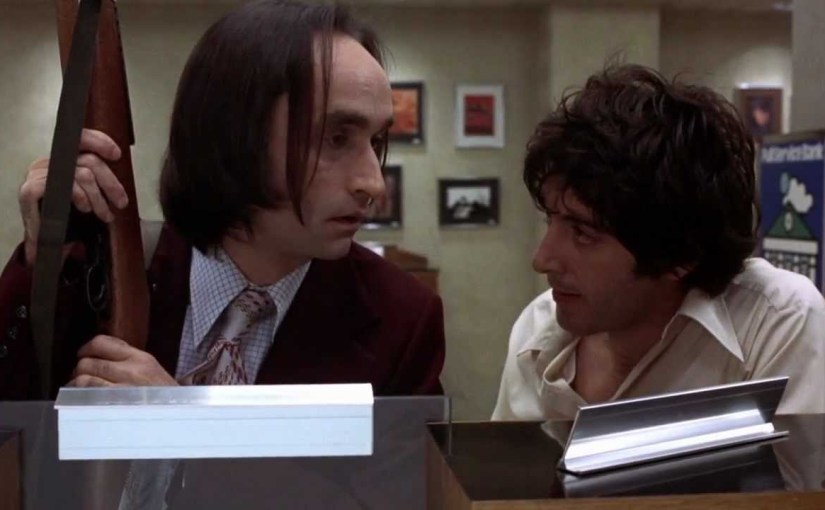
Sidney Lumet uses his best strengths in this ridiculous Brooklyn bank robbery that is actually based on fact.

Here, Al Pacino and his cohort, John Cazale, play inadvertent stupidity without compromise. If two of the three stooges went on to do drama, this would be the material they’d use.

A simple bank robbery with little to no planning spirals out of control and into sheer pandemonium. Nothing goes right even when Pacino’s dimwit character, Sonny, is deluded enough to believe all is going in his favor. He immediately earns the support of the encroaching Brooklyn community only to lose them when he shows his true homosexual nature. Then he’s blindsided as to what happened. Layered in drenching sweat, Lumet wisely takes advantage of Pacino’s best up close facial expressions. Utter delirium!!!!!

Once again, Lumet’s camera moves while his best actors remain naturally in place. Al Pacino does his thing and trusts his director will find his shots. As the cop initially in charge, Charles Durning does as well. Pacino and Durning especially have great scenes together in the middle of a heavily populated New York Street as the robber shines off the cop, and the cop does his best to obtain some measure of control. It’s a scream fest for the ages. “Attica! Attica!” Pacino and Durning’s best career performances were always the ones where it looked like neither of them were ever acting. Dog Day Afternoon is one those better examples.

Frank Pierson’s jagged script of wild turns makes every person whose an extra like the pizza delivery man, for instance, caught up in the hysteria. The pizza kid shouts out to the crowd “I’m a star!!!” It’s great reason to applaud Sidney Lumet’s control over a crew and the entire company of extras he’s employed. This film is a rare example where all of the extras (seemingly the entire Brooklyn population) are as integral as the leads. The setting is the main antagonist from the media all the way to the observers who can’t look away and can only cheer, yet mock as well. Brooklyn, New York is a great character here.

Most fascinating about Dog Day Afternoon is that it is all based on fact from the media circus to dumb bank robbers with a need to steal in order to fund a lover’s sex change operation. It’s ridiculous. It’s funny. It’s frighteningly stressful and it’s all true.

This was released following the first two Godfather films and confirms the enormous range Al Pacino possesses with his performance talents. Hyperactive and dumb here as gay bank robber, Sonny; quietly contained, evil as Michael Corleone. His range was through the roof in the 70s before absorbing his loud, crackling, smokers voice. It was when the script outshined Pacino and before the current age of writing being catered to its bankable star.

Lumet also allows great moments for the hostages who become undone to the point of regretfully using foul language, to actually befriending their captors. He’s a director who efficiently leaves no stone untouched.

Chris Sarandon as Leon, Sonny’s male gay spouse is great here too. He’s full of melodrama, panic, worry, and a New York maternal despair. Another great scene is a phone exchange between Pacino and Sarandon. It might appear funny at first, especially in the 70s when homosexuality was lampooned often with the other F-word, but anyone who appreciates the filmmaking of Lumet will quickly contain their snickering when they realize a gay man is equal flesh, bone and feelings like anyone else.

Dog Day Afternoon is very telling of an out of the closet social media future. The story will always get grabbed regardless of danger or sensitivity. People will get swept up in the hoopla (a teller hostage quickly boasts her brief fame on television “Girls, I was on TV!”), police will overextend their privilege, helicopters will swarm, the criminals will demand their moment in the spotlight, and the public will serve as jury per the majority.

It’s a vicious cycle but considering it is a 1975 masterpiece, it’s all disturbingly valid and sensationally true.

NO COUNTRY FOR OLD MEN

By Marc S. Sanders

Joel and Ethan Coen have an odd collection of films under their belt. No Country For Old Men, an adaptation of Cormac McCarthy’s novel is no exception. You’re likely to meet the oddest hit man you’ve experienced in a film. (Reader, I’m going under the presumption you’ve never encountered a normal or odd hit man in real life. If you survived long enough to read this passage, you are truly blessed.)

Anton Chigrh follows a discipline that likely no one ever taught him. His code is to continue until he finds what he’s looking for and dispose of any lead in his ongoing quest. His weapon of choice-an air gun hose connected to an oxygen tank. It’s instant in serving its purpose. Its sound is quick and jarring.

Javier Bradem delivers an Oscar winning performance as Chigrh in search of $2 million when Llewelyn Moss (Josh Brolin) takes possession of it after coming upon the sight of a drug deal gone bad.

Tommy Lee Jones is perhaps one of the old men in the title. A Texas sheriff not surprised by the carnage he comes upon, but not of much use either. I think he regrets that he can never do more or better and simply can only surmise what’s already been done. I gathered that especially from a scene depicted in a hotel room during the third act of the film. His approach on the scene and his need to sit down translate that for me. His periodic anecdotes during the course of the film seem to say so as well. This sheriff has likely never rescued anyone from harm despite how intuitive he may be.

The Coen Brothers are never shy with blood. A lot of directors are not, really. Yet with the Coens, it seems the bloodshed is disturbingly honest. The instant splatter and flow following another act by Chigrh couldn’t be more truthful. They tell this tale very well, never concerning themselves with how unsettling they can be. Sun filled deserts are not comfortable. Evenings are sleepless. Blood is dark, thick, sticky, messy.

Moss is a hunter who has no idea what he’s up against. Brolin plays him with quiet reservation. He could not resist the urge to take the bag of money, but he also knows he’ll pay for it as well. When he realizes there’s no way to escape, by even crossing the border, he can only try to kill the devil incarnate. He’s likely aware of how this will all play out though.

Among this trio of fine actors (with Woody Harrelson also briefly in the fold), the film is nevertheless celebrated for Bardem. Whenever the story returns to Chigrh, you sit up in your chair a little more alert. He’s got disturbing dialogue exchanges with those he encounters and Bardem’s method makes you wish you never have to decide your fate with a coin toss.

No Country For Old Men is not an action film. The pace takes its time, invested in three men with respective histories who cannot change what their meant for. No incident will change their lifestyles. They are meant to be an assassin, a washed-up lawman, and a poor country hunter. Until they die, no moment in time will alter their caricatures. That’s what I took from the Coens’ Best Picture winner.

I appreciate its honesty.

THE SOCIAL NETWORK

By Marc S. Sanders

Power and knowledge can be a dangerous thing for a kid who is not necessarily as mature as his IQ would suggest. Mark Zuckerberg reinvented the way an entire planet functions from his Harvard dorm room. In the process, he couldn’t have cared less about the antagonism he was generating.

David Fincher’s The Social Network, with a brilliant screenplay by Aaron Sorkin captures kids with too much opportunity to seize, and the hubris they carry when they discover money, jealously, pride, and greed through a winning societal experiment.

The film features one of the best casts ever assembled, at least definitely within the confines of the 21st Century. Andrew Garfield, Justin Timberlake (should’ve been nominated), Armie Hammer (one of the best twin brothers’ portrayals in film), Rooney Mara, Brenda Song, and of course Jesse Eisenberg. Sorkin wrote the dialogue. It’s another thing to deliver it.

These people talk before they think, and it’s likely what caused them the aggravations of their own success and discovery. Watch the first scene between Eisenberg and Mara, as Zuckerberg and his girlfriend, Erica. Zuckerberg is already too smart for his own good. His failure with dating Erica is destined to be his undoing. He’ll never recover from this moment. Never! This is a kid with his hand on the nuclear button and he can’t stop pushing it. The other characters are all the same. Harvard geniuses with so much to gain, but how much will they lose?

Mark Zuckerberg, Cameron & Tyler Winklevoss (the self-absorbed twins of prestige and legacy), and Sean Parker (inventor of Napster) are prophets of a bigger picture. They foresaw the basic human desire for attention. People’s needs to be noticed are the commodities to monetarily profit from. These kids knew that better than anyone else. Ironically, Zuckerberg’s best friend and financial partner, Eduardo Saverin (Andrew Garfield), didn’t know it until he realized he was a large step behind. It cost a lot of money. Ironically, in the process of creating a new means of connecting with friends, it suffered the cost of a friendship, as well.

The Social Network will always be one of my ten favorite films. (Talk about huge Oscar upsets…excuse me The King’s Speech for Best Picture????) I’m always amazed at these kids with power. The knowledge they possess is bigger than anything within the confines of our historical governments, and yet they bicker and steal and betray like toddlers in a sandbox. Switch out “Facebook” for a Nerf football or a Barbie doll, and you can still apply this fast-paced wit of words. Sorkin pounced on that dichotomy. We’ve seen civil lawsuits on film with grand disputes and long speeches in front of arbitrators. We had yet to see college students dominate tables full of lawyers with crackling dialogue exchanged to prove their worth over one another. Amazingly enough, Sorkin used much of the dialogue from recorded transcripts he accessed. These guys actually spoke like this with each other. These technological pioneers gave the planet’s people the attention they wanted. Yet, what ultimately mattered to them was the credit for what they felt entitled to.

I’ll never tire of watching The Social Network, even if listening to Mark Zuckerberg is as exhausting as talking with a stair master.

One of best films ever made.

DANCES WITH WOLVES

By Marc S. Sanders

The western motif of filmmaking really comes alive with the 1990 winner for Best Picture, Dances With Wolves starring Kevin Costner in his astounding directorial debut. Until now, this film eluded me. I just never got around to seeing it. Watching it now is to recognize the parallels of current events in the year 2020. A Native American Facebook friend of mine recently lauded the takedown of a statue of Christopher Columbus. At the risk of sounding like I’m taking political side (I insist that I’m not!), I think understand her position a little more. I’m not saying I agree or disagree with this topic. I’m just saying I understand.

After committing what was seemingly an act of suicide, but instead is recognized as heroic in the eyes of the Union army during the Civil War, John Dunbar (Costner) is offered the pick of location for his next post. He opts for Fort Sedgwick because he wants to witness the frontier out west before it will likely be taken over by the white Americans. As Dunbar waits for fellow infantrymen to arrive, he gets the old fort into shape with his trusty horse Sisco. He also encounters companionship in a lone wolf he names Two Socks. The wolf only gradually learns to trust Dunbar, but that’s a project for the infantryman to occupy himself with. That, and keeping his personal journal.

Shortly after he’s settled in, he comes upon a Sioux Indian named Kicking Bird (an excellent Graham Greene). He and Dunbar are the first to develop trust with one another. Eventually, Dunbar’s good nature allows him the opportunity to rescue a white woman who lives with the Sioux tribe known as Stands With A Fist (Mary McDonnell). She has attempted to kill herself following the death of her husband. As the film continues, she becomes the translator between Dunbar and the other Indian leaders, allowing the story and relationships to move along.

The script by Michael Blake is fascinating simply because we are granted plenty of opportunities for the tribespeople to speak in their native tongue. Forgive me, I thought for a little about Hollywood’s most famous Indian, Tonto, and his laughably limited English. Here, language is instead limited for the white man as Costner does his best charade of buffalo to find initial common ground with the tribe’s holy man played by Greene.

Hollywood westerns seem to equate American Indians as savages, the bad guys of the films, complete with tomahawks and bow and arrows and bellowed battle cries for expression. Not here. Dunbar’s loneliness at the fort without another white man in sight does not allow for the ease of prejudice to interfere. Instead, he is a character who must learn to be accepted by the greater populace. When he is, he realizes that his true name is Dances With Wolves and not John Dunbar. That’s a fascinating character arc of change. The setting and the community within that location change the character. I was really moved by it.

As well, there is struggle and disagreements among the Indian population. Perhaps it truly is in the nature of humanity to be that way. The Sioux tribe must contend violently with the Pawnee tribe in a struggle to protect their territory and their food and supplies. Yet, that is wholly different from what drives the war that Dunbar has heroically served in. It’s not until Dunbar fights alongside his Sioux friends that he realizes he’s not an infantryman. This is another example of Costner effectively directing himself to find a new and enriching identity for his character.

A third example of character change stems from the eventual and expected love story that unfolds between Dunbar and Stands With A Fist. It’s something I’ve seen in countless other films. However, Mary McDonnell is quite good as the white woman whose English is close to being entirely replaced by the Native American tongue. She seems so indoctrinated within the Sioux tribe that when she first comes on the screen I questioned if she was a natural born Indian or an actual white woman.

Costner’s film is full of magnificent imagery. Gorgeous landscapes of the filming locations of South Dakota are like perfect paintings of open fields and endless blue sky. The blu ray transfer I watched was eye popping.

One of the greatest moments was a sequence involving a buffalo stampede. Costner with cast all on horseback ride within, as well as parallel to the animals and if ever a widescreen shot should be appreciated, this is a moment to turn to. The score moves beautifully with the pounding of the horses and buffalo stampeding across the open plains.

A personal sidenote is in regards to John Barry, the film’s music composer. I know this is an unfair criticism but at times his score is so strikingly similar to his work on various James Bond films that it was a distraction for me. Other times, Barry’s work lent well in some of the action scenes.

Nonetheless, what an incredible achievement that Costner commanded. He gives a terrific performance, but his direction is what truly stands out. Particularly, with the battle scenes and animal footage, I questioned how he managed to accomplish all of it. It’s just spectacular.

Dances With Wolves is certainly worthy of the accolades it attained and the reputation it still holds. The production value is easy to admire and unforgettable. Beyond that though, is the converse nature the film adheres to as a Hollywood western. The culture of a Native American tribe never seemed so authentic to me as it does here, accompanied with their sense of humor or even their temptation at playful gossip when observing the central love story between Dunbar and Stands With A Fist. We see what the Sioux tribe does to survive, yes. Still, we also see how they interact with one another and converse, as well as how they respond to a new neighbor, for example.

Dances With Wolves is an authentic masterpiece of a modern western. It’s a must-see film.

THE DEPARTED

By Marc S. Sanders

Martin Scorsese finally won his Best Director Oscar with the 2006 Best Picture The Departed, from a script written by William Monahan. The film is a remake of a Hong Kong crime drama called Infernal Affairs.

Also known as the one film in Scorsese’s library with a linear plot, The Departed depicts the stories of two guys who grew up in the south end of Boston and joined the police academy to serve. Only difference is one is recruited to go undercover within the Irish mob, while the other is recruited by the same mob to become a highly respected police officer and supply an unlimited wealth of information to his criminal boss.

Leonardo DiCaprio is the undercover cop Billy Costigan. Matt Damon is the criminal cop Colin Sullivan. Jack Nicholson is the Irish mob boss in the middle, Frank Costello.

The Departed works because Scorsese and Monahan allow the audience in on every deceit playing against the characters. Pleasantly surprising is that there are even twists to this layered story, and cellular flip phones assist all the players with trying to remain in hiding or hoping to one up and trap the other. However, because everyone is getting tipped from their own respective sources, people are either not ending up dead, or arrested or caught red handed. As Costigan builds his case against Costello, Sullivan is worming his way to protecting his cover in the police force while also tipping off his true boss.

Performances from DiCaprio, Damon and Nicholson are what you’d expect. Nicholson is chewing the scenery again appearing like the devil incarnate while hamming up the facial expressions. Damon is great at playing it like the Boy Scout cop in well-tailored suits, clean shaven and flirtatious within his department and earning respect among his peers, that is until it all seems to unravel. DiCaprio is wired as the cop who needs to show he’s a dangerous hood to be trusted among the mob cohorts. However, he’s getting more paranoid and unwound at the risk of being made.

Thelma Schoonmaker (one of my favorites) does a balanced approach edit to showing a parallel among the cops. She will insert a happening of Costigan for a snippet and then segue to Sullivan appearing to do honest police work, or reaching out to Costello with a warning of what’s coming for him.

Great support also comes from Ray Winstone as Costello’s right hand man, and Alec Baldwin, Anthony Anderson and Martin Sheen, all within the police department.

Ironically, the one Oscar nominated performance was bestowed upon Mark Wahlberg and I grew tired of his presence quickly as the cop who berates Costigan endlessly with yelling and fast one liners that involve someone’s mother. Could we just move on from this please?

I also found Vera Farmiga as a police psychologist to be mostly unnecessary until a contrived ending point needed to arrive. Her character naturally has affairs with both Damon and DiCaprio, who also attend her office for sessions. Of course they do! Whenever the film sidetracks to one of them with Farmiga, The Departed stalls for a moment. Her character carries no stake in the plot line and offers no further dimension to DiCaprio and Damon’s characters.

The film works best as the complications compound on each other. A great moment occurs between the cops when one of them picks up a bloody cell phone to dial back the most recent call. Silence on both ends of the line, and the moment just plays out until someone speaks or hangs up.

Moments like that is suspense similar to when a man is intruding in a dark house. However, this is suspense delivered by Martin Scorsese, and Martin Scorsese will film suspense that is anything but typical. Martin Scorsese’s suspense leaves you breathless.