GET OUT

By Marc S. Sanders

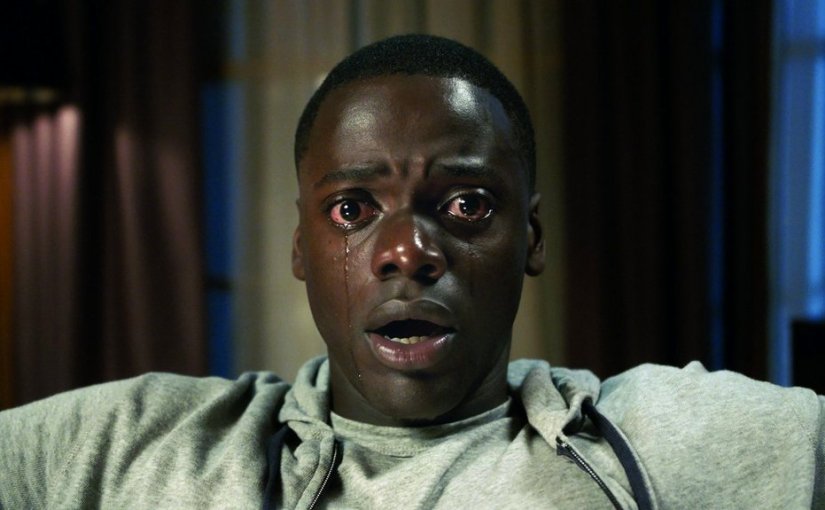
Consider this for a second.  You’re an African American thirty year old who has recently begun a promising relationship with an affectionate, loving Caucasian woman.  As she attempts to ease your apprehension about meeting her parents for the first time she tells you her dad would have voted for Obama if he could have run for a third term.  When you arrive at their upstate home, one of the first things dad tells you is that if he could, he would have voted for Obama for a third time.  Exactly why is that so important to say?  From her?  And later from him?  Why is it necessary for an audience to hear the statement twice within a span of less than fifteen minutes? While it should sound assuring, it feels anything but trusting.  That’s how smart Jordan Peele’s debut horror/thriller is.  He has a way of delivering two different perspectives with one simple statement.

In Get Out, Daniel Kaluuya is Chris.  His girlfriend is Rose played by Allison Williams.  These actors are a perfect pair on screen but that’s about all I want to share with you considering their relationship.  

Chris is meeting Allison’s family at their home for their weekend.  It’s a beautiful, quaint estate off the beaten path from any intrusive neighbors.  Burrowed within the woods, this is a place to escape the stresses of city life.  Just like with any horror film though, the characters do not know they are operating inside a horror film.  The audience always does, and the best filmmakers find those frequent moments to get their viewers to squirm in their seat, tuck their knees under their chin, clench the butt cheeks maybe and say, “Don’t do that!,” “Don’t go in there,!” or maybe they’ll urge you to “GET OUT!!!!”

Nevertheless, the storyteller finds it important to bring up Barack Obama on more than one occasion???? 

Before they even get out of the car, the landscaper, a black gentleman, seems curious to Chris.  Friendly handshakes and welcoming hugs on the porch segue into the furnished home and there’s the maid, a black woman, who is as intriguing as the first black person to be seen.  Wouldn’t you know it but over lunch, you learn that tomorrow there’s the annual party gathering of friends.  Oh my gosh, was that this weekend?  

Jordan Peele doesn’t turn on the creepy music you may expect.  He relies on his visuals and while you are being as observant as Chris, you just might be alarmed and less sensible than he is.  That credit goes to Kaluuya, giving a reserved, contained performance.  This guy does not look like a hero in the least because he has instincts but seems to never look for a fight or a debate or the need to set an example.  An unexpected stop on the drive over demonstrates where Chris stands in a topsy turvy world of political divides in the twenty first century.  He just wants to make life easy.  So, he also will not make waves when that groundskeeper runs directly at him in the middle of the night.  This is just too freaky, but Chris tells us to just get through the weekend.

Rose’s brother seems like a weirdo from a Judd Apatow comedy, but he’s not being a clown.  Dad (Bradley Whitford) is a successful surgeon always ready with a relaxing tone and an open hug.  Mom (Catherine Keener) has done well as a psychiatrist performing hypnosis on her patients.  Yet, a late-night encounter with her leaves Chris feeling uneasy. Visually, it’s disturbing when he reflects on what he thinks he experienced with her.  However, he tries to give the family the benefit of the doubt especially when he shares his concerns with Rose.  Allison Williams is quite good with being convincingly dismissive.  I trust her, and I like her too. 

Then there’s the party the next day.  All the guests, primarily white, arrive exactly at the same time in a convoy of tinted black sedans and SUVs.  Chris doesn’t hide himself despite feeling awkward, and he doesn’t initiate the odd conversations with these middle age WASPs, but he politely keeps engaged with them.  Ironically, the strangest conversation he experiences is when he approaches a fellow black guest who is oddly dressed inconsistently compared to everyone else while his demeanor looks like he’s in a trance.

For comedic effect, Jordan Peele incorporates a best friend for Chris to confide in with opportune cell phone calls.  Lil Rey Howery is Rod and I can say, unequivocally, he is the best endorsement for the TSA. I do not recall seeing Howery in other films of late, but this actor deserves a long career for making a big splash in Peele’s busy picture.  Get Out would never be as inventive if Howery’s role is edited out.  Rod is the only other guy who, from a distance, can tell something is not right, here.

Get Out closes on an airtight ending.  Explanations for everything that is questionable is provided.  Yet, on both occasions that I’ve watched the movie, I think about it long after it’s over.  It takes some of the best elements you might uncover from The Twilight Zone, plus what you might have seen in the original Texas Chainsaw Massacre, and builds new ideas off of those circumstances.  

It is especially fun to read the IMDb trivia about the film to uncover a wealth of appropriate symbolism that does not jump directly at you.   You’ll appreciate how clever Jordan Peele is as a writer.  Froot Loops without milk in a bowl says much about a character.  Another character is engorged with the antler of a taxidermic deer head.  One character scrapes cotton stuffing out of an armchair.  Jordan Peele approaches his scary fiction with an educated eye.  

This movie is inventive.  Its horror does not seem redundant and thankfully the monsters are not vampires and zombies all over again.  There are new tactics at play.  There are fresh approaches to victimize the heroes, and there are creative ways to surprise the audience.  

Get Out is amazing the first time you watch the film.  On a second viewing, Jordan Peele’s story works like a class experiment in social standards while it still has fun by keeping you in triggering suspense.

THE LIFE OF EMILE ZOLA (1937)

by Miguel E. Rodriguez

DIRECTOR: William Dieterle
CAST: Paul Muni, Gale Sondergaard, Joseph Schildkraut, Gloria Holden
MY RATING: 9/10
ROTTEN TOMATOMETER: 92% Certified Fresh

PLOT: Prolific novelist and muckraker Emile Zola becomes involved in fighting the injustice of the infamous Dreyfus affair.


If you want to get me angry at the movies, you can do one of two things (besides leaving your phone on): Make a really terrible movie that makes me sorry I’ll never get those two hours back…or make a really good movie about some kind of social injustice, where those in power are so empirically wrong that any fool can see it, except those in power.  Matewan (1987) comes to mind, as do I, Daniel Blake (2016) and Do the Right Thing (1989).  William Dieterle’s The Life of Emile Zola falls neatly into that category, as well.

I’m tempted to give a play-by-play summary, but that would take too long.  In short, novelist and muckraking author Emile Zola is approached by the wife of Alfred Dreyfus, a French officer wrongly convicted of espionage and sentenced to Devil’s Island.  Mme. Dreyfus convinces Zola of her husband’s innocence, and Zola pens the famous J’Accuse…! article, an open letter published in the paper accusing the French military of antisemitism (Dreyfus was Jewish) and conspiracy.  The last act of the film covers Zola’s trial for libel.

The scenes that really made me angry were the ones where French officers planted, suppressed, or burned incriminating evidence of their own treachery.  Outright lies were paraded as fact, and the actual spy was acquitted in a court-martial of his own, just so the French government could continue the façade of Dreyfus’s guilt.  When the comeuppance arrives for the parties involved, it is immensely satisfying.  No one is drawn and quartered, which is what I would have preferred, but it’s good enough.

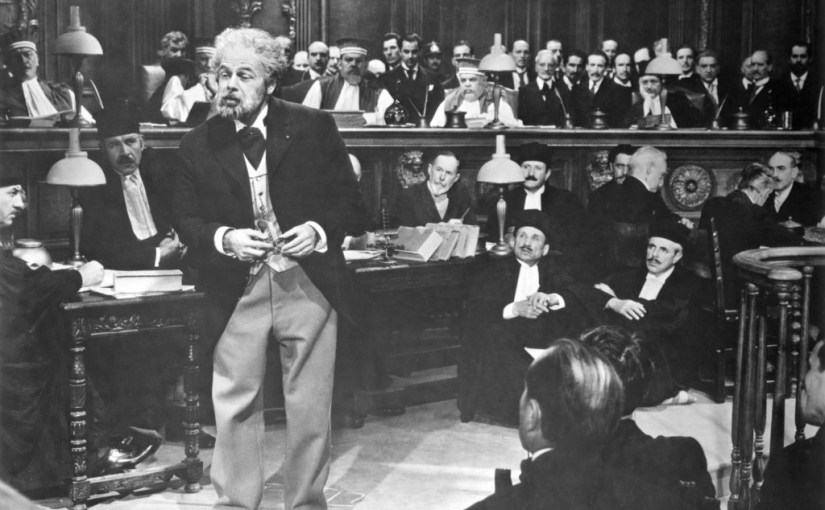
While the actor playing Dreyfus himself (Joseph Schildkraut) won the Oscar for Best Supporting Actor, it seems incredible to me that Paul Muni did not win for Best Actor that same year.  It went to Spencer Tracy for Captains Courageous, and I’m sure Tracy’s performance was exceptional, but Muni as Zola is pretty amazing.  He ages convincingly with Zola, from starving artist to a well-fed member of respected Parisian society, never less than convincing while playing a man much older than himself for much of the film.  The highlight is a late courtroom monologue that runs about six minutes.  It’s not exactly subtle screenwriting, but Muni makes the most of it.

The same could be said about the film’s screenplay as a whole.  It’s not the kind of story where the two sides have equal validity, so the script doesn’t have to be coy about where its sympathies lie.  There may be a few moments that feel like the film is preaching to the choir, but it nevertheless has great power.  That might just be me, though, given my proclivity for rooting against social injustice at the movies.

On the whole, The Life of Emile Zola is the tale of a life well-lived, punctuated by an incident that made Zola’s name immortal, and contains one of the best courtroom sequences I’ve ever seen.  It’s biography at old Hollywood’s best, not 100% historically accurate (as stated in an opening title card), but capturing the emotional essence of the story in a way no history textbook ever could.

THE EXORCIST (1973)

By Marc S. Sanders

Perhaps it is my Jewish upbringing or the fact that I’m not a spiritual person anymore, but what many consider to be the scariest movie of all time really does not alarm me that much.  William Friedkin’s The Exorcist is a superb demonstration in horror though.  Disturbing? Yes.  Unsettling? That’s an understatement.  Scary? A little bit. 

It’s not so much the threat of a random demon or the possibility of Satan on earth that chills me.  It’s this poor, sweet girl who has been unfairly taken advantage of that makes me shudder. 

William Peter Blatty adapted his best-selling novel into his Oscar winning screenplay and it succeeds so well because amidst all of the terror, there’s an education to be had.  Do any of us truly know or have witnessed someone who has been demonically possessed by an entity of pure evil?  I’ll be the first to come clean and say no.  Therefore, I’m intrigued as Friedkin’s film proceeds to observe how the decision to exorcise a demon from the shell of a pre-teen girl arrives.  Nevertheless, to me it is all fantasy.  I might just hold more faith in the Jedi practice of the Force than I do in the ideas of holy water, devilish idols or even what can befall you by flippantly using the name of Christ in vain.

Famous film star Chris MacNeil (Ellen Burstyn) is on location in Georgetown shooting her latest picture.  She resides in a furnished home with her twelve-year-old daughter Regan (Linda Blair), along with an assistant and a butler servant.  Regan is a fun-loving kid and adored by her mom.  Strange behaviors begin happening and all too quickly, the daughter is beyond control with patterns of activity that are anything but recognizable.  I can’t even describe most of the imagery.  I could never do it justice.

Doctors are quick to attribute Regan’s afflictions to a lesion resting on the cerebellum of her brain.  Yet, extreme procedures and x-rays show no medical disruption or disturbances.  I recall Friedkin’s director cut from 2000 inserted the questionable practice of dosing the girl with Prozac.  Before the supernatural is ever considered, the merits of science and medicine must be explored.  

Nevertheless, it is unbelievably bold how this personification puppeteers young Regan with vile actions of vomiting, uttering the ugliest vocabulary and committing terrible bodily harm and atrocities with a crucifix.  Blatty could have drawn the line with the slaps and punches Regan delivers to the doctors and her own mother.  The point would have been clear.  Yet only something that has to be tangibly real with no question of a joke or side humor, has to go this far.  It’s often sickening and demoralizing to the worst degree, but reality never compromises.  The drivers of this fiction wish to move this as far away from what’s not valid. It’s evident how convincing all the footage is within the film.

Following the mysterious death of Chris’ film director, along with an unheard-of recommendation from a physician, the idea of committing an exorcism to release whatever’s possessing the girl is suggested.  The problem is there is no expert on the subject of exorcism.  It seems absurd, and the Catholic Church is never quick to endorse the procession.  

During the first hour of the picture, a second story covers the personal conflict of Father Karras (Jason Miller).  One of his first scenes shows him arriving home to his ailing mother and removing his collar.  It’s a visual sign that the minister is questioning his own faith as he undoes his garb.  Karras may be a priest, but he also specializes in the study of psychology for his parishioners.  As he encounters Regan in her bedroom, he’s gradually assured that he is speaking with the demon who knows too much about himself.

A third story, which actually opens Friedkin’s film, occurs in Iraq where Father Merrin (Max von Sydow) is excavating through an archeological dig.  He doesn’t have much to say but his stoic expression tells us that his discovery of a medallion buried in the rubble, along with particular statue, spell dread.  It’s no accident that Friedkin places this scene often against the backdrop of a sun sparked, blood red sky.  

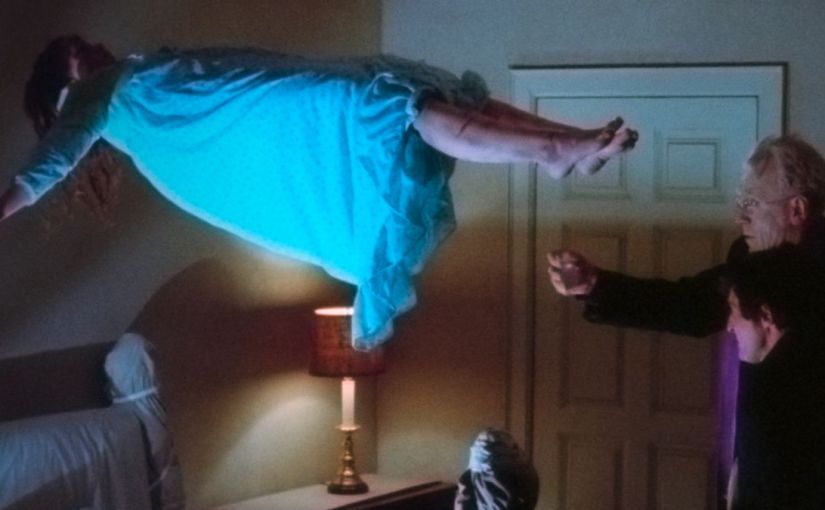
Eventually, all three stories intersect within the coven of Regan’s upstairs bedroom, where this demon taunts, cackles, teases and defies the power of the Bible and the Catholic faith.  This third act is impossible to take your eyes off.  Every second of imagery builds upon the power of the supernatural from moving furniture that charges forward like monsters on the attack, to ceilings and doors that split open.  The bed rumbles.  Demonic imagery appears out of the cold darkness.  It’s such a well-crafted sequence of events that is completely atmospheric.  

On what I believe is only my second viewing of the film, there are few things I noticed.  Chris is not a religious character.  So, when she evokes frustration, first at her ex-husband over the phone, and then at doctors and priests who lack explanations, she’s apt to shout “For Christ’s sake,” or “Jesus Christ.”  Variations of the word fuck is also adjacent to this dialogue.  Chris’ language could be a close second to the abhorrent verbiage coming from her monstrous daughter.  Blatty and Friedkin seem to imply how the son of God and the potential of Satan are so easily taken for granted.  Chris may be corrupted, but it is the innocent, young Regan who is trifled with.  There is nary a thing more disturbing in film than watching a child in peril.

Friedkin’s direction with Father Karras is consistently interesting as well.  Often, he positions his camera on a ground floor or at least pointed up to a level above to witness Karras’ ascents.  His faith is clearly shaken.  So, all he can do is rise and rise again, closer to a heaven that may still be welcoming.  Karras climbs flights of stairs or walks up sidewalk hills, to approach a vile intruder seeking to disrupt the purity of angelic youth.  

Only after I watched the film did I read that Linda Blair’s unforgettable performance was not the only contributing factor to Regan’s demonic possession.  Oscar winner Mercedes McCambridge who originally was not credited, supplied the scratchy, tormented and taunting voice of the demon.  It’s an unbelievable embodiment of a powerful villain.  Linda Blair was Oscar nominated for this role, but because she did not entirely own the performance, she likely lost to another child actor, Tatum O’Neil (Paper Moon).  The craft of Blair’s makeup all the way to her changes in eyes is a gut punch to the psyche.  Regardless, this is one of the most uncompromising and effective child performances I’ve ever seen in a film.

Max von Sydow donned aging makeup on his youthful forty-four-year-old complexion, and he looks straight out of another famous role from later in his career (Minority Report).  Richard Pryor and Saturday Night Live did a hilarious spoof on The Exorcist and for this nonbeliever I related to Pryor’s antics.  Yet, Max von Sydow takes what could have looked like utter silliness and convinces me that the ritual of exorcism is incredibly trying and exhaustively repetitive accompanied with the robes he dons to the holy scripture he reads from.  Merrin specifically instructs Karras not to directly respond to the demon.  Don’t even talk to it.  Merrin sticks to that practice.  Karras, the younger and less experienced sidekick, is drawn into the monster’s personal jibes.

Despite my position on religion and faith, I do not frown on what others value.  People find solace in their perceptions of God, the biblical stories, and the figures who teach. Religion often bestows a fulfilling life cycle.  Religion offers comforts through pain, loss, love and hope.  That’s okay. Everyone must follow their own path towards salvation. I tend to turn towards my personal psyche which I speak to daily.  

I watched The Exorcist off of a 4K streaming print found on HBO MAX, and the picture is positively striking.  Aside from dated fashions and cars of the early 1970s, the picture looks incredibly modern.  The themes of the film remain strong.  Hardly anything has ever matched the horror of The Exorcist.

I value everything in The Exorcist that Father Karras and Father Merrin heed to.  I believe in this story wholeheartedly.  Friedkin and Blatty, plus the cast enhance the authentication of demonic possession and how it operates.  This work of fiction, which Blatty claims to have been inspired by from an account of possession of a young boy during the 1940s, is a thousand percent genuine.  Within the moment and inside the confines of this picture this demon lives by overtaking young Regan.

How much did I believe it? Before bed last night, I made sure my little night light was on and I never walked into a dark room.   Every single light in the whole house was practically turned on.  

It’s not about the fear of God or the Devil.  It’s the fear I had for young Regan.

WINGS (1927)

by Miguel E. Rodriguez

DIRECTOR: William A. Wellman
CAST: Clara Bow, Charles ‘Buddy’ Rogers, Richard Arlen, Gary Cooper
MY RATING: 10/10
ROTTEN TOMATOMETER: 94% Certified Fresh

PLOT: Two young men, one rich, one middle class, who are in love with the same woman, become fighter pilots in World War I.


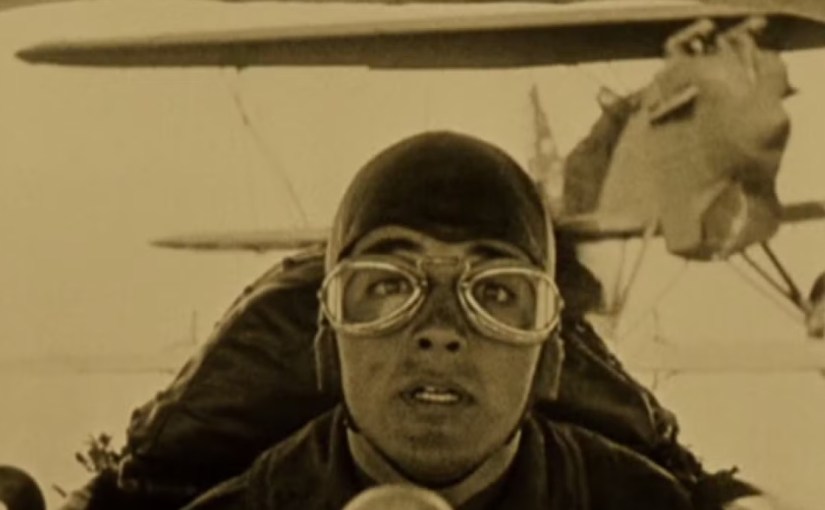
Not long ago, I purchased a copy of the 1927 classic Wings, based mostly on the favorable review by my friend and colleague, Marc Sanders.  I was more or less aware of its place in cinema history: the very first winner of the Best Picture Oscar, essentially the birthplace of Gary Cooper’s career (despite appearing in the film for just over 2 minutes), legendary aerial footage, and so on.  But I never felt compelled to seek it out.

Having finally watched it, I am very glad I did, and you should, too.  Wings is pure entertainment from start to finish.  Unexpectedly engrossing, captivating, thrilling, the whole enchilada.  High melodrama, comedy (borderline slapstick, what are you gonna do, it was 1927), romance, comic misunderstandings – and some not-so-comic – and eye-popping aerial footage, true to its reputation.  A neat camera move gliding over several cabaret tables even showcases director William A. Wellman’s desire to push the boundaries of what was possible with the massive cameras of his day.  I once wrote that Sunrise (1927) was my favorite silent film of all time.  If I ever make another 100-Favorite-Films list, Wings and Sunrise are going to have to duke it out…

Wings sets a surprisingly modern tone from the start.  In the very first sequences of the film, Jack Powell (Charles ‘Buddy’ Rogers) does not “ham it up” like some of the more typical Hollywood actors of that era.  Obviously, his mannerisms are exaggerated, but there is a restraint to his face and body that seems at odds (in a good way) with nearly everyone else in the film…except Gary Cooper, who, if he underplayed his role any further, would have become a still painting.  That restraint is also evident in Jack’s foil/nemesis, David Armstrong (Richard Arlen), the rich aristocrat to contrast Jack’s more humble background.  This moderation lends a very contemporary feel to a movie that’s nearly a century old – quite a feat.

In sharp contrast to the two male leads, the fabled Clara Bow plays her role, Mary Preston, with complete abandon.  She never truly overacts, exactly, but she throws herself into her supporting role with abandon.  Mary is hopelessly infatuated with Jack, who is actually in love with the debonair Sylvia Lewis (Jobyna Ralston), who is already involved with David, though they haven’t made anything official.  (If Facebook had been a thing back then, their relationship status would have been “It’s Complicated”.)  So, when Jack makes eyes at Sylvia, poor Mary is in the background as her hopeful smile deteriorates into sobs.  She may not be subtle, but Clara Bow makes sure you know EXACTLY what is on Mary’s mind at any given moment.

In the middle of this would-be soap opera, World War I intervenes.  Jack and David both enlist to become aviators.  A crucial scene shows Jack asking for Sylvia’s picture to keep as a good luck charm, a picture that has already been signed over to David.  Then, as he says his farewells to the lovelorn Mary, she offers him her picture.  How this scene plays out, and how it comes to bear much later, is one of the high points of the film’s ground-based drama.

But the real marquee attraction Wings comes during the aerial training and combat scenes.  Watching this movie, you understand why modern filmmakers today strive for realism as much as possible.  Ron Howard wanted to show weightless environments for Apollo 13, so sets were constructed inside a military jet tanker that flew parabolic arcs to simulate weightlessness…for real.  The makers of Top Gun: Maverick wanted to draw audiences into the film, so they had their actors train for weeks and months so they could be filmed inside the actual cockpits of F-18 fighters as they performed simulated combat maneuvers…for real.  Those filmmakers knew what had already been demonstrated decades earlier by Wings: nothing beats reality.

(Almost nothing…Ready Player One was pretty damn cool…BUT I DIGRESS…)

For Wings, director Wellman, a combat pilot himself during the war, knew that the best way to grab the audience by the lapels would be to get his actors up in the air for real.  To put it very briefly, he got his two lead actors to become certified pilots, got them into the air with small cameras strapped to the front of their planes, and had them act, fly their own planes, and be their own camera operators, all at the same time, while other stunt pilots flew around them, sometimes in VERY close quarters, simulating aerial combat.

The results are staggering.  There is a visceral mojo to these scenes that cannot be overstated.  Sure, it looks “old” because it’s black and white and grainy, but it is also undeniably real, and when you see long shots of a biplane going into a death spiral after being shot out of the sky, your intellect tells you there’s a real pilot flying a real plane hurtling at high speed towards the real ground, and you either sit back in awe or you lean forward with excitement.  There are a few scenes where real planes crash to the ground in various ways; one of them crashes into the side of a freaking HOUSE…for REAL.  IMDb mentions one staged crash where the plane didn’t do exactly what it was SUPPOSED to do, and the stunt pilot literally broke his neck…but survived and returned to his job six weeks later.  And it was all done in camera with no trickery or fake dummies in the cockpit.  It is literally mindboggling.

However, it should be noted that these accomplishments by themselves would mean very little if they weren’t hitched to a compelling story.  The love story among Jack, David, and Mary is a constant thread through the whole film.  Mary, having volunteered as an ambulance driver in the Army, miraculously finds herself stationed overseas…right next to Jack and David’s unit, wouldn’t you know it!  Contrivances aside, Wings expertly balances the exciting elements with the melodramatic flourishes.  The melodrama comes to a head when Mary finds herself alone in a hotel room with Jack, who is so drunk on champagne he doesn’t recognize her.  (She is dressed as a cabaret dancer, but that’s a long story…)  This movie truly contains the best of both worlds, genre-wise.

This might be crass of me to mention, but I’m going to anyway…Wings is also notable for some of the earliest on-screen nudity (in an AMERICAN film, anyway) that I can recall seeing.  There is a scene in a recruitment office where a line of bare male bums are lined up in the background, awaiting health inspection.  Then later, we see a woman’s bare breasts…just a brief glimpse, but it’s there.  Not only THAT, but during a fancy camera move in a French cabaret, we see a woman caressing another woman’s face…are they a couple?  Scandalous!  Who needs the Hays Code?  Not this guy!

(I could also mention the homo-erotic overtones during a pivotal scene towards the end of the film, but they pretty much speak for themselves [like the volleyball scene in Top Gun], so I’m just gonna move on…)

To sum up: Wings ranks as one of the greatest pure entertainments that Hollywood has ever served up.  Marc mentioned that it perhaps doesn’t get the love it deserves.  He’s probably right.  I’m sure it’s revered among cinephiles, but it is certainly not in the general public consciousness when it comes to silent films.  Regardless, it is exceptionally well-made and uncommonly effective.  If ever an old film deserved to be rediscovered by the general public, Wings is it.

TOOTSIE

By Marc S. Sanders

Tootsie is my favorite comedy of all time.  At age ten I saw it on Christmas Eve with my family and beyond the Star Wars and Rocky films, I had yet to see an audience respond, or more specifically laugh, so uncontrollably for two hours straight.  I might not have recognized all of the innuendo and I was not yet alert to the idea of women feeling belittled while knowing they should be entitled to equal respect, but the performances, especially from Dustin Hoffman were entirely genuine.  Tootsie still remains the only film where I can forget that a man, a not so attractive or sexy man, is convincingly disguising himself as a woman who possesses internal strength and gusto.

Whether directing or acting on screen, Sydney Pollack was not someone well known for overseeing comedy at the time.  Yet, that’s an attribute to the end product of this celebrated movie.  Other than a typical Bill Murray routine in an uncredited role, no one in this picture is waving their hands in the air to insist they’re funny.  The humor of Tootsie bears from true, raw emotion, fear and desperation.  No one is doing Saturday Night Live sketches and building up to the next punchline.  Despite the cross dressing, Tootsie is not even a farce.  A guy gets a job wearing the necessary garb and modifying his verbiage, but only to earn enough money to survive.  However, it also doesn’t help that he’s falling for his co-worker.  

Dustin Hoffman is an actor living in New York City named Michael Dorsey.  He’s a great, learned performer, especially on the stage, who lives with his playwright buddy Jeff (Murray) in a crummy apartment in the meat packing district.  They need to raise enough money to put on Jeff’s play in Syracuse.  

The problem is that Michael can no longer get cast in anything.  Not on stage or even in a commercial.  His agent (Pollack) says it point blank that nobody will hire him.  He’s just too difficult with short bursts of temper and no tolerance for others who work in the field.  

So, Michael surrenders to desperation and puts on the guise of a character actress named Dorothy Michaels.  As quick as she stands up for femininity against a chauvinistic TV director (Dabney Coleman) she is cast on the most watched daytime soap opera.  As long as Michael can perform off and on camera as Dorothy he should be able to earn more than enough money for Jeff’s play.

Complications arise though when he becomes protective of his co-star, Julie (Jessica Lange, in her Oscar winning role), against her unfaithful boyfriend, the TV director.  Julie’s widowed father, Les, is falling for Dorothy though, and then there is Michael’s friend Sandy (Teri Garr) who lost out on the part that he earned, and to keep things maintained has been seduced by Michael into a romantic relationship beyond just their friendship.

With me so far?  I hope so because there’s even more obstacles to overcome.  Tootsie is very economical in its story development, but it’s also a very crowded film.

Don McGuire and Larry Gelbart (TV’s M*A*S*H) wrote this Oscar nominated script with a brilliant collection of characters.  The blessing is while it sounds like farce, Tootsie is never delivered with a slapstick tongue.  In order for the film to work, Dustin Hoffman especially had to portray Michael Dorsey as a guy with natural ticks, motivations and fears.  He accomplishes that because Michael always ensures that Dorothy is as real as she can ever be.  When Dorothy hails a cab or shops for clothes the southern accent must hold while perusing through the city streets in heels.  Michael gets frustrated over what to wear for a dinner visit at Julie’s apartment.  Especially when Julie opens up her heart, Hoffman is precise to make sure Dorothy approaches with a low whispered approach to simply be a consoling girlfriend.  

The comedy arrives when Michael has no other choice but to break this strong powered female persona.  Dorothy will call for a cab but if it just won’t stop, then a deep voiced, bellowing New Yorker will come out of this woman’s mouth with an angry “TAXI!!!”  I like to believe that Sydney Pollack deliberately arranged for Dorothy to yank a Woody Allen lookalike out of a cab that was about to be taken from Dorothy too.  Dustin Hoffman knows Michael Dorsey is such a committed method actor that he has to convince all eight million people in New York he is strong willed Dorothy Michaels – a character actress capable of playing the new Hospital Administrator on Southwest General

There are so many fleshed out pairs of relationships in Tootsie – all going beyond the cross dressing of the film’s main character.  All of these people could get along forever if only for the fact that some characters have befriended a man while others truly believe they have made a connection with a woman.  How long can we have it both ways?  The facade has to undo itself, right?  True.  Thankfully it occurs at the end when every single character can have it explained to them all at once.  I’ve never forgotten the roars of laughter from my mom, dad and grandmother as the end of Tootsie arrived.  Well-placed close-up shots of every actor who had a speaking role in this movie is covered (well except for Sydney Pollack as Michael’s agent). On Christmas Eve in 1982, the packed movie house at the Forum Theater on Route 4 in Paramus NJ only amplified the shocking reactions.  Tootsie is a reason why you sit among a crowd at a movie theater.  

This is Dustin Hoffman’s all-time best performance.  He was nominated against fierce competition from Paul Newman in The Verdict, Jack Lemmon in Missing, and Ben Kingsley in Ghandi (who took home the trophy). Michael Dorsey/Dorothy Michaels is a much more challenging role than what Hoffman superbly accomplished in his two Oscar winning roles (Kramer Vs Kramer, Rain Man).  Robin Williams or Tom Hanks could have played Michael Dorsey who invents Dorothy Michaels.  Yet, what Hoffman emotes are the natural tics of a guy who is constantly broke while he charms an array of women at his birthday party, only with the intention of bedding them and hardly ever listening to what these ladies have to say.  When Hoffman puts Michael literally in a pair of woman’s shoes though, he begins to identify the lack of respect that women endure on a daily basis.  

Watch Dustin Hoffman’s body language.  He becomes angered with his agent upon learning that he lost out on a role which somehow leads to a debate about whether a tomato should walk or talk or sit or stand.  That back and forth is outrageously hilarious.  Having seen Tootsie hundreds of times though, I now appreciate how a schleppy looking Michael hustles across the streets of New York, avoiding traffic and then marches down the hallway to his agent’s office.  Hoffman twitches his head and shrugs his shoulders as if he’s prepping to give the agent a piece of his mind.  Hoffman is so absorbed in this guy he’s playing.  I am not recognizing any other kind of Dustin Hoffman that I’ve seen anywhere else.

Sydney Pollack is also attuned to the cutthroat atmosphere of desperate theater folk trying to survive in this concrete jungle.  Tootsie opens with a montage of quick episodes for Michael.  He is leading a workshop while being candidly ugly with his fellow thespian students about how challenging it is to get work.  In between, are auditions that he goes on where there is one reason after another why he can’t land a role.  Michael Dorsey is an incredibly skillful actor, but that means nothing for this role or that role.

On this most recent viewing I caught on to a detail that never occurred to me.  Bill Murray as Jeff, the broke playwright, is snacking on lemons and wincing while he talks to Michael.  Now I don’t know if this is in the script or if this was Pollack or Murray’s idea.  Nevertheless, it’s a brilliant detail.  These guys are so broke that they have resorted to smuggling lemon slices out of the restaurant they work at to live off of.  Another actor or filmmaker would have used an orange or cookies.  Who snacks on lemons?  Only those with nothing else to rely on.  

Makeup bottles with spirit gum, cannisters of fake blood, prosthetic teeth, props and sloppily hung costume wear are all given focus beyond the broad comedic storylines.  Sydney Pollack pans his camera over all of these items with no actors in frame because he wanted to ensure that being an actor or a playwright in New York is nothing glamorous.  It’s a world of unending torment. All of these nuances and details justify the extremes that Michael has to go through to achieve his goal.  

Jessica Lange never plays her role for laughs.  Her portrayal of Julie, the beautiful, blond celebrity of daytime television, is authentic and she inherits a new girlfriend to confide in. Finally, Julie can share what she values and holds dear.  You can’t not fall in love with someone who only treasures the best parts of her young life and yet only seeks a companion to chat with.  A humble celebrity is hard to find and that is one reason Michael falls hard for her.  Lange is outstanding while being so heartfelt.

Teri Garr’s comedy stems from the insecurities of actors.  Sandy is described as someone who wants to commit suicide at a birthday party.  Doing community theater for over thirty years I know precisely who this person is.  I’ve been this person, and I’ve encountered hundreds of these people.  It’s hard to be a big fish in the small pond of community theater.  Imagine trying to hold on to your sanity when you have to compete with all of New York.  Teri Garr was rightly Oscar nominated for what could have been a throwaway part. Like Hoffman she also has these little gestures that suggest her lack of confidence. After she sleeps with Michael and he’s getting ready to leave, Garr peaks at her naked chest hidden underneath the sheets.  It’s as if she’s wondering was I not attractive enough.  She’s hurting. No matter if she just had sex with one of her favorite people, she is still suffering.

Charles Durning is familiar for having the tough guy, intimidating persona because he’s usually so much larger than life.  However, he offers a sweetness to this guy who’s ready for companionship.  You don’t want Michael or Dorothy to let him down.  Les doesn’t deserve to get hurt.

Again, as I described any of these characterizations, none of it is funny.  They are wrapped in sensitivity. There’s a lonely sadness to people like Michael, Jeff, Julie, Sandy and Les.  Yet, when this variety of sorrow and anguish collide, while poor Michael is only trying to make some money, does it all combust in hilariously, unwinnable scenarios of tremendous proportions.

Tootsie is an amazing film.  It is one of the smartest, most insightful scripts ever written and it is blessed with a cast and director who mastered how to live in an unforgiving and unsympathetic industry.  This picture offers lessons in the human spirit while demonstrating the lengths and boundaries that must be broken in order to survive.  By practically not performing as a comedy, it only becomes that much more funnier and wiser.  

Tootsie is a perfect film!

KLUTE

By Marc S. Sanders

Perhaps Klute, directed by Alan J Pakula, was one of the earliest erotic thrillers to hit the cinema.  In 1971, with Jane Fonda portraying a call girl who briefly goes topless on screen, the daringness of the picture likely garnered a lot of attention.  I bet it was perceived as controversial and elevated the common murder mystery to a grittier more forthright and sleazier height.  Even John Klute, the investigator, played by Donald Sutherland, did not possess the theatrical disposition of a Sam Spade like Bogart or even a Jake Gittes that was just a few years away.  The case at hand in Klute felt real and disturbing.  The actions of the characters were unmentionable and unfathomable.

A highly respected married man named Tom Grunerman turns up missing.  The most unusual clue into his disappearance are letters found in his desk that were written to a New York City prostitute named Bree Daniels (Jane Fonda).  According to his wife and the CEO of his company, the letters seem out of character for a man like Tom.  Six months go by and there is still no sign of the man.  So, John Klute voluntarily goes to New York to investigate for himself while becoming acquainted with Bree.  

Bree is a very high-priced call girl who estimates she does between five hundred and six hundred calls each year.  She’s trying her best to step away from this lifestyle and work as a professional actress and model.  Yet, to uphold her means of living and to make up for the various rejects at auditions, she can’t help but return to what she’s best at.  Occasional visits to a therapist help her justify why she maintains this seedy occupation.  Various recordings of Bree’s observations and conversations with her Johns are about her regard for the profession. She claims that she is capable of catering to any particular vice a man might have. Most impressive is that she does not get turned on by the trysts she shares with these men. She also does not cast much judgment on whatever niche her various clients are into.  She’s positively cold to the demands of her job. Tom does not sound familiar to her, but he might have been the guy who beat her up a year earlier.  

I like the slow burn wait of this story.  A picture like Sea Of Love with Al Pacino works this way.  That’s a better movie though.

Donald Sutherland has significantly less dialogue than Jane Fonda.  He’s got a disturbing expression with large eyes and closed lips, not to mention a tall stature, that allows him to seem alert as an observer and a listener, particularly to Fonda’s character who is protective of herself even if she has much to say.  So, while the two get to know one another with Bree offering some possible leads for Klute to follow, there is an eerie and deliberately meandering pace to the story.  I knew I had to keep up my patience with Klute because an unexpected payoff would eventually arrive.

What bothered me though is that the twist of the mystery is revealed midway through the movie.  You brought me my steak before I had time to finish my salad.  Now, for the rest of the story I’m smarter than the characters and I’m only watching everything unfold. That left me feeling unchallenged through the whole second half of the film. Klute became boring and less inviting.

In 1971, this was a bold kind of picture though, not a common 1990’s erotic thriller like Basic Instinct or Color of Night.  It was seedy, unheard of and therefore fascinating.  At the time, the intrigue for a picture like this must have been off the charts.  Pakula even shows off how novel a tiny tape recorder was in 1971. Imagine what this recorder is capable of!

Had Klute been released today, I’m certain many would take issue with its final edit of story development.  I would also argue that a young Jane Fonda would never be accepted in a role like this.  Frankly, twelve years after this film, Jamie Lee Curtis was more convincing to me as a call girl in Trading Places.  Fonda’s inflection and voice of maturity just did not work for me in this role.  I did not find her alluring in the part, and I think she was too organized and educated to be Bree the call girl.  I was surprised to read afterwards that Jane Fonda won the Oscar for Best Actress for this film because I considered her miscast. Fonda’s voice always sounded overly patronizing to me.  I read later that the actress’s moments with the therapist were primarily improvised by Fonda, shot after the bulk of the picture was completed. Pakula honored her wish to shoot the therapist scenes later because Fonda wanted to have more of a grasp on this call girl character. The therapist scenes definitely look unpolished, particularly for the woman portraying Bree’s counselor. I could detect the improv going on before I knew that it was so. I was watching Jane Fonda, the actress, making a case for the research she collected to prepare for this role.  I wasn’t convinced Jane Fonda was playing the role, though.

The film provides moments where Bree is catering to a couple of clients.  Pakula is honest with his staging.  One client breathes heavily with nervousness about the trouble he’s about to indulge in and then there is the awkward business agreement between Bree and the man followed by the necessary construction of turning the hotel sofa into a bed. It’s weird and unromantic. All this business interrupting this guy’s ultimate fantasy. Very good direction by Alan J Pakula.

Another client hires Bree to pose like a woman from a pre-World War I era where she simply narrates a scenic moment from his past. He does not touch her. He does not undress. This old man from the city’s fabric district simply takes it all in, allowing Bree to do the heavy lifting while he remains stoic in his chair surrounded by the darkness provided by famed cinematographer Gordon Willis (The Godfather).  Still, Fonda seems out of place in these episodes.  Even her fear of a possible killer on her trail left me unsatisfied.  This woman always looks like she has it altogether. She arrives on John Klute’s doorstep in the middle of the night because she’s apparently haunted by what he’s pursuing and also, she’s getting prank calls at odd hours. Nevertheless, I’m still not convinced that Jane Fonda as Bree the call girl is truly shaken by any of this. Jane Fonda is just too put together and hardly evokes any convincing weakness.  

It is ironic the film is named after Sutherland’s character, Klute.  The story begins with his perspective.  I liked his detective.  Almost like the guy could’ve branched off into other stories, like Sherlock Holmes or Sam Spade or Mike Hammer.  The fact that the picture is called Klute leaves me wondering if a series of mysteries would have been paved for this character.  To my knowledge, I do not believe that ever came to be.  I’m sorry the trajectory of the movie veers off into Fonda’s character primarily when she enters the story.  Little is revealed about John Klute.  I only know his experience as a detective is limited, and he’s actually never visited New York City before.  Some interesting challenges for this guy, but none of this hardly becomes obstacles or factors for the rest of the film.  Much is learned about Bree Daniels, but hardly anything is absorbed about the title character, John Klute.

Klute starts off with a lot of promise.  I was excited to tag along with a new kind of brooding investigator who is impervious to influence and looks like he could not get easily overwhelmed. The mystery to uncover why a man went missing but not murdered is very intriguing.  My curiosity was there from the start.  Unfortunately, my interest dwindled as the picture carried on.  Jane Fonda talks a lot with not much to say and when the real culprit is unmasked at the midway point, my attention span is no longer demanded by the film.

Klute was likely a risky, pioneering kind of picture at the time of its release.  A sexy thriller.  Nowadays, it’s like any Saturday night midnight kill thrill of the week where the tempos are foreseen several minutes before they come to life.  Klute just loses its lust–ahem–sorry luster.

WALL STREET

By Marc S. Sanders

Oliver Stone is a very good director at providing the evidence of cynicism within the worlds he films.  JFK covered a clandestine, conspiring environment oozing out of the columns of government.  Platoon not only depicted the horrors of war, but also the cancer that poisons the mentality of soldiers expected to protect one another.  Wall Street explores the temptations to cheat the stock market for grand prizes in wealth.  Gordon Gekko is the 1980s tycoon who never knows the meaning of enough.

The well-dressed yuppie lizard, Gordon Gekko, is memorably played by Michael Douglas in his only Oscar winning role; regarded as one of the most villainous characters of the last fifty years.  It’s not a modest part, and Douglas’ performance is therefore electrifying.  With slicked back hair, the signature crackle of a voice inherited by his father Kirk, and the newest 80s innovation, a brick size cellular phone, the power to earn money and crush corporate enemies is done with ease.  Gekko relies on obtaining inside information (a federal crime) to find the next chest of treasures.  It might be an illegal practice but the best of the best at making mountains of money do it, and if you keep your process on the down low, nobody will catch wind of what you’re up to.  Gordon Gekko is an absolute genius, and he’s awarded a script of fast talking, slick monologues that justify his sins.

Bud Fox (Charlie Sheen) is the kid on the ground, way below Gordon’s high-rise office, desperately trying to get five minutes with the guy.  A whole day’s wait in the lobby and a birthday gift of Cuban cigars does the trick.  Now the lizard has the fox ensnared in his money-making schemes of deception and pursuits for unlimited greed.

Oliver Stone writes Sheen’s character as virginal when it comes to stock trading.  The kid is dying to get laid with the big boys while getting away from the cold calling hang ups of promising uncertain futures in stocks and bonds.  A subtle and effective angle is to give Bud a mentor.  Hal Holbrook enters the screen from left or right on many occasions to put his hand on Bud’s shoulder and give him his own twist of Confucius philosophy.  Then he exits out of frame towards the opposite direction he enters, leaving Bud to follow the questionable paths that Gordon paves.  Holbrook’s contribution to Wall Street has never been celebrated enough over the years.

Michael Douglas and Charlie Sheen are an outstanding pair of devilish mentorship against innocence lost.  Gekko preaches his passion for wealth on top of more wealth and why nothing should stand in his way, especially the law or the cost of others’ livelihoods.  Bud Fox emulates him as a master of the universe.  Charlie Sheen is great at being the biggest fan in Michael Douglas’ concerts of monologues. Watch how Sheen listens when Douglas has the floor. 

Martin Sheen extends his paternal role to Charlie within Stone’s film.  As Gordon sets designs on taking stock ownership of the small airline company that the father works for, the father/son relationship is tested, and Bud becomes blurred between what is right and wrong.  The Sheens have good debates and heightened dramatic moments.  I wish they were given more to do together though.  Perhaps even showing the wedge of the mother role within this family.

Additionally, Oliver Stone writes dynamics for Bud in a worker relationship with a fellow trader colleague (John C McGinley). There’s a former college pal/now lawyer (James Spader) that Bud tries to squeeze at the behest of Gordon’s demands.  Bud is also covered doing his own tricks of the trade such as dressing as a janitor to dig for what’s forbidden.

Why bring up all of these storylines?  Well, there’s a wealth of great material in Wall Street that’s relevant to the practice of insider trading and corporate overhaul.  Somehow though, Oliver Stone is responsible for writing one of the most unnecessary characters in film history.

Daryl Hannah just had to be cast as the buxom blond love interest for Bud Fox.  She’s never believable as a New York City interior designer and the chemistry between Hannah and Sheen is as thin as water.  Her name is Darien (a 1980s name) and one scene between Michael Douglas and her bustling the streets of Manhattan goes nowhere.  Wall Street is simply not the superb film it could have been because of the amount of time devoted to Daryl Hannah’s character.  Every moment she occupies is cutting room floor material.  When Darien exits the picture she’s never mentioned again.  The history she has with Gordon is never revealed to Bud.  Regrettably, it’s all meaningless.

What’s frustrating with Wall Street is its promise is never fully committed.  The roles awarded to Spader, McGinley, Holbrook and even Saul Rubinek in an early role as Gordon’s nerdy lawyer could have been even more fleshed out in lieu of what is covered with Daryl Hannah’s part.  More moments with Martin and Charlie Sheen would have better served the film.  A competitor tycoon played by Terence Stamp is very interesting and worthy of a larger presence.  Sadly, I imagine a studio producer or even Stone insisted on having a love interest that serves no purpose here except to put a glamorous actress above the title in the credits.  

Nonetheless, Oliver Stone built an authenticity to the hysteria of stock trading and corporate underhandedness.  When he shoots the scenes occupied by Bud and Gordon, he does handheld shaky camera work to emulate that nothing feels sturdy and balanced.  In moments that Bud’s father is at the center, the director shoots with a locked in position, bearing the character’s assured apprehension to trust his son or this prophet of greed.

I especially like the scene where Michael Douglas delivers his famous “Greed…is good!” speech at a shareholders’ annual meeting.  Stone glosses over all the company vice presidents and officers as well as the fat cat suits who carry stakes in the company.  Yet, the filmmaker also takes the time to show that little old lady with the pocketbook who finds her entitled seat to see how the value of her small ownership share is being treated.  Remember, if you own stock like Disney or IBM, you get that invitation in the mail to attend these meetings, and you have just as much a right to attend as all the Gordon Gekkos of the world.

Wall Street serves an important reflection of 1980s capitalism, while taking place in 1985, two years ahead of the infamous market crash of 1987 (the year the film was released).  Guys like Bud Fox had the Charlie Sheen image. Boyish men who got rich quick with little imagination to create and build.  They stood next to tall wealth and learned, but they never gained the knowledge to prepare for quick falls and disheartening sacrifice.  Most importantly, they took their own sense of morale for granted.  These are the best parts of Wall Street.

A PLACE IN THE SUN (1951)

by Miguel E. Rodriguez

DIRECTOR: George Stevens
CAST: Montgomery Clift, Elizabeth Taylor, Shelley Winters, Raymond Burr
MY RATING: 9/10
ROTTEN TOMATOMETER: 82% Fresh

PLOT: A struggling young man gets a job working for his rich uncle and ends up falling in love with two women, one rich and one poor.


I first saw A Place in the Sun many moons ago at a friend’s house.  I remember enjoying it but thinking it was too soapy for my taste.  Years went by.  I finally got around to watching Woody Allen’s Match Point and was stunned at how much Allen’s film borrowed from George Stevens’ celebrated melodrama.  Having just re-watched A Place in the Sun, my opinion of it has warmed considerably, without diminishing my admiration for Match Point, which remains one of my favorite films of all time.

A Place in the Sun tells the story of young George Eastman, played by Montgomery Clift at or near the height of his powers.  He’s a bit of a layabout who wrangles a job at his rich uncle’s swimsuit factory.  When George meets his rich relatives, I was reminded of a George Gobel quip: “Did you ever get the feeling that the world was a tuxedo and you were a pair of brown shoes?”  That’s George Eastman to a T, a ne’er-do-well in a sea of the well-to-do.

Against company policy, George falls in love (or at least in lust) with a rather plain girl, Alice, played by Shelley Winters in a de-glamorized role that went completely against type at that point in her career, winning her a Best Actress nomination.  Alice and George flirt and hold hands and occasionally neck (mildly scandalous for a 1951 film), but George can’t help but stare at another girl who pops up occasionally: Angela Vickers.  Angela is played by a ravishing Elizabeth Taylor, who was only 17 at the time of filming and empirically one of the most beautiful women in Hollywood, if not the world.  It’s not too hard to imagine any man, let alone poor George Eastman, falling in love with her instantly.

But George is still connected to Alice, especially because he’s already slept with her.  When George learns Alice is pregnant, he despairs because he had been planning to end things with Alice to pursue Angela.  Alice even visits a doctor who might possibly provide an abortion.  Of course, this being 1951, “abortion” is never mentioned out loud, nor is the word “pregnant.”  But Alice’s visit to the doctor is handled with incredible intelligence and brilliant screenwriting that manages to say everything it needs to say without ever uttering those forbidden words.

The rest of the film examines what George may or may not be willing to do for the sake of his love for Angela, who loves him back, it turns out…but she doesn’t know about Alice.  Since this is based on a then-famous novel called An American Tragedy (by Theodore Dreiser), it may not be too hard to divine what is in store for George before the final credits roll, but getting there is the fun part.  By casting heartthrobs as the hero/anti-hero and the rich girl he loves, the film cleverly gets us to root for them a little bit, even when George is considering murder.

While Elizabeth Taylor dominates every scene she’s in just by standing there, the Academy made sure Shelley Winters was recognized for her incredibly difficult performance as Alice.  There are some movies where, if a character is an emotional yo-yo, it can be frustrating.  With Alice, Winters never crossed a line into unlikability, even when she calls George at a fancy dinner party demanding he marry her tomorrow, “or else.”  It’s clear she has no options left to her if she wants to have any semblance of a life in polite society (by 1950s standards, anyway).  I felt bad for her.  But I also felt bad for George – to a degree – when he demonstrates how sincerely he has fallen head over heels for Angela.  Not just because she’s stunningly beautiful, but also because she really seems to have fallen for him, too.

Lately, my movie-watching itinerary of classic films has involved a fair share of outstanding melodramas (Leave Her to Heaven, 1945; The Heiress, 1949; Dodsworth, 1936).  A Place in the Sun fits right into that mold.  It doesn’t quite achieve the perfection of The Heiress, but it is a fantastic example of its genre, good enough for Woody Allen to “reimagine” its basic story for Match Point, so it’s definitely worth a look if you’re into that kind of thing.

LEAVE HER TO HEAVEN (1945)

DIRECTOR: John M. Stahl
CAST: Gene Tierney, Cornel Wilde, Jeanne Crain, Vincent Price
MY RATING: 9/10
ROTTEN TOMATOMETER: 85% Certified Fresh

PLOT: A writer falls in love with a young socialite, and they quickly marry, but her obsessive love for him threatens to be the undoing of them both as well as everyone around them.


Leave Her to Heaven is one of the earliest examples in my movie collection of what I call a “head-fake” movie.  There is a tiny bit of foreshadowing in its opening moments, but after that, it appears to fall into the traditional pattern of an old-fashioned, melodramatic potboiler, with a spurned fiancé, lovers in a whirlwind romance, and glorious three-strip Technicolor production design and cinematography that makes everything feel like a Douglas Sirk soap opera.  When it makes its left turn into unanticipated territory, I was on tenterhooks.

Author Richard Harland (Cornel Wilde) has a classic, almost clichéd meet-cute with the ravishing Ellen Berent (Gene Tierney, who has never looked more beautiful) during a train trip to New Mexico.  He’s visiting friends, she’s there for a funeral, and their circles of friends unexpectedly mesh.  He winds up staying with her family at their ranch house.  She and her family remark how much Richard resembles Ellen’s late father.  He notices her engagement ring, but a few days later he also notices its absence along with her declaration that she’s removed it “forever.”  (I’m REALLY condensing here to get to the point…)

Her fiancé, Russell Quinton (a very young Vincent Price), arrives upon hearing she’s broken off their engagement.  He leaves after a brief conversation, and a few minutes later she literally proposes to Richard.  They marry and enjoy a few scenes of wedded bliss (in separate beds, of course, this is the ‘40s), during which Ellen makes some red-flag-raising statements to the effect of, “I’ll never let you go” and “I want you all to myself.”

During all of this, the filmmakers exhibit terrific restraint.  In some high-tension scenes, there is a notable lack of background score, which is a bit unusual for these kinds of pictures.  You usually get ominous for tension, or pastoral for outdoor scenes, etc.  But Stahl seems determined not to cue the audience for what they’re supposed to feel at any given moment, with one or two exceptions.  This method contributes greatly to not giving away what’s coming.  Ellen’s own words do that all by themselves.

There are other plot developments I could mention: Richard’s brother, Danny, who is disabled and comes to live with them for a while…Ellen’s fixation on how much time Richard spends with her sister, Ruth…Ellen’s attempt to get Danny’s doctor to prescribe more bedrest…these and other signal markers start to twist this apparent soap opera into something else entirely.  It reminded me of the great head-fakery in Woody Allen’s ingenious Match Point [2005], which also started out in soap opera territory and wound up somewhere altogether more sinister.

Much is made of the film’s Oscar-winning cinematography, and rightly so.  In an era when color films were an extravagance for a movie studio, they made the right choice here.  Cinematographer Leon Shamroy and production designer/art director Lyle R. Wheeler create picture-postcard images of a bygone era, lending an air of “vintageness” to the rooms, wardrobe, and makeup of the actors.  Look at Gene Tierney’s marvelous red lips, or the gaudy red of her swimsuit, worn at a time in the film when she probably shouldn’t have been so extravagant.

But I particularly love the music choices, or rather the choices to NOT use music during key sequences.  One in particular stands out.  If you’ve never seen Leave Her to Heaven, I won’t spoil it for you.  It’s the scene with a rowboat and one character’s attempt to swim across a lake.  In many other films of the time, there would almost certainly have been tense strings, low cellos and brass in the background.  For some reason, my mind goes to Miklós Rózsa’s magnificent score for Double Indemnity [1944].  That’s the kind of music normally heard in scenes like this.  But the filmmakers made the canny decision to let us merely listen to the actors and watch as Ellen makes a crucial decision.  That dread silence fairly SCREAMS as the scene progresses.

It’s tempting to look at this movie as a kind of Fatal Attraction [1987] prototype, but that’s not giving either movie its due.  Fatal Attraction is a straight up thriller, and it’s about an unfaithful husband getting what he deserves.  Leave Her to Heaven is also a cautionary tale, but not because the husband did anything wrong, aside from choosing to ignore a lot of red flags in Ellen’s behavior until it was far too late.  It might also be possible to interpret the film as a warning to men against women who think for themselves too much, who are too “take charge”, or would be considered such in the 1940s.  But I would disagree with that interpretation, too.

Look at Leave Her to Heaven as a whole, and I think it most closely resembles Lawrence Kasdan’s Body Heat [1981], or vice versa.  Both feature femme fatales who are not shy about doing what’s necessary to get their way.  The film’s ending even seems about to resemble Body Heat’s ending, but it veers away at the last second from the later film’s bleakness, providing an ending that seems just a little too pat.  I have a sneaking suspicion the filmmakers had a different ending in mind, but were forced to make changes to please the censors.  If there’s anyone out there who knows how the book on which the film is based ends, sing out.

Leave Her to Heaven is a singular experience.  I even knew about the famous boat scene, and I was still on the edge of my seat.  I simply couldn’t believe she was going to go through with it.  That’s the sign of a great film: you know what’s coming, it’s inevitable, but instead of feeling predestined, there is real suspense, a desire to know why this is happening, and what’s going to happen next.

MYSTIC RIVER

By Marc S. Sanders

Two crimes, thirty years apart, pave the destiny for three childhood friends during their adulthood, while residing in the same Irish neighborhood of Boston.  Sean Penn is Jimmy, a former criminal.  Kevin Bacon is Sean, a police detective.  Tim Robbins is Davey, who was held captive and molested for four days following an afternoon when the guys were playing street hockey together.  Naturally, Davey was never the same but over the course of events in Clint Eastwood’s psychological crime drama, Mystic River, we learn that Jimmy and Sean likely changed too.

Jimmy’s daughter, Katie (Emmy Rossum), is found brutally murdered following an evening of bar hopping with girlfriends.  Sean and his partner Whitey (Laurence Fishburne) head up the investigation.  While the magnetic screenplay written by Brian Helgeland, based upon the novel by Dennis Lehane, relies on a who done it track, that seems to be less a priority as details unfold for the trio of men.  Jimmy and Davey’s wives (Laura Linney, Marcia Gay Harden) may be hiding some information.  A possible murder weapon invites some curious questions. There’s reason to question Katie’s boyfriend, and Davey’s odd behavior combined with his childhood trauma raises eyebrows as he was one of the last men to see Katie alive.

The less you know about Mystic River the better, but this engrossing cast which earned Oscars for Penn and Robbins, plus a nomination for Harden, is not the only stand out feature.  This film is one of Clint Eastwood’s best directing efforts; definitely one of my favorites.  

First, Eastwood hides many of his characters in dark shadows so the viewer never forgets that all these people have pasts they regret or would rather not resurface.  Sometimes, you hauntingly recognize the silhouettes of Sean Penn and Tim Robbins, each for different and unnerving reasons. Eastwood notably shoots himself this way often when he’s in front of his camera (Unforgiven, Sudden Impact, Million Dollar Baby).  It’s a brilliant photographic strategy that will make you fear or empathize with his flawed protagonists.

Second, Clint Eastwood shoots much of the Boston neighborhood with wide overhead shots in the daytime.  Interiors offer little light no matter the time of day.  Exteriors present the multi floor homes which are easy to see and showcase a labyrinth of crevices, yards and blocks where activity occurs.  

While the title of Lehane’s mystery is hardly spoken until a series of shocking revelations occur at the end, Eastwood ensures the setting of this Boston Irish populace is given much attention.  The more closely located these homes are up against one another, the less apt that any of the residents can truly see what’s going on under their nose.  These people live on top of each other with no room to spread out.  Their nearsightedness is practically blinding.

Furthermore, Eastwood composed the morose soundtrack for this piece. The director seems to speak to the audience because nothing good will likely arrive for any of these folks who grew up together like the generations before them.  Even a colorful Red Sox cap worn by Davey does not offer much cheer or Boston pride.  Eastwood’s musical compositions paint a modern-day setting encased in unimaginable heartache.  

Mystic River is not an easy film to watch.  Yet it’s not gory.  It’s not scary.  It’s the internal struggles of these characters that’s hard to imagine or observe. On the surface Lehane’s story seems reminiscent of most any other crime drama or Law & Order episode of the week.  The challenge is to watch these masterful performances, especially from Sean Penn, Tim Robbins and Marcia Gay Harden.  

We’ve seen moments where the father comes upon the crime scene of a murdered child.  However, Sean Penn delivers this staple with raw, unbearable heartache.  This actor invests his soul into the moment and reminds any one of us, whether we are a parent or child, of how wrenching it is to even imagine losing a loved one to senseless violence.  If I had to ever experience an episode like this, it might just take the entire police force to hold me down too.

Robbins and Harden are husband and wife, who get in over their heads when incidents of surprise occur.  Harden is especially ripped apart with what she knows and what she suspects.  Robbins embraces an inner child who has never outgrown a trauma that stubbornly stays attached to him, even if he’s a loving father.

As difficult as Mystic River is to watch, I’ll return to it on repeat because this cast and crew are at the top of their game.  Dennis Lehane has written other Boston crime stories (Gone Baby Gone with the film adaptation directed by Ben Affleck), particularly involving children, and he recycles his characters for future tales.  To my knowledge, I do not believe he’s ever written a sequel to Mystic River, but I’d love to see what happens to these people after the events of this film unfolded.  

Everything is revealed in Mystic River, except what happens next and I’m dying to know.