ANT-MAN

By Marc S. Sanders

Peyton Reed not only capitalizes on Edgar Wright’s interpretation of Marvel’s Ant-Man, but also on the first chapter of the MCU, Iron Man. The similarities in the two films are so familiar that Ant-Man seems a little boring and redundant. You’ll turn to your seat mate midway through and say “We’ve seen this.”

Nevertheless, Reed’s film is saved thanks to a likable Paul Rudd, a welcome Michael Douglas and a scene stealing Michael Pena. Evangeline Lilly is here but she’s as useful as Gwenyth Paltrow has been. Corey Stoll is the bald villain, like Jeff Bridges before him, and well… LOOK!!! You just needed to find someone to be the villain; the guy interested in stealing technology to use for making a lot of money and other nefarious purposes. You’ve seen it all before.

Pena is given the best stuff to do as Reed takes advantage of visually recounting a “telephone game” story of what he and then what she said and then what he said after that. Michael Pena is a really funny guy who deserves more work. He’ll likely get a lead in an ABC family sitcom one day called Pena or Michael!, let’s say.

Rudd has fun with the stupidity of his superhero name and abilities. Let’s face it. Controlling the minds of ants is not as flashy as Batman and his gadgets or Spider-Man web slinging through the city. Rudd smirks through all of it. So, I felt okay to smirk as well.

The film suffers from a lot of exposition and a few too many characters. In a flashback 80s scene, Douglas’ character (the original Ant-Man) breaks some SHIELD agent’s nose. What’s so special or offensive about this guy? I don’t know. Also, Bobby Cannavale is a pain in the ass cop for Rudd to deal with, but more or less you’d have the same film if he was excised from the final cut.

Reed saves his movie with a really fun ending consisting of a battle involving shrinking and enlarging and shrinking again aboard a Thomas The Train Engine toy playset. It’s Rudd as Ant-Man vs Stoll as Yellowjacket (very cool looking and not used enough). As well, you can’t help but smile when you see a fifty foot high toy train crash through a house.

This is a scrappy little film in the Marvel Cinematic Universe and not much seems original, but you got a cast that’s likable and an ending to be entertained by.

Nothing special, but nothing terrible either.

AVENGERS: AGE OF ULTRON

By Marc S. Sanders

The character of Ultron, a terrorizing cyborg, has been a favorite Marvel Comics villain of mine ever since I discovered him in 1984 during the Secret Wars 12 issue limited run. He looked sinister with a devilish face in the shape of a metallic claw. His sonic blasts appeared more destructive than anything else ever drawn on the page. Ultron was a badass!!! (“Language!”). That being said, the cinematic interpretation is quite different, yet he’s modeled on a much more grown up sculpt.

Ultron is still a terrorist bent on utter destruction, but now he has a disregard for man. He’s written quite inventively as a direct contradiction to arguably the favorite of all the Marvel cinematic characters, Iron Man aka Tony Stark. How fitting that James Spader is cast opposite his former brat pack cast mate (Less Than Zero), Robert Downey, Jr. It is really uncanny how the dialect of Spader’s limitless Ultron can sound just like Downey’s genius Stark but with a means of annihilation; “All of you against all of me.” Ultron is smart first, powerful second. He’s not just a monochromatic android. There’s a means to his end and an inventive science to his purpose; uproot a country high in the sky and then DROP IT BACK DOWN INTO THE PLANET, like an anvil flattening Wile E. Coyote. It’s actually more novel than I’m giving it credit for.

Most Marvel afficianados from the blogs, and fellow colleagues as well, do not care much for this chapter in the MCU. I have yet to understand why. Again, each character is really drawn out beautifully by Joss Whedon with a respective storyline. Finally, Jeremy Renner’s Hawkeye is given some oomph to his back story. So is Paul Bettany as the other cyborg, Vision, formerly J.A.R.V.I.S, the artificial intelligence.

Vision/J.A.R.V.I.S. outshines Data (“Star Trek: TNG,” apologies to my friend, Jim Johnson), but will never top C-3PO. I like how he’s introduced as an amalgamation of all of the film’s main characters’ abilities. Bruce Banner and Tony Stark, Thor, Ultron, Scarlet Witch, some brilliant doctor friend, and even the nation of Wakanda. They all have a piece of themselves in Vision. It’s a better story than the comics ever suggested. Maybe I’m biased having grown up on these stories, but the Vision element makes me want to clap every time I see it. So inventive and economically told for a two-hour film with a ginormous cast. Vision’s introduction is one of the best scenes in all of the Marvel Cinematic Universe.

A great device to unhinge most of the Avengers comes through by means of Elizabeth Olsen’s Scarlet Witch (identified as Wanda Maximoff) who cripples them with mind control. How else should a sorceress take out a whole lotta muscle? It works and it gives Olsen conflict to play with. The visual effects surrounding her are also pretty cool. Sure, it might be just some neon red mist, but the cinematography and CGI surrounding her look gorgeous.

This installment also serves as neat set up for what’s to come. Quick Easter Egg in Age Of Ultron: Tony Stark Name drops the term “Endgame.” Oooooooo!!!!!!

It is really admirable what Marvel and Disney have done with the MCU, and especially watching this film. It’s ironic how filmmaker James Cameron made a statement hoping for “Avengers fatigue” so the phenomenon can die down in movie houses, etc. Funny! For me, seeing all of Ultron’s toys and wit seemed to outshine quite a bit of the residuals spawned from Cameron’s Terminator franchise.

Whedon wrote and directed a film with much more intelligence, wit, at least as much action, and threat than I ever got from Cameron’s reputation of clunky dialogue and plot hole time travel storytelling. It would do Mr. Cameron well to maybe not throw stones at the glass Avengers towers. I’m skeptical that his upcoming FOUR Avatar films will carry the smirk inducing cues the MCU has used to its advantage.

FANTASTIC BEASTS AND WHERE TO FIND THEM

By Marc. S. Sanders

I really do like the Wizarding World of J.K. Rowling.   The attention to detail is marvelous.  The landscapes she has painted over eight best-selling books that follow the adventures of a boy wizard, are limitless.  A new kind of fun vocabulary was invented thanks to her colorful imagination.  Still, she needs an editor!  Even if it is not a novel, her recent screenplays that follow the escapades of another magical protagonist, Newt Scamander, and his small, distressed suitcase drift off into so many side stories, it is difficult to focus on a central plot at play.  While some might appreciate the assortment of distractions, for me it grows a little frustrating.

Fantastic Beasts And Where To Find Them (great title) is the first of what will become five new films that focus on an earlier time before the famous boy who lived was ever born.  Rowling takes the magic to New York City for the odd, but adorably likable Newt (Eddie Redmayne) to accompany his suitcase that carries the most unusual creatures that any other fantasy has likely ever introduced.  There’s a platypus duck thing that has a penchant for stealing jewelry and coin; perfect for stuffed animal merchandising at Universal Studios.  There’s a purplish-blue mosquito that twittles around.  There’s a dragon and an elephant/rhino combo thing.  There are bright green grasshoppers that hide in Newt’s jacket pocket.  It’s an encyclopedia of Rowling wildlife.

Newt arrives in Depression era New York and some of the creatures flip the buckles on the suitcase open, and before you know it, he’s chasing them through the streets.  Soon after, he gets his bag mixed up with another one belonging to a lovable baker “No Maj” (American term for “Muggle” or non-magic person) named Stanley Kowalski (Dan Fogler).  From there, a partnership is forged, and the men are pursuing the missing animals through the city bank, the zoo, tenement buildings and jewelry shops.  Romantic angles serve the men by way of magical sisters, Tina and Queenie (Katherine Waterston and Alison Sudol).

Parallel to all of this are concerns of a magic criminal known as Grindlewald who is making headlines for his various worldwide offenses.  The North American magic congress is disturbed by these events and rely on a man named Graves (Colin Farrell) to investigate.  As well, there is a No Maj woman (Samantha Morton) leading a chorus of city folk and politicians (including Jon Voight) in the hunt for what are believed to be witches and those that are committing crimes of witchcraft.  This woman serves also as a foster mother to numerous children, two of which are known as Credence and Modesty (Ezra Miller and Faith Wood-Blagrove).  These two in particular are curiously quiet with a dark way about them. 

So, yeah!  There’s a lot going on here.  There are a lot of stories to explore and a lot of characters to meet. As well, there are a lot of animals to learn about.

David Yates has become the go to director for the Harry Potter franchise and he takes up the mantle here as well.  This first film in the new series is gorgeous to look at with its period piece art design and the CGI special effects blend nicely with the human actors. 

However, the film loses itself over and over again with the different avenues it takes.  One moment we are supposed to feel the tension of Grindlewald on the loose. Then we are getting into madcap mischief with two other characters chasing down silly creatures seemingly inspired by a Jumanji theme.  We are also treated to an opportunity to literally step down into the suitcase for a whole other world of different settings where these animals are meant to be housed.  It’s wonderous for sure and Yates simply allows time for observation and nothing else.  Intermittently within the film, we also end up following these two dark children who are altogether disturbing, and we wonder why.  How and when do they come into play?  Rowling’s script is more concerned with painting broad strokes of new environments, rather than staying focused on one trajectory.  At times, I’m asking myself, where did we leave off with this storyline or that storyline.

Eddie Redmayne is adorably quirky, but maybe a little too much.  He has the “Willy Wonka” palette to his wrangler occupation. Though, his dialogue gets swallowed in his modified English accent and it is difficult to comprehend what he is saying.  He’s deliberately mumbling his words to build upon the oddities that come with Rowling’s character.  Newt has a name for each creature in the film, but there’s no way I could understand what he calls them.  I don’t even think his acting partner, Dan Fogler, understands everything being said to him.  On this latest viewing with my wife, we opted to turn the subtitles on our 4K player.

The characters are suitably atmospheric for the dark and unusual that stems from Rowling’s imagination.  Colin Farrell always plays well as the handsome, yet brooding man of mystery.  Ezra Miller seems to come from the cloth of a Tim Burton iteration.  Fogler’s character is the best though.  His expressions of stare at the amazements he’s witnessing for the first time represent the audience.  He’s not the bumbling fool that other storytellers might depict him to be.  He truly can’t believe his eyes at first, but eventually builds an affinity for the fantasy in front of him.

The ending somehow brings all of these characters together. It is engaging for sure with an action-packed encounter with a black cloud blob within the underground subway tracks. Then it is concluded with a celebrity cameo that teases of what’s to come. 

Fantastic Beasts And Where To Find Them is not unwatchable, but it requires extra attention so that you can recall where one story leaves off and then later resumes itself.  Often, I found myself asking how did I get here, and then my mind would wander and I’d get distracted from the continuing narrative. 

There’s no doubt of the kind of power and influence J.K. Rowling has.  If only someone would be brave enough to offer her a little constructive criticism, though.  The Fantastic Beasts series was originally meant to be a trilogy of films.  Then her contract with Warner Bros expanded to five films.  You know what?  With all that Rowling has to share with us, I think she might need ten or twelve films.

THE LOST CITY

By Marc S. Sanders

Sandra Bullock’s film The Lost City is nothing more than rollicking fun at the movie theater.  A popcorn movie.  You can simply focus on gorging yourself with endless amounts of popped kernels and large fizzy drinks and you’ll never find yourself lost in a complex plot.  It’s a screwball adventure in the same vein of Romancing The Stone.  What I appreciate is that it is not a duplicate blueprint of Romancing The Stone.  Maybe just the opening scene, but no matter.

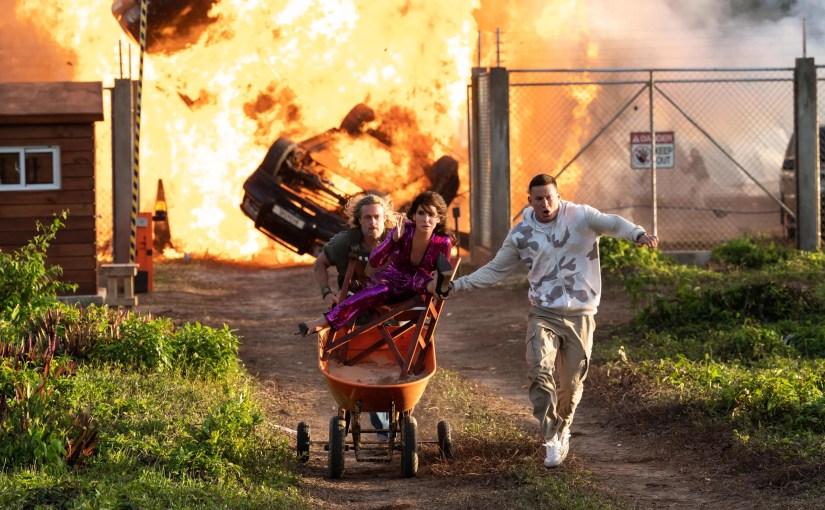
Bullock is Loretta, a reclusive romance novelist, who knows that her books are nothing more than cheesy pulp material to the umpteenth degree.  Her agent Beth (Da’Vine Joy Randolph) keeps a positive attitude as she encourages a book tour to promote Loretta’s newest installment in a series that follows the adventures of Loretta’s fictional swashbuckler.  That hero is preserved on the covers of her novels in the image of fashion model, Alan (Channing Tatum) – a Fabio inspiration.  Alan dons the gorgeous blond locks wig with the beefcake chest and the fans seem to go wild for him more than they do for Loretta’s work.  Even the glittery purple jumpsuit with stiletto heels that Loretta dons for an appearance at a book fair doesn’t deter the screaming fans away from Alan’s muscular build and chiseled chin.

When Loretta is captured by a spoiled brat of a villain known as Abigail Fairfax (Daniel Radcliffe), she finds herself having to research the location of a lost city on a remote island rumored to possess treasures beyond anyone’s wildest dreams.  Somehow, within Loretta’s fiction she implied the actual location of this place.  Abigail needs her to delve even further towards the destination.

This all sounds cliché.  It is, actually.  So what!

What saves The Lost City is the screwball comedic approach to the film.  Bullock and Tatum are nearly twenty years apart in age.  Yet, they make a great pair in the same way that Hepburn and Grant did in Bringing Up Baby.  I could care less about the actual lost city and whatever treasure was there.  The symbols etched on an old piece of parchment that Loretta attempts to decipher never mattered to me.  Two days after seeing the movie, I don’t even remember what the lost city revealed when they eventually got there.  I did like the endless pratfalls of Tatum and Bullock, however. 

Channing Tatum looks like the adventurer of a romance novel.  Yet, he’s nothing more than a pretty boy or a “mimbo” as Jerry Seinfeld might describe him.  He’s actually got a crush on Loretta and upon determining that she’s been kidnapped, he recruits the legendary problem solver Jack Trainer (who could only be encapsulated in the form of a gorgeously blond, tan and muscular Brad Pitt) to rescue Loretta.  It’s important to Alan, though, that he gets recognized as the savior.  So, he kind of learns as he goes. 

Adventures in the jungle abound.  There are bad guys on motorcycles.  Guns, of course.  Fires within Alastair’s luxury SUV. Rock climbing.  Rivers with leeches.  Dark caverns and on and on and on.  Yeah.  I’ve seen this all before.  Again, I say so what!  It’s just a fun time at the movies that brought me back to the fast-paced escapades found in the 1980’s films I grew up on.  Yet, it has its own spin thanks to the relationship of Alan and Loretta.

Daniel Radcliffe and his beard are also great characters.  It’s a nice departure from the shoe horned role that’ll never leave him as a certain boy wizard who will not be named here.  He just brings out his fun bratty side.  His beard seems to wink along with him.

A better side story could have come with Da’Vine Joy Randolph though.  As the agent goes from one traveling step to the next as she attempts to find Loretta herself, Randolph just doesn’t look comfortable in the role with her sky-blue pant suit and big breasted physique that is intentionally in your face.  Where’s the slapstick that should be accompanying her?  She’s specifically made up to look like diva luxury and you’re waiting for one disaster after another to befall her. Beyond having to fly on a puddle jumper plane carrying farm animals, she simply survives her trek unscathed.  Either this storyline should have been excised all together, or it should have been rewritten to be just as silly as what Bullock and Tatum are delivering.  A flop in the mud or a slip in the river would have helped this plotline. 

The Lost City is just a cute film for Sandra Bullock and Channing Tatum to look…well…cute together, and in a world where celebrities are slapping each other silly on live television, isn’t this a much better escape on a Saturday afternoon?

THE ACCUSED

By Marc S. Sanders

Jodie Foster won her first of two Best Actress Oscars for playing Sara Tobias, a victim of a barroom gang rape in The Accused, directed by Jonathan Kaplan and written by Tom Toper.

Kelly McGillis portrays prosecutor Katherine Murphy. Murphy initially makes a deal with the three men accused of the rape. An agreement is made for a lighter conviction “reckless endangerment,” rather than “rape,” and a trial is avoided. What happened to Sarah is never put on public record.

Circumstances thereafter motivate Katherine to go another step further and prosecute the men in the bar that encouraged and cheered for the rape to continue. Her own office questions if it will be worth it though and demand she walk away from this seemingly no win scenario.

Kaplan’s film is more or less paint by numbers until it reaches the moment a material witness takes the stand to testify on the exact sequence of events that actually occurred in the back room of a neighborhood bar. Foster is hard to watch at times and that’s the point. There’s nothing glamorous in a film centered on a rape victim, and she puts out all the ugly parts of her character first physically, and then with temper, habitual drinking, and the sense of a poor upbringing. Toper does equip his character with likability though. Sarah tries to get through the tough exterior of Katherine’s no nonsense lawyer ideology with her interests in astrology. Through the film, Katherine shows no interest but we all know that’ll change. Nothing is shocking in the developments of Toper’s story.

What is jaw dropping though is how Kaplan depicts Sarah’s post rape examination. Deep cuts and bruises are shown in various parts of her body. She is propped on stirrups for evidence retention (hair, skin and semen samples for example), even the annoyingly repetitive click and flash of a Polaroid camera are disturbing. You can’t help but be concerned or taken aback.

No. A movie will never measure up to what victims endure following incidents like this. Still, the footage early on in The Accused certainly got me emotional.

The big shock is towards the end when the re-enactment of the rape is presented. Kaplan doesn’t hold back with his crew of extras playing the bar mates. Drinks are abundantly consumed, then a song in the jukebox, some weed, pinball, a wink, then a sexy dance, and suddenly Sarah’s skirt is lifted to reveal her panties and she’s propped on a pinball machine with her arms restrained and her mouth covered by a hand. Then the woo hooing is disturbingly brought on.

Why do I document all of this? I want to show how subtle Kaplan is with the rape scene. Innocent laughs and drunken play can suddenly turn on any one of us, man or woman. A song plays. People are stoned and drunk, and before any of us realize it, there’s a sexually assaulted victim, and a rapist, or three rapists actually. Moreover, there are those who wish for this moment to last and egg it on. For one woman, none of it is fun anymore.

Again, the storyline development of The Accused is nothing we haven’t seen before. It’s step by step, connect the dots within the courtroom and law offices. The crimes (rape for one, cheering & persuading – a crime for another) are terribly shocking though, especially when we see it first-hand.

Every man and woman should watch The Accused. It’s important we remember that we are capable of subjecting ourselves or being subjected.

More so, regardless of our age or experience, we all have something to learn about what a rape victim endures. I imagine this film doesn’t come close, but it’s a solid start.

MAJOR LEAGUE

By Marc S. Sanders

Never seen it before!!!! Finally at the behest of my colleague Miguel Rodriguez and company I sat down to take in the view.

Tom Berenger was a B leading man of the 1980s. Rugged with shaggy hair and a hoarse voice in films like Platoon, Someone To Watch Over Me and Shoot To Kill (a secret favorite of mine). Here in Major League, he carries on that tradition as an aging ball player with bad knees. He’s not given many of the gags, but he sure is likable. I didn’t need the inevitable romantic subplot with Rene Russo. Nothing great there. When he’s playing the ball player in a catcher’s uniform though, Berenger is at his best.

Wesley Snipes shows the future of his albeit temporary star power. He’s not on the level of Eddie Murphy funny but he made me laugh nonetheless, as the base stealer. His entrance into the film is hilarious. A cross between a Bentley & Volkswagen Beetle perfectly sums up his character. Looks like class when really he’s got none.

Dennis Haysbert is one guy I never knew was featured. Now, this guy can bring the comedy as a Voodoo believer trying to get his idols to help him hit a curve ball pitch. He was my favorite.

Charlie Sheen is the Wild Thing. It’s not so much Charlie Sheen’s talent. It’s how his character is written that’s hilarious. Writer/Director David Ward (The Sting) doesn’t rely on dialogue for his 2nd billing star. Sheen doesn’t say much actually. Sheen brings the image of a near sighted, out of control, felon with a power arm teetering on 100mph. Throw in some nerd glasses, a punk haircut and an anthem song, and now you’ve got a gag to carry you through a good comedy.

Major League screams of an 80s picture, most especially with the synthesized keyboard soundtrack, Berenger’s Miami Vice sports jacket over a t-shirt, Bob Uecker (great timing as a sports announcer), and 80s mainstay Corbin Bernsen (TVs L.A. Law). Sure, it’s dated but I found the movie to be fun.

Not my favorite baseball film. That belongs to Bull Durham. Still, I’m glad I finally saw Major League.

Oh yeah. As in many sports movies, the team sucks (hey…it’s the Cleveland Indians), the owner wants to stay that way for profit and the team eventually unites themselves to victory.

Exactly!!!! Rene Russo has nothing to do with any of this.

DO THE RIGHT THING

By Marc S. Sanders

inally, after 30 years, I’ve caught up to a film that has eluded me, Spike Lee’s masterpiece Do The Right Thing. Here is a film from 1989 that really could have been made in 2019. At the very least, it should be rereleased in the theatres. We desperately need this film right now.

My view of Spike Lee has gradually changed over just the last year. It must be due to the current political and socioeconomic climate. I’ve become terribly sensitive to what I see in the news these days.

Following seeing BlacKkKlansman and now this film, Lee really is aware of how low humanity can go. Do The Right Thing offers just a little push that leads to an endless fall, however.

Lee’s film was shot on location in the Bedford-Stuyvesant neighborhood in Brooklyn. The story takes place on a day where the heat wave has reached a record high, so the predominantly black community has turned on the fire hydrant and Sal’s Pizzeria is open for business. Sal is played by Danny Aiello in an Oscar nominated performance. The main character that everyone knows is Mookie, Sal’s trusted delivery guy, played by Spike Lee. Mookie is well aware of Sal’s mild prejudices towards his customers; mild compared to Pino’s blatant racism (John Turturro), Sal’s older son who works for him along with Vito, the other son.

The film is a day in the life when it appears the same daily routines occur yet again. Mookie delivers pizzas while getting chastised by his son’s mother (Rosie Perez’ debut) for not making more of himself. The middle age men sit on the corner talking about anything random. The kids roam up and down the street goofing off and teasing. Da Mayor (Ossie Davis) seems a little crazy even if we can recognize a life of experience as he’s sipping on a bottle while trying to charm Mother Sister (Davis’ real life wife Ruby Dee) who stays perched on her window sill, and Radio Raheem (Bill Nunn) and Buggin Out (Giancarlo Esposito) are on their own mission to make sure black celebrities appear on Sal’s wall along with the Italian Americans, and “Fight The Power” is rightfully blasting on the boom box.

Each scene in the film plays like a vignette and Lee often times will be as direct as possible with his characters to honestly show what they stand for, whether they are racist or intrusive or even naively annoying. The heat index is nicely displayed through the random commentary from the local DJ portrayed by Samuel L Jackson, and it’s easy to grasp that the temperature serves as a threatening metaphor for what we fear will eventually happen. Our communal mentality is about to boil over.

I easily saw the still controversial ending coming. What’s sad is that it is no longer surprising in today’s era. It’s probably one of the best endings to a film that I’ve ever seen. That’s a bold statement but having watched the film just a week ago, I’ve repeatedly had an internal argument with myself. Who is right? Who is justified? Who is wrong? Why do these activities continue to happen? If I’m still turning this film over in my head after a week, then I can’t deny the impact Spike Lee accomplished. I’m angry. I’m annoyed. I’m sad. Don’t get me wrong. I was also entertained with the film. It’s a great script and a great cast.

Beyond the messages of Do The Right Thing, the film is an assortment of bright colors in costumes and backdrops within the neighborhood. Bedford-Stuyvesant really looks like a beautiful area. It looks clean and the residents really never appear terribly intimidating. Lee finds qualities in all his characters to like, even Pico the most racist of all. Mookie even tries to make a point to Pico about just how racist he seems. It’s a great conversation about the status quo of a black celebrity vs simply another “N-word” who walks into Sal’s for a slice of pizza. I found charm among most of the various conversations in the film. So much so that I said to myself, this is a film that truly could be adapted into a musical or a stage play. There’s so much to tell and so many ways to say it. I wouldn’t be surprised if Lee likely had a hundred more pages of dialogue and a dozen more characters that never made it into the final product.

In 1989, and all the years thereafter, I dismissed this film. I never cared for Lee’s commentary during public interviews. I can’t stand his response to certain issues, and admittedly I just do not like hip hop and rap music. I also may have naively thought that Spike’s viewpoints were a little over the top. I still do, at times. Nevertheless, I was blind, Reader. I truly was.

There’s a terrible truth to Do The Right Thing. A frightening truth. We are very, very far out of reach of racial harmony.

We learn best, only when we fall. Spike Lee’s film shows the shortcomings of the human spirit. Spike Lee’s film makes you think and debate. You have no choice but to question a moral compass.

Whether you have already seen it or not, watch Do The Right Thing today. More importantly, watch it with your children.

BELFAST

By Marc S. Sanders

Within the first three minutes of Kenneth Branagh’s Belfast, there is impactful transition that goes reverse in time.  Van Morrison supplies the music to the film and it opens in bright color capturing glimpses of the thriving city.  There are well paved highways with ongoing traffic.  Fresh painted construction cranes stand in front of a blue sky with a warm sun.  Buildings have beautiful architecture.  There are pieces of eye-popping art within the city.  It looks like the most gorgeous vacation destination.  Even the opening credits are stenciled in nice gold font.  Then Branagh’s camera lifts up over a wall and the screen reverses back in time to August, 1969 where it’s depicted in black and white.  A sweet blond-haired boy named Buddy (Jude Hill) is holding a stick and a trash can lid as he slays an imaginary dragon, but then reality dawns upon him and violent riots erupt on the street he lives on. Cars are set on fire, windows are smashed, bricks are thrown, and Molotov cocktails burst into flames.  What we see as prosperity now, had a history at one time, and history is not always something to embrace.  Belfast reminds us that it was ugly before it got better.

Belfast, Ireland in the late 60s/early 70s is shown through the eyes of Buddy.  Branagh never has Buddy be forced to grow up so fast, despite the inflamed conflicts between Protestants and Catholics living in Ireland.  He plays in the park.  He watches Star Trek on TV.  He does his math homework with his Pop (Ciaran Hinds). He’s a little bit of a troublemaker as he pockets chocolate from the local candy store.  He also escorts his grandmother (Judi Dench) to the movies and live theater.  He’s a happy little kid, but he’s also wise to the new world thrust upon his doorstep.  It’s hard not to see the make shift barrier walls of junk at the end of the block and the sometimes-questioning policemen.

His Pa (Jamie Dornan) leaves for two-week trips for work, but when he’s home, Buddy eyes upon his Pa’s childhood friend intimidating him to join the cause to rid the area of Catholicism.  His Pa is put into an “either you’re for us or you’re against us” dilemma.  Pa does not sway so easily. 

His Ma (Catriona Balfe) tries to keep things as normal as possible.  A surprising moment occurs when Buddy gets swept up in looting a grocery store with the rioters.  He runs home with a box of laundry detergent.  Ma will not stand for that and escorts him back to the store to return the item.  Ma gets a full account at this moment of what’s become of their hometown when all she wants to do is properly discipline and raise her child.

As tensions rise over the coming months, Ma debates with Pa about whether to leave Belfast for a new life in the United Kingdom.  I think this becomes more traumatic for Buddy than the random violence he periodically witnesses.  He’d have to leave his grandparents and his school and his friends.  As well, he’s been working so hard to keep his grades up so that he can sit at the front of class, next to the young girl he pines for.  They are working on a science project that recounts the historic first trip to the moon.

Belfast is a rather short film, but Branagh’s script offers much.  It focuses on a piece of mid-twentieth century European history that I was never familiar with.  The film gives you the minimum details through conversations and sound bites from news broadcasts.  That’s fine, but my attention span was waning at times.  It’s not fair for me to criticize the picture this way.  I just couldn’t relate to the culture of the community, and so I just was not engaged on this one and only viewing.

It’s clearly well-made, and Branagh presents a convincing depiction primarily of this one residential block that this family lives on.  While Buddy’s exploits are endearing and there are especially good performances all around, the riot violence is scary with harsh sound editing of screams and shattering window panes.  The cinematography is strong, especially when it contrasts with color.  The choice is made to depict a live performance of A Christmas Carol in color while the seated audience with Buddy and his grandmother stays in black and white.  Branagh does a cool effect by having bright orange stage lights reflect in Dench’s eye glasses which remain in monochrome.  When the family goes to see Chitty Chitty Bang Bang, the movie screen is in color like the film they are watching.  The characters of Belfast remain in black and white, though.  This family and others like them, remember these tumultuous times in a dull, gray perspective.  It was a non-celebratory and often harsh way to live.  The escapism they partake will always be preserved in promising and welcome colors, however.  This is a fantastic storytelling device.

As Kenneth Branagh wrote and directed the piece, it’s clear that he strove for his exact vision and he has a personal achievement he should be proud of.  There doesn’t appear to be any compromise to his picture.  It’s very well directed with its cast performances, the town extras and the technical choices made.  Yet, the film never grabbed me emotionally.  Belfast exists to simply to show how this family survived day to day with turmoil surrounding them.  If anything, at least I learned something new within the confines of Ireland from fifty years ago.

CODA

By Marc S. Sanders

CODA is a film directed by Sian Heder that focuses on a New England fisherman family known as the Rossis.  There is Frank, the dad, Jacki, the mom, Leo, the son, and then there is Ruby, the daughter.  Frank, Jacki and Leo are deaf. Ruby is not.  Ruby is the family interpreter by default.  She’s content with holding the title, but as she is close to finishing high school, it’s seeming less and less fair.  That’s the conflict at play with CODA.  At times, it’ll make you laugh hysterically and it’ll also make you cry for multiple reasons.  You’ll cry as Ruby breaks free from her reserved lifestyle and shyness, and you’ll also cry because Ruby seems likely to miss out on a lifetime of opportunity with her god given talent of singing.

Ruby is portrayed by Emilia Jones.  Watch out for this actor.  She will be the next big sensation.  It amazes me that she was not nominated for an Academy Award.  Jones operates on so many levels in this film.  She learned fluent sign language for the role, in addition to singing gorgeous harmonies, and operating a fishing boat.  Oh yeah.  She has to act the role too, and Ruby Rossi has got to be one of the best protagonists of the last 10 years in film.  She’s an absolute hero. 

Ruby follows a rigid routine of waking up at 3:00am every day.  She goes out on the boat with Frank and Leo to bring in fish to sell on the dock later in the day.  It’s practically necessary to have her there as the one hearing person out in the open sea.  From there, she races her bike over to school.  She’s only adding to her plate when she opts to join the school choir to be close to a school crush named Miles (Ferdia Walsh-Peelo).  

The problem is that Ruby is incredibly shy.  So, when the music teacher known as Mr. V (a brilliantly energetic Lonnie Farmer) requests she sing solo following a long line up of students ahead of her, she retreats in fear.  Mr. V knows there’s something there though, and he gradually uncovers the singing voice Ruby never realized she had.  Suddenly, he’s proposing the idea of preparing an audition where she could attend the Berklee College of Music.  Ruby is reluctant at first, but Mr. V instills confidence in her talents.  However, he doesn’t stand for her tardiness at private rehearsals either.  He demands she takes this seriously, even if she has to tend to her family.  He’ll also make her tough, not willing to let her surrender to those that tease and bully her at school.  I swear that Lonnie Farmer must be a music teacher on the side. What an inspiring individual he portrays.  He’s hilariously intimidating in his classroom, but loved by his students in this film.  He should have gotten an Oscar nomination as well, and he ranks up there with other celebrated teacher characters in film history.  Completely unforgettable.

The Rossis are in the middle of a crisis.  The dock where they keep their boat and sell their fish supply is charging outrageous fees to all of the fisherman.  What makes it harder for this family though is the communication barriers they encounter.  Frank (Troy Kotsur) relies on Ruby to speak on his behalf, even cursing them out when necessary.  In response to the challenge, Jacki (Marlee Matlin) starts to sell their fish privately to circumvent around the overbearing-imposed taxes.  Yet, she also depends on Ruby to speak on her behalf during a news interview or with customers.  On the other hand, Leo (Daniel Durant) insists that Ruby should follow her own path.  Leo reminds everyone that just because he’s deaf doesn’t mean he’s dumb and he can handle the business.

CODA is a coming-of-age picture.  While the title may stand for “child of deaf adults,” Heder’s film focuses further away from deafness being an obstacle as the film moves along.  It lends more attention to Ruby’s dilemma of not being able to be in three places at once.  She’s only living a different life than that of her family, and that’s a problem I’d argue happens for most of us.  Eventually, we all have to leave our nests   

It becomes problematic when she has to deal with doctor visits on behalf of her parents where she embarrassingly has to explain to them the doctor says not have sex in order to heal their jock itch.  Frank and Jacki have sex in the house, completely unaware of how loud they are while Miles is over to practice singing.  Frank loves to play gangster rap at a high volume to feel the beat of the bass.  Imagine how that looks for Ruby when he’s picking her up at school.  These issues are as inconvenient as any family makes someone feel.  Frank, Jacki, Leo and Ruby enjoy their lives.  It’s just hard at times to enjoy their lives together.  Isn’t that the case for any of us?

CODA is so aware of its subjects on singing, deafness, sign language, family, fishing and first love.  Ruby has a multitude of relationships that are explored.  She has to deal with her affections towards Miles.  She has her mentor, Mr. V, to answer to.  Ruby has to understand that Leo can depend on himself, and she has to balance what is best for her while questioning how much she can give of herself to her mom and dad.  What wonderful storytelling conflicts there are to explore here!  Sian Heder’s Oscar nominated script allows enough time in just under two hours to meet the demands of each angle presented. 

I’m always pointing out how much I love random singing or dancing that appears in non-musical films.  CODA is another perfect example.  Ironically, I just read that the film is actually going to be adapted into a stage musical.  It has to happen.  It’ll break through so many glass ceilings on the limitations people have presumed comes with deafness.  Deafness is never a limitation. In the film, however, each time Ruby sings either solo or as a duet with Miles, your pulse will race.  Emilia Jones has vocals that lift your spirits and make you appreciate the gift of actually being able to listen and hear.  So many of us take that for granted.  Sian Heder’s film will remind you not to.  Just watching Frank place his palms on his daughter’s throat while she sings to him, reminds you that the gift of sound, whether you hear it or not, is a beautiful thing.  Frank doesn’t hear the song.  Rather, he feels the vibration of song.

CODA is one of the best pictures of 2021.  When you watch CODA, it’s simply easy to just embrace CODA.

BOOGIE NIGHTS

By Marc S. Sanders

Boogie Nights was director Paul Thomas Anderson’s second feature following a very different and very quiet film debut with the gambling addiction piece Hard Eight.

Heck, it’s fair to say all of Paul’s films are very different; here is the seediness of porn while later in his career he will focus on the ruthlessness of a wealthy and angry oil man and then an obsessed dressmaker devoid of care for the models who parade his accomplishments. (See There Will Be Blood and Phantom Thread.). Paul was definitely striving for recognition with his familial depiction of life in the California pornographic film industry.

What I’ve always liked about Boogie Nights was Anderson’s intent to show the naive innocence of this large cast of characters. Filming blatantly oblivious awful porn scenarios can still be regarded as very proud efforts by its talent.

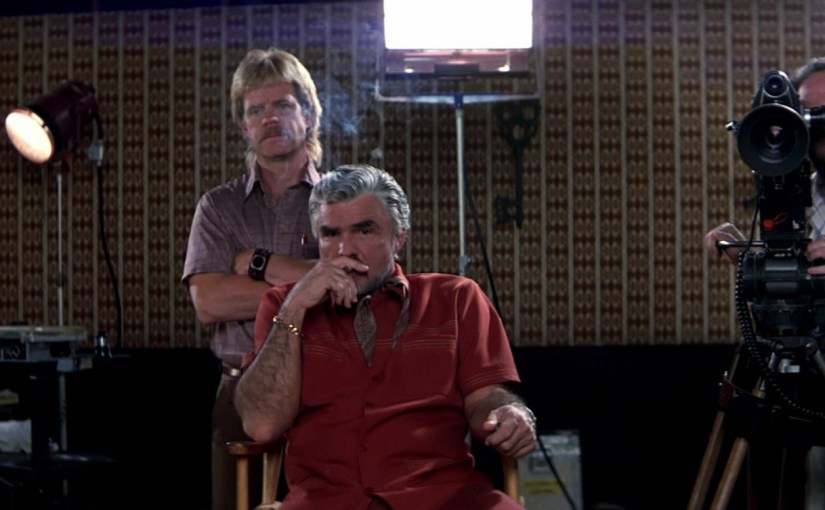
The main character is Eddie Adams (aka the amazing Dirk Diggler) played with macho pathos by Mark Wahlberg. It’ll likely be the best role of Wahlberg’s entire career. Dirk is proud of his natural talent in front of the camera. He’s even more proud of what God has gifted him. Don Cheadle is another porn star named Buck. He’s also proud of his accomplishments and simply a kind fellow looking to make country cowboy a trendy look for a black man while selling the “Hi-est Fidelity” in stereo equipment on the side. Julianne Moore is Amber Waves, the maternal porn mom of the bunch; very affectionate, very comforting and very reassuring when Dirk shoots his first porn scene. The one individual who really holds all of these misfits together is Burt Reynolds as Jack Horner, the porn film director. He’s the paternal one who believes in his artistic merits of shooting porn but with a story, and only with the integrity of film, and never the cheapness of videotape. So, Jack is like any artist who insists on a certain type of canvas. It might be smut, but he has principles, and he has pride.

Anderson is wise in how he divides up the developments. The film begins in the late 1970s during evening night life and decadence and everything seems fine and innocent and right despite the endless debauchery of reckless sex and drug use on a Disco backdrop. Wahlberg’s character is welcomed lovingly into this world, and nothing appears wrong. It all seems to stay that way for Dirk until New Year’s Eve, 1979. The 80s begin with a gunshot and then Anderson’s cast must pay for the revelry of their sins. A great moment presented on this night is where Amber Waves introduces Dirk to cocaine. Dirk has been thriving, making money, developing a following and now it is jeopardized in one moment thanks to his naivety. Julianne Moore is superb in this particular scene against Wahlberg. She’s the mentor with the peer pressure to pass on her high and keep it running.

Drug addiction, violence, sexual abuse and even changes in pop culture lead to hard times for these likable people.

It’s a hard life. It’s a complicated life. Yet it’s not all necessarily illegal. Morally, it might appear wrong, but it’s a life nonetheless.

Anderson was wise to use (at the time, relatively new) filming techniques of Martin Scorsese with rocking period music and fast edits along with savored moments of great steady cam work. One long cut especially works when the film first begins on the streets of Reseda and on into a crowded night club. This industry doesn’t sleep. So, neither will the camera that follows it. The music must also be celebrated. I do not listen to Night Ranger’s Sister Christian without thinking of firecrackers and a dangerously drug addled Alfred Molina playing Russian roulette. Though I know which came first, I also wonder if Three Dog Night’s Momma Told Me Not To Come and Spill The Wine by Eric Burton & War was written to enhance the celebratory introduction for Dirk when he attends his first party at Jack’s house. It’s another great steady cam moment from a driveway, followed by steps in and out of Jack’s house to simply a bikinied girl’s dive in the swimming pool. As a viewer I was absorbed in the California haze. Superior camera work here.

The cast of unknowns at the time were a blessing to this film. Anderson writes each person with care and attention and dimension. They have lives outside of this world like Amber’s child that we never get to meet, thanks in part to her lifestyle. She might be maternal but that doesn’t make her a good mother. Julianne Moore should have won the Oscar she was nominated for. Burt Reynolds’ own legacy seems to carry his role. His distinguished silver hair and well trimmed beard earn him the respect of every cast member and he performs with a quiet grace of knowledge, and insight, even if he will inevitably be wrong with how things turn out. Phillip Seymour Hoffman plays the dumb kid Scotty insecure and unsure of his homosexual attraction to Dirk. It’s not easy to play a dumb character when you are not doing it for laughs. Hoffman makes a huge impact with little dialogue but Anderson is wise enough to capitalize on him.

Boogie Nights offers one of the best cast of characters and assembled talents in any film ever made. An individual movie could be made about each of these people, and it’d be interesting and entertaining.

Try to avoid a blush and mock at the industry depicted because then you’ll see how another walk of life truly lives day to day. It might be porn. It might be smut. Yet, it’s still a thriving industry.