BLOW OUT

By Marc S. Sanders

Brian DePalma’s Blow Out is an inventive approach to the political conspiracy thriller.  In 1981, following a mask of innocence the United States lost with the assassination of President Kennedy, later his brother Bobby, plus the drunken, liable carelessness of their brother Ted, and then finally the Watergate scandal, DePalma capitalized on newsworthy incidents to make a paranoid thriller of present day while incorporating what he likely knows much about which is sound effects editing.  Despite the cheesy music soundtrack that is highly intrusive and poorly composed, Blow Out is a good blend of hysteria and suspense.

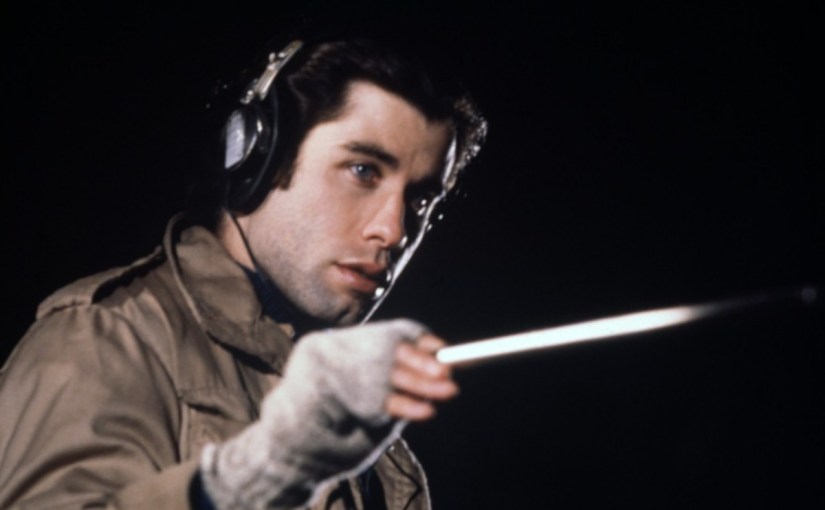
John Travolta plays Jack Terry, a Philadelphia sound effects recording artist for b-grade schlock horror movies.  One night, while out in a park trying to pick up sounds of outdoor nature, he witnesses a car suffer a blown-out tire and crash into a nearby river.  Jack is able to rescue a woman named Sally (Nancy Allen) but cannot save the Pennsylvania governor who was driving the car.

As he is about to leave the hospital, he is specifically instructed to never speak to Sally nor acknowledge to anyone about any of his own involvement in this incident.  However, Jack cannot help but recount the sequence of events in his head and as new details come to light, he knows that there is a cover up at play.

Blow Up operates like a how-to kind of picture.  The expertise of a sound effects recording artist is demonstrated as Jack replays every sound that his equipment picked up. Later he’s able to manufacture his own film by assembling a series of published photographs that also captured the crash.  Sync up the sounds with the sights and a new theory surfaces.  Other mysteries change the course of the riddle through dialogue.  This character has to work by himself using the skills he’s acquired to learn the truth.  He hardly has anyone to commiserate with.

John Travolta is convincing within this occupation that’s not as common as a cop or a private eye.  I like how I can pick up how he uses his recording equipment and even the minute details like labeling what he has preserved within his inventory.

It took a little bit of patience to get used to Nancy Allen’s damsel in distress who plays it up like Judy Holliday or Jean Hagen with the squeaky, dingbat voice.  When we first meet her, she is in an intoxicated stupor that goes on a little too long. Nevertheless, I came around because the tension of the film builds quite well.

John Lithgow is the sadistic adversary – a serial killer and assassin rolled into one.  He’s got the weird, unwelcome appearance like any bad guy in a Hitchcock film.

DePalma is known for his split screen cuts that he offered in Carrie and later in Mission: Impossible.  More well known is his reliance on bringing a character in zoom close up, while in the same frame, another object will be zoomed out at a distance.   During an outdoor evening in the park, an owl hoots and stares us down while John Travolta is far in the background standing on a bridge. Within this same moment, DePalma does it again with a toad ribbiting up close with the actor again positioned out. It’s a disorienting approach that works well at maintaining the perplexity of his story.

I think the final act of Blow Out falls apart a bit.  Travolta is on the heels of rescuing Sally by rampaging his jeep through a crowded parade.  The scene is shot so aggressively that it was hard for me to believe he would survive much less not run down a cop, spectator, or the entire marching band.  DePalma could have tightened this up a bit.

Blow Out ends on a bleak irony that’s quite surprising and definitely against formula.  There’s a running gag for Jack and a film director as they edit a silly problematic issue for a new slasher flick.  I guessed early on how this was going to resolve itself.  Though I was right, I didn’t expect how the conclusion arrived at my predication.  

As well, there are some notable questions left unanswered.  I had to roll back and see if I missed something.  I didn’t.  DePalma’s script neglects some key points with unfinished resolutions. So, I was not entirely satisfied. Still, the how-to procedures along with the pursuit of the truth, while also evading demise, are very engaging.

When I conduct workshops on playwriting, I always recommend keeping up with the news.  An unending wealth of ideas are there to be discovered.  As a sincere compliment to Brian DePalma, it could not be more apparent where his creativity took off with this film.  As a skilled and educated filmmaker, he also writes what he knows.  

Blow Out is very close to being a smart nail biter that echoes the sad truths of political rule breaking by means of savage crime. I wish modern films would be as risky today.  There are so few of these kinds of thrillers being made anymore.

WALTZING WITH BRANDO

By Marc S. Sanders

You think you know someone, but then you learn a whole other side about the person.

I only know Marlon Brando from his achievements in The Godfather, Superman, A Streetcar Named Desire and On The Waterfront.  There’s also his final picture, The Score, with his Vito Corleone counterpart, Robert DeNiro.  I’ve seen him spoofed on Saturday Night Live and know that he’s even poked fun at himself in a film like The Freshman.  He was notoriously and proudly quirky.  I guess Brando was so content to appear odd to everyone else beyond the island of Tahiti, which became his escape to paradise, away from autograph hounds, environmental abuse and Hollywood barbarianism.  Brando simply endured his greatness as one of the most incredible movie actors ever to subsidize how he really wanted to live in utopian isolation.

Billy Zane seamlessly inhabits the persona and physical appearance of Marlon Brando in Waltzing With Brando.  The film presents a slice of the actor’s uncompromised efforts to build an ecological home, and maybe a hotel, on an uninhabited island next to Tahiti.  To bring this idea to fruition, Brando recruits a young, undaring Los Angeles architect named Bernie Judge (Jon Heder) to helm the project.  This will be an undertaking that Bernie could never expect and can hardly circumvent around impossible challenges in the face of proven scientific engineering, chemistry, and physics.  Brando seems to have an answer for everything though.

By breaking the fourth wall to speak to the viewer along with voiceover narration, Heder is charming about his unexpected adventures.  The white-collar shirt and necktie of city life is abandoned for shorts and conch shell necklaces.  Actually, as Brando demonstrates its better and less inhibited to just be nude like the rest of the cheerful islanders.  Despite his reservations, Bernie gets more and more accustomed to Brando’s perceptions but still he has to find ways to be practical to complete this unconscionable project.

Drinking water is needed.  Marlon’s answer is to filter it from his own urine.  Electricity needs to be installed on the island.  Though, is Marlon truly serious when he suggests that energy stem from a power source like electric eels?  Bernie soon learns that there will never be a client as unpredictable as Marlon Brando.  Money is not an obstacle he cares about.  Oscar trophies serve a menial, floor level purpose that is only a little more useful than resting on a mantle.  An upcoming gangster movie is not really his thing.  A paradise devoid of man-made contamination and pesky societal intrusions is where his focus lies.

Watching Bernie Judge struggle with being away from his wife and daughter, while working with islanders to start at the basics like building an airplane landing strip first, I was reminded of The Brutalist, the fictional period piece that centered on building a grand, outrageously expensive structure within a mountaintop.  That film watched its architect wither away into haunting madness.  The Mosquito Coast with Harrison Ford also came to mind.  Thankfully, Waltzing With Brando does not take these directions.  I know nothing about architecture or engineering or practically any kind of science.  Yet, I know that whatever Marlon Brando conjures up seems unheard of and impossible.  Brando’s friend, Bernie Judge, did not allow these considerations to stop him though.  Why shouldn’t we explore our ideal paradise no matter how exuberant it seems? (Mosquitos are also a problem to deal with and Brando frowns on using pesticides.  Hmm. What can be done?)

Still, we have to be realistic.  Richard Dreyfuss plays Brando’s money manager and represents the challenge of making resources obtainable.  Brando has to go back to work.  Judge needs more and more funds for material and labor.  He takes daring personal risks.  Even the banker does.  Utopia is expensive and never merciful. 

Director Bill Fishman wrote and adapted Bernard Judge’s biographical tales of his encounters with Marlon Brando.  His film is lighthearted, hardly stressful in any kind of dramatic weight.  Perhaps that is because Bernie Judge did not respond to Brando’s ideas with frustration like The Brutalist would have you believe.  While I was not entirely fond of the voiceover narration because I did not recognize its necessity, Jon Heder is magnetically likable.  He’s a cheerful friend telling a bedtime story that took place in a small corner of the world.  Most people never explored these crystal waters and white sands traversed only by Marlon Brando and the native islanders.  This is a civilization unaware of the burden of conflict and pressure. 

Billy Zane does not go over the top with his portrayal of Marlon Brando.  The more subtle and aloof he is in each scene, the more convinced and accustomed I became to his peculiarities.  With Fishman’s script, Zane delivers a handful of dynamics to Brando.  Early in the film, Brando tells Judge that his desire is to live in this Tahitian paradise forever.  He knows however that he must continue to make movies to eventually fund this lifestyle permanently.  Later in the film, it is easy to surmise why Brando feels that way.  While filming The Last Tango In Paradise, he is trapped in a phone booth where his fan base recognizes him.  It’s one of the few times when Billy Zane performs on Marlon Brando’s genuine discomfort, and it is terribly unsettling.  It’s awkwardly ironic that the most famous actor in the world is out of his element among a worldwide community of followers and devotees begging for pictures and autographs.

Like Marlon Brando and an eventual Bernie Judge, Waltzing With Brando wants you to leave the theater with a smirk on your face.  An attempt at achieving the impossible with absolute content does not have to be a miserable journey.  An effort to find ways to overcome challenges can deliver lifelong friendships and personal experiences that belong only to you.  Bernie Judge learned this through his friendship with Marlon Brando.

Waltzing With Brando is a thankfully rewarding experience, a brush with perfect happiness.

NOTE: Stay through the end credits because this “Marlon Brando” has a few treats in store for you.

TRUE LIES

By Marc S. Sanders

James Cameron’s True Lies never had to be believable.  It only had to be fun, and it is fun for the first act and most of the third act.  Too bad the sitcom like, chauvinistic second act pretty much overthrows the whole picture.

When you watch an Arnold Schwarzenegger pic, you have to take it with a boulder of salt.  Throughout his career, he’s been pregnant (never saw Junior), he’s begged God to give him the strength to fight Satan (I’m being honest here. It happened in End Of Days), he’s been tossed out of a plane at thirty thousand feet with no parachute and lands safely in a dumpster (Eraser) and his twin brother has been Danny DeVito.  (Do I really need to share the title of that movie?) In True Lies, I have to accept the fact that the muscular body builder with an Austrian accent, and pretty good line delivery, convinces his wife and daughter, played by Jamie Lee Curtis and Eliza Dushku, that he’s simply a boring computer salesman.  It’s shocking, utterly shocking, to realize that he is actually a clandestine spy, and his family is completely unaware.  See if Bruce Willis or Harrison Ford or Mel Gibson were in this role, then I’d buy it.  Tom Arnold might have been a good pick, but James Cameron settled to make Roseanne’s ex-husband Schwarzenegger’s secondary partner with some comedy bits. He might be the best part of the movie.

A brilliant 007 inspired opening gets this adventure started off with a literal bang at a black-tie affair at a wintery German mansion. Harry Tasker (Schwarzenegger) infiltrates the party along with support from his partner Albert (Tom Arnold) who hides in a tech equipped van that’s close by.  Harry does the tango with Tia Carrere, which is charming and something new for the Terminator.  The outcome of this shoot ’em up episode puts these super spies on the trail of an Arab terrorist who has the capability of unleashing a nuclear arsenal on the United States.  When Harry is not chasing this guy on horseback and up high-rise elevators, with the equine in tow, he and Albert report to an eye patch played by Charlton Heston.  

Somehow, I sleepwalked into another movie, though.  Harry has not been the model family man and when he tries to make amends, he inadvertently hears his wife Helen (Jamie Lee Curtis) chatting with a sleezy car salesman (Bill Paxton).  Now all of the spy department’s resources change course to surveille Helen and this moron she’s been talking to because this is the episode with the misunderstanding.  James Cameron’s script makes very poor efforts to achieve sitcom level comedy.  A laugh track couldn’t even save this tripe.

Bill Paxton is a great actor, but he accepted a terrible, unfunny role as he ironically pretends to impress Helen by actual being a spy.  Ha!!!! Go figure!!!!

Jamie Lee Curtis is a great actor too, but she agreed to play one of the dumbest women to ever grace a screen.  She believes this moron’s lies as easily as she believes the one and only Arnold Schwarzenegger is just a computer nerd.

One of the most intolerable scenes I can ever think of occurs after Harry learns what is really going on. He gladly continues to play one over on his neglected and unhappy wife by believing he’ll give her a fun adventure he thinks she deserves.  Helen is convinced that she must abide by the wishes of a clandestine government group who apprehends her.  She arrives at a dark hotel room with Harry sitting in the shadows, mere feet away, and convinces his wife to do a striptease dance in front of a stranger.  This routine goes on for the longest five minutes.  It’s not funny.  It’s not sexy.  It’s eerie and perverted with sick narrow mindedness. 

At the risk of getting political and prudish, Jamie Lee Curtis has always been one of the most outspoken celebrities for equal treatment between men and women and has ostracized those in positions of power who work towards their own self advantage.  Yet here she allows herself to be objectified by James Cameron and Arnold Schwarzenegger to be a punchline for male chauvinistic pranks.  If this scene ended with Curtis breaking Schwarzenegger’s nose with a karate chop while holding him at gunpoint, then this becomes something else.  That’s a no, however.  Instead, she is a scantily clad victim of sexual deviants, and she never stands up for herself, or exudes any kind of pride.  I recall in 1994 not liking this sequence.  Over thirty years later, well after the tides of the Me-Too movement have passed, I still hate this material.  With all of the high-flying stunts and action thrown in to other parts of the movie, it is this scene that stays with me.

Once this stupid story detour is over with a cast of actors enhancing its inanity, do I sleepwalk my way back into the movie I was watching before.  Whattya know?  The Arab terrorist who has not been discussed for the last forty-five minutes, still exists. So, while being held captive, this becomes an opportune time for the unhappy couple to sort through their baggage.

True Lies starts out so fun and when the action is turned on, James Cameron and his team are offering some solid footage.  Helicopters, limos, and missiles fly over a bridge running from the Florida Keys.  Then it is ridiculous silliness with a fighter jet piloted by Schwarzenegger who uses the entire cache of weapons to wipe out the one bad guy while trying to rescue his daughter who his hanging from a crane high in the skies over Miami.  Some say the slapstick of The Three Stooges is a demonstration in violence.  I ask if those critics have seen True Lies because the mayhem is absolutely bonkers. 

I can’t endorse this movie because I think it is one of Arnold Schwarzenegger’s worst films.  It’s also one of James Cameron’s most awful efforts.  The action is marvelously over the top, but the characters are reprehensibly idiotic and the film gets hijacked by a whole other storyline that is neither funny nor worth caring about.  There are so many better options to select from this writer/director, and this entire cast. 

With an absence of untruth, I am being forthright by declaring that True Lies belongs back within the scummy cauldron from it was stirred up from.

ROCKY III

By Marc S. Sanders

By the time a series of franchise films reaches its third installment there better be something interesting for the characters to encounter.  Otherwise, it is the same old show.  Not many talk about it, but Rocky III actually does have something new to offer even if the story still feels like the same kind of tread.  What’s new?  Mr. T!

In the lexicon of greatest villains of all time Mr. T’s introductory role of Clubber Lang, the fierce boxer who lacks pity for a fool, should be included within these tabulations.  Reader, I challenge you to find him listed anywhere.  I don’t think you’ll be successful.  Not even as a runner up. That is a terrible oversight.

As Rocky III opens with a quick flashback of Rocky Balboa (Sylvester Stallone who also writes and directs) winning the championship away from Apollo Creed (Carl Weathers), quick cuts of the hero show him knocking out one fighter after another with debonair ease.  When he’s not boxing, he’s posing for commercials and magazine covers, or he’s riding his custom-designed Italian Stallion Harley with his wife, a glamorous Adrian (Talia Shire) on the back.  Juxtaposed within this montage, played against one of the greatest songs in film history (Eye Of The Tiger by Survivor), is Clubber Lang executing bloodletting beatings on his own opponents.  He’s angry and he threatens to kill Balboa in the ring. Rocky’s mainstay coach Mickey (Burgess Meredith) attends these fights and grows fearful of this new menace.  Clubber will not give up on this campaign until he has his shot in the ring with Rocky.

Rocky III has a glossy finish the first two installments deliberately withheld.  The photography is sharper. Stallone is quite handsome, rich and fit.  Adrian has abandoned the meek bashfulness and nerdy, wing shaped eyeglasses.  Their furnished house sits on a gorgeous estate complete with servants, a golf cart, and a little boy all their own.  The filth-ridden areas of Philly are behind these protagonists.  Welcome to the materialistic and decadent 1980s.  Frankly, I like how nice and put together everything feels in Rocky III.  It truly is a window into what much of the 1980s looked like.  Stallone and Shire’s characters have evolved amidst their wealth, and I continue to like them. 

The one ingredient that carries over is the alcoholic slob, Paulie (Burt Young), whose grumpiness hasn’t changed.  He is a given a substory in the first ten minutes of the film where he shows his resentment for Rock.  Then, the slugger bails him out of the drunk tank, gives him a job, and he only remains through the film for a few laugh bits.

(SPOILER ALERT) Following accepting the challenge to fight Clubber Lang, Rocky loses in terrible defeat just as Mickey suffers what will be a fatal heart attack.  Not only does he lose, but he cannot overcome his sorrow, and fear has intruded upon his psyche.  Apollo volunteers to train Rocky and encourages him to do one last fight against this new opponent, now champion.  Only now, Rocky has to get that “eye of the tiger” back and he needs to move light on his feet like Apollo originally learned.

Everyone in Rocky III has an energy about them.  These actors are used to one another even if Stallone and Weathers were on opposite sides for the last two films.  Stallone’s script experiments with testing his boxing character to lose what he earned organically in his earlier films.  He also sketches the guy with conceited fault ahead of the film’s first fight when he showboats his training and does not take this new fighter seriously enough.  This is good material for a third follow up piece.  It’s certainly more exciting than what Rocky II offered.

However, the film belongs to Mr. T who became a pop culture icon of the 1980s with gold jewelry, the mohawk, a TV action series, cartoons, toys and guest appearances on telethons, Johnny Carson, Diff’rent Strokes and Silver Spoons.  Forty years later, he deserves some recognition for the impact he had on the American psyche.  This guy was a big influencer.  No one has ever replicated what Mr. T delivered.  If you watch Rocky III again, you can’t help but get caught up in how hostile his Clubber Lang is.  I doubt this guy was written this broad or aggressive in Stallone’s script pages.  Clubber Lang is a villain that owns this picture anytime he appears on screen.  Mr. T is not a diverse actor by any stretch but the personality that was introduced here is unforgettable.  During both training and boxing montages, his muscular physicality is an astonishment, and he’s a terrifying new kind of monster with every threat he screams at this cast of likable heroes.  This guy would burn the whole happy village down if given the chance.

I’m also impressed with Talia Shire.  She’s not given much to do here.  For the most part she is sitting in the audience, cheering on Rocky, or watching from the sidelines while he trains.  However, there is one special scene that Stallone wrote for them that turns the tide of this ninety-minute film ahead of the inevitable, pulse racing training montage.  Her scene of truth-hurting candor with Stallone’s character on California shoreline where all of the pain and anguish surfaces is carried by her against Sylvester Stallone, the superstar.  It’s a reminder why the Rocky films were never anything without Adrian.  The love of Rocky’s life has to always be there to rescue the lug from his despair and lack of confidence.  I love this scene.

I would never argue with anyone who said this franchise became a sad joke upon itself by the time Rocky III rolled around.  The formula is very recognizable.  It’s not a tremendous sequel like The Empire Strikes Back, The Godfather Part II, or even Superman II demonstrated ahead of its release.  Yet, there is a vigor to Rocky III, and the highs and lows are told efficiently at a very comfortable pace. 

I saw Rocky III before I saw the prior two films and at age ten, this had my attention from beginning to end. It’s likely when I left the theatre, I wanted to be a boxer and pound someone’s flesh into a bloody pulp amid a cheering crowd.  I recall the whole audience in the theater applauding as soon as Rocky triumphed again.  I also recall the tears and sniffles I heard at the midway point when poor Mickey’s life suddenly ends.  These are beloved characters that we only want to remain happy and healthy.

Rocky III is not accurate to how it really is for professional boxers.  I do not think the well edited cuts of the fights are genuine either.  A lot of the footage looks like an action movie more than a sports picture.  When Clubber Lang swings with a jab, there’s a whooshing sound.  However, Stallone as a writer/director knew how to touch on the melodrama effectively with laughs, sadness, fears and cheers. 

With that amazing Bill Conti soundtrack, Survivor’s rattlesnake opening chords of their Oscar nominated song, Mr. T and, oh yeah, a giant named Hulk Hogan as a beast of a wrestler named Thunderlips, Rocky III is outstanding, pure escapist entertainment.

UNCOMMON VALOR

By Marc S. Sanders

In the decade following the Vietnam War a common denial (or ignorance, maybe) went towards American soldiers who were missing in action.  Many men were theorized to be prisoners of war long after the armed forces left the country, ending a losing battle with record numbers of casualties.  A handful of films of the 1980s brought focus to this topic, as a means for adventurous entertainment.  Chuck Norris had a series of Missing In Action films.  Even light action fare TV shows like The A-Team and Magnum PI brought attention to this issue.  Most predominantly, the possibilities of POWs were ingrained within Sylvester Stallone’s box office bonanza of Rambo pictures.  In 1982, Ted Kotcheff directed the initial entry of that series, First Blood, and he zeroed in much more precisely the following year, with Uncommon Valor.  

Gene Hackman is retired Marine Colonel Jason Rhodes who begins a decade long campaign convincing the U.S. government to seek out those who were left behind and are likely being held as prisoners of war.  His motivation stems from his belief that his son Frank is likely being held captive in a camp located in northern Laos.  

By the time 1983 arrives no action of recovery or rescue is taken.  The Colonel is committed to bearing the responsibility.  He appreciatively accepts financing of his own mission from an oil tycoon (Robert Stack) whose son might be with Frank.  The Colonel also recruits members of Frank’s unit who made it home (Fred Ward, Reb Brown, Randall “Tex” Cobb, Harold Sylvester, and Tim Thomerson). Patrick Swayze is a young guy named Scott who never served in the conflict but is an expert combat and weapons specialist who will get these men retrained for the upcoming rescue.  He also has his own reasons for partaking of this mission. 

Uncommon Valor is sporadic on humor and focused on the adventure and resourcefulness.  The first half provides footage of how the squad gets reacquainted with each other and the jungle elements they left behind in Vietnam.  They practice routines outlined by the Colonel with ground patrols, detonators, hand to hand combat, artillery, sabotage, and chopper rescue.  The second half follows them back into the Asian country where they have to obtain weapons and supplies, while making connections with locals who will escort them through the dense jungle area towards the camp.  

This is a rare occasion where Gene Hackman is not applying much of his acting craft. He is primarily going through motions of Kotcheff’s film direction with a script rumored to be co-written by Wings Hauser (also a producer on the film).  The trauma of the war is primarily carried by Fred Ward who struggles with PTSD long before it became so widely attributed to service men and women after returning from combat.  In First Blood, Stallone offered a much more substantial and convincing demonstration.  Yet, Ward does a serviceable job with a script that never goes terribly deep.

Uncommon Valor is better described as a present-day adventure picture.  It’s never boring.  There are fireball explosions and machine gun shootouts. The action set pieces still hold up with good art designs staged off the Hawaiian Islands in place of a sweltering Vietnam.  The prisoners who are recovered, supposedly held for over a decade, are chilling to look at with obvious malnourishment and dead-blank expressions.

Randall “Tex” Cobb and Reb Brown (the TV movie Captain America) are mostly doing wacky A-Team material here.  Gene Hackman, Fred Ward and Harold Sylvester are the straight characters.  

It’s not as grand as a Rambo film, but Uncommon Valor never lampoons or minimizes what was a horrifying experience for those enlisted soldiers who never came home, while their next of kin never obtained closure.  

For the 1980s, which feels like it had just passed yesterday, it’s fair to say that all those missing in action during that terrible and bloody war are no longer alive over fifty years later.  The opportunity to search and negotiate for their freedom has long expired by now.  While movies like Missing In Action, Rambo and Uncommon Valor focused on fictional triumphs that were never factually replicated, at least these films can serve as reminders for the sacrifices these people served at the behest of their country.  I’m not writing to ease lifelong pains.  All I can do is recognize, remind and be forever grateful.  These movies still serve a purpose beyond the pulpy Saturday afternoon adventures. 

TOOTSIE

By Marc S. Sanders

Tootsie is my favorite comedy of all time.  At age ten I saw it on Christmas Eve with my family and beyond the Star Wars and Rocky films, I had yet to see an audience respond, or more specifically laugh, so uncontrollably for two hours straight.  I might not have recognized all of the innuendo and I was not yet alert to the idea of women feeling belittled while knowing they should be entitled to equal respect, but the performances, especially from Dustin Hoffman were entirely genuine.  Tootsie still remains the only film where I can forget that a man, a not so attractive or sexy man, is convincingly disguising himself as a woman who possesses internal strength and gusto.

Whether directing or acting on screen, Sydney Pollack was not someone well known for overseeing comedy at the time.  Yet, that’s an attribute to the end product of this celebrated movie.  Other than a typical Bill Murray routine in an uncredited role, no one in this picture is waving their hands in the air to insist they’re funny.  The humor of Tootsie bears from true, raw emotion, fear and desperation.  No one is doing Saturday Night Live sketches and building up to the next punchline.  Despite the cross dressing, Tootsie is not even a farce.  A guy gets a job wearing the necessary garb and modifying his verbiage, but only to earn enough money to survive.  However, it also doesn’t help that he’s falling for his co-worker.  

Dustin Hoffman is an actor living in New York City named Michael Dorsey.  He’s a great, learned performer, especially on the stage, who lives with his playwright buddy Jeff (Murray) in a crummy apartment in the meat packing district.  They need to raise enough money to put on Jeff’s play in Syracuse.  

The problem is that Michael can no longer get cast in anything.  Not on stage or even in a commercial.  His agent (Pollack) says it point blank that nobody will hire him.  He’s just too difficult with short bursts of temper and no tolerance for others who work in the field.  

So, Michael surrenders to desperation and puts on the guise of a character actress named Dorothy Michaels.  As quick as she stands up for femininity against a chauvinistic TV director (Dabney Coleman) she is cast on the most watched daytime soap opera.  As long as Michael can perform off and on camera as Dorothy he should be able to earn more than enough money for Jeff’s play.

Complications arise though when he becomes protective of his co-star, Julie (Jessica Lange, in her Oscar winning role), against her unfaithful boyfriend, the TV director.  Julie’s widowed father, Les, is falling for Dorothy though, and then there is Michael’s friend Sandy (Teri Garr) who lost out on the part that he earned, and to keep things maintained has been seduced by Michael into a romantic relationship beyond just their friendship.

With me so far?  I hope so because there’s even more obstacles to overcome.  Tootsie is very economical in its story development, but it’s also a very crowded film.

Don McGuire and Larry Gelbart (TV’s M*A*S*H) wrote this Oscar nominated script with a brilliant collection of characters.  The blessing is while it sounds like farce, Tootsie is never delivered with a slapstick tongue.  In order for the film to work, Dustin Hoffman especially had to portray Michael Dorsey as a guy with natural ticks, motivations and fears.  He accomplishes that because Michael always ensures that Dorothy is as real as she can ever be.  When Dorothy hails a cab or shops for clothes the southern accent must hold while perusing through the city streets in heels.  Michael gets frustrated over what to wear for a dinner visit at Julie’s apartment.  Especially when Julie opens up her heart, Hoffman is precise to make sure Dorothy approaches with a low whispered approach to simply be a consoling girlfriend.  

The comedy arrives when Michael has no other choice but to break this strong powered female persona.  Dorothy will call for a cab but if it just won’t stop, then a deep voiced, bellowing New Yorker will come out of this woman’s mouth with an angry “TAXI!!!”  I like to believe that Sydney Pollack deliberately arranged for Dorothy to yank a Woody Allen lookalike out of a cab that was about to be taken from Dorothy too.  Dustin Hoffman knows Michael Dorsey is such a committed method actor that he has to convince all eight million people in New York he is strong willed Dorothy Michaels – a character actress capable of playing the new Hospital Administrator on Southwest General

There are so many fleshed out pairs of relationships in Tootsie – all going beyond the cross dressing of the film’s main character.  All of these people could get along forever if only for the fact that some characters have befriended a man while others truly believe they have made a connection with a woman.  How long can we have it both ways?  The facade has to undo itself, right?  True.  Thankfully it occurs at the end when every single character can have it explained to them all at once.  I’ve never forgotten the roars of laughter from my mom, dad and grandmother as the end of Tootsie arrived.  Well-placed close-up shots of every actor who had a speaking role in this movie is covered (well except for Sydney Pollack as Michael’s agent). On Christmas Eve in 1982, the packed movie house at the Forum Theater on Route 4 in Paramus NJ only amplified the shocking reactions.  Tootsie is a reason why you sit among a crowd at a movie theater.  

This is Dustin Hoffman’s all-time best performance.  He was nominated against fierce competition from Paul Newman in The Verdict, Jack Lemmon in Missing, and Ben Kingsley in Ghandi (who took home the trophy). Michael Dorsey/Dorothy Michaels is a much more challenging role than what Hoffman superbly accomplished in his two Oscar winning roles (Kramer Vs Kramer, Rain Man).  Robin Williams or Tom Hanks could have played Michael Dorsey who invents Dorothy Michaels.  Yet, what Hoffman emotes are the natural tics of a guy who is constantly broke while he charms an array of women at his birthday party, only with the intention of bedding them and hardly ever listening to what these ladies have to say.  When Hoffman puts Michael literally in a pair of woman’s shoes though, he begins to identify the lack of respect that women endure on a daily basis.  

Watch Dustin Hoffman’s body language.  He becomes angered with his agent upon learning that he lost out on a role which somehow leads to a debate about whether a tomato should walk or talk or sit or stand.  That back and forth is outrageously hilarious.  Having seen Tootsie hundreds of times though, I now appreciate how a schleppy looking Michael hustles across the streets of New York, avoiding traffic and then marches down the hallway to his agent’s office.  Hoffman twitches his head and shrugs his shoulders as if he’s prepping to give the agent a piece of his mind.  Hoffman is so absorbed in this guy he’s playing.  I am not recognizing any other kind of Dustin Hoffman that I’ve seen anywhere else.

Sydney Pollack is also attuned to the cutthroat atmosphere of desperate theater folk trying to survive in this concrete jungle.  Tootsie opens with a montage of quick episodes for Michael.  He is leading a workshop while being candidly ugly with his fellow thespian students about how challenging it is to get work.  In between, are auditions that he goes on where there is one reason after another why he can’t land a role.  Michael Dorsey is an incredibly skillful actor, but that means nothing for this role or that role.

On this most recent viewing I caught on to a detail that never occurred to me.  Bill Murray as Jeff, the broke playwright, is snacking on lemons and wincing while he talks to Michael.  Now I don’t know if this is in the script or if this was Pollack or Murray’s idea.  Nevertheless, it’s a brilliant detail.  These guys are so broke that they have resorted to smuggling lemon slices out of the restaurant they work at to live off of.  Another actor or filmmaker would have used an orange or cookies.  Who snacks on lemons?  Only those with nothing else to rely on.  

Makeup bottles with spirit gum, cannisters of fake blood, prosthetic teeth, props and sloppily hung costume wear are all given focus beyond the broad comedic storylines.  Sydney Pollack pans his camera over all of these items with no actors in frame because he wanted to ensure that being an actor or a playwright in New York is nothing glamorous.  It’s a world of unending torment. All of these nuances and details justify the extremes that Michael has to go through to achieve his goal.  

Jessica Lange never plays her role for laughs.  Her portrayal of Julie, the beautiful, blond celebrity of daytime television, is authentic and she inherits a new girlfriend to confide in. Finally, Julie can share what she values and holds dear.  You can’t not fall in love with someone who only treasures the best parts of her young life and yet only seeks a companion to chat with.  A humble celebrity is hard to find and that is one reason Michael falls hard for her.  Lange is outstanding while being so heartfelt.

Teri Garr’s comedy stems from the insecurities of actors.  Sandy is described as someone who wants to commit suicide at a birthday party.  Doing community theater for over thirty years I know precisely who this person is.  I’ve been this person, and I’ve encountered hundreds of these people.  It’s hard to be a big fish in the small pond of community theater.  Imagine trying to hold on to your sanity when you have to compete with all of New York.  Teri Garr was rightly Oscar nominated for what could have been a throwaway part. Like Hoffman she also has these little gestures that suggest her lack of confidence. After she sleeps with Michael and he’s getting ready to leave, Garr peaks at her naked chest hidden underneath the sheets.  It’s as if she’s wondering was I not attractive enough.  She’s hurting. No matter if she just had sex with one of her favorite people, she is still suffering.

Charles Durning is familiar for having the tough guy, intimidating persona because he’s usually so much larger than life.  However, he offers a sweetness to this guy who’s ready for companionship.  You don’t want Michael or Dorothy to let him down.  Les doesn’t deserve to get hurt.

Again, as I described any of these characterizations, none of it is funny.  They are wrapped in sensitivity. There’s a lonely sadness to people like Michael, Jeff, Julie, Sandy and Les.  Yet, when this variety of sorrow and anguish collide, while poor Michael is only trying to make some money, does it all combust in hilariously, unwinnable scenarios of tremendous proportions.

Tootsie is an amazing film.  It is one of the smartest, most insightful scripts ever written and it is blessed with a cast and director who mastered how to live in an unforgiving and unsympathetic industry.  This picture offers lessons in the human spirit while demonstrating the lengths and boundaries that must be broken in order to survive.  By practically not performing as a comedy, it only becomes that much more funnier and wiser.  

Tootsie is a perfect film!

THE 39 STEPS

By Marc S. Sanders

I propose you try an experiment.  Watch one of Alfred Hitchcock’s earliest, British produced films, The 39 Steps, and then have a look at Andrew Davis’ The Fugitive with Harrison Ford and Tommy Lee Jones.  You’re likely to recognize how inspiring Hitchcock’s film is towards modern thrillers almost sixty years later.  In particular, Hitch explored the thrill of the chase.  All he needed was the simplest of reasons for the pursuit to begin.  Then, he had the framework for his entire motion picture.

The 39 Steps is a loose adaptation of John Buchan’s novel.  Hitchcock’s film invented so much more than the book offered.  When the film was previewed for Buchan, midway through, the author reportedly told the filmmaker how he was wondering how it was going to end.  I took a film studies course in college and one of my assignments was to read the book and then document how it compares with the movie.  The nationality of the hero is different, a potential love interest appears in the film that is nonexistent in the novel, and even the actual 39 steps is entirely something else in the film.  Some books are challenging to deliver on a visual medium.  Alfred Hitchcock knew what needed to be altered to make for an adventuresome thriller.

The film opens in a European theater where one of the most astonishing people has taken the stage.  He is Mr. Memory (Wylie Watson) and he claims that his mind contains an infinite number of facts.  So much so, that any reasonable question pertaining to math, science, geography, sports or history can be answered by him instantly.  He won’t be able to tell a lady where her husband is spending his nights, and while he knows how old Mae West is, because he’s a gentleman, he will never reveal a woman’s age.

A Canadian gentleman named Hannay (Robert Donat) is in the audience and after a riot breaks out within the crowd and some gunshots go off, he’s escorting a mysterious woman back to his flat.  She hides from the windows, away from the light and is fearing for her life because of what she knows about The 39 Steps.  She also accurately points out two men down below on the street who have been following them. When she awakens Hannay in the middle of the night with a knife in her back, he is suddenly on the run, trying to make it to Scotland with what few clues she has shared with him.  However, he’s also become a prime suspect in her murder.  The police are after him. These two men are following him and who knows who else is on his tail relation to the 39 steps. This foreigner is now up against an entire country that offers no friends and only suspicions. Alfred Hitchcock relishes in drowning his characters within whatever can be sinister.

Though I have not seen the picture in decades, I’ve never forgotten the secret of The 39 Steps. This recent viewing (on a superb Criterion print) offers moments that are near copies of films that had yet to come.  

Ian Fleming declared that without the invention of the suave, well dressed and sarcastic Mr. Hannay there would be no James Bond.  A woman’s scream upon discovering a murder victim is reminiscent of a scene transition from Spielberg’s The Lost World: Jurassic Park.  Black Widow and Captain America evade secret agents the same way Hannay does with a woman named Pamela (Madeleine Carroll) who he inadvertently encounters on a train.  How many times have you seen two characters handcuffed together while on the run? Plenty, right?  (The Defiant Ones and I’m sure there’s an episode or two from Moonlighting or Starsky & Hutch). Here’s where the idea of such an inconvenience first took place.  Of course, there’s Davis’ thriller with so many near identical scenarios like a foot chase through a chilly countryside to blending within the crowd of a town’s marching parade.  The one-armed man from The Fugitive franchise of TV and film is seen here as a character with a deformity on one of his fingers. Both films even boast nail biting train scenarios, and pursuits that take to the air while the escapee flees down below on the ground.

Alfred Hitchcock tricks his viewer time and again.  He will make you believe that the focus of his pictures carries an overwhelming weight.  Often, they do.  However, it’s of no consequence to reveal what must remain secret or concealed.  Instead, his themes are to make sure his protagonists survive and evade.  The 39 Steps is one of his first efforts he thematically became known for about an ordinary man getting entangled in undeserving threats of danger.  

I directed a stage adaptation of The 39 Steps and the script, published in 2005, pays deliberate tributes to some of the most famous films from Hitchcock such as North By Northwest, Rear Window and The Man Who Knew Too Much.  (Liberally, I incorporated my crew into the play and called them The Backstage Psychos.) The play is notable for its broad spoof treatments and the fact that only four actors are intended to play every character, and some props and pieces, within the story.  It may teeter on satire, but it’s also a salute to Hitchcock’s career.  Before any of his most famous films were conceived, The 39 Steps created some of the director’s most well-known set ups.  While Hitch is a direct, or indirect, inspiration to modern filmmakers, he was also laying groundwork for what audiences would accept as shocking and eye-opening beginning with something as simple as a knife in someone’s back.  

I was also impressed with the director’s use of the camera.  The audience’s questions for Mr. Memory come at him fast, and Hitchcock moves his camera from row to row in a zig zag trajectory with a new extra ready with a demanding query as soon as the camera arrives on every face.  You’d think this was Steadicam work, but this is nearly fifty years before that option was available.  Alfred Hitchcock was daring enough to work beyond simplicity.  

Wide shots of a small Hannay silhouette stumbling across the mountainous Scottish terrain allow for the pursuit to appear overbearing.   The police close in, while a flying machine above is ready to bear down on the hero.  Close ups during a dinner sequence at a farmer’s home are provided with alarming looks and eyes widening to spell doom and fear. Hannay’s need for caution while containing his paranoia uphold the suspence. 

The 39 Steps is a picture that any film enthusiast should watch.  When you see a Marvel movie or an Indiana Jones adventure or even an episode of Murder, She Wrote, you are apt to uncover staples and tropes you have become all too familiar with.  Yet, what about when these ideas were fresh and new? 

The 39 Steps is nail biting entertainment from the early twentieth century, ninety years ago.  Despite its grainy black and white footage, its pursuit moves at a brisk pace with new encounters to overcome while a man tries to hide in plain sight. Again, it seems of utmost importance to discover the answers to a conspiracy wrapped in murder and secrecy.  Actually, it’s the struggle to stay ahead and alive that hold you until the end.

You have watched movies like this before, but have you watched one of the first of this kind?

WEAPONS

By Marc S. Sanders

The longevity of horror movies and the insatiable appetite that audiences hunger for hinges on curiosity.  Horror is other worldly or beyond commonplace.  It’s unrealized. Stories likely begin with the concept of a particularly unique, unheard of scenario.  

For example, one night in a small suburban neighborhood, what could explain why an entire classroom of elementary school students, taught by Ms. Gandy, leave their homes at exactly 2:17 in the morning, vanish into the darkness and never return? Could Ms. Gandy be behind this mystery?  Also, why is Alex the only student in the class to show up for school the next day?

Reader, the trailer for Weapons had me hooked.  The imagery showing the silhouettes of innocent children running into the darkness with their arms outstretched was eye opening.  A young girl narrates the brief camp fire ghost story in the preview. It also opens the film with additional details.  This set up seems odd and different.  Doesn’t sound like another vampire or zombie flick to me.  This was going to be something else.  Frankly, ahead of the release of Zach Cregger’s film, I could not stop thinking about it.  I needed to know the reason behind this phenomenon.  

Yet, anticipation and finally scratching that itch turned out to be disappointing.  

Cregger’s movie answers almost all the questions it offers even if some elements are not wholly consistent as the story unravels.  The only salvation to watching Weapons is not knowing why any of this happened, in particular with the squirrelly young teacher, Ms. Gandy (Julia Garner, whose career continues to impress) at the center of it all.  

Like most second rate horror films though, there are teases of drawn out scenes as you anticipate the next jump scare.  Loud knocking on a front door to motivate the protagonist to go “Helloooooo!!!! Anyone there?,” and then to open the door to an empty street is just as annoying. Especially, if nothing is ever explained of that sequence. Was this wedged into the final cut for another hair raising experience? The best horror has an explanation for EVERYTHING you see. However, I was waiting for a cat or a bird to jump into frame. It’s been done!

There are also the nightmare sequences.  Once again, I have been banged over the head with “It’s just a dream!”  This is such a desperate, last resort trope to stretch out a running time or make up for lost road in storytelling.  Can movies just stop with the “only a dream” sequence please?  Freddy Krueger is the only one who can legitimately lay claim to this tired idea.

While I may not care for the explanations of Cregger’s phenomena, at least I can compliment his skills as a filmmaker during the expository portion of his picture.  The writer/director provides an abundance of tracking shots through the hallways of the school, down neighborhood streets, in Ms. Gandy’s house, and even within the small confines of a liquor store.  

Much of his material is positioned behind his characters and he tracks where they are walking while being limited on showing their facial expressions.  Recently, I watched Alfred Hitchcock’s Notorious and the film initially only shows the back of Cary Grant’s head.  It works as a mysterious character device.  For the first twenty minutes of Weapons, we are primarily only seeing the back of Julia Garner’s head.  I was invested in this movie wondering what is it about this loner teacher who is being admonished as a witch within the community.  This movie is starting out with a modern day Salem. Ms. Gandy is weird and I desperately want to look her in the eye, but Cregger’s direction won’t let me.  So, I can’t get a grasp of this odd individual.  Well played.

The outline of Weapons works like Doug Lyman’s Go or a Quentin Tarantino film.  Cregger said he got inspiration from Paul Thomas Anderson’s Magnolia.  The movie is divided into different perspectives of a collection of characters.  You see the teacher’s experience first, and then respectively of another student’s father (Josh Brolin), a cop (Alden Ehrenreich), a homeless meth addict, and the school principal (Benedict Wong).  Their stories eventually cross paths while more and more clues and answers gradually deliver.

What is surprising are the humorous beats that come out of some of the frightening moments of the picture.  The bonkers ending feels like a salute to a memorable scene from Ferris Bueller’s Day Off.  What comedy derives from the dark elements though felt unwelcome to me.  For a horror picture with fascinating potential, the threats and whatever suspense that was to be expected suddenly feels watered down.  Now, Weapons feels like an uninspired episode of Tales From The Crypt or an exhausting and unnecessary two hour installment of Stranger Things.  This movie had its brains working overtime when it began and then lost its intelligence along the way.

Two characters in the script are given too much unwanted and uninteresting attention here.  When the film arrives at their perspectives, the picture meanderingly drags along offering little of anything substantial.  It felt like I walked into a different movie, far away from the spooky stuff that was eerily described in the beginning of the film.  More material could have been devoted to others in the town with a bigger and more personal stake in the central plot.  There are too many diversions of little significance.  Seventeen children disappeared and yet we only get to know one father and brush by another mom and dad. No one else is feeling the agony of this incident?

There are pertinent clues of simple logic that are overtly ignored as well so that the story can just simply move along.  Specific objects in Ms. Gandy’s classroom suddenly disappear and no one seems to question their absence while this case is being investigated.  Because it’s too apparent, you can’t help but dwell on this inconsistency.  If you’ve participated in an Escape Room, this bit of information will tediously occupy your mindset.  

Weapons has a marvelous idea, but it circumvents common elements of all horror movies too.  There’s a spooky house, nightmares, a haggardly weird old lady, knocks on the doors and lots of darkness too.  I don’t mind any of this.  What gnawed at me though was the simplicity of the answers to the riddles, and the enormous waste of veering off into several characters who bear little importance.

Someone should take this idea of children running away into the night and do it all over again.  I just love the idea. Other screenwriters would have written Zach Cregger’s story and then ripped the pages off their legal pad and tossed the crumpled balls of paper over the shoulder to start again. Cregger seems to have just settled on his first draft.

Weapons feels like a movie where the audience gets to experience a wrenching case of writer’s block, and nothing could be more frustrating.

NIGHT MOVES

By Marc S. Sanders

As soon as composer Michael Small’s easy listening disco themes kick in and you see Gene Hackman make a u-turn in his green Ford Mustang convertible, I had vibes that Night Moves was going to operate like an episode of The Rockford Files.  I was alert and energized.  I liked where this was going.  A new, undiscovered gritty 70s movie to sink my teeth in.

Gene Hackman is Harry Moseby, a perfect name for a private detective.  Arthur Penn is the director in his second of three collaborations with the actor.  The film starts off well for Harry.  He’s giddily promiscuous and happily married to Ellen (Susan Clark), and he’s ready to take on a new case. 

A Hollywood has been actress needs Harry to find and bring back her sixteen year old, runaway daughter named Delly (Melanie Griffith, in her debut role).  Through a lead in the form of a young, punk kid (James Woods, in an early role), Harry flies out to the Florida Keys where Delly might have taken up with her step father.  

Seems easy enough, but before he departs Harry does some personal investigating on the side and discovers that Ellen is having an affair with a guy named Marty (Harris Yulin).  Harry’s carefree exterior is shattered.  Quickly, he becomes bitter towards all he cared about, from his wife and his profession which serves a purpose of lifting the veil on sins and secrets.  

Night Moves performs with unpredictable directions and tempos.  When Harry finds Delly with her step father Tom (John Crawford) and his younger girlfriend Paula (Jennifer Warren), the rundown boat dock where they reside seems relaxing and tranquil.  Paula tends to a dolphin pen.  There’s a plane that Tom uses for shipment trips.  Drugs?  Harry is not all that concerned.  He’s only here to pick up Delly.  A boat is there for fishing and swimming off of too.  Delly feels welcome and independent here.  Though as a teen she’s resistant to Harry’s obligation to return her to her mother in Los Angeles.  

It’s only after he wraps up the case that unexpected twists occur and now he’s got to backtrack to find out what is really going among the ranks of these folks.  In parallel succession, Harry and Ellen have to wade through their own sordid conflicts.  

Watching the Criterion issue of Night Moves was really interesting.  After seeing the film, I watched two different interviews with director Arthur Penn.  There are lots of discoveries to find in the film all the way down the very last frame of the picture.  However, the revelations of the mysteries are not told but rather shown.  Dialogue hardly spells out this story.  It’s what Arthur Penn allows you to see.  He described it as explaining through a lens or view from a window, for example.  As Penn speaks, Criterion edits in quick moments where mirrors and windows that were woven into the final cut of the film provide new information and answers.  It’s a very clever strategy.

The sinister happenings of Night Moves are undetectable until Harry gets wise.  It made me think of what Jake Gittes experiences in Chinatown.  The new assignment seems so easy.  An open and shut case until the complexities surface from under water or even high above.  

What separates Night Moves from the Mickey Spillane gumshoe stories or Chinatown and The Maltese Falcon for example, is that Harry Moseby’s personal hell interferes with an occupation where he’s meant to serve from outside of all of the sordidness.  Harry won’t slack on his case, but he still has to grapple with a sudden broken marriage that he is so capable of uncovering from his wife and her bumbling lover.  He’s not a loner like Sam Spade, Jake Gittes or Mike Hammer.  He’s opted to open his own private practice and dig into others personal conflicts and misgivings.  On the side, he wants a happy home life.  Problem is he is just too damn good at what he does.  So, he’ll get hurt.  It’s the cost of his talents.

This is a great performance from Gene Hackman.  He seems like a put together Jim Rockford in the form of James Garner.  Yet, when the film steers into the tsunami of its conflicts, this character splinters apart.  Hackman has always been good at evoking strength and confidence in the romances and adventures his characters get into as well as with their various occupations.  He’s also a dynamo at showing how his characters crack and become undone (Crimson Tide, The Conversation, The French Connection).  

The supporting cast of lesser known but familiar character actors are collectively stellar as well.  Sharing scenes with Hackman only makes them look more engaging and natural in either their privileged Hollywood, California habitats or the earthy locales of Florida islands.  Arthur Penn assembles this whole cast in great footage and sequences.

Whether it’s a trip to Florida or back to California, a late night personal stake out and break-in at an ocean beach house, a visit to a film set, or a moonlit boating venture in the Keys, Alan Sharp’s script never foreshadows what’s too come.  Thus, Night Moves offers a verity of the sinister and complex.  Just when you think you don’t need to carry much thought with the picture, it suddenly begins to challenge you.

Night Moves will have you believe it gets its title from how Harry plays the strategies of two celebrated chess champions against one another.  He explains to Paula, that while it may seem that the players are three moves ahead of each other, they’re really not.  Instead, there’s play going on beyond a standard trap of check or checkmate.  When everything is laid out to the very last second, it all makes sense even if Harry never had the instinct to think of any likely scenario before.  

Was I a little vague with you just now?  

Good.  

That’s how Night Moves serves its audience best. A stunning, unpredictable thriller.

THE CHAMBER

By Marc S. Sanders

Having recently read John Grisham’s fifth novel, The Chamber, I opted to watch the film adaptation directed by James Foley. 

First, allow me to say that Grisham’s novel is primarily stale and boring.  That’s only because his nearly five-hundred-page best seller is occupied with a lot of legal procedurals and tactics necessary to get a convicted, racist murderer off of death row before his scheduled date of execution.  Grisham permits moments where his characters can bond, become forgiven or get even more revolting with each other.  In between though are efforts of appeal after appeal.  It’s likely how it works.  A motion is carried out.  It’s rejected.  On to the next in line.  In fiction though, this is terribly redundant. 

James Foley’s film does not work that way, however.  In fact, it’s a much worse experience.

A grey bearded Gene Hackman with oily, stringy hair and tobacco-stained teeth is Sam Cayhall.  He’s a former member of the Ku Klux Klan who is sentenced to the gas chamber for the murder of two young Jewish boys who accompanied their father, a Mississippi civil rights attorney in 1967.  The father lost both legs and years later he took his own life.  Sam is considered solely responsible for bombing the lawyer’s office building. 

Chris O’Donnell plays Adam Hall, a twenty-six-year-old attorney eager to take on Sam’s case and get him off death row.  Sam will finally meet his grandson but he won’t be very welcoming.  Adam is adamantly against capital punishment and he’s repulsed by his grandfather’s past, but that is not enough to send the old man to the chamber.

IMDb trivia documents that screenwriter William Goldman (Butch Cassidy And The Sundance Kid, The Princess Bride) walked away from the film after six drafts.  Another credited screenwriter used a pseudonym to keep his name disassociated with this picture.  John Grisham considers The Chamber the least favorite of his film adaptations thus far.  I can imagine the suffering with trying to assemble something compelling on film.  Frankly, I don’t think it could ever be accomplished.  This stuff is either boring or ugly or both.  Try and project it on a screen and it will not deliver a message like Schindler’s List or Do The Right Thing.

Gene Hackman suffers the most from this film.  His character is clearly there, but the script and directing and even his primary scene partner, Chris O’Donnell, are not up to par.  Hackman puts in the energy with an old man white trash dialect.  He has the expected hateful outbursts of a Klansman.  His appearance is convincing too.  However, nothing he has to say is important.  He’s actually not hateful enough, even if he’s freely uttering the N-word or being derogatory towards the Jewish people who run the legal firm that Adam works for.  As well, the script does not offer empathy for him or enough remorse of his past sins. 

Chris O’Donnell is supposed to be the idealized grandson in the mid-1990s who feels shame for his family’s history of Klan participations and crimes going all the way back to his great, great grandfather.  Hardly any opportunity is offered for the young actor to feel this way.  He barely gets angry or empathetic when he shares scenes with Hackman.  Instead, his moments are wasted with a young staff member of the Governor, played by Lela Rochon. She has too large a role, especially when Gene Hackman could be doing more. The two prattle on about topics that result in no consequence. 

Faye Dunaway plays Hackman’s daughter, now a wife to a Southern aristocratic banker.  She’s a recovering alcoholic, which is assumed to be a residual cost of her father’s misdeeds.  Dunaway, this once great actress, has no connection to either Gene Hackman or Chris O’Donnell.  It’s as if she is not listening or properly responding to either of them when she appears.  Then again, O’Donnell is not lending his best towards Hackman either.  He’s very flat, very plain.  His character from Scent Of A Woman went on to legally represent his racist grandfather.  His Robin, the acrobatic DC superhero, has more personality and drive than this guy.

Thematically, John Grisham builds his thrillers off of what southern American law mandates.  Precedents become obstacles for his protagonists to overcome, or the characters have to learn to embrace what’s at their disposal.  However, it’s tempting to hinge on racial divides to serve as antagonism.  That’s tricky because if you emulate the hate and racism too much, then it looks glamourized. 

James Foley provides many exterior shots of uniformed modern-day Nazis and Klansmen marching outside of Sam’s penitentiary.  Others are there to applaud the death penalty for the old coot.  These are just visuals though.  They say nothing except enhance the image and platforms these sects stand for.  If a film is to bring prejudice to the forefront, then the screenplay or book better have something important to say.  Let’s study the science of hate and where it stems from.  Let’s focus on those who fight against such cruelty.  The Chamber just marches itself towards an inevitable conclusion with nothing gained in the process.

Fortunately, the author’s novel uses its five hundred pages to span the last four weeks before Sam Cayhall is to be executed, and in that time his grandson learns more of what transpired in the convict’s past.  Then the author delves into how Adam grapples with what he learns.  James Foley’s film only flashes back to one very ugly incident.  From there, it’s hardly discussed and it is definitely not focused on enough.  Foley stages the murderous events but his film has nothing to say about any of these things afterwards.  Adam hardly ever gets disgusted or even a little angry.  Sam never regrets or even champions what he’s responsible for.  These are just scenes from a book reenacted for a Hollywood film, and devoid of any emotional weight.  Do something guys!!!!!  Shock me!!!!

I have to credit what Gene Siskel and Roger Ebert observed about the film.  The racist, former Klan member, Sam Cayhall, steps out of his cell and walks down the hallway. A series of hands belonging to African American prisoners shake Sam’s hand through the bars, and they pump their fists in allegiance for their fellow prisoner.  In what world would this happen where the black occupants applaud the cellmate racist buddy?  Forgive the term, but I’d expect they would lynch this guy for what he did before entering this prison.  This kind of staging is an insult to the intelligence of what hate stands for in this country, where it was back in 1996, or nearly thirty years after the movie was released.  Why is The Chamber whitewashing what really happens? 

I was not fond of either the novel (a boring drag of a read) or the film (an insult lacking insight or sensitivity), but at least John Grisham did his homework. Racism is not to be sugar coated for what is genuinely ugly in this world.