SINGIN’ IN THE RAIN

By Marc S. Sanders

Reader, I’ve been having a hard week.  My beloved puppy dog, Falcon, has not been feeling well and my family and I are so worried for him.  It’s just been a long week having to deal with reality.  Nevertheless, when I watch a classic musical like Singin’ In The Rain, it’s impossible not to smile and catch on to the energy that drives the film from the talents of Gene Kelly, Debbie Reynolds and Donald O’Connor.  This trio are not just sensational dancers and singers.  They’re adoring comedians that set a standard for facial expressions and endless entertainment variety. 

A simple, but informative story sets the spine of the picture.  Talking films like Al Jolson’s The Jazz Singer are catching on in Hollywood movie houses and the silent pictures are quickly becoming archaic.  Established talents like Don Lockwood (Kelly) and Lina Lamont (a scene stealing Jean Hagen) are being threatened with becoming extinct unless they can adapt to the use of their voices in the romantic cinematic roles they are known for.  Don will adjust.  Lina is another story.  Her alluring blond bombshell looks are recognized everywhere.  However, none of that will line up with her natural, squeaky, ear piercing vocals.  She’s a hopeless case for the best vocal coaches that money can buy.  Don and Lina are star attractions with contracts to guarantee them work, but Lina’s voice could put the movie studio out of business. 

Fortunately, Don just happens to land smack dab into the passenger seat of Kathy Selden’s (Reynolds) car.  Kathy has the voice, and soon Don and his trusty songwriting companion and pal, Cosmo Brown (O’Connor), will realize the acting talent to boot.  In the meantime, though, Kathy’s voice will dub in for Lina’s on screen.  There are great gags at Lina’s expense as she tries to work with a microphone for the first time.  This is Lucille Ball material of the finest, comedic polish.

In between all these story developments reside some of the greatest musical song and dance numbers to ever grace a screen.  Few, if any, films have matched the rubber faced hyperactive quick steps of Donald O’Connor during his rendition of “Make ‘em Laugh!” What he does with this cutaway scene looks like a superpower of marvelous agility.  Jim Carrey could never stand next to Donald O’Connor.

Gene Kelly’s accompaniment with O’Connor and their silly, tongue twisting “Moses Supposes” is magnificent to watch.  You could be on your death bed, looking at this scene, and I truly believe you’ll think nothing is so bad in life while you watch this moment.  The pair are masters with their physicality of jumping on and off desks and chairs, while they toss around a stuffy, glass eyed linguist caught in the middle of their shenanigans.  Every prop and set piece are given functionality, be it a lamp shade, office supplies or stacks of paper.  Then there are the lyrics.  How do you so fluently utter words like “Moses” and “supposes” and every other imaginable piece of vocabulary that phonetically sound like them to seem like it is as natural as saying grace? And they do it all while bouncing all over the place with two stepping in perfect sync.  It’s like nothing I’ve ever seen before.  These guys are functioning on one motor.

To add further compliment, I must emphasize that the camera pointed at these magnificent players hardly ever cuts away.  There are long sequences where the guys are literally walking up walls and back flipping over.  It’s all done in one shot.  There’s only frequent edits away for a close up or another angle.  Otherwise, Gene Kelly and Donald O’Connor are defying the impossible to show breathless choreography.  They seem to defy physics, and the props they use cooperate with every step, leap, run or jump taken.

The same goes for when Debbie Reynolds makes it a trio during another unforgettable number called “Good Morning.”  The furniture pieces are choregraphed to work with the three dancers.  All three race towards a sofa, step on to the seat cushions in unison and then walk onto the back of the sofa, allowing it to flawlessly tip over so they can continue their stride.  Just writing about this, I think about how amazing and wondrous this scene is.  Lightning in a bottle!

All of the material contained within Singin’ In The Rain is incredibly cheerful, full of color and humor and tremendously likable characters.  Yet, it does not ever teeter on being hokey or cheesy.  The musical doesn’t feel dated.  This film transcends generations like The Wizard Of Oz or Star Wars.  No matter the age, anyone should be able to like this movie. 

I love the irony of the number “Singin’ In The Rain” that lends to the title of the picture.  Just think about the word “rain.”  Often it is associated with gloominess and sorrow and mood.  However, the tempo of Singin’ In The Rain as a full length film invites happiness and glee no matter the situation.  Gene Kelly’s clownish activity with an umbrella, a large smile and a rain soaked street corner becomes one of the most delightful moments ever to grace a screen. He stomps, skips and splashes in the large puddles while taking a leap on to a streetlamp just to express all of Don Lockwood’s glorious bliss and adoration for his new love Kathy Selden.  A hat becomes its own character as gushing rain drains out of a storm pipe soaking Don’s head.  The brim of the hat seems to develop its own form of jubilation.

I’ve read that Gene Kelly was a viciously strict co-director (with Stanley Donen) and choreographer on this film.  Debbie Reynolds has testified to long sessions of endless starts and stops.  It was tortuous at times.  If just a toe or a hand was out of place in any of the choreography, Kelly would not stand for it.  It had to be perfect.  I can’t imagine Kelly in a demanding or authoritative capacity.  He is just so cheerful and lovable on screen and so is the entire company of performers.  I guess the contrast with his character lends to how impressed I am with the final product.  However, to make a picture like Singin’ In The Rain this exact and eye popping requires astute examination.  The assembled rhythm of the three dancers and the chorus behind them at least matches some of the most refined military assembly marches I’ve ever seen. 

Watch Singin’ In The Rain for a glimpse into the evolution of Hollywood and cinema.  Watch it for a simple, yet funny story.  Watch it for the characters and set pieces.  Most of all, watch Singin’ In The Rain to discover how grand and wonderful life can be.  It’s likely that none of my readers can do what Kelly, Reynolds or O’Connor accomplish in this film, but I can guarantee that you’ll feel just as joyous as they do while they are putting the show on for you.

Singin’ In The Rain is why movies are so important for our emotional lexicon of escapism.  It lends to good health to watch Singin’ In The Rain.  It’s a film we all need.

Singin’ In The Rain is a reason to live.
TRIANGLE OF SADNESS

By Marc S. Sanders

I’ve noted before that the value of satire lives off how divisive it is within audiences.  Satire will drive home a perspective by going to the extreme to maintain order or deliver a sense of logic that needs to be prompted. Ruben Östlund’s Oscar nominated film Triangle Of Sadness explores how a rank in social class values itself and what’s beneath them in different scenarios.  I do not think there is room to argue with the message delivered in the film.  However, for all the reasons I liked the film, in turn my wife hated the picture.  Yet, I can’t blame her.  The message is just.  The message is sound.  The envelope it was delivered in is quite grotesque, though.  I guess that is how satire should be served.

When your dependence on others becomes so reserved to only what your stature and money pays for, then what will you do when that assured reliance is absent from what you live for?  Ruben Östlund will have you believe you could end up getting violently sick, drowning in your own feces, and propagandized with debates about the needs for communism vs capitalism.  Then again, you could just be pirated by scavengers and shipwrecked on an uncharted island.

Östlund begins his picture with cattle of chiseled male models auditioning for a catwalk stroll.  Carl (Harris Dickinson) is asked to adjust his “triangle of sadness” – the area identified between someone’s eyebrows and above their nose.  Carl acquiesces, but I never saw the difference.  The casting agents apparently did, and it is implied that Carl is past his prime.  In the next scene, he’s in the front row of an audience ready to watch a fashion show, and he’s asked to move down the row of chairs until there are no seats left.  He’s left to take a seat in the back.  He no longer carries any value in the world of modeling.  More importantly, because he has only been a male model with good looks, he is no longer a value in any world, anywhere. 

Following this pretext, we are introduced to Part I (“Carl & Yaya”) of a trilogy of chapters involving Carl and his model/social media influencer Yaya (Charlbi Dean).  Östlund stages a scene duet with his characters at a restaurant table debating about who is going to pay the bill.  Yaya makes more money, but Carl is the man.  What is appropriate here?  What is the societal norm? The conversation turns into a tense exchange between boyfriend and girlfriend, that carries over to an elevator ride and I don’t recall any kind of resolution coming from any of it.

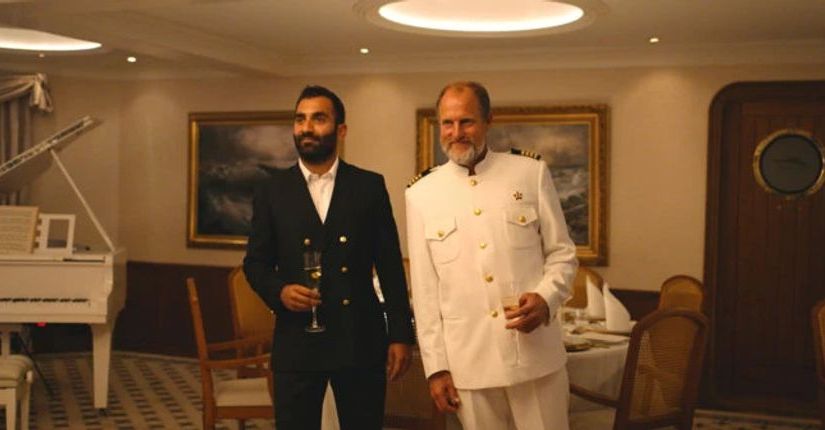
The centerpiece of the film is Part II (“The Yacht”) where Yaya has been complimentary invited to sail on a small, luxury yacht with other passengers, all stemming from the most elite and wealthy social class.  Yaya’s influence will lend testimony to the vacation voyage.  Carl is her plus one.  The other passengers include a husband who made his fortune “selling shit,” or more appropriately, fertilizer.  Another couple are thriving off their success selling hand grenades worldwide.  The staff of the yacht have a rah-rah session led by their cruise director, Paula (Vicki Berlin), who stresses that whatever the passengers say or need is right and should be completely satisfied.  What will that lead to?  Better tips!!!!!! WOO HOO!!!!!  She gets the primarily white and attractive looking staff in a clapping and stomping frenzy of enthusiasm for the voyage while the maintenance crew of darker skinned minorities are on the deck below waiting to clean or do housekeeping with no sense of gratitude for their service.  What’s in it for these people on the bottom deck?

Part II of Triangle Of Sadness really drives home the point of the picture.  These wealthy folks rely on their satisfaction based upon how they are catered.  Carl thinks he is so elite that he inadvertently gets a maintenance man fired for cleaning the boat while shirtless.  A woman insists the sails are unclean compared to the pictures in the brochure.  Paula will ensure it is addressed.  Another woman insists that all the staff do a swim with her.  The cooking staff has to prepare for the Captain’s dinner.  If they swim, the food risks getting spoiled.  Doesn’t matter though.  This passenger has asked for a staff swim and Paula will make certain the upper class are accustomed.  It doesn’t help either that the Captain (Woody Harrelson) – the man in charge – refuses to leave his cabin and thus no one with authority is steering the ship away from choppy waters and a violent storm.  As such, the Captain’s dinner is going to be unforgettable for sure.

Part III is known as the “The Island” which depicts a turn of events when seven surviving people are marooned on a desert island following the graphic complications of that doomed dinner at sea.  Dynamics in social class take a drastic turn here.  The rich and privileged don’t know how to fish or build a fire.  So, what happens when a maintenance worker does?

The message of Ruben Östlund’s film is not surprising to me.  Yet, how many of us forget that we all biologically evolve the exact same way.  We come from the womb with the same appendages and capabilities to eat, breathe, learn, and digest.  Eventually we all face the same demise.  What I appreciate about the movie though is how many people of a wealthy social class are incapable of fending for themselves, even in the most desperate of situations.  What can a social media influencer do for her fellow man or woman beyond taking endless selfies of herself?  How can a man who profits off of selling fertilizer or hand grenades survive with just the raw materials of the earth?  How can a woman suffering from the aftereffects of a stroke with limited communication make due for herself? 

Östlund’s script examines the dependability of one for the other, and how it is taken for granted.  The dependability is not from equal peers though.  Östlund goes a step further when the one positioned lowest on the pole turns herself into the highest rank when any kind governing mandate is dismissed.  In any community, opportunity will allow someone to always usurp the higher cabal and assume his/her own dominance. 

There are many ways to deliver the message of what is unfair or what is right in a social class system.  I don’t think I risk much by declaring that anyone who watches Triangle Of Sadness should have a presumption of extending value and appreciation to his/her fellow neighbors, even if we don’t always live by that mantra.  What will divide audiences of this satire though is in the route that Ruben Östlund adopts to make his point.  In The Three Stooges, the wealthy would lose their dignity and authority when they got struck with a pie to the face, humiliated by the well-known vagabonds.  Here, the wealthy gradually toss their cookies as the boat continues to toss and turn with no Captain at the wheel, while they all continually try to consume the fancy prepared entrees that are not agreeing with them.  I could tolerate and laugh at that ugliness that surfaces during Part II of Östlund’s film.  My wife could not.  I can appreciate a good pie splattered in someone’s deserving kisser as well.  My wife doesn’t like The Three Stooges.  However, the point is what we agree upon.  The approach is where we differ.  My wife could have done without watching endless streams of vomit spew across the dining room or toilets bubbling over with brown sewage.  I can’t fault her for that, though.  It is disgusting.  It’s supposed to be.  I wouldn’t want to watch my wife or child get violently ill.  For that matter, I wouldn’t want to watch anyone in real life succumb to that state of helplessness.  Fictionalized mediums allow that opportunity though. 

An interesting angle that Ruben Östlund takes is as the ship is spiraling out of control, the Captain engages in a drunken debate with the wealthy fertilizer seller on the positives of communism vs capitalism.  Both men use the loudspeaker to preach the gospel of celebrated leaders like John F Kennedy and Karl Marx.  Our leaders are arguing.  The constituents of this doomed boat have no choice but to listen, all the while they are drowning in their own vomit and shit.  These are just words that our leaders are drunkenly shouting.  Heck, these guys didn’t even write these policies.  They stole them from pioneers before them.  Where’s the execution leading to a salvation for their community, though?

As I continue to write this column, it occurs to me how much I listen to the guidance of others.  A doctor tells me what pills to take.  An article will explain what foods are bad for me.  A politician will tell me his or her platform is the best course.  I write critiques of movies encouraging readers like you to watch or avoid. These are all sources of authority that we are exposed to everyday.  Triangle Of Sadness explores what occurs when those sources are taken away and we are each individually left to our own devices. Maybe Ruben Östlund’s testament is that only the meek shall inherit the earth.

I can not promise that you’ll like Triangle Of Sadness.  You will appreciate the message though, and whether you care to or not, you will think about it for a while after it is over.  Hence, another satire has done its job.

WOMEN TALKING

By Marc S. Sanders

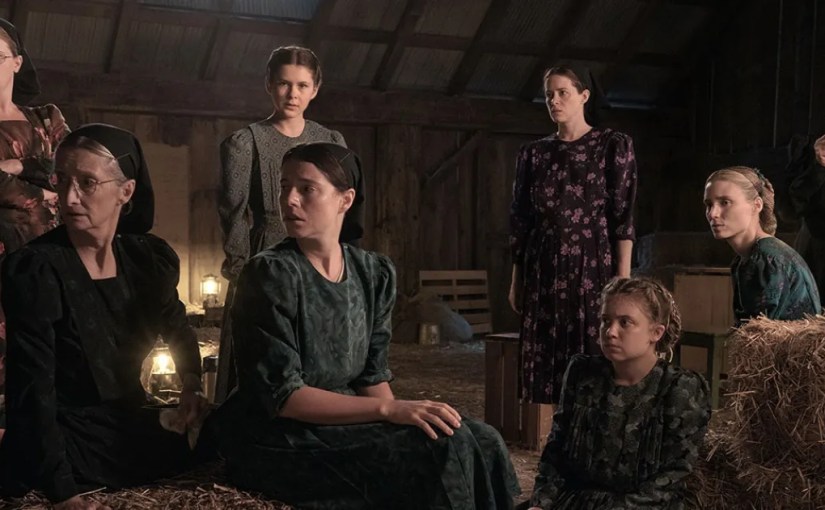
In the year 2010, a sect of women must hold congress in the upper level of a barn to debate whether to leave their colony or stand and fight against the oppressive men who rape, beat, and brainwash them into believing they will be denied entry into the kingdom of heaven should they never offer forgiveness and tolerance for the abuse they suffer.  That is the story of Women Talking, written and directed by Sarah Polley, from the novel by Miriam Towes.

From IMDB, Towes based her novel on a true story of vicious serial rapes in an insular, ultraconservative Mennonite community in Bolivia. From 2005 to 2009, nine men in the Manitoba Colony, using livestock tranquilizers, drugged female victims ranging in age from three to sixty and violently raped them at night. When the girls and women awoke bruised and covered in blood, the men of the colony dismissed their reports as “wild female imagination”–even when they became pregnant from the assaults–or punishments from God or by demons for their supposed sins.

Sarah Polley’s film works like a stage play.  She shoots with deliberately dim cinematography as if to have you feel the cold, helpless isolation the women of this fictional community endure.  These women are smart but uneducated in reading or writing.  When they vote for what do, pictures are drawn to display their options.  Two figures with dueling swords are drawn for stay and fight.  A horse is sketched for the choice to leave.  The women cast their ballots by drawing an X under the picture they opt to follow. 

To know that this piece of fiction is inspired by true events is very chilling, and when the film finishes there’s much to ponder and talk about.  It stays with you.  A young educated man named August (Ben Whishaw, in a beautifully reserved performance) from a university is recruited to keep the minutes of the meetings.  Topics of debate include if they should leave with a mass exodus of all the women, do they also take the young boys; most of them products of the numerous rapes they suffered through.  At what age are these boys incapable of trusting they will not be as monstrous as their bastard and abusive fathers?  What about August?  He is harmless and sympathetic to the ladies’ victimizations.  Shouldn’t he be allowed to go too, or because he is a man, is he excluded?  Frances McDormand’s character, whose appearance lives up to the name Scarface Janz, insists upon doing nothing.  She’s convinced they will be denied entrance into heaven by their almighty God.  To not forgive their attackers is a sin.  Is doing nothing an option?    If they stay and fight, how exactly will that be done?  Violence is an unforgivable sin, as described in doctrine.  How else do you fight against the constant attacks of violence, though?

Women Talking deserves an audience.  It’s a very good film because it draws attention to a modern day hardship.  When there are communities like this in the world that most of us are unaware of, how are the members accounted for?  Are they being nourished and educated and living comfortably?  Is everyone safe and protected?  If they are not, then how are they getting the justice they are entitled to, and do they have a chance of survival?  I appreciate when movies can open my eyes to a reality for which I have yet to carry any regard or awareness.  I feel taught having watched a movie like Women Talking

When the movie began, before knowing anything of what the story was about, my first presumption was that maybe this is an Amish or Quaker community based on the farm country setting and the simple wardrobes of the characters.  The time frame was uncertain to me as well.  Horse and buggies are shown, but no automobiles.  So, is this the early twentieth century, perhaps?  Only after the first ten minutes of exposition, did I realize this was something else taking place within a more recent time period.  It is astounding how far we’ve come globally with the rights of women, minorities and the overall oppressed.  Yet, there are those who regrettably remain overlooked.

Polley’s script is rhythmic with strong dialogue, and the cast of actresses (Rooney Mara, Claire Foy, Judith Ivey, Frances McDormand, Jessie Buckley) are quick with their retorts when one makes one statement after the other.  There are lots of fascinating arguments at play here, reminiscent of Sidney Lumet’s 12 Angry Men.  Again, this is gripping material ready for live stage work. 

I did have a problem with the picture, however. The trajectory of the film works on its dialogue of debates.  The actors deliver lines from Polley’s script perfectly.  This is a smart collection of actors.  Still, it is challenging to keep track of what platform each woman stands upon.  When one gets swayed from one argument over to other side, it is also a little tricky to realize when that has occurred.  Who is staunch in their beliefs is also difficult to keep track of.  The dark photography that Polley layers the film with is meant to be morose.  It works.  It places you in the helpless mood of these afflicted women.  When you consider the practicality of the piece though, it makes it hard to identify who is who and what perspective they have.  Often, the characters don’t stand apart from one another.  It might sound trivial.  I may risk putting a stain on the filmmaker’s art.  Nonetheless, but it got in the way of the movie I was watching.

It is a blessing that Women Talking has received Oscar nominations for Best Picture and for Sarah Polley’s screenplay.  Had it not, the film would likely go unnoticed, and it cannot afford to be.  Sarah Polley’s film deserves attention.  Any one of us may never come upon these very private, hidden, and isolated communities that function under an unfair governance.  However, the film demonstrates the vicious dominance that one sex can have over another which still remains all to common.  No matter how much wiser we have become as a people, there are some who still have never gotten the message.

APOCALYPSE NOW

By Marc S. Sanders

Francis Ford Coppola’s Vietnam War masterpiece, Apocalypse Now from 1979, focuses on a madman assigned to find another madman and assassinate him.  I look at the film as a spiral into a dark, demented psychosis.  Each section of Coppola’s film appears like some variation of insanity within an environment and period of time where there was no end in sight for a war that was going out of control.

Captain Benjamin Willard (Martin Sheen) is first shown in a hotel room that he has ransacked during a drunken rage, going so far as to smash his fist into a mirror.  His voiceover explains the horrifying experiences he has already endured.  Now he is at a point where killing is all he is capable of performing. He is summoned to a General’s lunch where he is assigned to seek out a highly decorated Special Forces soldier named Colonel Walter Kurtz (Marlon Brando).  Kurtz has taken his squad over to Cambodia without authorization.  It is believed that he has gone insane with his will to harbor people over there into a cult that he controls while engaging in his own actions against the Vietcong.  The army needs this problem contained and Willard has been selected to terminate Kurtz.

Apocalypse Now is primarily about the journey, rather than its destination.  Willard is to be escorted by patrol boat up the Nang River to find Kurtz and complete his mission.  Along the way he will encounter a variety of scenarios and characters. 

The standout character is Lt Colonel Kilgore (Robert Duvall) the commander of a helicopter calvary battalion.  Willard meets up with Kilgore early on as he will provide an opening on the river for the long journey to begin.  This is the most memorable section of Coppola’s film.  Robert Duvall is truly maddening as he relishes in the destruction he commands.  Kilgore is amused to blare Wagner’s The Ride Of The Valkyries as his choppers blast the shore line where Vietnamese villagers and farmers reside.  Duvall almost seems god like during this sequence because he does not even flinch as explosions and armory are set off mere inches away from him.  He’s crazed enough to even send his troops out into the ocean to surf while the mayhem is still occurring.  When he takes off his shirt while proudly wearing his calvary hat, sunglasses and yellow scarf around his neck, he utters the famous line “I love the smell of Napalm in the morning.”  There is no hint of sarcasm in that line.  Kilgore truly means it.  The commands of war are his absolute pleasure.  The only human feeling that Kilgore shows is when his personalized surfboard turns up missing.  Otherwise, the carnage he leaves behind is a job well done.

Why do I focus on this sequence so much?  First, it is a perfect construction of filmmaking and acting combined.  Coppola’s clear daylight shots of the choppers advancing on the surf are an amazing sight to behold.  To have that much control of so many vehicles in the air so that a select number of cameras can take in the sequence amazes me.  It is feats like these that show why I love movies so much.  The moment is more enhanced with Wagner’s piece accompanying it.  This could all be appreciated as simple documentary style filmmaking.  However, when you combine the mayhem Coppola stages with the proud march of The Ride Of The Valkyries, and Duvall’s crazed glee of commanding this episode of mass destruction, you start to see a pretense.  The hypocrisy of all the elements contained in this sequence tells the story. This country and its people are being obliterated by a crazed individual arriving from the heavens above.  As the scene progresses, my mind returned to the overall plot of the film; the mission of the protagonist which is to kill a lunatic.  At this point in the picture, I have yet to meet Colonel Kurtz.  So, how much of a madman must Kurtz be when compared to a maniac like Kilgore?

Later sequences carry on the insanity theme.  A trio of Playboy playmates are brought in to entertain the troops during one of Willard’s stop overs.  Yet, the crowd of soldiers gets out of control and the entertainers are forced to flee by helicopter with some of the men grasping on to the chopper as it takes flight.  My thoughts were you must be insane to continue hanging on while it gets higher into the air.  Let go for heaven’s sake before you plummet to your death.  Nevertheless, these half naked women are the purest, most angelic thing that these boys have ever seen since being recruited into this hellish nightmare. 

Willard’s crewmen on the patrol boat seem too green with the impacts of war.  They are not as battle weary as Willard.  There’s a guy named Lance (Sam Bottoms) who seems happy go lucky to play the Rolling Stones.  There’s a chef by trade (Frederic Forrest) and a young kid who goes by the name of “Clean” (Laurence Fishburne).  Chief Phillips (Albert Hall) drives the boat.  Willard must keep his mission classified.  These men are only supposed to get him to his destination no matter how far up the river it takes them.  These soldiers are riding into the unknown, escorting a crazed fellow who knows that a positive outcome is not likely.  Coppola provides moments where the men lose control of their senses.  These boys don’t come as informed about what is right and wrong within the parameters of war.  Innocent lives are taken as the patrol boat continues its horrifying tour.  Their lives might be taken as well.  The question is what is the worse cost?  Death, or the horrors they encounter, act upon, and live with thereafter?

It’s notable to watch Frederic Forrest’s performance as he transitions into a mindset with no other option but to slaughter as he dons camouflage makeup later in the film.  Albert Hall’s performance lends some sensibility to the picture.  However, how does Chief Phillips’ receptivity measure up to the crazed obsession that Willard has for completing his assignment?  It’s all quite tragic as the film moves from one moment to the next.

As expected, the third act of the film focuses on Willard’s encounter with Kurtz.  Before all of this, we follow along as Willard reads through the extensive files of Kurtz’ history and career.  This man seems like a giant among giants and in 1979 it seems only befitting that a giant of an actor portrays the mysterious Colonel.  So, that actor had to be none other than Marlon Brando.  Oddly enough, this portion of the film is where the film starts to wear out for me.  Kurtz is insane in a quiet and dark way.  Coppola shoots much of Brando’s performance in darkness.  I’m aware of the purpose with that kind of filmmaking, but it is a long section of film to watch an actor move in and out of the light.  Brando comes off mysterious with lines of dialogue that make little sense at times.  Some allegories work as he describes Willard’s purpose as that of a clerk delivering groceries.  Yet, Kurtz seems the least crazed of all the crazies provided within Coppola’s film. 

A babbling, hippie photographic journalist (Dennis Hopper) greets Willard upon his arrival.  He’s talking in circles with envy for Kurtz, his leader, who resides within the tomb like structure along the banks of the river.  The natives also seem to heed towards Kurtz’ influence.  Willard is taken captive and tormented.  Still, when Kurtz speaks he doesn’t come off so kamikaze like the others we’ve seen before.  I can only presume there are levels to insanity.  Madness is not a well-defined ailment.  I find it ironic that Kurtz, the great soldier and decorated war hero, is deemed the greatest threat to the armed forces’ image within this conflict.  Kilgore, on the other hand, has free reign to slaughter helpless women, children, and farming communities all in the name of victory while commanding his underlings to surf along the coastline. 

What is so mystifying about Apocalypse Now is how thematic the movie seems to be.  It follows this common pattern demonstrating how crazed the effects of war can have on people.  The killing and bloodshed are the most apparent of course.  However, the military declares early on that there is a loose cannon within their ranks that must be contained.  The only option is to kill this man, who has done his bidding for the progress of its army for so long.  This man, Colonel Kurtz, has sacrificed promotions in ranking and a return to a quiet life with his wife and children, so that he can continue with carrying out the agendas administered by his government.  Yet somehow, he crosses a border, and he no longer kills the way his superiors want him to, and now he must be terminated.  The hypocrisy is to send a madman to do a madman’s bidding, as if that will preserve some sort of sanity within this out-of-control conflict.

I could not get away from that impression during the whole three-hour running time of the film.  Practically every caption, scene, expression, or scenario is rooted in madness.  Francis Ford Coppola wrote the script with John Milius and it’s been said that much of the filmmaking was done on the fly.  Still, with Coppola’s direction along with a strong cast, particularly from the quietly, reserved Martin Sheen, the message comes through clearly.  War begins with a difference in politics and a need for further control.  Pawns are the collateral damage used at will to settle the argument.  Rules of engagement may appear formally on paper.  However, is anyone with a gun in his hand or facing the end of a loaded barrel going to pause and consider what’s just and appropriate before taking action? 

Apocalypse Now speaks to an end of days where the soldiers sent to do the bidding of others respond by doing what they ask of themselves.  Therefore, I’ll end this piece on a vague note. 

There is no organized effort when it comes to war.

NOTE: This article is based on my viewing of Coppola’s third iteration of his film, entitled Apocalypse Now: The Final Cut.

GUESS WHO’S COMING TO DINNER

By Marc S. Sanders

Watching Stanley Kramer’s Guess Who’s Coming To Dinner had me reflect on a brief encounter I had many years ago.  I was a head teller in a bank and approached the drive thru window to collect a customer’s transaction.  The junior teller who was part of my team got there before me and as she reached for the checks and deposit slip she commented “That’s disgusting!”  I was so engrossed in a busy day that it didn’t register until later what she was referring to.  In fact, I’m proud it did not register.  The customers in the car were a mixed couple with two children in the back.  I guess I’m happy to be naturally color blind.  Sadly some others still live with such an ailment.  We’ve come a long way, but I think we have a lot further to go.

Guess Who’s Coming To Dinner is a classic American film that should be watched by anyone with a pulse.  If not for anything else, then to realize that somehow our human nature is held back by prejudices that we can not keep from considering.  So, let’s learn to overcome whatever foolhardy thinking stands in the way of happiness for ourselves and our loved ones.

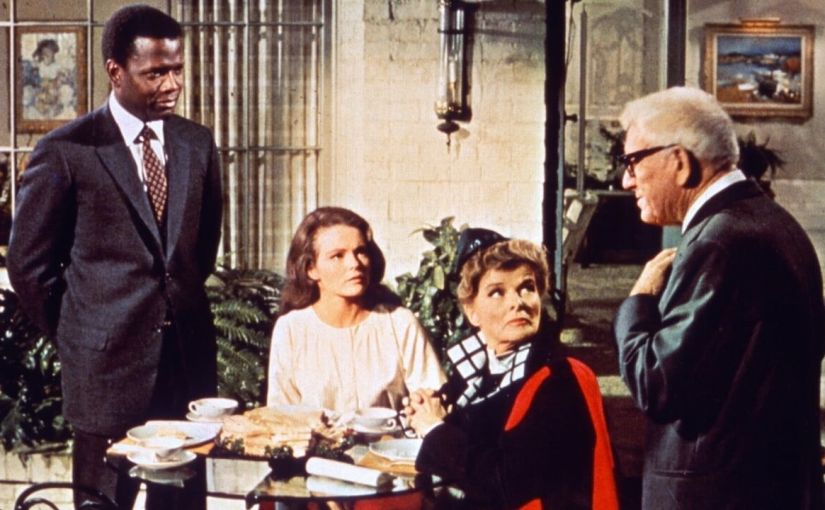
Sidney Poitier portrays Dr. John Prentice, a gentlemanly successful, polite, and brilliant physician with an educational background from Johns Hopkins, a professorship at Yale and internships with the World Health Organization in Africa and Asia.  He has just flown into San Francisco from a Hawaiian vacation with the young girl he has fallen madly in love with, Joanna Drayton (Katharine Houghton).  Joanna is the daughter of Matt and Christina Drayton (Spencer Tracy, Katharine Hepburn).  She is a highly energetic twentysomething with an optimistic view on life.  Everyone else has to take a second look at the fact that Joanna is paired up with a Negro or a colored man (as the movie indicates).  Even their cab driver has to offer an odd glance while the happy couple kiss in the back seat.  John is even aware that it can be a little startling at first.  Joanna doesn’t give it a second thought as she was raised by liberal parents who taught her that no race or creed is better than any other.  Everyone is equal.

The test for Matt and Christina however is whether a black man can be a husband to their white daughter?  It’s much different when you are on the outside looking in.  How do you respond when such a scenario occurs within your own household.  Even the black loyal housekeeper to the Draytons, Tillie (Isabel Sanford), takes a serious contempt towards the situation, more vocally than Joanna’s parents.  For Tillie, this is a hairbrained stunt by a wild-eyed young girl.  John’s parents fly up to meet Joanna and they have reservations as well.  It does not help that John doesn’t share with his mom and dad that Joanna is white ahead of meeting her in person.  Joanna also did not offer the same courtesy to Matt and Christina about John.  Curiously, for Joanna it should not even make a difference.  For John, he’s hesitant because he knows this will not play out well, initially. John is okay with his new, loving relationship.  He’s wise enough to know that his parents, particularly his father, will not be, however.

What caught my attention more than anything was the difference in age between John and Joanna.  He’s 37.  She’s 23. 

In Stanley Kramer’s film, there isn’t so much a prejudice towards whites or blacks.  It’s more so that there is a reservation toward a mixed race couple.  Should blacks only belong with blacks, and whites only belong with whites?  Of course not.  However, biting sarcasm is tossed into the script suggesting that what Joanna and John are doing would be considered illegal in 14 states.  It wasn’t at the time of the release of this film in 1967, but this was just ahead of when Dr. Martin Luther King Jr was assassinated amidst the civil rights movement spreading throughout the country.  Joanna even makes reference to the fact that she would not let go of John even if her mother was Governor of Alabama, who at the time was Governor Lurleen Burns Wallace, wife of notorious segregationist and former Governor George Wallace.  As well, let’s face it.  While it might be legal on the books, many in the United States were still intolerable of a living situation like this. Legally, a mixed marriage can happen.  Yet not everyone settles for just accepting what is law. 

Spencer Tracy as Joanna’s father Matt is the one who most prominently struggles with this situation.  He’s insisted upon to offer his blessing on John and Joanna’s upcoming nuptials.  However, he’s on a deadline to approve as they are flying out of town later that night and will get married in ten days while John is working in Geneva.  This is all contrived to contain the story within one day where a beginning is offered that must arrive at an end that provides closure.  It’s kind of sitcomy.  Christina warms up to the idea.  She likes John very much.  It’s Matt who has the problem.  It’s also John’s father (Roy Glenn) who takes issue as well.  His mother (Beah Richards) approves if the children are happy simply because she loves her son.

Spencer Tracy closes the film with his reasoning on the subject.  Arguably it is one of the most well thought out soliloquies in film history.  What I took away from it the most is that he stressed his concern for how hundreds of people across this country will look upon John and Joanna with unjustified derision.  Yet, the young couple will have to plow on and survive through those challenges. 

As a film, I could not help but account for a common theme in the picture which did not have so much to do with race as it did with a change in generations.  First, Kramer offers a quick escapist scene where a white delivery truck driver is bopping along to the latest rock music.  Tillie’s daughter joins in and hops in the truck for a ride with the fella.

Matt drives to a diner with Christina and orders an ice cream float.  Upon leaving, he accidentally backs his car into a young black man’s hot rod.  The older white man has to negotiate and accept fault with the younger, frustrated black man.  Once it is settled, Matt vents to his wife that he runs into one of them everywhere he looks.  Times have changed.  Matt has taught his daughter that no race is better than any other.  Does he realize that as well, though? 

Later in the film, Sidney Poitier as John has a stern conversation with his father.  John says in no uncertain terms that he owes nothing to his father.  He does not owe it to his father to not fall in love with a white woman.  His father owes everything to him for having him as a son, and he will commit that same mindset to his own children, if he should ever have any, regardless of the changes that come of that future generation.

There’s a reason Sidney Poitier is noted as a pioneer for black actors in cinema.  He was the first African American man to win an Academy Award for Lillies In The Field.  He also performed in Guess Who’s Coming To Dinner in the same year he made In The Heat Of The Night, which focused on a black Philadelphia cop headlining a murder investigation in the racist state of Mississippi at the time.  Both films were nominated for Best Picture. Heat won.  Poitier was well aware of the racist strife permeating throughout the country.  Per his insistence for his own safety, In The Heat Of The Night had to be shot primarily in the state of Illinois, away from the southern states that were not ready to accept a black man in an authoritative role.  I recall reading that Poitier refused to be cast in roles as the clown where the black man was treated as the punchline for white people’s entertainment.  He kept to a policy of adhering to roles demonstrating the intelligence of black men the same as other colleagues in his profession who were of the Caucasian race.  What an influence he was because of his doctrine.

Guess Who’s Coming To Dinner does not take daring risks with its story.  Every single character is likable, other than the racist colleague memorably dismissed early in the picture by Hepburn.  At times, the story does play like a sitcom ready to welcome a laugh track.  Nevertheless, it is an important film to see nearly sixty years later when racism and prejudice remain uninvitingly prominent.  The script, written by William Rose, is so sensible.  What is so wrong with a man, any man, in love with a woman, any woman?  Yes.  It feels unconventional when your household has consisted of one race for so many years or decades.  However, despite the difference in the pigments of two people’s skin, happiness is what is most important.  Matt testifies towards his unconditional love for Christina in his closing remarks and determines that is the one true factor in a relationship that must always be questioned whether it is the start of something new or something that has reached its twilight years.

As I come to my conclusion, again I reflect to that incident I had working in the bank with that teller.  What exactly was so “disgusting?”

NOTE: On this second viewing of the film, I specifically paid attention to Spencer Tracy’s closing monologue.  George Clooney recalled on Inside The Actor’s Studio with James Lipton, a story he heard.  Tracy was very ill during the making of this picture.  So ill, that Katharine Hepburn contributed financing to making this film to appease the insurance company that was concerned about the actor being unable to finish the project.  She drove him to and from the studio and often left early with him when she could see he could not go on much longer in the shooting days. During Spencer Tracy’s monologue, you can see him looking down frequently as he delivered his dialogue.  He was reading lines and blocking cues on the floor.  Clooney was just so impressed.  Typically, an actor would be directed to avoid looking down so much and focus on the camera in front of him or the other performers in the scene.  Spencer Tracy was just so impressive with his timing in this moment.  His glances down at the floor were embedded into the behavior of the character.  Sadly, Spencer Tracy passed away 17 days after filming was completed on Guess Who’s Coming To Dinner.  He received a posthumous Oscar nomination for Best Actor.  I like to think the challenge he endured lent itself to an adoring, beautiful and unforgettable performance. 

THE MENU

By Marc S. Sanders

Whether you’re the storyteller or the viewer/reader, you take a chance with satire.  The darker the satire is, the even greater the risk you take. A film like The Menu, from director Mark Mylod, is one such example. You’ll hate it…like my wife did, despite the lively conversation we had afterwards.  On the other hand, you might love its invention to strike back at an upper class that lacks any clue or respect for the talents of others. Then again, you just might only like it.  Well…at least I liked it.

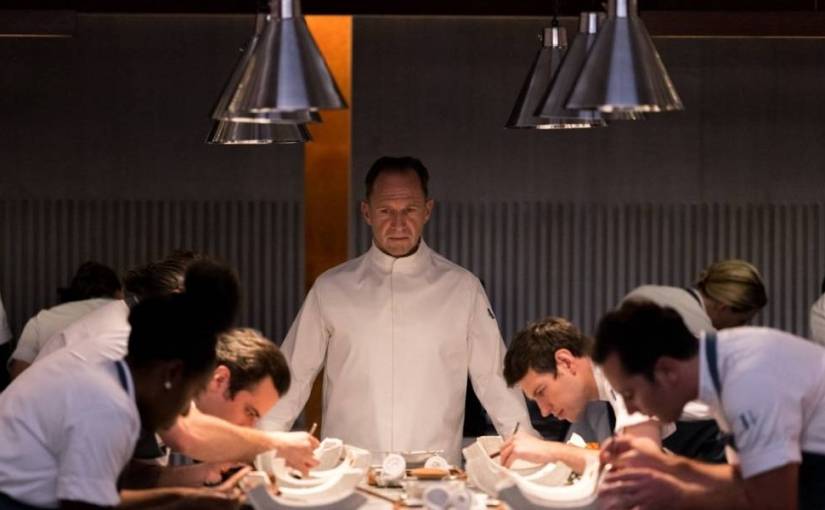
Ralph Fiennes’ résumé has earned a reputation to intimidate an audience. He is a superb actor who can be absolutely frightening as a Nazi in Schindler’s List, or heartbreaking as a torn affiliate of a deceitful plot like in Quiz Show. He can also go toe to toe as a Greek god against Liam Neeson, or he can demand that James Bond “Stand down!” and strike with snake like glee at Harry Potter. He can also teeter along the antics of the devil himself as he portrays the world’s most esteemed chef in The Menu.

A collection of guests is escorted by boat to a remote island where the finest restaurant is located and run by Chef Slowik (Fiennes), with assistance from Elsa (Hong Chau).  There’s Tyler (Nicholas Hoult), a die-hard fan of the chef’s craft with his date Margot (Anya Taylor-Joy), who is nowhere near as impressed.  Tyler has to remind Margot not to smoke, otherwise it’ll destroy her palette for taste.  There’s an older couple who has frequented the Chef’s dining establishments before and are back for another visit.  There are a pair of restaurant critics. There’s a movie star (John Leguizamo) with his young assistant.  Finally, there is a trio of sophomoric, yuppie businessmen who are here because their last monthly commission likely afforded this exclusive opportunity, and their favorite hockey team was out of town.

When the guests arrive on the island, Elsa gives them a tour ahead of the restaurant where they will eventually dine.  A cabin is displayed to show how the meats are aged over a period of 152 days. Quite specific! One of the yuppies has the audacity to ask what happens if you age it to day 153. I don’t recall Elsa’s response.  I do remember her disdain for the question though. They walk through the lodge where Elsa explains that the entire staff reside and sleep in the one room together. One cot for each person. Odd, but okay. Moving on is a quick pass by the cottage where the Chef resides, and no one is permitted to enter. Oooo!!!! I know one thing I expect to happen.

It is important to note that I opted not to read up on anything The Menu was about.  I didn’t know if I was to see a comedy, drama or horror film.  As this tour continued though, I had eerie recollections of the film Midsommar, directed by Ari Aster. That movie still gives me the bejeebees.  So much so that I could not bring myself to write an article about it.  Like that film, our cast has become isolated in a desolate locale, and the guide could not be more unsettling.  When they arrive at the restaurant, a large horizontal door is thunderously closed behind them. Margot gives a quick look back over her shoulder. This cannot be good.

Lending to the structure of the film, courses are presented with a startling clap of the hands from Chef Slowik. Mark Mylod executes a nice pattern of gracefully displaying text across the screen describing what the next featured course is, along with its fine ingredients.  It is elegant but also only partially revealing of some of the guests. Tyler isn’t the kind of fan that Chef would welcome.  After a request has been made not to take pictures of the dishes, he does so anyway.  He is uncouth with his commentary and clumsy as well.  Additionally, bewildering for Chef Slowik is the presence of Margot. He was not expecting her to attend. Yet, here she is and he cannot understand why.

The Menu does not deviate from its intent to be strange. A bread dish is presented without any bread! Only the dips. Tyler is absolutely impressed. Margot thinks it is ridiculous. By the time, the fourth course has arrived, a shocking presentation is exhibited to the guests and that is where the film takes a graphic turn.

It’s best not to reveal much about the movie.  Its features work if you share the perspective of the guests, particularly Margot. What you are left to decide though is if you accept that dark satirical nature of the piece.  You will or you won’t.

I did not find The Menu to be very symbolic, allegorical, or even a reflection of the natures of social classes who partake in exclusive high-end cuisine.  Chef Slowik has prepared a specific plan for this assortment of guests. The execution and outcome cater to his personal satisfaction and no one else’s.  I guess that’s why I only liked the wit behind the message of the film.  I just could not fully embrace its invention.

My experience with satire typically allows me to think about how people behave and what they can learn from outrageous proposals or extreme actions. Network explores how the world responds to what is proposed for satisfying television audiences while generating business profits.  A film like The Menu delves into grandiose, unheard of actions that will satisfy the one puppet master behind everything you are seeing.  Maybe I was looking for the message the Chef delivers to include my own misgivings and sins and temptations in his overall delivery.  Instead, his machinations rely on these specific guests on this particular night, and so I kind of felt left out of the circle. As the guests are specifically affected by the developments of the evening, I can’t say I had any care or sense of suspense for them.  Nor did I care for Chef’s own satisfaction as the evening carries on.

The cast is a terrific eclectic assortment. Anya Taylor-Joy is a smart and forthright hero against Ralph Fiennes’ antagonist. A well written conclusion that made me applaud is included by her character’s deductive reasoning. The other players though are not given much fat to chew on in terms of dialogue or scenes.  Their purpose is specifically explained, and then they are left to watch and wait for the climax of the film. I like the veil that is lifted from Margot’s character.  I would have welcomed a little more subtext on the other characters, however. Again, their purpose is laid out, but I think the film, which clocks in at around an hour and forty-five minutes, could have dug a little deeper into the guests sitting at the other tables. Not to mention those few who also serve on the Chef’s cooking staff.

The Menu is an unusual film, like an episode of Tales From The Darkside or The Twilight Zone.  It is limited like a TV episode. I just think it needed two or three more courses to savor just a little more meat on the bone.

THE BANSHEES OF INISHERIN

By Marc S. Sanders

You ever hear of the modern term “ghosting?”  Normally, it applies to social media, like with Facebook, Instagram and every other brain cell sucker app we occupy ourselves with on our electronic devices.  It’s where suddenly, for no reason at all, a friend or acquaintance will stop speaking to you.  They will ignore your attempts to talk.  If they do talk to you, they simply will say stop talking to me and do not call me again. They will never share a reason for this new perspective they have for you.  They just want to continue with their lives without you being a part of it.  I have been ghosted on two separate occasions.  It hurts.  It really hurts, and I constantly must remind myself not to dwell on these people.  They don’t care.  They lack any further regard.  It’s just unbelievably puzzling when it happens.

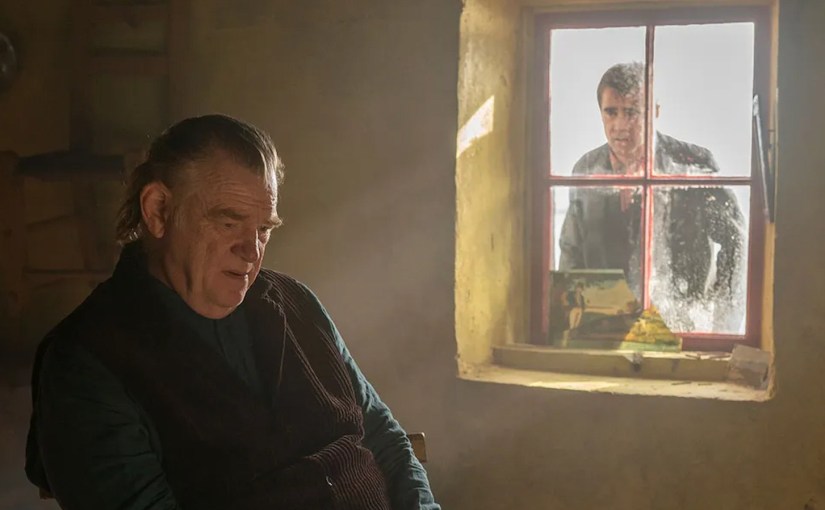
With The Banshees Of Inisherin, director Martin McDonagh reunites Colin Farrell and Brendan Gleeson, who shared the screen together in the well received In Bruges, to portray these two former friends.  Farrell plays Padraic.  Gleeson is Colm.  The film takes place in 1923 on the fictional Irish coastal island of Inisherin.  Padraic strolls over to Colm’s house to walk with him to the pub for their daily 2pm pint together while they chat.  Upon arrival, Colm is seen sitting in his home, ignoring Padraic’s knocks on the door and window.  It’s odd and unexpected. 

When Padraic shows up at the pub alone and later Colm arrives, the other regulars ask Padraic if the two lifelong friends are “rowing.”  Not to Padraic’s knowledge.  Maybe this is an April’s Fools joke?!?!

Colm holds true to his new position.  He explains to Padraic, with no uncertain terms, that he no longer wants to speak with him.  Padraic makes attempts to open up to Colm hoping they can hash this out, but there is nothing penetrating Colm’s stance.

What lends to the sustenance of the near two-hour film is the setting that Padraic resides within.  An island in the middle of nowhere where he has no interests or hobbies or specialties for anything.  He really has only happily lived with his friendship with Colm, which is now suddenly yanked away from him.  He lives well with his sister, Siobhan (Kerry Condon), and his adoring miniature donkey, Jenny.  Siobhan truly loves her brother, but not Jenny or the other animals who reside on their property.  As the Irish Civil War is coming to a close, an educated Siobhan is ready to move on from the nothingness of Inisherin.  Padraic is not.  He’s lived so comfortably on the Irish coastal island his whole life.

Colin Farrell is an actor you want to embrace in this film.  As I’ve experienced something similar to what Padraic endures, I can relate to what stuns him at his sudden loss of friendship.  Padraic is a good man.  Colm knows this which is seemingly why extremes needs to be undertaken to stress exactly how Colm feels about Padraic going forward.  Colm cannot simply plead for Padraic to move on.  He first makes the request.  Later, he has to do something else to deliver his point.  When I say extremes are taken, you can not even imagine what occurs.  It’s shocking, but believable. 

Brendan Gleeson normally offers an intimidating presence on screen.  He falls into roles of men you’d likely only cautiously approach.  The same goes for his character of Colm here.  McDonagh wrote the character with no compromise. Only when a significant turn occurs, does Colm violate his feelings with how he regards his former friend.

Kerry Condon should get an Oscar nomination along with Gleeson and Farrell. Siobhan is both a loving sister but while she’s the younger sibling, she is also the more sensible.  As Siobhan, Condon’s timing for losing patience in the part is well paced.  Condon is awarded with some of the best dialogue in the script.  McDonagh could have written this film from the perspective of her role, rather than Padraic’s, and I bet it would still work thanks to what she lends to the piece.

Barry Keoghan plays a young regular around Inisherin named Dominic.  Kind of like a local idiot who is undeservedly abused by his policeman father.  Keoghan’s role is a side story, but he plays it so well.  Despite Siobhan’s protests, Padraic takes Dominic in.  He’s not meant to replace the void that Colm left in Padraic’s life but it further reminds you of the kindness of Farrell’s character.  It begs the question why someone would ultimately stop speaking with a good person like Padraic, at a given instant.

My wife was not interested in watching this film and asked me to give her a rundown of what happens from beginning to end.  When you describe The Banshees Of Inisherin out loud, you sound ridiculous even though you’ve appreciated some of the surprising moments you just watched.  I told my wife; you have to see it to understand.  I understand Padraic’s yearning for the friendship he once had.  I understand the measures he takes in response to the one thing he valued beyond his sister and his pet donkey.  When you live in a low populated island town with little stimulation beyond the people who have been a part of your entire life, to suddenly lose that is devastating.

Martin McDonagh has crafted an unusual script.  Often, break ups in films go the traditional route of the loving relationship going through a split.  If it’s a friendship, I’d argue I’ve seen it occur more often between two women.  McDonagh’s film acknowledges the impasse among two grown men.  His script could have been occupied only with dialogue constructed of standard duet scenes between two very strong actors.  Fortunately, he doesn’t just rely on that.  McDonagh stretches his imagination further to drive home the point of how these two men respond to this unfortunate outcome.  The actions they take are startling, but as I reflect on the script for the film, I cannot deny how alert McDonagh is with crafting the motives of his characters. At the very least, I’m empathetic for poor Padraic who struggles with the loss of a friend. 

To lose a friend is to lose a part of your soul. What can I say? I’m an overly sensitive guy.  It’s always been my Achille’s heel.  How do I survive, though? I think back to what my father once told me.  He said “Marc, if you have one friend in life, then you’re the luckiest guy in the world.”  Thankfully, I’m rich in many friendships.

Forgive my digression though.  It’s important to know The Banshees Of Inisherin is a very good and a very sound film.

BABYLON

By Marc S. Sanders

Director Damien Chazelle has come a long way since his first major motion picture, Whiplash, a small film about a young, tortured drummer.  Since that accomplishment, he seems to get more and more elaborate with each project.  Babylon certainly exceeds ambition in any select 3–5-minute scene it offers within its grand opus.  The main title card doesn’t appear on screen until after the first thirty minutes and by then you are exhausted, yet completely awakened.

Babylon begins in the mid-1920s, during the pioneering times of Hollywood filmmaking where silent films were fresh and were regarded outlets for escapism and entertainment.  Big studios like MGM were not quite on the scene just yet and movie makers experimented with their films having no regard for rule and caution while constructing them.  On a busy day of shooting at around 3:15pm, an open field sword and sandal battle might turn up an extra in an accidental death with an impaled spear.  No matter.  Must keep shooting before daylight is lost and everything runs off schedule. 

It was at this time that a star like Jack Conrad (Brad Pitt), rugged with a square jaw and dashing with a pencil thin mustache, offered greatness in movie houses that showed silent pictures.  A new discovery like Nellie LaRoy (Margot Robbie) who seemingly came in off the street captured producers and patrons alike with her wide-eyed expressions and lanky, yet appealing posture.  These were the first celebrities of the advancing twentieth century.  They were starlets that brought people back and back again to the cinemas to witness battles of roman conquest or dancing on top of a bar while batting their long eyelashes for a mug at the camera.  The filmmakers loved to work with them. 

These performers ruled Hollywood until the Talkies appeared on the scene.  Movies with sound revolutionized the industry, but these famed individuals couldn’t keep up with the evolution.  Audiences and filmmakers couldn’t accept a compatibility.  Try to imagine a Jack Conrad listen to a packed movie house chuckle at one of his romantic speaking scenes.  It’s heartbreaking to watch.  He was admired, but now he’s a joke.

When the sun would set, the parties soaked–make that drenched–in orgy and debauchery would begin and nothing was off limits.  Naked women would happily get high and drunk and tossed over a large crowd.  Prop penises would be inserted into one partygoer and then another and then another.  Fat ugly men would happily accept getting urinated on.  Endless amounts of liquor and especially cocaine would be gulped and snorted and the greatest dares imaginable would always try to top themselves.  Have you ever heard of a party getting so out of control that someone would go so far as to wrestle a rattlesnake in the middle of the desert?  Jack happily watched all this decadence go down.  Nellie joyfully became the outrageously intoxicated and fearless ringleader. 

I have offered only a sliver of description for Chazelle’s over three-hour film.  To sum up, Babylon offers a hard-edged response to the family friendly interpretation found in Singin’ In The Rain.  Both films delve heavily into the transition of silent filmmaking to talking pictures and those who were left behind.  Gene Kelly and Stanley Donen’s G rated picture will have you giggle at their Lina Lamont with the squeaky voice and pratfalls who’s all wrong for the next phase.  The heavy R rated dramatic interpretation is offered in Chazelle’s script with Margot Robbie’s Nellie LaRoy and her Jersey accent, accompanied by unrefined posture and behavior.  Her drug binges are no help either.  Margot Robbie is fearless in her performance.  She is messy, sloppy, harsh and frenzied with her character.  One thing that came to mind as she is snorting line after line of coke is that at that time, there was no such thing as a means for rehabilitation like today.  No one was even looking out for the harm that drugs and alcoholic binging could have on people.  People were left to their vices to just drown in their poison of choice.  For silent pictures, you could plaster them in makeup and costume and let them mug and bat their eyes for the camera.  It didn’t matter if their speech was slurred.  Talkies required much more concentration of their performers.

The main player of the film is newcomer, Diego Calva, as Manny Torres.  A Mexican who inadvertently finds himself in the Hollywood nightlife while pushing an elephant up a steep hill only to get shit on.  (The elephant serves no purpose except to make an appearance at one of these crazy parties.)  Manny has an instinct for what’s to come in the movies and builds himself up into a studio executive.  While he’s dangerously falling in love with Nellie, he’s also discovering next big things like a Negro entertainer who’s magnificent with a trumpet, Sidney Palmer (Jovan Adepo).  Manny is a good man who swims above the dangerous life of Hollywood partying and decadence.  He’s an innovator that’ll never receive credit for what he uncovers.  That’s for the white executives to profit from.

A minor but welcoming story is Sidney’s.  He’s soon hung on posters outside movie houses, and performing with big bands.  Hollywood awards him with riches he could never imagine and never asked for.  However, ironically, his complexion comes off too white against some of his other band players and the idea of caking himself in charcoal makeup is insisted.  How will Sidney respond to this humiliating request? The wealthy also have a particular regard for him.  His status as an entertainer.  Do they see him as a showboat clown or the artist he values himself to be?  How does Sidney want to be considered?

With all of the parties and drinking and drug use to go around, Babylon goes off in a hundred different directions before it finds an even keel outline that switches storylines from Jack to Nellie to Manny and Sidney.  Chazelle strives to one up what other filmmakers before have attempted.  I could not help but think about Paul Thomas Anderson’s Boogie Nights which follows the porn industry in the late 70s and early 80s.  Happiness abounds until time and technology and constant self-abuse cause everything to unravel.  Babylon follows a very similar trajectory.

A friend of mine found Babylon too be overly gratuitous.  She’s not wrong, but while she took it as a complaint with the film.  I take how superfluous the movie is as a major compliment.  There are long scenes where Chazelle will not surrender for the audience.  He shows how drug raged Nellie is when no one will fight that rattlesnake by having her violently pick it up, swing it around and thus it will eventually latch on to her neck while she’s running around amid a gang of naked partygoers.  Then we get to see another starlet cut the snake off below it’s head, rip its fangs out of Nelly’s skin and proceed to suck the venom out.  Oh, you’ll squint and squirm through the whole scene.  What do we learn from this?  Drugs are bad.  Really bad, and they will delude you into acting with no vices or boundaries.  So, let’s be completely honest about it.

When Nellie is recruited for a talking film, we see take after take after take of her trying to make her mark while it is shouted over and over again to the crew to shut the fuck up.  There can be absolutely no noise from anywhere that the mikes can pick up and it doesn’t matter if a crewman is getting dangerously overheated in a soundbox.  (No air conditioning could be allowed because the hum would be picked up by the microphones.)  It’s a brilliantly, well edited, long and tortuous scene of flaring tempers, sweat, heavy light and stress.

I remember reading an interview with Henry Hill, the mobster who was the focus of Martin Scorsese’s Goodfellas.  Hill said with no uncertainty that the characters portrayed by Joe Pesci and Robert DeNiro were not even close to how frightening and violent their real-life counterparts were.  So maybe even Scorsese glossed over how harsh that world ever was.  Damien Chazelle is a relentless filmmaker with Babylon.  Nothing is whitewashed.  Most of what you see is shock value, but that’s the message he’s conveying and per his research he must be convinced the life of this era was actually this outrageous and way over the top. He’s certainly not forgiving with how manic these people lived, particularly with Margot Robbie’s character.

At the same time, he calms the film down to offer a harsh truth to a quickly becoming has been like Jack Conrad, Brad Pitt’s character, no longer in his prime.  Jean Smart portrays a gossip columnist reminding Jack that the height of his career is long gone, but fifty years from now, new generations will be rediscovering his achievements.  He will be a legend for all eternity.  Chazelle is speaking to us, those that appreciate what Turner Classic Films and other formats like videotape and DVD offer to see the first of these kinds of pictures where it all began with legends like Jack and maybe Nellie and especially Chaplin. Chazelle was an important student of this later generation.  This is the best scene of the picture with a magnificently written monologue, and I won’t be surprised if Jean Smart gets an Oscar nomination that no one ever saw coming.  I’m inclined to declare she should just get the award.  It’s such a telling moment for all kinds of movies.

Chazelle loves to make films.  The epilogue to Babylon demonstrates his affection as his story jumps to twenty years later, and an older Manny watches Singin’ In The Rain in a theatre. From what he inadvertently brought to the fold all those years ago, movies have evolved and continue to develop into bigger scales of what we could never have thought possible.  Chazzelle edits in a sequence where it started with silent films like A Trip To The Moon and Keystone Kops over to grand musical ensembles and adventures like Ben-Hur and then on to special effects with quick cuts of Raiders Of The Lost Ark, Terminator 2, and Avatar.  Flashes of color appear on the screen and then quickly cut back to these captions in celebrated films and film stock.  I don’t believe any of this spoils anything of the film, but I like to recognize how Chazzelle takes inspiration from Stanley Kubrick’s bewildering conclusion to 2001: A Space Odyssey.  Movies are going on and on and on.  Whoever is hot now and presently significant will have to adjust to an ever-changing industry.  Once celebrated puppeteers working for guys like George Lucas have no value in an age of computer graphic engineering.  Big box office stars might not be able to uphold their careers during a time of streaming films that come to us by means of our flat screen TVs we can affordably buy at Walmart.  Kardashian girls are more widely recognized than maybe a Jack Nicholson or a Meryl Streep.  (Someone I know had no idea who Carol Burnette is.)

It’s hard to sum up everything captured in a film this big and ambitious and yes, gratuitous.  Perhaps, the best I can tell you is simply that a hard truth to accept is that casualties come from discovery in a film like Babylon

THE WHALE

By Marc S. Sanders

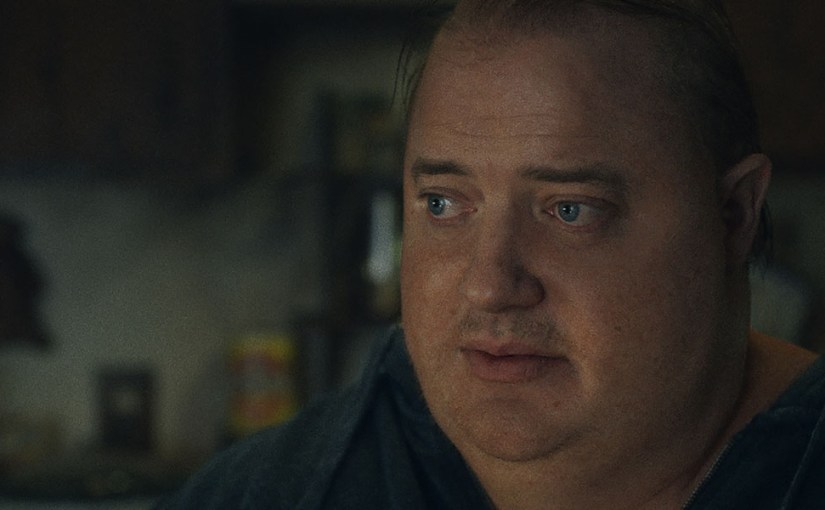
I still have a lot of catching up to do, but arguably the best performance by any actor in 2022 comes from Brendan Fraser in Darren Aronofsky’s The Whale, an adaptation of the stage play written by Samuel D. Hunter.

Fraser plays Charlie, an intelligent online writing professor.  His course is done online as he has become an enormously overweight recluse, following the loss of his boyfriend, circumstances to be revealed over the course of the film.  Charlie is so obese that he can barely walk, and he confines himself to the left side of his sofa with the television in front of him and his laptop nearby to conduct his courses or to pleasure himself with gay pornography.  He has a walker to get himself on to his feet and carry his bulk, but showering is not easy.  Even picking a key up off the floor is an impossibility.

He receives visits from his only friend, a nurse named Liz (Hong Chau).  When she arrives on Monday, she discovers that his blood pressure is indicative of congestive heart failure and urges him to go to the hospital.  He insists he can not afford the bills and has no insurance.  He also receives unwelcome visits from a young man named Thomas (Ty Simpkins) spreading the word of God with brochures from the local church.  Lastly, the visits Charlie treasures the most are from his cruel and mean-spirited daughter Ellie (Sadie Sink) who takes no reservations with berating Charlie as a deadbeat dad and only comes to him because she practically demands he write her essays to avoid dropping out of school.  She also rudely takes pictures of Charlie at any given moment.  Each time she raises her cell phone for a click, it feels like she is giving her father the harshest middle finger imaginable.

Much like an earlier film, known as The Wrestler, Darren Aronofsky explores what comes after the main character has tormented himself into a destiny difficult to escape or be rescued from.  Aronofsky is frank about offering up helpless souls only now living with everyday ongoing pain both physically and, as we discover, more importantly, mentally.  Highlights of Charlie’s day are when the pizza is delivered and he shouts through the door that the money is in mailbox.  The delivery guy knows the routine all too well by now and the best he can offer is to ask if Charlie is okay while never seeing his grotesque appearance.

Aronofsky doesn’t offer much variety on the surface.  The film takes place entirely in Charlie’s apartment.  Sometimes we go down the hallway and see another room or we get a conversation between Liz and Thomas on the front porch.  The cast only boasts seven actors.  Yet, Hunter’s screenplay is not limited to what Charlie is having to endure.  There is also an unexpected backstory to Thomas and there’s more to uncover with Liz and Ellie. The pizza delivery guy, who we never see, even discovers something.  One particular essay about Moby Dick that Charlie desperately urges Thomas to read out loud early on has a surprising significance that I didn’t see coming. 

Still, the film belongs almost entirely to Brendan Fraser and how he enhances the performances of his cast mates, particularly Sadie Sink.  Their scenes are so well performed.  She is an outstanding young actor working on a manic level.  I imagine Sadie Sink had to come down from the hyper activeness of her scenes.  She is uncompromisingly mean. When the director yells, there is no way she could just turn that characterization off.  I bet she walked away from the set to catch her breath.  Opposite her, Fraser’s character has no choice but to be more restrained.  Physically, it is hard for him to breathe and therefore speak at times at a high octave.  He cannot stand up very well and rush to embrace his daughter even if he wanted to try.  She is mean enough to challenge him though.  The outcome of that moment will have you hate her character for sure.  Yet, you don’t forget she’s a kid and her current state is a product of something else, perhaps from Charlie’s past misgivings.

Timewise, they are also on uneven playing fields.  Hunter’s script counts down the days as the top of some scenes depict it as Monday and then Tuesday and so on.  Charlie is running out of time and has a lot of hanging threads to tie off.  Ellie has an entire life ahead of her to name call and scream at him and hurt him, but Charlie cannot afford to upset someone and work on apologies later.  The best he can take advantage of right now is to appeal for all the wrongs he’s committed or been accused of.  Most importantly, can he fix his relationship with his daughter?

Liz is a health care professional by trade and knows what is best for Charlie, but likely also knows it’s too late and rather hopeless, considering his current condition.  So, it only makes sense to surrender to his needs by bringing him meatball subs and barbecue ribs.  What she is determined to do is to keep his daughter and ex-wife away from him.  It’s a conflict that Charlie has no choice but to allow.

Thomas is that last new person to ever enter Charlie’s life.  Yet, what is his gospel of God and salvation going to do for Charlie now?  Charlie can’t keep this kid from coming over, but is he really going to listen and take any of it seriously? 

Brendan Fraser’s performance is so limited to the setting of the film and the physical restraint of being a large man with no flexibility.  However, he provides so much in the pain his character has suffered long before the current week captured on screen.  It’s an astonishing achievement in acting.  Within the bulbous head depicted in so many closeups are tired eyes that have gone through so much like toiling with leaving a marriage in exchange for a homosexual relationship, and weakening a connection with his child.

Beyond the enormous weight he lives with, Charlie also lives with an unhealthy food addiction.  Just ahead of the last act of the film, Aronofsky is relentless in showing how Charlie responds to personal suffering, not physical, by drowning himself in enormous amounts of sloppy and messy food as Fraser guzzles everything into his mouth.  Charlie suffers from so much more than just being morbidly obese.  He could live with that.  It’s other moments and people and losses in his life that are hard to continue to live with.  The difficulty of those things is cursed upon by Charlie with uncontrollable amounts of food.  Some people who suffer with difficult matters might hide in bed all day or binge watch television for an entire week.  Some turn to drugs and alcohol.  Charlie binges on food.  He doesn’t love his food.  He only uses it to drown out his pains.

I imagine it’s hard to learn about people like Charlie who are held down by the challenge of extreme obesity.  They have become so physically large that they literally can not get up from their sofa without help and therefore never leave their homes.  Because they never go outside, we are unaware of people like this.  I once had a neighbor that I never, ever saw.  I could hear their TV in the apartment next door but I never saw them.  How is that possible?  Why is it that they never revealed themselves?  There’s a story there.  Maybe a terrible or uncontrollable dilemma.  Darren Aronofsky, Samuel D. Hunter and Brendan Fraser offer a glimpse into what goes on behind this closed door.  It’s heartbreaking. 

Maybe it is so tragic because of why Charlie is shown within his confines by Aronofsky, written within the circumstances that Hunter offers and most importantly demonstrated by Fraser as a man ready for his life to end.  If only he can resolve a final digression with his teenage daughter suffering from a pain of anger likely instigated by him. 

Again, Brendan Fraser’s performance is the best one I have seen this year, and with no doubt in my mind, he should absolutely win the Oscar.  This could go down as the best accomplishment is his colorful career. 

PARENTHOOD

By Marc S. Sanders

Once you’re a parent, you’re always a parent.  You’re also always a child to someone.  No matter if you are close with your mom and dad, or estranged and not on speaking terms, or your parents have passed on, you are always a child to someone.  Parenthood from 1989 demonstrates that you never clock out from being a parent or a child.

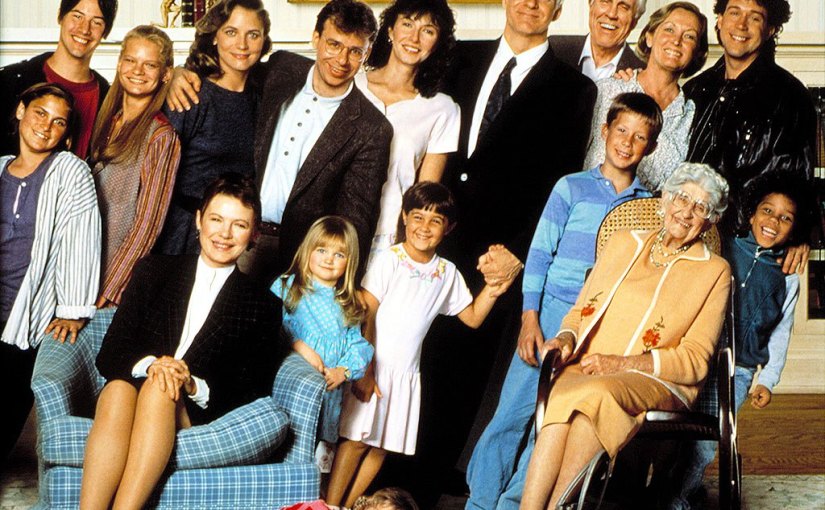
The Buckmans consist of four adult children portrayed by Steve Martin, Dianne Weist, Harley Kozak and Tom Hulce. They all got little ones to tend to with respective partners (Martin with Mary Steenburgen, Kozak with Rick Moranis and the other two are currently on the single status).  Their parents are portrayed by Jason Robards and Eileen Ryan and even the generation before them is represented by Helen Shaw.

With a cast of characters this large, there are various storylines and dynamics of raising and supporting children to go around.  Each child, or in other words, each parent has daily struggles to deal with.  The nuclear family of Steve Martin and Mary Steenburgen’s is given the most attention when it is uncovered that their eldest child of three is struggling with anxiety.  Elsewhere, Robards finds himself trying to rescue his immature, lying twenty-seven-year-old son, Hulce, from gambling addiction and debt.  Weist is doing her best to survive a sexless life after her letch of an ex-husband has left her to deal with a daughter (Martha Plimpton) pregnant and married to a stock-car racing airhead (Keanu Reeves) and a quiet, distant teenage son (Leaf, later known as Joaquin, Phoenix).  Kozak’s storyline really belongs to Rick Moranis as her genius, nerdy husband determined to raise their three-year-old daughter as a virtuoso prodigy.  Kafka is a bedtime story.

Wow, that’s a lot of baggage to unload in two hours’ time.  Yet, it works so efficiently in a film directed by Ron Howard.  I’ve used this compliment before, but it bears repeating.  You can write a full-length screenplay about any one of these characters.  I guess that is the goal you strive for when you produce a film featuring an all star cast filling the slots of a large collection of characters.  A film like Boogie Nights and Love, Actually accomplishes this feat so well.  Parenthood just the same.

Favorite moments for me occur with Jason Robards’ character.  It is evident that he was not the best father, particularly to Martin’s character, and his admiration is likely misdirected towards the kid who hasn’t made the best choices in life, played by an aloof Tom Hulce.  I really like the story arc of Robards and Hulce’s relationship when the truth rests like an ugly slime on the surface that just can’t be filtered away.  Suddenly, a man prepared for retirement and rest, has to acknowledge that his adult son needs help but is he worthy of support and love any longer?  This movie is arguably not even the highlight of Jason Robards career, but you can not deny what a gifted actor he was.  His timing and delivery are so recognizable as a hard-edged retiree parent.

Dianne Weist, the only cast member to be nominated for an Oscar for this film, has a couple of good storylines as well.  Much of her performance stems from all too common drama where a spouse leaves her and abandons any relationship he had with their children.  It’s so unfair for the child.  It’s hard on the mother who has to maintain a career while raising teenagers who are entering a new phase with regards to love and sex.  Plimpton gets into an argument with Reeves, her boyfriend, and Weist starts to swat him away.  Then Plimpton unexpectedly announces they just  got married and Weist turns to swatting Plimpton.  Weist is funny while the material holds dramatically.  It’s a real nice balance.  

Steve Martin has a good storyline as well.  He’s a hard working white collar executive who wants to prioritize attention for his son though it kills him to lose out on a promotion he knows he’s entitled to.  At the same time, he battles with how his own father (Robards) treated him at a young age.  He makes sure that his son’s birthday party is the best.  He encourages the boy to play second base on the little league team.  He attempts to do everything denied of his own childhood for his son, now.  Still, it’s not enough.  Parenthood can often feel like a winless battle. 

Martin also has good scenes with Steenburgen, and they remind me of my relationship with my wife.  She’s the sensible one.  I’m the one who gets trapped in insecurity and anxiety and low self esteem as a worker, a friend, a husband, and especially as a parent to our teenage daughter.  I excel at taking care of the bills though. 

Why am I making this personal all of the sudden?  Well, perhaps it is to call out the true nature of family and marriage that exists within the script for Parenthood, written by Babaloo Mandell, Lowell Ganz and Ron Howard.  There are some moments where Martin’s character daydreams of scenarios for his son.  One time the boy becomes a valedictorian with a speech offering complete recognition towards his father.  In another moment, he’s a rooftop sniper blaming dad for making him play second base and missing the game winning out.  When I get trapped listening to the thoughts in my head, I envision what could be.  More often than not I’m predicting dread, which almost never arrives.  Yet, I believe parents yearn to raise the perfect child that they never were.  It’s an impossible stretch.  I write that here and now, and still, I’ll try and try.  So what, though! While I’m working for perfection and absolute happiness for my daughter, I must remind myself that my efforts are contributing towards a successful path for her full of fulfillment and happiness.  More importantly, while at least half of my efforts could lead in failure on my part, my intentions are always done with absolute love and care for her.  That’s what I see in the here and now.  I’m blessed. My whole family is blessed.  So many families have it so much worse and I wish them well.  I have to remind myself not to take what I have for granted.

Ron Howard’s film is not entirely perfect.  I could have done without some of Steve Martin’s recognizable schtick from his stand-up routines.  I always like his material.  I just think some of it doesn’t belong here, the same way Robin Williams would let his known antics creep into some of his films.  Some scenes are also spliced into the film jarringly, like when a dentist’s office is suddenly vandalized.  Thematically, these break away moments should have remained on the editing floor.  Fortunately, the movie isn’t anchored by these plot points for too long.

There’s much to relate to with Parenthood.  Kids who gleefully sing about diarrhea, to parents mired in regret and doubt.  Teenagers who think they have found love to the absence of father figures.  Grown-ups who just haven’t grown up and parents who are just getting a little too ambitious in their child’s upbringing.  This is not a film, necessarily about the love a parent has for a son or daughter.  Rather, I appreciate how it questions the role these characters serve towards their fathers, mothers and children. 

Love is only one dynamic in fatherhood, motherhood, and childhood.  Parenthood focuses on everything else.