MAD MAX: FURY ROAD

By Marc S. Sanders

After watching Mad Max: Fury Road, you will feel like you need a shower.  Strike that, you will need a shower in aloe first, then a traditional shower and then a weeklong bath in aloe.  It’s a baked in environment that gives you the feel of grainy sands and burning sunbeams.

George Miller’s return to the gonzo, apocalyptic diesel future franchise is exciting from the moment the Warner Bros logo appears with the vroom vroom blaring through your sound system’s speakers.  Miller hardly surrenders the breakneck speed of his two-hour picture to let an audience catch a breath, and because the director is so unforgiving it makes this a tour de force of action entertainment that other adventure films can only strive to at least match.  Still, the movie has next to no story, and that’s fine.

Up until this 2015 reinvention, Mel Gibson was the Aussie Road Warrior donned in leather fighting to survive against lawless bandits coming from any direction in the sand swept plains of an earth afterlife.  Now Tom Hardy takes over the role.  Frankly, it could have been anyone who got recast in the part.  Hardy has few lines and for half the film his face is caged in a grotesque, steel bar mask while he is strapped to the front of a hot rod, gear grinding, amalgamation of a vehicle, simply to be a kind of three-dimensional hood ornament.  This Max is suffering through high-speed chases with his head trapped in animalistic headgear and his arms and legs bound behind his back while he’s tethered to this four-wheeler.  It’s brutal and we can feel how tortuous it is for Hardy’s character.  Yet, we love it!!!!  Keep it going, George!

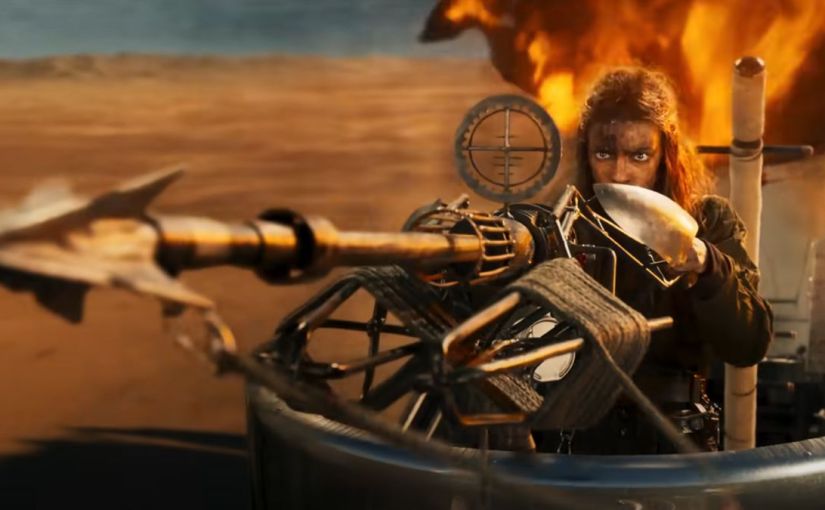
The real star of Fury Road is Charlize Theron as a one arm rebel caked in black grease with a shaven head.  Her name? Imperatour Furiosa.  What a name!!!!!  Furiosa attaches a steering wheel to the driving hilt of an 18 – no 20, maybe 24-wheeler (it could even be 36) big rig with a big ball of fuel hitched to the back. She detours away from a band of outlaw drivers ruled over by Immortan Joe (Hugh Keays-Burn).  Yes!  His name is Immortan Joe. 

In tow with Furiosa are Joe’s pregnant concubines whose fetuses are declared his property.  These lovely lasses dressed only in bed sheets have names like Capable, Cheedo The Fragile, The Dag, Toast The Knowing and The Splendid Angharad (Riley Keogh, Courtney Eaton, Abby Lee, Zoë Kravitz and Rosie Huntington-Whitley).  What is the point of listing off these ladies’ identities? Well, the script for the film doesn’t do so. Yet, the end credits do in a heavy metal kind of font, and it is clear that George Miller is proud of every name, every piece of junk that flies through the air in one crash and bash after another, and every flame that exhausts out of a pipe or even a death metal rock guitar orchestrated by a guy simply known as The Doof Warrior (played by a musician named Iota).  Incidentally, The Doof Warrior is garbed in red long johns and tethered by chains to a big rig with the biggest, blastiest speakers known to man.  The Doof Warrior serves no purpose except to scratch on the guitar while flames shoot out of the stem.  I’m laughing as I type this all out.  This whole display is thankfully ridiculous while all of these figures have the most outlandish and greatest names of all time!!!!

When Furiosa diverts away in the mighty big rig with the pregnant women, Joe follows suit with his endless band of albino crazies in one tricked out vehicle after another.  One car has the chassis of a Mercedes wedged on to the fattest wheels ever conceived.  Another is a Chrysler (I think) resting atop a pair armored tank tracks.  Joe’s automobile looks like it got disqualified from a monster truck rally because it was caught taking diesel steroids. 

Anyway, Mad Max eventually catches up with Furiosa and the ladies.  His last name is not something simple like Jones, Smith, Sanders or Rodriguez.  It’s ROCKATANSKY!!!!!  BOOM! That is awesome!!! A one-time underling of Joe’s, named Nux (Nicholas Hoult), eventually sways over to the heroes’ side as well, and the pursuit carries on.  Furiosa’s destination is a location of green, beyond the desert wasteland.

It’s a wonder that Mad Max: Fury Road was applauded so much in 2015.  However, take a moment to consider the construction of this two-hour operatic noise fest and you cannot help but salute all the merits that went into the final product.  First the nominated visual effects are primarily practical with little to no CGI.  If George Miller is going to make another Mad Max film, he’s going all the way.  The cinematography is gorgeous in a tan, orange, and yellow sun burning desert, while the night scenes are unhidden due to a pure, bright blue.  The interior of the truck seems cramped and uncomfortable, and yet Miller leaves enough room for the viewer to sit inside and uncover every hidden firearm plus get up close with the driver and the lady passengers.  There’s even a cool weapon found in the stick shift.  Wait until you see that!  The editing is relentless with perfectly captured close ups of so many character drivers and passengers all in a matter of seconds.  Plus, wide overhead shots and extended ground captions make it easy to understand just how many vehicles are included in this endless demolition derby.  I’m talking hundreds of monster machines ready for weaponized destructions. The choreographed action scenes of gun shots firing and vehicular collisions is like a ballet of a perfect derby show.  Monster razor blades are given their due, along with an assortment flame throwers. Also, kamikaze suicidal albinos are ready to act like destructive grenades.  Not one scene or shot in a Transformers CGI picture of metal vomit comes close to a millisecond of George Miller’s craft.

No other film could be as deserving of Academy Awards for sound, cinematography and editing as well as nominations for Best Picture and Best Director.  Even the warped-out S&M costume designs and make up are eye popping; merits that also earned Oscars.  You might have a fondness for art house cinema like Fellini or perhaps a Daniel Day-Lewis piece that invests in the method of caliber acting performances, but you cannot deny the artistic efforts vested by George Miller, his editor wife Margaret Sixel, and the rest of the crew. Mad Max: Fury Road was placed on so many top ten lists in the year 2015, and its because the film succeeds in the best of technical achievements. 

George Miller operates like that nasty kid named Sid from the Toy Story pictures.  He assembles his set pieces in the most tricked out, ugly and grotesque combinations of auto body parts, gives them engines that breathe fire and roar like vicious beasts that smell like diesel and then collides them altogether in a wide open plain.  Try to imagine Miller as a young child with his Matchbox cars on his bedroom floor.  His parents might have had some concern while observing his play activity.  What’s appreciated though is that this director never settled for simple with his Mad Max films and he never repeated what he’s already demonstrated.  No car crash looks the same.  No single shot is  repetitive.  This is how a director of any film genre should operate.  When they take attentive care to every frame they capture with their camera, then they get a Mad Max: Fury Road

One of the best films of the twenty-first century!

NOTE: I originally saw this film in 3-D in the theaters.  Wanna know my sentiments towards 3-D? Well, I hated this film after I saw it.  I gave up five minutes into the piece because the 3-D was unforgiving in distraction and dark beyond comprehension and measure.  Watching Mad Max: Fury Road again, a number of years later in a standard 4K on my 65-inch flat screen, you can likely tell by my write up that my sentiments have drastically changed for the picture.  It’s also telling to note that the new prequel film Furiosa is not being presented in 3-D.  Unless it is a James Cameron film or a special exception like Ridley Scott’s Prometheus, modern 3-D is as big a failure as the new formula Coke was back in the 1980s. 

KINGDOM OF THE PLANET OF THE APES

By Marc S. Sanders

The revival of the Planet Of The Apes films within the last decade and a half remain impressive.  Moreover, the first film, Rise Of The Planet Of The Apes, led to a global epidemic that wiped out most of humanity, well before we ever heard the term COVID, or used the word pandemic in our everyday vernacular.  That first film was guided by James Franco with fast food science summarization, but it was a thrilling film in context of storytelling and most especially in the visual effects delivered by WETA (who worked on Peter Jackson’s Tolkien films) convincing audiences that apes inherited a superior intelligence to overthrow the dominant human species.  A chimp character named Caesar led the rebellion and he was masterfully played by Andy Serkis.  Caesar did for the retelling of Planet Of The Apes what Wolverine did for X-Men.

In this 2024 fourth installment titled Kingdom Of The Planet Of The Apes, Caesar has now passed away and this universe jumps many generations into the future.  The new ape hero is Noa played by Tampa native Owen Teague.  The mannerisms of Noa are just as convincing as what we saw in Caesar, even if the character is not written with as much nuance or magnetic care that we found in Serkis’ performance over the prior three films.

In this film, practically all of humanity is wiped out.  This ape population, Earth location unknown, has formed a bond with the bird community and Noa and friends find adventure while retrieving eggs from high birds’ nests to be used for a symbolic ceremony within their village.  

However, just as real-life human history teaches us, other ape factions adopt man’s nature to control and conquer.  Noa finds himself on a horseback sojourn to rescue his village members who were harshly taken from camp.  Along the way he meets wizened orangutan Raka (Peter Macon) who apprises Noa of the legend of Caesar.  Curiously, a mute teen girl (Freya Allen) is found as well.  They engage in a united trek that will test them as encounters with danger present themselves.  In particular, they come upon the sadistic tribe overruled by the mighty gorilla Proximus Caesar (Kevin Durand).

All of these ape portrayals are marvelous to observe.  The expressions and change in facial features plus the flex of limbs and torsos with involuntary motion are unbelievable to see as the characters deliver their dialogue and converse or debate with one another.  The hand-to-hand combat interactions are perfectly enacted. You remain impressed through the course of the entire film, even if the picture is unnecessarily longer than it needs to be.

Kingdom moves episodically through Noa’s eyes.  The movie begins with one story.  Then as additional characters are introduced it moves on to something else until it gets to a mildly sinister (PG fare, really) telling of Proximus forcing his chimp followers to heed his command by opening a large steel vault door of a beached ocean cruiser from the long-lost days of human occupation.  What’s in the vault?  Well, I was never expecting much, but Proximus believes the contents to be revolutionary. By commanding under a misleading guise of what the original Caesar stood for, he’s a vicious figurehead to the apes he holds hostage.

The interesting aspect to Kingdom is by this fourth film we know who the real Caesar was.  Though, Noa was never educated on the messianic purpose of that leader.  So, we find Proximus to be a deceitful evangelist to his underlings. While it’s not a major requirement to know what occurred in the prior films, it helps to know what Caesar stood for versus how he is regarded in this further future.  Ministers deceive biblical teachings and the figures within the holy text to capture their congregations’ impressions.  Proximus functions in a similar way.

The prior films kept a divide between the apes and the few human survivors as a means to set up conflicts.  With Kingdom, we witness beyond what Caesar oversaw generations later, and how divisions within the ape species serve only to live quietly or govern with a domineering crown and the symbol of a legend to deliver an updated mantra.

Socially speaking, like the best Ape films and going back to the French novel adaptation from Pierre Boule (known for also writing The Bridge On The River Kwai), these stories work when they explore new aspects of intelligent developments within the ape communities.  Some function with selfishness and a need for power.  Others lean towards love, friendship and a moral compass.  Blend these ideals together and in turn comes conflict – the nucleus of effective storytelling.

Kingdom Of The Planet Of The Apes is perhaps the weakest of the four most recent films.  The film is too long with unnecessary exposition.  Noa is not the hero that Caesar was. Though some turn up, humans are primarily absent from the whole film, and they are still the best opponents against the ape communities.  

The cliffhanging ending keeps me excited for more subsequent tales because I’ve not grown tired of this franchise yet.  These films are more dazzling than James Cameron’s two Avatar films combined.  

I must confess I was hoping this movie would address some hanging threads that stem all the way back to Rise Of The Planet Of The Apes.  Still those topics have regrettably not been addressed and I hope those moments were not just some random wink ‘n nod.  Specifically, I’m referring to the rocket that astronauts launched in the direction of Mars just before the virus spread across the planet and Caesar’s band took over Earth.

There’s a good story in Kingdom Of The Planet Of The Apes.  I was just hoping for a few other angles than some of what were offered up this time around.

THE PROFESSIONAL (Léon)

By Marc S. Sanders

The cult following that has come with Luc Besson’s first American made film seems unwarranted to me.  It’s currently listed as number 40 on IMDB’s top 250. I have no idea why. I recognize the artistic style of the picture, but what is here to relish beyond an enlightening introductory performance from would be Oscar winner Natalie Portman?

To watch Besson’s use of the camera makes me feel like a viewer from the director’s native France.  The setting is Little Italy, New York and it has a feel to it like Besson just stepped off the plane and decided to hone his lens on a condensed city section, but lacking an education of its culture or history.  The Professional certainly doesn’t look or feel like Dog Day Afternoon, When Harry Met Sally…, or Die Hard With A Vengeance.  (Perhaps the music from Éric Serra altered my mood.)  I never took issue with this aspect of the movie. It is unfortunate however that Besson’s film comes off too perverse in its storytelling, especially with its character blend.

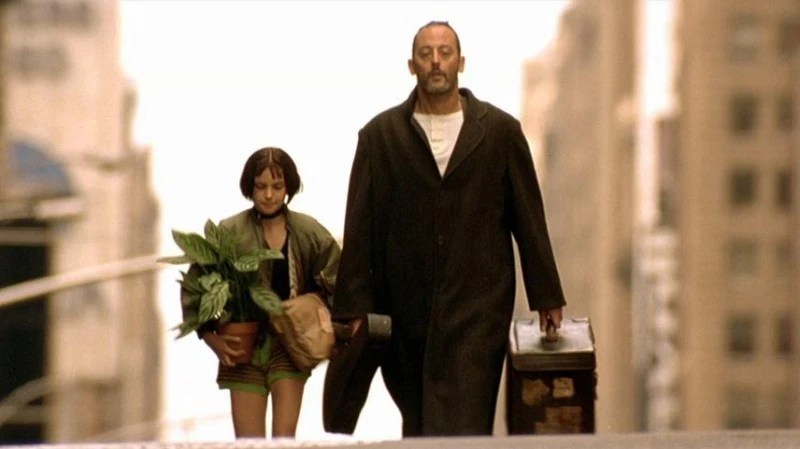
Portman is Mathilda, a spunky kid who survives the murder of her family when a corrupt, drug dealing DEA agent named Stansfield (a way over the top Gary Oldman) carries out the slaughter after her father fails to pay a debt.  Fortunately, as Mathilda is returning home and coming upon the bloody aftermath, Stansfield and his crony of killers opt not to take her out too as they believe she belongs with the occupant of her neighboring apartment.  Léon lives there and happens to be a skillful hitman and weapons expert who pulls Mathilda inside to safety.  He’s played by Jean Reno.  These killers who massacre by day have no care to eliminate the other tenants living on the same floor, including a little old lady.  Why?  I don’t know.  Maybe they called in sick on the day assassination school covered “Chapter 6: Leave No Witnesses.”

Besson does not apply much brainpower to the script he wrote and directed.  Oldman’s characterization could not be more obvious with how unhinged he behaves.  His department colleagues who take less than a minute and a half to question him don’t even raise an eyebrow.  While the storyline can be dismissed as a pulpy kind of graphic novel come to life, isn’t it lucky that if your family is going to get shot up, you have a professional hitman living right next door? I mean c’mon.  This is only the set-up of the picture, within the first ten minutes, and my suspension of disbelief never arrived.  

The most egregious lack of consideration falls within the relationship between Reno and Portman’s characters though.  She’s twelve.  He’s in his late thirties or early forties, but his silence implies it is time for assisted living.  When they are not relocating from apartment to apartment, trying to stay out of sight of Oldman’s gang, they are valuing the life of Léon’s beloved plant, drinking milk and demonstrating the fine art of sniper operations.  That’s fine – it’s the stuff of Tarantino fare.  

However, when the pair decide to entertain each other with Portman doing routines of Madonna and Chaplin for play fun, there’s a cringey temperature to the picture.  Besson was seeking out a relationship between a random man and child without any element of sexual proclivities involved and yet, it’s there.  In another writer/director’s hands, there would have been a stronger attempt to develop a paternal relationship between the two characters.  Yet, Natalie Portman doing a childlike song and dance performance of “Like A Virgin,” with Jean Reno’s Léon acting unaware seems artificial and perversely moving in the wrong direction.  When danger crosses their path later and they both say “I love you” to one another, I can’t help but question how this bond might have turned out if they were never forced to separate and save themselves from the bad guys while continuing to live a quiet life with a house plant and gallons of milk.

The final third of The Professional has the inevitable shootout and explosions.  Out of context, it looks good but again this is New York.  So, when Stansfield brings in the firepower of the entire city police to force Léon and Mathilda out of the tenement building, shouldn’t someone be questioning someone?  Anyone? It’s ridiculous.  None of the neighbors run for cover or are given warnings to divert away as a small rocket launcher is propped up for blasting the front door open, along with anyone inside.  

The Professional contains a boring, inappropriate middle section accompanied with a ridiculous opening and ending.  Therefore, I have trouble locating the merits for this piece.  I can recognize the potential of Natalie Portman in her performance.  Yet, if this were the first film I ever saw Gary Oldman in, I might not be so prone to watching anything by this best of the best character actors.  “EVERYONE!!!!” he screams, shouts, screeches, and bellows all at the same time.  Whether you’ve seen the film or not, most cinephiles relish in that sound byte from him on social media. I’d argue it’s in no way a salute to the actor.  Frankly, it’s indicative of the material when a guy as accomplished as Gary Oldman cannot uncover enough of a quirk in a bad guy from a very unimaginative script.  It’s not your fault Gary, so much as it is Mr. Besson’s.

Jean Reno has a cool looking, silent poise to Léon, the professional hitman, but there’s nothing lent to him to work with except a pair of opaque, circular sunglasses, milk, a plant and at least as many guns and ammo as found in The Matrix.  Reno functions on little dialogue and no background save for a few scenes he shares with Danny Aiello as the mob boss who frequently hires him for jobs.  Reno’s scenes with Natalie Portman only demonstrate how inappropriate their connection as actors in a scene are, as well as how their characters are supposed to serve each other. 

The faults of The Professional ultimately lie with its puppet master, Luc Besson.

THE FALL GUY

By Marc S. Sanders

Indulge me please while I spout off a number of movie titles. 

I am big fan of Emily Blunt.  She justifiably earned her first Oscar nomination for Oppenheimer.  She was Mary Poppins – a damn good one.  She’s good in her husband John Krasinski’s A Quiet Place monster movies.  Have you seen Sicario? The first one?  You should!  As well, there’s the role that put her on the map with The Devil Wears Prada.  Just a great actress with a huge repertoire of sensational performances under her belt.

I am also a big admirer of Ryan Gosling.  Magnificent in the long-awaited Blade Runner sequel.  He’s a dancing wunderkind and musical genius as well with films like La La Land.  You ever seen The Nice Guys where he partnered with Russell Crowe?  Another one you should see.  Also find him in The Ides Of March, directed by George Clooney.  He got his umpteenth nomination for Barbie recently, but let’s face it, after that Oscar show performance for Best Song the man only overshadowed what he blew our eyes out with, and now I believe they should bow to his dancing feet for hosting duties.  Plus, the guy is now the pinnacle live action Beavis to go with Mikey Day’s Butthead.  Is there nothing this guy can’t do?

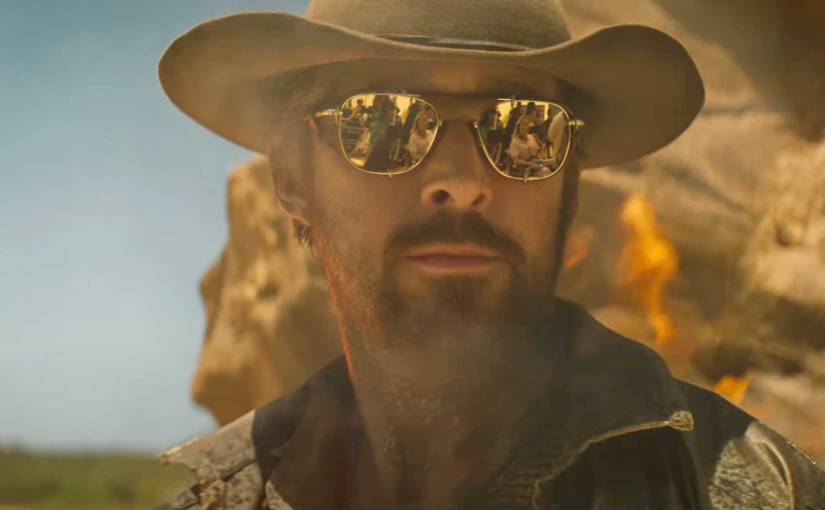
I think back to all of these sensational cinematic achievements, and I am dumbfounded that when this pair finally, at long last, team up it is for wasteful bash up/smash up junk like a television adaptation of the Lee Majors’ ABC action series The Fall Guy.  It’s been a long time since I was so bored watching a stunt filled two-hour flick with zero spice or flavor.  There are fire balls aplomb in this movie and I don’t think Gosling ever feels the burn.

I’ve seen the Die Hards and the Lethal Weapons with the fight scenes and car chases and bombastic explosions. Amid all nine of those pictures (well maybe not the last Die Hard movie) the action usually drove at least some semblance of story, suspense and amazement.

The Fall Guy, directed by former stuntman David Leitch, proudly declares itself a stunt movie because the hero, Colt Seavers (Gosling) is a stunt man for action movies.  However, the audience is shortchanged on…well…the stunts.  I remember Miguel and I watching The Fast And The Furious for the first time.  We both agreed the movie failed because it did not provide what it was selling, namely car chases and car stunts.  At least not enough of them.  Instead, we got Paul Walker and Vin Diesel getting all Terms Of Endearment like and we asked ourselves, when are they going to get in a car and drive.

Consider the opening sequence of The Fall Guy.  First I’m dazzled by a well-done Steadicam shot the runs at least four minutes as it follows Colt talking on his cell phone as he struts from his movie set trailer then on into the lobby of a sky rise building, through a crowd of movie extras, crew and cameras, up an elevator and then over to a platform ledge where a harness is strapped to his uniform and he is suspended high above the ground below, while facing up.  A fall is gonna happen, right? And it does, but then we do not see the finish of the fall.  This one shot walk for Gosling cuts the legs out from under us. Just as the fall is about to finish, it cuts to the guy in a stretcher being wheeled into an ambulance. 

Now you can insist to me that is the start of the story.  Colt breaks his back in a stunt fall gone wrong and thus he’s now retired and surely 18 months later, he will be called back to do his best bidding and set the wheels in motion for the rest of the movie.  Okay.  Fine.  I’m with you.  The hero comes out of retirement for one last job. Yet, THE RYAN GOSLING just did the actual fall and we couldn’t see THE RYAN GOSLING finish the fall.  This wasn’t a stunt double as far as I could tell.  I’ve used this analogy before, but this is like Moe throwing the cream pie at Curly, only you don’t get to see the pie make impact with Curly’s face.  I feel cheated, and I felt cheated during most of The Fall Guy.

This approach is done often during Leitch’s film.  He’ll put Colt into a stunt sequence but then cut away to something else.  Later in the movie, Colt gets into a fist fight with some bad dudes while trying to hang on to a runaway truck and trailer careening through the streets of Sydney, Australia.  Colt throws punches.  He gets punched.  He falls.  He hangs on.  He gets up again.  Wash, dry, repeat.  The problem is that Leitch opts to cut away after each punch or fall to Emily Blunt doing a rendition of “Against All Odds” in a karaoke bar.  This whole action scene is chopped up for no purpose that keeps me in the film.  It’s like when I would have to ask my kid to stop interrupting while the grown ups are still talking.  I love watching Emily Blunt sing.  I love watching Ryan Gosling do his version of what a kamikaze Mel Gibson used to do in his younger years.  Can we just have one thing at a time though?  This kind of juxtaposition is not intriguing or beguiling or whatever the filmmaker wants it to be, and it does no favors for either lead.

The story is pretty simple and pedestrian. Nor does it follow the theme of the TV show that everyone has forgotten or that this generation has ever heard of.  Blunt plays Jody Moreno, a maybe former flame/middle school crush of Colt’s.  Unbeknownst to her, the producer (Hannah Waddingham) of the science fiction film Jody is directing has reached out to Colt a year and a half after his broken back accident to come to Australia and not only work on the set but also track down the star (Aaron Taylor-Johnson) of the picture who has disappeared without a trace.  Colt is not very bright and he’s especially not a detective of any sort. 

Once this is all set up, The Fall Guy flip flops from the search, over to Colt getting set on fire repeatedly on the set, and then back to the search, followed by the inevitable twist, which is in no way a twist because the surprise seems known as soon as movie begins. 

I was not expecting utter brilliance here, but I was hoping for substance.  Gosling and Blunt are two of the biggest stars out there right now and can have their pick of the litter in what they do next.  It only makes sense that these two should pair up for a movie, but this is what they choose?  The script has less wit or intelligence than a coloring book that has yet to be scribbled in by a four-year-old.  I remember the hype around a picture called The Mexican with Julia Roberts and Brad Pitt, the biggest stars of the time finally teaming up, and just like it is with The Fall Guy, they had zero chemistry, and they barely shared any scenes together.  When they did, they hardly acknowledged each other.  Filmmakers cannot just stop working when they get the marquee names to sign a contract for the film.  They gotta work to live up to the hype that comes with these capably appealing actors.

In his pursuit, Colt gets drugged and then we see a unicorn standing next to him for a long sequence.  The audience sees the unicorn, but Colt hardly acknowledges it.  I don’t get where the ha ha ha is supposed to come from this bit.  I think the writers were maybe going for an Airplane!/Naked Gun gag.  Colt gets thrown through glass walls.  He tells us he was part of the Miami Vice stunt show at Universal Studios by simply wearing a jacket that says it, but so what?  There’s no dimension to any of this. (I did appreciate hearing the theme song during a very brief nighttime boat chase.)

Aaron Taylor-Johnson (Avengers: Age Of Ultron, Kick Ass, and one time James Bond candidate) is another fine actor, not doing his best work.  He’s a jerk here with bleach blond locks and nothing to do.  He’s just unlikable and unfunny.  Hannah Waddingham?  Never heard of her, but I can only imagine she’s got something better lined than this obnoxious movie producer role with an annoying over the top Australian accent.  If she’s really Australian, then I’ll have to surrender to the fact that I just don’t know the down under dialect.  Frankly, she’s just terrible. 

Never thought I’d say this but Gosling and Blunt had a thousand times more chemistry when they did that presentation at the 2024 Oscars jabbing at the Barbenheimer trend and shamelessly promoting the upcoming release of this film.  In this movie, they look like they are not making eye contact with one another or listening to what the other actor is saying. I don’t blame them, though.  I call foul on David Leitch for lousy directing.

The most interesting thing about the film adaptation of The Fall Guy are post credit behind the scenes footage where I got to see all of these stunts in their uninterrupted entirety, but without the glossy cinematography finish.  However, an Easter egg scene shows up with THE LEE MAJORS and the other blond Heather from the 1980s, THE HEATHER THOMAS.  She is given blond wig and probably an unseen muzzle because she has no dialogue to say except stand there in a cop’s uniform with her butt and boobs sticking out.  Majors is left to be dull, like he probably was in the final season of the show when it was jumping the shark.  If the writers of this movie just used a tenth of their imagination, they could have kept Lee Majors as the original Colt Seaver who mentors Gosling into being THE FALL GUY of today.  Why couldn’t Lee Majors have a substantial role in this picture?  It would have worked.  However, that is not likely because there’s barely a plot, character, or even stunt scene that implies the makers of this movie have that kind of capable imagination. 

Find another movie for Emily Blunt and Ryan Gosling. STAT! They are so much more worthy then the building they jumped off of only to land in this fire ball blasted junk resting below.

LEAP OF FAITH

By Marc S. Sanders

You never know when God may come knocking.  You never know when Jonas Nightengale may come knocking either.  If you’re fortunate enough to reside in small town Rustwater, Kansas, you sir, or you ma’am, or you dear child may be blessed by the healing powers of Reverend Nightengale. 

On the surface, Jonas appears like a comedic role for Steve Martin, but in actuality it is not aiming for laughs at all.  When it comes to the confidence scheme that Reverend Jonas offers the townsfolk of Rustwater, Steve Martin plays the phony preacher with nothing but a serious operandi. 

Jonas and his crew travel the states from one big city to the next where he preaches his gospel of deceitful hope in exchange for donations to his traveling church that supposedly serve the almighty lord.  When one of their trucks breaks down in Rustwater, Jonas and his top aide, Jane (Debra Winger) use it as an opportunity for easy cash.  This Kansas town relies on harvests and the infrequent rain that feeds the crops.  Otherwise, this sleepy town has one diner, a movie theater, and a sheriff named Will (Liam Neeson) who is out to reveal the false Oz behind the curtain.  At the same time, Will is romancing Jane who has been eagerly seeking out a flame that never had a chance to flourish because she is on the road so often.

Jonas is wooing Marva (Lolita Davidovich), a waitress at the diner who is also skeptical of the whole act and is protective of her younger handicapped brother, Boyd (Lukas Haas) who suffered a permanent leg injury in a car accident that killed their parents.  Boyd was once told by a preacher that there is not enough faith in his heart for him to be the receiver of healing powers.  Lukas Haas was not just cast because he’s a talented actor.  He also has that angelic face that suggests he’s never committed a sin.

The tricks of Jane and Jonas’ trade are all revealed here.  Jane hides in the back feeding information about certain audience members and their ailments into Jonas’ earpiece.  Eavesdropping by the crew (including an early appearance by Phillip Seymour Hoffman) ahead of the show provides Jane with all the data.  It’s neat to see and it is likely how these outrageous televangelists pull off their miraculous “gifts.”

There’s an interesting argument to Leap Of Faith.  Jane defends Jonas’ façade to Will by him just selling fairy tales that make people feel good and fulfilled.  Will sees the obvious moral dilemma.  Jonas offers another defense.  Is this any different than a circus act that presents the fantastic for an audience to witness. Personally, I think Jonas and Jane’s defense is a bunch of hooey.  Yet, the residents of Rustwater buy into the act and soon people from all over the Midwest are lining up to listen to the gospel and witness the miracles of Reverend Nightengale. 

Jonas has a dilemma himself though.  He has a fondness for Marva, and he likes Boyd.  Boyd is not a plant in the audience to go along with the healing power showmanship.  So, how is Jonas going to explain his position?  He’s quick on his feet to fend off public accusations from Will, but how can someone who is not a miracle worker perform a miracle while maintaining his illusion.

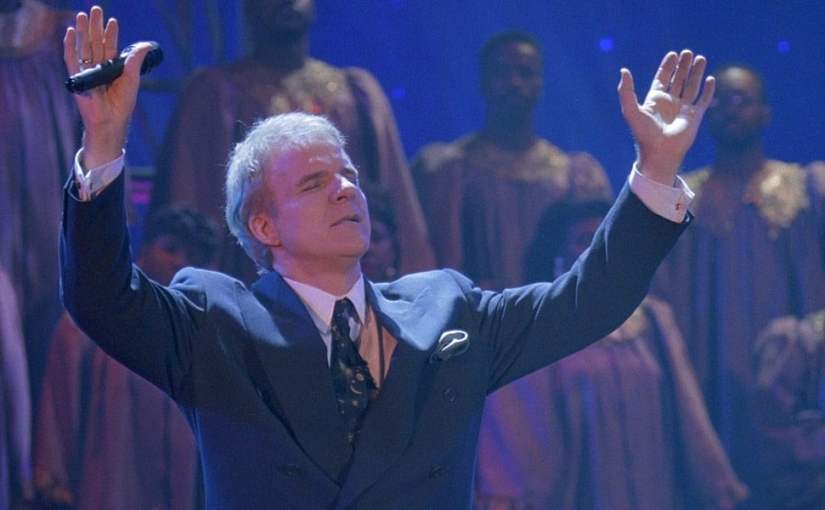
I like the set up and questions that Leap Of Faith asks.  It’s the story of the arriving snake oil salesman which I do not see too often in films.  The showy pieces of the movie are wonderful with terrific singing from the choir under the big top circus tent with the enormous crucifix of Jesus in the center.  There’s also an enthusiastic supporting cast from Phillip Seymour Hoffman, as well as Meat Loaf as the church keyboardist.  The crowd extras are wonderful with their vocal responses.  I also especially love how Jonas ups the ante with a terrific sight gag to silence his biggest doubter, namely Will. 

The film is different, especially for Steve Martin.  He’s a ball of energy on the stage. He does his one-foot slide that was often seen on Saturday Night Live and his stand-up acts, but here it is not done for laughs.  Instead, Martin’s recognizable schtick upholds the public persona of Judas, and it works. 

Still, I do not think I got what I would have prayed for from the film.  I could not get past how Liam Neeson does not work as a Midwest sheriff in this Podunk town.  His boyish good looks from the early 1990s are right for the romance, but he makes no effort to hide his native Irish dialect.  He just doesn’t blend into the Americana canvas very well.  Debra Winger is great and it’s a shame I do not see her in enough films.  Almost everything she does I like.  She just has a natural vibe about her.  She has good scenes with Neeson, but just like his character, their storyline belongs in another movie very distant from the prime directive of Leap Of Faith.

The romance between Martin and Davidovich does not amount to much either. Frankly, it feels as if the story editors opted to abandon this angle midway through the making of the film. I do not recall how the relationship resolved itself and the ending certainly does not generate any kind of response for how either character regards one another. 

Towards the end of Leap Of Faith, the unexpected occurs twice, sort of like what happens in the end of Magnolia.  I found it interesting, but then the credits roll and the gospel choir sings on until the screen goes dark.  I’m leaping from my chair asking but wait, what about this and what about that.  Nevertheless, the choir keeps on singing, deafening my concerns.  Janus Cerone’s script seems to paint itself into a corner just when a brilliant irony arrives and hardly an acknowledgement, and certainly no explanation, is offered for the new phenomena that occurs. 

Leap Of Faith begins with a prologue between Jonus and a traffic cop.  It’s a brilliant scene demonstrating right away how smooth this “preacher” is when it is a one on one grift.  (Celebrated trickster and former con man Ricky Jay was a consultant on the film.) Later, we see how mesmerizing Jonus is in front of hundreds of people.  I was very excited during the first hour and a half of the picture, but then the movie gives up on itself.  The best way to describe this viewing experience is to say that Leap Of Faith simply loses faith in itself.

SATURDAY NIGHT FEVER

By Marc S. Sanders

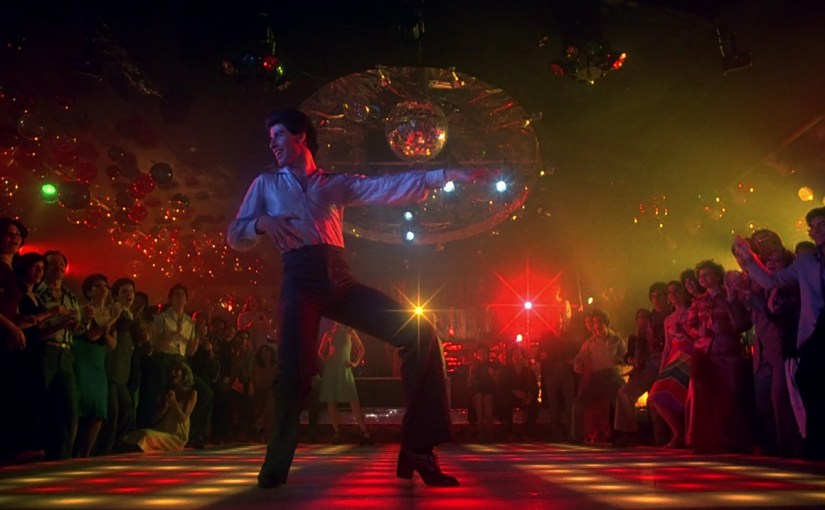
One of the biggest cinematic cultural touchstones announced itself just as the fad was withering away.  John Travolta blew up movie screens in 1977 when he strutted down the streets of Brooklyn with a paint can in one hand while wearing his wide collared red shirt under his black leather jacket.  The song that that got audiences grooving in their seats with the immediate superstar? Staying Alive by The Bee Gees.  The movie?  Saturday Night Fever which offered one of the most memorable character introductions in film history.

Disco might be dead and only designed for themed costume parties nowadays, but Saturday Night Fever remains very much alive.  No one forgets the moves Travolta did on the dance floor in his polyester shirts and suits.  John Badham’s film continues to be saluted with spoofs ranging from Airplane! to Saturday Night Live to Family Guy and one commercial after another.  The soundtrack is an unforgettable mix played for every generation that comes along at weddings, proms and bar mitzvahs.  The film was also adapted into a successful Broadway and touring musical.  I loved the live stage performance by the way.

Still, there’s a sensational dramatic story to Saturday Night Fever and Tony Monero, the nineteen-year-old kid who is only a Brooklyn celebrity on the streets and especially at the local dance club 2001: Oddyssey (the extra d is included).  Tony has unwanted ladies dying to sidle up to him, especially his contest dance partner Annette (Donna Pescow) who will eagerly surrender her virginity to Tony without protection.  His buddies idolize him as well, as they cruise the streets at night drinking in their beat-up Ford sedan on the way to and from the club, before finishing off the evening with some risky tomfoolery on the edge of the Verrazano bridge.  His boss at the paint shop even loves the kid.  Tony doesn’t ask for it, but he gets a raise and by the end of the conversation, the boss has nearly doubled his first offer. 

None of this is enough for Tony though. He doesn’t want to be tied down to working at the paint store for the rest his life.  He’s afraid he’s losing his beautifully well coifed hair and maybe his dancing skills will not survive as the years pass him by.  He also gets no love from his father.  Every dinner erupts into a family argument.  His mother has preferred adorations for Father Frank, Tony’s older brother who entered the priesthood.  Ma calls her son Father Frank, because, after all, he’s a Father of the Catholic Church.  Tony is also envious of Frank, first for their parents’ adoration.  Later, it is because Frank decides to leave the seminary to be free of the parents’ expectations.  

Tony also sees the talents and beauty of a dancer named Stephanie (Karen Lynn Gorney) who has no interest in his immaturity but is willing to be his partner for 2001’s upcoming dance contest.  Try as he might, Tony cannot keep up with Stephanie beyond the dance floor.  He’s not educated or cultured like her, and she is relocating across the bridge to Staten Island for a better life.  On the other hand, Tony remains stationary and therefore he is a frustrated man about to put his teenage years behind him with no aspirations and the weight of those who he spends time with holding him down.

I’d argue many are familiar with the colorful dance sequences accompanied by The Bee Gees’ memorable numbers (How Deep Is Your Love, Night Fever, More Than A Woman) as well as KC and the Sunshine Band (Get Down Tonight) and The Tramps (Disco Inferno).  Yet, Saturday Night Fever demonstrates a tough coming of age struggle for its protagonist.  John Travolta is at least just as memorable as James Dean was in Rebel Without A Cause.  Life goes on, but how can it when all you have to show for yourself is being the best at disco dancing?  There’s a whole other world beyond Brooklyn.

Sex is even frustrating for Tony.  He gives in to Annette’s desires to make love to him in the back seat, but then tosses her aside when she does not bring a condom.  All of this is too easy for Tony; so easy that it’s not even pleasurable and thus he’s continuously cruel and dismissive of her.  When Annette gives in to group sex with the guys, one after the other, Tony can do nothing but chastise her for allowing herself to be subjected that way.

Bobby C (Barry Miller) is the fearful, untalented, uncool and insecure buddy who is lost with what to do when he thinks he might have gotten a girl pregnant.  Tony is the greatest guy he knows, but he has no interest in helping.  Bobby even tries the next best thing by approaching Frank…formerly Father Frank.  Everyone wants to be with Tony and stay in his social circle, yet Tony is the one who wants out.

Norman Wexler’s screenplay is tremendously insightful but never so apparent.  As loud as the clothes, the disco music and the dance is, this is a script of subtly in Travolta’s performance.  It’s likely why he got the film’s sole Oscar nomination for Best Actor.  Despite Tony’s continued outbursts, there’s nothing so blatant in Saturday Night Fever like you would find in other coming of age films like James Dean’s, for example, or any of John Hughes’ films.  Director John Badham accustoms you to Tony Manero’s anxiety. 

It’s ironic, normally a protagonist will grow into self-assurance.  In this film, Badham wisely shows the confident swagger of Tony Manero in the film’s unforgettable opening only to see him diminish as the character arc proceeds over the film’s next two hours.  Badham includes small hints in this opening.  Tony might walk with a strut, but the first attractive woman he passes on the street does not give him the gumption to approach her, and the second woman tries avoiding him being in her way.  Later, Tony is outright rejected by Stephanie for anything beyond friendship and dance practice.  Tony wears the local celebrity façade, but in reality he is just a nobody.

John Travolta is so effective at showing on screen how Tony internally speaks to himself as he vocalizes his frustrations at those around him.  Whatever is angering Tony only looks like it’s Annette’s fault, or Stephanie’s or the guys, or Mom and Pop.  There must be something better for him than just being a small time, well dressed disco dancer, and a valued worker in a paint store.  He’s also outgrowing the street brawling with his buddies.  All he knows is he had better find a way out of this life with no promise of a future. Otherwise, he’s destined for a destructive ending.

Saturday Night Fever has a staying power.  Years after anyone has seen this film, all that might be remembered is John Travolta in the white suit on the lighted disco floor while Staying Alive is blaring through the speakers.  However, it’s a deeper film than just glitzy aesthetics that arrive with the final cut.  This is a coming-of-age story that does not hide the struggles nor romanticizes a path towards a better person or future. 

The film’s ending is even deliberately ambiguous. It’s more realistic than you might realize because the future remains uncertain for all of us, especially when we believe we don’t have much beyond what we are envied for to send us forward.  I know of the film Staying Alive directed by Sylvester Stallone which brought Travolta back into the legendary role.  It is the follow up film to Saturday Night Fever; notoriously considered one of the worst sequels ever made as it attempts to bring Tony Manero into the early 1980s cheesy zeitgeist world of Cats on Broadway or a poor impersonation of Prince pop music.  Norman Wexler demanded his story credit be stricken from that film. 

Choosing to ignore what came with that awful sequel, Wexler’s script for Saturday Night Fever wisely offers no promises for its protagonist, because unlike what we often see in the movies, life never guarantees a new day, and that’s what truly scares Tony Manero more than anything else.  It’s fair to say an uncertain future terrifies all of us.  That is why Saturday Night Fever remains completely genuine.  We are never meant to see what comes of Tony Manero because Tony Manero struggles with the unknown of what’s to come.  Some endings are meant to have those hanging threads from a time gone by.

CIVIL WAR

By Marc S. Sanders

On the drive home, my wife and I left saying that we could not recall this country existing on a such a divisive plane within our lifetimes as it is currently.  Maybe we were not paying enough attention as we were growing up.  With that in mind however, it’s not unreasonable to see a possible future coming to life from Alex Garland’s Civil War.  What’s clear is the vitriol displayed in Garland’s film is not surprising.

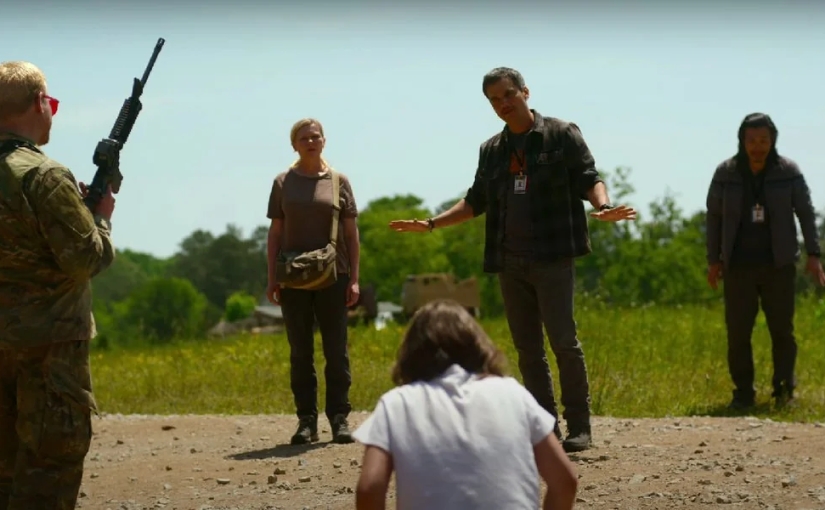
Civil War is an observational piece as it is told through eyes of photojournalists who function with no stake in the conflict.  Lee (Kirsten Dunst) has become a legendary war photographer.  Along with Joel (Wagner Moura), who’s a reporter, they intend to journey through the Northeastern battlegrounds from New York City to Washington D.C.  As they believe, the seceded states of California and Texas are close to overthrowing the government, they are determined to interview and photograph the President (Nick Offerman) before he’s taken prisoner or more likely, assassinated.  An old-time New York Times journalist named Sammy (Stephen McKinley Henderson) and Jessie (Cailee Spaney), a young photographer who idolizes Lee, tag along.  To do this trip is a crazy undertaking, but Lee and Joel know what importance their purpose serves and the fact that they have press passes should uphold their survival amidst violence and chaos. 

My wife asked which side does writer/director Alex Garland lean towards politically and I said I do not know as he’s primarily known for science fiction movies (Ex Machina, Annihilation).  Garland likely wants his political leanings to remain unknown as it upholds what Civil War deliberately steers its focus away from.  We never learn what policies each side of this war stands for or what instigated it.  In fact, it is quite intentional of Garland to make what are arguably the bluest and reddest states in the United States the united seceders who lead one side of this bloody chess board. 

This fictionalized war is well established when the picture opens.  The President attempts to deliver a speech that is clearly uncertain despite the staple resilient vocabulary he includes.  Nevertheless, buildings on fire randomly appear, looters are bloodied pulps who are strung up by random factions, downed helicopters are the carnage occupying a parking lot in front of a JC Penney.  Nothing that anyone says, much less the President of the United States are going to sway this country into a state of comfort.  That time has passed.

The production value of Civil War is astonishing.  Sometimes it looks just like photographic accounts of what we see on the evening news coverage from the Middle East.  Garland also never forgets that his main characters are photographers as he captures in freeze frame people being randomly shot or beaten or simply screaming at one another.  The film abruptly turns off the sound and a black and white photograph interrupts the chaos for you to catch a freeze frame glimpse.  The editing lends to the character designs of the story’s four main players.  I did question, however, why video footage was not also taken beyond just photographs.  Cell phones are not used or mentioned in this picture.  The inconvenience of Wi Fi on a laptop is however. 

The sound design of the film is spectacular and reminiscent of how powerful it served in the Oscar winning film The Zone Of Interest.  As the characters set up camp for the night, rapid pop pop pops are heard in the distance.  On multiple occasions, Garland gets you right in the middle of the various firefights that occur in and around office buildings or what were once shopping districts.  The machine gun fire and rubble blasts are all around you.  The cinematography is also quite eye opening.  I like to think of areas like Virginia and the Carolinas as beautiful American spots during the summertime, and that is when these events unfold. Yet, to see how ugly it is amidst endless debris and bloodshed is an awful, still convincing effect.

My Cinemaniac pal Thomas made a good point about Garland’s approach.  Out of nowhere a needle drop of songs will intrude on the picture and often I found them to be overly distracting and definitely unnecessary.  One such number is a hip hop tune with samples from an 80s tune (I can’t remember which one now) that plays over a gunfire scene.  Regrettably, it takes me a little out of the picture.  Thomas is entirely correct in this area. This technique is not effective as when Oliver Stone or Francis Ford Coppola included The Doors in their set pieces. 

Kirsten Dunst is quite good in her role.  Lee knows where to point her camera, and Dunst lives up to the legendary status that her character is supposed to have.  You can feel the exhaustion that teeters on her mental stability, especially as the story reaches its third act.  Lee has been doing this for far too long and the horrors are a part of her now.  Her trauma can never be erased or covered.  Cailey Spaeny is the standout performer though as Jessie, the young girl who is eager to reach the levels of her idol.  Lee wishes Jessie would just not tag along.  Alex Garland writes good characters, but they are not what stayed with me following the conclusion of the film.  What upholds Civil War is the depiction of this all too convincing reality. 

I write this article the morning after Iran delivered missiles and drones in the direction of Israel and with every article I’ve read, I ask myself again and again what is the purpose.  These efforts are not done for strategic overthrow.  Rather, actions are executed with hate and revenge and the only ones who are paying for it are those that are not arguing; those that are just trying to raise families and live in peace.  Alex Garland might know what finally began his fictionalized American civil war, but none of that matters any longer.  It’s what the pawns do to one another in place to place to place.

The fighters and individuals you meet in his film all move with their own ulterior motive.  A chilling scene includes Jesse Plemons (Dunst’s real-life husband) dressed in camouflage fatigues who does not even have a statement or a cause to deliver.  His minimal dialogue is nowhere near as expressive as the vast graveyard of Americans he’s sprinkling with lye and burying. When the press team comes upon him, nothing they say matters or motivates him to lower his machine gun.

Fighting, fighting, fighting.  That’s all you see in Civil War.  You don’t even know the position that the President holds, or even what his name is.  You never learn what party he represents either.  I salute Alex Garland for not leaning one way or another.  It is the divide that is tearing our country, our world, apart and not what we stand for. 

Sadly, some commentators on social media have already devised in their own minds that Civil War is a “woke film” (whatever the fuck that means) simply because of the pink (HOT PINK!!!!!) sunglasses that Plemons’ sadistic character wears.  Reader do not listen to the voices in your head.  There is no political agenda to this film.  Rather, Civil War shows us what occurs when political agendas have been entirely deafened by gunfire.

INSIDE MAN

By Marc S. Sanders

The abundance of Spike Lee’s films offer a message as quickly as the film begins.  Then they set out to demonstrate what Lee is talking about in the scripts he writes and/or directs and what is presented on screen for the next two or three hours.  BlacKKKlansman (a favorite of mine) and especially Do The Right Thing are perfect examples.  Lee is direct and hardly ever ambiguous.  Inside Man is an exception.  

This Spike Lee Joint is having a bit of fun with the director’s own take on the staple bank robbery found in so many films.  By the time the film is over, and all the cards are on the table, you realize the audacity of this caper is as unique as Sidney Lumet’s Dog Day Afternoon or Michael Mann’s Heat.  With a screenplay by Russel Gerwitz, Spike Lee is proudly vague until he finally reaches his conclusions during the third act of the piece.  It’s unusual.  It’s out there and it’s a stretch, but the math of the heist seems to add up.  Still, knowing what I know now, I do wish there was a little more focus on some characters that lend to the film’s twist. Then again, maybe that would have implied too much.

Four people wearing sunglasses, caps and painters’ uniforms take a well trafficked New York City bank branch hostage, complete with the entire staff and around thirty customers who are in the lobby.  The ringleader is played by a mostly concealed Clive Owen.  You might not see his face too often in the film, but you’ll be grateful he’s the bad guy in charge.

Denzel Washington is Detective Keith Frazier, and with his partner Bill Mitchell (Chewetel Ejiofor), they are on the scene attempting to diffuse the situation. The police captain right next to them is John Darius (Willem Dafoe).  Ejiofor and Dafoe are good as expected, though their roles are routine elements for these kinds of movies.  Washington has the kinetic pace that audiences are familiar with as he tries to outthink the bank robbers.  His character is labeled with a checkered reputation as he’s suspected of stealing drug money.  That element really goes nowhere.

Another party comes into the fold with Jodie Foster as a well-tailored and confident “fixer” hired by the bank’s president (Christopher Plummer).  To get these two actors together in a film along with Washington?  Well, that begs for repeat viewing.  Unfortunately, I didn’t see much point to the Foster character.  Upon hearing the news of the robbery, Plummer’s character clandestinely employs Foster to contain the situation so that a particular item in a safe deposit box remain untouched.  She arrives on the scene, exchanges dialogue with Washington that does not add up to much.  She surveys the hostages being held and then exits the story, until the epilogue.  As welcome as it is to see Jodie Foster, I can’t imagine what was gained from the context of her role, which does nothing to advance the story.

Inside Man always kept me interested and guessing.  The structure of Gerwitz’ script jumps ahead at times to show the detectives interrogating each hostage with suspicion after the incident is over.  So, I always wanted to know how it ever came to that shift in direction.  Plus, what happened to the bank robbers, and what precisely had Christopher Plummer so concerned about one particular branch robbery that he had to reach out for special services from Jodie Foster’s character? 

The answers arrive, and I can swallow the explanations.  Yet, the wrap up actually involves additional characters who hardly say a word or appear on screen earlier in the film.  Because they are briskly glossed over, it did not give me complete satisfaction.  I like the twist a lot.  It just needed a more solid foundation.

Inside Man is of those rare films that Spike Lee is invested simply for the fun.  The quick cuts and bustling New York atmosphere work well.  I love the opening credits to the movie; kind of his own spin on what Lumet did with Dog Day…  Lee has a good villain and appealing heroes. Other than few shortcomings, this is a solid crime drama.  

Often, Spike Lee positions himself on a platform that endorses a cause for the African American populace, or he brings attention to social wrongs in world history.  He is one of the best at what he does with his filmmaking approach.  Ironically, a message and a comeuppance arrive with Inside Man, but for a different demographic.  It might not be as hard hitting or thought provoking as other Spike Lee Joints, but it is appreciated.  

AN OFFICER AND A GENTLEMAN

By Marc S. Sanders

You ever feel proud of a character in a movie?  Like you walk out, and you say to yourself, “Well done, Rocky!  You did it!!!”  That’s how I feel about Zack Mayo, the Navy enlisted candidate who has to survive his first 13 weeks of basic training on his way to eventually obtaining his dream of flying jets.  Just as important though, Zack has to mature as a responsible young man with a commitment to caring at least as much for others as they already care for him.  Richard Gere plays the guy who must become both An Officer And A Gentleman.

Director Taylor Hackford goes deep into the bottom of the well to show what makes Zack such a loner.  His Navy enlisted father (Robert Loggia) abandoned him and his mother, and only reenters Zack’s boyhood life once his mother commits suicide. Zack spends time growing up on the Philippine Islands Naval base where he gets bullied while remaining unloved.

Years later, after college graduation, not knowing of any other direction to take with his adult life, he opts to go down the same path of his bum of a father and join the Navy where he’ll perform basic training when he arrives at a coastal Seattle base. The enlisted men do not have a good historical reputation in this area.  Many are known for bed hopping with the local factory girls, and then they relocate to where they are going towards next in their servitude, leaving the girlfriends behind and forgotten.  Zack’s father was one of these guys. The ladies in the area also have a stained legacy.  Many of them will deliberately get pregnant or even lie about missing their period to keep these enlisted men from leaving them.

Sergeant Foley (Louis Gossett Jr, in his unforgettable Oscar winning role) oversees Mayo and his class, specifically warning all of them that these trends occur over and over again.  When he’s not cautioning them, Foley attacks the character traits that weigh Mayo and the others down.  If they had a rough childhood or checkered background, Foley will not hold back.  He has to prepare these men and women for a possible war or a position of captivity behind enemy lines.  If these young folks can endure Sgt Foley’s cruel mind games and unforgiving, hard-hearted nature, then they are more prepared for any worst-case scenario that can come while performing military service.  

Mayo is a leading candidate in his class.  He has the potential to break the record on the brutal obstacle course, and he’s secretly resourceful with selling polished boots and belt buckles to his classmates ahead of bunk inspection.  Not bad.  However, he’s not mature and he doesn’t even realize it.  The first time he completes the obstacle course he sits over on the side, proud of himself, rather than joining his teammates in cheering each other on to finish the job.

Love is also not something Mayo is experienced with. He meets Paula (Debra Winger in a superb Oscar nominated performance) who is ready to love Zack but he’s not ready to open up to her.  Perhaps he never wants to love or commit to anyone to save himself from loss or further abandonment because it’s all he’s ever known.  An Officer And A Gentleman is very good at subtly covering what makes a loner a loner.  

Contrary to Zack’s background is the best friend he makes, Sid Worley, a fellow classmate (David Keith).  Sid is a happy go lucky fellow, but eventually the film shares what motivated him to enlist and how his relationship with a local girl pans out. Perhaps there’s some sense to what Foley has been warning these people about.  

An Officer And A Gentleman is sad at some points and very uplifting as well.  Sometimes it’s hard to watch the encounters that Zack and company must endure during these first thirteen weeks of a committed six-year servitude to the Navy.  The glamour of flying jets can only arrive once you shed away the person you once were by developing maturity, respect, resilience and honor.  

I love the way Taylor Hackford’s film tests Zack.  He’s tested by Paula, by Sergeant Foley and even by his own father.  Can he let go of the drunken whore parties arranged by his dad? Raised by a guy who might have worn the officer rankings and uniform, but now beds the women he picks up in bars only to finish it off with a drunken vomit session in the morning.  

Foley puts Zach to his mental and physical limits after he catches him in violation.  The sergeant then insists on the kid’s DOR (“drop on request”).  It’s up to Zack if he wants to take this seriously or simply quit and remain a loser like his father.

Then there is Zack’s commitment to Paula.  Can he trust Paula will not trick him or let him down, again like his father, then his mother, and followed by his father all over again?  

Richard Gere is sensational at balancing two stories at once.  This remains the best role of his career.  It’s a dynamic, multi layered performance.  First, the physicality he devoted to the role is impressive.  That is Gere doing the obstacle course and cockpit test crash dives in the swimming pool.  Gere is the one doing endless pushups in the mud and running in place with a rifle above his head while Gossett’s character torments him with his abusive yelling and a dribbling water hose.  Gere is also the one riding Mayo’s motorcycle.  The actor is completely absorbed in this divided character.  Arguably, he should have been considered for an Oscar nomination.  

Zack Mayo is not always likable.  The purpose of the film is to discover what is to admire about the conflicted loner who never had anyone to care for him or anyone for him to lend sincerity towards.  If joining the Navy can pull this guy towards a meaningful life that can be purely earned and not cheated or circumvented, then it’s possible to feel proud of what this man becomes.  

An Officer And A Gentleman is now over forty years old. So, it might feel dated. Yet, the traits that make a man and a woman good, honorable, and loving people has never lost their immense value.  If you have never seen this movie, it’s time you did, and if you have seen it, it is due for a rewatch.  

The last line of the picture, depicted in one of the greatest endings ever to close out a film, is “Way to go Paula!”  Allow me to also say “Way to go Zack!”

THE BRIDGE ON THE RIVER KWAI

By Marc S. Sanders

David Lean’s The Bridge On The River Kwai commits to a common theme.  The purpose of war means nothing to the pawns assigned to execute its actions.

The film primarily takes place in Japanese occupied Burma during World War II.  A prison has just acquired a British platoon of soldiers, and the Japanese have mandated this squad to construct a railway bridge that will run over the Kwai river benefiting the Axis efforts in the war.  Colonel Nicholson (Alec Guinness, in a celebrated early career role) respects the rules of war that come with his battalion being held as prisoners of the Japanese enemy, and he is prepared to have his men begin construction.  However, as his copy of the Geneva Convention Agreement dictates, his officers are not obliged to join in the assignment.  

This is a far off deserted jungle however, that does not even need to be fenced off because an attempted trek to escape is bound to fail.  Therefore, the Geneva Convention Agreement has no value of authority out here in this bug infested, stilted and sweltering heat with minimal resources of food, clothing or medicine.  The Japanese commander Colonel Saito (Sessue Hayakawa) does not hesitate to swat Nicholson’s copy in the Englishman’s face.  Now, since the politics of war are no longer a factor, the stamina of these two men are what’s at stake.

Saito forces Nicholson into a cramped, isolated hot box with next to no food or water.  He’s lucky because his remaining officers are forced to share the other box together.  Saito will force them to comply, or he may just have to kill himself.

The Bridge On The River Kwai explores how productivity, leadership and endurance thrive, but at a startling cost of madness.  Before you realize it, none of these characters are speaking of their respective war efforts or even the mandates of war.  As Nicholson persists in his stance as a defiant leader, a remarkable tide turns within this prison camp.  Soon, the question arises as to who is running this camp and overseeing this bridge project. The enforcers or the prisoners? 

A separate storyline involves an American prisoner named Shears (William Holden) – one of the last men in his platoon to survive, and now only here to bury his fallen comrades.  He’s introduced to describe the harsh reality of what Nicholson and his men can expect.  Yet once Shears escapes the camp, he is caught in a twisted irony, being forced to return to the prison camp where he must destroy the bridge under the command of a British special forces leader named Warden (Jack Hawkins).  Warden goes through his own form of madness.  A badly injured foot becomes something worse than a bloody stump and still he insists on leading his small brigade into the jungle.  

Meanwhile, as Nicholson develops more control over the camp, with Saito realizing his own pitiful ineptitude, a faction of the British are now likely to engage with Nicholson’s newfound achievement as a leader over his own squad, as well as the human Japanese resources he’s also recruited to complete this solid foundation.

David Lean had a reputation for never settling for less on his pictures and The Bridge On The River Kwai is a perfect example.  I recently watched the film, for a second time, with my fellow Cinemaniacs.  Thomas and Miguel assuredly pointed out that one less than sturdy bridge was constructed by Lean’s crew to demonstrate its weaknesses and the lack of engineering the Japanese possess, before Nicholson fully takes over.  That structure collapses on film and thus lends to the next plight in the story, when Nicholson proves to Saito that he is more capable than his enemy counterpart.

Later, the actual bridge is finished leading to a nail biting ending that elevates in suspense as an oncoming Japanese train is heard approaching with its signature whistle and chugging overheard as Colonel Nicholson proudly walks across his success, newly minted with a plaque carved with his name.  Elsewhere in the area are Stearns and Hawkins.  What began with Japanese antagonism has shifted to one side likely to do battle with itself.  

Who is fighting who?  More importantly, what are they fighting for?  War or persistent, delusional madness?

The Bridge On The River Kwai is a magnificent adventure produced with sensational filmmaking.  The investment and risk that David Lean took to assemble this picture is astounding.  It was filmed within the actual jungles.  (Miguel said somewhere around Sri Lanka.) The costumes worn by the thousands of extras are tattered dirty scraps that certainly does not invite the sex appeal you’d expect in a modern film of this kind.  Moreover, the audacity of the filmmaker at least matches the nerve of the story’s cast of characters.  

The cast is marvelous, but it is Sessue Hayakawa and Alec Guinness who serve the impact of Lean’s film.  The movie comes close to a three-hour running time.  The first half of the film has Hayakawa positioned as the leading antagonist, but the second half has Guinness filling that spot.  They almost seem to mirror one another as their character arcs move in parallel but opposite directions working to accomplish their goals, while shedding any kind of humane concern for their underlings or the countries they serve.  

I consider this film to be groundbreaking.  It’s a spectacle, but it allows much to be examined in mental acuity, military allegiance and endurance.  The Bridge On The River Kwai tests how effective war can be for any side that participates.  My Cinemaniac comrade, Thomas,  informed me that the story, adapted from a novel by Pierre Boulle, is entirely fictional.  Still, I believe it garners an important message.  Are we supposed to truly embrace “rules of war?”  This is not Risk the board game.

These men might carry the titles and rankings issued to them by their governments. However, isolate them in the middle of nowhere and who is going to uphold any semblance of regulation?  War functions on efforts of violence.  When was the last time anyone had respect for violence?