YOUNG GUNS

By Marc S. Sanders

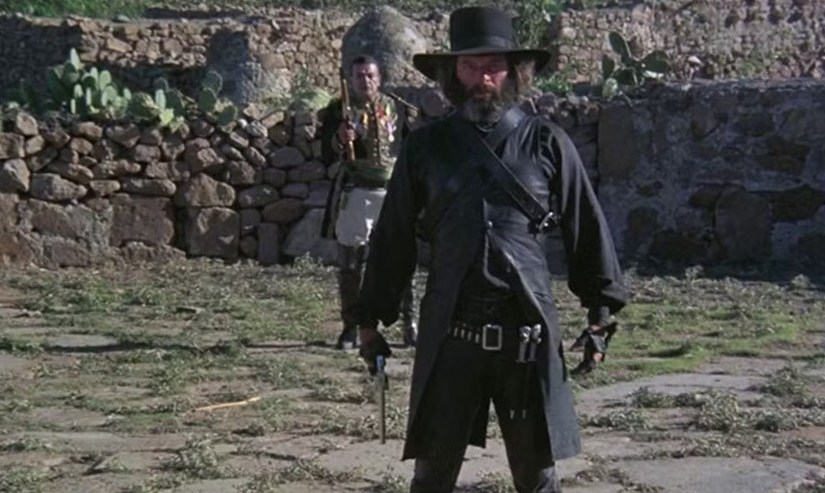
In the late 1980s a novel idea hit the screens.  An MTV interpretation of the Old West with a rock anthem soundtrack of electric guitars and drums. A far separation from Ennio Morricone’s unbeatable spaghetti western approach.  

The film was Young Guns, featuring handsome stars like Emilio Estevez, Kiefer Sutherland, and Lou Diamond Phillips.  They were each different kind of gunslingers in their own right while delivering stand out personalities.  The film has some problems in editing, and some sequences do not work.  Yet, it remains stylish with impressive set designs, props, costume wear, and an especially appealing array of performances from the whole cast.  

Billy The Kid aka William H Bonney is one of the most notorious outlaws in American history.  Emilio Estevez brilliantly turns the gunslinger into a quick draw joker with an addictive cackle and an adorable smile.  William is taken in by the mentoring John Tunstall (Terence Stamp) who already oversees a collection of orphaned young men.  He’s teaching them to bear responsibility on his farm while they learn proper manners at the dinner table and how to read.

A neighboring industrial enemy, L.G. Murphy (Jack Palance) commissions his men to gun down Tunstall.  Billy and the rest of the gang are then deputized by the local Sheriff to issue warrants for the arrest of the killers.  However, Billy repeatedly exercises his own form of justice by killing one guy after another with his pair of six shooters.  Soon after, the boys are on the run by horseback while creating a whole bunch of mayhem.

I never considered Young Guns to be a perfect film, but I like it a whole heck of a lot.

There are moments that serve no purpose, like when the men get high on peyote, introduced by the Navajo, Chavez Y Chavez (Lou Diamond Phillips).  It’s not amusing.  It’s not quotable and the scene runs too long as we watch the cast walk and talk while in daze.  Frankly, most movie scenes of just watching people get high are boring.  Often, they go nowhere and I’m not sure how to respond. It’s like I’m the designated driver fiddling with my car keys at a drunken binge fest. This is no different.

As well, there seem to be gaps within the body of the story. I know it is inspired by the Lincoln County War, but it’s never entirely clear why Tunstall and Murphy are at odds with each other.  We just have to accept that the two elderly men of equal proportions are against one another.  Still, Palance versus Stamp is a very inviting conflict to look at. (Supposedly, the real John Tunstall was only in his mid-20s.)

Young Guns has a very cool polish.  These cowboys are downright attractive, sexy like Hollywood movies tend to offer, and I love how they handle each other, their horses and their pistols.  Every time a six shooter whips out of a holster and clicks, the movie becomes more alive.  The guys look well-worn within this environment, close to the Mexican border of the 1870s.  The image is just as effective as Clint Eastwood appears in his various assortment of westerns.  

Billy The Kid, over this film and its sequel, is Emilio Estevez’ best role of his career.  The actor has such a cocky, nervy way about him and his over-the-top laugh is impossible to forget.  A favorite scene in all of movies emerges when Billy toys with a bounty hunter in a saloon.  Estevez delivers much fun before gunning the guy down. I never tire of watching that moment.

Kiefer Sutherland is second in line with a graceful sensitivity as the educated and poetically romantic Doc Scurlock.  You worry about him and his courting affair with a young Chinese concubine that is owned by Murphy.  Lou Diamond Phillips specializes in knife throwing as Chavez, the token Navajo.  His presence belongs here as an unpredictable sidekick.  

The best surprise is delivered by Casey Siemaszko as the virginal, boyish illiterate Charlie.  Some gunslingers were afraid to ever become outlaws.  Charlie is ugly and dirty, bumbling and sweet, reminiscent of Fredo in The Godfather films.  Siemaszko never became as established as the others in the cast, but he’s a good performer who delivers panicked fear and brings the glamour of Young Guns down to a semblance of reality.  

Young Guns is a style over substance product.  It has potential for a stronger storyline, but the dialogue works and the cast is stellar, which also includes Dermot Mulroney, Terry O’Quinn and Charlie Sheen.  The sequel is actually better as it commits closer to the intrigue of Billy The Kid.  

Not perfect, but this is a fun escapist western experience.

HIGH PLAINS DRIFTER

By Marc S. Sanders

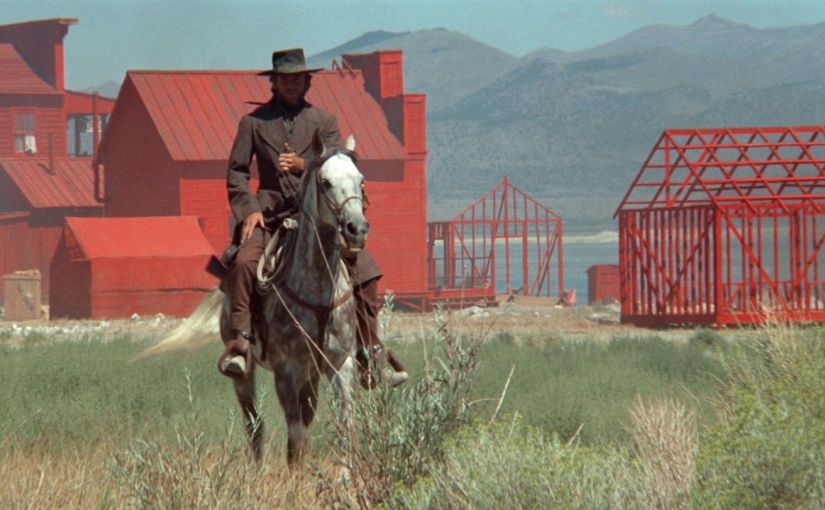
Because Clint Eastwood’s career of acting roles is thematically the strong, silent type, it’s easy to appreciate that in one film he may be The Man With No Name, while in another picture he’s simply The Stranger.  In the second film he directed, High Plains Drifter, he’s an intimidating force riding on horseback into the lakeside town of Lago.  

He may enter the saloon for a beer and a bottle and then cross the street to the barber for a shave and a bath, but you likely do not want to ever involve yourself with him.  He is also horrifically unkind to one of the few women in these parts.  Let’s just say it ain’t no roll in the hay.  This Stranger is a scary dude in a black hat.

The townsmen recognize a convenience in this man’s arrival though.  He’s demonstrated what he is capable of and therefore he appears to be the one qualified to kill three outlaws who were just released from prison with vengeance on their minds as they make a return to Lago.

There’s a hint of supernatural play in High Plains Drifter.  The Stranger recalls a harsh night when the local Marshall had been whipped to death by the townsfolk.  Could the Marshall be the Stranger?  Perhaps.  The victimized Marshall is portrayed by Eastwood’s long time stunt double and occasional director Buddy Van Horn (Pink Cadillac, The Dead Pool).  While that bloody slaughter occurred, the townsfolk simply watched with no offer to help.  For a while, High Plains Drifter was rumored to have been inspired by a real-life rape from the mid-1960s which ultimately led to the need for calling 911 in the event of an emergency.  Art imitates life even in the Old West.

The Stranger agrees to help the town prepare for the outlaws’ violent return, but like a fantasy character he makes special requests of his own including reassigning the sheriff’s badge to the town dwarf, plus taking whatever merchandise he wants from the mercantile and occupying the two best rooms in the hotel.  Also, he gives instructions to load up on a large supply of red paint.  Is the town of Lago getting what they bargained for or are they dwindling into a worse fate? Could be a deal with the devil or as Jewish mysticism might imply, the town of Lago might be inheriting a gollum.

Clint Eastwood salutes his prior directors that prepped him to become an esteemed filmmaker.  Don Siegel’s (Dirty Harry) and Sergio Leone’s (The Dollars spaghetti westerns) names are engraved on tombstones within the nearby cemetery built for the set.  Eastwood adopts some of their famed techniques while not setting himself apart from what those influencers accomplished.  He was still finding his footing behind the camera. High Plains Drifter is just a tale of revenge with recognizable set ups found within typical Hollywood westerns.  

Visually, the film starts out mysteriously with The Stranger’s arrival out of a sun soaked desert boil.  The photography looks deliberately grainy before the modern twenty-first century film restoration appears. Not a word of dialogue is uttered until after the picture has run for over seven minutes.  

Lago becomes a town with a new kind of identity later in the film as mandated by the script.  This is where Eastwood finds opportunity to do things with his western that his earlier pictures had not offered yet.  A bloody, hellish war is expected.

High Plains Drifter traverses in different directions while primarily staying in this one small town and you may wonder what this storyline has to do with that storyline.  Well, the commonality of its various parts is The Stranger’s arrival.  

You’ll may question who this unnamed man truly was by the time film ends.  Maybe it was not a man at all.  There are moments included by Eastwood’s direction to question what precisely occurred.  

Is High Plains Drifter a western or is it a ghost story? Like me, perhaps you’ll uncover moments that support either argument.

SHANE (1953)

by Miguel E. Rodriguez

DIRECTOR: George Stevens
CAST: Alan Ladd, Jean Arthur, Van Heflin, Brandon De Wilde, Jack Palance
MY RATING: 8/10
ROTTEN TOMATOMETER: 97% Fresh

PLOT: A drifter (who may or may not be a retired gunfighter) comes to the assistance of a homestead family terrorized by a wealthy cattleman and his hired gun.


Shane affords me the opportunity to use a word I never get to use in daily conversation: archetypal.  John Ford’s Stagecoach [1939] may be the granddaddy of the modern Western, but Shane taps into something even more primal.

Alan Ladd as Shane is the archetype of the mysterious stranger riding out of the mountains, either coming to the aid of a community who has lost hope (Pale Rider, 1985) or wreaking havoc as an avenging angel (High Plains Drifter, 1973), and then disappearing into the sunset or riding back into the distant mountains.  This formula was probably already old when Shane was made, and the film does little to dress it up or add any kind of pretentious spin to the story.  But by sticking to the formula and really nailing it home, director George Stevens achieved a weird kind of clarity that elevates Shane into a mythical realm.  If it’s not terribly realistic, well…who wants realism mixed in with their magic?  Not me.

Shane is set in the high plains of Wyoming in 1889.  (I don’t remember the exact year being mentioned in the film – I pulled it off IMDb – but we can tell it’s after the war because a running gag involves a harmonica player who always starts playing a Union song whenever a homesteader called Stonewall, who fought for the South, walks into a meeting.  It’s a mark of faith in the intelligence of the average viewer that the screenplay never comes out and explains that’s what’s happening; we just see it and have to put two and two together.  Nice.)

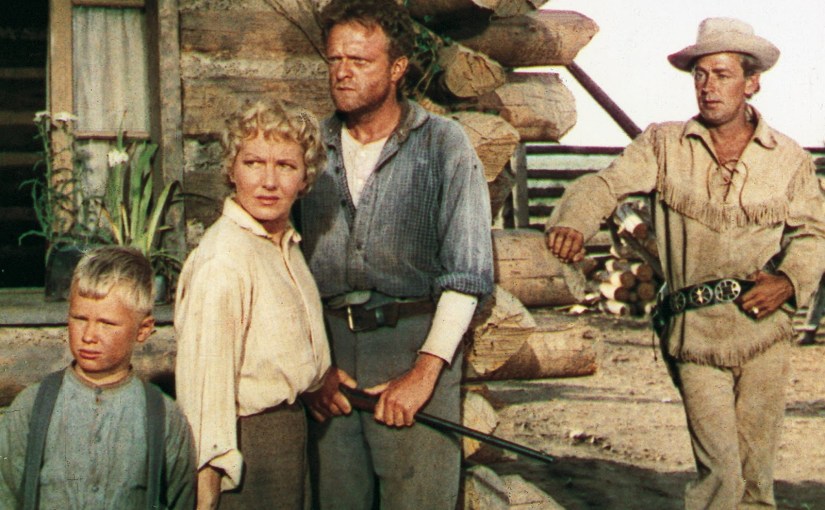
ANYWAY…it’s 1889, and a land baron named Rufus Ryker is trying to run homesteaders off some land that they rightfully own, but which is preventing Ryker from expanding his cattle ranch.  Among these homesteaders is Joe Starrett (Van Heflin); his wife, Marian (Jean Arthur); and his little boy, Joey (Brandon De Wilde, who earned an Oscar nomination for Best Supporting Actor, but don’t ask my opinion of his performance…just don’t).

One day, true to mythical form, a lone figure rides out of the mountains and up to Starrett’s patch of land.  He is improbably good looking, wears a fringed buckskin jacket, two ivory-handled revolvers, and identifies himself only as Shane.  After earning Starrett’s trust, he agrees to stay on as a hired hand and possibly help with the struggle against Ryker…

…and if you’ve been watching movies as long as I have, you could practically write your own screenplay for the rest of the film, because you’ve seen it before, many times.  The stranger proves his worth, defends his new friends, makes friends with the wife (but not TOO friendly), gets hero-worshipped by the little boy, and eventually runs them cattle barons plumb out of business.  But I’ve never seen it done quite like Shane.

For example, there’s a bar fight that ought to be in the Bar Fight Hall of Fame.  Shane, in what HAS to be a deliberate move to goad the bad guys into action, walks into a saloon filled with Ryker’s men to return a soda-pop bottle for the deposit.  A fight predictably breaks out, first one-on-one, then 1-on-2, then 3, then 4.  (Who does this guy think he is?  John Wick?)  The fight gets to a point when it’s winding down…then it picks right up again.  Then they get Shane on the ropes and start waling on him…until Starrett sees what’s happening, grabs an axe handle, and cracks it over someone’s head.  That may not sound like much in writing, but it’s pretty impressive visually, especially from a 1953 Western that feels at times like a Disney product.

(It almost feels like what Tarantino did with the fight between the Bride and the Crazy 88 in Kill Bill, Vol. 1 (2003).  George Stevens said, “Okay, these people want a bar fight?  I’ll give you a damn bar fight.”)

But while I was watching it, I started to analyze it a little bit.  Bar fights…seen one, seen a thousand.  But Shane felt to me like it was embracing the cliché, making friends with a trope, and in so doing the fight became a myth of a bar fight, a fever dream of itself.  It’s not just a bar fight.  It’s THE bar fight.

A lot of Shane works that way.  Shane isn’t just a mysterious stranger, he’s THE mysterious stranger.  An argument could be made for Eastwood’s “Man with No Name” as the archetype of this character, at least in the Western genre, but it’s clear that Eastwood took a lot of cues from Shane when writing and directing his own films.  I’m not suggesting that Eastwood plagiarized Shane.  I’m suggesting that Eastwood’s creations are infused with Shane’s DNA in all the best ways.  (I wouldn’t presume to speculate how much of Shane is in Sergio Leone’s spaghetti westerns starring Eastwood, though I would say those have more of Kurosawa in them than George Stevens.)

There are just two items that bugged me while watching Shane.  One, the editing was occasionally erratic, using a lot of fades or cuts to virtually empty frames in the middle of the action.  I don’t normally pick that kind of thing apart in a review, but it was glaringly apparent in a lot of places.

Two…the tragic waste of talent by casting Jean Arthur as Mrs. Starrett.  Jean Arthur is the fast-talking, quick-thinking actress who appeared in such classics as Mr. Deeds Goes to Town [1936], Mr. Smith Goes to Washington, and Only Angels Have Wings [both 1939].  She goes (or OUGHT to go) on the list of intelligent female actors like Katharine Hepburn and Rosalind Russell.  By 1953, she was semi-retired and only appeared in Shane as a favor to her friend, director George Stevens.  When I saw her name in the credits, I had visions of her delivering fiery speeches, shaming and out-thinking the menfolk, declaring her admiration for Shane without exactly laying out her TRUE feelings for him, and so on.  Instead, she is reduced to spending the majority of her screen time fretting over her husband’s safety, casting loaded glances at Shane while her husband isn’t around, baking pies, and reading bedtime stories to Joey.  I know I just got done writing about how the movie embraces clichés and becomes mythological, and there’s nothing more clichéd than the “little woman” supporting her husband, etc., but something about her role just rubbed me the wrong way.  After this film, Arthur retired from film completely, and although Shane was a massive popular and critical hit, I can’t help but wish she had been given more to do in her last film.

By the time Shane reaches its famous finale (“Shaaane!  Come baaack!”), justice has been meted out and the little guys have won…all is right with the world.  Echoes of Shane still linger today, because who doesn’t like a good old-fashioned bad-guy beatdown, administered by the archetypal mysterious stranger?  This may not be my favorite Western of all time, but from now on, whenever I do watch my favorite Westerns, I’ll keep an eye out for Shane’s shadow, looming large over all who came after it.

WINCHESTER ‘73 (1950)

by Miguel E. Rodriguez

DIRECTOR: Anthony Mann
CAST: James Stewart, Shelley Winters, Dan Duryea, Stephen McNally, Millard Mitchell, Rock Hudson, Tony Curtis
MY RATING: 9/10
ROTTEN TOMATOMETER: 100% Fresh

PLOT: A cowboy’s obsession with retrieving his stolen rifle leads to a violent odyssey through the American West.


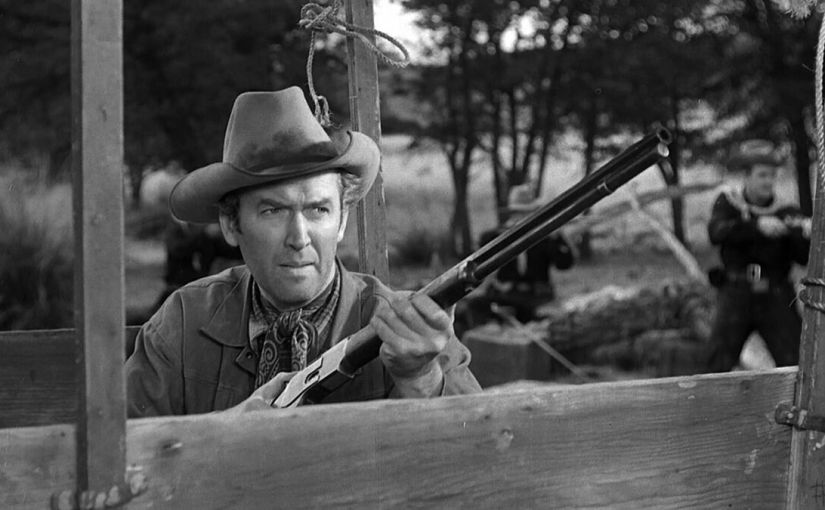
Even without knowing the full history of how the film impacted contemporary audiences, Anthony Mann’s Winchester ’73 still packs a punch.  Using an ingenious story structure, courtesy of a very Western MacGuffin, the film follows the path of a rare, expensive Winchester rifle from hand to hand for ninety taut minutes.  James Stewart is top billed, but he is on screen for less time than you’d think.  That’s actually a good thing in this case, as Mann’s focus is not on star power, but on metaphor and mythology.  (Although Stewart’s star power certainly doesn’t hurt, as he demonstrates in several key moments.)

The movie plops us right into the action with nary a flashback nor an expositional monologue in sight.  The legendary town of Dodge City is holding a shooting contest to celebrate Independence Day, 1876.  Sheriff Wyatt Earp (!) is officiating, and the prize will be a rare model of the Winchester ’73 repeating rifle.  Arriving in town that day is Lin McAdam (Stewart) with his partner, High-Spade Frankie Wilson (Millard Mitchell).

(Around this part of his career, Stewart’s trajectory was on the decline, as he was getting too old to play the aw-shucks-y kind of roles that were his bread and butter in the ‘30s and ‘40s.  Winchester ’73 was an opportunity to showcase his range, and he delivered.  Lin McAdam is not the villain, but neither is he the kind of character Stewart had ever played before.  It’s been written that, when audiences of the day saw Stewart get violent and pin a man to a saloon bar, there were gasps.)

Lin is none too friendly towards another man in town, Dutch Henry Brown (Stephen McNally), who reciprocates in spades.  There is clearly some kind of history, but what that history entails would take too long to explain, so the movie wisely doesn’t try.  They’re enemies, and that’s enough.  Somewhat predictably, they both enter the contest for the prize Winchester, but in the first of many twists, the contest doesn’t play out exactly as you would expect.  Then the rifle is stolen, Dutch and his pals skip town, and Lin and his partner give chase.

From there, the movie gets episodic.  There’s the Indian trader, the Indian himself, Young Bull (Rock Hudson in a fake nose and braids!!!), the obligatory feisty lady, Lola (a luminous young Shelley Winters) and her beau who behaves in a most unmanly manner, a run-in with some cavalrymen (featuring an unknown young actor billed as “Anthony Curtis”), and winding up with a real sleazeball, Waco Johnny Dean (Dan Duryea).  How the rifle makes its way from place to place I will not reveal, but it’s all perfectly feasible.

(I will leave it to wiser minds than I to discuss the racist portrayal of Indigenous Americans, including using Rock Hudson in “red-face” to play a tribal chief.  Yes, it’s shameful and unfortunate, but it happened, and I use the term “Indian” earlier because that’s how they’re referred to in the film, for better or worse.)

If I had to explain what this movie is actually about, beyond its brilliant plotting, I’m not sure I could do it.  I can report that it was engaging and crisp and surprising and almost demands a rewatch after the end credits, but aside from just being a darn good entry in the Western genre, it’s hard for me to pin down its message.  Is it a screed against the violence in the real West?  How some men searched for violence because it was in their nature, or because they felt it was their duty?  I mean…yeah, I guess, but that feels like just scratching the surface.  What were Mann and Stewart trying to say?

Maybe it’s one of those movies where the message depends on the viewer.  If you look at it as an anti-violence film with a bittersweet ending filled with moral ambiguity, it’s there.  If you look at it as just a travelogue or tapestry of the old West, made by a director who loves the genre and an actor sinking his teeth into a great role, that’s there, too.  (Mann and Stewart would go on to make seven more films together, five of them Westerns.)  There’s even melodrama and a hint of romance along the way, but never too much to drown everything else out.  For me, Winchester ‘73 is much harder to unpack than Unforgiven (1992), whose message is crystal clear from beginning to end.  Both movies are equally entertaining, though, don’t misunderstand me.

If any active readers have made it this far, feel free to let me know what the “true meaning” of Winchester ’73 is.  Whether I find out or not will truly not matter, because the movie is still hugely entertaining with or without an explanation.  I might have a tiny bone to pick with the final battle, with its foregone conclusion, but it comes with the territory, so I have to forgive it.  This is a great entry in the genre, featuring a star pushing his boundaries and a director who knew how to harness that energy.

MONTE WALSH (1970)

by Miguel E. Rodriguez

DIRECTOR: William A. Fraker
CAST: Lee Marvin, Jeanne Moreau, Jack Palance, Mitchell Ryan
MY RATING: 7/10
ROTTEN TOMATOMETER: 89% Fresh

PLOT: An aging cowboy realizes that the West he knew and loved will soon be no more – and that there will be no room for him, either.


Based on this film, Monte Walsh, and the other two films he directed, A Reflection of Fear [1972] and The Legend of the Lone Ranger [1981], I think it would be charitable to say that William A. Fraker’s best films are the ones where he served instead as director of photography, such as Bullitt [1968], WarGames [1983], and Tombstone [1993], among many other notable movies.  Am I saying Monte Walsh is a bad film?  No, but it’s certainly not as bad as Gene Siskel’s 1-star rating, nor is it as stellar as Roger Ebert’s 4-star rating.  I give it a 7-out-of-10 on my scale because of the way the second half of the film builds and builds so that the outbursts of violence feel earned and motivated instead of cliched.

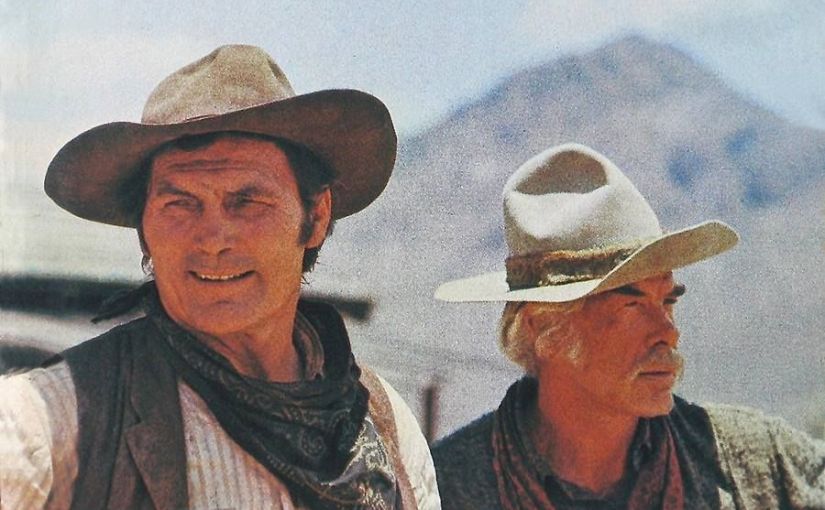
Monte Walsh (Lee Marvin, grizzled as ever, even with a handlebar moustache) and his friend and partner, Chet (Jack Palance in a rare non-villainous role), come down off a mountainside after a rough winter keeping watch on Mr. Brennan’s herd of cattle, only to get news that Brennan’s ranch has been purchased by a corporate entity, Consolidated Cattle.  Brennan offers them a steady job, which they reluctantly take, but deep inside they know this means their prairie-roaming way of life is coming to an end.  Chet is prepared to accept this, but Monte chafes at the idea.  “I ain’t doing nothing I can’t do from a horse,” he warns Brennan.

We get entertaining glimpses of the ranch hand life, complete with the saloon fights and the stinky cook.  Monte dallies with a French madame, Martine (played by the exotic Jeanne Moreau).  At one point, Monte and Chet ride out and meet a weathered old ranch hand who is “riding fence,” or inspecting every foot of fence around the ranch for repairs…the only work he’s cut out for anymore.  “Looks like his life is over with,” they say, and you can tell they’re looking into their own future.

The thrust of the film is one I’ve seen in many other westerns before this one: “The old West is changing, and there’s no place in it for people like us anymore, so we’d better evolve or die.”  This theme is present in Once Upon a Time in the West [1968], Butch Cassidy and the Sundance Kid [1969], and especially The Wild Bunch [also 1969]…seemed to be a trend for westerns at the turn of the decade, for some reason.  Monte Walsh handles it in an episodic format, kind of like another Lee Marvin film, The Big Red One [1980].  It doesn’t quite tell a straightforward plot with a pre-determined story arc.  It skips around a little bit, painting a picture without telling a conventional story.

There can be a sense of freedom in this kind of storytelling.  Unshackled by traditional story beats – at least for the first half – the movie is laid back, asking the viewer for a little patience as it slowly lays down building blocks for the finale.  However, I must report that I found this section of the movie a little slow.  I grew impatient.  I felt I was being set up for something, but pretty soon I just wanted the movie to get on with it.  Butch Cassidy sort of works that way, but you had two of the most photogenic stars who ever lived as the two leads.  I struggled to care the same way for Jack Palance as I did for Paul Newman.

But then an unexpected scene of violence occurs, setting into motion a series of events that culminate in a tragic series of deaths that, I must admit, had me glued to the screen as they unfolded.  Because of the gangbusters nature of this section, I am inclined to forgive the film’s shortcomings in its first half.  Here, we see, yes, Monte must evolve or die, and even if it’s never in any real doubt what he will choose, it’s entertaining to watch him make that choice.

If not for the second half of the picture, I might not even be writing about Monte Walsh.  I didn’t care for the opening song (even if it WAS sung by Mama Cass), some of the movie felt ripped off from several other westerns, and I was borderline bored for the first half.  But if you stick with Monte Walsh until the end, I think you’ll agree it’s worth a look.

DJANGO UNCHAINED

By Marc S. Sanders

Quentin Tarantino’s scripts have never been shy with using the N-word or any other colorful terminology.  He turns harsh and biting vocabulary into rhythmic stanzas of dialogue.  When he films these scripts, he’s not bashful with the buckets of blood splashed all over the set either.  His interpretation of violence works in a kind of slapstick fashion among his seedy one-dimensional characters.  Normally, I never get uneasy with his approach.  I know what to expect of the guy.  Yet, as well cast, written and formulated his Oscar winning film Django Unchained may be, I wince at both his word play and physical carnage.  I think Tarantino gets a little too comfortable with his slave era storylines and the African American actors he stages in his set ups.  A good portion of this Western may be thrilling, but it’s also cringy like watching a drunk uncle at a three-year old’s birthday party, and I defy viewers not to squint at the movie if they so much as live day to day with even the smallest shred of kindness in their hearts.

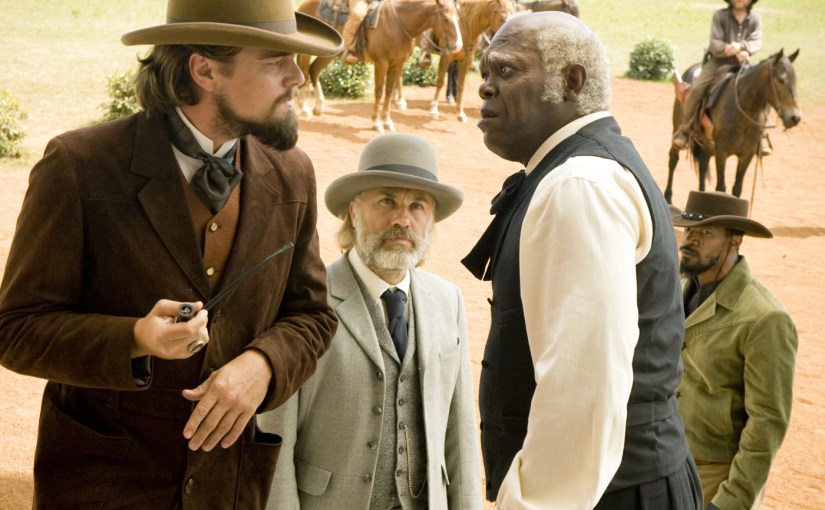
Django Freeman (Jamie Foxx) is released from slavery by the former dentist now bounty hunter, Dr. King Schultz (Christoph Waltz, in his second Oscar winning performance cast by Tarantino).  Django is a good man, though uneducated and mostly illiterate.  Once he assists the doctor with locating and collecting a bounty, the two make an arrangement to stick together through the winter collecting further ransoms.  In return for the former slave’s help, Dr. Schultz will assist in rescuing Django’s wife, the German speaking Broomhilda (Kerry Washington).  She is believed to be held at the infamous Mississippi slave plantation known as Candyland, owned by the ruthless Calvin Candie. He is played by Leonardo DiCaprio in one of his best roles while also delivering one of his most unforgiving portrayals.  Calvin Candie is a mean son of a bitch slave owner who has too much fun with investing in slaves for brutal Mandingo wrestling matches that don’t finish until the loser is dead in bloody, bone cracking fashion.  

All of these figures belong at the top of Quentin Tarantino’s list of sensational character inventions, particularly Django.  He has more depth than most of the writer’s other creations.  This guy goes from an unkempt, nearly naked, tortured and chained slave to a free man proudly wearing a bright blue court jester costume on horseback.  His third iteration places him in a gunslinger wardrobe comparable to a Clint Eastwood cowboy and when the conclusion arrives, Django is meaner, more confident and instinctively wiser, glamorously dressed (purple vest with gold inlay designer seems) like a graphic novel superhero ready to take on an endless army of redneck slave abusing outlaws.  Django is taught everything he needs to know from Doc Schultz.  Christoph Waltz and Jamie Foxx stand as an impressionable mentor/student pair.  They are the spine of Django Unchained.

The villainy of the piece belongs to DiCaprio and his head slave in charge, known as Steven, played by the director’s go to player for happy street slang and N-word droppings, Samuel L Jackson.  Steven is Jackson’s best career role because as an old, decrepit and frightening individual it’s this portrayal which looks like no other part the actor has ever played.    Both actors are funny, and you can’t take your eyes off of their unlimited grandstanding, but they will leave you feeling terribly uncomfortable.

I think what is most unsettling about Django Unchained is that the cruelty persists for nearly the whole three hour run time, and it is more so at a shameless attempt of comedic, pulpy entertainment, rather than just insight and education.  A Schindler’s List finds no glee in the torment that kept the Holocaust alive.  Tarantino didn’t even go to great heights with Inglourious Basterds because that film featured ongoing grisly heroics with his assortment of vengeful protagonists.  The Nazis were never celebrated in that film at the cost of innocent Jewish lives that faced peril and threat.

In Django Unchained, it’s hard to watch the Negro characters and extras getting brutally whipped while bound by inescapable chains.  Kerry Washington’s nude character is yanked out of a sweat box on the Candyland plantation and while I’m watching it, I ask myself if I’m too much of a prude.  No.  I don’t think I am.  This teeters on torture porn. The N-word is now being used way too freely to stab at the slaves for gleeful poetry. It grows tiring and, yeah even for a Quentin Tarantino picture downright ugly and offensive. I imagine Tarantino grinning behind the camera every time DiCaprio or Jackson happily drop another N-bomb.

Quentin Tarantino has been applauded time and again for his excessive abuse and tortuous murders committed by his characters.  Because he’s courageously gone so far before, the line of acceptance is either pushed out farther or maybe in the case of Django Unchained it is entirely erased.  

My compliments to a well-known humanitarian like Leonardo DiCaprio for energetically acting through this bastard of a role that requires a twisted pleasure in watching two husky black bruisers beat the bloody tar out of each other in a formal drinking parlor.  Later in the picture, a weeping slave is shredded to pieces by ravaged, bloodthirsty dogs.  These fictional scenes staged by Tarantino and his filmmakers come off a little too real and even by the director’s standards much too over the top for the temperature of this film’s narrative.  

What could these extras cast to play these slave and Mandingo roles have really been thinking while shooting this picture?  Did these men recognize the racially poetic humor in Tarantino’s verbiage? Did they find a commitment to demonstrate a once historic atrocity for a lesson learned? I doubt it. Did these actors simply succumb because they needed the work?  Believe me.  I empathize.  Yet, Tarantino took this film to a very uncomfortable extreme for a movie intended on following his reputable and always admired lurid material.  Here, despite my reverence for his work, I think Quentin Tarantino goes unnecessarily over the line.  The whippings and dog torture are quite uneven from what The Bride commits in Kill Bill when a Crazy 88 henchman gets spanked with a sword and there’s nothing to compare to whatever sick, graphic novel atrocities occur in his later western, The Hateful Eight – both are PG rated compared to what is offered in Django Unchained.

Much of Tarantino’s signature comedy works.  The Ku Klux Klan of the late 1850s are represented with brilliant stupidity by a cameo appearing Jonah Hill and a racist, foul speaking, plantation owning charmer played by Don Johnson, known by what else but Big Daddy.  The filmmaker turns these guys into bumbling stooges who can’t even wear their hoods properly. And yes, they also freely drop the N-word in cruel like fashion. I get it, Mississippi and Southern Plantation owners were not the Mickey Mouse sort, and I’m not asking for whitewashing what the real-life despicable characters stood for or how they carried themselves. Still, when all of this compounded together, it goes too far. In a drama like 12 Years A Slave, I see an authenticity to an ugly slave era. In Tarantino’s world, I see a kid who learned a bad word and dad said go ahead son, play with the machine gun but make sure the vocabulary ammo will riddle the entire script to pieces.

Django Unchained is a gorgeous looking picture.  Tarantino goes to the outdoor plains following the interiors of Pulp Fiction and Jackie Brown.  Jamie Foxx and Christoph Waltz’ cowboy antics look marvelous riding on horseback or even simply camping by the fire as well written exposition is revealed on cold moonlight evenings.  

I can watch this western on repeat and feel a free-spirited energy when Django steps out in his cowboy outfit with boots, spurs, the hat, and a brand-new saddle to ride off on his steed while Jim Croce’s uplifting “I Got A Name” cues into the picture.  I love how Jamie Foxx appears as a super heroic action star, especially in the final act of the movie.  I can absorb the sadism of DiCaprio’s downright mischievous evil, particularly when he uses a bone saw and skull prop to make a point.  I feel like I’ve gained a comforting friend in Christop Waltz’ kindly sensible Doc Schultz, and I welcome a very funny and altogether different Samuel L Jackson that finally arrives.  

It’s the filling within these strong moments and characterizations that is very hard to swallow.  Django Unchained is that great picture that still should have been made but with a modicum of caution. Perhaps one of the Weinsteins, or maybe even these powerhouse, marquee actors who led this piece should have shared some constructive input with the writer/director.

Django Unchained is fun, but it’s not entirely fun.

THE QUICK AND THE DEAD

By Marc S. Sanders

The Quick And The Dead is a gritty, stylish western that boasts a who’s who of great actors.  Some of which went on to magnificent careers.  I wish the story was a strong as the cast list though.  It’s watchable.  It’s intriguing. It’s also too repetitious.

Sharon Stone is Elle.  Otherwise known in these parts as The Lady.  Two minutes into the picture and my suspension of disbelief is withering away.  Not because this gunslinger cowboy is a cowgirl, but because Stone does not look like she fits in the Old West.  Her blond locks are shampooed and conditioned.  Her complexion perfectly made up without a hint of grime or dirt or sunburn.  Stone looks like she took one step off the Oscars red carpet and onto this set. Her costume with a scarf, leather pants, black rimmed hat, and spurred boots looks like its attempting its own kind of Clint Eastwood stranger.  Frankly, it appears to have leaped off the pages of an Old Navy catalogue.

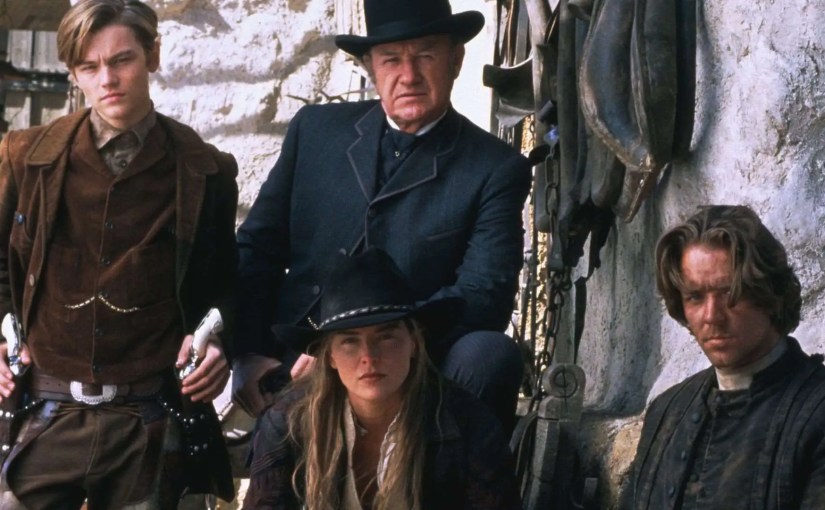
Below Stone on the credit lineup is a much more redeemable list of characters.  Gene Hackman is Mayor Herod who has amped up his level of sinister from his Oscar winning performance in Unforgiven.  There’s also Ace Hanlon played by Lance Henrickson with a rare on-screen giddy grin, whose personal deck of cards consists of aces of spades for every man he’s killed. Sgt Cantrell is the flamboyant personality with the handlebar mustache, deep voice and toothy grin that actor Keith David proudly bears.  A kid named Leonardo DiCaprio plays up the youthful cockiness of an outlaw named The Kid.  All these folks are gunslingers participating in the sport of gunslinging.  Last one left standing is the winner.  Midway through though, Herod will up the ante and deem that the last one left alive is the winner.  Each one challenges another until a final winner is recognized.  One reluctant participant is played by a very youthful looking Russell Crowe.  Cort is a former fast draw, who is now a remorseful preacher for all of the killings he’s committed.  Herod is not entirely convinced and will antagonize Cort to throw his hand in the game.

Sam Raimi directs and Sharon Stone produces this slick small town modern day High Noon.  The problem though is that Raimi and screenwriter Simon Moore choose to only send up the climax of that classic Gary Cooper western over and over.  Time and again, two opponents line up at opposite ends of the street.  The townsfolk observe with close up tension shots.  The hands twitch their fingers next to the holsters and when the clock strikes twelve, the guns go off.  Raimi often gives you the impression that the one expected to live is the one who is going to topple over dead and then an edit shows the match went exactly like you thought it would. 

This whole supporting cast has enough presence and charisma to keep my attention, but the set ups are the same over the course of the film.  Cut in between are discussions within the saloon or the hotel rooms where Herod or the Lady rest.  Cort remains chained in the town square.  When the movie breaks away it goes to flashbacks of Stone’s character as a child when she once crossed paths with the devilish Herod. 

I like the polish that Sam Raimi brought to The Quick And The Dead.  Before Quentin Tarantino was glamourizing his pulp fiction to his own two dimensional westerns and war movies, Raimi was daring enough to let us look through literal bullet holes from the front to the back of his victims.  Holes through the hand, the chest and the head.  It’s fun.  There are also countless closeups of haunting music from Alan Silvestri as a new stranger enters a saloon to click his spurs on the wooden floor.  Quick draw action is how these pistols perform too.  Hangings are a part of any day as well.  All of this is familiar and standard to the B movies brought to us by Sergio Leone’s spaghetti westerns during the mid twentieth century, but now we have a modern day cast and some glossy cinematography.

I was ready for a worthy salute.  It just comes up short due to a lack of any depth in story.  Gunslinging quick draws are not as dynamic as a gunfight at the OK corral.  How much different is one dual draw going to be from the last one we watched five minutes ago?  Raimi’s camera points from behind each challenger.  The music builds louder and louder.  Zoom in shots of townsfolk cut in.  The minute hand on the clock tower moves closer and closer to the roman numeral twelve, and then…BANG BANG!!! (I’ve said this before, haven’t I?  Well, so does the movie.)

The Quick And The Dead is worth seeing especially for another scenery chewing villain from the great Gene Hackman.  I’ll never tire of watching him.  To see the beginnings of Russell Crowe and Leonardo DiCaprio’s potential is a real treat as well.  They all certainly have some acting moments that I loved digging up from this time capsule.  Character actors Keith David and Lance Henrickson break from the standard personas you’ll find on the rest of their resumes.  I just needed more of a variety to this town setting they got play in.  The déjà vu is too overdone.

Sharon Stone usually looks like she’s giving a so so community theatre audition.  It’s hard to take her seriously, the same way I would had Uma Thurman, Susan Sarandon or Geena Davis been cast as The Lady.  Those actresses work for their appearance to be appropriate for the setting of their films.  Look at Sharon Stone here in the dusty Old West.  Then look back to what Sarandon and Davis did in Thelma & Louise.  You’ll see right away, practically anyone else would have been more suitable for the lead of The Quick And The Dead.

GUNFIGHT AT THE O.K. CORRAL (1957)

by Miguel E. Rodriguez

DIRECTOR: John Sturges
CAST: Burt Lancaster, Kirk Douglas, Jo Van Fleet, John Ireland, DeForest Kelley, and a young bit player named Dennis Hopper
MY RATING: 8/10
ROTTEN TOMATOMETER: 87% Fresh

PLOT: Lawman Wyatt Earp and outlaw Doc Holliday form an unlikely alliance which culminates in their participation in the legendary Gunfight at the O.K. Corral.


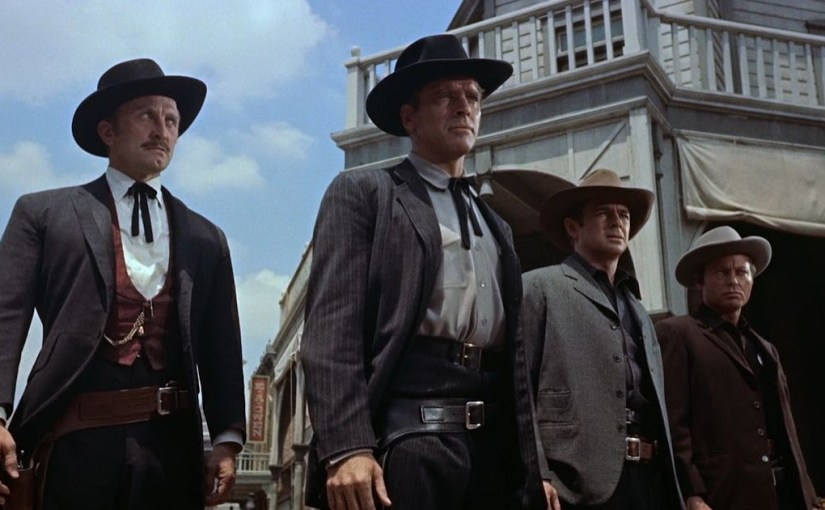
In real life, the legendary gunfight at the O.K Corral in the frontier town of Tombstone lasted thirty seconds, but what kind of movie would that be?  (Kill Bill: Vol. 2 springs to mind…)  A 1950’s Western requires a long-to-medium shot of the good guys – Wyatt Earp, his brothers, and Doc Holliday – striding down the street to meet the challenge of the dastardly Clantons, who had gunned down Wyatt’s youngest brother in cold blood.  We need a gunfight, not too long, but longer than 30 seconds.  And we need to make sure the ratio of surviving bad guys to good guys is just right: 0 to all.

John Sturges’ Gunfight at the O.K. Corral delivers the goods in a remarkably mature film for its time, free (for the most part) of cheap sentimentality and distractions from the main plot.  That’s a double-edged sword, though: we rarely leave the side of either Wyatt Earp or Doc Holliday, but the result is we get little to no information about Earp’s brothers until the final reel, nor do we get many details about Earp’s romance with the lovely Laura Denbow, a high-class gambler who knows enough about cards to beat the men at their own game.  We only find out they’re engaged as an afterthought, it seems.

As for Doc Holliday’s relationship with Kate Fisher (Oscar winner Jo Van Fleet), the word “dysfunctional” is woefully inadequate.  Loosely based on Holliday’s real mistress, referred to only as “Big Nose Kate” on Wikipedia, she seems to exist only to serve as Holliday’s psychological punching bag when required.  Her emotional yo-yoing gave me whiplash: she pledges her unending devotion in one scene, tries to stab him in another, helps him escape a lynch mob, takes up with the loathsome Johnny Ringo after yet another fight, begs to be taken back, and eventually tells him, “I’ll see you dead!”  With friends like these…

But even that kind of sordid melodrama is not enough to derail the throughline of the film, which is focused intently on establishing the rocky relationship between the morally good Wyatt Earp (Burt Lancaster) – who nevertheless wears a black hat the entire film – and the morally chaotic Doc Holliday (Kirk Douglas), a professional gambler who leaves a string of dead bodies behind him, all killed in self-defense, of course.  Earp also helps get Holliday out of town before a mob can lynch him, so Holliday decides to stick around until the debt is paid.

I think the essence of their relationship is summed up in a scene where Earp is forced to deputize Holliday when no other options are available.  Earp reluctantly walks up to Doc, tells him to raise his right hand, and says, “Do you solemnly swear to uphold…oh, this is ridiculous.  You’re deputized.”  Doc: “Wait a minute, don’t I get to wear a tin star?”  Earp: “Not on your life!”  Both men are torn between their philosophy and their sense of honor.  Holliday is no hero, but he’ll help Wyatt until his debt is paid.  Earp despises Holliday’s moral code, but he’s the best gunslinger in town.  What can you do?

All of this is handled in dialogue that seems mostly uncluttered by the hokey clichés I’ve heard in so many other films of the 1950s, even some of the great ones.  This may perhaps be due to the fact the screenplay was written by Leon Uris, a novelist who would eventually go on to write, among many others, Exodus, Topaz, and QB VII.  Listening to the characters talk, it was interesting to hear how natural they sounded, compared to the overblown melodrama of so many other westerns and dramas of that era.  The dialogue was clearly written by someone with a writer’s ear, who wants to get to the point of every scene with a minimum of fuss or flowery exposition.

As I mentioned, however, this quest for directness means we spend all our time with Earp and Holliday and almost no time at all with the Clantons or Earp’s brothers or anyone else.  By the time we hear Wyatt’s brother, Virgil, is in trouble, we’ve almost forgotten he HAS brothers.  As far as the Clantons go, we hear everything about them secondhand until we finally meet them in Tombstone.  We never even see Wyatt propose to Laura; we barely even see them courting (their courtship appears to consist of one false arrest and one kiss in the moonlight).

And I would be remiss if I did not mention…that song.  I learn from IMDb that the song, “Gunfight at the O.K. Corral,” that plays over the opening and closing credits, and which also plays over any transitional scene as Earp moves from one town to the next, was one of the inspirations for the theme song for Mel Brooks’s parody Blazing Saddles.  Brooks even got the original artist, Frankie Laine, to sing for his own movie.  It is so corny and earnest, juxtaposed against the gritty characters and scenery, that any sequence featuring that song loses all credibility.  If the filmmakers had just ditched that song, I might consider this one of the greatest Westerns of all time.  (see also Rio Bravo with Ricky Nelson’s crooning.)

But…having said all that, I must report that Gunfight at the O.K. Corral was entertaining from start to finish.  By avoiding the temptations to give in to melodrama and hokeyness, we are presented with a surprisingly solid Western drama that culminates in a decent (for the late ‘50s) gun battle.  It’s not as flashy as anything from one of Eastwood’s spaghetti westerns, and it’s not quite as thrilling as the one at the end of 1993’s Tombstone, but it’s satisfying, nevertheless.

(And for the record, when it comes to memorable lines, against Val Kilmer’s immortal “I’m your huckleberry”, I would gladly put Kirk Douglas’s venomous, “You slut!” …you have to see it in context, trust me.)

JOE KIDD

By Marc S. Sanders

Joe Kidd is not one of Clint Eastwood’s best westerns.  In fact, it might be his weakest of the sort.  The film arrived at the tail end of director John Sturges’ (Bad Day At Black Rock, The Magnificent Seven) career and through my research it seems that Eastwood did not get along with him.  Sturges was rumored to be an alcoholic providing limited focus on the film in question.  I’m apt to believe that theory.  Joe Kidd, which was scripted by Elmore Leonard who would go on to write Get Shorty, is full of enormous plot holes. 

Eastwood is a welcome sight at first, handcuffed in the Sherrif’s jail until he’s unlocked to attend his court hearing.  Before leaving, in typical quiet, tough guy style, he demonstrates to an annoying cellmate that he won’t be intimidated by splashing the guy’s stew in his face and then denting the pot over his forehead.  It’s a great introduction for a title character.  I laughed.  I clapped.  After that, however, the movie fell apart.

The structure of Joe Kidd seems to start in the middle of a story that opted not to go back to the beginning.  A Mexican rebel leader named Luis Chama (John Saxon) causes some ruckus in the courtroom and around town, and then he flees into the nearby mountains.  Joe manages to shoot one gang member who enters the saloon.  Thereafter, a wealthy landsman named Frank Harlan (Robert Duvall) arrives and after paying for Kidd’s bail, he hires the ex-bounty hunter to accompany his posse and bring back Chama and his squad.  According to Harlan, Chama is occupying a large chunk of valuable land and therefore has to be taken out of the equation.  Okay.  Simple enough.

However, the narrative zig zags from that point.  First, Joe declines the offer from Harlan.  Then he discovers that Chama has tied up one of his ranch hands in barbed wire.  So, he dons his perfect tough guy cowboy duds (his hat looks great on his head) and off he goes with Harlan.  Midway on their journey through the mountains, they set up camp at a Mexican church.  Harlan announces into the wide expanse, for Chama to hear, that he will kill five people in the church if he does not surrender himself.  After a period of time, he’ll kill five more until the Rebel gives himself in and so on and so on.  Joe Kidd does not agree with this arrangement, gets fired by Harlan and eventually sidles up with Chama.  What’s going on here?  Didn’t Joe want to even a score with Chama after what he did to his ranch hand?  In a short ninety-minute running time, set ups occur only to be undone minutes later, and I’m starting to question my ability for basic comprehension. 

To date, of all I’ve seen in Robert Duvall’s illustrious career, this is hands down the weakest character he’s portrayed.  He’s not a terrible actor here.  He just has nothing to do except look like a greedy landowner with a mustache and a six shooter on his hip.  He’s not given any dimension of material to play with, and thus comes off like a bad guy of the week on an episode of The A-Team.  John Saxon actually guest starred a few times on that show as a variety of different bad guys.  The only new thing I see from him in this picture is his unconvincing Mexican accent. 

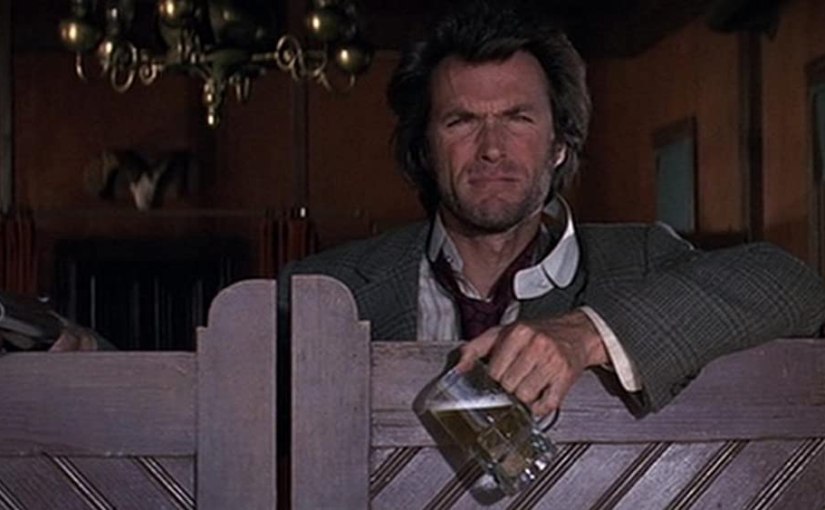
Clint Eastwood is playing his typical westerner.  He looks great with the hat and stature and the gun in his hand.  Yet, the novelty looks tired here.  As if we’ve already seen him in other classics like the Dollars trilogy, and High Plains Drifter.  There was nothing new to offer with Joe Kidd.  A diversion occurs early on where Kidd is about to take advantage of Harlan’s girl.  That goes nowhere and serves no purpose.

I imagine there was a better and more fleshed out script here that never materialized.  A friend of mine recently asked me if it would make sense to remake films with potentially good ideas that were poorly executed.  Seems logical to me, and then he asked me to name some examples.  On the spot, I could not come up with one.  Howard The Duck? Never!  Green Lantern?  Yeah, that’ll likely be done eventually anyway.  However, I think I have come across a good one to consider.  How about remaking Joe Kidd

You know what?  Wouldn’t work.  There’s a tone to the piece that seems a little prejudiced and not appropriate for present day. More importantly, on another try, it wouldn’t have the main attraction. 

Has anyone remade a Clint Eastwood picture? 

My point exactly!

THE HATEFUL EIGHT

By Marc S. Sanders

Quentin Tarantino’s eighth film, The Hateful Eight, has the signature director’s fingerprints all over, but it still stands apart from the rest thanks to a lurid, foreboding soundtrack from Ennio Morricone with an Agatha Christie narrative approach.

During a post-Civil War period, near the mountaintops of Wisconsin, an image of a crucifixion post is blanketed in snow as a stagecoach races past.  The cold symbol spells doom.  The coach is stopped by a curious, well-dressed man in the middle of the road.  This is Major Marquis Warren (Samuel L Jackson), a legendary black Union veteran, now bounty hunter.  With a fierce blizzard on its way, the Major convinces another bounty hunter, who has paid for the coach, to hitch a ride.  That man is John Ruth (Kurt Russell) and he’s escorting his ten-thousand-dollar bounty, a black-eyed unsavory Daisy Domergue (Jennifer Jason Leigh), to her hanging in the nearby town of Red Rock.  A would-be sheriff of that town eventually hitches a ride as well, Chris Mannix (Walton Goggins). The coach has to take shelter from an oncoming blizzard at Minnie’s Haberdashery, where four other men are already holed up.  They are Confederate General Sandy Smithers (Bruce Dern), the charming British hangman Oswaldo Mobray (Tim Roth), Cowboy Joe Gage (Michael Madsen) and the giant like Mexican Bob (Demian Bichir).  Tarantino has invented another collection of seedy two-dimensional characters whose unique appearances and vocal inflections set them apart from the rest of the gang respectively. Still, they are interesting enough.

The first celebrated performer of the piece is Morricone’s Oscar winning soundtrack which is totally eerie, sinister and immersive.  I go back to that carved out wooden image of Christ hanging from the cross and covered in snow.  Morricone’s music replays the same notes but with more intensity each time it starts up again.  It’s as if the Devil is luring us into his hellish lair.  If the famed Conductor’s chords could speak it would start with “Once upon a time, on a dark and stormy night…”

Twists of fate await all of these men and the one woman.  Like a mystery from Dame Agatha, the characters are set up for introduction to each other, with a little bit of back story.  The ones that especially stand out belong to Major Warren who possesses a personalized letter from President Abraham Lincoln himself.  The curious question of what could possibly merit a ten-thousand-dollar bounty for a small woman like Daisy is the other mystery I initially take notice of.  Once everyone is gathered at Minnie’s Haberdashery, how will these people intersect with one another?

The Hateful Eight plays like a short story you might find in a Reader’s Digest.  Taratino might correct me and insist that more specifically it would be found in a magazine of lurid subject matter – pulp fiction.  Go figure.  It is a theme he sticks to and continues to reinvent himself with each passing film.  The creativity comes in the new situations he constructs for his players.  He’s placed his figures in another kind of western by this point already.  He’s applied them to an alternate kind of Nazi occupied Europe during the second world war.  He’s updated swordplay in a zippy Dojo.  Now, he inserts his personalities into primarily a single setting, like Christie did time and again. 

Clues are uncovered as the film moves on to indicate that something may have happened here, before the stagecoach arrived.  There’s a broken door that needs to be nailed shut each time it is crashed opened.  A jellybean?  A chess board sits in front of the General and appears to be in the middle of a game.  And where is Minnie and Sweet Dave, the caretakers? The Major positions himself as the detective and within the small confines of this log cabin suspicions will reveal more about how the men and Daisy are connected and why they are here, now, while a harsh, unforgiving blizzard rages on outside.

The dialogue of The Hateful Eight is not as memorable as other Tarantino scripts.  Yet, the characters are just as colorful, and there are a couple of zips in time to keep you alert when a new development surfaces.  Tarantino is not shy about the bloodshed either.  The violence plays like most of his other films with a kind of slapstick twist.  A character gets violently ill and vomits blood all over Daisy.  That’s after a couple of wallops to the nose and jaw, plus a face full of stew that she’s had to endure as John Ruth’s handcuffed prisoner.  Later, someone’s brains splatter all over her. 

None of the guys are standard cowboys of the Old West either.  Goggins plays a good-natured dimwit.  Jackson is impervious to the racial name calling.  Russell is a cranky old grunt.  Your grandfathers did not take your fathers to Saturday matinee “ride ‘em into the sunset” westerns like these.  This is the most garish of material, and as in your face as it is, it’s also quite entertaining.

Tarantino has definitely graduated from the simplicity of his first films, Reservoir Dogs and Pulp Fiction.  The production value of The Hateful Eight is phenomenal.  Originally, I saw this movie in theaters with a couple of my Cinemaniac buddies.  Tarantino was proud to present it on 70mm Panavision film, complete with some intrusive lines and occasional burn spots.  Don’t tell me if this was not shot on location.  I don’t want to know.  I treasure the illusion. The deep snow-covered Wisconsin mountains are glorious to look at.  I feel completely absorbed in the setting with the harsh whispers of chilly winds happening outside as the dark blue of the snowstorm can be seen through the cabin windows.  This may be Quentin Tarantino’s most atmospheric film to date. 

This movie has a running time of three hours, but I strongly recommend to watch it without stopping.  The blu ray was a Hanukkah gift from my wife, and I tried watching the night before, but I kept having to pause it to struggle with a cold I’m currently fighting.  I only made it to “Chapter Four: Domergue’s Got A Secret.”  The next day, I told myself to start it from the beginning while everyone was out of the house and the experience was very fulfilling as Tarantino’s wintery day moves into night and then finally reaches its bloody conclusion. 

The Hateful Eight works like a graphic novel come to life.  It’s a great late-night rainy-day kind of picture.  If you haven’t seen it or it’s been a while since the last time, like it was for me, then I recommend checking it out during this winter season.  Trust me.  It just wouldn’t play as well on a hot summer night in July.  Quentin Tarantino and his cast work better when they are at their most cold blooded.