THE BRIDGE ON THE RIVER KWAI

By Marc S. Sanders

David Lean’s The Bridge On The River Kwai commits to a common theme.  The purpose of war means nothing to the pawns assigned to execute its actions.

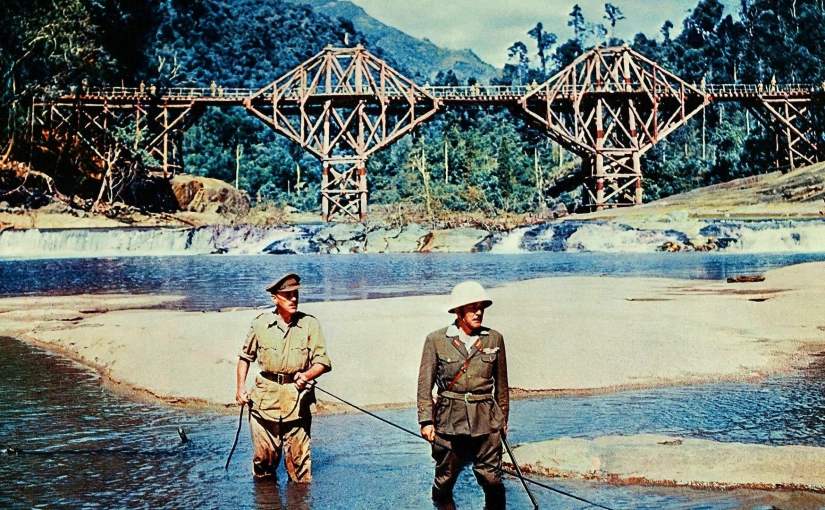
The film primarily takes place in Japanese occupied Burma during World War II.  A prison has just acquired a British platoon of soldiers, and the Japanese have mandated this squad to construct a railway bridge that will run over the Kwai river benefiting the Axis efforts in the war.  Colonel Nicholson (Alec Guinness, in a celebrated early career role) respects the rules of war that come with his battalion being held as prisoners of the Japanese enemy, and he is prepared to have his men begin construction.  However, as his copy of the Geneva Convention Agreement dictates, his officers are not obliged to join in the assignment.  

This is a far off deserted jungle however, that does not even need to be fenced off because an attempted trek to escape is bound to fail.  Therefore, the Geneva Convention Agreement has no value of authority out here in this bug infested, stilted and sweltering heat with minimal resources of food, clothing or medicine.  The Japanese commander Colonel Saito (Sessue Hayakawa) does not hesitate to swat Nicholson’s copy in the Englishman’s face.  Now, since the politics of war are no longer a factor, the stamina of these two men are what’s at stake.

Saito forces Nicholson into a cramped, isolated hot box with next to no food or water.  He’s lucky because his remaining officers are forced to share the other box together.  Saito will force them to comply, or he may just have to kill himself.

The Bridge On The River Kwai explores how productivity, leadership and endurance thrive, but at a startling cost of madness.  Before you realize it, none of these characters are speaking of their respective war efforts or even the mandates of war.  As Nicholson persists in his stance as a defiant leader, a remarkable tide turns within this prison camp.  Soon, the question arises as to who is running this camp and overseeing this bridge project. The enforcers or the prisoners? 

A separate storyline involves an American prisoner named Shears (William Holden) – one of the last men in his platoon to survive, and now only here to bury his fallen comrades.  He’s introduced to describe the harsh reality of what Nicholson and his men can expect.  Yet once Shears escapes the camp, he is caught in a twisted irony, being forced to return to the prison camp where he must destroy the bridge under the command of a British special forces leader named Warden (Jack Hawkins).  Warden goes through his own form of madness.  A badly injured foot becomes something worse than a bloody stump and still he insists on leading his small brigade into the jungle.  

Meanwhile, as Nicholson develops more control over the camp, with Saito realizing his own pitiful ineptitude, a faction of the British are now likely to engage with Nicholson’s newfound achievement as a leader over his own squad, as well as the human Japanese resources he’s also recruited to complete this solid foundation.

David Lean had a reputation for never settling for less on his pictures and The Bridge On The River Kwai is a perfect example.  I recently watched the film, for a second time, with my fellow Cinemaniacs.  Thomas and Miguel assuredly pointed out that one less than sturdy bridge was constructed by Lean’s crew to demonstrate its weaknesses and the lack of engineering the Japanese possess, before Nicholson fully takes over.  That structure collapses on film and thus lends to the next plight in the story, when Nicholson proves to Saito that he is more capable than his enemy counterpart.

Later, the actual bridge is finished leading to a nail biting ending that elevates in suspense as an oncoming Japanese train is heard approaching with its signature whistle and chugging overheard as Colonel Nicholson proudly walks across his success, newly minted with a plaque carved with his name.  Elsewhere in the area are Stearns and Hawkins.  What began with Japanese antagonism has shifted to one side likely to do battle with itself.  

Who is fighting who?  More importantly, what are they fighting for?  War or persistent, delusional madness?

The Bridge On The River Kwai is a magnificent adventure produced with sensational filmmaking.  The investment and risk that David Lean took to assemble this picture is astounding.  It was filmed within the actual jungles.  (Miguel said somewhere around Sri Lanka.) The costumes worn by the thousands of extras are tattered dirty scraps that certainly does not invite the sex appeal you’d expect in a modern film of this kind.  Moreover, the audacity of the filmmaker at least matches the nerve of the story’s cast of characters.  

The cast is marvelous, but it is Sessue Hayakawa and Alec Guinness who serve the impact of Lean’s film.  The movie comes close to a three-hour running time.  The first half of the film has Hayakawa positioned as the leading antagonist, but the second half has Guinness filling that spot.  They almost seem to mirror one another as their character arcs move in parallel but opposite directions working to accomplish their goals, while shedding any kind of humane concern for their underlings or the countries they serve.  

I consider this film to be groundbreaking.  It’s a spectacle, but it allows much to be examined in mental acuity, military allegiance and endurance.  The Bridge On The River Kwai tests how effective war can be for any side that participates.  My Cinemaniac comrade, Thomas,  informed me that the story, adapted from a novel by Pierre Boulle, is entirely fictional.  Still, I believe it garners an important message.  Are we supposed to truly embrace “rules of war?”  This is not Risk the board game.

These men might carry the titles and rankings issued to them by their governments. However, isolate them in the middle of nowhere and who is going to uphold any semblance of regulation?  War functions on efforts of violence.  When was the last time anyone had respect for violence?

LA GRANDE ILLUSION (France, 1937)

by Miguel E. Rodriguez

DIRECTOR: Jean Renoir
CAST: Jean Gabin, Dita Parlo, Pierre Fresnay, Erich von Stroheim, Marcel Dalio
MY RATING: 9/10
ROTTEN TOMATOMETER: 97% Certified Fresh

PLOT: During WWI, two French soldiers are captured and imprisoned in a German P.O.W. camp. Several escape attempts follow until they are eventually sent to a seemingly inescapable fortress.


What a pleasure it is sometimes to be proven wrong.  Years ago, back when Netflix was still sending physical DVDs to subscribers, I watched Jean Renoir’s anti-war masterpiece La grande illusion.  Unfortunately, I either could not or would not appreciate it for what it was, and I returned it after giving it a mediocre rating.  Flash forward to today, and even in the midst of suffering through my second Covid infection (thank YOU so much, [establishment name redacted]), I rewatched La grande illusion and found it charming, delightful, poignant, and full of (for me) unexpected comedy and ominous foreshadowing, especially because it’s a World War I film made two years before Hitler invaded Poland and ignited World War II.  Turns out this is one of the best war films ever made, whose influences are clearly seen in later classics like Stalag 17, Casablanca, and The Great Escape.  Who knew?

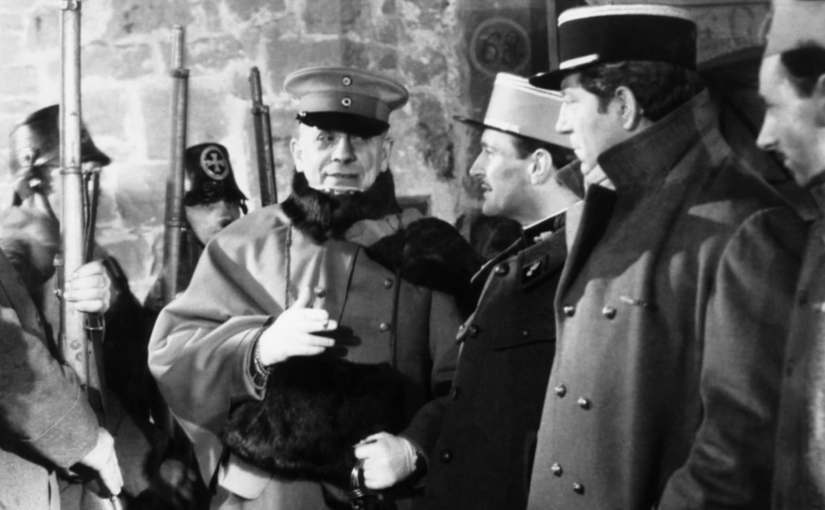
The film centers around two French soldiers in particular, Lieutenant Maréchal (Jean Gabin) and Captain de Boeldieu (Pierre Fresnay).  They are captured after being shot down during a reconnaissance mission and are taken to a German prison camp…camp number 17, because of course it is.  There they meet the paradoxical camp commander, Captain von Rauffenstein, portrayed by Erich von Stroheim as a man who knows the rules of war, but is willing to bend them – slightly – when it comes to imprisoned officers.  He invites them to dine at his table and even offers de Boeldieu a private cell because, wouldn’t you know it, he knew de Boeldieu’s brother before the war.  It’s almost like he’s saying, yes, we’re enemies, but we’re not savages.

There’s another reason for von Rauffenstein’s behavior that has nothing to do with chivalry.  It’s very clear that de Boeldieu and von Rauffenstein are both aristocrats.  They demonstrate this class affiliation by occasionally holding brief conversations in English, which the other soldiers, being mostly of working class, would not have understood.  It’s fascinating to watch the German and the Frenchman interacting with each other, stubbornly maintaining an air of sophistication and bonhomie required of their class, when de Boeldieu knows he must attempt escape, von Rauffenstein knows it, and de Boeldieu knows he knows it.  This might be considered the first and most obvious level of meaning in the film’s title: the grand illusion that we can still be friends, despite the war, because we’re both members of aristocracy.

Ironically, de Boeldieu doesn’t share this same kind of camaraderie with his own countrymen.  Maréchal, the man he was imprisoned with, is clearly a working-class soldier, a bit less refined, and doesn’t know a lick of English or German.  He makes one escape attempt too many and is put in solitary.  Interestingly, de Boeldieu makes similar escape attempts (we learn later), but we never see him having to experience solitary confinement for his actions.  Double standards?

The fourth major player in this drama is another fellow prisoner, Lieutenant Rosenthal, a French Jew played by Marcel Dalio.  He and several other prisoners are in the process of digging an escape tunnel under the barracks, using gear and methods that are directly quoted in The Great Escape, especially the problem of soil disposal.  It was fascinating to see so many elements in this 1937 film featured so prominently in later films.  I never realized just how influential this movie was, and probably still is.  (There’s even a scene – I won’t spoil the setup – that features a small orchestra spontaneously breaking out into La Marseillaise at a key moment…tell me the Casablanca screenwriters didn’t have this movie in mind when writing their script.)

After some months (perhaps longer, it’s unclear), Maréchal, de Boeldieu, Rosenthal, and several other prisoners are unexpectedly transferred to another camp before they can finish their tunnel.  Their new digs are at an enormous gothic castle, also run by von Rauffenstein, who by now has sustained injuries from some kind of airplane crash which require him to wear a neck brace.  He is still exceedingly friendly to de Boeldieu but assures him escape is impossible from this new “camp.”

What happens from there, I’ll leave for you to discover.  What I will repeat is that this movie covers some heavy territory with a deceptively light touch.  There is a scene where a prisoner receives a parcel from home, a large box containing nothing but women’s clothing, so the men decide to hold a mock “revue” with the male prisoners doubling for the showgirls.  One of the soldiers tries on a dress and wig and walks out and asks, “Don’t I look foolish?”  Au contraire.  The men are struck dumb in a moment that is at first hilarious, then poignant, as they feast their eyes on the first thing even resembling a woman for the first time in forever.  Another parcel arrives for some Russian prisoners in another barracks, a large box which they are sure contains food, but instead it contains – well, I won’t spoil it, but to say they are disappointed would be an understatement.

La grande illusion is brilliant at balancing profound ideas of men at war with the occasional humor in the everyday rhythm of life in a prison camp.  It even gets into the ingrained prejudices of so many people against Jews, views that in 1937 were sweeping across Germany like a plague.  (Nazi Germany banned the film, of course.)  This dichotomy is a little hard for me to describe without just giving a play-by-play of the film in its entirety.  Watching it again today, it’s impossible for me to remember what I didn’t like about this movie the first time around.  It has everything: drama, suspense, comedy, daring escape attempts, a showdown between friendship and duty, men in drag…I mean, everything.  This is one time I’m happy to admit: yes, I was wrong.  La grande illusion is not mediocre.  It’s a masterpiece.

KAGEMUSHA (Japan, 1980)

by Miguel E. Rodriguez

DIRECTOR: Akira Kurosawa
CAST: Tatsuya Nakadai, Tsotumo Yamazaki, Ken’ichi Hagawara
MY RATING: 7/10
ROTTEN TOMATOMETER: 88%

PLOT: A petty thief with an utter resemblance to a samurai warlord is hired as the lord’s double. When the warlord later dies, the thief is forced to take up arms in his place.


Kagemusha is a double-edged sword for me, no pun intended.  On the one hand, its visual beauty is virtually peerless.  Only the films of Kubrick, Lean, and those shot by Vittorio Storaro are even in the same league as Kurosawa.  There are shots in Kagemusha that will remain in my mind long after the details of the story have been purged by old age.  In particular, there’s a shot with Japanese soldiers crossing a ridgeline in the background, more soldiers in the foreground, and the setting sun positioned perfectly, so the shadows of the soldiers in the background reach out towards the viewer and interact with the foreground soldiers.  It’s a masterpiece.

On the other hand, the pacing is so sedate that newcomers to Kurosawa or foreign films in general might wonder, my god, when is something going to happen?  At one point, a key figure is taken out by musket fire from an enemy soldier.  This happens so early that we haven’t been introduced to all the main characters just yet, so the conversations surrounding the gunshot were a mystery to me until later in the film.

On the other hand, Kurosawa proves himself over and over again to be a master of the visual aspects of cinema.  In addition to the shot I mentioned above, there is a trippy dream sequence that looks as if it were painted with an explosion at the paint factory (I mean that in the best possible sense), a wonderful camera move that reveals two characters who are conversing in a plain room are actually overlooking a stormy lake, and an eerie moment when the contents of a large vase are revealed after a lengthy burglary attempt.  There are way too many other examples, you simply have to see the film to appreciate what I’m talking about.  I suppose the way to get the most out of the Kagemusha experience is to surrender to the visuals, much like I do with Barry Lyndon or Doctor Zhivago.

I wouldn’t advise anyone to completely ignore the story, though.  There is immense food for thought here.  A condemned thief is conscripted to act as a warlord’s double.  We never learn the thief’s real name.  He is credited only as “Kagemusha”, aka “The Shadow Warrior.”  He must present an outward face to the other generals, friends and foe, in the event that the real warlord is injured or killed, which (SPOILER ALERT) inevitably happens.  There is portentous dialogue about how a shadow only exists if the man is alive.  Remove the man, and how can a shadow remain?

There are several close calls where Kagemusha’s secret is almost revealed.  His grandson – well, sort of his grandson, it’s a long story – immediately yells, “THAT’S not my grandfather!” when he sees him after a long absence.  The real warlord, Shingen, had a huge black horse that only he could ride.  The inner circle who knows Kagemusha’s secret agrees immediately that he should never try to ride it; you can fool some of the people some of the time, but you can never fool a horse.  Shingen’s mistresses present a real danger.  Kagemusha squirms for a few moments as they slowly start to question his identity during tea, but he brilliantly defuses the situation by telling them the one thing they would never believe: the truth.

There’s also a much larger issue at work in Kagemusha.  Shingen’s own generals (the ones outside of the inner circle), and the opposing warlords, all believe Shingen is still alive when they see him on the battlefield.  They have no reason to think he’s an impostor.  There are some skeptics, but their spies are helpless to discover the ruse.  For all intents and purposes, that is Shingen, and they behave accordingly.

There is one battle at night where this, I don’t know, philosophy becomes all too real for Kagemusha.  In the darkness, Shingen’s forces can hear enemy armies approaching, and then musket fire breaks out.  Instinctively, Shingen’s bodyguards leap to shield Shingen/Kagemusha from enemy bullets.  Some are killed.  The look of horror on Kagemusha’s face as the dead bodyguards are piled on top of other bodies is indescribable.  They gave their lives for him.  Or, more importantly, they gave their lives for the idea of Shingen, their belief that he was the most important person on the battlefield.  I was reminded of a bit of dialogue from American Sniper, of all things, when the lead character, an accomplished sniper, is asked to cover some soldiers on a raid.  He is told that the soldiers feel invincible with him up there.  He says they’re not, and the reply is eye-opening: “They are if they think they are.”  Just like the soldiers in American Sniper, the soldiers in Kagemusha are prepared to lay down their lives for a concept.  The man is nothing, a thief.  They don’t know that, though.

This took me down a little bit of a rabbit hole.  I thought of Secret Service agents whose literal job is to protect our President and take a bullet for him if necessary.  It doesn’t matter whether he (or she) agrees with the President’s policies.  That is secondary.  Their job boils down to one thing: I will die to protect this person if that’s what it takes.  The dedication on display by these men and women humbles me, and it makes me think.  Surely, they have opinions about world and national policies.  Doesn’t matter.  It’s not part of the job.

Watching those bodyguards fall in front of the imposter warlord made me think really hard about those kinds of jobs, about anyone in any branch of the armed forces.  Ready to kill and die for what they believe in.  In the case of Kagemusha, these people died for a fake.  It makes their deaths sad, but are they any less honorable?  Like I said, food for thought.

The film ends with a massive battle where, curiously, we are not shown any deaths, only the aftermath.  (The opposing general is especially cruel: “Shoot the horses first.”)  Then there is a dreamlike coda that recalls that philosophy of dying for the right cause.

To recap, though, the movie is slow going, at least as slow, if not slower, than Kubrick’s Barry Lyndon.  I can see that Kurosawa has a lot to say with this movie.  He employed thousands of extras and lavish costumes (financed thanks to the involvement of Francis Ford Coppola and George Lucas, which is this whole OTHER thing).  It’s not my favorite Kurosawa film.  That spot is reserved for Ran (1985), which I consider his career-capping masterpiece.  Kagemusha sort of lays the groundwork for that movie, in my opinion.  It was one of his first films in color (I think) and it shows a natural talent for the medium.  Like I said before, surrender to the visuals and contemplate the story, and the slow pacing will take care of itself.  (That doesn’t make much sense, but I’m sticking to it.)

PLATOON

By Marc S. Sanders

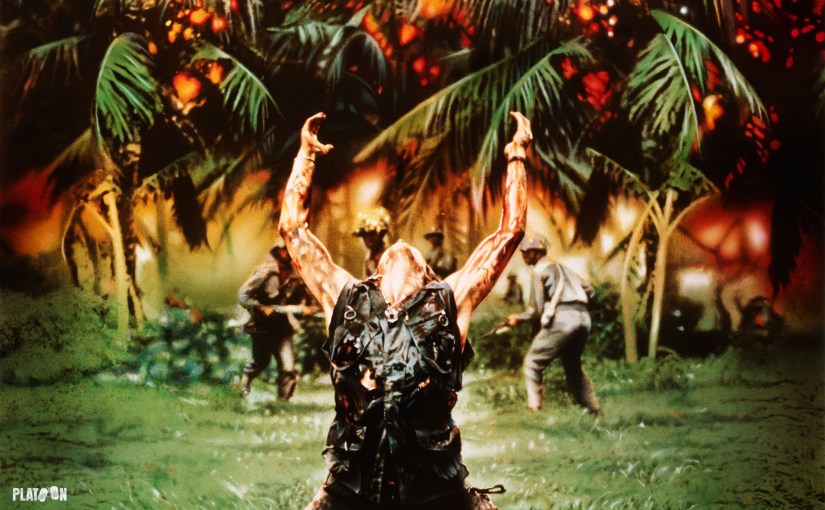
Oliver Stone’s Oscar winning Platoon takes place in the late 1960s, somewhere on the Cambodian border during the Vietnam War.  Many of the chaotic happenings the film presents are based on Stone’s own experiences after he voluntarily enlisted to fight.  However, while there is an unwinnable war occurring for the American troops, there is just as horrifying a battle going on within the ranks of the platoon the film focuses on.

Charlie Sheen echoes a lot of his father’s, Martin Sheen, voiceover narration, and performance in Francis Ford Coppola’s Apocalypse Now.  He portrays Chris Taylor, a college dropout who voluntarily enlisted for a one-year tour of duty to serve.  After only one week within the harsh, humid, and wet jungles, he’s writing his grandmother a letter asking what the hell was he thinking.  Chris is quite virginal to the harshness of war and that won’t work to his advantage when needing mentoring and support from his fellow soldiers.  The newest enlistees are the ones at the front point.  They haven’t devoted enough time to sit in the back and because of their lack of experience with war, they are not as valuable for the ongoing campaign in battle.  Platoon is not the heroics depicted in John Wayne movies.  This was one reason that Oliver Stone wanted to make this picture.  Platoon is a bitter retort to Wayne’s celebrated movie, The Green Berets.

There is an angel and devil flanking Chris in the form of Elias (Willem Dafoe) and Barnes (Tom Berenger).  Berenger is the cruel side of the conflict with his battle-scarred face.  He gives his underlings the impression that because he’s seen so much fighting and endured being shot seven times, that he must be invincible.  Elias is a fighting soldier, but he adheres to the rules of war and when it is time for rest, he joins his fellow troops in a unified vigil of drug-induced relaxation.  Chris warms up to Elias easily despite his initial fears of being a soldier with no experience or knowledge of how to survive, much less fight alongside his fellow men.

What drives the conflict between Barnes and Elias occurs following the first act of the movie.  The infantrymen come upon a Vietnamese village.  Some men, including Chris, get wildly abusive with the unarmed people, burning and pillaging their huts.  Only after Chris gets control of himself does he realize the wrongs he’s capable of by serving in this war.  He prevents a group of men from gang raping a child.  Furthermore, he witnesses Barnes commit the illegal murder of a defenseless village woman, shot at point blank range.  Elias has his bearings though and will file the proper reports when the opportunity permits.  Nothing in Platoon is easy though.  This war rages on and the possibility of an investigation and court martial is held off while the fighting continues. 

An interesting take on Oliver Stone’s direction is that he never really shows any close ups or lends any dialogue to the Viet Cong.  I believe Stone is confident that people know who our battalions were supposed to engage with.  However, as another favorite picture of mine stated (Crimson Tide), the true enemy of war is war itself.  The enemies of Elias, Chris, and Barnes as well as the rest of the platoon permeate within and among themselves and it lends to the chaos of the brutal combat scenes depicted in the film. Stone doesn’t offer much opportunity to see who any of the soldiers are shooting at or who is shooting at them.   There is much screaming and hollering but who are any of the characters shouting at and can they even be heard or understand what is being said amid the gunfire?  Platoon demonstrates that a Vietnam war picture is not one of heroics with grandstanding trumpets and a towering John Wayne who takes a hill.  War is disorganized, messy, and terribly bloody. 

This may be Charlie Sheen’s best film of his career.  As he represents the fictional account of Oliver Stone’s personal experiences, we see the trajectory of his change.  He is supposed to be there for 365 days, and he, along with his buddies, count down to when their tour will be complete.  However, this one short year will be the longest he ever encounters, and it will change him permanently, assuming he survives.  Chris is always tested of his tolerance.  He’s always subject to respond to how Barnes commands or how Elias mentors and leads. 

Oliver Stone is so convincing in his often-documentary approach to Platoon that it is at least understandable to see how the men in this picture behave and carry themselves.  Why do they refer to the Vietnamese as “gooks.”  Why do they bully with intent to commit rape.  Why do they quickly pounce to kill when for even a moment there is no threat.  Moreover, why they are willing to turn on each other.

They were never the decision makers for this conflict.  These soldiers are depleted of sleep and rest.  They are the pawns of a higher power, and they have been left to their own devices in a dense environment infested with bugs, snakes, unbearable humidity, and bodies that infest the waters and land while armed men appear out of nowhere ready to ambush.  Some ensnarements might occur within their own regimen.  None of these men are justified in their actions.  Yet, it is not hard to understand where their motivations stem from.  They are not programmed for heroics.  Keith David portrays a likable soldier who tells Chris that his mission is just to survive until he’s summoned home.  Survive among those you march and sleep with.  Outlast this hellish environment and overcome those that are trying to mow you down in machine gun fire.  Everything else around here is “just gravy.”  When you are an infantryman, you are not making a statement any longer.  You are not fighting for a cause anymore.  You are only trying to stay alive.

Platoon is such a shocking film of unconventional madness and turmoil.  Oliver Stone is relentless in the set ups he stages.  This picture came out in 1986, long before the strategic methods of the modern “shaky camera” approach.  It’s beneficial to watch the film as Stone must be positioning his camera on a track as the platoon hikes through the forest, parallel to his moving lens.  We are walking alongside them.   Early morning overhead shots depict the carnage of battles that occurred in the dark of night. Flares and sparks come from nowhere.  I think you could watch this movie ten times and still not know when to expect gunfire to intersect with the story or when the bombs to go off.  It’s hectic hysteria like I can only imagine these young men experienced before they spilled their blood on the battleground and either died right there or returned home physically and mentally crippled for life.

Platoon is one of the best and most frightening war pictures ever made.

AMERICAN SNIPER (2014)

by Miguel E. Rodriguez

DIRECTOR: Clint Eastwood
CAST: Bradley Cooper, Sienna Miller, Luke Grimes, Jake McDorman
MY RATING: 9/10
ROTTEN TOMATOMETER: 72% Certified Fresh

PLOT: Real-life Navy S.E.A.L. sniper Chris Kyle becomes the most lethal sniper in American history during four tours of duty in Iraq, but he finds it difficult to leave the war behind when he finally returns home.


I once called Katherine Bigelow’s award-winning The Hurt Locker the Deer Hunter for the Iraq War generation.  Having just seen Clint Eastwood’s masterful American Sniper for the first time, I must now amend my statement.  American Sniper presents its story concisely, almost tersely, states the facts of the matter, and leaves the audience to draw its own conclusions when the credits roll.  For myself, I was once again struck by the sacrifices of those men and women who have ever made, and will ever make, the choice to serve their country, for whatever reasons.

Chris Kyle’s reasons are made clear at the outset.  30-year-old Kyle (Bradley Cooper) is a skilled cowboy and rodeo rider when he decides to enlist in the military after seeing footage of the embassy bombings in 1998.  In a marvelously edited prologue (resembling a Scorsese film), we see Kyle’s father impress upon a school-age Kyle how people are either sheep, wolves, or sheepdogs.  Wolves attack the sheep, and the sheepdogs protect the sheep.  Kyle has lived his entire life with a sheepdog mentality and badly wants to do his part to protect his country against what he feels are the forces of evil.

Kyle enlists in the Navy S.E.A.L.s and, after a brutal training process, becomes a skilled sniper.  Shortly after graduation, he meets and falls in love with Taya (Sienna Miller).  The abbreviated exposition of their courtship and marriage contains little details that give a ring of authenticity that even The Deer Hunter lacks at times.  (After their first meeting in a bar, for example, Taya has to run outside and throw up after doing one too many shots.  Kyle follows and discreetly holds her hair back, as every gentleman should.  It’s the kind of scene you would normally see in a mid-level rom-com, but it feels as real as an autobiography.)

Kyle’s and Taya’s relationship at home is an important factor in the film, but the bulk of the story shows us Kyle putting his unique skills to use in Iraq, where he is sent shortly after the 9/11 attacks.  These scenes belong in some kind of war movie Hall of Fame.  Kyle’s first kills occur when he has to make a command decision whether or not to shoot a young Iraqi boy holding a grenade and running towards a US convoy.  The scene takes on an even more horrific dimension when the mother tries to pick up where her young son failed.  This horror is echoed in triplicate in a later scene when an even younger boy approaches an abandoned rocket launcher and appears ready to fire it at American troops.

Kyle goes on to much more “conventional” warfare later on (including a virtual duel between himself and another similarly skilled enemy sniper), but it’s scenes like the ones I mention above that elevate American Sniper into a masterpiece.  Watching them, I could not help but remember that this movie is based on a real person who went to real war zones during his lifetime.  I have no idea whether Kyle really did make those choices in real life, but the idea remains: whether Kyle did or not, it’s a foregone conclusion that someone had to make similar decisions at one time or another, not just in the Iraq War, but in other wars, many wars, ALL wars.  (I was perversely reminded of another superior war film, also based on fact, Jarhead, where the main character is also a sniper, except he never gets to fire his weapon in combat.  My respect for that character is no less profound.)

Speaking for myself, I don’t know if I have it in me to make that kind of call.  I have nothing but admiration and respect for those people who are making those calls every day in wartime, who are asked to put their lives and mental health on the line and do their duty no matter what.

Kyle’s compulsion to be a protector leads to his decision to become part of the teams “clearing” houses on the ground, as opposed to being the “overwatch” who protects them from the rooftops.  He sees too many squads being cut down by enemy soldiers inside the houses where he can’t see them from above.  “If I can’t see them, I can’t shoot them.”  One of his comrades disagrees with this decision.

“All these guys?  They know your name, and they feel invincible with you up there.”
“They’re not.”
“They are if they think they are.”

His decision puts him in even greater danger than before, but he can’t help himself.  Every death that he feels he could have prevented haunts him.  In another echo of another shattering war film, I was reminded of Oskar Schindler’s last scene in Schindler’s List when he breaks down thinking of how many more Jews he could have saved, instead of focusing on the ones he did save.  It’s impossible to say exactly how many lives Chris Kyle may have saved with his actions in Iraq, but in his mind, he was just doing the right thing, not the heroic thing, so he never felt comfortable accepting the title bestowed upon him by his grateful comrades: “The Legend.”

American Sniper is also very careful to depict the cost Kyle faced as the result of his job.  For one, the Iraqi insurgents put a $180,000 bounty on his head, making his job even more dangerous than it already was.  For another, he witnesses some things firsthand that would give Quentin Tarantino nightmares.  At one point, he tracks down an Iraqi enforcer nicknamed “The Butcher” who uses a drill to punish anyone who collaborates with American soldiers.  When Kyle raids his compound, he finds a freezer full of the Butcher’s “souvenirs.”  This is all on top of the various times he sees his teammates cut down by enemy fire, sometimes right in front of him.

The other cost comes during the brief periods at home between tours.  He loves his wife and children, but he finds it impossible to share the details of what happened to him in Iraq.  This reticence threatens his marriage to the point where Taya tells him flat out: “If you leave again [for another tour of duty], I don’t think we’ll be here when you get back.”  This kind of plot point is hardly new, but again, there is a ring of truth to it in this movie that makes it much more poignant than it normally is.  Kyle’s internal code can’t allow him to let someone else go to a war zone and do a job that he is eminently more qualified than anyone else to do.  “I have to serve my country.”  And that’s that.

(The film does have one drawback that compels me to score it as a “9” instead of a “10.”  There are scenes later in the film depicting more of Kyle’s troubles at home and as he speaks to a psychiatrist who recommends he go down to the VA and meet with disabled veterans as a way of “saving” soldiers without being in combat.  While these scenes are invaluable in terms of shedding even more light on Kyle’s character, even this late in the film, I did feel like there could have been a little more time spent with Kyle and those veterans so we could flesh that issue out just a little more.  There’s much more to it than could possibly be explored in just the last fifteen minutes of a movie.  I’m not saying it should have become Coming Home, but…that’s my opinion.)

In the event you don’t know Chris Kyle’s ultimate fate, I won’t spoil it here.  I had forgotten about it, and when the movie sprung it on me, it was as surprising as any other plot twist I can think of.  American Sniper proved to me, as if it needed proving again, that the people in our armed forces, especially those in combat zones, face unthinkable decisions, sometimes on a daily basis.  The morality of those decisions can, and will, be debated from now until such time (God willing) that armed forces are no longer necessary in this world.  This movie doesn’t pass that kind of judgement.  It merely says, “Here is what happened.  What do you think about it?”  How you answer that question is what the movie was really about.

ALL QUIET ON THE WESTERN FRONT (GERMANY, 2022)

By Marc S. Sanders

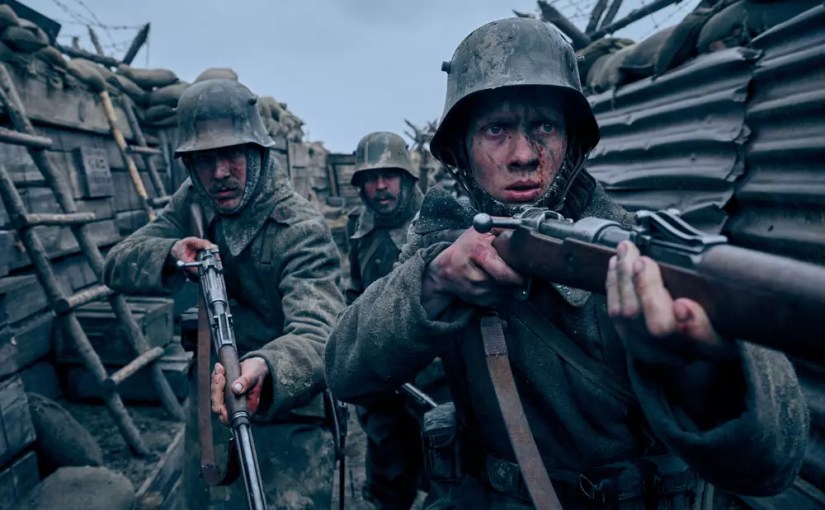
Edward Berger’s Oscar nominated interpretation of All Quiet On The Western Front is a massive success in filmmaking, storytelling, character and construction.  This 2022 adaptation of the well-known novel by Erich Maria Remarque does not only depict the ugly horrors of a mud soaked, gory and bloody conflict within deep dug out trenches, and on endless plains of wasteland battlegrounds.  It also provides perspective for the difficult peace talks occurring near the tail end of the third year (1917) of the First World War.  Another aspect covers the celebrated commander who leads a charge from the comfort of a German high castle while feasting on grand meals, far away from the front, steadfast to never surrender, and emerge victorious no matter the cost.

The main character is a youth named Paul (Felix Kammerer) who is eager to join the German brigade against the French armies.  He happily takes up with school chums to forge their parents’ signatures and enlist amid the reverie that greets them with cheer from his school superiors raging with heroic propaganda.  Shortly after, he is gifted an honorary soldier’s uniform, pressed, and laundered, that once belonged to another soldier who violently perished in battle.  Paul and his friends are rushed to front line of the fighting, into a muddy German trench and pushed on to slaughter in the name of his country. It does not take long for Paul to realize any derring-do he envisioned is nonexistent as men die by gunfire, grenades, flame thrower attacks and tank armaments.  If the men around him aren’t dead, they are at least dismembered with shredded, bloody stumps in place of limbs.

Elsewhere, the German diplomats travel in class aboard a luxury passenger train to meet up with French leaders in an effort to come to a cease fire.  Germany is greatly failing this conflict with loss of life, territory, supplies and money.  It’s a reluctant meeting to partake as the French are uncompromising with their terms.  Either Germany agrees to the demands of the French, or the war continues.  The Germans only has 72 hours to concur.  Coinciding with all of this is General Friedrichs of Germany (Devid Striesow) who lays out commands while dining and taking his butler service for granted.  He also sheds no tears for the soldiers beneath him as they are giving up their lives to fight a war that can’t be won.  Assuming a complete understanding of what constitutes a soldier based upon the generations who fought before him, he asks “What is a soldier without war?”; a dangerous philosophy for all others but him.

Of the modern war pictures to arrive in the late twentieth century and on (The Thin Red Line, Born On The Fourth Of July, Letters From Iwo Jima, 1917), the battle footage consistently offered a convincing and horrifying reality of the bloodshed that occurred during these historical conflicts.  These are not the John Wayne pictures of yesteryear.  Watching Berger’s film, which he co-wrote, I didn’t necessarily see anything that I hadn’t seen before, like sudden gun shots to the head, rapid gunfire, caked on mud, faces being blown off, or bodies being blasted to bits. Tanks are destroyed with grenades tossed into the cockpits and within their tracks. At times Paul even loses his sensory hearing amid the deafening battles, just as Tom Hanks’ character did in Saving Private Ryan.  Much of the material is identical to these other esteemed films.  What grabbed me though was how three storylines in this new film compound on each other.

Peace talks arrive. However, any kind of reconciliation will not begin until the eleventh hour of the eleventh day of the eleventh month.  That’s quite convenient for country leaders to agree on while sitting around a dining table within a luxury train compartment, but the bloodshed continues until that scheduled moment arrives.  Talk of peace also does not force battalion leaders to stand down.  If Germany is to lose the conflict to France, they will go down with one final victorious conquest in battle.  War does not play like a sporting contest where the officials ensure that everyone stops what they are doing as a clock runs out.  War unleashes a rampage in the pawns used to obtain territory and conquest. The fighting gets personal.  One on one fights resort to drowning your enemy in a brutal mud puddle or clubbing an attacker with a rock to the head.  A very personal scene occurs when Paul resorts to stabbing a French soldier multiple times in the heart.  The poor man is giving his last breaths and Paul needs to shut him up to avoid drawing any attention to their location, so he starts to shove mounds of dirt in the man’s mouth.  Soon after, Paul is apologizing to this man and begging his victim to hold on for dear life.  It’s a powerful scene never intended to make any sense, because ultimately in the field of battle, nothing makes sense.  Only frenetic chaos exists.

I have every appreciation for men and women who serve their country with the courageous will to protect against enemy threats and uphold domestic freedom and democracy.  Yet, endless war for achievement of gain does not necessarily translate to protection or honor like General Friedrichs preaches to his battalions from his balcony.  It’s easy for him to heed this policy, dressed in an unstained, decorated uniform with the pride of his fighting generations before him who were all hailed as heroes.  For an insignificant solider like Paul, though, when does he earn the recognition he has sacrificed?  When will his dead comrades gain any appreciation?  Paul’s greatest accomplishment is that he does not get shot and blown away as he runs head on towards a more powerful enemy.  Is that a celebration of the Germany he thought he stood for, though?  Paul encounters an awakening he never expected while fighting at the front line. 

Edward Berger controls a very detailed and forceful piece.  Every ditch or shredded body of a solider tells the real story of this bloody war that cost nearly 17 million lives.  The art direction of the trenches for both the German side and the French, located at the front lines, are endless mazes dug deeper than the heights of the even the tallest soldiers.  Vokel Bertelmann provides the blaring, monstrously echoing soundtrack to the film and uses his horn like chords as an omnipotence to this hellish environment.  His orchestra is so pertinent to the setting of the film.  The craft of makeup and costumes for all the extras and main players in the battle scenes is grotesque with extra thick caked on mud and different shades of blood reds, browns, and blacks.  The sounds of the tanks and the rattling explosions will make you wince with fear and shock for these boys running to their ill-fated doom with just a thin rifle to fight with. 

All Quiet On The Western Front has all of the common tropes of other more modern war pictures.  It works on its own though because the battle scenes are spliced in with the puppet masters, comfortably located elsewhere, who can control the outcomes of these bloody conflicts.  The delay of peace and agreement prolongs the horrifying carnage.  The fate of Paul, his friends, and all the other soldiers rests on what does or does not come to settlement from the people whose commands they serve.

This is a fantastic movie.  One of the best films of 2022.

APOCALYPSE NOW

By Marc S. Sanders

Francis Ford Coppola’s Vietnam War masterpiece, Apocalypse Now from 1979, focuses on a madman assigned to find another madman and assassinate him.  I look at the film as a spiral into a dark, demented psychosis.  Each section of Coppola’s film appears like some variation of insanity within an environment and period of time where there was no end in sight for a war that was going out of control.

Captain Benjamin Willard (Martin Sheen) is first shown in a hotel room that he has ransacked during a drunken rage, going so far as to smash his fist into a mirror.  His voiceover explains the horrifying experiences he has already endured.  Now he is at a point where killing is all he is capable of performing. He is summoned to a General’s lunch where he is assigned to seek out a highly decorated Special Forces soldier named Colonel Walter Kurtz (Marlon Brando).  Kurtz has taken his squad over to Cambodia without authorization.  It is believed that he has gone insane with his will to harbor people over there into a cult that he controls while engaging in his own actions against the Vietcong.  The army needs this problem contained and Willard has been selected to terminate Kurtz.

Apocalypse Now is primarily about the journey, rather than its destination.  Willard is to be escorted by patrol boat up the Nang River to find Kurtz and complete his mission.  Along the way he will encounter a variety of scenarios and characters. 

The standout character is Lt Colonel Kilgore (Robert Duvall) the commander of a helicopter calvary battalion.  Willard meets up with Kilgore early on as he will provide an opening on the river for the long journey to begin.  This is the most memorable section of Coppola’s film.  Robert Duvall is truly maddening as he relishes in the destruction he commands.  Kilgore is amused to blare Wagner’s The Ride Of The Valkyries as his choppers blast the shore line where Vietnamese villagers and farmers reside.  Duvall almost seems god like during this sequence because he does not even flinch as explosions and armory are set off mere inches away from him.  He’s crazed enough to even send his troops out into the ocean to surf while the mayhem is still occurring.  When he takes off his shirt while proudly wearing his calvary hat, sunglasses and yellow scarf around his neck, he utters the famous line “I love the smell of Napalm in the morning.”  There is no hint of sarcasm in that line.  Kilgore truly means it.  The commands of war are his absolute pleasure.  The only human feeling that Kilgore shows is when his personalized surfboard turns up missing.  Otherwise, the carnage he leaves behind is a job well done.

Why do I focus on this sequence so much?  First, it is a perfect construction of filmmaking and acting combined.  Coppola’s clear daylight shots of the choppers advancing on the surf are an amazing sight to behold.  To have that much control of so many vehicles in the air so that a select number of cameras can take in the sequence amazes me.  It is feats like these that show why I love movies so much.  The moment is more enhanced with Wagner’s piece accompanying it.  This could all be appreciated as simple documentary style filmmaking.  However, when you combine the mayhem Coppola stages with the proud march of The Ride Of The Valkyries, and Duvall’s crazed glee of commanding this episode of mass destruction, you start to see a pretense.  The hypocrisy of all the elements contained in this sequence tells the story. This country and its people are being obliterated by a crazed individual arriving from the heavens above.  As the scene progresses, my mind returned to the overall plot of the film; the mission of the protagonist which is to kill a lunatic.  At this point in the picture, I have yet to meet Colonel Kurtz.  So, how much of a madman must Kurtz be when compared to a maniac like Kilgore?

Later sequences carry on the insanity theme.  A trio of Playboy playmates are brought in to entertain the troops during one of Willard’s stop overs.  Yet, the crowd of soldiers gets out of control and the entertainers are forced to flee by helicopter with some of the men grasping on to the chopper as it takes flight.  My thoughts were you must be insane to continue hanging on while it gets higher into the air.  Let go for heaven’s sake before you plummet to your death.  Nevertheless, these half naked women are the purest, most angelic thing that these boys have ever seen since being recruited into this hellish nightmare. 

Willard’s crewmen on the patrol boat seem too green with the impacts of war.  They are not as battle weary as Willard.  There’s a guy named Lance (Sam Bottoms) who seems happy go lucky to play the Rolling Stones.  There’s a chef by trade (Frederic Forrest) and a young kid who goes by the name of “Clean” (Laurence Fishburne).  Chief Phillips (Albert Hall) drives the boat.  Willard must keep his mission classified.  These men are only supposed to get him to his destination no matter how far up the river it takes them.  These soldiers are riding into the unknown, escorting a crazed fellow who knows that a positive outcome is not likely.  Coppola provides moments where the men lose control of their senses.  These boys don’t come as informed about what is right and wrong within the parameters of war.  Innocent lives are taken as the patrol boat continues its horrifying tour.  Their lives might be taken as well.  The question is what is the worse cost?  Death, or the horrors they encounter, act upon, and live with thereafter?

It’s notable to watch Frederic Forrest’s performance as he transitions into a mindset with no other option but to slaughter as he dons camouflage makeup later in the film.  Albert Hall’s performance lends some sensibility to the picture.  However, how does Chief Phillips’ receptivity measure up to the crazed obsession that Willard has for completing his assignment?  It’s all quite tragic as the film moves from one moment to the next.

As expected, the third act of the film focuses on Willard’s encounter with Kurtz.  Before all of this, we follow along as Willard reads through the extensive files of Kurtz’ history and career.  This man seems like a giant among giants and in 1979 it seems only befitting that a giant of an actor portrays the mysterious Colonel.  So, that actor had to be none other than Marlon Brando.  Oddly enough, this portion of the film is where the film starts to wear out for me.  Kurtz is insane in a quiet and dark way.  Coppola shoots much of Brando’s performance in darkness.  I’m aware of the purpose with that kind of filmmaking, but it is a long section of film to watch an actor move in and out of the light.  Brando comes off mysterious with lines of dialogue that make little sense at times.  Some allegories work as he describes Willard’s purpose as that of a clerk delivering groceries.  Yet, Kurtz seems the least crazed of all the crazies provided within Coppola’s film. 

A babbling, hippie photographic journalist (Dennis Hopper) greets Willard upon his arrival.  He’s talking in circles with envy for Kurtz, his leader, who resides within the tomb like structure along the banks of the river.  The natives also seem to heed towards Kurtz’ influence.  Willard is taken captive and tormented.  Still, when Kurtz speaks he doesn’t come off so kamikaze like the others we’ve seen before.  I can only presume there are levels to insanity.  Madness is not a well-defined ailment.  I find it ironic that Kurtz, the great soldier and decorated war hero, is deemed the greatest threat to the armed forces’ image within this conflict.  Kilgore, on the other hand, has free reign to slaughter helpless women, children, and farming communities all in the name of victory while commanding his underlings to surf along the coastline. 

What is so mystifying about Apocalypse Now is how thematic the movie seems to be.  It follows this common pattern demonstrating how crazed the effects of war can have on people.  The killing and bloodshed are the most apparent of course.  However, the military declares early on that there is a loose cannon within their ranks that must be contained.  The only option is to kill this man, who has done his bidding for the progress of its army for so long.  This man, Colonel Kurtz, has sacrificed promotions in ranking and a return to a quiet life with his wife and children, so that he can continue with carrying out the agendas administered by his government.  Yet somehow, he crosses a border, and he no longer kills the way his superiors want him to, and now he must be terminated.  The hypocrisy is to send a madman to do a madman’s bidding, as if that will preserve some sort of sanity within this out-of-control conflict.

I could not get away from that impression during the whole three-hour running time of the film.  Practically every caption, scene, expression, or scenario is rooted in madness.  Francis Ford Coppola wrote the script with John Milius and it’s been said that much of the filmmaking was done on the fly.  Still, with Coppola’s direction along with a strong cast, particularly from the quietly, reserved Martin Sheen, the message comes through clearly.  War begins with a difference in politics and a need for further control.  Pawns are the collateral damage used at will to settle the argument.  Rules of engagement may appear formally on paper.  However, is anyone with a gun in his hand or facing the end of a loaded barrel going to pause and consider what’s just and appropriate before taking action? 

Apocalypse Now speaks to an end of days where the soldiers sent to do the bidding of others respond by doing what they ask of themselves.  Therefore, I’ll end this piece on a vague note. 

There is no organized effort when it comes to war.

NOTE: This article is based on my viewing of Coppola’s third iteration of his film, entitled Apocalypse Now: The Final Cut.

A BRIDGE TOO FAR (1977)

by Miguel E. Rodriguez

DIRECTOR: Richard Attenborough
CAST: Sean Connery, Ryan O’Neal, Gene Hackman, Michael Caine, Anthony Hopkins, James Caan, Maximilian Schell, Elliott Gould, Denholm Elliott, Laurence Olivier, Robert Redford, and MANY others
MY RATING: 7/10
ROTTEN TOMATOMETER: 63% Fresh
Everyone’s a Critic Category: “A Movie Set During an Historic War”

PLOT: A detailed account of an overly ambitious Allied forces operation intended to end the war by Christmas of 1944.


In September of 1944, in an attempt to land a finishing blow to Germany following D-Day, Allied forces launched Operation Market Garden, a bold offensive that would drop over 30,000 soldiers behind enemy lines.  The objective was to capture and hold three strategic bridges in the Netherlands, over which a massive column of British tanks would then roll straight into the Ruhr, the heart of Germany’s industrial complex.  Neutralize the Ruhr, and taking Berlin would be inevitable.  However, as with so many other simple plans in history, multiple factors led to the operation getting bogged down at the third bridge, and after massive Allied casualties, the offensive was abandoned.

Based on a bestselling novel by Cornelius Ryan (who also wrote the novel The Longest Day), the movie of A Bridge Too Far resembles the actual Operation Market Garden, not just in appearances, but also in its ambition, scope, and ultimate failure to achieve its goal.  However, as a pure combat movie, I give it credit where it’s due.

First off, look at this cast.  There had not been an assemblage of so many of Hollywood’s leading men since 1962’s The Longest Day (“42 International Stars”, that movie’s posters proclaimed).  Naturally, most of the actors are pitch perfect in their roles, with one glaring exception.  Whoever thought Gene Hackman was just the right guy to play a Polish general was either desperate or foolhardy, or both.  Hackman is a talented actor, without question, but his attempt at a Polish accent is a MAJOR distraction from whatever he’s saying.  Every once in a while, it even pulls a disappearing act, not that it matters.

ANYHOO.  The all-star cast.  To offset the lengthy running time, the story is told in semi-episodic fashion, which makes me wonder if someone hasn’t thought about rebooting this movie as a Netflix/HBO/streaming miniseries.  I’d watch it.  Within each of these episodes, it helps if we remember right away that Michael Caine is the leader of the tank column, Sean Connery is heading up one of the ground units, Anthony Hopkins is holding the bridge at Arnhem, and Elliot Gould is the cigar-chewing American trying to get a temporary bridge put together, and so on.  It’s a rather brilliant way of using visual shorthand to keep the audience oriented during its nearly three-hour running time (including an intermission at some screenings).

There is one “episode” featuring James Caan that has literally – LITERALLY – nothing to do with the plot.  He plays an Army grunt who has promised his young captain not to let him die.  After a grueling ground battle, Caan finds his captain’s lifeless body and, after improbably running a German blockade, holds an Army medic at gunpoint, forcing him to examine his dead captain for signs of life.  I read that, unlikely thought it may seem, this incident really did happen as presented in the film (more or less).  All well and good.  But what does it have to do with capturing bridges?  I’m sure the story is in the novel, but the movie takes a good 10-to-15-minute detour from the plot to follow this bizarre story.  Did director Richard Attenborough think we needed comic relief or something?  I remember liking that story as a kid, but watching it now…is it necessary?  Discuss amongst yourselves, I’ll expect a summary of your answer at tomorrow’s class.

I want to mention the combat scenes in A Bridge Too Far.  First off, I never served in the armed forces.  Well, never in combat.  I was in the Air Force for about a week.  (Well, Air Force boot camp in Oklahoma for about a week…LONG story.)  So, my observations of the combat scenes are less about historical accuracy and more about how they compare to other films.  While some of the combat portrayed is rightfully horrific in its own way – the river crossing in those ridiculous canvas boats, the slaughter of the paratroopers, the seemingly endless holdout at Arnhem – a lot of the combat, particularly the tank shelling and the skirmishes at Arnhem, is…I have to say, it’s kind of fun to watch.  There’s something, I don’t know, charming about it all.  It reminded me of how I used to play with my army men and Star Wars figures, or how I used to run around with neighborhood friends wearing plastic helmets and pretending we were “good-guys-and-bad-guys” while throwing dirt clods at each other and making fake explosion noises.  It was movies like A Bridge Too Far that shaped my young impressions of what wartime combat was like, and whether it was realistic or not was irrelevant.

Anyway, enough nostalgia.  Here’s the sad truth: A Bridge Too Far, despite its thrilling combat and all-star cast, falls short of delivering a truly meaningful war film.  There are half-hearted attempts to drum up some dramatic impact with scenes in a makeshift field hospital and a speech in Dutch from Liv Ullman wearing her best “isn’t-war-awful” expression, but for some reason those scenes fall flat.  (I did like the “war-is-futile” scene with that one soldier who runs out to retrieve the air-dropped canister, only to discover…well, I won’t spoil it, but it’s a good scene.)

After writing almost 1,000 words, I’m no closer to explaining why A Bridge Too Far falls short.  It’s still an entertaining watch, but I’ve really got to be in the mood for it.  It’s rather like reading a historical novel that isn’t particularly thrilling like a Crichton or a Clancy, but it does deliver some eyebrow-raising information.  It doesn’t hit me in the heart, but it does feed my brain.  Maybe that’s not such a bad thing in the long run, but if movies are about stirring emotions, I must say: A Bridge Too Far is no Saving Private Ryan.

(Sure, I probably could have just said that instead of writing this long-ass review, but where’s the fun in that?)


QUESTIONS FROM EVERYONE’S A CRITIC

Best line or memorable quote:
“Remember what the general said: we’re the cavalry. It would be bad form to arrive in advance of schedule. In the nick of time would do nicely.”

Would you recommend this film?  Why or why not?
Ultimately, I would recommend it to film buffs who have not yet seen it.  If nothing else, it’s an interesting time capsule movie.  This would be the last time for a VERY long time that anyone would attempt to make an epic film with a truly all-star cast.  …come to think of it, I can’t think of a major, epic drama since A Bridge Too Far with an actual A-list cast.  Can you?

ALIENS: THE DIRECTOR’S CUT

By Marc S. Sanders

James Cameron’s Aliens is deliberately morose in its storytelling and cinematic look.  It’s ugly and nightmarish.  It’s nerve-wracking at times.  It’s dark and somber too.  It’s also one of the best action films ever made.  For me, this is Cameron’s best film and it’s not only because I’m a sci-fi blockbuster nerd of sorts. 

Serving as a sequel to Ridley Scott’s monster movie, Alien from 1979, Aliens works on its own independence while still adhering to the storyline qualities of the original.  Sigourney Weaver returns as Ripley.  The story begins 57 years later where Ripley’s lifeboat ship from the end of the first film is found in deep space.  She reports back to the conglomerate company of the terrifying happenings she experienced with her crew mates who didn’t survive when an unrecognizable creature terrorized them aboard their vessel.  The company is less than apt to believe her account though. 

One of the company men, Burke (Paul Reiser), requests that Ripley accompany him and a squad of tough Marines on a mission to the planet, LV-426, where her crew discovered an immense crop of eggs and took back an alien aboard their ship.  In Ripley’s absence, a colony of over a hundred families was set up on the planet to establish habitable real estate.  However, the colony has lost contact, and the company is sending in the military to assess the situation to see what’s going on. Ripley is supposed to only serve as an advisor.

James Cameron’s script and direction takes its time to build up suspense and explore what’s unknown to these soldiers.  Upon arrival on the planet, much of what they find is left in wreckage and no one is to be found anywhere.  At best, Ripley can only see what was likely the remains of alien attacks with acid burns within the steel structures.  Yet to Ripley and viewers familiar with the first film, it is still a mystery as to what truly occurred.  Naturally, more will eventually be uncovered and then this arriving crew will have their hands full.

James Cameron has an imagination that bursts with colorful and amazing ideas.  The Terminator films were astonishing in its own apocalyptic future that haunts a present time period.  Titanic was a film mired in much expense and technical setbacks. Though, no one ever expected just how accomplished the award-winning blockbuster turned out to be.  Avatar is wonderous on a planetary level.  However, James Cameron is not necessarily a celebrated script writer.  Often his dialogue is very cheesy and unnatural.  Aliens is the exception though.

The script acknowledges that these gung-ho marines are “grunts.”  Thankfully, they talk like grunts.  I know that many fans adore Bill Paxton as the cut-up member of the troupe known as Hudson, who has brilliant one liners.  It’s actually a well fleshed out character.  Before Hudson knows what he’s up against, this new mission is just a lame “bug hunt” and he happily screams out as their spacecraft makes the quick drop into the planet’s atmosphere.  When he eventually comes to face to face with the monsters, terrifying, cry baby like fear overtakes him.  He’s giving his one liners like “Game over, Man,” and “We’re  fucked!”  Yet, the dread and anxiety are completely relatable.  There’s something out there waiting to tear me apart and eat me, and there’s hardly anyone left to help and rescue me.  I’m in the middle of nowhere.  Cameron wrote a good under the radar kind of character, and we feel for this guy’s dilemma as if it’s our own.  Paxton’s performance made it better and awarded it with adrenalized highs…and these aliens, with teeth and tails and acid for blood, are most definitely scary as hell.

I no longer watch the original theatrical cut of Aliens.  I turn to the Director’s Cut that Cameron always envisioned.  Particularly, it triumphs because the Ripley character is much more fleshed out with necessary dimension for the film.  Early on, a cut scene, now restored, tells us that Ripley’s daughter died from cancer while she was lost in deep space.  The daughter lived to the age of 66, even though Ripley didn’t age a bit.  Awakening from her cryo sleep, only introduces heartache for Ripley.  What I like about this information is that it serves a relationship later found in Aliens.  A little girl named Newt (Carrie Henn) is found by the marines and appears to be the sole survivor of the alien attacks.  Ripley steps in as a surrogate mother towards Newt as all of the characters work tirelessly to survive and somehow get off the planet.  The Director’s Cut gives some value to Ripley and purpose beyond just violently slaughtering aliens as a means of revenge or fulfillment.  It allows Aliens to work on an effective emotional level and Sigourney Weaver earned her Oscar nomination because of it.

Cameron introduces traitors as well into the story, which are likely not so surprising but make the film all the more challenging for the heroes of the picture.  Michael Biehn is the sex symbol, a cool and quiet tough guy.  Jenette Goldstein is a Hispanic marine who gives off good imagery as one of the few female squad members who enters the areas first with the largest gun in the troupe.  Lance Henrikson is memorable as an android that Ripley is apprehensive to trust – perhaps he’s the “Mr. Spock” of this sci-fi entry.

Technically speaking, Aliens is so unbelievably atmospheric in its bleak, futuristic setting.  Barring a few moments where the spaceships clearly look like miniatures, the interiors look organically formed.  I can’t compliment the set pieces enough in that respect.  When the Marines enter a large cavern, it is enormously shell like that it looks like an animal’s nest.  Cameron hides his various monsters perfectly.  So that when they slowly unravel their tales and skeletal forms, it looks as if the darkness within the frames begin to move.  The stillness of what surrounds our main characters awaken with life that maybe we don’t want to see. 

Aliens works independent of Ridley Scott’s prior picture because it’s a war movie; one that is set on an outer space planet.  We witness how the surviving squad troops strategize with what little they have left.  Thereafter, we see how they face enemies who may have the upper hand in battles to come.  I love how Cameron builds suspense with a sensor device the troops use.  It begins to ring as a life form closes in on their proximity.  The monitor fills with glowing blurs as more life forms nearby build up.  A nervous and great moment occurs when they can not understand how the aliens could be so close and yet none of them can see what is so nearby.  The surprise is unexpected and worthy of a scream. 

Cameron’s script doesn’t give his heroes a break.  Aliens thrives on the characters simply playing keep away, while one member of the party is working against what little they have left.  I like that.  While Aliens may be intentionally dreary the fact that there’s no easy out for these folks is what keeps the pulse of the film racing with nonstop suspense and action.

Aliens is an absolutely solid picture promising a future for this franchise. Sadly, it really never excelled above what was accomplished in these first two films from Ridley Scott, and now James Cameron.  Years later, Scott returned to the franchise with some interesting prequel films that colored in some of the elements that were only talked about before, like the company that puts all these people within the peril of the aliens.  Yet to date, that all still remains unfinished.  James Cameron just set the bar so high with his movie that the few that followed never amounted to what he created.

You may not feel all warm and fuzzy after watching Aliens, but at least you’ll feel incredibly excited with its construction from a director in the early years of his profession.  James Cameron brought about a solid script and unbelievable effects that say so much on a visual level.  If Aliens makes you nervous, fearful and especially terrified, then James Cameron has done his job.

SAVING PRIVATE RYAN

By Marc S. Sanders

How much blood needs to be spilled to change the color of an ocean red?  The battle of Normandy during World War II showed quite a bit, and Steven Spielberg more than convincingly duplicates that terrible episode in world history with his war picture Saving Private Ryan

Spielberg earned his second Oscar for direction with this film from 1998.  It’s not only a technical marvel, but it’s a story that tests the nature of humanity when a squad of American soldiers ask themselves if saving the life of one man is worth sacrificing themselves.  Tom Hanks leads the team of recruits.

Saving Private Ryan begins on June 6, 1944 when thousands of American soldiers were inevitable sitting ducks as they washed ashore on Normandy Beach to engage in battle with German forces.  Spielberg’s footage is astonishing.  First of note is the cinematography is wisely washed out of color.  The sky is grey.  The ocean water and sand feel frigidly cold.  The most dominant color is blood red.  The fear displayed on the thousands of extras portraying soldiers, who never look mentally ready for battle, is palpable. 

The shots in this roughly thirty-minute opening do not compromise.  A soldier is seen walking around looking for his arm that has been shredded from below his elbow.  Other soldiers will turn over one way out of camera, but when they roll back into frame there’s a smoking hole where their face used to be.  Deadly head shots come out of nowhere.  Army medics have their hands soaked in bright red blood while trying to use scissors and thread to sew up wounds caked in wet sand. 

The action slows down at one point to focus on Hanks.  We haven’t even gotten to know his character yet, but we realize he is exhausted of this violence.  His hearing seems to deafen for a moment while he watches the horror quickly unfold as he puts his helmet back on only to have blood-stained water shower down over his head.  War is not meant for heroics and glamorization.  War only serves chaos and brutal death. 

Following this incredible opening sequence, one of the most impressive ever to start a film, Captain John Miller (Hanks) receives orders to locate the titled character, a paratrooper named Private James Francis Ryan (Matt Damon).  The army insists on sending the young private home to his grief-stricken mother, who has recently lost her other three sons in the conflict.  So, Miller recruits a handful of men consisting of fantastic actors like Tom Sizemore, Edward Burns, Vin Diesel, Adam Goldberg, Barry Pepper, Giovanni Ribisi and Jeremy Davies to make the trek across war torn Europe and rescue Private Ryan before he perishes as well.  How is that really fair though?

Any one of these men are sons to a worried mother back home.  The script for Saving Private Ryan by Robert Rodat has the men question why should they risk their own lives to find this one kid?  What makes him more special than any one of them?  Is the United States Army being fair?  Are they using this special mission as a means of propaganda?  Questions like this are irrelevant to the war department.  Just get him the hell out of there.

The journey of Miller’s squad is not just a simple hike.  At any given moment, they will come across a bombed-out town or another regimen who has just experienced their own kind of hell.  Further questions are asked when Miller recognizes an opportunity to take out an enemy battalion.  His own men suggest circumventing around this potential battle.  Miller won’t hear of it.  He’s a soldier.  Yet, after it is done, there is loss of life.  Should he have listened to their warnings or was he right to engage the enemy to avoid another team of allies suffering a terrible fate? 

Other dilemmas also come into play.  Should they escort a family and their young children who have lost their home?  The brutal dialogue of the script says that’s not their job.  Their goal is to take out the enemy and eventually rescue this one man.  Should an unarmed German prisoner be forced to dig his own grave and later be executed for the atrocities he’s committed?

War tests the ultimate limits of man.  What has to be done to allow us to finally, ultimately and justifiably shed ourselves of our humanity?  A correct answer is never provided in Saving Private Ryan.

Amid a series of astonishing battle scenes and images, two parts of the film stand out for me.  Following the loss of one of their comrades, there is disorder within the ranks.  This is where Tom Hanks takes control of a chaotic scene.  John Miller knows his soldiers have placed bets on what he does for a living back home.  Considering the strategist that Miller shows himself to be, its quite startling to find out what his occupation is.  It’s so surprising that Hanks as Miller uses it to temper his men which segues nicely into why Miller honors the mission assigned to him, even if it means risking his own life.  It’s not the best answer to why one man is more valuable than any other, but it’s the only one we are going to get. 

An even more powerful image comes to mind in the third act.  Jeremy Davies plays a Corporal assigned to the team to be a German and French interpreter.  He’s a soldier in this war, but he’s the last one you would want in combat.  As the American forces await the inevitable arrival of a German tank and a large number of troops to arrive, the men assign Davies to hold on to the long chains of ammunition and artillery.  He is draped in bullets around his neck and shoulders.  As the battle engages, shots are fired in all directions, men are quickly dispatched and Spielberg wisely has his cameras follow a helpless, weeping Davies do nothing but run from one end of the street to the other and up the stairs of a blown-out building.  He has all of the power in the world but he lacks the muster to kill and destroy which is what the nature of war demands.  He can even hear a man slowly die by stabbing in the floor above him. Yet, the Corporal can’t even rush to rescue his friend, and slaughter the enemy.  War destroys, but it also paralyzes man to act beyond an intrinsic nature of peace.  Each time I watch this scene, I can’t get past what this poor young man is truly capable of while being utterly helpless at the same time. 

I found Spielbergian techniques in Saving Private Ryan that hearken back to other celebrated moments in his film repertoire.  Tom Sizemore engages an enemy, only for both of them to run out of ammunition.  So, they wind up clumsily throwing their helmets at each other.  Indiana Jones might have done something like this for the sake of some form of slapstick.  Spielberg applies desperation to this scenario however.

The German tank at the center of the third act is somewhat reminiscent of the shark from Jaws.  Before we get an opportunity to see it, a focused Barry Pepper in a sniper’s bird’s nest gives a visual description of how big it really is and what accompanies it.  Later, Miller and Ryan have taken cover in a trench of rubble only to be overtaken by this beast as it careens over them.  The mouth of its cannon seems to come alive just before it blasts out a tower.  It’s just as scary and shocking as even Spielberg’s pictures of fantasy and adventure came before the release of this picture.  Every shot Steven Spielberg provides in any one of his films build towards an intrinsic and organic response from his viewers.  He always works with that goal in mind.  The tank is the tool used here.

The art direction is fascinating in this film as well.  A knocked over chair is picked up before a soldier stands it up as sturdy as he can on top of splintered wood and crumbled stone.  Sand on the beach is blasted up and out, sometimes splattering the lens of the camera.  Ocean water too.  Pockets of afterburn flames will be seen in the distance of a war-torn area.  The tangibility of these set pieces works cohesively with the distressed colors of a weathered and battle-stricken Europe. 

As chaotic as Spielberg demonstrates war to be, the editing is also commendable.  A war movie like this is not an action picture for the sake of escapism.  We don’t need to see the gun that fired the bullet that pierces the skull of a person.  We just need to see the person get a bullet that penetrates his helmet only to blow his head off to understand the unforgiving nature of war.  A man might be dialing up headquarters requesting air support, but he suddenly will not finish the conversation.  Editing allows the unexpected to become all too common in the midst of battle.

Saving Private Ryan is one of the best films ever directed by Steven Spielberg.  He had already shown real brutality not embedded in fantasy with films like The Color Purple, Empire Of The Sun and especially Schindler’s List.  Yet, with this picture, small factions of men, seeking world conquest, might have started this terrible conflict, but the movie does not concern itself with those instigators.  Instead, we witness the pawns at the disposal of war.  We see the collateral damage that suffer and die at the hands of unseen powers that be.  With Robert Rodat’s script, Steven Spielberg questions the value of one man versus a collection of men, and how any man, who may physically endure this terrible period in time, can also mentally survive long after it is all over.