GET OUT (2017)

by Miguel E. Rodriguez

Director: Jordan Peele
Cast: Daniel Kaluuya, Allison Williams, Catherine Keener, Bradley Whitford
My Rating: 10/10
Rotten Tomatometer: 98% Certified Fresh
Everyone’s a Critic Category: “Watch a Low-Budget Blockbuster” [Budget: $4.5 million.  Worldwide Gross: $255 million.]

PLOT: A young African American visits his white girlfriend’s parents for the weekend, where his simmering uneasiness about their reception of him eventually reaches a boiling point.


Many years ago, I attended a wedding in New York.  After the ceremony was over, I stepped outside to watch it snow.  After a couple of minutes of me standing outside alone wearing a tux, a very polite man walked up to me, held out his keys, and said something like, “The blue Buick in the second row, please.”  After I explained to him that I was not, in fact, the valet, he apologized profusely and went back inside, clearly embarrassed.  (I’ve always regretted what I should have done: just taken the keys, gotten in the car, and driven it out of the parking lot while waving goodbye. Yes, I would have returned it, but imagine the look on that guy’s face…!)

I have been lucky and, yes, privileged enough that, in fifty-one-and-a-half years of living on planet Earth, that is only the second time I have ever been the target of overt racism, intentional or not.  I will never ever know what it’s like to have to think twice before walking alone at night while wearing a hoodie.  I’ll never know what it’s like to literally fear for my life when a cop signals me to pull over.  The beauty of Jordan Peele’s Get Out is that it addresses the issue of what it’s like to be African-American today in a way that is so entertaining that the subtlety of the screenplay is only apparent when you watch the movie a second or third time.  Unless you’re African-American, in which case the symbolism and sly satire is not so subtle.

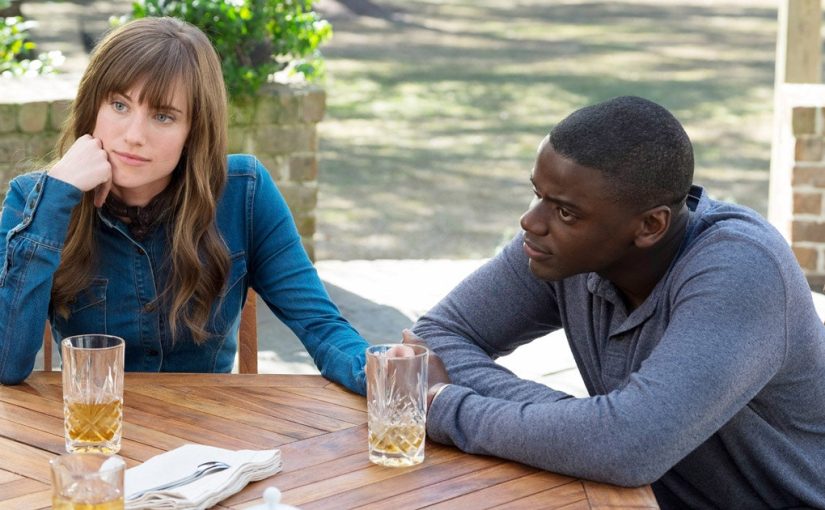
After a brief terrifying prologue, we meet Chris Washington (Daniel Kaluuya in his breakout role) who is about to visit his girlfriend’s parents for the first time.  His girlfriend, Rose (Allison Williams), is white.  He wonders if her parents are aware he’s black: “I don’t wanna get chased off the lawn with a shotgun.”  Rose casually dismisses his concerns: “First of all, my dad would have voted for Obama a third time if he could’ve.”

On the drive to her folks’ house, a startling and intensely creepy incident/accident occurs followed by a tense moment involving a white police officer asking to see Chris’s driver’s license even though he wasn’t driving.  Rose valiantly tells the officer off for profiling, and he lets them off with a warning.  This is just one of the many ways the screenplay probes and exploits the inherent fears of the average viewer.  Even if Chris had been white, it would still be a foreboding scene.  Because of the additional racial tension, the scene crackles with suspense.

Things get progressively weirder from there.  Chris meets Rose’s parents, Missy (Catherine Keener) and Dean (Bradley Whitford), along with their groundskeeper and maid, Walter and Georgina, both of whom are black.  Walter and Georgina’s behavior is just plain odd.  Their sole purpose seems to be to make Chris (and the audience) say, “What the f**k” repeatedly.  Dean directly addresses Chris’s apprehension: “I know what it looks like: a white family with black servants.”  His explanation of why they’re there answers Chris’s questions without really answering them if you follow me.

It would be unfair of me to describe any further plot details.  I’m sure those of you who’ve seen the movie would agree.  But I will issue a SPOILER WARNING for the remainder of the review.  Consider yourself warned.

Get Out is one of the most original, most effective modern horror films I’ve seen since The Descent (2005) and The Babadook (2014).  I have rarely been so glued to a screen.  The way director Jordan Peele ratchets up the creepiness levels is virtually unparalleled.  Here is a first film that rivals M. Night Shyamalan’s The Sixth Sense (1999) in terms of how to manipulate an audience.  Look at the moment when Chris sneaks out of the house for a cigarette, looks around, and suddenly spies Walter, the groundskeeper, running towards him in the night.  No, not running…sprinting.  Silently.  When I watched this for the first time on my own, I literally said, out loud, “What the s**t…???”  I can’t remember when I’ve seen anything like that in a suspense film.

Take the moment when Chris gets involved in a late-night discussion with Missy (Rose’s mom) that turns into an impromptu therapy/hypnosis session.  When Missy calmly says, “Sink,” and Chris actually does, and we see him floating in some kind of limbo, I felt the same kind of transfixed curiosity that I felt while watching Under the Skin (2013).  I had absolutely no clue what was happening or why, and I couldn’t wait until I could get answers.  When those answers come, they are both gratifying and suitably horrific.  Remember those old commercials for the American Negro College Fund?  The tagline was, “A mind is a terrible thing to waste.”  You will never think of that line the same way again after watching Get Out.

Peele was wise enough to include some comic relief in the form of his best friend, Rod (Lil Rel Howery), who works for the TSA and ironically gets closer to the truth of what’s going on at Rose’s house than he or anyone else realizes.  If the movie has a single weak spot, though, this might be it.  Rod is so comic it feels as if he was lifted directly from a romantic comedy.  Sometimes his delivery and dialogue feel a little too much like he’s trying for laughs rather than just being himself.  This is a minor quibble, though…he is funny as hell, especially during a phone conversation between him and Rose.

The bottom line, as if you couldn’t tell, is that Get Out is a sensational movie, containing more levels than “Super Mario Bros.” and more food for thought than a Judd Apatow dramedy.  It’s one of those movies where, if I hear anyone hasn’t seen it, not only do I recommend it unreservedly, but I immediately ask if I can watch it while they watch it for the first time.  Just to see their reactions.


SELECTED QUESTIONS FROM EVERYONE’S A CRITIC

  1. Do you feel a larger budget would make this film better or worse?
    …that’s a tough question.  As you can see from my 10/10 rating, the movie is just about perfect as it is.  What might change with a larger budget?  A more realistic-looking deer corpse?  A wide-angle shot of…something…burning?  Maybe they wouldn’t have gone with Daniel Kaluuya, or maybe Rose would have been played by, I dunno, Emmy Rossum or Lily James.  So, I guess my answer is, a bigger budget would make this film worse.  The filmmakers made the choices they made because of their limitations, and those choices resulted in a masterpiece of the genre.  It’s like Salieri says in Amadeus when describing Mozart’s music: “Displace one note, and there would be diminishment. Displace one phrase, and the structure would fall.”
  2. Were you surprised by the ending?  What would you do differently?
    Because of how the very ending of the film is structured, yes, I was surprised by the ending.  In fact, on the blu-ray, we can see the original filmed ending, and it’s what I feel might have been a more realistic ending.  As it is, the new ending is very satisfying on an emotional level, but I will always wonder how that original ending might have been received by general audiences.  Probably not well.  Imagine putting your hero up a tree, story-wise, then setting the tree on fire…but instead of getting him out of the tree, firemen chop the tree down and the hero is falsely arrested for arson.  Something like that can work – look at Body Heat (1981) and the original director’s cut of The Descent.  But Get Out provides a much more cathartic resolution and gets a smile on your face when you walk out the theater instead of shaking your head ruefully.


On the next “episode” of Everyone’s a Critic: “Watch a Film Starring Animals.”  I’m leaning towards The Black Stallion, but stay tuned…

THE BIRDS

By Marc S. Sanders

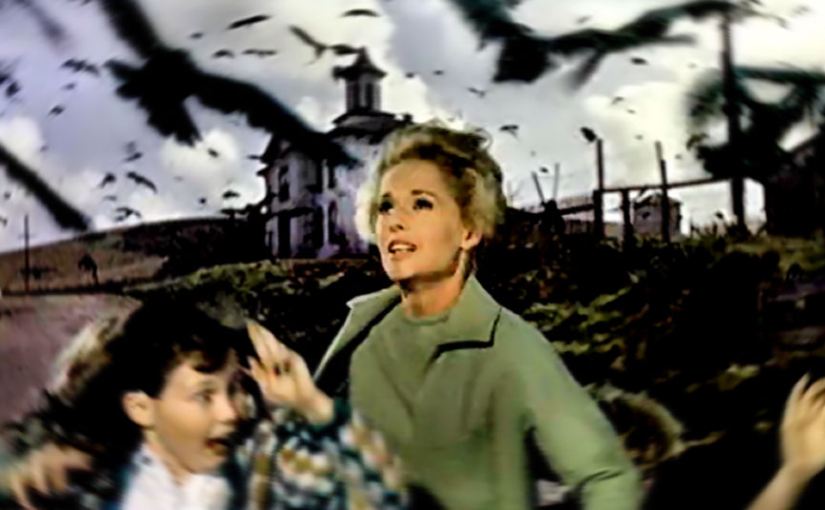
Alfred Hitchcock’s monster movie is The Birds from 1963.  There’s really not much to the piece as far as a story goes.  Characters are just given a purpose to be with one another so that they can be tormented together.  In this case, the film offers up a near hour introduction of newspaper heiress Tippi Hedren playing meet-cute with attorney Rod Taylor.  How ironic that they begin a flirtation in a bird shop of all places only to reconnect at Taylor’s harbor island home in Bodega Bay, located on the outskirts of San Francisco.  Still, as only Hitchcock can demonstrate there’s an ominous feeling sprinkled throughout before the real terror takes flight in the movie’s second half.

While I don’t rush for repeat viewings of The Birds, there’s no doubt as to its influence.  Each time there’s a shot of a bird soaring in the sky, your eyes open wider.  Something will eventually take effect.  At the beginning of the film, Hedren looks out into the San Francisco sky to see large flocks of birds soaring overhead.  Later, while taking a boat in Bodega Bay towards Taylor’s home that he shares with his mother and sister (Jessica Tandy, Veronica Cartwright), she’s attacked by a random gull.  It’ll raise the hair on your arms for sure. 

I’ve noted before how Alfred Hitchcock builds suspense.  The audience knows there’s a bomb under the table.  The characters in the film don’t. So, the audience is nervous as to when the bomb is going to go off or if the characters are even going to discover the explosive.  An outstanding sequence in The Birds includes Tippi Hedren sitting on a park bench near the jungle gym, outside of a school house.  The children are singing along inside.  One crow lands upon the jungle gym.  Then Hitch returns to a shot of Hedren calmly lighting a cigarette.  Then back to the jungle gym and there are four more birds perched just behind her.  Then back to Hedren, unaware.  Then back to the jungle gym for Hedren to turn around and there are suddenly hundreds of crows congregated together.  Effectively, other than the innocent harmonies of the children nearby, Hitchcock opts not to use any music to shock his audience as the scene develops.  The visuals lend to the fear.  The danger that threatens Hedren and the children heard off screen is at the forefront of the viewer’s mind.  No more is needed.  It’s scary, and you want to be as quiet and unalarming as Hedren so as not to instigate the monsters right next to you.

A later scene has Hedren ascend a dark staircase to open a bedroom door.  The roof has been torn open and suddenly the blackness comes alive with flapping wings from every direction.  That’ll make you shift in your seat.

Hitchcock offers plenty of set pieces for bird attacks, but another effective device is to show dissention among the ranks.  From a character perspective, the picture takes a sideways route to imply an oedipal complex between Rod Taylor and Jessica Tandy, who plays his mother.    Therefore, the script suggests Hedren as a threat to their relationship.  Before the film is over, they are likely going to have to develop a united front or it could be their undoing.  (Maybe it’s a nod to Hitchcock’s popularity with Psycho. A cute wink and nod.)

There’s also Suzanne Pleshette as the school teacher that we learn had a tryst with Rod Taylor’s character at one point.  That doesn’t spell out too well for Hedren, either.  As this bizarre epidemic becomes clearer, a scene in the town diner goes so far as to suggest that these random bird attacks didn’t start until Hedren arrived the day before.  Yes!!!!  It’s all her fault!!!! 

None of this will eventually matter though.

Other disaster films and monster movies later relied on exchanges like these, from Jaws to The Towering Inferno.  Hitchcock was wise enough to build tension.  Not a single bird in the scene, but still the fear and doubt among each other bares the strain.  There’s even an advocate for the birds with a strange elderly woman proudly debating her ornithological expertise, while a drunkard at the end of the bar declares the world is coming to an end.  All of these characters could have come from different movies, only to be pasted on to this canvas thereby lending to the frenzy.  Chaos must ensue among the masses.

Often, I get frustrated when there’s no explanation for a film’s central story.  I gave up on the TV show The Walking Dead many years ago because there never was a cause revealed for the zombie epidemic.  It became a smut of soap opera cliché accompanied with ridiculous gore.   Forgive the SPOILER ALERT, but I commend Hitchcock’s film for not providing a wrap up to The Birds.  The film ends with an uneasy final caption.  Nearly every inch of space on the screen is occupied with birds as the cast makes their way to the car to slowly drive out of town, careful not to disrupt the now dominant species of this universe.  Hitchcock provides a picture where the laws of nature declared a winner.  As intelligent as humans are considered to be, they have not won out.  They have had to surrender.  Why the birds attacked, we’ll never know.  Odd phenomena can happen.

There’s nothing thought provoking about The Birds.  It’s simply a film based on heightening your discomfort.  Often, I find the material and dialogue laughable.  The townsfolk notice a man lighting a cigarette right over a stream of gasoline and urge him to put out the flame.  Wouldn’t the dumb guy smell the diesel?????  However, then we wouldn’t get a fantastic fire ball to observe up close as well as from Hitchcock’s “God shot” in the sky with the birds looming into frame over the town below. 

The visual effects look outdated of course, but they still hold because of how Hitchcock demands they are used.  I noticed that his reliable composer Bernard Hermann is credited, but as a “sound consultant” this time.  The shrieking of the birds is what sends the chills down your spine.  Also, there’s the fact that Hitchcock offers up birds flying right at the screen or the windows.  A great sequence includes the front door of a house being gradually shredded apart by the bird masses.  The wood proceeds to splinter.  You don’t see the monsters but you know they’re right there on the other side.  Once that door breaks open or those windows shatter, then it’s likely all over for our heroes.  George A Romero exercised bits like this in Night Of The Living Dead.  Very, very effective.

The Birds is just okay for me, honestly.  The fright material is what keeps its legacy.  Yet, there’s a lot of soapy material among the cast of characters that’s not all that interesting.  Again, a purpose has to be served for these people to occupy the story.  Just offering a movie where birds hover and peck at people wouldn’t be enough.  So, we have to follow Rod Taylor and Tippi Hedren’s trajectory.  It’s fun to see screaming kids run from these animals turned menace, though.  I found it hilarious to watch a birthday party run amok.  I also yelp when I see a flock storm into Jessica Tandy’s house from the chimney turning the living room into a contained disaster area.  An especially gruesome discovery by Tandy later in the film is absolutely eye opening (pardon the pun, if you know what I mean), and clearly an inspiration to a well-remembered scream out loud moment in Jaws.

The Birds is fun, but it’s not the artistic merit you’ll find in other Hitchcock classics like Rear Window, Vertigo, Suspicion, or even Psycho. What I can promise is that once you get through the plodding character connection build up, you’re allowed to forget about any of their value to the picture and simply relish in the mayhem. 

PSYCHO

By Marc S. Sanders

To watch Alfred Hitchcock’s Psycho today is a blessing and a curse.  You can’t take your eyes off the craftsmanship of the film.  Yet, you know all the surprises and plot twists.  There’s only so much blood you can draw from the stone. 

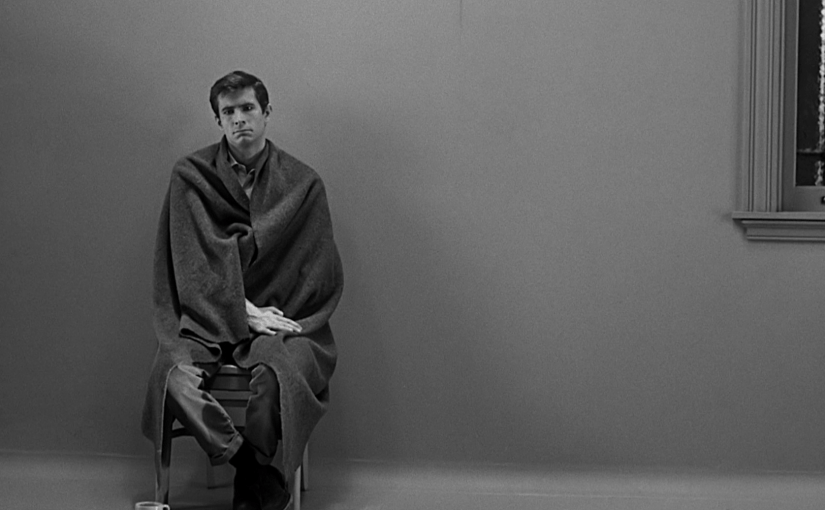
Recently, I told my fourteen-year-old daughter, who doesn’t like scary movies, that she needs to watch the film.  If only because she knows absolutely nothing about Psycho.  She has no idea what’s to come of Marion Crane (Janet Leigh). She’s never heard of the shower scene.  She doesn’t know about the true relationship between Norman Bates (Anthony Perkins) and his chastising mother.  Imagine, assuming you have seen the movie and/or know all its secrets already, watching the movie with someone who is seeing it for the first time with a completely blank canvas to go on.  Oh, the reactions you’ll get to see!!!

Hitchcock’s film, with a screenplay from Joseph Stefano, works under a lot of different dimensions.  It’s classified as the first “slasher movie.”  That may be true.  However, it’s much more intelligent than a typical Jason or Freddy Krueger fright fest.  Psycho begins as one story with a central character, seemingly innocent, carrying out a crime.  Later, it turns on itself and becomes something else altogether.

Marion Crane makes off with $40,000 in cash from a chauvinistic, obnoxious client of her real estate boss.  She hits the road, heading towards her lover’s home in nearby California.  Her impending doom is never implied.  Stefano and Hitchcock focus only on Marion’s scruples with the crime she’s committed.  She gets haunted by a curious police officer.  She certainly wonders what her boss must think when he’ll discover that she never deposited the money in the bank.  Is the used car salesman going to follow up on her after she urgently trades in her car for a new one with new plates?

Soon though, none of that will matter when she has no choice but to pull off the road for the evening to stay at the Bates Motel, currently with twelve cabins and twelve vacancies.

For the one or two readers who have never heard of Psycho, I’ll stop there with the narrative.  However, what I appreciate about the second half of the film is that the new central character, now young, quirky, altogether strange Norman Bates, seems to respond with avoidance when a private investigator named Arbogast (Martin Balsam), and then later Marion’s lover Sam (John Gavin) and her sister Lila (Vera Miles) start questioning him about Marion’s whereabouts.  Arbogast is on the trail of a thief who went off with $40,000.  Sam and Lila are also curious about the theft that seems unheard for Marion to commit.  Yet, there’s something else leaving them curious.  Norman, on the other hand, knows nothing as to what Marion was up to.  In his eyes, the only odd thing about her is that she checks into the motel under a different name.  All of these characters are coming in conflict with one another, but not for the reasons they think they are.  The fun part is that we are the only ones who know the hands that each player is holding.  Even more fun is when we uncover a secret that Norman has been hiding from the audience all along.

Hitchcock tricks his audiences with Psycho.  With its first story, we are in suspense of one criminal.  Will she get away with the theft? Rather, how and when will she get caught?  With its second story, we are unnerved by someone far worse and frighteningly mysterious.  Following the infamous shower scene, it’s a little nerve wracking to watch as Norman tries to hide the evidence in the trunk of a car that he pushes into the nearby swamp.  Any storyteller would just have the car simply sink.  Hitchcock brings in shadowed close ups (with his wise idea of black and white photography) of Norman chewing gum, and then becoming completely still when the car actually stops sinking midway through its descent.  As a viewer, your jaw drops.  What is Norman going to do if the car doesn’t fully submerge?

Later, it’s a wonder how Norman is going to circumvent around the unexpected visits form Arbogast, Sam and Lila.  Then, we are in suspense of their safety.  They’re just looking for the missing money while tracking where Marion went off to.  Unbeknownst to them, they have can’t even fathom her demise.

I was talking with one of my Cinephile brothers about Psycho, explaining how it follows a similar dynamic that the second half of Vertigo moves upon.  In Vertigo, the main characters, Scottie and Madeliene, are both in love with one another.  Yet, it’s for different reasons that they can’t explain to each other.  In Psycho, the characters are all under suspicion and even paranoid of each other, yet for all different reasons.  Norman never knew of Marion’s crime.  Though the other characters suspect that he does.  In both pictures, only we, the audience, know almost everything at play.  According to various documentaries I’ve watched, Hitchcock wholeheartedly trusted his screen writers to flesh out the stories.  He concerned himself more with constructing the film with a faithfulness to the script.  What’s commendable about the films Alfred Hitchcock chose to make is that he sought out these conundrums where his chess pieces are left bewildered or unaware of why they are sharing the stage with the other players.  The director had a way of channeling into deceiving his characters against one another, allowing the viewers to relish in their trickery.  Going a step further though, Hitchcock reveals other twists never suggested in the film to turn the audience on their ear in shock.

You can’t take your eyes off Psycho, even with knowing all the goodies that Hitchcock provides. 

Anthony Perkins especially is a tense and unnerving menace.  He has a boyhood innocence to him that should not appear threatening to Janet Leigh’s Marion Crane.  It’s in his relaxation with the role that it feels all the more terrifying to the viewer.  Simply look at the way Arbogast pulls up to the motel and Perkins is sitting calmly on the porch eating his bag of candy.  Watch how he casually shares with Marion how he relishes in stuffing the birds he has mounted on the parlor walls, or even how he casually offers cabin number one for Marion to occupy so that she can be close to everything.  Norman Bates hides himself very well in his virtue.  A wolf in sheep’s clothing.

The Bates Motel and the large house poised behind it on the hill were set up on a Universal back lot.  It remains one of the most famous settings in film history.  When you see the silhouette of Norman’s mother in the window from afar or young, slender Norman standing in front of the house, the images of the chilling locale stay with you whether it is on a dark and stormy night or even during a sunny afternoon.  Hitchcock opted to shoot the film in black and white to taper the goriness of the piece.  Outside of the gore elements though, the black and white lends a foreboding feeling to this destination.  Even before we realize that Marion is in danger, we feel uneasy with just arriving at this place.

The shower scene of course is one for the ages.  I’m not here to discuss all of the mechanics of film’s centerpiece.  The assembly of the scene’s elements are masterful though.  Can you imagine the scene without Bernard Hermann’s shrieking score?  Hermann was to Hitchcock like John Williams is to Steven Spielberg.  The aftermath is brutally shocking as well.  The camera does a zoom out on Janet Leigh’s eye as the soaking head of her corpse lays down on the bathroom floor.  I notice the eye does just the slightest twitch.  For me, that’s all the more disturbing than just a very still open eye.  It implies the last bits of life leaving her body and consciousness.  Later, when Norman cleans up the bathroom, Hitchcock shows his process with a mop and neatly wrapping Marion in the torn shower curtain and disposing of anything belonging to her, including a newspaper that isn’t just a newspaper.  Norman is methodical.  Perhaps this strange man has done something like this before.

I do have one grievance with Psycho.  The air is kind of sucked out of the film in its last few minutes before that delicious last close up on Norman.  Stefano’s script offers up a psychological explanation for what Norman Bates seems to suffer from.  It’s as if we are given a scientific description for what ails him. This is all painfully boring.  I dunno.  Maybe in 1960, when Psycho was a pioneering kind of horror film, and moviegoers were not as familiar with the genre that seemed far scarier than Boris Karloff, and vampires and mummies, they needed a summation like this.  Sixty years later, naturally this is not necessary.  We know all to well that there are disturbed people who live among us.  We know, sometimes, to be cautious of folks like these.  For someone as reputed as Hitchcock was, being identified as the “Master of Suspense,” this long monologue, spoon fed diagnosis from the psychiatrist kills all of the horror we’ve bared witness to over the last two hours. 

Psycho was the first slasher movie.  It was the first movie to feature a toilet and have it flush on film. It has one of the most famous characters in all of film history.  It has one of the most famous scenes of all time.  It was directed by one of the greatest directors of all time.  Yet, it also has one of the worst conclusions of all time.  If ever a scene should have been cut from a finished product, it is the second to last scene of Psycho.

Now, go find someone who has never heard of Psycho, knows nothing at all about Psycho, and watch them watch Psycho.  Of course, as the famous marketing campaign for the film insisted, by all means do not start the movie or walk in the middle, and never reveal any of its secrets.

VERTIGO

By Marc S. Sanders

Never would I think Alfred Hitchcock would enter the world of the supernatural.  At least of all that I’ve read about him and the films I’ve seen to date, I do not recall tales of ghosts and ghouls from the master of suspense.  Yet, as I’m watching his classic, psychological film, Vertigo, I’m questioning the territory that Hitch has entered.

James Stewart returned to work with Hitchcock in 1958.  He plays Police Detective John “Scotty” Ferguson who opts to retire following a frightening encounter involving a foot chase over the rooftops of San Francisco.  When he succumbs to his debilitating fear of heights, a police man loses his life in the process.  Scotty just can’t go on.

He is recruited by his wealthy industrialist friend Gavin Elster (Tom Helmore) to shadow his wife, Madeleine (Kim Novack).  Gavin is concerned that Madeleine may be suicidal, because it is becoming not too unreasonable to consider that perhaps a woman from the past has taken possession of her.  Scotty is reluctant of course, and it all sounds like a bunch of nonsense.  Yet, he accepts the assignment.

Vertigo may be a classic film, known by millions worldwide, but I won’t dare utter any hint of what’s to come.  Scotty’s pursuit of Madeleine continues to spiral into new inventive twists like Alfred Hitchcock always took advantage of.  The film could have ended on several different notes, and its running time could have been shorter.  However, Hitch lay insistent on peeling back more of the onion.

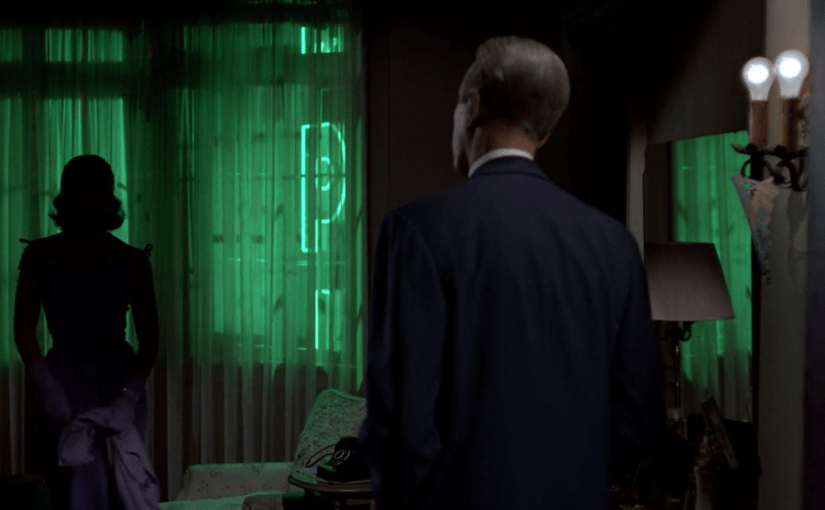
I was fortunate to see the movie following a painstaking restoration after the film was uncovered to be in terrible shape.  Now, it is preserved on 4K disc, and Vertigo is tantamount to the necessity of 4K.  Firstly, as Scotty continues to oversee where Madeline goes and what she does, Hitchcock keeps much of her activity bathed in a rich emerald green.  Green almost works like breadcrumbs for Scotty.  She drives a green car.  Many of her elegant dresses have green in them.  Hitchcock lights many of her scenes in green.  Oddly enough though, while green is so apparent from Scotty’s perspective, Madeleine’s overall purpose and intent is such an enigma.  So, film historians proudly recall how the most popular outfit for the bleach blond Novack to wear in the film is a plain, simple grey suit which tells us nothing.  Grey is melancholy, seeming to express no kind of emotion.  Not fear, or anger or love, or happiness or sadness.  The suit even becomes a significant plot point later in the picture.  The woman is there plain as day, at times shining in the emerald car, or beneath a green light, but why is she there? 

As well, Scotty’s continued pursuit and eventual love affair with Madeleine overcomes him and he spirals into a madness highlighted in reds and blues and oranges with spiral lines turning into bottomless pits.  Hitchcock even imposes haunting animation to show how Scotty’s mind is splintering and falling away from any depth of reality.

I have seen clips of the original film and the colors are so faded out.  It takes you out of the picture.  The color is so pertinent to the narrative of Vertigo that there was no question.  The movie had to be restored.  Watch this movie on 4K.  You won’t regret it.

Have you looked at the well-known marquee poster for Vertigo lately?  It is definitely one that’s consistent to dizzying turns and descents to overtake the movie.

Furthermore, the opening credits of the film zoom into the pupil of a woman’s eye and then spiral sketches start to turn and spin.  It’s easy to connect this to the side effects of Scotty’s acrophobia.  He gets dizzy.  His visual perspective draws him out of measured reality.  As the film progresses, though, it goes further than that.  Hitchcock turns Scotty into a man crippled with obsession. 

I heard my Cinephile colleagues discuss this film recently, implying that Vertigo is not their favorite.  They didn’t like James Stewart’s character.  For one thing he falls in love with Madeleine, his friend’s wife. The Cad!!!  Later, he invokes unequivocal dominance over a new woman he meets in the second half of the picture.  (I won’t say much more, here.)  He insists the woman dress like Madeleine and do her hair and makeup like Madeleine.  She also needs to walk like her too.  Stewart and Hitchcock really put this protagonist through the ringer.  He’s first crippled with a fear of heights.  However, dominant obsession interferes with him as well.  Is it the acrophobia that is so debilitating, or is it a sick obsession that comes into play?

San Francisco is an ironic setting for a film where the main character has a fear of heights.  It’s made up of steep hills that descend from high tops, or ascend into the sky.  Try climbing the staircases that stand upon these hills and now you are even closer to the heavens and further away from the ground.  How could a guy like Scotty Ferguson live in such a city?  Yet, here it is.  Maybe it was a sick, subtle joke of Hitchcock.  I think it’s a nice touch to amplify the suspense.

James Stewart is just as good here as he was in Rear Window.  The likable fellow who serves as a sponge to what’s laid out before him.  If he absorbs too much though it could defeat him altogether.  Much of the suspense Hitchcock is known for, stems from this thread line.  Stewart’s Hitchcockian characters get drunk on needing to know more, and delve even further.  The audience can’t help but get intoxicated with him.

Kim Novack is radiant.  She gives an especially incredible acting performance.  Through the first half of the picture, she’s quiet and reserved laying credence to what Gavin suggests to Scotty.  Is she being possessed by a young woman with odd resemblances too her, who killed herself back in the 1800s?  Is it something else?  Her turn in the second half of the picture leaves you questioning if you are even watching the Kim Novack.  An amazing double performance from her that lends to one of the twists that Vertigo offers.

Pictures like Vertigo and Rear Window are so important for people to see.  These films laid the groundwork for much of the horror, macabre and disturbingly mysterious stories shown today.  They are pioneering films that only invent what needs to be shown.  In other words, they don’t get diverted in overcompensating with action and gore.  Many films that derived from Vertigo desperately turn to blood and over the top stunts and visual effects.  Alfred Hitchcock thought about how the actors, the settings and wardrobe, along with his cameras, would capture the terror and embrace the unknown.  Filmmakers need to continue learning from a craftsman like him.

REAR WINDOW

By Marc S. Sanders

Alfred Hitchcock’s beloved classic Rear Window remains absolutely relatable today.  Before the age of the internet and reality TV, people already had a voyeuristic instinct about them.  Heck, movies are voyeuristic!  The audience watches the behaviors and actions of people on a large screen.  Snooping into the activities within your neighbor’s private apartments is not much different.  Though likely less ethical.

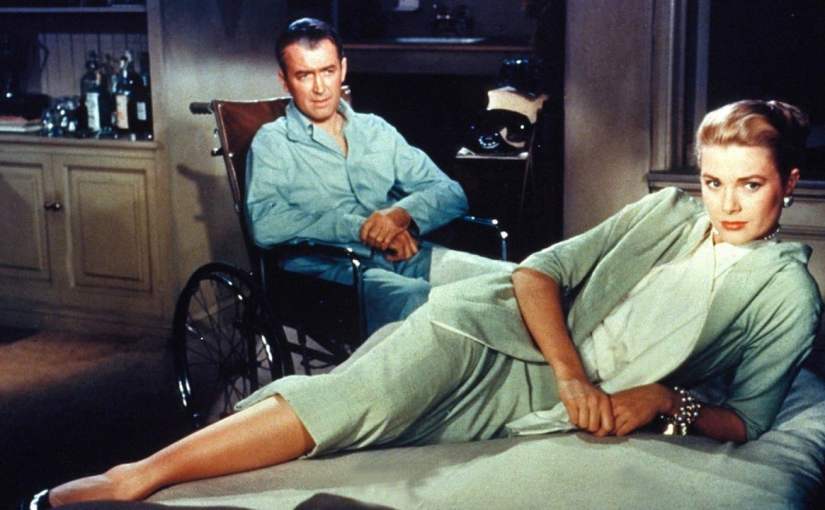
When photographer L.B. Jeffries, aka “Jeff,” (James Stewart, in one of his most famous roles) is bound up in a wheelchair with his broken leg wrapped in a waist high cast, there’s not much adventure like his traveling career demands.  So, he gets caught up in looking at the goings on of his Greenwich Village apartment neighbors like a beautiful hourglass figure dancer he dubs “Miss Torso,” or the newlywed couple and their never-ending sexual escapades.  There’s also an elderly couple who find comfort in sleeping at night on their outdoor balcony next to one another.  He can also take pleasure in a struggling musician trying to write his next piano tune while also entertaining a collection black tie guests.  Another woman he dubs “Miss Lonely Hearts,” for her desperate attempts at entertaining herself with imaginary escorts she’s “invited” for dinner, also leaves him curious to keep up with.

The most inquisitive occupants in this building are a husband (Raymond Burr) and his seemingly ill and often irritating and nagging wife.  Over one rainy night, Jeff takes notice of the husband leaving his apartment with a suitcase at three different times and the wife is nowhere in sight ever again thereafter.  Later glimpses of the husband handling a carving knife, a saw and some rope tied around a storage trunk are also eye opening.  Jeff recounts this sequence of events to his desperate love interest, Lisa (Grace Kelly, with a gorgeous on-screen entrance in one of costumer Edith Head’s legendary dresses) and his nurse caretaker Stella (a smart allecky and perfectly cast Thelma Ritter).  When the likelihood of murder has probably occurred, Jeff also lets his detective friend Tom Doyle in on what’s seen.  All seem skeptical at first. 

Now the action of murder is never seen by Jeff, nor by the audience, mind you.  For the most part, Hitchcock limits the viewer only to what Jeff sees with his own eyes or with the help of his binoculars and his long lens camera.  Midway through the film, the director allows Jeff to doze and gives us a glimpse of something the husband does.  Now, we the audience, have a slight edge of knowledge that our hero doesn’t.  This plays with Hitchcock’s approach to suspense.  We know there’s a “bomb” under the table.  The people sitting there don’t however.  It pains us to wonder if our protagonists will discover the bomb before it goes off.

I’m a big fan of Alfred Hitchcock movies because they never get too complex.  The stories he chose to direct normally place an everyman in a scenario he/she never expected to find themselves in, much less be invited to.  With a screenplay from John Michael Hayes, Hitchcock puts out only a few pieces of a puzzle.  Then, it’s up to his handicapped hero and the audience to solve it.

The voyeurism for Jeff seems like a harmless vice while his time at home slowly passes painstakingly by.  Hitchcock and Stewart do very well in assembling this film.  A close up of Stewart will have him turn his eyes to his right and then we will see what the newlywed couple are doing.  Then we will cut back to Stewart and see his reaction with a smirk.  A look down will cut to the dog, curiously digging away in a flower bed.  Then once again back to Stewart for a close up that maybe has him wondering if the dog is getting at something pertaining to this husband and his now missing wife.  The smirk leaves Stewart’s face.  Now, it’s an expression of puzzlement.

I noted earlier that Rear Window can easily be related to what drives people’s obsessions today.  We are people driven by internet surfing and television streaming and social media.  The known statistic that half of marriages end in divorce is still prominent.  (Maybe that percentage is even higher by now.) Stewart’s character of Jeff becomes so obsessed with keeping up with these people’s stories, that he hardly finds time or enthusiasm to accept the romantic gestures of Lisa.  It’d be fair to argue that technological devices of today serve as an equal distraction in relationships.

Grace Kelly is well cast here.  Arguably one of the most beautiful women to ever appear on screen, dressed in some of the most artistic and fascinating costumes provided by Edith Head, and even she can not divert Stewart’s attention away from the activities of others that Jeff doesn’t even have an intimate knowledge of.  Kelly begins her performance in the film with an approaching close up followed by a sensual kiss upon a sleeping Jeff.  She arranges a catered dinner, delivered by the renowned New York restaurant, Twenty-One.  It just doesn’t completely sway Jeff away from what he becomes obsessed with.  Much like people are with social media, Jeff has been addicted to his vice.  When Lisa tries to implore with Jeff to take their relationship further, James Stewart raises his voice to tell her to shut up and insists that her beautiful hairstyles, wardrobes and high heel shoes could never keep up with him on his travels to far off deserts, jungles and war-torn areas that he photographs.  Yes, Jimmy Stewart tells Grace Kelly to shut up.  It’s shocking.  However, maybe the film will eventually demonstrate that Jeff really doesn’t know anything about Lisa.  The everyman of cinema at that time has been corrupted by what he’s focused on, and in an Alfred Hitchcock film, it is bound to get him into more trouble than he ever expected.  More importantly, the one who cares for him may open his eyes to what he really can’t see as this mystery proceeds.  Broken leg or not, Jeff has never truly seen the real Lisa.

I recall visiting Universal Studios in Orlando, Florida when there was an Alfred Hitchcock attraction there.  I miss it.  It was taken over by a Shrek ride and soon it will be another Minions adventure.  Before ever having seen Rear Window, the attraction featured a look at the Greenwich Village courtyard setting of the film.  It was fascinating.  It was four floors of apartments directly across a courtyard that had a flower bed, folding chairs and the like.  There was also an alley that presumably led to a bustling New York City street.  Naturally, you couldn’t see much of the street.  Just a sliver.  Hitchcock arranged with Paramount Pictures to build the set this way.  Audiences would have wide open views of activities within the window frames of these apartments, the hallways beyond the front door of each dwelling and that one slim alleyway.  The viewer is as limited in what can be seen as Jeff.  This mysterious husband may be going somewhere at odd hours of the night, but once he passes that alleyway, there’s no way of knowing where he went.  Today, we might call something like this one of those “Escape Rooms.”  Solve the mystery, but only with what you can see and only from your one stationary position.  If something takes an unexpected direction, you could find yourself in danger without any means of escape.  That’s how Hitchcock sets up the limitations for Jeff.

As the film progresses, Lisa proves that she can be adventurous like Jeff claims that she isn’t.  In her beautiful gown, heeled shoes and coifed hairdo, she climbs into the apartment of the likely murder suspect looking for clues.  Jeff, however, can’t do anything but watch.  There’s not much he can do either even when the suspect returns while Lisa is still there.  He’s helpless to help her or even himself.  This assembly of direction again falls in line with the “bomb under the table” idea.  It’s one of many devices Hitchcock uses to keep Rear Window as suspensefully entertaining as it was for audiences in the 1950s.

Few directors still can’t keep audiences on the edge of their seat like Alfred Hitchcock.  He had such an intuition for knowing what would keep viewers engaged and wanting to know more.  Unlike other films from him, there’s not much of a twist to Rear Window.  The resolution falls in lifting the veils.  Jeff must reveal himself to this mysterious husband.  (When they come face to face finally, Hitch is smart to position Jeff as a silhouette in darkness.)  Lisa must show Jeff a side to her that he refuses to acknowledge in order to save their relationship. Most importantly, a mystery has to be confirmed.  You find yourself more and more breathless as the film moves on, and then more facts are revealed implying that Jeff is truly on to something.  When the picture finally ends, if you got caught in Hitchcock’s web of suspense, you’ll likely let out a satisfying sigh of relief.

RED DRAGON

By Marc S. Sanders

So this may be director Brett Ratner’s best film, but that doesn’t make it a great film. Ratner directs Anthony Hopkins as Hannibal “The Cannibal” Lechter in this prequel film to The Silence of The Lambs.

Hopkins does his best with a script that lacks the wit of the original Lambs script. The puns are lacking this time as he plays mind games with Edward Norton’s FBI agent who is trying to apprehend “The Tooth Fairy,” a deranged killer of families played by a disturbing Ralph Fiennes.

Red Dragon boasts a who’s who of a great cast; Hopkins, Norton, Fiennes, Harvey Keitel, Emily Blunt, Mary Louise Parker and Phillip Seymour Hoffman. Yet, every player is incredibly boring. It’s as if they memorized their lines and just recited them at the call of action. There are no nuances. No fear or fascination within their interactions, and thus what’s at stake seems awfully minimal. We get a LOT of Norton just talking to himself or a tape recorder. It’s all very flat.

Ratner’s art director should be commended for effectively duplicating Hannibal’s prison from Lambs. That’s where the eye-popping stops, however. Hannibal’s infamous muzzle mask also makes a return.

I remember loving this book by Thomas Harris. It was so imaginative and descriptive. Very fast reading. Ratner gets all the important scenes in his film as well as some additional fodder for Hopkins but it’s all color by numbers. Nothing is here to carry a swell of emotion. No close ups. No lighting technique.

The best that Ratner comes up with is to chain Hannibal to a steel cable like a wild animal. He lunges for Norton and the chain rattles. Meh. A cat jumping out of nowhere has given me worse nightmares. Ratner forgot to cast the cat, however.

THE PELICAN BRIEF

By Marc S. Sanders

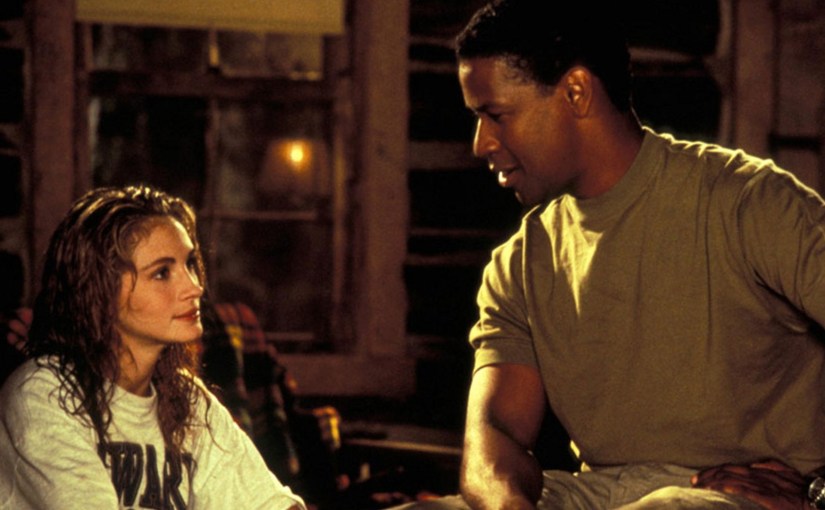
Tulane Law Student Darby Shaw (Julia Roberts) is unbelievably lucky. She can find herself being pursued by one white guy in a suit after another over the course of a two hour movie and will be fortunate enough to escape every threat by sheer chance. It’s only to her benefit when she is being chased by two assassins in a creepy downtown parking garage that someone left an angry doberman in a car to startle the killers. As well, it’s really a blessing that Darby has caught on that if an engine sputters when turning the ignition it can only mean one thing – car bomb! GET OUT!!!!!

Darby is the main protagonist of The Pelican Brief directed by Alan J Pakula, adapted from John Grisham’s best-selling novel. When the eldest and the youngest Supreme Court justices are murdered, Darby conceives of an outrageous conspiracy stretching all the way to the President and documents the whole rundown in the so-called Pelican Brief. She shares the document with her law professor who shares it with his government friend who shares with the CIA who shares it with…and so on and so on.

Pakula is an under celebrated director when you consider his better thrillers like Presumed Innocent, Klute, and especially All The Presidents Men. Here though, I think he got a little lazy with his screenplay and direction. The Pelican Brief is a little too paint by numbers.

Sure, the film has suspense. I think Grisham’s story has some convincing weight to it where wealth and government won’t stand for the platforms of environmental causes and therefore people have to die. Still, while the meat of that story eventually surfaces, we are left with A LOT of buildup before Darby gets involved. Just a lot of white guys in different office buildings walking down hallways, entering doorways and talking on the phone. Every so often we come across a DC crack reporter, Grey Grantham (Denzel Washington) who gets a phone call from a potential informant. When that guy gets scared and hangs up, thank goodness Darby just happens to call two seconds later regarding the same story. Good on you Grey for being by that telephone.

That’s my problem here. Pakula just works in the lucky conveniences to keep Grey and Darby on the trail. Neither of them ever truly escape a bind on their own. Neither of them ever truly dig the hole any deeper without something COMING UPON THEM to help them along at just the right moment.

We learn a safe deposit box belonging to a dead character exists. Darby just strolls into the bank and posing as the widow, who is not a signer on the box, is just asked for her address and phone number. No proper identification necessary. Why didn’t anyone ever tell me it’s that easy? Folks, hide your valuables because I’m gonna be robbing you blind.

Pakula will even set up a good scenario where Darby thinks she’ll be meeting someone who can help but it’s an assassin ready to kill, only suddenly the assassin is killed while holding Darby’s hand in a crowded courtyard. Wow!!! Lucky again, Darby. I’m still fuzzy on who actually killed the guy. That didn’t concern Pakula though. It’s explained in a quick throwaway line before the credits roll. Pakula only had to get Darby out of danger again. So let’s see he’s got the barking doberman for something else, the engine sputter will be used later on. Hmmmm??? Meh!!! we’ll just have someone randomly kill this guy. Now run, Darby. RUN!!!

Notice I haven’t talked about performances. Well, there’s not much to them. The Pelican Brief boasts an impressive cast of character actors like Sam Shepherd, Anthony Heald, John Lithgow, Stanley Tucci, Robert Culp and John Heard. Yet, these guys, along with Roberts and Washington are flat. Just reciting their lines when the cues call for them. There’s nothing very exciting to any of them really. Very monotone. Roberts is beautiful yet depressing even before she gets caught up in the mystery. Washington, while handsome, does not seem to have the gusto that Pakula’s reporters did when he directed Hoffman & Redford. Grey is too neat, physically fit and tailored for an always on the job, aggressive reporter looking for a scent.

There was a better movie to be made here, thanks to some convincing motivations that were started with Grisham’s novel. Unfortunately, Pakula just didn’t devote enough respect to the original author’s imagination.

THE FIRM

By Marc S. Sanders

Sydney Pollack was the first director to take a crack at adapting one of John Grisham’s best-selling books, namely the still most popular novel, The Firm. Wisely, and with a measure of risk, Pollack took the script from David Rabe, Robert Towne and David Rayfiel and maintained a true adaptation for the first hour of the film while inventing a new kind of second half that I think improves upon Grisham’s story.

Mitchell McDeere (a well cast Tom Cruise) is the most sought after Harvard law graduate in the country. A small Tennessee firm makes an offer to him that outbids any of the big leaguers. Considering that Mitch comes from a poor broken home with a brother (David Strathairn) currently in jail for manslaughter, the offer and treatment given to Mitch and his school teacher wife Abby (Jeanne Tripplehorn) could not be more enticing. A house, a car, school loan payoffs, and a near six figure salary in the first year is not something anyone would walk away from.

Once the happy, young couple are comfortable though, a curious FBI man (Ed Harris, an MVP of this stellar cast) inquires if Mitch finds it odd that this firm has four of its lawyers dead within the last ten years. The two most recent casualties perished in a boat accident.

The sharp minded Avery Tolar (another welcome performance from Gene Hackman) is assigned to make sure Mitch follows the path the firm expects of him. Avery also has his sights set on Abby. For a guy who has never been regarded as good looking, Hackman plays a pretty effective flirt.

The firm, led by a seasoned Hal Holbrook with a charming Mark Twain like bow tie, and a perfect henchman villain played by Wilford Brimley (definitely on my top list of best bad guys) are involved with the Mafia and their shady dealings of money laundering, racketeering, murder and embezzlement. Now Mitch is stuck.

The FBI want to use him to uncover the firm’s activities but that risks blowing his career and maybe his and Abby’s life. If he doesn’t cooperate, then the Feds will run him in with the rest of the gang.

A second hour focuses on a complicated way for Mitch to get out of this ordeal. It means a lot of white collar work and contrived timing in the script. Fortunately though, Pollack builds suspense with foot chases and some allies on Mitch’s side, including Holly Hunter as an hourglass figured, bombshell secretary to a private investigator (Gary Busey) that Mitch went to see. His plan involves traveling to and from the Cayman Islands, and making copies of legal documents to build evidence of mail fraud against the firm.

Mail fraud???? That’s right mail fraud. It’s not a sexy crime, but the script with Pollack’s direction and a hard pounding piano soundtrack from Dave Grusin manage to keep the suspense up and alert.

Pollack directs Cruise to sprint across downtown Nashville for some great sights and hideouts in broad daylight. Your adrenaline moves with the film even if you can’t connect all the dots of Mitch’s complex plan.

In fact, it’s best to just give up on following every little step Mitch and his team take to stay ahead of the firm. What works best is the seemingly no win scenario for Mitch and Abby. Pollack follows a Hitchcock trajectory. He leaves the bomb on the table but doesn’t detonate it right away. Thus the suspense holds steady.

So, the best kind of counsel I can give is to just enjoy The Firm as it runs through its paces. It’s a solid white-collar thriller.

UNLAWFUL ENTRY

By Marc S. Sanders

The boogeyman is dressed as a police officer!

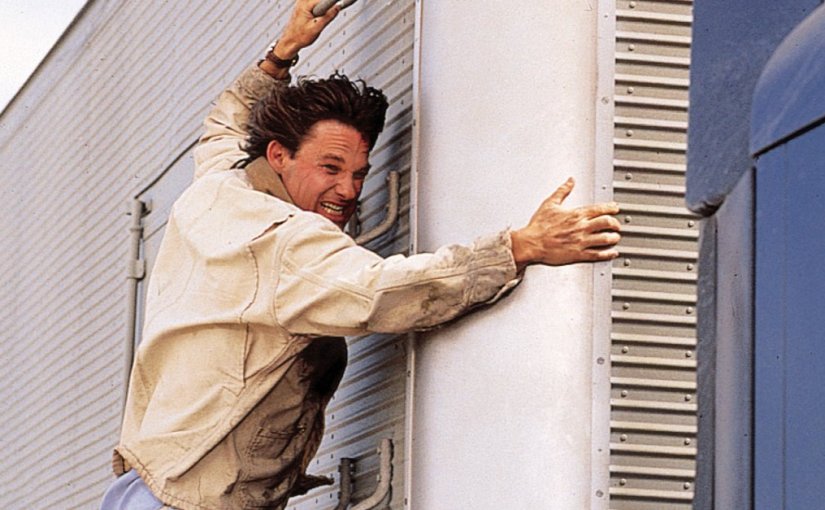
In 1992’s Unlawful Entry, Jonathan Kaplan (The Accused) directs a well-played Ray Liotta as a psychotic cop named Pete Davis who is terrorizing a yuppie couple named Michael & Karen Carr (Kurt Russell, Madeleine Stowe). The Carrs experience a home intruder who puts a knife to Karen’s throat. Officer Davis offers comfort to the pair and happily volunteers the arrangements for a high-tech alarm system. The first mistake that Michael makes is sharing the password with trusty Pete. You’ll expect that to come into play later on. Maybe what inspired the password will work itself into the film as well. Hmmmmmm?????

It’s difficult for Pete to resist the obsession he has for Karen and so he begins a campaign to get Michael out of the way. First, he demonstrates his brutality by offering Michael the opportunity to senselessly beat up the home intruder for no other purpose than personal satisfaction. When Mike refuses, Pete finishes the job. Later, Mike makes efforts to keep Pete out of their lives. It’s hard to do that when a highly decorated cop is involved. Karen, his own loving spouse, won’t even truly believe Mike; neither will the police chief.

As Pete continues with his intentions, Mike’s credit cards are maxed out, he loses a high priced client that Pete has been talking to, parking tickets add up, and so on. Pete also appears at the house at inopportune times like when Karen is taking in a swim or creepily stepping into their bedroom while the married couple is having sex. Eventually, Mike is put out of the way when he’s imprisoned after being framed as a drug dealer. Now Karen is all alone for a terrifying third act that you’ve likely seen hundreds of times before.

Unlawful Entry is engaging while you’re watching, but it does not convey much. The happenings all appear probable if a deranged cop wanted to go through all this trouble. Therefore, Ray Liotta owns the picture. Yet, what did I learn here? Don’t call the police?

For Kurt Russell, this is the first of two “husband is being terrorized” roles for him. Later, Russell would headline the cast of a better film to fall in this genre called Breakdown. Still, I like Russell here. He starts out as a guy who is not capable of fighting for the sake of his wife. He regrettably admits that shame to Pete early on. Pete pounces on that advantage to win Karen. Later, the strength of Mike’s short temper followed by his fear push him to do what he must to protect himself and his wife.

Madeleine Stowe is a good actress. There’s just not much for her to do with this part. She’s the spouse who opts not to believe her husband’s concerns. If she did, there wouldn’t be much of a movie. The third act is all action and blood and falling down the stairs and running back up the stairs. It’s no surprise really. Though it is convenient that Michael is finally able to post bail and get home in time for a final confrontation with Pete.

One thing that kept echoing in my head though was that as good as Ray Liotta is (he’s very, very good actually; very primal and deceiving), he is terrorizing a woman named “Karen.” Every time he says the name Karen, all that comes back to me is the film Goodfellas where he more or less tormented and disrespected Lorraine Bracco known as, you guessed it, Karen. A rule should be put in place, Liotta can no longer be cast with other characters named Karen. His Karen quota is maxed out.

CAPE FEAR (1991)

By Marc S. Sanders

Would you ever think that Martin Scorsese could be a master of horror? I do. I thought so ever since I saw his remake of Cape Fear, back in 1991, featuring Robert DeNiro, Nick Nolte, Jessica Lange and Juliette Lewis. This cast of four is an astonishing assemblage of talent, complimented with players from the original film, Robert Mitchum and Gregory Peck, as well as Joe Don Baker, Fred Thompson and Illeana Douglas.

Wesley Strick is credited with this updated screenplay that questions the measure of sin; pot vs heroine, battery vs rape, flirting vs infidelity, as well as the ethics and justifications that we reason with every day.

DeNiro provides one of his greatest roles. He lost the Oscar in 1991 to Anthony Hopkins. Reader, DeNiro should have won for a much more complex, fleshed out part. He plays Max Cady, a man released from prison after a fourteen year stretch. His focus during his time was to learn how to read, build up his body, tattoo his flesh with the principals he inherited from the Almighty Bible and other literary sources, and most importantly reconnect with his defense attorney Sam Bowden (Nick Nolte in one of his best roles, as well). Cady needs to remind Bowden of how he was misrepresented during his trial.

Strick’s screenplay is so smart. Smart because the antagonist never, ever makes an error, not until the end of the story. Cady’s intelligence is always one step above anyone else’s intuition and with the literal mechanics of the law beside him, Cady’s tactics come off very believably. Cady might come off as hokey, hillbilly white trash with ugly polyester clothing, a slicked back mullet and a fat, offensive cigar but he is a smart hunter who will weaken his victims before initiating his attack.

Bowden is a smart lawyer but he’s at a loss, and he does not have the support he needs from his family to protect himself and them, Jessica Lange as his wife and Oscar nominee Juliette Lewis as his daughter. Lange is very good as a wife who has survived marital turmoil of infidelity from her husband. She’s a marketing career woman who does not succumb to Sam as being head of the household. Sam asks that the dog not be put on the table and Lange as Leigh Bowden scoffs at his concern.

Fifteen years old at the time, Lewis is astonishing as a young girl discovering her sexuality but unsure of what is appropriate; almost like a kid finding a loaded weapon in a closet. One of the greatest acting sequences in the last thirty years, occurs between DeNiro and Lewis alone on a stage set against a sinister lighted Hansel & Gretel set. Lewis twitches and stutters like any girl would, as DeNiro assuredly comforts her and seduces her into a touch that leads to a kiss. Scorsese uses this midpoint scene to quiet down an aggressively frighteningly film, meticulously edited by the legendary Thelma Schoonmaker. Before this moment, telephone rings, shutters, racket balls, car engines, aggressive close-up zooms, and Elmer Bernstein’s horn and string sections of his orchestra startle you and scare you when almost nothing terribly vicious has really happened. When we arrive at Lewis and DeNiro’s scene, Scorsese quiets it all down. He needs no devices for this exchange of disturbing, yet researched dialogue by Strick, blended with the performance talents he has at his disposal.

Another stand out performance belongs to Illeana Douglas in a small, early role. She plays a court clerk to Bowden’s lawyer and they are flirtatious. Cady uses this as an opportunity to remind Bowden that he must take his sins seriously. Douglas is supreme in an inebriated scene with DeNiro as she flirts with him and then goes to bed with him. We can sense the danger she’s in. Douglas’ drunken portrayal cannot. Never does she look like she’s foreseeing her immediate future.

It’s ironic, really. I can’t help but compare Cape Fear to any one of the various slasher films featuring Jason, Freddy, Michael, etc. Those guys stalk the house or are seen from the distance at the end of the street. Those are horror films as well where an entity stalks a prey. Scorsese really has that here with Strick’s screenplay. However, Scorsese finds other ways than to just have the menace be…well the menace. He offers up an overabundance of fireworks behind Cady as he sits in Bowden’s backyard. He’s got Bernstein’s blaring horns and squealing strings for soundtrack, of course. He colors the palette of the sky above Bowden’s doomed house in bruised purples and blood reds. He even changes the perception of the Bowden family by showing what they are looking at in a sort of X-ray/black light like state. Are they seeing what they think they are seeing? Sure, Cady is stalking them, but in a given moment, are they just being paranoid by the disturbances Cady has cemented in their consciousness?

I’d imagine these are filmmaking inventions of Scorsese not specifically featured in Strick’s script. That’s what makes Martin Scorsese a director above so many others. He doesn’t just settle for the page. He won’t necessarily manipulate the script, but he won’t settle to just leave it at only what he reads. Cape Fear is a demonstration in unsettling, visual terror, and it’s worth revisiting for a look.