THE SHADE

By Marc S. Sanders

A ghost story works best when a mystery can be upheld.  Something so shocking or fascinating must draw you in and stay with you so that you want to look around every nook and cranny you see on screen and uncover clues that will eventually give you solid answers to the questions you have.  Writer/director Tyler Chipman, partnered on a script with David Purdy, to deliver The Shade.  His prowess with a camera had me darting my eyes from one corner of the screen to the next.

Newcomer Chris Galust portrays Ryan, a pot smoking student, who looks after his younger brother James (Sam Duncan) while his mother Renee (Laura Benanti) works the late shifts at the hospital.  When he is not delivering pizzas or working on his talents for tattoo artistry, Ryan is attending sessions with a mental health counselor (Michael Boatman) to discuss his attacks of anxiety.  Except that is an understatement.  Ryan awakens from night terrors where he encounters a ghoulish woman in skeletal white skin.  Charlotte Stickles portrays this phantom, known as The Harpy, and she puts on a terrifying performance to complement her grotesque makeup design.

These haunting episodes seem to amplify once Ryan’s disturbed brother Jason (Dylan McTee) returns home from school.  Jason is usually stand offish.  He’s disrupting the house in the middle of the night with loud death metal music blaring from his room.  He looks exhausted with a pale complexion and droopy eyes, and the two older brothers seem to get into bouts with one another very easily.

Chipman and Purdy plant a lot of intriguing seeds for a good campfire thriller.  I was curious through the whole course of the film.  The cast is especially top notch with an engaging performance from Chris Galust.  It’s easy to buy into all of his fear and panic. 

Tyler Chipman is also a promising filmmaker.  He’s got magnificent shots that made me blink twice because I am not a jump scare kind of guy.  So, when Ryan opens a medicine cabinet or the creaking door of Jason’s bedroom, for example, and there’s a change in angle, I got nervous for what would appear on the other side.  Camera shots loom on a darkened closet where something appears to be crawling inside of it.  All of this is very effective work in shot, editing and performance combined. 

The prologue to the film is positively eye catching.  Tyler Chipman depicts a late-night ride out to a cemetery and the whole sequence is cut beautifully, with a nervous, young boy staying back by the headlights of the truck, to the inebriated father who slovenly walks towards a tombstone and draws a gun from his pocket to a flame that goes out of control, and then on to the figures cloaked in black who emerge from the darkened woods.  The film had my attention from the start.

Yet, despite a solid cast, I wish the script for The Shade was stronger.  There’s too much written for the Ryan character from his job at the pizza place, to working on his tattoo art, and then providing scenes with friends at a campfire and sharing time with a girlfriend.  All the side characters in these various locations, do not serve much purpose.  Most of these people are unnecessary, including Ryan’s girlfriend Alex (Mariel Morino), who is never put in danger and never lends to the mystery at hand.  Morino is doing the job that the script demands of her but her character does not hold enough weight to belong in the final cut of the film.  Simply being a worrier for Ryan is not enough.

As well, Michael Boatman’s character works more like a collector of information than someone who can lend some clues or new intel to the mystery of The Shade.  During one of a handful of scenes with Boatman, Galust’s character only seems to relay an experience that the audience has already seen.  Once Ryan finishes his description, the moment ends and nothing new is established.  This is just repetitive.

Benanti’s character could have served more purpose, as the mother to these characters.  Not enough exposition is provided for the ghostly encounters that Ryan experiences, and I was hoping Benanti’s character would offer some Act 3 surprising insight and development. Renee always looked like she had a twist in the story to share.

Tyler Chipman needs to continue on with his filmmaking career.  He knows how to handle a camera that will lead to impactful edits with effective imagery, and he cast his film very, very well.  Yet, the writing of the script is too crowded with unnecessary characters that serve no purpose and weigh down the storyline.  Instead of arguing over who should be buttering a pizza crust or having a drawn-out drunken fight during a campfire outing, more attention could have been put towards the set up provided in the first few scenes of The Shade

As I understand through IMDb, Chipman first made this tale into a film short.  I’d be up for seeing a director’s cut of The Shade now that it is a full movie.  I want to learn more about The Harpy and her direct connection to Ryan and his family.  I imagine mom and Jason have more to share.  I simply wish they offered more of their knowledge in the finished product.

CASABLANCA

By Marc S. Sanders

I’ve always struggled with Casablanca.  It just does not have that hold on me that so many cinema lovers acquire upon viewing the celebrated film.  In the past, I’ve called it overrated, a bore, underwhelming, and plenty of other negative connotations.  Don’t worry reader.  I’ve been stabbed in the heart, back and eyes a thousand times over with the eyerolls, the verbal gasps, and the room exits from friends when I contribute to a discussion on this overall favorite.  I’ve tried.  Believe me, I’ve tried to love Casablanca.  Now, on this fifth viewing, or call it the sixth because I had to stop in the middle when my mind was wandering last week, I sincerely developed a semblance of appreciation for the picture.  Now be patient with me.

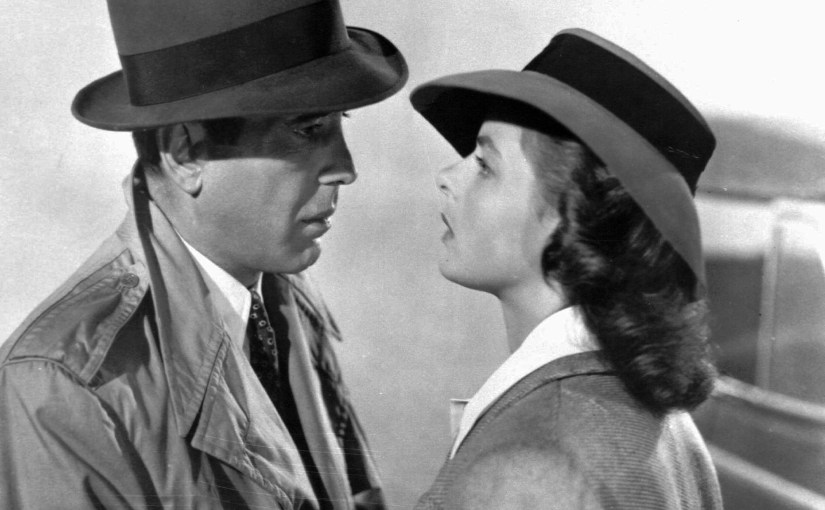
To absorb the classic film about Rick Blaine (Humphrey Bogart), the saloon keeper who keeps to himself, crossing paths with his long-lost love Ilsa Lund (Ingrid Bergman), I allowed myself to envision watching it in a movie house in 1942, when World War II was occurring on another side of the world and people were being forced to relocate or suffer captivity at the hands of the vile Nazi regime.  Casablanca, Morocco was the last hopeful exit to Lisbon, and then on to the Americas.  I had to embrace the setting and the time period in order to relate to the Oscar winning film. 

Rick runs the Café Americain near the airport of Casablanca.  All walks of life come through the doors each night to drink, gamble, smoke, flirt, and sing along with Sam the memorably charming piano player (Dooley Wilson). Most importantly, some patrons hope to score the necessary papers for passage out of this tiny desert port area that has yet to be Nazi occupied.  Rick is the expatriate who runs this gin joint and he has no interest in aiding anyone with an escape, nor with assisting the Nazis in rounding up their usual suspects they believe are enemies of the state.  He could care less about anyone’s cause or politics.  He just wants to run a respectable bar.

However, the past circles back on Rick when Ilsa arrives with a wanted Frenchman named Victor Laszlo, great name, played by Paul Henreid.  Victor has escaped the concentration camps and he is making efforts to reach the states so that he can continue his underground campaign of exposing the treachery and threats of the Nazis.  Rick has already been warned if Victor should make an appearance he must not be permitted to leave Casablanca.  The bar manager would rather not be involved.  Yet, it’s hard for him to resist thinking about his past love, Ilsa. Flashbacks soon reveal their time spent in Paris when they fell madly in love only for her to suddenly abandon him as they were trying to board a train exodus before the Nazis seized the territory.

Casablanca has a very simple plot and that lends to the strength of its finished product.  The love triangle of three good people, Rick, Ilsa and Victor, is where the complexity lies and there is no denying how memorable the main players are in their roles.  However, I can only surmise that the legendary status of the film tainted my open mindedness for an admiration of the piece.  The hype has always been too much for me, I guess.

Reader, I don’t think I am a big fan of Humphrey Bogart.  I’m very sorry.  It could be The Big Sleep or The Maltese Falcon.  Too often, I think he is quite bland in his signature, unforgettable caricature. No matter which film he’s in, Bogart is unique.  There is still no one like him with his chiseled face, dark hair and deep voice.  I’m not sure that’s even a fair description.  It’s hard to find the right adjectives for Bogie.  He was one of a kind.  However, there was little range to the star.  (I know.  I’ve seen The African Queen; great movie.) Rick is so closed off and predominantly on the same plane of emotions whether I am seeing him at the beginning of the film or at the end when he delivers his final speech to Ilsa before the plane departure.  He’s too one note for me. He’s just a boring guy and if I was at a table drinking alongside him, I would have to excuse myself very quickly.  Even to play chess with Rick would be excruciating.

Paul Henried is charming though.  He plays Victor as the adventurer or the daring swashbuckler, aware of his threat to the Nazis, but fearless in whatever he faces.  He just knows he serves a greater purpose to the world.  The loose knit, white suit and hat compliment his relaxed stature.  Even the scar over his right eye seems to tell a story.  In Casablanca, I find myself more concerned with what will happen to Victor Laszlo than anyone else.

Ingrid Berman is strikingly beautiful.  You can just recognize her exuberance through the black and white photography.  She was an actress that the camera loved and her performance is sensational as the woman caught in the middle, who mourned what she thought was the loss of a husband, only to find new love. Then the unexpected interfered with her desire for a promising new future.  Her best scene is when she stands up to Rick, no matter the stakes, to get him to help her rescue her husband Victor.  If it is not pleading, then she will use other means.  Frankly, I had forgotten what she tried next in this scene, which I will not spoil.  So, when the camera cuts back to her following another speech from Rick, my eyes went wide.  Ilsa is not just some pretty dame.  She knows she must be more than that, even more than a one night stand or some gentleman’s true love.

For so many years, I would hop on The Great Movie Ride at Disney/MGM studios and come across the famous final scene.  I heard Rick’s speech so many times, a hundred times more than I have watched Casablanca.  Take a scene like that out of context, and it waters down the power of the celebrated film.  What a difference it makes after you learn why Rick and Ilsa could not stay together following Paris, and why you learn their fates are destined for different paths perhaps.  “Here’s lookin’ at you kid!” has a deeper connotation when watching the film as a whole.  I know I’m pointing out the obvious.  Yet, I embraced Bogart’s improvised line that much more in addition to so many other well-known pieces of dialogue.  Other films have those special moments where you can isolate a scene on a work break and just take it in.  I know snippets of Casablanca are viewed that way, but there’s an emptiness to watching these scenes in that fashion.

In 1942, following the Japanese attack on Pearl Harbor, as Jews and gypsies and every other race or nationality or demographic were being bullied at the hands of an unforgiving Nazi regime, audiences must have regarded Victor, Ilsa and Rick as heroes.  True heroes!  They must have been considered the heroes who don’t amount to a hill of beans in this crazy, mixed-up world, but must therefore sacrifice what they hold so dear and personal.  It makes me wonder if Michael Curtiz’ film would have had the same kind of impact if it was released at later time in the century like the 1960s, long after the war was over and the Axis armies, particularly the Nazis, were wiped out.  In 1942, perhaps I would have had more of an appreciation for Rick and Ilsa if I watched the film then. 

My attention especially perked up during the competitive nature of the French and Moroccan patrons singing the anthem La Marseillaise against the Germans’ rendition of Die Wacht am Rhein.  It’s a scene that demonstrates promise during a very frightening and confusing period in time.  I imagine audiences applauded and cheered during this scene.  On the other hand, maybe they were afraid and apprehensive to do so during such a confusing time.  The fiction found in the Oscar winning script from twin brothers Julius and Phillip Epstein was daring enough to defy the power of Hitler’s fast rising influence.  Modern films from the likes of Spike Lee and Adam McKay attempt to circumvent their stories to present day crises and dare to footnote their films with real life news footage.  It’s admirable at times.  Sometimes their efforts are divisive.  Yet, they do not feel as meaningful as what the Epstein brothers and Curtiz accomplished.  For me, this moment near the conclusion of Casablanca is my favorite scene of the picture.  The slaphappy regulars of Rick’s Café  Americain were enthusiastic to join Sam for a rousing rendition of Knock On Wood, but when reality intrudes upon their escapism, another dimension to the people does not hesitate to stand up for a purpose.

So, it’s always been tough to win me over with Casablanca.  Still, I marvel at the picture for the absorbing settings of Rick’s Café along with the crowded Moroccan streets occupied with refugees and pickpockets under the authority of a party who threatens to stake its claim.  Sam turns the bar into a regular evening atmosphere to bond and escape while the drinkers yearn to be on the next plane to safety and freedom.  Tricks are turned where travel papers are the most sought-after commodity, and ultimately, beyond Rick Blaine, there are people who may strive for safe passage and will also unite against a tyranny if enough will take up their swords, people like Victor Laszlo. This is what I treasure from Casablanca

The cast consists of a colorful bunch including Claude Rains, Sydney Greenstreet, Peter Lorre and Conrad Veidt.  Plus, Rick and Ilsa will always have Paris, but that was always a tough relationship for me to connect with.  What is more meaningful is the harbor that Casablanca and Rick’s Café Americain offered those who were fleeing, hiding and surviving amid their desperations.

This will not be the last time I watch Casablanca.  For a film to have this much staying power after more than eighty years, there must be something else I have yet to uncover, and I cannot wait to find it.

I’ll play it again for old time’s sake. 

LEAVE THE WORLD BEHIND

By Marc S. Sanders

Anxiety and the unknown are the themes of Sam Esmail’s apocalyptic Leave the World Behind.  Actually, I can’t even be sure it’s apocalyptic or not until the end arrives.  Even then I wasn’t so sure.  

A family (Julia Roberts, Ethan Hawke as the parents, Farrah Mackenzie, Charlie Evans as the kids) make an impromptu getaway from New York City and rent a luxurious upstate air B & B for the next five days.  Upon arrival they are quickly relaxed amid all the amenities and beautiful outdoor pool.  A visit to the beach is refreshing until an oil tanker arrives from the deep ocean waters and drifts upon the shore with no warning.  Strange, but okay.  No need for that to ruin the vacation.

Then other unexpected occurrences happen.  A charming gentleman dressed handsomely in a tuxedo and his formally dressed daughter appear on the doorstep of the home in the middle of the night.  They are played very well by Mahershala Ali and Myha’la.  The man claims that he’s the owner of the house and while attending a concert in the city, they needed to make a quick exit and the best place to hold up was at this house.  Conveniently, he does not have any ID to prove his identity along with no specific personal items in this home he claims to own, not even the title ownership papers.  No photos of family tucked away anywhere.  He does have a key to the liquor cabinet, however.

Quickly, the scene is set where the internet goes down.  Federal blue screen warnings appear on every television channel.  Cell phones don’t work.  Deer, lots and lots of deer, appear in the backyard and then disappear.  Pink flamingos wade in the pool.  Elon Musk’s white Tesla cars have a stand out scene.  Roberts then recalls seeing a grizzled Kevin Bacon collecting an abundance of supplies when she made an earlier shopping trip in the local town.  

The paranoia starts to set in beginning with Julia Roberts’ character Amanda.  Amanda declares early on that she fucking hates people.  Hawke’s husband character, Clay, is not ready to hit any panic button and is happy to accommodate the strangers on the doorstep and just wait for the internet to be restored with a logical explanation.  Ali’s character, known as G.H., lends a welcome smile but it’s clear he’s not sharing all that he’s thinking or maybe what he knows.  

Sam Esmail’s film wants to provide a demonstration of how people respond when they don’t know all that’s going on, particularly when modern technology fails us.  A more relatable inconvenience is suggested as Mackenzie’s character Rose is frustrated that her streaming channel shut down just as she was starting to watch the final episode of the sitcom, Friends.  I felt her anguish immediately as my daughter consumes the trials and tribulations of Ross and Rachel on a repetitive cycle.  Ironically, streaming goes down and now the girl can’t watch Friends.  Netflix is the distributor of this film.  Yet, I think they just gave a ringing endorsement for a dying medium.  If only this girl collected the DVDs.  

My problem with Leave the World Behind is the slow pace of it all.  This is one of those movies where its triumphs hinge upon the final five minutes or so.  Either you applaud what sums up the last two and a half hours you invested, or you roll your eyes at where the picture drops you off with the urge to throw your popcorn at the screen.  

Watching Leave the World Behind brought back experiences of shows like Lost or The Walking Dead.  The set ups are brilliantly intriguing from one development to another.  The follow through on each new happening amounts to nothing or at least not anything where I can suspend my disbelief.  Questions are answered with questions.  It’s like calling an insurance company for information following a car accident.  You just want to slam the phone down.

When Ali’s character chooses to check on a neighbor, he sees a watch embedded in the sand nearby.  He picks it up only to get a fright that makes us jump.  The viewer sees nothing else and we are led to believe that Ali sees nothing else, until Esmail goes to a wide overhead shot showing the massive wreckage of a commercial airplane crash, complete with black smoke and flames and endless amounts of luggage and debris.  It’s hard for me to buy a scene like this.  G.H. doesn’t smell any burning fire nearby?  He doesn’t hear anything? He doesn’t see any other debris left mere inches away from the wristwatch only until Esmail’s direction goes from closeup to wide?  I cannot accept the character’s tunnel vision.  My eyes would go towards the crashed plane before I’d ever discover a wristwatch.  It’s just eerily quiet.  The director’s manipulation is a set up shock for me, the viewer, to grab my attention.  Yet, it backfires because it’s completely implausible.  There are many moments like this in the film.

Other than Marhershala Ali (who I still insist should be considered a viable candidate for the next James Bond or a 007 adversary), the rest of the cast is not dynamic enough.  Julia Roberts is working a little too hard.  Ethan Hawke is not working hard enough.  The dialogue is often boring arriving at no conclusions.  Thankfully, most scenes are enhanced by unusual camera angles from Esmail’s artistic freedoms with his lens.  It’s reminiscent of the deliberately weird structure that Stanley Kubrick often did with The Shining.  Nevertheless, it’s exhausting after a while.

Sam Esmail’s work is no doubt shown through long ponderous imagination.  I certainly felt Julia Roberts’ frustration on display, but still, I got the point.  I see no reason to repeat the same lines at higher volume.  I got the point of a lack of trust between the two parties being brought together.  However, I just got tired of the act.  The racial elephant in the room is even suggested.  Though I wish it wasn’t. People quickly forget that George Romero’s Night Of The Living Dead steered clear of any racial factor, and just look at the legacy of that film from the era of the Civil Rights Movement.

The ending that arrives seems inevitable.  Without revealing anything literal, it is doom and gloom.  However, I might have had more appreciation if suddenly the TV and internet got restored and these odd occurrences all just happened to be one big nothing.  At the very least, then I’d understand that this whole freaking planet would just go nuts without their You Tube, Instagram and Netflix.  

You might have had a conversation at one point in the last decade or so that began as “How did we ever manage to survive before the internet?”  The truth is we did just fine.  The adults in Leave the World Behind never stop to remember that though. 

THE MEAN SEASON

By Marc S. Sanders

I get caught up in movies focused on serial killers.  As an actor, I imagine it must be fun to portray a deranged psychopath like Norman Bates or Hannibal Lector, or maybe even John Doe from Seven.  On the other hand, maybe not because an effective screenplay needs to be nearby.

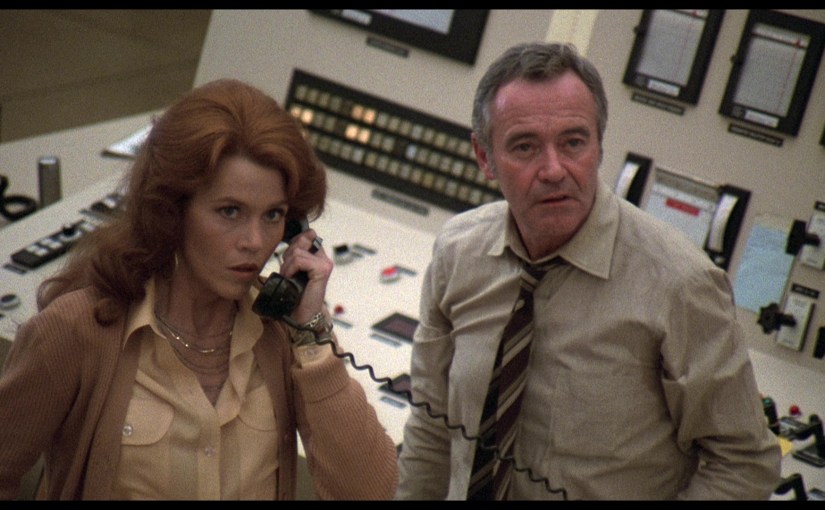
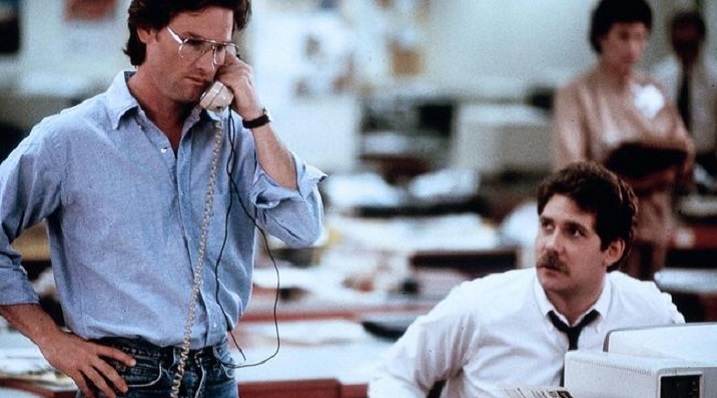
The Mean Season from 1985 has an effective premise but that’s where the positives of the picture stop.  Kurt Russell portrays Malcolm Anderson, a burnt-out reporter for the The Miami Journal.  He is the paper’s most reputable writer but just as he is ready to resign and move to Colorado with his loving girlfriend, Christine (Mariel Hemingway), he’s tasked with writing an article about the murder of a teenage girl on the beach.  Soon after, he’s getting phone calls from the killer himself, played by Richard Jordan whose face is concealed through most of the film by his hand holding a telephone.  The killer insists on only maintaining communication with Malcolm and no one else, especially not the cops.  He relays that the city of Miami can expect four more murders.

The title of the film stems from south Florida’s well known weather variations that occur at the start of hurricane season, primarily in July.  That does nothing for me, but the title alone sounds marketable enough for a thriller.  Almost sounds like a Stephen King novel.  The Mean Season!!!!!  Unfortunately, that’s all that this movie has to rely on, even if Kurt Russell is doing his best like he always does in better suspense movies like Unlawful Entry and Breakdown.

The fault with The Mean Season resides with the director’s amateurish approaches.  Fifteen minutes into the film, with the story hardly in motion, a nude Christine is taking a shower.  The haunting music begins and suddenly the shower curtain is pulled for Malcolm to deliberately startle his girlfriend.  So, we have the Psycho salute.  Check!  Later, following an argument between the two lovers, Malcolm gets in his car and is startled by Christine coming up from behind in the backseat. Ha!!!! Okay and there’s the Halloween nod.  Another check!  I bet these cheap tactics were not even written in the script.  Director Phillip Borsos (never heard of this guy before; doesn’t surprise me) must be so insecure in his skills behind a camera that he just goes for duplicative tripe.

Threats to the couple elevate as the film moves on and when Malcolm gets wind of Christine being in danger, he’s in his Mustang racing to her.  The cops (Andy Garcia, Richard Bradford) are right behind him, and no one thinks of summoning a squad car to where Christine is expected to be?  Of course not.  If they did, then we wouldn’t be treated to a clumsy sequence where an elevated bridge gets in Kurt Russell’s way forcing him to make a leap across the gap and come down on the steep other side and continue his foot race.  Kurt Russell really looks stupid in this moment, and I’m sure he was thinking I can not believe I agreed to this.

As with any of these movies, there is a just when you think the bad guy is dead, there he is again.  No wonder we didn’t get a long enough closeup on the corpse found in the dense Everglades.  However, we get treated to seeing a long, meaningless sequence of Kurt Russell being a passenger on a swamp buggy.  Big deal.  Does this enhance any kind of suspense?  Does it move the story along?  The director got access to a couple of swamp buggies and a day of shooting in the Everglades and said we gotta get this in here.

The final fight is as moronic as the rest of the picture.  Richard Jordan and Kurt Russell are going at it in the living room while a hurricane rages outside.  Mariel Hemingway just sits on the sofa and watches.  She just watches.  She doesn’t reach for a kitchen knife or a vase to smash on the bad guy’s head and help her poor boyfriend.  We just get a sad excuse of a damsel who is not in distress. 

Thankfully, Kurt Russell’s career survived this junk of standard jump scares and shortness on intellect. 

As I’ve said before in other columns, there was a better movie here.  There could have been a movie that explored the endless hours that an investigative reporter must endure.  His editor and photographer (Richard Masur, Joe Pantoliano) could have shared the heightened fear and suspense.  The cops on the case could have applied more pressure and/or assistance to the reporter.  They don’t even tap his phone to trace where the calls are coming from.  In 1985, I think they already had the technology to do that.  A tape recorder was used though, and the audience not only gets to listen to the conversations once as they are happening but then again as the characters listen to the tape.  Why?  Is there something I missed the first time I heard Kurt Russell say hello?  This is filler crap. 

A better movie would have pursued what motivates this killer we hardly get to know.  We should have learned more about this guy because he’s the one making the phone calls.  So, it is obvious he wants to be heard.  However, the guy has nothing to say of any significance.  Even a psychologist who’s recruited for one scene doesn’t make any observation that gives me, or the characters in the film, pause. 

The Mean Season is an “I got it!” film.  It’s where the director gets his big break and declares “I’ve got it!!!!  We’ll do Psycho and then we’ll do Halloween.  Gotta make sure we see Marial Hemingway topless.  That’s definitely at the top of the list. Oh yeah, and then we’ll get swamp buggies and can we get some wind and rain machines for a really, really, really mean—I mean very mean—season!”

THE BIG CLOCK (1948)

by Miguel E. Rodriguez

DIRECTOR: John Farrow
CAST: Ray Milland, Charles Laughton, Maureen O’Sullivan, George Macready, Elsa Lanchester, Harry Morgan
MY RATING: 10/10
ROTTEN TOMATOMETER: 100%

PLOT: A harried magazine editor finds himself in the unique position of trying to track down the person who murdered his boss’s mistress…when all the clues lead back to him.


I have been a fan of 1987’s No Way Out since first seeing it on cable umpteen years ago.  The marvelous twists and turns in the script – yes, including that improbable ending – kept me guessing from the moment of the murder to the final pull-away shot.  Having seen it multiple times, I always noted the fact that it was based on a book with an odd title: The Big Clock.  Since No Way Out takes place mostly at the Pentagon, I always wondered what the story has to do with a clock, but I wasn’t motivated enough to track down the book, so I just let it go.

Imagine my surprise when years later, I discovered that No Way Out is not just based on a BOOK called The Big Clock, it’s also a reboot of an earlier film-noir from 1948, also called The Big Clock.  For years I had never been able to track down an affordable copy of the movie until recently.  I just finished watching it a couple of days ago, and wow.  It has all the snappy pacing of a Howard Hawks screwball comedy, the witty dialogue of a Thin Man film, and the coiling suspense of Hitchcock at the height of his powers.  The Big Clock is a forgotten film that deserves to be rediscovered by the public.

The story opens in typical noir fashion with our hero, George Stroud (the dour-but-likable Ray Milland) avoiding security guards before hiding inside a giant mechanical clock located in the lobby of the office building where he works.  His voice-over narration wonders how he got into this mess and tries to figure out where it all began…and we’re on our way.  So far, pretty stereotypical, not very promising.  But once the prologue ends, the surprises start rolling in.

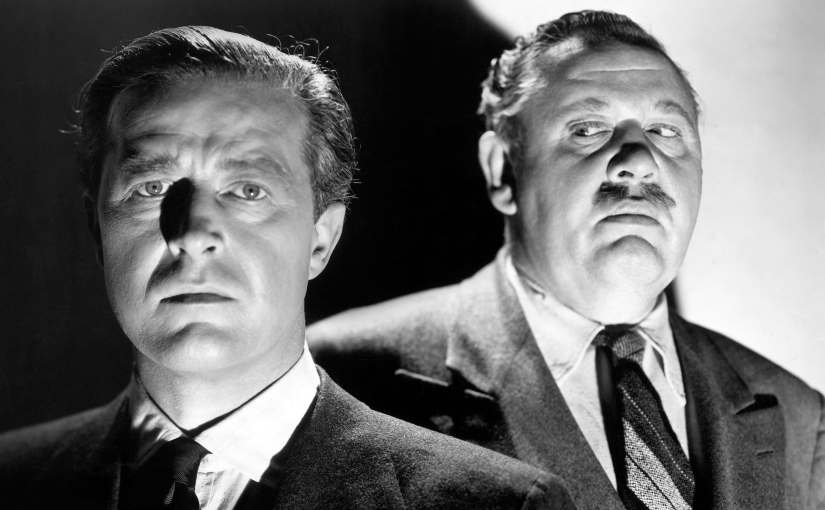
George’s boss is Earl Janoth (Charles Laughton), a clock-watching, penny-pinching tyrant who doesn’t hesitate to fire an employee who leaves a light on in a broom closet, for example.  George is the editor of a magazine called Crimeways, one of many magazines in Janoth’s publishing empire.  Crimeways specializes in investigative reporting like tracking down murder suspects, allegedly to assist law enforcement, but mostly so they can publish attention-grabbing headlines about captured criminals to boost circulation.

Through a series of events too circuitous to list here, George winds up missing a very important train (he was supposed to finally give his wife a long-delayed honeymoon) and spends a drunken night carousing with Pauline York (Rita Johnson), a blonde bombshell who also happens to be Janoth’s mistress.  He winds up passing out on her couch at her apartment (having NOT slept with her, mind you), but is forced to skedaddle when Janoth unexpectedly shows up.  Janoth catches a glimpse of George in the hallway but cannot see his face.  When Janoth confronts Pauline, things get heated, and Pauline winds up dead.  Instead of going to the police, Janoth confides in his second-in-command, Steve Hagen (George Macready, whom you may or may not remember as the slimy general in Paths of Glory [1957] who charges three men with treason for not following a suicidal order).  Hagen returns to the scene of the crime, “amends” the crime scene, and comes up with a brilliant plan: use the magazine’s considerable resources to track down the mystery man Janoth saw outside Pauline’s apartment.

And who better to lead the investigation than George himself, whose investigative skills are second to none?

There is a delightful thrill of suspense when George receives his assignment and realizes that he cannot reveal the truth of his whereabouts without implicating himself, but he is compelled to lead the investigation as thoroughly as possible.  There is an amusing but highly-charged moment when an investigator reaches a witness on the phone and starts dictating the suspect’s vital features…and they match George almost to a T.

The beauty of the film is the head-fake.  We are shown the details of the drunken night George spend with the dead woman, but we are never tipped off that what we’re watching will eventually come back to haunt him.  Green mint martinis.  The hunt for a green clock.  A sundial.  An antique painting.  An eccentric painter.  A radio actor.  All disparate elements that are almost thrown away while they’re happening, but all of which come back to neatly bite George in the ass at just the wrong moments.

I cannot stress enough how ingeniously the screenplay is constructed.  One of the greatest joys of watching The Big Clock is admiring how airtight it is, how George is forced to fly by the seat of his pants from one moment to the next, putting on a show of doing his job while simultaneously trying to find a way to sabotage the investigation without showing his hand in any way.  I won’t give away how he manages this high-wire act, but it’s brilliant screenwriting.

Eventually, the building gets locked down with George still inside and two or more witnesses who can identify him prowling the hallways, including one who is drawing a sketch of his face.  At this point, even though I’ve seen No Way Out many times, I was 100% sucked into the story: “How can this guy possibly get out of this?”  The answers will be just as unexpected to you as they were to me.

(I should mention a small role played by an impossibly young Harry Morgan.  It’s one of the most sinister performances by a mute character that I’ve ever seen.  One shot in particular feels out of time, like it was shot in a movie from the ‘60s or ‘70s.  Creepy stuff.)

The Big Clock deserves a place among the great noirs like The Maltese Falcon, Out of the Past, and The Big Sleep.  It’s filled with great performances, the visuals are suitably moody and shadowy when necessary, and the plotting is impeccable.  What more can you ask from a great film noir?

KALIFORNIA (1993)

by Miguel E. Rodriguez

DIRECTOR: Dominic Sena
CAST: Brad Pitt, Juliette Lewis, David Duchovny, Michelle Forbes
MY RATING: 9/10
ROTTEN TOMATOMETER: 58%

PLOT: A journalist duo go on a tour of serial killer murder sites with two companions, unaware that one of them is a serial killer himself.


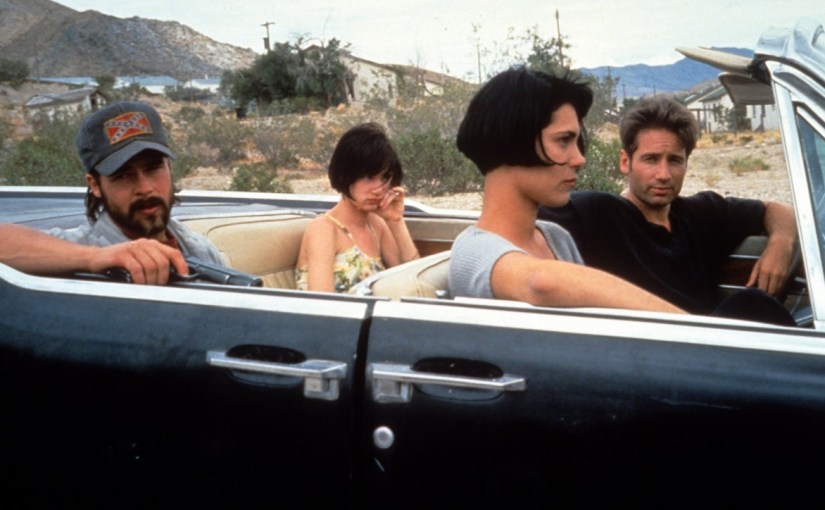
Ask any movie fan for names of actors who played memorable serial killers in film, and you’ll get a lot of obvious ones (Anthony Hopkins, Charlize Theron, Anthony Perkins) and you might get a few not-so-obvious ones (Michael Rooker, Andrew Robinson, Peter Lorre).  But I’m willing to bet no more than one person in 20 will name Brad Pitt, whose performance as the skeevy Early Grayce dominates Kalifornia, the 1993 directorial debut film of music video director Dominic Sena (Gone in 60 Seconds, Swordfish).  Pitt is so convincing and deliberately off-putting that I came close to switching the movie off and returning it to the thrift store where I found it.  Why would I want to keep watching a film where I’m repulsed by one of the main characters nearly every second he’s on screen?

Kalifornia may be predictable to some, but I was blown away by the story development.  Brian (David Duchovny) and his longtime girlfriend, Carrie (Michelle Forbes) are embarking on a cross-country road trip from Pittsburgh to California.  He’s an author writing a book on serial killers.  During their trip, he will visit infamous murder sites to gather material, and Carrie, a professional photographer, will take pictures for the book.

(The first time we see Brian, he’s mixing drinks at a party and holding forth about how the government should rehabilitate killers instead of executing them.  They are products of their environment, their upbringing, they’re not ultimately responsible for their own actions because they simply don’t know any better, and so on.  Over the course of the movie, his beliefs will be put to the test.)

Brian is short on cash until he finishes his book, so he places an ad on a university message board looking for people willing to split gas and food costs on a cross-country road trip to California.   One of the most incisive moments in the movie comes when Brian and Carrie drive to a meet-up point and spot their new travel companions: Early and his girlfriend, Adele (Juliette Lewis), a young woman whose mental development seems to have been arrested at about a 13-year-old level.  Carrie whispers to Brian, “Look at them, they look like Okies.”  Meanwhile, Adele whispers to Early, “Oh, Jesus, Early, they look kinda weird.”  The movie seems to be setting us up for an awkward odd-couple road-trip movie where, uh oh, one of them is a serial killer!  But you ain’t seen nothing yet.

During their road-trip, and in between visits to famous murder sites, Early and Brian start to bond a little, much to Carrie’s dismay.  Brian has a theory about why the Black Dahlia killer was never found, but Early has another: that he’s alive and well in a trailer park somewhere, “thinkin’ about what he’s done, goin’ over it and over it in his head, every night, thinkin’ how smart he is for gettin’ away with it.”  Ohhh-kay…

One night when Brian and Early are at a bar, Carrie and Adele get to talking, and Adele reveals that she doesn’t smoke because “he broke me of that.”  Carrie asks her if Early hits her, and her reply is as heartbreaking as it is terrifying: “Oh, only when I deserve it.”

This and several other red flags get to be too much for Carrie, and she gives Brian an ultimatum: “Either they get out at the next gas station or I do, your choice.”  What happens at that next gas station I would not dream of revealing, but it ignites the slow burn of the previous hour and turns Kalifornia into a tense, bloody thriller that rivals anything by David Fincher.

I’ve given so many establishing plot details above (I left some juicy bits out, trust me) because I’m trying to convey how this film, which starts out like a slightly amped-up basic-cable movie-of-the-week, shifts into another gear in the second hour.  Unsuspecting viewers like me, who have only heard of the movie but never even seen the trailer, will watch the first hour wondering where the good movie is.  But have patience, it’s coming.  The payoff is worth the wait.

[Author’s note: by the way, don’t watch the trailer for this movie.  It gives away WAY too many plot points that I haven’t mentioned, both before and after the gas station incident mentioned above.  Just the worst.]

Visually, I didn’t see a lot of the music-video camera pyrotechnics that director Sena would later employ in Gone in 60 Seconds, etcetera.  The movie is content to let the dread sort of speak for itself.  The various murder sites they all visit seem even creepier and uglier than they need to be.  Slick editing brings little details into focus that heightens the tension.

Ah, I can’t think of any way to explain how great this movie is without giving away more plot details, and this movie is best seen in a vacuum, knowing as little as possible.  So trust me.  If you’re a fan at all of serial killer movies or documentaries, this movie will not only entertain, it will give you a lot to chew over.  Kalifornia belongs in the serial killer movie pantheon with The Silence of the Lambs, Psycho, and Henry: Portrait of a Serial Killer.  Especially that last one.

DON’T LOOK NOW (United Kingdom, 1973)

by Miguel E. Rodriguez

DIRECTOR: Nicolas Roeg
CAST: Julie Christie, Donald Sutherland, Hilary Mason, Clelia Matania
MY RATING: 8/10
ROTTEN TOMATOMETER: 94% Certified Fresh

PLOT: In Venice, a married couple grieving the recent death of their young daughter encounter two elderly sisters, one of whom is psychic and brings a warning from beyond.


I’ve only seen two films from director Nicolas Roeg.  The first was Walkabout, which I’ve now seen three times in an effort to “get” it.  While I admire Walkabout’s visual strategy, that film has always left me cold and frustrated, and I do not imagine that will ever change.

However, Don’t Look Now, Roeg’s adaptation of a Daphne Du Maurier short story, is about as expertly made as any supernatural thriller could be.  While the story may feel a little thin when all is said and done, this is yet another case of a movie not being what it’s about, but how it’s about it.  The entire film utilizes an editing and cinematographic strategy to convey an aura of dreamy dread and paranoia.  Of course, the performances from the two leads, Julie Christie and Donald Sutherland, are exceptional, but the direction, editing, and cinematography are really what make Don’t Look Now so disturbing and compelling.

Christie and Sutherland play married couple Laura and John Baxter who are grieving the death of their daughter, Christine, who drowned in the pond behind their cottage.  The scene of her death which opens the film showcases the visual and editing strategy that will come into play so heavily later in the film.

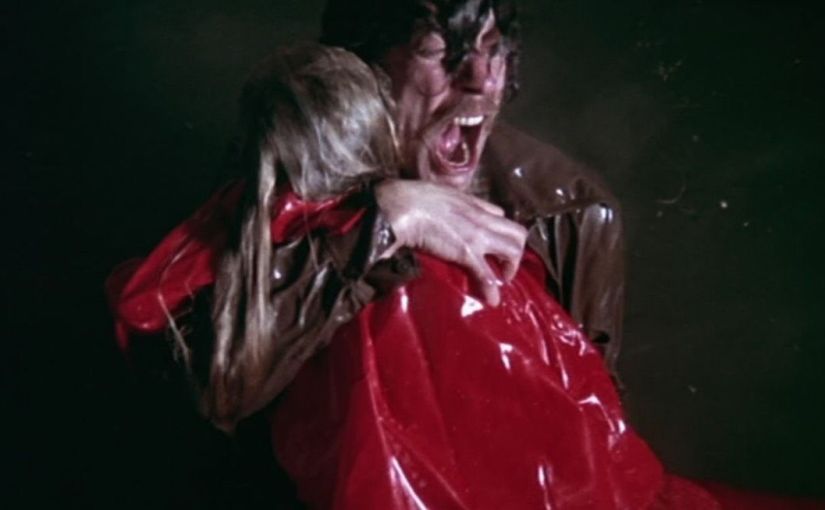
They relocate to Venice, leaving their other child, a son, behind in England in a boarding school.  In Venice, John works on restoring an old church while Laura…well, it’s not clear what Laura does to pass the time in Venice.  One day she bumps into two old women in a café restroom, one of whom is a blind psychic.  The psychic abruptly tells Laura that she’s seen Christine, happy and laughing, and wearing the red raincoat in which she drowned, information the psychic could not possibly have known beforehand.

Later, as John wanders the Venetian streets at night, he gets a brief glimpse of a small figure darting among the buildings ahead…wearing a red raincoat.  When Laura visits the psychic again, the psychic warns Laura that she and her husband are in danger and must leave Venice as soon as possible.  Meanwhile, a body is discovered in the canal near their hotel…

Because the film’s effectiveness relies so heavily on its visual style and editing, I’m finding it difficult how to convey how strongly I recommend searching this movie out, while simultaneously acknowledging the story itself is not as “meaty” as, say, a thriller from David Fincher or Alfred Hitchcock.  I was actually reminded more of the films of Brian De Palma and David Lynch, two directors whose visual and storytelling styles were clearly influenced in one way or another by Don’t Look Now, which was itself clearly influenced by the early films of Dario Argento (The Bird with the Crystal Plumage, Suspiria), though without quite so much bloodshed.

Making a movie like this is tricky.  Use too much cross-cutting and non-sequitur edits, and you risk simply confusing the audience.  One plot point involves John putting Laura on a plane back to England, but hours later he clearly sees her on a funereal gondola in Venice.  Convinced the two elderly women are somehow behind it, he tracks down their apartment, only to find it abandoned.  Quick cut to the sisters in another hotel somewhere…laughing.  Are they involved in some kind of sinister plot?  Or is he having a breakdown?  Is this the director just yanking the audience’s chain simply because he can?  One could make the argument, but the process and style of the storytelling kept me intrigued rather than confused.

All sorts of small details become ominous.  A single glove abandoned on a windowsill.  A child’s plastic baby doll left on the steps leading down to a canal.  Old family portraits on a table.  The lingering glance of a stranger in a police station or a café.  In one scene, John visits the police, convinced the two sisters have kidnapped his wife.  IMDb trivia reveals that the Italian actor playing the captain had no knowledge whatsoever of the English language, so he simply read the lines phonetically without understanding what any of it meant.  As a result, his dialogue with John sounds oddly stilted and detached, almost menacing.  Is he part of some kind of conspiracy?  During their conversation, he actually sees the two sisters walking outside his window but fails to mention this fact to John.  Is he in on the conspiracy?  Or does he simply not recognize the two women?

After a few more plot developments and a couple more sightings of the small figure in the red raincoat in the distance and the discovery of yet another murder victim, everything finally gets wrapped up in a way that I found satisfying even though it didn’t exactly bring the kind of closure I was hoping for.  However, it does bring all the story threads together, including the possibility that John himself might be psychic without realizing it.  Don’t Look Now doesn’t pack quite the punch of Psycho or Mulholland Drive, but it is exquisitely well-made, well-acted, and well-directed.  Watch closely, and you can see how many other filmmakers have been influenced by this movie decades later.

THE CONVERSATION

By Marc S. Sanders

To watch Francis Ford Coppola’s The Conversation from 1974 is to feel the paranoia of what Harry Caul, the protagonist played by Gene Hackman, endlessly feels as a surveillance expert. Harry is so skillful at his job and yet so modest, that he only believes someone may actually be better. Even he doesn’t believe he’s that good. Still, his own expertise can drive him to insanity.

Coppola opens the picture on a wide lens that gradually zooms in, looking down on a sunny afternoon in a crowded park. There are musicians and mimes. Bums that sleep on a park bench and food vendors, and then there is a couple (Cindy Williams, Frederic Forrest) who we are drawn to to get some sound bites of their random conversation. Their voices are muffled at times. Feedback and background noise interferes as well. Harry is spotted trying to keep within a perimeter to allow his hardware to function and get every tidbit of the conversation.

Following this sequence, Harry is back at his fenced in warehouse operation that he shares with a loudmouth partner named Stan (John Cazale) attempting to clean up the recording for his client, only known as The Director. It’s a skill that only Harry has the means to do. Hackman plays the part as a quiet and reserved man, unlike his competitors who proudly boast of their next, great invention to eavesdrop and capture the actions and discussions of any subject. With an awareness of what he’s capable of, I’d argue he trusts no one, even when he’s being praised. Does he even trust Stan, who he works with?

To be good at this kind of work requires the ability to separate yourself from the content of what you’re listening to. Just get an audible recording and move on. The content should be for someone else to stew over. For Harry, this becomes a challenge. He uncovers a hint in the couple’s exchange that suggests perhaps their lives are in danger. When he goes to drop off the recordings and collect his fee, he is not met by The Director. Instead, he comes across a lackey (Harrison Ford) who insists that he was instructed by the client to make the exchange. His paranoia sets in, when the lackey keeps on appearing at random, unexpected moments with Harry. None of it feels right for Harry. So he violates what should be his own rules and investigates further. The risk is whether his own capabilities will undo his sense of humanity and decency, including his connection with God.

Coppola, who also wrote the script for his film, puts Harry to the test in nearly every scene. He writes Harry to be the best at what he does, and yet that doesn’t prevent failure from occurring. He even fails to recognize when he’s being victimized and listened to. A midway point features a party among the men who specialize in surveillance. Harry quietly flirts with a girl only to feel embarrassed when his East Coast competitor reveals that he recorded their conversation from across the room. Seems like a harmless prank, as sophomoric as playground or locker room teasing, but it’s enough to maybe drive Harry into madness.

Harry Caul is one of Gene Hackman’s best roles. It stands apart from other films he’s been in. Harry is very much a three dimensional character who values his religious connection and his sense of morality. The problem is that Harry is a specialist in something that’s really not very moral or ethical. His Catholic beliefs might suggest what he does is sinful. Sure, he goes to confession, but he still pursues actions that are deemed inappropriate in the eyes of God.

Francis Ford Coppola depicts a very telling moment as Harry tries to find a listening device in his apartment. He takes apart everything in the place by either breaking it or unscrewing it. What do you think he’ll do when he comes upon his figurine of the Virgin Mary? Is there anything left to trust? Anything of value or purity in Harry’s world? He doesn’t trust others. He doesn’t trust himself? Does he trust a higher power that he’s leaned on his entire life?

Because The Conversation does not delve too much into the now dated-very dated– technology from the early 1970s, it is a film that is especially relevant in today’s age of cell phone recordings and devices that are relied upon for everyday use. While Harry is possibly thinking he’s on a noble pursuit with his means to eavesdrop, either by servicing a client or even rescuing someone from what appears to be imminent danger, is this the right way to go about it? What will it cost Harry? As well, what does it cost our society to embark on the convenience of what we are now capable of? Does the ability to record someone’s actions contain absolute merit, or are we violating a civil mentality within ourselves and among our fellow human beings?

There’s a lot of hard questions to answer in The Conversation. I think that’s why especially now it’s an important picture to see.

HALLOWEEN (1978)

By Marc S. Sanders

Finally, I saw it.  I had never seen any of the Halloween movies.  At last, considering the time of the year, I chose to watch the original John Carpenter classic slash fest from 1978.  Granted, I believe I have seen every scene of this picture by flipping channels or watching Netflix documentaries.  I have just never stopped to watch the film from beginning to end.  So, if the surprises didn’t grab me as much you, when you first watched, well my apologies for having an advantage.  Let’s just say I can see why the picture is still regaled so much, nearly fifty years later.  Nevertheless, I think Halloween is full of plot holes and short sightedness.

Understand reader, I know what to likely expect when I watch a slasher flick.  Man in a mask who walks at even pace while the girl victim sprints as far away as possible.  Still, the girl can’t get away, right?  Well, normally she would be able to.  This is a horror movie, though.  The suspense is heightened in any film if the storyteller elongates what you fear as much as possible.  So, yeah, it is much more effective to show the ominous killer as far away as possible while the camera cuts away to a helpless Jamie Lee Curtis fumbling with the lock on the door.  Even more effective is if you have a pulse pounding soundtrack to get you fidgeting in your chair while you bite down on your last fingernail.

I think Carpenter’s film stands as the granddaddy of the modern-day slasher film (though not besting Hitchcock’s Psycho) because of the methods he adopts with his camera work and editing.  The opening sequence is skillfully executed as we watch one Halloween night unfold in 1963 where a six-year-old Michael Myers, dressed in a clown costume, takes a kitchen knife to his naked older sister in her room upstairs.  Carpenter gives us the literal point of view from the killer kid.  We watch through his eyes from the outside of the Myers’ home, then as he enters, he picks up a kitchen knife, dons a mask and heads upstairs.  Now we are looking through eye slips in the mask. Then he moves down the stairs and out on to the sidewalk.  Carpenter then reveals we’ve been watching through the eyes of a child with murder on his mind while he holds a bloody knife by his side.  For me, one of the scariest things I can think of is a murderous child.  Children are made up of innocence, devoid of corruption.  When you poison the mind of a child, it seems like the most heinous act a writer can take with a character.  Look at The Exorcist and The Omen, as perfect examples in addition to Halloween.

Fifteen years go by to present day 1978, and Michael has escaped from a mental institution on the night before Halloween.  This is where I lose my suspension of disbelief.  He terrorizes his psychiatrist, Dr. Sam Loomis (Donald Pleasence) and a nurse driving in middle of a dark and stormy night and steals their station wagon.  Michael is now driving back to Haddonfield, Illinois where he committed his first crime.  You know I would have dismissed this trope of Michael being able to drive had I never seen the car again.  However, Carpenter uses the car as a character itself, much like the rampaging truck in Duel.  For the first half of Halloween, this car drives up and down the Haddonfield neighborhood stalking three high school girls as they walk to and from school.  Where did Michael, who has been institutionalized since age 6, learn to drive a car?????  The movie even asks the question at one point and I don’t recall getting a satisfactory answer.  Every time I see this car, slowly keeping up with the girls walking the sidewalks or riding in their own car, I can’t help but ask how Michael so skillfully pilots this station wagon.  I’m teaching my 15-year-old daughter how to drive right now.  Maybe Michael should give me some pointers, because it isn’t going so smoothly.

The structure of the film centers on three teen girlfriends, two of which are babysitting on Halloween night across the street from one another (Jamie Lee Curtis, Nancy Kyes).  The third (PJ Soles) is out and about with her boyfriend, ready to get laid.  What’s appreciative of Carpenter’s craft is that the film is not occupied with buckets of blood spilling all over the place.  Instead, the audience is repeatedly teased in a dark neighborhood, where trick or treaters appear on occasion, and these girls are being looked at from different angles.  We all know Michael is there.  His heavy breathing under his mask tells us that he is hungry for death.  What messes with our senses is figuring out when he’s finally going to strike.  Will it be when one of the girls finds herself clumsily stuck in a window?  What about when a couple is having sex upstairs?  A quick trip to the kitchen, maybe?  New tricks are pulled with each attack and Carpenter wisely stretches these episodes of terror out. 

Michael Myers never speaks.  Other than at age 6, he is masked the entire length of the film.  We really never get a sense of his physicality either.  We don’t know why he has the urge to kill.  The best we can count on is Dr. Loomis.  Donald Pleasence does a good job of heightening the terror.  He is not forgiving with his patient as he simply describes him as the worst kind of evil imaginable.  He describes the black eyes that Michael has, and I couldn’t help but think of Captain Quint describing his experience with a man-eating shark in Jaws.  The worst kinds of monsters are the ones you can’t beg and plead with; the ones who have no comprehension of compromise.  If you are caught in their sight, you will be killed.  That’s it. 

Now, I’ve already discussed the deal with the car?  I’ll never get past that.  Never.  It’s ridiculous.  There’s also the fact that the parents/homeowners these girls are babysitting for seemingly never come home.  This is one long night.  Where the hell are mom and dad, already?  I have to give up my grudge with these oversights.  It’s not fair to the strengths of Halloween

A magnificent third act involves Curtis’ character taking it upon herself to seek out what she fears may have occurred.  She goes across the street to the dark house where her friends are supposed to be.  Carpenter takes his time with his protagonist walking deeper and deeper into darkness, calling out her friends’ names.  I’ve seen things like this before, but it works all the better, the longer the sequence plays out, sometimes in silence and sometimes with music cues from Carpenter’s synthesized soundtrack.  What she finally uncovers is more terrifying than the killer we know has always been there. 

When the chase picks up from that point, a horrifying moment with Curtis taking refuge in a closet is likely the scariest moment of the film.  Carpenter focuses on the interior of the closet with the fragile wooden folding doors violently rattling and getting torn apart by the killer.  When he’s able to reach inside fumbling with the light bulb, darkness is disturbed by intermittent light to toy with your senses.  It shakes up your nerves.  How does a helpless victim escape a narrow closet with a faceless killer standing in the way?  An absolutely unsettling scene.

Michael Myers is referred to as the “boogeyman” in the film.  We all have our cognition of what a boogeyman is.  He hides under our bed or in our closet or maybe behind a bush or shrub.  Carpenter’s film works like Spielberg’s Jaws where the environment is what is really terrifying.  The ocean water is the first unsettling element before we encounter the monster that occupies it.  In Halloween, a dark neighborhood with a haunted past keeps us at bay before it comes alive with a killer in its shadows.  We know there’s a shark somewhere.  We know there’s an evil, murderous presence somewhere too.  When is it going to come out, and attack us already??????  This is where Halloween succeeds.  Imitations that were made afterwards only set up the moments, one kill after another.  Carpenter wasn’t setting up kills so much as he was preparing mood and darkness.  There’s nothing to gain symbolically from Halloween.  It’s three girls, with one having a sneaking feeling that something doesn’t feel right, a killer, and a man who dreadfully knows what’s to expect.  John Carpenter assembles the elements together and we see what’s to come of it from there. 

I’ll likely not return to Halloween anytime soon.  Slasher fests are not my style.  Yet, if anyone asks for the best of the best, I’m going to highly endorse Psycho first, and then I will turn their attention to the original Halloween.  There have been gorier releases since.  There have more jump scares since.  All of that is nothing but cheap tactics lacking imagination. 

Halloween chills you with its menacing approach.

BREAKDOWN

By Marc S. Sanders

The southwest region of the United States can be brutal.  The desert landscape is scorchingly hot and the end of the world seems like an eternity away…no matter how fast you drive or how far you go.  Worse yet could be the truckers and locals who could care less about who you are, where you came from or where you’re going.  So, you better be sure your well equipped Jeep Cherokee has enough gas in the tank and your oil dipstick comes up black.  For Jeff and Amy Taylor, though, nothing they do will matter.  Their car is destined to break down anyway.

Jonathan Mostow wrote and directed a taut thriller called Breakdown that builds on a Hitchcockian formula for a road picture.  When Jeff and Amy’s (Kurt Russell, Kathleen Quinlan) car breaks down on a long, lonesome highway in the middle of the desert, a friendly trucker stops by (JT Walsh) to lend a hand.  He offers to take them to the next stop where they can call a tow truck.  Jeff agrees to stay with the car.  Amy hitches a ride to call for the tow.  Shortly after, Jeff realizes that Amy has mysteriously disappeared.  When Jeff catches up with the trucker, the situation gets even stranger because this guy claims to have never met Jeff before or even know who his wife is.  It gets even weirder and more frightening from there.

Kurt Russell is very good in a relatively simple, but effective story that only needs its ninety minutes to get your heart racing.  As Jeff learns of the conspiracy playing against him, the panic builds in Russell’s performance.  A really effective moment occurs when Jeff is forced to go to a local bank and withdraw ransom money.  While the banker is executing the money transaction, Jeff enters the restroom.  In this short moment, Mostow keeps a good close up on a very sweaty, beaten and nervous Kurt Russell.  Jeff is looking for something to use as a weapon.  Now, we’ve seen this many times before.  What kept me absorbed in the suspense of the film is how Kurt Russell evokes his thought process without having anyone to talk to.  In this bathroom, he involuntarily walks in circles, seemingly asking himself “what am I going to do?”.  Mostow never breaks the shot, allowing his lead’s performance to send home the paranoia.  I was right there with this poor guy.  What is Jeff going to do?

JT Walsh was an under the radar character actor; one of those guys that you recognize from dozens of films (Good Morning, Vietnam, A Few Good Men), but you just never knew his name.  He passed away too soon.  I’d wager eventually he’d get some kind of awards recognition.  This is a magnificent villain in Breakdown.  A good antagonist is one you can trust at first.  So that when the veil is lifted, your jaw drops a little.  Walsh accomplishes that here.  He turns on the good guy and he betrays the viewer.  He really plays a guy with two masks on.  Friendly and helpful at first.  Later, a toothless scowl is across his face as he terrorizes Jeff.  The big rig truck that Walsh drives becomes reminiscent of what Steven Spielberg accomplished with his first film, Duel.

While a Jeff Taylor character may have appeared in an Alfred Hitchcock film, as the common man caught up in an outrageous plot he was never looking for, Jonathan Mostow has modernized the method with well edited action scenes.  This is a road picture but there really are not car chases to behold.  Instead, there are moments where like any of us, we will increase our speed on long stretches of road.  When we take our eyes off the highway for a split second, we never expect what will pop out and startle us.  As well, when we try to pass ahead by cutting into the opposite lane, a head on collision may come our way.  The film goes for those pressure points first before another overly used car chase.  This is where the environment fights back against the protagonist.  

The location shoots of Breakdown are superb.  An old diner, in the middle of nowhere, has some locals who could care less about a polite out of towner, clearly concerned about his missing wife.  They just look straight ahead while nursing their beers.  The bartender has also had enough of this guy to the point of threatening him with a gun to get out of the joint.  A passing by police officer (Rex Linn of Better Call Saul, another great character actor) devotes no more than five minutes of his time to poor Jeff’s concern, and then he moves on.  The desert and the people who occupy the area serve only apathy to a helpless stranger.  The setting of Breakdown is a villain all its own.

This thriller works simply because a scenario like this could happen to any of us.  It was released in 1997, just ahead of the cell phone age, and there’s acknowledgement of that time.  Jump to today and this situation could still happen.  Technology is not always going to help us, no matter how many bells and whistles we have on a car or how many bars show on our handheld devices.  In the desert, any one of us can be a victim unto ourselves.  In the middle of nowhere, a bad guy can use an opportunity to his advantage at the expense of any persons leaving themselves unguarded.

Breakdown shows that our worst nightmare could be to drive into an endless daylight void, where any one of us can get stuck, only to later get caught.  It’s scary as a desert hell, and it’s a fantastic nail biter right until its bang-up conclusion.