CLOUD ATLAS (2012)

by Miguel E. Rodriguez

Directors: Lana Wachowski, Lilly Wachowski, Tom Tykwer
Cast: Tom Hanks, Halle Berry, Jim Broadbent, Hugo Weaving, Jim Sturgess, Doona Bae, Ben Whishaw, Keith David, Susan Sarandon, Hugh Grant
My Rating: 10/10
Rotten Tomatometer: 66%

PLOT: An exploration of how individual lives impact one another in the past, present, and future, as one soul is shaped from a killer into a hero, and an act of kindness ripples across centuries to inspire a revolution.


Okay, faithful readers, I hope you’re comfortable.

Cloud Atlas is one of those movies like Baraka that leaves me with the urgent need to tell people how amazing it is.  It’s visually spectacular, thought-provoking, and hopelessly optimistic about love and the good side of human nature, even in the face of the worst humanity has to offer.

Based on a critically acclaimed novel by David Mitchell, the movie tells six separate stories, linked by the fact that a core group of actors plays all the principal roles in each story, and by the fact that at least one actor in each story carries a curious birthmark shaped a bit like a comet or a shooting star.  Each story is separated from the others by decades or centuries, taking place in the years 1849, 1936, 1973, 2012, 2144, and an apparently post-apocalyptic 2321.

I cannot imagine the lengths to which the filmmakers, and the film editor in particular, went to make this movie work.  The film jumps freely from one story to another, forward, back, forward, and back again, somehow maintaining a clean flow and keeping each storyline absolutely clear.  Although the stories are unique, the editing keeps the idea of connection alive for nearly three hours.  Just based on the editing alone, that makes Cloud Atlas kind of exhilarating to watch, especially when things heat up in the 2144 segment.

Let me see if I can quickly summarize each story, without giving too much away:

  • 1849 – An American lawyer visits property holdings overseas and witnesses the brutal whipping of a slave, who stows away on the lawyer’s ship returning to San Francisco; meanwhile, an unscrupulous doctor has plans to steal the lawyer’s gold en route.
  • 1936 – A struggling composer, Robert Frobisher, is hired as an amanuensis (a fancy word for a music stenographer) to another aging composer, which allows Frobisher to compose his own masterpiece, The Cloud Atlas Sextet. The aging composer demands credit for the piece and threatens to expose Frobisher’s bisexuality, including his deep, unconditional love for a gentleman named Rufus Sixsmith.
  • 1973 – An investigative reporter stumbles onto a conspiracy at a nuclear power plant, thanks to a whistle-blowing report written by none other than Rufus Sixsmith, now in his sixties.
  • 2012 – An author on the run from hooligan creditors takes refuge in what he thinks is a hotel, but is in fact a nursing home, to which he has inadvertently committed himself.  He and three other residents plan a daring jailbreak.
  • 2144 – Set in a vastly futuristic New Seoul, a renegade “fabricant” is brought in for questioning by the ruling government known as Unanimity.  The fabricant, known only as Sonmi-451, spins a tale of oppression, liberation, and horrific realization as she becomes the voice of a revolution that will ripple across centuries.
  • 2321 – In a post-apocalyptic Hawaii, peaceful Valleysmen live in constant fear of attacks from vicious cannibals, the Kona tribe.  They also receive periodic visits from Prescients, a highly advanced society that apparently lives offshore.  One day, a Prescient, Meronym, asks a Valleysmen leader to guide her to a remote mountain peak where she hopes to send an SOS signal to off-world colonies.

Confused yet?  Don’t be.  The editing keeps everything crystal clear.

But that’s just the clinical description of the movie.  What catapults Cloud Atlas into the stratosphere is how the fancy editing and visual effects occasionally take a back seat to a really deep philosophical question that leaves me with a sense of awe.  It’s really a what-if question, one of the greatest what-if questions of human existence.

What if…death isn’t the end?

I know that countless other movies have asked this question. We all have our own answers and beliefs.  I am not suggesting that Cloud Atlas has somehow figured out THE answer to this question, or that the answer it provides somehow trumps your own beliefs. But of all the movies I’ve seen on this topic, Cloud Atlas is the only one that really, genuinely, truly left me in awe of the possibilities it proposes.

I mentioned earlier that key roles are played by the same actors over and over again in each of the stories.  While that was initially distracting, I realized that the filmmakers were actually making a genius move.  It was nothing more than a simple way of illustrating the concept that a life in one era is echoed in another, decades or centuries later.  Heavy makeup is used to indicate how one person’s life as an Asian woman could, in theory, be echoed in the life of a Mexican woman in another era.  Or perhaps the life of a British man might be echoed later as a British woman.

And then there’s the question of that recurring birthmark.  One key character from each storyline bears a birthmark that resembles a shooting star.  So many people (including me the first time around) wanted to attach some kind of conventional story-based meaning to that birthmark.  Did it mean these characters were all somehow blood-related?  Was it a prophecy of some kind?  Something mentioned in the book, perhaps, that had to be left out of the film for pacing reasons, or some such thing?  No.  It’s just another visual reinforcement of the idea of recurrence, or reincarnation.

And that’s where I get awestruck by the movie.  Reincarnation is not a new concept in films, but Cloud Atlas really got under my skin.  Imagine.  What if…the person you love, your soulmate, the one you’ll love until the day of your death…what if, centuries hence, you’ll meet each other again?  Maybe you’ve walked down the street, or been eating in a restaurant, and for a fleeting second you lock eyes with a total stranger across the room, and you think, “I KNOW that person,” but the moment passes and life goes on.  What if that happened because you have met in some past life?

Or maybe you go on a date, and it goes phenomenally well, as if you’ve known each other for ages?  Well…maybe you have.  It’s your destiny to meet and love this person because you’ve already done it before.

I know I’m getting a little woo-woo/touchy-feely here.  It’s not a new idea.  It’s just that Cloud Atlas presents the idea so well that my breath gets taken away when I think about its implications.

I just have to bring up the stunning visuals again.  There’s a scene where the composer, Frobisher, is writing to his lover, Rufus Sixsmith, and there’s a passage where, in his mind, he meets Sixsmith in a china shop.  In a wonderfully poetic moment, they start smashing the china in slow motion as Frobisher’s composition plays in the background.  Then, just as the music reaches a crescendo, the two of them stop in place, and hundreds of china vases and plates rain down from the ceiling in slow motion, hanging in space, descending slowly to the ground like gigantic snowflakes.

I’m at a loss.  I’ve come to the end of whatever I can discuss about this movie without repeating myself endlessly.  I want to reiterate that I don’t believe this movie has THE answer to what lies beyond death.  But it has a truly lovely hypothesis, one that leaves me awestruck with its implications.

So let me just end with a line from the movie that makes my heart swell every time I hear it.

“I believe there is another world waiting for us, Sixsmith. A better world…and I’ll be waiting for you there. I believe we do not stay dead long. Find me beneath the Corsican stars, where we first kissed.”
PROMETHEUS (2012)

by Miguel E. Rodriguez

Director: Ridley Scott
Cast: Noomi Rapace, Michael Fassbender, Charlize Theron, Idris Elba, Guy Pearce, Logan Marshall-Green
My Rating: 10/10
Rotten Tomatometer: 73%

PLOT: A deep-space research vessel arrives at a distant moon, searching for clues to the origins of mankind.  What they find instead threatens their lives and the lives of everyone back on Earth.


I am at a loss to explain the mediocre Tomatometer score for Prometheus, Ridley Scott’s long-awaited return to the universe he created in Alien [1979].  Intellectually, I can hear the arguments:

  • “Where’s the Xenomorph?”
  • “So did the ‘Engineers’ create humans or what?”
  • “Is that planet at the beginning supposed to be Earth?”
  • “Where’s the Xenomorph?”
  • “Why did that idiot scientist approach the snake-looking creature?”
  • “How is the android able to break almost all of Asimov’s Laws of Robotics?”
  • “What’s with the open-ended ending that provides no resolution?”
  • “WHERE’S THE XENOMORPH???”

I get it.  You hear Ridley Scott is making a prequel to Alien and you build up a lot of expectations, especially after watching some of the sorrier sequels that piled up after Aliens [1986].  When you go into a movie expecting one thing and get another, people get hacked off.  I feel you, bro.

But to those people who dismissed Prometheus because it didn’t deliver what they expected to get, all I can say is: your loss.  Because Prometheus is one of the greatest sci-fi movies of all time, in my humble opinion, and it’s mostly for the very same reasons that people disliked it in the first place.

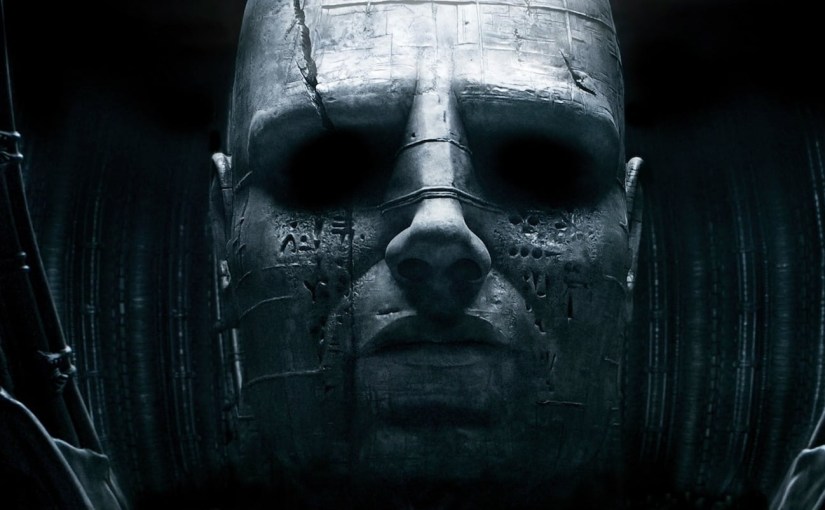
After a brief prologue set in an unknown time in an unknown place, we jump to the year 2093, when a deep-space research vessel arrives at a far distant moon, searching for clues to the origin of mankind.  Dr. Elizabeth Shaw (Noomi Rapace) says they were led to this specific moon by “Engineers”, humanoid beings who are visible in ancient cave drawings from across the globe.  She believes the Engineers can provide an answer, THE Answer, to Life, the Universe and Everything. (Apologies to Douglas Adams.)

Instead of Engineers, Dr. Shaw and her expedition discover miles of underground caverns and a room full of canisters that turn out to contain a horrifying contagion that attack the body at a cellular and/or genetic level, creating painful mutations that, if they don’t kill the host outright, turns them incredibly violent.  We also get a glimpse of the famous “space jockey”, the fossilized alien creature seated in some kind of contraption inside the spaceship in Alien.  So at LAST we’re in familiar territory.

But still no Xenomorph.

The story progresses, the shipboard android turns out to be less than trustworthy, people die in creative and horrifying ways, an Engineer actually turns up, we get a couple more visually spectacular tie-ins to the first Alien…but by the time we get to the end, what gives?  The movie’s obviously over, but we haven’t gotten any answers to the burning questions: Who are the Engineers?  If that was an Engineer in the prologue, was that supposed to be Earth?  If it WASN’T Earth, why even HAVE that prologue?  And don’t try to tell me that was a Xenomorph at the end…

Well, here’s my two cents.

First, of all, expectations are tricky.  They can color and compromise your entire movie-watching experience.  When I went to see Prometheus, I did have my own set of expectations, but as the movie settled in and it became clear that the movie had other designs, I had to consciously shake myself loose of my expectations and embrace what was being presented to me.

Second of all, the visuals are stunning.  I happened to see this in 3-D, and it’s one of a handful of movies where the technology was used PERFECTLY.  No gimmicky shots of spears or harpoons or whatever being pointed out of the screen.  It was used as it should always be used: as a tool to further immerse you into the world of the film without overloading you or being ridiculously obvious.  The gorgeous landscapes during the prologue and during our heroes’ descent to the surface are awe-inspiring.

And then, the story.  I was completely okay with the open-ended nature of the story, and I’ll tell you why.

There are some films out there that play Prometheus’s game of asking questions and not answering them.  One of the most famous examples is Stanley Kubrick’s adaptation of 2001: A Space Odyssey [1968].  If you’ve never read the book, I defy you to provide a concise explanation of the last thirty minutes of that movie.  But that didn’t bother people, because the goal was to get the viewer to ask questions, to provoke discussions about the movie that would eventually get around to some of the same questions asked in Prometheus: Why are we here?  What is our purpose?

And then there are other films that play that open-ended game and fail.  The one that comes immediately to mind is Darren Aronofsky’s The Fountain [2006].  By the end of that movie, my head was locked in a tilted position like a cocker spaniel hearing a strange noise.  If I had been a cartoon character, the word balloon over my head would have been all question marks.  I once read a full description of what was really going on in that film, but to the degree that I understood it, I simply didn’t care.  If I have to go that much work to “get” a movie, the movie didn’t do its job.

There are those who say that’s what Prometheus did, throwing us in the deep end and making us do some mental heavy lifting with no payoff.  But I disagree.

I think, for me, it has to do with the very nature of the questions Prometheus is asking.  “If we could discover the answers to the riddles of our existence, to what lengths would we go, or should we go, to get those answers?  And do we even want to know the answers?  Are we better off NOT knowing?”  These are questions that, almost by definition, can’t be answered in any satisfying way.  So Prometheus presents a possible answer, but then teases it away so there is still some mystery in the story.  If the characters in Prometheus had discovered some kind of document that laid out the Engineers’ plans in detail, I would have felt cheated.  It would have been woefully anticlimactic.  I liked it better that the biggest questions went unanswered, so I could formulate my OWN theories about the Engineers, their plans, their methods, their history, their future, etcetera.  It’s much more stimulating to let my imagination run riot.

(Granted, some of those questions are answered in Alien: Covenant [2017], but that movie still had the guts to leave some things to the imagination by the end.)

Prometheus couches deep philosophical riddles about our very existence within a crackling good thriller with spectacular visuals from beginning to end.  It stands tall as one of the best prequels ever made…Xenomorph or no Xenomorph.

KNOWING (2005)

by Miguel E. Rodriguez

Director: Alex Proyas

Cast: Nicolas Cage, Rose Byrne, Ben Mendelsohn (plus an early sighting of a young Liam Hemsworth in his first movie role)
My Rating: 9/10
Rotten Tomatometer: 33%

PLOT: M.I.T. professor John Koestler links a mysterious list of numbers from a 50-year-old time capsule to past and future disasters and starts to wonder…what happens when the numbers run out?


[SPOILER ALERTS…not that anyone is going to rush out and stream this, but whatever, still … SPOILER ALERTS]

Knowing is a polarizing film from Alex Proyas, the visionary director of The Crow (1994) and Dark City (1998).  It tells the story of an M.I.T. professor whose son is given an envelope that has been sealed inside a time capsule for 50 years.  Inside the envelope is a list of seemingly random numbers that appear to be meaningless, until he notices a pattern emerging.

I remember when this movie came out very well.  I was stoked to go see it because Alex Proyas is one of my favorite directors. But it got PANNED right out of the gate.  And most of the negativity stemmed from the movie’s ending, which turned off the vast majority of moviegoers who thought was the equivalent of someone saying, “It was all a dream!”

Knowing does NOT have one of your typical Shyamalan-esque endings.  The ending follows the strict logic of everything that has come before and arrives at an astonishing, awe-inspiring conclusion that left me gobsmacked.  But more on that later.

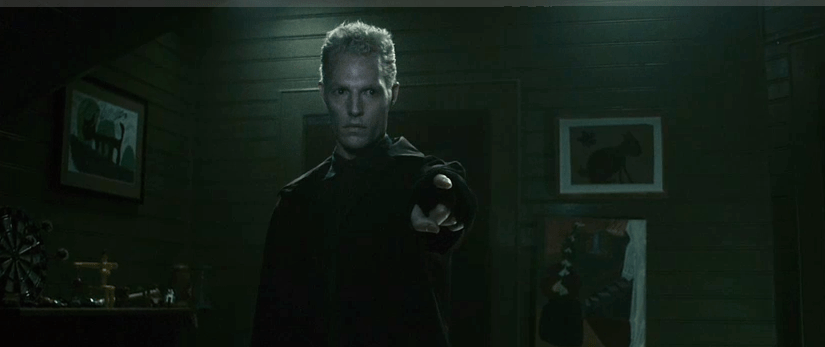
Let’s talk about how Knowing works.  First, everything about the movie sets us up for what appears to be a standard horror movie with Nicolas Cage’s son apparently in danger from mysterious pale figures in dark coats who show up at their house in the middle of the night and just stand there…watching the house.  Creepy.  At one point, one of them somehow gets INSIDE the house, a sequence that ends with the boy having a nightmarish vision of a raging forest fire.

These are, so far, basic horror tropes.  But director Proyas uses skillful styling and editing to create something that feels as creepy and suspenseful as any horror movie I’ve seen.  In fact, every time I watch Knowing, I find myself still on edge during certain scenes, particularly the ones involving the pale strangers.

Another feature of the movie that I feel elevates it is the visceral nature of the key scenes involving various accidents.  See, that 50-year-old list of numbers is actually a list of dates on which various catastrophes occurred over the last 50 years, along with the number of casualties…and Nicolas Cage’s character, John Koestler, can plainly see that three of them are coming up in the next few days.

So it’s a foregone conclusion that we, the audience, are going to see some sort of major accidents.  And, man…I have never seen, before or since, such astonishing, nerve-racking sequences of horrible accidents in films.  I don’t want to be a spoiler, but I CAN say that I guarantee this is one movie that will never be an option for in-flight movie channels on commercial airliners.  I mean…when it happens, it’s out of the blue, and it feels as real as these things can get with CGI.  It literally takes my breath away every time I watch, and I’ve seen it like ten times.  Easily.

So now that Koestler has proof the list is real, the question that keeps nagging at him is…what happens when the numbers run out?

And that’s where Knowing leapfrogs over other genre thrillers and actually becomes ABOUT something.  Before finding that fateful list, Koestler asks his students at M.I.T. to write a paper on determinism versus coincidence in the natural world.  That is, do you believe that everything up to this point has happened for a reason, or is literally everything we do completely random, with no purpose or design?  Koestler believes in the latter, even though he’s the son of a minister, a man with whom he’s had no contact for years.

Koestler has his reasons.  Years ago, his wife was killed in a hotel fire, an event which he perceives as a random accident.  But then he gets this list, and it seems as if someone has been able to accurately predict seemingly random events.  This list flies in the face of everything he’s believed for years.  If these accidents are predictable, is everything ELSE predictable?  Is there a REASON for the accidents?  Is life more than just the result of millions of years of evolution and genetic mutations?

Koestler cannot square this list with his personal beliefs, and it’s that conflict that’s at the heart of the movie.  Knowing forces its main character (and, by extension, the audience) to make a decision one way or the other.  Is there a plan for existence, or is it random?  How long can he ignore the evidence of his own eyes before he makes his choice?

And over all of that, there’s still the issue of the list running out of numbers.  What happens then?  The end of the world?  Is he destined to SAVE the world?  Or stand by helplessly as pre-determined events spin forward out of his control?

This is why the movie stands above other genre sci-fi thrillers.  It poses tough questions and forces us to confront our own beliefs.  And the movie does not take the easy way out by trying to have it both ways.  The finale of Knowing is as implacably logical as it is visually stunning.

Detractors of the movie decry this finale as a “deus ex machina” that cheapens everything that came before.  I even remember some mild laughter in the audience when I first saw it.  But seriously…given everything that happened before, what ELSE would have been a good ending?  Have Koestler wake up from a dream?  Have him discover that it was all really a government experiment?  A drug-fueled hallucination?

None of those would have worked NEARLY as good as the ending the movie DOES provide.  As I said before, it follows the logic of its own story to the bitter end, and gives us some spectacular visuals into the bargain.  It doesn’t cheat, it doesn’t pander or cop out.  We have gone from point A to point B, and the only way out is through point C.  When you think about it, isn’t that kind of audacious?  How many movies have had the nerve to follow the courage of its own convictions?  (I’m reminded of The Bridge on the River Kwai with its own fatalistic finale, combining spectacular visuals with an ending that was not a “happy” one by any stretch of the imagination.)

I stand behind this movie as one of the great sci-fi mystery thrillers.  Love the ending or hate it…I challenge you to come up with an ending that would have been better than the one presented in the film.

FREAKS (2019)

by Miguel E. Rodriguez

Directors: Zach Lipovsky and Adam B. Stein
Cast: Emile Hirsch, Bruce Dern, Lexy Kolker
My Rating: 9/10
Rotten Tomatometer: 87% Certified Fresh

PLOT: A sheltered young girl (Kolker) discovers a bizarre, threatening, and mysterious new world beyond her front door after she escapes her father’s protective and paranoid control.


In the tradition of one of my very favorite sci-fi films, Midnight Special (2016), Freaks is a sci-fi mystery that doesn’t pander, doesn’t spoon-feed (except when it HAS to), and doesn’t insult my intelligence.  It premiered in 2018 at the Toronto International Film Festival, was picked up by a distributor two days later, and surfed the festival circuit for over a year, winning multiple awards, before finally getting a US/Canada release in 2019.

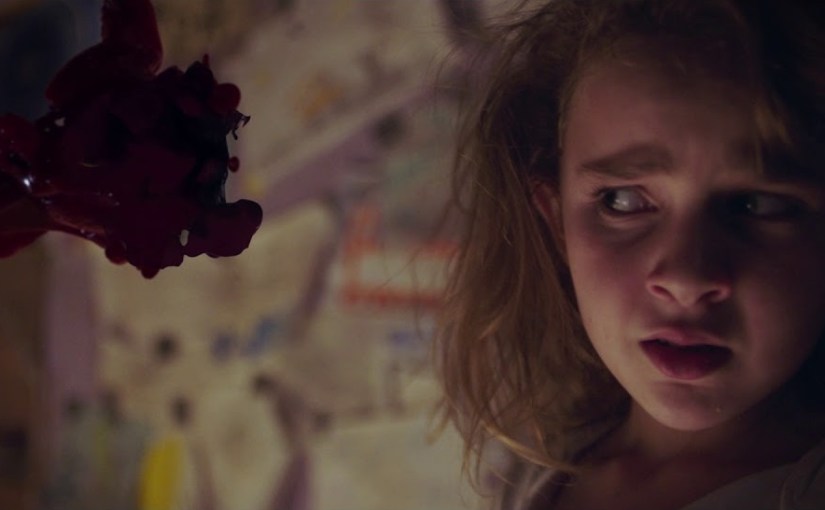
The story opens with a young girl, Chloe (a brilliant performance from Lexy Kolker), who lives with her father in a ramshackle house with covered windows and locked doors.  She takes a peek out the window through curtains that have been duct-taped to the windowsill and sees an ice cream truck outside; in the sky above she spots birds that seem to be…frozen in place?  Hm.  THAT’S weird.

As the opening section unfolds, we learn that the father is doing everything in his power to keep his daughter safe from something dangerous in the world outside their front door.  (She has never set foot outside.)  The movie is cagey at this point about explaining exactly what that something is, and immediately I thought, “Aw, man…is this gonna be another rip-off of A Quiet Place?”  The father walks around the house performing maintenance on drapes and boards and locks, and constantly reminding her daughter how dangerous it is outside, and how he’s doing all this to keep her safe.  Shades of Stranger Things, right?

So the first couple of acts of the movie felt like rip-offs of…sorry, homages to previous contemporary sci-fi entertainments.  The girl portraying Chloe delivers a fantastic, natural performance, but that wasn’t enough for me to shake that feeling of, “Man, I’ve seen all this before.”

At random intervals, Chloe starts to see things.  People in her room, in her closet.  Sometimes these people talk to her, and she talks back.  Are they ghosts?  We’ve learned that Chloe’s mother is dead…could one of these visions be her mother?  And what’s the story with that weird ice cream truck at the beginning, with the creepy, smiling old man who seems to know more than he’s letting on?

These are all threads that make you THINK you know where the story is headed, and you may or may not be right.  You may already think you know what the rest of the movie’s about just based on my description above.  Fair enough.

As for me, I was bamboozled when the true nature of the girl, her father, and the world outside her house was revealed.  I’m not talking about a Sixth Sense kind of reveal that’s kept a secret until the last 5 minutes of the movie.  This movie makes its “reveal” with about an hour left (I’m guesstimating), so I basically felt like I got two movies in one.  Or maybe two episodes of an EXCELLENT cable miniseries.  Once the “reveal” is, well, revealed, the movie shifts into high gear and doesn’t ease off until literally the final frame.

The joy of Freaks is that reveal at the halfway point, and what they do with it afterwards, so it’s extremely hard to know what else I can say without spoiling the fun of discovering it for yourself.  I could mention the visual effects, which are relatively minimal, but EXTREMELY effective, especially during the finale.  I could mention the screenplay’s deliberate attempts to make certain plot points analogous to the current immigration debate.  (I’m gonna mangle this, but one of the lines goes something like, “If you attempt forced relocation, that will only force them underground.”)  I could mention the way certain clues are hidden in plain sight, once you get to the endgame of the movie.

But you won’t get another word from me about the story.  You deserve to discover this one yourself.  I cannot recommend this highly enough.  It’s not quite a PERFECT film, but what are you gonna do, they can’t all be Midnight Special.  I never saw one trailer, not one Facebook ad or YouTube video about Freaks.  I only saw it by pure luck tonight because the showing was at a better time than Ready or Not.

I’m telling you.  Seek this one out. It’s a winner.

GODZILLA: KING OF THE MONSTERS (2019)

by Miguel E. Rodriguez

Director: Michael Dougherty
Cast: Kyle Chandler, Vera Farmiga, Millie Bobby Brown, Ken Watanabe, Bradley Whitford
My Rating: 6/10
Rotten Tomatometer: 40%

PLOT: Five years after the events of Godzilla (2014), humanity finds itself once again at risk as multiple titanic creatures awake from slumber and wreak devastation on the planet.  Who can stop them?  Indeed, WHO?


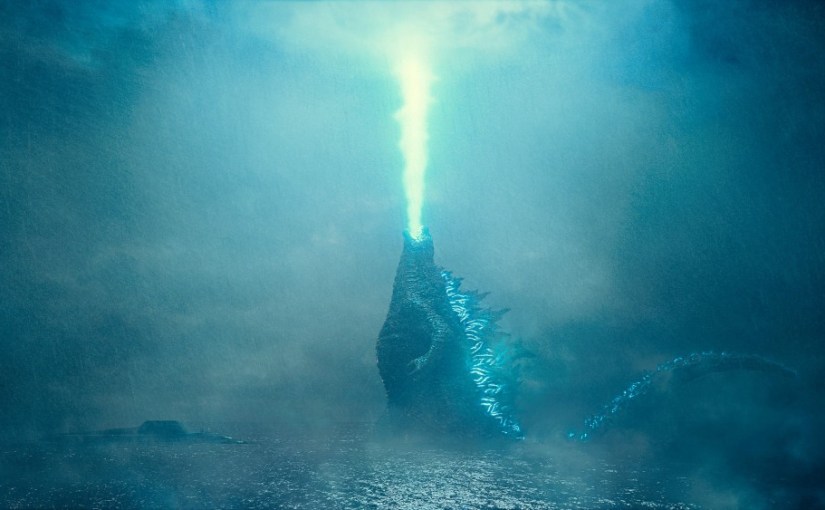
In many ways, Godzilla: King of the Monsters reminded me of Guillermo del Toro’s kaiju epic Pacific Rim, although, to be fair, the monster battles were far superior in del Toro’s film.  But that’s the framework in which this movie should be measured: the monster battles.  With a title like King of the Monsters, one shouldn’t walk into a screening of this film expecting a screenplay by Ernest Hemingway.  You won’t find self-reflexive, multi-layered dialogue here.  You want that, wait for Oscar season later in the year.

No, this is a popcorn movie, pure and simple, and on that level, I believe it succeeds.  We got two monster “species” total in 2014’s Godzilla reboot, and in this sequel, we get an additional six at least.  We got two major monster sequences in the first film…this time we get, jeez, four, I think?  I lost count.  In the summer blockbuster vein of “bigger is better”, G:KotM pulled out all the stops.

At least, in terms of the monster battles.  The screenplay is one giant cliché after another.  Think of the screenplay for Independence Day and square the cheesiness factor.  Then think of all the monster movies you remember from your youth, and imagine someone funneled every cliché from those terrible scripts into this one.  Yeah, it’s like that.

  • One character talks about humanity being a scourge to the planet, and how it ought to be eradicated by the titans in order for the planet to survive.  As my friend Marc Sanders pointed out, they should have just called Thanos; he could have fixed the problem in a SNAP, thank you, I’m here all night.
  • At one point, a kidnapped little girl is taken to a military-style bunker and, in a feat that rivals Houdini, manages to steal an EXTREMELY important piece of hardware, climb into an air shaft, and literally stroll out the UNGUARDED front gate, presumably while all the grownups are too busy watching the world end on their computer monitors.
  • At another point, it’s determined that the best way to revive an injured Godzilla is to fire a nuclear weapon into his radioactive underwater lair.  Alas, the launching mechanism has failed, and it’s impossible to detonate it remotely, meaning someone must volunteer to hand-carry a nuclear warhead, place it literally RIGHT NEXT to Godzilla, and blow themselves up.  Because, why not?  Instead of feeling like a heroic moment, it felt really, REALLY contrived.

But, I mean…it’s not like any of that really matters here, does it?  To re-state an important factoid, the title of the movie is Godzilla: King of the Monsters.  KING OF THE MONSTERS.  This is simply a mindless, monstrous summer diversion that oddly appealed to me, but only when we saw the monsters fighting.  It kinda took me back to my childhood, watching one of any number of Godzilla films in syndication.

I’m not saying it’s better than the 2014 film, let me be clear.  I thought that film, helmed by Gareth Edwards (who went on to direct the sensational Rogue One), was a more “awesome” movie in the most literal sense of the word.  There was a sense of grandeur, almost, to Godzilla that bordered on reverence. King of the Monsters is all about the fight.  The rumble.  The battle for dominance.  Only one can be king, and Godzilla will not give up his throne without a fight.  Or three.

Many moons ago, I went with my good friend Marc to see what promised to be a cheesy movie: Freddy vs. Jason (2003). Was it cheesy? Yes. But did it deliver on its title? Brother, we got, not one, but THREE showdowns between the two title characters. I got what I paid for and had no complaints.

Same principle applies here.

AVENGERS: ENDGAME (2019)

By Miguel E. Rodriguez

Directors: Anthony Russo & Joe Russo
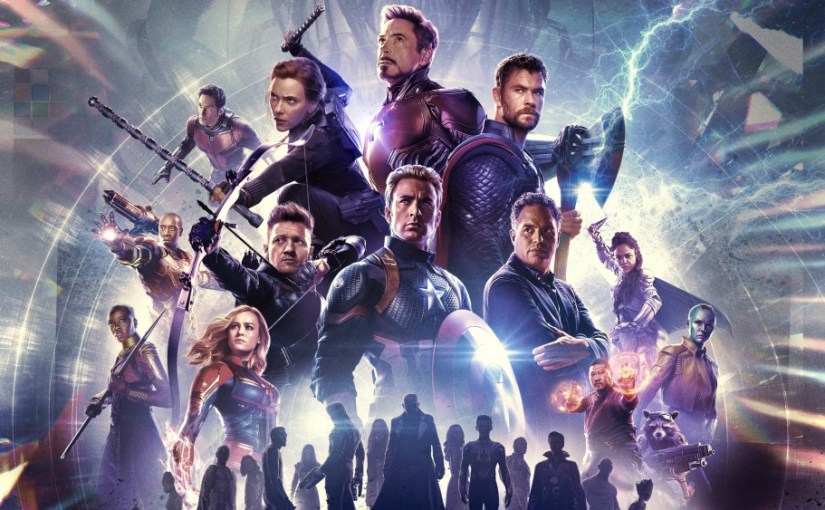
Cast: Robert Downey Jr., Chris Evans, Mark Ruffalo, Chris Hemsworth, Scarlett Johansson, Jeremy Renner, Don Cheadle, etcetera, etcetera…
My Rating: 10/10
Rotten Tomatometer: 96% Certified Fresh

PLOT: After the devastating events of Avengers: Infinity War, the universe is in ruins. With help from some of their remaining allies, the Avengers assemble once more to try to undo Thanos’ actions.


I have tried several different drafts of this review, and I simply am unable to write a decent review without necessarily revealing spoilers.

So…

DO NOT READ ANY FURTHER IF YOU HAVE ANY INTENTION OF SEEING AVENGERS: ENDGAME IN THE FUTURE.  SPOILER ALERT!!!

SPOILER ALERT!!!

SPOILER ALERT!!!

You have been warned.

For starters, Avengers: Endgame is not my favorite movie in the MCU.  (That title still goes to the incredibly complex, endlessly debatable Captain America: Winter Soldier, the superhero movie for people who hate superhero movies.)  BUT…Endgame contains my single favorite moment in the entire franchise.  It occurs during the climactic battle, and it involves…hardware.  YOU know what I’m talking about.

That aside, while Endgame is a more-than-worthy sendoff for the 11-year-long story arc, and is Hollywood spectacle at its best, I gotta be honest and say that the 3-hour running time was starting to get to me around about the 2-hour mark.  Yes, the plot threads all had to be woven together to bring everything to a head for the ultimate showdown, and I wouldn’t dream of eliminating anything that I saw, but it just was feeling a little slow.

Other than that…it gets all A’s across the board.

  • ACTION – I haven’t seen CGI action on this scale since the Battle of the Pelennor Fields in The Lord of the Rings: The Return of the King.  Or Avengers: Infinity War, take your pick.  I can only imagine the headaches and nervous breakdowns experienced by the hordes of CGI artists who painstakingly created the outstanding battle scenes.  They were incredibly dense, but I was never unable to see any of the key moments involving key characters.  Nothing was too dark or murky.  It was an event.
  • HUMOR – In spite of the heaviness of the proceedings, the filmmakers never lost sight of their origins: COMIC books.  From the first appearance of Thor in residence at New Asgard, to Stark’s never-ending supply of dry one-liners, to Hulk’s selfie in the diner, the audience is always kept from falling into major depression, even after some really, REALLY dark moments in the story.
  • CLOSURE – The film ends the way it does because it HAD to.  Some of the original actors are just getting too old to do it anymore, folks, that’s just the way it is.  Hugh Jackman hung up his claws on Wolverine because he was getting too old to get into that kind of shape anymore.  And some other actors are just ready to move on.  It’s time.  Regardless, though, the way that certain characters were granted their own particular curtain call…it was IMMENSELY satisfying, not a bit gratuitous, and even noble for everyone involved.  I wasn’t moved to tears myself, but there were audible sniffles in the movie theater.

(I did also REALLY like the abandoned New York cityscapes after we jump ahead in the timeline a little bit.  I’ve always LOVED the concepts of modern edifices and cities left to ruin after abandonment.  That’s one of the reasons I really love I Am Legend.  BUT I DIGRESS.)

So, yes, it’s worth the hype.  They got it right.  It is a fitting final chapter to one of the most amazing cinematic achievements in history.  It IS a little long, but I can get over that.

And I am stoked to see what comes next.

ZATHURA: A SPACE ADVENTURE (2005)

By Miguel E. Rodriguez

Director: Jon Favreau
Cast: Josh Hutcherson, Dax Shepard, Kristen Stewart, Tim Robbins
My Rating: 9/10
Rotten Tomatometer: 75% Certified Fresh

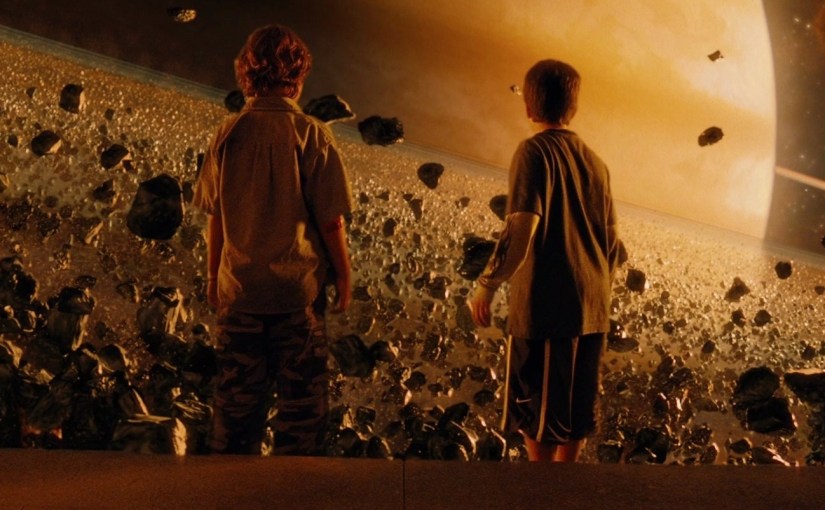
PLOT: Two young brothers (Hutcherson, Jonah Bobo) are drawn into an intergalactic adventure when their house is hurled through the depths of space by the magical board game they are playing.


If only all family movies were like this.

Too often, so-called family films are mealy-mouthed cream puffs that appeal to the short attention span of their target audience, leaving the parents either bored to tears or fatigued from sitting through 90 minutes of explosions.  The scripts are subpar and tend to treat kids as if they’re not all that bright.

Not Zathura.  With his third film (after the forgettable Made and the Christmas neo-classic Elf), director Jon Favreau proved that he’s the real deal.  Here’s a REAL family film with something for everybody: comedy, family drama, peril, thrills, a killer robot, fearsome aliens, and nostalgia.

The nostalgia part is especially notable.  The board game at the center of the film is constructed to look like something made in the ‘50s or ‘60s, which, to the kids in the film, is practically ancient history.  But for me, I found the film nostalgic in the way it captures the kind of fun I used to have at the movies.

Not that I don’t still have fun, mind you.  It’s just that, when I was a kid, sci-fi and fantasy films felt more real, you know?  It was so easy to imagine myself as a resident of the Goondocks, or discovering an alien in the cornfield behind my house, or building a spaceship in the backyard with my two best friends.  Zathura captures that kind of feeling like few other modern family films can.  It’s a movie that has the potential to live on in the imagination after countless other films have vacated your consciousness.

And the VISUALS.  I don’t know what kind of budget the movie had, but it looks like a $100 million movie.  The killer robot is absolutely convincing, as are the aliens.  Which brings up another great element of the film: danger.  The bad guys in this movie may occasionally look a little cartoony, but they are not to be trifled with.  That’s something a lot of kid’s movies tend to get wrong.  The filmmakers lose their nerve in creating real villains, for fear of pissing off too many parents.  In reality…dude, kids can handle it.  Give the bad guys fangs and spinning saw blades.  It just makes it that much more satisfying when the bad guys LOSE.

Zathura barely made its money back, and that’s including domestic AND worldwide grosses (okay, I looked it up).  I could be wrong, but I’ll bet too many people thought it was a Jumanji ripoff.  It IS based on a book by the same author as Jumanji (and The Polar Express, as it happens).  But it is possible, I think, to see Zathura in its own light.  It’s a fantastic movie that will please all ages.

QUICK TAKE: Serenity (2005)

By Miguel E. Rodriguez

Director: Joss Whedon
Cast: Nathan Fillion, Gina Torres, Alan Tudyk, Summer Glau, Adam Baldwin, Chiwetel Ejiofor
My Rating: 9/10
Rotten Tomatometer: 83% Certified Fresh

PLOT: The crew of the ship Serenity tries to evade an assassin sent to recapture one of their members who is telepathic…and perhaps something more…


In a perfect world, Han Solo would still have shot Greedo in cold blood, not self-defense.  Universal would have stopped with Jaws 2.  Heath Ledger would still be around for at least one more Dark Knight film.

And in that perfect world, Serenity would have spawned two more films, each better than the one before, for a trilogy that would be in the conversation for greatest science-fiction franchise ever.

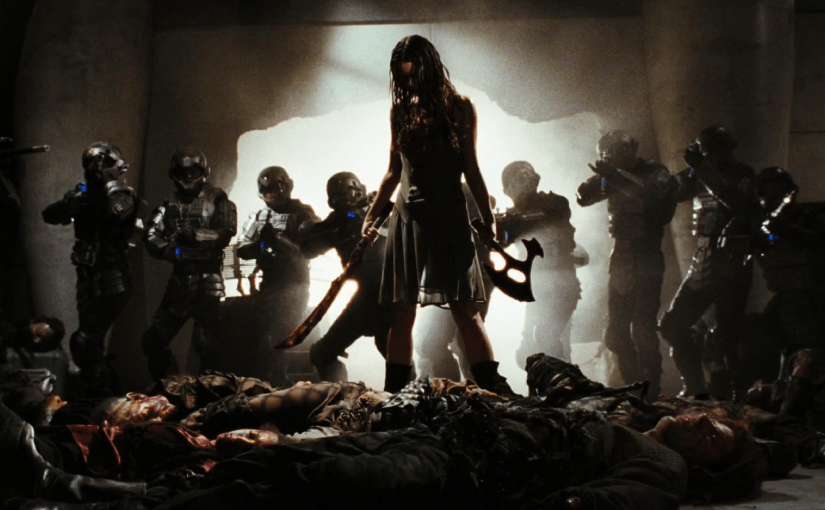
I do not say this as a fan of Firefly, the short-lived, devoutly-worshipped television show upon which Serenity is based.  When I first saw this movie in 2005, I had no idea why the pilot had dinosaurs on the cockpit dashboard.  I didn’t know why it was such a big deal to see River Tam, this wisp of a girl, performing intricate fight scenes right out of a Jackie Chan movie.  I didn’t know why the characters sprinkled Chinese or Japanese phrases in the middle of their dialogue (sometimes cursing in those languages).  Or why they talked like it was the old West instead of hundreds or thousands of years in the future.

Know what?  It didn’t matter.  Serenity is so well-made and well-written that, after the two main opening sequences, I rolled with it.  I had an immediate sense of the vast history of this “used” universe and the characters within it.  In this world (taking a cue from “Star Wars”), the good guys fly rust-buckets, not sterile starships.  It’s a pure visual pleasure from start to finish.

The great story, screenplay, acting (from actors who are clearly enjoying themselves), effective usage of visual effects, genuine surprises, and one bona fide shocker that had audiences gasping and yelling at the screen…it’s all here.  Shiny!

AQUAMAN

By Marc S. Sanders

The next installment in the DC Cinematic Universe takes place in the ocean. Too bad the ocean is just too murky. James Wan’s Aquaman is muddied in long, boring, unsurrendering exposition and CGI. It is a film based on the most famous of all the undersea super heroes who is destined to be King of Atlantis. HE’S HALF MAN! HE’S HALF FISH! HE’S AQUAMAN, AND HE MUST BE KING!!!! That’s about all we should have to know to appreciate the storytelling of this film. However, Wan left me guessing just what the hell everyone was talking about for most of the film. King Orm (boring Patrick Wilson) declares takeover of this kingdom and take over of that kingdom and I’m like what, who, how, why???? Who the hell is he talking about? Why is this a threat? What will this mean for everyone? Shut up! Stop talking! Show me something! In the immortal words of Syndrome (from a better super hero film), “Stop Monolouging!!!!”

The first problem is when we are brought from one ocean floor to another and another and another and they all have location names like Kingdom of the Starfish Curtain or Dwelling of the Stingray Horse or some such thing. So what? These locales are literally shown for no more seven seconds before it moves to another location. This isn’t Krypton or the Batcave. We get to go to “Somewhere In The Atlantic Ocean” or “Somewhere In The Indian Ocean,” but so???? And????? Wan seems too proud to uncover these geographical areas that hold no measure.

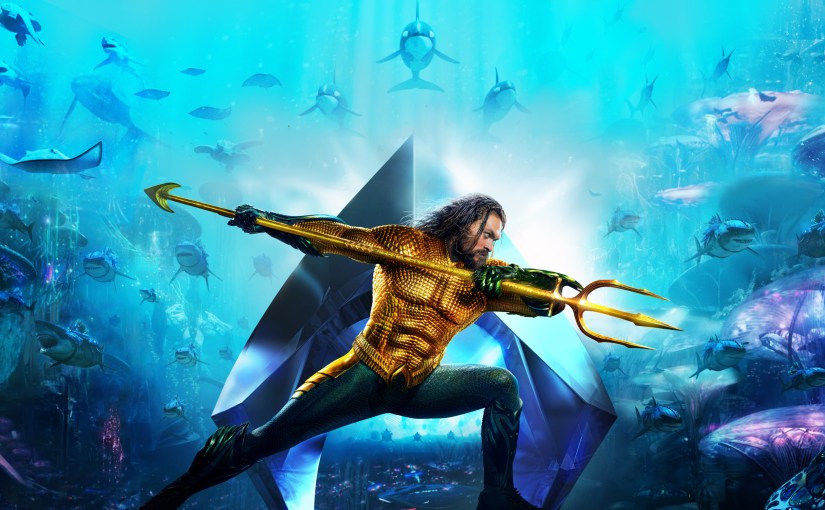
Then there is the cast of characters. We got Dolph Lungren with a red beard, Willem Dafoe with a slicked back ponytail, Amber Heard beautiful as the love interest Mera, Nicole Kidman with her alabaster skin looking angelic as a queen and mother to Arthur Curry (the Aquaman title character) and Patrick Wilson, blond, white and curiously looking like the Hanna Barbera Aquaman during the days of Super Friends. Wilson is the big bad here and he’s kind of boring, kind of not intimidating, kind of the guy who looks too innocent to ever be cast as a villain in any film.

Let’s go off subject for a moment, shall we? Jason Momoa is the best thing about Aquaman and he makes a great Aquaman. I knew that when I saw him in the role in last year’s Justice League (a much better film; yes the Joss Whedon cut). Momoa is ripped, muscled and tattooed perfectly with long flowing charcoal hair, a perfect beard and sparkling blue eyes. This guy looks great on land while downing full pints of beer with his dad, or under CGI water. As I became less and less interested as the movie went on, I found it curious that the image of Momoa’s Aquaman is destined to defeat the image of Patrick Wilson’s (supposedly) ruthless King Orm, also known as Ocean Master. It’s as if the gorgeous motorcycle dude is meant to erase the much maligned (see countless GIFs and a couple of Big Bang Theory episodes) Hanna Barbera blond boy image.

The CGI does its best. After all, how else do you film a movie that primarily takes place under the ocean? It’s colorful. The effort is there. What I took issue with was the great battles between all these kingdoms. I couldn’t tell who was fighting who, who was with who, and who lived and who died, not to mention how they fight. Was it with spears? Laser guns? Swords? Hammers? Pies? What?????? I know these are underwater battles, but why can’t any of these great kingdom of kingdoms movies learn from the best like Peter Jackson’s Tolkien films or Ridley Scott’s Gladiator? There is something more literal in those grand battles. You could always recognize who was charging at whom. In Aquaman, it’s mass hysteria, riots in the ocean streets.

The villain Black Manta is next best thing after Momoa. Played by Yahya Abdul-Mateen II. Unfortunately, he’s not given much to do. He’s out for revenge against Aquaman. That’s been done before. What saves the character is the costume and helmet. Now this is a villain!!!!! He looks badass with red sonic blasts shooting out of his eyes and he’s agile; the filmmakers at least got the image and movements of this guy right. The best scene of the film takes place on land in what looks to be the Greek Isles. Lots of rooftop jumping, statue shattering, and wall breaking with good fisticuffs are in play here between Momoa and Abdul-Mateen. It’s a good long scene. Then, oh yeah, we gotta go back to Wilson and Dafoe talking about something somewhere that’s labeled with some “legendary” location amid some coral.

James Wan and the writers of Aquaman try too hard. There’s too much going on here that doesn’t belong. I don’t know how a pre teen kid nor an adult could sit through these boring conversations of fiction that is unfamiliar to many. Again, none of this is the stuff of legend like Lord Of The Rings, or Krypton, or Gotham City, or even Star Wars or Star Trek. If only Wan and crew didn’t elevate the importance of things that even they show are just not that important. Stick with the simplicity guys. At least, you got the Atlanteans riding Sea Horses. Nice touch, there!

STAR WARS: THE RISE OF SKYWALKER

By Marc S. Sanders

Star Wars: The Rise Of Skywalker is a well packaged thrilling adventure of spectacle, emotion, thrill and salutations to a film saga that’s lasted nearly a half century. JJ Abrams, with backing from the franchise’s new owner Disney, invents a storyline that bears consistency with the episodes that have been seen before. There’s just so much to appreciate.

To get the story rolling, it appears the villainous Emperor Palpatine (Ian McDiarmid in a role that has never garnered enough deserving praise) returns from the dead, intent on recruiting the confused Kylo Ren to kill Rey. From there, it becomes a race for Rey and her allies (Finn, Poe, Chewbacca C3PO & BB8) to find “wayfinders” (like directional compasses) that will lead to Palpatine’s location. Naturally they get sidetracked with some unexpected encounters like flying Stormtroopers (“They fly now!”) and Lando Calrissean (a very welcome and delayed return for Billy Dee Williams). As well, Rey gradually learns more of her back story and there are some quite surprising moments to see.

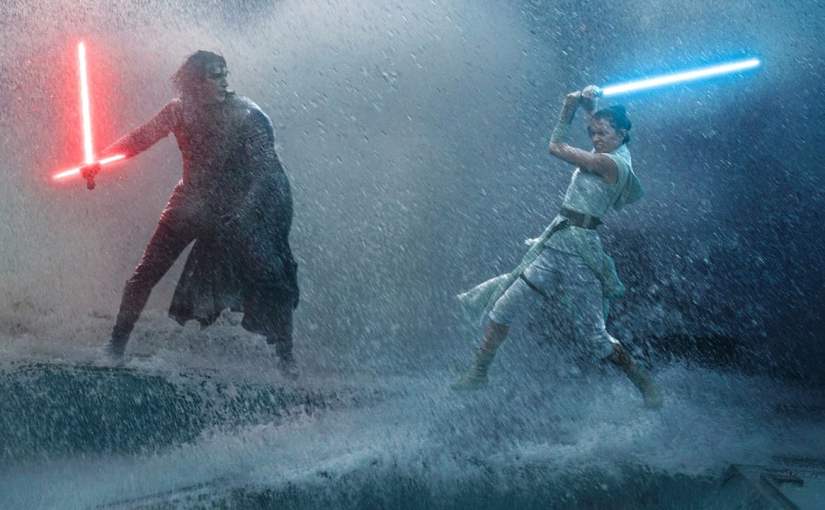
ROS is really a beautifully shot piece of cinematography. Abrams still loves the occasional lens flare but it’s never distracting. Outer space flights and battles have a clear exactness to them. The moments between Rey and Kylo Ren are well edited conversations and lightsaber duals that occur at two different parts of the galaxy as background settings seamlessly change at times. This is an element from the prior often sour Episode VIII known as Rian Johnson’s The Last Jedi that still works for these new characters.

Abrams and company really get everything right here by neglecting wasteful narratives from Johnson’s installment to allow reflections on the other films in the series with fan loved cameos of characters and ships from before.

Episode IX is bound to displease some fans who carry their own vision that challenge them to accept something satisfying. I dare not consider what those thousands of possibilities could be.

All that I know is that the newest chapter is never boring, often surprising and in the most capable hands possible with the Mouse House engineers.

Major applause for the Daisy Ridley giving her best performance to date followed by John Boyega & Oscar Isaac offering terrific buddy chemistry with fun, wry dialogue and major kudos to Anthony Daniels who is given much material that reminds the audience that the Skywalker saga is quickly approaching closure. Daniels has always offered a quite humane performance to a character that can show one expression but still carries dimensions of fear, wisdom and humor. An actor limited in expression who only provides a vastness of emotion.

The Rise of Skywalker delivers a lot of story and some new, albeit unnecessary characters (except for new merchandising to sell), but everything is a visual treat.

Abrams’ contributions offer opportunities of laughter and tears and messages of redemption and sacrifice for a greater good.

There’s much to this to consider and appreciate. I absolutely loved Star Wars: The Rise of Skywalker.