ARRIVAL (2016)

by Miguel E. Rodriguez

Director: Denis Villeneuve
Cast: Amy Adams, Jeremy Renner, Forest Whitaker, Michael Stuhlbarg
My Rating: 9/10
Rotten Tomatometer: 94% Certified Fresh

PLOT: When 12 alien spacecraft descend to Earth at seemingly random points around the globe, a linguistics expert (Adams) is recruited to interpret the aliens’ speech in order to find out why they are here, among other things.


“If you could see your whole life from start to finish, would you change things?” – Louise Banks (Amy Adams), Arrival

That seemingly simple question lies at the heart of Denis Villeneuve’s sci-fi brainteaser, Arrival.  Surrounding it is a film of uncommon grace, beauty, and intellectual stimulation that deserves comparison to Kubrick’s 2001 or Tarkovsky’s Solaris.  When I first saw it in 2016, I’ll admit to some slight confusion at the end, but after many repeat viewings, I believe I understand it fully enough to call it a masterpiece.

After a prologue where we witness a montage of her losing a daughter to an unnamed but ravaging disease, we see Dr. Louise Banks (Amy Adams) teaching linguistics at a university.  Classes are interrupted when news breaks of not one, but TWELVE alien spacecraft suddenly appearing at random points around the globe.  Eventually, the military contacts her and reveals that contact has been made between us and the aliens, but to say we can’t comprehend their language is an understatement.  She and a top-notch mathematician, Ian Donnelly (Jeremy Renner) are flown to the US sites in Montana and are given an impossible task: decipher the alien language and ask them why they’re here.

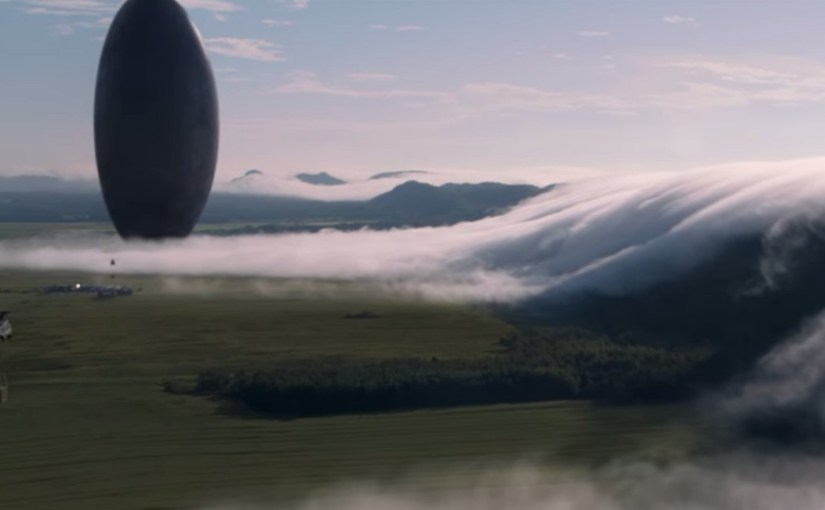
The design of the aliens and their ship are visual masterstrokes.  The ship, in fact, bears a striking resemblance to the famous Cloud Gate sculpture, aka “The Bean”, in downtown Chicago.  (Google it if you’re unfamiliar with it.)  But imagine it standing vertical on end, matte gray-black instead of chrome, and hundreds of feet tall.  Ominous and delicate at the same time.  The aliens themselves…well, I won’t spoil it for anyone who hasn’t seen it, but I will say they are called “heptapods” by the scientists.  Seven legs.  Cool.

The US researchers and military are connected via satellite to every other landing site around the globe, each attempting to make a communications breakthrough, but it’s Dr. Banks who realizes the aliens may have a form of written communication.  Using a whiteboard and simple words at first, she can have very limited conversations with the heptapods.  But when Banks is finally able to ask the all-important question, “Why are you here”, the answer she gets throws the military and government representatives into a tizzy and they cut off all communications to the other landing sites.

Meanwhile, Dr. Banks has periodically been having extremely vivid visions or memories of her daughter at random moments.  At one point, she is struggling to remember the scientific term for a “win-win” situation, and the memory comes back to her in a flash from a previous conversation with her daughter.  Although it is odd that we hear the term first in the present, and then she remembers it in the past…but enough about that.

Arrival may strike some as slow and plodding.  I suppose they’re right, in a sense.  It lacks any of the deliberately manipulative editing of, say, a Spielberg or a Scorsese film, where the cuts are specifically designed to grab the audience member by the collar and propel them to the film’s high and low points.  By contrast, Arrival takes its time.  It stands back and presents us with all the information we need to really, actively watch the film and work those brain cells.

[The score of Arrival deserves special mention.  In a film whose story arc involves linguistics and translations, it’s appropriate that, at key moments, the score includes multiple human voices harmonizing in ethereal chords or pulsing in a rhythm that sounds utterly alien, not just foreign.  A brilliant touch.]

What gives Arrival that extra push is that question Dr. Banks asks at one point in the film.  “If you could see your whole life from start to finish, would you change things?”  This question, when it comes, has poignant undertones that were not even hinted at in previous scenes.  And I find it to be incredibly moving, every time.  In fact, I wonder if I’m not really the prime target audience for this movie.  I wonder if it’s most effective for people who have lost loved ones to disease or accidents – untimely, unbearable deaths.  For those people, I cannot even begin to imagine how they would answer, or if they agree with Dr. Banks’s answer to her own question.

For myself, I have been blessed in this life, knock wood.  I have lost family members, but mostly to old age, although two uncles were taken by cancer in their fifties and sixties.  But I found myself thinking about this question today more than any other time, for some reason.  If I could magically go back in time, while retaining all my current knowledge, would I change things?

It’s deceptively easy to say “yes”, especially when it concerns the big things.  Sure, I would probably not stay as silent as I did when I learned a dear friend was being molested in high school and college.  No, I would probably not have gotten romantically involved that one time with the absolute wrong person.  No, I would most certainly not have skipped work that one day to see Spider-Man 3.  I would have remembered my driver’s license that one time I was pulled over.  I would have rearranged my schedule to go with my father and sister to Spain that one time.  And on and on.

But…if I hadn’t done some of those things…I may not be where I am now.  In a wonderful relationship with my best friend.  Working at a job that has its challenges but is rewarding and accommodating enough for me to do theater.  Surrounded by a support structure of friends that is second to none.  Able to leap tall buildings in a single bound.  Just kidding.

Your answer may differ from mine, or from Dr. Banks’s answer in the film.  That’s fine.  We all have our own reasons for our own answers to that question.  What’s wonderful about Arrival is its ability to couch that existential question in a top-notch sci-fi drama that, in its own unflashy way, is every bit as exciting and though-provoking as ten Independence Days.  It looks great, sounds great, acted great…what more could I ask for?

FLASH GORDON

By Marc S. Sanders

How can anyone not like Mike Hodges’ camp celebration of a savior hero vs a destructive villain?

Flash Gordon was penned by Lorenzo Semple Jr, writer on the 1960s Batman TV show. His first draft is the one and only draft which producer Dino DeLaurentis approved for shooting. A glossy, flashy and fetishistic approach was adopted for the film, and it became timelessly memorable.

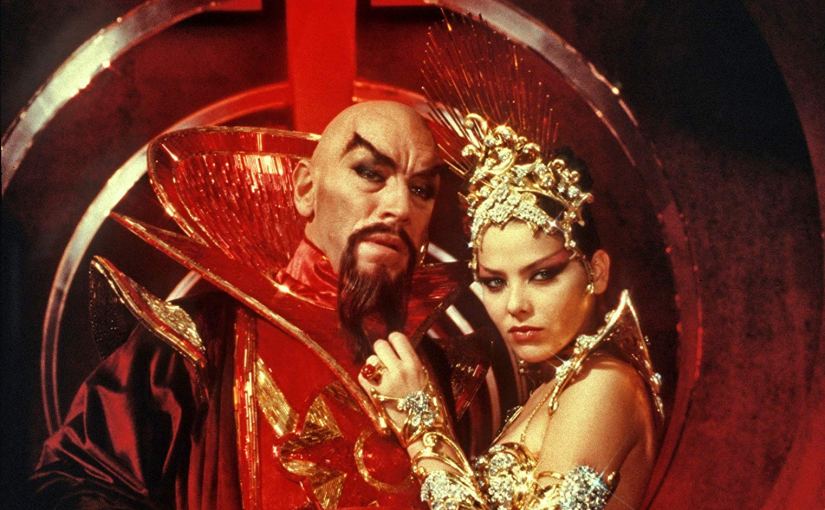
What thrills me about the film is its appreciation for the original, pioneering comic strips on which the film is based. Max Von Sydow’s Ming The Merciless is pulled right from the newspapers in his gloss pinks, reds, golds and blacks costume wear. The inflection of his voice is otherworldly from the start (“Klytus, I’m booooored. What do you have for me to play with today?”)

Sam Jones is a level down in the relatable hero of Christopher Reeve, but he’s enjoying every minute of his hero character schtick. He’s perfect for Semple’s playful writing and he looks like a champion.

Timothy Dalton and Brian Blessed are great side characters on opposite ends; one distinguished, the other gluttonous and proud.

The best flavor of the film is its soundtrack. Thank you Queen!!! Their musical touch is an early inspiration to some modern Marvel films like Guardians of the Galaxy, and Thor: Ragnarök, clearly showing direct influence from Flash Gordon. Freddy Mercury, Brian May and company relish in heavy pounding drums and special effect sounding guitars to deliver a cheerleading rock anthem. “Flash…aaaah!!! He’s a miracle!”

Dino DeLaurentis saw opportunity following the success of science fiction with Star Wars. He produced Flash Gordon with his own style, not as a copycat. The film became a fantasy with characters bleeding rainbow colors, pet midgets, cat fighting concubines, great hall football fighting with aluminum watermelons, weird lizard creatures, hawkmen, half egg-shaped planets, and even a thrilling fight to the death on a tilting platform with protruding spikes, the best scene amid all the camp craziness.

It’s all great. Flash Gordon is the savior of the universe. “He’s a miracle!!!!”

CLOSE ENCOUNTERS OF THE THIRD KIND

By Marc S. Sanders

Close Encounter of the First Kind – Sighting of a UFO.

Close Encounter of the Second Kind – Physical Evidence.

Close Encounter of the Third Kind – Contact.

Music is the most universal of all languages.  Steven Spielberg’s Close Encounters Of The Third Kind demonstrates that claim. 

I appreciate how Spielberg’s script, along with his direction, opens the film.  It takes place during a sun swept sandstorm in New Mexico.  At first, hardly anything but sand blowing can be seen, along with the high volume of wind breezing about inconveniently.  You are not even sure what you are looking at.  Then, headlights from a vehicle appear and a group of men assemble.  We come to find the main character of this scene is a French scientist named Lacombe (Francois Truffaut).  He only speaks French and hardly understands any English.  He is in need of an interpreter (Bob Balaban) to translate to American men who are accompanying them.  After we’ve established French and English are in the fold, we then realize that Spanish must enter the conversation amidst the overwhelming winds from the blinding storm.  An occurrence must have happened here recently, because Lacombe and crew interview some of the locals who are trying their best to define what took place the night before.  An elderly man is mysteriously sunburned on only one side of his face.  Thereafter, a grouping of bi-planes last seen flying over the Bermuda Triangle nearly forty years earlier come into focus.  No matter how you learn, communicate or understand, the confusion depicted is a perfect match for each of the men occupying this space.

A parallel story begins after this opening in the state of Indiana.  Sightings by airline pilots, as well as residents, are discovered in the skies above.  Blackouts occur everywhere.  The experiences of two residents, a young boy named Barry, and a utility worker named Roy Neary (Richard Dreyfuss), are who Spielberg uses to guide us through these strange episodes of phenomena.  They are being drawn towards a calling or an image and they become entirely focused upon what has happened to them.  Barry’s mother, Jillian (Melinda Dillon), while trying to reign her son back home has also been delivered a message from unusual spectacles in the skies. 

Soon after, these people cannot help but focus on a shape that they know they’ve seen before but can not place it.  Roy sculpts the shape in his shaving cream and his mashed potatoes.  He becomes neglectful of his work, his three children and his wife, Ronnie (Teri Garr), who refuses to take him seriously.  Barry’s young age allows him to avoid understanding the meaning of any this.  So, when the blinding “lights,” of whatever these entities could be, come towards his home in the middle of the night, he happily welcomes them, and willingly accompanies them back to wherever they came from.

I know this science fiction film is a highly regarded classic.  It’s earned the right to be considered as such, and so many have seen it.  Yet, I also know that I appear vague in my description of the film here.  I choose not to expound on everything going on in Close Encounters…  Steven Spielberg would want it that way, and I hate spoiling any movie.  A movie not seen is new to any of us. 

The residents of Indiana insist to higher governmental and military authorities that they have witnessed unidentified flying objects.  What those UFOs are, or where they came from, or why they visited their home state is unexplainable.  Spielberg intentionally avoids definitively explaining what’s occurred.  After all, if aliens are visiting our planet Earth, then who’s really to say we understand what they want or why they’ve come here?  Like the rest of the countries of the world, it’s fair to say that inhabitants of another planet in our galaxy would likely have their own way of communicating or speaking that’s entirely different from English, or French, or Spanish.

Spielberg goes even further to distance any understanding among ourselves or with these new entities that we are encountering.  A cargo sea vessel appears out of nowhere in the most unlikely place, the Gobi Desert of Mongolia.  Why?  How?  The people of a village within the continent of India are harmonizing a tune over and over again, in unison.  Lacombe along with his interpreter, and their American crew, attempt to decipher why these episodes have occurred as well.  The harmony must mean something.  What’s the message?  The world must learn to communicate with one another if they are to understand why these strange happenings continue.

Once Spielberg introduces the Indian village’s response to their experience, oddly enough Barry becomes obsessed with the tune as well.  Lacombe believes he’s recognized the tune as a means to speak with the visiting entities.  Again though, what is the message within the song?  In addition, Roy and Jillian are beginning to understand their obsession of the shape.  “This means something.  This is important.”  The script for Close Encounters… does not take for granted the repetitive significance of this line.  It is uttered a few times at different moments, by both Roy and Lacombe.

Close Encounters Of The Third Kind functions as a riddle, and yet it all makes sense in a breathtaking ending that occupies the last 30-40 minutes of the picture.   I hope there will be readers of this column who have yet to see this film.  It is better to go into it by knowing as little as possible.  Only then can you truly experience the maternal frustration that Jillian has for her young son’s insistence on going towards the lights, or Roy’s obsession with what dwells in his mind following his encounter.  With knowing as little as possible, can you become all the more curious at Lacombe’s pursuit.  When Spielberg gradually pulls the curtain away, it is such a satisfying relief and a feeling of fulfillment to have taken the journey with these characters. 

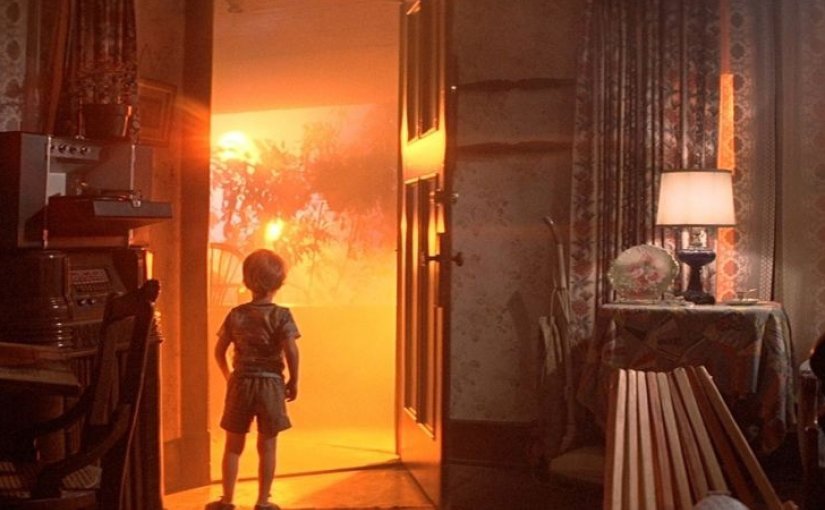
The construction of Spielberg’s first of many sci-fi films is magnificent.  It performs as if it is operating with real world science and language.  Yet, I have to draw attention to a scene that arrives in the middle of the picture.  Barry’s innocent, but youthful obsession, is tested within the home, beside Jillian’s fear.  Spielberg uses every prop and device available within the set of this scene.  Battery operated toys come alive.  The record player goes off.  The stove turns on. The dishwasher opens and closes. Blinding lights bleed through the curtains, chimney and keyholes.  The echoing sounds become overpowering.  What’s come to the house can’t be explained.  However, one person is thrilled by it while another is terrified.  It is such a well edited scene of terror at the unknown, that for me still remains as one of the most suspenseful moments in film history.  Steven Spielberg is bringing life to a “boogie man.”  When I showed my daughter this picture during a re-release in a Dolby movie theatre, I held her 11-year-old self in my lap concerned she’d become frightened of the scene.  It’s as thrilling as going on an unpredictable roller coaster for the first time.  The scene occurs out of nowhere, with no convenience of foreshadowing.  Once again, as he did with Jaws and somewhat implied with Duel, Steven Spielberg does not show you the terror or the invasive entity.  He allows the viewer’s subconscious to draw its own conclusion.  This is master craftsmanship.

Close Encounters Of The Third Kind remains as one of the best science fiction films of all time.  Nearly forty years later, despite its fiction, it still feels like it’s real.  It all feels like it means something.  It still feels like its important. 

RETURN OF THE JEDI

By Marc S. Sanders

There’s a moment in Return Of The Jedi where Luke Skywalker (Mark Hamill) is about to be forced into Jabba The Hutt’s monstrous Sarlaac pit. R2D2 launches the Jedi Knight’s lightsaber in the air. Luke catches the hilt of the saber and just before he ignites it, the hero gives a smile. The Star Wars saga is not just fun for audiences. The players in the film are enjoying themselves just as much.

Following the mind-blowing cliffhangers of The Empire Strikes Back from 1980, the third film in the original trilogy picks up to tie off all those loose ends. The result is nothing but giddy, refreshingly inventive, swashbuckling adventure. I always admired the sets of the original trilogy. No two locations looked the same. Prior films have introduced desert, snow, swamp and cloudy locales. Jedi takes us to a forest moon known as Endor. It’s no surprise that a forest moon will not offer much technology even in science fiction/fantasy. So, we are treated to a welcoming and ironic final battle to overthrow Darth Vader’s evil Empire. Ewoks, cuddly looking teddy bears, known for the means of survival with primitive devices like rocks, sticks and logs will face up against armored Stormtroopers and gigantic, zippy little speeder bikes, and steel chicken walkers armed with powerful blasters. The battle scenes are fun, and they work. Just before the heroes break into an Empire bunker, Han Solo outstretches his arms and gives a smirk at the Imperial troops. Even Harrison Ford is having a good time. There’s much opportunity for the audience to clap along.

The main story involves Luke making an effort to defeat Darth Vader once and for all after he’s urged by Yoda and Ben Kenobi (Frank Oz and Alec Guinness) to confront the dark lord as a means to complete his training to be a Jedi. It will not be easy as it also means that Luke must resist the evil Emperor Palpatine’s seductive nature to join the dark side.

Ian McDiarmid is the Emperor and I always say this guy never got enough recognition. He’s as masterful with the role as Margaret Hamilton was with The Wicked Witch of the West. He chews the scenery and like the good guy actors, he’s also having fun in the part.

Jabba The Hutt is also a terrific surprise that’s finally revealed (if you had been following the more preferred original cuts of the trilogy). This large, slug like puppet character is an amalgamation of Marlon Brando in The Godfather and a very bulky Orson Welles. The infamously controlling gangster on Luke’s home planet of Tatooine gleefully displays a captive Han Solo still frozen in carbonite. The sets within his palace are magnificently detailed in creature extras and sleazy decor, much like a seedy strip club.

I think the appeal of Star Wars comes partly from the nature of human beings and the planet Earth where we reside. All looks familiar in a way the first time we see something and it’s easy to make presumptions of this galaxy’s inhabitants and what they are respectfully capable of. We can recognize that Ewoks might be as constructive as the Swiss Family Robinson with their tree like village. At the same time, a giant slug with a green skinned, dancing concubine chained to him commands over a peasantry. Elders in black robes carry an instinct to almost gaslight a weaker opponent for personal gain.

George Lucas sourced from prior films of all different categories used before. He only made it his own original work with some modifications. So you get sword fights, only in this world the swords are beams of light. You get a strip club bar, but it’s science fiction polish allows it to be a little more PG rated.

Return Of The Jedi serves as a great time to watch a movie. It’s swashbuckling and even well-acted, especially with Mark Hamill in the lead. His character changes from one film to the next. He’s no longer a child here. He’s now an absolute leader walking into the depths of hell aboard a new and more powerful Death Star, ready to sacrifice himself to fulfill a likely prophecy, as well as to save the Rebellion he commands.

It may not be the best film of the original trilogy, but Return Of The Jedi was one of the most satisfying movie going experiences from the decade of the 1980s.

THE EMPIRE STRIKES BACK

By Marc S. Sanders

My absolute favorite film of all time is the Star Wars sequel The Empire Strikes Back.

It is a film that brilliantly reinvents the outstanding product that George Lucas introduced to the world three years prior. The dialogue is sharper for every single character from Han Solo (Harrison Ford giving a breakneck, adventurous performance) to C3PO (Anthony Daniels, masterfully giving the perfect and necessary inflections to a golden droid with a sole expression of worry, but still quite intelligent) to the man in black, Darth Vader (with David Prowse’s hulking physicality playing much more aggressively, and James Earl Jones’ voice giving a more sophisticated nuance to the character’s coldness). Lawrence Kasdan, the screenwriter, uncovered new ways to apply story to these characters above the incredible special effects of miniature models and matte paintings, as well as set design. Just look at the underground tunnels of the Hoth rebel base for convincing set pieces. Director Irvin Kershner knew how to apply the beats. A director and screenwriter make a perfect duet of cinematic filmmaking.

For one thing, settings were unlimited. While the first film showed a great contrast of sandy, sun-drenched desert and lack of development against the industrialized steel of a massive space station, Empire opts to introduce new, previously unseen environments for the characters to play in. A planet made of snow? Yup! There’s that. A planet mired in mud and swamps? Yup there’s that as well. A planet with a city in the clouds? Yup, got that too!

As the film opens, the Rebellion, heroically led by Jedi in Training Luke Skywalker (a terrifically believable Mark Hamill) is in hiding from the evil Empire on the desolate snow planet Hoth (filmed in Norway, accompanied by realistic matte paints in post production). The first battle sequence moves with a kinetic pace as the band of heroes are defeated and forced to retreat when the Empire’s giant four legged walkers (inspired by the monster films of King Kong and Godzilla) locates them.

From there, the film really lives up to its title as the heroes never win the advantage over the domineering bad guys. Han Solo with Chewbacca desperately escorts Princess Leia (a fiercely sarcastic Carrie Fisher to play against Harrison Ford) out of danger, only to find worse encounters to come as Vader remains hot on their trail. There’s a spectacular sequence that includes John Williams beloved score involving the Millennium Falcon in a crowded asteroid field. Meanwhile, at the request of Obi Wan Kenobi (Alec Guinness, in spirit), Luke visits the swampy planet of Dagobah to be trained by a mysterious Jedi Master named Yoda.

Assuming you can avoid focusing on all that you may already know of the film, including events that lead to discoveries in Empire, you have a film that never stops surprising you. Sure, by now we all know who Yoda is and what he looks like. What I remain curious about is Luke’s own image of what Yoda could be before it’s revealed midway through the film. Isn’t it a brilliant surprise and sleight of hand that Lucas, Kasdan and puppet master Jim Henson, with the voice of Frank Oz, to offer up the most unlikely person to be this great warrior or Jedi Master? It’s refreshing and it remains that way to me, no matter how many times I’ve seen the film. No matter how small or odd looking any of us could be in the eyes of someone else, our true strength and wisdom and bravery will show itself in unexpected ways. Yoda must be the most unlikely hero ever to grace a film. It’s smart storytelling when two entire scenes in Luke’s story arc come before the curtain is lifted on who Yoda actually is. Later, we are treated to a demonstration of the small creature’s strength and skills. It’s done beautifully with the absence of a lightsaber or any kind of attention-grabbing fight scene. The moment Yoda lifts Luke’s ship out of a swamp still raises the hair on the back of my neck. This scene shows that the mysterious “force” is more than simply sword fighting. There’s something more intrinsic in the willingness to believe in this element of fantasy. For us, I think it reminds us to believe in unlimited possibilities. I’m comfortable with that philosophy.

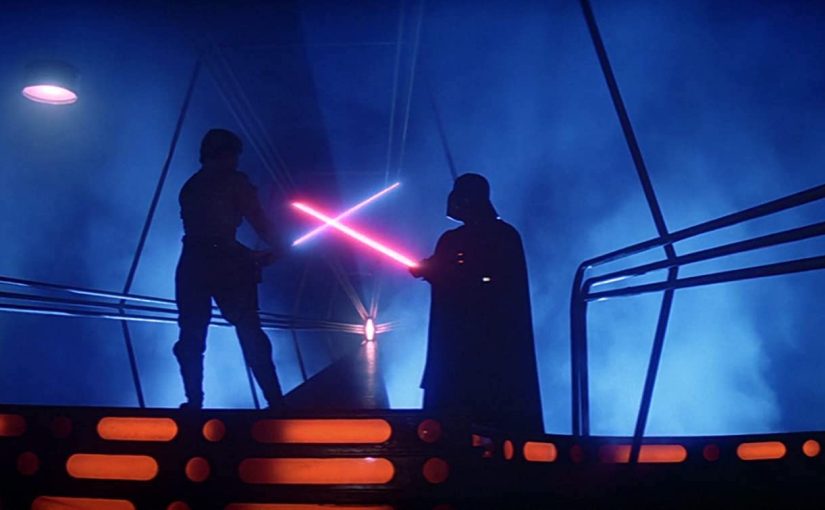
Masks are a theme I’ve always embraced in the Star Wars films. It’s not discussed enough actually. It’s ironic to me. Characters like C3PO or Darth Vader or Chewbacca and Boba Fett have these blank facial images to them. However, with the economics of Kasdan’s dialogue they say so much with brief statements of anger, despair (including a howl from Chewbacca) or worry. The expression physically never changes on C3PO’s face and yet I see different moods in the character thanks to the miming techniques of Anthony Daniels, the actor. A nod of the head will say something. With the practically silent Boba Fett agreeing to a contract with Vader, you see how methodical this bounty hunter dressed in dented armor really is. The character hardly gets any action scenes, yet you know how threatening he is. Every dent and scratch of his green armor tells a story. An aggressive walk shows a fear inducing Vader, one who is intolerant of any shortcomings. Sometimes Vader is simply matter of fact. If a minion fails in their assignment, he’ll force choke them and just walk away. As he duels with Luke, he simply puts his saber down when Luke is struggling with a massive wind current. We know that Darth Vader is cunning. So he hardly ever pushes himself further than necessary. We understand all of these characters’ emotions and motivations, and yet they are covered by masks.

The big surprise at the end of the film is the main crux that’s sustained the success of this sequel. It’s an absolute surprise out of nowhere but it seems to belong, as it is consistent with my belief in the mask motif throughout the whole film. There’s a veil draped over many developments of the film.

Allow me to digress. I’ve already discussed Yoda. Also consider other elements of the film though. Han decides to hide his ship from the Empire in the deep cavern of a large asteroid. Later, we learn it’s no cave. We also meet a charming new character named Lando Calrissean (Billy Dee Williams, who’s also great). He might not be what he seems as well. Since the first film came out, we’ve never had a full grasp of what or who Darth Vader is. He murdered Luke’s father and he’s someone or something in black. So, he must be the villain. That’s all we know, however. Yet, we eventually discover there’s something more. Because this is fantasy and science fiction with no roots in Earth based science, Lucas and Kasdan are well aware that they can color outside the lines and make up their own rules to this unfamiliar galaxy we are immersed in. Why not, actually? There are simply no boundaries.

A favorite scene of mine is when the Millennium Falcon makes a daring escape from that cave. It turns out to be the stomach of a giant slug…living in a rock…that floats in space! That’s the beauty of the original trilogy of Star Wars films, nearly anything could be put on the table, and it would be easy to accept and believe. In The Empire Strikes Back, almost every scene is layered and then further layered in imagination. Other storytellers would stop at just making this setting a cave and nothing else. It just might be shocking though. Put it this way, I’ll never forget taking my dad to see the special edition of this film in 1997. When the space slug revealed itself, dad burst out laughing. He didn’t see it coming. Kasdan hooks his audience with the furthest thing from your mind. When we got to the surprise ending, dad turned to me and actually asked me if he heard what he actually heard. When I showed the film to my daughter at age 6, her jaw dropped. How could a being dressed in complete black have any more depth to himself when I can’t even see what he looks like? The storyline of this film in particular is not aimed at any one demographic. Anyone could absorb the merits of surprise stuffed into this piece.

Empire is also admired for its firm stance to wrap up the film with an unhappy ending and cliffhanger. No other film has ever accomplished that so well. Much uncertainty is left to our imaginations. Will a character turn out to be dead? Is Vader’s revelation true, and if so then how does that explain the exposition delivered from Obi Wan? What does this “Jabba The Hutt” I keep hearing about actually look like? Was I looking at Vader’s brain or a human head underneath his helmet? What is Luke’s destiny? He didn’t do so well here. Could that lead to a worse fate? That scene for Luke in the Dagobah cave seemed quite foreboding, after all. Yoda implies “there is another.” Who could he be talking about, and what does that even mean? What about the conflict between the Rebellion and the Empire?

In the year 1980, the internet was not available as a means to spoil certain surprises and dismiss our own theories. We simply had the storytelling to work with. We had to wait three long years, speculating and discussing among our friends and family. It’s what maintained the strength of George Lucas’ space saga. The idea that we could play in the sandbox over a six-year period made these films more than just movies. They were events and they symbolized turning points in our lives. Personally, I discovered the magic of imagination. When I’m the writer the only rules I need to abide by are my own. That is most especially true with The Empire Strikes Back.

STAR WARS

By Marc S. Sanders

Of all the infinite times I have watched Star Wars (now also known as Episode IV: A New Hope), what remains appealing to me is the depth of its outer space setting. It would have to, right? Otherwise, what was the point of making action figures beyond the main characters, Darth Vader & Luke Skywalker? It’s a film where it’s just as important to get to know the extras seen in the film like a “Walrus Man” or a “Hammerhead,” or green skinned “Greedo.” Unquestionably, Star Wars is a film with a very, very rich and very deep setting.

What kept moviegoers coming back to the film time and again in the late ‘70s through the ‘80s and on into the next century, is that there is just so much to get accustomed to. One moment, you are adjusting to a summary scroll that opens the film with John Williams triumphant music, and then you are trying to familiarize yourself with an unusual ship that is being pursued by a much grander one within the depths of space while circumventing an orange planet. Laser shootouts occur with robots caught up in some kind peril, and then we meet a towering figure in black with an asthmatic, incessant breathing mask.

Later, we have to get used to small scavengers, and then scarier scavengers tormenting a boy on the cusp of adulthood who only dreams of adventure. The boy meets a mentor and then we are in a saloon with the oddest collection of patrons we could ever encounter. The film carries forward to daring rescues and escapes and a sword fight that may lack sophisticated choreography, but makes up for it with lightsabers and a surprising death that leaves an air of mystery. Before that’s all over, we still have to become enamored with the daring dog fights within space among battalions of one man piloted space ships.

That’s what has always kept Star Wars alive with much to celebrate. There is always something new and different just minutes away from the current scene you are engaged in. No two characters or bands of people look the same. No two settings look the same either.

Lucas always sought out to build a “used universe.” The ships and settings beyond the villains’ (known as the Empire) powerful Death Star space station were beat up and bruised and rusted and dented. This galaxy is lived in, and mired in a history.

Considering the film released in 1977 is somewhat telling of that decade. Films like The French Connection and Dirty Harry showed the ugliness of their respective cities and citizens with broken down cars and trash in the streets, and hoods with unkempt beards and worn-out clothing. Lucas must have carried these visions over to his PG universe to give viewers the idea that a guy like Greedo is a dangerous bounty hunter unconcerned with drawing his pistol in public, and a gangster like Jabba The Hutt rules a territory with a threatening criminal fist. (Incidentally, I strongly oppose Jabba’s appearance in the reissue of the film; better to imagine how vile this guy is in my own mind when watching the picture for the first time).

Lucas also famously takes inspiration from Akira Kurosawa’s Japanese films (especially The Hidden Fortress) of samurai culture, and blends it perfectly with a sci fi interpretation of the Old West gunslinger as seen in Sergio Leone’s spaghetti westerns.

Star Wars pleases so many different demographics of audiences because it jump starts its multiple stories and settings with what made going to the movies so appealing to begin with. Present within the film are humor, childlike appeal, fantasy, western motifs, suspense and romance.

It’s a visual classic that remains unmatched. At least with the original trilogy, Lucas never allowed any two settings to look alike. With this film in particular, we are treated to the contrast of a desolate desert planet vs the cold industrial operations of a ruling regime proud to carry out their actions with menace and terror. (More pleasing contrasts occur in the next two films.)

Star Wars is well known for the simplicity of its story. It’s main hero, Luke (Mark Hamill), is recognized for his basic innocence simply with his white tunic and mop top head of hair. Same can be said for the damsel in distress, Princess Leia (Carrie Fisher) and the fearful but sweet droids she sets out to embark on a mission. She evokes a royal and dedicated government in her white robe with elegant hairstyle; the droids have an expression of worry for the tall one, and spunky nerve for the shorter fat one, like a Laurel & Hardy pair. Villainy is epitomized with Darth Vader (voiced with commanding authority from James Earl Jones), who dons all black with a terrifying mask/helmet. You don’t know what Darth Vader really is beneath that dark costume. It’s not important for the exposition of this film. All that matters is that Lucas shows you who is good and who is bad. The visual references are enough for the explanations. What we need to know about these characters are summed up with the wise but elderly prophet in quick summation by Ben Kenobi (Alec Guinness, in an Oscar nominated role). Kenobi serves as the historian of this universe.

Over time, even almost immediately upon its release, the commercialization of Star Wars hogged the spotlight of the original product. It’s reflected today based on a measure of expectations both financially and within the fraternity of diehard fandom. Ironically, in 1977 everyone was satisfied with the surprise that George Lucas shared on the big screen. There were no objections to be found. Today, though, it’s become an act of trying to satisfy the masses by what they believe the next developments should be. I’m guilty. I admit to sometimes being an accomplice to that notion. It’s impossible to please everyone. So new film products in the Star Wars franchise will never succeed as well as the original film managed to do.

I don’t let any of that bother me. I remain pleased that I can still feel the sensation of pumping my fist in the air when Luke & Leia swing across the chasm thereby evading Stormtroopers, or getting a thrill when their pirate escort, Han Solo (Harrison Ford), finally lets loose of his quiet, cool demeanor to run down a hallway while trying to take out an army of baddies. I get a lump in my throat when Kenobi gives a slight grin before surrendering to Vader in front of Luke’s eyes.

So much is to be seen in Star Wars, but not all of it is explained. George Lucas completed his film with routes left to wonder and think about; he gave an opportunity to continue our imagination long after we finished watching the film for the first time. On the multiple occasions we watched thereafter, we pondered where we could get a table in the Cantina/saloon, or just how many droids the Jawa scavengers kept in their sand crawler.

As well, what did the blue milky substance taste like. More importantly why exactly did Luke’s uncle give a concerned glance across the dinner table to his aunt during a slight mention of his father?

That’s the magic of Star Wars. Like the land of Oz or Willy Wonka’s chocolate factory, there’s just so much to explore and think about and imagine beyond its surface. Long after we are all gone and our grandchildren’s children are beginning to stimulate their imaginations, they may well turn to the cartoons and other films and toys in the vast galaxy from long ago and far, far away. One thing is certain, though. They should ALWAYS begin with the original Star Wars.

BLADE RUNNER

By Marc S. Sanders

Ridley Scott’s Blade Runner is a technical and special effects masterpiece…however thin-very thin-its story may be. 

When the film was originally released in 1982, its period setting of November 2019 seemed unimaginable.  So, it was easy to accept that the dystopian future first conceived by author Phillip K. Dick (in his book Do Androids Dream Of Electric Sheep?) could actually happen.  With the Vietnam War behind us, and shopping malls becoming the happening place to be in our Members Only jackets and Jordache jeans with Swatch watches, the 1980s seemed like eternal bliss.  Middle class America felt prosperous and free and comfortable with a President on his way to eight years in office.  Bright pastel and neon colors took over.  A hopeless, dreary future was all but fantasy.  Therefore, just like Star Wars, a gritty, urban Los Angeles seemed like another possibility where science fiction had become as trendy as super hero movies are today.  It was cold and rainy and dirty, but we wanted to see that because that was nowhere near what we were living in, much less envisioning. 

Ridley Scott achieved greatness with visuals never thought possible.  George Lucas might have introduced moviegoers to desert and swamp planets and industrialist Death Stars, but Scott delivered an Earth where Coca-Cola, Pan Am, Atari and Cuisinart still existed amid a dark, rainy Chinatown section of Los Angeles with glowing umbrella handles, flying police cars and cabs, hovering electronic billboards, and exhaust flames that spewed out of the rooftops of cylindrical skyscrapers.  Ridley Scott might have supervised this palette of futuristic film-noir, but the real heroes of Blade Runner belong to its Oscar nominees Lawrence G. Paull, David L. Snyder, and Linda DeScenna for set decoration, as well as Douglas Trumbull (already a legend for 2001: A Space Odyssey), Richard Yuricich and David Dryer for visual effects.  All these years later, there’s much to explore within the appearance of Blade Runner, but the storyline still remains shallower than a puddle of water.

I’ve watched Blade Runner a number of times because fellow peers and colleagues carry such admiration for the film.  I cannot deny the first third of the film holds your attention as you acclimate yourself to this enveloping world.  Once your accustomed however, the story is what has to carry you through to the end, and the journey is as slow moving as a rickshaw on one wheel.  Harrison Ford is Rick Deckard, a blade runner and the best one there is.  Upon learning of an escape of four Replicants from an off-world slave site, Deckard is tasked with coming out of retirement to hunt down these Replicants and “retire” them.  Retire is the polite word for kill, exterminate, slaughter or execute.

A replicant is an android that looks completely human, bleeds like a human and talks like a human.  It’s near impossible to tell the difference on sight between a human and a replicant. As well, replicants are manufactured with four-year life spans and are not permitted on Earth.  They are intended for the sole purpose of slavery towards their human creators.  Yet, what makes them so exemplary or offensive?  What trait do they carry that threatens their human counterparts?  Racism often occurs because of fear derived from skin color or appearance.  Antisemitism will have you believe that Jews have horns growing out of their heads under their yarmulkas.  What is so terribly misconstrued or offensive or threatening about Replicants?  The film never makes clear, and that’s frustrating.  What makes a villain a villain?

M Emmet Walsh comes on early enough to tell us through dialogue that he needs the best of the blade runners back and that’s Deckard.  When I’m to understand that I’m watching the absolute best of something, whether it be a cop, lawyer, baker, student, doctor, painter or blade runner, I want to see what exactly makes them the best.  In Top Gun, I saw the aerial maneuvers that potentially justified why Maverick could be the best of the best fighter pilots.  The problem with Blade Runner and the script, written by Hampton Fancher and David Webb Peoples, is that I never see in its two-hour time span when or how Rick Deckard is such an exceptional blade runner.  How is a blade runner different from an ordinary cop or a simple person with a large gun?  No matter which of the various cuts of the film I’m watching, with or without Harrison Ford’s voiceover narration, I fail to see any outstanding fighting skills or clear thought-provoking intuition.  This guy is neither as good as Dirty Harry or Sherlock Holmes or even James Bond.  He’s not even as personable as Sam Spade, the original noir detective.  Rick Deckard just looks like Harrison Ford with a very large hand gun.  Furthermore, where does the term “Blade Runner” derive from?  Is it just there because it sounds cool?  The moniker wasn’t even created by Philip K. Dick.

The film’s eventual sequel, Blade Runner 2049, is a far superior film.  It’s longer, but it’s much more fleshed out in tone and character and understanding of its setting.  The original film stands on the heels of its cult like legendary status.  Some of the best filmmakers today cite Blade Runner as an influence in how they construct their own movies.  I buy that.  The assembly of whatever cut I’m watching is evident of how mind blowing its appearance is.  You can see some of the blue print visuals that carried over in to Christopher Nolan and Denis Villeneuve’s pictures. But I’m past all that.  Now I need to appreciate what it’s all there for, and who is playing in its yard. 

I cannot simply rely on IMDb trivia and endless social media sites that speculate on whether Deckard is a replicant himself, or why he dreams of a unicorn and why Ridley Scott opted not to include said dream in the original cut.  I cannot just tickle my curiosity with the picture’s eerie foreshadowing of the various product placements that suffered real life eventual downfalls after its release.  Beyond the visuals, what am I watching Blade Runner for?  This is not just a riddle in the Sunday paper.

The film boasts an eclectic cast that work well together.  I just wish they were provided with something much more insightful with background and personal experience.  Rutger Hauer became a familiar name following the release of this picture.  When he’s finally given the opportunity within the second hour of the film to come off as hideous and terrifying and strange, it’s worth looking at.  His famous “tears in the rain” closing dialogue is beautifully poetic, as it was personally written by him.  It’s as ambiguous as the film.  Yet, Shakespeare can be vague too.  I might not understand what anyone is talking about, but the performance can keep my attention.  Regrettably, he does not do much else in the film beyond his closing fight scene with Ford.  Ridley Scott insisted on casting Sean Young as Rachel, as her appearance was reminiscent of Vivian Leigh.  She’s intentionally mysterious as a likely replicant and/or niece of the wealthy creator of the replicants, Dr. Tyrell.  It works, but again, if the viewer is going to be questioned on the mystery of this major character early on, then why doesn’t the film follow further into that enigma?  You don’t have to say for sure, but at least give me evidence to argue one way or the other.  The same goes for the speculation on Deckard.  Had it not been for outside references, I’d never question who or what Deckard really is.  Daryl Hannah, Brion James and Joanna Cassidy round out the rest of the cast/replicants within the film.  Edward James Olmos is here too with a curious and odd habit of making origami.  They all have their unique way or look about them.  In science fiction, every character should stand apart.  Yet, again, it’s all about appearance.  What is the motivation here?  What is the motivation to live on earth or off earth?  What is the motivation to kill a human?  What is the motivation to kill a replicant?

I’ve beaten my head enough over this film.  Blade Runner has always been frustrating to me.  Maybe I’m not being fair to myself, as I try to find something else or some underlying layer each time I watch it.  Why do people love this movie so much?  Why does it consistently appear on “greatest of all time” tabulations?  Ultimately, I’ve come to the conclusion that I’m just pounding sand, or maybe as Rutger Hauer’s Roy Batty suggests, I’m impossibly looking for tears in rain.

MOONRAKER

By Marc S. Sanders

Roger Moore’s fourth outing as James Bond was supposed to be For Your Eyes Only. However, producer Albert R. Broccoli made a last minute switch before production was to take place. Two little known films called Star Wars and Close Encounters Of The Third Kind broke box office records and Broccoli went with “Moonraker” to piggy back on the science fiction trend. James Bond needed to launch into outer space. The effort proved profitable even if the story mostly fails.

A Moonraker shuttle is mysteriously hijacked from the Americans. After Bond survives being thrown out of an airplane with no parachute by the hulking assassin Jaws, he is assigned to determine what happened to the ship, and what purpose it is being used for.

Bond travels to California to introduce himself to Hugo Drax (Michael Lonsdale) with his samurai henchman Chang, and to Dr. Holly Goodhead (yes you read that right) played by Lois Chiles.

The issue with Moonraker is it suffers from a number of boring elements including Lonsdale, Chiles and even Jaws is watered down as he falls in love with a nerdy, pigtailed, blonde. Eventually, Jaws becomes a good guy and that’s when your eyes roll. Lonsdale is hardly any fun in his villainy. Chiles is not any more interesting than her character’s last name. Action scenes are bland beyond the airplane drop in the title sequence which has outstanding camerawork accompanied by the staple Bond theme.

Broccoli and returning director Lewis Gilbert (The Spy Who Loved Me) focused more on the science fiction cinematic trend with laser guns and laughable lack of effective zero gravity.

Broccoli became guilty of going with what was trendy with Moore’s 007. Blaxploitation with Live And Let Die, martial arts with The Man With The Golden Gun, Steven Spielberg’s Jaws, in The Spy Who Loved Me, and now science fiction in Moonraker. The sci fi doesn’t work so well for Bond or Drax’ diabolical scheme to destroy all human civilization and begin a new life in space.

Q provides Bond with a cool wrist band that shoots darts. That’s pretty fun.

As well, travel sites still hold up with destinations along the California coast, Italy with a gadget filled gondola and a glass shop fight, and Rio De Janeiro where Bond faces off against Jaws along the tops of two cable cars and engages in a boat chase. Then of course Bond eventually reaches Drax’ satellite base in space. None of it is unwatchable. It’s fun. It’s just not comparatively as exciting as prior Bond adventures before, and still to come.

Moonraker is just a little too weightless.

It should be noted as well that sadly, we also say goodbye to Bernard Lee as M, head of the Double O section for the last eleven films. He’s here to remind 007 that the British government can’t afford any slip ups. The whole series thus far was only better because of Lee to emit humorous aggravation in response to Bond’s relaxed and sarcastic response to the government risks at hand. Bernard Lee deserves recognition.

her

By Marc S. Sanders

Director/Screenwriter Spike Jones is a master at adding multiple dimensions to what we always know exists. It’s been evident in his prior films, Adaptation, Where The Wild Things Are, (which I did not care for personally), and most especially in Being John Malkovich. He plants the seeds of fantasy in what we can normally touch, hear and see. Then his elements of fantasy receive a supportive crutch from what his viewers have always been familiar with.

her is another masterwork; a film that takes place in the not too distant future that expounds on our current digital age. If we can already talk to “Siri” or “Alexa” and trick–umm, excuse me, “her” (I mean “Siri”) into making sophomoric dirty jokes, then of course we are bound to approach the stage where we can literally, truly fall in love with her and then she can reciprocate.

With her raspy yet silky vocals, Scarlett Johansson is inspired casting as the voice of “Samantha.” Had she actually had a physical presence in the film I would have totally fallen for her affections. The film hinges on the performance of Joaquin Phoenix as Theodore. If we can’t believe that he loves “Samantha” more than he loves himself (a surefire test of true love as far I’m concerned) then “her” falls apart. Phoenix passes abundantly. He deserved his Oscar nomination.

From the start, you become very accustomed to the banter between Theodore and his electronic device voiced by “Samantha.” Both have personal feelings. Both have personal longings (more especially “Samantha” the computer, of all things!!!).

Spike Jonze explores all the diameters and dimensions of a loving relationship. The ups, downs, and in betweens. What’s different is how all of these layers of a relationship are received in this currently fictional (bound to come true, one day) dynamic of a relationship. Theodore and “Samantha” are affectionate. They argue, they laugh, they even make love. Watch the movie to understand that last point. It happens, and it is perfectly executed with the residual effects of their lovemaking bringing the film into its next act brilliantly.

Jones won the Oscar for original screenplay simply for how innovative this picture is. I’m not sure it’s the most exciting two hours of film, however. Personally, I think other films in this category back in 2013 had sharper and more interesting scripts. her is practically all talk and when it ended, I was ready for it to be over, and it concluded as I expected.

Still, Jones is fortunate that his cast (Johannsson, Phoenix, Amy Adams and Rooney Mara and Chris Pratt) trusts him. If they hadn’t, this movie would have lost its magic by probably how absurd this script must have originally been perceived on paper. Well done work by all involved but credit has to begin with Jones, the screenwriter.

ANNIHILATION

By Marc S. Sanders

Science Fiction/Horror for the thinking viewer is the best way to describe this film.

Director Alex Garland has found a way to make a viewer’s eyes pop, not just with fear but with the unimaginable. This is as good an effort or better than his other well known film, Ex Machina. I foresee it will not be long before Garland is recognized among the ranks of today’s most notable and popular directors like Del Toro and Nolan.

This is not a run of the mill monster movie. This is fictionalized science that seems foreign and strange, yet makes complete sense by the time the credits roll. All questions are thankfully summed up despite a hanging thread or two to relish in deep thought long after the film has ended.

Natalie Portman strongly leads a nearly all female cast to uncover the purpose and functionality of “The Shimmer.” She does so, but at what expense? She’s great and believable in her role with lots of dimension by way of her career as a Johns Hopkins professor/former army infantry soldier and through periodic dreams of sin she feels guilty over.

Jennifer Jason Leigh does her best no nonsense disturbing creep. Gina Rodriguez makes good transitions in levels of sanity.

Like Black Panther, I’d argue this is also a front runner for art direction as an encapsulated swamp is overrun with strange pastel plant life, mixed up animal life and cinematic lens flare. Yes, here the lens flares serve a narrative purpose which is why the cinematography should also be given some recognition.

I’m looking forward to seeing this again to uncover what I missed the first time.

Annihilation turned out to be one of the biggest surprises of 2018.