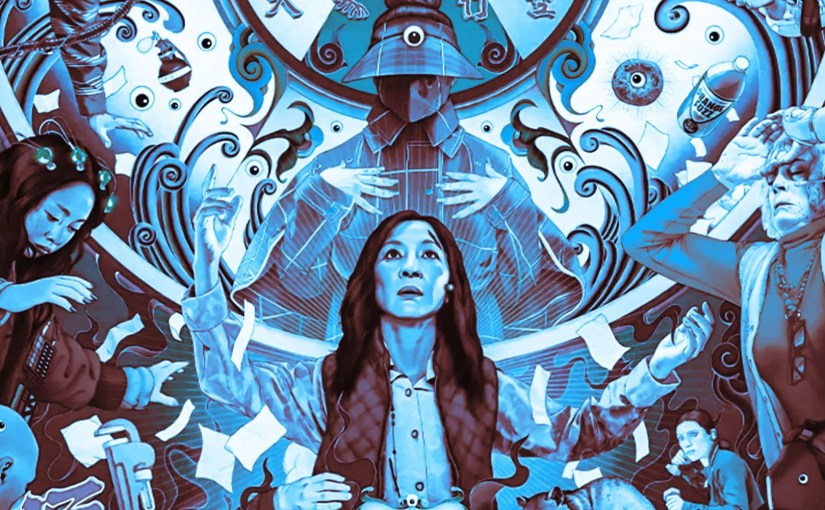
EVERYTHING EVERYWHERE ALL AT ONCE

By Marc S. Sanders

Exploring the science fictional context of parallel universes can turn your thought process into a tailspin.  It can leave you up at night trying to find the center of a never-ending spiral.  Maybe that is why this gradually more common story line is reviving itself in current films like the next Doctor Strange installment from Marvel, or DC’s The Flash with multiple Batmans, and the unexpected surprise of Everything Everywhere All At Once.

My first experience with a multi-verse concept happened one Saturday morning in the early 1980’s.  At age 7 or 8, my favorite cartoon, Hanna Barbara’s Superfriends, explored a Universe of Evil.  Following a volcanic eruption, an evil Superman exchanged places with the noble Superman that we all know.  They each found themselves in opposite universes.  For the good Batman, there was an evil Batman, dressed in pink.  (Pink is evil????)  Evil Robin had a mustache itching to twirl.  Aquaman had an eyepatch.  Later, I hypothesized that this simple plot catered for kids was likely inspired by the famous Star Trek episode Mirror, Mirror.  (Evil Spock donned the evil goatee. Mwah ha ha ha ha!!!!!) These two storylines, which I highly recommend you seek out and watch, were very cut and dry in the concept of multiple universes.  There was a Yin and Yang structure of just black and white.  Everything Everywhere All At Once welcomes diverse complexity in its storytelling.  In this film, nothing is black and white.  Instead, everything consists of infinite shades of grey and gray.

The Wang family are Chinese immigrants buried in demanding and overwhelming tax obligations from the IRS while trying to manage a California laundromat.  Evelyn (Michelle Yeoh) is the matriarch who is married to Waymond (Ke Huy Quan) and they have a daughter Joy (Stephanie Hsu).  Upon visiting the IRS agent assigned to their case, Deidre (Jamie Lee Curtis, who finally found something else to do besides another Halloween retread), odd occurrences take place.  Evelyn is warned by Waymond with suddenly a strange and very different personality to act upon their current situation, like getting off an elevator and turning to the right, not the left.  Just trust me when I say that while you will likely be bewildered for a while as the exposition unravels itself, it will all pay off satisfyingly.  Somehow in another universe that is performing parallel to the one we first see in the film Joy is a villain bent on destroying Evelyn…and that’s not even half of what’s out of place.

I saw this film directed by the “Daniels” (Dan Kwan and Dan Scheinert) with my Cinephile colleagues, Miguel and Thomas.  After it was over, it was no surprise that they knew what I was talking about when I said this film is the reason why good editing is necessary in a film.  Because the Daniels introduce not one or two parallel universes, but SEVERAL, and there is so much happening…well…all at once.  I’d argue most shots in the film last no longer than an average 8-10 seconds because the multiple universe equivalents of Evelyn, Waymond, Joy and Deidre switch on a blink of your eye.  I warn you not to make a quick bathroom exit.  Quick flashes of scenes are relevant towards something else you may see in the next minute or an hour later.

Anyway, I’ll bet you never realized that there is a universe where the people have raw hot dog like fingers.  There’s also a universe where Evelyn is a street sign twirler, and a good thing there is an Evelyn like that to help another Evelyn fend off of a bunch of attackers in a different universe.  There’s also a world where humanity doesn’t exist.  Yet the equivalent of Evelyn and Joy are represented by two rocks.  That’s right.  Rocks with no limbs, no way of speaking vocally.  Yet, the film cleverly has the characters or products of its earth communicate with one another.  There’s even a different variation of the Pixar creation, Ratatouille.  Replace the rat with a racoon and see what transpires.

So, what does this all lead to?  Fortunately, there is a reason for these different worlds to collide and it leads to a valuable lesson in love and understanding within family.  Now that may sound hokey, but the film demonstrates that none of us are the same in what we are affectionate about, or what’s important to us.  How a daughter considers a girlfriend is not going to be easy for a mother to accept as any more than a friend.  The Daniels’ film carries much profoundness among its silliness depicted on the surface.

Having only seen Everything Everywhere All At Once one time so far, I could not help but laugh often and uncontrollably at what I was looking at, and the laughter becomes contagious when watching the film in a crowded theatre.  What made my movie going experience with this film quite fascinating though is that I responded in tune with the rest of the crowd.  Once you get past looking at Michelle Yeoh and Jamie Lee Curtis (two recognizable and accomplished actors) flap their hot dog fingered hands at each other, eventually you recognize the “normalcy” of that particular universe.  You are no longer laughing with them.  Now you are accepting the people and how they function in that specific environment.  Same goes for the rock universe.  The Daniels are brave enough in their direction to just show two inanimate rocks perched on a ledge and communicating with subtitles of very aware and well written dialogue.  It looks completely crazy at first.  Later, you yearn for the impending destiny of those rocks.

Much symbolism is tucked into the Daniels’ script as well.  The most telling is that it focuses on an Asian immigrant family obligated by law to honor American tax codes.  The Deidre character portrayed by Jamie Lee Curtis is not so empathetic to the Wangs’ comprehension of resolving tax violations.  Basically, two different cultures are butting heads with no progress because they have a different viewpoint on how things function.  Wisely, this serves as a springboard to demonstrate how multiple universes will lack perfect chemistry as well when they collide.  None of this is written off as communication barriers.

I imagine on a second viewing, I likely will look at Everything Everywhere All At Once through a different lens.  I won’t laugh as much because I’ve grown acclimated to what were once very odd and strange environments for these characters that dwell within.  Instead, I’ll be even more observant and appreciative of the film as it presents different behaviors and cultures encountering one another.  This is a very good picture that is worth multiple viewings for sure.

In fact, this film is such a pleasant surprise, that I am comfortable suggesting this early on that I will consider it one of the best films of 2022.  If at least Everything Everywhere All At Once does not receive an Oscar nomination for Best Screenplay, then it would be a terrible disappointment.  The imagination of its endless devices is just so inventive.  Heck, I’ll throw my hat out there and strongly suggest nominations for Michelle Yeoh’s performance, along with Best Editing for Paul Rogers (this guy should win the award) and Best Picture of the year.

See Everything Everywhere All At Once in a movie theatre with a crowd and/or a large group of friends.  You may just have a cathartic experience of how human nature responds when getting acclimated to what at first appears to be so foreign.

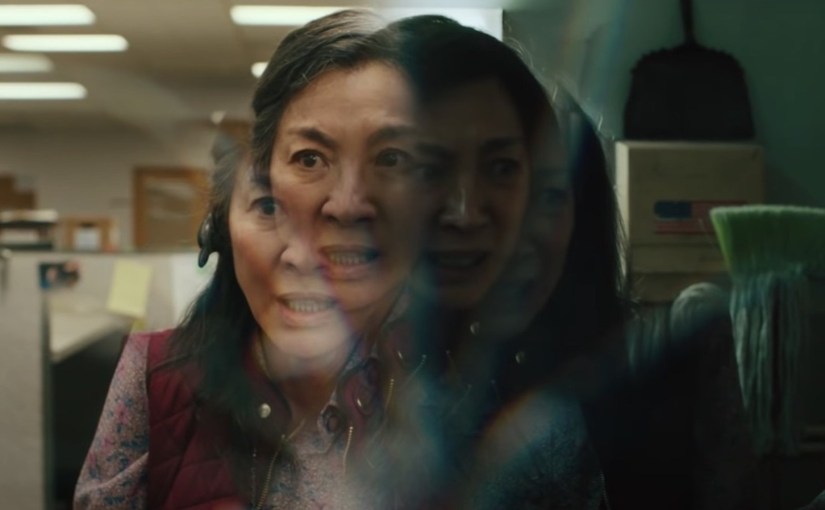
THE BOOK OF ELI

By Marc S. Sanders

Do you believe in the word of God?

The Book Of Eli directed by The Hughes Brothers will make sure you do.

Faith carries Denzel Washington’s loner character on a journey through a grim, sunburned post apocalyptic wasteland as he protects a rare, sacred text. He has been on a sojourn to reach a final destination out west.

Me, being the religious skeptic these days, might normally find the convenient episodes of survival that Washington encounters as far fetched. However, The Hughes Brothers direct a script penned by Gary Whitta that never mocks the purpose of the film presented. As a viewer it would be rude of me to laugh at how Washington continues to walk when it seems he’s getting shot in the back. I wouldn’t dare misbehave in that manner. Watching The Book Of Eli…well…I feel like I’ve gone to church.

The Loner carries a book he faithfully reads every day as continues his long walk through treacherous, barren and motorcycle pirated lands. If the sun doesn’t blind him and kill him, the various marauders might.

The worst adversary of this bunch is Gary Oldman in yet another treasured villain role. Oldman keeps a tight authority on an “old west” inspired town, commanding from his comfortable leather chair in the upstairs level of the town’s bar (saloon, perhaps?). He’s been tirelessly dispatching men to find a particular book and perhaps it’s the one that The Loner possesses.

Post-apocalyptic wasteland, a book, a Loner, a villain. That’s the structure of this film along with some side characters like an impactful Mila Kunis and Jennifer Beals. Very simple ingredients allow for well edited moments where Washington can display his unexpected fighting techniques with a gun or a shotgun or a forearm length sword. When he exercises these moments the scenes are outstanding. Oldman is the guy who sits back letting his own horde do the dirty work and only acts when he sees that he has an upper hand. He’s oily, scary and in this dense waste of a future he likely dreams of being a prophet or a high powered evangelical might.

I was so pleasantly surprised by this film. Post apocalyptic films wear on me these days. How much is there to show that I haven’t already seen like abandoned cars, skulls, and deserted highways?

This is different however because Whitta’s script offers a reason to live through this hellish void. I had to wait for it but the ending is a very satisfying conclusion. I loved it, actually.

The Book Of Eli is a great film.

EVERYTHING EVERYWHERE ALL AT ONCE (2022)

by Miguel E. Rodriguez

Directors: Dan Kwan, Daniel Scheinert
Cast: Michelle Yeoh, Stephanie Hsu, Ke Huy Quan, James Hong, Jamie Lee Curtis
My Rating: 10/10
Rotten Tomatometer: 96% Certified Fresh

PLOT: A middle-aged Asian woman tries to do her family’s taxes with mind-bending results.


Every once in a while, a movie comes along that is so daring and original that any attempt to accurately describe it feels futile.  Scott Pilgrim vs. the World was one of them.  Being John Malkovich was another.  And now comes Everything Everywhere All at Once, a sci-fi action brainteaser that feels as if it were written by Terry Gilliam and Quentin Tarantino and directed by Stephen Chow (Kung Fu Hustle, Shaolin Soccer…two movies that also meet that “indescribable” criterion).  It feels like an episode of Black Mirror crossed with Jackie Chan and a dash of David Lynch and Terrence Malick.  If you can’t find anything to like in this movie, check your pulse.

Evelyn Wang (Michelle Yeoh) opens the film trying to do her family’s taxes.  She and her husband, Waymond (Ke Huy Quan – “Short Round” from Temple of Doom!!), carry stacks and stacks of receipts to their local IRS branch and try to explain to their case worker (a dowdy Jamie Lee Curtis) how a karaoke machine can be deducted as a business expense.  However, before that can happen, after a series of very strange events involving Waymond and a pair of Bluetooth headsets, Evelyn finds herself immersed in a trans-dimensional battle between the forces of good, led by an alternate-universe version of Waymond – the “Alpha Waymond,” if you will – and someone called Jobu Tupaki, a being or person who is hunting for Evelyn in every conceivable parallel universe.  All Evelyn has to do is use these weird headsets to access the infinite multiverse and harness the skills learned by the infinite Evelyns before Jobu Tupaki can track her down and kill her.

To access the multiverse in such a way, one must commit random acts of…randomness, which leads to bizarre scenes of individuals doing some very weird things to access special skills.  What kind of weird things, you ask?  Things involving…sticks of lip balm, putting your shoes on the wrong feet, saying “I love you” to a stranger, or wiping someone else’s nose for them and…well, use your imagination.

That’s seriously just scratching the surface.  I haven’t even mentioned Evelyn and Waymond’s daughter, Joy; their laundromat; Evelyn’s elderly grandfather, Gong Gong (veteran character actor James Hong – 450 film and TV credits and counting); or the divorce papers Waymond has on his person.

This movie is a trippy, joyous, tightrope-walking masterpiece.  There are moments where you can sense it tap-dancing on the line of self-parody, then jumping over it and daring the audience to go along with it.  If there are some people that say they were unable to follow where this movie leads, I can’t really say I’d blame them.  Not many movies would ask you to take it seriously, then include a scene involving two rocks having a conversation via, I guess, ESP.  Or where the two lead characters turn into piñatas.  Or where Jamie Lee Curtis staples a piece of paper to her own head.  Or where the fate of the world might hinge on who gets their hands (in a manner of speaking) on a trophy shaped like…a very specific kind of toy.

HOT DOG FINGERS, people.  HOT.  DOG.  FINGERS.

I’m frankly amazed this movie didn’t collapse on itself.  There are so many ways it could have gone wrong, and so much it wants to say, while trying to be simultaneously massively entertaining and heartbreakingly poignant.

From a technical standpoint, I think it’s the frontrunner for the Best Film Editing Oscar for 2022.  This movie jumps from one parallel universe to the next and the next and back again so frequently that I got whiplash, BUT it was never confusing or mystifying.  It was always crystal clear what I was watching and why I needed to see it.  I could list any number of films or TV shows that have attempted this kind of thing on a much more modest scale and failed.  This is like the Who Framed Roger Rabbit of film editing.  It has been done so well and on such a grand scale that it seems unlikely anyone will try to tell this kind of story in the same way again.

Some may quibble at the mildly melodramatic resolution of the conflict among Evelyn, the “Alpha” universe, and Jobu Tupaki.  I can understand that viewpoint, but honestly, I just rolled with it when it came around.  And so did the theater audience I was with the night I saw it.  We all laughed uproariously on cue, sometimes for something funny, sometimes in sheer disbelief at what we had just seen.  But when the wrap-up started to come together, we all hushed and waited to see what would happen.  Even when it involved a parallel universe with something called Raccacoonie.  (It’s a long story…)

I hope I’ve conveyed how crazy good this movie is while preserving some of its best surprises.  I haven’t felt this urgent about getting the word out about a great movie since I saw Roma.  To call this an entertaining night at the movies does a serious injustice to the words “entertaining” and “movies.”  It’s more than entertaining and, not to get too hyperbolic, this is more than a mere movie.  It’s a masterwork, a collision of grand ambition and even grander moviemaking.  I plan on seeing it at least once more in theaters, if only just to see what I may have missed the first time around.  (And maybe also to tune more carefully into audience reactions at key moments, like the performance trophies, or those two rocks.  Who knew two rocks could be funny?  Like REALLY funny?)

E.T. THE EXTRA TERRESTRIAL

By Marc S. Sanders

It’s easy to give credit to a magnificent script by Melissa Mathison when talking about E.T. The Extra Terrestrial.  However, director Steven Spielberg clearly invented tricks of his own off her page.  Thus, E.T. strikes a chord with me on a very personal level. 

While my parents never separated or divorced, in my adolescent years I did not have any kind of relationship with my father.  He left for work at 4:30AM and would not come home until nine at night.  He worked Saturdays as well.  I hardly saw him.  He hardly conversed with me.  One time, later on in life, he explained to me that he just never knew how to connect with a child.  It was only then that I understood why his response of “Oh wow!” amazement seemed so fake when I showed him how the wings pop off of my Star Wars TIE Fighter.

Mom was the constant in my life with regular Saturday trips to Burger King, and the comic book and toy stores, while singing along to Barry Manilow in the car.  The adults I viewed in my childhood were mom and my grandmother, Helen.  So, I understand why Steven Spielberg opts to only include Mary (Dee Wallace), the one adult in full focus through most of his picture.  Mary has recently separated from her husband leaving her to tend to their three children. Gertie (Drew Barrymore) is the youngest. Michael (Robert MacNaughton) is eldest.  Elliot (Henry Thomas) is the middle child and main character of the story.  These kids have no other important influence in their lives except their mom and maybe Michael’s buddies.  Their father is only mentioned to be vacationing in Mexico with his new girlfriend, but never seen.

After an alien ship departs Earth while looking for plant life in a California forest, one of the passengers is sadly left behind.  Through a series of suspenseful moments, Elliot welcomes the stranger from a strange world into the comfort of his room full of toys and games.  A connection is immediately made of trust and friendship, but on a science fiction level, there is also psychic bond.  Somehow, Elliot and E.T. share one another’s thoughts and can feel what the other feels.  In a humorous moment, E.T. gets drunk on beer while being left at home alone.  This leads to disruptions caused by Elliot during a frog dissection scene in science class.  Even deeper though is that E.T.’s biological make up doesn’t appear to be suitable for a long stay on Earth.  As E.T. gets more and more ill, so does Elliot.  It is up to him and his siblings to help their new friend “phone home” so he can be rescued. 

The interference in all of this are the government officials who are surveying the suburban neighborhood for clues on E.T.’s whereabouts.  Wisely, and because Mathison’s story is told primarily through the perspective of children, Spielberg shows these men from the waist down.  After all, if Elliot and the others can’t identify with these adults, why is it necessary to show their faces? (In Jaws, the townsfolk can’t identify with the man-eating instincts of a great white shark.  So, why is it necessary to show the animal?)  One adult in particular is a man who has a keychain clipped to his waist.  The film credits the character simply as “Keys” (Peter Coyote).  Only when the safety of Elliot, E.T. and the family are intruded upon in their home, does Spielberg show the faces of these scientists and G-men.  Still, most of them are displayed with intimidating radiation suits and masks on.  If they absolutely have to be shown, then they are going to look more obscure and threatening then any alien from outer space.

E.T. The Extra Terrestrial will always remain as of one Steven Spielberg’s greatest achievements.  That’s saying quite a lot considering his other films like the Indiana Jones series, Schindler’s List, Jaws and Saving Private Ryan.  What sets this picture apart from those others is the gamut of emotions it sends to the generations of audiences that continue to watch the movie over and over again.  It’s very funny at times.  It’s also very scary, and it can be very sad as well.  At one point, Elliot has to explain why a daring escape for E.T. must occur because “This is reality, Greg!”  Of course it is, no adult would ever believe what they’re involved in.  It takes a child to comprehend this wonderment.  The unknown is frightening as well.  What exactly is leaving footprints behind in the shed?  Is it a goblin?  Also, why are frightening looking figures with helmets and astronaut suits barging out of bright light into every doorway of their home?  As well, how does someone from another place adapt to a foreign environment of stuffed animals, flowers, and what’s on T.V. or in the refrigerator?  In two hours time, Spielberg answers for all of these dynamics. You develop a kinship with not just E.T., the cinematic creation, but also the kids who snap at each other and sometimes affectionately curse and tease one another. 

You also feel the sadness of a mother who is trying her best to uphold a home while hiding a sense of abandonment herself.  E.T. was left behind, but so was Mary.  Dee Wallace provides an exceptionally tear-jerking experience on Halloween night.  The following morning, she is distraught to find a missing Elliot finally return home with a high fever.  I see my mother in that scene each time I watch it.  Now that my mom is gone, it’s even more meaningful.

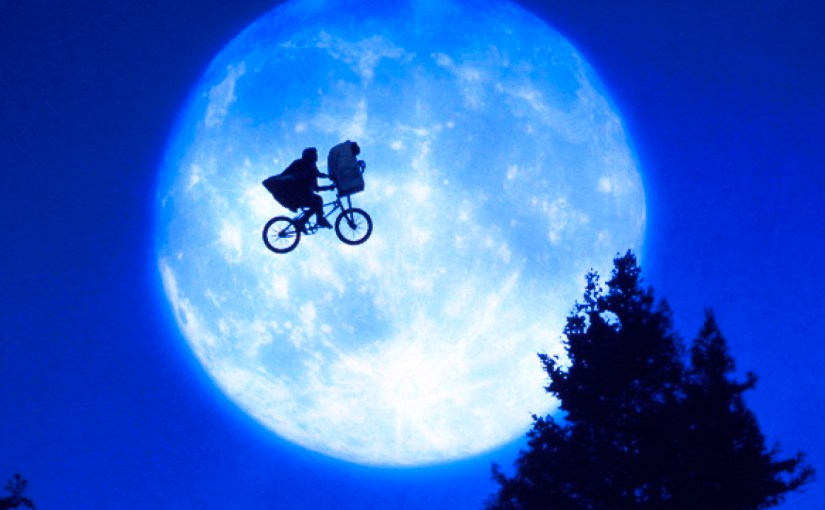
Spielberg’s film also works beautifully with an original score from John Williams.  Williams’ music speaks a language for the characters of the film.  Sometimes, his orchestration is foreboding as someone unseen lurks nearby.  Other times, it soars as the adventure kicks into gear with an outstanding bicycle escape from the government.  Williams also relaxes the pulse of the audience for the tender moments while a friendship of love and support is being built.  Watch how the score enhances the fantasy when E.T.’s fingertip glows and heals a cut on Elliot’s hand.  Williams hits a note that is in sync with Henry Thomas’ amazement.  The best sample of Spielberg’s craft blending well with Williams’ work is when Elliot’s bicycle soars into the sky with E.T. as a passenger.  As they ride across the backdrop of a full moon midnight clear, this movie provides one of the greatest shots in film history.  If there was ever a reason to prove why an original score is so necessary in film, it’s important to use E.T. as an example.

Steven Spielberg was especially sensitive when making E.T. The Extra Terrestrial.  I saw an interview with him where he decided that once E.T. departs the children of the story, the actors themselves would never see him again.  He insisted on that with young Drew Barrymore and Henry Thomas, and he warned them in advance.  Because he was steadfast in that decision, their performances were all the more genuine.  Their tears of love and sadness were kept authentic.   In one documentary, footage following the end of shooting with E.T. shows Barrymore completely distraught in the comfort of Spielberg’s arms.  Spielberg knows that everyone suffers loss.  It’s a rite of passage in life.  My first loss was my grandfather at age 9.  Imagine coming to the understanding for the very first time that someone you’ve grown close to will never be seen ever again. 

That’s the magic that Steven Spielberg possesses.  He can make anything feel real.  His fantasies and frights are true in nature.  Nothing appears ham-handed.  When watching a film from Spielberg, you’re enveloped in its environment.  What’s in front of you is what will terrify you or laugh with you or make you cry.  What you are seeing, and hearing will allow you to reminisce on a time in your life when you were scared or sad or happy or lonely.  Steven Spielberg might have used people from outer space in his films to tell us that we are not alone.  However, we are also not alone in our feelings.  Steven Spielberg reminds us that we all encounter these emotions at point or another and therefore, there’s nothing wrong with responding like any other human being would. 

SNOWPIERCER

By Marc S. Sanders

Korean director Bong Joon-ho’s sci fi thriller Snowpiercer is a locomotive fast paced adaptation, that oddly enough is reminiscent of The Wizard Of Oz. There’s no yellow brick road however. Here, the on foot journey occurs on a massively long on going train that contains the last survivors of a frozen apocalyptic Earth.

Each car of the train separates the demographic classes of this populace. The one percenters live it up closer to the front of the train. The steerage and lower class are resorted towards the back, forced to live in filth and nourish themselves on protein bars made of vermin and waste. Chris Evans is the hero who leads the pack from the back to the front. They’ve had enough and they will not be restrained any longer. However, who and what resides up there? Let the journey into the unknown begin.

I liked Snowpiercer a lot, and mainly because the surprise of what was next kept me alert. An especially fun moment occurs when the gang comes along the car where elementary school is in session.

Characters are met along the way, including a warped performance from Tilda Swinton. She’s dressed in uniform regalia that David Bowie or Elton John might have worn to mock totalitarians. Her performance matches her wardrobe. She definitely makes her antagonist role her own with her pale complexion, short stark red buzz cut, weird dialect and large false teeth.

John Hurt is also a welcome surprise as the old wise one that is needed for these roles. He’s doing his basic John Hurt but that’s all we need.

Rounding out the cast is Octavia Spencer. She’s good too with lots of energy. A great pair up also comes from Song Kang-ho and Ko Asung as techies who can assist the band with opening doors from one car to another; allies that are encountered along the journey to see the wizard or the one in the engine car. I won’t dare spoil that surprise. The cameo was welcome in my eyes.

The journey is great.

The final moments of the film are a little short sighted though. It’s a great action set up but when everything settles down, not much is offered for a final statement on the grand outcome. I wanted more from that.

This is, however, worth checking out. Snowpiercer might consist of a ridiculous concept with all life residing on a never stopping train, but the set pieces are great fun, as are the characters.

GUARDIANS OF THE GALAXY

By Marc S. Sanders

Forgive me! I’m going into the woods or, rather, outer space a little on this review.

Director James Gunn brings new perspective to Marvel Studios’ Guardians Of The Galaxy, by recognizing the one instinct that every person possesses but is not acted upon often enough…the instinct to dance.

I love to watch characters (not part of a standard song and dance musical) break out into dance. It comes out of nowhere while it humanizes the person. I write my own plays that way, and I award my characters the opportunity to dance as well. I love it when I see it because it’s always a surprise and always welcomed with a smile. Think of that great moment in John Hughes The Breakfast Club, when the five kids let it all out after they’ve let it all out among themselves in confidence. Look at Eddie Murphy boogie in a night club in 48 hrs and Beverly Hills Cop, and look past the crappy script of Footloose for one of the silliest and most fun dance soundtracks to bop your head to. That last bit offered some inspiration for James Gunn especially. Dancing is needed in life. Dancing brings a surge of security as we shed our inhibitions for a fleeting moment. James Gunn reminds his audience of that. If you can’t smile and tap your toe to at least one fresh minute of GOTG then I worry for your soul.

Try not to smile when you first see lead hero Peter Quill aka Star Lord shake, slide and lip sync out by himself on a marooned, wasted planet to the melody of Come And Get Your Love by Redbone. Yes. Don’t deny it! Your head was shifting and your foot was shaking when you first saw this moment.

Gunn hit on all the right notes with a film that could have torpedoed straight to B class junk in another director/writer’s hands.

GOTG focuses more on the humor than any of the zippy outer space special effects. Everyone is having a good time, even the bad guys.

The story more or less focuses on the pursuit and take away/get back of a MacGuffin. Because that’s so simple, Gunn doesn’t have to concern his script with logic and over plotting. Instead, he can offer time for great naive one liners from brutish Dave Bautista as lovable Drax The Destroyer (do I really need to explain this character? ) and Rocket Raccoon (do I really need to explain this character as well?). There’s a giant tree named Groot who will happily tell you “I am Groot” in case that wasn’t clear to you, and a tough as nails, green skinned Gamora played by Zoe Saldana. She, along with Chris Pratt as Quill, have great chemistry together as they develop a caring friendship amid their competitiveness and wacky action. A pause in the play to allow a sway and flow dance for Saldana and Pratt to Elvin Bishop’s Fooled Around And Fell In Love is hypnotic as Gunn stages it against a gorgeous purple galaxy sky with random yellow sparkles raining down. I could stay in that scene forever.

Main focus goes to Quill who pirates the galaxy while not knowing much about his father and keeps the memory of his Earth mother alive with her “Awesome Mix Tape Vol 1.” He’s a lone pirate with no allegiance, and happily scavenges items for pay from the highest bidder. Pratt has fun with his breakout cinematic role. He laughs, he teases and yup, he dances.

On a first viewing, GOTG can leave you a little bewildered as you try to comprehend what weird name belongs with what weird character and what is everyone talking about. Your next viewing will feel like an invitation to a night club because you’ll realize whatever exposition Gunn’s script offers is really not significant.

James Gunn offers a pleasure piece of sights and musical sounds. One motif I like about his fictional galaxy is that no two characters look the same. It reminded me of George Lucas’ first Star Wars film. The famous cantina scene never shows two of the same species of alien. That’s all that’s needed to imply the vastness of the population. Unlike the Aquaman, James Gunn doesn’t feel the need to show you every inch of this universe to prove just how big it all is. He adopts the means of many extras all with their unique look.

The villain is Lee Pace, a guy who’d make a great Bond villain actually. He’s hidden behind a lot of costume and makeup as Ronan, and maybe he could’ve been given more to do. There’s not much one on team time between him and the Guardians.

Other fun moments abound though, including a ridiculous daylight chase through a busy planetary downtown, and a ridiculous prison break led by Rocket and Groot that reminded me of a lot of the Zucker brothers humor from their Airplane! and Naked Gun films.

James Gunn manages the biggest and bravest departure from the Marvel Cinematic Universe and it’s oh so right and necessary to keep the franchise alive and fresh.

Guardians Of The Galaxy is Marvel Studios’ answer to Looney Tunes and The Muppets. The great Mel Blanc and Jim Henson would have applauded a ridiculous film like this for years on end.

ARRIVAL (2016)

by Miguel E. Rodriguez

Director: Denis Villeneuve
Cast: Amy Adams, Jeremy Renner, Forest Whitaker, Michael Stuhlbarg
My Rating: 9/10
Rotten Tomatometer: 94% Certified Fresh

PLOT: When 12 alien spacecraft descend to Earth at seemingly random points around the globe, a linguistics expert (Adams) is recruited to interpret the aliens’ speech in order to find out why they are here, among other things.


“If you could see your whole life from start to finish, would you change things?” – Louise Banks (Amy Adams), Arrival

That seemingly simple question lies at the heart of Denis Villeneuve’s sci-fi brainteaser, Arrival.  Surrounding it is a film of uncommon grace, beauty, and intellectual stimulation that deserves comparison to Kubrick’s 2001 or Tarkovsky’s Solaris.  When I first saw it in 2016, I’ll admit to some slight confusion at the end, but after many repeat viewings, I believe I understand it fully enough to call it a masterpiece.

After a prologue where we witness a montage of her losing a daughter to an unnamed but ravaging disease, we see Dr. Louise Banks (Amy Adams) teaching linguistics at a university.  Classes are interrupted when news breaks of not one, but TWELVE alien spacecraft suddenly appearing at random points around the globe.  Eventually, the military contacts her and reveals that contact has been made between us and the aliens, but to say we can’t comprehend their language is an understatement.  She and a top-notch mathematician, Ian Donnelly (Jeremy Renner) are flown to the US sites in Montana and are given an impossible task: decipher the alien language and ask them why they’re here.

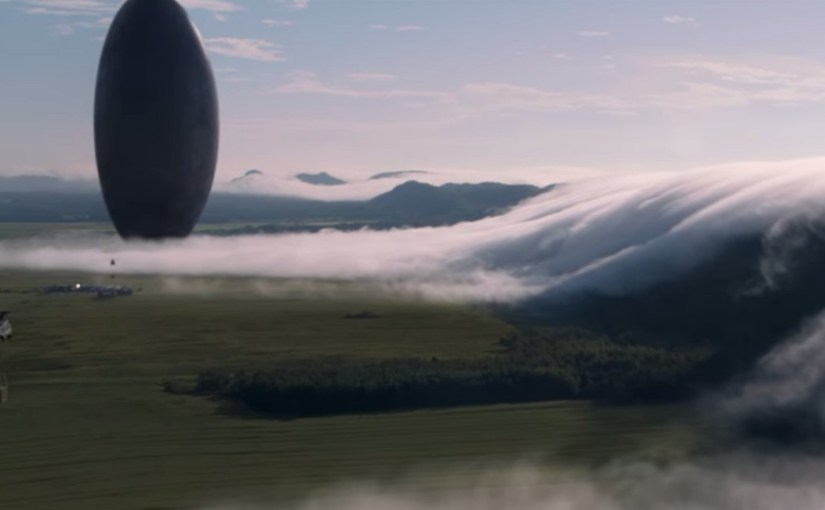
The design of the aliens and their ship are visual masterstrokes.  The ship, in fact, bears a striking resemblance to the famous Cloud Gate sculpture, aka “The Bean”, in downtown Chicago.  (Google it if you’re unfamiliar with it.)  But imagine it standing vertical on end, matte gray-black instead of chrome, and hundreds of feet tall.  Ominous and delicate at the same time.  The aliens themselves…well, I won’t spoil it for anyone who hasn’t seen it, but I will say they are called “heptapods” by the scientists.  Seven legs.  Cool.

The US researchers and military are connected via satellite to every other landing site around the globe, each attempting to make a communications breakthrough, but it’s Dr. Banks who realizes the aliens may have a form of written communication.  Using a whiteboard and simple words at first, she can have very limited conversations with the heptapods.  But when Banks is finally able to ask the all-important question, “Why are you here”, the answer she gets throws the military and government representatives into a tizzy and they cut off all communications to the other landing sites.

Meanwhile, Dr. Banks has periodically been having extremely vivid visions or memories of her daughter at random moments.  At one point, she is struggling to remember the scientific term for a “win-win” situation, and the memory comes back to her in a flash from a previous conversation with her daughter.  Although it is odd that we hear the term first in the present, and then she remembers it in the past…but enough about that.

Arrival may strike some as slow and plodding.  I suppose they’re right, in a sense.  It lacks any of the deliberately manipulative editing of, say, a Spielberg or a Scorsese film, where the cuts are specifically designed to grab the audience member by the collar and propel them to the film’s high and low points.  By contrast, Arrival takes its time.  It stands back and presents us with all the information we need to really, actively watch the film and work those brain cells.

[The score of Arrival deserves special mention.  In a film whose story arc involves linguistics and translations, it’s appropriate that, at key moments, the score includes multiple human voices harmonizing in ethereal chords or pulsing in a rhythm that sounds utterly alien, not just foreign.  A brilliant touch.]

What gives Arrival that extra push is that question Dr. Banks asks at one point in the film.  “If you could see your whole life from start to finish, would you change things?”  This question, when it comes, has poignant undertones that were not even hinted at in previous scenes.  And I find it to be incredibly moving, every time.  In fact, I wonder if I’m not really the prime target audience for this movie.  I wonder if it’s most effective for people who have lost loved ones to disease or accidents – untimely, unbearable deaths.  For those people, I cannot even begin to imagine how they would answer, or if they agree with Dr. Banks’s answer to her own question.

For myself, I have been blessed in this life, knock wood.  I have lost family members, but mostly to old age, although two uncles were taken by cancer in their fifties and sixties.  But I found myself thinking about this question today more than any other time, for some reason.  If I could magically go back in time, while retaining all my current knowledge, would I change things?

It’s deceptively easy to say “yes”, especially when it concerns the big things.  Sure, I would probably not stay as silent as I did when I learned a dear friend was being molested in high school and college.  No, I would probably not have gotten romantically involved that one time with the absolute wrong person.  No, I would most certainly not have skipped work that one day to see Spider-Man 3.  I would have remembered my driver’s license that one time I was pulled over.  I would have rearranged my schedule to go with my father and sister to Spain that one time.  And on and on.

But…if I hadn’t done some of those things…I may not be where I am now.  In a wonderful relationship with my best friend.  Working at a job that has its challenges but is rewarding and accommodating enough for me to do theater.  Surrounded by a support structure of friends that is second to none.  Able to leap tall buildings in a single bound.  Just kidding.

Your answer may differ from mine, or from Dr. Banks’s answer in the film.  That’s fine.  We all have our own reasons for our own answers to that question.  What’s wonderful about Arrival is its ability to couch that existential question in a top-notch sci-fi drama that, in its own unflashy way, is every bit as exciting and though-provoking as ten Independence Days.  It looks great, sounds great, acted great…what more could I ask for?

FLASH GORDON

By Marc S. Sanders

How can anyone not like Mike Hodges’ camp celebration of a savior hero vs a destructive villain?

Flash Gordon was penned by Lorenzo Semple Jr, writer on the 1960s Batman TV show. His first draft is the one and only draft which producer Dino DeLaurentis approved for shooting. A glossy, flashy and fetishistic approach was adopted for the film, and it became timelessly memorable.

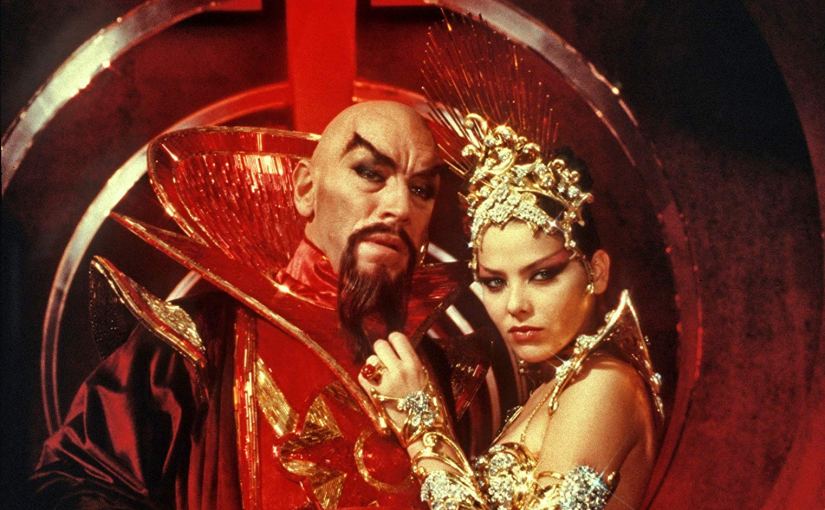
What thrills me about the film is its appreciation for the original, pioneering comic strips on which the film is based. Max Von Sydow’s Ming The Merciless is pulled right from the newspapers in his gloss pinks, reds, golds and blacks costume wear. The inflection of his voice is otherworldly from the start (“Klytus, I’m booooored. What do you have for me to play with today?”)

Sam Jones is a level down in the relatable hero of Christopher Reeve, but he’s enjoying every minute of his hero character schtick. He’s perfect for Semple’s playful writing and he looks like a champion.

Timothy Dalton and Brian Blessed are great side characters on opposite ends; one distinguished, the other gluttonous and proud.

The best flavor of the film is its soundtrack. Thank you Queen!!! Their musical touch is an early inspiration to some modern Marvel films like Guardians of the Galaxy, and Thor: Ragnarök, clearly showing direct influence from Flash Gordon. Freddy Mercury, Brian May and company relish in heavy pounding drums and special effect sounding guitars to deliver a cheerleading rock anthem. “Flash…aaaah!!! He’s a miracle!”

Dino DeLaurentis saw opportunity following the success of science fiction with Star Wars. He produced Flash Gordon with his own style, not as a copycat. The film became a fantasy with characters bleeding rainbow colors, pet midgets, cat fighting concubines, great hall football fighting with aluminum watermelons, weird lizard creatures, hawkmen, half egg-shaped planets, and even a thrilling fight to the death on a tilting platform with protruding spikes, the best scene amid all the camp craziness.

It’s all great. Flash Gordon is the savior of the universe. “He’s a miracle!!!!”

CLOSE ENCOUNTERS OF THE THIRD KIND

By Marc S. Sanders

Close Encounter of the First Kind – Sighting of a UFO.

Close Encounter of the Second Kind – Physical Evidence.

Close Encounter of the Third Kind – Contact.

Music is the most universal of all languages.  Steven Spielberg’s Close Encounters Of The Third Kind demonstrates that claim. 

I appreciate how Spielberg’s script, along with his direction, opens the film.  It takes place during a sun swept sandstorm in New Mexico.  At first, hardly anything but sand blowing can be seen, along with the high volume of wind breezing about inconveniently.  You are not even sure what you are looking at.  Then, headlights from a vehicle appear and a group of men assemble.  We come to find the main character of this scene is a French scientist named Lacombe (Francois Truffaut).  He only speaks French and hardly understands any English.  He is in need of an interpreter (Bob Balaban) to translate to American men who are accompanying them.  After we’ve established French and English are in the fold, we then realize that Spanish must enter the conversation amidst the overwhelming winds from the blinding storm.  An occurrence must have happened here recently, because Lacombe and crew interview some of the locals who are trying their best to define what took place the night before.  An elderly man is mysteriously sunburned on only one side of his face.  Thereafter, a grouping of bi-planes last seen flying over the Bermuda Triangle nearly forty years earlier come into focus.  No matter how you learn, communicate or understand, the confusion depicted is a perfect match for each of the men occupying this space.

A parallel story begins after this opening in the state of Indiana.  Sightings by airline pilots, as well as residents, are discovered in the skies above.  Blackouts occur everywhere.  The experiences of two residents, a young boy named Barry, and a utility worker named Roy Neary (Richard Dreyfuss), are who Spielberg uses to guide us through these strange episodes of phenomena.  They are being drawn towards a calling or an image and they become entirely focused upon what has happened to them.  Barry’s mother, Jillian (Melinda Dillon), while trying to reign her son back home has also been delivered a message from unusual spectacles in the skies. 

Soon after, these people cannot help but focus on a shape that they know they’ve seen before but can not place it.  Roy sculpts the shape in his shaving cream and his mashed potatoes.  He becomes neglectful of his work, his three children and his wife, Ronnie (Teri Garr), who refuses to take him seriously.  Barry’s young age allows him to avoid understanding the meaning of any this.  So, when the blinding “lights,” of whatever these entities could be, come towards his home in the middle of the night, he happily welcomes them, and willingly accompanies them back to wherever they came from.

I know this science fiction film is a highly regarded classic.  It’s earned the right to be considered as such, and so many have seen it.  Yet, I also know that I appear vague in my description of the film here.  I choose not to expound on everything going on in Close Encounters…  Steven Spielberg would want it that way, and I hate spoiling any movie.  A movie not seen is new to any of us. 

The residents of Indiana insist to higher governmental and military authorities that they have witnessed unidentified flying objects.  What those UFOs are, or where they came from, or why they visited their home state is unexplainable.  Spielberg intentionally avoids definitively explaining what’s occurred.  After all, if aliens are visiting our planet Earth, then who’s really to say we understand what they want or why they’ve come here?  Like the rest of the countries of the world, it’s fair to say that inhabitants of another planet in our galaxy would likely have their own way of communicating or speaking that’s entirely different from English, or French, or Spanish.

Spielberg goes even further to distance any understanding among ourselves or with these new entities that we are encountering.  A cargo sea vessel appears out of nowhere in the most unlikely place, the Gobi Desert of Mongolia.  Why?  How?  The people of a village within the continent of India are harmonizing a tune over and over again, in unison.  Lacombe along with his interpreter, and their American crew, attempt to decipher why these episodes have occurred as well.  The harmony must mean something.  What’s the message?  The world must learn to communicate with one another if they are to understand why these strange happenings continue.

Once Spielberg introduces the Indian village’s response to their experience, oddly enough Barry becomes obsessed with the tune as well.  Lacombe believes he’s recognized the tune as a means to speak with the visiting entities.  Again though, what is the message within the song?  In addition, Roy and Jillian are beginning to understand their obsession of the shape.  “This means something.  This is important.”  The script for Close Encounters… does not take for granted the repetitive significance of this line.  It is uttered a few times at different moments, by both Roy and Lacombe.

Close Encounters Of The Third Kind functions as a riddle, and yet it all makes sense in a breathtaking ending that occupies the last 30-40 minutes of the picture.   I hope there will be readers of this column who have yet to see this film.  It is better to go into it by knowing as little as possible.  Only then can you truly experience the maternal frustration that Jillian has for her young son’s insistence on going towards the lights, or Roy’s obsession with what dwells in his mind following his encounter.  With knowing as little as possible, can you become all the more curious at Lacombe’s pursuit.  When Spielberg gradually pulls the curtain away, it is such a satisfying relief and a feeling of fulfillment to have taken the journey with these characters. 

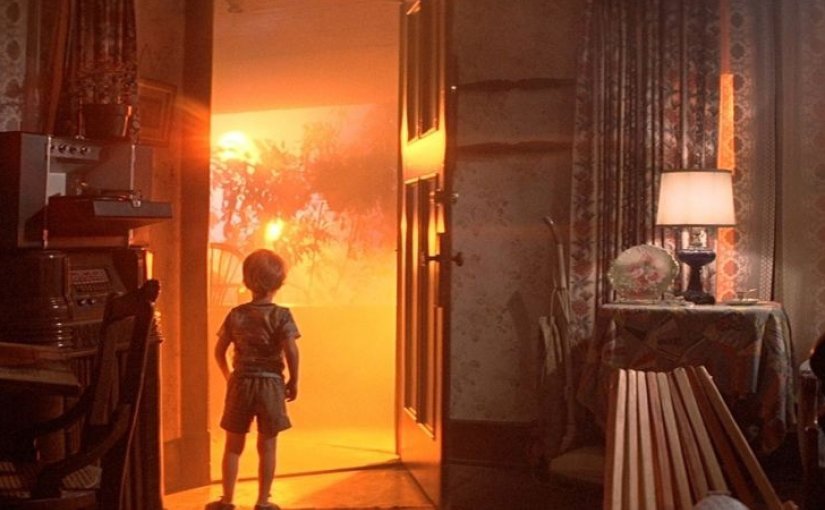
The construction of Spielberg’s first of many sci-fi films is magnificent.  It performs as if it is operating with real world science and language.  Yet, I have to draw attention to a scene that arrives in the middle of the picture.  Barry’s innocent, but youthful obsession, is tested within the home, beside Jillian’s fear.  Spielberg uses every prop and device available within the set of this scene.  Battery operated toys come alive.  The record player goes off.  The stove turns on. The dishwasher opens and closes. Blinding lights bleed through the curtains, chimney and keyholes.  The echoing sounds become overpowering.  What’s come to the house can’t be explained.  However, one person is thrilled by it while another is terrified.  It is such a well edited scene of terror at the unknown, that for me still remains as one of the most suspenseful moments in film history.  Steven Spielberg is bringing life to a “boogie man.”  When I showed my daughter this picture during a re-release in a Dolby movie theatre, I held her 11-year-old self in my lap concerned she’d become frightened of the scene.  It’s as thrilling as going on an unpredictable roller coaster for the first time.  The scene occurs out of nowhere, with no convenience of foreshadowing.  Once again, as he did with Jaws and somewhat implied with Duel, Steven Spielberg does not show you the terror or the invasive entity.  He allows the viewer’s subconscious to draw its own conclusion.  This is master craftsmanship.

Close Encounters Of The Third Kind remains as one of the best science fiction films of all time.  Nearly forty years later, despite its fiction, it still feels like it’s real.  It all feels like it means something.  It still feels like its important. 

RETURN OF THE JEDI

By Marc S. Sanders

There’s a moment in Return Of The Jedi where Luke Skywalker (Mark Hamill) is about to be forced into Jabba The Hutt’s monstrous Sarlaac pit. R2D2 launches the Jedi Knight’s lightsaber in the air. Luke catches the hilt of the saber and just before he ignites it, the hero gives a smile. The Star Wars saga is not just fun for audiences. The players in the film are enjoying themselves just as much.

Following the mind-blowing cliffhangers of The Empire Strikes Back from 1980, the third film in the original trilogy picks up to tie off all those loose ends. The result is nothing but giddy, refreshingly inventive, swashbuckling adventure. I always admired the sets of the original trilogy. No two locations looked the same. Prior films have introduced desert, snow, swamp and cloudy locales. Jedi takes us to a forest moon known as Endor. It’s no surprise that a forest moon will not offer much technology even in science fiction/fantasy. So, we are treated to a welcoming and ironic final battle to overthrow Darth Vader’s evil Empire. Ewoks, cuddly looking teddy bears, known for the means of survival with primitive devices like rocks, sticks and logs will face up against armored Stormtroopers and gigantic, zippy little speeder bikes, and steel chicken walkers armed with powerful blasters. The battle scenes are fun, and they work. Just before the heroes break into an Empire bunker, Han Solo outstretches his arms and gives a smirk at the Imperial troops. Even Harrison Ford is having a good time. There’s much opportunity for the audience to clap along.

The main story involves Luke making an effort to defeat Darth Vader once and for all after he’s urged by Yoda and Ben Kenobi (Frank Oz and Alec Guinness) to confront the dark lord as a means to complete his training to be a Jedi. It will not be easy as it also means that Luke must resist the evil Emperor Palpatine’s seductive nature to join the dark side.

Ian McDiarmid is the Emperor and I always say this guy never got enough recognition. He’s as masterful with the role as Margaret Hamilton was with The Wicked Witch of the West. He chews the scenery and like the good guy actors, he’s also having fun in the part.

Jabba The Hutt is also a terrific surprise that’s finally revealed (if you had been following the more preferred original cuts of the trilogy). This large, slug like puppet character is an amalgamation of Marlon Brando in The Godfather and a very bulky Orson Welles. The infamously controlling gangster on Luke’s home planet of Tatooine gleefully displays a captive Han Solo still frozen in carbonite. The sets within his palace are magnificently detailed in creature extras and sleazy decor, much like a seedy strip club.

I think the appeal of Star Wars comes partly from the nature of human beings and the planet Earth where we reside. All looks familiar in a way the first time we see something and it’s easy to make presumptions of this galaxy’s inhabitants and what they are respectfully capable of. We can recognize that Ewoks might be as constructive as the Swiss Family Robinson with their tree like village. At the same time, a giant slug with a green skinned, dancing concubine chained to him commands over a peasantry. Elders in black robes carry an instinct to almost gaslight a weaker opponent for personal gain.

George Lucas sourced from prior films of all different categories used before. He only made it his own original work with some modifications. So you get sword fights, only in this world the swords are beams of light. You get a strip club bar, but it’s science fiction polish allows it to be a little more PG rated.

Return Of The Jedi serves as a great time to watch a movie. It’s swashbuckling and even well-acted, especially with Mark Hamill in the lead. His character changes from one film to the next. He’s no longer a child here. He’s now an absolute leader walking into the depths of hell aboard a new and more powerful Death Star, ready to sacrifice himself to fulfill a likely prophecy, as well as to save the Rebellion he commands.

It may not be the best film of the original trilogy, but Return Of The Jedi was one of the most satisfying movie going experiences from the decade of the 1980s.