COLOR OUT OF SPACE (2019)

by Miguel E. Rodriguez

Director: Richard Stanley
Cast: Nicolas Cage, Joely Richardson, Madeleine Arthur, Tommy Chong
My Rating: 9/10
Rotten Tomatometer: 86% Certified Fresh

PLOT: A secluded farm is struck by a strange meteorite which has apocalyptic consequences for the family living there and possibly the world.


Some backstory…

Once upon a time, there was a film director named Richard Stanley.  He made a few unremarkable films in the early 1990s, toiling in relative obscurity, until he hit the big time in 1996 when he got the opportunity to direct his dream project: a remake of The Island of Dr. Moreau starring none other than Marlon Brando.  The story of that film’s troubled production inspired a documentary all by itself (Lost Soul: The Doomed Journey of Richard Stanley’s Island of Dr. Moreau [2014]).  Stanley himself was fired after only four days of shooting and replaced by John Frankenheimer.  Rumor has it that Stanley secretly convinced the makeup crew to turn him into one of the background mutants so he could keep tabs on his dream project.  After Moreau bombed, Stanley’s career imploded, and he never directed another feature film.

…until over twenty years later when an enterprising film production company expressed interest in allowing him to direct another dream project: an adaptation of an H.P. Lovecraft story from 1927 called The Colour Out of Space.  To say that Stanley redeemed himself with this film would be an understatement.  This is one of the scariest movies I’ve ever seen.  It was supposed to be the first part of a Lovecraftian trilogy, but alas, Stanley was accused of domestic abuse in March of 2021 and the trilogy was scrapped.  One hopes that someone like Guillermo del Toro or Jordan Peele might pick up the promising threads here.  [insert good mojo dance here]

Anyway, the movie.

Color Out of Space is, at first glance, an amalgam of previous horror films.  One can easily spot elements of The Thing (1982), Annihilation (2018), and David Cronenberg’s The Fly (1986).  But when you consider the screenplay has been adapted from a 95-year-old short story, the movie takes on a prescient nature.  Here are all the elements of a solid contemporary horror film, in a story that was published the same year sound was introduced to motion pictures for the first time.  Remarkable.

The Gardner family lives on a secluded farm in the forests of New England, where the nearest township, Arkham, is an hour’s drive away.  (No, Arkham isn’t a Batman reference, it’s Lovecraftian…which might explain why the very name “Arkham Asylum” has always felt a little creepy all by itself.)  One night, a meteorite lands with a crash in their front yard.  This is no ordinary meteorite.  It glows with an unearthly magenta light, and by the following morning it has disappeared.  Shortly thereafter, the youngest son, Jack, starts hearing strange noises outside.  Mrs. Gardner (Joely Richardson), who is recuperating from cancer surgery, keeps getting disconnected from her business calls.  Nathan Gardner (Nicolas Cage) takes a shower one day and discovers what looks like a cake of soap covering the shower drain.  He picks it up…and experiences something NO ONE wants to experience after picking up a cake of soap.

Things get stranger.  A local hydrologist takes some water samples and urges the Gardner family and their squatter, Ezra (Tommy Chong), who lives in a shack on the Gardner’s vast property, not to drink the water until he gets some test results.  Meanwhile, Jack, the youngest son, takes a peek down their well and watches as an alien-looking egg hatches and releases a magenta-colored praying mantis.  Mrs. Gardner gets distracted by…something…and has a kitchen accident with a knife.  Their daughter, Lavinia (Madeleine Arthur), who dabbles in Wiccan rituals, hears a noise that makes her sick to her stomach.  Time passes in fits and starts.

And the whole time, new vegetation has sprouted up around the well.  All the same magenta color…

Experienced moviegoers might be able to plot the film’s course from A to B to the climax, and they might be right on.  But Color Out of Space has one or two surprises up its sleeve that elevates it into the same level as other modern horror classics like Hereditary (2018) or The Babadook (2014).

There are scenes involving a small herd of alpacas – oh yeah, they raise alpacas – that are as unsettling as anything from John Carpenter.  At one point, mother and son are caught in the “grip” of the alien color/light.  What happens to them sets up one of the biggest jump scares I’ve ever had in my life.  I yelled so loud and long that my girlfriend ran to the back of the house wondering what was happening.

Color Out of Space is one of the most effective horror movies I’ve seen in a long time.  Naysayers may refuse to watch it because of Nicolas Cage’s presence, but I can assure you, his “hammy” talents are put to good use and are always in service of the story.  It’s not for everyone.  It’s not for the squeamish.  But for those who dare…Color Out of Space is a horror-film lover’s dream.
LIGHTYEAR

By Marc S. Sanders

It’s kind of neat to see the evolution of a classic film character when you are a fully aware adult.  In 1995, I had no idea what the term Pixar meant, or knew the impact it would have with the Disney brand as a whole or on the cinematic landscape.  Pixar is now as pioneering as Skywalker Sound or Industrial Light and Magic.  There’s Pixar, and then there’s everything else.  Back in ’95, I was age 23, and my intuition never perked up that I was watching a touchstone character like Buzz Lightyear who would become as grand today as Batman and Elvis turned out to be in an ever-changing pop culture lexicon. Buzz Lightyear is by far one of the company’s most inventive creations.

Jump to nearly thirty years later, with four Toy Story adventures, and endless amounts of merchandising the Space Ranger has been primed for a more personal adventure beyond the imagination of a young child possessing an action figure in his playroom.  Lightyear tells of the adventure that leant to merchandising of the toy depicted in the Toy Story fictional world.  (Try not to think too hardly on that description.)

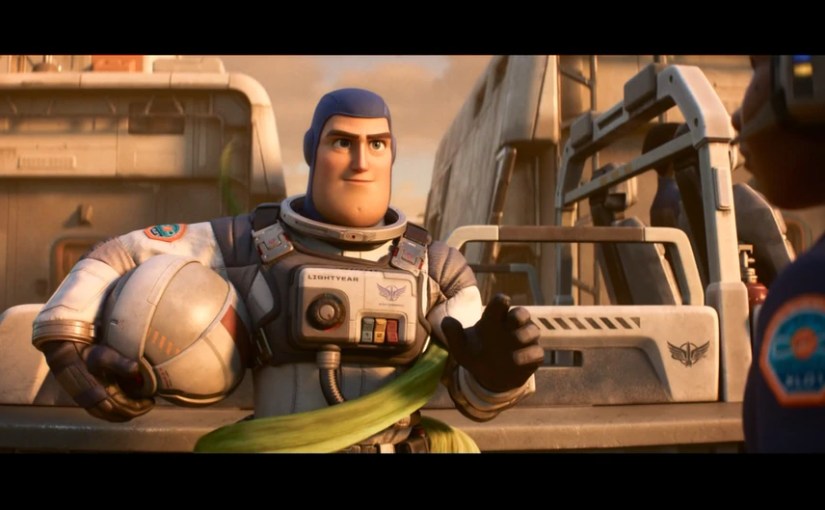
Buzz Lightyear (Chris Evans) is the eminent Space Ranger of Star Command, out to explore strange new worlds and seek out new life and– STOP! That’s another franchise.  When Captain Lightyear comes upon an unchartered planet, complications in unexpected science fiction adventure ensue.  Buzz and the small colony living on his global spaceship are marooned on this planet with no immediate solution for getting off and returning to Earth, 4.2 billion light years away.  Buzz makes it his mission to uncover a new kind of resource fuel that will eventually help the colony make its eventual return home.  Yet, with each experimental try, the minutes he spends in his super speed orbits around the planet equate to years for the colony who have set up habitation below.  His comrades on the ground below continue to age while Buzz does not.

I needed help with this picture.  My wife had to explain the staple lesson that usually comes with each Pixar film that I just didn’t catch while watching Lightyear.  I don’t think I’m spoiling anything, but the film reminds us to accept the hand dealt to us and appreciate what has come even if we never expected or planned on the circumstances in the first place.  It’s a good lesson.  I guess I just wish Lightyear made it a little clearer.  There’s a lot of mud on the windshield that I needed to wipe away before I realized what the message was about.

Maybe I was not fair with this film.  Tim Allen was not invited back to lend his recognizable voiceover to the character.  I guess Pixar is insistent that he’s reserved only for the toy version of the character.  Chris Evans is fine, mind you, and he doesn’t overdo it.  Yet, I could not help but think Tim Allen would have been just as capable and even more entitled to voice the role yet again.

Perhaps I was thinking that if Pixar wanted to go in another animated direction with the character, it just seemed completely fruitless.  How different could Lightyear be from the Toy Story films if the animated design is pretty similar in every frame?  Honestly, it doesn’t look like a new kind of device.  So that was a problem for me, as well.  It wasn’t inventive enough.  Maybe it’s time for a live action version of the space traveler.  Imagine Chris Evans wearing a live action and tactile version of the famous astronaut costume with the colorful buttons.  I still say that could work, and it’s what Disney/Pixar should have considered.

Maybe I’m getting bored with the time travel motif.  Isn’t everyone doing that these days?  Doesn’t it also seem like all our heroes are meeting their future selves and struggling to understand their current predicament?  Lightyear hinges on these story developments, and when the moments arrive my eyes rolled in the back of my head.  Time travel stories are very tricky for me to appreciate.  Often, the narrative paints itself into a corner, unable to explain itself back correctly.  Only two films that come to mind have worked their way out of it almost seamlessly – Back To The Future and 12 Monkeys.

So, while I love the lesson that Lightyear offers, the standard carbon copy plot outline left me unfocused at times.

The voiceover cast is well done with Keke Palmer, Taika Waititi and James Brolin.  The animation is gorgeous, most especially when Buzz is piloting his super jet around the planet’s sun. The atmosphere of the planet is fun when it becomes a nuisance with giant flying insects and vines that come alive to entangle the characters at any given moment.

Science Fiction can go to infinity and beyond with the directions it can take.  There is absolutely no limit.  With today’s technology in filmmaking and the endless resources that Disney provides, why didn’t the filmmakers try a little harder with Lightyear? Again, a live action interpretation would have allowed it to stand apart from the character’s prior Toy adventures, and some different avenues in space exploration would have opened a leaner and more entertaining story.  If Star Trek can do it, Lightyear can do it too.

I think Pixar tried to go the route of Christopher Nolan, by way of Interstellar.  However, Lightyear is designed for people of all ages where the brain of the show is in reminding us how to carry ourselves through life, and not to uncover the twists that a brilliant filmmaker like Nolan has become recognized for.  I didn’t want to resolve a puzzle in fictional science.  Lightyear is trying too hard to be to be brainy and thus we get distracted from its “The More You Know” lesson in self-effacement.

ALIEN

By Marc S. Sanders

To be lost and alone is my absolute greatest fear.  I don’t know what to do when I find myself in situations like that.  I feel palpitations and terrible anxiety.  The only argument my wife and I had on our honeymoon was when we got lost in the Louvre in Paris.  She was relaxed.  I definitely was not.  I didn’t know in which direction to walk through the massive museum, located in a country that I’m not at all familiar with, inhabited by a majority of people who speak a language that I’m terribly limited at using for conversation.

When a person is completely, physically isolated, the only thing to depend on is his/her own wits and sensibilities.  That’s step one in constructing a scene of terror.  Step two is to lock that person away with an entity that is unpredictable, unrecognizable, smart and grotesquely frightening.  In a film, each time that entity comes into the play, the scene should not look like the last time the protagonist or the audience encountered this creature.  Whatever I learned a few minutes ago is not going to offer much help the next time around. 

I’ve just described the spine of the story that makes a horror film like Ridley Scott’s Alien so successful.

Science Fiction always works best when it can be convincing enough to lend authenticity to the fiction of its, well, science.  With Alien, a variation of biology and evolution lends to the terror of the picture and you don’t even realize it until the movie is half over. The title character is introduced in different characterizations with every scene it is called for.  First, it’s an egg, then a tentacled creature wrapped around the face of an unfortunate victim.  Later, at dinner time, it reveals itself in an unforgiving and memorable scene as a phallic shaped organism with a snake like tail and steel teeth.  Lastly, you just can’t even describe what it is except to say it is huge and its even worse than the monsters you imagined as a kid hiding in your closet or under your bed.  Credit has to go to the creature designs from H.R. Giger.  Every limb or shape of the monster seems to serve a purpose.  If that’s not enough, the animal bleeds acid that’ll burn through the hull of an enormous spaceship.  The alien in this 1979 film, later deemed a “xenomorph,” is one of the scariest and most unforgettable monsters in movie history.

A crew of seven are piloting a large ship back to the planet Earth.  Their cargo is carrying mineral ore (whatever that is).  This crew is not military of any kind.  There’s a science officer, but by and large, I’d characterize these people as truckers in outer space working on behalf of a company, by hauling a load across the galaxy.  During the long journey, they rest in a cryo-like sleep.  As the film opens, they are awakened by their transmission computer, known as “Mother,” to respond to a distress call.  Their ship has been diverted from Earth to investigate an unexplored planet.  As the piece continues, the crew brings back a plus one. They have no idea what to expect or how to handle its presence, and then they are hunted across the maze of the large ship, dispatched one by one.

The byline for Alien is marketing brilliance.  In Space, No One Can Hear You Scream.  It only scratches the surface of the terror you encounter when watching this terrifying film.  Ridley Scott uses art direction set up with long, dark hallways and warehouse size rooms that make the cast appear infantile.  His labyrinth of a spaceship offers up practically any place for a killer creature to hide and strike at an opportune time. 

It’s important to point out that Alien lends to the argument for the value of 4K resolution.  This latest print to honor the film’s 40th anniversary offers much clarity within the dark settings of the picture.  Having seen Alien countless times, I still examine each frame carefully because Giger’s designs allow the monster to blend in properly with engineering architecture of long and large pipes and cables, and immense darkness.  Chains hang from the ceilings and water drips down for no reason to be explained.  It’s just how the spaceship lives, apparently.  The atmosphere rattles you, however, when you realize there’s a dangerous bug crawling around somewhere.  Did I just catch a glimpse of the alien’s head there????  Was that his tail????  Is that a limb, like an arm or a hand????  I know all of the highlights of the picture by now, but to this day I still look for when and where the silent terror is looming, thinking I missed it from the last time I watched.  Would you believe on this last viewing, I found a caption of the alien I don’t recall ever seeing before?

Once the monster is established and we see our heroes within inescapable danger, then paranoia and mistrust can lend to their erratic nature.  The screenplay from Alien co-creator Dan O’Bannon establishes how the “grunts” of the seven (Yaphet Kotto, Harry Dean Stanton) debate what is and isn’t their responsibility and what monies they truly are entitled to on this mission.  Early on, before the threat is even considered, a divide exists within the band.  They are not always going to get along.  Later, the debate on whether to quarantine the crew members who investigated the distress signal on the strange, unknown planet comes into play.  It would be easy to simply make Alien all about blood, guts and sci fi laser pistols in a post Star Wars/Star Trek era, but it is even more effective to create disagreements and seeds of unreliability among the group.  One or two of them could end up operating in a different and unexpected direction that won’t help their cause.  Maybe it’s not just the alien we should be afraid of.

The seven members (5 men, 2 women) all have different personalities.  They like one another well enough, but they all have uncommon values and motives.  Sigourney Weaver portrays Ripley, the third in command, behind two men.  However, in outer space, does it really matter where she falls in the line?  The science officer, Ash (Ian Holm), seems to drift into his own way of thinking, separate from the rest.  Captain Dallas (Tom Skerritt) moves along the straight and narrow, only doing what’s assigned simply to move on and get things over with.  The other woman Lambert (Veronica Cartwright) does not have much dialogue to work with, but her expressions seem to be questioning why she even took this job.  Was this woman desperate for work and this is the best she could find?  She’s definitely the most unrelaxed and fearful of the crew.

Like Steven Spielberg’s Jaws, Alien does not operate on the movie monster alone.  There are other factors at play.  A popular Hollywood story is that Spielberg didn’t show the shark for a long period of time simply because the thing would not work, mechanically speaking.  Ridley Scott, however, demonstrates that he can present the animal one way and then show it in a completely different form later.  When it has reached what we can only believe is full evolution, we still don’t get a clear physical picture of the creature’s design from head to toe.  Scott will show us teeth, or maybe a shoulder blade or a tail that whips or moves at a slow and cautious pace.  The alien functions with a combination of real-life predators’ behaviors.  It hatches.  It sheds its skin.  It bites.  It runs.  It hunts a prey.  It grows and evolves…and seemingly very quickly.

Alien has been duplicated many times following its release, including a few shameless sequels.  Mind you, some of the franchise follow ups remain exceptional in their own right.  What misgivings Ridley Scott’s movie have later inspired cannot be helped.  Mr. Scott should consider it an honor, at best, that various craftspeople have attempted to top what he accomplished, I guess.  Those copycats don’t follow the recipe of Alien though.  There’s either too much of an ingredient included like blood and guts or there’s a lacking in its script, such as the eerie haunts of a dangerous setting or the overeager intelligence of its characters.  Whatever the case may be, the achievements in horror work so well in Alien, because it moves with dread, uncertainty, helplessness, a lack of knowledge, and then with only a few touches of gore and violence that are mostly left to our worst imaginations. 

Alien is not only one of the best science fiction films ever made.  It is also one of the best horror films ever made.

SCANNERS

By Marc S. Sanders

David Cronenberg’s Scanners, from 1981, is part of the Criterion DVD collection. So is Michael Bay’s Armageddon from 1998. Why? Beats the hell outta me, but what does that truly say about Criterion?

Scanners tells the story of people who are capable of mind controlling others. Some use this ability so powerfully that they can actually make a person’s head explode into what looks like what can happen when you leave a hot dog in the microwave too long. It’s likely how they achieved this visual effect, actually.

Well known cinematic henchman (with the cool voice) Michael Ironside plays a nasty scanner named Revok. In 1981, the best and most cheap way to display “scanning” was for Ironside to distort his face, roll his tongue back as well as his eyes and shake like he’s having a seizure or contending with intolerable constipation. Maybe in 1981, this would amaze and terrify me. In 2020, I wanna say “Michael, knock it off. Pick your toys up off the floor, and brush your teeth.”

There’s also Cameron Vale (Stephen Lack), a good guy scanner. He does the same kind of weird contortions though not as spastic as Revok. He’s been hired by some soft spoken scientist, Dr. Paul Ruth (Patrick McGoohan) – no, not THAT Dr. Ruth – to stop Revok from, I think, taking over the world. McGoohan, plays the role of mentor like he’s failing miserably at his audition for Obi Wan Kenobi.

A scan causes faces to convulse and squirt out blood that looks like Kool Aid. Maybe even your hands would catch fire. That’s about all Cronenberg offers here. Just a lot of schlocky, hamburger meat gore centered around Vale catching up to Revok. Eventually, we learn how a scanner became a scanner. It’s not very eye opening. The final frame does offer a twist but the credits roll too quickly thereafter to really relish that moment.

I can only envision that Scanners was one of those cheapie, mindless, B movie horror flicks on USA Up All Night with Rhonda Shear, during the late ‘80s & ‘90s.

Certainly mindless at least, and that’s the irony. A film about performing mind control and yet it doesn’t have a brain cell in its mix.

JURASSIC PARK III

By Marc S. Sanders

Jurassic Park III.  What’s to say?  Well not much.  The third film in the dino franchise plays like an extension of the first two.  Sam Neill is brought back as paleontologist, Dr. Alan Grant.  Sadly, the rest of the cast is terrible.  Yet, the dinosaurs remain marvelous.

Following an opening sequence parasailing adventure gone wrong, an enormously wealthy couple, the Kirbys (William H Macy, Tea Leoni), recruit Dr. Grant and his apprentice Billy (Alessandro Nivola) for a vacation excursion to the restricted island of Ilsa Sorna as a twentieth anniversary celebration for them to see the exotic, resurrected animals.  Grant and Billy are to be their tour guides.  The offer is too good for the doctor to refuse and off they go. Once on the island, the mayhem we’ve all grown accustomed to commences.

The intelligence of the Jurassic films only comes from one source, and that is the special effects makers of these animals.  The attention to detail in skin texture, eye movement, teeth, roars, claws, limbs and facial expressions are sensational.  You truly believe these are actual living creatures.  These wizards reinvent themselves with a new dinosaur known as the Spinosaurus.  Bigger than a T-Rex and at least as fast as the velociraptors.  This is a BEAST!!!!!! 

Director Joe Johnston takes the director chair from Steven Spielberg. While the magic is lacking this time around in some of the thrills and scares, at least the new director has some fun with a couple of gags.  A cell phone (the new novel household item at the time of this film’s release) plays for some laughs, especially when the Spinosaurus appears on the scene.  There’s also a magnificent sequence in the Pteranodon bird cage.  Love the Pteranodons.  Finally, we get to see the winged dinosaurs in action as they lift the various members of the cast into the air with their claws and snap their beaks for a couple of nips.  There’s a great close up of one Pteranodon that is one for the ages.  He turns his sinister head over his shoulder towards the camera with a “Wanna fuck with me?” expression.  It’s like it was modeled off of Robert DeNiro.  Great stuff.

Raptors are back, and while we may have seen all of this before, I don’t get tired of it.  It’s like seeing a thrilling car chase for the fiftieth time.  As long I’m thrilled, I guess I’m satisfied.  Nevertheless, being that this is the third chapter, I was hoping for something more with some insight in the film.

My colleague, Miguel Rodriguez, notes that this installment as well as the prior one serves merely as amusement park fun rides.  All true.  I think I’ve backed that up here.  However, there are so many unexplored elements within the franchise originally conceived by novelist Michael Crichton.  For example, there’s the secret scientific research and development company known as InGen – the party responsible for discovering how to resurrect dinosaurs in the modern age.  Three movies in, and we’ve barely gotten to know InGen.  I think it’s time we do.  There’s gotta be a CEO at the top who is twirling his mustache amid his or her dominance.  That would really play for some good storytelling.  At best, in all three films to this point, we just get the InGen logo printed on the side of some motorized vehicles and laboratory doors. 

Much like the Alien franchise (with Weyland-Yutani), these puppet masters are never fully realized.  One of the three (THREE????) co-writers of Jurassic Park III is director/writer Alexander Payne (Election, About Schmidt).  With a genius mind like that couldn’t we have been treated to something that had more depth than just jaws, beaks, teeth, claws and roars?  What we are left with is an annoying William H Macy (one of his worst career roles) and an even worse Tea Leoni (feels like I’m watching Chrissy from Three’s Company) as the Kirbys.  They quickly provide a twist to their purpose in the movie.  It’s a dumb twist.  It’s hard to believe a doctorate mind like Alan Grant is supposed to have never seen this unexpected turn of events coming and it takes up space where the writers could have spent time bringing more back story to the Jurassic Park universe.  Crichton lined it all up!  Why didn’t the filmmakers pounce on these golden ideas?

That’s all there is to say.  Jurassic Park III is a popcorn movie.  Nothing else.  It’s only just a somewhat satisfying popcorn movie, though.  You miss the Spielberg touch, and you wish for just a little more dimension.  You don’t get it, but you do get the “don’t fuck with me” attitude of a nasty looking Pteranodon.  That alone is worth ninety minutes of your time.

THE LOST WORLD: JURASSIC PARK

By Marc S. Sanders

The Lost World: Jurassic Park contains a batch of characters making a lot of stupid decisions all in the name of being stupid for stupidity’s stake.  That doesn’t make it a bad movie though.  Just somewhat…unsophisticated…and stupid.

In the sequel to the monster smash adaptation from Michael Crichton, Steven Spielberg reunites with Jeff Goldblum, now at the top of the credits list, as smarmy mathematician Dr. Ian Malcolm.  It really doesn’t matter if the guy is a doctor of any kind of specialty though.  Malcolm doesn’t utter one scientific fact or theory or observation this time around.  Whatever shred of debate regarding the resurrection of dinosaurs that existed in the first film is completely abandoned this time around.  Carnage, mayhem and outrageous ridiculousness take center stage, stage left, stage right, downstage, upstage, off stage, and over a high cliff.

In an early scene, Malcolm is summoned by wealthy entrepreneur John Hammond (Richard Attenborough, in a welcome cameo).  Hammond tells Malcolm that his paleontologist girlfriend (isn’t that a coinkidink), Sarah (Julianne Moore) is on a nearby island to the original one from the first film, and studying the behaviors of the dinosaurs that were developed there.  She will soon be meeting up with a photographer (Vince Vaughn) and another associate (Richard Schiff; I don’t recall the script explaining his specialty).  So, Malcolm sees no choice but to go after Sarah and rescue her from the island.  This is one Daring Mathematician.

One point of order, because this is a Spielberg adventure, a kid has to be involved.  Malcolm’s pre-teen daughter and gymnast extraordinaire Kelly (Vanessa Chester) stows herself away on the excursion. Thank god she’s gymnast.  That may come in handy.

At the same time, Hammond’s greedy nephew, Peter Ludlow (Arliss Howard) is leading a large expedition crew on the island to recover representatives of each breed of animal to bring back to the mainland in San Diego for show and tell.  The leader of this pack is also the best character in the whole film.  He’s a game hunter named Roland Tembo (Pete Postlethwaite).  Tembo’s price is to hunt down one Tyrannosaurus-Rex for his own game pleasure.  Aaaaand that’s where the story stops. 

I just ticked off a lot of actor names, didn’t I?  Well, this is a sequel and in a monster movie sequel there’s a demand for more casualties of course.  If that’s what you are looking for, you won’t be disappointed. 

You also won’t be disappointed in the assortment of dinosaurs on hand.  This time there are two T-Rex’s and they are used beautifully in a very daring, albeit long for the sake of maximum suspense, scene that involves our heroes dangling within a double RV trailer that has been pushed off a cliff.  When Sarah lands face first on the back windowpane of glass, try your best not to bite your nails.

Another exceptional scene is when the expedition runs into a tall grass raptor nest.  This is like Jaws on land.  With the help of much CGI, but also puppetry from Stan Winston’s imagination factory, Spielberg gets great overhead shots of fast forming black lines that quickly cut through the meadow taking out one poor soul after another where beast overcomes man. These moments occur in the large second act of the film where it’s nothing but action done with Spielberg’s skill to oversee. 

The third act is questionable, but I found a nostalgic admiration for it.  Spielberg goes for the salute to King Kong, the grand daddy of all monster movies.  Ludlow’s hubris and what remains of his expedition team trap and bring back the male T-Rex to San Diego aboard a large freighter.  In the dead of night, garbed in his finest suit, he’s ready to give a speech to a press junket that must work a graveyard shift introducing the marvelous attraction.  Naturally, we know things will not go as planned.  Now, we know this is not New York City and the Empire State Building is not nearby, but this T-Rex will naturally run amok anyway and settle for destroying a suburban dog house, about a dozen cars and a 76-gas station.  No, it is not King Kong, but the salute is appreciated nonetheless.  There’s even a wink and nod to Godzilla.  I laughed.

Pretty stupid of Ludlow to do this, right?  Well, he’s the villain.  So, let’s give him a pass.  On the other hand, the heroes are dumb as rocks.  Sarah takes a baby T-Rex away from its quarters. Ian gets up into a high area platform with his daughter as an escape to safety…but then he comes down again!!!!!  The hunters simply think they are hunting kittens no matter the stature of any of the game they are pursuing.  The telephone doesn’t get answered when it really, really should.  You’ll find yourself shaking your head and outstretching your arms at the screen (palms up) as if to say “WHY????????”. 

It really doesn’t matter.  The first Jurassic Park film never had a fully developed brain.  This installment, unabashedly, never even stops to think.  It’s as if a collection of characters in a shoebox raised their hand for volunteer slaughter. 

My wife watched this with me recently, and at times she would ask “Why are you doing this or why not just call such and such?”  I’d have to remind her it’s not that simple.  Cuz if it were that simple, then they would have picked up the phone.  We all have a destiny in life.  I truly believe that.  The destiny of the cast of The Lost World: Jurassic Park was to run and maybe or maybe not get chomped on and eaten.  This is what they were groomed for their whole lives. So, let’s not interfere with the laws of nature.

JURASSIC PARK

By Marc S. Sanders

Michael Crichton’s best-selling novel, Jurassic Park, is my favorite book of all time.  I recall reading it in one Friday night a week before the Steven Spielberg adaptation was released in theaters.  It was the easiest book to breeze through and I never stopped thinking about Crichton’s approach to a what if scenario where dinosaurs are resurrected in the name of scientific discovery and profitability.  Ideas related to chaos theory and DNA experimentation were considered against the mayhem of people running for their lives in an amusement park attraction.  Amid the action, there was opportunity to think and consider.  Spielberg’s film doesn’t offer enough time for ponderance.  It starts out that way, but it doesn’t finish its thought.  That’s always been a hinderance for me.

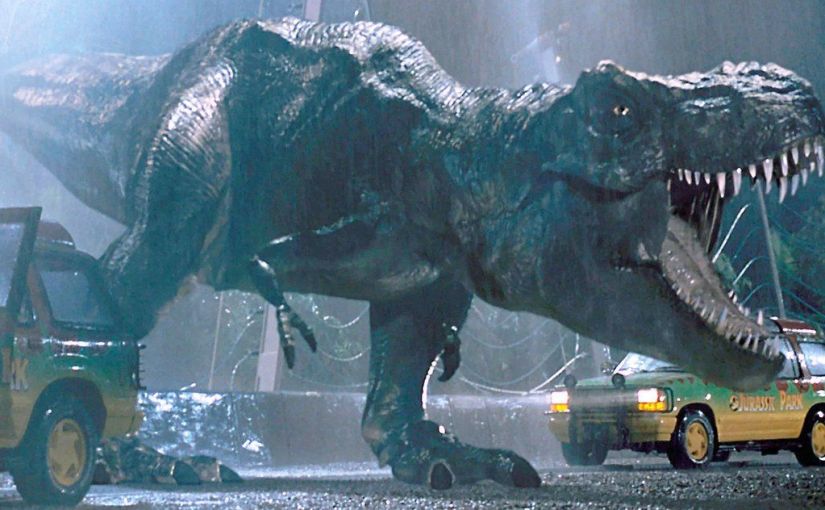
There’s no question regarding the immense thrills the film brings, even thirty years later.  Effects and puppeteer wiz Stan Winston (how I wish he hadn’t passed away so soon) outdid himself following memorable recreations from films like Aliens and Predator.  The centerpiece of the blockbuster is of course the T-Rex.  Spielberg follows his age-old approach of not showing the monster right away, though high publicity and massive merchandising of the early 1990s never kept this cat in the bag anyway.  Oh well!  Yet, when the humungous, twenty-ton dinosaur puppet makes its grand entrance midway through the film, it still holds as a spectacular scene, especially because two fine child actors (Ariana Richards, Joseph Mazzello) with high pitched screams heighten the terror.  Look, you should know by now.  If Steven Spielberg is aiming for the rafters of box office thrills, he’s gonna put the kids in danger first and foremost.

Velociraptors are the other big stars of this creature feature and the behavior of these CGI animals is magnificent as we observe them communicate with one another.  Like the T-Rex, we don’t get an immediate first glance of them either, but their squeals and screeches as they leap in for a monster mash smorgasbord get us to jump in our seats.  When the veil is lifted on these guys, Spielberg and his effects crew go further by granting them with quick agility.  Before all this, we are told by the science experts of how they are strategic pack hunters with cheetah like speed and how they tear away at flesh as they pounce on live prey.  You wince as you imagine.  They are also smart too.  These dogs can open doors! 

Again, all good stuff here.

The best character is the sarcastic mathematician, Ian Malcolm (Jeff Goldblum), who insists resurrecting dinosaurs is a terrible idea for the modern age.  Goldblum is so good with the script written by David Koepp that my favorite scene in the picture is when the main characters sit around the dinner table to discuss what has surprisingly been thrust upon them.  I yearned for more scenes like this.  Ian Malcolm offers up a new iteration of “Matt Hooper” (Richard Dreyfuss in Jaws) that I just didn’t get enough of.  Only the surface is scratched on the argument of intelligence versus stupidity.  In Jaws, we got nearly a full hour of this welcome back and forth.

What lacks is what Jaws provided over a decade earlier.  The debates of how to live (or die) with dangerous animals begins, but doesn’t finish in Jurassic Park.  It merely gets started, and then the argument gets abandoned to allow for unending carnage.  Don’t get me wrong.  I love carnage in my movies.  However, Crichton illustrated an even amount of attention to chaos blended with intelligence (or ignorant lack thereof) when he wrote his book.  I got a textbook education from Michael Crichton.  From Steven Spielberg and David Koepp, I just got a thin dog eared comic book.

Goldblum is third in line in the cast credits behind Sam Neill and Laura Dern as Alan Grant, a paleontologist, and Ellie Satler, a paleobotanist.  They, along with Malcolm, are cordially invited by billionaire entrepreneur John Hammond (Richard Attenborough) to visit his private island that is soon to be converted into Jurassic Park, a zoo/amusement park consisting of live dinosaur attractions.  The dinner sets up the debate of Hammond versus the three scientists.  Is anyone being responsible with the potential to act upon breakthrough discoveries?

Granted, if Hollywood was going to make a dinosaur movie, then it was going to be catered to children age 10 and up.  Kids and families of four or more sell tickets.  The novel doesn’t aim towards that demographic, however.  It is darker and the Hammond character is more sinister and greedier.  He’s not a fleshed-out villain in the film.  He’s lovable.  The film simplifies itself too much as it devolves into a run and chase and chew and chomp adventure of screams and outstanding John Williams music.

I watch the film over and over again because visually it remains magnificent, but I still remind myself that it is not enough.  Steven Spielberg’s film is admired and so well regarded and perhaps it is deserving of its legacy, thirty years, five sequel films and a couple of Universal Studios attractions later.  On the other hand, I wish it allowed its brain to develop a little bit more. 

Steven Spielberg’s interpretation of Jurassic Park could’ve been as smart as a velociraptor.

STAR TREK VI: THE UNDISCOVERED COUNTRY

By Marc S. Sanders

I got the urge to watch Star Trek VI: The Undiscovered Country after seeing the compelling HBO miniseries Chernobyl. The Star Trek franchise succeeds best when it applies current and true-life events to its fictional future set in the 23rd century.

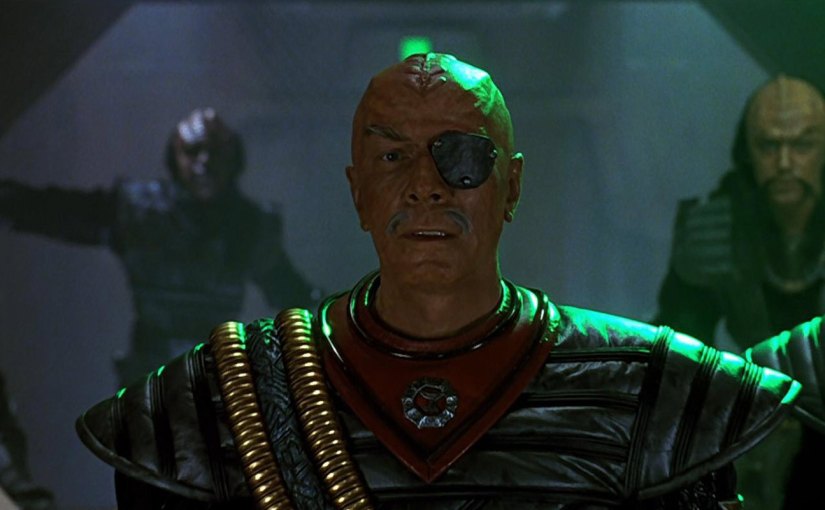
Like the USSR, the savage Klingon empire suffers a terrible accident at one of their most powerful energy planets, that spirals them into possibly having only fifty years of life left to survive. Therefore, Klingon Chancellor Gorkon (David Warner) reaches out to representing Ambassador Spock of Starfleet (Leonard Nimoy) to begin peace talks that will help prolong the alien race’s survival.

Captain Kirk (William Shatner) however, is not so keen on the idea, especially after he blames them for the murder of his son. It turns out many other factions are not enthused either, as Gorkon is assassinated and Kirk and McCoy (DeForrest Kelley) are sentenced to an ice like Siberian prison planet.

There’s much to think about in the original Star Trek cast’s final film together. Beyond the sentiments of the crew retiring and the Enterprise being put out to pasture so to speak, there’s an interesting story to ponder about how we map out the future for upcoming generations when we are still living with the past that we’ve grown accustomed to. It’s telling, considering much of the real-life events happening twenty-two years into our new century with historical statues being removed and minorities fighting for fairness among their communities.

As well, is one country or people too proud and always wanting to be at odds with another by relishing in being a super power? Can we think beyond that nature? I think that’s maybe where the curious title, The Undiscovered Country, stems from. We just haven’t seen the possibility that could be truly within our reach, if we all wanted it that way.

Christopher Plummer plays Klingon General Chang who vows revenge for the assassination. Plummer is spectacular; a villain not recognized enough on all of those on line top 10 lists of bad guys. Plummer brings his theatrical training to the role as he relies on Shakespearean quotes to take in the scene at hand. He’s at least as good as Ricardo Montalban’s Khan is remembered.

The crew is adored as usual. The supporting cast are given their fair share of lines and moments in the spotlight. Kim Cattrall joins as a Vulcan Federation Officer who’s helpful to uncover the true criminals at play.

Director Nicholas Meyer contributed to the best of the Star Trek films, and this is a perfect example of his strength within the franchise. The story was partly conceived by Nimoy with Meyer credited on the screenplay. Cold War politics really lend to this film. It’s interesting to see how the Klingons are initially in denial of assistance or the desperate problem they face which is similar to Russia’s response following the horrifying nuclear accident at their power plant in Chernobyl. I just love how the ideas within The Undiscovered Country parallel the world’s response and effects of what was happening just a few years prior to this film’s release, in 1986.

Never let it be said that movies can’t teach you anything.

STAR WARS EPISODE III: REVENGE OF THE SITH

By Marc S. Sanders

Star Wars Episode III: Revenge Of The Sith is the best installment in George Lucas’ prequel trilogy of his epic space opera saga. However, that is where the line is drawn.

It carries a heightened drama thanks primarily to Ian McDiarmid as the eventual Emperor Palpatine. Shakespeare might have been proud of the character and performer. Much like Alec Guinness received an Oscar nomination for his portrayal of Ben Kenobi, so should McDiarmid have been honored playing an antithetical influence (of Kenobi) on the student and Jedi in Training, Anakin Skywalker (Hayden Christensen in a much more improved performance).

War within the galaxy is rampant and there’s no end in sight. The Jedi Order is overwhelmed. Anakin is used as a pawn to spy on his new mentor Palpatine who in turn insists that the young Jedi occupy a chair in the Jedi Council to spy on them. In addition, it’s hard for Anakin to come to grips with his secret wife Padme (Natalie Portman) dying from childbirth as his nightmares continue to remind him. A deal with the devil himself in Palpatine is offered as an option. Can a manipulation in the Force rescue Padme from death?

There’s a lot of weight on Anakin here. Sith departs from the politics discussed in the prior entries as it focuses primarily on Anakin’s personal struggles. The film really needed to take this direction. After all, it’s time to witness Anakin’s transformation into Darth Vader. Everyone has been dying to see that.

George Lucas’ scene set ups work on occasion. A great performance of dialogue occurs in an alien opera box between Palpatine and Anakin. This is where McDiarmid really comes through. He’s subtle and deliberate in his influence. Fortunately, Christensen just needs to listen mostly.

Later however, a scene works only so much when Samuel L Jackson as Jedi Master Mace Windu duels with Palpatine, having just revealed his secretly evil Sith side. Through all three of these films, Mace Windu has been one of Jackson’s least exciting roles. He’s bland and never doing much. Christensen comes upon this scene and doesn’t give me the genuine anguish I was hoping for. McDiarmid, again, is hitting home runs in surprise and development. This turning point scene is not as strong as it should have been thanks to Lucas’ stilted direction and writing, along with Jackson and Christensen lacking any true depth.

Episode III also has a handful of so what moments that continually frustrate me in this trilogy. We have to watch Yoda and Obi Wan watch a video of what Anakin has done. Why? We’ve seen this already. Bail Organa (Jimmy Smits; I wish he had a larger role) needs to be informed of an upcoming meeting. Honestly, I don’t need an update on a character’s calendar. Just make sure he arrives on time. Moments like these don’t drive towards anything.

Natalie Portman is not served well as a pregnant Padme. Her dialogue is worse than ever, and it hinders her performance. Padme is torn between her affection for Anakin and her passions for democracy. We see next to none of the latter. How does an intelligent woman like Padme suddenly become so unaware? Ironically, opportunity for her political nature was filmed but remains only as deleted DVD features. These scenes would have enhanced the movie as they imply the foreshadowing of the upcoming Rebellion, while a petition attempt is mounted to usurp the Emperor’s administration. Here, Padme is trying to be instrumental in Luke & Leia’s (her own children) future. Really good material here. Nevertheless, George Lucas opted to leave it all on the cutting room floor. Oh well! I’m still holding out hope for a “special edition” cut one day, inclusive of this storyline.

Lucas’ lava planet, Mustafar, is quite grand as the arena for the much-anticipated dual between evil Anakin and noble Obi Wan. Still, again, it could have been better. There’s too much CGI and flashing lightsabers that hide the acting among the swordsmen. Compare this to the duals in Empire and Jedi and you see what I mean.

I know my commentary on the prequels is quite pessimistic, but I do have an (maybe a biased diehard fan) appreciation for the films. The stories work. The execution falls short however in dialogue, performances and visual artificialness.

George Lucas had all the right make up for a trilogy as epic as his original films that began in 1977. Maybe because he didn’t have the monies and technology at that time, his imagination had to work overtime back then. In these later films, however, his hubris got in the way of his craft. So, we have to settle for his next great technological discovery in CGI efficiency. Therefore, we get cartoons with no depth like Jar Jar Binks, General Grievous, and lame, clicking battle droids.

Lucas always defended the position of his writing by insisting these films are aimed for kids. No. I don’t accept that. Star Wars was aimed for kids and the kids that remain in all of us as we continue to grow into adulthood. George Lucas needed to write with that in mind.

STAR TREK V: THE FINAL FRONTIER

By Marc S. Sanders

Leonard Nimoy is an actor who can also direct himself.  Man o’ man, he accomplished amazing feats with Star Trek III & IV, didn’t he? On the other hand, William Shatner is just an actor.  Look at Star Trek V: The Final Frontier and you’ll see what I mean. 

(Mind you, I’m not being fair, because actually Shatner is a very good literary author.  Read his TekWar series to understand what I mean.)

What a terrible shame that this fifth film in what was mostly a successful and beloved film franchise descended so poorly in craftsmanship, writing, direction and performance.  The lesson to be learned when committing to a plot that has your cast of characters meeting with the Lord, Almighty God is…I guess you’ll always come up short.  Someone will be there to say, “Well that’s not my God!” or “God?  Who is this God, you speak of?”

The behind-the-scenes story goes that Shatner agreed to return for the fourth film on the condition that he direct the fifth installment.  Producer Harve Bennett and Paramount agreed, and Shatner got to writing.  What set this film up to fail from the get go is what a skeptical producer later recounted.  If you have a film where the crew of the Starship Enterprise meets up with God, it’s never going to please everyone.  Someone-a lot of someones-are going to be disappointed.  Talk about hindsight. 

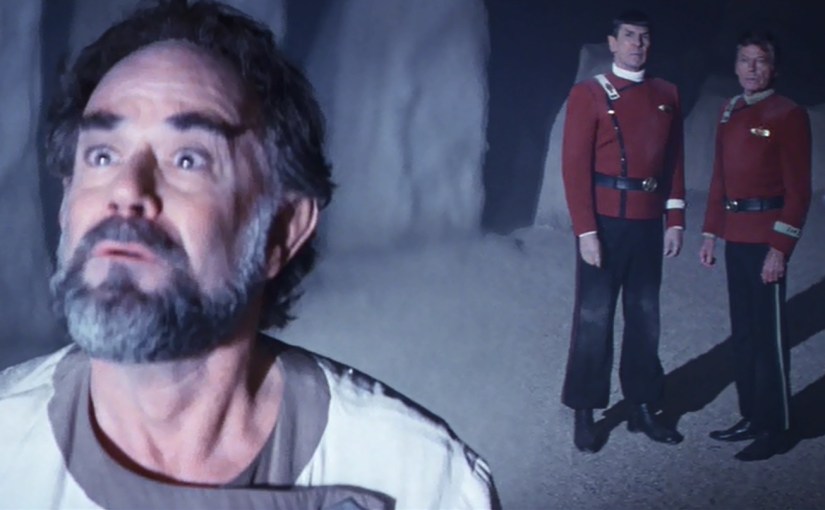
Shatner’s other mistake was offering up a shocking new development for the franchise’s most treasured character.  Spock (Nimoy) has a long-lost step brother.  Yes.  Of course, use your film installments for big moments like this, but not this way.  Sybock (a dumb sounding, uninspired character name, played Laurence Luckenbill) is a crazed Vulcan heretic who brainwashes people by easing what pains them the most.  He arrives on a planet in the neutral zone (between Klingons and the Federation) and rounds up a posse masking them as hostages to bait Captain Kirk and the Enterprise to arrive, thereby hijacking the starship.  Next stop a mythical Eden, where God presumably resides.  This is supposed to be Spock’s brother????

When the veil is pulled off on who Sybock is, Shatner’s scene set up is kind of anti-climactic.  He portrays Kirk in a silly kind of comedic frustration against the no nonsense Spock for not sharing this news.  Lines like “Aha…. See?  See what I mean?” creep in.  It’s kind of sophomoric and hokey, like a failing stand up comic.  Spock doesn’t even find Sybock’s arrival very fascinating. (In case you aren’t aware, Spock exudes enthusiasm by declaring something fascinating.)  Instead, it’s just matter of fact.  So, why should the audience raise an eyebrow at any of this, if Spock won’t even make the effort?

The Final Frontier fails miserably on its visual effects.  The renowned Industrial Light & Magic was not available for this picture.  Shatner and company resorted with another contractor and the lack of substance in space travel and models shows terribly.  At one point Sulu (George Takei) must fly a shuttle transport into the hull of the Enterprise.  Reader, I’ve orchestrated better crash landings with my GI Joe toys.  This is one of the few science fiction films where I can literally tell that miniature models are being used.  The ships are not filmed to appear large and carrying vast amounts of crew members.  The scale of it all seems off.  God is just a holographic face in strobe blue light.  Why did the Paramount production team allow this to happen on such a valuable commodity as Star Trek?  After the enormous success of the last three films, especially Star Trek IV: The Voyage Home, you would think that the filmmakers would be especially protective of their money maker. 

I guess I answered my own question, though.  The title Star Trek sells itself, like Batman, James Bond, Jurassic Park or Marvel or Star Wars.  So, let’s not kill ourselves with money and effort.  Is that the idea?  If audiences came in droves for the last picture, surely, they’ll want more and naturally return for the next one, no matter what’s plastered on the screen.  It’s terrible corporate hubris that happens all too often though, and it’s not right.

Star Trek always succeeds when each adventure is a reflection on our world histories and/or our current events.  The Voyage Home relied on the cause of environmental preservation.  The Undiscovered Country (the next film in the series) sprung from the Cold War politics that ended terribly for Russia with the Chernobyl disaster.  I like to believe The Final Frontier was aiming for religious doctrine, but ended up being a betrayal on a level of cult status, perhaps in the direction that Scientology or NXIUM have been suspected of taking.  A zealot will brainwash you into the illusion of immediate relief from what personally ails you. Then you will follow this so-called leader on a tour to meet the almighty, himself (“God” in this film is portrayed by a man, actor George Murdock.)  It’s regrettable, because nothing was gained from this.  Characters ranging from McCoy to Uhura, Chekov and Sulu all become followers of Sybock under his hypnosis.  Yet, Shatner’s story and direction never provide a relief from what overtakes them.  Were they ever deprogrammed?  Cults do exist and sadly people have to be reverted back from the mind control that’s overtaken them.  I’d argue science fiction could allow for a more economical and immediate relief, but even that is not offered here.  So, again nothing is gained or absorbed from Star Trek V.

Film Critic Gene Siskel made a simple and wise observation about the Star Trek films as a whole.  We like these movies because we like these characters and they like each other.  William Shatner offers a simple life approach to Kirk, Spock and McCoy as they camp out on shore leave in Yellowstone National Park.  They sing “Row, Row, Row Your Boat.”  It has its charm as Spock is dumbfounded by the illogical lyrics of the song.  You smirk along with Kirk and McCoy.  However, it has nothing to do with the crux of the film.  This moment reintroduces the characters at the start of the film and then it is bookended to close out the movie.  But why?  What was proffered from this?  It goes back to William Shatner spit balling as a writer/director.  In other films, before the meat of the story would begin, the characters would reflect on Shakespeare or Charles Dickens for example, and somehow it weaved nicely into the adventure or the outcome later on.  A campfire song has no relevance that I could determine with a quest for God.

Star Trek V: The Final Frontier was just aimless telling, and it bothers me to this day.  By the time this film arrived in 1989, the cast was already starting to wind down.  Their age was showing, and they only had so many more voyages to travel on.  Kind of sad that their second to last exploration was dull, short sighted and massively insignificant.