STAR TREK II: THE WRATH OF KHAN

By Marc S. Sanders

I was only a mild fan of the original Star Trek television show. Some storylines were flat and simply a bore. It had some thrilling moments though, including episodes that I’ve watched on repeat. (The Squire Of Gothos was always my favorite.) Unfortunately, the first big budgeted Trek film followed suit of the weaker, less interesting aspects of Gene Roddenberry’s series. Thankfully, Paramount Pictures with producer Harve Bennett had enough faith to try once more and get it right. Star Trek II: The Wrath Of Khan is one of my favorite science fiction films of all time.

Bennett invested time in rewatching the entire series looking for the return of a formidable foe against the crew of the famed Starship Enterprise, and he settled on the power mad muscled genius, Khan (played with gravitas and impressive pecs by Ricardo Montalban) from the series episode Space Seed.

Khan, along with his wife and crew were left marooned by Captain James T Kirk (William Shatner) on a barren planet for their crimes. Fifteen years have passed and Chekhov (Walter Koenig) along with his Captain (Paul Winfield) unexpectedly come upon the villain’s vessel. Now Khan has taken control of their starship with a vow for revenge upon Kirk.

Caught in the middle of this conflict is a new age device called “Genesis” which has the potential to create life from non life. Find a planet devoid of any living organism and allow the device to go to work. In Khan’s hands though, it could serve as a terribly destructive weapon.

Regardless of its ending, The Wrath Of Khan offers the best performance by Willam Shatner with his memorably storied character. There’s more depth than ever in Kirk. He is now ranked as an Admiral who in turn is denied of directly commanding a starship, his greatest career accomplishment. He’s fearful of aging as his birthday approaches. He also meets up with a past flame whom he shares a son with. There’s plenty of dimension devoted to Kirk, and it all works. None of it feels mired down. This is a story devoted primarily to Shatner’s character with the others in tow. He looks so comfortable in the role as he walks the halls of the Enterprise. Because he always looks like he knows where he’s going, so does the audience. He’s very casual in his manner. The setting of the starship has life when Kirk is populated within it.

Furthermore, the friendship he has with Spock (Leonard Nimoy) feels solid. When Spock gifts Kirk an antique copy of Charles Dicken’s A Tale Of Two Cities, you feel cozy in the history of these two people. It’s further noted in Kirk’s relationship with Dr. McCoy (DeForest Kelly). It’s important to realize that this film is only the second film following three seasons of an episodic television show that more or less just showed villains of the week. We never had an opportunity to really get inside Kirk’s head before. So despite the vastness of Star Trek, it’s main players were arguably still quite green.

Director Nicholas Meyer (the best one of all the films), turns two sea captains upon one another amid an ocean of space as they play battleship. You get a strong idea of the tactician that Khan is. Montalban is great as a Captain Ahab seeking to destroy his Moby Dick, suitably relying on quoting Melville’s classic novel. Meyer is so good at drawing from the best of both sides. The adversity between Khan and Kirk works very effectively that you hardly realize that Shatner and Montalban never appear on the same set together. Both primarily work from their Captain’s chairs. The set ups play with much strategy and good back and forth dialogue as they communicate by screen images. Call it their “Zoom Session” if you must. Ultimately, this film demonstrates that how a movie is only as strong as its villain.

The Enterprise setting also looks superb with its elevators, curved and endless hallways, engineering platforms & alcoves and submarine like doors. The command bridge looks realistically functional too. Everything on the Enterprise seems like it has a working purpose. When crew members are running towards something or climbing a ladder, Nicholas Meyer makes it feel like you know where these people are going and what they are trying to do.

Composer James Horner also needs a good amount of credit. At times, his music comes off frightening. As Khan makes various approaches with his ship, Horner has this claw like thunder clap cued in to the danger. His more upbeat tempos feel like proud militaristic marches for the Starfleet characters. You get that feeling especially in the opening credits. During a sequence where the two ships are flying blind through a nebula, the music is eerily string like and quiet. Horner studied this film to get the absolute best notes.

The ending is heartbreaking and suitable to the character arc that Kirk experiences. While it is surprising, it’s also pleasingly foreshadowed, wrapping up the internal dilemma that Kirk grapples with over the course of the film.

I would argue that Star Trek II: The Wrath Of Khan turned out to be the most vitally important chapter in the famous franchise’s history. It succeeded in acting, writing, effects, setting, score and direction. Had this film not generated a response from audiences, I have to wonder if any more of Star Trek would ever have been seen again.

One thing for sure, you don’t have to be a die hard fan to really appreciate a great film like The Wrath Of Khan.
TENET

By Marc S. Sanders

Christopher Nolan is certainly the most imaginative director working today. Films like Inception and Interstellar welcome new kinds of science fiction dissimilar from most any other films. He is an incredibly inventive filmmaker. He’s so inventive, in fact, that I think he might have carried himself too far with his much anticipated sci fi spy thriller Tenet, featuring John David Washington and Robert Pattinson along with Kenneth Branagh in a James Bond villain role. Actually, there’s a lot of Bond inspirations here. Not surprising, as Nolan is a devoted fan with much admiration for The Spy Who Loved Me, in particular.

It’s hard to describe Tenet because it’s hard to fully comprehend Tenet. I don’t even have to worry so much about revealing spoilers because I likely wouldn’t know what I’m unveiling.

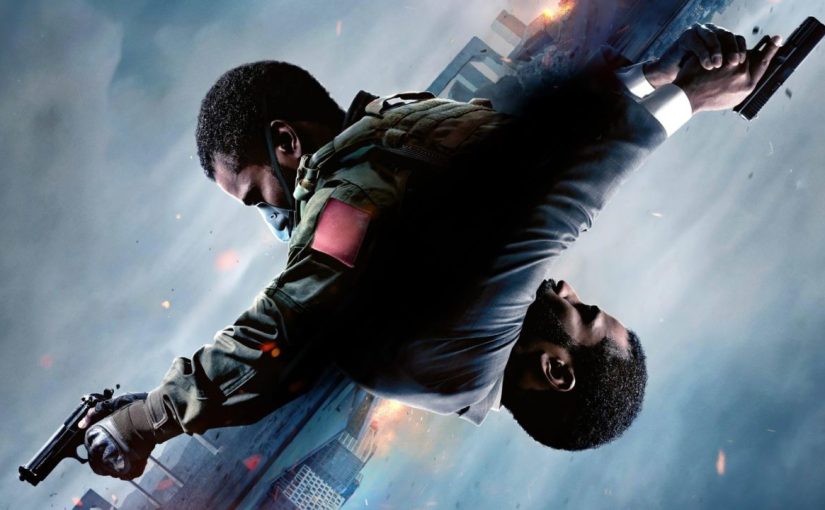
Washington is a good leading actor. This film along with BlackKklansman prove that. He plays The Protagonist (no name revealed) who is extracted from a hostage mission that opens the film at an opera house. Apparently the CIA liked how he handled himself in the field and now they want to assign him to the concept known as Tenet where time moves inversely with itself.

Try and stay with me here. If you fire a bullet out of a gun, the bullet can also be pulled back into the pistol if you are moving through time on a backwards trajectory. Sounds very Nolan, right? Sounds very cool as well and when the science of this is simplified early on it looks cool too. However, as the film moves on and objects and time traveling get more complicated Christopher Nolan seems to lose his way.

There’s a bomb out there made of technology that is unfamiliar yet. Why? Because that tech was perhaps invented in the future and brought backwards through time inversely to be detonated and literally destroy the world. The Protagonist has to prevent this from happening and so he’s partnered up with Neil (Pattinson) who is a handler with more knowledge about this mission and Washington’s character than he should know.

Tenet has some spectacular edits and footage of dazzling camerawork. It’s a contender for an amazing car/truck chase. Washington and Pattinson are good together. Branagh is fine as a vicious wealthy industrialist with a penchant for abusing his beautiful wife (Elizabeth Dibecki). CGI thankfully seems very limited as well. All of the gorgeous locales and vehicles are here. Warner Bros holds so much faith in Nolan’s works that his budget seems to not exist. There’s boats, yachts, helicopters, trucks, a fire engine and a BMW. There’s also a real life jumbo jet crash. It’s a gorgeous looking film and every dollar seems well spent. However, it’s not a well assembled film.

This is the first time I would NOT recommend seeing a movie in a Dolby theatre. The sound is obnoxiously loud. The musical score from Ludwig Göransson is POUNDING bass; so loud that I couldn’t even decipher any semblance of a tune. Much of the sound edits seem that way as well. It’s a headache to sit through this film. A terrible soundtrack and sound edit for sure. To watch Tenet on a technical level is to park your automobile next to that rebuilt Oldsmobile with the new gold rims and the maxed out speakers that shake your car while you’re at a red light. It’s terribly distracting and overly annoying.

Nolan also does not demonstrate his science very well here either. It’s hard to understand when someone is traveling normally through time versus inversely. Somehow it just occurs at times and you lose your way as to when it began. If you consider Inception, Nolan explains the tactical strategies of approaching someone’s mind by means of dreams and in sleep mode. Everything was spelled out nicely. You want to learn more and see more of the tricks. Tenet doesn’t leave you with that curiosity.

I didn’t hate Tenet. My wife did, however. There are close ups of arbitrary things early on that circle back later. So it kept me engaged when I uncovered some significance here and there. Still, it’s not enough.

Nolan conceived another brilliant and brainy idea. I only wish his delivery and the construction work of his crew, especially his sound and music staff, were more up to par.

AVATAR

By Marc S. Sanders

James Cameron is the guy with the ambitious talent, and yet he more often than not has a missing link in his widening imagination. It never surprised me that Titanic was nominated for a slew of Oscars and still the one thing that was not recognized was Cameron’s overly melodramatic screenplay. That shortcoming carries over to Avatar from 2009.

As a naysayer of 3D viewing who is giving you this review, I was initially so impressed with this picture featuring tall blue people with tails and big ears that I saw film twice. Still, I couldn’t get past the simplicity of the story. Avatar is Pocohontas. Avatar is Dances With Wolves. Avatar is Ferngully. (Okay. That last one I only heard from Miguel and his girlfriend Penni. I’d never seen Ferngully.)

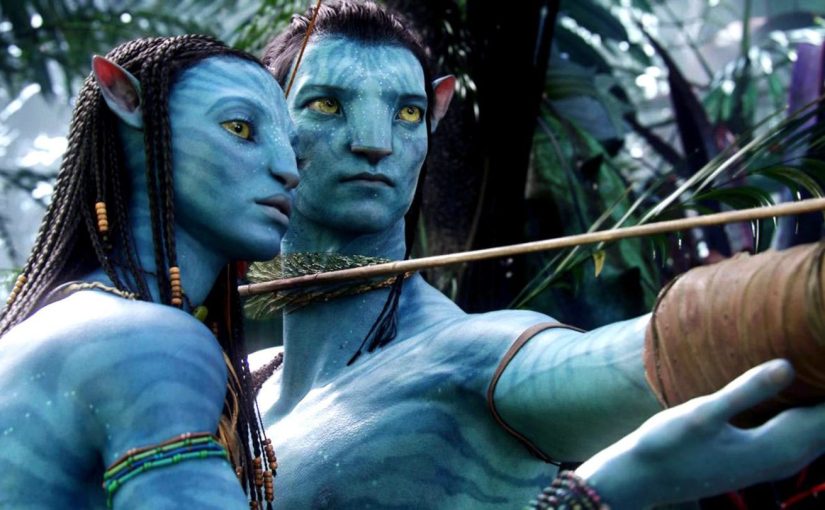
Jake Sully (Sam Worthington) is a Marine now confined to a wheelchair and recruited to replace his deceased soldier brother on a mission to meld his mind with an “avatar” body of a native of the neon jungle planet known as Pandora. The actual Greek meaning of the name Pandora is never considered for any kind of thought provoking significance. Jake is assigned to learn about the natives known as the Na’Vi and expose a tactical weakness in their fighting skills and weaponry. Jake works alongside the scientist known as Grace (Sigourney Weaver) to connect with the people. The evil military corporation led by a mean grunt named Colonel Miles Quaritch (Stephen Lang) is in need of collecting a valuable mineral known as “unobtainium.” Grace’s priority is not the mineral. She’s more concerned with connecting and peacefully studying the people. On Jake’s first tour into the wild, he ends up stranded overnight. Gradually, his mission for the means of the military and corporation dwindle as he bonds with a Na’Vi named Self (Zoe Saldana). Soon, he identifies only with aiding the Na’Vi declaring his will to defend their planet against the greedy humans.

Much of Cameron’s near 3 hour film is a travelogue of the fictional Pandora and the customs and behaviors of the Na’Vi along with the creatures they share the planet with like oversized dog looking animals and winged dragon variations that the natives can ride on their backs. Neon plant life is shown in excess. Rivers and streams as well. Wide open skies too. It’s amazing to look at for sure, but eventually the novelty wears off. More or less, a lot of these trees are just glowing palm trees.

Because the film’s central storyline is so simplistic and familiar it’s not very gripping. When a Na’Vi dies or a precious worship tree tumbles at the behest of the military’s destruction, the Na’Vi wail in their own way. It just didn’t hold me so much because I didn’t feel a connection to the sci fi the film presents. James Cameron can paint a picture like no other. Somehow though, his prints are devoid of much emotion. The dialogue is clunky or cheesy in its nature. Regrettably, this has always been his problem going back to films like The Abyss or even the original Terminator. All BIG IDEAS, but weak development.

Avatar enchanted audiences back in 2009 thanks to its 3D. It was positively immersive and you felt surrounded by the nature of it all. At home, that effect is sorely missing and so you are left dazzled during the film’s exposition, but worn out on its long winded and simple storytelling.

Apparently, James Cameron is filming the next three sequels back to back to back. Three more movies of this? Really? Look, the guy has a great track record and has mostly defied the pessimists over the years when his budgets go through the roof, but I can’t see another nine hours of this material to hold me interested or thirsting for more of either Pandora or what the blue people still have yet to offer.

STAR TREK (2009)

By Marc S. Sanders

Well Batman did it, and James Bond did it.  So why can’t Star Trek do it too? 

JJ Abrams adopted another franchise to direct when he rebooted the outer space western originally conceived by Gene Rodenberry over 50 years ago.  He did well with it too, if you are willing to dismiss the final polish to the look of the picture that Abrams couldn’t resist.  Not so much a polish as it is a tarnish, unfortunately.

I was late to the party of realizing that Abrams has a terrible habit of using “lens flares” on many of his films.  Now that I’m attuned, I can’t help but notice.  I typically get quite entertained by his pictures.  Mission: Impossible III is still the best of the series as far I’m concerned.  The Force Awakens thankfully carried the original trilogy tradition of the Star Wars franchise.  His one original film that he directed, Super 8, is criminally underrated.  However, those films were spared the over saturated and very unwelcome lens flare that dominates his first Star Trek film.  The film opens with an outstanding special effects battle as a Federation starship is being overwon by a Romulan war ship.  The sets of the bridge and decks of the ship are slanted to emote chaos.  There are sparks of fire falling all over the place.  Crew members are being sucked into space, and falling over each other.  And there’s lens flares aplenty which are not so distracting within all the hysteria depicted.  The scene climaxes with the birth of one of the two most celebrated franchise characters, James T Kirk.  It’s a spectacular opening sequence that seems to uphold the traditions of Star Trek while feeling fresh with outstanding visual effects.

Afterwards, the visual effects stay on course with the updated technology that Hollywood now relies upon.  Nothing here looks CGI.  It all feels tangible, hot, and operationally functional.  Abrams accomplished a great looking science fiction film, but then he and his cinematographer spray painted a graffiti of light streaks that never end.  Crew members will be walking down a hallway – there’s a lens flare.  A character gets abandoned on a deserted snow planet – there are more lens flares.  A bar fight occurs, only to be blinded by lens flares.  Every time a guy throws a punch, it’s literally followed with a lens flare.  A hearing in an assembly room takes place.  Why do we need streaks of light in here of all places?  If I were on vacation and taking in the sights of the Golden Gate Bridge in San Francisco within this future, my pictures would be terrible.  Apparently, lens flares have taken over the state of California.  (I guess I should be thankful knowing the state did not in fact eventually sink to the bottom of the ocean.)

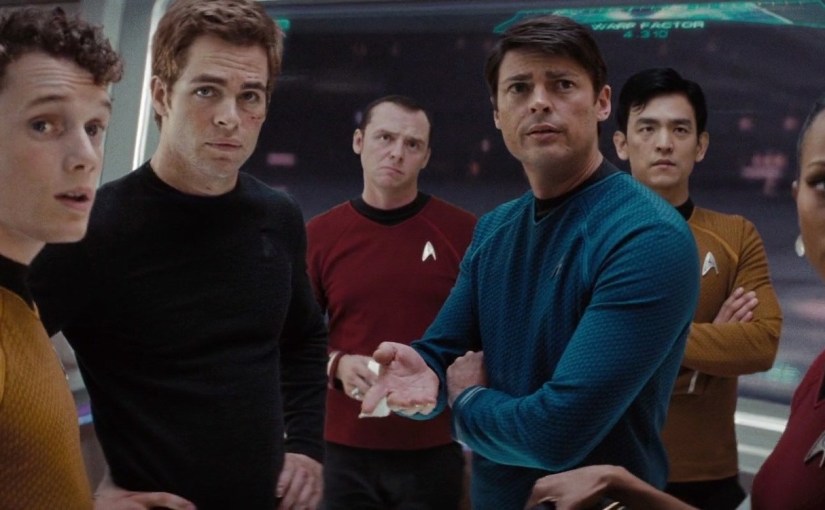
The rebooted story line is fine, yet simple.  A Romulan terrorist named Nero (Eric Bana) from a further distant future is obsessed with exacting revenge on Spock.  Next to that plot, this film serves more as opportunity for production company Paramount Pictures to reintroduce the beloved seven main characters of the original series of television and films with new actors.  Chris Pine is one of the best casting selections.  His Captain Kirk is his own performance and yet when he finally sits in that captain’s chair on the bridge, I could recognize the stature and expressions of William Shatner.  He gives a nice salute to the character and the original actor who played him.  Zachary Quinto is also good as Spock, though this character is distant cry from the original Leonard Nimoy portrayal.  I found it interesting.  This Spock has greater challenges with emotions harbored in the human side of his brain.  Karl Urban is fantastic at taking over the reigns of DeForrest Kelley as “Bones” McCoy, the Enterprise’s eventual resident doctor.  Urban is given the opportunity to be hilariously cynical upon his entrance into the film.

While the visual effects and sets are at the top of their game with Abrams and crew sparing no expense, it is a little eye opening to see the sexuality of the characters take a step forward.  Abrams is not shy about showing Zoe Saldana as Uhura disrobe into her under garments with Kirk standing on the other side of the bedroom.  I’m not offended or prudish about this material but was it really necessary to go with the Porky’s angle?  It doesn’t have to be a requirement to take some of the most beautiful actors in the world and get them to strip to uphold a film.  Star Trek always had much more to offer than that.  Scenes like this come off like a cheap shot.  Pine and Saldana are better actors, worthy of favored franchise fare (DC and Marvel films) than just material like this. 

There are some surprises in this reboot for both the casual and obsessed fans.  It’s kind of welcome actually as it takes the familiar universe of Roddenberry’s conception and turns it on its head.  Certain well known locations and characters arrive at unexpected fates.  Though, unfortunately, the alternate timeline motif pushes its way through the middle of the picture.  I fear for these kinds of stories.  All they do, time and again, is open up unanswered and (forgive me for the pun) illogical answers.  Marvel and DC films are on their way to doing this with their upcoming films following the year 2021 and I can see the whole thing unraveling at the seams.  Was it necessary here, though?  I really didn’t think so.  Abrams had an opportunity to win back an appearance of an actor from the original series and it seemed forced into the film like a square trying to fit into a circle.  The older installments had their moment in the sun.  Let that go.  Focus on this new cast and this new vision.

Again, this Star Trek is a gorgeous looking film full of color and clean looking set designs all around.  The bridge of the Enterprise is something that I’d love to see in person.  The cast is actually quite perfect filling the shoes of their respective roles.  However, JJ Abrams tried too hard I think with a couple of plot developments, and an extremely distracting and very unwelcome LENS FLARE.  I KNOW I’M REPEATING MYSELF.  YET I’M NOT BEING ANY MORE REDUNDANT THAN ABRAMS WAS WITH THE STUPID BLINDING PIECE OF LIGHT. 

Maybe the next time I watch this picture, I’ll wear my sunglasses.

MAD MAX

By Marc S. Sanders

What is the fascination with George Miller’s original 1979 film, Mad Max?  I don’t get it.  I know this film shot in the Australian outback was made a on budget less valuable than even a shoestring.  The fast-paced camera shots of cars careening down long stretches of highway are high octane (pun, most certainly intended) and the crashes are completely in your face.  Yet, I need more than this. 

When the film pauses for albeit very brief moments of storytelling such as a motorcycle gang apparently out for revenge against dystopian future cop Max (Mel Gibson’s breakout role), how is this ever even learned among the characters?  When Max opts to resign from the police force and take his wife and young son on holiday, how does this motorcycle gang led by a savage named The Toecutter (great name) catch up with them, and then after a narrow escape, how do they catch up yet again with one another, while making a sudden appearance on the back of these noisy motorcycles?  Miller’s film never goes from A to B to C.  Rather it goes from W to S to Q and then Z.  It’s a mixed up mess.

I’m all for throwing logic out the window when watching a thrilling action piece…if it’s thrilling.  When it’s not, well then, I’m asking for the logic.  Miller’s film feels like a bunch of want ads cut out of old newspapers, and then scotch taped together into a film reel.  I’d be curious to see an original script.  I can only imagine it being no more than three pages long. 

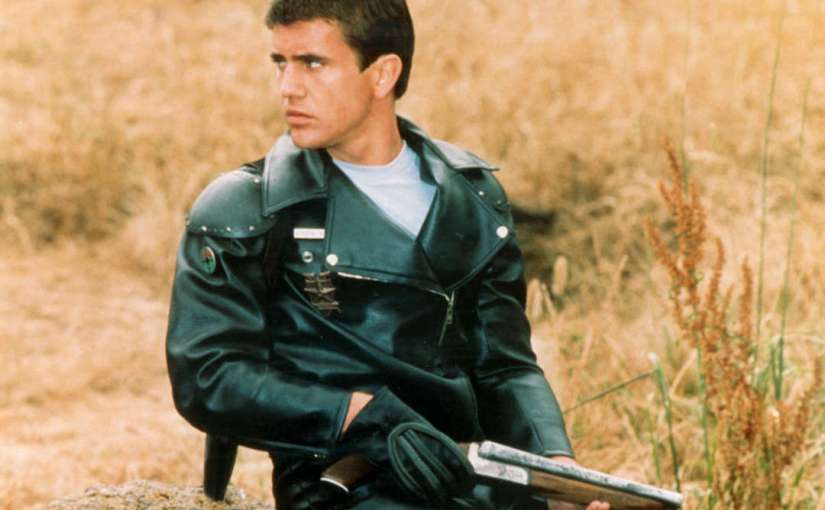
The appeal in 1979 and the years thereafter when the Max character blossomed into a franchise must have come from Gibson on film.  Yes, the stunts in this film with quick edit action pieces are daring.  I still think so forty years later.  This wasn’t CGI after all.  This was all the crunched up metal, rubber tires and flames that Miller could muster.  Still, the one artistic achievement had to be Mel Gibson’s image.  He wears the costume well.  A blue t-shirt enhancing his blue eyes under all black leather with a sawed off shotgun in his right hand while driving a souped up black Pursuit Special automobile with the engine sticking out of the hood.  Just writing that out reminds me of how iconic that image is, and this is before the similar looking Terminator that came along a few years later. Still, that’s where George Miller’s inventiveness stops. 

There is nary a character to consider.  The villains are nothing more than leather clad with bleached hair and dark mascara under the eyes riding Kawasaki bikes.  I know this was made with next to no money.  These guys don’t have to look like Darth Vader, but could they at least offer up something interesting to say?  Max has a couple of partners in the police squad.  They have no camaraderie.  One of them gets burned to a crisp.  Max takes a look at him in the hospital.  Why should I care though?  It’s not like I saw these guys share a Coke together.  Max is married.  They lie side by side each other in bed and their toddler sits on the floor nearby.  So?  Anything else?  Could one of them start a pillow fight or kiss or something, please?  A shoestring budget can still allow relationships to happen.  Miller doesn’t care about that though.  John Woo may show a nonstop bloodbath in any of his films with next to no story.  His films can work however, because he won’t get sidetracked with showing two people in their bedroom doing nothing.  He’ll remain focused on the mayhem.  Miller is not doing that here.  He shows a house with a bedroom.  Yet he doesn’t show the story in that bedroom that’s in that house.  That’s the difference.

I know the subsequent films in the franchise vastly improve upon the original Mad Max.  I’m just amazed they ever saw the light of day.  I’m more amazed that this became one of the most profitable films in worldwide history.  How did 1979’s Mad Max have the legs…no…the wheels…to maintain this ongoing velocity of interest?  What do I know?  I guess I’m a Debbie Downer for wanting people to talk to one another before handcuffing them to a gas guzzling fiery wreckage.  Is it too much to ask for a little sensitivity?