THE LITTLE MERMAID (1989)

By Marc S. Sanders

What I hearken back to most when I watch The Little Mermaid is my junior year of high school in 1989.  If you were around at that time, then maybe you realized how much of an impact the characters of Ariel, Sebastian, Flounder, Scuttle and Ursula The Sea Witch had on kids, but teen pop culture as well.  Batman was big that year.  Disney’s underwater, romantic, musical adventure was at least as large.  Driving home from school, everyone I knew were singing along to celebrated numbers like Kiss The Girl, Les Poisson, Under The Sea and Part Of Your World.  My drama class couldn’t get enough of Poor Unfortunate Souls.  Oh, how overdramatic we would get in Mr. Locklair’s class while emulating Pat Carroll.  I still harmonize Ariel surrendering her voice.  Yes!  I can hold the tune!!!!  There is no denying The Little Mermaid cast a spell over the student body at Berkeley Preparatory School in Tampa, Florida.

The Little Mermaid is an important entry in the Disney lexicon.  Disney films were considered substandard, tired and stale before this release.  However, the adored fable based upon a story from Hans Christian Anderson awakened something that still carries on.  The music within the film from beloved writers Alan Menken and Howard Ashman were delivered like Broadway showstoppers.  The quality of the songs was elevated with gorgeous calypso and reggae harmonies, and vocal characterizations as colorful as the underwater life depicted on screen.

Ariel (Jodi Benson) is the title character who dreams of what life is like above the surface.  Her father, King Triton, strictly forbids her from going above the water.  In his eyes, humans are ghastly.  That’s a problem because his daughter is enamored with handsome Prince Eric (Christopher Daniel Barnes).  Like a sixteen-year-old who sneaks out of the house through a bedroom window, Ariel visits the nefarious and alluring sea witch, Ursula (a rapturous Pat Carroll in one of the best fantasy villain roles to ever appear in the movies).  The deal is Ursula will turn Ariel into a human for three days.  In exchange the little mermaid must surrender her gorgeous singing voice.  If Eric does not give Ariel a kiss of true love by the time the sun sets on the third day, then her soul belongs to Ursula for all eternity. Ariel gets some help from Sebastian the crab (also a sea-life orchestral conductor), innocent Flounder, and a zany seagull named Scuttle (Buddy Hackett).

The animators at Disney use everything at their disposal to burst wondrous color within the film.  There’s life brought to the sea life within the backgrounds from a blowfish who BLOWS, to the Octopus and the shrimp and swordfish.  Even the random bubbles that float around are marvelous to look at. Nothing is off limits and life under the sea seems so much more enticing compared to the ho hum activities that we humans endure each day with traffic jams and junk mail.

Other Disney productions like Alaadin and Beauty And The Beast that followed, offer some life lessons for the protagonists to consider.  The Little Mermaid doesn’t actually.  It rests upon wishes and dreams for Ariel.  I’m thankful for that.  It’s such a glorious picture that I coast through on the fantasy of it all.  Ariel takes me on adventures to explore shipwrecks and her grotto where her human collectibles are stashed.  I get to carefully approach the dark imagery of Ursula’s caverns where countless, slimy, pitiful souls suffer, while the tentacled monster delights in her vanity with Pat Carroll’s gleeful voiceover.  It’s just enough for me.  Disney doesn’t always have to preach, and I think it’s why The Little Mermaid is my favorite of all of their films. 

Every moment is beautifully drawn in shape and color.  Still for a film that came six years before the Pixar evolution, the expressions of the characters come off so naturally.  Look at Sebastian’s fear and frustration as he tries to keep up with an independent Ariel.  Pay attention to Ariel’s nervous reaction when she encounters Eric on the beach after she’s become human.  She’s animated to try and straighten her hair and grin her teeth because its as if the popular kid in school is walking across a disco lit gymnasium to ask her for a dance.  The animation is purely inspired by natural, human behavior that we are all too familiar with.  When drawn like this, we can’t help but be impressed.

The songs are the highlights though.  The compositions are so lively and easy to pick up and sing along to, like we all did in high school.  The lyrics are equally impressive like the most brilliant of dialogue.  When Ursula makes her campaign for why this trade would be advantageous for Ariel (Poor Unfortunate Souls), I can’t help but believe her.  She’ll have her looks and pretty face.  It’s only her voice!  You got a point there Ursula.  The best villains always have the most sound reasonings behind their motivations.

Sebastian (Samuel E Wright) makes a strong argument for why life Under The Sea is so much better than living on land.  His enthusiasm in song is completely convincing.  Life under the sea is nothing but a party.  Let’s go.

Jodi Benson gives a strong voiceover performance as Ariel.  I’m hearing a firm and independent young woman who stands her ground and will defy any orders to go after what she desires.  Her rendition of Part Of Your World is one of Disney’s most treasured and celebrated moments in film history when accompanied with the setting of Ariel’s towering grotto of props that we humans take for granted like fish hooks and dining utensils, especially a dinglehopper…you know…a fork!  This is what a kid dreams of becoming when alone in her room with no one there to judge her true feelings and desires.  It’s truly glorious.

The one scene that does give me pause is the dramatic discovery King Triton has of Ariel’s secret vault of collectibles.  By the end of the moment, his temper has grown so big, that he unleashes the power of his trident to destroy everything she’s treasured.  I’ve always said this looks brutally familiar to how a father might take a baseball bat to a kid and her room, teetering on domestic violence.  The scene is memorable but unnerving all the same.  Still, I have to remind myself that this is a fantasy, and this is only a movie. 

Nonetheless, The Little Mermaid is a timeless film filled with magic and whimsy and daring escapes and big laughs that are not just relegated for eight-year-olds.  As adults, we remember those butterfly feelings of our first crush and what held us back from pursuing it further.  We can relate to what the characters do for, and towards each other.  Again, everyone from the deliciously wicked villain down to the defiantly brave protagonist and her sidekicks have a point and very human understandings for why they exist and what they want out of life.  Being a mermaid or a crab or a sea monster doesn’t make any of these people any less human. 

THE THOMAS CROWN AFFAIR (1968)

By Marc S. Sanders

My father always loved how the ultra-wealthy lived on screen.  James Bond’s encounters with villains hiding out in the most elaborate estates, or the social class stabbings of the women in All About Eve were the fantasies that he wanted to live among.  Dad also appreciated the way billionaire playboy Thomas Crown lived.  Though I doubt Dad would ever suffer from a mild case of boredom like Tommy Crown did. 

The original, 1968 version of The Thomas Crown Affair begins with an elaborately planned bank robbery. Then begins the chess match between Steve McQueen as the title character and a beautiful insurance investigator who is trying to pin the entrepreneur for the crime, Vicki Anderson played by Faye Dunaway. 

The film, directed by Norman Jewison, is a caper adventure during its first thirty minutes.  Thomas Crown assembles a crew of five men to don hats and sunglasses.  He coordinates what time they should arrive in Boston, either by plane, train or automobile.  They enter a particular elevator in a bank located in the center of downtown Boston, hold some people hostage and simply walk out the door with over two and half million dollars in cash.  Afterwards, Mr. Crown will take over and make sure the monies are deposited in a Swiss bank account. 

This film is quite outdated by now.  There’s a lot of easy-very easy-conveniences that work for the heist to successfully come off.  Yet, that does not interfere with enjoying The Thomas Crown Affair.  With film editing from Hal Ashby, Jewison directs the heist in rapid split screens.  It manipulates you into thinking the mechanics behind the robbery is more elaborate than it really is.  Thomas Crown orchestrates everything from his luxurious office across the street.  His crew simply hold folks at gun point with one of them driving away with the money.  It’s the pacing of the split screens in halves, thirds and sometimes fourths that keep you alert as the crew arrives at the scene of the crime from all different points. 

After the robbery is successfully committed, the insurance investigators for the bank show up.  Paul Burke is the frustrated one in charge with the loose tie and wrinkled shirt.  He allows Vicki to enter Thomas Crown’s life when she miraculously suspects that he must be the kingpin behind the theft.  Thomas knows what Vicki suspects and then the pair fall in love while trying to hide each other’s hand.  At times, one is playing cat.  At other times, one is playing mouse.

As I said, the robbery is the most exciting part of The Thomas Crown Affair.  Afterwards, the film seems to turn into a picture album or an episode of Lifestyles Of The Rich And Famous.  McQueen doesn’t offer up much dialogue.  We get to see him play polo, take a flight in his hang glider and play golf.  Dunaway has occasional conversations with Burke trying to figure out how to prove that Crown is the master thief, wearing the most beautifully trendy outfits of the time.  You can’t not pay attention to how sensational Faye Dunaway looks in this picture.  When Dunaway and McQueen share the screen it’s simply an album of romance and escapist adventure.  Tommy takes Vicki in his custom-made dune buggy (personally customized by McQueen himself) along the wind-swept beaches.  They allegorically engage in the sexiest chess match to appear on film.  They tease one another with their suspicions of each other.  Yet, the movie never advances beyond any of that.  Norman Jewison simply wanted to go on a luxuriously scenic New England vacation while shooting this picture. 

I can appreciate the internal dilemma of Tommy Crown.  A bored, isolated and very wealthy man who has everything, and cannot get thrilled with what to do next except to become a moonlighting criminal for one opportunity.  One character trait that I liked was that Tommy will place bets on shooting a golf ball out of a sand trap, and lose not once but twice.  He’ll play chess with the alluring woman who’s pursuing him as well.  Yet, she gets his king in check.  The only challenge he wins at is the one that nobody is legally permitted to play.  It’s a dimension for the character, even if it is not explored with too much depth. 

The Thomas Crown Affair is not the greatest film.  I have seen it a few times as a personal means to stay in touch with my father who has passed now.  He loved to watch how the wealthy lived within the confines of their mansions with their brandy sifters and pocket watches.  When Tommy sits at his grand office desk, I hear Dad saying, “Wow, what an office.”  Dad talks to me when I watch Sean Connery as James Bond or Steve McQueen as Thomas Crown.

The movie features Dad’s most favorite song, the Oscar winning The Windmills Of Your Mind which opens the picture to feature the credits.  Honestly, this is my most favorite part of the movie.  It’s a magnificent song that I could listen to on replay.  The lyrics and haunting melody seem to tease the introduction of a man of mystery.  Yet, Thomas Crown doesn’t turn out to be all that enigmatic.  He’s a quiet fellow who only finds amusement when he comes up with the audacity to pull off what many of us would never dream to carry out.  Yet, once that is over, what is there left to do?  Fall in love with Faye Dunaway?  Well, there could be worse things in life.

Footnote: I share this portion from the eulogy I wrote for dad in September, 2019:

Dad’s favorite song was The Windmills Of Your Mind from one of dad’s favorite movies The Thomas Crown Affair, featuring Steve McQueen as the title character with Faye Dunaway about a man bored with his wealth who seeks adventure by orchestrating a complex robbery simply for the fun of it all.  As dad never slept and was always active, I consider this lyric from the song.

Round like a circle in a spiral/Like a wheel within a wheel/Never ending or beginning/On an ever-spinning wheel/Like a snowball down a mountain/Or a carnival balloon/Like a carousel that’s turning/Running rings around the moon.

Dad could never memorize the lyrics exactly but I recall him humming the tune endlessly when I was growing up.  Dad’s life was never ending.  In a spiral, in a circle, always moving and going on and on.  Just 3 months ago we were at the Tony Awards together.  Just this past summer he was reading with Julia.  Just this year he was making plans with Adrienne for Julia’s upcoming Bat Mitzvah.  Just this year he was accompanying Brian to the shooting range for time together. Just this year he was planning another party at his home for his clients, friends and fellow congregants.  Just five weeks ago, he was driving his Aston Martin, named after the Bond girl from the film Goldfinger. I dare not repeat that name here.

While in the hospital this last month, the nurses would ask him with surprise “You still work?” and dad’s reply was “Yeah.  Don’t you?”  He refused to ever retire.  He said he would never do it because then what would he do with himself.  He never stopped.  He never ever stopped, and I imagine he hasn’t stopped since he reunited with Linda and my grandmother Helen this past Thursday evening.  He is truly a windmill of the mind.

SHAKESPEARE IN LOVE

By Marc S. Sanders

William Shakespeare’s works will always remain timeless.  His accomplishments are simply magnetic.

If you have any love for live theater, you’ll likely have at least a fondness for John Madden’s Oscar winning film Shakespeare In Love.  I loved the movie.  Perhaps that is because as a moonlighting playwright, myself, I could relate to The Bard’s early dilemma in the film – writer’s block.  It’s a gnawing, aggravating experience to go through.  You have an urge to create.  You just don’t know where to begin.  Believe me Bill, I know what you’re going through.

This likely fictional telling of William Shakespeare’s process of conceiving Romeo & Juliet begins with two competing theaters who have purchased the rights to Shakespeare’s (Joseph Fiennes) newest play that he has titled Romeo & Ethel, The Pirate’s Daughter, a comedy of course.  However, he has not yet written one page.  Not only does he suffer through his writer’s block, but William also has to endure the pressure of the theatre companies to stage and cast the play.  Geoffrey Rush and Martin Clunes are the scene stealing theatre owners who pester poor Bill for his script. 

My experiences in theatre allow me to also relate to the frustrations of staging a play.  Casting can be troubling if you don’t have the right selection of actors for the roles to be filled.  Huge egos can also be an annoyance.  Ben Affleck seems perfectly cast for that. (“What is the play, and what is my part?”)  In Shakespeare’s time, women are absolutely forbidden on the stage. As most theater presentations are intended to be comedic, men occupying the female roles only heightens the humor.  Still, as troubling as it is to cast the supporting roles with the available men of the company, including Ethel and her nurse, no one seems right for the role of Romeo. 

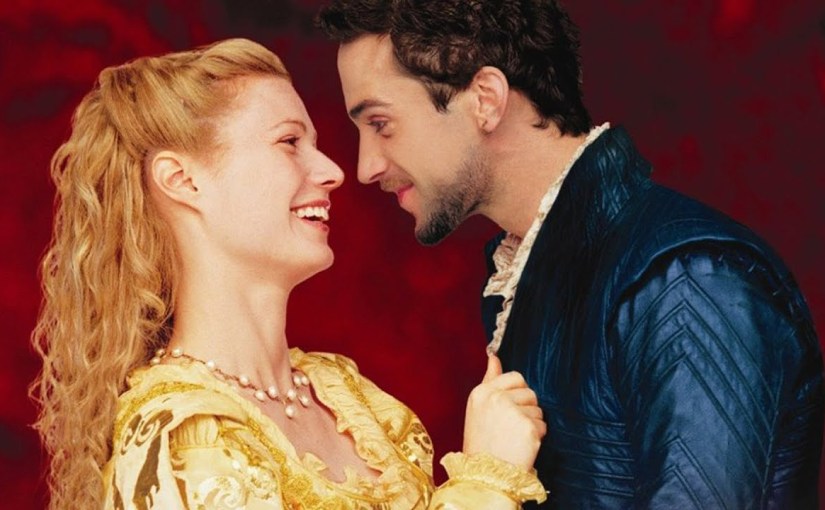
A fan of his, and a lover of theater, is Viola De Lesseps (Gwyneth Paltrow), the daughter of a wealthy merchant.  She musters the courage to disguise herself as a man and attend an audition under the name of “Thomas Kent.”  William is immediately taken with Thomas’ stage presence and upon his pursuit of him, encounters Viola.  They are both immediately stricken with love for one another and soon the writer learns of Viola’s deceit and revels in trysts with her while they maintain the secret for the integrity of the play that he now has inspiration to continue writing to its grand conclusion.  Viola is the muse that William has been seeking.

One problem beyond the usual obstacles in producing a play for performance time comes in the form of Lord Wessex (Colin Firth), a snobby cash poor aristocrat, who claims Viola as his soon to be bride as a means of earning a stature of wealth through her family.  Wessex is a demanding and unreasonable fiend of course, and Firth delivers an effectively cruel villain against the heroism found in Fiennes’ Shakespeare.

As the play is rehearsed and the romance between Viola and William continues to blossom, the drama is not left only on the stage.  A grand scene bordering on slapstick occurs when the competing theaters engage in a swashbuckling dual.  Props are tossed, swords are swung and feathered pillows explode.  Later, adventure on the level of Errol Flynn occurs with swordplay between William and Wessex within the theater and its trappings.  Screenwriters Marc Norman and Tom Stoppard inventively imply that theater, as we know it today, was simply inspired by what Shakespeare encounters in his own life.  When I conduct playwrighting workshops at my local community theater, I always tell the class that you have to “write what you know.”  Shakespeare In Love precisely demonstrates that mantra, even if it is elevated for the theatrics of cinema.  After all, this movie proudly boasts its silly comedy as much as it embraces its romance which thankfully never drowns in sap.

A wonderfully well edited centerpiece cuts between Viola and William’s passion for one another against their stage rehearsals with Viola in her guise as “Thomas Madden.”  In bed, they romance each other with recognizable dialogue, originally written by the real Shakespeare, that then makes its way into William’s pages for his script in progress.  This is where Gwyneth Paltrow really shines as she is momentarily depicted as the lovely Viola and then we see her in the guise of “Thomas,” the naturally gifted actor perfect for William’s Romeo character.  Paltrow’s range with the Oscar winning performance is done so well in this sequence alone.

The final act of the film is joyously assembled.  Behind the scenes, actor and writer William Shakespeare stresses over a stuttering actor who has entered the stage to begin the play.  Can he get through the scene?  What about the poor actor who is stricken with stage fright, and suddenly can’t go on as Juliet?  The audience is left in a rapturous trance with open mouths of silence and tears, following the suicides of the lovers on stage.  Yet, they don’t know if they should applaud at the end of the play.  The actors don’t know how to respond to the applause.  As well, are we given an opportunity to bear witness where the well-known phrase “The show must go on!” originated from?

It’s also necessary to point out one of the most favorite side characters to ever grace a film.  Judi Dench is the staunch and intimidating Queen Elizabeth I.  Arguably, this brief role, that I believe amounts to no more than five and half minutes on screen, carried Dench to not only Oscar glory but a celebrated favorite character actress for years to come.  Dench demonstrates how fun acting can be even if she is wrapped up in layers of 16th century wardrobe and caked on makeup.  Her first scene has her laughing at a poor actor performing with an uncooperative poodle.  Her last scene has her tearing down the romantic gesture of men laying down their coats for her to cross over a mud puddle.  It’s an unforgettable appearance in the film.

I take issue with one element of the picture, however.  Forgive me for going against the opinion of the Academy Awards, but Shakespeare In Love would have been an even grander experience for me had it not been for an overproduced and intrusive original score from Oscar winner Stephen Warbeck.  The music cuts into the film too much.  It borders on obnoxious.  Over and over, I was telling myself, these scenes hold together beautifully without any of the blaring horns and trumpets from Warbeck’s orchestra.  This film has an outstanding cast of actors and often I felt like they were being upstaged by the soundtrack of the film.  There are magnificent scenes with witty dialogue delivered by the likes of Imelda Staunton, Tom Wilkinson, Ben Affleck, along with Dench, Firth, Paltrow, Fiennes and Rush.  I could literally envision these moments working based simply on their performances alone.  Imagine watching a live stage performance, only elevator music cuts in at the most inopportune times. 

Still, I refuse to end on a sour note for Shakespeare In Love.  It is worthy of a standing ovation.  John Madden’s film is a grand production in cast performance, art direction, costume and makeup.  The script by Marc Norman and Tom Stoppard is brilliantly clever and witty as they weave inspired references from Shakespeare’s various sonnets, poems and plays into rich, everyday dialogue. 

Sustaining the value of performing arts can easily begin with a viewing of Shakespeare In Love in a school curriculum.  Even better would be to adapt this film into a stage play.  I think to watch Shakespeare In Love, live on stage, would be a wonderous experience.

SOME KIND OF WONDERFUL

By Marc S. Sanders

I don’t get it. Why title a movie with the name of a popular song only to make the movie title seem arbitrary? Some Kind Of Wonderful is a rockin’ great song by Grand Funk Railroad that you turn the volume up on your car radio as you leave work on Friday afternoon. Maybe you get the bar patrons riled up on karaoke night. Some Kind Of Wonderful is also the name of a movie written by John Hughes that has no meaning or relevance to the song it’s named after. It’s as lacking in imagination as the film itself.

Why do you suppose John Hughes didn’t direct this film and left it for Howard Deutch to take over? Could it be that Hughes realized this script was nowhere near as insightful as The Breakfast Club or even Ferris Bueller’s Day Off?

The characters are positively boring in Some Kind Of Wonderful. In fact, they are so boring that they look bored with each other. They look half-awake when they are talking to one another. Unless, that’s how you look cool in the rebellious 1980s. I dunno. To me they all looked flat.

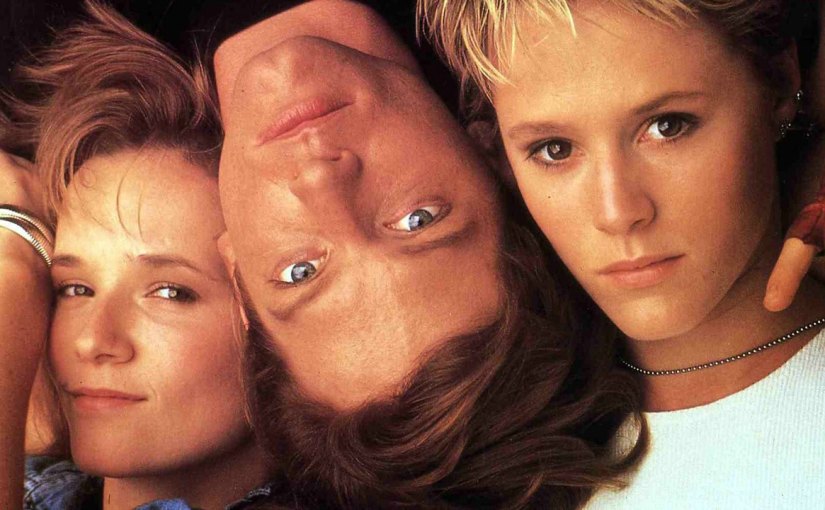
Eric Stoltz plays Keith. He’s a kid who avoids college discussions with his father (John Ashton) while pining over Amanda Jones (Lea Thompson), the popular girl who’s dating the popular jerk with the Corvette. We get to hear a song called Amanda Jones not once but THREE TIMES. Where’s the song Some Kind Of Wonderful, though? Why not just call the film Amanda Jones?

Unbeknownst to Keith, his tomboy best friend Watts (Mary Stuart Masterson) plays it cool, while carrying around her cool looking drumsticks, like she doesn’t love him when it couldn’t be more apparent. Keith is so unbelievably stupid that he can’t even detect the slightest crush that Watts has on him when she practices kissing him so he’ll be prepared for an upcoming date he has with Amanda. Now I’d buy this routine if Keith were at least playing dumb to Watts’ advances. However, Keith is not playing dumb. Keith is just dumb.

As a community theatre actor and playwright at times, even I follow at least a slight discipline of exploring character backgrounds. Watts and Keith are best pals yet I don’t recall one tender moment or discussion that even slightly recollects their history or friendship. Pretty In Pink offered plenty of moments that shaped the Molly Ringwald and Jon Cryer relationship. Not in Some Kind Of Wonderful, however. Every time Stoltz and Masterson meet up for a scene together it feels as if they never met each other before. They never look like they are familiar with one another and really know what makes the other tick. Are they acting with their stand in doubles?

I also was not so convinced of Keith’s attraction to Amanda. There’s nothing to this girl beyond Lea Thompson’s sultry looks. Granted, I recall having a day or even a month-long crush on a number of girls in high school simply based on appearance alone; girls who never gave me the time of day. Raging hormones naturally will do that to teenage boys but remember this is a movie. In a movie, I need to be shown why there is a crush. Not just told in a statement of dialogue.

Recently, I reviewed Can’t Buy Me Love. I didn’t like that film either. However, the popular girl in that film at least revealed a knack for poetry and a sudden interest in astronomy and an old airplane graveyard. The popular girl here only opts to go out with Keith to anger her jerk of a boyfriend. I don’t know anything about Amanda from beginning to end.

Keith only paints and draws images of Amanda. A talent for art is a springboard for sweet and sincere in a John Hughes movie, but it’s all Keith ever learns about Amanda. So it’s all we ever learn about Amanda. Great! You sketched a third picture of Lea Thompson. Sorry, but I already know what Lea Thompson looks like.

The date between Keith and Amanda tries to aim for cuteness and maybe some comedy. I say maybe because I’m not sure if the cast with Hughes and Deutch are looking for laughs. But see Masterson volunteers to be the limo driver complete with the hat and uniform, and drive the lovebirds around town. A limo uniform on a character can be funny like if Kramer in Seinfeld did it, or if it was one of the Three Stooges. Problem here is no one in this movie sees how funny it could be. So, it’s not funny. See how that works?

No one was at the wheel of this D grade fare teenage 80s flick. Beyond all that’s wrong with the story and characters and performances, ultimately again I ask, where is the song Some Kind Of Wonderful in the movie Some Kind Of Wonderful? If that doesn’t even occur to you, then I can’t have much faith the film will have any provocation of thought either…and it doesn’t!!!!!

CAN’T BUY ME LOVE

By Marc S. Sanders

I’m ashamed of myself. All the hours I wasted in my adolescence watching the 1980s teen flick, Can’t Buy Me Love. Now, having watched it again with my 12-year-old daughter, what was I thinking?

The overall problem with Can’t Buy Me Love is that literally every single character is drowning in depths of despicable shallowness. There’s not one redeeming character. Truly. I couldn’t stand to watch most of the film. Over and over again I asked myself what could I have been thinking? These are not likable people. Did I just repeatedly return to the film during Friday nights on HBO because I couldn’t take my eyes off actress Amanda Peterson?

Lawn mower nerd Ronald Miller (Patrick Dempsey) pays $1,000 to popular high school cheerleader, Cindi Mancini (Peterson) to be his girlfriend at the start of their senior year. The plan will be once Ronald’s reputation is established among the jocks and preppy valley girl cheerleaders, that Cindi and Ronald will break up. In other words, boost Ronald’s image so that he can live by that image. (I can’t believe I just clarified this movie with a sentence beginning with “In other words,…” A movie this stupid should not need additional clarification by means or words or even crayon sketches.)

It’s obvious what’s going to happen. Beware the idiot plot!!!! They fall in love, but both are too stupid to realize that they have fallen for one another. So, they are just cruel instead. Their friends are cruel too in their own superficialities.

I don’t find much to be proud of anymore with Can’t Buy Me Love. Maybe it reminds me too much of high school, which by and large I don’t look back on very fondly. High school in a film like this is all about impressing the greater mass with the car you drive, how much mousse you drown your hair in, or the sunglasses you wear.

John Hughes’ teen films looked at material with more substance like status quo and social class with a picture like Pretty In Pink or The Breakfast Club. No one was trying to impress anyone with the latest trendy look. The characters stayed secure in their appearance and yet found a personality to be attracted to, not an outfit. The challenge was in keeping to yourself while stepping into territory where you didn’t feel welcome.

Can’t Buy Me Love adheres to the observation that “he went from totally geek to totally chic.” Thanks for the limerick. I appreciated Pretty In Pink for a sobbing scene where the main character is embarrassed to show where she lives to the rich guy whose genuinely interested in her. There’s a consciousness to Pretty In Pink that Can’t Buy Me Love lacks.

If anything, Can’t Buy Me Love introduces us to The African Ant Eater Dance. So, as a plus, at least it’s got culture and diversity going for it.

OUT OF SIGHT

By Marc S. Sanders

In 1998, Elmore Leonard’s best-selling novel, Out Of Sight, was adapted by director Steven Soderbergh, where Federal Marshall Karen Sisco (Jennifer Lopez) falls in lust with Bank Robber Jack Foley (George Clooney), which leads to ridiculous, albeit logical set ups as a high stakes diamond heist is planned along the way.

I know years after Steven Soderbergh’s film was released an ABC tv series based on the Sisco character was produced. That was a misfire. Simply because the beautiful, sexy and most importantly under appreciated and intuitive portrayal that Lopez mastered was a role that could have led to another great film franchise of sequels to come. Carla Gugino played author Leonard’s heroine in the tv show. If you are saying “Carla who?” then ‘Nuff said. Sisco belongs to Jennifer Lopez.

Lopez and Clooney have great chemistry amid gorgeous cinematography on location in sun filled Miami and snow blanketed Detroit. Soderbergh shoots a great scene midway through where the two characters, on opposite sides of the law, throw caution out the door as they seduce each other in front of a hotel window view boasting beautiful midnight blue sprinkled with falling snow. It is one cool and very hot scene.

Sisco is always a step ahead of Foley. Her problem arises when after being held hostage by him in the trunk of her car following his escape from prison…well, she just can’t resist him.

My apologies. Out Of Sight is a far better film than I could describe here thanks also to a boastful cast featuring Dennis Farina, Ving Rhames, Don Cheadle (how many films has he done with Clooney?), Steve Zahn, Albert Brooks (simply great as a hairpiece wearing white collar criminal), Michael Keaton (two Batmans in a film for the price of one) and finally a master of cameos reserved for a smirk inducing final scene. Make an educated guess of who I could be talking about.

Lopez and Clooney should have done more films together over the years. They are as classic a couple as Tracey & Hepburn, Beatty & Dunaway, Hanks & Ryan or Gere & Roberts.

This was a gem of a movie I mistakenly found boring when I saw it in theatres. What was I thinking? On a second viewing, 20 years later, I laughed, smiled and just couldn’t take my eyes off it. It’s just great fun.

Without Out Of Sight, Soderbergh, Clooney and Company would probably never have made an Ocean’s 11. Check out what became before their more successful collaborations to come.

TOP GUN

By Marc S. Sanders

For a movie that focuses a lot on showers, men’s locker rooms and bare chested sweaty and chiseled volleyball players, it’s a wonder that it is called Top Gun.  Maybe the title has another indirect meaning to it, other than a moniker for a Navy fighter pilot school of the elite.  Maybe these guys are elite for a different reason.

The Tony Scott film that is supposedly about the top one percent, the best of the best, American fighter pilots in the Navy is arguably the most important film in Tom Cruise’s career.  It launched the actor into a superstar sensation that has hardly faltered since the movie’s release all the way back in 1986.  But is it a good movie?  Well, yes and no.

I’ve always loved Tony Scott’s filmmaking technique.  Sure, his sun-soaked film shots are constantly repeated.  He always relishes in enhancing the beaded glow of sweat drenching his actor’s faces, arms and chests.  It’s seen in nearly every moment of Top Gun, as well as other celebrated pictures like Crimson Tide, Beverly Hills Cop II and True Romance.  Orange sunlight blankets palm trees and beach lined streets.  Bar saloons and military headquarters are lit in sexy blues and greens.  It may lack originality after seeing a few of his films, but it just makes the movie all the more sexy. 

Tony Scott is also a well-versed director in action sequences.  He’ll get your pulse racing and Top Gun is the best example.  The fighter jet sequences in this film are masterful in editing, sound and speed.  It’s fantastic to see how the planes will twirl around and then shoot themselves straight up into a vertical trajectory in the sky and finally cut in on actors Tom Cruise, Anthony Edwards and Val Kilmer for a “WOO!” moment in the cockpit.  This stuff still holds up.

Yet, unlike other modern-day films that focus on cadets or students in our armed forces, Top Gun doesn’t concern itself with the discipline of what it takes to serve in the Navy.  This is the informal, class clown version of An Officer And A Gentleman.  You only need look as far as Tom Cruise’s character’s pilot call name, Maverick.  The name itself is a one-word thematic description of what you are watching.  So, the kid who learned to say “what the fuck” in Risky Business, went on to do daredevil flybys while disobeying orders.

Maverick’s real name is Pete Mitchell.  He has no family except that of his co-pilot, Goose (Anthony Edwards).  The disappearance of his Navy pilot father remains a mystery…because it is sexy and cool to have a mystery for your handsome hero in a film like this.  Call it DRAMATIC HEFT!!!! 

When Maverick and Goose get the opportunity to attend “Top Gun” – a fighter school specializing in training the best pilots in the world in aerial dog fighting – they are intent on getting their names on the plaque for the best of the best of THE BEST.  Competition comes in the other prettiest of the pretty boys with Iceman (Val Kilmer).  These are all great likable characters.  Yet, even when I saw this film at sleepaway camp at age 13, I couldn’t help but notice how distracted it gets with the abundance of erotic machoism on display here.  What would serve as dramatic dialogue in another film is presented in a steam room area allowing opportunity to see the male cast wrapped in towels around their waists with wet spiky blond and black hair.  It truly doesn’t matter what they are talking about in this scene.  When you are watching it, all that you are hearing is the sound of Charlie Brown’s unseen and indecipherable school teacher.  “Waa waa.  Waa waa waa waa!”

That’s not enough though.  The infamous volleyball scene keeps you awake.  I don’t care if you are hetero or homo or bi or pan or plus, the beach volleyball scene keeps you alert as one of Kenny Loggins’ many movie songs plays in accordance.  Tony Scott doesn’t just go for tossing the ball around.  Slow mo captions are offered of each guy just posing with their chiseled arms and chests.  You may not take your eyes off of it, but oh my…what does this have to do with the discipline of attending Navy fighter pilot school training?????

The romance is second to none.  Truly!  These days, people talk about Jack and Rose in Titanic or Ross and Rachel on Friends.  For me, it’s Maverick and Charlie (Kelly McGillis).  Cruise and McGillis really light up their scenes together.  It’s an absolute perfect pairing of sex appeal and it is really when Top Gun performs at its smartest level.  The dialogue is strongest during their scenes.  The romance isn’t rushed but nicely flirted with, and when tragedy strikes within the thin storyline of the overall film, the relationship goes in another supportive and appreciated direction.  When I was a kid, with hormones being discovered for the first time, my buddies and I would elbow each other during the midnight blue sex scene between McGillis and Cruise with the Oscar winning song “Take My Breath Away” from Berlin playing.  I look at this scene now and it is modern romance at a beautiful best.  A fantastic scene from Tony Scott. 

Charlie is the unexpected, well-versed contractor for the Navy giving counsel to the pilot students on how best to operate the jets.  In the 1980s, action blockbusters normally held the women as the barely dressed damsels to be rescued, and nothing more.  The female characters didn’t have brains and the only brawn to go around was saved for Princess Leia or Marion Ravenwood (Raiders).  Charlie is an exception though.  McGillis plays the character as someone who is aware that these testosterone-filled guys will regard her as a piece of meat, until they realize otherwise.  The irony of Top Gun is that the nearly all male cast, Cruise included, are the pieces of meat.  The one main female role is actually the brains of the whole operation.  McGillis was a marvelous actress back in the day.  Go look at Witness and The Accused to see what I mean.  With her help, Cruise elevates above the hokey dialogue of the Top Gun script. Kelly McGillis really could act well in almost anything.  I wish her career went further, honestly. 

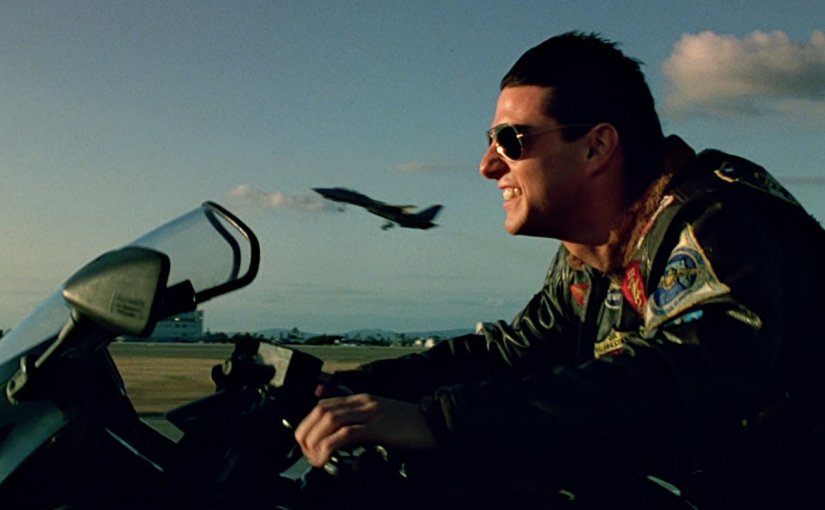
Top Gun remains a mainstay in 1980s pop culture.  If the VH1 channel is doing a documentary on the decade of Madonna, Michael Jackson, parachute pants and neon pastels, Top Gun is also brought up in the mix with a close up of Tom Cruise’s toothy grin and his aviator sunglasses.  We were never watching Oscar winning material here, but somehow the film that introduced all of us to Tom Cruise still feels like a day at the beach with the twenty something boy toy in his tight jeans and leather bomber jacket riding his Kawasaki Ninja motorcycle at top speed or breaking the sound barrier in his fighter jet with his shiny navy-blue helmet on his head.  Top Gun and Tom Cruise demonstrated that it’s a party to serve in the Navy.  Why not?  Vietnam was behind us and the decade was not embroiled in war.  Join the Navy!!!!  It’s fun and you get to shower with the best-looking guys in the world.  You’ll even get to play volleyball with them and date your sexy flight instructor.

A lot of the dialogue and the storyline may sound like an adult, military interpretation of Saved By The Bell, but you can’t break away from the sexy allure of what Tony Scott with Cruise, Kilmer, McGillis and Edwards put on the screen.  It’s always been there and somehow a sequel was never made. 

Wait a second!  WHAT??????

ME AND YOU AND EVERYONE WE KNOW (2005)

by Miguel E. Rodriguez

Director: Miranda July
Cast: John Hawkes, Miranda July, Miles Thompson
My Rating: 8/10
Rotten Tomatometer: 82% Certified Fresh

PLOT: A lonely shoe salesman and an eccentric performance artist struggle to connect in this unique take on contemporary life.


There is a scene in Me and You and Everyone We Know, Miranda July’s directorial debut, where Christine, an aspiring artist played by July herself, has submitted a videotape of her experimental video shorts to a museum curator who’s looking for examples of new art in a digital world.  At the end of the video, July addresses the camera and bemoans the fact that the curator will probably never watch the tape or get that far.  She pleads: “If you are watching this, then just call this number, the number you see on your screen, and say, ‘macaroni.’  …Just ‘macaroni’ and hang up.  No questions asked.”

In that moment, in the middle of a movie where I was never bored but constantly off-balance, I connected with Christine.  I’m guessing other people do, too, but I’m just guessing.  Who among us has never wanted validation or confirmation from someone, anyone, the world, that, yes, I see you and I hear you?  That right there is one of the reasons I do theatre, man.  I don’t always talk about it, but it’s there.  And I appreciated seeing that heartfelt emotion acted out in such a quirky and direct way.

That’s just one of the charms of this movie that defies description.  It’s a romantic dramedy where the two ostensible romantic leads can function around other people, but just barely.  There is also a subplot about two young boys who are bullied by two witless teenage girls.  How witless?  They thoughtlessly flirt with a much older man who starts leaving sexually graphic notes on his living room window so the girls can see them as they walk to school.  I won’t even tell you how their bullying of the two boys leads to the kind of sexual experimentation I devoutly hope doesn’t happen…but probably does more than I would care to admit.

Now, I’m making this sound like a Larry Clark movie (Kids, Bully), but it’s not.  The main story involves Christine and Richard (John Hawkes), a recently separated father (of the two young boys).  Richard works at a shoe store and is a hopeless romantic, not just when it comes to love, but life in general.  He tells his co-worker, “I want to be swept off my feet, you know?  I want my children to have magical powers.  I am prepared for amazing things to happen.”  But his idealism sometimes moves him to do and say odd things.  Near the beginning of the film, as he’s preparing to move out of his house and into a small apartment, he runs out to his front yard, gets his kids’ attention, and carefully and methodically uses lighter fluid to set his hand on fire.  Why?  His explanation (if I remember it correctly) is semi-reasonable, but I can’t help thinking there might have been a better way to demonstrate his thought process.

Christine is an aspiring artist who makes short experimental videos in which she provides voice-overs to still photographs.  In my mind, they are examples of how she might relate to people in real life if she weren’t so terrified of how other people might respond if she reaches out to them in person.  Her day job is as a taxi service for the elderly – sort of a proto-Uber service.  One day she drives a client to the shoe store where Richard works.  Richard notices small scars on Christine’s ankles.  She says her shoes rub her ankles, but all shoes do that because she has low ankles.  Richard looks her dead in the eye and says one of the best lines in the film: “You think you deserve that pain, but you don’t.”

Something passes between them, and the rest of the film, as far as these two are concerned, is about getting these two dysfunctional people together.  There are obstacles, of course.  A sick kid, an unexpected visit from the ex-wife, some examples of logic that seems rude but really isn’t.  It’s hard to explain.  But theirs is the thread that holds the rest of this weird film together.

And weird it is…but in that good way, you know?  Richard’s two sons are Robby, maybe 7 years old, and Peter, probably about 12 or 13, right when the hormones are kicking in.  In their off time, Peter visits an online chat room where he starts interacting someone who calls themselves “Untitled.”  (He calls himself “NightWarrior.”)  Their conversation gets racy.  If you think this is improper or immoral to show in a film, allow me to direct you to my own experiences on AOL chat rooms when I was that age.  (That’s one of the things the movie gets exactly right: the teenage boy’s curiosity/fascination about sex.)  Thing is, Peter is doing the chatting with Robby right there next to him.  Robby has no idea what he’s reading.  When Peter jokingly asks Robby for something dirty to type, Robby launches into this incredibly detailed scatological description of what he thinks is dirty.  At first, I was a little shocked, but then I started laughing because this is something else the screenplay gets exactly right.  Ask a really little kid to say the dirtiest thing they can think of, and this is the kind of thing you’re most likely to hear.

The movie is full of little moments like that.  The main love story is tooling along, and suddenly a store-bought goldfish is left on top of someone’s car in a baggie.  We’re watching Christine agonize over whether to call Richard or not, and then those two teenage girls from before persuade Peter, the teenage son, to let them give him what they call a “Jimmy Ha Ha.”  It’s exactly what you’re thinking.  Why do they do this?  Because they want to settle an argument over which of them can do it better.  Where were those girls when I was in high school???

And don’t even get me started about what happens when Robby, the youngest boy, starts posing as NightWarrior and chats with Untitled on his own.  This exceedingly weird situation, which I can honestly say I’ve never seen in any other movie before, leads to a moment when Untitled asks to meet NightWarrior in person.  The payoff of this story thread is sure to divide audiences, but I found it both hilarious and oddly touching.

If I’m making the movie sound like a mixed bag, well, it is.  But nothing ever goes too far in the taste department.  The perv who leaves graphic notes on his window has an interesting reaction when his bluff is called.  The Untitled/NightWarrior stuff comes to a proper close, in my opinion.  And Richard and Christine?  Well…what kind of romantic dramedy ends with the lovers NOT getting together, right?

Bottom line: Me and You and Everyone We Know is constantly engaging, constantly weird, but never boring, never conventional.  It held my interest for 90 minutes.  That’s more than I can say for most romantic dramedies involving poop jokes and “Jimmy Ha Ha’s.”

NOTTING HILL

By Marc S. Sanders

Notting Hill written by Richard Curtis (Love, Actually) and directed by Roger Michell is a pleasant surprise of a romantic comedy. It’s not a perfect film but it certainly loves every one of its quirky supporting characters, as well as its two straight romantic leads played by Julia Roberts and Hugh Grant.

Grant plays Will Thacker who lives in the Notting Hill district of London where every proprietor is a charming little shop of some form or other; a quaint street where merchants appear on the sidewalks during the weekends selling their art or homemade jams or coffee products. Will owns a travel book shop located across the street from his flat that is whimsically recognized by its big blue front door. His wife left him for another man and now he’s relegated himself to living with a roommate called Spike (character actor Rhys Ifans doing a British equivalent of Cosmo Kramer, Seinfeld’s neighbor).

One day the superstar celebrity Anna Scott (Roberts) simply strolls into Will’s store. They have a quiet moment and he sells her a travel book about Turkey that he didn’t recommend she purchase. Moments later they run into each other down the street when Will spills orange juice all over Anna. From there, a meet cute relationship begins to unfold. It’s not so simple for the pair though as Anna’s enormous celebrity is hard to negotiate; hard for Anna, not hard for Will.

Anna is at ease when she can have a quiet dinner to celebrate Will’s sister’s birthday with his friends or when she can escape her turbulent life of gossip magazines and paparazzi by taking shelter at Will’s flat, even if grungy looking Spike walks in on her taking a bath.

I like Notting Hill. However, the quiet moments shared between Grant and Roberts sometimes carry on too long. Oh my gosh!!!! Will someone say something already????? Hugh Grant has made characters that trip over their words and stumble with what to say into a master craft. Julia Roberts is one actress that a camera loves especially when she’s distressed. A crying moment in any one of her films will milk the scene for every blush, or glassy eye or tear and whisper she can offer. She’s a terrifically skilled actress in almost any film she does. Eventually, we have to move on from all of this though. My patience for some scenes were just running way too long for me at times. Kiss already!!!! Make love already!!!! Scream at each other already!!!!

Fortunately, there’s much escape to be had with the supporting cast, especially Ifans as Spike who is the most absent minded, lovable, dirty underwear wearing and sloppy prig imaginable. Emma Chambers is just as fetching with her scarlet pigtailed haircut as Will’s sister, Honey. Tim McInnery, Gina McKee, James Dreyfus and Hugh Bonneville round out this madcap collection. The birthday dinner party is a great scene for this ensemble as a comedic but relaxed chemistry blends nicely during a competition to see who is suffering the most to earn the last brownie on the dessert plate. The group is unsure how to include a movie star like Anna in their simplicity but Julia Roberts pulls off a trick that even had me fooled. Simply put, for the whole cast, there’s just that much more life and vibrancy when they are all together and it’s not just relegated to only Roberts and Grant in a scene.

Another special moment occurs later when the couple have split up once again. To depict time fleeting by, Roger Michell offers up a transition of Will wearing one outfit but walking through the hustle and bustle of Notting Hill as the weather and seasons seamlessly change all around him from sunlight to rain to snow and spring sunlight again. You even get a glimpse of Honey starting a flirtatious relationship at the beginning of the sequence and by the time it’s over a minute later Honey is breaking up with the guy. It’s a wonderful moment of wordless narration to show Will’s struggle with moving on as time continues to pass by. More importantly, it allows the titled setting to be a character of its own. This is a great example of showing a lovesick character unable to move on while life has no patience to wait for him to catch up.

I like Hugh Grant and Julia Roberts whether it’s in Notting Hill or one of their many other fine movies. I can’t deny the chemistry they have in this film. It works. I only wanted a little more life to the material that was handed to them. Still, Notting Hill is charming and simply a very sweet romantic comedy.

PETER IBBETSON (1935)

by Miguel E. Rodriguez

Director: Henry Hathaway
Cast: Gary Cooper, Ann Harding, Ida Lupino
My Rating: 9/10
Rotten Tomatometer: No rating

PLOT: A successful architect who longs for the love of his childhood friend is delighted to discover that the Duchess who just hired him is in fact his long-lost beloved.  This being melodrama, there is of course much more to the story.


[SPOILERS FOLLOW]

Peter Ibbetson plays like a long-lost Dickens novel, full of melodramatic flourishes and convenient plot contrivances designed to play the audience like a grand piano.  Is it shameless?  Yes.  Is it maudlin?  Yes.  Do I normally like movies like this?  No.  But there is something about this film and its story that got around my defenses and into my heart and soul.  I’ll try to elaborate on that as much as I can, but I don’t know how well I’m going to do.  Good luck.

The story opens, as the title card helpfully explains, in the middle of the last century, which would make it somewhere around the 1850s.  Somewhere in a well-heeled French countryside, two children from neighboring British families play and quarrel with each other, Mimsey and Gogo.  (I am not making that up, though why parents felt the need to inflict those names on their children is utterly beyond me.)  Gogo, the boy, cruelly teases the girl, Mimsey, who nevertheless gives as good as she gets.  Unfortunately, Gogo’s mother dies after a long illness, and when a distant uncle arrives to take Gogo back to England, he realizes he doesn’t want to leave his precious Mimsey.  Together they try to run away and hide, but it’s no use.  The sight of poor Mimsey weeping in the branches of a tree as Gogo is finally taken away was one of the scenes that started to chip away at my armor of cynicism.

Time passes, and Gogo changes his name to Peter and takes his mother’s last name, Ibbetson.  He becomes a successful architect and a valuable asset for his employer.  (In a very Dickensian touch, Peter’s employer is blind…wholly unnecessary to the plot, but that specificity makes it feel even more realistic amid all the other melodrama.)  Peter is successful, yes, but he is unhappy.  He is a bachelor, and when a very pretty girl more or less hits on him at a museum back in France, he takes her for a drink as a matter of courtesy, not out of any real attraction.  His heart still belongs to the lost love of his childhood, you see.  Mimsey is the touchstone of his past, his Rosebud, his green light at the end of the pier, and she will not be easily eradicated.

Initially, I was unsympathetic to the adult Peter.  How can anyone get on with their life if they’re stuck in the past?  It didn’t work for Kane or Gatsby.  If there’s anything the last thirty or so years of my life has taught me, it’s that the past will only weigh you down if you let it.  I’m not suggesting one should literally forget history, but had I been one of Peter’s associates in the film, I would have been constantly reminding him about being grateful for the present rather than bemoaning the mistakes or regrets of the past.  That way lies madness.

Before I get into more story details, I should mention the style of the film and the acting, which is so mannered and stylized that it feels as if it were a silent film that had a soundtrack added as an afterthought.  Gary Cooper may be a legend, but in this film…let’s be blunt, he is no Cary Grant.  Every sentence feels as if it’s been dragged out of him by way of torture.  His charisma is based solely on his imposing height and his dashing good looks, NOT his speech.  (Sorry, I calls ‘em like I sees ‘em.)  The women are not much better acting-wise, though the Duchess of Towers does have some interesting moments.  However, one of the movie’s highlights are the cinematography and subtle visual effects, especially in the late stages of the film.  Look at that scene involving the peculiar qualities in the bars of the jail cell and explain to me 100% how that was accomplished.  It’s so understated and effective that it took me completely by surprise.  I believe it would raise eyebrows with TODAY’S audiences.

I mention all of this about the style and my mindset because I believe that it all contributes to the reaction I had to the film, at which I’m still perplexed.

One day, Peter is contracted to rebuild the stables of an aristocratic family, the Duke and Duchess of Towers.  When Peter first meets Mary, the Duchess, he experiences an unexplainable connection.  His contract requires him to live in the Towers house for several months.  One day they share a conversation and discover that they shared a dream.  This isn’t a case of two people dreaming about the same thing coincidentally.  They actually shared a dream, Inception style, but without the machinery.  How can this be?

By now, any breathing audience member has already deduced that the Duchess is Mimsey and they are destined for each other.  Alas, Peter and Mary are not as quick on the uptake as we are, and their moment of recognition is delayed until after the peevish Duke confronts them at the dinner table, in a conversation laden with Hays-Code-era double-speak.  “Well, Mr. Ibbetson, are you to be congratulated again?” the Duke asks.  Later, during a second confrontation, the Duke points a gun at Peter and Mary and explains that they will not make love behind his back.  He raises his gun and says, “Get into your lover’s arms.”  Whoa.  Daring stuff for 1935.  It’s during this second confrontation that something goes horribly wrong, and Peter is sent to jail for life.

MORE melodrama?  Hasn’t this movie already had more than its fair share?  Children tearfully separated?  An equally tearful reunion?  Outrageous coincidences?  Shared dreams, for crying out loud?  Oh, you ain’t seen nothing yet.

It’s in the film’s third act, when our hero is in prison, that Peter Ibbetson really started to get to me at some primal level.  Peter and Mary, after being reunited against all odds, are now separated even more cruelly than before.  Peter is so distraught he goes on a hunger strike, chained to his “bed,” which is little more than a wide wooden beam.  (Look at it from a certain angle and he might almost appear to be on a cross, but don’t worry, it’s not that kind of movie.)  When one of his fellow prisoners makes a joke at Mary’s expense, Peter goes a little crazy and starts to throttle him.  Miles away, at the same time, Mary suddenly senses something is wrong.  In the jail, guards use force that’s a tad too excessive to restrain Peter, and at the same exact moment Mary screams.  The two are connected in a mystical way that transcends walls or distance.  They continue to share dreams in which they laugh and walk and talk as if nothing bad had ever happened.  In one dream, he points to a castle in the distance that he has built for his beloved.  I was reminded instantly of the scenes in Inception where Cobb and his wife Mal build entire cities for themselves in their own shared dream.

I’ve already given away too much, far too much than I usually care to.  As much as I want to, I can’t describe the one scene that got me to literally yell, “NO!” at the TV screen.

What fate eventually befalls Peter and Mary, I leave for you to discover.  What remains for me is to try once again to summarize how I felt after the movie was over.  Intellectually, I can see its shortcomings.  The acting is wooden, despite some pretty sharp dialogue.  The music is overwhelmingly romantic and dramatic, commenting on a lot of action unnecessarily, as was the custom back then.  There are one or two odd cuts.  But on an emotional level, the experience of watching Peter Ibbetson was like watching one of Shakespeare’s tragedies.  The only other movies that ever made feel these precise emotions, although not to the exact same degree, are The Remains of the Day and Atonement.  If you know those movies, you know what I’m talking about.

The movie’s final shot is as shamelessly manipulative as these things get.  It’s unabashed romanticism at its best AND its worst.  But you know what?  This movie earns it, and it works.