THE LORD OF THE RINGS: THE FELLOWHSHIP OF THE RING

By Marc S. Sanders

JRR Tolkien was one of the 20th Century’s greatest fantasy writers. The Lord Of The Rings series was a dense, sweeping epic inspired by the torn European climate during World War II and its conflict with the Axis nations, particularly Hitler and his organized Nazi Germany.

Peter Jackson found the opportunity to adapt Tolkien’s works. In 2001, The Fellowship Of The Ring amazed audiences with its epic landscape of Middle Earth, Isengard and Mordor where the fiery Mount Doom is located and the evil eye of Sauron waits for a resurgence of overthrow.

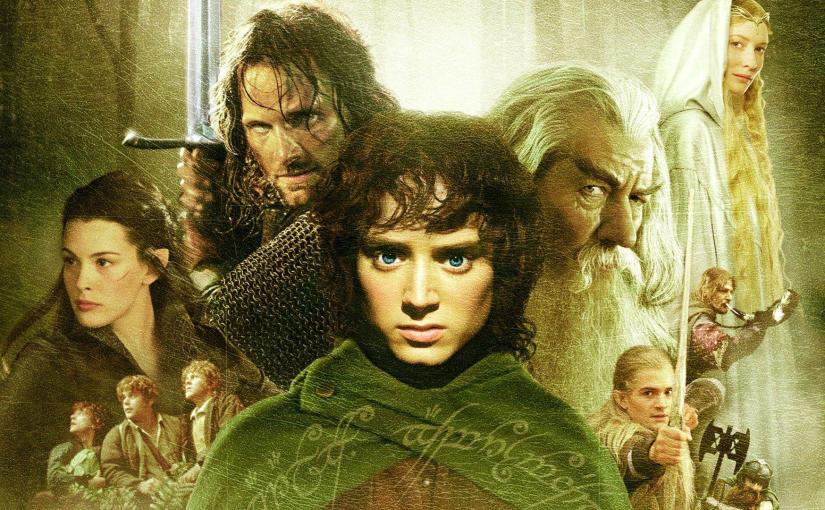
Much happens in each three hours plus Rings films. Tolkien’s story is not so much plot, but moreover a journey from one adventure to another. What’s special is that the main hero is a small, kind Hobbit named Frodo Baggins (Elijah Wood) who has been tasked with carrying the dangerously powerful “One Ring To Rule Them All” back to Mount Doom and destroy it. He is aided by eight fellows, three other Hobbits and four representatives of various nations and backgrounds to protect and escort him. The most significant member is the wise wizard Gandalf The Grey played by Ian McKellen in an Oscar nominated performance. The other characters’ significance become more established in later films.

This first installment is my favorite of the series because it is the most absorbing. I believe in the all but sinister and deadly value of Tolkien and Jackson’s MacGuffin, the Ring. Jackson does well of posing the threat of danger each time Frodo dons the Ring for the sake of invisibility while the Orc army of Saruman, Sauron’s Wizard henchman played by Christopher Lee, bears down on the Fellowship. The film shows one battle after another but the suspense is heightened each time as we become more familiar with Jackson’s digital world. It’s also quite dramatic to see Frodo become consumed in fear and a kind of sickness as the possession of the Ring weighs upon him. To precisely show that transition requires a three hour film, and Elijah Wood is up to the task, always appearing quite angelic and unsure of his assignment. Wood is quite the underrated actor.

There are a multitude of character descriptions in The Fellowship Of The Ring and a number of them come into play when centered around the viewpoint of the Ring. Backstories for others are really not necessary but Jackson attempts to cram as much of Tolkien’s narrative as possible. Beyond Frodo, and maybe Gandalf, the other most interesting character here is that of Boromir played by Sean Bean, often playing a variation of a hero in his films, but quite good at not being worthy of endless accolades. Boromir is a great character to show how the temptation of the Ring can cloud and poison the mind. Bean evokes that of one who might be a weak addict, needing a quick fix of the Ring’s power. There’s a complexity to his performance. Boromir is likable but Sean Bean makes the character quite shocking as well. He’s not a villain but his internal weakness presents a conflict for Frodo and his band. Sean Bean never got enough recognition for his role here.

Peter Jackson is the real hero though. This series is a massive cinematic accomplishment. Everything feels gratefully familiar. Perhaps that is from reading Tolkien’s visually descriptive books, or maybe even the animated film from the seventies. There’s something to see in every corner of the screen. It’s a world come alive in leaves, creatures on land or in the sky, sorcery and swords, flames and even saloons of overflowing drink and large platters of food. The Shire where Frodo lives with his uncle Bilbo (an excellent and jovial Ian Holm) comes off as a happy utopian village of farming and Hobbit celebrations of laziness and relaxation from any outside elements. Jackson contrasts this beautifully against the majesty of Rivendell and the hell of Mordor. It’s a nuanced universe.

Again, for me this first installment remains the best as it is cinched up tightly in its exposition and narrative. Later films are just as grand but maybe sidestep away from themselves a little.

I never got that impression with The Fellowship Of The Ring. Everything I see belongs in the film.
SUDDEN IMPACT

By Marc S. Sanders

The very first R rated picture I ever saw in theaters was the fourth installment of Clint Eastwood’s Dirty Harry franchise, entitled Sudden Impact.  I was eleven years old and I loved it.  My brother Brian took me with his best friend Nick.  Age 11 and I’m in a crowded theater on a Saturday night watching a brutally violent and sometimes funny crime drama with the cop who carries the .44 Magnum.  Looking back, it felt like a rite of passage.  It felt rebellious.  I’d now be the coolest kid in school as I recount for them everything I was allowed to see that their parents refused to even consider.

Brian introduced me to many of what remain my favorites this very day.  He introduced me to Jackie Gleason in The Honeymooners,and then at age 8 or 9 I must have watched the first of Eastwood’s series, Dirty Harry, on video tape.  At that age, you just want to get to the next shootout where Harry allows his bloodletting revolver do the talking while he finishes his hot dog.  I watched those first three films (Dirty Harry, Magnum Force and The Enforcer) over and over again.  As an adult, I more so appreciate the themes of the San Francisco cop, Harry Callahan.  He always had a low tolerance for the bureaucratic BS of court procedure and legal precedent.  He was always smart enough to know who the real bad guys were and that was enough to bring them in. If they didn’t cooperate, well then there were other means. 

The first two films in the series question Harry’s procedures and philosophies.  The third film, although entertaining to a degree, deviated from that.  The fourth film returns to test Harry’s beliefs in police enforcement and justice.  Only this time, it’s actually from the perspective of a gang rape victim, played by Sondra Locke.

Much of the first hour of Sudden Impact is episodic.  Scene after scene shows Harry’s encounters with various hoods that he has a connection too.  Harry disrupts a wedding to undo a vicious mobster.  Later, those guys try to take him down.  Some punk kids get off on a technicality in court.  They’ll have something to say to Harry as well, and just in case you need a little more action, there is that very memorable coffee shop robbery where Harry tempts all of us to “Go ahead.  Make my day.”  There’s also good laughs as Harry is gifted a bulldog he calls Meathead. 

Weaved within these various moments is a separate story focusing on a beautiful painter who has a knack for killing men with one bullet to the genitals and another to the head.  She has revenge on her mind following a gang rape of her and her sister ten years prior.  Eventually, Harry is assigned to investigate and he is on his way to a fictional neighborhood known as San Paulo (filmed in Santa Cruz).  Harry has to navigate around a difficult police captain (Pat Hingle) as the killings continue to happen out here.

I’ve always been fascinated with the Dirty Harry series.  Surprisingly, when I do internet searches on the films and character, I don’t find much that explores the measure of rights and law.  Yet, beyond the sometimes-comic book violence of the pictures there’s much to question and think about.  Is Harry right with his chosen actions?  After all, the films make clear that the bad guys are the bad guys.  The writing however, makes it a challenge when legality interferes and the rights of men and women are tested.  Sudden Impact does the same thing.  With Eastwood directing, he makes the viewers witnesses to what the Locke character is subjected too.  That should be enough, right?  Real life is not that clean cut though.  However, in an age of internet surfing and headline breezing, people are endlessly tried in the court of public opinion and not a court of law.

The first film in the series had Harry declare that the law is crazy.  The second film tested the protagonist when he uncovers that people supposedly on his own team were carrying out vigilante murders against the worst mobsters and pimps in the city, as a means to clean up the streets.  Now, another and more personal vigilante appears.  What makes Harry right and these others wrong?  I don’t think any of the five films in the series ever give a clear-cut answer.  That’s okay.  I’d be frightened if there were a direct response, because it remains a complex issue.  When the courts fail us, what is there left to do?

Do not mistake me.  I am not calling for violence.  I’m just questioning a system that is sometimes broken.    

Recently, a local trial wrapped up where a retired police officer shot a man in a movie theatre who became argumentative and belligerent when he wouldn’t turn off his cell phone.  Popcorn was thrown, a gun was drawn and a man was instantly killed.  The retired police officer was found not guilty by a jury of his peers.  The court of public opinion by and large have been outraged with this verdict.  The grieving widow felt as if justice was not served.  Followers of the story didn’t either.  Another story focused on a beloved teacher who was hit by a car in a school parking lot.  I actually got into a public Facebook debate with someone who said the driver should be punished to the full extent of the law.  I questioned if the driver is truly guilty of murder or manslaughter.  It could have just been an accident.  We are humans to a fault.  How do we know the teacher didn’t just step in front of the car without looking?  The opposing view insisted the driver had to be speeding.  Maybe.  Yet, at the time neither of us knew that.  A car going at 5 mph can just as easily crush a human to death as a car going at 30 mph.  I insisted to the person I was sparring with that she was riding a slippery slope of presumption without all of the facts disclosed.  A police report has yet to be publicly disclosed.  Circumstances always come into play.

I know I’m digressing.  With a Dirty Harry picture like Sudden Impact, it’s laid all out for you.  Harry will request that four robbers put down their guns before introducing his friends Smith & Wesson.  He’ll also consider the circumstances after a woman’s life has been permanently scarred with no one to side with her.  A police officer should not be judge and jury.  Yet, it’s reassuring those films like Sudden Impact or Dirty Harry will allow a comeuppance for the wrongdoers in the world. During the closing minutes of the film, Sondra Locke delivers a monologue that at least is worth consideration even if it’s not agreeable.  I don’t believe our society should turn into a wild west circus where you can get gunned down in a movie theater over thrown popcorn.  I do believe however, that evidence must be taken more seriously in many circumstances.  Suspicion must be valued more often. 

Sudden Impact might have a right-wing attraction to it.  It glorifies gun violence, for the sake of action entertainment.  Harry doesn’t just have a .44 Magnum.  Now, he also has a .44 Magnum Auto Mag!!!!  (Whatever that is!)  Ironically, this picture is primarily told from a woman’s point of view where she wants to be believed and she wants justice, much like many of the messages of the Me-Too movement that gained major traction in 2019.  It’s insisted that when a victim says they have been raped or assaulted, no matter how far back the incident occurred, it should be believed.  The argument is where’s the proof?  Like Harry Callahan though, proof is not always the end all be all.  Instinct and common sense sometimes have to prevail.  Again, it’s a slippery slope, but it’s also always worth questioning.  Harry Callahan is always worth questioning.

THE TRUMAN SHOW

By Marc S. Sanders

Perhaps The Truman Show directed by Peter Weir demonstrates that no matter what time period a person exists in, he/she/they will never be limited to life within a television set.  Life is meant for more than just stories coming from an electric box.

Jim Carrey portrays Truman Burbank who is the star of the addicting and ratings bonanza 24/7 television program known as The Truman Show.  Since his birth, Truman has been observed by the world.  His parents are actors.  His friends are too.  Co-workers and neighbors and townsfolk as well.  His wife Meryl (Laura Linney) is just an actor.  It’s all fake.  Yet, for Truman it’s all real.  He has no idea that he is a worldwide guinea pig meant for complete observation.

Now that Truman is in his thirties, though, he is becoming wise to the fact that something doesn’t feel right.  Every day, for example, is no different than the one before.  It’s all routine.  He kisses his wife on his way out the door.  He waves to his neighbors.  He always teeters on selling an insurance policy to two dweeby twin brothers.  He picks up a magazine at a local stand in the center of his harbor island town.  He responds positively to his boss and then he comes home and mows his lawn. 

It’s only when odd occurrences appear that Truman starts to think and for the television show’s creator, Christof (Ed Harris), that’s a dangerous risk for the longevity of the program.  Christof manipulates everything that happens to Truman thereby manufacturing his fear of the ocean.  An episode from long ago focused on Truman’s near fatal drowning accident with his “father” who went missing.  That fear keeps Truman contained and unable to explore beyond Christof’s inserted limits.  His program allows for sponsorships like the six pack of beer that Truman’s best friend Marlon (Noah Emmerich) always carries or the household products that Meryl uses at “home.”

Peter Weir’s film is concerned with discovery.  Efficiently speaking, he presents the script written by Andrew Niccol with a “how it works” narration as part of a fast moving first act.  When we, the viewers of the film (not the viewers of the show within the film) are accustomed to Truman’s normalcy, then we perk up when we see something out of place like a set door that reveals a backstage catering counter for cast and crew.  We find it amusing when the weather doesn’t work properly and it only rains directly over Truman, and nowhere else.  What would Truman make of a stage lamp falling out of nowhere from a clear blue sky? Christof would not even think to imagine. Even more disturbing is when one of the program’s actors does not cooperate with the illusion, like a girl named Lauren (Natasha McElhone) when she attempts to reveal the truth to Truman as they genuinely become attracted to one another.  Suddenly, “her father” whisks her over to a mysterious place called “Fiji,” and Truman becomes fixated on visiting that locale one day.

Unlike Paddy Chayefsky’s Network, I don’t consider The Truman Show to be brilliantly prophetic.  Ever since the television was invented, we’ve become addicted to the images emanating from the box in the center of our living rooms.  So, I guess I’m not as fascinated with this film as others have claimed.  The viewers depicted in the movie like regular bar patrons, old ladies who are sewing throw pillows and blankets while watching on their sofas, and parking garage security guards working out of their enclosed booth, are hooked.  They’d never even think of falling asleep or changing the channel.  We are not however, and are left with observing Jim Carrey doing another silly role sprinkled with some sensitivity and an intelligence that is slowly becoming aware.

Perhaps Weir and Niccol are toying with the idea of God, and his play toy that he calls man or in this case Truman (True-Man).  God has the will to control a person and keep him contained, but his invention will eventually develop a mind of its own.  Intelligence breeds defiance and a want for freedom.  History continues to show that.  Therefore, man will build up the gumption to sail across the treacherous seas in search of what’s out there beyond what the eye can see.  God will test and test and test.  Man will either pass or fail, again and again.

In this age of endless reality tv programs, far be it for me to say that the set up of The Truman Show is unlikely.  Yet, it still does not seem possible.  It’s ridiculously over the top.  (Watch me eat my words one day.)  So, Peter Weir’s picture is a fantasy, I guess.  However, is it a fantasy I really care about?  Unlike the viewers of the program within the film, I never cared about Truman.  I never cared about Christof, Truman’s antagonist.  I definitely don’t care about the actors in the tv show.  Sure, Niccol’s script is an idea: “What if a guy was born and raised and lived within a television show?”.  However, is this an idea that is worth running through with?  What’s to gain from the picture? I guess I missed a number of episodes or a couple of seasons to empathize or follow the ongoing story. 

Having seen all the episodes of The Sopranos or Breaking Bad or even Cheers and The Big Bang Theory, I was there from the beginning.  So, I was concerned with the outcome of Tony Soprano and Walter White and whether Sam & Diane would make it as a couple.  Truman Burbank is just another Jim Carrey caricature that I just don’t care about.  So, you’ll have to excuse me if I go check out what’s on the other channel instead.  Maybe Jeopardy is on.

THE POWER OF THE DOG

By Marc S. Sanders

Don’t blame Jane Campion.  Blame me. 

The ending to The Power Of The Dog feels ambiguous, but writer and director Campion invites you to think and ponder.  It also helps that I have a good friend who shed some light on how the film actually wrapped up.  I’m grateful because I appreciated the picture even more.  Ironically, my friend didn’t care for the movie.

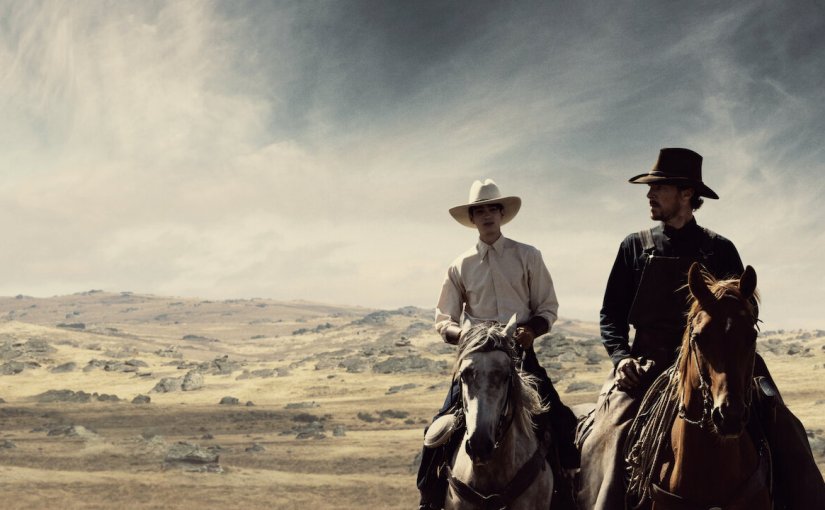
Technically, Jane Campion directs an absolutely breathtaking film with majestic cinematography and art design of open Montana fields taking place in 1926.  Tech work can only take me so far though, and I appreciated the four different perspectives of the headlining cast that includes Benedict Cumberbatch, Jesse Plemons, Kirsten Dunst and Kodi Smit-McPhee. 

Cumberbatch is Phil, a cowboy relic of the Old West.  He’s an expert horseman donned with spurs on his boots, and leather padding on the jeans along with the worn in staple cowboy hat.  He also has a fearful and intimidating temper.  Maybe that’s because his era is soon to be passed by and he’s not designed or updated for anything else.  Plemons is George. Phil’s subdued, business wise brother who knows his way around their Montana ranch, and more importantly knows how to build connections that’ll provide fiscal and political support, while he drives his Ford buggy to get from one place to the next.  Dunst is Rose, the artist of appetizing delicacies and designs who marries George.  She manages the kitchen of her restaurant and can play piano; not exceptionally well but her love for the instrument is what matters.  Her son is Peter, played by Smit-McPhee, a lanky and weak, yet book smart, young adult with his focus on the science of medicine.  He aspires to be surgeon.  So, as the 20th century is now over a quarter complete, these four individuals represent what once was, what is now, what is trending and what will become.

Campion sprinkles her film in more atmosphere than telling dialogue.  The gist of the story is how Phil’s tormenting presence scares both Rose and Peter.  A hair-raising scene occurs midway while Rose attempts to play a song on the piano, only to be drowned out by Phil’s cruel banjo interpretation from the top of the staircase.  Cumberbatch is really scary here as the bear teasing the cub to poke him.  Rose tries again and again to play only to be further interrupted by Phil.  A banjo is an instrument of a bygone era, the Old West.   The piano is the more sophisticated and elegant device to use now within the decorated designs of a reading room.

The future is also upon the characters.  Young Peter purchases a pair of sneakers to wear; not exactly the most appropriate for a horse ranch, nor are his suppressed homosexual yearnings.  Still, the future carries forth as he studies the latest in medicine and surgical practices, whether it is through dissection of a rabbit or studying the most up to date medical journals.

George is the symbol of transition.  He was raised like his brother Phil to be a rancher, but he knows that time has passed.  Currency, technology and longevity are necessary and it is not wise to remain stagnant in a time gone by.  It’s practical to develop connections with the Governor of the state, to drive himself and Rose in a car as opposed to by horseback.  To carry on the family name, it is also prudent he marries and builds a new generation.

I appreciated the subtle visuals and behaviors that Campion weaves into her adaptation from the novel by Thomas Savage.  Over the course of two hours, I was always learning something new, whether it be about the characters or the period setting.  Most telling is the fact that the past can not live in an updated future such as Phil with his suprising and deeply inhibited attraction to Peter.  As well, the future is not going to adjust well to the past like when Peter is trying to learn horse and ranch handling from a teasingly cruel Phil while wearing a ridiculous cowboy hat, white sneakers, and factory tailored jeans.  Furthermore, even if you’re only a frequent movie watcher, you likely are aware that Westerns would pit cowboys against Indians.  Rose demonstrates with her talents for craft how Native Americans are appreciated in this still young new century.  Phil and his ranchers would never imagine such relations to ever exist.

Our history is not comfortable with our eventual future, and our future can not fathom how we ever lived within our past.

Because these two worlds can never mesh in accordance with each other, a loss will have to be committed.  In another storyteller’s hands, The Power Of The Dog, might have resulted in a gun shot, or a stabbing or an illness to eliminate what cannot survive.  As well, long speeches of dialogue would spell out what must cease to continue and what must continue to flourish and go on.  With Campion’s lens, and with Savage’s work, it works atmospherically, however.  The environment of the Montana landscape along with life on a transitioning horse and cattle ranch serve the conflicting time passages and the characters who are relegated to a past, or a present, or a future. 

Don’t watch The Power Of The Dog with expectations of simplicity or quotable dialogue.  I value Campion’s approach to not spoon feed me.  Rather, take in the visuals of the four main characters’ behaviors.  Allow yourself to become more observant of the nature of how things end up.  Powerfully speaking, Jane Campion shows that some people will work well together, while others will crave to blend effectively, and sadly some can never live within another environment or time period, much less someone else’s.

The Power Of The Dog offers a thought-provoking message of loss and reflection while gazing into what’s just beyond.  It’s a very well-made film.

MAGNOLIA

By Marc S. Sanders

Ernie Anderson was the cool voiceover for the ABC television network that would introduce upcoming programs for years. He was a staple of the television industry from the 1970s through the ‘90s. I promise that you or your parents know his sharp, recognizable tempo. So, it makes sense that his son Paul Thomas Anderson would center his multiple story crossover film Magnolia around the television industry, within a 10-block radius in the Hollywood Area. Magnolia presents the off-chance coincidences that somehow happen and the unusual phenomena that can occur when never expected.

Anderson’s three hour epic offers storylines centered around former and present day game show quiz kids (Jeremy Blackmon, William H Macy), the game show host stricken with cancer (Phillip Baker Hall), the drug addicted daughter he’s estranged from (Melora Walters), the dying game show producer (Jason Robards), the producer’s son who is a motivational speaker for men to sexually conquer women (Tom Cruise), and the producer’s gold digging wife (Julianne Moore).

Because the narrative of the film has a biblical theme specifically referencing Exodus 8:2, there are also two good natured guardian angels involved. John C Reilly as a sweet but clumsy police officer proud of his work, and a sentimental hospice nurse played beautifully with bedside sympathy by Phillip Seymour Hoffman.

Anderson’s film opens with three stories of random coincidence that resulted in the deaths of three different men. More than likely most people would say these tall tales of legend could only occur in a movie. Yet, the voiceover narrator , Ricky Jay, says they did not, and thus begins one specific day with torrential downpours of rain, where all of these random characters will come in contact with a personal experience of monumental impact that will change their individual lives forever. Oddly enough, all these people are somehow connected to one another and are within blocks of each other located near Magnolia Blvd in the Hollywood Hills.

Like Boogie Nights, Paul Thomas Anderson directs a film of very weighty emotions that thematically focuses on the sins of fathers that carried over to the futures of their children. The game show is titled “What Do Kids Know?” which likely symbolizes what they didn’t know while at the behest of their parents during their youth. What they know now about their fathers is a burden to bear in insecurities, drug abuse and outright cruelty for the opposite sex. Every character represents some aspect of this ongoing theme during Magnolia. It’s a lot, a whole of information, but fortunately it moves at a very swift pace with an energetic steady cam and dramatic notes of instrumental soundtracks.

Anderson consistently shows different references to Exodus 8:2 by either using the numbers in clocks or decks of cards or temperature readings of the weather or on marquee signs. It’s almost like a scavenger hunt when seeing the film on a multiple viewings.

MAYBE A SPOILER ALERT:

“But if you refuse to let them go, behold, I will plague all your country with frogs.”

Sure. Most recognize the Bible verse as Moses’ decree to Pharaoh to release the Jews from Egypt. I like to think Anderson used Magnolia to release his beloved, but damaged, characters from their own sins or the sins of their fathers. Set them free even if it could be by means of confession, judgment, offering and begging for forgiveness, or journeying towards a personal salvation.

The smart device that Anderson uses is the angelic music of Aimee Mann. Often I talk about how I love when film characters would spontaneously dance. In Magnolia, the cast surprisingly breaks into song with Mann’s confessional number entitled “Wise Up.” It more or less summarizes each individual plight that all the various characters must endure. Magnolia is only an even better film because of Mann’s music.

Magnolia is a beautiful film that I draw many personal parallels from, especially having now lost both of my parents and being by my father’s bedside during his difficult final days of illness.

It is very touching, sometimes funny, and sometimes a difficult film to watch with a belief in random coincidence that is only stronger after watching it.

Like the film insists “we may be through with the past, but the past ain’t through with us.” After Magnolia finishes, you won’t be through with Paul Thomas Anderson’s film. It’s a film that will stay with you.

LIONS FOR LAMBS

By Marc S. Sanders

Robert Redford directed a huge, glossy looking misfire of a political thriller in 2007 with a film called Lions For Lambs, written by Matthew Michael Carnagan.

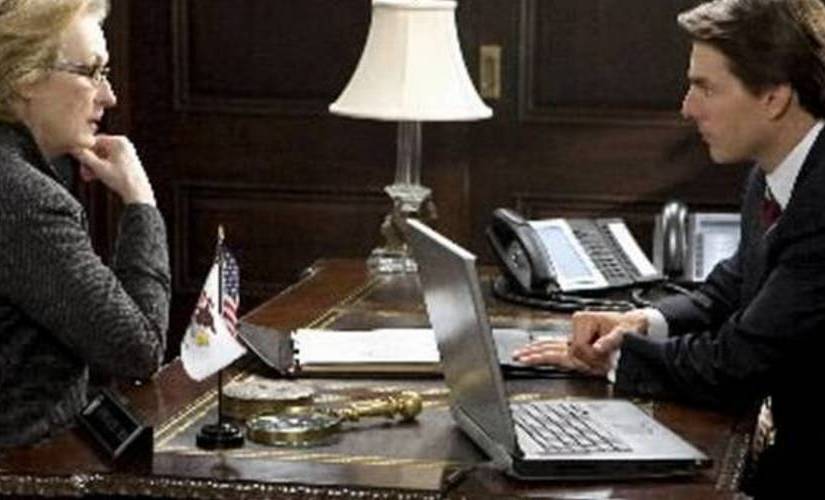
Preachiness is never fun when it labors on for an hour and a half. I don’t care if it’s Tom Cruise or Meryl Streep or even Robert Redford doing the preaching. If these powerhouse celebrities called me up and asked if they could come to my house for coffee and talk, and when they got there, all they did was spew in circles a political platform of “right and wrong” and “why” and “don’t” and “can’t” and “yes and no,” I’d call the police and have them arrested. Time for you to leave, Meryl! Tom, it’s been real.

In 2007, during the late half of Bush 43’s second term, questions of war with the Middle East was at the forefront during a post 9/11 age. Redford, with Cruise producing, thought it’d be interesting to show three different stories (actually two long winded conversations set around desks, and two stranded soldiers) occurring. A political professor (Redford) tries to open the eyes of a student (Andrew Garfield) with great potential but no drive to make a difference. A Republican Senator (Cruise) sets up his own interview with a liberal leaning reporter (Streep) to boast of a new secret mission he’s championing, and two special forces ops are left stranded (Michael Pena & Derek Luke) in the cold of Iraq, the most interesting of three narratives.

Carnagan’s script goes in circles and it’s likely the politics he questions all lean left. Yet the conversations (Redford & Garfield; Cruise & Streep) become just a lot of back talk. A character makes a point, and the other character makes a counter point. I was hoping for a line like “Meryl, you ignorant slut!” Where are we going with all of this?

The soldiers are the mission planned by the Senator that has now gone awry and follows their outcome as they are left wounded and surrounded by Iraqi forces in the snowy darkness. We learn they were students of the professor who wanted to make a difference by enlisting in the Army. See the connection now; the very thin uninspired connection?

Here’s something for ya. In case, you can’t recognize easily enough, Redford dresses his characters in either shades of Red or Blue. Nice touch with Garfield’s frat boy wearing a RED Hawaiian shirt while Redford has the BLUE denim button down. Cruise gets the shiny RED coffee mug for a prop. Does the film have to be THIS transparent? If so, couldn’t the dialogue have been as well?

Lions For Lambs talks A LOT and tells me nothing. Streep’s reporter is a disappointment. Yet Redford portrays her as noble. She loathes the platform of the Senator she just interviewed and is adamant about not writing the quite revealing story he just laid out for her. How can she be that way? She’s a reporter!!!! Tell the truth. Inform the public, even if it’s not pretty, and yet Redford will have a viewer believe it is righteous of Streep to figuratively break her pencil and unplug her computer while she gripes to her editor in chief. No! This is an absolute betrayal of journalistic integrity. What is Robert Redford, the once producer and star of All The President’s Men, thinking here???

You wanna talk about betrayal? The final moments with Streep really had me puzzled. She takes a thought-provoking cab ride that drives past the Capital, Arlington National Cemetery, the Supreme Court, and The White House (right, dab, in front of it no less). Reader, I’ve been to Washington DC a number of times as recent as this past summer. Where the hell is this cabbie driving to, and what route was he taking????

MIDNIGHT RUN

By Marc S. Sanders

Martin Brest’s Midnight Run is a perfect blend of comedy, action and sweet tenderness. Different facets of what two guys could potentially experience together, especially if they are on an unexpected cross country road trip, pop up unexpectedly. It’s a well-acted film with great exchanges in dialogue that surge with broad comedy and high-octane car chases and shootouts. Yet, there’s even some special quiet moments to appreciate as well. It’s another favorite film of mine.

Robert DeNiro is Jack Walsh, a disgraced former Chicago cop now turned bounty hunter who spends his days wrangling up criminals who skip out on their bail. When Eddie the bondsman (a great Joe Pantoliano) asks Jack to bring back Jonathan “The Duke” Mardukas (Charles Grodin) who skipped out on a $450,000 bond, something as simple as a “midnight run” turns into an excruciating journey from New York to California. The Duke doesn’t make it easy for Jack. He never shuts up and right from the start it doesn’t help that he’s afraid to fly. Well, there’s always the train, right? Plus there’s plenty of time because Jack has five days to get The Duke back into custody.

Not so fast. The mob, led by a silky smooth and threatening Dennis Farina, wants The Duke dead as revenge for embezzling millions of dollars from them, plus avoiding the risk of him testifying against them. The Duke unknowingly served as their accountant. The Feds, led by a just as awesome Yaphet Kotto, want The Duke as their material witness against the mob. On top of all that, Jack has to compete with Marvin (John Ashton), another bounty hunter who wants to bring in the The Duke.

There’s great action in Midnight Run and you can’t get enough of it, but it’s the comedic layers of complications the cast of characters bring on to themselves that serve the film best. Danny Elfman’s music accompaniment primarily on horns with guitar and piano bring out the fun in the best way possible. Great chases with a helicopter and various stolen vehicles while Jack and The Duke outrun endless squad cars are magnificent. Martin Brest (Beverly Hills Cop) is just an entertaining director.

Still, the action is not even the highlight for me. First, the chemistry among all the actors is fantastic. They have such brilliant exchanges of cursing each other out, getting on each other’s nerves, and especially listening to one another as well. It doesn’t matter if it’s a screaming match phone call between DeNiro and Pantoliano, or a one on one with Kotto getting frustrated DeNiro. It all works.

Most especially is the pairing of DeNiro and Grodin. They hate each other and then seconds later they’re laughing with each other. Grodin as The Duke, as pesky as he is, plays an unwelcome therapist at times to DeNiro’s Jack as the history of his failed marriage resurfaces and his fall from grace with the Chicago police department comes back to bother him. Jack doesn’t give in so easy to The Duke’s desire to share his feelings. He’d rather endlessly smoke, eat unhealthy food and tell The Duke to “shut the fuck up!” Nevertheless, a bond between the two forms and continues to reshape itself during the course of the film. A great moment occurs when they need to scam a barkeep out of some twenty-dollar bills. You’ll never forget “the litmus configuration” after you see Midnight Run.

I also want to call attention to one of my favorite of so many DeNiro moments in his long career. Midway through the film, Jack reunites with his ex wife and teen daughter that he hasn’t seen in nine years. Like many divorced couples, an argument breaks out among the parents only to be quickly silenced by the quiet intrusion of Jack’s daughter Denise (Danielle DuClos). As Jack waits for his wife to bring him money to help, Brest allows DeNiro to do some of his best acting with this young actress. They can hardly speak to one another. DuClos simply stares in disbelief that her estranged father came home. DeNiro can’t, in good conscience, make eye contact, knowing he’s been the absent parent. It’s too difficult. It is such a humane moment that it grabs me every time. It reminds me that dialogue is not always necessary for a great acting piece. Martin Brest really trusts his actors in this moment. It’s likely my favorite scene of the film and of DeNiro’s career. You can take this scene out of the context of the entire film and still be just as moved by it.

The best action films succeed when the filmmakers care about the characters. When the characters are given depth, then we worry about them. We hope they don’t get killed or taken or arrested, and simply make it home. Midnight Run is that kind of action piece. Had we not cared for Jack and The Duke, movie lovers never would have cared for Martin Brest’s film, now going on 34 years later. It’s a perfect film.

THE ITALIAN JOB (2003)

By Marc S. Sanders

F Gary Gray’s 2003 remake of The Italian Job is crackling with cool and sleek film coverage. It is a blend of wit and fast paced action delivering a solid heist thriller. The cast is terrific as well.

Donald Sutherland plays John Bridger, a near retired master thief and safe cracker. He is ready for one last job with his protégé, Charlie, played by Mark Wahlberg. They assemble a team specializing in different skills like Left Ear, played by Mos Def, who overlooks explosives, Lyle or “Napster”, Seth Green, as a computer hacker, and “Handsome Rob,” Jason Statham, the getaway driver. With another member named Steve (yeah, he’s just called…ahem…Steve) played by Edward Norton, they successfully rip off a safe containing $35 million in gold bars from a home located off the straits of Venice, Italy. However, Steve betrays the team leaving them for dead.

Jump to a year later and the team ventures out to Los Angeles with Stella (Charlize Theron), another safe cracker and daughter to John. They have an opportunity to even the score with Steve while also collecting what’s left of the gold bars. Early on, an idea is conceived to use light weight, speedy MINI Coopers to get in and haul away the booty. However, soon they learn that it’s not so easy to just take it from Steve’s house. They will have to apprehend the gold while in transit.

There’s nothing overly special about The Italian Job. I don’t think Gray was looking to achieve an iconic classic. He just made a solid caper flick that’s pure fun. Sure, the thieves would likely get busted. No, the timing of everything from sabotaging the downtown traffic lights and exploding a precise hole in the street for an armored car to fall through would never occur so perfectly. Who cares? This film is a pitch perfect dance in car chase choreography where we get a kick out of watching sporty little red, white and blue MINIs careen through a subway system, down public staircases and through cylindrical tunnels. It’s all done to get your heart racing.

The players are fun but they aren’t putting in much dimension. I doubt they did much research on the specialized skills their respective characters possess. Maybe Theron researched how to crack a safe. She amps up some nail biting in those sequences as Gray edits between high speed motorcycles approaching while she’s quietly trying to concentrate on the lock’s combination.

There are some cute inside jokes. The best being that Lyle insists he is the inventor of Napster (a little dated by now), and the idea was stolen from him by Sean Parker. The real Sean Parker makes a quick cameo as that scene is told in flashback. Seth Green is quite funny in a nerdy kind of way.

I like the cast. Norton plays a good jerk for villain; a real “Frank Burns.” I appreciate the story behind his character. Early on before he betrays the team, each member shares what they are going to spend their money on. Later, it’s revealed that Steve just used what he ripped off to buy everything the other guys had in mind. He’s a killer and he’s a jerk, but he’s also a guy with no imagination or creativity. I like that angle for a bad guy. He’s only just so much of a genius.

The Italian Job is a fun film that is never too intense, and offers great surprises in the step-by-step process of how to pull off a cinematic heist. If anything, it’ll make you wanna buy a MINI Cooper. I came…THIS CLOSE one time!

MY WEEK WITH MARILYN

By Marc S. Sanders

Simon Curtis directs a glimpse into the life of Marilyn Monroe with an exquisitely cast Michelle Williams in the title role of My Week With Marilyn.

The film is told through the perspective of 23 year old Colin Clarke played under dream like naivety from Eddie Redmayne. Clarke embarks on joining the production crew of Sir Laurence Olivier’s (pompously over played by Kenneth Branagh) newest film that he is directing and starring in, opposite Monroe. When Marilyn’s new husband, playwright Arthur Miller, returns to the states, Colin is drawn into Marilyn’s seduction; protecting her from an intimidating Olivier and tolerating her drug and alcohol use.

This film features an outstanding cast of who’s who from Dame Judi Dench to Emma Watson to Dougray Scott, Julia Ormand (playing a past her prime Vivienne Leigh), Toby Jones and Dominic Cooper. An amazing cast and amazing performances all around.

Still, I just wasn’t wild about the film. With her life startlingly cut short, Marilyn Monroe is arguably one of the biggest enigmas to come out of Hollywood, and yet this tiny glimpse into her life just wasn’t interesting enough for me.

Fully aware of her impending doom to come, the sad foreshadowing of pills on her dresser, and her unfamiliar stupors didn’t drive anything for the character. It all becomes repetitious with nothing new to say. Colin’s virginal experience with this celebrity tryst never drives anywhere but back into Marilyn’s bed after he’s requested to appear at any given hour. This occurs again and again. The film just doesn’t progress past these moments. I found myself saying “I’ve seen this already!”

Did Marilyn learn anything from this fleeting moment in her lifetime? Did Colin? Maybe Colin got to witness the dichotomy of the privately ill Marilyn versus her ability to turn on the public charm with curvaceous ease and a wide lipstick smile. Yet, I have to wonder what came of it for Colin, thereafter.

Redmayne is quite good in his naive innocence. He inhabits nearly every scene since the story is told from Colin’s experience. Storywise though, what was the point of all this really?

Williams as Marilyn is astonishing. As good at playing a Hollywood legend as when Cate Blanchett deservedly won her Oscar for playing Katherine Hepburn in The Aviator. My one wish is that Williams accepted the role with a much more dimensional and nuanced script.

Perhaps because of the mystery that always seemed to surround Marilyn, Williams will never get the chance at playing the bombshell in something better. Marilyn’s life was so dubious and questionable. What filmmakers would be brave enough to truly make claim of how the starlet lived and how she died?

I can wish for another Marilyn portrayal to come one day, with Michelle Williams in the role, but alas I won’t hold my breath.

THE LAST EMPOROR

By Marc S. Sanders

Finally, I invested myself in watching Bernardo Bertolucci’s Oscar winning Best Picture The Last Emperor. Honestly, as breathtaking as the undertaking to make this sweeping epic is, it was the first and likely last time I will ever watch the film.

This three hour plus biographical picture focuses on a young child named Puyi, plucked from nowhere to become the next Emperor of China. He is destined to reside in Peking, The Forbidden City amid rich tapestries and deep Chinese culture at the start of the twentieth century. Oddly enough, the would be Emperor is a prisoner of his own surroundings for nearly his entire life. He is forbidden to go beyond the walls of Peking. Later in his adult life, he is a political prisoner and war criminal in the now regarded People’s Republic of China. Puyi was never granted an opportunity to think for himself or act upon his devices. He is forced to become an adaptable symbol to ongoing representations of the country that harbors him.

I watched this film with my wife. The next day we discussed it with my colleague Miguel who regards the picture as one of the best films he’s ever seen. I can not dismiss his viewpoint, but personally the depth of Betolucci’s efforts for maximum authenticity pushed my interest away from the film.

I embrace character arcs in films. It’s what keeps each passing moment of a movie refreshingly interesting. I do not deny the change in the Emperor’s story arc. Puyi changes as his country changes on both a political or militaristic platform. Yet, the film has vague segues in its changes as well.

Characters appear and disappear. Moments in history occur with no build up or explanation. It was challenging to follow who is who, and what has just happened.

Early on, we see how Puyi as a child interacts with his younger brother, Pujie. Much later in the film, Pujie reappears when they are adults. I am not going to pretend I’m a sophisticated enough moviegoer to realize this is the brother we saw as child over an hour earlier in the film. It took some time to realize who this guy was.

I’m also not going to pretend I know enough about Chinese history and culture to comprehend the traditional customs and ceremonies that occur, or China’s relationship that developed with Japan, or China’s significance during World War II.

That’s my problem with the film. Was I supposed to take a college course on Chinese history before watching The Last Emperor? The film is expository for sure, but it presumes the viewer will recollect at what point in history this moment or that moment occurs.

The film flashes forward and back to when Puyi was a prisoner of war in 1952. In prison, he eventually becomes reformed, but it became frustratingly complicated to understand exactly why he was even sentenced.

Following the film, I referenced Wikipedia to grasp the sequence of events. The historical change of this one man certainly merits a film to be made, much like Malcolm X or Born On The Fourth Of July. However, those films had a more comprehensive narration for me and the ongoing changes that the central figures experience are more well defined as the years pass and the people around them change.

The Last Emperor felt unclear to me in its storytelling while still immersing me in a land I’d imagine is unfamiliar to most viewers. For centuries “The Forbidden City” was not open for a public to encounter. If that’s the case, I believe Bertolucci needed to define what he captured much more clearly. Who’s to know what we are looking at, or what significance this setting has if most of the world population has yet to see what is here?

The Last Emperor requires a high threshold of patience and focus to grasp what it presents. It should be seen for the locales that are filmed, which were completely unseen by me personally. You’ll also get some tidbits of Chinese history, for sure.

All I can recommend is not to be so hard on yourself, when you find yourself lost at times in the film.