THE LONG GOODBYE (1973)

by Miguel E. Rodriguez

DIRECTOR: Robert Altman
CAST: Elliott Gould, Nina van Pallandt, Sterling Hayden, Henry Gibson
MY RATING: 9/10
ROTTEN TOMATOMETER: 95% Certified Fresh

PLOT: Private eye Philip Marlowe does a favor for a good friend, and as a result he loses his cat, spends three days in jail, and incurs the wrath of a mobster looking for his missing $355,000.


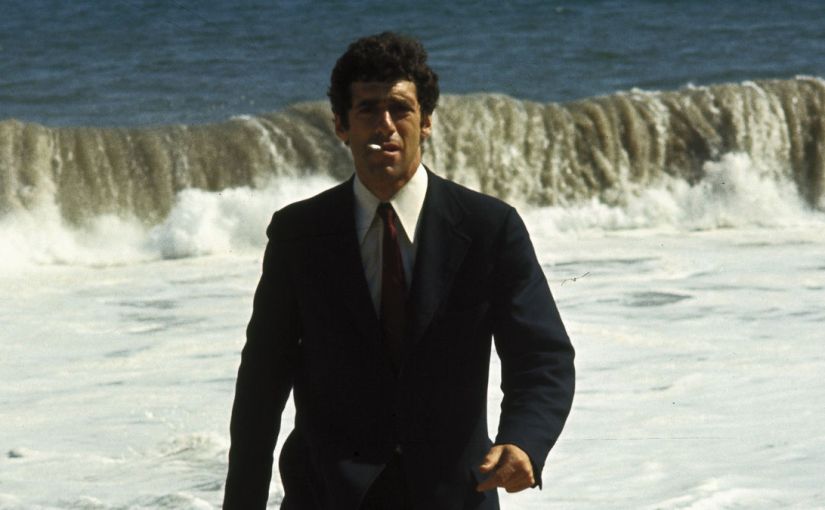
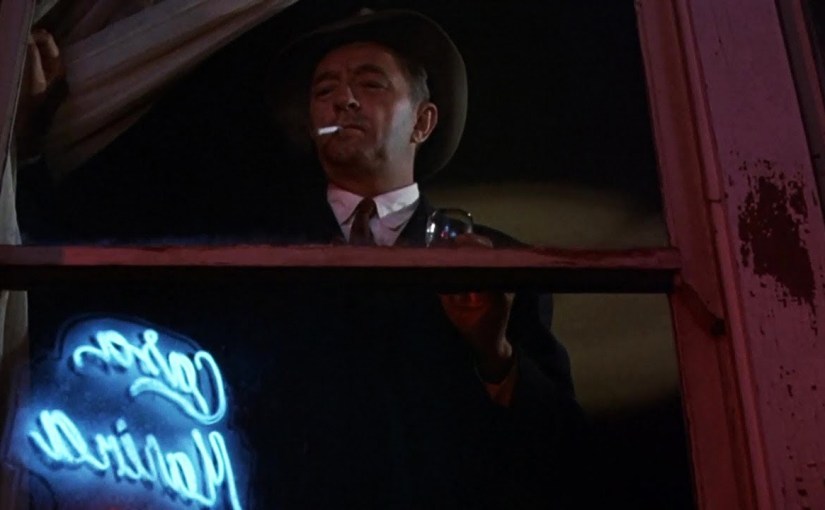
Elliot Gould’s version of Philip Marlowe is a far cry from Humphrey Bogart’s classic interpretation in The Big Sleep [1946], and I’m okay with that.  Who wants to see any actor, no matter how talented, try to follow in Bogey’s footsteps?  Gould resembles no one so much as Walter Matthau as he shambles from one fine mess to another, cracking wise to cops and hoodlums alike, smoking cigarettes like there was no tomorrow, and bemoaning the loss of his cat (played by the original Morris the Cat…no, seriously).

I mention all that because, apparently, there were (and maybe still are) Raymond Chandler fans who were none too pleased with Robert Altman’s film The Long Goodbye when it was released, as Gould did not fit the image they had in their mind of one of fiction’s greatest hard-boiled detectives.  In my opinion, it just doesn’t matter.  Bogey is Bogey and Gould is Gould and, as Marlowe himself repeats throughout the movie, “It’s okay with me.”  Just had to get that out of the way.

The Long Goodbye is one of the finest private eye flicks I’ve ever seen.  With Robert Altman’s trademark style and wit, we first encounter Philip Marlowe as he wakes up in the dead of night to feed his cat.  Much has been made of this opening scene, as the filmmakers apparently intended it to be a metaphor for the Marlowe character being transposed from the ‘50s to the early ‘70s, like a “Rip van Marlowe” suddenly having to deal with a new world after being asleep for 20 years.  I get it, but the movie plays just as well without that kind of metaphysical layering.

Next thing you know, Marlowe’s best bud, Terry Lennox, shows up at his door with bruised knuckles, scratches on his face, and a sudden desire to visit Tijuana, Mexico…indefinitely.  Marlowe does what any friend would do: drives his buddy to Mexico and drops him off at the border.  But when he gets back to his apartment, the cops are already there, interrogate him, and bust him on a phony charge until he tells them where Lennox is.  Three days later, Marlowe is released because Lennox has turned up dead, with a suicide note and a confession to murdering his wife at his bedside.

That’s just the setup.  Next thing you know, he’s hired by a ritzy dame, Eileen Wade (Nina van Pallandt), to find her drunkard husband, famous author Roger Wade (the always dependable Sterling Hayden), who apparently has a nasty habit of taking his drunken frustrations out on Eileen’s face.  That leads to an encounter with a mean little mobster named Marty Augustine (director Mark Rydell) who makes Roger Wade look like Tiny Tim.  HE wants to know where his $355,000 is, that TERRY was supposed to deliver to him in Mexico.  Are these three plot threads connected?  Is the sky blue?

Even if the mystery plot of The Long Goodbye weren’t meticulously plotted and virtually airtight, the movie would still be a pleasure to watch and listen to because, hey, it’s a Robert Altman movie.  I’ve only seen one movie of his that I HAVEN’T liked so far, but I’m reluctant to say what it is for fear I’ll get a deluge of comments about how wrong I am.  Anyway, Altman’s style is in full force in this movie: overlapping dialogue, the occasional cameo (David Carradine as a cellmate, and a certain Austrian bodybuilder as one of the mobster’s muscle men), and characters who never, ever look like they’re acting.

Altman frames his actors and directs them almost as if he’s shooting a documentary, although there are very few (if any?) hand-held shots, so you can tell that there was a method to the…well, not madness, but spontaneity.  Watching them deliver their lines is like watching the scene play out through a keyhole, or like we’re watching them on a hidden camera.  There’s a voyeuristic feel to the whole movie that, while it lacks a certain polish, is nevertheless compelling and absorbing.  I wanted to know what happened next, not because the mystery still hadn’t been solved, but because I simply wanted to see what these characters were going to do or say.  This is a vibe that I don’t even REALLY get, at least not to this degree, in some of Altman’s later films, like The Player [1992] or Short Cuts [1993].  There is something about the synergy between Gould, Altman, and the Marlowe character that struck a chord in me, and I was just happy to be along for the ride.

Naturally, I wouldn’t dream of revealing any of the secrets to the mystery of Terry Lennox and the mobster and the author’s wife.  But I do want to mention one specific scene, between Marty Augustine and his beautiful mistress.  To say that the payoff of this scene was a jolting is a vast understatement.  I can’t even say what other films it reminded me of, but it’s safe to say that it took me completely by surprise.  You’ll know what I mean when you see it.  (And how about that ending!?  Altman had a clause written into his contract specifically stating the ending of the film could NOT be changed by studio interference or whatever…and thank God he did.)

Based on the movie posters for The Long Goodbye, I had always assumed this was Altman’s stab at madcap, screwball comedy.  I could not have been further from the truth.  This is a great film noir, or I guess neo-noir, that does its best (and mostly succeeds) to capture on screen the grittiness and fatalism of only the best dime store detective novels, as well as some of the more highbrow entries in the genre.  Only Altman could have made a movie specifically like this, in this way, and only Gould could have captured that precise mix of “here we go again” and “I’m smarter than you and we both know it”.  I wouldn’t call it a forgotten film, but it’s worth digging up if you’ve never seen it.

GHOST

By Marc S. Sanders

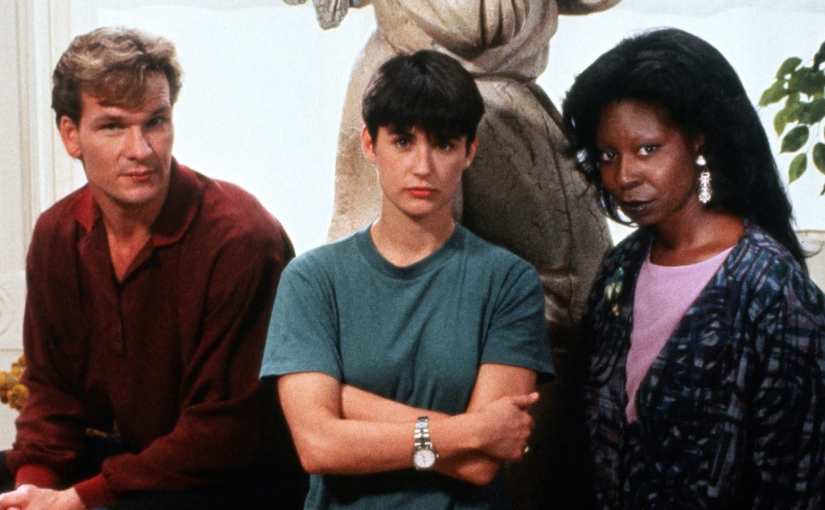
For a perfect blend of the supernatural, suspense, mystery, drama, romance and comedy, the first film that will always come to mind is the surprise hit film Ghost from 1990.  One of the zany Zucker brothers, Jerry to be more precise, who introduced the world to slapstick spoof (Airplane!, The Naked Gun) directed this film turning Demi Moore into a ten-million-dollar actress, placing Patrick Swayze ahead of his Dirty Dancing looks and earning Whoopi Goldberg a very well-deserved Academy Award.  Ghost was a film for all kinds of movie goers.

Sam Wheat (Swayze) is an up-and-coming New York City business executive who loves his new live-in girlfriend, Molly (Moore) even if he can only say “Ditto!” when she tells him she loves him.  Shortly after the picture begins Sam is gunned down following an evening at the theatre.  Unbeknownst to Molly and anyone else living on earth, Sam’s spirit lives on though, and he realizes that he was not the victim of some random mugging/murder.  Now, Sam must find out who arranged to have him killed and why, while also protecting Molly from becoming a victim.

Along the way, Sam crosses paths with a phony con artist, working as a medium, named Oda Mae Brown (Goldberg) who turns out to be the real thing when she can actually hear Sam’s voice and communicate with him.  Sam must recruit Oda Mae to be a go between for him with Molly and everyone else necessary to follow up on in order to resolve the mystery of his sudden death.

Ghost succeeded in every category of filmmaking.  Rewatching the film decades later, I believe Demi Moore should have gotten an Oscar nomination.  Her close ups on camera with beautiful, muted colors from Adam Greenberg’s cinematography are masterful.  Greenberg should have been nominated too.  He’s got perfect tints of pearl whites both on the cobble stone streets of New York with the outer architecture of the apartment buildings, as well as within the studio apartment where the couple lives.  He strives for an ethereal look with his lens. Gold often occupies Molly’s close ups with dim lighting.  Blues and blacks and steel glinting shines follow Sam’s trajectory. 

Look at the lonely scenes that Moore occupies in the couple’s apartment.  There’s a haunting image of isolation with no dialogue capturing the young actress at the top of a staircase when she eventually rolls a glass jar off the top and it shatters below.  It’s one of the moments that defines a sorrowful character, and not many cry on screen better than Demi Moore.  Later, Sam is engaging in a pursuit through the subway system and races down a steep blue escalator in the dead of night.  Zucker places Greenberg’s camera at the bottom of the escalator to show the depth of hell that Sam may be risking continuing his chase.  The images and transitions of this whole movie from scene to scene are stunning.

I mistakenly recall Whoopi Goldberg as just a comedienne doing her stand up schtick in this film.  Not so.  Goldberg looks radiant on film and while she starts out comically as the script calls for, she eventually resorts to sensitive fear of what her paranormal partner demonstrates as real within this fantasy.  There are so many dimensions to this character.  She’s silly.  She’s exact in her nature for what’s at stake and the dialogue handed to her from Bruce Joel Rubin’s Oscar winning script compliments the actress so well. Goldberg never looks like she’s working for the awards accolades. Yet, she earned every bit of recognition that followed her.

Patrick Swayze makes more out of the straight man role than what could have been left as simple vanilla.  His spirit character uncovers more and more about his afterlife and what happened to him as the film moves along. With each discovery, you’re convinced of Sam’s surprises and what he becomes capable of as a ghost.  Long before superhero films became the novelty, Sam Wheat operates like one who has to learn of his origin and then acquire his new talents and powers to fend off the bad guys.

Jerry Zucker, working with Rubin’s script, Greenberg’s photography and Oscar nominated editing from Walter Murch, along with haunting yet sweet scoring from Maurice Jarre, builds a near perfect film.  The narrative of Ghost shifts so often from comedy to crime to drama to romance and the various natures of the piece hinge so well off each other.  That’s due to storytelling and the editing necessary to smooth out any wrinkles.  You become absorbed in Jerry Zucker’s direction, especially with the movie’s most famous scene where Demi Moore and Patrick Swayze are sensually doing pottery together accompanied by Bill Medley’s rendition of “Unchained Melody.”  Watch that scene with someone you love or take it in on a late Saturday night by yourself with no one to distract you with cackles and eye rolls.  You’ll see how effective Zucker’s work is along with Swayze and Moore upholding the scene in a dark, empty apartment.  Take it as seriously as the scene was originally constructed.  (Then go watch Zucker’s Naked Gun 2 ½ for a chuckle.)

The mystery of Ghost works well with surprises if you are watching it for the first time.  You build trust with a character only to realize it is a ruse for something else.  I do not want to give too much away.  For viewers who have never seen the film, maybe you’ll see an early twist as soon as the film begins.  Maybe not.  Either way, Ghost performs very naturally, unlike a forced kind of twist that M Night Shyamalan too often relies upon.  I do advise that you not watch the trailer that was used for Ghost as I believe it deals out too many of the film’s secrets.

There are movies that I watch over and over again because I love to relive the special moments they offer.  Ghost has those kinds of gifts and yet I have not seen it in ages.  I’m glad.  To experience the picture again was such a treat.  While I recalled all of its secrets, this time I was able to take in the various technical achievements and the assembly of the piece, along with outstanding performances. 

I have no problem saying that Ghost possesses the best performances within the vast careers of Demi Moore, Patrick Swayze and Whoopi Goldberg.  Ghost still holds up. It deserves a rewatch and an introduction to new generations.

THE SWIMMER (1968)

by Miguel E. Rodriguez

DIRECTOR: Frank Perry [reshoots directed by an uncredited Sydney Pollack]
CAST: Burt Lancaster, Janet Landgard, Marge Champion, Kim Hunter, Joan Rivers (!)
MY RATING: 8/10
ROTTEN TOMATOMETER: 100% Fresh

PLOT: A well-off ad man visiting friends in a suburban town impulsively decides to swim home via all his neighbors’ swimming pools.


The decidedly odd The Swimmer starts out like it’s going to be one of those pretentious mid-to-late ‘60s “art films” featuring attention-getting zooms, quick edits, and a kitschy/dreamy score that oozes “soap opera” from every note.  (Incidentally, this was Marvin Hamlisch’s first film score.)  It starts mundanely enough, but then it veers imperceptibly into vaguely Lynchian territory, until by the end we’re no longer sure what’s real.  If the payoff doesn’t quite live up to the build-up, I’m prepared to forgive it because of the film’s daring originality, Burt Lancaster’s nude scene notwithstanding.  Hope I didn’t spoil that for you.

Based on an acclaimed story by John Cheever, The Swimmer opens with those ostentatious zoom shots/quick edits of forests and woodland creatures before we meet Ned Merrill (Lancaster), visiting a friend and swimming in their pool.  The neighborhood is decidedly upper-middle class.  The conversation between Merrill and his friends is banal to the point of tedium.  “You ever see such a glorious day?”  “You old son of a gun!”  “Ned Merrill!  How are you, sport?”  Who talks like this?  The dialogue evokes the kind of vibe you’d get from reading a screenplay written by a moderately talented middle-schooler, or perhaps by an advertising executive with no sense of how people talk in the real world.

After some more boring pleasantries and treacly politeness and observations of how nice the weather is, Ned has a brainwave.  He and his wife and daughters live in a house on a hill a mile away.  Or two.  Or five.  It’s never really made clear.  Anyway, he realizes that his friends and neighbors, all of whom have pools, form a river that he can use to swim all the way home.  He never explains where this decision comes from, but whatever, off he goes, to the consternation of his neighbors.

That’s the plot in a nutshell.  For the rest of the film, Ned will visit his neighbors one by one, popping in unexpectedly, take a lap in their pool, and jog off to the next one.  Along the way, he’ll have encounters with his neighbors that will range from friendly to strained to flirty to outright hostility, and two unsavory encounters that involve borderline sexual harassment.  By the time he reaches his goal, everything we’ve seen before will be redefined in light of new information.  I had an idea of what would happen, but I was wrong.  Sort of.  See for yourself.

The Swimmer is a borderline one-trick-pony movie, like Primal Fear.  As good as that movie is, and as good as Edward Norton’s performance is, after watching it the first time, all the suspense is gone.  But The Swimmer is so much odder than anything I’ve ever seen that it gets some kind of award just because of its oddness.  We’re invited to simply watch a man swim in other peoples’ pools and talk to the owners.  At one such encounter, Ned marvels that their 20-year-old daughter, Julie, has grown up so much.  He mentions his own daughters, Ellen and Aggie, probably playing tennis at home.  Julie suggests driving to Ned’s home to meet them…but Ned changes the subject.  This will occur repeatedly.  Ned will mention his wife or daughters, someone will ask how they are, and Ned will abruptly move to the next topic.  (It’s this behavior that made me think I knew what was going on, but as I said, I was wrong.)

The encounter with Julie takes an odd turn: he invites her to join him on his swim, and she agrees.  After crashing a neighbor’s pool, and Ned hurts his leg jumping over a hurdle meant for horses (long story), Ned and Julie share an odd conversation where she confesses she used to like smelling his shirts when she was much younger.  Ned takes in this information and starts flirting with Julie, who is at least 30 years his junior, to the point where it looks as if something unsavory is about to happen.  Nothing does, but the scene itself is a very strange detour, even in the middle of this strange movie.

While Ned’s encounters with his neighbors are all different in one way or another, the first few all have the same thing in common: they’re all trite, by which I mean their dialogue with Ned is filled with lines and sentences that sound, well…scripted.  Not a word of it sounds or feels genuine.  I suppose one could interpret this triteness as an indictment of modern suburbia, where one house and one pool is so like the next as to be indistinguishable from each other.  The same could be said of the people.  One guy brags about his pool’s water filter: “It filters 99.99.99% of all solid matter out of the water.”  Another house features an enormous sliding roof so people can…go swimming while it rains, I guess?  We are treated to scenes of luxury that border on decadence.  At one party, caviar is served, and the guests scoop it up as if it were onion dip.  I was reminded of a line from The Philadelphia Story about “the privileged class enjoying its privileges.”  Is The Swimmer a clumsily disguised diatribe against consumerism?  Sure, why not.

At the end of the day, while The Swimmer does have a buried subtext that is not fully revealed right away, I’ll admit the subtext is not what compels me to recommend it.  I recommend it because it is a cleverly constructed “head-fake” movie, making me think it was about one thing when it was about something else altogether.  Viewers more astute than I may have guessed what was going on, and more power to them.  For myself, my theory was proven wrong at the finale.  The Swimmer gets points for originality, with deductions for the cheesy score and hammy acting.  The back of the Blu-ray describes the movie perfectly: “…a feature-length ‘Twilight Zone’ by way of The New Yorker.

(P.S.  If you have “seeing Burt Lancaster’s bare ass” on your Movie-Watching Bingo card, this movie will help you fill it.  You’re welcome.)

CHINATOWN

By Marc S. Sanders

Forget it Jake!  

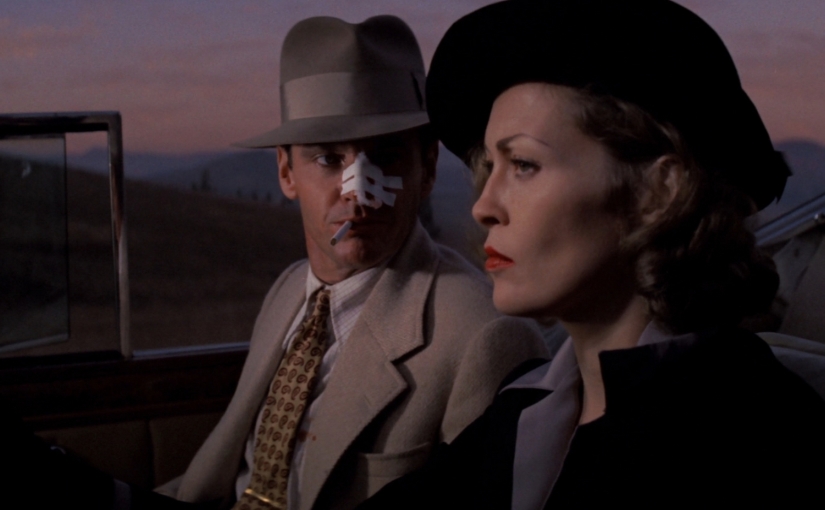
Roman Polanski turned Robert Towne’s page turning script into a noir mystery for the ages.  Practically every scene in Chinatown turns whatever you learned before off its axle.  The mystery of what Jake Gittes, a private dick played so well by Jack Nicholson, is attempting to uncover seems to repeatedly take the guy back to square one.  

Towne’s Oscar winning original screenplay, one of the best ever written, begins with simplicity in motion.  A Mrs. Mulwray insists on hiring Mr. Gittes to find out if her husband is having an affair.  The husband is in charge of the water supply within the surrounding areas of Los Angeles.  Despite Jake’s encouragement for her not to go down this path and recuse herself of heartache, he accepts the case charging his regular fee plus a bonus should he turn up anything that points to something illicit.

Just before meeting with the wife in despair, Jake wrapped up a case, handing over photographs of a wife to her bruiser husband (Burt Young).  The poor guy understands that his spouse was messing around.  None of it is shocking to Jake.  He’s seen the same results many times before and he’ll likely come upon the same situation with Mr. Mulwray.  However, as he follows her husband, it does not seem to be just an affair that is transpiring.  Jake finds himself driving out to a dried-up reservoir and then he’s adjacent to a drainpipe by the ocean shore.  The more he sniffs out, the more likely his nose is going to pay for what he gets closer to.

It’s hard to write about Chinatown as I reflect on the film for a review.  There’s just so much to spoil, even beyond what is now considered to be one of the all time great twists in film history.  I would dare not give anything away.  Some of the luckiest people today are those that have never seen the picture.  To watch Chinatown with a blank slate.  If that’s you…Wow!!! You are blessed of the experience that awaits you.

The cast is a bevy of recognizable faces; character actors who went on to popular television shows and movies (Higgins from Magnum P.I. and Miss Collins from What’s Happening!!!).  Faye Dunaway though is maybe the most unforgettable.  Jake is smart enough not to trust the famed actress’ character (I don’t even want to share the name of who she portrays).  Long before Sharon Stone hammed it up with a less creative eye rolling commando cross legged sitting, Faye Dunaway was best at being sexy, alluring and especially enigmatic.  With her Hollywood glamor appearance in costume wear from Anthea Sylvester, she has that classic noir dame appearance with a smooth inflection in her voice.  Word is that Polanski wanted Dunaway to reflect his own mother’s appearance.

Then there is the celebrated filmmaker John Huston representing old money, a lot of it, in a rare acting appearance.  He plays Noah Cross, a great name to be associated with water.  His gravelly voice and hulking mass lend to what he’s earned demonstrating his power over a commodity resource that everyone cannot live without.  Per Jake Gittes’ experience, he knows it’s best to seek out a motive long before he can uncover a crime.  Gittes’ perusal of some photographs on an office wall will allow him the gumption to go up against a titan like Cross. 

It’s a welcome setting to see late 1930’s L.A.  There is a drought going on and coincidentally Jake is perhaps tailing the guy responsible, but only because of a likely affair.  Still, when his pursuit takes him to the most unexpected places, something more sinister may be happening.  When someone turns up dead by drowning, Chinatown becomes more deliciously complex. Why would Dunaway’s character pay Jake, and later why would Noah Cross double the fee to hire the detective, as well? Jake’s clients may be playing against one another, but he’s the one being tossed in several different directions.

There has to be over a dozen twists in Chinatown.  Thankfully, none of them are contrived or thought up out of the blue.  New depths await further down the rabbit hole.  

I love how Jake Gittes functions.  He might be accused of being sleazy in his profession, but he drives a nice Pontiac classic convertible and dons a stylish wardrobe to go with his fedora hats, designer sunglasses and sterling silver cigarette case.  He’s also quite sharp.  He’s got methods to easily prove how long someone has been at a certain locale and how to follow another car at night.  All of it makes perfect sense.  

Jack Nicholson is great in his role. He does not go all looney like in other pictures, but he’s quiet with his tone, reserved of any kind of shock to the discoveries he finds.  Yet, this particular case might challenge the detective’s sense of acuity into another realm.

Polanski, Towne and Nicholson also thought it best to apply a crudeness to Gittes.  He’ll happily tell an off color joke to his colleagues.  When Dunaway, sneaks up behind him, Gittes is not quick to apologize.  Instead, he gives an annoying scowl for her being there when a prim, genteel woman has no business listening in.  When he gets a phone call, he’ll tell his partners in the room to “shut the fuck up.”  Sam Spade never talked like this.  

The production value is great.  Nothing in or on top of a desk, for example, looks out of place.  From the cars to the interior furnishings of the homes and offices, it’s a Technicolor transport back in time with the dialogue uttered like characters of the ‘70s and ‘80s might deliver.  Humphrey Bogart could never occupy the role of Jake Gittes.

I recently watched The Offer on Paramount Plus which explores how The Godfather made it to the big screen.  Chinatown was next on the horizon, but executives were left confused by a boring middle section about – excuse me, water???? Plus, there was an unsavory plot twist that is hard to even fathom.  The script’s first draft doesn’t even have a scene set in Chinatown.  So what’s with the title? Casting was also unsatisfying.  Now producer Robert Evans wanted you to see more and identify with the chutzpah of the ultra-powerful and wealthy, because only the super-rich are the ones who can get away with murder.

Despite the movie’s welcome yet perplexing surpises, it’s all incredibly satisfying.  Who is doing what to whom, and why?  The best mysteries are the ones that make perfect sense yet can’t be figured out until someone finally starts telling the protagonist the whole shocking truth.  In Jake’s line of work, nothing is shocking. However, the greater the secret, the bigger the liability for everyone involved. 

I’m sorry reader.  I know I’m being vague but therein lies the delight in watching Chinatown.  As you watch, you may throw your hands in the air.  Now what?  You’ll find yourself in disbelief and that would be the best compliment you can give to Roman Polanski, Robert Evans and Robert Towne.

Chinatown is the best example of a film noir pot boiling thriller.  It’s the reason movies continue to thrive; to witness a scene chewing villain, pine after a beautiful, lustrous woman who is not telling us everything, and follow a gumshoe detective who thinks he knows everything but actually could never fully comprehend anything until he makes it all the way back to Chinatown.

TRUE BELIEVER (1989)

by Miguel E. Rodriguez

DIRECTOR: Joseph Ruben
CAST: James Woods, Robert Downey Jr., Margaret Colin, Yuji Okumoto, Kurtwood Smith
MY RATING: 7/10
ROTTEN TOMATOMETER: 96% Fresh

PLOT: A cynical former civil liberties attorney, now reduced to “specializing” in defending drug dealers, becomes transformed by an eight-year-old murder case.


I don’t know if True Believer counts as a “forgotten” film in today’s world, but it’s certainly not a movie that I hear mentioned anymore.  Directed by genre-hopping journeyman Joseph Ruben, whose films are more recognizable than he is (Dreamscape, The Stepfather, Sleeping with the Enemy), and anchored by James Woods and Robert Downey Jr., True Believer is a solid entry in the crime/courtroom drama/thriller arena, at least in broad strokes.  However, there are momentary lapses of logic that strain credulity, and despite the momentum of everything around them, they were enough to affect my opinion/impression of the movie.

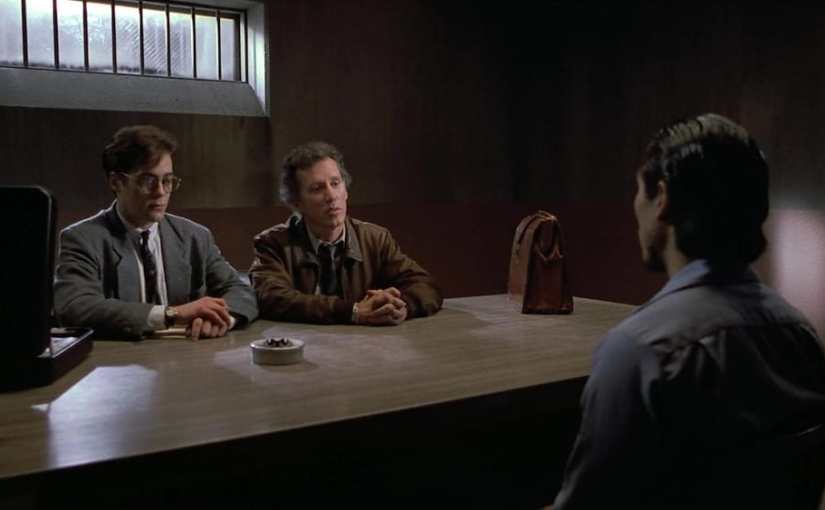
After a flashback and prologue that introduces us to his future client, we meet Eddie Dodd (James Woods), a fiery former civil liberties attorney who once defended Black Panthers and other social revolutionaries in the 1960s.  Now, at the tail end of the ‘80s, in the waning days of the “Me Generation”, he specializes in defending drug dealers and/or distributors under the guise of painting the government’s use of wiretaps and undercover agents as invasions of privacy…a shabby attempt at investing his sleazy client list with some sort of social nobility.  Into his life comes an aspiring attorney, Roger Baron (future Oscar-winner Robert Downey Jr., looking fresh and innocent during what must have been one of his infamous rough patches).  Roger idolizes the old Eddie Dodd, the idealist, and is severely disillusioned by the current Eddie, the opportunist.

Things change, though, when a Korean mother and daughter track Eddie down and ask him to defend their son and brother, Shu Kai Kim (Yuji Okumoto, The Karate Kid Part II, Better Off Dead), who is eight years into a prison term for a murder they say he didn’t commit.  The daughter says she tracked him down by going to all the courthouses: “They all speak of you, and they all say the same thing…you do cases cheap.”  He dismisses them with a vague promise to “review the material,” but after some predictable prodding from Roger, his new conscience incarnate, he takes the case.

What follows is a well-directed, well-paced mystery-slash-courtroom thriller.  It’s not fancy or especially slick, but it held my interest, which is all I ask of a mystery where I’m expected to keep track of a lot of information.  And there is a lot of information to keep track of.  Eddie and Roger, with the assistance of their P.I., Kitty (the invaluable Margaret Colin), uncover inconsistencies in witness accounts, inconsistencies from their own client, the involvement of the Aryan Army, a bona fide conspiracy theorist who believes the phone company killed Kennedy, and a possible link to an 8-year-old drug bust.  (That’s about all I can say about the plot without ruining the surprises of the evidence chain.)

As I said before, the movie is solid, but they made one major misstep: casting the talented Kurtwood Smith as opposing counsel, D.A. Robert Reynard.  From his first scene, no matter how nicely he smiles or how friendly he seems, he is obviously the bad guy, because it’s Kurtwood Smith.  Because of his mere presence, you know he’s not to be trusted and must be brought low, no matter how logical his courtroom arguments are.  He is clearly the villain, even if he’s not doing anything truly wrong.  So right away, any possible objectivity about who’s right and who’s wrong is skewed.  It would have been more interesting if the ostensible bad guy had been cast by someone who is at least a little ambiguous.  Just my two cents.

There are other issues.  As the investigation progresses, there is an anguished speech from Eddie to Shu Kai Kim that spells out exactly where the title of the movie comes from and ends with some tortured dialogue that must have looked good on the page, but just doesn’t feel right coming out of James Woods’s mouth.   In another scene, Eddie walks away from two armed men who have every reason to shoot him in the back but inexplicably choose not to, presumably due to a sudden attack of conscience.  Given what these two men had done just previously, this inaction seemed wildly improbable.  Then the D.A., whom we have seen is highly intelligent, allows himself to get cornered in the courtroom when he absolutely should not have.  Not the actions of a smart man…but certainly the actions of the clear villain, because it’s Kurtwood Smith.

Because of these inconsistencies, True Believer will probably never be mentioned in the same breath with Jagged Edge or The Verdict or any other great courtroom thriller.  But the performances from the leads are more than adequate (despite James Woods’s incongruous ponytail), and the mystery is fun to unravel, and Joseph Ruben’s direction is competent if not splashy.  In other words, it’s your slightly above-average ‘80s genre movie.  (And I am sometimes a sucker for ‘80s nostalgia, so…there you go.)

THE DRAUGHTSMAN’S CONTRACT (United Kingdom, 1982)

by Miguel E. Rodriguez

DIRECTOR: Peter Greenaway
CAST: Anthony Higgins, Janet Suzman, Ann-Louise Lambert, Hugh Fraser
MY RATING: 8/10
ROTTEN TOMATOMETER: 97% Fresh

PLOT: An insouciant young artist is commissioned by the wife of a wealthy landowner to make a series of drawings of the estate while her husband is away.


The directorial debut film of Peter Greenaway at first feels like a mashup of earlier British period films, most notably Kubrick’s Barry Lyndon and Tony Richardson’s Tom Jones.  It contains much of the painterly beauty and some – not a lot – of the stateliness of Kubrick’s film, combined with the irreverence of Tom Jones, especially concerning sexual matters.  However, The Draughtsman’s Contract makes its own mark, particularly in the closing sequences when revelations occur throwing everything that has come before into a different light.  In behind-the-scenes interviews on the Blu-ray, multiple people say multiple times that the clues to the mystery that pops up unexpectedly are hidden in plain sight.  Well, kudos to the filmmakers, because I was fooled.

The story takes place in 1694 in one of the more beautiful portions of the English countryside.  A dimly-lit prologue establishes the particulars: Mr. Neville (Anthony Higgins, whom you may recognize as Sherlock Holmes’s mentor in Young Sherlock Holmes [1985]) is a talented but arrogant draughtsman (pronounced “draftsman”), much in demand for the quality of his pencil drawings.  After much prodding from Mrs. Herbert (Janet Suzman) and her married daughter, Mrs. Talmann (Anne-Louise Lambert), he is persuaded to enter into a contract to produce twelve drawings of Mrs. Herbert’s country estate while Mr. Herbert is away on business.  But because Mr. Neville is abandoning a previous commitment, he insists that his payment be his regular fee, full room and board on the estate…and one private visit each day to Mrs. Herbert so that she may “comply with his requests concerning his pleasure.”  I would say that this may have influenced Jane Campion’s masterpiece The Piano, except the favors in The Piano evolve into something deeper, while the favors in Contract have no deeper level than satisfying Mr. Neville’s appetites.

Given the reputed over-the-top nature of Greenaway’s The Cook, the Thief, His Wife & Her Lover (unseen by me so far), I expected the scenes depicting Mrs. Herbert’s contractual obligations to be far more explicit than what is shown.  This is not a criticism.  I think, for this film, that kind of attention-getting device would detract from the narrative momentum Greenaway achieves.  Since the movie is extremely dialogue-heavy, we are better served by short scenes leaving no question as to the liberties taken by Mr. Neville, so we may return expeditiously to the plot.

(I stand corrected: there is one brief but potentially stomach-churning shot of Mrs. Herbert dealing with the effects of eating something that perhaps did not entirely agree with her…eeyuck.)

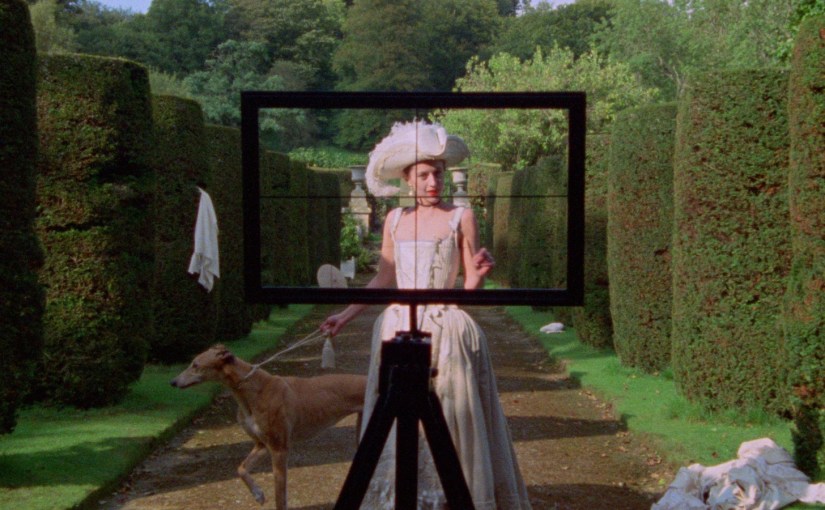
Leaving those interludes aside, the film is essentially a series of deliberately wordy conversations among Mr. Neville, his servant, Mrs. Talmann, Mrs. Herbert, etcetera, while we also watch Mr. Neville practicing his craft.  Using an ingenious device I’ve never seen before, he sets up a framed grid of wires on a tripod so that the object he’s drawing is divided into multiple squares.  Then he simply draws an expanded version of the framed object onto his sketchpad, grid by grid.  (My girlfriend and I used a variation of this same process to draw Timon from The Lion King at Animal Kingdom.)

His one guiding rule is: “Draw what you see, not what you know.”  As such, if the view has changed in any way when he returns to each site, he immediately incorporates those changes into his drawing, whether the changes be as simple as the addition of a ladder on the side of a building or more complex, like adding a dog standing outside a greenhouse.  This credo will come back to haunt Mr. Neville in ways he cannot anticipate.

A mystery arises.  Mr. Herbert never returns from his business trip.  His horse is found wandering the estate.  No one can confirm his arrival at his destination.  Articles of Mr. Herbert’s clothing suddenly appear here and there around the estate…and as such, immediately become part of Neville’s drawings.

And what’s the story with the occasional appearance of a naked man whom we, the audience, can see, but which the movie characters cannot?  True, he’s not quite in anyone’s field of vision, except twice, when a child can clearly see him, but his guardian cannot, and when a steward shoos him away off a bridge.  I have gone over his scenes in my head multiple times, and I still cannot grasp the significance of this anomaly.  Director Greenaway was a painter before he became a filmmaker (indeed, it is his hands we see making Neville’s sketches), so presumably there’s a reason behind it.  Is this man a Fellini-esque or Lynchian sideshow, intended to raise questions without answering them?  Or is this man a visual representation of the “paint what you see, not what you know” philosophy?  If we extend that rule to our lives, are we being encouraged not to ignore the fanciful, the odd, the unusual, simply because they may not fit in the limited framework of our beliefs and/or prejudices?  Perhaps the child could see this man because he did not yet have any prejudices that would exclude him from his awareness, whereas his guardian simply sees a wall, or a statue, because that’s easier to deal with.  Discuss.

Whatever this naked man represents is secondary, at least during the film, to what happens among Mr. Neville, Mrs. Herbert, and her daughter Mrs. Tallman.  I especially enjoyed just listening to them talk.  In its own way, The Draughtsman’s Contract reminded me of the films of Tarantino, where outrageous incidents or conduct are always framed by characters who talk and talk.  What a treat it is sometimes to just listen to dialogue that doesn’t feel like it was generated at the cliché factory.  Some examples:

  • “Why is that Dutchman waving his arms about?  Is he homesick for windmills?”
  • “When your speech is as coarse as your face, Louis, then you sound as impotent by day as you perform by night.”
  • “He doesn’t like to see the fish.  Carp live too long…they remind him of Catholics.”
  • “Your inventory, Louis, is unlimited, like your long, clean, white breeches.  There is nothing of substance in either of them.”

And so on.  Full disclosure: before the eventual resolution of Mr. Herbert’s disappearance and the subtle change in relationship between Mr. Neville and Mrs. Herbert, I was resigned to the idea that the movie had nothing else to offer, plot-wise, and I was mentally giving the film a more mediocre score.  But good things come to those who wait.  Give The Draughtsman’s Contract a chance, and you will find, as I did, that Greenaway has a few surprises in store for anyone who thinks they know how this story will end.

JFK – DIRECTOR’S CUT

By Marc S. Sanders

Oliver Stone’s JFK is told through perspective, not necessarily history.  It’s not a biography and I do not believe Stone would ever claim it to be so.  It’s a thinking person’s picture that gives viewers entitlement to question what occurred, how it occurred and why it occurred.  It might guide you not to trust what anyone says, sees or hears, but let’s face it.  Probably the day Kennedy was shot, November 22, 1963, could we ever completely trust anyone ever again? 

(Forgive my cynicism.  I must backtrack a little.  I still trust my wife and daughter.)

Oliver Stone works through the eyes of New Orleans Prosecutor Jim Garrison (Kevin Costner, in what may have been his most challenging role to date at the time).  Garrison sees a little too easily that there are circumstances out of place, or maybe too neatly in place to satisfy the ultimate resolution that a known American defector to the Soviet Union, like Lee Harvey Oswald (Gary Oldman), acted alone in the assassination of the President.  Stone wrote the script for JFK with Jim Marrs and used Garrison’s input from his own novel. Nearly every scene builds into another possibility of how that fateful day came to be.  Stone even questions if a famous photo of Oswald on the cover of Life Magazine is real.   Too many cover ups with a building list of body count witnesses and too many coincidences keep Garrison up at night.  So, he assembles a crack team of investigators and fellow attorneys to reopen the case and question the official Earl Warren Commission.

Firstly, JFK is magnificent entertainment with a hair raising and unusual original score from famed film composer John Williams.  His notes on percussion with dings and harpsichord strings cue in at just the right moments when Stone introduces another one of many scenes that point out what seems cagy and suspect. The music of JFK works as a narrator.  This narrative keeps you alert.  Maybe you should look in each corner of the screen at times for some subtle clues.

It was also wise of Stone to go with a well-known cast of actors.  The Oscar winning editing from Joe Hutshing and Pietro Scalia moves at a breakneck pace.  Yet, because I recognize fine performers like Ed Asner, Jack Lemmon, Kevin Bacon, Tommy Lee Jones, Brian Doyle-Murray (Bill’s brother), John Candy and Joe Pesci it is easy to piece together who is playing who and what significance they lend to the many theories Garrison and Stone question next.  

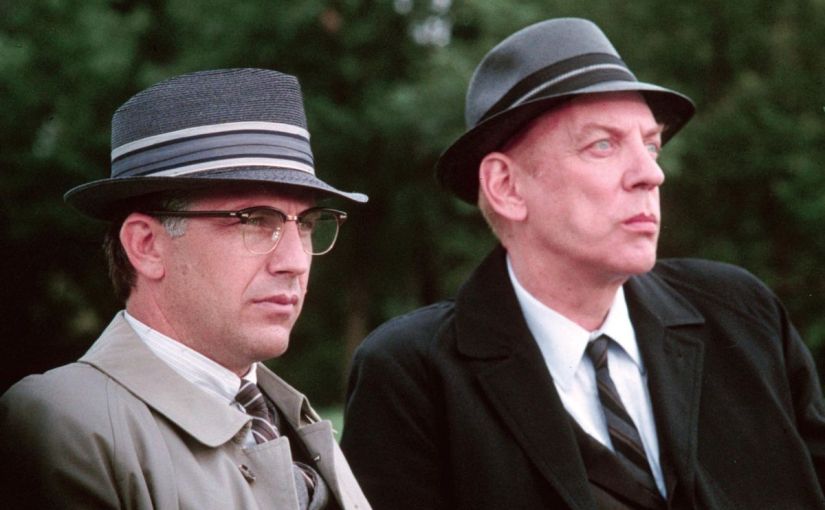
My admiration for the casting continues with the Garrison team that performs with Costner – Michael Rooker, Laurie Metcalf (especially impressive), Wayne Knight, and Jay O. Sanders.  There’s also a clandestine trench coat guy named X portrayed by Donald Sutherland.  Who even knows if this guy ever existed?  He’s more secretive than Deep Throat, but Mr. X has a hell of a lot of information to justify Jim Garrison’s suspicions.  That is an especially marvelous sequence between two men strolling through Washington D.C., eventually concluding a disturbing realization on a park bench.

Sissy Spacek brings out another dimension to the Jim Garrison character.  She’s his wife and the mother of five who suffers the loss of her husband’s attention which is entirely focused on this compounding investigation.  I like Costner’s take on the Garrison character.  Early on he politely asks one of his associates to stop cursing.  He does not like that kind of talk.  Later, it is Garrison who is dropping a number of eff bombs in front of his wife and young children.  This conundrum of a case, a very puzzling detective story, is unraveling the investigator. 

JFK was instrumental for further Congressional consideration following its release.  Files were reopened.  Additional research was executed, and soon many of those secret documents pertaining to the assassination will be revealed in 2029.  Back in 1991, of course that appeared to be a lifetime away.  It’s time we know everything, though.  Arguably, most of who were involved in this incident are dead by now.  Let us know our history.  Still, Garrison was bold enough to point skepticism at not just the adversarial relationship Kennedy may have had with Castro, the Cubans and their Communist allies, but also the people within the CIA and the FBI.  Lyndon Johnson is not even free from scrutiny after he’s sworn in.  Some on Garrison’s team went so far as to factor in culpability from the mafia.  Garrison was not so keen on that theory, actually. 

The construction of Oliver Stone’s film is unparalleled.  I think it’s his best film to date and I can find few others that even compare to how he assembled the picture.  It begins with the voiceover of Martin Sheen laying out many news cycles that were occurring ahead of Kennedy’s murder such as the Bay Of Pigs and the President’s supposed efforts to withdraw from Vietnam.  Sheen’s narrative comes at you very fast with Stone incorporating real life home movies of Kennedy along with his brother Bobby, as well as Castro, and television news footage from Vietnam and anywhere else events were happening.  By the end of the roughly five-minute opening, your head might be spinning. 

Thereafter, though, Stone goes through Garrison’s day on November 22, 1963, watching the outcome following the momentous event and the writer/director works his way into the drama beginning with Asner and Lemmon as two drunk old guys walking through the rain and getting into an argument. 

Three years pass by and so begins Jim Garrison’s motivations to follow multiple trails of breadcrumbs that lead to a lot of different places, all unlike what Earl Warren surmised. 

The scenes work quickly from that point on, and cuts of theoretical reenactments occur.  Who knows if any of these scenes are factual?  Stone and Garrison want you to at least consider their reasonable likelihood.  Moments happen where Joe Pesci and Tommy Lee Jones’ characters appear to be lying about even knowing one another while Stone will depict a sexual role play encounter between them which also includes Kevin Bacon as someone with no more reason to lie. 

Episodes are deeply focused on Lee Harvey Oswald depicted as an infamous and suspected patsy in association with others who may have a reason to want Kennedy dead.  Gary Oldman hides so well in the role.  Oliver Stone even lends focus to how different witnesses describe Oswald.  In some scenes it is Oldman, but then there are other times where a shorter, more overweight man may have been the real Oswald. Later, there’s an Oswald who is taller and more slender. 

A few years ago, I was visiting Dallas, and I was able to spend a some time walking around the crossroads where Kennedy was shot in the convertible while seated next to his wife Jackie.  Watching JFK again lent more clarity to all of the locales such as where Oswald was supposedly shooting from the top floor of the corner book depository.  Kevin Costner and Jay O. Sanders go through the motions of Oswald firing the three shots from his rifle in the short amount of time span.  The script also questions why Kennedy was taken out by Oswald after the turn off the corner of Elm and Houston. There appears to be a better wide-open clear shot long before the turn with the car only going ten miles per hour.  The men question if it was Oswald, then why didn’t he take advantage of the clearer shot.

I know.  I could go on and on.  I have to stop myself.  There’s a ton – A TON – of information in JFK.  It becomes addicting to watch.  You don’t even want to pause the long film for a bathroom break.  I watched the extended Director’s Cut by the way. 

Many common critiques of JFK lean towards how many of these scenes did not even happen.  People are happy to point out there’s no evidence to truly say any of Oliver Stone’s enactments occurred.  I agree, but that’s not the point of this director’s piece.  This is primarily told through the eyes of Jim Garrison.  Kevin Costner is great as the listener, the observer and especially at the conclusion, the describer.  Watch him physically respond to anyone he shares a scene with.  There’s a memorable twitch he offers while at the scene of the assassination that works perfectly with a jarring echo of a gunshot edited into the film.  He’s also great at turning his head down as the thinker while Mr. X lays out an enormous amount of information that comes from several different directions.  Because the film comes from Garrison’s perspective, it does not have to be true.  It only has to be what the investigating prosecutor reasonably believes, and what he absorbs from suspects, witnesses, and his devoted team. 

A final speech of Garrison’s is told at the trial of suspect Clay Bertram, aka Clay Shaw (Tommy Lee Jones), who was the only man tried by Garrison for Kennedy’s murder.  First, it’s important to note that during this fifteen-minute sequence, when Stone cuts back to Garrison in the courtroom, Costner is wearing different suits.  So, while it is assembled as an ongoing rundown, it is not meant to all be in one instance.  Garrison lays claim to an endless amount of possibilities and circumstances that at times have no correlation with each other but could possibly all merge together towards November 22, 1963.  Critics argued this speech of Garrison’s never took place.  That’s correct.  However, this is a movie and for the efficiency of information to come out, a funnel must be opened up to learn what is being pursued and what has been uncovered.  This is the strategy that the script for JFK adopts and it works, leaving you thinking and rightfully doubting what our governing bodies and history books have told us.  Most famous of all of these nonsensical happenings delivered by Garrison is the “Magic Bullet Theory” made extra famous by Jerry Seinfeld with Wayne Knight on the comedian’s sitcom.  It’s silly but it is also a response to the impact that came from JFK.

JFK has a very glossy appearance from the Oscar winning cinematography.  Reflections and natural glares come off of Jim Garrison’s glasses.  The exasperation, along with the shiny persperation of John Candy’s sleazy lawyer character is undeniably noticed as his integrity is being questioned.  Staged reenactments are shown in black and white, clear color or grainy distressed output (such as recreations of the known Zapruder Film).  Nothing is clear about what led to Kennedy’s murder.  So, Oliver Stone’s filmmaking team will ensure that nothing should look consistent.  There are no straight answers; only endless amounts of reasons to ask another question after another.

Oliver Stone does not make JFK as complex as some will have you believe.  It’s quite easy to piece together who represents what in this story.  Many theories are offered at lightning speed, but they hardly ever intersect with each other until a probability is completely laid out on the table and then the film moves on to the next one.

JFK may have a long running time and a large cast with a lot to say and ask, but it’s an exhilarating thrill to behold.  Who knows what is true?  The importance of Oliver Stone’s masterpiece demonstrates that much of what we were told as truth may not consist of the entirety of facts. 

Again, question your governing bodies and ask the hows and whys and whos.  Oliver Stone reminds us that we have that right as the citizens of America. 

What really happened to our President, and who was really responsible?

THE SNAKE PIT (1948)

by Miguel E. Rodriguez

DIRECTOR: Anatole Litvak
CAST: Olivia de Havilland, Leo Genn, Celeste Holm, Natalie Schafer [aka Mrs. Howell on Gilligan’s Island…how about that?]
MY RATING: 8/10
ROTTEN TOMATOMETER: 100%

PLOT: A young woman’s life is torn apart when she suffers a mental breakdown and is admitted to an institution.


For much of its running time, The Snake Pit remains firmly in the realm of reality without succumbing to melodrama, as was symptomatic of so many film dramas of the 1940s.  That’s what makes it mildly disappointing when, in the last reel, we get a nice little summation of the origins of our heroine’s dilemma, and she bravely makes a series of decisions that result in a happy ending.  Naturally, that was the case in real life, as well.  The film is based an autobiographical novel by Mary Jane Ward, who spent eight months in a mental institution after a nervous breakdown.  I don’t begrudge the happy ending, you understand.  I just wish it didn’t feel as rushed as it does.

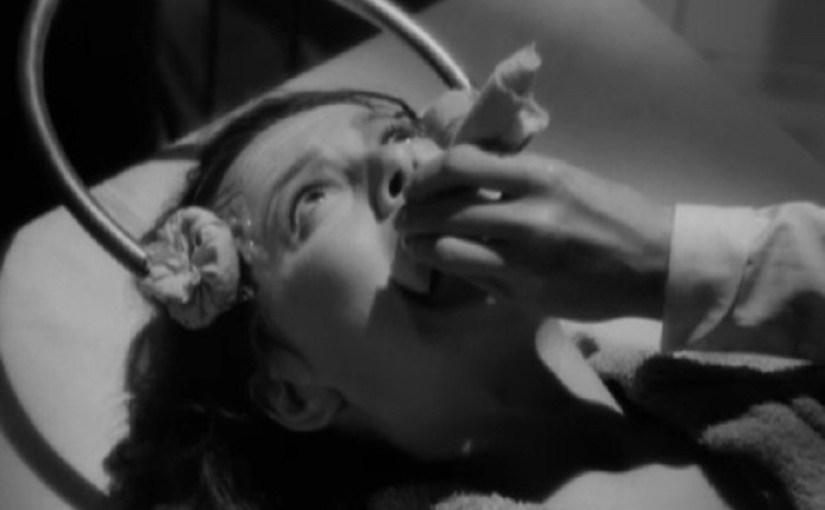
But I’m quibbling.  This is a fine film.  The Snake Pit was another in a series of Daryl F. Zanuck productions intended as “message pictures”, movies that addressed real issues in contemporary society.  The Grapes of Wrath (1940) dealt with the Dust Bowl and harsh labor conditions.  Gentleman’s Agreement (1947) was one of the first films, if not THE first, to openly condemn casual anti-Semitism in “polite” society.  The Snake Pit is said to be the first mainstream film to realistically depict conditions in America’s mental institutions at the time.  If so, the filmmakers really went for the jugular in their first at-bat.  In its own way, this is as harsh and unforgiving a film as One Flew Over the Cuckoo’s Nest.  There’s even a sequence involving shock treatments that are as effective as anything else I’ve seen along those lines.

The story begins intriguingly, as we open on the lovely open face of Virginia (a deliberately un-made-up Olivia de Havilland) as she wonders mentally what she’s doing outside on this bench.  A man we don’t see asks her a series of questions, and she has little mental conversations with herself before she answers.  Then the camera pulls out, and there is no man, just another woman telling her it’s time to go back inside.  Inside where, she wonders?  Then she’s herded with a bunch of other women back into the main hall of the Juniper Hill State Hospital.  She starts to panic.  What is she doing here?  Is she crazy?  She doesn’t feel crazy.  The reasons for her stay provide the central mystery to the film.

(Incidentally, Stephen King apparently saw this film on TV as a youngster…which may account for the numerous appearances of the Juniper Hills psychiatric facility that appears in many of his novels and stories, including It, The Dark Half, and Needful Things.  When you win on “Jeopardy”, I’ll let you know where to mail my half of the winnings.)

De Havilland’s performance is extraordinary.  Her talent is undeniable, but it’s notable that one of the silver screen’s great beauties went without makeup, wore clothes two sizes to big, and even dropped some weight to make her look more fragile.  This was my first time watching the movie, and I was astonished at her appearance.  When she flies into rages, or pleads for mercy, or desperately tries to remember her past, you really believe it.

In a series of flashbacks, we discover that Virginia Stuart was a frustrated author who met her future husband in Chicago, in the offices of the company that had just rejected her manuscript.  There was a whirlwind romance that ended when she simply ran out on him and disappeared, only to show up six months later in New York, where he had moved…six months previously.  (I don’t know about you, but that’s red flag territory in my mind, but whatever.)  Their romance picked up where it left off, there was a ceremony at City Hall, and they enjoyed married life…for about a week.  At which point Virginia behaved erratically, declaring that she will never love any man, that no man can love her, and flatly denying that today is May 12th, no matter what it says on the newspaper.  Virginia’s husband admits her to Juniper Hill, and it’s here where her troubles REALLY begin.

The film’s depictions of life on the various wards of the asylum are tame by today’s standards, but they are no less disturbing.  There are the usual cast of off-kilter characters wandering the halls, mumbling to themselves or being unreasonable, but there is something indefinably…I don’t know, squirmy about seeing this kind of behavior in such an old movie.  At least for me.  When it’s played for real and not for laughs, in black and white, in 1948, something about that place and those people became much more real to me, at least as real as McMurphy’s fellow travelers, or maybe even more so.  I’m unable to put it into words.  When someone in Cuckoo’s Nest dances by themselves in a corner or wants his cigarettes, it’s kinda funny.  In The Snake Pit, when a woman dances by herself, or another covers her face with her hair and paces around muttering that it’s her right to cover her face…it was creepy.  Is it the black-and-white cinematography?  Is it the shortage of comic relief?  Is it because they’re women instead of men?  Discuss.

(There’s even a head nurse who seems like the prototype for Nurse Ratched: a no-nonsense, by-the-book authoritarian who makes no bones about disliking Virginia.  When Virginia is given a typewriter for therapeutic reasons, the nurse reminds her: “Don’t go thinking you’re better than the rest of us just because you’re a writer.”  Talk about terrible bedside manner, geez…)

Interestingly, I didn’t find Virginia’s behavior all that “crazy.”  She has problems with her memory, she tends to fly off the handle at trivial matters, and she once bit the finger of an arrogant doctor who was waving it in her face unnecessarily.  Frankly, that sounds like something I would do on a bad day.  Virginia’s conversations with her doctor, Doctor Kik (Leo Genn), are the only things that keep her tethered to reality.  These conversations are handled extremely well.  I found myself thinking of another famous movie about psychiatry in the ‘40s: Hitchcock’s Spellbound (1945), which was not so concerned with legitimate psychiatry as it was with making sure Bergman and Peck wound up together at the end.  In that film, the conversations between doctor and patient are full of double-speak and heavy-handed metaphors.  In The Snake Pit, I found it interesting that, whenever Dr. Kik makes a small breakthrough with Virginia, he never pushes the matter.  He simply calls it a day and picks it up tomorrow, armed with new information.  I’m no doctor, but that seems way more realistic to me.

I went into The Snake Pit expecting a semi-watered drown treatment of insanity and mental institutions.  Instead, I got a film that is remarkably effective and powerful, containing a performance from Olivia de Havilland that might seem like a lot of histrionics at first, but which is the very definition of someone completely at the mercy of mood swings beyond her comprehension.  They say that only the insane never wonder if they’re crazy.  If that’s the case, Virginia is as sane as they come, wondering over and over again why she does what she does, why she’s been thrown into this place.  She comes across as someone who desperately wants someone to listen to her.  Thankfully for her, someone does.  If everyone were as lucky as she is, maybe there’d be a lot more happy endings in the world.

SEA OF LOVE

By Marc S. Sanders

Al Pacino is a twenty-year veteran New York City cop, working out of Manhattan, on the trail of a serial killer in Sea Of Love.  The profession is nothing new to Pacino’s repertoire of roles, but the portrayal is unique thanks to a smart and suspenseful script from Richard Price and intense directing from Harold Becker.

The killer leaves a calling card.  A 45 LP record of Phil Phillips ’50s classic crooner, “Sea Of Love,” spinning on the turntable.  The victims are naked men lying face down in bed with a bullet to the head.  Turns out that a cop from another precinct played by John Goodman has uncovered a similar crime scene in Queens.  So, the two team up.  They believe the murderer is a woman.

All the victims have posted a Lonely-Hearts Club blurb in a magazine. The invitation for a date stands out because the text rhymes.  The detectives decide to post their own ad in the same kind of format, meet the women who respond and hope to nab the killer.  It gets complicated when Pacino encounters a breathtaking and sultry woman played by Ellen Barkin. 

Pacino’s cop is a smart guy.  He’s got instincts.  Yet, perhaps due to his constant drinking, insomnia, and the bitterness he carries now that his partner (Richard Jenkins) has hooked up with his ex-wife, he’s also quite vulnerable.

The mystery is strong, and the tension builds as Sea Of Love moves on.  Barkin has Pacino and the audience convinced that she’s the prime suspect.  Still, he lets his defenses down because he’s easily getting seduced by her advances.

Whether you’re watching Al Pacino share scenes with John Goodman or Ellen Barkin, the execution is fantastic.  Great performances from the three.  Pacino and Goodman have a natural exchange with one another. Often humorous, but the guys always talk like cops.  When Pacino admits to tossing away a fingerprinted glass from Barkin, Goodman suggests lifting the prints from something- ahem – more personal of his.  A cute wink and nod exchange.

More important to the film is the erotic chemistry between Barkin and Pacino.  Harold Becker uses a late-night supermarket visit in the vegetable aisle to evoke the risky and irresistible nature the two characters develop for one another.  Other scenes build well on the relationship between these two lonely strangers who’ve only recently met. 

Moments of isolation and drunken stupors also work towards fleshing out Pacino’s burned out cop.  He’s got a schleppy posture to him and an exhausted expression with his sullen eyes and shaggy black hair.  At the same time, his character’s twenty years of experience seem to uphold his alertness.  This cop knows he’s letting his guard down. Without any dialogue, you see the internal struggle Pacino has with what should be done against what he is deliberately neglecting.

This film was Ellen Barkin’s breakthrough role.  She received rave reviews as someone who takes care to uphold a New York City trendy appearance by day as a shoe salesperson in contrast to a woman looking for some carefree lust in the evening.  For Pacino, Sea Of Love reinvigorated a career slump following a series of poorly reviewed films.  Together, they make for a sexy yet untrusting pair.

Circumventing this relationship is the mystery.  Is Barkin the culprit? She seems to have a dark way about her that may not surprise you.  Price, Barkin and Becker designed the character quite well for her to at least have the potential to be a killer of men.  Is she setting Pacino up to be the next victim?

New York City from the late 1980s looks great, even though interiors were shot in Toronto.  Trevor Jones offers a nail-biting soundtrack to keep the suspense heightened at just the right beats of the picture with Becker’s camera pointing down dark hallways or when new clues are discovered.

I’ve seen Sea Of Love a few times and even with knowing the surprise ending, the film still holds up thanks to the performances from its three stars, along with its taut editing, well-paced writing, and smart direction. 

This is a good erotic murder mystery.

MURDER ON THE ORIENT EXPRESS (1974)

By Marc S. Sanders

When considering Sidney Lumet’s admirable body of work, many would likely connect him with covering corruption within police precincts and the legal jargon of courtrooms.  Fortunately, on occasion, he experimented outside of those genres, and we are all the better cinematic viewers because we were treated to an all-star cast, devouring up the scenery in an adaptation of Agatha Christie’s celebrated mystery Murder On The Orient Express.

Lumet abandons his penchant for the metropolitan jungles of conflicted souls and high stakes drama to offer up a deliciously fun who done it, with Albert Finney gleefully playing the oddball, mustached Belgian (not French) detective, Hercule Poirot.  Despite a cast that features Sean Connery, Lauren Bacall, Jacqueline Bisset, Vanessa Redgrave, Martin Balsam, Richard Widmark, Michael York, John Gielgud, Anthony Perkins, and an Oscar winning performance from Ingrid Bergman, it is Albert Finney who makes the film wonderfully delightful.  His stature that seemingly hides his neck within his stout torso, along with a shoe polished, flattened hairstyle and a thick, echoing dialect tempo are an absolute combination of pleasure.  He makes the glossary of Tim Burton’s bizarre characters seem rather straightlaced.

He’s strange, but funny.  Before the expected murder gets underway, we observe an unrecognizable Finney performing Poirot’s nightly routines, including applying cream to his hands and unique mustache, as well as donning a kind of strap beneath his nose to keep his signature trait in its proper shape.  Batman maintains care of his cowl.  This crime fighter must preserve his facial hair.  It’s completely normal for Hercule.  While these mundane tasks of his are executed, the great inspector is also alert to several rumblings and bustles going on in the nearby cabins aboard the famous train in the title. Lumet ensures we see how smart and observant Mr. Finney chooses to portray Poirot; unique, and instinctively wise without limits.

An impolite and bossy man named Ratchett (Widmark) is discovered dead with multiple stab wounds to the chest.  It doesn’t make much sense considering the other passengers should all be complete strangers to one another.  Or are they?  Each one has an alibi, and their respective personalities couldn’t be more different.  Who would have the motive to kill a stranger aboard a moving train?

There appear to be twelve suspects for Poirot to consider.  That’s quite a list.  The standouts for me include Bergman, Bacall, and Perkins, but Lumet allows at least a scene or two for each celebrated actor to shine.

Ingrid Bergman dresses down to portray a shy, nervous, homely Swedish woman.  Sidney Lumet knows to back off on directing inventions when working with talent of such magnitude.  In one uncut take, Bergman controls an interrogation scene with Poirot and the camera stays fixed on her never diverting away and very subtly tracking behind Finney to stay with the actress’ nervous portrayal and expression.  The question is, should we trust this person? If Ingrid Bergman is putting on a façade, she’s awfully good at it.

Lauren Bacall carries such a strength on screen.  She walks with square shoulders and utter confidence that makes it seem like she’ll be impenetrable to Poirot’s inquiries.  Bacall’s booming signature voice would make me back down at any given moment.  She commands the supporting cast and appears to defy intimidation.

This film was made fourteen years after Psycho and yet Anthony Perkins portrays Mr. McQueen, a secretary of the murder victim, with youthful naïveté.  His stutter is perfectly timed and authentic, and he’s got body language that flails from one direction to the next when put to the test, not just by scenes he shares with Albert Finney, but anyone else in the cast as well.  His character is clearly unrelaxed.

I decided to watch this picture for reference.  In September of this year, I will be portraying Hercule Poirot in a stage adaptation of Agatha Christie’s story, written by Ken Ludwig.  My colleague Miguel Rodriguez is in the production as well, occupying Martin Balsam’s role.  They’re brilliant with magnificent energy by the way; Balsam and Rodriguez.  I had to watch Lumet’s film twice to appreciate the gleeful nuances he offers with this celebrated cast, including the actual train which serves as not only a claustrophobic setting but a character as well, stuck in a snowdrift, trapping the guilty party with no means to escape.  The dialogue flies fast and many of the various accents (Belgian, Russian, Scottish, Italian, Swedish, Hungarian) are challenging to decipher on a first watch, particularly Finney’s performance.

On a second watch, I was more wide-eyed to the detective’s behavior and how he breaks down a suspect during an interrogation.  No two interviews of suspects are even remotely similar.  Finney alters his way of approaching a scene partner each time.  I’ll credit the screenplay’s dialogue from Paul Dehn for that achievement as well. 

When a cabin door is opened to reveal the deceased victim, Finney’s odd mannerisms drastically change as he enters the room knowing what to say and look for immediately.  Sidney Lumet characteristically will position his camera pointing up at his actors, so the audience is the perspective of the subject being looked upon.  Albert Finney is gifted a wide scope within a narrow quarter to react as the famed detective.  This filming technique was an inspired choice by the director. Hercule Poirot is built up to be the foremost detective and now we see him demonstrating his specialty for examining a crime scene, and thus where to begin with his examination.  Albert Finney received an Oscar nomination for this role and it’s because of the skills he orchestrates under a guise of heavy makeup with a thick incomprehensible dialect.  All are meant to be taken as winning compliments from me.

The art design of the train is breathtaking.  The exteriors are magnificent too, particularly the train station located in Istanbul where the Turkish merchants crowd each cast member as they enter the film for the first time ready to board the Orient Express.  In one spot, a steward is inspecting the food cargo.  Another area has a merchant spilling over a carriage of oranges.  Locals crowd Bacall, Bissett and York with trinkets to buy.  Lumet captures the whole exotic tapestry.

Richard Rodney Bennett’s musical score is unforgettable.  A sweeping, romantically uplifting waltz accompanies the locomotive’s ongoing trajectory.  Then it gets more brooding when the journey comes to an unexpected halt in a chilling snowdrift, with the thought of a dangerous killer nearby.

Sidney Lumet is to be applauded for stepping back to allow his who’s who of legendary cast members play with Agatha Christie’s famous mystery.  He’s done this on other occasions including his outstanding cast in Network and Paul Newman’s career best performance in The Verdict

Those who are not familiar with the Agatha Christie’s tale are fortunate to experience the wonderfully twisted ending that serves the story’s continued appreciation.  Lumet deserves credit for the final touch though.  It’s not often that a film boasts such a collected caliber of talent together.  So, the best way to cap it off is with a charmingly giddy champagne toast.  It’s Sidney Lumet’s perfect little garnish to wrap one of greatest literary mysteries to ever be published and adapted for the stage and screen.