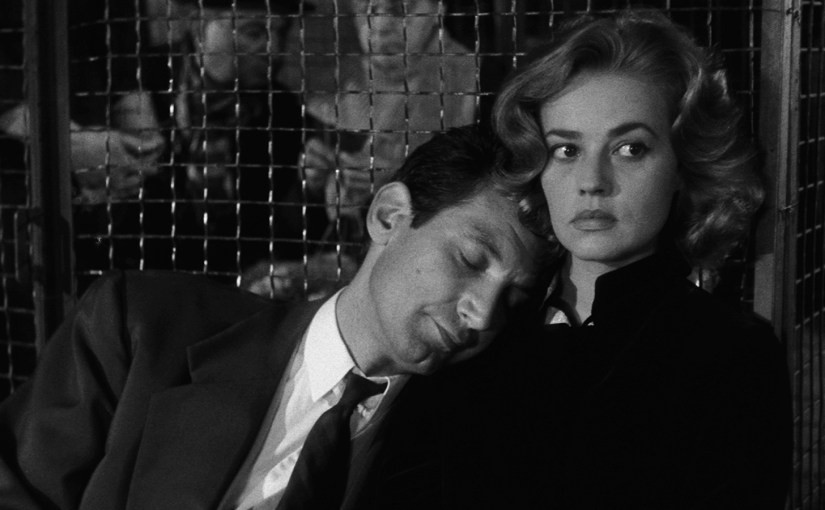
ELEVATOR TO THE GALLOWS (1958, France)

by Miguel E. Rodriguez

Director: Louis Malle
Cast: Jeanne Moreau, Maurice Ronet, Georges Poujouly
My Rating: 10/10
Rotten Tomatometer: 93% Certified Fresh

PLOT: A married woman and her lover hatch an apparently foolproof plan to kill her husband (his boss), but a split-second decision at a crucial moment sends everything into a tailspin.


We plan, God laughs. – old Yiddish proverb

Let me get this out of the way right at the top: Elevator to the Gallows is one of the best crime drama/thrillers I’ve ever seen.  It holds its own against anything by Hitchcock or Clouzot.  With admirable focus and restraint, first-time director Louis Malle (My Dinner with Andre, Vanya on 42nd Street) crafts a gripping illustration of how the best laid plans can fall apart because of one minor miscue.

The film cuts right to the chase at the opening scene, showing a phone conversation between Florence Carala (Jeanne Moreau) and her lover, Julien Tavernier.  They discuss their plans for Julien to kill her husband in his office on a Saturday evening, after which he’ll pick her up at a café where she’ll be waiting, and that will be that.  Everyone will assume her husband is in Geneva on business, and no one will discover the murder, which Julien will arrange to look like a suicide, until Monday morning, giving Florence and Julien plenty of time to make their escape.

(I liked how we never got any flashbacks of the relationship between Florence and Julien.  All we need to know is, they’re lovers, they’re desperate enough to commit murder, and that’s it.  Very concise.  I love it.)

Julien’s plan involves using a grappling hook to avoid using the office elevator to get to his boss’s office one floor above his.  He proceeds with the plan, nearly getting caught in the process, but he’s able to commit the crime and leave the building with several witnesses as an alibi, witnesses who will say they never saw him enter his boss’s office before he left.  So far so good.

Julien gets to the street, takes the top down from his convertible, takes one last look back at the building…and realizes he left a vital clue in full view of any pedestrian or street cop.  Leaving his car running, he decides to run back into the office building and retrieve the evidence before the night guard shuts off the power for the night.

Unnoticed by Julien, a florist and her bad-boy boyfriend have been having an argument at the shop next to his car.  The boyfriend sees this rich man leave his convertible on the street…with the engine running…

Thus begins a Hitchcockian odyssey that leaves Julien stranded in an elevator, his car and his identity stolen, and his mistress stranded on the streets wondering where the hell her lover is.  At one point, Florence sees Julien’s car drive by the café where she’s waiting…she can’t quite make out the driver, but who is that girl in the car with him?!  Has she been betrayed at the last minute?

The film follows the younger couple, Louis and Véronique, as they tool around in Julien’s car, eventually winding up at a roadside motel, and unwittingly making friends with two German tourists.  They even share drinks with the Germans and take some candid photos using a little spy camera in Julien’s raincoat.  (We learn that Julien was in the Foreign Legion and was well-trained as a soldier – maybe even in spycraft.)  I found myself wondering why we were wasting time with this larcenous couple…until they decide to check into the motel as Mr. and Mrs. Tavernier to cover their own tracks.

The screenplay ingeniously heaps one hasty decision on top of another so that, just when it seems Julien might be in the clear, something else happens that makes it seem impossible he won’t be discovered or at the very least blamed for something he didn’t do.  Meanwhile, Julien is desperately trying to escape the elevator, using a penknife as a screwdriver, getting excruciatingly close to tripping a vital switch that’s just out of his reach.  He eventually tries to get out using the old climbing-the-cable trick…which is of course exactly when a night watchman is making his rounds.

This story is so good, I can’t believe there hasn’t been an American remake.  And it’s not like there aren’t other great films out there that cut right to the chase and never look back for flashbacks or additional material.  I’m not sure what makes Elevator to the Gallows so good, to be honest.  Maybe I was rooting for Florence and Julien when they are clearly not the good guys.  Maybe it’s the economy of the storytelling, or the screw-turning twists that lead the police to believe Julien has committed more than one murder.  At one point, Louis and Véronique make a startling decision that had me yelling at the screen.

Words fail me on this one.  I can’t describe it any better than by saying this is one of the best films I’ve ever seen, certainly one of the best film-noirs I’ve ever seen, and a movie that I’ll bet Hitchcock watched while thinking to himself, “Damnation…I wish I’d thought of that.”

ALL ABOUT MY MOTHER (1999, Spain)

by Miguel E. Rodriguez

Director: Pedro Almodóvar
Cast: Cecilia Roth, Marisa Paredes, Penelope Cruz, Antonia San Juan
My Rating: 8/10
Rotten Tomatometer: 98% Certified Fresh

PLOT: A single mom fulfills her son’s last wish by going on a search for her estranged husband, whom she has not seen since before her son was born.


Whatever you might think personally of director Pedro Almodóvar’s films, you can’t say he doesn’t have range and/or versatility.  In one of his previous films, Women on the Verge of a Nervous Breakdown [1988], he takes potentially dark material (a suicidal woman’s quest to find out why her lover abruptly left her) and turns it into farce (police officers accidentally eat drug-laced gazpacho intended for another suicide attempt).  In All About My Mother, winner of 1999’s Oscar for Best Foreign Film, Almodóvar takes potentially farcical material (a mother searches for her estranged husband, who happens to be a transvestite named Lola, and makes friends with a pregnant nun) and turns it into solid, albeit soapy, melodrama that is rather unique in its matter-of-fact treatment of its transvestite characters and situations.

Manuela (Cecilia Roth), a single mother and part-time actor, takes her teenaged son, Esteban, to see a local production of A Streetcar Named Desire in Spanish.  (The night before, they watched All About Eve together, so she’s clearly teaching him right.)  Esteban is so taken with the performance of Huma Rojo (Marisa Paredes), the lead actress playing Blanche, that he waits outside the stage door to get her autograph.  Huma absently gets in a cab and drives away, Esteban runs after her, and is struck dead by a car in traffic.  In a scene of poignant irony, Manuela must sign some official forms to release her son’s body as an organ donor, just days after portraying a grieving mother in a hospital video about…becoming an organ donor.

Manuela discovers her son’s journal in which he is literally writing all about his mother, and he mentions his sadness because he never knew his father, and his mother has told him nothing about his father his entire life.  So begins her quest to locate the long-lost father, whom she refers to as either Esteban or Lola, depending on the context.

After she travels across Spain to Barcelona, her first encounter is with an old friend, a transvestite hooker named Agrado, which roughly translates to “liking” or “agreeable.”  Agrado helps Manuela find a job through the social services of a nunnery, where they meet Rosa (Penelope Cruz), a nun dedicated to assisting hookers of all sorts escape their scandalous lives and find wholesome work elsewhere.  Rosa talks about leaving soon to go to El Salvador to assist in similar work there…but alas, she soon finds out she is pregnant herself.

Meanwhile, Manuela also connects with Huma, the actress whose autograph her son was seeking.  Soon she is hired as an assistant and even, through circumstantially suspicious events, manages to appear onstage as an emergency substitute for Nina, the actress portraying Stella, who is also having an on-again/off-again fling with Huma…

And so on and so on.  At times, All About My Mother feels a little too much like a telenovela, those famous Spanish-language soap operas whose plotlines pack more melodrama into one episode than Dynasty did in an entire season.  But as wacky as the situations got, the movie never gets out of hand, so to speak.  It never wallows in the trashy elements, like a John Waters or Russ Meyer movie, for example.  It simply presents the situations, and the characters face it, deal with it, and move on with their lives.  If I find the situations trashy or overly sensational, that’s my problem, at least in Almodóvar’s world.

That’s one of the charms of this film.  There is a running gag where Agrado, the transvestite hooker – pre-op, by the way – gets hit on by both men and women, and neither gender seems to care about her seemingly incompatible sets of equipment, if you get my drift.  (The guy even offers to do to her what she would normally do to him.  I don’t remember the exact line, but at one point the guy says something like, “Hey, if you think it will relax me, I’ll try anything.”)  In virtually any other movie, that scene would be milked for laughs, or it might be the defining scene for the Agrado character.  But instead, it showcases the…I’m not sure what word I’m looking for here…the “non-issue” attitude that everyone in the movie has to transvestites, gays, lesbians, or any other sexual orientation that might otherwise be a distraction in most American films.  Manuela’s husband is himself a transvestite hooker.  Okay, she accepts it, everyone accepts it, even Rosa the pregnant nun accepts it, and let’s get on with the story.

There is a remarkable scene where Agrado has gotten a job as an assistant to Huma, the actress, and for various reasons a performance has to be cancelled.  Agrado goes in front of the curtain, informs the audience, and offers to tell her life story as compensation for anyone who wants to stay.  She proceeds to itemize every bit of cosmetic surgery she has had done to herself in the past few years in order to become…herself.  Eyes, nose, breasts, jaw reduction…all so she can be more authentic.  “And one can’t be stingy with these things, because you are more authentic the more you resemble what you’ve dreamed of being.”

And then the movie moves on.  It’s a bravura moment that might have been the centerpiece of another film, but in this one, it’s just a dash of character color that deepens everything around it.

I should also mention the lighting style throughout nearly the entire film.  On a few occasions, we are treated to scenes from that stage production of Streetcar, and we clearly see the theatrical lighting.  But in many, if not ALL interior scenes throughout the rest of the movie, the lighting is roughly similar to that of a stage production, or maybe a TV production.  Nothing is lit like I have come to subconsciously expect.  Instead, it all has a kind of heightened reality to it, or maybe “un-reality”, which paradoxically makes it more engaging to watch instead of being distracting.  I think I’m being a little contradictory, but it’s the best description I can provide.

Pedro Almodóvar has been directing shorts and feature films since 1974 and shows no signs of slowing down.  I can’t promise I’ll eventually watch everything he’s ever done, but of the two films of his I’ve seen, this one is my favorite so far.  There’s an abundant love of theater, theatricality, and especially for his characters in his work.  You or I may not like all of them, but he doesn’t seem to care.  Almodóvar seems to be arguing there is humanity in everyone, not exactly a groundbreaking message, but certainly one that was still not widely accepted, even as recently as 1999, and even less so today, unfortunately.  He’s saying, “Look at someone, and don’t see their differences.  See them.  And get on with your life.”

ROSETTA (1999, Belgium)

by Miguel E. Rodriguez

Directors: Jean-Pierre Dardenne, Luc Dardenne
Cast: Émilie Dequenne, Fabrizio Rongione, Olivier Gourmet
My Rating: 9/10
Rotten Tomatometer: 90%

PLOT: A poor young woman, teetering on the edge of desperation, struggles to support herself and her alcoholic mother.


The word “neo-realist” is used several times in other reviews or movie blogs where this little Belgian film is discussed. I’m not a film scholar, so I can’t claim to know precisely what that term describes. Without searching for the dictionary definition, I think it refers to a film in which the predominant theme or tone is that of real life, happening to real people. A favorite method of creating this tone is to use non-professional actors in all the key roles, so one never gets a sense of acting from a performance, only reality.

If I got that right, then Rosetta is definitely a neo-realist film, and I typically do not like neo-realist films. I have seen Bicycle Thieves (1948) a couple of times, and while I acknowledge its place in cinema history and its craftsmanship, the appeal of the film (commonly called a masterpiece of Italian neo-realism) eludes me. It’s not my favorite genre and/or time period.

But Rosetta undercut my preconceived notions of the genre and had me riveted from its opening moments to its severely unconventional ending, ninety short minutes later.

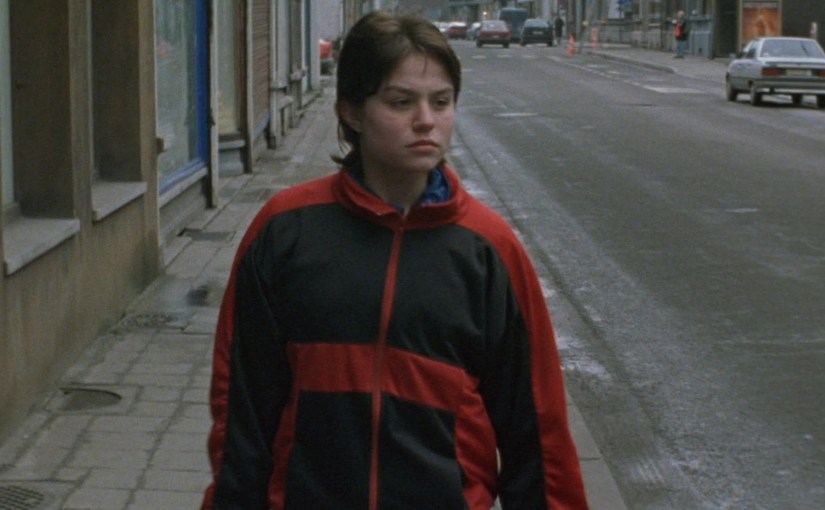
The determining factor is the camerawork, at least at first. We immediately follow this young girl, Rosetta (a gutsy, award-winning performance by Émilie Dequenne), maybe 16 or 17 years old, who is walking briskly through a factory floor, though we’re not sure why at first. As she walks, the camera follows her, hand-held, unsteady, very queasy-cam, but it lends a sense of immediacy to the shot. The camera is almost running just to keep up with Rosetta, and I was instantly curious. Where is she going? Why is she walking so fast? Is she about to punch someone out?

But no, she’s about to be fired for being late, and when her boss intercepts her, she refuses to go quietly, to a point where security has to be called and chases her through the entire building. Why so desperate? Aren’t there other jobs to be had for someone her age out there?

Apparently not. This will be a theme throughout the film: her constant hustle to get a paying job. At one point, someone offers to hire her and pay her under the table, but she refuses: “I want a real job.”

Wherever she goes, the handheld camera follows right behind her, like a paparazzo who won’t give up. We only get a handful of long shots, like when she crosses a busy street after getting off a bus. Virtually every other shot is right behind her or right next to her. The effect creates the idea that Rosetta’s life is composed mostly of sleep and hustling to make that next dollar, or franc. In between, she maintains her trailer home with her alcoholic mother, a woman who is so pitifully down the road of addiction that she demeans herself with the landlord of their trailer park to pay for their water, just so she can keep the money to pay for more liquor. Rosetta ruthlessly tries to keep her mother in check, constantly berating her for her behavior, their familial positions clearly reversed.

Rosetta is not a happy film. How can it be? It simply follows this girl’s life from one crisis to another. But I was totally engrossed in a way that reminded me, for some reason, of another movie, Noah Baumbach’s The Squid and the Whale, which was also shot and filmed in such a way that the actors (most of them recognizable and famous) didn’t feel like actors, and as such felt more real than many other films.

So…what is the takeaway from this movie? Is Rosetta a good person? She has noble intentions, I believe, but she is forced to be strong and calculating as a way of keeping her and her mother afloat. At one point, she meets a young man, might even like him, but at one point, on the shore of a small lake, he falls in and appears to be drowning…and Rosetta takes an awfully long time to decide whether to help him or not. After all, if he dies…she might be able to take his place at work.

I just watched a video essay on Netflix about how it’s not always necessary for you to like a character in a movie in order for it to be enjoyable. Overall, I’d agree with that assessment, especially with Rosetta (though What About Bob? is the CLEAR exception). This film was both dazzling and simple, a neat trick, involving a character I didn’t always agree with, but who I believed made the only choices she could make in her situation. I found myself asking what I would do in her place. Left to fend for myself with no steady job and an alcoholic parent, how would I fare in this world? How would you? Rosetta answers that question in a way that makes sense for the lead character. Her answers may differ from yours. Discuss.

LOOK WHO’S BACK (2015, Germany)

by Miguel E. Rodriguez

Director: David Wnendt
Cast: Oliver Masucci, Fabian Busch, Christoph Maria Herbst
My Rating: 10/10
Rotten Tomatometer: No score [never released in the U.S.]

PLOT: Without a single word of explanation, Adolf Hitler materializes in modern-day Berlin and, thanks to an unscrupulous TV station, begins to once again take the world by storm.


In the comedy documentary The Aristocrats, scores of comedians tell different versions of the same hilariously dirty joke.  In one scene, the staff of the parody website The Onion gets together in a room and tries to construct the perfect Aristocrats joke by combining every known shocking and taboo subject into their version.  Nothing is off the table: religion, politics, graphic sexual acts, nothing.  We never hear their version of the joke, but their discussion is hilarious by itself.  Look Who’s Talking, a shocking comedy from Germany, feels like someone took all the notes from that meeting, pulled out all the Hitler material, and put it all in this one movie.

…this has happened to me before.  I started a review of this movie earlier this week and abandoned it after I realized I had written over 1,500 words of mostly summaries of the action and plot.

I think the reason is because the plot and the comedy in Look Who’s Back are so outrageous and shocking that I felt I HAD to give context to my reactions.  And the only way to do that was to summarize this scene and that scene and the next.

I simply am unable to put my feelings about this movie into words, at least none that would do justice to this stunning, effective, supremely disturbing satire.

The story: For reasons that are never explained, Adolf Hitler materializes in modern-day Berlin…well, Berlin in October, 2014.  After some initial confusion, he marches to the Brandenburg Gate and tries to get some answers from the crowds of people regarding his situation.  No one will answer his questions…but a bunch of people take a second for a quick selfie with this crackpot in a Hitler costume.

At first, Hitler concerns himself with short-term goals.  After befriending a newsstand vendor, he is informed that he smells.  He needs to get his uniform laundered.  And if you don’t think the sight of Adolf Hitler trying to communicate with a laundromat clerk, who doesn’t speak German very well, about when he can pick up his dry cleaning is hysterical, this movie may not be for you.

The story expands.  A TV producer on the skids at work discovers Hitler at the newsstand and convinces his bosses to allow him to take Hitler on a road trip across Germany.  (They’re convinced because a short video of him railing against German politics has gotten a TON of views on social media.)  Then he lands a spot on a live TV show, and things REALLY start to snowball.  He writes a book.  The book is optioned for a movie.  And so on.

I assure you, this is just the bare bones of the story.  I haven’t even gotten into the innumerable scenes that made me laugh like a hyena on acid.  But I can’t describe those scenes in detail, because I don’t want to get banned from the internet.

Here is a list of the scenes that struck me as the funniest or the most disturbing.  Usually both at the same time.

  • The dog.
  • The discussion about rap music.
  • The “hand puppet.”
  • Hitler drawing sketches (badly) in a public square to earn some money.
  • The TV host in blackface.
  • The scene at the soccer stadium.
  • When Hitler visits a pro-Nazi demonstration.
  • When Hitler compares the TV network manager to Leni Reifenstahl

…and on and on and on.

The true horror/comedy of the movie comes when you realize that, for the VAST majority of scenes where Hitler interacts with people on the street, those are real people having real reactions, not actors. The things that come out of the mouths of some of these people is beyond belief. One guy tells Hitler point blank that he had the right idea about concentration camps. A shop vendor says he had the right ideas about how to run the country economically, and she’d support him if he ran for office. All on camera.

There are other genuine laughs, to be sure. The sequence where Hitler discovers the internet for the first time is worth the rental/streaming fee. But by the time the movie is over, I was left with a distinct feeling of unease. The movie depicted the sinister way in which someone with extreme views can manipulate popular opinion and catapult themselves into a position of power. And it’s not so hard to imagine what it must have been like in the 1930s when Hitler did it all the first time.

The film closes with Hitler being driven down a public street in a convertible, saluting random people as they go by. Most people are shocked. A lot of them flip Hitler the bird. But there are some who give the Nazi salute as he drives by. Are they joking?

This is one of the most effective, provocative satires ever made, and it was never released in the U.S. due to the controversial nature of some of its funniest scenes. If you can stream this somewhere, you won’t regret it. Then ask yourself: could it happen this easily today? This movie provides its own answer. Compare and discuss.

THE ARTIST (2011, France)

by Miguel E. Rodriguez

Director: Michel Hazanavicius
Cast: Jean Dujardin, Bérénice Bejo, John Goodman, James Cromwell, Penelope Ann Miller, Missi Pyle, Malcolm McDowell
My Rating: 10/10
Rotten Tomatometer: 95% Certified Fresh

PLOT: A hugely popular silent film idol must adjust to culture shock when “talkies” suddenly invade the movie business.


Is there a movie more in love with the First Golden Age of Hollywood than The Artist?  I can’t think of one.  Sunset Blvd. comes close, but that was a caustic commentary on the heartless tendencies of studio executives to reject the Old and embrace the New.  The Artist covers the same ground, but in a much more comic fashion.

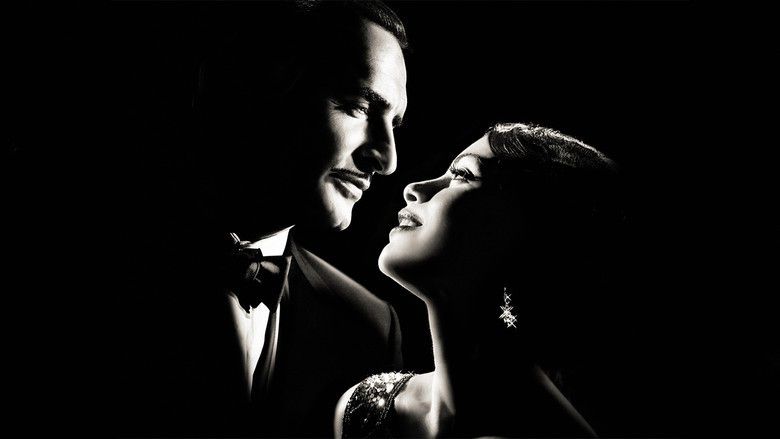
Not to say The Artist pulls its punches.  Not at all.  It tells the story of a silent film idol, George Valentin (Jean Dujardin), who has a meet-cute with a fan, Peppy (the stunning Bérénice Bejo), outside of a movie theatre.  Long story short, she becomes a bit player in numerous silent films and eventually becomes a superstar when the talkies take over Hollywood.  And George?  He struggles, as so many other silent actors did, to acclimate himself to a brave new world where faces and title cards aren’t enough anymore for an audience who is always looking for something new.

And, oh, yeah, did I mention The Artist is itself a silent film?  Shot in black and white?  Filmed in the old 1:33 aspect ratio?  Yeah.  It’s actually pretty cool.  It takes a little while to get used to seeing modern actors moving their mouths and not hearing their voices, but after a while, my brain acclimated itself to this “new” way of watching a movie.

As I was saying, The Artist doesn’t pull its punches in exposing Hollywood’s appetite for the New (in ways I don’t want to give away here), but it is still far more whimsical and audience-friendly than Sunset Blvd.  I’d compare it more to Singin’ in the Rain, if I had to compare it to anything at all.  But The Artist is a singular achievement, and well worth the Best Picture Academy Award for 2011.

There are two scenes in particular that elevate The Artist. In one, Peppy, who has always adored George from afar, finds herself alone in his dressing room.  She spots one of his jackets hanging on a coat rack and embraces it, imagining his arms inside it.  She then slips one of her own arms into the jacket, and voila!  She has a brief love scene where it really feels like she’s interacting with another person’s arm.  It’s a little hard to describe, but the effect is magical.

The second scene is one of my favorite scenes of all time.  George has just gone to see one of Peppy’s new films, a talkie.  The audience loves it, but he is still resistant to the idea.  He retreats to his dressing room, but something bizarre happens.  Remember, up until now, the movie has been completely silent (except for a musical score).  But this time, when he puts a glass down on a table…it clinks.  He stares.  What the heck was that???  He does it again.  Clink!  What’s going on???  He picks up a comb and drops it.  Thunk!  What the hey?!!  He opens his mouth to yell…but nothing comes out!

It’s a wonderfully comic moment, and a perfect way to demonstrate George’s anxiety at what this new technology will mean for him.

The more I think about The Artist, the more I’m realizing that the only way to properly discuss it is to go almost scene by scene, and I certainly don’t want to go down that road, especially for anyone who may not have seen it.  I mean, there’s the dog, George’s butler, the release date for one of his movies (October 24th, 1929, oh dear), the auction, the fire, and the deliriously happy ending, the kind of ending that tends to only exist in movies.

That’s really all The Artist is.  It’s an efficient engine designed to pull at our heartstrings and deliver a feel-good ending after teasing us with darker possibilities here and there.  The fact that it’s black-and-white and silent is a bonus, especially for film buffs.  It may not be realistic, but when it comes to Hollywood’s Golden Age…I mean, who really cared about realism back then?  (Back then, they didn’t need words, they had faces.)

INCENDIES (2010, Canada)

by Miguel E. Rodriguez

Director: Denis Villeneuve
Cast: Mélissa Désormeaux-Poulin, Lubna Azabal, Maxim Gaudette
My Rating: 10/10
Rotten Tomatometer: 93% Certified Fresh

PLOT: Twins living in French Canada journey to the Middle East to fulfill their mother’s last wishes by discovering their family history.


A few years before French-Canadian director Denis Villeneuve made a big splash in American cinema with Sicario, Arrival, and Blade Runner 2049, he directed Incendies [French for “flames” or “fires”…I had to look it up].   This is one of the best films I’ve ever seen.  It’s a mystery, a melodrama, and an urgent plea for peace, all at once.  It’s heartbreaking, engaging, absorbing, and beautiful to look at.  There are two directors currently working who I believe have successfully picked up the mantle left behind by Stanley Kubrick.  Denis Villeneuve is one of them.

(The other is Alejandro G. Iñárritu [Babel, The Revenant], but let’s not get sidetracked…)

A mother dies.  At the reading of her will, her twin son and daughter receive a mission: go to the Middle East and track down their previously unknown father and brother, and give them letters in sealed envelopes.  Only then will the mother allow a headstone to be erected on her gravesite.

The brother, Simon, is skeptical, owing to the mother’s strange behavior in her later years, but the daughter, Jeanne, dutifully follows her mother’s wishes and travels to an unnamed country in the Middle East and begins the laborious process of tracking down anyone who knew her mother and father.

We also get flashbacks of the mother, Nawal, in her younger years, paralleling the daughter’s search.  We learn that Nawal, a Christian, fell in love with a Muslim, Wahab, which is a BIG no-no, to say the least.  Soon, Wahab is out of the picture, and Nawal gives birth to a son who is immediately taken from her arms and delivered to an orphanage.

So far, this is standard soap opera material, but it’s depicted with gorgeous cinematography and spot-on direction.  Director Villeneuve uses a lot of wide shots that have a stark beauty; they reminded me of some of the memorable vistas from Bonnie and Clyde and The Deer Hunter.

When Nawal gets a little older, she decides to track down her son.  This is made difficult owing to the state of war that now exists between Muslims and Christian Nationalists.  Attacks and reprisals make it nearly impossible to find accurate records.  She travels alone from one burned-out orphanage to another looking for clues.  At a key moment, she flags down a bus, but is very careful to first hide her crucifix necklace and put on a head-covering.  Can’t be too careful.

At this point, regrettably, I have to abandon summarizing the story, because the less you know about what happens after Nawal gets on that bus, the more effective those events will be.  Suffice to say it’s a life-changing event, one that sends her on a wildly careening path from activist to assassin to political prisoner.

All of this, naturally, comes as a shock to her children, Jeanne and Simon, who are starting to think this search for missing family members may be a mistake.  At one point, someone makes an important statement: “Sometimes, it’s better not to know some things.”

So…what is this movie really about?  It’s not just about the mystery of the missing family members, which is enough of an engine to make a compelling movie on its own, especially when it’s intertwined with the mother’s past.  But there is a deeper, much more profound level to Incendies that is not apparent until the movie’s final sections, when the threads of Nawal’s past converge in a moment of shattering revelations.  The movie beautifully hides its real motives along the way so you get blindsided by its true message, its true heart.

I dunno, maybe I’m getting too mushy.  But that’s the effect this movie had on me.  I’ve only experienced this kind of emotional catharsis after a precious few films.  It’s impossible to fully describe it without giving away the secrets lying at the heart of Incendies.

ROMA (2018)

By Miguel E. Rodriguez

Director: Alfonso Cuarón
Cast: Yalitizia Aparicio, Marina de Tavira, Diego Cortina Autrey
My Rating: 10/10
Rotten Tomatometer: 96% Certified Fresh

PLOT: A year in the life of a middle-class family and their maid in Mexico City in the early 1970s.


The closing credits of Alfonso Cuarón’s intensely personal, emotionally powerful Roma state unequivocally (in Spanish) that the entire movie was shot on 65mm film.  This is an important choice with a movie that communicates its emotional beats with strong, crisp visuals that don’t feel like a traditional movie.  To me, Roma feels like looking through an old, well-preserved photo album of a family I don’t know.  But the closer I look at the pictures, the more I can intuit how their lives are no less important or vital than my own.

More than most films, Roma exemplifies one of Roger Ebert’s core beliefs about film.  He said that movies “are like a machine that generates empathy. It lets you understand a little bit more about different hopes, aspirations, dreams and fears. It helps us to identify with the people who are sharing this journey with us.”

That’s how I felt watching Roma.  I never really felt like I was watching a film.  Director Cuarón (who served as his own cinematographer) uses his camera and shrewd editing to create the idea that I was looking at a fondly remembered memory instead of a traditional, plot-furthering movie sequence.  I didn’t grow up in Mexico or have a maid, but within just a few seconds of the opening scene – hell, during the opening CREDITS – I was sucked into the world of the film.

Another important element of this movie’s success is the exquisite sound design.  Over the opening credits, we see nothing except a close-up of some sort of tiled surface.  Soapy water spills over it a couple of times. We hear a mixture of street sounds, but not a busy street.  At one point a jet airliner flies far overhead, visible in the sky as reflected in a puddle of water. We can hear birds, and people talking and shouting in the distance, and a street vendor, and the occasional dog barking, and…it succeeds in placing you firmly in the world of the movie. It all feels completely organic, not engineered.

I’ve just realized I haven’t said a word about the plot.  The story, in itself, is nothing extraordinary.  We follow several months in the lives of a middle-class family in Mexico from 1970 to 1971.  They have a maid, Cleo, who discharges her duties with efficiency, who is beloved by the family children, who has a life of her own outside of her employer’s household.  Through various personal upheavals, both in her own life and the life of the family she works for, they all grow incredibly close.  …and I can almost hear your eyes glazing over as you read those words.

But, as is the case with every other film, what’s important is not WHAT this movie’s about, it’s about HOW it tells the story.  And Roma, if nothing else, solidifies Alfonso Cuarón’s standing as one of the great modern masters of cinematic storytelling.  In his hands, this humdrum story of middle-class life becomes a hymn to nostalgia. There’s a brief scene of everyone gathered around a television set, watching a variety show.  The sight of their smiling faces, illuminated by the screen, triggered a memory of my own family sitting around the TV back in ancient history, before VCRs and even cellphones(!), and watching the ABC Movie of the Week, like The Towering Inferno or Grey Lady Down.  It’s rare for a film to affect me like that.

I have to tread carefully here, because I want to mention a key event that occurs in the latter half of the film.  It’s immensely harrowing, all shot in one take (indeed, IMDb tells me it was shot only ONCE and not repeated).  In any other movie, I would say that it’s the kind of thing a screenwriter would throw in as a shamelessly manipulative plot twist, designed solely to elicit unearned emotions from the audience.  In Roma, however, the movie has so thoroughly worked its magic that the event, when it happens, is not shameless, but shocking and heartbreaking.  I was not watching an actor or actress.  I reacted as if I was watching a home movie of a real person going through a traumatic event, and it was devastating.  THAT’S the kind of rare cinematic event that I live for.

Roma is a black-and-white film shot in Spanish, with English subtitles, and which leans heavily on visual storytelling.  This may not be your cup of tea.  But if you like film at all, if you like the kind of movie where you can drink in the visuals like you were at a museum where the pictures breathed and lived and loved, then you owe it to yourself to see Roma as soon as possible.

INGLOURIOUS BASTERDS

By Marc S. Sanders

If you are going to rewrite history then go crazy.  Go big and bloody.  Go for broke.  Don’t hold back.  Quentin Tarantino didn’t hold back when he penned and directed Inglourious Basterds, my personal favorite of his films.

To date of when this review is published, Tarantino has directed nine films and if ever the maturity of a director is so evident, it really shows with Basterds where three quarters of the picture is performed in either French or German.  English is secondary here, and Italian is limited to only a couple of “Bonjournos!”  and “Gorlamis!”

Tarantino presents early 1940s France when Germany occupied most of the country and practically rounded up all of the Jews.  In 1941, a cunning detective of a Nazi Colonel, Hans Landa (Christoph Waltz performing as one of the greatest villains of all time) visits a French dairy farmer to ensure there are no unaccounted-for Jews scurrying around; scurrying around like their beastly equivalent, the rat.  Landa is the hawk that will most assuredly find them.  This scene is the best written moment within Tarantino’s catalog of various scripts and dialogue exchanges.  The Landa character offers justification as to why a Jew needs to be exterminated to the point that he nearly had me (a conservative practicing Jewish man) believing in his hateful philosophy.  The lines crackle here with Waltz doing most of the talking while the sad dairy farmer can do no more than respond with certifying Landa’s interesting points.  Tarantino closes the peaceful discussion with horrifying violence though.  Hans Landa may be complimentary of a farmer’s milk and his three beautiful daughters.  He may be eloquent in his dialogue albeit French, German or English, but he is a ruthless enforcer of law …of Nazi law at least.  I also would like to note Tarantino’s tactful way of using props like the pipes the characters smoke, the glass of milk that is consumed by Landa and the ink pen and spreadsheet he uses for accounting of the Jews in the area.  There’s an uncomfortable intimidation in all of these items as they are handled by Waltz, the actor.  Later in the film, Waltz will send a chill down your spine as he happily enjoys a delicious strudel with whipped cream.  Inglourious Basterds is a great combination of directing, editing, cinematography and acting.

The film diverts into a few separate stories, namely the title characters led by Aldo “The Apache” Raines, played with Tennessee redneck glee by Brad Pitt.  The Basterds consist of mostly Jewish American soldiers tasked with going deep into enemy territory and literally killing and scalping one hundred Nazi soldiers, each.  However, keep at least one alive during each encounter with a carved souvenir on their forehead, to spread the word of the Basterds intent.  This is deliberate B movie Dirty Dozen material and it works because it doesn’t take itself seriously.  Tarantino maintains that pulpy fiction narrative.  A cut to an over-the-top crybaby Adolph Hitler asks, “What is a Hugo Stiglitz?” and then we get a quick pause with big black block letters across the screen spelling out HUGO STIGLITZ.  This guy is a bad ass; a German turncoat who only wants to kill fellow German Nazis.  He’ll shoot them up until they are dead three times over.  He’ll stab them in the face twenty times through a pillow.  He’s not a suave killer.  He likes it violent and bloody messy.  The Basterds are fans.

The heroine of the film is Shoshanna (Melanie Laurent), a Jewish girl who is living undercover as a cinema owner in France.  By implied force she is tasked with presenting Himmler’s proud film of Nazi Germany’s finest war hero, Fredrick Zoller (Daniel Bruhl), recreating his bird’s nest three day sniper battle against an army of three hundred men.  This is where Tarantino does best at writing what he knows, and what he knows best is anything about cinematic film.  He literally uses his knowledge of film and film reels to bridge his story while setting Shoshanna on a mission to actually end World War II in one swift motion.   

In addition, he captures the adoration of film lovers and celebrity status.  Zoller is as heroic a celebrity as John Wayne or Zorro.  When he is recognized in the coffee houses or on the street, he humbly stops his ongoing flirtation with an uninterested Shoshanna, to give an autograph or pose for a picture.

Furthermore, Tarantino applies the scientific knowledge of how 35mm film is more flammable than paper as well as how to edit a film reel to an unexpected moment for Shoshanna’s Nazi audience.  He knows the architecture of a European cinema with its lobby and balconies and seating capacities.  He allows his characters to speak on an intellectual level by discussing great film artists of the time – filmmakers not as well-known as Chaplin here in the United States, but just as great or even artistically better. The art direction of the cinema both inside and out is adorned with washed out, distressed classic noir films.  Shoshanna changes out the lettering of the curved marquee top of the theater as well.  It might sound mundane, but to me it’s all atmospheric.

Beyond the subject of cinematic art, a bad guy will weed out a spy disguised in Nazi garb by recognizing how he signals for three drinks with his hand.  There’s a right way and a wrong way to place an order with a bartender.  Inglourious Basterds may be a fictional historical piece, but it also will give you an education. All of this reminds me that Quentin Tarantino has graduated from the simplicity of Reservoir Dogs to something bigger and grander and glossier.  Production money with a large budget will lend to that status of course, but Tarantino still had to learn to truly know what he was doing.

I will not spoil the ending here.  It’s a bloody blast for sure.  Moreover, it’s shocking.  If anything, Inglourious Basterds introduces an exclusive universe that resides in the mind of Quentin Tarantino where the textbook is thrown away, burned, riddled with bullets and blown up; it is where something else altogether happened, and you know what? I really wish it did actually happen this way.

ROMA

By Marc S. Sanders

Alfonso Cuaron’s new film, Roma, is a masterpiece in cinematography, sound, and empathetic storytelling. Shot in beautiful, multi-dimensional black & white, it tells the story of a house servant named Cleo who tends to a family living in the city section known as Roma during the year 1970 in Mexico.

Cleo is portrayed beautifully with quiet reservation by Yalitza Aparicio. I imagine this actress is not well known to mainstream audiences. Perhaps she is not well known to Mexican or Hispanic audiences as well. However, it would be so refreshing if the positive response of this film opens up opportunities for her within more widely known fare, much like Precious did for Gabourey Sidibe.

Cleo seems content to cater to the family that contains four young children and their mother. The father appears stern in his mannerisms until one day he leaves for a conference taking place in Quebec. However, allusions to this conference indicate a different story when his absence lingers on longer than expected. During this year, Cleo gets pregnant by Fermin, the cousin of a friend. Fermin leaves Cleo to deal with the pregnancy on her own, and in the moments when he returns to the story, it is not promising that he will commit to fatherhood.

Cuaron writes and directs a relatively simple story amid turmoil in a very confused country that centers on riots among the young citizens and men who are not noble enough to dedicate themselves to the women that cross their lives. Family is not convenient either. When a conclusion dawns upon Cleo near the end of the film, you can’t help but understand her position. What she has seen is gut wrenching.

To further compliment this work is to appreciate the visual sense and sound of the film. This is not a sci fi special effects extravaganza like Cuaron has accomplished with his Oscar winning Gravity, or the dystopian action depicted in his under appreciated Children Of Men (masterful steady cam work in that film, especially). Cuaron takes advantage of a crowded bustling lower middle class city with an overpopulation of dogs, planes flying overhead, music, and crowded streets of different happenings. I watched this film with my new 7 point sound system and this film is perfect proof that I made a smart purchase. Cuaron hooks your senses to engage you in his setting. Therefore, the setting justifiably serves the title of the film.

The photography is sensational as well. Cuaron hardly does a close up on any of the characters. Rather, he opts to go deeper to show there’s more going on in any one given moment than just what is in front of you. The first example of this is during the opening credits that are displayed over the course of several minutes on a tile paved driveway. First you are just looking at tiles. Then you are looking at Cleo’s soapy mop water splash across the tiles. Now you have a reflection of the sky above and you get a sense of how high the sky goes as a passenger jet plane casually flies overhead. Dimension is gradually introduced and the theme of Cuaron’s filmmaking continues on during the course of the picture.

Later, at a pivotal point in the film, when Cleo delivers her child (I don’t think that’s a spoiler), Cuaron puts the silhouetted profile of Cleo close to his lens and then to the right deeper into the room you watch as the hospital staff tend to the newborn; seeing the baby, seeing the towels held by the staff, watching the staff tend to the baby. Cleo is separated from the activity but she remains in the room, exhausted and discombobulated from what she has just experienced. A moment like this, I would imagine, would be good material for film students to examine. Cuaron proves that what you show in a moment can be limitless in the scope of a lens. Nothing is impossible.

Because the film is in black & white, the activity of the hospital staff never appears to upstage or overshadow the experience that Cleo is enduring. Had this been in color, a viewer could have been distracted by the blood and the sweat and lighting in the hospital room. It’s all there. It’s just not as distracting as a colorized moment might have suggested. Cuaron’s choice of black and white permits you to focus on everything. So, a scene like this is so wisely conceived.

Roma will likely be selected as a nominee for Best Picture and Director. It deserves it, much more so than many other films I saw in what I consider 2018 to be a weak year for inventive filmmaking. I highly recommend this film. If you don’t have a good sound system or a high definition TV to watch it currently on Netflix, then find it at a local cinema. To immerse yourself in this film, requires the best in sound and visual quality.

I will admit that it takes some getting used to reading the subtitles translating both Spanish and Mexican, and Cuaron takes his time setting up his story. You have to be patient with the film. However, I watched the film on Saturday, December 28, 2018 and I still can’t stop thinking about it.

Please check out Alfonso Cuaron’s beautiful film, Roma. I think you’ll be glad you did.