MEPHISTO (Hungary, 1981)

by Miguel E. Rodriguez

DIRECTOR: István Szabó
CAST: Klaus Maria Brandauer, Rolf Hoppe, György Cserhalmi, Karin Boyd
MY RATING: 9/10
ROTTEN TOMATOMETER: 80% Fresh

PLOT: In early-1930s Germany, a passionate, prominent stage actor must choose between an alliance with the emerging Nazi party or a life of obscurity in exile.

[Author’s note: this is another in a series of movies I’ve watched lately whose subject matters have intimidated me.  There are topics at play in Mephisto that are beyond my ability to analyze in coherent prose.  I must advise you, this is a BRILLIANT film, even if my review below does not convey that fact…]


Watching Mephisto reminded me of the early days of Covid-19.  As the infection spread and restaurants and other businesses voluntarily closed their doors, I was still naively hopeful that it would all just go away.  A friend asked me, “When will you take this seriously?”  I blithely said, “When all the McDonald’s restaurants close, that’s when I’ll know there’s a problem.”  Not long afterwards, that’s exactly what happened.  Then I was indefinitely “furloughed” from my job, and soon after that, the government shutdown occurred.  In hindsight, I was foolish.  The signs were all there.  Had I paid more attention, I might have been better prepared for the stressful days that followed.

This situation is echoed in director István Szabó’s Mephisto, the first Hungarian film to win the Academy Award for Best Foreign Film.  Mephisto tells the story of a popular actor in 1930s Germany, shortly before and after Hitler rose to power.  Hendrik Höfgen (Klaus Maria Brandauer) is a hot-headed, passionate stage actor who throws himself into his performances with abandon.  We watch him evolve from an actor/director to the leading force behind a “revolutionary” theater company that exhorts its audience to acknowledge the plight of the everyman in their society.  He marries (for money more than anything else), but keeps a mistress on the side, a black German woman named Juliette Martens (Karin Boyd) who doubles as his private dance instructor.  He rails at his wife for riding horses before breakfast – the ultimate in bourgeois behavior – but engages in frantic frolicking with his mistress between dance lessons.

Brandauer plays Hendrik as a man who only feels like himself when he’s pretending to be someone else.  Onstage or when directing his cast, he’s filled with boundless energy, dancing with the chorus line or leaping across the stage with abandon.  Offstage, he is quiet and self-effacing, unless he’s socializing with other cast members.  Mention is made several times of his “limp” handshake, a direct contradiction to the strong characters he portrays, especially his most famous role: Mephistopheles in Faust, a role that brings him even more fame and prominence within the theater community.  The imagery of Hendrik is striking: He covers his face in white makeup like a kabuki player with sharply angled black eyebrows and red lips, the ultimate in being able to disappear inside a character.

But something is happening in the background that Hendrik is reluctant to acknowledge.  A fellow cast member almost gets into a fistfight with him when he criticizes another actress because of her associations with a member of the Nazi party.  His wife warns him about the dangers presented by this man who was just elected Chancellor.  [Interestingly, the name of Adolf Hitler is never once mentioned onscreen.]  She tells Hendrik that many of his friends are leaving Germany, fearing for their livelihoods, if not their lives.  But Hendrik refuses to panic:

“There is still the opposition, no?  They’ll make sure he doesn’t get too big for his boots.  And even if the Nazis stay in power, why should it concern me? … On top of that, I’m an actor, no?  I go to the theater, play my parts, then go back home.  That’s all. … I’m an actor.  You can design sets anywhere or buy antiques.  But I need the German language!  I need the motherland, don’t you see?”

Hendrik is so wrapped up in his profession that he simply cannot accept the fact that his freedoms are about to come crashing down around him.  He would rather formulate a far-fetched scenario based on nothing but hope so he can just stay where he is and keep performing.

(I have to be honest: when we took our first steps out of the Covid lockdown, I felt the same way.  Local theaters announced auditions for shows again, and I assured myself and my girlfriend that I would take the utmost precautions and wear masks at rehearsals and disinfect and wash my hands and I wouldn’t get sick.  And, of course, I eventually got sick.  I recovered, but you can probably imagine my disbelief when I tested positive that first time.  “ME?  But I was so careful!”)

Hendrik stays in Germany.  His wife moves to Paris.  Fellow actors either disappear outright or are arrested by the Gestapo in full view.  Hendrik accepts an offer to direct the official state theater, despite his past affiliations with liberal/Bolshevik causes, because of his prestige in the theater world.  A character known only as the General (probably intended to be Hermann Göring) gives him his marching orders as theater director.  He witnesses several Nazis beating a man on the street and walks in the other direction…best not to get involved.

So, what we have here is an actor willing to trade away his soul and his conscience in exchange for the opportunity to remain in the limelight, performing as Mephisto or Hamlet.  The metaphor is not exactly subtle, but director Szabó manages to land the message in such a way that it never feels like preaching.  It’s a masterpiece of storytelling that lands somewhere between satire and Kafka.

An especially telling scene has Hendrik explaining to an attentive crowd of Nazi journalists that his production of Hamlet will portray the lead character as “a hard man…an energetic, resolute hero”, rather than as a neurotic, “pathetic” revolutionary.  Hendrik tells them exactly what they want to hear so he can stay in the limelight.  He’s made his own deal with the devil.  I will not reveal whether Hendrik’s bill comes due during the film, but I will say the finale evokes the landmark documentaries of Leni Riefenstahl.  I’ll leave it at that.

As I said, watching the film reminded me of the Covid lockdown…but it also made me think about all those many, many times in the past that actors and other celebrities have been criticized for voicing their political opinions in public.  “Shut up and play/act!” is the usual cry.  Many people would prefer their favorite actors to behave more like Hendrik: just keep your head down and let everything blow over, don’t make waves, it’s not your place, etcetera, etcetera.  Mephisto argues that keeping silent in the face of injustice or tyranny is not an option, especially not for people in the spotlight.  Those who do so risk suffering Faust’s fate.  Or Hendrik’s, whose last words in the film are brilliantly contradictory.

INHERIT THE WIND (1960)

by Miguel E. Rodriguez

DIRECTOR: Stanley Kramer
CAST: Spencer Tracy, Fredric March, Gene Kelly, Dick York, Harry Morgan
MY RATING: 9/10
ROTTEN TOMATOMETER: 93% Fresh

PLOT: In 1925, two great lawyers argue the case for, and against, a Tennessee science teacher accused of the crime of teaching Darwin’s theory of evolution.  (Inspired by the real-life Scopes Monkey Trial.)


I have known about the movie version of Inherit the Wind for many years now, but it has taken me this long to get around to finally watching it.  One of the first shows I ever did in community theater was Inherit the Wind.  I played E.K. Hornbeck, probably one of the best-written characters I’ve ever performed.  I hesitated this long to watch the movie, or any of the other various TV/cable versions, because I feared it could never live up to the power of the stage play.  Boy, was I wrong.  Stanley Kramer’s film of the award-winning play is anchored by two of the greatest performances ever to grace the silver screen, courtesy of Spencer Tracy and Fredric March, both 2-time Oscar winners.

It’s 1925, and in the Bible-belt hamlet of Hillsboro, Tennessee, a young teacher, Bertram Cates, has been imprisoned.  His crime?  Teaching Darwin’s theories in high school.  In Hillsboro, you see, it’s against the law to teach anything but Biblical creationism in the classroom.  The arrest makes national headlines, most of them negative.  Example: “Heavenly Hillsboro: Does It Have a Hole in Its Head, or Its Head in a Hole?”  The despairing town fathers rejoice when they discover that the great Matthew Harrison Brady, lawyer extraordinaire and 3-time Presidential nominee, will volunteer to prosecute the case.  Brady is played by Fredric March with gusto, although I almost wish March had dialed it back JUST a touch every now and then.  He comes VERY close to becoming a parody of a character instead of a real person.

Covering the story in Hillsboro is E.K. Hornbeck (Gene Kelly!), a reporter from Baltimore.  Hornbeck is loosely based on the legendary newspaperman H.L. Mencken.  The screenplay reduces Hornbeck’s presence a tad as opposed to the stage play, but Kelly delivers the goods with all the appropriate flair and panache.

Hornbeck’s Baltimore paper uses its influence and checkbook to lure another skilled, big-city attorney to Hillsboro to defend Cates.  This is Henry Drummond, played by Spencer Tracy in arguably the best performance of his lengthy career.  Drummond is a shambling, good-natured fellow whose twinkling eyes disguise a sharp legal mind and a passion for the truth.  It’s a tribute to Tracy’s abilities that we get to see both sides of Drummond’s persona and there is never a sense of any disconnect between them.

After the first half-hour or so of exposition, the remaining bulk of the film takes place in the sweltering Hillsboro County Courthouse, as a jury is selected, witnesses are questioned, and both sides present their case to the judge (Harry Morgan).  In between court sessions, we get short scenes with Bertram Cates’s fiancé, Rachel, who just happens to be the daughter of the town’s religious leader, Reverend Brown (Claude Akins); a prayer meeting where Reverend Brown essentially damns his own daughter to hell; and pleasant interludes where Drummond and Brady sit on a front porch and reminisce how they used to be great friends, fighting for the same cause once upon a time.  But now Brady has combined his faith with his political ambitions, and Drummond dreams of a day when reason and science are not equated with heresy.

I won’t give you a play-by-play of the courtroom scenes here.  But if I were a film director, and I found myself directing a courtroom thriller, I would sit down and watch Inherit the Wind at least ten times before shooting a foot of film.  The scenes where Drummond and Brady butt heads and cross-examine and make objections are simply spellbinding.  I would be remiss if I didn’t mention the camerawork by the great Ernest Laszlo, moving around the courtroom and around each attorney, pushing in, tracking backwards.  I know great camerawork is supposed to become invisible while watching a film, but this was different.  Laszlo’s camera sometimes calls attention to itself, but it never, ever distracts from the story.

Of course, beautiful camerawork only works when it’s photographing something worthwhile, and Spencer Tracy and Fredric March do not disappoint as Drummond and Brady.  For nearly 90 minutes, they bicker, trade jabs, and put on a double-act of Hollywood professionalism and technique that would not be matched until the films of Newman and Redford.  Tracy is especially fascinating to watch.  It’s impossible to catch him acting.  There’s never a moment when he looks anything but authentic.  His speech patterns give the impression of a man whose mouth is just barely keeping up with his brain.  When he occasionally stumbles over a word, the odds are 50-50 whether it was a real slip up or if he just threw it in as a flourish.

If Tracy’s performance is a triumph of realism, or at least naturalism, Fredric March’s performance is one of the last great displays of old Hollywood, full of facial tics and vocal mannerisms and speechifying that would have made even Charles Foster Kane say, “Dude…dial it down.”  It’s still a powerhouse performance, but it’s a good thing Tracy didn’t try to match March.  Otherwise, the whole movie would have become a cartoon.  Because we have two such contrasting performances, the movie achieves a nice balance that makes time pass much more quickly than it might have with two other actors.

Regarding the TOPIC of the film…well, to be honest, if I started to write about all the things I felt while watching the film, about how so many people today, not just random folks, but people I know personally, would have felt right at home in 1925 Hillsboro, asking God to rain hellfire on the non-believers, chanting about hanging the accused teacher from a “sour apple tree”…I’d still be writing this review three days from now.

Besides, I believe the film makes its point much more eloquently than I ever could (especially when it comes to the discussion of how long that first day of Creation was, exactly).  One of my favorite lines from the movie comes when Brady accuses Drummond of attempting to destroy everyone’s belief in God and the Bible.  Drummond replies:

“That’s not true, and you know it.  The Bible is a book.  It’s a good book.  But it’s not the ONLY book.”

Inherit the Wind is not anti-Christian or anti-God or even anti-religion.  It is a plea for tolerance.  The fact that it was released over sixty years ago does not diminish the power of that message.  And even if it did not have that agenda, it would still be one of the most exciting, crackling courtroom dramas I’ve ever seen.

(Fun fact: A quick internet search reveals that, while all US states currently teach evolution, there are some that voluntarily pair it with creationism.)

STILL ALICE

By Marc S. Sanders

Still Alice is the observation of a woman whose mind gradually deteriorates from the symptoms of early onset Alzheimer’s disease.  Julianne Moore won an overdue slew of awards, particularly the Oscar, for the portrayal of the title character.  It’s a magnificently sensitive performance that will have you in tears following the first twenty minutes of the film.

Alice Howland is a revered Columbia professor of linguistics.  She has three grown children (Kristen Stewart, Kate Bosworth, Hunter Parrish) and John, her loving husband (Alec Baldwin).  The sad irony of Still Alice, adapted from Lisa Genova’s novel, is the fact that Alice specializes in teaching word origins and their formations, but she is stricken by the disease that will wipe her memory of the simplest vocabulary.  A highlighter becomes a “yellow thing.” 

The beginning of the film shows Alice functioning at her highest capacity following her fiftieth birthday.  She teaches her classes, does her daily jogs across campus, plays word games on her phone, travels across country delivering seminars and also tries to convince her youngest daughter, Lydia (Stewart) to abandon her dreams of becoming an actor and acquire a college degree.  Mixed in, however, are losses of train of thought, forgetting recipes, misplacing basic objects, forgetting appointments and getting lost during her jogs.  A quick glance over some visits with a neurologist (Stephen Kunken) set the wheels in motion of what we will witness Alice struggle with over the course of the film.  These doctor visits also teach the audience how one is examined for symptoms with simple memory tests and spelling questions. 

The film was directed by Richard Glatzer and Wash Westmoreland.  After I watched the movie, I learned that Glatzer could not speak while he was directing.  Due to his gradual deterioration from ALS, he had to resort to a computer monitor that would express his instructions to the cast and crew.  So now I’m that much more impressed.  To home in on the sensitivity of Still Alice, it only seems fitting that someone with Glatzer’s condition could co-direct this story. 

This is not a glamourous film.  Sometimes we may laugh at ourselves because we cannot think of a word or we forget a year or a name or we put our car keys in the refrigerator as soon as we come home and reach for a cold beverage.  However, when we see Alice discover that she puts a bottle of liquid soap in the fridge it says so much more.  Illnesses like Alzheimer’s and ALS strip people of the basics in living.  Having recently witnessed a friend slowly suffer and perish from ALS, I know that one disease brings you to this point with complete mental capacity while the other seems to tease you with how your mind gradually deteriorates.  Yet, like Richard Glatzer, my friend Joe did not stop functioning and co-wrote a play with me in his final year of life.  He couldn’t speak.  He couldn’t walk, but the man could write.

I have to credit the supporting cast behind Moore’s performance.  The film begins with the ease of conversations between the family members.  Before you know it, the exchange of dialogue shifts and becomes more one sided.  Julianne Moore most often shares scenes with Alec Baldwin and Kristen Stewart respectively.  She hides so well in her character’s mental incapacity that eventually, it looks like Alice Howland is not even applying the intelligence she’s collected and earned over her lifetime.  A scene in a yogurt shop towards the end of the film seems like Baldwin is the only one working.  He’s consuming his yogurt and reminding his wife of where she used to work while she sits beside him in an absolute haze of emptiness.  He simply says she is the smartest woman he’s ever known and by this point, I know exactly what he is talking about.  Moore is so heartbreaking in moments like this that I have to give credit to Alec Baldwin for maintaining his own performance against a scene partner who cannot offer much in return.

Alzheimer’s first affects the victim but also the family.  Still Alice allows time to explore the inconvenience of the illness.  There is the expected residual squabbling among the siblings.  Alice needs to be overlooked more and more as she gets sicker.  Who can be with her?  John still has to earn a living and has an opportunity for career advancement that he cannot afford to pass up.  A relocation is questioned because will it be okay for his wife.  Lydia is on the other side of the country trying to build her acting career.  Anna (Bosworth) is a pregnant, busy attorney, while Tom (Parrish) is in medical school. 

It’s also much more serious when the family learns that the gene Alice possesses has a one hundred percent chance of being passed down to the children.  This angle is touched upon for a brief moment, but then is hardly reflected as the film moves along.

Still Alice is a difficult film to stay with because it feels genuine in its account of living with Alzheimer’s.  Simple mistakes are just as heartbreaking as the big developments.  Leaving a potato in a purse is as hard to watch as seeing a mother speak to her daughter backstage, following a live acting performance. The daughter is now a stranger to the mother. 

Yes.  At times, the film feels like schmaltz you may find on the Lifetime channel, but then again you are seeing authentic, relatable performances from a cast who make up this family, especially the Oscar winner, Julianne Moore.  Alzheimer’s is an unfair and cruel disease that strips away everything a person builds for themselves in a lifetime.  Pardon the pun, but Still Alice makes sure you never forget that.

ELMER GANTRY (1960)

by Miguel E. Rodriguez

DIRECTOR: Richard Brooks
CAST: Burt Lancaster, Jean Simmons, Arthur Kennedy, Shirley Jones
MY RATING: 9/10
ROTTEN TOMATOMETER: 94% Fresh

PLOT: A fast-talking traveling salesman convinces a sincere evangelist that he can be an effective preacher for her cause.


Elmer Gantry pulls a double, then a triple-fake.  It’s a good thing they stopped at three because you can only subvert an audience’s expectations so many times before they hold it against you.  It starts as a tired (but well-executed) formula, then it turns that formula on its head, and then, just when you think you’ve gotten a stereotypical Hollywood ending, it pulls one more rabbit out of the hat.  In a way, it reminded of The Blue Angel (1930) in the way it presents a clearly hypocritical man to the audience, warts and all, and gets us to feel a little sympathy for him at the end, despite his wicked ways.

The film is also the most intelligent film I’ve seen about religion and Christianity since Robert Duvall’s The Apostle (1998).  It contains the best scene/exchange on the topic I’ve ever seen, between a fire-and-brimstone preacher and a non-believing newspaper reporter.  Both sides score points, but in the end, neither one wins, which I believe is just as it should be.  But I’m getting ahead of myself.

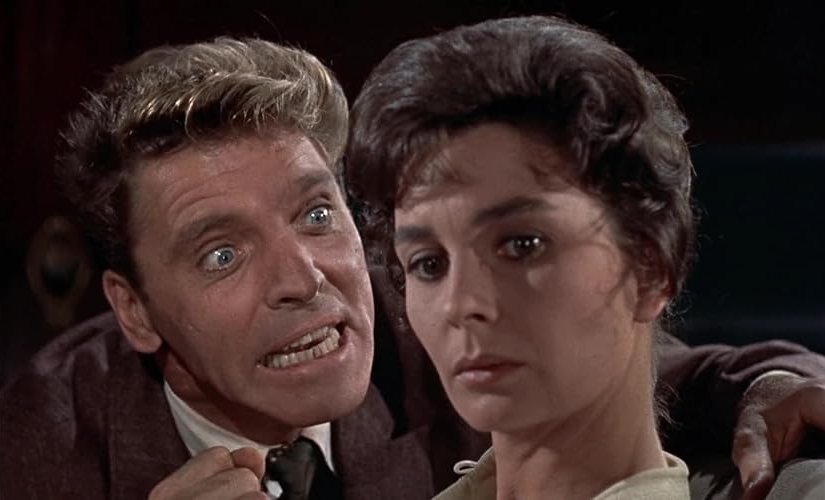
We first meet Elmer Gantry (Burt Lancaster) as he’s telling a dirty joke to some prospective clients in a bar, sometime during the Prohibition era.  The impression he gives right away is that of a huckster, a fast-talking, fast-thinking heel who’ll do whatever it takes to make a sale.  His conversation is interrupted by two nuns soliciting donations.  As a lark, he grabs their collection plate and exhorts the bar patrons to give all they can.  He’s pulling a cynical prank, but his words are surprisingly effective.  And no wonder: we later learn he was expelled from a theological seminary some years ago.  He knows the words, but not the music, but that’s enough for folks to turn out their pockets for him.  No one is more surprised by this outcome than Elmer himself.

Later, after visiting a Negro church service and hoboing around on a train, he visits a traveling revival led by Sister Sharon Falconer (Jean Simmons).  He is immediately smitten by her beauty – because, hello, it’s Jean Simmons – and realizes the only way to get to her is through her vocation.  With some of his trademark fast-talking, he flirts with one of Sister Sharon’s followers and uses what he learns to get closer to Sharon.  He agrees to deliver a mini-sermon at one of her very well-attended revival services to prove his good intentions, but something unexpected happens: the crowd responds to his words as if he were a bona-fide preacher.  Soon he’s touring with Sister Sharon from town to town as crowds get larger and larger.

Meanwhile, we get to see the inner workings of the business side of this religious venture.  We watch as various preachers and pastors debate the merits of inviting Sister Sharon and Gantry to a “big” city, Zenith.  (I learn from Wikipedia this city name is fictional, created by the author of the book on which the film is based…didn’t know that.)  Committee members are uncertain whether Sharon’s and Gantry’s message will increase church rolls in a metropolitan area as opposed to their previous, more rural locales.  I loved this scene because it feels authentic.  Whether it’s realistic or not is not for me to say.  But I can easily imagine well-intentioned religious leaders (and maybe some NOT so well-intentioned) sitting around and discussing, not just the spiritual expectations of such a revival, but also the FINANCIAL expectations, as these men do in the film.

Elmer Gantry is filled with scenes and dialogue that held my attention for the film’s duration.  Growing up as I did in a Christian church environment and graduating from a Christian college, I recognized virtually all of Elmer’s tactics, as well as Sister Sharon’s tactics, in using exactly the right words, gestures, and tone to play a congregation like a fiddle.  The difference is, Sister Sharon genuinely believes she’s been touched or called by God to this vocation, while Gantry is expertly going through the motions as a means to an end.

 (On a personal note, I should mention that Burt Lancaster’s mannerisms and speech patterns as Elmer Gantry strongly reminded me of the pastor of the Southern Baptist church I attended for many years, from his physical appearance to his, pardon the expression, shit-eating grin.  But that’s another story…)

There is one scene that I must specifically mention and dissect.  A Zenith newspaper reporter, Jim Lefferts (Arthur Kennedy), writes an article in which he expresses his skepticism of Gantry’s and Sister Sharon’s motives, as well as of revivals in general.  He writes:

“What qualifies someone to be a revivalist?  Nothing.  Nothing at all.  There is not one law in any state in the Union protecting the public from the hysterical onslaught of revivalists.  But the law does permit them to invest in tax-free property, and collect money, without accounting for how it is used.  What do you get for your money?  Can you get into heaven by contributing one buck or 50?  Can you get life eternal by shaking hands for Jesus with Elmer Gantry?”

(The Lefferts character is asking questions in this article that are as relevant now as they were in 1960, or 1920, or even going back to ancient times when Jesus whipped the moneylenders from the church.  To put it another way, as one dissenting church elder says in the film, “Religion is not a business.  And revivalism is not religion.”)

Sister Sharon and Gantry show up at the newspaper office to officially protest the article to Lefferts and his editor.  Sharon objects to the article’s implications about misusing collection money.  Lefferts calmly asks if Sister Sharon is ordained.  She is not, in fact, sanctioned to preach by any church body.  She points out that neither was Peter or Paul or any of the apostles.  Lefferts retorts:

“Ah, but they said that they lived with the Son of God, were taught by Him, were sanctified by Him.  What gives you the right to speak for God?  …How did you get His approval?  Did God speak to you personally?  Did He send you a letter?  Did you have a visitation from God?  A burning bush, perhaps?  Where in the New Testament does it say that God spoke to anyone except His Son?”

Then Lefferts quotes First Corinthians to show how the Bible says it’s shameful for women to speak aloud in church.  I’m watching that scene, and I’m going, BOOM, game, set, and match to Lefferts.  I remember asking these very same questions when I was younger and having normal doubts about the way church was structured.  Not about women speaking in church, I knew that was archaic and outdated, but I would always hear preachers and evangelists say, “God spoke to me.”  And I wanted to ask, “Well, what did His voice sound like?  Did He have an accent?  Did He speak English?”  But we weren’t SUPPOSED to ask those kinds of questions, we just had to take their word for it because, after all, they’re up there in the pulpit, and I’m down in the pews just listening.

But here’s where Elmer Gantry shows its colors as a film that may SEEM like it’s taking sides, but it really isn’t.  Lefferts finishes his takedown of Sister Sharon, but Elmer has a trick up his sleeve.  He turns Lefferts’s argument against itself by asking why he quoted the Bible if he doesn’t really believe the Bible is factual.  If Lefferts doesn’t believe in the six days of Creation or in the miracle of the loaves and fishes, then how can he use the scripture against Sister Sharon?  It’s a rather brilliant argument that almost feels lifted from Inherit the Wind (released the same year as Elmer Gantry.)

My admiration of this scene stems from the fact that both sides make excellent points, and the scene ends in a kind of stalemate where Lefferts won’t retract the article, but the newspaper offers to run a response to the article.  (Naturally, Gantry wheedles it up to a series of radio broadcasts instead.)  It would be tempting in a movie that is predominantly anti-religion to portray religious proponents as Bible-thumping, spittle-spraying zealots without a brain in their heads.  While Elmer certainly takes cues from that behavioral playbook, he is clearly not a moron, and that is refreshing.

Those who have seen the film before may note that I haven’t even touched on the one Oscar-winning performance from the film.  Shirley Jones plays a prostitute named Lulu Baines, and she has the film’s most unforgettable line as she recounts how a young man once took advantage of her behind a church pulpit one Christmas Eve: “He rammed the fear of God into me so fast I never heard my old man’s footsteps!”  What part she has to play in Elmer’s story, I will not reveal, just in case anyone’s reading this who’s never seen the movie.  She reveals unexpected depths and makes unexpected choices in the last couple of reels that seal both Elmer’s and Sister Sharon’s fates.

Whew!  This was another long one.  Elmer Gantry by its very nature engenders discussion and debate.  There’s even an opening title crawl advising patrons that, while the filmmakers believe that “certain aspects of Revivalism” demand further scrutiny, everyone is free to worship as they please, and patrons should prevent impressionable children from watching the movie.  Perhaps they were afraid children would believe that all religions and evangelists proceed from secular motives, which would lead to all kinds of uncomfortable conversations with their parents, churchgoing or otherwise.  In my opinion, those kinds of conversations can only benefit both the children and the parents.  I believe Elmer Gantry is one of the finest treatments of religious beliefs and activities I’ve ever seen, specifically because, by the time we get to the end credits, I’m still not 100% sure whose side the movie is on.  I think it’s up to us to look at the movie as a whole and make our own decisions.

THE BLUE ANGEL (Germany, 1930)

by Miguel E. Rodriguez

DIRECTOR: Josef von Sternberg
CAST: Emil Jannings, Marlene Dietrich, Kurt Gerron, Rosa Valetti
MY RATING: 10/10
ROTTEN TOMATOMETER: 96% Certified Fresh

PLOT: An elderly professor’s ordered life spins dangerously out of control when he falls for a nightclub singer.


There are so many things I admire about The Blue Angel that I hardly know where to begin.  The cinematography, the story, the acting, the unbearably tragic arc, the dichotomy of the main character, the debut performance of Marlene Dietrich…just ridiculously top notch all around.  The final 20 minutes or so of the film are so searingly tragic and raw that there were times when I wanted to look away, not out of disgust, but out of social embarrassment.  I’m fully aware of Emil Jannings’s Nazi sympathies, but love him or hate him, this is one of the greatest performances I’ve seen from any film of this period.

[Fair warning, I’m about to really run off at the mouth about this one, so make yourselves comfortable.]

Jannings plays Professor Immanuel Rath, a fussy, stuffy little man who teaches at a local school in Germany somewhere around 1924.  Director von Sternberg directs Rath’s introductory scenes almost as if he were using sound only reluctantly.  With a bare minimum of dialogue, we watch Rath’s morning process as he prepares his clothes just so, eats his breakfast just so, carries his books just so, and arrives at his classroom like Gandalf: never late, never early, but precisely when he means to.  His upper-high school students, all male, respect him just enough to stand at attention upon his arrival, but are rebellious enough to write graffiti on his notebooks, turning his name from “Rath” to the German word for “trash.”

One day, he discovers that several of his male students are in possession of scandalous little postcards picturing a sensuous burlesque performer whose lower regions are covered by a little tuft of actual feathers pasted onto the card.  Blow on the card just right, and her little feather skirt rises to reveal – well, nothing terribly scandalous by today’s standards, but certainly not family friendly in 1924.  Rath is incensed.  How dare these students profane their minds with such affronts to decency?  (We get a brief glimpse of his hypocrisy as he experiments with the feather skirt himself when no one is watching.)

Rath discovers that some of his students have been frequenting a burlesque house called The Blue Angel to see the girl on the postcard.  Her name is Lola Lola, portrayed by Marlene Dietrich in the role that made her a star.  It’s all here: the skimpy outfits, those long legs, the pouty face, sitting backwards on a chair, and the singing voice that eventually led to concert hall appearances in later years when her acting career waned.

Enraged by the thought of his students attending something as inappropriate as a burlesque show, Rath storms to the Blue Angel that very night to try to catch them red-handed.  All his wrath evaporates, though, when he spies Lola in the flesh while she performs.  From that moment, he is doomed.  He winds up in Lola’s dressing room where Lola, seasoned performer that she is, treats him as if he were a rich patron, showering him with compliments and, daringly, gifting him with a pair of her underpants.  Talk about chutzpah.

Predictably, Rath’s students see him at the Blue Angel, and his authority in his classroom starts to wane.  He returns there to give Lola’s underwear back, winds up in a box seat, and watches as she trills the song (in German) “Falling in Love Again.”  She sings directly to him.  He is smitten.  He drunkenly stays the night in her boudoir (nothing happens) and is late to school the next day.  At this point his authority over his students utterly vanishes, he announces his plans to propose to Lola, and his superior essentially fires him from his post.

It’s here where we get one of the first real masterstrokes in von Sternberg’s direction.  Rath carefully empties his desk drawer, fussy as always, picks up a few books, stands, and then slowly looks over the empty classroom.  As he stands, the camera slowly dollies back away from him, increasing our awareness of how large the empty room is, and putting a visual exclamation point on just how momentous his decision is.  He’s throwing away his vocation, everything he’s ever known, and perhaps there’s a moment during this camera move when he is thinking to himself, “What the hell am I doing?”  I’m not doing it justice verbally, but it’s a sensational moment, reminding me of the famous moment in Taxi Driver when Scorsese’s camera tactfully dollies off Travis Bickle during an embarrassing phone call.

The second half of the film involves Rath’s rash proposal to Lola, her improbable acceptance, and his slow inevitable decline.  Up to now, von Sternberg’s direction has been impeccable, using dialogue only when necessary, relying on Emil Jannings’s imposing presence and impressive non-verbal acting, and on Marlene Dietrich’s inimitable beauty and sensuality to underscore their scenes together.  Now, in the tragic second half, von Sternberg REALLY impresses.

Without going into too much detail (you deserve to be as wowed by this movie as I was), let me just list some moments that stood out to me, moments that felt as fresh and moving as any other movie I can think of.

THE WEDDING RECEPTION: At Rath and Lola’s reception, a magician conjures eggs from under Rath’s nose.  The kittenish Lola playfully clucks like a hen.  Rath, besotted beyond reason, smiles and crows like a rooster.  The sight of him making such a ridiculous noise filled me with unease, a reaction I am still unable to completely unpack.  Did I feel sorry for Rath?  Maybe, but why?  He has brought this on himself.  Lola isn’t to blame for his unseemly behavior, though it is all too easy to see how she could be seen as the “villain” of the film.  That is wrongheaded, in my opinion.  If there is a villain in the movie, a person who brings about every bad thing that happens to Rath, it’s Rath himself.

THE EDITING: At one point, Rath discovers that Lola still carries large numbers of those feathery postcards to sell at her performances.  He is adamant: “While I have a penny to my name, you will never sell another one of these postcards!”  Lola’s response is simple, but both wise and somehow chilling: “Well, bring them with us anyway…you never know.”  The camera fades out, and in the very next scene, Rath is sitting at a table, watching Lola perform, and as her song ends, he carefully gathers up the postcards before him and goes table to table, hawking them.  With one single edit, von Sternberg captures not only how wrong Rath was, but also how quickly he has fallen from a place of petty pride to a lowly peddler.  The effect was startling and disheartening at the same time.

THE CALENDAR: Lola is preparing for another performance.  Rath is helping her with a primitive curling iron, but she complains that it’s too hot.  To cool it down, Rath turns to a small day-to-day calendar on the wall, pulls a sheet off, and touches it to the iron to, I guess, burn off some of the heat.  One isn’t enough, so he pulls another sheet off.  We watch as the calendar’s sheets disappear one by one, then in a montage of burning sheets and curling irons as March turns to April turns to November turns to December, and quick as a flash it’s suddenly 1930…four years later.  This astonishing sequence has as much impact as that moment in Cast Away when we fade out on Tom Hanks in the cave and fade back in with the title card FOUR YEARS LATER.

THE FINALE: Wow, I’m really going to have to tread carefully here, but the last 15-20 minutes seal the deal and make The Blue Angel one of the greatest classic films I’ve ever seen.  There is enough heartbreaking pathos and awkwardness and humiliation to satisfy any fan of melodrama.  It’s practically operatic, right down to the image of an anguished clown (long story, watch the movie and see what I mean).  Rath’s rooster crows make an encore appearance, but the circumstances under which he makes those noises are just…I’m having trouble finding the right words.  It’s genuinely hard to watch.  Lola’s portion of responsibility in this sequence is undeniable, but honestly, it’s like that fable about the scorpion and the frog that ends with, “What’d you expect me to do?  I’m a scorpion.”  She is no more evil or immoral than a shark or an earthquake.  In the end, Rath’s hypocrisy and intolerance are rewarded with a comeuppance that is richly deserved, but also pathetic and pitiful, in the most literal sense of those words.

The Blue Angel is one of the most uncompromising depictions of a tragic arc that I’ve ever seen, but it also manages to make the tragic figure inexplicably sympathetic, despite his hypocrisy.  It is achingly, wonderfully sad and melodramatic and heartbreaking, tempered by the occasional song from Marlene Dietrich as well as just being able to gaze upon her from time to time.  Watching it for the first time is an experience I will not soon forget.  I hope I haven’t spoiled too much of it for you if you’ve never seen it, either.  If you haven’t, I urge you to seek it out immediately.  (The German version whenever possible…I’ve seen clips of the English version, and it simply does not carry the same weight as the German version.)

THE OUTSIDERS

By Marc S. Sanders

As we are about to embark on a trip to New York City to celebrate my wife’s half century milestone (wish her a Happy Birthday, please), we decided to watch the film adaptation of S.E. Hinton’s celebrated novel The Outsiders, read by many high school juniors and seniors, and now a beloved Broadway musical.  The play has to be better than the movie.  It truly would not take much.

Francis Ford Coppola is the director of this very amateur piece that is best known for introducing a who’s who of the brightest actors that would go on to occupy some of the biggest films of the 1980s and 90s.  One of these guys, someone named Tom Cruise, is still a money maker elite. Ironically, he’s got one of the smallest roles in this film.

I can see the potential talent of C Thomas Howell, Ralph Macchio, Patrick Swayze (age 29 here), Emilio Estevez, Rob Lowe and Matt Dillon.  Diane Lane is likely giving the best performance in a next to nothing role as a could’ve been puppy love interest.  However, I said potential.  Had they been directed with just a little bit of passion, it’d be nothing but apparent. Coppola didn’t put enough work into getting this cast into shape.

Hinton’s story focuses on two factions of kids from small town Oklahoma, the greasers dressed in jeans with slicked back hair and tough guy attitudes all portrayed by the gang listed above and the Socs (pronounced Sosh), who are the spoiled rich kids dressed in school letterman jackets and khakis.  Their leader is Leif Garrett, the only known celebrity name at the time of this film’s release.  The antagonism between the groups is as evident as the Jets and Sharks.  The greasers flash their switchblades, curse and strut, particularly Matt Dillon as the fearless tough guy leader Dallas. Yet, within this screenplay, and among the performances by the whole cast, Coppola often relies on hokey, cornball drama that is on par with an after school special.  This is a lousy, rejected Hallmark card come to life. I’ve cried more at “Deep Thoughts With Jack Handy.”

The edits of the picture hide much of the bloodshed until a climactic rumble in the pouring rain presents itself with many endless, overdramatized punches and kicks that clearly don’t make contact.  Yes.  I heard Tom Cruise broke his teeth from a slug to his jaw. Otherwise, the ballet boxing of West Side Story has much more threatening smacks and cracks. 

C Thomas Howell is Pony Boy and Ralph Macchio is Johnny – the sixteen-year-olds who are overtaken by the Socs in the middle of the night. One of the prep kids turns up dead as the two young greasers defend themselves.  They hop a freight train and hide out of town, only to be brought into the spotlight when they rescue a group of little kids from a burning church. Pictures are smack dab on the front page.

The Outsiders is a very brief ninety-minute film that does not do enough to establish relationships among these kids.  Howell has the most fleshed out role.  With his two older brothers (Swayze and Lowe), Pony Boy dresses the part but his appreciation for literature and poetry by Margaret Mitchell and Robert Frost says that his life as a greaser is not for him.  His current situation does not allow for any other opportunities, though. Howell is just mediocre in his performance.  I cannot say I related to his supposed anguish and conflict.  He’s a body saying the lines and standing on his mark for the camera.

Just as in The Karate Kid, Ralph Macchio is an annoying over actor.  His character has an abusive relationship with his parents. However, we never see the parents. Frustratingly speaking, I’d question if this kid Johnny is simply a storyteller looking for attention. Why would Coppola leave out this dimension of one the main character’s home life that is frequently mentioned? Macchio looks more concerned with making sure the collar on his jean jacket is popped up with his bangs hanging down just right for a cover photo on Seventeen Magazine.  The profile that has the cute scar imbedded in his tan complexion is front and center. He always looks like he’s posing for a still shot in front of Coppola’s movie camera.  Macchio delivers the final monologue of the piece, and it’s near impossible to believe the actor truly embraced any of the dialogue of the script.  His performance appears mechanically memorized. 

Matt Dillon looks like he was genuinely trying to turn in a tough guy performance, but his moments on film, especially his final scene, look terribly edited and off kilter.  The cutaways that Coppola uses are awful, like a TV movie that is interrupted by commercials.  Only someone axed the ads from the final print and did not tape the film reel properly together.  

The Outsiders is a coming-of-age story hinged on tragedy and the yearning for a better life, particularly for Pony Boy.  Hinton’s book remains essential reading for young adults needing to relate to characters their own age.  It also serves as an effective homework assignment.  Francis Ford Coppola’s film though offers little focus on what makes any character tick or why there’s a conflict between the rival groups.  Where’s the history and backstory?  Most of the actors, especially Estevez and Cruise, come off as if they are high on sugar with incomplete sentences for lines. What are you guys doing here if not to look anything but hyperactive?

West Side Story and Stand By Me quickly found their footing for adolescent boys with insecurities and uncertain futures.   The respective settings of those films knew these misfit kids, and they in turn interacted within the environments. Coppola went the wrong route because there is hardly any bond between the kids and the other folks who reside in this picture.

From a technical standpoint, The Outsiders is a muddled mess of poorly timed original scores, from Carmine Coppola, wedged into scenes that do not call for anything to enhance the emotional heft.  The director often puts one actor’s close up at a zoom in, while a buddy will be in the foreground. This technique looks like an Olan Mills family photograph you get in the mall.  It’s cringey.  It’s hard to take seriously as well.  

The Outsiders simply does not work to acquire an emotional punch of despair and loss.  These pretty boy tough guys have no effective humor even with Tom Cruise behaving like an ugly, incomprehensible wild man and Emilio Estevez donning a Mickey Mouse t-shirt with his signature cackle.  There’s just too little to relate to anything in this picture that S. E. Hinton magnetically achieved within her pages.  Her book was published when she was age seventeen by the way. What an amazing accomplishment!

Regrettably, the filmmaker who upped the scales of the war picture (Apocalypse Now) with terror and disillusionment, and successfully delivered two of the greatest, most operatic films of all time (The Godfather movies), not to mention his smaller but shocking films like The Conversation offered little attention to what S.E. Hinton captured and impressed upon young readers.  If anything, Coppola was more concerned with shooting picturesque, midwestern sunset landscapes that honestly have an artificial texture to the eye.  Nothing from the music to the photography to the editing to the overt contrivances or the acting seems natural here.

The Outsiders is equally regarded as assembling one of the most impressive groupings of eventual male box office stars, as it is for Francis Ford Coppola’s lazy and uninspired film work.

THE SWIMMER (1968)

by Miguel E. Rodriguez

DIRECTOR: Frank Perry [reshoots directed by an uncredited Sydney Pollack]
CAST: Burt Lancaster, Janet Landgard, Marge Champion, Kim Hunter, Joan Rivers (!)
MY RATING: 8/10
ROTTEN TOMATOMETER: 100% Fresh

PLOT: A well-off ad man visiting friends in a suburban town impulsively decides to swim home via all his neighbors’ swimming pools.


The decidedly odd The Swimmer starts out like it’s going to be one of those pretentious mid-to-late ‘60s “art films” featuring attention-getting zooms, quick edits, and a kitschy/dreamy score that oozes “soap opera” from every note.  (Incidentally, this was Marvin Hamlisch’s first film score.)  It starts mundanely enough, but then it veers imperceptibly into vaguely Lynchian territory, until by the end we’re no longer sure what’s real.  If the payoff doesn’t quite live up to the build-up, I’m prepared to forgive it because of the film’s daring originality, Burt Lancaster’s nude scene notwithstanding.  Hope I didn’t spoil that for you.

Based on an acclaimed story by John Cheever, The Swimmer opens with those ostentatious zoom shots/quick edits of forests and woodland creatures before we meet Ned Merrill (Lancaster), visiting a friend and swimming in their pool.  The neighborhood is decidedly upper-middle class.  The conversation between Merrill and his friends is banal to the point of tedium.  “You ever see such a glorious day?”  “You old son of a gun!”  “Ned Merrill!  How are you, sport?”  Who talks like this?  The dialogue evokes the kind of vibe you’d get from reading a screenplay written by a moderately talented middle-schooler, or perhaps by an advertising executive with no sense of how people talk in the real world.

After some more boring pleasantries and treacly politeness and observations of how nice the weather is, Ned has a brainwave.  He and his wife and daughters live in a house on a hill a mile away.  Or two.  Or five.  It’s never really made clear.  Anyway, he realizes that his friends and neighbors, all of whom have pools, form a river that he can use to swim all the way home.  He never explains where this decision comes from, but whatever, off he goes, to the consternation of his neighbors.

That’s the plot in a nutshell.  For the rest of the film, Ned will visit his neighbors one by one, popping in unexpectedly, take a lap in their pool, and jog off to the next one.  Along the way, he’ll have encounters with his neighbors that will range from friendly to strained to flirty to outright hostility, and two unsavory encounters that involve borderline sexual harassment.  By the time he reaches his goal, everything we’ve seen before will be redefined in light of new information.  I had an idea of what would happen, but I was wrong.  Sort of.  See for yourself.

The Swimmer is a borderline one-trick-pony movie, like Primal Fear.  As good as that movie is, and as good as Edward Norton’s performance is, after watching it the first time, all the suspense is gone.  But The Swimmer is so much odder than anything I’ve ever seen that it gets some kind of award just because of its oddness.  We’re invited to simply watch a man swim in other peoples’ pools and talk to the owners.  At one such encounter, Ned marvels that their 20-year-old daughter, Julie, has grown up so much.  He mentions his own daughters, Ellen and Aggie, probably playing tennis at home.  Julie suggests driving to Ned’s home to meet them…but Ned changes the subject.  This will occur repeatedly.  Ned will mention his wife or daughters, someone will ask how they are, and Ned will abruptly move to the next topic.  (It’s this behavior that made me think I knew what was going on, but as I said, I was wrong.)

The encounter with Julie takes an odd turn: he invites her to join him on his swim, and she agrees.  After crashing a neighbor’s pool, and Ned hurts his leg jumping over a hurdle meant for horses (long story), Ned and Julie share an odd conversation where she confesses she used to like smelling his shirts when she was much younger.  Ned takes in this information and starts flirting with Julie, who is at least 30 years his junior, to the point where it looks as if something unsavory is about to happen.  Nothing does, but the scene itself is a very strange detour, even in the middle of this strange movie.

While Ned’s encounters with his neighbors are all different in one way or another, the first few all have the same thing in common: they’re all trite, by which I mean their dialogue with Ned is filled with lines and sentences that sound, well…scripted.  Not a word of it sounds or feels genuine.  I suppose one could interpret this triteness as an indictment of modern suburbia, where one house and one pool is so like the next as to be indistinguishable from each other.  The same could be said of the people.  One guy brags about his pool’s water filter: “It filters 99.99.99% of all solid matter out of the water.”  Another house features an enormous sliding roof so people can…go swimming while it rains, I guess?  We are treated to scenes of luxury that border on decadence.  At one party, caviar is served, and the guests scoop it up as if it were onion dip.  I was reminded of a line from The Philadelphia Story about “the privileged class enjoying its privileges.”  Is The Swimmer a clumsily disguised diatribe against consumerism?  Sure, why not.

At the end of the day, while The Swimmer does have a buried subtext that is not fully revealed right away, I’ll admit the subtext is not what compels me to recommend it.  I recommend it because it is a cleverly constructed “head-fake” movie, making me think it was about one thing when it was about something else altogether.  Viewers more astute than I may have guessed what was going on, and more power to them.  For myself, my theory was proven wrong at the finale.  The Swimmer gets points for originality, with deductions for the cheesy score and hammy acting.  The back of the Blu-ray describes the movie perfectly: “…a feature-length ‘Twilight Zone’ by way of The New Yorker.

(P.S.  If you have “seeing Burt Lancaster’s bare ass” on your Movie-Watching Bingo card, this movie will help you fill it.  You’re welcome.)

THE COLOR OF MONEY

By Marc S. Sanders

The Color Of Money is the first and only time that director Martin Scorsese tackled a sequel of sorts.  Paul Newman returned to the screen as Fast Eddie Felson, the hustling pool shark from thirty years prior in The Hustler.  That movie established his career on a bigger scale going forward.

Fast Eddie is older now, and wiser.  He’s much more humbled as a bar owner with a conservative amount of cash on the table to stake younger pool players for small time wagers.  A young John Turturro is who he relies on and quickly loses faith in when a brash, cocky kid named Vincent Lauria (a perfectly cast Tom Cruise) easily undoes his opponent. 

Eddie sees the talent in the kid.  He’s got a helluva break and clears a game of nine ball with as much speed as he has conceit.  What he lacks for in brains and instinct is made up in Vincent’s cool and mature girlfriend Carmen (Mary Elizabeth Mastrantonio in an Oscar nominated role).  It does not take long for Eddie to coach her into realizing that together they can make a lot of money off of what Vincent can do in pool halls across the country.  If only he’d listen to them and do what they tell him to do. Vincent can’t comprehend how sometimes you win a whole lot more, when you lose first.

Scorsese works his camera like a swinging Steadicam.  When he gets close ups of this trio of actors, it’s never just a close up.  He’ll position his lens in a northward direction and then swing around east.  Newman, Cruise and Mastrantonio trust the eye of the camera to follow their performances.  There’s an energy to this kind of shooting.  It makes for a great style.  Scorsese was doing this novel kind of filmmaking, going all the way back to 1971 with Alice Doesn’t Live Here Anymore.  The director is so favored because as typical as a script might seem by its title or its prose, he’s going to find an exhilaration to its narrative.

Along with the director’s resident editor Thelma Schoonmaker, there’s a crackle and quickness to the many variations of pool play – much more playing than I believe was featured in The Hustler.  Schoonmaker makes sure to cut in the cracks of the pool balls as they collide with one another.  The blue cue chalk snows off the tip of the cue sticks.  Reflections of the players appear in the shine of the balls.  Close up profiles of Cruise and Newman lower down into frame just before they take their shots.  Before the kinetic energy found in later films like Goodfellas and The Departed, Scorsese and Schoonmaker were already putting their tag team best at play in The Color Of Money.

Yet, all of this is style with not so much substance.  What kind of story does this next installment in the legacy of Fast Eddie Felson have to say?  Not much really.  While the three actors are doing top notch work, the conversations run very repetitive and do not build toward higher stakes or developments.  Time and again they argue over Vincent’s refusal or naivety to understand the hustling strategies that Eddie has in mind.  Carmen gets it but she goes her own way more often than cooperating with Eddie.  Simply, this is a story of the protégé not grasping what the mentor is trying to teach, and it never evolves from that problem.  It gets stagnant.

What changes within the second half of the film is the introduction of a championship pool tournament in Atlantic City.  Therefore, it’s easy to expect a showdown between Vincent and Eddie.  It happens and there is a twist of a dagger included, but then when the real competition is about to begin, Scorsese concludes his film.  Does it matter who is the better player?  I don’t know, but as the film is wrapping itself up, one character gets short changed.  When that’s discovered, the film opts to also shortchange the audience.  I didn’t think that was very fair.

I think about the notorious ending to the HBO series The Sopranos.  Sure, it’s an ending no one will ever forget but for all the wrong reasons, and I defiantly believe it is because the storyteller ran out of imagination or lost his confidence in upholding an ending that he really wanted.  I feel the same way with The Color Of Money.  The film establishes the skills, intelligence and capabilities of these characters.  Yet, when you take the tool kits away from them, the building never gets completed; only left abandoned.

I’m drawn to watch The Color Of Money.  Michael Ballhaus’ photography is smokey and colorful. I can’t get enough of Paul Newman’s gravelly vocal inflections or even how he unfolds hundred dollar bills from the roll in his pocket.  Tom Cruise humbles himself to look like an idiotic jerk and it works well against the maturity of his scene partners.  Mary Elizabeth Mastrantonio oozes sexual appeal with a lot of brains to uphold the cons.  She has sensational scenes with Paul Newman.  There’s a coolness to the picture because of the cast, the settings, the sounds, the visuals, the editing and the direction. 

This film arrived in 1986 with rock music from the likes of Eric Clapton and Phil Collins.  Beyond Miami Vice and an assortment of John Hughes teen flicks, these artists were making for effective needle drops of atmosphere in films from the 1980s.  Scorsese’s use of the camera keeps me engaged, but when I look at what the characters are anchored to only do, and never rise above, the film does not hold the weight of other character studies that several of Newman’s and Scorsese’s pictures were so astute at achieving.

One scene transcends the arc of Newman’s character and it works beautifully within or out of the context of the picture.  A relatively unknown Forest Whittaker portrays an unlikely kid who goes up against Fast Eddie. As the long scene evolves over their pool competition, the writing hearkens back to the weaknesses and torment that defined Eddie Felson’s character in The Hustler.  If you watch the first film and then jump over to this scene, you recognize a connection for the protagonist of both pictures.  Beyond that The Hustler and The Color Of Money stand a long distance apart from each other.  This scene though is always a favorite of mine for the eventual Oscar winner, Forest Whittaker.  Watch how Whitaker holds his cue stick when he exits the scene.  Think about how he picks the cash up from the table after Newman drops it.  Consider, what his character Amos really means when he asks Eddie: “Do you think I need to lose some weight?”

Had The Color Of Money used more of Whitaker’s character in the film along with the other three, there might have been something more solid to say and introduce within the world of pool hustling with a 1980s barroom vibe.  Same could be said if John Turturro’s character was utilized more.

Paul Newman received the Oscar for this picture.  The actor was nominated seven times before, having never won and the irony is by the time this nomination arrived, Newman opted not to attend the ceremony.  Roles in films like The Verdict (for which he should have won the award) and Cool Hand Luke were much more memorable and fleshed out.  I’d argue Newman likely knew this was not his best performance because it was not the best written of his long-established career, and so he genuinely did not expect to win.  Because he won, it became a celebration of his legendary status as an actor who should have been taken much more seriously, much sooner.   (Two more nominations would follow in Newman’s career.)

THE TWO OF US (France, 1967)

by Miguel E. Rodriguez

DIRECTOR: Claude Berri
CAST: Michel Simon, Roger Carel, Paul Préboist, Alain Cohen
MY RATING: 10/10
ROTTEN TOMATOMETER: 94% Fresh

PLOT: In German-occupied France during World War II, a Jewish child is sent away from his family and conceals his religious affiliation from the anti-Semitic elderly man that takes care of him.


What are we to make of Pépé Dupont, the grandfatherly old man at the center of Claude Berri’s film The Two of Us?  Here is the kind of craggy, crotchety, yet endearing old man we’d like to turn into when we get to be his age.  He loves his 15-year-old dog almost as much as he loves his wife, if not more.  He’s a vegetarian who doesn’t like it when his wife cooks rabbit for dinner.  “Cannibal!” he exclaims.  He makes friends easily with Claude, the little 9-year-old boy who comes to live with him and his wife in the French countryside in late 1943, sent away by his Jewish parents who feared for his safety during the German occupation of Paris.

But Dupont makes some comments at the dinner table about Jews that makes it very clear: he is anti-Semitic.  He quotes statistics about how the percentage of Jews in political office is vastly higher than the percentage of Jews in France.  The little boy, Claude, is instantly cautious and tentatively asks Dupont, how can you tell if someone is a Jew?  “Why, by their smell, and their large noses, and their flat feet that keeps them out of the army, but look how fast they run to make money!”

These scenes and others like them are intentionally jarring because they emerge from a man who is utterly unaware he’s talking to a Jewish child.  Dupont’s deep-seated bigotry is as much a part of him as his beloved dog, Kinou, but it is so blindingly wrongheaded that he completely overlooks the fact that Claude is Jewish himself.  It’s a situation that is both funny and heartbreaking at the same time: funny because we laugh at the ignorance of someone blinkered by his prejudices, and heartbreaking that such attitudes are harbored by a man who would otherwise be the perfect picture of a loving grandfather.  (Or surrogate grandfather in this case, but you get the idea.)

The Two of Us is based on the actual experiences of director Claude Berri, which makes the film even more poignant.  Over the course of the film, little Claude will cautiously befriend Dupont, but he is careful to never let Dupont’s wife wash him (it wouldn’t do for her to see he has been circumcised).  He memorizes the Lord’s prayer.  He assumes a new last name – Longuet instead of the more Jewish “Langmann.”  Over time, he even becomes bold enough to tweak Dupont’s ignorance.  When Dupont says all Jews have large noses and curly hair, Claude gleefully points out Dupont’s own bulbous nose and frazzled hair and runs away in mock terror: “You’re a Jew!”

Perhaps I’m making this film sound like a dreary exercise in pointing out the obvious – anti-Semitism is wrong, DUH – but it’s far more than that.  Berri’s film is very careful to never, ever include a scene in which Dupont is shown the error of his ways.  The closest we get is when Dupont’s son refuses to enter his house because Dupont supports the Vichy (pro-German) Prime Minister Pétain as opposed to Charles de Gaulle.  Aside from that, we are simply allowed to observe Dupont’s behavior and Claude’s reactions.  Berri is smart enough to realize that people (generally) know right from wrong on an instinctive level and do not need to be preached at.  So few films dare to assume their audiences have a brain that it’s a relief when one is discovered, waiting in some long-forgotten corner of cinema history.

The dichotomy between Dupont’s beliefs and his obvious affection for Claude define the word “provocative.”  It forces us to realize that not all bigots are loud-mouthed blowhards.  They can be just as charming and effusive and loving as your best friend’s favorite uncle or aunt.  Is Dupont evil in The Two of Us?  Some of his core beliefs are rotten, for sure, but I started to take pity on him a little bit.  Like so many other racists, his attitudes were probably taught to him by his own parents, and he simply accepts them as reality without realizing how deeply wrong he is.  The phrase “the banality of evil” has perhaps been overused of late (especially in the wake of Jonathan Glazer’s brilliant film The Zone of Interest), but it occurred to me time and again during scenes showing Dupont playing with Claude, doing chores with Claude, helping Claude with his first crush, and so on.  We get lulled into the idea of a wonderfully jolly fellow…and then he says something anti-Semitic, and it all comes crashing down again.

Not only that, but we get hints and omens of what is occurring on the wider world stage during the war.  At Claude’s new school, children’s heads are checked for lice.  When they are discovered on another boy’s head, the teacher immediately sits him down and shaves his head, right then and there, using a pair of uncomfortable-looking clippers, to the amusement of the other schoolchildren.  As the boy’s hair falls to his feet in clumps, and the other kids are laughing, Berri cuts to Claude, who observes the process without a trace of emotion.  What is he thinking?  Is he aware of the concentration camps?  Or were they still just rumors to everyone else in France in 1943?

The Two of Us feels like a Fellini film (poignant reminiscences of childhood) cross-bred with a Stanley Kramer message picture, minus the sermonizing.  It shifts between delight and solemnity with no warning, making each shift stand out that much more, and enhancing the storytelling by making us passive observers, letting us make our own judgements without guidance from an overanxious screenplay.  This movie was made to be discussed around the water cooler, or on a podcast, or in a movie chat room, just so we can try to wrap our heads around exactly what this film is trying to say by making the kindly old man at the center of the film the source of all of its moral and ethical conflict.

ROCCO AND HIS BROTHERS (Italy, 1960)

by Miguel E. Rodriguez

DIRECTOR: Luchino Visconti
CAST: Alain Delon, Renato Salvatori, Annie Girardot, Claudia Cardinale
MY RATING: 8/10
ROTTEN TOMATOMETER: 90% Fresh

PLOT: An impoverished family from rural southern Italy moves north in search of a better life in Milan, a “big city” that puts their familial bonds to the test.


Movies like Visconti’s celebrated Rocco and His Brothers are much-needed reminders that films need not provide explosions or alien invasions to be interesting or exciting.  I won’t say it’s perfect (several scenes could have been trimmed and still been effective), but I was as absorbed in the story as I am when reading a particularly good novel.  (For some reason, I was reminded of my headspace while reading Donna Tartt’s The Goldfinch; the story and style grabbed hold of me and had me riveted the whole time, despite the fact my preferred tastes run to Crichton, Clancy, and King.)

Since I make no claims to be a historian, filmic or otherwise, I cannot vouch for the verisimilitude of Rocco and His Brothers in terms of Italy’s social and demographic picture in the late 1950s/early 1960s.  I seem to remember reading something somewhere about how this period reflected to some degree the Dust Bowl era in the United States when displaced midwestern families flocked to the West coast in search of better lives.  In the world of this film, we are led to understand that families like the Parondis, faced with financial hardships, were migrating north to Milan and other larger, modernized cities.  Some folks were able to adjust, others were not, and that was that.  The Parondis – Mamma Parondi and her five sons – are determined to make the move work no matter what.

The tone of constant struggle is set near the beginning when the Parondis arrive in Milan and, ominously, no one meets them at the station.  The eldest brother, Vincenzo, was supposed to be there, but he was distracted by a gathering of his girlfriend’s family.  When the Parondis arrive unannounced to the gathering, they are initially met with open arms, but innate prejudices about “country folk” get the better of everyone and they leave in a huff.  They find cheap lodging and the brothers make their first bits of money by shoveling snow.  A revealing scene shows the mother rousing her sons out of bed in the middle of the night at the first sign of snowfall so they can beat everyone else to the jobs.  Rocco and his brothers are reluctant at first, but they rally together and stay positive because, well, they must.  These strong ties will be tested as never before by the time the credits roll.

The film is broken up into sections, one for each brother.  The first section, “Vincenzo”, shows how his life seems to have changed for the better after relocating himself to Milan some months before the rest of his family, but their sudden arrival puts a crimp in his personal life when he is obliged to move in with them.  The next, very lengthy chapter focuses on Simone, a handsome, outgoing fellow who is spotted by a boxing coach and achieves local fame by winning a high-profile match soon after he begins training.

Shortly after this win, the family gets entwined with a local prostitute named Nadia who arrives unexpectedly on their doorstep in need of some clothes.  Before long, she becomes involved romantically with Simone, but tells him outright that she’s not interested in anything long-term, despite his obvious desire to be near her whenever possible.  The affair ends, and Nadia leaves town after having a crucial conversation with Rocco.

The third chapter, “Rocco”, follows Rocco after he serves a brief tour of duty in the military, after which he fatefully reconnects with Nadia after over a year.  They fall in love, and Nadia surprises herself by truly falling for Rocco despite her previous wishes not to be involved in anything permanent.  But when Simone discovers their relationship, events are set in motion that are as devastating as they are unexpected.

(The last two chapters, “Ciro” and “Luca”, focus on the fallout of the previous three sections.)

Rocco and His Brothers feels like it was adapted from an Italian opera.  It wouldn’t surprise me in the slightest if I learned that someone had turned it into an opera.  There are emotions and reversals and shocks and tragedies on display here that rival anything on American daytime television, but it rarely feels like soap opera.  Yes, there are some moments when the characters and the filmmakers take the time to deliver speeches that don’t seem to spring out of any true motivation other than to pound home the point the director is trying to make at that stage in the film.  (I’m thinking especially of Ciro’s final scene.)  But I am inclined to forgive these momentary lapses in momentum because, in retrospect, they lend emotional weight to the characters.  Novels can achieve this with a paragraph or two detailing the inner thoughts of their characters, but in film, the characters have to tell you what they’re thinking, verbally or nonverbally, or the audience gets lost.

I have hinted only vaguely about certain tragic aspects of the story.  This is because Visconti and his editor took great pains to allow them to arrive organically in a way that took me completely by surprise, so it would be wrong of me to give those surprises away.  For those of you who have seen the film, you know what I’m talking about.  It’s these moments that elevate Rocco and His Brothers into something more than a mere soap opera.  Some of the acting will strike modern audiences as exercises in histrionics, especially as exhibited by Mamma Parondi and Nadia.  To that I would say: “What do you want from opera, subtlety?”

Rocco and His Brothers is one of those elusive films that I’d heard and read about for some time now, and I’m grateful that I’ve finally seen it.  I’ll be honest, it’s not exactly a film I’ll take down and rewatch multiple times in a year, but it’s worth seeking out if you’re looking for a good old-fashioned family drama that’s not quite a tear-jerker, but it’s certainly no bed of roses, either.  Martin Scorsese once deemed it one of 39 foreign films every moviegoer should see before they die.  And if you can’t trust Marty, who can you trust?