THE PEOPLE VS GEORGE LUCAS

By Marc S. Sanders

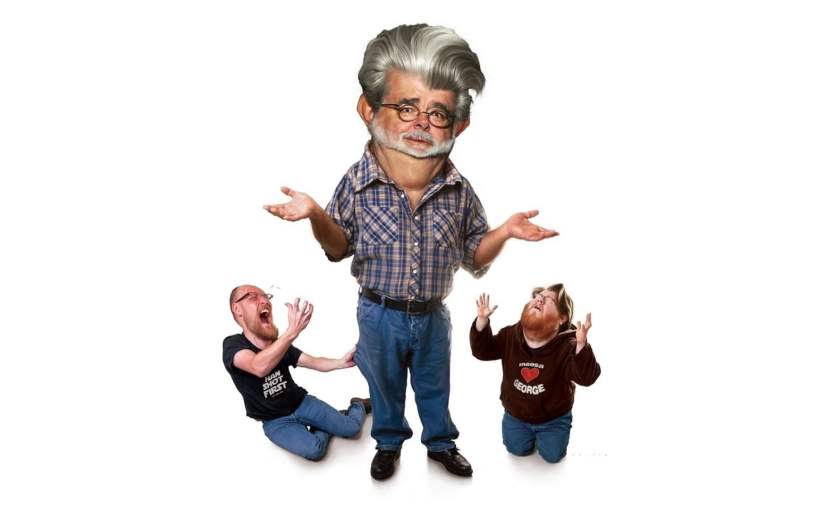
Star Wars has evolved from a beloved franchise celebrated in detailed play sets, figures, bed sheets, costumes, plush toys, and t-shirts to a franchise still wrapped in all those materials, only now there is an animosity and regret among its populace of fans. Vitriol and love mix like oil and water towards its creator, George Lucas.

In the documentary The People vs George Lucas a lot of complaining and poking transpires in the medium of endless home movie fan films (the best one being a spoof of Misery where a fan holds an injured Lucas captive) to measure the stress and betrayal followers of the franchise feel for a creator.

As a lifelong fan of the galaxy far far away, I did not watch this documentary with a constant nod in accord and “preach/fight the power” mentality. I could only think some people really need to value something more than this. Go outside. Taste an apple. Ride a bike. Feel a breeze in the air. Talk to a girl or a boy your own age.

The documentary only works to a certain level of degree and that’s because it doesn’t live up to the promise the title suggests. It’s primarily a one sided 90 minute argument of various worldwide fans venting frustrations with little to offer from Lucas. It’s fair to say Lucas would never give these documentarians the time of day anyhow. Why should he have to, really? So stock footage interviews are used instead to a minimal degree. The “vs” never really shows and the ball only ever stays on one side of the court.

Complaints abound of who shot first, the special edition edits of the original films, Jar Jar Binks (the best sequence of the film) and Lucas’ refusal to release the original cuts of the Episodes IV-VI (that’s always been my biggest issue).

A ridiculous segment focuses on the reiteration of merchandise like thousands of different Darth Vader figures or endless new releases of the films in new boxed sets thus tempting fans to continue to buy. This is frustrating. Yet, somehow, some way this need to collect is all Lucas’ fault? That’s where the film loses me. When a person uses a scapegoat because of a weakness of free will, there’s not much I can empathize.

There’s moments to laugh at. The frustrations are not wrong but who cares to listen to someone who claims their childhood was literally “raped by George Lucas?”

I did appreciate how the film examines that sadly, in an ironic sense, Lucas became the monster he tried to avoid. When making the 1977 original he broke many standards of filmmaking in Hollywood refusing to answer to corporate cogs. He wanted independence of money grubbing and grasps. He achieved that mean to an end by simply becoming the biggest corporate cog of them all. Stock footage interviews show him admitting that. Ultimately, he never directed again until 1999 when he declared he would direct a trilogy of prequels. He did not answer to anyone, and no one questioned his methods. Thus, the world was treated to Jar Jar Binks. That’s what corporate America does. That’s what George Lucas did.

VALERIE

By Marc S. Sanders

Stacey Souther’s short documentary, Valerie, explores the colorful life of Valerie Perrine. 

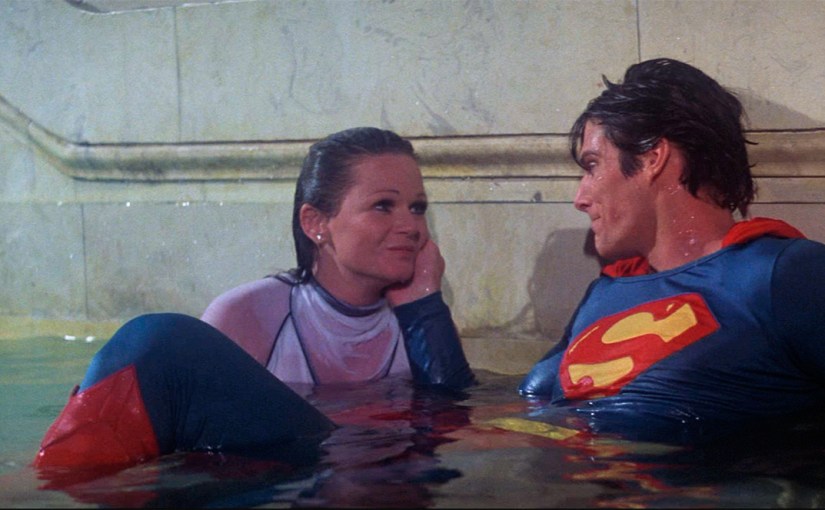
I must confess, up until I saw the film, the most I knew about Ms. Perrine was as “MISS TESCHMACHER!!!!!,” the adorable sidekick dame of Gene Hackman’s Lex Luthor from the first two Superman films.  Yet, in just 36 minutes, Souther offers a wealth of knowledge about the famed star that only motivates me to uncover her other accomplishments and films.  I already have her Oscar nominated turn in Bob Fosse’s Lenny, with Dustin Hoffman, cued up on my Roku.

Having watched Valerie twice, it stands to reason that this life could be covered quite well in a full-length biographical film adaptation.  I petition Souther to direct if that ever comes to light.  He provides a large selection of pictures and video footage that cover Perrine from childhood through her late teens and early twenties as a Vegas showgirl, on through her prime of adulthood in Hollywood films and then finally reaching her most recent years as she bravely lives with Parkinson’s disease.

On top of the photos, testimonials are weaved into the movie from co-stars like Jeff Bridges (The Last American Hero), directors like Richard Donner (Superman) and George Roy Hill (Slaughterhouse-Five), friends like David Arquette, Loni Anderson, Angie Dickenson, George Hamilton and Howard Hessman.  All have nothing but celebratory words of their experiences with her.  The comments are provided over film footage and photos of smiles and non-stop energy.  Souther makes it seem as if you could never be in a bad mood if you are standing next to Valerie.  Just watch her own the stage on The Tonight Show with Johnny Carson.  She belts out a scream of absolute fire that Johnny and Ed can’t help but applaud and cheer for. 

How fortunate that Stacey Souther was able to recover old interview footage and glimpses of times where Valerie offered up a comment on her philosophy of life.  In one televised interview, Valerie answers a question with “I have no worry about tomorrow…the fact that I don’t know what’s going to happen tomorrow, I’ve grown up with (it).”  Once the film concluded, this observation stayed with me.  Souther depicts Valerie in the past and her present time, as only being concerned with the now and never focusing on the unpredictability of what’s to come.  It takes real strength to approach each day you awaken with a purpose.  One time in her younger years, she’s captured answering a question with “It’s karma…look at the good things in life…”  Things like that are said to us all the time in fortune cookies or greeting cards, maybe.  When Valerie said it, I believed her.

Tragedy has also crossed paths in her lifetime having lost two boyfriends to violent and unexpected deaths.  Jay Sebring was one of the victims of the infamous murders committed by Charles Manson’s followers, which also included actress Sharon Tate and her unborn child.  According to the film, Valerie was actually meant to be at that gathering.  Yet was called away at the last minute for work.  These incidents are hard for her to recall, but it also opened a transitional door for Valerie to move on from Vegas and go to Hollywood for acting.  She may not have had any formal training, but that didn’t stop her from trying, and she succeeded.

Valerie is quite debilitated by the year 2014.  Her Parkinson’s wants to upstage her life and dominate her with uncontrollable shaking.  Still, she puts on her makeup and Souther inquires about her daily routine.  By this point it takes her a good forty-five minutes before she can finish applying.  It’s involuntary to notice her shaking before anything else, yet that doesn’t ever stop Valerie from maintaining a proper appearance. 

We see her eating a salad and her fork shakes in her hand as she brings it to her mouth.  Valerie comments on how this is not so easy when trying to eat soup.  Her delivery offers a sense of humor to this annoyance.  For my own attempt at empathy, I found it annoying for Valerie.  For the camera, Valerie will never admit it is annoying.  It’s just what she is living with today.

Valerie is described and admits to never having any inhibitions when she was a Las Vegas Showgirl, wearing revealing outfits or appearing topless.  She was also comfortable with the well-known Playboy shoot she did.  From this film, I learned that’s a skill of hers.  Because she does not carry insecurities, she is able to offer up the unglamourous life she endures today as a woman with Parkinson’s.  Souther captures moments where health professionals are getting her comfortable in bed and she may not be completely dressed.  There are times where she is lifted in a harness and it looks anything but graceful.  Often, she is responding to interview questions and her voice is raspy and shakes.  The film shows that Valerie Perrine does not carry one bit of bashfulness.  She has never been shy.  So, whether she’s breathtakingly beautiful or physically unhealthy, she does not perform for the camera.  She only shows herself. 

I have to praise Stacey Souther for an especially telling moment in his short film.  Valerie goes in for surgery in an attempt to alleviate the shaking and tremors she’s experiencing.  Like always, she welcomes Souther’s camera in the hospital room just before she’s to go under.  Soon after the procedure is completed, we learn that Valerie is suffering from a Transient Ischemic Attack (TIA).  Blood was not flowing properly to her brain and thus she was dealing with neurological issues like poor vision, confusion and frequent unconsciousness.  To get an idea of this moment, Souther fades his film in and out of blackness.  At one moment, Valerie is tasked with simply saying her name and counting to three, but she just can’t do it.  As best as a film medium can provide, we get a sense of how lost Valerie must be during this period.  It’s a frightening moment, but again I went back to how she was described best; lacking any inhibitions.  Other subjects would have insisted that sequences like this be removed from the final cut of the film.  For Valerie Perrine, if a film is going to cover her life of ups and downs, then it’s going to cover everything.  This is quite brave of both Valerie and her director, Stacey, to cover.

Valerie’s younger brother, Dr. Ken Perrine, recollects memories of a vivacious childhood, as well as accompanying her to the Oscars, and then witnessing the health challenges she’s been facing since before 2014.  He’s as forthright as his sister.  A hard moment to watch is when he describes what it’s like to leave her home on any given day.  He wonders will this be the last time he ever sees her.  The film explores the beginnings of her illness in 2014 and goes through 2018.  Now, in 2022, Valerie is still with us and this feeling has likely never escaped Ken’s subconsciousness.  Illness of any kind is hard on the victim, but it’s also so trying on the loved ones as well.

I found out about this film from Valerie’s Facebook page.  I was only following her because she was a member of the Superman cast.  When she posted about the completion and upcoming release date for this picture, I jumped at the chance for an advance screening so that I could offer up a review.  The fact that Valerie still connects with her fans by means of social media with pictures and anecdotes inform me that she still lives life to the fullest.  The Parkinson’s never pushed her into hiding.  She stays out front with her makeup applied, adorable headpieces to wear and with her friend Stacey by her side, a camera pointing right at her.  Valerie Perrine is nothing less than an exceptionally triumphant woman.

Valerie is available now to stream on Amazon, iTunes, Appletv, google play and Youtube.   

CITIZENFOUR (2014)

by Miguel E. Rodriguez

Director: Laura Poitras
My Rating: 9/10
Rotten Tomatometer: 96% Certified Fresh

PLOT: Documentarian Laura Poitras captures the first week or so of Edward Snowden’s leaks to the press and the ensuing aftermath.


Over the last month or two, I have watched two stirring documentaries (Cave of Forgotten Dreams and Nostalgia for the Light) that redefined my idea of what a “good” documentary should be.  Instead of being passive observers, those filmmakers documented what they saw and then commented on it with definite viewpoints and biases.  Narration was used heavily.  That’s not normally my favorite kind of documentary, but they were clear exceptions to my rule.

Tonight, I finished watching Citizenfour, a documentary about the first week or so of the Edward Snowden whistleblowing controversy.  In direct opposition to the other documentaries I’ve seen recently, this film steadfastly avoids narration and simply presents the facts as they happen.  As I was watching, I was simply absorbed in the storytelling, and after it was over, it occurred to me that this documentary captured something incredibly rare: the first few days of a national scandal, behind the scenes with the actual person blowing the whistle, BEFORE the story breaks.  It was captivating.

But that sense of being a fly on the wall is nothing compared to the revelations Snowden made.  If you’re politically-minded, Citizenfour is not just revelatory; it’s chilling.  If one-tenth of what he discusses just in this film is true, the ramifications are vast.  I don’t want to sound like a conspiracy theorist, but the secret surveillance programs Snowden describes are exactly the kind of tools needed to create a dictatorship.  When a government is using a program/algorithm/whatever that can follow your movements via phone calls, emails, e-payments, cell phones, laptops, etcetera…that’s a police state, empirically.

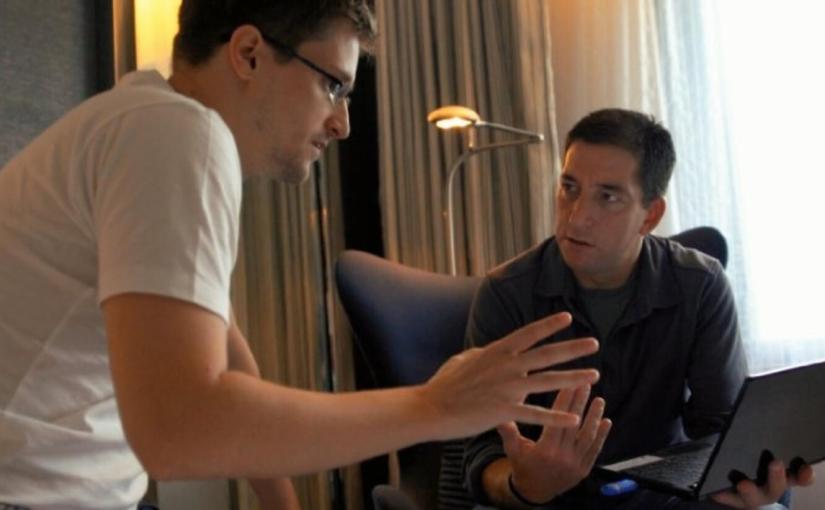
Snowden’s revelations are so mindblowing and voluminous that paranoia is the rule of the day.  He contacted Poitras and a reporter from The Guardian, Glenn Greenwald, via encrypted emails and air-gapped laptops and arranges to meet them in a Hong Kong hotel.  He makes a quick call to room service, then disconnects the phone.  Why?  Because, according to Snowden, the NSA has technology to listen in on conversations via a telephone handset, even when it’s hung up.  Later, the hotel’s fire alarm starts going off sporadically.  Snowden reconnects the phone and asks the front desk what’s going on, and he’s told it’s a scheduled test.  “Nice of them to let us know,” Snowden says.  Random event?  Who knows?  It’s a mark of how well the movie is constructed that seemingly innocuous events are transformed into, “They’re listening…”

The film follows the story, including the publication of the reports that eventually resulted in Snowden being forced to live in Russia for the better part of a year after his passport was revoked.  We meet Julian Assange as he organizes Snowden’s legal strategy along with a squad of ACLU attorneys, all working pro bono.

The genius of the film is how it simply presents the facts and allows the viewer to draw their own conclusions.  Is Snowden an attention-seeking charlatan?  Or was the US government actively spying – spying – on American citizens without their knowledge?  After a while, without really trying to, the movie takes on the air of one of those classic paranoid thrillers from the 1970s like The Parallax View and Three Days of the Condor.  At one point, Snowden logs into a laptop while covering his upper body with a blanket like a tent, presumably to make sure no one would be able to tell where he was by using the camera on his laptop.  Or something.

(Admittedly, we only hear snippets of opposing viewpoints, one from then-President Obama where he agrees that Snowden created a much-needed discussion but declines to call him a patriot because of his methods.)

But surely some of this stuff is a little too sensational, right?  The cynic in me wants to believe that’s the case.  But consider: The material in Citizenfour was so sensitive at the time that the director, Laura Poitras, had to move to Berlin because she kept getting detained by border authorities when trying to re-enter the US.  All the film footage was kept on encrypted drives to prevent access from…whomever.  In fact, she edited the movie completely in Berlin so the FBI couldn’t serve a search warrant for the drives.  Just in case.

At one point, Snowden and reporter Greenbaum carry on a conversation about another whistleblower, apparently inspired by Snowden, who seems about to release information about drone strikes and watch lists under Obama.  They are careful to censor themselves by not saying certain words and phrases out loud.  Instead, they write key phrases on pieces of paper and hand them back and forth.  And then the paper is torn to pieces.  Normally, this kind of thing would reek of paranoia, but considering what has come before, it seems perfectly reasonable, in light of what they’re discussing.

I gotta say…in all honesty, I may not be the best person to review this movie.  I think it’s well-made and eye-opening and informative, but is it going to make me change my online or cell phone habits?  Probably not.  I’m in my 50s, and I enjoy the convenience of Amazon Prime and paying my bills online and using my phone to pay for things when shopping.  Am I worried I’m being spied upon?  I suppose I should be.  But I’m not.  I guess I’m willfully ignoring facts, at least the ones based on this documentary.  I’m not saying I like it.  I’m definitely against it.  But is it enough to make me change my behavior?  If I’m being honest, no.  (And if I can’t be honest in an online review, where CAN I be honest?)  But, bottom line, Citizenfour is one of the finest documentaries I’ve seen in recent years. If you’re running short of things to be outraged about, look no further.

CAVE OF FORGOTTEN DREAMS (2010)

by Miguel E. Rodriguez

Director: Werner Herzog
My Rating: 9/10
Rotten Tomatometer: 96% Certified Fresh

PLOT: Filmmaker Werner Herzog is granted a rare opportunity to film a documentary inside France’s Chauvet Cave, where the walls are covered with the world’s oldest surviving paintings, dating back some 30,000 years.


Over the last several years, I’ve had the opportunity to travel to some amazing places, including London, England, where we toured the famous Tower of London.  When I lived in Virginia, we used to visit colonial Williamsburg, where some structures and artifacts exist from the 1600s.  But at the Tower of London, we saw walls and structures that have existed since the 1400s.  Six-hundred-plus years old, man!  Wild!  We saw Anne Boleyn’s final resting place.  THE Anne Boleyn!  Was buried right there.  Freaky.

Then we traveled to Greece, and that really put the zap on me.  We walk to the Acropolis and a tour guide tells us, “And that rock over there is Mars Hill, where the apostle Paul preached to the Greeks over two thousand years ago.”  TWO THOUSAND YEARS.  And in a museum, we saw artifacts dating back to 5,000 BCE, objects that were so old the archaeologists weren’t even sure what they were for.  Religious totems?  Toys for children?  Purely decorative?  Who knows?  I love this kind of thing!  Looking at things that have survived for millennia, created by people who were probably just satisfying a hobby, for all we know.

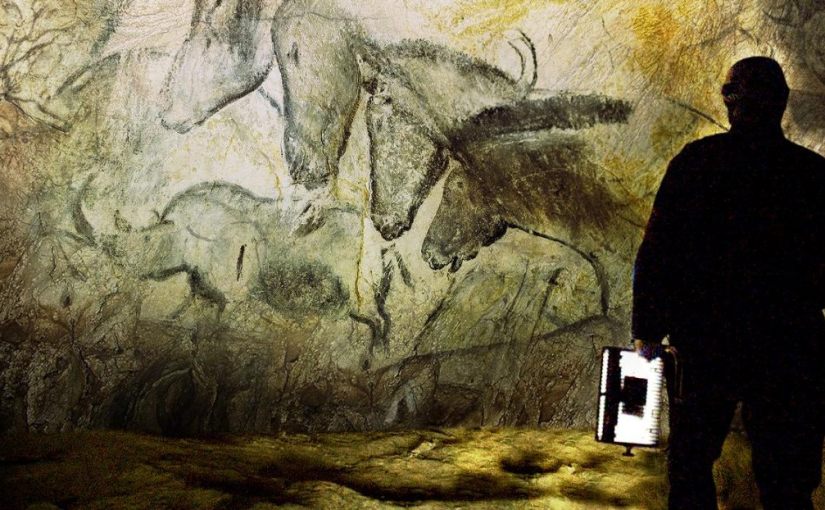
Now comes Werner Herzog’s documentary Cave of Forgotten Dreams, in which he was allowed to film inside the famous Chauvet Cave in France.  Inside are the oldest known artistic renderings of any kind on the planet.  How old?  Approximately thirty thousand years old.  To put that number in perspective, when Paleolithic humans made these paintings, the surrounding area was covered with a glacier that was so huge, when it finally melted, the ocean levels rose three hundred feet.  A hunter could have crossed what is now the English Channel by walking on dry land from coast to coast.  It’s an abyss of time that is utterly incomprehensible to me.

These paintings are indescribably cool to observe.  I’d seen photos before, but to see them on film is an indescribably stirring experience.  There are drawings of horses and wild rhinoceros that look as if they were drawn yesterday.  One animal was drawn with a total of eight legs.  A mistake?  No.  It was an attempt by the artist to convey movement or motion.  PROTO CINEMA.  Mind.  Blown.

There are handprints by some of these drawings.  Were they intended as a signature by the artist?  Perhaps so, because further into the cave are more handprints by other drawings, and we can tell they’re handprints from the same person because of a crooked pinky finger.  A maker’s mark from three hundred centuries ago.

I can’t stop.  On the floor of the cave, nearly obscured by eons of calcification and crystals, are visible footprints of a wolf and a 7-year-old child.  Was the wolf stalking the child as prey?  Were they maybe companions?  Or are the footprints separated by years, or decades, or centuries?  Near what used to be the entrance to the cave – the actual entrance was blocked by a rockslide an unknown number of years ago – is a rock with a flat top like a table, and on the table, facing the entrance, is the skull of a cave bear.  Traces of charcoal at the base hint that incense may have been burned there.  Was this a temple?  A holy place?  Or did they just think it looked badass to have a skull on a table?

This stuff fascinated me.  I found myself thinking about, of all things, a scene from Star Trek: First Contact, when Picard, having traveled back in time, is able to reach out and touch the very first vehicle to achieve warp speed.  He explains to a confused Data that touching something old is a way of somehow reaching back across the centuries and identifying yourself with the people who created it.

That’s what these cave paintings are like.  They’re a conduit back through time.  Along with the paintings, archeologists also discovered remnants of what look like flutes.  One enterprising guy recreates one of these instruments and plays it for the camera.  Using a 30,000-year-old design, this guy knocks out the first stanza of The Star-Spangled Banner.  On a flute made from BONE.

Why did Herzog even want to make this movie?  To be a social activist?  The cave is in no environmental or man-made danger.  There are only two weeks out of every year when anyone is even allowed inside the place.  He filmed it in 3-D.  Was he looking for a fast buck by capitalizing on the 3-D craze around that part of the decade?  It only grossed $5.2 million, a pittance, even by documentary standards.  (Although that was the highest box-office return of any independently released documentary of 2011…so there’s that, I guess.)

So why do this?  Because I believe Werner Herzog is one of the last remaining filmmakers who will make a film simply because he feels he must do so.  He latches onto an idea, and it will not release him until he commits it to film.  He doesn’t particularly care if it’s commercially viable or mainstream or anything.  If he gets an idea (and the funding), he finds a way to get it filmed.  It may not reach everyone, but you know what they say: “If you only reach one person, you succeeded.”

Man, did this reach me.  I was fascinated from beginning to end.  There’s one sequence that is nothing but, I think, 5 or 10 minutes of the camera simply regarding the paintings, slowly panning and tilting, just looking at them, while strange, but appropriate, music plays in the background.  Under any other circumstances, this would be boring.  Here, it was almost holy.

NOSTALGIA FOR THE LIGHT (2010, Chile)

by Miguel E. Rodriguez

Director: Patricio Guzmán
My Rating: 10/10
Rotten Tomatometer: 100% Certified Fresh

PLOT: This award-winning documentary juxtaposes the search for answers about the history of the cosmos with Chilean women searching the Atacama Desert for the remains of loved ones killed by a despotic regime decades earlier.


I am going to look at the stars.  They are so far away, and their light takes so long to reach us…all we ever see of stars are their old photographs. – Dr. Manhattan, Watchmen


If Nostalgia for the Light has one flaw, I might point to its rather abrupt ending.  It comes so quickly it almost cuts off the sentence being spoken by the film’s narrator.  Perhaps it’s metaphorical.  The film is over, but there is no resolution.  The riddles of the cosmos remain unanswered, and the bodies of cherished loved ones remain undiscovered.  If they don’t get a resolution, why should we?

The Atacama Desert in Chile is one of the driest places on earth, with an average annual rainfall of 0.5 inches.  With its virtually zero percent humidity, the skies remain remarkably clear at night, making it one of the prime spots on the planet for astronomical observatories.  From these perches, astronomers use massive visible light and radio telescopes to probe the outer reaches of the cosmos, searching for clues to the origins of life, the universe, and everything.  (Sorry, couldn’t resist.)

One astronomer points out that many times, when science finally answers a question, two more pop up to replace it.  He says some people even consider it an exercise in futility.  If every answer only reveals more questions, why bother?  You might as well ask NASA why we sent men to the moon.  Because it’s in man’s nature to know, to try to find out what’s over the next hill or what is beyond the farthest galaxy.

Another scientist explains that the calcium in our very bones literally comes from the stars.  Everything on earth today is descended in one form or another from the Big Bang.  Radio telescopes can measure the calcium levels in distant stars.  (Calcium in stars?  You learn something new every day.)  That calcium came from the Big Bang, and so did Earth’s.  As Carl Sagan said, “We are star stuff.”  We may die, and we will.  The stuff in our bodies remains, and will eventually help a tree to grow, or a vegetable, and so on and so on.  The circle of life, as it were.

All this information in the film is presented in a very straightforward without flash or fanfare, at least in terms of the narration.  Visually, the filmmakers use great editing with the interiors of huge observatory domes and the immense telescopes within, cut together with stunning vistas of starfields, including shots of our own Milky Way.  Indeed, the film’s narration informs us that, night after night, “slowly, impassively, the center of the galaxy passes over Santiago.”

But this is not simply an overblown episode of “Nova.”  Nostalgia for the Light is divided almost schizophrenically into two parts bumping into each other for the duration of the film.  It’s this second part that gives Nostalgia its heart and soul.  I’ve been thinking about it ever since I finished watching it this afternoon.

In 1974, Augusto Pinochet rose to power in Chile.  His dictatorship lasted for 17 years.  During that time, he imprisoned as many as 80,000 people in concentration camps in the Atacama Desert, killing anywhere from 3,000 to 4,000 dissidents.  To cover his tracks, he ordered his military to truck the bodies into the desert and dump them in unmarked mass graves.  It was rumored that he also had many of them thrown into the ocean.  Families were torn apart.  One young woman in the film tells how, when she was 12 months old, her grandparents were forced to reveal the whereabouts of her mother and father, using her as leverage.

For decades since then, women have come to the desert with spades and pickaxes, searching the dry ground for clues to the whereabouts of their loved ones.  The desert is enormous, and there are very few of these women.  In the film, they talk about the people who try to convince them of the futility of their actions.  Not just their friends or family, but public figures, politicians.  They are embarrassing.  They are dredging up a painful past others would prefer to forget.

One of these women wishes the giant telescopes on the distant hilltops could be designed to see through the ground instead of into space, so they wouldn’t have to dig.  They could find the secrets of their past much more quickly.  But of course, that’s exactly what the telescopes are designed to do.  They’re just pointing in a different direction, reaching to a far more distant past.

When I was younger, I was of the belief that a good documentary had to be completely impartial.  It simply documented what was happening without commentary from the filmmakers.  You could use editing to make a point, but it was against the “rules” to editorialize your subject.  And never use a narrator.  Let the audience make up its own mind, right?  The fancy word for this kind of strictly observational filmmaking is “cinéma verité.”

Nowadays, with most modern documentaries I’ve seen, the strictures of “cinéma verité” have gone by the wayside.  Instead of being a passive observer, the director is free to edit together disparate footage and interviews to make their point of view heard loud and clear.  This director, Patricio Guzmán, is using this documentary as a tool for social activism, or at least awareness.  I wouldn’t normally care for this kind of in-your-face, this-is-my-point documentaries.  I have never been a fan of Michael Moore’s films (at least not anything after Roger and Me), and I think Morgan Spurlock’s films are nothing but glorified Jackass stunts.

But Nostalgia for the Light affected me in a way I did not expect.  There is a sequence where an astronomer explains how “the present” isn’t technically real.  Light from the sun takes eight minutes to reach earth.  The light we see from the distant stars are years, decades, centuries old.  What we see in the sky is not the stars’ true position.  It’s where they were years and years ago.  It’s almost as if we’re looking at the memory of light.  This concept, which I’ve heard before, simply boggled my mind this time around.  I don’t know how to explain it.  And then when the film draws parallels between the astronomers searching for answers in the cosmos to the sad, determined women searching for closure in the desert, and the perceived futility of both ventures in the minds of so many…it’s very difficulty to put into words.  I felt that I was watching, or perceiving, something that transcended my poor abilities to describe it.

The astronomers search for answers to better our world and themselves.  The women in the desert search to bring closure to their lives and to the lives of the ones they lost.  They cannot forget, as so many in their country have willingly forgotten.

Director Guzmán also narrates the film, and I believe the crux of the entire film can be explained in one of his lines: “…those who have a memory are able to live in the fragile present moments.  Those who have none don’t live anywhere.”

HOOP DREAMS

By Marc S. Sanders

Hoop Dreams is not a simple documentary. It spans five years beginning in the late 80s through the early 90s capturing the lives of two young promising basketball prospects looking for a shot at the NBA, a million to one shot.

Arthur Agee and William Gates are two black youths from the ghetto areas of Chicago who are given an opportunity to attend St. Joseph’s High School and to participate on their prestigious basketball squad, the same team where Isaiah Thomas began his trek to the pros. The film, directed by Steve James, continuously shows how far reaching the accomplishments of Thomas really are with moments frequently focusing on the school’s hallway cabinet display dedicated to the legendary former student. Arthur and William are magnificently talented as top coaches and recruiters will attest, but are they that good? Do they have Thomas’ drive and ferociousness on the court. As well, are they capable to maintain their required minimum grades and ACT test scores for college scholarships? Can the boys overcome injury or tuition demands to stay at St Joseph’s?

Hoop Dreams explores these questions in its three-hour running time. Though it’s a documentary, the drama is undeniably intense.

For Arthur, his talents on the court can only go so far. A family life that has highs and lows make it challenging for him during his high school years. His father, Bo, has been in and out of prison and he’s a drug addict. Director Steve James is so attentive and unforgiving with using his camera that he shows fourteen-year-old Arthur playing on the neighborhood court with Bo, who eventually drifts off into the background where we actually see Bo purchasing drugs from a dealer, right in front of his son and right in front of the camera.

Arthur’s NBA dreams also become more fleeting in his sophomore year when his family can not come up with the necessary portion of his tuition to remain at St. Joseph’s. From there, I desperately wondered if he’d ever return to the school.

William’s story begins with much more promise. He’s a magnificent player and comes off very responsible beginning in his freshman year at age 14 while keeping a job, and a respectful and positive attitude with his teachers and peers. His scholarship to remain at St Joseph’s is backed by a top executive for Encyclopedia Britannica. He’s a dynamo on the court and he’s got tremendous support from legendary St Joseph’s Coach Eugene “Ping” Pingatore who started Isaiah Thomas on his road to success. However, a knee injury comes into play. William is given the best treatments available including numerous surgeries to remove cartilage and maintain repairs. The knee never seems to go back to what it once was for William but even worse, according to Ping, the injury is messing with William’s confidence on the court.

This is not only disappointing for William with various setbacks that keep him off the court, but also for his older brother, Curtis, who lost out on his own basketball dreams. Curtis lives through the potential success of William.

The Agee and Gates families have next to no money living in the projects of Chicago. They endure job layoffs, welfare and at times no means to put food on the table or cover the cost of electricity. The need to support families of multiple children while they make every effort to survive the streets laden with drugs and crime beyond these troubles. What they live for is the will of Arthur and William’s potential for athletic greatness. The families are these boys’ greatest cheerleaders.

James’ film puts the golden ticket for these young men front and center at the beginning of the film when Isaiah Thomas speaks at a session for many prospective talents with a shot to attend St. Joseph’s High School. There’s uplifting footage of young Arthur playing with Thomas, and you feel the drive to now follow the boy’s journey to maybe see the professional ball player again but maybe in an arena where Arthur is now wearing a Detroit Pistons uniform as an actual teammate. As a viewer I was truly believing this could work out and by the time I get to the end I’ll finally see that moment captured in real life footage.

Nevertheless, Hoop Dreams shows that exceptional talent is never a promise for a shot in the NBA. Surviving day to day with no money and even a challenge to maintain academics, stay healthy, and avoid drugs and crime are at least just as important factors along that path.

Hoop Dreams is a long film. It needs to be to truly depict the essence of what happens to William and Arthur from year to year in high school. It’s absolutely riveting and emotionally suspenseful. Amazingly enough is that Steve James could never know what would come of Arthur and William when he began covering their stories in freshman year. Unlike other celebrated documentaries, Hoop Dreams is not a recap of a historical moment in time with stock footage that’s been recovered for narrative use. Hoop Dreams is in the moment. It’s a continuous exploration of what direction life will spell out for these boys and their families once high school comes to an end. Steve James was intuitive in following the respective trajectories without really ever being fully aware of the conclusions for these two stories.

Siskel & Ebert declared this film the best picture of 1994, topping films like Pulp Fiction, Forrest Gump, and The Shawshank Redemption. I can’t decide yet if I agree with that ranking, but I will never deny that the film belongs in that company of greatness for sure.

Hoop Dreams is absolutely magnificent, and likely one of the best documentary films I’ll ever see.

LIFE ITSELF

By Marc S. Sanders

Gene Siskel and Roger Ebert’s television program was a show that I religiously watched growing up. They both taught me how to argue, how to agree, how to observe and how to appreciate; most especially when it came to the subject of movies which I continue to have an incredible passion for.

To watch Steve James’ documentary Life itself, which focuses on Ebert’s colorful and pioneering life, as the most popular film critic in the world, is a mind-blowing experience. James along with commentators such as Chaz Ebert (Roger’s wife), Martin Scorsese, Werner Herzog and A.O. Scott (film critic for the New York Times), paint a picture of what drove this man to continue his greatness all the way down to his last breath.

James alternates between the moments of struggle for Roger and Chaz during his final six months of life and his past which celebrated his annual visits to the Cannes Film Festival, his sparring matches with Siskel, his friendships, his moments of joy with Chaz and her family and his master talents of words on the page, and on the television screen.

As director of this incredible documentary, Steve James holds no filter in any of the material he shows. Roger is described as arrogant and competitive at times, sometimes acting like a bratty child. He is shown in his deformed state without a bottom jaw, and as a recovering alcoholic. He is also presented as a most valued opinion, a dear friend, a loving husband, a brave, young newspaper editor, a sensational film critic, and a man with exceptional resilience to the cruelty of thyroid cancer, deformity, and deterioration.

There was an incredible dynamic to Siskel and Ebert’s relationship where the surface would reveal animosity, but James’ documentary uncovered true loving brotherhood.

I continue to read Roger’s columns as a ritual following a viewing of a movie. His reviews are a conversation to me. They are personal to me. Roger always personally speaks to me. I’ve never felt as much a connection to any other writer. I continue to seek out clips of Siskel and Ebert’s programs on You Tube, to laugh, reflect, relate and uncover different points of view.

There will never be another Gene Siskel. There most especially will never be another Roger Ebert. I recall reflecting on his legacy during a trip to Chicago. I walked in front of the Chicago Sun Times and Roger seemed to say hello to me. I even met a local film critic there who knew Roger, attended his funeral, and somehow, I felt that I finally met Roger himself after so many years.

I especially recall missing him as the latest Transformers installment was released during that time. He savagely hated the prior two films in the franchise I think even more than me, and for that he wrote two of his best reviews. I only wished he was still alive so that I could return to that kind of review one more time for this picture as well. I didn’t see the movie, but I know he would have hated it and I would have loved the article all the same.

Roger is one of the most influential people I have encountered and Life itself was one of the best movies from 2014.

Catch this movie on demand if you can. You won’t regret it.

Thumbs up for me!

BARAKA (1992)

by Miguel E. Rodriguez

Director: Ron Fricke
Cast: N/A
My Rating: 10/10
Rotten Tomatometer: 81% Certified Fresh

PLOT: The rhythms of life and time are explored in this wordless montage of spectacular filmed images from around the globe, set to a haunting, ethereal score.


Some time ago, I wrote a post on Facebook about movies with an extremely rare quality: transcendence.  Movies that are so good that mere genre definitions are not enough to quantify them.  I’m not talking about perfect examples OF a genre (Aliens, Unforgiven, Young Frankenstein, et al.)  I’m talking about movies that wind up being more than the sum of their parts and take on a haunting, spiritual quality.

Film is an extremely subjective medium, so my list of such “transcendental” movies will likely differ wildly from your own.  For example: Breaking the Waves (1996), a meditation on the capacity for human suffering, forgiveness, and the definition of belief.  Or Cloud Atlas (2012), a mind-bending journey that poses the greatest “what-if” question of our existence.  Or Fearless (1993), a mainstream drama concealing life-altering truths at its core.

And then there’s Baraka, a 1992 film that premiered in Canada on the festival circuit before receiving its American release a year later.  I suppose it would have to be classified as a documentary, since it consists entirely of wordless images edited together into a feature-length music video.  It was directed by Ron Fricke, who had previously worked with director Godfrey Reggio on Koyaanisqatsi (1982), a groundbreaking film, similar in structure to Baraka, that introduced time-lapse photography to the mainstream; it’s hard to believe, but there was a time when time-lapse was a novelty.

But this clinical description doesn’t nearly do justice to the religious experience that is Baraka.  This is one of those movies that begs for the best viewing conditions possible, on the biggest screen and with the best sound system you can afford.  The cinematography simply defies belief.  There are monumental shots of Himalayan mountain ranges, ancient temples, an enormous graveyard of decommissioned B-52 bombers, the interior of a spectacular cathedral where the walls appear to be inlaid with millions of tiny mirrors.

The film’s score is credited to Michael Stearns, but it also includes existing musical pieces that lend certain sequences an exotic, global feel.  These music choices are absolutely essential to Baraka’s success. 

In particular, a musical piece called “Host of Seraphim” by Dead Can Dance brings unbearable sadness and pity to a sequence in which we see Indian families picking through massive garbage dumps, searching for food or God knows what.  The sequence shifts to showing homeless people, families, sleeping on city streets, next to sewer grates, under makeshift shelters, and there is an overwhelming sense of mourning that this kind of thing is happening today, right now, all over the world.

In addition to the sequence above, there are also sequences depicting members of various religions worshiping in their own unique way.  And oceans of clouds swirling and flowing over and around mountaintops.  And the horrible abandoned camps at Auschwitz and in Cambodia.  And majestic waterfalls.  Oil fires in Kuwait.  A vast, still lake that perfectly mirrors the sky above it.

Every time I watch this film (this marks at least the 9th or 10th time I’ve seen it), I am left at the end feeling hopeful, expansive, with the urgent need to show this film to other people.  Is this what they mean by religious fervor?  I felt this same way after watching Parasite (2019), for example, but for very different reasons.  Parasite is thrilling.  Baraka is transcendent.  It pierces through my sometimes cynical expectations of what a movie should be and presents me with a showcase of the human experience.  It makes me feel, however temporarily, more connected to the global population as we travel through the cosmos on our huge (and also tiny) planet.  It gives me a shiver of comprehension when I look at the ruins of ancient temples on the screen and realize the people who built them many thousands of years ago were just…people.  Like you and like me.  Humans on this uniquely life-sustaining chunk of space rock, hurtling through the universe.

You may disagree with my assessment.  You may hunt it down on Netflix or Amazon or wherever, and you may give it a shot, and you may turn it off after 15 minutes, thinking, “What was he THINKING???  This is boring as hell!”  I suppose that’s the beauty of this movie.  It’s like a Rorschach test.  It doesn’t tell a story, per se.  It’s more like a tone poem, where certain images are juxtaposed with completely different images, but which are nevertheless similar.  This kind of moviemaking doesn’t always work.  (See, for example, Naqoyqatsi (2002), also directed by Reggio, part of his vaunted Qatsi trilogy, but which I find insufferably cryptic.)  But when it does work, it’s quite literally magical.

So, if you can, go ahead and see if this is available somewhere.  Check your television’s settings so you get the optimal picture.  Turn your speakers up as loud as you can get before the neighbors call 911.  And open yourself up to the possibility that a picture truly is worth a thousand words.

FYRE

By Marc S. Sanders

Fyre is a newly released Netflix documentary directed by Chris Smith that displays the hubris of a young entrepreneur named Billy McFarland, a despicable human being.

It’s an interesting story simply because Billy had all the writing on the wall yet proceeded with duping Bahamian island workers, influencers, web app designers, musical acts and concert goers into investing millions of dollars and hours of time and service into a music fest, the “Fyre Festival,” that could never possibly happen. People lost wages, ended up stranded and starved. Ultimately people were duped by the attractiveness of Instagram and Facebook, and they wanted to live within the images of what they saw.

Chris Smith offers strikingly beautiful pictures of Billy living it up with rapper Ja Rule and gorgeous women on a private island he boasts that he purchased from Pablo Escobar. The rapper and Billy think up an idea to offer the greatest music fest ever conceived. Concert goers can experience the concert while mingling with super models and celebrities, partake in the finest foods from world renowned chefs, and reside in beautiful cabanas. Thousands of people invested thousands of dollars in what could only be an illusion offered by well edited sun soaked, blue water, and white sand film footage with tan bikini models and jet skis. What they got was cheese and lettuce on bread with a rain soaked hurricane tent and a soggy strewn about mattress.

Question was who’s paying for all these acts and talent? Whose booking all of this? What about bathrooms and where is everyone expected to reside during the event?

It was a pipe dream disaster from the get go and Chris Smith’s documentary shows the orchestrator of it all act with reckless abandon and false optimism.

It’s an interesting piece. McFarland is as corrupt as a Kenneth Levy or a Bernie Madoff. One associate describes Billy as a man who knows how to separate the cash from the consumer. I believe that after watching the film. To live a life of fantasy is tempting to all of us. We all at one point yearn for something greater. Billy McFarland pounced on that idea imbedded in everyone.

Fyre will serve as warning for a buyer to beware.