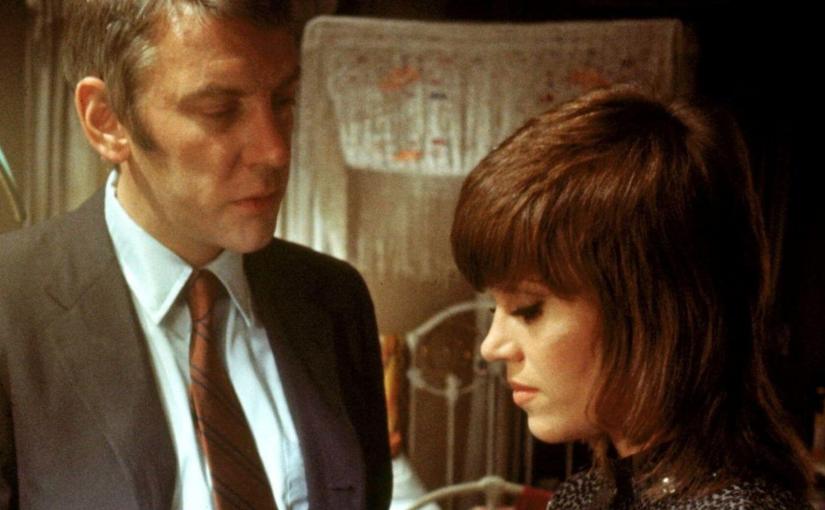
INSOMNIA

By Marc S. Sanders

Insomnia is an unusual kind of crazed killer pursuit because the hero is initially implied to be compromised, and before the first act of the picture ends, we see that he truly is not as noble as he is described.  This Christopher Nolan film, one of the few that neither he nor his brother Jonathan wrote, is headlined by three Oscar winners and they beautifully absorb this insightful script from writer Hillary Seitz.

Al Pacino is a celebrated Los Angeles Detective named Will Dormer.  When we see him arriving aboard a propeller plane into the foggy town of Night Mute, Alaska with his partner Hap Eckart (Martin Donovan), he looks weary and worn out.  Greeted with warm welcomes by a fan of his is Ellie Burr (Hilary Swank) and his old friend Chief Nyback (Paul Dooley).  Will has been special requested to investigate the murder of a young girl found in a trash heap, strangled to death.  Happenings like this do not occur often in Night Mute.  So, it is best to use the assistance of an expert.

Right away, Will is ready to get to work by visiting the girl’s boyfriend at school.  What he doesn’t realize is that it is ten o’clock at night. At this time of year, a midnight sun lasts twenty-four hours over this little getaway.  After he’s had a chance to investigate the victim’s body and go over the autopsy notes, the discovery of her bookbag leads to the prime suspect, mystery writer Walter Finch (Robin Williams).  A raid on his home near the beach is initiated and it does not go as planned.  Will screws up while chasing down the guy who gets away. 

While it seems that with some cover up, Will can keep his terrible error in judgment to himself, Walter knows everything. Now, with taunting phone calls in the middle of broad sunlit evenings, Will’s insomnia is becoming a hinderance as he tries to do his job while suppressing his own personal guilt and egregious acts.

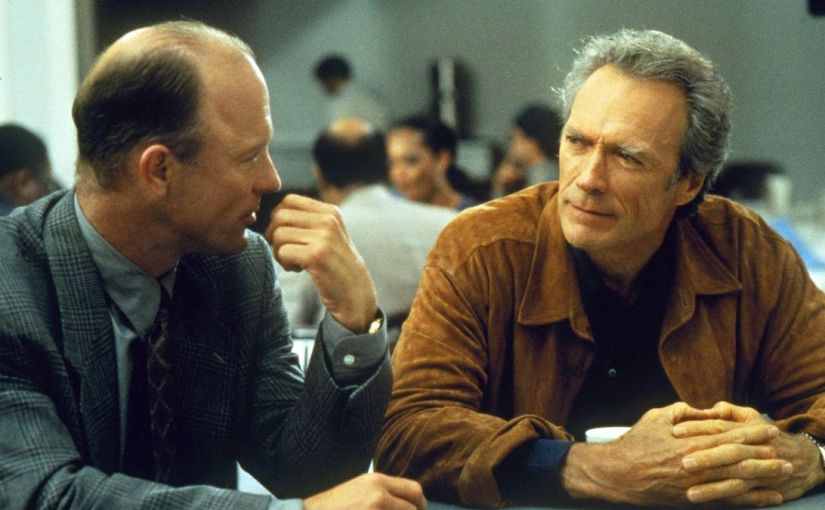
The duality of Pacino versus Williams is reminiscent of Eastwood against Malkovich in In The Line Of Fire.  It works very well especially because of the departure that Robin Williams takes from his usual fare.  Ironically, he portrayed another creepy guy in the year of this release with a movie called One Hour Photo.  Williams is just a different kind of cut from Al Pacino and that’s why their conflict works well.  Pacino’s gruff tone, which is all too familiar within the second half of his career, has a roughness against the smooth and calm demeanor that Robin Williams relies on with his dialogue.  Walter Finch appears relaxed, rested and neat.  Will Dormer is wrinkled, tired, and lonely with guilt.  This killer has an inescapable edge over the cop, and thus Insomnia stands apart from the other fare of its time from the likes of Fincher, Demme or the Scott brothers’ respective films.

Christopher Nolan captures a creepy and uncomfortable setting for an environment bright with daylight amid a corner of the world that still embraces the nature of Earth.  He is thorough explorer with his go-to director of photography, Wally Pfister.  Clouds and the blurs of fogs keep moments unclear.  The sun blaring through windows is disorienting.  You can also feel the chill of Alaska, even if you are like me and have never visited the state. 

Though the film was primarily shot in Canada, there are amazing bluish/white overhead shots of snow-capped mountains and expansive rocky lakes surrounded by green woods.  A foot chase midway through the picture uses this unusual environment as Dormer chases after Finch across an expanse of floating logs that trap him underwater.  As Pacino desperately looks for an opening to the surface, Nolan really makes you feel like you are drowning amid this unexpected trap.  (Try to watch Insomnia on with at least a 5.0 surround sound.)

Hilary Swank’s role appears like a forgettable partner early on, but her significance opens up later in the story as more is revealed.  I look at her character of Ellie and it occurs to me that a theme of mentorship builds the backdrop of Insomnia.  Ellie has studied Will’s most famous cases and he’s much like a celebrity in her presence.  Finch is a well-known author that built a connection with the murder victim who avidly read his novels.  This film is a good reference to the adage that perhaps it is best to never meet your heroes.

I was very surprised by the directions that Insomnia takes, and quite early on.  There are unexpected moments that occur very quickly after the exposition is covered.  Nolan’s film is not a carbon copy of the tough cop working to nab the intelligent killer that’s on the loose.  Bodies do not just turn up before the final showdown, and the office Captain does not unleash on the detective threatening to pull him from this case.  What you observe in Insomnia is not what you have seen a thousand times before. 

Will Dormer is in an unsolvable conundrum of doing the right thing, but can he afford to surrender to his own misgivings after a decorated thirty-year career?  I could not predict how he would get himself out of this situation where Walter Finch, his antagonist, has got the clear advantage. 

Insomnia is a well thought out script superbly brought to vision by Christopher Nolan.  A thinker’s thriller.

NOTE: It’s a nice touch to call Pacino’s character “Dormer” which in French and Latin means “to sleep.”

MEMENTO

By Marc S. Sanders

Christopher Nolan’s Memento was Oscar nominated for his screenplay, adapted from a short story by his brother Jonathan, as well as for editing.  You’d be hard pressed to find a better example that lives up to the merits of these categories because without the inventive storytelling and how it’s cut together, Memento would not be so memorable.  

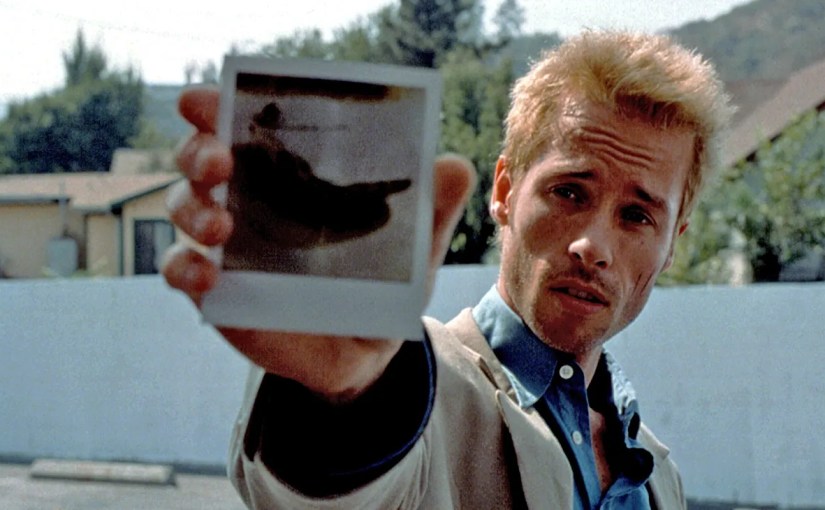
Guy Pearce plays Leonard, but he distinctly remembers that only his wife called him Lenny.  We observe him in two different narratives.  A black and white collection of scenes has him in a hotel room chatting on the phone with an unknown caller.  In modern color, Leonard is wearing a tan suit and driving a dusty Jaguar while traipsing from one place to another.  He’s trying to make progress with uncovering who murdered his wife.  The scenes in color though must be shown in reverse.  In other words, a scene is shown, then it will cut to Leonard back on the phone, and then another scene is revealed showing what occurred literally just prior to the last color scene we saw.

It must be done this way so we can be just as discombobulated as Leonard.  He suffers from a condition where he has no short term memory.  Therefore, if Leonard learns something or meets someone or arrives at a location, he’ll soon forget anything he just encountered minutes ago.  

While he pursues the mystery of his wife’s killer, Leonard tattoos his flesh with notes to help guide him when his short attention span can’t. He also takes instant Polaroids of people he meets and the places he goes.  As quick as he can, he’ll jot a note on the photos to aid him as he carries on.

Memento starts at the end of the story and when the film concludes, the viewer arrives at the beginning.  Perhaps the beginning will explain the end that was shown almost two hours before.

Christopher Nolan had a small budget to work with and the California city locales are nothing dazzling.  There’s little to offer with special effects as well.  So, it is impressive that he uses Jonathan’s idea to create a mystery we want to see resolved where the information we get seems to erase itself as quickly as it is told.

Leonard can’t remember anyone he’s recently met, but oddball cases like Teddy (Joe Pantoliano) and Natalie (Carrie-Anne Moss) certainly remember him.  Are these folks working with Leonard or against him?  Even with seeing the ending first, I could never spoil anything, and you’ll find it hard to decipher what these are these characters’ best interests.  

Nolan exercises some neat visuals to keep you on track.  We see a broken car window before we see how it got shattered.  Leonard can’t recall how that happened.  Leonard is also unable to remember why a bar patron is chuckling at him.  Christopher Nolan maintains well placed book marks to aid the viewer in this story that makes an effort at throwing off its protagonist as well as the audience.

What also helps is that when all the secrets are revealed, at least to the viewer, it’s a pretty solid crime set up that does not come off like a stale Murder, She Wrote episode.  It’s clever, tricky and unexpected.

Guy Pearce is really good in his role that eventually reveals some duality, but that’s where I’ll stop.  Carrie-Anne Moss always seems questionable, but what’s her agenda?  Joe Pantoliano is the sleazy guy with the mustache.  So why is he always turning up in Leonard’s way?

Like his future efforts to come, Christopher Nolan layers his films in great depths of dimension.  It never stops thinking. Often, he answers a riddle with one or two or three more conundrums.  What’s especially appreciative is that he eventually reaches a final answer to all of his questions.  Still, that doesn’t mean he ever would want you to stop thinking about what you ascertained from Memento.

FOLLOWING

By Marc S. Sanders

A young filmmaker scraped up six thousand dollars to make a short movie clocking in at just over an hour called Following.  The writer/director is Christopher Nolan.  While he may have been very limited on resources, his reach for imagination was already infinite at the start of his career.  Following is…well…challenging to follow, and I had to watch it twice to grasp the novel curves in time jumps and twists.  However, on my second go round I enthusiastically applaud its brilliance.  The wrap up to this short film is genius.

Gone for nearly fifty years, Alfred Hitchcock’s attempts at pursuing the questionable temptations that people undergo remain wholly intriguing.  His movies are still watched, studied, referenced, and duplicated.  Most importantly, they inspire filmmakers like Christopher Nolan.  Following leaps into its story with parallels from Rear Window and then segues into brief encounters like Strangers On A Train commits.  Mischief is at play which gradually develops into deceit and maybe murder.

Nolan makes an hour and ten minutes feel like a breezy fast moving two hours.  The script for Following throws a lot of information at you at a fast pace, which is something the famed director continued to do with the majority of his later films.  It’s to your advantage to stay alert and explore what’s shown in every frame.  Much of what comes at you will circle back for a twist or two.

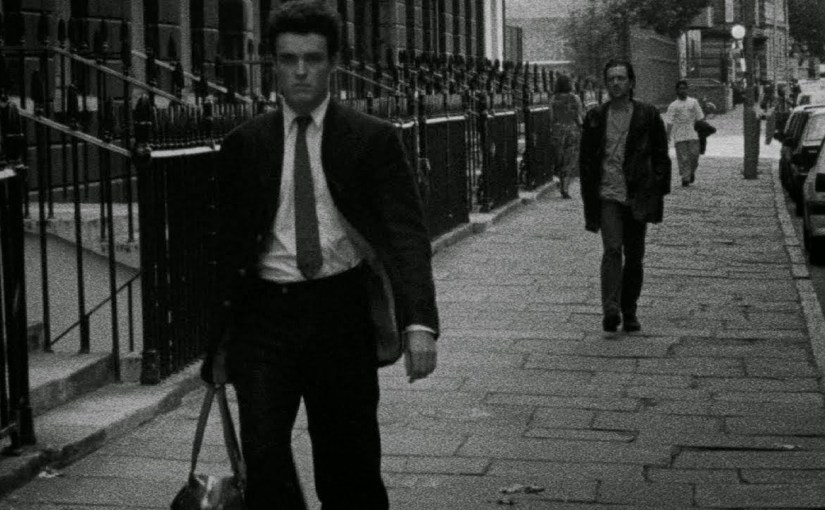
Bill (Jeremy Theobold) is an unemployed writer who occupies his time by simply shadowing random people going about their lives within the streets of London.  There’s no particular reason for his behavior.  He relays to an older man that perhaps he’ll learn or become inspired by what he sees people do during their day-to-day business.  

A man in a suit carrying a large tote bag (Alex Haw) becomes Bill’s latest observation.  Bill keeps his distance and follows the man into a cafe.  As the man gets up to leave, he makes a surprising stop at Bill’s table.  He calls himself Cobb, and he has an unusual habit of his own.

Cobb demonstrates to Bill how he takes interest in learning about random people by entering their flats when they are not home.  He’s not there to necessarily burglarize.  Though he will tease the owners by planting a pair of women’s panties in their laundry or emptying their little box of knick knacks on the desk.  Maybe he’ll hide one earring to turn up later. In particular, he shows Bill how much you can learn about people by looking at how they keep their home, what they collect or what they furnish the place with.  So, how about the gentlemen pop the cork on a bottle of wine and have a chat while they stay a while.

These two strangers build a warped kind of mentality for this behavior, but as Bill becomes more natural at what Cobb has introduced him to, so do the risks become more apparent.

Following has some unusual ideas; the kind that are perverted enough to only see in the movies.  If I were to meet guys like Bill or Cobb at a bar and they started telling me of their derring do, I might excuse myself as subtly as possible.  In Christopher Nolan’s film though, I’m intrigued of what these men gain or how they entrap themselves.  

On occasion, it is hard to follow where the film turns its attention.  There are time jumps that come out of nowhere.  We see Bill with a different haircut.  At another time he has cuts on his face.  His wardrobe is different. Because of the small budget, the editing and cinematography must have suffered making these time jumps feel seamless.  So, on my first watch I was confused and wondered if the movie had some scenes cut or if I dozed off while watching it.  Then again, this is Christopher Nolan who is notorious for not keeping a straight and narrow narrative.  His well-known movies like Memento, Interstellar or Oppenheimer have all of his best tools at play to emulate different periods of time.  Following is presented in black and white and so it’s a challenge to focus on where you are in the story and where you left off.

The second time I watched the movie, it was much clearer to bridge everything together and you recognize when one twist occurs at the halfway mark followed by something else until it reaches its fascinating conclusion where every prop you see or line that was uttered serves their ulterior motives.

Following is a thrilling play on your thought process where one character might be performing a cruel sleight of hand on another.  Do not trust anything you see or hear.

Currently, Following is on You Tube and streaming on TUBI, but I had to watch with some limited commercial interruptions.  I encourage you to deal with it because Christopher Nolan’s first film shows some of the storytelling tricks he’s most appreciated for.  What you see in Memento, The Prestige or Inception was attempted early on with Following.  It was not as flashy, but it was just as inventive and brainy.

At just over an hour, Following is that perfect story to watch just after you’ve crawled under the covers and turned off the lights.  It’s a thrilling bedtime story.

TIGHTROPE

By Marc S. Sanders

The most recognizable cop Clint Eastwood portrayed is of course Dirty Harry Callahan, San Francisco’s finest.  Tightrope introduces a different kind of policeman though.  Wes Block covers New Orleans, and he balances the seedy underworld of crime in and around the French Quarter while being a single dad to two preteen daughters (the elder one played by Eastwood’s real life child Alison Eastwood).

There’s a serial killer on the loose whose victims of choice are ladies who work in the sex industry.  A skeleton in Wes’ closet is his penchant for getting involved in the world of kinky sex for satisfaction.  This killer seems to follow closely behind Wes’ investigation and his personal trysts.  Best he knows about this creep is he wears tennis shoes and he’s likely a Caucasian.  If Wes didn’t know any better, he could be as likely a suspect as the mayor.

Tightrope is a surprising film considering Eastwood’s resume in the nineteen seventies through eighties.  Usually, his tough, quiet persona never emulated weakness or questionable morals pertaining to rough sexual treatment of women.  Tightrope is not an action picture, but it implies ugly portraits of victimization for women.  It does not hold back on the nudity or the peril that the killer’s victims find themselves in.  It’s an uneasy crime thriller that does not compromise.  

On the flip side of Wes Block’s kinky obsessions is a genuine relationship he begins with a woman named Beryl (Geneviève Bujold). She specializes in helping women protect themselves from rape attacks as well as recovery.  The two have a good chemistry that begins with different interests with sex crimes. Later, they find a mutual appreciation for one another.  Wes might carry shame and fault, but considering Beryl’s background she might be the only grown woman who understands his personal demons.

What I like about this section of the story is that Wes and Beryl’s relationship does not rush itself.  He has an armor that covers his weakness.  She has a bold strength and will not be intimidated.  In order for them to connect, they’ll need to alter their nature when it comes to affection and respect.

There’s also a good dynamic with the two daughters.  To watch Clint Eastwood try to maintain composure while explaining a hard on to his youngest daughter is both hilarious but also stands for another conflict for this protagonist with a checkered background.  This is a different kind comedy routine than his prior connections with an orangutan or a bulldog named Meat Head.

I like that his older daughter played by Alison Eastwood offers empathy with little dialogue.  A great moment has her lie down on her father’s back while he’s in an anguished, drunken stupor. A young girl lending comfort to her pained father.

Eastwood lends a convincing portrayal of guy dealing with personal torment as both a parent and a cop.  The more he digs into what makes this psycho tick the more he seems to endanger what could be another victim for prey and even his own children, plus Beryl.

Writer/director Richard Tuggle captures great location shots of New Orleans along Bourbon Street and within the French Quarter, sometimes celebratory and frequently frighteningly lurid.  Jazz trumpets deliver an atmospheric soundtrack.  A lot of cuts, edits and photographic shots seem reminiscent of Eastwood’s techniques. It would not be surprising, especially since he’s a producer, if he sat in the chair behind the camera to bring the film to completion.

Tightrope is a slow burn potboiler with convincingly ugly material.  It’s disturbing but wholly engaging with different reasons for a familiar Clint Eastwood to quietly brood.  The suspense and frustration build as the danger heightens.  This is the kind of movie you watch after midnight when the rest of the household has gone to bed.

ABSOLUTE POWER

By Marc S. Sanders

As Clint Eastwood’s Absolute Power was unfolding I started to think this plays like one of those hardcover bestseller political thrillers from the 90s that my dad would scoop up off of the neatly designed stack at the front of Barnes & Noble.  You know with the glossy book jacket that has the blood stain and a dead girl’s nail polished hand next to a bloody letter opener.  The graphics are elevated to feel the crime scene with your fingertips.  The intrigue is summed up on the inside tab.  You turn to the back of the book to see the picture of the author.  Then you buy it with your membership card.  Go figure!  William Goldman adapted the screenplay from a novel by renowned author David Baldacci. Absolute Power has an engaging set up, a who’s who of a cast, it’s directed, produced and starring Eastwood. Still, it evolves into utter eye-rolling preposterousness.

Eastwood directs his own portrayal Luther Whitney, an expert jewel thief.  He might be getting up there in age but he scopes out the mansion of a billionaire tycoon (E.G Marshall, in his final on-screen role) and locates the vault hidden behind a large two-way mirror.  Everything is going to plan as Luther bags up the valuables and a lot of cash but then a drunken couple enter with Luther hidden behind the mirror to watch their tryst turn deadly.  The President of the United States (Gene Hackman) avoids being stabbed to death by the young lady (Melora Hardin) when his secret service detail (Scott Gleen and Dennis Haysbert) enter to shoot the girl dead.  The President’s Chief of Staff (Judy Davis) arrives soon after.  Luther observes the four as they rush the Commander In Chief out of the house and alter the crime scene.  They get careless and just as Luther makes a quick exit, he retrieves evidence that will hopefully work to his advantage.  Now he’s in danger of the President and the other three as they work to permanently contain the situation.

Elsewhere is Ed Harris as the detective out to solve the murder and uncover everything we already know.  When he realizes a thief must have been at the scene of the crime, he actually approaches Luther for some guidance as to who could have been there.  Later, he will use Laura Linney, playing Luther’s daughter, for assistance as her father seems to be the prime suspect. 

The tycoon, the President’s biggest supporter, also wants to resolve his personal vendetta by hiring his own sniper (Richard Jenkins) to take out Luther. 

Absolute Power has all of these players, with recognizable actors in the roles, and yet cannot work the magic necessary to fix this outrageous conundrum.  I can believe that a President could get in more trouble than he needs with a one-night stand and a dead girl on the floor.  I can believe members of his staff will work to tie off all the loose ends, even if it means more murder and mayhem must occur. 

What is hard to swallow is how neatly the story wraps up literally within one afternoon leading into an evening.  It’s fortunate that window washers are present to throw off a couple of snipers with an inconvenient glare at the most inopportune time.  Otherwise, there will be no more movie.  It helps that a character with remorse happens to take his own life, thus exposing the conspiracy, just as Eastwood’s character is steering his own way to exoneration.  All in the same night!!!!

To ramp up the suspense, the bad guys go after Linney’s character, the one person Luther cares for the most.  She ends up in a hospital.  Message has been sent.  Luther better surrender himself along with what he knows to the President’s squad.  Yet, they try one more time to permanently eliminate her and I asked why.  What purpose does that serve to kill her now?  If you kill her, then Luther has nothing to protect or care about anymore.  He can just reveal the entire breakdown of what really happened complete with evidence and so on.

A few years earlier, Eastwood starred in In The Line Of Fire where John Malkovich played a master of disguise assassin.  Luther is also a craftsman at hiding in plain sight.  However, there’s no way I can believe that.  We are looking at Clint Eastwood here.  He’s got his own unique and very tall and square stature.  Put a white mustache and a pair of glasses on the guy, and it is still Clint Eastwood.  Put a hat and beard on him and it is still Clint Eastwood.  Wrap him up in a trench coat and have him walk the city streets in broad daylight where fifty cops are awaiting his arrival and you’ll be able to see the one and only Clint Eastwood.  It just can’t work.  James Bond can hide in disguise.  John Malkovich can hide in disguise.  Go anywhere in the world and Shaquille O’Neal and Clint Eastwood would never be hidden in plain sight. 

William Goldman (The Princess Bride, Butch Cassidy And The Sundance Kid) is one of Hollywood’s most celebrated screenwriters.  He did not think this story all the way through.  You may believe Gene Hackman (second billing behind Eastwood) would have had more of a presence in this picture but oddly enough he’s hardly there. The real bad guy roles belong to Judy Davis and Scott Glenn who are not nearly as exciting as what Hackman could have delivered.

There was a potential for a good conspiracy thriller. The problem is the audience knows too much following the first fifteen minutes of the film.  We know everything that happened and therefore I could care less about the progress that Ed Harris’ detective makes.  Absolute Power likely would have performed better had it opened after the crime had occurred.  Run the opening credits over the dead girl in the room and open the two-way mirror for Luther to enter the frame.  He makes a run for it and then the film can gradually reveal what precisely happened.  A mystery for the characters and the audiences who are watching them only works if the questions are offered before the answers are revealed.

Absolute Power offered a lot of promise with a lot of talent but it’s devoid of both.

THE PLEDGE

By Marc S. Sanders

The Pledge is a moody and bleak crime drama that follows a retired detective’s descent into obsessive madness.

Director Sean Penn opens his film with the gruesome discovery of a murdered nine year old girl found amid the snow covered woods outside a small Nevada town.  She happens to be discovered on the evening of veteran detective Jerry Black’s (Jack Nicholson) retirement party.  Upon receiving word of the crime, Jerry leaves his celebration to explore the scene that is carelessly compromised by the local sheriffs.  His protege partner Stan (Aaron Eckhart) rushes through a possible suspect’s (Benicio Del Toro) interrogation that draws a quick conclusion along with an unnecessary and bloody outcome.

Jerry surrenders his position with the police department, but he’s not entirely convinced the crime has been solved.  He obligates himself to uphold a devout promise he gave to the victim’s parents (Patricia Clarkson, Michael O’Keefe) that he will catch their daughter’s killer.

Time passes and rather than retire into a quiet life of fishing, Jerry purchases an old gas station located within the vicinity of the crime scene as well as nearby where two other murders with similar circumstances occurred.  Jerry is going to wait out the next attempt committed by “The Wizard” or “The Racoon Killer,” and catch him in the act.

The Pledge is a brooding and lonely film.  Sean Penn’s piece offers an impressive list of who’s who actors that appear in small roles to shape out the detective’s progress.  Amidst all of these familiar names in the cast, Jack Nicholson has never appeared so isolated or despondent before.  His character is limited on dialogue.  A thin mustache and a wrinkled complexion with a smoking habit hide any humor or joy.  Jerry Black knows he’s the last capable police detective in this area.  It pains him to abandon his post to the halfwits he leaves behind.

A promise is a dangerous gesture.  If you adhere to it, all obstacles become nonexistent.  Anything will be done to uphold a pledge and conclude your wild theories, even if proof is not conveniently supplemented.   Nothing stands in the way of pledge.  

The second half of The Pledge moves at a slower pace when Jerry welcomes an abused mother (Robin Wright Penn) and her daughter into his home.  A new life seems destined for these three people but at what cost?  Is the hero of this film at least as dangerous as the psychopath that supposedly remains at large?

Would you go to the great lengths that Jerry puts himself through?  Is the expense of his own sanity, and the safety of an innocent woman and her daughter worth this pursuit?

Sean Penn’s film does not operate on suspense. What action there is only fuels Jerry’s chase at a long-shot truth.  It’s a slow burn crime drama that makes the central murder a far second priority to how the initial discovery overtakes the main character.  Again, this kind of mania is a different breed from Jack Nicholson’s other crazed portrayals found in One Flew Over The Cuckoo’s Nest, Five Easy Pieces, or The Shining.  Nicholson is not as vocal or expressive in this role.  Yet, we all know what drives this guy with what few words he uses.

Robin Wright Penn and Nicholson share some effective scenes together. Their motive to be with one another stems from a misery loves company ideal. Good casting here, and throughout the film with small appearances from Helen Mirren, Harry Dean Stanton, Sam Shepard, Vanessa Redgrave, Mickey Rourke, Tom Noonan, Clarkson, O’Keefe, Del Toro and Eckhart.

Sean Penn is very good at creating visual moods to his film. The image of Nicholson standing within the pen of a crowded turkey farm with the anguished parents of the victim is truly haunting. Animals of all kinds seem to emote a cold harshness as well. The first image to appear consists of a swarm of large, winged birds soaring above this backwoods area where the biggest thing to happen is a town parade. Otherwise, as one girl tells Jerry there’s nothing else to do here. This remote Nevada area is unprotected from greater powers, and its only guardian is forced to accept retirement, leaving his community vulnerable. This formerly decorated Marine is now a formerly decorated cop, and the unseen animals-or monsters-still roam.

I won’t spoil the ending which I commend, but there is one moment that Sean Penn includes in the final cut that is objectionable.  For the first time in the picture since Jerry Black accepted the case, one moment near the end of the movie tells the audience everything they need to know while leaving Jerry in the dark.  I think it was a poor choice to go this way.  The audience is going along with Jerry’s pursuit until they are spoon fed a resolution they didn’t earn because Jerry never arrives at this conclusion.  A better route would be to leave the audience in the same dizzying haze that Jerry must live with.  Some hanging threads should be left untied. The Pledge is a pot boiling, well-made and disturbing film, but with minutes to go before the end credits roll, a less is more approach should have been adopted.

MYSTIC RIVER

By Marc S. Sanders

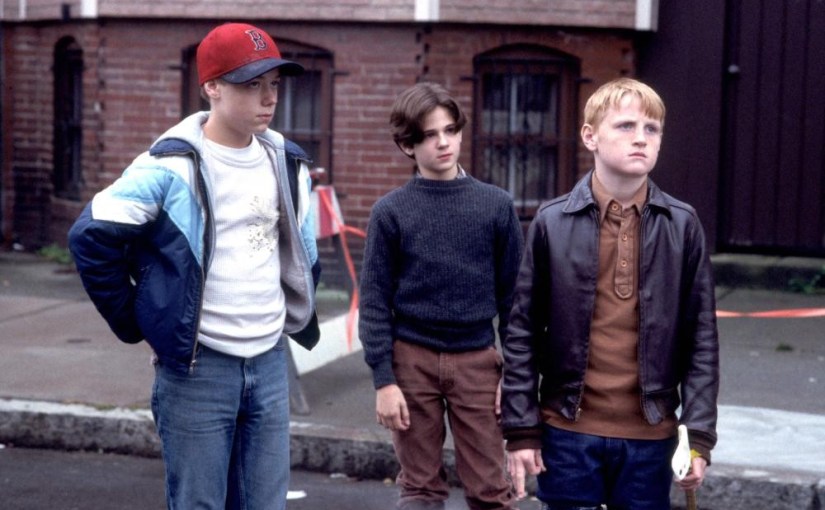
Two crimes, thirty years apart, pave the destiny for three childhood friends during their adulthood, while residing in the same Irish neighborhood of Boston.  Sean Penn is Jimmy, a former criminal.  Kevin Bacon is Sean, a police detective.  Tim Robbins is Davey, who was held captive and molested for four days following an afternoon when the guys were playing street hockey together.  Naturally, Davey was never the same but over the course of events in Clint Eastwood’s psychological crime drama, Mystic River, we learn that Jimmy and Sean likely changed too.

Jimmy’s daughter, Katie (Emmy Rossum), is found brutally murdered following an evening of bar hopping with girlfriends.  Sean and his partner Whitey (Laurence Fishburne) head up the investigation.  While the magnetic screenplay written by Brian Helgeland, based upon the novel by Dennis Lehane, relies on a who done it track, that seems to be less a priority as details unfold for the trio of men.  Jimmy and Davey’s wives (Laura Linney, Marcia Gay Harden) may be hiding some information.  A possible murder weapon invites some curious questions. There’s reason to question Katie’s boyfriend, and Davey’s odd behavior combined with his childhood trauma raises eyebrows as he was one of the last men to see Katie alive.

The less you know about Mystic River the better, but this engrossing cast which earned Oscars for Penn and Robbins, plus a nomination for Harden, is not the only stand out feature.  This film is one of Clint Eastwood’s best directing efforts; definitely one of my favorites.  

First, Eastwood hides many of his characters in dark shadows so the viewer never forgets that all these people have pasts they regret or would rather not resurface.  Sometimes, you hauntingly recognize the silhouettes of Sean Penn and Tim Robbins, each for different and unnerving reasons. Eastwood notably shoots himself this way often when he’s in front of his camera (Unforgiven, Sudden Impact, Million Dollar Baby).  It’s a brilliant photographic strategy that will make you fear or empathize with his flawed protagonists.

Second, Clint Eastwood shoots much of the Boston neighborhood with wide overhead shots in the daytime.  Interiors offer little light no matter the time of day.  Exteriors present the multi floor homes which are easy to see and showcase a labyrinth of crevices, yards and blocks where activity occurs.  

While the title of Lehane’s mystery is hardly spoken until a series of shocking revelations occur at the end, Eastwood ensures the setting of this Boston Irish populace is given much attention.  The more closely located these homes are up against one another, the less apt that any of the residents can truly see what’s going on under their nose.  These people live on top of each other with no room to spread out.  Their nearsightedness is practically blinding.

Furthermore, Eastwood composed the morose soundtrack for this piece. The director seems to speak to the audience because nothing good will likely arrive for any of these folks who grew up together like the generations before them.  Even a colorful Red Sox cap worn by Davey does not offer much cheer or Boston pride.  Eastwood’s musical compositions paint a modern-day setting encased in unimaginable heartache.  

Mystic River is not an easy film to watch.  Yet it’s not gory.  It’s not scary.  It’s the internal struggles of these characters that’s hard to imagine or observe. On the surface Lehane’s story seems reminiscent of most any other crime drama or Law & Order episode of the week.  The challenge is to watch these masterful performances, especially from Sean Penn, Tim Robbins and Marcia Gay Harden.  

We’ve seen moments where the father comes upon the crime scene of a murdered child.  However, Sean Penn delivers this staple with raw, unbearable heartache.  This actor invests his soul into the moment and reminds any one of us, whether we are a parent or child, of how wrenching it is to even imagine losing a loved one to senseless violence.  If I had to ever experience an episode like this, it might just take the entire police force to hold me down too.

Robbins and Harden are husband and wife, who get in over their heads when incidents of surprise occur.  Harden is especially ripped apart with what she knows and what she suspects.  Robbins embraces an inner child who has never outgrown a trauma that stubbornly stays attached to him, even if he’s a loving father.

As difficult as Mystic River is to watch, I’ll return to it on repeat because this cast and crew are at the top of their game.  Dennis Lehane has written other Boston crime stories (Gone Baby Gone with the film adaptation directed by Ben Affleck), particularly involving children, and he recycles his characters for future tales.  To my knowledge, I do not believe he’s ever written a sequel to Mystic River, but I’d love to see what happens to these people after the events of this film unfolded.  

Everything is revealed in Mystic River, except what happens next and I’m dying to know.  

MY COUSIN VINNY

By Marc S. Sanders

The American Bar Association’s publication, The ABA Journal, ranked My Cousin Vinny #3 on its list of the “25 Greatest Legal Movies.”  Surprised?  You really shouldn’t be.  

This “fish out of water” film follows a goodfella who did not pass the bar exam until his sixth try.  Now he’s defending his cousin and another UCLA college kid in an Alabama courtroom.  It’s Vinny’s first murder trial.  So he’s gotta learn the ropes of how to dress properly for court all the way up to discrediting material witnesses and demonstrating reasonable doubt to get his clients exonerated.  It’s a great courtroom picture because within the dense slapstick comedy there are authentic lessons to learn about being a member of the Bar and having confidence in yourself.

Bill and Stan (Ralph Macchio, Mitchell Whitfield) are roadtripping through southern America, en route to UCLA, when they get pulled over and framed for the murder of a convenience store clerk.  With no money or hope of retaining a reliable public defender, the young men turn to Bill’s cousin Vinny.  

Straight out of the five boroughs of New York wearing a black leather jacket, black boots and a slick pompadour, Vinny Mancini arrives in small town Alabama.  You know something?  If I didn’t know any better I’d say he looks and acts a lot like Joe Pesci.  With him is his long time fiancée, Mona Lisa Vito (Marisa Tomei, in her very well remembered Oscar winning role). Mona Lisa Vito!  I love when there’s some thought put into a character’s name.

The future looks grim for the accused as Vinny doesn’t know where to begin.  The iron horse Judge Chamberlain Haller (Fred Gwynne) habitually holds the guy in contempt because Vinny can’t shed his New York ways either in wardrobe or proper decorum. The prosecutor played by Lane Smith really doesn’t have to try hard at all.  Though he deliberately gets all Southern showy each time he faces the jury, made up of friendly locals.  In an unexpected and tender moment, the tough guy, Vinny, admits to Lisa that he’s “a-scared.”

I never cared for My Cousin Vinny since I had seen it in theaters.  However, there’s much I appreciated on only my second viewing of this film directed by Jonathan Lynn, an actual law scholar.  Lynn is always striving for an authenticity within the courtroom.  His protagonist might not know anything about being a litigator, but the director ensures that a genuine regiment of customary courtroom behavior, procedure, and theatrics will be upheld even if this is only a silly, little comedy flick.  

Outside the courtroom, there’s primarily an updated George and Gracie situational comedy at play.  Marisa Tomei is of cinema’s great scene stealers.  Mona Lisa Vito might look like an overly familiar character, but the actress’ performance is entirely unique.  She never plays Lisa as a dumb side character to her boyfriend who will not commit to marriage.  Lisa comes off generous, always offering to assist Vinny despite his rejections.  She’s also positively smart as a whip with her extensive knowledge of automotive repairs, and she’s a quick study of Alabama law.  When she gets put on the witness stand it hardly matters what she’s saying.  Marisa Tomei owns the expertise and defiance of Lisa.  Turn the scene on mute to watch her doing some of her best work would be equally effective.

Go look at Silver Linings Playbook when Jennifer Lawrence rhythmically dictates numeric football statistics at Robert DeNiro.  Both actresses won Oscars for these respective roles.  These performances stand apart from so many other second, third and fourth billed actresses because they are written with immense intelligence.  That’s what Tomei and Lawrence normally embrace first, ahead of costume and makeup.  The confidence from these actors is uncanny.  More women need to be cast in roles like these.  

Joe Pesci is doing his reliable, familiar schtick from Goodfellas, Raging Bull and Easy Money.  He’s in a what if scenario though.  What if there’s a movie with Jersey Boy Joe Pesci, but he’s put in Alabama country with roosters crowing and trains chugging into town at five in the morning? There can even be a communication gap between the Judge and Vinny for some padded laughs.  “What is a yoot?”

I was bored with this movie the first time I saw it.  I just didn’t think the humor was funny even if I recognized the attempts.  Over thirty years later, what I appreciate is the heart that feels much more apparent.  The hero feels weak and at a loss.  Only when he is given strength and support from a wisecracking, sexually frustrated girlfriend does he get the drive to behave like a lawyer he’s licensed to become.  I like Vinny.  I like Lisa.  Therefore, now I can laugh at their unfortunate dilemmas as they work towards an end goal – getting him to do his best at becoming a courtroom lawyer and hopefully reaching a not guilty verdict. 

I gotta give a shout out to the supporting cast.  Bruce McGill plays a familiar sheriff that we’ve seen before, but so what.  It’s the way he carries himself that I’m always welcome to see him in a movie.  Same goes for Lane Smith.  These guys are sophisticated Dukes Of Hazzard.  Fred Gwynne, most famously known as Herman Munster, was always a brilliant character actor.  He has the ability to be goofy and intimidating all in the same scene.  To place his towering stature against little Joe Pesci? Who needs dialogue? Watch Fred Gwynne’s moments in My Cousin Vinny.  He could’ve been Oscar nominated, and I would not have complained.  While Ralph Macchio is doing his typical routines (same things we saw in The Karate Kid, The Outsiders and so on), it’s Mitchell Whitfield playing his buddy who really stands out.  This is a nothing role but it’s as if this guy fell out of a Woody Allen or Neil Simon picture to claim his own territory among an outstanding cast.

My Cousin Vinny is one of those comfort films to put on when the stress is becoming too much in real life.  Everyone is so likable here.  There isn’t a villain to dual against.  Instead, it’s a conflict of cultures who must work together to uncover truths within a murder trial while also learning about what any one of us is actually capable of accomplishing. 

Vinny from da Bronx is a lawya???? 

FUGGETABOUTIT!!!!!

FAREWELL, MY LOVELY (1975)

DIRECTOR: Dick Richards
CAST: Robert Mitchum, Charlotte Rampling, John Ireland, Sylvia Miles, Anthony Zerbe, Harry Dean Stanton, Jack O’Halloran, Joe Spinell, Sylvester Stallone
MY RATING: 9/10
ROTTEN TOMATOMETER: 71% Fresh

PLOT: When a giant ex-con fresh from prison asks Philip Marlowe to find his missing sweetheart, Marlowe winds up entangled in multiple murders, prostitutes, and a sultry trophy wife.


Because it was released only a year after Chinatown (1974), it is tempting to compare Farewell, My Lovely to that landmark film noir, but although they are in the same genre, the two films are apples and oranges…or at least apples and pears.  Both feature hard-nosed private eyes accepting cases that turn out to be more complicated and far-reaching than they appear, both feature multiple unexpected deaths, and both feature curvy, smoky-eyed dames with dangerous secrets and aging husbands.  All true to the genre.  But Chinatown breaks (successfully) with film noir in several key areas, while Farewell, My Lovely achieves its lofty heights while still remaining faithful to the bedrock tropes of vintage film noir, right down to the tired voice-over narration from the hero.  I have no idea how faithful it is to the Raymond Chandler novel by the same name, but if the book is half as entertaining as the movie, I may have to track it down and give it a read.

Robert Mitchum plays legendary gumshoe Philip Marlowe, the third version of the character I’ve ever seen after Humphrey Bogart (The Big Sleep, 1946) and Elliott Gould (The Long Goodbye, 1973).  Compared to the other two, Mitchum is by far the most shambling version, but I mean that in a good way.  We first see him staring out of a rundown hotel room in downtown Los Angeles, some time in 1941.  We know the timeframe because of a calendar here and there, and because Marlowe is obsessively following Joe DiMaggio’s progress, as he is on the verge of breaking the record for hits in consecutive games.  That’s a nice touch.  Marlowe’s world-weary narration plays over Mitchum’s sagging face and drooping cigarette, and the spell is complete: we are in the hands of one of the great genre pictures, from a story by one of the greatest mystery writers of his generation.

Marlowe’s story starts as a flashback, a story he’s relating to similarly-weary Lieutenant Nulty (John Ireland).  See, it all began when Marlowe was tracking down a rich family’s runaway daughter.  Soon thereafter, “this guy the size of the Statue of Liberty walks up to me.”  This is Moose Malloy, an ex-con fresh out of the slammer after serving seven years for armed robbery and making off with $80,000, which was never recovered.  Moose is played by Jack O’Halloran, whom cinephiles will recognize immediately as the overly large/tall man who played Non, the mute superpowered henchman in 1980’s Superman II.  To see this man actually string words together into sentences was a strange experience, but I eventually got used to it.

Moose wants Marlowe to find his sweetheart, Velma, who hasn’t written to him the last six years of his stretch.  Next thing you know, someone takes a potshot at Moose on the street, Moose winds up killing a guy in a bar, and Marlowe follows Velma’s trail to an insane asylum, and that’s still just the tip of the damn iceberg, because now there’s this guy who wants Marlowe to help deliver $15,000 in ransom to some other guys who stole a jade necklace…and we STILL haven’t seen the rich trophy wife yet.

And round and round it goes.  I have seen other films that attempted to combine this many plot threads and they wound up a jumbled mess.  Not this movie.  Farewell, My Lovely skillfully walked that tightrope and held my interest all the way through.  I was never lost, never confused…except for a couple of places where the soundtrack obscured a word or two, but I don’t know if that’s the soundtrack’s fault or the actors for mumbling too much.  Plus, this movie contains one of the single greatest interrogation sequences I’ve ever seen, starring Marlowe, two thugs, and the madame of a whorehouse.  It starts semi-normal, escalates with a shocker, then tops the first shocker with something I didn’t think even a hardcase like Philip Marlowe would do.  But the more I watched this movie, the more I got the sense (whether it’s true or not, I don’t know) that this Mitchum version of Marlowe is truer to the literary Marlowe than we ever got previously, in terms of Marlowe’s principles.

I should also mention the dialogue, which contains some of the best one-liners and comebacks I’ve ever had the pleasure of listening to.  For example:

  • Marlowe describing a large house he’s driving up to: “The house wasn’t much.  It was smaller than Buckingham Palace and probably had fewer windows than the Chrysler Building.”
  • Marlowe on his billing practices: “I don’t accept tips for finding kids.  Pets, yes…five dollars for dogs, ten dollars for elephants.”
  • Marlowe describing the obligatory femme fatale (Charlotte Rampling): “She had a full set of curves which nobody had been able to improve on.  She was giving me the kinda look I could feel in my hip pocket.”
  • Marlowe when the femme fatale asks him to sit next to her: “I’ve been thinking about that for some time.  Ever since you first crossed your legs, to be exact.”

Dialogue and lines like this are dangerous because they have been the targets of so many parodies for so long that modern audiences may have forgotten how to take them at face value.  But in Farewell, My Lovely, it comes off perfectly as a tribute to the classic noirs of the 1940s and ‘50s, a tip of the hat to the giants of the past.

Conversely, this movie also reminded me of many of the best eighties thrillers I remember watching, which is ironic considering it was released in 1975.  Movies like Body Heat and Jagged Edge and Silverado, whose purpose for existing seemed to be just to tell a freaking awesome story, unburdened with subtextual layering but laden with style and wit and intelligence, paying homage to their cinematic ancestors by emulating them without plagiarizing them.  There are no doubt film historians who could analyze this film scene by scene and explain exactly what the filmmakers were really trying to tell us underneath the ingenious dialogue and intricate plotting.  But even if I knew or understood all of that, I maintain the best reason for seeking out and watching Farewell, My Lovely will always because it’s just a damn good movie.

(…if for no other reason because of that interrogation scene…I had to rewind it a couple of times just to get my shocked laughter out of my system…)

THE PUBLIC ENEMY (1931)

by Miguel E. Rodriguez

DIRECTOR: Willam A. Wellman
CAST: James Cagney, Jean Harlow, Edward Woods, Joan Blondell
MY RATING: 10/10
ROTTEN TOMATOMETER: 100% Fresh

PLOT: An Irish-American street punk tries to make it big in organized crime during Prohibition.


Having just finished watching Little Caesar (1931) a few days ago, I popped in The Public Enemy, expecting more of the same, if I’m being honest: a fledgling gangster picture, rough around the edges, not spectacular, but historically important.  I could not have been more wrong.  Where Little Caesar at times seemed to be going through the motions, The Public Enemy crackles and sizzles and pops off the screen, still capable of shocking and surprising me nearly a century after it was released.  If that’s not the definition of a masterpiece, well, it damn sure oughta be.

James Cagney gives one of his most indelible performances as Tom Powers, a kid who grew up tough with his best friend, Matt Doyle.  We meet them first as kids in 1909, raising a little hell, teasing Matt’s sister, disdaining Tom’s goody-two-shoes older brother Mike, and learning to treat the law and police officers as a necessary evil.  They supplement their income by stealing watches and giving them to a small-time hood, Putty Nose, who gives them a pittance and treats them like Fagin treated Oliver Twist.  Six years later, they’ve grown into young men (Matt is played as an adult by Edward Woods) who are still in league with Putty Nose, but when a planned theft goes awry, Putty leaves Tom and Matt dangling and wishing only for revenge.

(I enjoyed this back-story approach, as opposed to Little Caesar, which by comparison feels like it plunks us into the middle of a story already in progress and wastes no time waiting for us to catch up.  I know I probably shouldn’t critique a movie by comparing it to another, but I can’t stop myself, sue me.)

It’s during this botched robbery that we get the first glimpses that this movie will pull no punches when it comes to violence, or at least as much as it could in 1931.  A fleeing accomplice is shot at least twice in the back by a patrolman.  He chases Tom and Matt into a dark alley.  We see gunshots flare in the darkness with no clear idea of what’s happening.  Tom and Matt reappear, toss their guns away, and run off…and in a poignant button to the scene, we see a close up of the patrolman’s gun hand lying lifeless under a streetlamp.  We see nothing graphic, but we know exactly what’s happened.  The Public Enemy will use this device many times throughout the picture, to great effect.

Time passes.  Tom’s older brother, Mike, enlists in the Marines for World War I.  No love is lost between the two of them when Mike learns of Tom’s criminal activities.  When Prohibition is enacted, Tom and Matt get even more involved in those activities, working for a sharply dressed mobster, “Nails” Nathan.  They start making more money, buying fancy new cars and clothes.  (One of the funnier scenes occurs when Tom is getting fitted for a custom suit by a tailor who is so far in the closet he’s finding Christmas presents from 1889.)  They meet a couple of molls, which leads to the famous “grapefruit” scene that had women’s groups up in arms…maybe it still does, I couldn’t say.  And they get better at their jobs, in deeper with the mob, and suddenly…

But I’m summarizing again.  That’s how this movie has gotten to me.  I am so enthused about it that I want to shake people by the collar and say, “If you love gangster movies, don’t make the same mistake I did by not seeing The Public Enemy until I was [age deleted]!  It’s sensational!  Here, let me tell you about it…”

Director William A. Wellman (The Ox-Bow Incident, 1942) displays a directorial style that, to my untrained eye, transcends the era in which he was working.  Made in 1931, it feels like it was made ten or fifteen years later, in the vein of the best films of Wilder or Hawks.  Martin Scorsese even calls it “the birth of modern movie acting,” and it’s hard to argue with him when you’re watching Cagney command every single second he’s onscreen, whether he’s whispering sweet nothings into a girl’s ear or playfully chucking his mom on the chin or contemplating gruesome violence as his face twists into an evil grin.

I feel it necessary to mention once more the shocking violent acts perpetrated during the film.  Again, we rarely actually see the violent acts themselves (like the infamous ear scene in Reservoir Dogs [1992]), but that just makes them land even harder.  The camera either tracks off the impending scene or stays behind while gunmen march into another room, leaving us to hear the violence instead of seeing it.  It’s practically Hitchcockian, and it’s perfectly executed.  This method makes the film feel even MORE modern.  Re-shoot this movie, shot for shot, line for line, with all of the tools available to the modern filmmaker, and it would still work, even in a world where Goodfellas and The Untouchables exist.

So, run, don’t walk, to either your friendly local streaming service or to your favorite online retailer and buy or stream The Public Enemy today.  And don’t thank me.  Just promise to tell YOUR friends how awesome it is.  Because it really, really is.