KISS KISS BANG BANG (2005)

By Miguel E. Rodriguez

Director: Shane Black
Cast: Robert Downey Jr., Val Kilmer, Michelle Monaghan
My Rating: 9/10
Rotten Tomatometer: 85% Certified Fresh

PLOT: A murder mystery brings together a private eye (Kilmer), a struggling actress (Monaghan), and a thief masquerading as an actor (Downey Jr.).


Kiss Kiss Bang Bang is so good, it’s a total freaking mystery how this same director, Shane Black, wrote and directed one of the worst movies I’ve seen in the past 20 years: 2018’s The Predator.  Just had to get that out of the way.

I envy you if you haven’t seen this movie yet, because one day it’ll be on Netflix or something, and your curiosity will get the better of you, and you’ll experience for the first time one of the great comedy mysteries ever written.  The dialogue flies faster than an episode of Gilmore Girls, so prick up your ears and stay on your toes, cause this train waits for no one.  The laughs are big and genuine.  The surprises are legion.  The mystery itself is a bit of a head-scratcher the first time around, so maybe watch it again, and you’ll get it.  Trust me…you’ll want to watch it again.

Downey Jr. and Kilmer exhibit the kind of unforced chemistry that deserves comparison to Newman and Redford.  If they decided to stage a two-person show consisting of nothing but the two of them interrupting each other, I’d pay to see it.  The actor in me gets a rush watching them play off each other, with Kilmer tossing off some of the great movie insults of all time.  Example:

Harry (Downey Jr.): “Do you think I’m stupid?”
Gay Perry (Kilmer): “I don’t think you’d know where to put food at, if you didn’t flap your mouth so much. Yes, I think you’re stupid.”

The screenplay is just one of the many delights of this movie.  It’s full of “meta” scenes and dialogue.  A scene occurs, and the movie pauses while the narration tells us, “That is a terrible scene.  Why was it in the movie?”  Or the movie is clicking along and suddenly it pauses again and the narrator tells us, “Oh, s**t, I skipped something!  That’s bad narrating.”  Brilliance.  To paraphrase Bugs Bunny, they do that kind of thing all through the picture.

Kiss Kiss Bang Bang utterly flopped in 2005, grossing a paltry $4.2 million domestically, against a $15 million budget.  What the heck happened?  You’ve got charismatic leads (especially Downey Jr., who was, even then, starting to resemble the Tony Stark we know and love), a beautiful femme fatale (Michelle Monaghan, hubba HUBBA), an intriguing mystery, lots of laughs, surprises galore, a snarky screenplay…this should have been a hit.  Did Warner Bros. refuse to advertise it?  Or did they advertise it incorrectly?  (20th Century Fox did that with Fight Club.)  Was it – gasp! – too smart for the general public?

Who can say?  Regardless of box office performance or name recognition, Kiss Kiss Bang Bang will always stand, for me, as one of the greatest comedy mystery meta-noirs of all time.  (Of course, with that many genre tags, it may BE the only one of its kind…)

QUICK TAKE: Thank You for Smoking (2005)

By Miguel E. Rodriguez

Director: Jason Reitman
Cast: Aaron Eckhart, Maria Bello, Adam Brody, Sam Elliott, Katie Holmes, Rob Lowe, William H. Macy, Robert Duvall
My Rating: 9/10
Rotten Tomatometer: 86% Certified Fresh

PLOT: Nick Naylor (Eckhart), Big Tobacco’s chief spokesman, spins the facts on behalf of cigarettes while trying to remain a role model for his twelve-year-old son.


I’ll keep this one brief.

There is a LOT to unpack in this movie: satirical effectiveness, logical arguments, debate about an intensely divisive topic.  And no, I’m not talking about race, I’m talking about cigarettes.

A full discussion would run a full twelve inches down this page.  Don’t wanna do that.

I’ll just say that this is one of the funniest, sharpest satires I’ve ever seen.  It makes a good guy out of the chief spin doctor for an industry that kills, quote, “two jumbo jet plane loads of men, women and children” a DAY.  (That’s from the film, not actual research, so take it with a grain of salt.)  It demonstrates how the art of deflection during an argument can be perfected to prove virtually anything.  It’s a commentary on both the pro- and anti-smoking movements, and how they’re both right, and they’re both wrong.  (That’s right.  I said it.)  It advocates choice over blind obedience.

And it’s funny, funny, funny.  Another one of those movies designed to be discussed afterwards in conversations that could NEVER be contained within the words of any movie review I could write.  Just take my word for it.  You won’t regret it.

PULP FICTION

By Marc S. Sanders

No one can deny that Quentin Tarantino’s classic film, 1994’s Pulp Fiction is one of the greatest screen accomplishments of the latter half of the 20th century. It’s strange, lurid, scary, unforgivingly funny and altogether different from practically anything that came before it. How did the Weinstein brothers with Miramax films prophesize the energy it would surge in mainstream audiences?

When I first saw the film I was apprehensively going with two college friends who insisted I see what they experienced from a prior viewing. Suddenly, I realized that alternate surf 70s rock, black suits, and a kinetic visit to the restaurant known as Jack Rabbit Slims could entertain and make me look further than just a facial close up.

Tarantino entertains the lens of his camera by making his audience the camera. A drug dealer scrambles to find a medical book to awaken a boss’ wife who is dying from a potent heroin overdose, and the camera stands in place only frantically swinging left and right. The camera doesn’t move while everyone in the scene remains in a panic, frightened of administering an adrenaline shot. The camera stands still to allow the audience to stand in the room as well. It’s very unusually funny, but unnerving and suddenly we are amid the clutter of crime and drugs frightened of a terrible fate.

Another scene follows two gangsters down the hall as they debate whether a foot massage equates to fellatio on a woman. They look serious as they earlier regretted bringing shotguns to their destination but here they are having a debate likely reserved for men’s locker room talk. Is a foot massage really worthy of dropping a guy out of a four story window into a glass enclosed garden below? I mean, apparently the poor guy developed a speech impediment.

Tarantino used Pulp Fiction as an excuse to show how criminals inadvertently lead their lives to the unexpected, beyond a cliché cop bust. Two guys might be settling a personal vendetta, but somehow get interrupted by a redneck gang rapist and his chained up “gimp.” Two other guys might be trying to deliver a briefcase and yet somebody’s brains splatter all over the inside of a car. Another guy might have left behind a family heirloom gold watch as he and his girlfriend run for their lives, or they might suddenly acknowledge a moment of clarity when death seemingly walks out of a bathroom door.

Some might not agree but I always consider Tarantino’s colorful film characters to be rather two dimensional. What you see is all you see. There are no hints at an underlying motivation or a background to anyone you meet in Pulp Fiction, or any of his other films. Normally, that’s a negative in my book but with Quentin Tarantino it is what’s expected. He’s a masterful script writer of the situation. A well known fan of kung fu and lurid crime movies of the B variety, gangsters like Vincent Vega, Jules Whitfield, Marsellius Wallace, Butch Coolidge and Winston Wolf (even the names are entertaining) get caught up in just a random moment in time. Beyond the incident nothing else matters, and just to make it fun Tarantino uses his favorite editor, Sally Menke, to scramble everything out of order. I like to think the script was assembled this way to demonstrate that what happens in one instance doesn’t reflect what happens in another. Every brief moment is bookended. Again, two dimensional characters who don’t reach an intended karma. It doesn’t matter what’s been done before or what will be done next. It only matters in the moment.

The cast is great. Likely, you know who all the players are by now. The best compliment is that they obviously listened closely to the director’s vision. They spoke his language which had yet to be very mainstream before this film’s release. They are a pioneering cast of great talent and many owe quite a bit to Tarantino for jump starting and reviving their careers.

Pulp Fiction is a rousing expedition in sin and surf music symphony with endless quotable and un-PC dialogue that revolutionized filmmaking and brought about risk taking movie makers. It’s just exciting and fun and wild and it especially became a favorite upon seeing one of my favorite kinds of scenes-a dance sequence. If you incorporate dancing into a non musical film, you’ll likely win me over.

Spoiler alert: Vincent & Mia win the dance contest, and right they should. Chuck Berry’s “You Never Can Tell” became that other popular film song once Pulp Fiction hit the scene.

Thank you Quentin Tarantino.

GOOD BOYS

By Marc S. Sanders

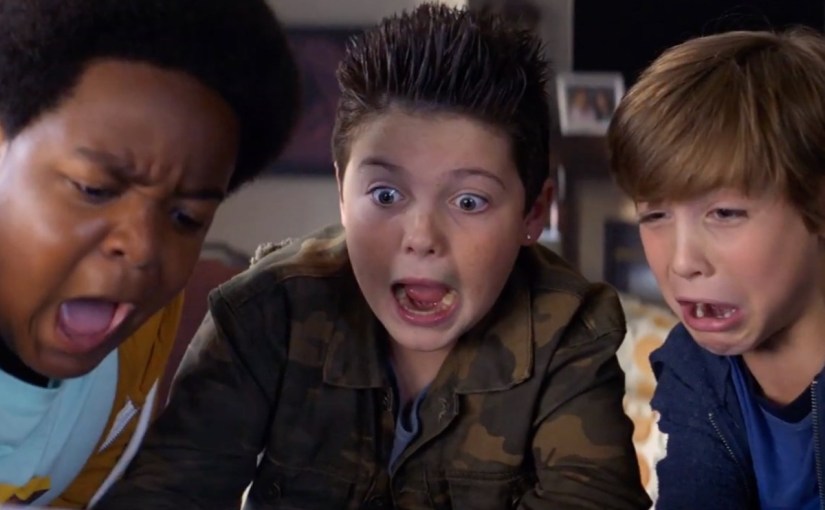
Jacob Tremblay, Keith L Williams and Brady Noon are the sixth grade Good Boys, a film directed and co-written by Gene Stupnitsky and produced by Seth Rogen and Evan Goldberg. This is a hard (very hard) R rated kids comedy adventure. Call it a prequel to Superbad.

Before sixth graders become aware of beer pong parties, the most important thing on their mind is perhaps a kissing party. At least it’s most important to Max (Tremblay). For Lucas (Williams, the MVP of the three kids) he’s broken up to learn his parents are getting a divorce. Thor (Noon, who needs a few more acting lessons) is feeling insecure on a scale of social popularity when all he really wants is to audition for the spring musical.

After Max loses his dad’s valuable drone while the boys are spying on some high school girls in a backyard, they end up stealing their girls’ “mollie” in an effort of blackmail to get the drone back. There’s the spine of the story.

My colleague Miguel E Rodriguez reviewed this film last year. He praised the picture for not making the gags the point of the film. However, I can’t agree with that observation. The thin plot of Good Boys serves as opportunity for one gross out or ridiculous gag after another. Okay. So the boys are unfamiliar with sex toys, particularly “a-nahl beads” or they mistake dad’s sex doll for a “CPR” doll. So when Max practices kissing on the doll, he’s confused as to why the lips feel so sticky.See, I found the main story to be getting the drone back before Max’ dad discovers it’s missing. So then why must I be subjected to imagining how much the beads smell like shit? Why must I see the kids try to cross a busy highway to get to the mall? These are detours, away from the plot. Yeah, they’re funny, but as funny as they are, they push me away from the ends that will justify their means.

An epilogue features one of the kids faking a snort of cocaine. Why? Miguel: these are set up gags. These are exactly the opposite of how you describe their ultimate purposes. None these jokes serve the plot. When I watch “The Goonies,” I get kids who pursue a chance at obtaining a treasure. The mission gets held up by booby traps. Those traps serve as obstacles to the mission at play. Anal beads and a sex doll are not obstacles. They are diversions.

If you want gags to come genuinely from the story then don’t make the mollie or the drone the MacGuffin. Make the sex toys the MacGuffin. These are no more than funny gags. Ultimately, they’re Saturday Night Live skits forced into a film. I laughed yes, but I also grew tired of these bits, that occurred every three to four minutes. What about the drone???? What about the mollie???? I dunno. Maybe with a better trio of boys, I’d be more invested in the film.

Tremblay is the most well known actor (from Room with Brie Larson). Brady Noon is supposed to be the wanna be rebel (he gets an earring), but the sensitive guy on the inside. Williams is the kid who still adheres to good behavior and is not so ready to move on from sleepovers with “Magic The Gathering” card games. Keith L Williams is the best performer of the three in fact. Great physical comedy and timing, as well as some authentic anguish. When the other two boys cry, it’s terribly, TERRIBLY, fake. The problem is the chemistry of three boys is lacking.

Stupnitsky’s coverage of scenes look like rehearsals before the real cameras started rolling. At times, it feels as if the boys, particularly Noon and Tremblay, are trying to think of their next line. When they can’t get the line right, I sense a fast thinking improv that includes shouting the F word. That’s not very funny for very long.

Foul mouthed pre teens are nothing new. Seen it before in The Bad News Bears and once again I say The Goonies. I’m not going to salute Good Boys because these three kids are given carte blanch to utter the F word on an endless cycle. That gets old. Boys uncover sex toys and handle them and naturally act perplexed by what they’ve found; okay, but is there anything more to that?

By no means is Good Boys acceptable for kids to watch. On the other hand, those that can watch a hard R rated flick like this might get a little tired of its material. I know I did. So then who is this film really aimed for? Best guess I could come up with would be a guy I know named Miguel E Rodriguez.

LATE NIGHT

By Marc S. Sanders

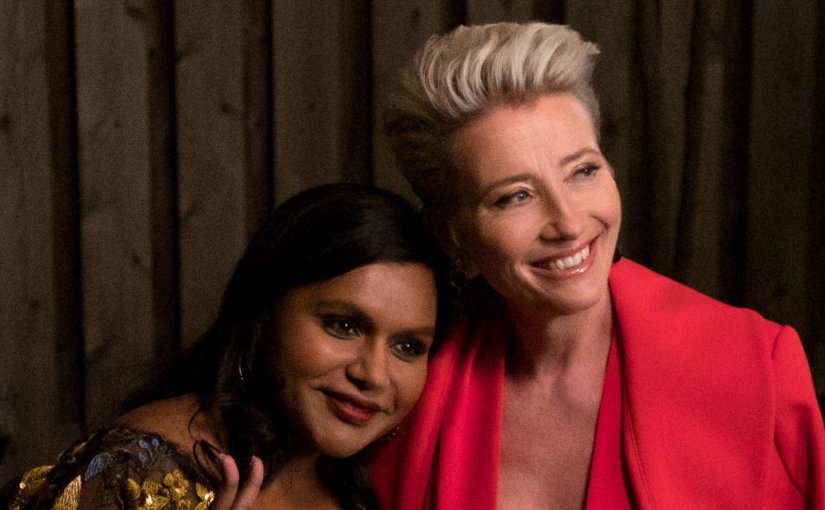
Mindy Kaling is a terrific writer. I first discovered her on The Office, where she scripted many of the best episodes as well as performed in front of the camera. She’s hilarious. She wrote and produced the film Late Night from 2019, and while I think it’s incredibly smart with ideas on prominent female identities and the status quo of race and gender within a fictional late night television industry, it does not forgive itself for wrapping up its ending in a pretty, pink bow.

Emma Thompson is fierce as Katherine Newberry, a late night network tv host approaching 30 years in the business. She’s become a staple for the 11:30 slot, even if she hasn’t kept up with the times of Twitter and You Tube. The network is ready to cut ties with her as she has become too outdated with her material, the guests she has on, and whatever semblance of a routine she’s awarded from her team of writers, that are all white males that might not have outgrown their fraternity years but only now complain about their miserable married or single lives. It’s brought to Katherine’s attention that she doesn’t like women. To mix it up, she demands her office manager hire a woman, any woman, immediately.

Enter Mindy Kaling, as Molly Patel, with zero experience in writing or television who leaves her job at a chemical plant. Like all office films that always seem to take place in New York, the new person does not get on great with the boss, endures some humiliation, cries, but then gets a brave epiphany that catches the boss’ attention out of nowhere. Molly writes a funny pro choice/anti Republican joke for Katherine’s monologue. It eventually goes over swimmingly.

A well acted side story occurs when we get to see some pains that Katherine has while living with her loving husband, Walter, played by John Lithgow, who has Parkinson’s disease. They have some outstanding scenes together. So while the Katherine Newberry with the tough exterior works her writing team to the bone to save her reputation and show, she is also dealing with a terribly sad domestic life. Unfortunately, a one time affair that she had with a writer unnecessarily creeps its way into the film. When it becomes material for public tabloid, her show is all but dead. Now by and large, Late Night is a comedy, so how do you think this film will end? Happily of course.

I don’t take issue with a happy ending. I love them, and it’s often why I go to the movies to escape. However, this is the cutthroat business of television. Shows get cancelled frequently. Kaling’s script even demonstrates that with the network president. As well, Katherine’s demeanor demonstrates this when she fires a writer simply for asking for a raise and to spend more time with his kid. Throw in a couple of lines, however, give a monologue from the heart for your audience and suddenly the show is saved! I wish it would work this way but I doubt it really does.

Another angle the film explores is Molly as an Indian American woman intruding upon a white male dominated occupation. The story had me convinced that she overcomes these demographic obstacles. I bought it. What was hard to accept was the “one year later” epilogue where the show’s staff is made up of every variation of gender and race demographic imaginable with Thompson’s character doing a quick walk through the office to the studio. Every desk is occupied by a different looking person. How touching…and unconvincing. Again, I wish it was that easy to flip a perspective on an office staff, in just one year. Yet I don’t think it’s all that simple. This is where Kaling’s script is pandering way too much.

The performances are excellent. Kaling and Thompson have great scenes together. Lithgow with Thompson as well. Following the reveal of the affair, there’s a magnificent scene between them where they come to a resolve. Only, I think this moment belongs in another film. The affair storyline is not correlated enough to the rest of the picture. I would have abandoned it altogether and simply focus on Katherine, Molly and Walter’s struggles; surviving the business, entering the business and living with illness. The affair intrudes on the last act of the film and as soon as it bleeds, Kaling’s script patches it up too neatly. Thus, we get a happy ending that just doesn’t feel very authentic.

Mindy Kaling needs to work even further. I think she’s one of the brightest writers I know of today. She writes what she knows; about working in television and being an Indian American woman thereby bringing those facts about her background as new strengths for storylines. She only now has to be careful about not patching up the conflicts she masterfully creates with simply a cherry on top. She might turn the APPLAUSE sign on for her audiences, but that is not necessarily going to get the crowd on their feet and clapping.

THE BEST LAID PLANS

By Marc S. Sanders

Michael LiCastri writes and directs The Best Laid Plans, a film shot on location in Tampa, Florida and available on Amazon Prime – https://smile.amazon.com/Best-Laid-Plans-Linnea-Quigley/dp/B07P83YB6K/ref=sr_1_1?keywords=the+best+laid+plans&qid=1580527934&rnid=2941120011&s=instant-video&sr=1-1

LiCastri also headlines the cast as Kevin. When Kevin’s parents are threatened to be evicted following losing their jobs, he recruits Allen and John (David Plowden, Keith Surplus) to carry out ridiculous schemes to get the money he needs fast. Naturally, the first thing to come to mind is to become a pimp.

A winning sequence has the boys do a little research to play their new roles. A trip to Ybor City has them observe a toughie pushing around one of his girls (Yvelisse Cedrez in a ditzy scene stealing role). The moment discourages them from following through with the plan.

Next up, how about kidnapping Tommy (Brian Ballance) a former friend who has won the lottery. Ballance plays the role smart with biting sarcasm and wit that becomes a challenge for the trio.

Bridging this comedy together is a lot of small talk inside dialogue like references to Buffy, and Dancing With The Stars, and an analogous reference to Jessica Alba and what she could do if she gets caught. As well, I think this is the first time I’ve ever seen a dick shaped bruise on a character’s thigh. Watch the film to understand why it’s featured. The efforts in making the film is reminiscent of Kevin Smith’s early films like Clerks and Mallrats.

The schemes of our three main heroes are absurd and it lends to the comedy. The dialogue doesn’t necessarily flow naturally though. It’s a little too stilted to appreciate. The delivery needs work.

Objections aside, LiCastri and his crew must not stop with their filmmaking efforts. The script for The Best Laid Plans has the seeds of something fun, but LiCastri’s script comes off like a first draft. It needs a second set of eyes to make it grittier or maybe sillier. Something to make it more outrageous in one direction or another.

It’s a good, short film, even if there’s a better interpretation waiting to present itself.

THE LAUNDROMAT

By Marc S. Sanders

Steven Soderbergh gets a little too inventive in his delivery of revealing “The Panama Papers,” in his new film The Laundromat now showing on Netflix.

His film is too convoluted deliberately to drive home the point of shell company, laundered fraud within the world. As such, it makes it very challenging to comprehend every point crammed into his short 90 minute film.

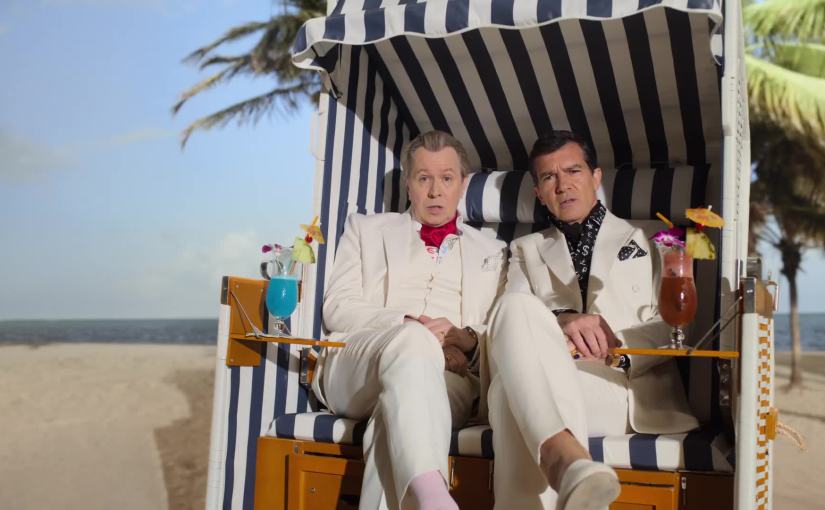
The two Panamanian attorneys behind the scheme, Mossack & Fonseca (played with great duet chemistry from Gary Oldman and Antonio Banderas) narrate the film by introducing different ways in which a shell company valued at everything on paper but tangibly nothing from an actual monetary standpoint.

Primarily, it focuses on Ellen Martin (Meryl Streep) a driven senior citizen who learns the truth of the plot when insurance does not compensate following the tragic accidental drowning of her husband on a boat tour.

Streep is brilliant as always. Such a natural with her monologues and her seemingly useless efforts to gain restitution for her loss.

The whole cast is excellent but the intentional confusion behind the story falls short of satisfying entertainment or enlightenment. I needed some moments where Soderbergh would give it to me straight. A diagram or a graph might have helped.

With The Laundromat Steven Soderbergh fails at becoming the next Jay Roach (The Big Short and Vice). Imagine if Roach actually got his hands on this script. Then there’d be a lot more buzz about this film. Oh well.

ONCE UPON A TIME IN…HOLLYWOOD

By Marc S. Sanders

There’s no question the most different of Quentin Tarantino’s directorial efforts is his latest film, Once Upon A Time In… Hollywood. Already described as his “love letter to cinema of the late 60s,” his 9th effort also implies the end of the Hippie Era by devoting a portion of time to B movie actress Sharon Tate, infamously murdered by Charles Manson’s followers when she was 8 months pregnant with Roman Polanski’s child.

Margot Robbie plays a near, gorgeous exact replica of Tate. She’s deliberately short on dialogue and I like to believe it’s because Tarantino treasures her as an innocent angel who was loving the atmosphere of Hollywood. She’s preserved of being nothing but likable. She dances with glee in her bedroom in the Hills or in public at the Playboy Mansion. One day she visits the local cinema to see her performance in “The Wrecking Crew” with Dean Martin. Tarantino shoots close ups of Robbie loving her footage as a pratfall klutz while listening to the audience reaction. She’s loving every second of the experience. People love her and she sees the love she has for people. Critics took issue with Robbie’s lack of dialogue. Not me. The performance is all there. Robbie is wonderful to look at with responses of pure happiness and celebration.

The main focus of the film is on Rick Dalton played by Leonardo DiCaprio with a huge range of drama, comedy and well intentioned over acting when Tarantino is wanting to spoof the TV western for fun. We see a collection of Dalton’s work, most especially on the fictional black and white TV western that airs Sundays at 8:30 on NBC (cue Dalton’s cowboy hat close up accompanied with “BONG, BONG, BONG!).

Rick is realizing he’s becoming past his prime. Marty Schwarz, his agent and a producer, played by Al Pacino warns Rick that he’s at a point where he’s only going to be the villain of the week on The Green Hornet and Batman. Rick does not take this well. Using his stunt double pal, Cliff Booth (Brad Pitt) to talk to, Rick is consumed with insecurity and alcoholism.

Tarantino wants to depict an era in Hollywood on its way out. A fictional character like Rick and the well known fate of Sharon Tate symbolize this turning point.

A third example is with Cliff. Rumored to have killed his wife, Cliff has trouble finding stunt work on a set. So he’s happy enough to just drive Rick around in his Cadillac, and fix his antenna. A great moment occurs when Cliff antagonizes a cocksure fist of fury Bruce Lee to a fight. Bruce doesn’t do so well against Cliff. Bruce Lee maybe not be what he once was, or what audiences ever perceived. Times they a changin’.

This is not the aggressive film that Tarantino is mostly known for. It’s primarily calm as we see these characters navigate around Hollywood locals, listening to The Rolling Stones and the Mamas & The Papas, and various product advertisements. Rick and Cliff are suffering a little. Suffering at the loss of what they were and the world they are forced to enter, nor what they are accustomed to. Sharon is ready for what’s next. Yet, will she get the opportunity to carry on?

The ending is bound to leave people divided. It’s different and very, very unexpected. It makes no difference how you feel about it. What matters is if it generates a response, and based on the theatre where I saw the film, yes! Yes, there is a massive response to what occurs.

Tarantino’s Once Upon A Time In… Hollywood is not his best film. There were moments where I thought it was a little slow and the film lacks the dialogue punch that many know Tarantino for. There’s really not one memorable line that stayed with me. I guess that’s what the trade off is when you finally are served multi dimensional characters that Tarantino has hardly offered before.

It’s the best non Tarantino film that Quentin Tarantino has ever directed.

BIRDS OF PREY

By Marc S. Sanders

Margot Robbie is a champion actress. Just look at Bombshell (I thought she was more memorable than Oscar winner Laura Dern.). Look at I, Tonya. (I thought she should have won the Oscar that year.) Harley Quinn? She’s perfect in the role as a ditzed out, mallet carrying party gal villain turned anti hero from the Batman universe. Only problem is that as good as she is in the role, I can’t stand Harley Quinn. This is a child who just won’t sit still.

Robbie takes on her second turn in the role following the abysmal Suicide Squad. This time she produces Birds Of Prey (and The Fantabulous Emancipation of One Harley Quinn). It’s an improvement from Squad but it still seems to be all over the place. It happily acknowledges that it time jumps and corrects itself. It is happy to drop F bombs because the producers wanted a R rated female driven equivalent to Deadpool. (It never had to be Deadpool.) It even goes in rewind mode (you know, with the cassette tape sound) because the viewer or the fans of Harley need to experience the lunacy of Harley. She talks looney so we need to feel looney while she voiceovers the story that’s going on here.

The Gotham gangster Black Mask (Ewan McGregor – the next candidate in line trying to replicate Jack Nicholson’s Joker, just like Jim Carrey and Tommy Lee Jones and Arnold Schwarzenegger and on and on), wants to find a diamond that was swallowed by a kid named Cassandra Cain. Harley recruits herself to protect Cassandra, while waiting for her to shit it out. Hilarious material here. Side stuff tells us that Harley has split from the Joker.

The problem with Birds of Prey is that it does the work for the audience. I was constantly reminded that Harley is cuckoo, that I didn’t get the chance to discover it for myself. Robbie’s delivery is perfectly on point. The issue is the writing by screenwriter Christina Hodson is hackneyed. The character’s antics are too in your face. Look at Heath Ledger. The Nolans only revealed so much about the Joker. When their film ended, I wanted to learn more. Where did that guy actually stem from? He was a Joker like no other before him. The character wasn’t shoved in my face like Harley is. I had to think about him during and after the film.

The supporting cast is nothing of interest either. Rosie Perez, a great actress, plays third or fourth fiddle here as a Gotham cop who doesn’t get the credit she deserves from a department of mostly men. Mary Elizabeth Winstead just carries a crossbow that people mistake for a bow and arrow, and she gets frustrated with that. Yeah that’s ironic, I’m sure.

Still, despite the title, Harley is the main protagonist. Warner/DC got the right actor for the part. So why couldn’t they write her with more depth than this? The film starts out fun with a silly Looney Tunes animated update but then it gets all scattered with Harley breaking a thug’s legs and blowing up a chemical factory. She also shoves cheese whiz in her mouth. You go, girl!!!

Think about it. Harley used to be a renowned psychiatrist who is dropped in a vat of acid and abused terribly by Joker, only to break free of him and find her own way. This film really only TELLS us this. A better film would have SHOWN that to me. A better film would have made this the story from beginning to end. I’d love to have seen Harley before she went nuts.

You know what? I might’ve then become Harley Quinn’s biggest fan.

DEADPOOL

By Marc S. Sanders

Okay….so here’s where I risk getting the “What!?!? You’ve got to be kidding me!!!!” response from fellow nerds.

Sorry, but I don’t get the hype or the reason why this stupid character called Deadpool continues to have legs in mainstream comics or, now, movies.

I was hoping to see something more fun than just one wisecrack after another.

Granted, the movie consistently breaks convention of everyday blockbuster movies beginning as early as the opening credits, but it also mires in absence of story…..I mean ZERO story. NONE!!!! NADA!!!! ZILCH!!!!

I like spoofs like Airplane! especially. Now I see that I like spoofs as long as there is some narrative. I guess I want the movie to hold my hand a little as it takes me on the journey. Sue me….okay?!?!?!?

This movie has no direction, and jumps in flashbacks and forwards countless times. I can not remember a movie before this one that had, I think 4 beginnings, sorry, maybe 5 beginnings. LET’S GO ALREADY!!!!

Yes, there are some good gags that I smirked at or goodness me, even laughed at but those moments ended quickly. Ryan Reynolds is trying waaaaaaayyy too hard to channel the smart alec ways of Robert Downey Jr and he’s boring trying to do it. He makes the character and the movie Deadpool look like a stand up comedian who wore out his welcome. I was waiting for the cane to yank him off screen. (In a movie like this, that could’ve happened.)

Here’s what I recommend, buy a ticket to The Big Short (a real movie; a genuinely funny movie that demonstrates how to break the 4th wall effectively), only before it starts, sneak into the end of Deadpool to watch the secret scene at the end of the credits. For fans of John Hughes 80s movies, that’s the best part.