JUST ONE OF THE GUYS

By Marc S. Sanders

Okay. Okay. No need to throw darts my way. Sorry, but I love the 80s teen comedy Just One Of The Guys.

People please!!!!! Please understand my position on this subject. It’s Joyce Hyser!!!! One of my top three crushes from adolescence – Joyce Hyser. Joyce Freakin’ Hyser!!!!!

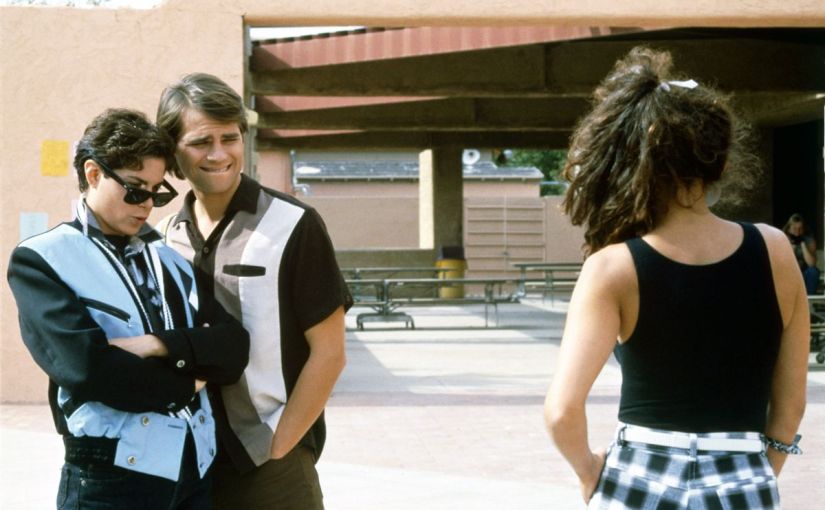
Now the irony is that while I have-yes, still have, and my wife has accepted this-a crush on Joyce Hyser the point of this film directed by Lisa Gottlieb is that lead character Terry needs to prove that she is more than just good looks. Terry is not just a hot chick. Terry has a brain, and to prove that she has the potential to be a fantastic journalist, she will register in another local high school where she will submit her article that’ll award her a summer internship at the Sun Tribune newspaper. Only thing is to keep her looks from getting in the way, she’ll have to register as a male student.

All the trappings of comedy cross dressing occur like using boys bathrooms and avoiding jock strap inspections from the gym teacher. She also has to put up with keeping her sex starved brother Buddy (Billy Jacoby) from teasing and revealing her secret. As well, her studly college boyfriend can never find out. An unwelcome crush (Sherilyn Fenn) on her male persona is trouble too. Oh yeah, and the typical 80s cinematic bully, actor William Zabka, has returned for the millionth time. There’s a lot packed into this cute flick that’s a loose adaptation of Shakespeare’s Twelfth Night.

Gottlieb’s film also steals elements from Jane Austen. The confused romance angle occurs. Terri decides to make Rick Morehouse (Clayton Rohner) the subject of her article. He’s a James Brown loving guy with no style and a crush on the bully’s girlfriend. Terri transforms him while she becomes Rick’s best guy pal. Only problem is that while Terri is working on finding a prom date for Rick, she’s also falling for him.

There’s a sweetness to Just One Of The Guys that always touched me as a teenager. Joyce Hyser as Terry is written more down to earth than characters from other teen 80s comedies. She has ambition and the movie stays with that theme. It’s important that Hyser is positively appealing in the looks department because it’s the Achilles heel of her character. Too often people are judged by their appearance. Her journalism teacher even suggests that she should pursue modeling with next to no shot at being a journalist. Interesting to see this scene in 2020 following the changes that sprung from “Me Too.” Frankly, the scene seems to have more impact today. It’s unfair to think that way about women. Just One Of The Guys with a script from Dennis Feldman & Jeff Franklin knew that well enough from the mid 1980s.

The film also has great side characters. It does really well in the geek gag department. One loves tiny reptiles, that he keeps housed in his pockets. Two others seem to share the same brain on a B movie science fiction level. They’re especially hilarious. Plus, the film boasts a zippy soundtrack that is one of my favorites.

I’ll also proudly say that the infamous topless scene that comes at the end actually seems necessary here, and not exploitive. It almost has to be done when the reveal is finally dawned upon Rick.

That and one of the best film ending on screen kisses make Just One Of The Guys one of my favorite 1980s byproducts.

SMOKEY & THE BANDIT

By Marc S. Sanders

Does a comedy get much better than Smokey & The Bandit?

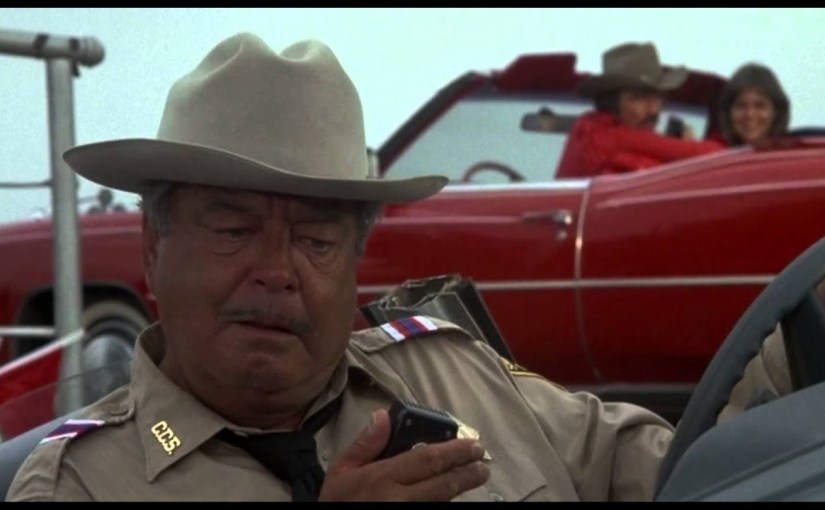
Stuntman Hal Needham re-energized the car chase comedy with this classic from 1977 featuring foul mouthed Jackie Gleason as Sheriff Buford T Justice of Portague County, Texas pursuing the charismatic, cocky and lovable Bandit played brilliantly by Burt Reynolds. It still holds up as a hilarious film.

Big Enos and Little Enos Burdette (Pat McCormick, Paul Williams), in matching cowboy hats and suits, challenge The Bandit to bootleg 400 cases of Coors beer from Texas back to Georgia in 28 hours; that’s 1800 miles total. They’ll pay him $80,000 to do it. Bandit recruits his best pal, The Snowman (the terrific Jerry Reed who also sings memorably on the soundtrack), to drive the truck hauling the manifests while he pilots the black Trans Am at 110 mph, distracting law enforcement away from the truck. On the way back from Texas, Bandit picks up a hitchhiking bride (an adorable Sally Field as Carrie soon to have the handle of “Frog”), who has fled from her wedding to Sheriff Justice’s son, Junior (a great dim-witted Mike Henry).

That’s all there is to it!

From there, it’s just one pursuit after another with the Trans Am doing ungodly stunts like jumping bridges and dodging roadblocks from state to state, while keeping Smokey Bear Sheriff Justice off his tail. A great on-going slapstick gag is seeing the excessive damage piled on to the Sheriff’s squad car. He loses the roof, the driver’s side door, the muffler and so on. The car keeps up with The Bandit, though, and Sheriff Justice never loses his hat.

This film doesn’t belong to any one member of the cast. Collectively it belongs to all of them. Every character is memorably quoted and given great comedic moments to laugh at over and over again. Even The Snowman’s basset hound, Fred has his share of laughs.

It’s impressive to think how influential this film actually became. The black Trans Am with the gold eagle spread across the hood, became a classic car much like any James Bond vehicle. The hit series The Dukes Of Hazzard made its debut shortly thereafter, and stole much of this film’s themes and gags. Tons of crash ‘em up stunt filled chase comedies attempted to duplicate the success of this film in the late ‘70s and early ‘80s, including further team ups of Needham, Reynolds, Reed and Field (Hooper, The Cannonball Run).

Hal Needham, with his cast and crew, really touched on something special with Smokey & The Bandit. As one of the first films I ever saw in theatres, it’ll always remain as a favorite movie going experience that I shared with my brother and babysitter, Mrs. Garcia. Along with late night viewings of the classic 39 episodes of The Honeymooners, Jackie Gleason will always stay on top as one of my favorite funny men. I’ll still watch and happily quote this picture endlessly for years to come.

“Now lemme have a diablo sandwich and a Dr. Pepper and make it fast. I’m in a g-ddam hurry!”

THE SUGARLAND EXPRESS

By Marc S. Sanders

Steven Spielberg’s second film, and first full-length theatrical release, is The Sugarland Express.  It’s inspired by real life events that consisted of a convict couple making their way to the Sugarland estate, located in Texas, to reunite with their toddler child living with foster parents.  Goldie Hawn played the mother, Lou Jean, who easily springs her husband, Clovis (William Atherton) from a pre-release penitentiary.  Clovis only had four months to go before a full release.  Once they’re out, they hijack a police car with the deputy driving and make their way across the state for Sugarland.  The rest of the police force, along with out of state authorities, are hot on their tail.  Pitifully speaking though, this becomes a long, drawn-out slow car chase.  It’s a pretty dim-witted story, but because it’s based on fact, well, some thought it’d make for an interesting two hours on film.

Unlike Spielberg’s first film, Duel, I didn’t find much inventiveness with The Sugarland Express.  If anything, it was likely green lit following what the director accomplished so well, at such a low expense, with his first film.  Car crash/car chase movies were also becoming trendy in the early ‘70s with Steve McQueen’s Bullitt becoming such a pioneering film of incredible automobile stunt work.  The French Connection would go on to win Best Picture a few years later with a centerpiece car chase to hang its hat on as well.  The Sugarland Express however is quite silly and very inferior to those pictures, though.

I was impressed with the infinite number of cars at Spielberg’s disposal and many of them get bashed up and crashed up in so many ways.  Yet, I grew tired of the novelty too.  The stakes didn’t seem so high with this film.  It is perhaps a film of its time.  After so many on the run pictures that were made with much better sophistication in the decades that followed, Spielberg’s film often feels unconvincing and unintentionally silly.  A funny moment occurs when Lou Jean needs to finally pee following miles and miles of endless driving.  The outlaws force the police led by Ben Johnson, in a nothing role with a big cowboy hat, to bring in a port o potty in the middle of an open field.  Cop cars are everywhere.  It’s clear as day outside.  Yet no one takes the opportunity for aggressive action.  Lou Jean gets to relieve herself.

As the pursuit carries on, Lou Jean and Clovis become celebrities, and crowds of townsfolk approach the car they occupy to lend them money and good wishes and even a pet pig.  Silly stuff mostly, but just not very amusing to me, and Goldie Hawn, who is normally a natural and adorable comedienne, is not very endearing here.  Lou Jean mostly screams in her redneck dialect and as a former beautician, styles her hair in the back seat applying endless amounts of hair spray to irritate Clovis and the deputy.

I didn’t find much camera work to impress me from Spielberg either.  I appreciated one moment in time however.  As the characters manage to hide out in an RV parking lot overnight, they watch an outdoor screening of a Roadrunner cartoon short out their back window.  Wile E Coyote falls victim to one of the Roadrunner’s tricks, and Spielberg captures a close up of Atherton with a foretelling expression of doom cross over his face.  It’s a nice moment that brought me back into the film, but then the ongoing themes of the film return thereafter.

I don’t care if it’s a true story.  I don’t care how ridiculously absurd it all amounted to.  The Sugarland Express was just noise for me.  Other absurdist stories of the 1970s, approached their subject matter better.  Films like Dog Day Afternoon whereas the ordeal continued to prolong, so did the mental exhaustion and desperation of the characters.  I’m afraid Spielberg just didn’t capture any of that here.

PLANES, TRAINS AND AUTOMOBILES

By Marc S. Sanders

The Tuesday Before Thanksgiving Tradition blazes on for another year as Steve Martin and John Candy travel from New York City to Wichita, Kansas and then who knows where all while trying to reach their final destination of Chicago, Illinois in time for Thanksgiving dinner.

Despite the fact that Planes, Trains & Automobiles was made in 1987 before the age of cell phones, personal navigation systems, Priceline .com and Ubers, it remains a timeless classic of inadvertent comedy. Travel is still as frustrating, maybe more so now, and family kinship is still treasured.

Martin plays Marketing Executive Neil Page, forced to succumb to the unwanted company of Shower Curtain Ring Salesman Del Griffeth (Candy). One inconvenience after another delays Neil from getting home to his family for the holiday. Del wants to be helpful, yet he is anything but.

The roles are perfectly cast. One of the best on screen couples of all time. I imagine had John Candy not passed away so young, he would have been paired up with Steve Martin at least one more time.

Writer/Director John Hughes is a master at taking simple circumstances (detention on a Saturday, skipping school, traveling) and blossoming it into episodes of relatability amplified in both comedy and drama. His knack for dialogue is a huge factor in his scenes. Consider the best scene in the film between Martin and favorite character actor Edie McClurg where 19 F- bombs are tossed over the mix up of a rental car. It happens all the time to any one of us, and Hughes took advantage of the frustration and built comedy that comes from it. Its not funny when you are in the moment. It’s funny when you recall the moment later on. It’s a brilliant scene.

Nut grabbing, taxi races, ride hitching in 1 degree weather, bed sharing with what you think are pillows, burning cars, wrong way driving, encounters with death and the devil, “The Canadian Mounted,” and a perfect excuse to use Ray Charles’ rockin’ “Mess Around” all point to a reason for a climax that arguably (on the first time any of us saw the film) we never expected or considered. If you don’t choke up, you have no soul.

Hughes was all too familiar with the meaning of Thanksgiving when he wrote Planes, Trains & Automobiles. I like to think those that see the film are even better for having watched it.

It’s a very funny movie, but it’s very special movie as well. Give thanks, offer what you can, when you can, and Happy Thanksgiving. 

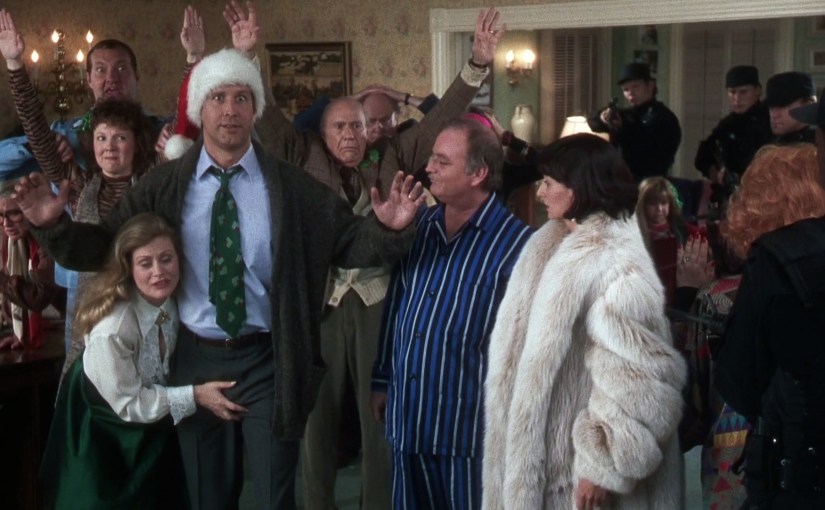
NATIONAL LAMPOON’S CHRISTMAS VACATION

By Marc S. Sanders

Not until December 25, 2021, had I seen National Lampoon’s Christmas Vacation.  Friends and colleagues couldn’t believe it, the same way they can’t believe I’ve never eaten a cheeseburger.  I’m not a big Chevy Chase fan.  I think the one film I like of his, because of him, is Neil Simon’s Seems Like Old Times.  The guy is just not a draw for me.  My fellow Cinephiles (Thomas Pahl, Miguel Rodriguez and Anthony Jason) introduced me to Fletch earlier this year.  Wow, did that movie start with a really interesting premise that just stumbled like 2,000-pound stone slowly sinking to the bottom of a very deep and empty sand trap.  The film didn’t work because of Chevy Chase.  Once it got past its exposition, Fletch relied too heavily on boring and unfunny schtick from a very unfunny Chevy Chase.  I was waiting for Christmas Vacation to fall into that same trap.  For a fraction of the film, thankfully, it didn’t.

By and large, what works with Christmas Vacation is because of its writer John Hughes, who writes with the consistency of humor that worked in Ferris Bueller’s Day Off and especially Planes, Trains and Automobiles.  The slapstick is most apparent here, then in other Hughes film released before.  (Home Alone would win that record title a year later, of course.)  As I said, Christmas Vacation relies entirely on the slapstick element.  There is no sensitive allowance for warm hugs or coming of age realizations and character arcs.  Clark Griswold gets in one predicament after another.  Like a mediocre Three Stooges short, some of those predicaments work.

Pun intended, the biggest highlight is when Clark decorates his Chicago suburb home with an infinite number of lights, eventually disrupting the next-door neighbors intimate candlelit dinner and blinding them into pratfalls.  The timing is pure John Hughes craftsmanship; John Hughes…not Chevy Chase

Stupid set ups include Clark getting trapped in the attic, unbeknownst to the rest of the family, as well as him hanging from the outside gutters and losing control of a tall ladder.  What works in these moments are what worked for the humor in Ferris Bueller with the school principal character, or Steve Martin’s character in Planes, Trains… .  Clark tries to come up with a way to get out and tip toe across the floor beams of the attic, trying to avoid a haphazard accident in the process.  The floors creak.  The items he finds in the attic squeak and grind.  When he’s hanging from the gutter, the rusty piece of metal is gradually giving way as he holds on for dear life.  I appreciated the prop humor.  The victim might be Chevy Chase, but that could’ve been anybody.  I guess sometimes, the pie is funnier than the one who gets it in the face.  So, there are moments that work.  I like the beginning as well where the dumb patriarch takes his family out to the forest to literally cut down a tree and then carries his optimism that he can actually fit it in the living room.  Moe, Larry and Curly had this kind of positivity when they convinced the Hoi Polloi that they could repair a plumbing problem in a mansion.

Much doesn’t work here either, though.  An overabundance of relatives show up to celebrate the holiday.  The set up is the same as in Hughes’ first film, Sixteen Candles.  However, in that film, each grandparent was given a moment to stand out among the masses.  Christmas Vacation doesn’t capitalize on that so much despite great talent that features Diane Ladd, Doris Roberts and EG Marshall.  No relative is a given a personality or unique and humorous annoyance.

The most remembered relative is Randy Quaid’s Cousin Eddie, but honestly, I found nothing funny about the guy and I thought he only served for irritated facial expressions to capture Chevy Chase in close up.  I know.  I know.  Before seeing this film, I was well aware of the “Shitter’s full” routine.  Okay.  Okay. Shit, poop, doodie, whatever you want to call it is funny.  Shit is God’s endless joke on the living beings he/she/they created.  A two word sentence of dialogue while draining a hose full of shit does not a movie make, though.  Otherwise, there is nothing marvelous about Randy Quaid in this film or the other relative extras that appear.  Clark’s (third time recast) kids could have also been funny but the script doesn’t let them.  There was just no material for these people on the page.  We know how pitch perfect actors like Juliette Lewis and Johnny Galecki have become over their careers.  I’d argue they are funnier and more talented actors than Chevy Chase ever was, but like the other supporting players the script didn’t consider the talent.  Beverly D’Angelo is back as Clark’s wife too.  Moving on…

I could have had regretted watching this film.  I finally, finally, FINALLY gave in per the insistence of practically everyone I know, on a whim, when I saw it available on HBO Max.  I don’t regret watching it.  Truly I don’t.  Yet, I don’t feel better having done so either.  Christmas Vacation is not an all-time great comedy or holiday film.  I don’t believe it did anything for anyone’s career.  Notice I didn’t mention the director’s name, because it doesn’t matter and I haven’t heard from that guy since this picture.

The film is just there, I guess, and as each passing December comes and goes, it is awarded new life…. unlike the electrocuted, exploding cat that perishes under a love seat.  Now that’s funny! Thankfully, this precious feline gave up his lives for a chuckle from me.  Had it been Chevy Chase though, then this review might have gone in another direction.

THE STING

By Marc S. Sanders

Find me a better combination of script, cast, direction, score, art direction and costume and I guarantee it’ll take you some time and effort.

The Sting, directed by George Roy Hill and written by David Ward, is the kind of movie where you uncover something new every time you watch it. It’s because the film is all in the minute details to assemble the beginning to the middle to the end. The film is wisely edited in step by step chapters; The Set Up, The Wire, The Shut Out and eventually on to the satisfying The Sting.

The audience is even set up but you’ll have to watch to see how. I dare not spoil it.

Cars, trains, drug stores, diners, a carousel, dames, gangsters, Bunko Cops, Grifters; all are elements needed for the best confidence men superbly played by Robert Redford and Paul Newman, along with a supporting cast like no other, Eileen Brennan, Harold Gould, Charles Durning, Ray Walston, Jack Kehoe and the best villain, or rather “mark,” Robert Shaw.

This is one of my favorite movies. When I first saw it, I was probably age 10 or 12. I understand next to nothing of what was going on. It was the music that drew me in first followed by the sharp suits designed by the legendary Edith Head. The movie’s script is its greatest asset but visually it is just as fun. The 1930s Chicago setting is a character in and of itself. Newman cheats beautifully at poker against a temperamental Shaw, and gets him!!! “You owe me 15 grand pal.” When I first saw it, I didn’t know what he was doing or how he did it. How did he switch hands? I was enamored with the hands that were dealt and the poker chips on the table, but I loved it when the better cheat won out.

The second iteration of the Hill/Newman/Redford trifecta (following “Butch…& Sundance…”) is just plain fun. It was the fun that earned it a Best Picture Oscar.

No other film has come close to duplicating it. Maybe the Clooney/Pitt/Damon version of “Ocean’s 11”? I don’t know. However, if you love that film, you owe it to yourself to watch “The Sting.”

The Sting is…”the quill!”

LOOK WHO’S BACK (2015, Germany)

by Miguel E. Rodriguez

Director: David Wnendt
Cast: Oliver Masucci, Fabian Busch, Christoph Maria Herbst
My Rating: 10/10
Rotten Tomatometer: No score [never released in the U.S.]

PLOT: Without a single word of explanation, Adolf Hitler materializes in modern-day Berlin and, thanks to an unscrupulous TV station, begins to once again take the world by storm.


In the comedy documentary The Aristocrats, scores of comedians tell different versions of the same hilariously dirty joke.  In one scene, the staff of the parody website The Onion gets together in a room and tries to construct the perfect Aristocrats joke by combining every known shocking and taboo subject into their version.  Nothing is off the table: religion, politics, graphic sexual acts, nothing.  We never hear their version of the joke, but their discussion is hilarious by itself.  Look Who’s Talking, a shocking comedy from Germany, feels like someone took all the notes from that meeting, pulled out all the Hitler material, and put it all in this one movie.

…this has happened to me before.  I started a review of this movie earlier this week and abandoned it after I realized I had written over 1,500 words of mostly summaries of the action and plot.

I think the reason is because the plot and the comedy in Look Who’s Back are so outrageous and shocking that I felt I HAD to give context to my reactions.  And the only way to do that was to summarize this scene and that scene and the next.

I simply am unable to put my feelings about this movie into words, at least none that would do justice to this stunning, effective, supremely disturbing satire.

The story: For reasons that are never explained, Adolf Hitler materializes in modern-day Berlin…well, Berlin in October, 2014.  After some initial confusion, he marches to the Brandenburg Gate and tries to get some answers from the crowds of people regarding his situation.  No one will answer his questions…but a bunch of people take a second for a quick selfie with this crackpot in a Hitler costume.

At first, Hitler concerns himself with short-term goals.  After befriending a newsstand vendor, he is informed that he smells.  He needs to get his uniform laundered.  And if you don’t think the sight of Adolf Hitler trying to communicate with a laundromat clerk, who doesn’t speak German very well, about when he can pick up his dry cleaning is hysterical, this movie may not be for you.

The story expands.  A TV producer on the skids at work discovers Hitler at the newsstand and convinces his bosses to allow him to take Hitler on a road trip across Germany.  (They’re convinced because a short video of him railing against German politics has gotten a TON of views on social media.)  Then he lands a spot on a live TV show, and things REALLY start to snowball.  He writes a book.  The book is optioned for a movie.  And so on.

I assure you, this is just the bare bones of the story.  I haven’t even gotten into the innumerable scenes that made me laugh like a hyena on acid.  But I can’t describe those scenes in detail, because I don’t want to get banned from the internet.

Here is a list of the scenes that struck me as the funniest or the most disturbing.  Usually both at the same time.

  • The dog.
  • The discussion about rap music.
  • The “hand puppet.”
  • Hitler drawing sketches (badly) in a public square to earn some money.
  • The TV host in blackface.
  • The scene at the soccer stadium.
  • When Hitler visits a pro-Nazi demonstration.
  • When Hitler compares the TV network manager to Leni Reifenstahl

…and on and on and on.

The true horror/comedy of the movie comes when you realize that, for the VAST majority of scenes where Hitler interacts with people on the street, those are real people having real reactions, not actors. The things that come out of the mouths of some of these people is beyond belief. One guy tells Hitler point blank that he had the right idea about concentration camps. A shop vendor says he had the right ideas about how to run the country economically, and she’d support him if he ran for office. All on camera.

There are other genuine laughs, to be sure. The sequence where Hitler discovers the internet for the first time is worth the rental/streaming fee. But by the time the movie is over, I was left with a distinct feeling of unease. The movie depicted the sinister way in which someone with extreme views can manipulate popular opinion and catapult themselves into a position of power. And it’s not so hard to imagine what it must have been like in the 1930s when Hitler did it all the first time.

The film closes with Hitler being driven down a public street in a convertible, saluting random people as they go by. Most people are shocked. A lot of them flip Hitler the bird. But there are some who give the Nazi salute as he drives by. Are they joking?

This is one of the most effective, provocative satires ever made, and it was never released in the U.S. due to the controversial nature of some of its funniest scenes. If you can stream this somewhere, you won’t regret it. Then ask yourself: could it happen this easily today? This movie provides its own answer. Compare and discuss.

THE ARTIST (2011, France)

by Miguel E. Rodriguez

Director: Michel Hazanavicius
Cast: Jean Dujardin, Bérénice Bejo, John Goodman, James Cromwell, Penelope Ann Miller, Missi Pyle, Malcolm McDowell
My Rating: 10/10
Rotten Tomatometer: 95% Certified Fresh

PLOT: A hugely popular silent film idol must adjust to culture shock when “talkies” suddenly invade the movie business.


Is there a movie more in love with the First Golden Age of Hollywood than The Artist?  I can’t think of one.  Sunset Blvd. comes close, but that was a caustic commentary on the heartless tendencies of studio executives to reject the Old and embrace the New.  The Artist covers the same ground, but in a much more comic fashion.

Not to say The Artist pulls its punches.  Not at all.  It tells the story of a silent film idol, George Valentin (Jean Dujardin), who has a meet-cute with a fan, Peppy (the stunning Bérénice Bejo), outside of a movie theatre.  Long story short, she becomes a bit player in numerous silent films and eventually becomes a superstar when the talkies take over Hollywood.  And George?  He struggles, as so many other silent actors did, to acclimate himself to a brave new world where faces and title cards aren’t enough anymore for an audience who is always looking for something new.

And, oh, yeah, did I mention The Artist is itself a silent film?  Shot in black and white?  Filmed in the old 1:33 aspect ratio?  Yeah.  It’s actually pretty cool.  It takes a little while to get used to seeing modern actors moving their mouths and not hearing their voices, but after a while, my brain acclimated itself to this “new” way of watching a movie.

As I was saying, The Artist doesn’t pull its punches in exposing Hollywood’s appetite for the New (in ways I don’t want to give away here), but it is still far more whimsical and audience-friendly than Sunset Blvd.  I’d compare it more to Singin’ in the Rain, if I had to compare it to anything at all.  But The Artist is a singular achievement, and well worth the Best Picture Academy Award for 2011.

There are two scenes in particular that elevate The Artist. In one, Peppy, who has always adored George from afar, finds herself alone in his dressing room.  She spots one of his jackets hanging on a coat rack and embraces it, imagining his arms inside it.  She then slips one of her own arms into the jacket, and voila!  She has a brief love scene where it really feels like she’s interacting with another person’s arm.  It’s a little hard to describe, but the effect is magical.

The second scene is one of my favorite scenes of all time.  George has just gone to see one of Peppy’s new films, a talkie.  The audience loves it, but he is still resistant to the idea.  He retreats to his dressing room, but something bizarre happens.  Remember, up until now, the movie has been completely silent (except for a musical score).  But this time, when he puts a glass down on a table…it clinks.  He stares.  What the heck was that???  He does it again.  Clink!  What’s going on???  He picks up a comb and drops it.  Thunk!  What the hey?!!  He opens his mouth to yell…but nothing comes out!

It’s a wonderfully comic moment, and a perfect way to demonstrate George’s anxiety at what this new technology will mean for him.

The more I think about The Artist, the more I’m realizing that the only way to properly discuss it is to go almost scene by scene, and I certainly don’t want to go down that road, especially for anyone who may not have seen it.  I mean, there’s the dog, George’s butler, the release date for one of his movies (October 24th, 1929, oh dear), the auction, the fire, and the deliriously happy ending, the kind of ending that tends to only exist in movies.

That’s really all The Artist is.  It’s an efficient engine designed to pull at our heartstrings and deliver a feel-good ending after teasing us with darker possibilities here and there.  The fact that it’s black-and-white and silent is a bonus, especially for film buffs.  It may not be realistic, but when it comes to Hollywood’s Golden Age…I mean, who really cared about realism back then?  (Back then, they didn’t need words, they had faces.)

GOOD BOYS (2019)

by Miguel E. Rodriguez

Director: Gene Stupnitsky
Cast: Jacob Tremblay, Keith L. Williams, Brady Noon, Will Forte, Stephen Merchant
My Rating: 9/10
Rotten Tomatometer: 79% Certified Fresh

PLOT: Three sixth-grade boys ditch school and embark on an epic journey while carrying accidentally stolen drugs, being hunted by teenage girls, and trying to make their way home in time for a long-awaited party.


You will either love Good Boys for the humor, or you will hate it for exactly the same reason.  There can be no middle of the road.  You will either guffaw through the entire film, as I did, or you will gape in shock at the behavior and language demonstrated by tween boys.

If you’re one of those people who cannot comprehend the humor to be derived from watching curious boys who haven’t yet hit puberty staring at sex toys and wondering what the hell they’re for (“What are ‘a-nahl beads’?”), then this movie is not for you.  It’s just not.  No amount of philosophizing or rationalization will make it “okay.”  The fact that the movie made me laugh pretty much beginning to end carries no weight.  I respect your opinion.  If you want to stop reading this review, I wouldn’t blame you.  Now’s your chance.  I don’t want to waste your time.  Quit now.

Okay.

If you kept reading, you’re one of those people like me who laughed through every second of the trailers for this movie, hoping against hope that they didn’t just show us all the funny bits in the trailer.  Thank the comedy gods, they didn’t.  Good Boys is the funniest movie I’ve seen this year so far, and it may wind up being the funniest comedy of the year.

If you’ve seen the trailers, you know the plot: three 6th-graders accidentally steal some “molly” from two college girls, who offer to trade it for an expensive drone they captured while the boys were using it to spy on them.  See, the boys have been invited to a “kissing” party, but they know nothing about kissing, so they were using the drone to spy on these two college girls to see if they would kiss.  Before that, they tried using the internet, but instead of just searching for “how to kiss a girl”, they jumped right into searching for “boobies” and “porn”…which did not end well.

Read that last sentence.  If I were the father of one of those kids, I would not find that funny.  I can understand from an intellectual standpoint how a kid that young can be curious about such things, but if I found out my kid had been searching for that stuff online, as a parent, I’d be upset.  So I can see how this movie might put some people off.

But I promise you.  This movie magically takes what would be uncomfortable in real life and mines those situations for the kind of belly laughs that I haven’t had in a movie theater since The Hangover.  And it’s not salacious or prurient, because they have NO IDEA what they’re looking at, or even talking about.  (The description one of them gives for what a tampon is used for is worth the price of admission.)

As the movie progresses, the screenplay doesn’t forget to give us reasons to like these kids.  We get glimpses of one of their families in particular, as they inform him they’re getting divorced.  (“You’ll get TWO Taco Tuesdays now!  Just…one of them will be on Wednesday.”)  One of them has a real gift for singing, but doesn’t want to look too uncool, so he doesn’t sign up for an audition.  One has a crush on a girl, but is so nervous about her that he talks to his friends about how he hopes one day to make actual eye contact.  Too many comedies make the GAGS the point of the film instead of the characters.  While the gags are fast and furious in Good Boys, they MEAN more, and are funnier, because we know who these kids are, and what makes them tick.

I’m trying to think of what else to write, but it would just be a catalog of the best gags and lines in the movie.  (“I’m gonna be a social piranha!”)  I don’t believe finding this movie funny is bad or immoral.  I know there are people out there who might think so, and I empathize.  But I know what makes me laugh, and I have to be true to myself, so…there you go.

TOY STORY 4 (2019)

by Miguel E. Rodriguez

Director: Josh Cooley
Cast: Tom Hanks, Tim Allen, Annie Potts, Keegan-Michael Key, Jordan Peele, Christina Hendricks, Keanu Reeves, Joan Cusack
My Rating: 9/10
Rotten Tomatometer: 98% Certified Fresh

PLOT: A new toy called “Forky” joins Woody and the gang, and a road trip with old and new friends reveals how big the world can be for a toy.


Frankly, one of the best “perks” of Toy Story 4 is the return of Bo Peep.  I had always wondered what had happened to her in Toy Story 3 that had Woody so sad.  I’m glad we got to see why she was no longer around, and I’m glad we get to see how she’s fared in the intervening years.  Just wanted to get that out of the way.

Toy Story 4 is not quite the pinnacle of perfection that is Toy Story 3, especially when it comes to the heartstring-tugging, but it’s a marvelous film on its own, and the ending is a fitting curtain call to the franchise.  Woody, Buzz, and the gang have gone through more hair-raising, death-defying adventures than Indiana Jones, it sometimes seems, and the fact that they reach the start of truly new chapters in their lives by the time the credits roll is comforting.

This fourth film introduces an intriguing element in the form of a doll named Gabby Gabby.  She’s one of those dolls that every girl seems to have owned at some point in her life…at least, every girl born before the year 2000, I’d guess.  She resides in an antiques store, and she has a problem: her voice box is defective.  When you pull her string, instead of a little girl’s voice, you hear what sounds like a 45 being played at 33 1/3.  (You older readers can explain that to the younger ones.)

Her potential salvation: Woody’s voice box is in perfect working order.  All she has to do is somehow exchange voice boxes with Woody, and she’ll have the chance to get a little human girl to love her enough to take her home.

This is…creepy.  There’s something unsettling about this Gabby Gabby character because she’s a cute little doll who essentially wants to perform an organ transplant whether Woody wants to or not.  She’s just so…matter-of-fact about it.

I’m doing a lot of simple play-by-play, and not really giving a sense of the movie itself.  That’s because, while it’s skillfully made and emotionally engaging, it’s not like this movie breaks new ground, exactly.  I think it’s a good thing this will finally be the last Toy Story film.  It’s becoming much harder to imagine what else Pixar can put these characters through, and I’d hate for them to push things too far like they did with the Cars franchise.

But don’t get me wrong, it was incredibly entertaining, and I loved every minute of it.  If you liked the first three movies – heck, if you love ANY Pixar movie – you won’t be disappointed by this one.  It’s just…you’ve gotta see it for yourself.  At this point, any further reviewing of the movie would involve spoiler alerts and scene descriptions and re-telling my favorite lines, and that’s not really a review anymore, that’s just a synopsis.

Suffice to say: “Toy Story 4” delivers the kind of movie we’ve come to expect from Pixar.  It’ll make you laugh, jump, laugh some more, give you a couple of hanky moments, and it’ll look GREAT doing it.