ARTHUR

By Marc S. Sanders

I would love to be friends with Arthur Bach. Sure I’d be wined and dined, living a lifestyle where money is no object, toy trains are at my disposal, and drinks on a serving platter are brought to me constantly. Arthur has got it all. Well, not all of it. He’s never been in love. He hates his cold hearted father and he only has one friend, his dependable butler, Hobson.

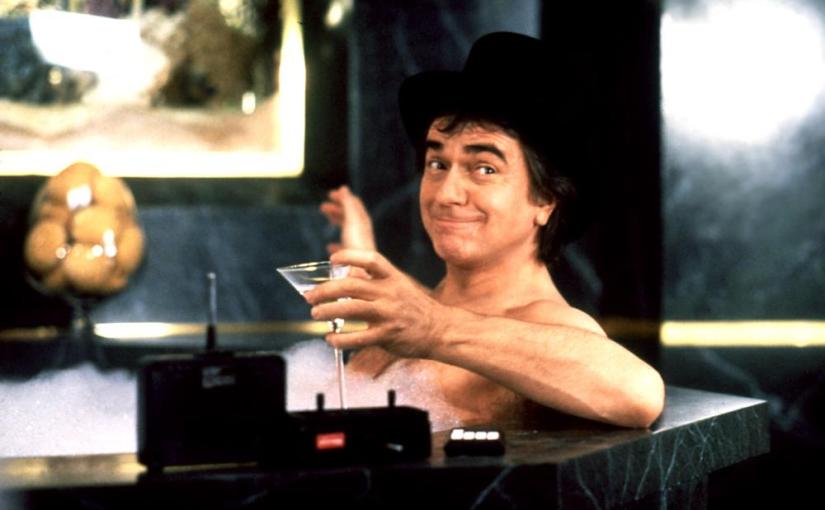
Dudley Moore’s greatest role is Arthur from 1981. The best protagonists in comedy are the ones who go against the order. Arthur is a spoiled kid in an adult’s body. He lives to smile and laugh and drink and play and drink some more and more. It’s easy when you are sitting on three quarters of a billion-dollar fortune. Imagine though if you could lose all of that money. The only way to hold on to wealth is to marry a woman named Susan (Jill Eikenberry) that you are not in love with, simply to merge two wealthy families together for even more industrial power. Arthur is made to be a pawn by his own unloving father, as well as Susan’s ruthless father (Stephen Elliott) who is proud to share how he killed a man when he was eleven years old. No matter. Arthur will just marry Susan and cheat on her, as his elderly grandmother Martha (Geraldine Fitzgerald) suggests.

All seems easy until Arthur becomes over the moon in love with a woman named Linda (Liza Minnelli) who is caught shoplifting a tie in Bergdorf’s in New York City. Arthur can’t stop thinking about Linda but the family would never approve. Linda is a waitress dreaming to become an actress, but lives a poor life with her unemployed father (Barney Martin).

Dudley Moore and Liza Minnelli have one of the best on screen chemistries ever in film. They look like they belong with one another, and their timing is perfectly solid. When they share moments together their on-screen laughter shows up naturally and intermittently. I imagine no matter how many times they rehearsed their scenes together it was never the same way twice.

As an individual performance, Moore works like a great stand up comic having the best show of his life. His drunkenness is hilarious with his slurs and infectious non stop giggles and outrageously loud laughter. He gives The Joker a run for his money in the laughter department.

Early on, he escorts a prostitute to dinner at The Plaza Hotel and his interactions with family members and those of the wealthy social circle are a great contrast in comedy. Throughout the film, Dudley Moore will use every prop he can get his hand on to make his inebriated state all the more funny from simply a telephone to a mounted moose head. Moore is also a helluva piano player.

The most special relationship though is Arthur’s connection to Hobson (beautifully played with blue blood dryness by Sir John Gielgud). A man like Hobson is not one you’d expect to associate with a man as immature and childish as Arthur, but you find a nurturing dimension to Hobson’s character. He’s Arthur’s surrogate father. He teaches Arthur to be practical about his good fortune. At the same time, he doesn’t dismiss Arthur’s happiness. Gielgud is at times surprising and positively touching. He also has some of the best lines in the film. After agreeing to run Arthur’s bath, he retorts with “Perhaps you’d like me to come in there and wash your dick for you, you little shit!” His impression of Linda: “Normally one would have to go to a bowling alley to meet a woman of your stature.”

As Hobson becomes ill, so must Arthur finally learn to grow up. The moment I lost my mother eight years ago, the very first thing that occurred to me was that I am no longer a child. I actually got my first grey hairs immediately after mom unexpectedly passed. No longer was there the protective guidance to make decisions and therefore as Hobson continues to deteriorate, Arthur becomes aware of tough decisions he must make regarding sobriety, wealth and most importantly love. With Hobson by his side, Arthur Bach is a beautiful character arc of comedy and sadness. As a kid growing up in the ‘80s, Arthur Bach was one of the first to demonstrate the change in a character’s arc for me. I really started to recognize depth and dimension; different angles and perspectives that a well written character faces.

The film is over 40 years old, but still has its magic to make you laugh and cry. Arthur is just an enormously touching comedy.

MOONSTRUCK

By Marc S. Sanders

Moonstruck has to be one of the most delightful romantic comedies of all time thanks to an outstanding cast, an intuitive director (Norman Jewison) and a script full of brilliant dialogue and set ups from John Patrick Shanley.

Loretta Castorini (Cher in her Oscar winning role) is a 37 year old widow. Her husband of two years got hit by a bus. So, naturally when her father, Cosmo (the hilarious Vincent Gardenia), hears the news that Loretta got engaged to the boring schlub Johnny Cammareri (Danny Aiello), he knows this is a bad omen and she should not get married again. Sure, her husband got hit by a bus, but that can only mean that marriage is no good for Loretta. When they wake up Rose (Olympia Dukakis in her well-deserved Oscar winning role), Loretta’s mother, to share the news, she just opens her eyes and asks, “Who died?” This is an adorable Italian family living in Brooklyn and somehow an Irishman wrote the script which was then directed by a Jewish mensch, and everyone is working on all Italian cylinders.

Two minutes into the film and I’m laughing. I’m laughing at Johnny’s wimpy proposal in the local Italian restaurant. I’m laughing at Rose and Cosmo who’ve seen enough of life to know that you don’t get married for love anymore. Rose is for Loretta getting married though. Cosmo doesn’t wanna spend the money.

Just after Johnny proposes, he flies off to Sicily to be by his dying mother’s bedside. He requests that Loretta invite his brother Ronny (Nicholas Cage), who he hasn’t spoken to in five years, to the wedding. Ronny is upset with Johnny. Ronny got his hand chopped off in the bread slicer at his bakery when Johnny was talking with him and Ronny looked the other way.

When Loretta approaches Ronny, before you know it, they are sleeping with each other. Ronny then invites Loretta to see La Boheme at the Met that night. Loretta knows it’s wrong and can’t keep this up. It’s a sin. She goes to confession, but then she also goes to buy a new dress and dye the greys out of her hair.

As well, Cosmo is stepping outside of his marriage, only Rose is not so stupid. She knows what’s going on. When Rose is dining alone, a college professor who strikes out with one attractive student after another joins her table. Rose isn’t gonna do anything. Instead, she asks the question on everyone’s mind “Why do men chase women?” Then she answers it. “Because if they don’t, they think they’ll die.” But they’re gonna die anyway. Right?

It sure looks like my column is just summarizing the film but my breakdown of Moonstruck simply celebrates all that’s good about it. Here’s a film that doesn’t stereotype a New York Italian family. Instead, it shows how they regard one another as well as the people within the neighborhood from the eager to please waiter in the restaurant to the mortician that Loretta works for. The mortician spills butter on his tie. Loretta takes the tie off of him and says she’ll get it cleaned.

Life in the home of Castorini family is shown beautifully with natural humor to display its atmosphere. Cosmo’s quiet elderly father with five yappy dogs on leashes is only a part of every passing day. Like I’ve made claim on other films, the best movies offer smart characters. Everyone has a way of carrying themselves in Moonstruck, and they’re not dumb. They might be cheap like Cosmo or wimpy like Johnny or a little dim like Ronny, not dumb, but they’re all wise to how they handle themselves.

This might seem like a relatively easy, untechnical little New York comedy. Norman Jewison, however, uses a great approach that makes each setting feel like you’re watching the most alive stage play you’ve ever encountered. I’m actually surprised this film has yet to be adapted for the stage. Maybe, just maybe, Moonstruck hasn’t made it to live theatre yet because it’d be damned near impossible to recapture the harmony of this magical cast.

I love Moonstruck.

MIDNIGHT RUN

By Marc S. Sanders

Martin Brest’s Midnight Run is a perfect blend of comedy, action and sweet tenderness. Different facets of what two guys could potentially experience together, especially if they are on an unexpected cross country road trip, pop up unexpectedly. It’s a well-acted film with great exchanges in dialogue that surge with broad comedy and high-octane car chases and shootouts. Yet, there’s even some special quiet moments to appreciate as well. It’s another favorite film of mine.

Robert DeNiro is Jack Walsh, a disgraced former Chicago cop now turned bounty hunter who spends his days wrangling up criminals who skip out on their bail. When Eddie the bondsman (a great Joe Pantoliano) asks Jack to bring back Jonathan “The Duke” Mardukas (Charles Grodin) who skipped out on a $450,000 bond, something as simple as a “midnight run” turns into an excruciating journey from New York to California. The Duke doesn’t make it easy for Jack. He never shuts up and right from the start it doesn’t help that he’s afraid to fly. Well, there’s always the train, right? Plus there’s plenty of time because Jack has five days to get The Duke back into custody.

Not so fast. The mob, led by a silky smooth and threatening Dennis Farina, wants The Duke dead as revenge for embezzling millions of dollars from them, plus avoiding the risk of him testifying against them. The Duke unknowingly served as their accountant. The Feds, led by a just as awesome Yaphet Kotto, want The Duke as their material witness against the mob. On top of all that, Jack has to compete with Marvin (John Ashton), another bounty hunter who wants to bring in the The Duke.

There’s great action in Midnight Run and you can’t get enough of it, but it’s the comedic layers of complications the cast of characters bring on to themselves that serve the film best. Danny Elfman’s music accompaniment primarily on horns with guitar and piano bring out the fun in the best way possible. Great chases with a helicopter and various stolen vehicles while Jack and The Duke outrun endless squad cars are magnificent. Martin Brest (Beverly Hills Cop) is just an entertaining director.

Still, the action is not even the highlight for me. First, the chemistry among all the actors is fantastic. They have such brilliant exchanges of cursing each other out, getting on each other’s nerves, and especially listening to one another as well. It doesn’t matter if it’s a screaming match phone call between DeNiro and Pantoliano, or a one on one with Kotto getting frustrated DeNiro. It all works.

Most especially is the pairing of DeNiro and Grodin. They hate each other and then seconds later they’re laughing with each other. Grodin as The Duke, as pesky as he is, plays an unwelcome therapist at times to DeNiro’s Jack as the history of his failed marriage resurfaces and his fall from grace with the Chicago police department comes back to bother him. Jack doesn’t give in so easy to The Duke’s desire to share his feelings. He’d rather endlessly smoke, eat unhealthy food and tell The Duke to “shut the fuck up!” Nevertheless, a bond between the two forms and continues to reshape itself during the course of the film. A great moment occurs when they need to scam a barkeep out of some twenty-dollar bills. You’ll never forget “the litmus configuration” after you see Midnight Run.

I also want to call attention to one of my favorite of so many DeNiro moments in his long career. Midway through the film, Jack reunites with his ex wife and teen daughter that he hasn’t seen in nine years. Like many divorced couples, an argument breaks out among the parents only to be quickly silenced by the quiet intrusion of Jack’s daughter Denise (Danielle DuClos). As Jack waits for his wife to bring him money to help, Brest allows DeNiro to do some of his best acting with this young actress. They can hardly speak to one another. DuClos simply stares in disbelief that her estranged father came home. DeNiro can’t, in good conscience, make eye contact, knowing he’s been the absent parent. It’s too difficult. It is such a humane moment that it grabs me every time. It reminds me that dialogue is not always necessary for a great acting piece. Martin Brest really trusts his actors in this moment. It’s likely my favorite scene of the film and of DeNiro’s career. You can take this scene out of the context of the entire film and still be just as moved by it.

The best action films succeed when the filmmakers care about the characters. When the characters are given depth, then we worry about them. We hope they don’t get killed or taken or arrested, and simply make it home. Midnight Run is that kind of action piece. Had we not cared for Jack and The Duke, movie lovers never would have cared for Martin Brest’s film, now going on 34 years later. It’s a perfect film.

FERRIS BUELLER’S DAY OFF

By Marc S. Sanders

I’ve said before how John Hughes had an instinct for making interesting stories out of the mundane. Sure he might broadly exaggerate, but the storylines stem from relatable anecdotes like cross country traveling, forgotten birthdays or school detention. Thankfully he also explored a day in the life of faking illness and skipping school with Ferris Bueller’s Day Off.

Matthew Broderick memorably plays the title character with an answer for everything and the means to outsmart his naive parents, his pesky sister Jeannie (Jennifer Grey), as well as the dim witted victim of staged slapstick, school principal Ed Rooney (Jeffrey Jones). Hughes teams Ferris up with his beautiful girlfriend Sloane (Mia Sara) and his troubled best friend Cameron (Alan Ruck) for a romp through downtown Chicago.

Ferris Bueller… is simply a party to watch. The tempo of its comedy thankfully gets very familiar, very quickly. There’s gag after gag to celebrate the inventiveness of Ferris. With Cameron, he manages to get Sloane out of school, alter his absent days in the school system, arrange for a high-end fancy lunch thanks to the “Sausage King of Chicago” and actually pilot Cameron’s father’s prized, rare Ferrari convertible. There’s nothing Ferris can’t do, nor won’t do. There’s nothing Ferris can’t get away with. The guy can even hop on a downtown parade float to get the entire city engaged in a rousing rendition of “Twist & Shout,” arguably one of the most fun scenes to ever be filmed. Hundreds of extras crowd the streets to remind any one of us how fun life can be. What a joyous pleasure life is.

As expected with most of Hughes’ films though, this picture has a heart. Life should always be celebrated, but that does not mean we don’t have episodes where we suffer. Alan Ruck as Cameron is not well with his home life. Parental discourse and the lack of a loving home weighs upon him. The storyline is embraced very sensitively. A touching moment occurs as Cameron tours the Art Institute of Chicago and maintains an engrossed stare with the painting called A Sunday Afternoon on the Island of La Grande Jatte. Cameron is a product of loneliness lacking the ability to cry for help unlike the child in the painting. It’s another one of those treasured moments in film where dialogue is not needed to describe a character’s pain.

Jeffrey Jones makes for a good foil in a Three Stooges style storyline as he attempts over and over again to catch Ferris in the act. It never works well for him and leads to hilarious moments with the house dog and every other unfortunate circumstance imaginable such as getting his car towed and his foot stuck in the mud. Hughes pieces these cheap gags together to make them really feel much more valuable than they should be.

Lastly, John Hughes creates good inside gags within his setting. The city of Chicago works as a character concerned with Ferris’ supposed illness, including well wishes from his classmates, to the faculty, and even the police department much to the chagrin of his sister.

Let’s just say it’s imperative we all do our part to Save Ferris!

1941

By Marc S. Sanders

Steven Spielberg’s first critical and box office flop, 1941, is a splattered mess of slapstick hysteria set a week after the Japanese attack on Pearl Harbor.  Residents of the California coast line prepare to be the next target.  Ahem!!!!!  Well, that’s it for the story…Goodnight.  Tip your waiters.

Just a year ahead of the Zucker brothers with Abrams comedy team that’ll deliver Airplane!, Spielberg opted to direct a spoof script penned by Robert Zemeckis and Bob Gale (Back To The Future).  1941 is full of gags galore beginning with a reference to the director’s most successful film to date, Jaws.  For me, seeing actress Susan Backline on screen again for another ocean skinny dip only to be intruded upon by a rising Japanese submarine was the second best joke of the film.  Once that was over, I had two hours left to go.  A long two hours. 

I’ve noted before that satire or spoofs are the riskiest genres to produce.  They can succeed with a picture like Dr. Strangelove…, or Network or Airplane!  Satire can be divisive too though, and thus only one half of your audience will appreciate the poke and prod.  Even worse, satire can just be unfunny across the board no matter which side of the aisle you lean on.  That’s 1941.  It plays too much like a Three Stooges series of slapstick violence.  Reader, even Steven Spielberg cannot capture the magic of the Three Stooges.

Zemeckis and Gale opt to poke a little fun at the Puerto Rican zoot suit riots vs the Enlisted men ahead of America’s entry into World War II.  So, when army soldier Treat Williams gets jealous of one handsome zoot suit dancer flirting with his girl, a fight breaks out which eventually populates two thirds of the film as it escalates all the way over to Hollywood Boulevard. Now thousands of stooge wannabe extras are walloping each other from one side of the street to the next. 

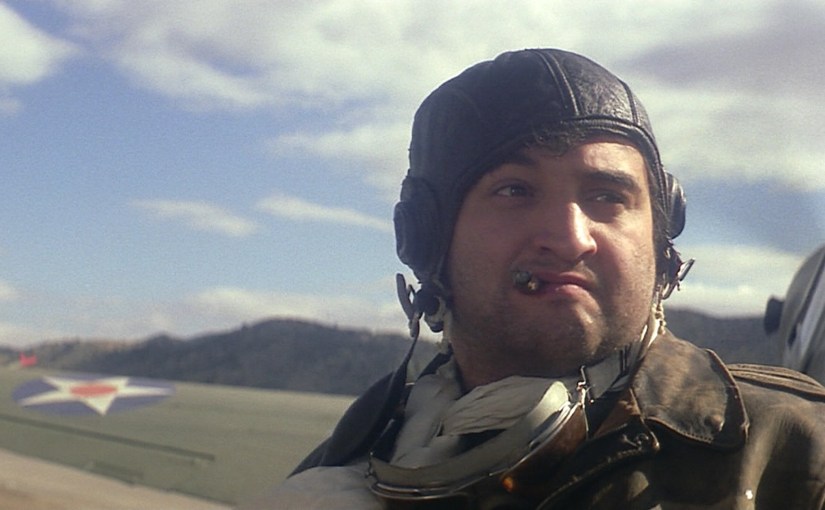
To allow a breather from this, the writers sidetrack over to Tim Matheson and Nancy Allen getting frisky in an out of control bi-plane while being mistaken for the enemy by John Belushi doing a very poor resurrection of his Bluto character from Animal House.  As Captain Wild Bill Kelso, Belushi’s pursuit fires upon everything else in sight, especially Hollywood Boulevard, but misses the plane occupied by Matheson and Allen.

The third point of this rectangle concerns Dan Aykroyd with John Candy and a whole platoon opting to set up a military cannon along the ocean view property belonging to Ned Beatty and Lorraine Gary in anticipation of the Japanese invasion.  Ned Beatty is the best stooge of the entire cast as the nerdy resident determined to protect his home while exercising his patriotic duty.  Gary’s response to Beatty’s ineptitude cracked me up as well.  The house wreckage of The Money Pit has nothing on what occurs in 1941.

The fourth storyline focuses on the enemy with a German speaking Nazi portrayed by Christopher Lee debating with the captain of a Japanese submarine (Toshiro Mifune) plotting to bomb Hollywood.  Somehow, each foil understands the other’s language.  These guys are just here to scream at one another.  There’s nothing funny about them.

Oh yeah.  Robert Stack is the Army General who watches Dumbo in the movie theatre while Hollywood Boulevard gets demolished outside.  Ho! Ho!

Often, I compliment Spielberg for his reliance on the sets he provides.  Everything you see on the screen serves a purpose to his films.  It happened as recently as with his remake of West Side Story in 2021, and it’s effectively used in Close Encounters…  He uses the same approach with 1941.  In this film though, there’s no pulse or significance to the props and pieces that are used.  The house is demolished.  So is the storage shed.  So is the movie theatre.  So is the Ferris wheel.  Yes.  What you’ve already seen in endless Looney Toons cartoons occurs here with a miniature model.  The Ferris wheel comes off its hinge and rolls across the beach side dock into the water along with Murray Hamilton and Eddie Deezen in tow.  When it happens, you’ll tell yourself I was waiting for that to happen.  What you expect to happen, happens, but you’re not laughing at it.

None of what you see in 1941 are terrible gags.  If you watch one scene out of context on a four minute You Tube channel, you may chuckle.  The problem is that every scene is treated like throwing spaghetti at a wall and seeing what will stick.  Mashing all of this together is not appetizing.  I like ice cream and I like steak.  I don’t like my ice cream on my steak.  Any idea of development is completely ignored.  The film can’t even work like a collection of skits.  Even Airplane! had a romantic storyline trajectory to perform with.  Here, two jealous guys have a fist fight and it more or less stretches that fight for an entire two hours.  The Three Stooges knew when to eventually quit.  Spielberg, Zemeckis and Gale didn’t. 

As soon as I saw Belushi on screen, I laughed.  It’s Bluto again.  Yet, the appearance wears off very quickly.  He has little dialogue and is limited to chomping on a cigar while grunting and groaning as the fighter plane he occupies wobbles around shooting at everything in sight.  When he eventually crash lands, Belushi continues to chomp on the cigar and grunt and groan.  Only now, he pratfalls as well…badly.

Ned Beatty is the real star here.  The ultimate nerd is also limited in dialogue. Still, to watch his body language with his glasses and bow tie and pear-shaped physique, accompanied with Lorraine Gary’s helpless gasping wife responding to the damage he commits with the cannon is hilarious.  Absolutely hilarious.  Tape all of their scenes together and make it a short to present ahead of the main attraction in a movie house. The audience will have a great time.

Otherwise, the only other fun I got out of 1941 was spotting the stars that were relevant at the time of its release.  Candy, Aykroyd, Frank McRae, Slim Pickens, Christopher Lee, Robert Stack, the cute blonde daughter from Eight Is Enough.  Even Penny Marshall has a quick blink and you miss it moment.  Oh, and look, there’s Lenny and Squiggy!

I think Zemeckis and Gale were on to a real smart idea here.  They maybe should have consulted with Harold Ramis and his National Lampoon’s crew however, because that’s the direction Spielberg’s film was aiming for.  What sets a film like Animal House apart from a 1941 though is in the set up.  Dialogue also helps.  1941 lacks set up.  1941 lacks dialogue.  It’s all visual and noise and more noise and more noise. 

1941 begins at letter A, and stops at letter A, never making it to B, and definitely never reaching Z.  An idea with potential was put down on paper.  The problem is these guys stopped writing after the first sentence.

THE WOLF OF WALL STREET

By Marc S. Sanders

When a person carries on with his/her life knowing full well that practically every action is illegal, immoral and harmful, it’s a story that must be told. Jordan Belfort, The Wolf Of Wall Street is such a person.

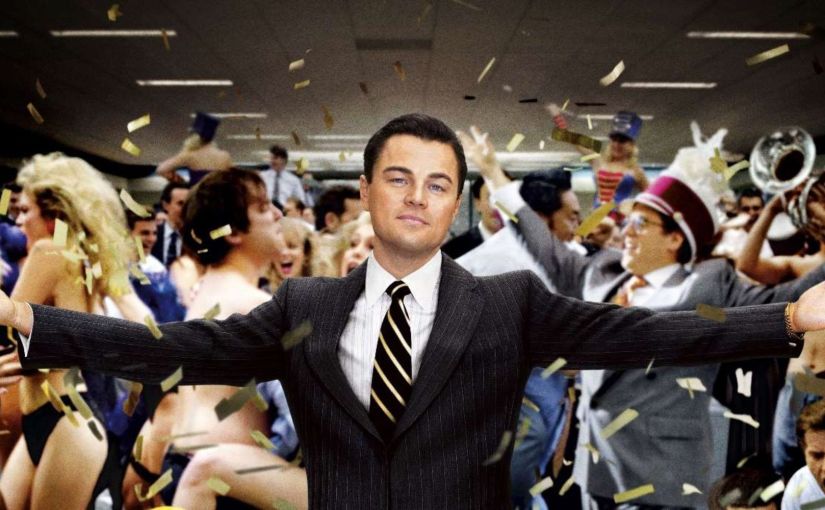
Leonardo DiCaprio explodes with rages of drug use, drinking, more drug use, banging prostitutes, even more drug use and pink slip stock trading along with some drug use. To get this manic, this wild, and this crazy requires a certain kind of energy to perform. The real Jordan Belfort must have had a massive amount of stamina to live this life. After all, he’s still alive today. DiCaprio, portraying the on-screen persona, throws himself into it. There’s no way he got to this pinnacle of hyperactivity on cue, with director Martin Scorsese’s call for action. DiCaprio had to thrust himself into this debauchery. It takes a certain skill to not let up on this. Pay attention to a hilarious scene where his quaaludes have paralyzed him to the point where he can’t even crawl to, much less open the door to his car. It’s a hilarious display of crippling physicality. DiCaprio maxed out on his Belfort portrayal, thereby earning his Oscar nomination. I thought he should have won that year. He lost to his cameo co-star, an excellent Matthew McConaughey for Dallas Buyers Club.

DiCaprio is so good that he yanks the entire cast into comparable craziness as well. Jonah Hill plays Jordan’s sidekick Donny: a buffoon of a guy who’ll whip out his member at inopportune times for attention and display. Hill doesn’t hold back either in his earned second nomination as well.

Scorsese, with a script by Terrance Winter based on Belfort’s book, is not concerned with necessarily showing a story arc where characters question their actions. Instead, he focuses on the hubris of all of this. Crashed helicopters, crashed cars, crashed planes and crashed luxury yachts not to mention endless office orgies, including one in first class on a commercial flight to Switzerland. It’s filmed very well, and while it is one over the top thing after another, it is nonetheless very funny and very entertaining.

The nerve of this guy, right? Yet that’s the thing about The Wolf Of Wall Street. Right from the get-go, Belfort is strongly urged to let up as the FBI easily closes in, and he doesn’t. It’s kinda crazy, really. Belfort put himself in an unwinnable situation and his addiction to money, drugs, ridiculous sex, and the ease by which he does it all calls to him to stay in the game until the lights just turn off.

This film marked the highly visible introduction of Margot Robbie as Jordan’s wife. She’s excellent with a New York accent (Robbie’s Australian) who loves the money and glamour but is not so stupid. Following up with a nominated role in I, Tonya (which she should have won against an aggravating Frances McDormand in Three Billboards…) and offering the best moments of Suicide Squad, it is easy to believe that she could go toe to toe with DiCaprio here. They have great arguments on screen together; funny but true.

Scorsese offers up his signature narrative voiceover from DiCaprio just as he did before in Goodfellas and Casino. His editor Thelma Schoonmaker is great at keeping the energy alive by taking advantage of the legendary director’s quick cuts and great music samplings.

The cast is just right with memorable moments from Jon Bernthal as Jordan’s tough guy friend and errand boy, Brad. (Bernthal is a great character actor all together. Check him out in Baby Driver, too.). Kyle Chandler is the modest element as the FBI agent who brings it all down. He knows he doesn’t have to exert himself too much. Belfort is doing all the work for him. Still, he spells it out harshly and honestly. No bullshit. He just cuts to the chase.

Other great appearances include Rob Reiner, Jon Favreau, Jean Dujardin, Joanna Lumley and I have to recognize Stephanie Kurtzuba. She offers a scene not widely recognized, as a disciple of Belfort’s team who is full of pomp, and confidence that far exceeds any of the guys alongside her. It occurs midway through and it’s an important moment because it really shows the power of influence Belfort had with his stockbrokers. He made them criminal millionaires overnight and to them he’s a Messiah. When Kurtzuba’s moment occurs, she solidifies the power of Belfort’s misdeeds.

It’s very easy to succumb to this lifestyle. Scorsese and Winter show how easily and quickly lots of unclaimed cash can be made at the expense of innocent people. It’s really fascinating. There’s no dimension to Belfort and his cronies of losers who would follow him anywhere despite the cost and the damage. That’s okay for me here. Simply because it fascinates me that he had the chutzpah to continue on with this immoral trajectory.

The Wolf Of Wall Street is a no holds barred, great film.

JUST ONE OF THE GUYS

By Marc S. Sanders

Okay. Okay. No need to throw darts my way. Sorry, but I love the 80s teen comedy Just One Of The Guys.

People please!!!!! Please understand my position on this subject. It’s Joyce Hyser!!!! One of my top three crushes from adolescence – Joyce Hyser. Joyce Freakin’ Hyser!!!!!

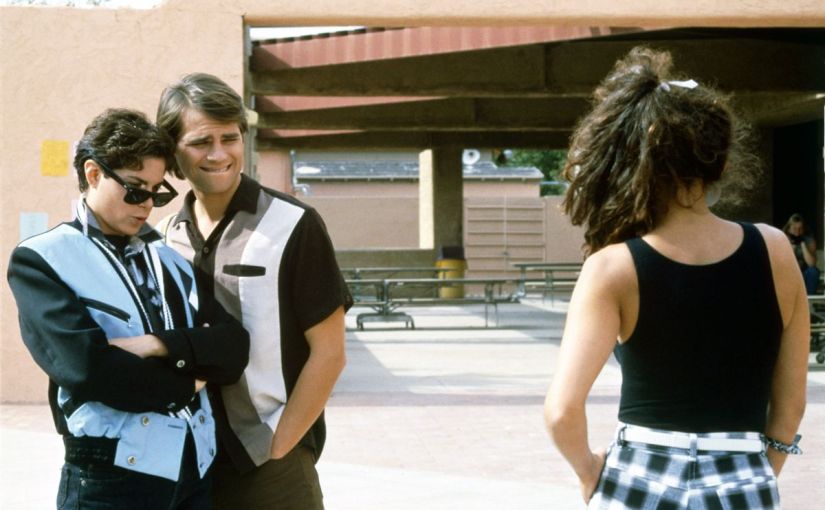
Now the irony is that while I have-yes, still have, and my wife has accepted this-a crush on Joyce Hyser the point of this film directed by Lisa Gottlieb is that lead character Terry needs to prove that she is more than just good looks. Terry is not just a hot chick. Terry has a brain, and to prove that she has the potential to be a fantastic journalist, she will register in another local high school where she will submit her article that’ll award her a summer internship at the Sun Tribune newspaper. Only thing is to keep her looks from getting in the way, she’ll have to register as a male student.

All the trappings of comedy cross dressing occur like using boys bathrooms and avoiding jock strap inspections from the gym teacher. She also has to put up with keeping her sex starved brother Buddy (Billy Jacoby) from teasing and revealing her secret. As well, her studly college boyfriend can never find out. An unwelcome crush (Sherilyn Fenn) on her male persona is trouble too. Oh yeah, and the typical 80s cinematic bully, actor William Zabka, has returned for the millionth time. There’s a lot packed into this cute flick that’s a loose adaptation of Shakespeare’s Twelfth Night.

Gottlieb’s film also steals elements from Jane Austen. The confused romance angle occurs. Terri decides to make Rick Morehouse (Clayton Rohner) the subject of her article. He’s a James Brown loving guy with no style and a crush on the bully’s girlfriend. Terri transforms him while she becomes Rick’s best guy pal. Only problem is that while Terri is working on finding a prom date for Rick, she’s also falling for him.

There’s a sweetness to Just One Of The Guys that always touched me as a teenager. Joyce Hyser as Terry is written more down to earth than characters from other teen 80s comedies. She has ambition and the movie stays with that theme. It’s important that Hyser is positively appealing in the looks department because it’s the Achilles heel of her character. Too often people are judged by their appearance. Her journalism teacher even suggests that she should pursue modeling with next to no shot at being a journalist. Interesting to see this scene in 2020 following the changes that sprung from “Me Too.” Frankly, the scene seems to have more impact today. It’s unfair to think that way about women. Just One Of The Guys with a script from Dennis Feldman & Jeff Franklin knew that well enough from the mid 1980s.

The film also has great side characters. It does really well in the geek gag department. One loves tiny reptiles, that he keeps housed in his pockets. Two others seem to share the same brain on a B movie science fiction level. They’re especially hilarious. Plus, the film boasts a zippy soundtrack that is one of my favorites.

I’ll also proudly say that the infamous topless scene that comes at the end actually seems necessary here, and not exploitive. It almost has to be done when the reveal is finally dawned upon Rick.

That and one of the best film ending on screen kisses make Just One Of The Guys one of my favorite 1980s byproducts.

SMOKEY & THE BANDIT

By Marc S. Sanders

Does a comedy get much better than Smokey & The Bandit?

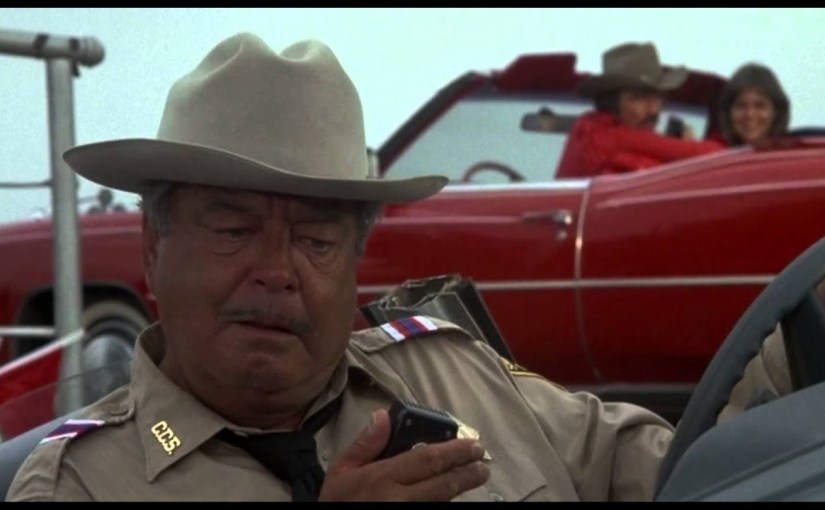
Stuntman Hal Needham re-energized the car chase comedy with this classic from 1977 featuring foul mouthed Jackie Gleason as Sheriff Buford T Justice of Portague County, Texas pursuing the charismatic, cocky and lovable Bandit played brilliantly by Burt Reynolds. It still holds up as a hilarious film.

Big Enos and Little Enos Burdette (Pat McCormick, Paul Williams), in matching cowboy hats and suits, challenge The Bandit to bootleg 400 cases of Coors beer from Texas back to Georgia in 28 hours; that’s 1800 miles total. They’ll pay him $80,000 to do it. Bandit recruits his best pal, The Snowman (the terrific Jerry Reed who also sings memorably on the soundtrack), to drive the truck hauling the manifests while he pilots the black Trans Am at 110 mph, distracting law enforcement away from the truck. On the way back from Texas, Bandit picks up a hitchhiking bride (an adorable Sally Field as Carrie soon to have the handle of “Frog”), who has fled from her wedding to Sheriff Justice’s son, Junior (a great dim-witted Mike Henry).

That’s all there is to it!

From there, it’s just one pursuit after another with the Trans Am doing ungodly stunts like jumping bridges and dodging roadblocks from state to state, while keeping Smokey Bear Sheriff Justice off his tail. A great on-going slapstick gag is seeing the excessive damage piled on to the Sheriff’s squad car. He loses the roof, the driver’s side door, the muffler and so on. The car keeps up with The Bandit, though, and Sheriff Justice never loses his hat.

This film doesn’t belong to any one member of the cast. Collectively it belongs to all of them. Every character is memorably quoted and given great comedic moments to laugh at over and over again. Even The Snowman’s basset hound, Fred has his share of laughs.

It’s impressive to think how influential this film actually became. The black Trans Am with the gold eagle spread across the hood, became a classic car much like any James Bond vehicle. The hit series The Dukes Of Hazzard made its debut shortly thereafter, and stole much of this film’s themes and gags. Tons of crash ‘em up stunt filled chase comedies attempted to duplicate the success of this film in the late ‘70s and early ‘80s, including further team ups of Needham, Reynolds, Reed and Field (Hooper, The Cannonball Run).

Hal Needham, with his cast and crew, really touched on something special with Smokey & The Bandit. As one of the first films I ever saw in theatres, it’ll always remain as a favorite movie going experience that I shared with my brother and babysitter, Mrs. Garcia. Along with late night viewings of the classic 39 episodes of The Honeymooners, Jackie Gleason will always stay on top as one of my favorite funny men. I’ll still watch and happily quote this picture endlessly for years to come.

“Now lemme have a diablo sandwich and a Dr. Pepper and make it fast. I’m in a g-ddam hurry!”

THE SUGARLAND EXPRESS

By Marc S. Sanders

Steven Spielberg’s second film, and first full-length theatrical release, is The Sugarland Express.  It’s inspired by real life events that consisted of a convict couple making their way to the Sugarland estate, located in Texas, to reunite with their toddler child living with foster parents.  Goldie Hawn played the mother, Lou Jean, who easily springs her husband, Clovis (William Atherton) from a pre-release penitentiary.  Clovis only had four months to go before a full release.  Once they’re out, they hijack a police car with the deputy driving and make their way across the state for Sugarland.  The rest of the police force, along with out of state authorities, are hot on their tail.  Pitifully speaking though, this becomes a long, drawn-out slow car chase.  It’s a pretty dim-witted story, but because it’s based on fact, well, some thought it’d make for an interesting two hours on film.

Unlike Spielberg’s first film, Duel, I didn’t find much inventiveness with The Sugarland Express.  If anything, it was likely green lit following what the director accomplished so well, at such a low expense, with his first film.  Car crash/car chase movies were also becoming trendy in the early ‘70s with Steve McQueen’s Bullitt becoming such a pioneering film of incredible automobile stunt work.  The French Connection would go on to win Best Picture a few years later with a centerpiece car chase to hang its hat on as well.  The Sugarland Express however is quite silly and very inferior to those pictures, though.

I was impressed with the infinite number of cars at Spielberg’s disposal and many of them get bashed up and crashed up in so many ways.  Yet, I grew tired of the novelty too.  The stakes didn’t seem so high with this film.  It is perhaps a film of its time.  After so many on the run pictures that were made with much better sophistication in the decades that followed, Spielberg’s film often feels unconvincing and unintentionally silly.  A funny moment occurs when Lou Jean needs to finally pee following miles and miles of endless driving.  The outlaws force the police led by Ben Johnson, in a nothing role with a big cowboy hat, to bring in a port o potty in the middle of an open field.  Cop cars are everywhere.  It’s clear as day outside.  Yet no one takes the opportunity for aggressive action.  Lou Jean gets to relieve herself.

As the pursuit carries on, Lou Jean and Clovis become celebrities, and crowds of townsfolk approach the car they occupy to lend them money and good wishes and even a pet pig.  Silly stuff mostly, but just not very amusing to me, and Goldie Hawn, who is normally a natural and adorable comedienne, is not very endearing here.  Lou Jean mostly screams in her redneck dialect and as a former beautician, styles her hair in the back seat applying endless amounts of hair spray to irritate Clovis and the deputy.

I didn’t find much camera work to impress me from Spielberg either.  I appreciated one moment in time however.  As the characters manage to hide out in an RV parking lot overnight, they watch an outdoor screening of a Roadrunner cartoon short out their back window.  Wile E Coyote falls victim to one of the Roadrunner’s tricks, and Spielberg captures a close up of Atherton with a foretelling expression of doom cross over his face.  It’s a nice moment that brought me back into the film, but then the ongoing themes of the film return thereafter.

I don’t care if it’s a true story.  I don’t care how ridiculously absurd it all amounted to.  The Sugarland Express was just noise for me.  Other absurdist stories of the 1970s, approached their subject matter better.  Films like Dog Day Afternoon whereas the ordeal continued to prolong, so did the mental exhaustion and desperation of the characters.  I’m afraid Spielberg just didn’t capture any of that here.

PLANES, TRAINS AND AUTOMOBILES

By Marc S. Sanders

The Tuesday Before Thanksgiving Tradition blazes on for another year as Steve Martin and John Candy travel from New York City to Wichita, Kansas and then who knows where all while trying to reach their final destination of Chicago, Illinois in time for Thanksgiving dinner.

Despite the fact that Planes, Trains & Automobiles was made in 1987 before the age of cell phones, personal navigation systems, Priceline .com and Ubers, it remains a timeless classic of inadvertent comedy. Travel is still as frustrating, maybe more so now, and family kinship is still treasured.

Martin plays Marketing Executive Neil Page, forced to succumb to the unwanted company of Shower Curtain Ring Salesman Del Griffeth (Candy). One inconvenience after another delays Neil from getting home to his family for the holiday. Del wants to be helpful, yet he is anything but.

The roles are perfectly cast. One of the best on screen couples of all time. I imagine had John Candy not passed away so young, he would have been paired up with Steve Martin at least one more time.

Writer/Director John Hughes is a master at taking simple circumstances (detention on a Saturday, skipping school, traveling) and blossoming it into episodes of relatability amplified in both comedy and drama. His knack for dialogue is a huge factor in his scenes. Consider the best scene in the film between Martin and favorite character actor Edie McClurg where 19 F- bombs are tossed over the mix up of a rental car. It happens all the time to any one of us, and Hughes took advantage of the frustration and built comedy that comes from it. Its not funny when you are in the moment. It’s funny when you recall the moment later on. It’s a brilliant scene.

Nut grabbing, taxi races, ride hitching in 1 degree weather, bed sharing with what you think are pillows, burning cars, wrong way driving, encounters with death and the devil, “The Canadian Mounted,” and a perfect excuse to use Ray Charles’ rockin’ “Mess Around” all point to a reason for a climax that arguably (on the first time any of us saw the film) we never expected or considered. If you don’t choke up, you have no soul.

Hughes was all too familiar with the meaning of Thanksgiving when he wrote Planes, Trains & Automobiles. I like to think those that see the film are even better for having watched it.

It’s a very funny movie, but it’s very special movie as well. Give thanks, offer what you can, when you can, and Happy Thanksgiving.