DIE ANOTHER DAY

By Marc S. Sanders

Once the 2nd half of Die Another Day arrived, Pierce Brosnan’s interim as James Bond was all but wrapped up. This was gonna be his last film after this misfire, and the craftspeople at EON Productions knew something had to change.

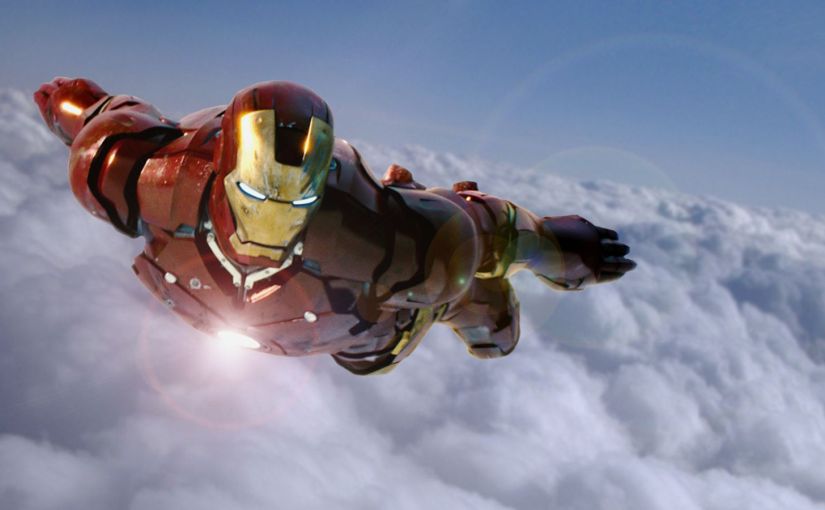
What happened here? Director Lee Tamahori was on the right path from the get go with some real world parallels and surprising elements for the long lasting franchise. Then, the film goes sci fi gonzo with some kind of robotic armor for the villain, a space satellite that harnesses the power of the sun, a palace literally held together by ice, an invisible car, DNA switcheroos, and James Bond kite surfing to avoid a solar laser beam.

This movie got ridiculous really, really fast.

Early on, 007 covertly surfs his way onto the coast of North Korea to intercept an arms trade in exchange for diamonds. He’s captured and held for the following 14 months. When the British make a trade for Bond with a North Korean prisoner with a bad case of facial diamond acne, Bond is no longer trusted by M (Judi Dench) and he must become resourceful on his own in stopping whoever betrayed him before his capture. He also needs to figure out what a wealthy industrialist named Gustav Graves (Toby Stephens) is conjuring up in Iceland, with a literal ice palace hosted to Bond as well as a slew of investors and dignitaries.

Die Another Day began with a grounded intent. However, the stunts and gadgets that are introduced later in the film fly way off the rails, even for a James Bond film. Bond has always completed his mission by ridiculous measure. However, when your hero and villain are on an out-of-control airplane that is being torn apart by a solar beam from space, ala hammy CGI, well, reader how does 007 even survive that?

Another ridiculous plot element involves DNA transfers. So Gustav Graves, a man who claims he never sleeps, may not be who he claims to be. Graves is the villain here and Stephens plays him like a spoiled brat. I didn’t like him and the best Bond films are primarily weighted by the bad guy. For some reason he has to wear this bionic suit of some kind to control the satellite. A keyboard and mouse weren’t as efficient, I guess. It’s also capable of electrocuting Bond; lots of zig zaggy tesla/lightning bolts surround Bond and so on. You really don’t have to see it to believe it.

The Bond girl is Halle Berry and she’s pretty good as an American agent who goes by the name of Jinx. Yes, there’s time made for the two agents to have some flirtations together, but like Michelle Yeoh before her, Berry gets in on the action.

Man oh man! WOW!!!! Die Another Day started so good and then it fell apart. While I don’t think it is the worst of the series, it borders towards the bottom of the list. It’s a shame really. If only it stayed a little more grounded, maybe it wouldn’t have died on any day.

THE WORLD IS NOT ENOUGH

By Marc S. Sanders

The 19th installment in the James Bond series is The World Is Not Enough from 1999. By now Pierce Brosnan is comfortably established in the role and an expert at pun delivery and suave debonair swagger.

Michael Apted more or less delivers a standard fare. Nothing new here, really, with the exception of John Cleese (perhaps playing the role of R) as the would be successor to exiting mainstay Desmond Llewelyn as Q, the gadget specialist. I wish Cleese could have lasted longer than just his two film internship. He’s hilarious and well suited for the super spy’s tongue in cheek universe.

The story is similar to other Bond films. The one who we eventually realize to be the main villain wants to wipe out oil pipelines so that only their pipe is the only one exclusive to the region in the European west of the world. Auric Goldfinger had a similar idea with his affection for gold. A View To Kill aimed for this with Silicon Valley. Gold, silicone and now, here the commodity is oil.

The World Is Not Enough has a lot of crazy stunts and gadgets that we are always eager to see, such as a boat chase along the Thames River, snow ski escapes from parachuting snow mobiles (a fun sequence), deactivating bombs within underground mines and pipelines, underwater heroics in and out of a submarine and another buzz saw device, only this is a big one connected to a helicopter that is not just for cutting down forestry. BMW also makes its 3rd appearance in the franchise with a spiffy convertible.

The Bond gals are also up to the task. Sophie Marceau is Electra King. A one time kidnapping victim, she has taken over her father’s oil business following his assassination, which Bond is investigating. Marceau is beautiful as expected, but she’s got a great, mysterious way about her.

Denise Richards is fine (QUIET, you haters!) as a geologist swept up in assisting Bond. Her name, Dr. Christmas Jones, is deliberately laughable but she’s works well with Brosnan because there’s hardly any approach at seduction. They’re partners more than anything else. At least, they are until the end of the picture.

I do wish there was more to do for Robert Carlyle, though, as the bad guy Renard. He is impervious to pain thanks to a bullet resting in his brain. He is rapidly heading to death without any sensory feeling, but he gradually gets stronger with each passing day. I don’t know how you diagnose that, but in a James Bond picture, you take it at face value. Carlyle looks perfectly dastardly but he’s hardly on screen and has barely any exchanges with Brosnan’s Bond. When the real villain is finally revealed, Renard doesn’t serve much purpose any longer.

Judi Dench is back again as M. She is positively one of the best casting choices in the entire franchise. Bond remains a chauvinist (early on seducing his gorgeous doctor during an examination), but Dench as M counterpoints that stance and it is more than welcome. She is given more material here as well.

The World Is Not Enough didn’t reinvent the passenger ejector seat or the exploding pen per the nature of 007 films. Yet, it has a neat twist midway. Yeah, you might see it coming, but still it’s appreciated to keep the story developments ongoing. As well, the action plays well with a very good cast.

Brosnan was 3-0 by this point with the franchise.

TOMORROW NEVER DIES

By Marc S. Sanders

Pierce Brosnan’s second outing as James Bond is Tomorrow Never Dies and it is his best appearance in the series.

Bond faces off against Elliot Carver (a gleefully bloodthirsty Jonathan Pryce), a global media mogul who enjoys creating worldwide conflict for the best news headlines in print, television and the newfound medium of something called the internet. His pawns are Great Britain and China, and just like any worldwide media mogul he has his own stealth war ship for apprehending missiles and using them against the nations. This ship also has a massive drill that can penetrate a ship’s hull. Oh yeah, Carver also has the means to redirect a sea vessel into enemy territory. Bet Ted Turner or Rupert Murdoch could never do any of these things. Carver also has a big, blond bruiser of a guy called Mr. Stamper (Gotz Otto) – another in a long line of big, blond bruiser guys to face off against 007. Stamper is nothing compared to Robert Shaw in From Russia With Love, though.

Dame Judi Dench is back as M. I like how she holds her own too. As an actor, Dench has such command of any role she plays. If she is in a scene, everyone listens to her primarily. Even in a goofy Bond movie, Dench puts these films above the standard fare.

Teri Hatcher is also good in a small role as Carver’s wife Paris, and a former flame of Bond’s. M encourages Bond to “pump her for information.” Ahem!

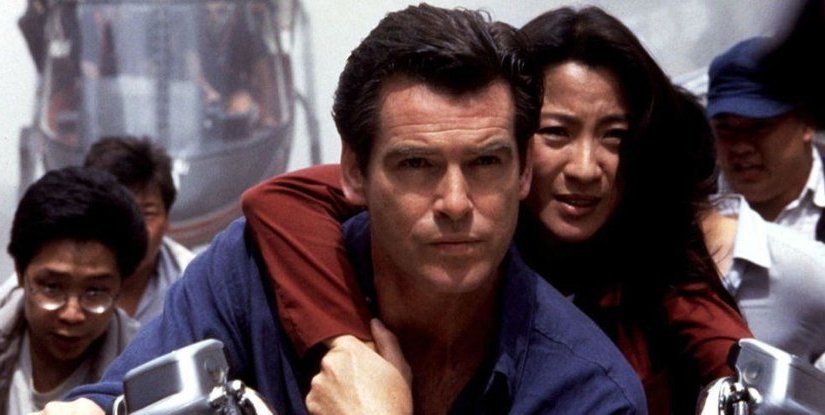
With the Brosnan entries from the 90s, the series was updating itself for a more mainstream feel. So the female stand-in is Michelle Yeoh as a Chinese agent named Wai Lin. Yeoh plays one of the best sidekicks/Bond girls of the series. This agent can hold her own while firing off two machine guns, one on each arm and offering up a great display of karate moves. Yeoh works well with Brosnan especially when handcuffed together while riding a BMW motorcycle and evading machine gun toting cars and a massive helicopter terrorizing a bustling Vietnam village. A fantastic sequence.

Before that, Bond pilots his BMW 700 series from his backseat on his cell phone pad, within a parking garage. Bazookas, guns, crowbars, sledgehammers and missiles can’t stop this luxury car though. After all, the Germans do make some of the best automobiles. Another really entertaining action scene.

I think this is a better film than GoldenEye. Brosnan appears more comfortable with the role and his humor is funnier. He rides the motorcycle through a laundry clothesline and Wai Lin tells him to go faster. Bond’s response: “Alright. Keep your shirt on!” I liked it. I was having a good time with the film.

Roger Spottiswoode was the director this time and he does a fine job. All of the action scenes are well orchestrated and edited.

I’ll also give props to Sheryl Crow for her alluringly sexy and haunting title track. I have never forgotten the song since I saw the film.

Tomorrow Never Dies is a great action film worth checking out whether you’re a James Bond fan or not.

I really like this entry.

GOLDENEYE

By Marc S. Sanders

Over six years went by following Timothy Dalton’s last appearance as James Bond. He wasn’t likely to come back and the big question, besides if we’d ever see another film, was who would carry the Walther PPK pistol next as 007. Pierce Brosnan was not a likely choice as I recall, having missed out on the opportunity before with a flimsy Remington Steele contract commitment with NBC. Yet, one day my brother called me at work to share with me the news that Brosnan had signed on. His first film in the everlasting series was Goldeneye directed by Martin Campbell (eventual director of Casino Royale and Green Lantern). It was a welcome debut for the former odds-on favorite contender.

Bond goes up against the Russians in a post-Cold War 1990’s era, with Sean Bean as his adversary, also once known as Bond’s ally, Agent 006-Alec Trevalyen.

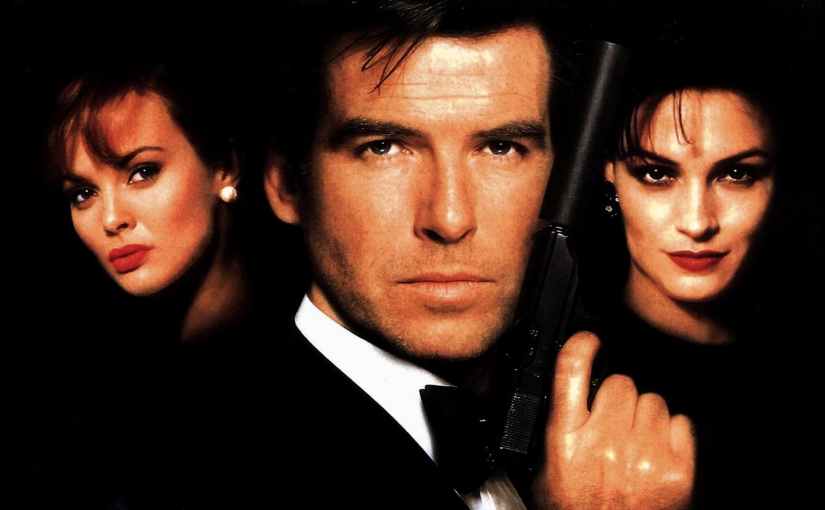
With Famke Jannsen as sidekick Xenia Onatopp (holding on to the sexual innuendo tradition), Alec steals a super helicopter that allows him to take possession of the Russian Goldeneye disc. Dame Judi Dench, making her first appearance as M, assigns Bond to locate the disc and find out what Alec intends to do with it. Forget about what the disc is for; you don’t uncover that until the end of the film.

Brosnan is a good physical Bond and he does the tongue in cheek well, sounding much like his Remington Steele character. Screenwriters Jeffrey Caine and Bruce Fierstein provide a wealth of signature puns for Bond to deliver. Onatopp can masterfully kill someone by squeezing a victim between her thighs. Bond’s observation: “She always liked a tight squeeze.”

The film has an outstanding but unrealistic opening scene with a motorcycle trying to catch up to a descending airplane. There’s also a fun tank/car chase in Red Square, and a great action-packed ending in Cuba where a satellite is hidden to aid Alec in his plot.

Bean’s role, like most of those on his resume, makes for a great villain – a real equal to Brosnan in physicality and wit. A great match up.

The Bond girl is also very good. Beautiful but not exuding too much sexiness. More so, actor Izabella Scorupco as Natalya, the Russian computer analyst, is an intelligent addition to the story. Alan Cumming is fun as a nerdy analyst as well. I love when he consistently boasts “I AM INVINCIBLE!!”

Goldeneye was well celebrated upon its release. James Bond was back and updated for the modern action film. The first scene of the film cemented Brosnan as the super spy with a true to life stunt where 007 bungee jumps off of a high-altitude water dam, with just enough time to take out his cable pistol. As soon as the scene graced the screen, fans sat up with attention.

This was a James Bond everyone could love.

THE FUGITIVE

By Marc S. Sanders

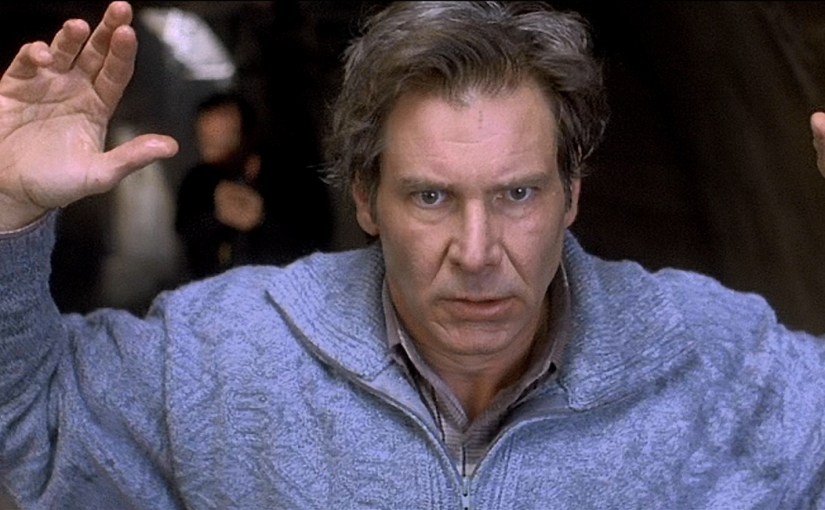
In 1993, Andrew Davis directed the best Alfred Hitchcock film that was not directed by Alfred Hitchcock. The Fugitive with Harrison Ford being pursued by Tommy Lee Jones was a runaway smash. As we now live in an age of cell phones and the World Wide Web, you’d think this film might be somewhat dated but it is the last thing on your mind while watching. This is a tense, taut thriller that never, ever lets up. Another favorite picture of mine.

The opening credits serve as a prologue, showing Dr. Richard Kimble struggle with a one armed man in his home after his wife (Sela Ward) has been assaulted and killed. Kimble becomes the accused and eventual guilty party who is sentenced to death.

Davis is now ready to show his first of many wonderful set pieces. As Kimble’s prison bus careens off the road landing on railroad tracks, an oncoming train collides with the bus. Kimble and another prison inmate now have the opportunity to escape and go on the run. Enter Tommy Lee Jones as Deputy Sam Gerard and his team of smart, intuitive misfits to catch up to Kimble who has made a mad dash into the dense Illinois woods. Because Kimble and Gerard are depicted to be incredibly smart, Kimble only remains a few steps ahead throughout the picture. Later in the film, Kimble makes his way back to Chicago to search for the one armed man and uncover exactly why his wife was murdered.

Location shots are masterfully done in The Fugitive. From the woods to a sewer system (a manufactured set I believe), to the streets of Chicago and Cook County Hospital.

The train crash is one of the all time best moments in film. No miniatures. No CGI. This is a fully loaded train crashing into a bus, and this is where you can not deny the craftsmanship of great filmmaking. Cameras were positioned at multiple angles to capture the mayhem in one take.

The other great set piece occurs during the actual St Patrick’s Day parade in Chicago. Gerard once again gets Kimble in his sights and Kimble manages to blend in with the parade marchers. The quick editing of improvisational camera work is spectacular here. Kimble and Gerard are literally in the same frame and yet Gerard can’t see what’s under his nose. Moments like these can’t be storyboarded. Andrew Davis’ production could not stop the actual parade for another take. It all had to be done on a now or never basis.

I watch The Fugitive and I always think back to Alfred Hitchcock’s best work like The Man Who Knew Too Much and North By Northwest. An innocent man is unexpectedly swept up in a conspiracy where he becomes the target and his adrenaline and instincts must kick in to save himself. The only thing he’s armed with is his mind. There’s also an unusually creepy antagonist, The One-Armed Man. This makes the film incredibly foreboding. I know the film stems from the legendary television series, but Davis treats this villain as if he’s among the ranks of Hitchcock’s use of Martin Landau or James Mason.

Harrison Ford is great at never glamorizing his role. He doesn’t suddenly become Rambo. He becomes a man of convincing desperation. Ford shines in roles like these such as his other films like Witness, Air Force One, and Frantic.

Tommy Lee Jones gives one of my most favorite performances on film. He plays Gerard with non stop adrenaline. He has exquisite chemistry with his team, including Joe Pantoliano. As well, Gerard is only interested in fetching what has escaped. He has no interest in guilt or innocence, until he realizes that Kimble has no interest in the consequences of escape. Kimble is interested in his innocence. Even Gerard becomes attuned to Kimble’s drive. Here is where the script is wise. There is no dialogue to imply what Gerard is thinking. Tommy Lee Jones has a way of giving a great close up to show what he’s thinking. He trusts the audience will presume what’s driving his intuition.

Davis pulls out all the stops with this film. There’s magnificent action shots of Gerard’s helicopter quickly flying over the ambulance that Kimble is racing away in. A great cat and mouse maze sequence happens within a sewer system. Lighting is perfect, there. Nothing is overly dark. There’s also incredible overhead shots of the dam and ravine that Kimble makes for a getaway with an absolutely surprising dive from an enormous height.

The Fugitive is smart and action packed to the teeth. You are in full focus while watching the ongoing pursuit. This film was nominated for Best Picture. Rare for an action film, but also a testament to its greatness. Tommy Lee Jones deservedly won the Oscar for Supporting Actor.

No doubt for me that The Fugitive is a must-see film for any kind of moviegoer. There are moments to feel scared, to laugh, and to cheer. When it is finally over and the story arrives at its satisfying conclusion, you cannot help but let out a deep breath. You feel like you’ve run a hundred miles, or at least as long as Richard Kimble ran towards his innocence. Your time will be well spent investing in the The Fugitive. An absolutely fascinating picture of great, mounting suspense.

JAWS

By Marc S. Sanders

Steven Spielberg’s third film, Jaws, is more than just an adventure or thriller piece of filmmaking. I believe it explores the dichotomy of motivations by man versus the intrinsic behavior of nature. In other words, in the peak season of summertime a great white man-eating shark will never care about how important it is for a small harbor town to sell the necessary amount of ice cream cones or hotel bookings to make an annual profit. You wanna swim with nature, then die by nature.

The New England coastal town of Amity Island has a new Police Chief named Martin Brody (Roy Scheider). When he comes upon what’s left of a girl’s mutilated corpse on the beach, he takes it extremely seriously when he learns the cause of death was a shark attack. The Mayor (Murray Hamilton) cannot afford to be mired with the inconvenience of a large fish just before the always profitable 4th of July weekend. So, the beaches must continue to stay open.

When the town gets a bloody public viewing of the problem at hand, a young, wealthy, educated oceanographer named Matt Hooper (a perfectly cast sarcastic and smart Richard Dreyfuss) is recruited. His knowledge with the science of shark behavior is not very welcome to anyone but Brody.

One dynamic of Hooper is his reliability of technology. Will any of his expensive tools be enough to rid the town of this shark?

As well, will a bounty hunt worth $3,000 satisfy? Any Joe Blow fisherman will take a crack at it. Spielberg’s film explores Hooper’s intellect of sea life, against the buffoonery that follows from others both near and far. Why not randomly toss some sticks of dynamite in the water or bait the animal with a pot roast while you’re at it? Maybe that’ll work. It’s money and technology in the face of one of nature’s most dangerous creations.

Will a sea faring Ahab like fisherman named Quint (Robert Shaw playing one of the greatest characters ever on screen) do the trick? His philosophy stems from his experience with the might of sharks in general. An illustrious monologue from Shaw describing Quint’s harrowing experience aboard the USS Indianapolis confidently tells us he’s seen what sharks can do. He’s floated in the blood red waters that sharks leave behind. Therefore, Quint has devoted his life to hunting one shark after another, boiling their large jaws of teeth for trophy hangings. He’ll win battle after battle, but never will he win the war with the nature of the ocean water.

Brody might be the only sensible guy, though. He fears the water and won’t go near it. He’s over with danger, leaving the cop’s life behind in the city for what he expected of the tranquility of ocean front real estate.

A mounting pressure always exists in Jaws. The townsfolk are hard pressed resistant to allow their businesses to avoid prosperity because of something as silly as a shark that isn’t even known to swim in these waters normally. Money is what matters. Money is what’s needed to live. During the age of quarantining with the spread of Coronavirus, Jaws is a fair allegory for the argument of staying at home or going back to work. You could die, but it’s still expensive to live.

The other argument lies in what’s more appropriate for this problem. Hooper’s technology or Quint’s hunter instinct. A metal “anti shark cage” with a spear of poison vs tying barrels to the predator and drowning him out in the shallows.

Spielberg with a script by Carl Gottlieb adapted from Peter Benchley’s best selling novel proposes no easy answer to ridding an ocean area of a man eating, uncompromising animal. That’s the thrill that keeps Jaws alive for over 45 years. Sharks will never change. Man might, but nature’s creatures will consistently emote the exact same patterns of behavior.

Unlike the fantasies of Jurassic Park or a Friday The 13th picture, a beast born of nature with enormous strength will always be unpredictable performing on God’s purpose. It will never be negotiable. If you’re a raggy fisherman like Quint, your old, leaky boat might keep you afloat for so long, but a shark will also not feel intimidated, no matter how many others of its kind this hunter might have conquered before.

Experience, technology or disregard for the elements of nature will not always win. Something unconquerable will come along.

To maintain the strength of the film’s monstrous antagonist is to watch the movie with your own most frightening, worst case scenario in mind. Hence, Spielberg gratefully never shows the great white until long after half the film is over. Masterful shots occur where his cameras seem positioned just at the surface of the water. When swimmers make desperate runs for the shore, away from danger, it feels as if the viewer is frozen in fear and getting trampled on by the panicked extras cast in the picture. What could be so terrible that these people are swimming and running away from? When Spielberg finally shows the gigantic shark emerge from the water, Scheider’s shock with his suggestion of needing a bigger boat assure you that, yes, this problem is actually this insurmountable.

Additionally, Spielberg uses props to keep the mystery of his beast alive. When the shark pulls a dock off its moorings with his bait, we know the fish is turning around to pursue its next victim as the wreckage now floats in the direction of a man’s panicky, desperate swim.

Most effectively beyond Steven Spielberg’s camerawork, has got to be the pulse pounding and blood curdling soundtrack from John Williams. (Cliche descriptions they may be, but I’d argue Williams’ score created the terms, nonetheless.). Without his music, the narration of the story would be a little lost, I’m sure. John Williams’ repetitive string notes that build, feel like the dialogue of the underwater monster. His music goes beyond the short rhythm everyone is familiar with. Looking at the opening scene with Susan Backline portraying the moonlight skinny dipper in the opening scene of the film, Williams brings in a variety of different sounding instruments that leave an impression of her body being torn apart by something she’s truly not aware of. Splashing, screams, body thrusting and harsh chords of long strings with percussion the emote panic and anarchy make for one of the most memorable opening scenes of any film. Spielberg with a collaboration of cinematography from Bill Butler and Williams orchestration make for an arguably unforgettable and frightening scene on the same level of the shower scene in Psycho.

Jaws transcends generation after generation. Everyone eventually has some kind of familiarity with the film, even if they’ve never seen it. People have seen the poster, heard the music or truly refused to step in the water off a coastline out of fear for what can’t be seen. Few films ever leave a subconscious effect on a viewer or a general public, but Jaws is most definitely one of those exceptions.

THE SUGARLAND EXPRESS

By Marc S. Sanders

Steven Spielberg’s second film, and first full-length theatrical release, is The Sugarland Express.  It’s inspired by real life events that consisted of a convict couple making their way to the Sugarland estate, located in Texas, to reunite with their toddler child living with foster parents.  Goldie Hawn played the mother, Lou Jean, who easily springs her husband, Clovis (William Atherton) from a pre-release penitentiary.  Clovis only had four months to go before a full release.  Once they’re out, they hijack a police car with the deputy driving and make their way across the state for Sugarland.  The rest of the police force, along with out of state authorities, are hot on their tail.  Pitifully speaking though, this becomes a long, drawn-out slow car chase.  It’s a pretty dim-witted story, but because it’s based on fact, well, some thought it’d make for an interesting two hours on film.

Unlike Spielberg’s first film, Duel, I didn’t find much inventiveness with The Sugarland Express.  If anything, it was likely green lit following what the director accomplished so well, at such a low expense, with his first film.  Car crash/car chase movies were also becoming trendy in the early ‘70s with Steve McQueen’s Bullitt becoming such a pioneering film of incredible automobile stunt work.  The French Connection would go on to win Best Picture a few years later with a centerpiece car chase to hang its hat on as well.  The Sugarland Express however is quite silly and very inferior to those pictures, though.

I was impressed with the infinite number of cars at Spielberg’s disposal and many of them get bashed up and crashed up in so many ways.  Yet, I grew tired of the novelty too.  The stakes didn’t seem so high with this film.  It is perhaps a film of its time.  After so many on the run pictures that were made with much better sophistication in the decades that followed, Spielberg’s film often feels unconvincing and unintentionally silly.  A funny moment occurs when Lou Jean needs to finally pee following miles and miles of endless driving.  The outlaws force the police led by Ben Johnson, in a nothing role with a big cowboy hat, to bring in a port o potty in the middle of an open field.  Cop cars are everywhere.  It’s clear as day outside.  Yet no one takes the opportunity for aggressive action.  Lou Jean gets to relieve herself.

As the pursuit carries on, Lou Jean and Clovis become celebrities, and crowds of townsfolk approach the car they occupy to lend them money and good wishes and even a pet pig.  Silly stuff mostly, but just not very amusing to me, and Goldie Hawn, who is normally a natural and adorable comedienne, is not very endearing here.  Lou Jean mostly screams in her redneck dialect and as a former beautician, styles her hair in the back seat applying endless amounts of hair spray to irritate Clovis and the deputy.

I didn’t find much camera work to impress me from Spielberg either.  I appreciated one moment in time however.  As the characters manage to hide out in an RV parking lot overnight, they watch an outdoor screening of a Roadrunner cartoon short out their back window.  Wile E Coyote falls victim to one of the Roadrunner’s tricks, and Spielberg captures a close up of Atherton with a foretelling expression of doom cross over his face.  It’s a nice moment that brought me back into the film, but then the ongoing themes of the film return thereafter.

I don’t care if it’s a true story.  I don’t care how ridiculously absurd it all amounted to.  The Sugarland Express was just noise for me.  Other absurdist stories of the 1970s, approached their subject matter better.  Films like Dog Day Afternoon whereas the ordeal continued to prolong, so did the mental exhaustion and desperation of the characters.  I’m afraid Spielberg just didn’t capture any of that here.

LICENCE TO KILL

By Marc S. Sanders

Regular James Bond screenwriters Richard Maibum and Michael G Wilson (also co-producer) along with director John Glen were not really doing any favors for Timothy Dalton with his 2nd and final outing as 007, with Licence To Kill. The story was a huge departure from what Bond audiences are accustomed to where the super spy goes rogue in the Florida Keys and Cuba, to seek vengeance against a Columbian drug lord named Sanchez (Robert Davi). The problem is this is all beneath Bond. James Bond prevents world domination, not drug trafficking.

Okay. So the story doesn’t hold much water. Dalton’s role is not written very well either. His prior entry in the series established him as a tougher Bond with less sarcastic wit, but certainly a man of culture and sophistication. This one takes out all the sarcasm. Dalton doesn’t even seem to wear his tuxedo very well here. He just isn’t carrying the Bond stature. There’s not much left to the guy.

The ladies are lacking, too. Carey Lowell (eventual Law & Order attorney) is a tough talking CIA operative lacking any sort of romance or chemistry with Dalton. At times, though they might share the same frame, they could have easily been acting in separate rooms. Dalton and Lowell never seem to be listening to one another.

Talisa Soto is Sanchez’ mistress. She’s positively beautiful and exotic like many Bond women before her, but like Lowell she doesn’t appear to really be acting the story. At one point, she tells Lowell “I love James.” I’m trying to figure when the seduction actually occurred though. A movie can’t just tell me that. A movie has to show me that.

Davi is quite vicious as a villain and Licence To Kill features one of the cruelest deaths in the entire series when Sanchez forces a traitorous drug runner into a depressurizing chamber. Yeah. We are treated to a gory, fun inflatable head explosion. As vicious as Sanchez is, his character seems more appropriate for a Lethal Weapon or Die Hard film. Sanchez just doesn’t mesh well in the James Bond universe. Nor does Wayne Newton, actually. Yeah, he’s here too, believe it or not, as a drug cover front messenger posing as a televangelist. Who wants to see Wayne Newton, and how is this funny or entertaining?

The big attraction is a tanker truck chase along a desert road. Big explosions here along with fights on top of the moving rigs. It’s fun but nothing great.

Nothing is at the top of its game with Licence To Kill. That’s a major problem for a relatively new actor taking on such a celebrated role. Primarily, since the story is so weak, it’s hard to accept Timothy Dalton and I think that lent to his end with the franchise after just two entries. Yes. There were known financial issues mired in studio buyouts and bankruptcy leading to Bond taking a near six-year hiatus following this lackluster film, but as soon as Licence To Kill finished its tenure in cinemas, I don’t think anyone truly missed Timothy Dalton.

THE LIVING DAYLIGHTS

By Marc S. Sanders

The Living Daylights is one of the best James Bond films. It’s more than just a Bond film with gadgets, and henchmen with unusual scarring or kill techniques. It’s actually a film that plays on the Cold War instead of loosely being inspired by it like say Dr. No or You Only Live Twice.

A Russian agent wants to defect and is eternally grateful for Bond’s assistance. The mission goes as planned but then twists fall into play and maybe there’s more to this Russian agent than was foreseen. Who is his beautiful girlfriend? What does an American arms dealer have to do with all this? How does opium and diamond smuggling become involved? There are travels to Czechoslovakia, Tangiers, beautiful Vienna and ironically Afghanistan. Yes. In 1987, James Bond could rely on Afghan rebels for aid and weaponry. Any chance this film will be remade today?

Maryam d’Abo is a beautiful concert cellist and she’s great in the film. Her character is Kara Miloviloy (no innuendo that I could find in that name; this is more spy thriller than sexual schtick). Timothy Dalton makes his first of two appearances as Bond. He’s more serious than audiences were accustomed to, putting his sharp wit and intelligence ahead of his sarcasm like Connery or Moore before him. Dalton and d’Abo have great chemistry together. Jerome Krabbe is the dubious defector playing to whatever side will help him profit, and Joe Don Baker is the redneck arms dealer with an affection for history’s greatest battles only recreating them on his play sets to his own liking.

The film also boasts one of my favorite Bond openings; a runaway Jeep full of explosives careening down the Rock of Gibraltar with 007 hanging on to the roof. It’s a great set piece because it seamlessly looks like stunt work with minimal effects and it lends to the movie’s story.

Another great action moment occurs towards the end with Bond and an intimidating muscle man dangling from the netting of the back of a plane. I’d swear Dalton was doing his own stunts.

Regular Bond director John Glen made a great film of adventure, romance, action and Cold War politics. The Living Daylights is definitely one of my favorites in the Bond series. It’s worth a look, and then another look.

A VIEW TO A KILL

By Marc S. Sanders

A View To A Kill marks Roger Moore’s final outing as James Bond 007, and it’s more or less a near complete failure. Quite possibly my least favorite film of the entire series, regardless of an awesome song, compliments of Duran Duran and composer John Barry.

The inspiration for invention is expired in this film. Action set pieces rely on outside elements that do nothing to spice up the scenes. Bond manages to surf away along the snow covered Swiss Alps, in place for Siberia, while evading the Russians. The surfing is one thing, but when accompanied with a lame cover of The Beach Boys’ “California Girls,” you earn every right to roll your eyes and shake your head.

An unnecessary sequence involves Bond dangling from the ladder of a fire truck while the San Francisco police are pursuing him. It’s slapstick, but it’s not funny slapstick. You just wanna yell at the screen “WHAT ARE YOU DOING?????”

A View To A Kill plays like a poor remake of What’s Up Doc? with Barbra Streisand & Ryan O’Neil. Bond eventually partners up with a former “Charlie’s Angel” and hijinx ensue. Tanya Roberts plays the Bond girl this time and her dialogue mainly consists of screaming “James!” as if she is in terrible, helpless fear. She hangs and runs and screams and stands and sits while keeping her flimsy white dress and heels spotless. There’s nothing adoring, funny or attractive about her. She lends nothing to the film but dead weight. A scene involving an elevator fire had me wishing Bond would leave her to perish. The term “dumb blond” must have been coined when Tanya Roberts came on the Hollywood scene. Her character, Stacy Sutton, appears unaware of any of her surroundings and more importantly Roberts, the actress seems to be that way as well.

Roger Moore carries almost no chemistry with any of the fellow actors, certainly not with Roberts, and I think it’s because he gave up trying by the time he got to his seventh Bond film. He moves slow. He looks out of breath as he climbs the stairs of the Eiffel Tower. His delivery carries little wit. He is found hanging from the the Golden Gate Bridge and utters the line “There’s never a cab around when you need one.” Moore seems to show that even he doesn’t think any of this is fun anymore.

Perhaps the one redeeming quality goes to Christopher Walken as the psychotic Max Zorin. It’s funny to watch Walken play this part all these years later as he shows qualities that movie goers would love in his later films like True Romance, The Rundown, and even Catch Me If You Can. Walken deserved better material than this (especially following his recent Oscar winning status at the time). Instead, he’s given a well-toned Grace Jones as an accomplice who falls nowhere near the ranks of Oddjob or Jaws.

Richard Maibum wrote the unclear script involving Zorin’s desire to wipe out Silicon Valley, and monopolize on the micro chip industry. At least that’s what I think the film was about. The story mires itself in an overlong side story involving drugging race horses snd I could never make the connection. Bond is given the opportunity to photograph various suspects involved with Zorin and then later in quick conversation they’re all explained of their purpose. Yet, I was just more confused and unsure of what was going on and how it’s all bridged together. I don’t think the plot was complex or confusing. Rather, I think the film was cursed with plot holes and little regard for coherence.

Roger Moore notoriously regretted doing this film. He had overstayed his welcome in the franchise by 1986 with A View To A Kill. Albert Broccoli with his new producing partner, Michael G. Wilson (his stepson and a co-writer) were getting stale with the series. At this point the Bond series was no longer relying on crafty, well edited and witty filmmaking.

Moore’s last film was just processed for another buck at the box office with little respect for the franchise.

007 was due for a change.