AMERICAN GANGSTER

By Marc S. Sanders

My favorite kind of crime dramas are the ones that tackle the grit.  The screenwriters and directors go for where the itty-bitty stuff scrounges up into something bigger for either the career criminal or the low-level cop.  These guys start out as butterflies flapping their wings and before you know it their legacies and pursuits are as big as hurricanes.  Movies like The French Connection or Heat operate on these trajectories.  How did we get from there to HERE?

Ridley Scott went in an unconventional direction away from his science fiction eye and ancient history recollections when he directed American Gangster with a screenplay by Steve Zallian based on the true stories of Harlem drug kingpin Frank Lucas (Denzel Washington) and narcotics detective Richie Roberts (Russell Crowe).

These two sensational actors don’t share one scene together until the epilogue of this always interesting three-hour opus.  Yet, in their second film together their pairing is as classic as DeNiro and Pacino or Newman and Redford.  I hope before they retire, these men pair up for at least one more film.  

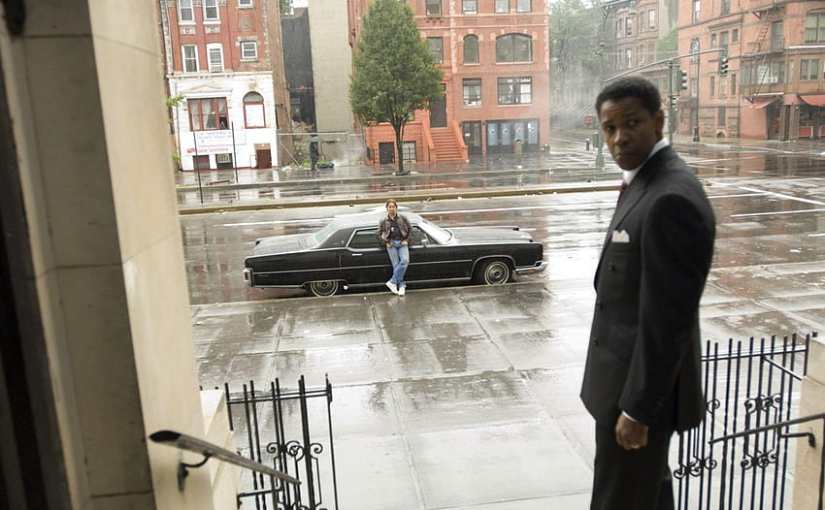
Ridley Scott and his nominated art directors, Arthur Max and Beth A Rubino, capture a gritty urban, crime ridden Harlem of the 1960s/70s.  The streets are filthily here, as well as in the five New York boroughs and all the way across the bridge into New Jersey.  Frank’s markets carry a very wide berth. The buildings are distressed and cracked.  The clothes are of the hippie era with polyester suits.  This is where Frank Lucas moves his imported contraband, white powder heroin, labeled exclusively as “Blue Magic.”  The film provides a convincing source locale deep within the jungles of Vietnam where thousands of kilos are shipped to Frank for sale on the street.  The purity of the drug is beyond compare.  Scott and his art designers place you directly in this time period of dingy grime and among the sweaty Viet Cong and rivers to finally arrive at the crop Frank purchases his products from.

Once he finds his footing by eliminating the competition and recruiting his brothers and cousins to run his business, Frank invests in creature comforts with a furnished penthouse apartment for himself and a beautiful mansion for his mother (Ruby Dee in an Oscar nominated performance that comes off so naturally; you’d think she’s sitting at the Thanksgiving table with you).  He marries a beautiful Puerto Rican wife that he treats like a princess. Frank is smart.  He stays under the radar by wearing conservative suits and not making many waves like going out at nights and showing himself around the social scene.  He knows famous athletes like boxer Joe Lewis or the staff on the New York Yankees that could give his nephew a shot at being a pitcher. Still, his profile manages to stay low. Like his mentor, he just operates a business with a viable commodity.  He tells his younger brother (Chiwetel Ejiofor) that the loudest one in the room is the dumbest and the most likely to get caught.  So, mind how you carry yourself, how you dress yourself and how you flaunt yourself.

A separate story has no business intersecting with Frank’s plight until something gives.  Richie Roberts is a good, honest cop. Though he’s also a lousy husband and father. He has been assigned to head up a task force that will bust the top of the assorted drug empires.  He needs those rare breed cops who are not on the take and follow a strict policy of law enforcement ethics.  His team will not bust a common street hustler.  They will be looking for the kingpins with unquestionable evidence to put them away for good.

American Gangster follows two separate stories for most of its running time.  At least during the first two acts of the film, Frank and Richie are unaware of one another.  It’s only through some gradual surveillance that the cop finally gets a whiff of an idea and starts to move methodically towards a conclusion. The methods are the fascinating parts the movie.

When Denzel Washington plays a villain it’s always memorable and contrary to popular opinion, Frank Lucas is my favorite of his antagonists, especially compared to his Oscar winning work in Training Day.  Watch how he walks or sits on a sofa and broods over how his family and his business are functioning.  He’s the only African American actor I can see playing this guy because I’m always convinced that whoever Denzel Washington portrays, it’s a character who will never be intimidated.  This guy faced down Gene Hackman during a threat of nuclear holocaust. Not many other actors can do that so authentically.

Russell Crowe works like that hero who doesn’t want to wear the cape.  Richie Roberts succeeds on so many levels where his peers surrender to their inhibitions.  This cop passes the bar exam while fighting for custody of his kid on top of going after the empirical criminals who litter the streets in drugs and murder.  I’m reminded of his role in The Insider, where he used a similar American accent.  Richie is not as temperamental or hard wired as that guy, but he is at least as focused on doing what’s right regardless of threat or distraction.  Russell Crowe has a way of getting audiences to admire the concentration needed for many of his complicated characters.  You have as much tunnel vision as he wants the men he’s portraying to have. You are zoned in with what his characters live by.  You only trust their standards.

There are signature staples within the construct of this true story adaptation.  There are gunfights.  Punches are thrown.  The guy at the top beats up one of his cronies when he gets out order.  Yet, what stands this material apart from others is that now I’m watching how Denzel Washington and Russell Crowe handle everything.

The truth behind the story of a black gangster defying the dirty cops and the Italian mobsters who were thought to run the metropolitan undergrounds is amazing.  It’s so interesting to see how novel Frank is with smuggling the product from one side of the world to the other. Then, you see how he uses his family members to distribute to the consumers and collect the monies. Ridley Scott provides all the breadcrumbs in an easy-to-understand fashion.  

Painted against the landscape of an unwinnable Vietnam War that just won’t end, power is acquired and thus the best police officers are forced to change their approach.  So again, you see two different stories that start out small and undetected.  Frank and Richie are the most careful and meticulous of guys in their respective fields.  Therefore, it only makes sense that their paths don’t cross until their missions are nearly over.

There’s much to learn from American Gangster.  

You get an idea of how the harm of the war was not exclusive to just what was happening over in Vietnam.  There were more indirect effects to that crisis impacting the streets of New York and New Jersey.  

You see what subtleties an investigation will collect upon before pouncing on to a bigger stake.  You also learn how to handle a criminal empire with trust and dignity rather than announcing your immorality. You witness the sheer defiance of a righteous guy in what is supposed to be a law-abiding field. Steve Zaillian’s script is not just good guy vs bad guy. It’s each of these guys holding on to the top while trying to catch up with or stay away from each other.

American Gangster is a very thorough and well-planned biographical thriller.  

SCHINDLER’S LIST

By Marc S. Sanders

Oskar Schindler was a handsome, well dressed man. A man of wealth, power, and influence. A successful businessman. He was a womanizer. And Oskar Schindler was a Nazi who saved 1100 Jews from the atrocities of the Holocaust.

On a filmmaking measure alone, Schindler’s List is one of the best pictures to ever be made. Steven Spielberg’s production value is incomparable. Nothing I can recall appears as grand (not sure that’s the appropriate word here???) and authentic as Schindler’s List. How did Spielberg pull off this feat? How did he direct hundreds, thousands maybe, of extras to reenact the vilest human suffering that a generation of people could ever encounter? I’m astounded. Positively astounded.

This evening was only my second time seeing the film. I always put off watching it over the last 30 years; reluctant maybe to see a horrifying truth. The first time I saw the film was on Christmas Day, 1993 at the Hyde Park cinemas in Tampa, Florida with my father. I didn’t realize it at the time, but I was in the beginning stages of the flu with a high fever. Midway through the film, I had to leave the theatre as my illness caught up with me. I mustered the strength to return to watching the remainder of the movie, as I recall I could not go without finishing this masterpiece. I was horrified and yet amazed; amazed that this moment in world history could have ever occurred.

To see a man like Amon Goth (brutally and uncompromisingly played by Ralph Fiennes), a high ranking Nazi, excuse himself from his nude mistress’ bed and perch himself on his balcony to sniper random Jewish prisoners as a means of sport was sickening and twisted to me. Twenty five years later, it is this moment that has always stayed with me, as much of the story and scenes left my memory from so long ago. This moment as well as Spielberg’s choice to highlight a young girl in a red coat amidst a most somber black and white picture have stayed with me all these years. The glimpse of red serves as a truth to Schindler’s naivety. Spielberg is a thinking director. He never follows the manual. He chooses to think outside the box. A glimpse of a child dressed in red in a sea of black and white where mutilated corpses and possessions are aimlessly strewn about. It’s a marvelously telling moment.

Liam Neeson plays Schindler. It will likely be the greatest role of his career. Schindler is a man who even fools the audience until the very end when he reveals that the war has ended and his salvation has rescued these 1100 souls. Finally, his humanity no longer hides and he weeps to his accountant and accomplice, Itzhak Stern (played subtly and beautifully by Ben Kingsley). Schindler weeps for he could have saved more. Neeson is superb in this moment. His commanding stature crumbles, his materialism and wealth have disappeared. Neeson translates all of that clearly, and finally my tears arrive. Prior to this moment, I was numb to the Nazi tactics of gas chambers, careless bloodshed and apathetic separation of families and friends; perhaps because I’ve extensively studied it during my years in Yeshiva. Before Schindler’s List, much of the history on the Holocaust seemed like textbook fare to me. Spielberg made its terrifying and tragic reality real.

Ben Kingsley’s performance is so important as well. The architect behind the list, his portrayal of Stern is countered with contained fear and leveled sensibilities amid the senseless intentions of a dominant force of evil. His instincts kept him alive so that only he could help keep his comrades alive.

Schindler’s List won the Best Picture Oscar for 1993, only 50-52 years following the events of the Holocaust. Many survivors thankfully remained to see Spielberg’s epic premiere. People who I share this planet with experienced the most insane and heinous evil ever encountered. They were well to do people living normally until they were violently pulled from their homes, stripped of their possessions, separated from their families, suffered at the threat of murder, witnesses to other murders and hate crimes, humiliated, beaten, forced into slave labor in tightly contained ghettos and eventually thrust into concentration camps. Yet, these few survivors lived to carry on with their lives and deliver new generations, beyond this morally ugly and evil historic episode.

I’m being redundant as I’ve said it many times before, but isn’t that the point? The Holocaust and the Nazi regime only occurred around 85 years ago. This happened before. This can happen again.

Thank you, Steven Spielberg for Schindler’s List.

I don’t consider myself to be very religious anymore. Because of moments like the Holocaust, I question how a God could ever be possible. Still, for the survivors and those that perished, I can only say Baruch Hashem, and L’Chaim. 

Peace.  Progress.  Love.

A CIVIL ACTION

By Marc S. Sanders

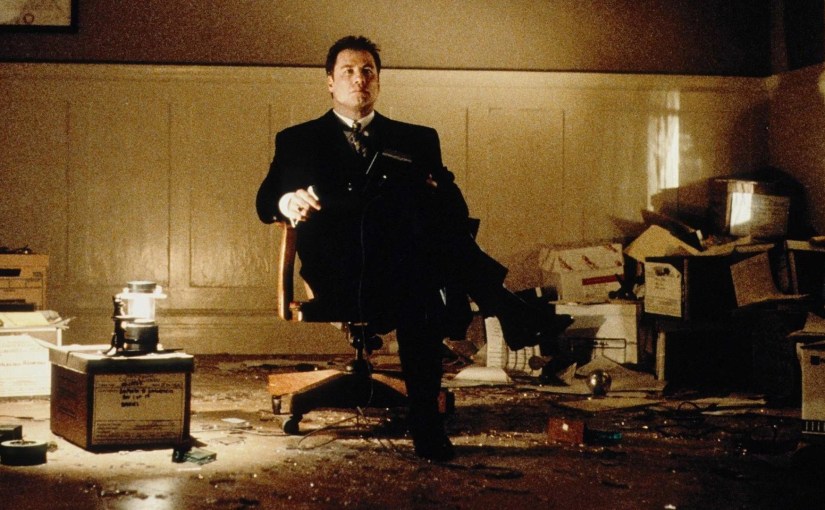
In A Civil Action, writer/director Steve Zaillian allows John Travolta to demonstrate the workings of a remorseless ambulance chasing lawyer with a pride for the finest in men’s wear and the title of one of the most eligible bachelors in Boston, Massachusetts.  Then, all of that crumbles apart when a self-effacing acknowledgment breaks through. 

Travolta portrays real-life attorney Jan Schlictmann, who heads a small personal injury law practice with three partners (Tony Shalhoub, William H Macy and Zeljko Ivanec).  They go after the cases that promise large settlements from hospitals, insurance companies and multi-million-dollar corporations.  The best cases are where the mid-30’s breadwinning male of the household has suffered irreparable damages.  The victim is not deceased, but permanently handicapped, unable to work and provide for his family.  A dead victim is not as theatrically attractive.   Better to put the poor soul in the wheelchair on stage for the winning cash settlement. 

When Jan is boxed into a corner to meet with the residents of a small New England town, he dismisses their case as an unwinnable nuisance.  The townsfolk believe that their children have taken ill, with some not surviving, due to locally contaminated drinking water.  Kathleen Quinlan is one mother who wants an apology and explanation from whoever is responsible.  An apology holds no tangible value for Jan though, until he observes who the primary suspects are likely to be; two large corporations that own well known brands like Peter Pan Peanut Butter, Tropicana Orange Juice, and Samonsite Luggage.  Now the pockets to collect from could go on forever, and Jan does not realize until it’s too late how much of a personal gamble he is undertaking with himself and his partners in tow.

A Civil Action has always left me thinking on so many different levels since I first saw it in theaters.  The value of a life, especially a child’s life, is not very significant when corporate America profits on dollar bills.  The priority of environmental protection and its most precious resource, water, is just as minimal, maybe more.  Zaillian uncovered a fantastic character arc from a very frighteningly sad and true story.   Jan Schlictmann proudly dons an appearance of false care for victims of botched surgeries and car accidents to advance his ego and materialistic nature.  However, then he found a conscience, as he realized that money doesn’t win cases for his clients.  Instead, the acceptance of responsibility triumphs.  That surrendering admittance, though, is not expected to come from these companies.  Not when the burden of proof only comes from a measly platoon of four small town attorneys, who could never bear the expenses of proving such gross negligence and wrong doing.  This is a David & Goliath confrontation. 

Beyond a cast of recognizable faces, there are scenes in this film that just stay with you.  Most especially for me is the unforgiving nature of Quinlan’s suffering maternal character.  She no longer has any care in the world for whatever sacrifices are made by the lawyers to reveal the truth of what happened.  I didn’t think that was fair of her, frankly.  Zaillian demonstrates what these four guys endure as the case prolongs itself.  However, people are unfair.  Sometimes they are unreasonable because they have been pushed down to a bottom they’ll never climb up from.  This movie and the circumstances at play are not here to please me and make me feel good with a tidy ending wrapped in a bow, however.  The script is brutally honest in its characterizations.

What’s also disturbing about this case is simply water.  Countless times, Steve Zaillian gets close up shots of glasses and pitchers of clear, crisp water.  Children are drinking water.  Water is spilled on tables.  Jan’s enemies in trial will indulge in a refreshing gulp from a glass as they finish a scene with him.  The movie reminds you time and again that water is the silent killer.

Robert Duvall is the shining talent on the other side of the aisle from Travolta as an attorney in a fifty-dollar suit with a beat up fifty-dollar briefcase representing one of the large companies that is being sued.  Duvall makes his shark of an attorney appear effortless.  He falls asleep in court.  He tucks away in a corner to listen to the Red Sox play on his transistor radio.  Yet, he’s wise enough to know how to derail an opposing counsel’s case with just his quiet, unspoken presence at the table.  He isn’t even so much a villain or an antagonist as he allows the hero of the film ample opportunity to settle rather than charge on.  His urgencies don’t work however because Jan has changed.  Where he once saw money, he now sees something much more valuable that is beyond any variance of negotiation.  The scenes shared between the handsome, fit and well-dressed John Travolta against the older, short, hunched yet astute Robert Duvall play beautifully here.  There is top notch stage performance work happening here.

It amazes me that A Civil Action is not available on Blu Ray or 4K.  Look at this cast and its direction.  It’s magnificent.  Zaillian’s film moves with a fast pace of easy-to-follow courtroom theatrics.  Additional performances from Sydney Pollack, James Gandolfini, Dan Hedaya, and John Lithgow are so engrossing.  William H Macy is very good too, as the desperate man trying to keep Jan’s cause afloat.  Why is this film not being granted the accessibility it deserves?  I actually had to pay for a streaming rental watch.  No matter, it was worth it.  For like Jan Schlictmann, money is not the most important commodity known to man.  Morality and decency will stretch further than money that’s been spent, never to be replenished.  A noble and most human thing you can do is to experience Steve Zaillian’s film, A Civil Action. Then you will understand what an unjust world any one of us could fall victim to.  Then maybe you will understand the loss a loving mother endures far outweighs any financial liability from a grocery food company.

SEARCHING FOR BOBBY FISCHER

By Marc S. Sanders

In a game of chess, if your queen is taken, it might mean a permanent loss of what was thought to be a god given talent. Seven year old Joshua Waitzkin does not realize that, and thus it allowed him to become the greatest chess champion in the country.

Josh (Max Pomeranc) is not a chess player. Josh is a boy who plays chess, as well as baseball. He also builds Legos, plays Clue and does just about anything else including fishing with his dad. He knows this about himself. The problem is the adults in his life only see chess, and nothing else. Writer/Director Steve Zaillian assembles a film that turns the world’s most historic board game into a means of recognizing self-worth and the limits of talent with its correlation to identity.

Josh gains influence from a cutthroat formal chess instructor named Bruce (Ben Kingsley) who doesn’t just teach chess but also offers guidance in manners of contempt and dislike for your opponent. It helps that he recognizes Josh’s talent but is Bruce coaching with the best intentions?

Contrary to Bruce is a city park speed player named Vinnie (Laurence Fishburne) who reminds Josh to always play on offense. Play the board, not the opponent. Josh’s father (Joe Mantegna) only sees victory through beautiful trophies. When Josh loses interest in champion accomplishment, his father only sees nothing but failure. His mother (Joan Allen) sees the boy losing his boyhood.

These are all good people and necessary for Josh. The conflict lies in the clash of their different ideals. I love that. There isn’t a villain here. There’s a debate.

Zaillain devotes time to footage of renowned champion Bobby Fischer who eventually went into seclusion probably due to the lack of any worthy challenger beyond himself. The worry of the film lies in whether Josh will end up with the same sad fate of Fischer. Everyone is on the hunt for the next Bobby Fischer. Does everyone want to be the cruel, cold and isolated Bobby Fischer, though; a man with talent yet also hates his talent?

Zallian films very effectively in a majority of close ups, hardly showing the surroundings of the settings. He wants his camera to maintain a tunnel vision to only allow Josh, and those that discover and observe him, per se, to see what’s directly in front of him. Nothing else. Nothing but the chess pieces on a board and how many moves until check mate arrives are all that matters.

The film edits beautifully in sound as the speed play pounds the chess pieces in an aggressive music accompaniment. Pieces are KNOCKED onto the board, and when a queen is taken it is SLAMMED on to the table. A person has ultimately been disabled and weakened. When check mate eventually comes, the king piece weakly drops over.

Josh is not proud of his ability to conquer. He’s proud of his ability to play.