TRUE LIES

By Marc S. Sanders

James Cameron’s True Lies never had to be believable.  It only had to be fun, and it is fun for the first act and most of the third act.  Too bad the sitcom like, chauvinistic second act pretty much overthrows the whole picture.

When you watch an Arnold Schwarzenegger pic, you have to take it with a boulder of salt.  Throughout his career, he’s been pregnant (never saw Junior), he’s begged God to give him the strength to fight Satan (I’m being honest here. It happened in End Of Days), he’s been tossed out of a plane at thirty thousand feet with no parachute and lands safely in a dumpster (Eraser) and his twin brother has been Danny DeVito.  (Do I really need to share the title of that movie?) In True Lies, I have to accept the fact that the muscular body builder with an Austrian accent, and pretty good line delivery, convinces his wife and daughter, played by Jamie Lee Curtis and Eliza Dushku, that he’s simply a boring computer salesman.  It’s shocking, utterly shocking, to realize that he is actually a clandestine spy, and his family is completely unaware.  See if Bruce Willis or Harrison Ford or Mel Gibson were in this role, then I’d buy it.  Tom Arnold might have been a good pick, but James Cameron settled to make Roseanne’s ex-husband Schwarzenegger’s secondary partner with some comedy bits. He might be the best part of the movie.

A brilliant 007 inspired opening gets this adventure started off with a literal bang at a black-tie affair at a wintery German mansion. Harry Tasker (Schwarzenegger) infiltrates the party along with support from his partner Albert (Tom Arnold) who hides in a tech equipped van that’s close by.  Harry does the tango with Tia Carrere, which is charming and something new for the Terminator.  The outcome of this shoot ’em up episode puts these super spies on the trail of an Arab terrorist who has the capability of unleashing a nuclear arsenal on the United States.  When Harry is not chasing this guy on horseback and up high-rise elevators, with the equine in tow, he and Albert report to an eye patch played by Charlton Heston.  

Somehow, I sleepwalked into another movie, though.  Harry has not been the model family man and when he tries to make amends, he inadvertently hears his wife Helen (Jamie Lee Curtis) chatting with a sleezy car salesman (Bill Paxton).  Now all of the spy department’s resources change course to surveille Helen and this moron she’s been talking to because this is the episode with the misunderstanding.  James Cameron’s script makes very poor efforts to achieve sitcom level comedy.  A laugh track couldn’t even save this tripe.

Bill Paxton is a great actor, but he accepted a terrible, unfunny role as he ironically pretends to impress Helen by actual being a spy.  Ha!!!! Go figure!!!!

Jamie Lee Curtis is a great actor too, but she agreed to play one of the dumbest women to ever grace a screen.  She believes this moron’s lies as easily as she believes the one and only Arnold Schwarzenegger is just a computer nerd.

One of the most intolerable scenes I can ever think of occurs after Harry learns what is really going on. He gladly continues to play one over on his neglected and unhappy wife by believing he’ll give her a fun adventure he thinks she deserves.  Helen is convinced that she must abide by the wishes of a clandestine government group who apprehends her.  She arrives at a dark hotel room with Harry sitting in the shadows, mere feet away, and convinces his wife to do a striptease dance in front of a stranger.  This routine goes on for the longest five minutes.  It’s not funny.  It’s not sexy.  It’s eerie and perverted with sick narrow mindedness. 

At the risk of getting political and prudish, Jamie Lee Curtis has always been one of the most outspoken celebrities for equal treatment between men and women and has ostracized those in positions of power who work towards their own self advantage.  Yet here she allows herself to be objectified by James Cameron and Arnold Schwarzenegger to be a punchline for male chauvinistic pranks.  If this scene ended with Curtis breaking Schwarzenegger’s nose with a karate chop while holding him at gunpoint, then this becomes something else.  That’s a no, however.  Instead, she is a scantily clad victim of sexual deviants, and she never stands up for herself, or exudes any kind of pride.  I recall in 1994 not liking this sequence.  Over thirty years later, well after the tides of the Me-Too movement have passed, I still hate this material.  With all of the high-flying stunts and action thrown in to other parts of the movie, it is this scene that stays with me.

Once this stupid story detour is over with a cast of actors enhancing its inanity, do I sleepwalk my way back into the movie I was watching before.  Whattya know?  The Arab terrorist who has not been discussed for the last forty-five minutes, still exists. So, while being held captive, this becomes an opportune time for the unhappy couple to sort through their baggage.

True Lies starts out so fun and when the action is turned on, James Cameron and his team are offering some solid footage.  Helicopters, limos, and missiles fly over a bridge running from the Florida Keys.  Then it is ridiculous silliness with a fighter jet piloted by Schwarzenegger who uses the entire cache of weapons to wipe out the one bad guy while trying to rescue his daughter who his hanging from a crane high in the skies over Miami.  Some say the slapstick of The Three Stooges is a demonstration in violence.  I ask if those critics have seen True Lies because the mayhem is absolutely bonkers. 

I can’t endorse this movie because I think it is one of Arnold Schwarzenegger’s worst films.  It’s also one of James Cameron’s most awful efforts.  The action is marvelously over the top, but the characters are reprehensibly idiotic and the film gets hijacked by a whole other storyline that is neither funny nor worth caring about.  There are so many better options to select from this writer/director, and this entire cast. 

With an absence of untruth, I am being forthright by declaring that True Lies belongs back within the scummy cauldron from it was stirred up from.
TERMINATOR 2: JUDGMENT DAY SPECIAL EDITION

By Marc S. Sanders

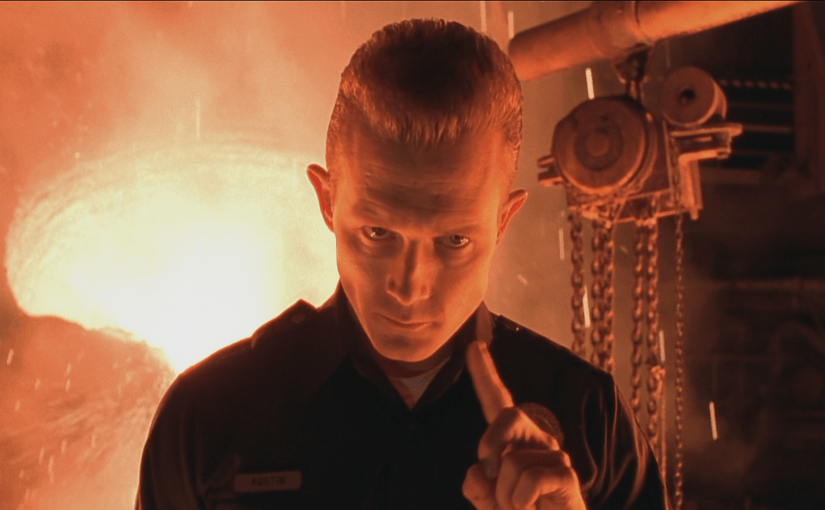
Hailed as one of the greatest sequels ever made, James Cameron’s sci-fi extravaganza Terminator 2: Judgment Day remains revolutionary in its achievements in special effects that still hold up over thirty years later.  This was a major film in Arnold Schwarzenegger’s career, but Robert Patrick became a known character actor for his stoic expressions as a sinister android with the ability to shape shift out of a substance of liquid metal that consumes his entire body.  Neither of these actors have much dialogue and yet the hero versus villain element is so well defined with Cameron’s imagination and drive for effects enhancements. 

It’s ironic.  The first Terminator was a scrapy film with an interesting plotline of time travel to serve outstanding shoot out and car chase mayhem for an hour and forty minutes.  Stan Winston’s make up work was effective. Visual effects of the metal exoskeleton look like the work of Ray Harryhausen from his days working on the Sinbad movies.  Impressive, but they looked outdated.  It’s forgivable though because the storyline and the action were masterfully orchestrated.  Cameron’s sequel makes up for these shortcomings.  It was a box office smash.  The image of Schwarzenegger mounting a Harley Davidson with sunglasses and a black leather motorcycle outfit (shotgun in hand) became as iconic as his standard promise of “I’ll be back,” and just about everything in the film raised the bar that much higher for all vision effects to be produced thereafter.  Some of the imagery in this film remains absolutely astonishing.

In this 1991 installment, two Terminators from the year 2029 are sent back in time to protect a pre-teen John Connor (Edward Furlong in a wonderful and spirited debut performance), the leader of the human resistance in a futuristic war between man and machine.  There is Schwarzenegger as a new T-800 (a steel skeleton with living tissue and skin on top) designed with good intentions to keep John alive.  The T-1000 is the much more advanced liquid metal monster who can form sharp objects like knives and stabbing weapons.  It can also take the shape of any human it encounters.  So, it has the capability of deceit.  This thing is truly unstoppable. 

John’s mother, Sarah (Linda Hamilton), who was being hunted in the first film is now a bulked-up warrior imprisoned in a psychiatric hospital for her violent tendencies, making outrageous stories that predict a doomed future, and for the crime of blowing up a computer factory.  Hamilton makes a major departure from her hokey damsel in distress in the first picture.

James Cameron is a director with high standards.  With each film he has made in his storied career (Titanic, Avatar), he seems to be both the teacher and student of advanced filmmaking.  Every new film shows a new discovery on his part.  The dazzling special effects of Terminator 2 work because they serve the robotic characters.  The effects are the threats and superpowers meshed within the plotline.  The technology used, along with Stan Winston’s artistic make up imagery, serves the story.  The liquid T-1000 will get frozen in liquid nitrogen.  Cameron will show Robert Patrick breaking apart like chipped ice.  Schwarzenegger will shoot the frozen statue, breaking it into a thousand pieces.  Is the monster dead though?  Cameron applies another cool effect for a fast resurrection, and you see how it all functions and morphs into something new.  The T-800 will shoot a grenade into the head of the T-1000, and you’ll see it break apart and what it does next in response.  It’s groundbreaking.  More importantly, it is eye opening.  Absolutely marvelous work.

There’s a handful of cheesy dialogue in Terminator 2: Judgment Day.  That’s to be expected in many of James Cameron’s scripts.  I can’t help but roll my eyes when I hear Michael Biehn or Linda Hamilton deliver a line like “On your feet, soldier!”  I dunno.  It just doesn’t come off authentic to me in the same way a drill sergeant would demand.  Hamilton’s voiceovers never did it for me either and I think it’s a combination of the dialogue and the vocal performance from the actor.  The melodrama is a little too thick in these areas. I’ve often regarded faults like those of Cameron.  That doesn’t make his films any less watchable.  I’m looking at some of the greatest visuals ever to grace a screen.  I do wish that he would take his screenplays to a script doctor, though.

Terminator 2 is never boring.  I opt to watch the Special Edition found in a DVD set.  It’s a recut of the film with lots of extra footage that flesh out the functionality of these sci fi futuristic figures and lend to more character depth.  A dream sequence is included.  Sarah sees the return of Kyle Reece (Michael Biehn), John’s father, to push Sarah on her campaign to change the future and ensure the technology that soon develops in a future 1997 never comes to be, while also continuing to protect their son.  My favorite new addition comes in the final act when we see the T-1000 suffer from the cumulative damage done by the heroes.  That welcomes some new visuals not seen in the original theatrical cut.

No matter which edit you watch though, the set pieces are spectacular with lots of shoot ‘em up mayhem, truck and motorcycle chases, and bullets blazing all over the place, including bouncing off of Arnold Schwarzenegger, while being “absorbed” by Robert Patrick.  A helicopter collides with a SWAT team van.  An entire building explodes into a huge blaze. Cameron offers frequent nightmares for Sarah that depict a truly frightening end to nearly all of humanity with scorching white heat, fire and ash.  A playground never looked so scary.

I digress with a mild spoiler alert.  This most recent watch of the film was fun because I showed it to my fifteen-year-old daughter.  She had a different impression than most movie going audiences who saw the film in 1991.  Promotions at that time clearly demonstrated that Schwarzenegger was a good Terminator this time, while Patrick was the threatening bad guy.  My daughter had no idea.  So, a well edited suspense scene that builds in a shopping mall left her quite surprised when both Terminators meet face to face for the first time, with their guns drawn and John perched right between them.  Who was the protector and who was the killer?  See?  It pays not to watch the commercials and previews.

Terminator 2: Judgment Day is one of many outstanding achievements for James Cameron.  It enhanced a new visual effect introduced in an earlier film of his, the “water worm” in The Abyss, and made it a major story element.  He might not be the best dialogue writer, but Cameron repeatedly showcases the art of writing a solid storyline around the technology he toys with as he brings it all to perfection. 

TITANIC (1997)

By Marc S. Sanders

James Cameron’s Titanic will always remain a timeless piece.  Audiences adore the relationship between the two lovers from different worlds, Jack and Rose, who meet aboard the maiden, and final, voyage of the doomed cruise liner.  Maybe more importantly, the craftsmanship of this film is still beyond compare.  Many know that when this picture was in the making, its budget ran way over and endless rumors of waterlogged technical challenges were rampant through media reports.  Titanic was predicted to sink James Cameron’s career.  Instead, it was the grand Hollywood underdog that no one expected.

I recall seeing the film twice in theaters during the Christmas season of 1997.  I was not so enamored with the script or the fictional love story that Cameron conjured as the central narrative for the real-life tragedy that took approximately fifteen hundred lives on April 15, 1912.  The visual effects were the marvel to watch, and what I patiently waited for, during the second half of the picture.  I had to tread water through the first half though.

A hardly known, but already Oscar nominated (What’s Eating Gilbert Grape?),  Leonardo DiCaprio portrays Jack Dawson, the poor member of the ship’s steerage company who falls in love with an aristocratic young woman named Rose Dewitt Bukater.  Rose is played by Kate Winslet, who’s uncomfortable with the snobbishly wealthy first class section of people she’s forced to associate with by mandate of her possessively cruel, and supercilious fiancée named Cal (Billy Zane) and her mother, Ruth (Frances Fisher).  Call it a Romeo & Juliet love story.  Two lovers are forbidden to be with one another.  Yet, they are going to do it anyway.  It’s simple and nothing dimensional.  It seems to have parallels to Disney’s rated G interpretation of Beauty & The Beast.  Fortunately, what saves the storyline are the performances and chemistry of DiCaprio and Winslet.  These are not even the best roles of either actor’s storied careers.  Yet, they are anything but unlikable. 

The relationship they share aboard Titanic, as it makes its way from Europe to the United States, is told in flashback by a 101 year old woman (Gloria Stuart) to a marine exploration crew who have been meticulously searching through submerged remains of the ship on the ocean floor of the Atlantic.  The most important element to come from this section is a wise choice by Cameron to include an informatively brief analysis of how exactly the ship took on an overabundance of ocean water following a collision with an iceberg, and how it gradually began to sink, weigh down, and split apart before finally concluding with a straight dive down into the murky, cold depths.  I must note that film critic Gene Siskel acknowledged this storytelling device upon the film’s initial release. He hailed this sequence because it offered an early “blueprint” of what audiences could expect to happen and witness during the film’s second half.  We all know the ending to the film, but how exactly did it happen?  The quick breakdown helps.

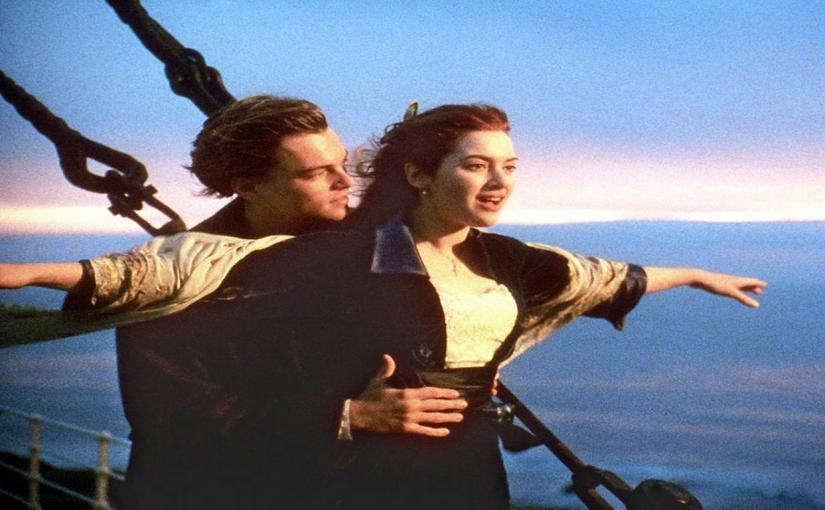
Ahead of the tragedy, Cameron and his set designers offer a grand, functioning piece of machinery that is absolutely impressive to modern audiences, even over a century later.  The decks and hallways are wonderous.  The forward and aft locations seem familiar and solid.  The CGI on this reinterpretation of Titanic is undetectable.  If this film was going to live up to its name, it most certainly has done so.  This ship looks tremendous and strong and indestructible just as the architect and engineer (Victor Garber, Jonathan Hyde) written into the script proudly lay claim to.  The famous moment of the film where Jack supports Rose on the forward bow of the ship with a sunset sky in the background is positively gorgeous.

I do have reservations with the film though.  I think both stories, the forbidden romance and the demise of the ship, in Titanic work.  However, when spliced together, the picture leaves me feeling uneasy.  James Cameron has weaved his fictional romance, appropriate for used, yellow stained paperback books, with a horrifying tragedy.  It’s what you would find in those cheesy Irwin Allen disaster epics from the 1970s.  When Cal’s anger over Jack’s intrusion comes to a boil, he pursues the couple, firing a pistol at them while the ship is continuing to sink.  Jack is apprehended and handcuffed in the lower deck and his doom seems imminent as the water level grows higher.  A priceless blue diamond serves as a MacGuffin that goes back and forth to deliver the operatic divide of these characters.  These are all cinematic inventions painted upon a well-known historical tragedy simply for the sake of adventure and suspense. 

I also found it unconvincing that the only person aboard the ship to question the contingency planning and safety measures ahead of any potential disaster is young Rose, who has no insight into mariner regulation or procedure.  Of all people, it only occurs to Rose that Titanic is not equipped with sufficient lifeboats for all twenty-two hundred people on board.  For storyline options, these avenues written by James Cameron sometimes take me out of the film. 

What I hold fascinating though is where the film depicts the eventual panicked response of the passengers and crew.  We see the captain appear helpless in his defeat against the nature of the ocean running its course over the ship he commands.  A string orchestra chooses to simply perform amid the ongoing disaster, which I have read actually happened.  Most breathtaking is how all the extras in the film react to the growing shift of the ship.  Their slant becomes steeper.  The people do their best to shuffle through the flooding, eventually having to keep their heads above water.  Helpless children are abandoned.  For an emotional punch, the steerage in the below decks is gated off from reaching the top of the ship, and giving themselves a chance at survival on a life boat.  James Cameron accounts for every response and detail that likely occurred during the sinking of the ship.  It’s captivating to witness, despite how tragic the outcome.

Though I do not care for the mix of the love story and the real-life submergence of the ship, Titanic has many strengths beyond what James Cameron achieved with the most up to date technology in visual effects, at the time.  Billy Zane is a villain that you love to hate.  Truly an underrated antagonist in the history of film.  David Warner is an intimidating henchman.  Kathy Bates is a welcome Unsinkable Molly Brown, the crass wealthy woman who sets herself apart from the pretentiousness of her lady peers.   

The exceedingly three-hour running time allows you to become completely familiar with the ship from stem to stern and again the set pieces are magnificent, whether you are hobnobbing with the wealthy up top or the steerage down below.  Every pipe or rope or stairway or hallway or chandelier serves a purpose.  The costumes and makeup designs are appropriate, including the frozen complexions on the bodies that float on the ocean surface following the tragedy.  Cameron’s use of the camera is amazing as he offers wide, expansive shots of nothing but dark ocean with hundreds of people suffering towards their demise. Thus driving home the point that there’s nowhere to find salvation and relief from the bitter cold air and sea water.  These poor people faced unimaginable challenges while competing with panicked crowds, and lack of foresight from those in charge of this newly designed technological wonder.  The movie covers everything that worked against these passengers.

Titanic is an incredible accomplishment. There’s much to see and absorb.  The last time I saw the film was nearly twenty five years ago and much of the footage never escaped my memory.  James Cameron left an indelible impression on moviegoers.  Regardless of the misgivings the film holds, Titanic has held its rightful place as an all-time landmark in cinematic achievement.

NOTE: I took advantage of seeing a newly restored 4K version in 3D at my local movie theater.  I have never been a huge fan of 3D as I often find it murky and distracting from the story.  Had Titanic been offered in standard 2D, that is what I would have gone to see.  Fortunately, this re-release is an exception to my impression with 3D presentations.  The picture is glorious, and I highly recommend the film be seen while it remains in limited release.  Titanic in 3D should not be missed.

ALIENS: THE DIRECTOR’S CUT

By Marc S. Sanders

James Cameron’s Aliens is deliberately morose in its storytelling and cinematic look.  It’s ugly and nightmarish.  It’s nerve-wracking at times.  It’s dark and somber too.  It’s also one of the best action films ever made.  For me, this is Cameron’s best film and it’s not only because I’m a sci-fi blockbuster nerd of sorts. 

Serving as a sequel to Ridley Scott’s monster movie, Alien from 1979, Aliens works on its own independence while still adhering to the storyline qualities of the original.  Sigourney Weaver returns as Ripley.  The story begins 57 years later where Ripley’s lifeboat ship from the end of the first film is found in deep space.  She reports back to the conglomerate company of the terrifying happenings she experienced with her crew mates who didn’t survive when an unrecognizable creature terrorized them aboard their vessel.  The company is less than apt to believe her account though. 

One of the company men, Burke (Paul Reiser), requests that Ripley accompany him and a squad of tough Marines on a mission to the planet, LV-426, where her crew discovered an immense crop of eggs and took back an alien aboard their ship.  In Ripley’s absence, a colony of over a hundred families was set up on the planet to establish habitable real estate.  However, the colony has lost contact, and the company is sending in the military to assess the situation to see what’s going on. Ripley is supposed to only serve as an advisor.

James Cameron’s script and direction takes its time to build up suspense and explore what’s unknown to these soldiers.  Upon arrival on the planet, much of what they find is left in wreckage and no one is to be found anywhere.  At best, Ripley can only see what was likely the remains of alien attacks with acid burns within the steel structures.  Yet to Ripley and viewers familiar with the first film, it is still a mystery as to what truly occurred.  Naturally, more will eventually be uncovered and then this arriving crew will have their hands full.

James Cameron has an imagination that bursts with colorful and amazing ideas.  The Terminator films were astonishing in its own apocalyptic future that haunts a present time period.  Titanic was a film mired in much expense and technical setbacks. Though, no one ever expected just how accomplished the award-winning blockbuster turned out to be.  Avatar is wonderous on a planetary level.  However, James Cameron is not necessarily a celebrated script writer.  Often his dialogue is very cheesy and unnatural.  Aliens is the exception though.

The script acknowledges that these gung-ho marines are “grunts.”  Thankfully, they talk like grunts.  I know that many fans adore Bill Paxton as the cut-up member of the troupe known as Hudson, who has brilliant one liners.  It’s actually a well fleshed out character.  Before Hudson knows what he’s up against, this new mission is just a lame “bug hunt” and he happily screams out as their spacecraft makes the quick drop into the planet’s atmosphere.  When he eventually comes to face to face with the monsters, terrifying, cry baby like fear overtakes him.  He’s giving his one liners like “Game over, Man,” and “We’re  fucked!”  Yet, the dread and anxiety are completely relatable.  There’s something out there waiting to tear me apart and eat me, and there’s hardly anyone left to help and rescue me.  I’m in the middle of nowhere.  Cameron wrote a good under the radar kind of character, and we feel for this guy’s dilemma as if it’s our own.  Paxton’s performance made it better and awarded it with adrenalized highs…and these aliens, with teeth and tails and acid for blood, are most definitely scary as hell.

I no longer watch the original theatrical cut of Aliens.  I turn to the Director’s Cut that Cameron always envisioned.  Particularly, it triumphs because the Ripley character is much more fleshed out with necessary dimension for the film.  Early on, a cut scene, now restored, tells us that Ripley’s daughter died from cancer while she was lost in deep space.  The daughter lived to the age of 66, even though Ripley didn’t age a bit.  Awakening from her cryo sleep, only introduces heartache for Ripley.  What I like about this information is that it serves a relationship later found in Aliens.  A little girl named Newt (Carrie Henn) is found by the marines and appears to be the sole survivor of the alien attacks.  Ripley steps in as a surrogate mother towards Newt as all of the characters work tirelessly to survive and somehow get off the planet.  The Director’s Cut gives some value to Ripley and purpose beyond just violently slaughtering aliens as a means of revenge or fulfillment.  It allows Aliens to work on an effective emotional level and Sigourney Weaver earned her Oscar nomination because of it.

Cameron introduces traitors as well into the story, which are likely not so surprising but make the film all the more challenging for the heroes of the picture.  Michael Biehn is the sex symbol, a cool and quiet tough guy.  Jenette Goldstein is a Hispanic marine who gives off good imagery as one of the few female squad members who enters the areas first with the largest gun in the troupe.  Lance Henrikson is memorable as an android that Ripley is apprehensive to trust – perhaps he’s the “Mr. Spock” of this sci-fi entry.

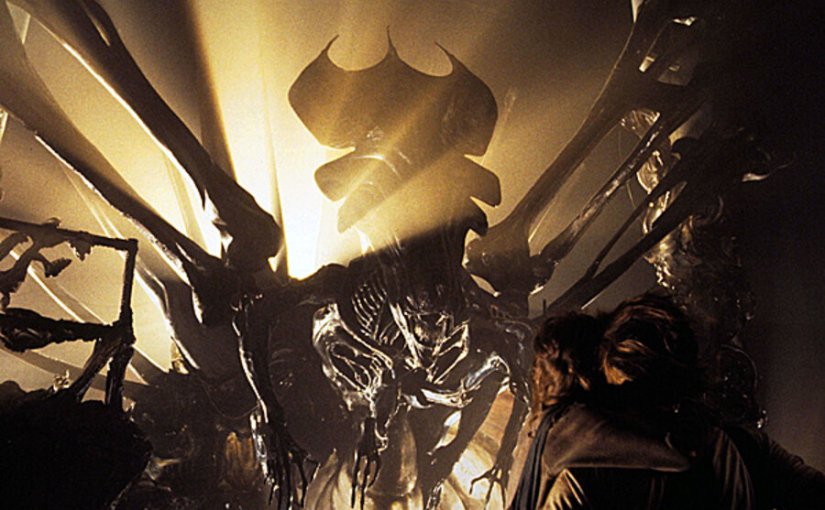
Technically speaking, Aliens is so unbelievably atmospheric in its bleak, futuristic setting.  Barring a few moments where the spaceships clearly look like miniatures, the interiors look organically formed.  I can’t compliment the set pieces enough in that respect.  When the Marines enter a large cavern, it is enormously shell like that it looks like an animal’s nest.  Cameron hides his various monsters perfectly.  So that when they slowly unravel their tales and skeletal forms, it looks as if the darkness within the frames begin to move.  The stillness of what surrounds our main characters awaken with life that maybe we don’t want to see. 

Aliens works independent of Ridley Scott’s prior picture because it’s a war movie; one that is set on an outer space planet.  We witness how the surviving squad troops strategize with what little they have left.  Thereafter, we see how they face enemies who may have the upper hand in battles to come.  I love how Cameron builds suspense with a sensor device the troops use.  It begins to ring as a life form closes in on their proximity.  The monitor fills with glowing blurs as more life forms nearby build up.  A nervous and great moment occurs when they can not understand how the aliens could be so close and yet none of them can see what is so nearby.  The surprise is unexpected and worthy of a scream. 

Cameron’s script doesn’t give his heroes a break.  Aliens thrives on the characters simply playing keep away, while one member of the party is working against what little they have left.  I like that.  While Aliens may be intentionally dreary the fact that there’s no easy out for these folks is what keeps the pulse of the film racing with nonstop suspense and action.

Aliens is an absolutely solid picture promising a future for this franchise. Sadly, it really never excelled above what was accomplished in these first two films from Ridley Scott, and now James Cameron.  Years later, Scott returned to the franchise with some interesting prequel films that colored in some of the elements that were only talked about before, like the company that puts all these people within the peril of the aliens.  Yet to date, that all still remains unfinished.  James Cameron just set the bar so high with his movie that the few that followed never amounted to what he created.

You may not feel all warm and fuzzy after watching Aliens, but at least you’ll feel incredibly excited with its construction from a director in the early years of his profession.  James Cameron brought about a solid script and unbelievable effects that say so much on a visual level.  If Aliens makes you nervous, fearful and especially terrified, then James Cameron has done his job.

THE TERMINATOR

By Marc S. Sanders

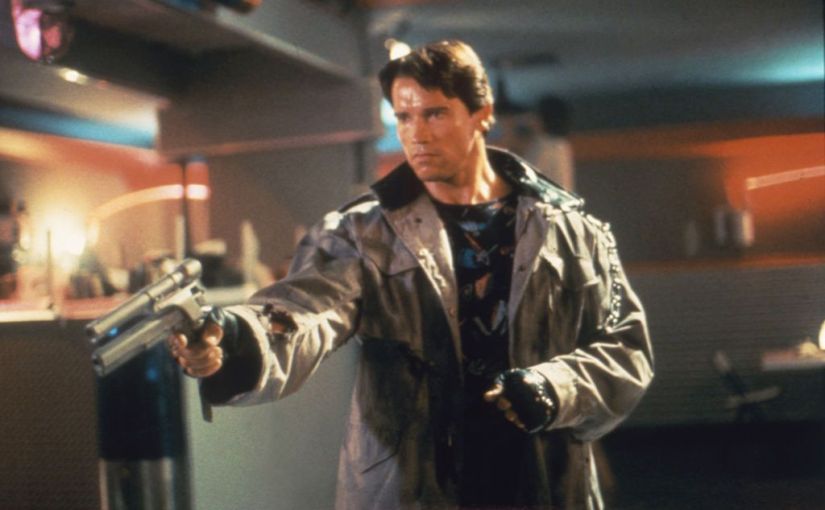
Arnold Schwarzenegger’s most famous role is The Terminator. The role made the muscle man a star simply based on his menacing appearance alone. Let’s face it. The guy looks pretty cool in the black leather jacket with sunglasses while riding a motorcycle. The shotgun and Uzi complete the appearance as well. All that he needs to do now is say “I’ll be back!” and you’ve got one of the most memorable film characters in history.

Director James Cameron with future wife and producer Gale Anne Hurd conceived this time traveling sci fi flick with next to no money and churned out what first feels like a Friday the 13th slasher film for USA Up All Night, but then became a little more thought provoking. You might work too hard questioning the time travel nonsense. However, the idea is so simple and yet so smart.

Schwarzenegger is a cyborg designed to look human with flesh and blood who travels from the year 2029 to 1984 to assasinate Sarah Connor (Linda Hamilton), a woman who becomes the mother of the would be leader of resistance fighters against a dominant machine army that has eradicated most of the human population. To fend off the Terminator and protect Sarah, a human fighter, Kyle Reese (Michael Biehn), has also travelled back in time.

James Cameron is a director of craftsmanship. He assembles riveting action sequences and his visual effects with makeup designs from Stan Winston are marvelous, especially considering the limited funds he had to work with. The dark, bleak future showing the war of the machines is well staged with vast lands of waste and crushed skulls. Laser beams dart across the screen with blaring Atari like sound effects. It’s not the most sophisticated, but it works.

The acting is very over the top however. Schwarzenegger is fine as he just needs to be robotic like the role demands. He hardly has any lines actually. Biehn and Hamilton needed a few more acting lessons though. Hamilton’s fear is terribly unconvincing and Biehn is overly dramatic. Their chemistry is also a little sour. They look great together if you saw them on a page of Tiger Beat or Starlog magazine, but their acting scenes fall flat. The script’s dialogue doesn’t help them either, but James Cameron was never big on dialogue anyway. There’s a reason that his masterpiece “Titanic” got all of those Oscar nominations except for screenplay.

Still, because the film is mostly steeped in wall to wall action that’s very well edited and the idea for this new kind of sci fi thriller is so inventive, The Terminator is one for the ages. It’s a film that can definitely be watched on repeat.

It’s best to take the story seriously while feeling exhilarated by the car chases and shootouts (especially in a police precinct with 30 cops), but it’s okay to roll your eyes at the ham on rye with cheese & mayo acting too.

AVATAR

By Marc S. Sanders

James Cameron is the guy with the ambitious talent, and yet he more often than not has a missing link in his widening imagination. It never surprised me that Titanic was nominated for a slew of Oscars and still the one thing that was not recognized was Cameron’s overly melodramatic screenplay. That shortcoming carries over to Avatar from 2009.

As a naysayer of 3D viewing who is giving you this review, I was initially so impressed with this picture featuring tall blue people with tails and big ears that I saw film twice. Still, I couldn’t get past the simplicity of the story. Avatar is Pocohontas. Avatar is Dances With Wolves. Avatar is Ferngully. (Okay. That last one I only heard from Miguel and his girlfriend Penni. I’d never seen Ferngully.)

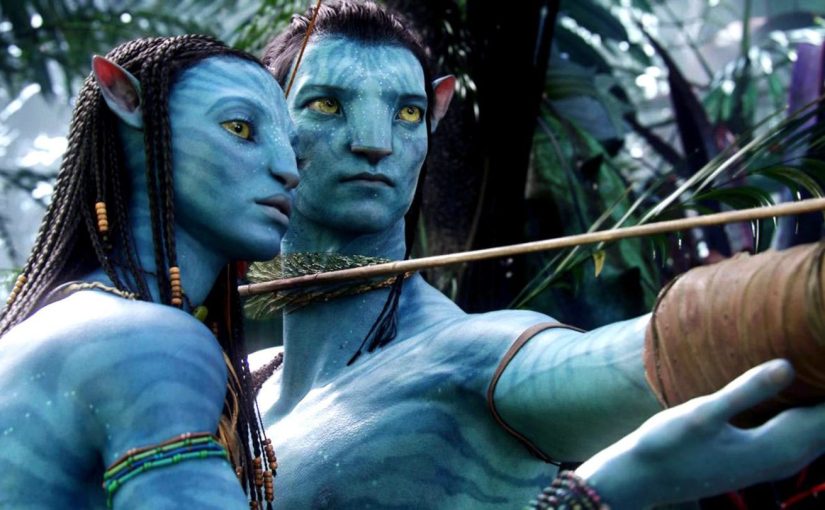
Jake Sully (Sam Worthington) is a Marine now confined to a wheelchair and recruited to replace his deceased soldier brother on a mission to meld his mind with an “avatar” body of a native of the neon jungle planet known as Pandora. The actual Greek meaning of the name Pandora is never considered for any kind of thought provoking significance. Jake is assigned to learn about the natives known as the Na’Vi and expose a tactical weakness in their fighting skills and weaponry. Jake works alongside the scientist known as Grace (Sigourney Weaver) to connect with the people. The evil military corporation led by a mean grunt named Colonel Miles Quaritch (Stephen Lang) is in need of collecting a valuable mineral known as “unobtainium.” Grace’s priority is not the mineral. She’s more concerned with connecting and peacefully studying the people. On Jake’s first tour into the wild, he ends up stranded overnight. Gradually, his mission for the means of the military and corporation dwindle as he bonds with a Na’Vi named Self (Zoe Saldana). Soon, he identifies only with aiding the Na’Vi declaring his will to defend their planet against the greedy humans.

Much of Cameron’s near 3 hour film is a travelogue of the fictional Pandora and the customs and behaviors of the Na’Vi along with the creatures they share the planet with like oversized dog looking animals and winged dragon variations that the natives can ride on their backs. Neon plant life is shown in excess. Rivers and streams as well. Wide open skies too. It’s amazing to look at for sure, but eventually the novelty wears off. More or less, a lot of these trees are just glowing palm trees.

Because the film’s central storyline is so simplistic and familiar it’s not very gripping. When a Na’Vi dies or a precious worship tree tumbles at the behest of the military’s destruction, the Na’Vi wail in their own way. It just didn’t hold me so much because I didn’t feel a connection to the sci fi the film presents. James Cameron can paint a picture like no other. Somehow though, his prints are devoid of much emotion. The dialogue is clunky or cheesy in its nature. Regrettably, this has always been his problem going back to films like The Abyss or even the original Terminator. All BIG IDEAS, but weak development.

Avatar enchanted audiences back in 2009 thanks to its 3D. It was positively immersive and you felt surrounded by the nature of it all. At home, that effect is sorely missing and so you are left dazzled during the film’s exposition, but worn out on its long winded and simple storytelling.

Apparently, James Cameron is filming the next three sequels back to back to back. Three more movies of this? Really? Look, the guy has a great track record and has mostly defied the pessimists over the years when his budgets go through the roof, but I can’t see another nine hours of this material to hold me interested or thirsting for more of either Pandora or what the blue people still have yet to offer.